

The DOI matches its Crossref record; 56 of the 58 references it cites were found in a registry or an index.
Critical assessment of protein intrinsic disorder prediction
Open accessPublished version of a preprint
Abstract
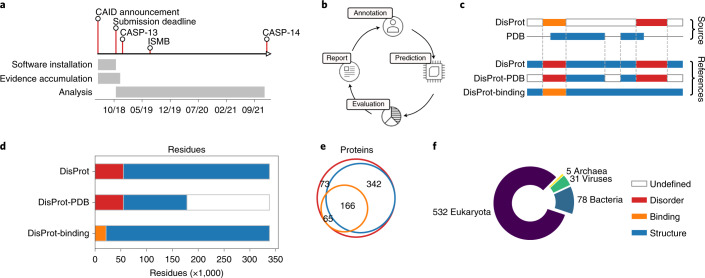
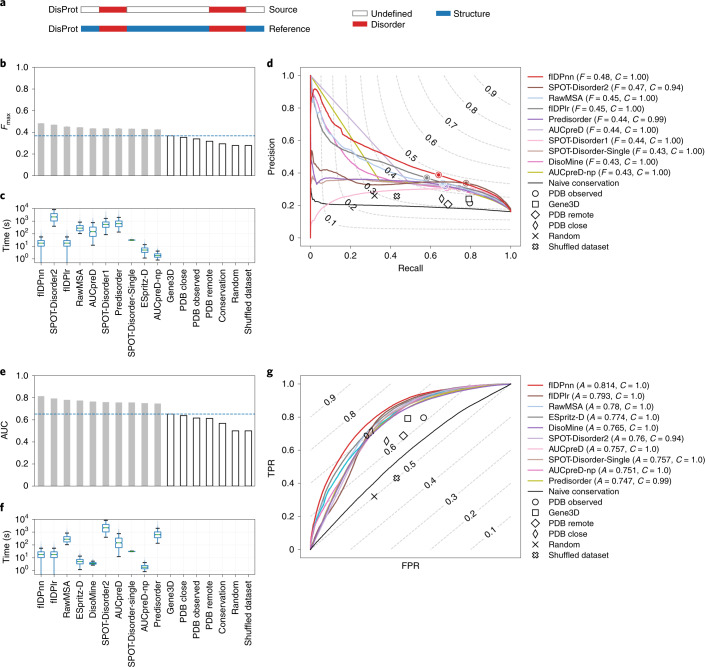
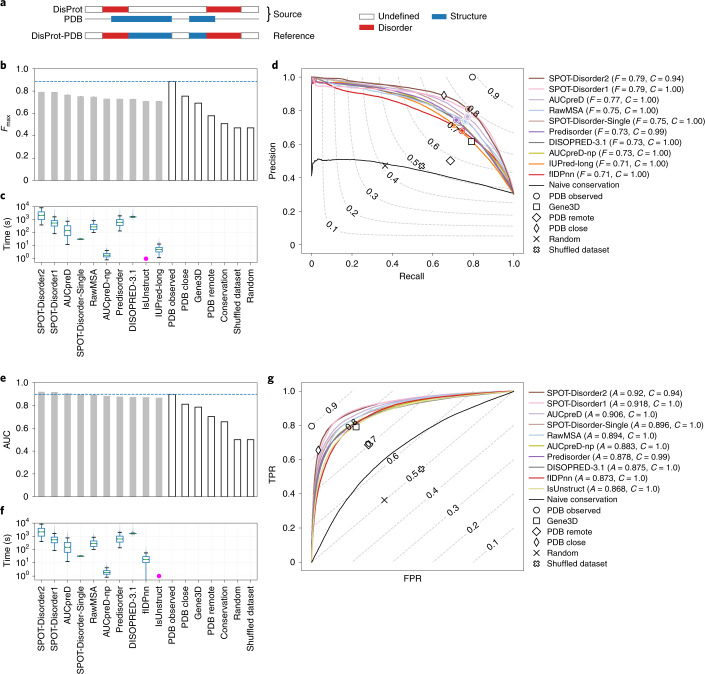
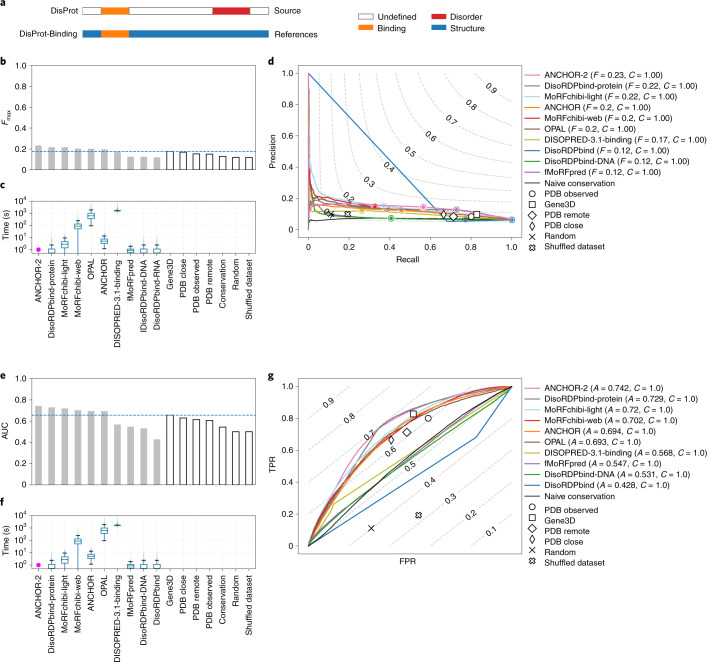
Abstract Intrinsically disordered proteins, defying the traditional protein structure–function paradigm, are a challenge to study experimentally. Because a large part of our knowledge rests on computational predictions, it is crucial that their accuracy is high. The Critical Assessment of protein Intrinsic Disorder prediction (CAID) experiment was established as a community-based blind test to determine the state of the art in prediction of intrinsically disordered regions and the subset of residues involved in binding. A total of 43 methods were evaluated on a dataset of 646 proteins from DisProt. The best methods use deep learning techniques and notably outperform physicochemical methods. The top disorder predictor has F max = 0.483 on the full dataset and F max = 0.792 following filtering out of bona fide structured regions. Disordered binding regions remain hard to predict, with F max = 0.231. Interestingly, computing times among methods can vary by up to four orders of magnitude.
Overview
The claims and statistics of this paper haven’t been checked yet.
Run the check — free, no account needed. It reads the open-access text and checks the sources it cites.
Integrity signals
Registry
Cites
Statistics
Figures
Verification
Claims the paper makes
The claims and statistics of this paper haven’t been checked yet.
Run the check — free, no account needed. It reads the open-access text and checks the sources it cites.
Claims other papers make about this one
Each is checked against this paper’s own text: does it say what the citing paper says it does?
The check wasn’t confident either way, so it gives no verdict — never disputed.
In the citing paper
“Conservative estimates indicate that roughly 30% of sequences, 30residues or longer, drawn at random from the human proteome, are likely to be IDRs. 3,5”
From AlphaFold and Implications for Intrinsically Disordered Proteins (2021) · cites this paper as [5]
Experimental — accuracy not yet measuredIn the citing paper
“pLDDT scores have been shown to be a competitive disorder predictor compared to standards in disorder prediction.5”
From AlphaFold and Implications for Intrinsically Disordered Proteins (2021) · cites this paper as [5]
Self-check
Percentages, sums and reported differences re-computed from the paper’s own numbers.
The self-check needs the paper’s full text.
Citations
Cites
Gapped BLAST and PSI-BLAST: a new generation of protein database search programs
Altschul, S. (1997) · Nucleic Acids Research · doi:10.1093/nar/25.17.3389 · Cited by 73,302
UniProt: the Universal Protein knowledgebase
Apweiler, R. (2003) · Nucleic Acids Research · doi:10.1093/nar/gkh131 · Cited by 7,593
UniProt: the universal protein knowledgebase
The UniProt Consortium (2017) · Nucleic Acids Research · doi:10.1093/nar/gkw1099 · Cited by 4,436
Intrinsically disordered proteins in cellular signalling and regulation
Wright, P. E., & Dyson, H. J. (2014) · Nature Reviews Molecular Cell Biology · doi:10.1038/nrm3920 · Cited by 2,482
Prediction and Functional Analysis of Native Disorder in Proteins from the Three Kingdoms of Life
Ward, J. J., Sodhi, J. S., McGuffin, L. J., Buxton, B. F., & Jones, D. T. (2004) · Journal of Molecular Biology · doi:10.1016/j.jmb.2004.02.002 · Cited by 2,010
Mészáros, B., Erdős, G., & Dosztányi, Z. (2018) · Nucleic Acids Research · doi:10.1093/nar/gky384 · Cited by 1,454
InterPro in 2019: improving coverage, classification and access to protein sequence annotations
Mitchell, A. L., Attwood, T. K., Babbitt, P. C., Blum, M., Bork, P., Bridge, A., Brown, S. D., Chang, H.-Y., El-Gebali, S., Fraser, M. I., et al. (2019) · Nucleic Acids Research · doi:10.1093/nar/gky1100 · Cited by 1,426
Coupling of folding and binding for unstructured proteins
Dyson, H. J., & Wright, P. E. (2002) · Current Opinion in Structural Biology · doi:10.1016/s0959-440x(02)00289-0 · Cited by 1,327
Linding, R., Jensen, L. J., Diella, F., Bork, P., Gibson, T. J., & Russell, R. B. (2003) · Structure · doi:10.1016/j.str.2003.10.002 · Cited by 1,235
Intrinsic Disorder in Cell-signaling and Cancer-associated Proteins
Iakoucheva, L. M., Brown, C. J., Lawson, J. D., Obradović, Z., & Dunker, A. K. (2002) · Journal of Molecular Biology · doi:10.1016/s0022-2836(02)00969-5 · Cited by 1,214
Cited by
Sorted by citations
Items 201–300 of 343
Conformation and Dynamics of Monomeric, Phase-Separated, and Cross-Linked Resilin Biomaterials
Otis, J., Reichenwallner, J., Reichheld, S. E., Au, A., Yip, C. M., Ernst, O. P., & Sharpe, S. J. (2025) · Journal of the American Chemical Society · doi:10.1021/jacs.5c12305 · Cited by 4
Next-generation predictors of protein phase behavior
Pinette, N. C., Terrado, M., Bui, J. M., Lallous, N., & Gsponer, J. A. (2025) · Current Opinion in Structural Biology · doi:10.1016/j.sbi.2025.103197 · Cited by 5
DescribePROT Database of Residue-Level Protein Structure and Function Annotations
Zhao, B., Basu, S., & Kurgan, L. (2024) · Methods in molecular biology · doi:10.1007/978-1-0716-4196-5_10 · Cited by 4
Yu, J., Zhao, B., & Kurgan, L. (2025) · Computational and Structural Biotechnology Journal · doi:10.1016/j.csbj.2025.05.047 · Cited by 5
Basu, S., Yang, Y., & Kurgan, L. (2025) · Current Opinion in Structural Biology · doi:10.1016/j.sbi.2025.103085 · Cited by 4
Biomineralization Controlled by Liquid–Liquid Phase Separation of a Highly Charged Protein
Klepka, B. P., Michaś, A., Wojciechowski, T., & Niedźwiecka-Kornaś, A. (2025) · Small · doi:10.1002/smll.202506227 · Cited by 6
Deep mutational scanning to probe specificity determinants in proteins
Bhowmick, J., Chandra, S., & Varadarajan, R. (2022) · Elsevier eBooks · doi:10.1016/b978-0-323-99533-7.00005-4 · Cited by 5
Assessment of Disordered Linker Predictions in the CAID2 Experiment
Wang, K., Hu, G., Wu, Z., Uversky, V. N., & Kurgan, L. (2024) · Biomolecules · doi:10.3390/biom14030287 · Cited by 5
VUS next in rare diseases? Deciphering genetic determinants of biomolecular condensation
Heredia-Torrejón, M., Montañez, R., González‐Meneses, A., Carcavilla, A., Medina, M. Á., & Lechuga-Sancho, A. M. (2024) · Orphanet Journal of Rare Diseases · doi:10.1186/s13023-024-03307-6 · Cited by 4
Zhang, J., Basu, S., Zhang, F., & Kurgan, L. (2024) · Journal of Molecular Biology · doi:10.1016/j.jmb.2024.168872 · Cited by 5
Computational Prediction of Linear Interacting Peptides
Malhis, N., & Gsponer, J. A. (2024) · Methods in molecular biology · doi:10.1007/978-1-0716-4196-5_14 · Cited by 4
Zheng, S. (2025) · PLOS ONE · doi:10.1371/journal.pone.0313812 · Cited by 4
Berge-Seidl, S., Nielsen, N. V., Rodriguez Alfonso, A. A., Etscheid, M., Kandanur, S. P. S., Haug, B. E., Stensland, M., Thiede, B., Karacan, M., Preising, N., et al. (2022) · ACS Chemical Biology · doi:10.1021/acschembio.2c00538 · Cited by 4
Roles of intrinsically disordered regions in phosphoinositide 3-kinase biocatalysis
Davé, V., & Uversky, V. N. (2022) · Elsevier eBooks · doi:10.1016/b978-0-323-99533-7.00001-7 · Cited by 4
Chaurasiya, D., Mondal, R., Lahiri, T., Tripathi, A., & Ghinmine, T. (2023) · Journal of Biomolecular Structure and Dynamics · doi:10.1080/07391102.2023.2290615 · Cited by 4
Katuwawala, A., Ghadermarzi, S., Hu, G., Wu, Z., & Kurgan, L. (2021) · Computational and Structural Biotechnology Journal · doi:10.1016/j.csbj.2021.04.066 · Cited by 4
Impact of intrinsically disordered regions and functional disorder hotspots in the human kinome
Thomas, S. D., Rajan, A., Mahin, A., Ahmed, M., Pavithra, S., Vignesh, U., Joy, N., John, L., Varghese, L., Sambreena, A., et al. (2025) · Briefings in Bioinformatics · doi:10.1093/bib/bbaf662 · Cited by 3
flDPnn3: Fast and Accurate Prediction of Intrinsic Disorder in Protein Sequences
Wang, K., Hu, G., Basu, S., & Kurgan, L. (2026) · Journal of Molecular Biology · doi:10.1016/j.jmb.2026.169629 · Cited by 4
Kombo, D. C., LaMarche, M. J., Konkankit, C. C., & Rackovsky, S. R. (2024) · Proteins Structure Function and Bioinformatics · doi:10.1002/prot.26704 · Cited by 3
Are Most Human-Specific Proteins Encoded by Long Noncoding RNAs?
Sanejouand, Y. (2024) · Journal of Molecular Evolution · doi:10.1007/s00239-024-10174-z · Cited by 3
Prevalent Fast Evolution of Genes Involved in Heterochromatin Functions
Lin, L., Huang, Y., McIntyre, J., Chang, C.-H., Colmenares, S. U., & Lee, Y. C. G. (2024) · Molecular Biology and Evolution · doi:10.1093/molbev/msae181 · Cited by 3
Accurate and Fast Prediction of Intrinsic Disorder Using flDPnn
Wang, K., Hu, G., Wu, Z., & Kurgan, L. (2024) · Methods in molecular biology · doi:10.1007/978-1-0716-4196-5_12 · Cited by 3
The evolution and exploration of intrinsically disordered and phase-separated protein states
Chow, C. F. W., & Tóth-Petróczy, Á. (2024) · Elsevier eBooks · doi:10.1016/b978-0-443-21809-5.00014-4 · Cited by 3
Matthes, M. S., Yun, N., Luichtl, M., Büschges, U., Fiesselmann, B. S., Strickland, B., Lehnardt, M. S., Schneitz, K., Michel, K., & Torres‐Ruiz, R. A. (2025) · PLoS Genetics · doi:10.1371/journal.pgen.1011217 · Cited by 3
Methods for measuring structural disorder in proteins
Gondelaud, F., Schramm, A., Brocca, S., Natalello, A., Grandori, R., Santambrogio, C., & Longhi, S. (2022) · Elsevier eBooks · doi:10.1016/b978-0-323-99533-7.00018-2 · Cited by 3
Deutsch, N., Pajkos, M., Erdős, G., & Dosztányi, Z. (2022) · Protein Science · doi:10.1002/pro.4522 · Cited by 3
Overview Update: Computational Prediction of Intrinsic Disorder in Proteins
Uversky, V. N., & Kurgan, L. (2023) · Current Protocols · doi:10.1002/cpz1.802 · Cited by 5
Yazıcı, Y. Y., Belkaya, S., & Timuçin, E. (2023) · Computational and Structural Biotechnology Journal · doi:10.1016/j.csbj.2023.06.021 · Cited by 3
Yu, T.-G., Lee, J., Yoon, J., Choi, J. M., Kim, D., Heo, W. D., Song, J., & Kim, H. (2023) · JACS Au · doi:10.1021/jacsau.3c00445 · Cited by 3
Effects of Aging on Intrinsic Protein Disorder in Human Lenses and Zonules
Antonietti, M., Kim, C. K., Djulbegovic, M. B., Gonzalez, D. J. T., Greenfield, J. A., Uversky, V. N., Gibbons, A. G., & Karp, C. L. (2024) · Cell Biochemistry and Biophysics · doi:10.1007/s12013-024-01455-x · Cited by 3
Order/Disorder Transitions Upon Protein Binding: A Unifying Perspective
Lebedenko, O. O., Sekhar, A., & Skrynnikov, N. R. (2024) · Proteins Structure Function and Bioinformatics · doi:10.1002/prot.26737 · Cited by 3
Yu, Z., Ran, G., Chai, J., & Zhang, E. E. (2024) · Cell Reports · doi:10.1016/j.celrep.2024.114727 · Cited by 4
Malebary, S. J., & Alromema, N. A. (2024) · Scientific Reports · doi:10.1038/s41598-024-75700-x · Cited by 3
Genome-Wide Characterization of Wholly Disordered Proteins in Arabidopsis
Long, W., Zhao, L., Yang, H., Yang, X., Bai, Y., Xue, X., Wang, D., & Han, S. (2025) · International Journal of Molecular Sciences · doi:10.3390/ijms26031117 · Cited by 3
Han, K., Kim, H.-K., Kim, M.-H., Pak, M.-H., Pak, S.-J., Choe, M.-M., & Kim, C.-S. (2025) · International Journal of Biological Macromolecules · doi:10.1016/j.ijbiomac.2025.141801 · Cited by 3
PEGASUS : Prediction of MD ‐derived protein flexibility from sequence
Meersche, Y. V., Duval, G., Cretin, G., Gheeraert, A., Gelly, J., & Galochkina, T. V. (2025) · Protein Science · doi:10.1002/pro.70221 · Cited by 5
Single-embryo phosphoproteomics reveals the importance of intrinsic disorder in cell cycle dynamicsPreprint
Valverde, J. M., Dubra, G., van den Toorn, H., van Mierlo, G., Vermeulen, M., Heck, A. J. R., Knipscheer, P., Krasińska, L., Fisher, D., & Altelaar, M. A. F. (2021) · bioRxiv (Cold Spring Harbor Laboratory) · doi:10.1101/2021.08.29.458076 · Cited by 3
Zheng, L., Shi, S., Fang, P., Zhang, H., Pan, Z., Huang, S., Xia, W., Li, H., Zeng, Z., Zhang, S., et al. (2023) · bioRxiv (Cold Spring Harbor Laboratory) · doi:10.1101/2023.05.13.540619 · Cited by 3
Csepi, M., Berta, B., Basu, S., Kurgan, L., & Hegedűs, T. (2025) · Journal of Molecular Biology · doi:10.1016/j.jmb.2025.169236 · Cited by 2
Repetitive proteins that undergo large conformational changes evade structural prediction algorithms
Chang, M. P., Jin, T., Gudinas, A. P., Fernández, D., Alexander‐Katz, A., Matsui, T., & Mai, D. J. (2025) · The Journal of Chemical Physics · doi:10.1063/5.0304777 · Cited by 2
The future of Forkhead box O transcription factors
Huang, H., Gui, T., & Burgering, B. M. T. (2026) · Biochemical Journal · doi:10.1042/bcj20253428 · Cited by 2
Wang, K., Hu, G., Yu, J., & Kurgan, L. (2026) · Cellular and Molecular Life Sciences · doi:10.1007/s00018-026-06087-3 · Cited by 3
Prediction of protein structure and intrinsic disorder in the era of deep learning
Erdős, G., & Dosztányi, Z. (2022) · Elsevier eBooks · doi:10.1016/b978-0-323-99533-7.00007-8 · Cited by 2
Dusi, D. M. D. A., Alves, E. R., Cabral, G. B., Mello, L. V., Rigden, D. J., Silveira, É. D., Alves‐Ferreira, M., Guimarães, L. A., Gomes, A. C. M. M., Rodrigues, J. C. M., et al. (2023) · Planta · doi:10.1007/s00425-023-04162-8 · Cited by 2
Meng, D., & Pollastri, G. (2025) · Journal of Molecular Biology · doi:10.1016/j.jmb.2025.169018 · Cited by 2
FusionEncoder: identification of intrinsically disordered regions based on multi-feature fusion
Liu, S., Chen, S., Bai, T., & Liu, B. (2025) · Bioinformatics · doi:10.1093/bioinformatics/btaf362 · Cited by 2
Hydrophobic cluster analysis at protein and proteome scales
Callebaut, I., & Mornon, J. (2025) · Biochimie · doi:10.1016/j.biochi.2025.07.013 · Cited by 2
Complementarity of the residue-level protein function and structure predictions in human proteins
Biró, B., Zhao, B., & Kurgan, L. (2022) · Computational and Structural Biotechnology Journal · doi:10.1016/j.csbj.2022.05.003 · Cited by 2
Redox Regulation of LAT Enhances T Cell-Mediated Inflammation
James, J. R., Coelho, A., Lahore, G. F., Hernandez, C. M., Forster, F., MALISSEN, B., & Holmdahl, R. (2024) · Antioxidants · doi:10.3390/antiox13040499 · Cited by 2
Klepka, B. P., Michaś, A., Wojciechowski, T., & Niedźwiecka-Kornaś, A. (2024) · bioRxiv (Cold Spring Harbor Laboratory) · doi:10.1101/2024.06.04.597398 · Cited by 2
Categorizing prediction modes within low-pLDDT regions of AlphaFold2 structuresPreprint
Williams, C. J., Chen, V. B., Richardson, D. C., & Richardson, J. S. (2025) · bioRxiv (Cold Spring Harbor Laboratory) · doi:10.1101/2025.06.06.658382 · Cited by 2
Predicting molecular recognition features in protein sequences with MoRFchibi 2.0
Malhis, N., & Gsponer, J. A. (2026) · BMC Bioinformatics · doi:10.1186/s12859-026-06532-x · Cited by 1
Sharma, K. K., Raghuvamsi, P. V., Aik, D. Y. K., Marzinek, J. K., Bond, P. J., & Wohland, T. (2025) · Cellular and Molecular Life Sciences · doi:10.1007/s00018-025-05712-x · Cited by 1
Bioinformatics‐Based Comparative Analysis of the Human Retina Proteome
Kim, C. K., Djulbegovic, M. B., Broytman, D., Hadzijahic, N., Antonietti, M., Gonzalez, D. J. T., Uversky, V. N., Yannuzzi, N. A., & Karp, C. L. (2025) · PROTEOMICS - CLINICAL APPLICATIONS · doi:10.1002/prca.70012 · Cited by 1
Prediction of Intrinsic Disorder Functions with DEPICTER2
Basu, S., & Kurgan, L. (2025) · Methods in molecular biology · doi:10.1007/978-1-0716-4662-5_15 · Cited by 1
Tahzima, R., Charon, J., Díaz, A., Jonghe, K. D., Massart, S., Michon, T., & Vranken, W. (2025) · Frontiers in Virology · doi:10.3389/fviro.2025.1501616 · Cited by 1
Structure and Disorder Predictions of Microproteins: Usage, Applications, and Pitfalls
Eicholt, L. A. (2025) · Methods in molecular biology · doi:10.1007/978-1-0716-5013-4_10 · Cited by 1
MetIoR: A meta predictor to predict intrinsic disorder in RNA binding proteins
Mitra, S., & Bahadur, R. P. (2025) · Biochimica et Biophysica Acta (BBA) - Proteins and Proteomics · doi:10.1016/j.bbapap.2025.141119 · Cited by 1
A Survey of Predicted Protein–Protein Interactions Involving Disordered Regions in Humans
Pei, J., Zhang, J. J., & Cong, Q. (2026) · Journal of Molecular Biology · doi:10.1016/j.jmb.2026.169636 · Cited by 1
Liang, J., Luo, Y., Su, B., & Peng, Z. (2026) · Briefings in Bioinformatics · doi:10.1093/bib/bbag126 · Cited by 1
Decoding variants of uncertain significance in systemic autoinflammatory diseases
Boursier, G., Carbone, A., Savic, S., & Henry, T. (2026) · Nature Reviews Rheumatology · doi:10.1038/s41584-026-01380-8 · Cited by 2
Liu, W., Tian, L., Xie, J., Wu, L., Hu, L., Ge, R., Wang, Y., & Cao, M. (2026) · Biotechnology Advances · doi:10.1016/j.biotechadv.2026.108931 · Cited by 1
No Time to Fold: Intrinsically Disordered Microproteins in Action
Chen, T., Cao, K., & Martinez, T. F. (2026) · Biochemistry · doi:10.1021/acs.biochem.6c00280 · Cited by 1
Quantum-Enhanced Transfer Learning for IDR Binding Partner Prediction
Kang, S.-J., & Shin, H. (2026) · IEEE Transactions on Computational Biology and Bioinformatics · doi:10.1109/tcbbio.2026.3724278 · Cited by 1
Disease association and comparative genomics of compositional bias in human proteins
Kouros, C. E., Makri, V., Ouzounis, C., & Chasapi, A. (2023) · F1000Research · doi:10.12688/f1000research.129929.1 · Cited by 1
Comparative Analysis of the Intrinsic Disorder Within the Layers of the Human Cornea
Djulbegovic, M. B., Antonietti, M., Gonzalez, D. J. T., Mattes, R., Kim, C. K., Uversky, V. N., Martinez, J. D., & Karp, C. L. (2024) · Cornea · doi:10.1097/ico.0000000000003706 · Cited by 1
Müller, G. A. (2024) · Academia molecular biology and genomics. · doi:10.20935/acadmolbiogen7401 · Cited by 1
Structural engineering of stabilized, expanded epitope nanoparticle vaccines for HPV
Helble, M., Zhu, X., Bhojnagarwala, P. S., Liaw, K., Gao, Y., Kim, A., Bayruns, K., McCanna, M. E., Park, J. H., Konrath, K. M., et al. (2025) · Frontiers in Immunology · doi:10.3389/fimmu.2025.1535261 · Cited by 1
Meng, D., Glavina, J., Alvarez, H. M. G., Leonetti, C. O., Pollastri, G., & Chemes, L. B. (2026) · Journal of Molecular Biology · doi:10.1016/j.jmb.2026.169994 · Cited by 1
Lowe, N. E., & Chang, R. L. (2022) · bioRxiv (Cold Spring Harbor Laboratory) · doi:10.1101/2022.01.29.478329 · Cited by 1
Fast and Accurate Prediction of Intrinsically Disordered Protein by Protein Language ModelPreprint
Xu, S., & Onoda, A. (2022) · bioRxiv (Cold Spring Harbor Laboratory) · doi:10.1101/2022.10.15.512345 · Cited by 1
Evolutionary analyses of IDRs reveal widespread signals of conservationPreprint
Singleton, M. D., & Eisen, M. B. (2023) · bioRxiv (Cold Spring Harbor Laboratory) · doi:10.1101/2023.12.05.570250 · Cited by 1
Matthes, M. S., Yun, N., Luichtl, M., Büschges, U., Fiesselmann, B. S., Strickland, B., Lehnardt, M. S., & Torres‐Ruiz, R. A. (2024) · bioRxiv (Cold Spring Harbor Laboratory) · doi:10.1101/2024.03.11.584374 · Cited by 1
Computational Tools for Structural Analysis of Proteins
Brezovský, J., Sethi, A., & Surpeta, B. (2024) · Elsevier eBooks · doi:10.1016/b978-0-323-95502-7.00089-0 · Cited by 1
Soh, T. K., Ognibene, S., Sanders, S., Schäper, R., Kaufer, B. B., & Bosse, J. B. (2024) · doi:10.1101/2024.07.16.603793 · Cited by 1
PIRATE: Plundering AlphaFold Predictions to Automate Protein EngineeringPreprint
Richardson, G. M., Kopec, J., Esposito, C., & James, T. (2024) · bioRxiv (Cold Spring Harbor Laboratory) · doi:10.1101/2024.10.02.611680 · Cited by 1
Complete NMR assignment for 275 of the most common dipeptides in intrinsically disordered proteins
Rindfleisch, T., Taule, E. F., Miettinen, M. S., & Underhaug, J. (2026) · Scientific Data · doi:10.1038/s41597-026-07602-8 · Cited by 1
Gonçalves-Kulik, M., Baptista, L. A., Schmid, F., & Andrade-Navarro, M. A. (2025) · Computational and Structural Biotechnology Reports · doi:10.1016/j.csbr.2025.100054
Zhang, W., & Zhai, R. (2021) · Faculty Opinions – Post-Publication Peer Review of the Biomedical Literature · doi:10.3410/f.740510745.793587739
Intrinsically Disordered Proteins
Grasso, E. M., & Eliezer, D. (2022) · Springer eBooks · doi:10.1007/978-3-642-35943-9_610-1
Disentangling the Protein Order/Disorder Continuum Using a Sequence-Based Foldability ScorePreprint
Bruley, A., Bitard‐Feildel, T., Callebaut, I., & Duprat, É. (2022) · SSRN Electronic Journal · doi:10.2139/ssrn.4116299
Approaches for the Identification of Intrinsically Disordered Protein Domains
Wang, H., Yang, Z., & Yang, D. C. (2022) · Methods in molecular biology · doi:10.1007/978-1-0716-2784-6_28
Die dynamische Funktion intrinsisch ungeordneter Proteine
Milles, S. (2023) · BIOspektrum · doi:10.1007/s12268-023-1966-z
Ye, S., Wang, S., Chan, R., Cao, L., & Wang, H. (2023) · Journal of Experimental Botany · doi:10.1093/jxb/erad411
The structure-function paradigm reshaped by intrinsically disordered regions
Gui, T. (2023) · Utrecht University Repository (Utrecht University) · doi:10.33540/1971
Are most human specific proteins encoded by long non-coding RNA ?Preprint
Sanejouand, Y. (2023) · bioRxiv (Cold Spring Harbor Laboratory) · doi:10.1101/2023.11.09.566363
Chakraborty, A., Hussain, A., & Sabnam, N. (2023) · Journal of Biomolecular Structure and Dynamics · doi:10.1080/07391102.2023.2292795 · Cited by 1
Bioinformatic analysis of disordered proteins
Erdős, G. (2023) · Eötvös Loránd Tudományegyetem · doi:10.15476/elte.2022.181
Su, J., Xu, X., Cseke, L. J., Whittier, S. K., Zhou, R., Zhang, Z., Dietz, Z. K., Singh, K. D., Yang, B., Chen, S., et al. (2024) · bioRxiv (Cold Spring Harbor Laboratory) · doi:10.1101/2024.04.02.587845
PDFll: Predictors of Disorder and Function of Proteins from the Language of Life
Yang, W., Du, Q., Zhou, X., Wu, C., & Bao, J. (2024) · Journal of Computational Biology · doi:10.1089/cmb.2024.0506
Techniques for Bioinformatic Applications in Protein Dynamics
Rackovsky, S. R. (2024) · Methods in molecular biology · doi:10.1007/978-1-0716-4213-9_11
Study of the Variability of the Native Protein Structure
Christoffer, C. W., Nakamura, T., Han, X., Shin, W., Terashi, G., Monroe, L. K., Kurgan, L., & Kihara, D. (2024) · Elsevier eBooks · doi:10.1016/b978-0-323-95502-7.00176-7
DARUMA: Your gateway to fast and easy prediction of intrinsically disordered regionsPreprint
Shimizu, I., Ida, T., Ozawa, Y., Fukuchi, S., & Anbo, H. (2024) · Research Square · doi:10.21203/rs.3.rs-5414158/v1
Metadata
- Authors
- Necci, M., Piovesan, D., Predictors, C., Hoque, M. T., Walsh, I., Iqbal, S., Vendruscolo, M., Sormanni, P., Wang, C., Raimondi, D., Sharma, R., Zhou, Y., Litfin, T., Galzitskaya, O. V., Lobanov, M. Y., Vranken, W., Wallner, B., Mirabello, C., Malhis, N., Dosztányi, Z., Erdős, G., Mészáros, B., Gao, J., Wang, K., Hu, G., Wu, Z., Sharma, A., Hanson, J., Paliwal, K., Callebaut, I., Bitard-Feildel, T., Orlando, G., Peng, Z., Xu, J., Wang, S., Jones, D. T., Cozzetto, D., Meng, F., Yan, J., Gsponer, J., Cheng, J., Wu, T., Kurgan, L., Curators, D., Promponas, V. J., Tamana, S., Marino-Buslje, C., Martínez-Pérez, E., Chasapi, A., Ouzounis, C., Dunker, A. K., Kajava, A. V., Leclercq, J. Y., Aykac-Fas, B., Lambrughi, M., Maiani, E., Papaleo, E., Chemes, L. B., Álvarez, L., González-Foutel, N. S., Iglesias, V., Pujols, J., Ventura, S., Palopoli, N., Benítez, G. I., Parisi, G., Bassot, C., Elofsson, A., Govindarajan, S., Lamb, J., Salvatore, M., Hatos, A., Monzon, A. M., Bevilacqua, M., Mičetić, I., Minervini, G., Paladin, L., Quaglia, F., Leonardi, E., Davey, N., Horvath, T., Kovacs, O. P., Murvai, N., Pancsa, R., Schad, E., Szabo, B., Tantos, A., Macedo-Ribeiro, S., Manso, J. A., Pereira, P. J. B., Davidović, R., Veljkovic, N., Hajdu-Soltész, B., Pajkos, M., Szaniszló, T., Guharoy, M., Lazar, T., Macossay-Castillo, M., Tompa, P., & Tosatto, S. C. E.
- Affiliations
- University of Padua (IT)
- LSU New Orleans (US)
- Agency for Science, Technology and Research (SG)
- Broad Institute (US)
- University of Cambridge (GB)
- Columbia University (US)
- Fiji National University (FJ)
- Griffith University (AU)
- Russian Academy of Sciences (RU)
- Linköping University (SE)
- Eötvös Loránd University (HU)
- Nankai University (CN)
- Sorbonne Université (FR)
- Tianjin University (CN)
- Toyota Technological Institute at Chicago (US)
- University College London (GB)
- University of Alberta (CA)
- University of British Columbia (CA)
- University of Missouri (US)
- Virginia Commonwealth University (US)
- University of Cyprus (CY)
- Fundación Instituto Leloir (AR)
- Centre for Research and Technology Hellas (GR)
- Université de Montpellier (FR)
- Danish Cancer Society (DK)
- Consejo Nacional de Investigaciones Científicas y Técnicas (AR)
- Universitat Autònoma de Barcelona (ES)
- National University of Quilmes (AR)
- Stockholm University (SE)
- University of Copenhagen (DK)
- Institute of Cancer Research (GB)
- Institute of Molecular Life Sciences (HU)
- Universidade do Porto (PT)
- Vrije Universiteit Brussel (BE)
- Corresponding author
- Tosatto, Silvio C. E.
- ORCID
- Necci, Marco
- Piovesan, Damiano
- Hoque, Md Tamjidul
- Walsh, Ian
- Iqbal, Sumaiya
- Vendruscolo, Michele
- Sormanni, Pietro
- Wang, Chen
- Raimondi, Daniele
- Sharma, Ronesh
- Zhou, Yaoqi
- Litfin, Thomas
- Galzitskaya, Oxana Valerianovna
- Vranken, Wim
- Wallner, Björn
- Mirabello, Claudio
- Malhis, Nawar
- Dosztányi, Zsuzsanna
- Mészáros, Bálint
- Gao, Jianzhao
- Wang, Kui
- Hu, Gang
- Wu, Zhonghua
- Sharma, Alok
- Hanson, Jack
- Paliwal, Kuldip
- Callebaut, Isabelle
- Orlando, Gabriele
- Peng, Zhenling
- Xu, Jinbo
- Wang, Sheng
- Jones, David T.
- Cozzetto, Domenico
- Yan, Jing
- Gsponer, Jörg
- Cheng, Jianlin
- Wu, Tianqi
- Kurgan, Lukasz
- Promponas, Vasilis J.
- Tamana, Stella
- Chasapi, Anastasia
- Ouzounis, Christos
- Dunker, A. Keith
- Kajava, Andrey V.
- Leclercq, Jeremy Y.
- Lambrughi, Matteo
- Maiani, Emiliano
- Papaleo, Elena
- Chemes, Lucia Beatriz
- Pujols, Jordi
- Ventura, Salvador
- Parisi, Gustavo
- Bassot, Claudio
- Elofsson, Arne
- Lamb, John
- Salvatore, Marco
- Hatos, András
- Bevilacqua, Martina
- Mičetić, Ivan
- Minervini, Giovanni
- Paladin, Lisanna
- Quaglia, Federica
- Leonardi, Emanuela
- Davey, Norman
- Murvai, Nikoletta
- Pancsa, Rita
- Pereira, Pedro José Barbosa
- Davidović, Radoslav
- Pajkos, Mátyás
- Szaniszló, Tamás
- Guharoy, Mainak
- Tosatto, Silvio C. E.
- Venue
- Nature Methods
- Published
- 2021-04-19
- Volume
- 18
- Issue
- 5
- Pages
- 472-481
- ISSN
- 1548-7091 (ISSN-L)
- 1548-7105
- PMC
- PMC8105172
- OpenAlex
- W3156051371
- Cited by
- 343
- References
- 58
- Citations by year
- 2026: 35 · 2025: 64 · 2024: 68 · 2023: 72 · 2022: 69 · 2021: 32
- FWCI
- 18.99
- Type
- journal article
- Language
- en
- Open access
- hybrid
- doi.org
- Locations
- Nature Methods (publishedVersion, cc-by)
- bioRxiv (Cold Spring Harbor Laboratory) (acceptedVersion, cc-by-nc-nd)
- PubMed Central (publishedVersion, cc-by)
- PubMed (publishedVersion)
- HAL (submittedVersion, other-oa)
- Dipòsit Digital de Documents de la UAB (Universitat Autònoma de Barcelona) (submittedVersion, cc-by)
- Griffith Research Online (submittedVersion, cc-by)
- CONICET Digital (CONICET) (submittedVersion, cc-by)
- Apollo (University of Cambridge) (submittedVersion, cc-by)
- ELTE Digital Institutional Repository (EDIT) (Eötvös Loránd University) (submittedVersion, other-oa)
- UCL Discovery (University College London) (submittedVersion)
- IUScholarWorks (Indiana University) (submittedVersion, cc-by)
- VinaR (Institute of Nuclear Sciences "Vinča") (submittedVersion, cc-by)
- VUBIR (Vrije Universiteit Brussel) (submittedVersion)
- Padua Research Archive (University of Padova) (submittedVersion, cc-by)
- Apollo
- Apollo (cc-by)
- Funders
- EC | Horizon 2020 Framework Programme (778247)
- Ministero dell’Istruzione, dell’Università e della Ricerca (2017483NH8)
- Topics
- Life Sciences › Biochemistry, Genetics and Molecular Biology › Molecular Biology › Protein Structure and Dynamics
- Life Sciences › Biochemistry, Genetics and Molecular Biology › Molecular Biology › Machine Learning in Bioinformatics
- Life Sciences › Pharmacology, Toxicology and Pharmaceutics › Drug Discovery › Computational Drug Discovery Methods
- Keywords
- intrinsically disordered proteins, CAID, blind test, deep learning, physicochemical methods, DisProt, prediction accuracy, benchmarking
- MeSH terms
- Amino Acid Sequence, Protein Binding, Protein Conformation, Software, Protein Folding, Computational Biology, Databases, Protein, Intrinsically Disordered Proteins
About these checks
Registry, retraction, Cites and statistics results are computed, not judged, with one exception: a printed reference that no index lists is read once by a model before it counts as a citation error. Claims are extracted by a model and kept only when their quote appears verbatim in the text; each cited source is then checked, with a model’s help, for whether it says what the claim relies on. Those verdicts can be wrong — read the claim’s quote and the cited source before relying on one.
Statistics and arithmetic are recomputed, not judged.
Confidence bands are shown only for fields calibrated on our annotated test set. None is calibrated yet, so no band is shown.
What counts as a claim ›How we measure confidence ›How we check this ›
Are you an author, or do you see a problem with this page? Request a review
