

A 4-year longitudinal study investigating the relationship between flexible school starts and grades
Open accessPublished version of a preprint
The DOI matches its Crossref record; 72 of the 72 references it cites were found in a registry or an index.
Abstract
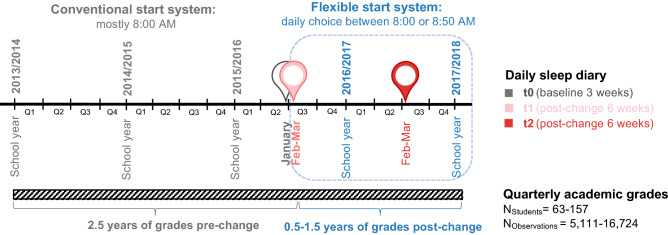
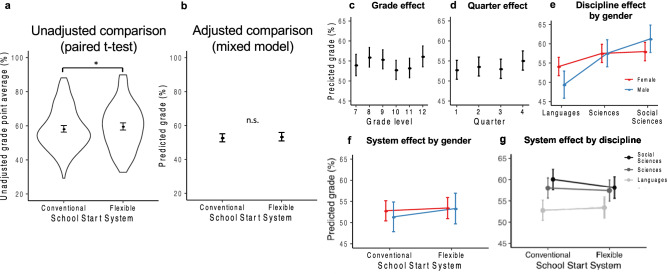
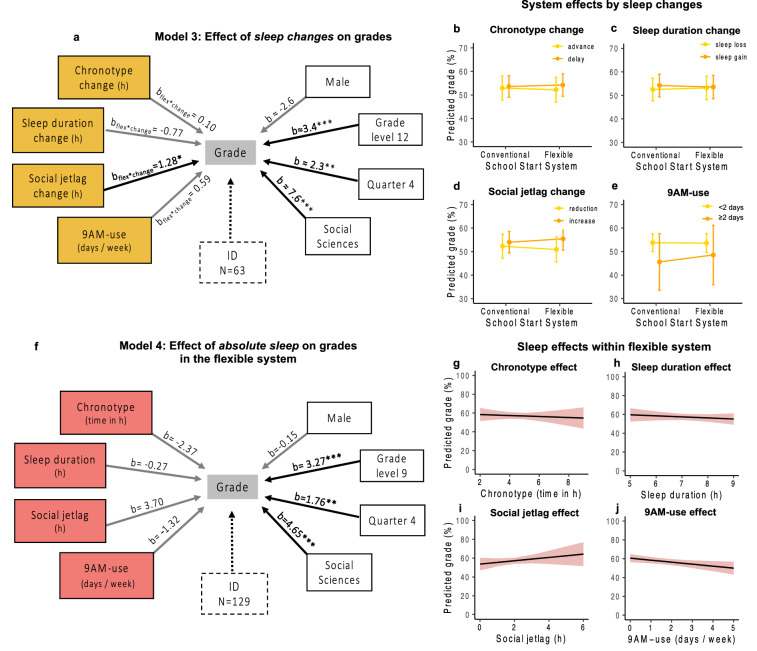
The mismatch between teenagers’ late sleep phase and early school start times results in acute and chronic sleep reductions. This is not only harmful for learning but may reduce career prospects and widen social inequalities. Delaying school start times has been shown to improve sleep at least short-term but whether this translates to better achievement is unresolved. Here, we studied whether 0.5–1.5 years of exposure to a flexible school start system, with the daily choice of an 8 AM or 8:50 AM-start, allowed secondary school students (n = 63–157, 14–21 years) to improve their quarterly school grades in a 4-year longitudinal pre-post design. We investigated whether sleep, changes in sleep or frequency of later starts predicted grade improvements. Mixed model regressions with 5111–16,724 official grades as outcomes did not indicate grade improvements in the flexible system per se or with observed sleep variables nor their changes—the covariates academic quarter, discipline and grade level had a greater effect in our sample. Importantly, our finding that intermittent sleep benefits did not translate into detectable grade changes does not preclude improvements in learning and cognition in our sample. However, it highlights that grades are likely suboptimal to evaluate timetabling interventions despite their importance for future success.
Overview
The claims and statistics of this paper haven’t been checked yet.
Free: it reads the open-access text and checks the first 5 claims that cite a source we can check. Create a free account to check every claim.
Integrity signals
Registry
Cites
Statistics
Figures
Verification
Claims the paper makes
The claims and statistics of this paper haven’t been checked yet.
Free: it reads the open-access text and checks the first 5 claims that cite a source we can check. Create a free account to check every claim.
Claims other papers make about this one
Each is checked against this paper’s own text: does it say what the citing paper says it does?
The cited source says what the claim attributes to it.
In the citing paper
“This might explain the inconsistent findings of the effects of later SSTs on grades [32].”
From The Power of Flexible School Start Times: (2026) · cites this paper as [32]
The cited source says what the claim attributes to it.
In the citing paper
“Because grades are assigned by individual teachers, they can be influenced by subjective factors and may be less reliable as objective indicators of academic performance and its changes over time [31,32].”
From The Power of Flexible School Start Times: (2026) · cites this paper as [32]
Self-check
Percentages, sums and reported differences re-computed from the paper’s own numbers.
The self-check needs the paper’s full text.
Citations
Cites
Fitting Linear Mixed-Effects Models Using lme4
Bates, D., Mächler, M., Bolker, B., & Walker, S. (2015) · Journal of Statistical Software · doi:10.18637/jss.v067.i01 · Cited by 86,835
Diekelmann, S., & Born, J. (2010) · Nature Reviews Neuroscience · doi:10.1038/nrn2762 · Cited by 3,760
Hattie, J. (2008) · doi:10.4324/9780203887332 · Cited by 3,051
Social Jetlag: Misalignment of Biological and Social Time
Wittmann, M., Dinich, J., Merrow, M., & Roenneberg, T. (2006) · Chronobiology International · doi:10.1080/07420520500545979 · Cited by 2,625
Self-citationUnderstanding adolescence as a period of social–affective engagement and goal flexibility
Crone, E. A., & Dahl, R. E. (2012) · Nature Reviews Neuroscience · doi:10.1038/nrn3313 · Cited by 2,507
Do Psychosocial and Study Skill Factors Predict College Outcomes? A Meta-Analysis.
Robbins, S. B., Lauver, K., Le, H., Davis, D., Langley, R., & Carlstrom, A. (2004) · Psychological Bulletin · doi:10.1037/0033-2909.130.2.261 · Cited by 2,479
Structural magnetic resonance imaging of the adolescent brain
GIEDD, J. N. (2004) · Annals of the New York Academy of Sciences · doi:10.1196/annals.1308.009 · Cited by 1,610
A marker for the end of adolescence
Roenneberg, T., Kuehnle, T., Pramstaller, P. P., Ricken, J., Havel, M., Guth, A., & Merrow, M. (2004) · Current Biology · doi:10.1016/j.cub.2004.11.039 · Cited by 1,585
Self-citationDewald, J. F., Meijer, A. M., Oort, F. J., Kerkhof, G. A., & Bögels, S. M. (2010) · Sleep Medicine Reviews · doi:10.1016/j.smrv.2009.10.004 · Cited by 1,526
Roenneberg, T., Allebrandt, K. V., Merrow, M., & Vetter, C. (2012) · Current Biology · doi:10.1016/j.cub.2012.03.038 · Cited by 1,407
Self-citationA meta-analysis of the impact of short-term sleep deprivation on cognitive variables
Lim, J., & Dinges, D. F. (2010) · Psychological Bulletin · doi:10.1037/a0018883 · Cited by 1,389
Gender differences in scholastic achievement: A meta-analysis.
Voyer, D., & Voyer, S. D. (2014) · Psychological Bulletin · doi:10.1037/a0036620 · Cited by 1,337
Seidel, T., & Shavelson, R. J. (2007) · Review of Educational Research · doi:10.3102/0034654307310317 · Cited by 1,259
Walker, M. P., & Stickgold, R. (2006) · Annual Review of Psychology · doi:10.1146/annurev.psych.56.091103.070307 · Cited by 1,075
Regulation of adolescent sleep: Implications for behavior
CARSKADON, M. A., ACEBO, C., & JENNI, O. G. (2004) · Annals of the New York Academy of Sciences · doi:10.1196/annals.1308.032 · Cited by 792
Cardiovascular, inflammatory, and metabolic consequences of sleep deprivation
Mullington, J. M., Haack, M., Toth, M., Serrador, J. M., & Meier-Ewert, H. K. (2009) · Progress in Cardiovascular Diseases · doi:10.1016/j.pcad.2008.10.003 · Cited by 783
Adolescent Sleep Patterns, Circadian Timing, and Sleepiness at a Transition to Early School Days
Carskadon, M. A., Wolfson, A. R., Acebo, C., Tzischinsky, O., & Seifer, R. (1998) · Sleep · doi:10.1093/sleep/21.8.871 · Cited by 769
Pathways to adolescent health sleep regulation and behavior
Dahl, R. E., & Lewin, D. S. (2002) · Journal of Adolescent Health · doi:10.1016/s1054-139x(02)00506-2 · Cited by 746
Sadeh, A., Gruber, R., & Raviv, A. (2003) · Child Development · doi:10.1111/1467-8624.7402008 · Cited by 742
Chronotype and Social Jetlag: A (Self-) Critical Review
Roenneberg, T., Pilz, L. K., Zerbini, G., & Winnebeck, E. C. (2019) · Biology · doi:10.3390/biology8030054 · Cited by 733
Self-citationSecond International Handbook of Science Education
(2012) · Springer eBooks · doi:10.1007/978-1-4020-9041-7 · Cited by 730
An update on adolescent sleep: New evidence informing the perfect storm model ☆
Crowley, S. J., Wolfson, A. R., Tarokh, L., & Carskadon, M. A. (2018) · Journal of Adolescence · doi:10.1016/j.adolescence.2018.06.001 · Cited by 684
Cognitive, behavioral, and functional consequences of inadequate sleep in children and adolescents
Beebe, D. W. (2011) · Pediatric Clinics of North America · doi:10.1016/j.pcl.2011.03.002 · Cited by 638
Sleep restriction worsens mood and emotion regulation in adolescents
Baum, K. T., Desai, A., Field, J., Miller, L. E., Rausch, J., & Beebe, D. W. (2014) · Journal of Child Psychology and Psychiatry · doi:10.1111/jcpp.12125 · Cited by 629
Adolescent changes in the homeostatic and circadian regulation of sleep
Hagenauer, M. H., Perryman, J. I., Lee, T. M., & Carskadon, M. A. (2009) · Developmental Neuroscience · doi:10.1159/000216538 · Cited by 593
Sleep in adolescence: Physiology, cognition and mental health
Tarokh, L., Saletin, J. M., & Carskadon, M. A. (2016) · Neuroscience & Biobehavioral Reviews · doi:10.1016/j.neubiorev.2016.08.008 · Cited by 552
We are Chronically Sleep Deprived
Bonnet, M. H., & Arand, D. L. (1995) · Sleep · doi:10.1093/sleep/18.10.908 · Cited by 477
Homeostatic sleep regulation in adolescents
Jenni, O. G., Achermann, P., & Carskadon, M. A. (2005) · Sleep · doi:10.1093/sleep/28.11.1446 · Cited by 469
Cognitive Function Following Acute Sleep Restriction in Children Ages 10–14
(1998) · Sleep · doi:10.1093/sleep/21.8.861 · Cited by 430
Garaulet, M., Ortega, F. B., Ruiz, J. R., Rey-López, J. P., Béghin, L., Manios, Y., Cuenca-García, M., Plada, M., Diethelm, K., Kafatos, A., et al. (2011) · International Journal of Obesity · doi:10.1038/ijo.2011.149 · Cited by 422
Sleep deprivation reduces perceived emotional intelligence and constructive thinking skills
Killgore, W. D. S., Kahn-Greene, E. T., Lipizzi, E. L., Newman, R. A., Kamimori, G. H., & Balkin, T. J. (2008) · Sleep Medicine · doi:10.1016/j.sleep.2007.07.003 · Cited by 382
Delayed school start times and adolescent sleep: A systematic review of the experimental evidence
Minges, K. E., & Redeker, N. S. (2016) · Sleep Medicine Reviews · doi:10.1016/j.smrv.2015.06.002 · Cited by 338
Sleep Loss and “Divergent” Thinking Ability
Horne, J. A. (1988) · Sleep · doi:10.1093/sleep/11.6.528 · Cited by 311
Sleep and memory in healthy children and adolescents - a critical review
Kopasz, M., Loessl, B., Hornyak, M., Riemann, D., Nissen, C., Piosczyk, H., & Voderholzer, U. (2010) · Sleep Medicine Reviews · doi:10.1016/j.smrv.2009.10.006 · Cited by 277
Sleep loss impairs short and novel language tasks having a prefrontal focus
HARRISON, Y., & HORNE, J. (1998) · Journal of Sleep Research · doi:10.1046/j.1365-2869.1998.00104.x · Cited by 256
Increased Sensitivity of the Circadian System to Light in Early/Mid-Puberty
Crowley, S. J., Cain, S. W., Burns, A. C., Acebo, C., & Carskadon, M. A. (2015) · The Journal of Clinical Endocrinology & Metabolism · doi:10.1210/jc.2015-2775 · Cited by 248
Spectral Analysis of the Sleep Electroencephalogram During Adolescence
(2004) · Sleep · doi:10.1093/sleep/27.4.774 · Cited by 231 · cited 1×
“To assess this, we looked at the interaction between (1) school start system and discipline, as well as (2) school start system and gender in a second model (Model 2; Supplementary Table S1, nstudents = 157).”
BackgroundGrades as Valid Measures of Academic Achievement of Classroom Learning
Allen, J. D. (2005) · The Clearing House: A Journal of Educational Strategies, Issues and Ideas · doi:10.3200/tchs.78.5.218-223 · Cited by 185
Sleep Deprivation Affects Speech
Harrison, Y., & Horne, J. A. (1997) · Sleep · doi:10.1093/sleep/20.10.871 · Cited by 183
Early to rise? The effect of daily start times on academic performance
Edwards, F. (2012) · Economics of Education Review · doi:10.1016/j.econedurev.2012.07.006 · Cited by 170
Dunster, G. P., de la Iglesia, L., Ben-Hamo, M., Nave, C., Fleischer, J. G., Panda, S., & de la Iglesia, H. O. (2018) · Science Advances · doi:10.1126/sciadv.aau6200 · Cited by 168
Cultural influences on the bedtime behaviors of young children
MCLAUGHLINCRABTREE, V, BEALKORHONEN, J., MONTGOMERYDOWNS, H., FAYEJONES, V, OBRIEN, L., & GOZAL, D. (2005) · Sleep Medicine · doi:10.1016/j.sleep.2005.02.001 · Cited by 166
The µMCTQ: An Ultra-Short Version of the Munich ChronoType Questionnaire
Ghotbi, N., Pilz, L. K., Winnebeck, E. C., Vetter, C., Zerbini, G., Lenssen, D., Frighetto, G., Salamanca, M., Costa, R., Montagnese, S., et al. (2020) · Journal of Biological Rhythms · doi:10.1177/0748730419886986 · Cited by 161
Self-citationFrench, M. T., Homer, J. F., Popovici, I., & Robins, P. K. (2015) · Eastern Economic Journal · doi:10.1057/eej.2014.22 · Cited by 160
Bowers, J. M., & Moyer, A. (2017) · Sleep Health · doi:10.1016/j.sleh.2017.08.004 · Cited by 156
Teen sleep and suicidality: results from the Youth Risk Behavior Surveys of 2007 and 2009
Fitzgerald, C. T., Messias, E., & Buysse, D. J. (2011) · Journal of Clinical Sleep Medicine · doi:10.5664/jcsm.1188 · Cited by 149
Sleep duration and mortality – Does weekend sleep matter?
Åkerstedt, T., Ghilotti, F., Grotta, A., Zhao, H., Adami, H., Trolle‐Lagerros, Y., & Bellocco, R. (2019) · Journal of Sleep Research · doi:10.1111/jsr.12712 · Cited by 148
Sleep Duration and Sleep Quality: Associations With Depressive Symptoms Across Adolescence
Raniti, M. B., Allen, N. B., Schwartz, O., Waloszek, J. M., Byrne, M. L., Woods, M. J., Bei, B., Nicholas, C. L., & Trinder, J. (2017) · Behavioral Sleep Medicine · doi:10.1080/15402002.2015.1120198 · Cited by 117
The effects of sleep loss on capacity and effort
Engle‐Friedman, M. (2014) · Sleep Science · doi:10.1016/j.slsci.2014.11.001 · Cited by 112
Association of Delaying School Start Time With Sleep Duration, Timing, and Quality Among Adolescents
Widome, R., Berger, A. T., Iber, C., Wahlstrom, K., Laska, M. N., Kilian, G., Redline, S., & Erickson, D. J. (2020) · JAMA Pediatrics · doi:10.1001/jamapediatrics.2020.0344 · Cited by 95
Seidel, T. (2014) · Zeitschrift für Pädagogik · doi:10.25656/01:14686 · Cited by 87
Marx, R., Tanner-Smith, E. E., Davison, C. M., Ufholz, L.-A., Freeman, J., Shankar, R., Newton, L., Brown, R. S., Parpia, A. S., Cozma, I., et al. (2017) · Cochrane Database of Systematic Reviews · doi:10.1002/14651858.cd009467.pub2 · Cited by 84
Longitudinal Outcomes of Start Time Delay on Sleep, Behavior, and Achievement in High School
Thacher, P. V., & Onyper, S. V. (2016) · Sleep · doi:10.5665/sleep.5426 · Cited by 83
A Novel Biochemical Route for Fuels and Chemicals Production from Cellulosic Biomass
Fan, Z., Wu, W., Hildebrand, A., Kasuga, T., Zhang, R., & Xiong, X. (2012) · PLoS ONE · doi:10.1371/journal.pone.0031693 · Cited by 80
Sleep Improves Memory: The Effect of Sleep on Long Term Memory in Early Adolescence
Potkin, K. T., & Bunney, W. E. (2012) · PLoS ONE · doi:10.1371/journal.pone.0042191 · Cited by 76
Validation of a touchscreen psychomotor vigilance task
Arsintescu, L., Kato, K. H., Cravalho, P. F., Feick, N. H., Stone, L. S., & Flynn-Evans, E. E. (2019) · Accident Analysis & Prevention · doi:10.1016/j.aap.2017.11.041 · Cited by 64
School start times matter, eveningness does not
Estevan, I., da Silva, A. C. R., & Tassino, B. (2018) · Chronobiology International · doi:10.1080/07420528.2018.1504785 · Cited by 52
Molecular genetic overlap between posttraumatic stress disorder and sleep phenotypes
Lind, M. J., Brick, L. A. D., Gehrman, P., Duncan, L. E., Gelaye, B., Maihofer, A. X., Nievergelt, C. M., Nugent, N. R., Stein, M. B., Amstadter, A. B., et al. (2019) · SLEEP · doi:10.1093/sleep/zsz257 · Cited by 52
Estevan, I., Silva, A., Vetter, C., & Tassino, B. (2020) · Journal of Biological Rhythms · doi:10.1177/0748730420927601 · Cited by 51
Sleep and Circadian Rhythms in Adolescence
Tarokh, L., Short, M., Crowley, S. J., Fontanellaz-Castiglione, C. E. G., & Carskadon, M. A. (2019) · Current Sleep Medicine Reports · doi:10.1007/s40675-019-00155-w · Cited by 47
Sleep and academic performance: considering amount, quality and timing
Gomez Fonseca, A., & Genzel, L. (2020) · Current Opinion in Behavioral Sciences · doi:10.1016/j.cobeha.2019.12.008 · Cited by 45
Guérin, N., Reinberg, A., Testu, F., Boulenguiez, S., Mechkouri, M., & Touitou, Y. (2001) · Chronobiology International · doi:10.1081/cbi-100107974 · Cited by 38
Later school start times in a flexible system improve teenage sleep
Winnebeck, E. C., Vuori-Brodowski, M. T., Biller, A. M., Molenda, C., Fischer, D., Zerbini, G., & Roenneberg, T. (2020) · Sleep · doi:10.1093/sleep/zsz307 · Cited by 30
Self-citationSchool start times and academic achievement - A systematic review on grades and test scores
Biller, A. M., Meissner, K., Winnebeck, E. C., & Zerbini, G. (2022) · Sleep Medicine Reviews · doi:10.1016/j.smrv.2021.101582 · Cited by 27
Self-citationExamination of the 8th grade students' TIMSS mathematics success in terms of different variables1
Yılmaz, G. K., & Hanci, A. (2015) · International Journal of Mathematical Education in Science and Technology · doi:10.1080/0020739x.2015.1102977 · Cited by 23
Marx, R., Tanner‐Smith, E. E., Davison, C. M., Ufholz, L., Freeman, J., Shankar, R., Newton, L., Brown, R. S., Parpia, A. S., Cozma, I., et al. (2017) · Campbell Systematic Reviews · doi:10.4073/csr.2017.15 · Cited by 21
Sleep improvements on days with later school starts persist after 1 year in a flexible start system
Biller, A. M., Molenda, C., Zerbini, G., Roenneberg, T., & Winnebeck, E. C. (2022) · Scientific Reports · doi:10.1038/s41598-022-06209-4 · Cited by 17
Self-citation0892 Sleep Duration and Mortality-does Weekend Sleep Matter?
Åkerstedt, T., Ghilotti, F., Grotta, A., Zhao, H., Adami, H., Lagerros, Y. T., & Belocco, R. (2018) · SLEEP · doi:10.1093/sleep/zsy061.891 · Cited by 16
Adolescents’ sleep/wake patterns and school schedules: towards flexibility
Mazzilli Louzada, F., & Isabel Ribeiro Pereira, S. (2019) · Biological Rhythm Research · doi:10.1080/09291016.2018.1491263 · Cited by 14
Kim, T. (2020) · The B.E. Journal of Economic Analysis & Policy · doi:10.2139/ssrn.3160037 · Cited by 11
The COACTIV Research Program: Methodological Framework
Löwen, K., Baumert, J., Kunter, M., Krauß, S., & Brunner, M. (2013) · Springer eBooks · doi:10.1007/978-1-4614-5149-5_5 · Cited by 8
A late bird or a good bird? The effect of 9 o’clock attendance policy on student’s achievement
Jung, H. (2018) · Asia Pacific Education Review · doi:10.1007/s12564-018-9558-1 · Cited by 7
Research works printed but not linked: 3
- 3. Huber, R. High-density sleep EEG recordings during adolescence. J. Sleep Res. 17, 1-39 (2008).
- 33. Parkhurst, H. Education on the Dalton Plan (E.P. Dutton & Company, 1922).
- 75. Heine, C., Briedis, K., Didi, H.-J., Haase, K. & Trost, G. Auswahl-und Eignungsfeststellungsverfahren beim Hochschulzugang in Deutschland und ausgewählten Ländern Vol. 3 (HIS-Kurzinformation, 2006).
Cited by
School start times and academic achievement - A systematic review on grades and test scores
Biller, A. M., Meissner, K., Winnebeck, E. C., & Zerbini, G. (2022) · Sleep Medicine Reviews · doi:10.1016/j.smrv.2021.101582 · Cited by 27
Self-citationCircadian preference and physical and cognitive performance in adolescence: A scoping review
Vidueira, V. F., Booth, J. N., Saunders, D. H., Sproule, J., & Turner, A. P. (2023) · Chronobiology International · doi:10.1080/07420528.2023.2256901 · Cited by 28
Borisenkov, M. F., Popov, S. V., Смирнов, В. В., Dorogina, O. I., Pecherkina, A. A., & Symaniuk, E. E. (2022) · Chronobiology International · doi:10.1080/07420528.2022.2117050 · Cited by 21
“Encouraging results were obtained in a longitudinal study of the effectiveness of a flexible SST with a daily choice of start times at 08:00 or 08:50 (Biller et al. 2022a, 2022; Winnebeck et al. 2020).”
Evanger, L. N., Bjorvatn, B., Pallesen, S., Hysing, M., Sivertsen, B., & Saxvig, I. W. (2023) · Journal of Sleep Research · doi:10.1111/jsr.13840 · Cited by 22
Sleep improvements on days with later school starts persist after 1 year in a flexible start system
Biller, A. M., Molenda, C., Zerbini, G., Roenneberg, T., & Winnebeck, E. C. (2022) · Scientific Reports · doi:10.1038/s41598-022-06209-4 · Cited by 17
Self-citation
Metadata
- Authors
- Biller, A. M., Molenda, C., Obster, F., Zerbini, G., Förtsch, C., Roenneberg, T., & Winnebeck, E. C.
- Affiliations
- Universität der Bundeswehr München (DE)
- Institut für Medizinische Psychologie (DE)
- University of Augsburg (DE)
- Ludwig-Maximilians-Universität München (DE)
- Helmholtz Munich (DE)
- Corresponding author
- Biller, Anna M.
- Winnebeck, Eva C.
- ORCID
- Venue
- Scientific Reports
- Published
- 2022-02-24
- Volume
- 12
- Issue
- 1
- Pages
- 3178-3178
- ISSN
- 2045-2322 (ISSN-L)
- PMC
- PMC8873390
- OpenAlex
- W4213417972
- Semantic Scholar
- b06440a9a827e3ea1d5254dc2decd42dc824d37b
- Cited by
- 10
- References
- 72
- Citations by year
- 2026: 2 · 2025: 1 · 2024: 1 · 2023: 2 · 2022: 3
- FWCI
- 1.61
- Type
- journal article
- Language
- en
- Open access
- gold
- doi.org
- Licence
- cc-by
- creativecommons.org/licenses/by/4.0 (tdm)
- creativecommons.org/licenses/by/4.0 (vor)
- Locations
- Scientific Reports (publishedVersion, cc-by)
- bioRxiv (Cold Spring Harbor Laboratory) (acceptedVersion, cc-by-nc-nd)
- PubMed Central (publishedVersion, cc-by)
- PubMed (publishedVersion)
- PuSH - Publication Server of Helmholtz Zentrum München (submittedVersion, cc-by)
- DOAJ (DOAJ: Directory of Open Access Journals) (submittedVersion, cc-by-sa)
- Open access LMU (Ludwid Maxmilian's Universitat Munchen) (submittedVersion)
- Open access LMU (Ludwid Maxmilian's Universitat Munchen) (submittedVersion, cc-by)
- mediaTUM – the media and publications repository of the Technical University Munich (Technical University Munich) (submittedVersion, other-oa)
- OPUS (Augsburg University) (submittedVersion, cc-by)
- Funders
- Graduate School of Systemic Neurosciences Munich, Germany
- Ludwig-Maximilians-Universität München
- Topics
- Social Sciences › Psychology › Experimental and Cognitive Psychology › Sleep and related disorders
- Social Sciences › Education › Educational Outcomes and Influences
- Life Sciences › Neuroscience › Endocrine and Autonomic Systems › Circadian rhythm and melatonin
- Keywords
- school start time, adolescent sleep, sleep stages, academic performance, school grades, high school students, sleep deprivation, longitudinal study
About these checks
Registry, retraction, Cites and statistics results are computed, not judged, with one exception: a printed reference that no index lists is read once by a model before it counts as a citation error. Claims are extracted by a model and kept only when their quote appears verbatim in the text; each cited source is then checked, with a model’s help, for whether it says what the claim relies on. Those verdicts can be wrong — read the claim’s quote and the cited source before relying on one.
Statistics and arithmetic are recomputed, not judged.
Confidence bands are shown only for fields calibrated on our annotated test set. None is calibrated yet, so no band is shown.
What counts as a claim ›How we measure confidence ›How we check this ›
Are you an author, or do you see a problem with this page? Request a review
Data sources
Bibliographic data: Semantic Scholar, OpenAlex, Crossref.
Contains information from the Semantic Scholar Academic Graph Datasets, made available under the ODC Attribution License (ODC-BY 1.0).
Semantic Scholar’s data is described in: Kinney, R., et al. (2023). The Semantic Scholar Open Data Platform. arXiv:2301.10140.
