

Innovation, organizational capabilities, and the born-global firm
Open accessThe DOI matches its Crossref record; 106 of the 106 references it cites were found in a registry or an index; none of the 100 sources its claims cite is checked for support yet.
Overview
CoChat Summary
## TL;DR
This study argues that born-global firms succeed because early internationalization is supported by an innovative culture and a distinctive set of organizational capabilities. Using qualitative case studies followed by a survey of 203 usable responses, the authors find that several capability links are significant and that these capabilities are associated with performance in international markets.
## Key findings
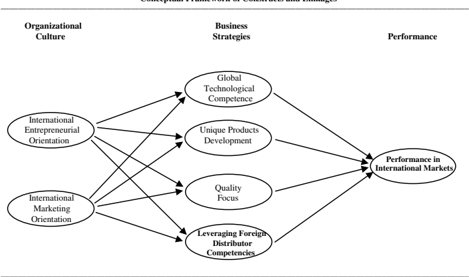
- The survey analysis found that international entrepreneurial orientation significantly predicted global technological competence with a standardized coefficient of 0.28; the link from international marketing orientation to global technological competence was not significant.
- Unique products development was significantly predicted by both international entrepreneurial orientation (0.19) and international marketing orientation (0.24).
- Quality focus was significantly predicted by both international entrepreneurial orientation (0.23) and international marketing orientation (0.35).
- Leveraging foreign distributor competences was significantly predicted by international marketing orientation (0.26) but not by international entrepreneurial orientation; these strategy variables were also significant drivers of performance in international markets: global technological competence (0.21), unique products development (0.14), quality focus (0.30), and leveraging foreign distributor competences (0.18).
## Methods
- The paper uses a two-phase design: first qualitative interviews/case studies to develop constructs and hypotheses, then a cross-industry field survey to test them.
- The qualitative phase included 33 professionals: 24 senior managers at early internationalizing firms, 6 scholars, and 3 international trade experts; the firms were mostly founded after 1985, sold half or more of their sales abroad, and had entered foreign markets within 3 years of founding.
- The survey was mailed to a random sample of 900 manufacturing firms in the United States founded in 1980 or later and exporting at least 25% of total production; 203 usable surveys were returned (about 23% response rate). The main analysis used LISREL8 path analysis, with exploratory factor analysis and confirmatory factor analysis for scale purification and validity checks.
## Limitations
- The paper states that “little empirical work” had been attempted on born globals and that there had been “almost no empirical research” on the factors driving their superior international performance.
- The study itself is focused on U.S. manufacturing firms that were selected using a 25% export threshold, so the evidence is tied to that sample and entry-mode context; this is evident from the text.
- The paper notes that the survey results are based on self-reported measures from responding firms; this is evident from the questionnaire-based design, though the paper does not frame it explicitly as a limitation.
Model-written summary. Check it against the paper before relying on it.
Integrity signals
Registry
Cites
Statistics
Figures
Verification
Claims the paper makes
0 Valid · 0 Not valid · 53 Not checked · 112 Own results and interpretations
A result the paper reports from its own data — it cites no other source for it, so there is none to check. The quote shows it is in the paper.
In the paper
“Despite the scarce resources typical of young firms, our findings reveal that born-global firms leverage a distinctive mix of orientations and strategies that allow them to succeed in diverse international markets.”
plainstates a cause- Asserted: passes — The authors put it forward as true.
- Checkable: passes — It can be checked against evidence.
- Load-bearing: passes — The paper’s conclusions depend on it.
- Based: passes — The paper gives a reason why it holds.
- Rests on an assumption not shown here.
A result the paper reports from its own data — it cites no other source for it, so there is none to check. The quote shows it is in the paper.
In the paper
“The critical role of marketing prowess overseas was also strongly emphasized by virtually all interviewees in the case studies.”
boosted- Asserted: passes — The authors put it forward as true.
- Checkable: passes — It can be checked against evidence.
- Load-bearing: unclear — It is unclear whether the paper’s conclusions depend on it.
- Based: passes — The paper gives a reason why it holds.
A result the paper states — it cites no source for it, so there is none to check. The quote shows it is in the paper.
In the paper
“Most interviewed firms exhibited strong technological capabilities in their respective product or industry categories.”
plain- Asserted: passes — The authors put it forward as true.
- Checkable: passes — It can be checked against evidence.
- Load-bearing: unclear — It is unclear whether the paper’s conclusions depend on it.
- Based: passes — The paper gives a reason why it holds.
A result the paper reports from its own data — it cites no other source for it, so there is none to check. The quote shows it is in the paper.
In the paper
“In general, the qualitative phase of the study revealed that born globals are likely to be formed by entrepreneurs who pursue foreign ventures with a strong marketing orientation.”
hedgedstates an association- Asserted: passes — The authors put it forward as true.
- Checkable: passes — It can be checked against evidence.
- Load-bearing: passes — The paper’s conclusions depend on it.
- Based: passes — The paper gives a reason why it holds.
A result the paper states — it cites no source for it, so there is none to check. The quote shows it is in the paper.
In the paper
“In contrast, born globals leverage a collection of fundamental intangible knowledge-based capabilities in the cultivation of foreign markets early in their evolution.”
plainstates a cause- Asserted: passes — The authors put it forward as true.
- Checkable: passes — It can be checked against evidence.
- Load-bearing: passes — The paper’s conclusions depend on it.
- Based: unclear — It is unclear why the paper says it holds.
- Rests on an assumption not shown here.
84 more claims
Create a free account to see all 165 claims and to verify the 3 references still open.
- It may state two separate claims as one. 33
- Probably not a substantial claim. 54
Citations
Cites
Evaluating Structural Equation Models with Unobservable Variables and Measurement Error
Fornell, C., & Larcker, D. F. (1981) · Journal of Marketing Research · doi:10.2307/3151312 · Cited by 109,314 · cited 2×
“Composite reliability was calculated using the procedures outlined by Fornell and Larcker (1981).”
MethodInfluentialEvaluating structural equation models with unobservable variables and measurement error
Fornell, C., & Larcker, D. F. (1981) · Journal of Marketing Research · doi:10.1177/002224378101800104 · Cited by 109,190
Firm Resources and Sustained Competitive Advantage
Barney, J. (1991) · Journal of Management · doi:10.1177/014920639101700108 · Cited by 48,334
(1994) · Journal of the American Dietetic Association · doi:10.1016/0002-8223(94)92216-0 · Cited by 45,910
Firm resources and sustained competitive advantage
Barney, J. B. (2004) · Advances in Strategic Management · doi:10.1016/s0742-3322(00)17018-4 · Cited by 38,152
Absorptive Capacity: A New Perspective on Learning and Innovation
Cohen, W. M., & Levinthal, D. A. (1990) · Administrative Science Quarterly · doi:10.2307/2393553 · Cited by 35,728
A resource‐based view of the firm
Wernerfelt, B. (1984) · Strategic Management Journal · doi:10.1002/smj.4250050207 · Cited by 25,635
The Theory of Economic Development
Schumpeter, J., & Backhaus, U. (2006) · The European Heritage in Economics and the Social Sciences · doi:10.1007/0-306-48082-4_3 · Cited by 22,506
An Evolutionary Theory of Economic Change.
Loasby, B. J., Nelson, R. R., & Winter, S. G. (1983) · The Economic Journal · doi:10.2307/2232409 · Cited by 21,366
A Dynamic Theory of Organizational Knowledge Creation
Nonaka, I. (1994) · Organization Science · doi:10.1287/orsc.5.1.14 · Cited by 17,809
Research works printed but not linked: 5
- Nikkei Sangyoo Shimbun (1995) Benchaa Shin Sedai (New Generation Ventures) , Nihon Keizai Shimbun: Tokyo.
- Nunnally, J.C. (1978) Psychometric Theory
- Porter, M.E. (1980) Competitive Strategy , The Free Press: New York.
- Rennie, M. (1993) 'Born global', McKinsey Quarterly (4): 45-52. Rosson, P. and Ford, I.D. (1982) 'Manufacturer-overseas distributor relations and export performance', Journal of International Business Studies 13 (2): 57-72.
- Schumpeter, J. (1939) Business Cycles , Vol. 1 McGraw-Hill: New York.
Cited by
Items 1,101–1,200 of 3,020
Adams, K., Attah‐Boakye, R., Yu, H., Chu, I., & Ishaque, M. (2023) · Journal of Business Research · doi:10.1016/j.jbusres.2023.113660 · Cited by 19
Examining the issue of employee intentions to learn and adopt digital technology
Chaudhuri, R., Chatterjee, S., Vrontis, D., Galati, A., & Siachou, E. (2023) · Worldwide Hospitality and Tourism Themes · doi:10.1108/whatt-02-2023-0020 · Cited by 34
Zahoor, N., Lew, Y. K., Arslan, A., Christofi, M., & Tarba, S. Y. (2023) · Journal of International Management · doi:10.1016/j.intman.2023.101036 · Cited by 26
The pace of international expansion for digital multinational enterprises
Lo, F., Bui, Q.-T., & Huarng, K. (2023) · Technological Forecasting and Social Change · doi:10.1016/j.techfore.2023.122629 · Cited by 20
Witt, A., Khalik, M., & Godinez, J. (2024) · Journal of International Management · doi:10.1016/j.intman.2024.101129 · Cited by 21
Relationship Between Competitive Strategies and the Success Perception of Polish Born Globals
Baranowska‐Prokop, E., & Sikora, T. (2014) · International Journal of Management and Economics · doi:10.1515/ijme-2015-0005 · Cited by 17
Bridging, bonding and linking global entrepreneurs: the case of Sri Lanka
Hewapathirana, G. I. (2014) · Human Resource Development International · doi:10.1080/13678868.2013.876255 · Cited by 24
“…studies in marketing, management, entrepreneurship, sociology and social psychology fields have identified some of the factors that support interpersonal relationships (Herman and Smith 2010; Knight and Cavusgil 2004; Mort and Weerawardena 2006; Oviatt and McDougall 1994; Zabkar and Brencic 2004).”
BackgroundGlobal Information Management Research: What have we Learned in the Past Decade?
Niederman, F., Alhorr, H. S., Park, Y., & Tolmie, C. R. (2012) · Journal of Global Information Management · doi:10.4018/jgim.2012010102 · Cited by 22
The Internationalization Processes of Small and Medium‐sized Swedish Tourism Firms
Agndal, H., & Elbe, J. (2007) · Scandinavian Journal of Hospitality and Tourism · doi:10.1080/15022250701640388 · Cited by 26
“Managerial desire to grow fast and entrepreneurial behaviour (Andersson & Wictor, 2003; Knight & Cavusgil, 2005; Pla-Barber & Escribá-Esteve, 2006) appear to be important explanatory factors, as is a ‘‘global vision’’ (Knight & Cavusgil, 2004).”
BackgroundAntecedents to export information generation: a cross-national study
Souchon, A. L., Dewsnap, B., Durden, G. R., Axinn, C. N., & Holzmüller, H. H. (2015) · International Marketing Review · doi:10.1108/imr-05-2011-0125 · Cited by 17
“Knight and Cavusgil (2004) outline how knowledge and information are the most important resource and provide particular advantages to firms looking to successfully internationalize.”
BackgroundSuccess Factors in Western and Chinese Born Global Companies
Andersson, S., Danilovic, M., & Huang, H. (2015) · iBusiness · doi:10.4236/ib.2015.71004 · Cited by 25
“[32] believe that technology competence, unique product development and product quality focus provide organizational activities related to R&D, knowledge development, play an important role in positioning Born Glob-”
BackgroundInfluentialLEARNING ORIENTATION AND TRUST IN SMALL AND MEDIUM ENTERPRISE (SME) EXPORT COMPETITIVE ADVANTAGE
İsmail, D. (2013) · Universiti Sains Malaysia Institutional Repository (Universiti Sains Malaysia) · Cited by 26
CAPABILITIES, INNOVATION, AND OVERALL PERFORMANCE IN BRAZILIAN EXPORT FIRMS
Cabral, J. E. D. O., Coelho, A., Coelho, F., & Costa, M. D. P. B. (2015) · RAM. Revista de Administração Mackenzie · doi:10.1590/1678-69712015/administracao.v16n3p76-108 · Cited by 18
Internationalisation of born globals: the role of strategic alliances
Franco, M., & Haase, H. (2016) · European J of International Management · doi:10.1504/ejim.2016.074471 · Cited by 17
Sheng, H., Ye, G., Zhou, J., & Jin, T. (2017) · Nankai Business Review International · doi:10.1108/nbri-05-2016-0016 · Cited by 19
Głodowska, A., Pera, B., & Wach, K. (2019) · Central European Management Journal · doi:10.7206/cemj.2658-0845.3 · Cited by 19
“Many authors attempt to develop and verify hypotheses on the role of the speed of internationalization in the development of firms or factors that influence fast internationalization (Knight and Cavusgil, 2004; Sapienza, Autio, George and Zahra, 2006; Chang, 2007; Acedo and Jones, 2007; Mohr and Batsakis, 2014; Knight…”
BackgroundCritical capabilities for widening international new ventures’ geographical scope.
Blesa, A., & Meliá, M. R. (2020) · European Management Journal · doi:10.1016/j.emj.2020.09.003 · Cited by 19
Strategic innovation and entrepreneurial ownership: an analysis using GEM data and fuzzy simulation
Dinesh, K. K., & Sushil, N. A. (2021) · Benchmarking An International Journal · doi:10.1108/bij-10-2020-0540 · Cited by 18
Sustainable Competitive Advantage through Entrepreneurship, Market-Oriented Culture, and Trust
Ha, J.-C., Lee, J.-W., & Seong, J. Y. (2021) · Sustainability · doi:10.3390/su13073986 · Cited by 30
“EP and MOC together can develop unique products and improve the quality of their products, corporate profits in global markets [30], and exploration and exploitation outcomes [31].”
BackgroundLi, W. H., Guo, B., & Sisto, M. D. (2021) · Journal of International Management · doi:10.1016/j.intman.2021.100852 · Cited by 22
Pre-start-up internationalization mindsets trigger action
Costa, S. F., Frederiks, A. J., Englis, P. D., Englis, B. G., & Groen, A. J. (2022) · Journal of Small Business Management · doi:10.1080/00472778.2022.2056607 · Cited by 23
“There are many different typologies and approaches to explaining internatio-nalization behavior (for example, Aspelund & Moen, 2005; Bell et al., 2003; Johanson & Vahlne, 1977; Knight & Cavusgil, 2004; Oviatt & McDougall, 2005).”
BackgroundB2B brand extension to the B2C market—The case of the ICT industry in Taiwan
Tang, Y., Liou, F., & Peng, S. (2008) · Journal of Brand Management · doi:10.1057/bm.2008.7 · Cited by 17
Dynamics of Experience, Environment and MNE Ownership Strategy
Jung, J. C., Beamish, P. W., & Goerzen, A. (2010) · Management International Review · doi:10.1007/s11575-010-0039-y · Cited by 19
Putting the world in the world wide web: the globalisation of the internet
Shea, T. P., Ariguzo, G. C., & White, D. S. (2006) · International Journal of Business Information Systems · doi:10.1504/ijbis.2007.011417 · Cited by 17
Drivers and Effects of Internationalising Innovation by SMEsPreprint
Rammer, C., & Schmiele, A. (2008) · SSRN Electronic Journal · doi:10.2139/ssrn.1207262 · Cited by 26
“This model has been challenged by the literature on so-called “born globals” (see Knight and Cavusgil; 2004, McDougall et al., 1994; Madsen et al., 2000; Fryges, 2004).”
The Effects of Entrepreneurial Orientation in a Digital and International Setting
Baldegger, R., Wild, P., & Schueffel, P. (2021) · Emerald Group Publishing Limited eBooks · doi:10.1108/s1074-754020210000022006 · Cited by 19
Aghazadeh, H., & Zandi, F. (2021) · Journal of Entrepreneurship in Emerging Economies · doi:10.1108/jeee-02-2021-0051 · Cited by 22
Gardó, T. F., Garcı́a, H. C., García-García, J. M., & Derqui, B. (2022) · Journal of International Entrepreneurship · doi:10.1007/s10843-022-00310-5 · Cited by 17
“With regard to the types of dynamic capabilities in internationalisation process, literature describes a variety of capabilities, most notably networking capability (Luo, 2002; Knight and Cavusgil, 2004; Weerawardena et al., 2007; Morgan et al., 2018).”
BackgroundDeterminants of SMEs’ performance: amalgamation of entrepreneurial, market and brand orientations
Ismail, A. R., & Mohamad, B. (2022) · International Journal of Entrepreneurial Behaviour & Research · doi:10.1108/ijebr-02-2022-0167 · Cited by 27
Mrożewski, M. J., & Hering, D. (2022) · International Entrepreneurship and Management Journal · doi:10.1007/s11365-022-00813-6 · Cited by 20
Knowledge and capabilities: what are their roles in international business of SMEs?
Nave, E., & Ferreira, J. J. (2023) · EuroMed Journal of Business · doi:10.1108/emjb-09-2022-0175 · Cited by 18
Behl, A., Kamboj, S., Sharma, N., Pereira, V. E., Salwan, P., Chavan, M., & Pathak, A. A. (2023) · Journal of International Management · doi:10.1016/j.intman.2023.101044 · Cited by 25
Strategic orientation, strategic renewal, and the international performance of born global firms
Ahmed, F. U., Babu, M. M., Rahman, M. N., Uddin, M. J., & Dey, B. L. (2023) · Asia Pacific Journal of Management · doi:10.1007/s10490-023-09903-7 · Cited by 29
“According to Knight and Cavusgil (2004), SO provides a critical and strategic mindset to BGFs that are required to persist and grow in the competitive global market.”
Ritter, T., & Pedersen, C. L. (2023) · Industrial Marketing Management · doi:10.1016/j.indmarman.2023.11.012 · Cited by 17
Idrissi, D. E., & Hauch, V. (2013) · Revue de l’Entrepreneuriat · doi:10.3917/entre.113.0015 · Cited by 22
Janjuha‐Jivraj, S., Martin, L., & Danko, A. (2012) · Journal of Small Business & Entrepreneurship · doi:10.1080/08276331.2012.10593569 · Cited by 22
Conceptualisation de l’internationalisation des PME
Ramadan, M., & Levratto, N. (2012) · Revue internationale P M E Économie et gestion de la petite et moyenne entreprise · doi:10.7202/1012552ar · Cited by 16
Wang, Y.-K. (. (2015) · Journal of Management & Organization · doi:10.1017/jmo.2015.26 · Cited by 15
“…networks, thereby further extending a firm’s ability to obtain new external resources and capabilities worldwide (Anand & Khanna, 2000), while leveraging the competences of their foreign alliance partners can further enhance a firm’s performance in international markets (Knight & Cavusgil, 2004).”
BackgroundEffects of Social Media Usage on the Speed of International Growth of an International New Venture
Fraccastoro, S., & Gabrielsson, M. (2018) · Hawaii International Conference on System Sciences (HICSS) · doi:10.24251/hicss.2018.543 · Cited by 16
“Literature on International New Ventures has found them to suffer from various liabilities, such as their smallness, newness and foreignness [19].”
BackgroundEtemad, H. (2019) · Journal of International Entrepreneurship · doi:10.1007/s10843-019-00243-6 · Cited by 19
“…developments in the 1970s and 1980s pointed to the rise of different institutions, to which we commonly refer to as Born Globals (Rennie 1993; Knight and Cavusgil 2004, 2004), International New Venture (McDougall 1989; McDougall et al. 1994 McDougall and Oviatt 2000; Oviatt and McDougall…”
BackgroundKnowledge relationships of university spin-off firms: Contrasting dynamics in global reach
Taheri, M., & van GEENHUIZEN, M. (2019) · Technological Forecasting and Social Change · doi:10.1016/j.techfore.2019.03.013 · Cited by 16
International business strategy: development of an integrated framework and typology
Bhattacharyya, S. S. (2020) · Review of International Business and Strategy · doi:10.1108/ribs-10-2019-0138 · Cited by 17
Kurtulmuş, B. E., Katrinli, A. E., & Warner, B. (2020) · SAGE Open · doi:10.1177/2158244020983294 · Cited by 20
“This was chosen instead of Trompenaar (1996), Hofstede (1980), and House et al. (2004), and represents an approach also followed by Knight and Cavusgil (2004).”
BackgroundMethodBaysak, B., Bozkurt, S., & Günsel, A. (2022) · Kybernetes · doi:10.1108/k-09-2021-0831 · Cited by 19
The Theoretical Embedding Of Born Globals: Challenging Existing Internationalization Theories
Bouncken, R. B., Schuessler, F., & Kraus, S. (2014) · International Business & Economics Research Journal (IBER) · doi:10.19030/iber.v14i1.9030 · Cited by 18
“Knight & Cavusgil (2004) explored the phenomenon for the first time in conjunction with the role of innovative culture, knowledge and capabilities and define BGs “[…] as business organizations that, from or near their founding, seek superior international business performance from the application…”
BackgroundInfluentialMonferrer, D., Blesa, A., & Meliá, M. R. (2013) · Revista española de investigación de marketing · doi:10.1016/s1138-1442(14)60023-1 · Cited by 61
Internacionalização acelerada de empresas de base tecnológica: o caso das Born Globals brasileiras
Ribeiro, F. F., Oliveira, M. D. M., & Borini, F. M. (2012) · Revista de Administração Contemporânea · doi:10.1590/s1415-65552012000600007 · Cited by 16
On the foundation and early development of domestic and international new ventures
Rasmussen, E. S., Madsen, T. K., & Servais, P. (2010) · Journal of Management & Governance · doi:10.1007/s10997-010-9162-1 · Cited by 27
“In a more recent article Knight and Cavusgil (2004) notice that the 25 percent cut-off ratio for exports is ‘somewhat arbitrary’ and ‘…established in light of the exploratory goals of the research…’ The 25% criterion is, however, probably a figure which means that a US based firm needs to take its…”
BackgroundInstitutional effect on born global firms in China: the role of Sun Tzu’sThe Art of Warstrategies
Zhang, M., Gao, Q., Wheeler, J. V., & Kwon, J.-S. (2016) · Journal of Asia Business Studies · doi:10.1108/jabs-11-2014-0084 · Cited by 19
Liu, J. (2018) · International Journal of Emerging Markets · doi:10.1108/ijoem-07-2017-0232 · Cited by 18
Michael, M. S., Saban, G., & Abdurahman, A. Z. A. (2016) · Procedia - Social and Behavioral Sciences · doi:10.1016/j.sbspro.2016.05.441 · Cited by 19
Kowalik, I., Danik, L., Král, P., & Řezanková, H. (2017) · Entrepreneurial Business and Economics Review · doi:10.15678/eber.2017.050302 · Cited by 20
“On the other hand, the new entry into foreign markets is already an innovation, therefore internationalising firms can be perceived as more innovative compared to domestic entities (Knight & Cavusgil, 2004; Zijdemans & Tanev, 2014).”
BackgroundA perspective on multinational enterprise’s national identity dilemma
Munjal, S., Budhwar, P. S., & Pereira, V. E. (2017) · Social Identities · doi:10.1080/13504630.2017.1386375 · Cited by 16
“…literature on born global firms which claims that firms following a ‘click’-based business model not only spread globally quicker but they can start their business with a ‘big-bang’ as they physically and virtually operate across the globe at the same time (Knight & Cavusgil, 2004; Rennie, 1993).”
BackgroundEarly strategic heritage: The carryover effect on entrepreneurial firm’s life cycle
Etemad, H. (2018) · Journal of International Entrepreneurship · doi:10.1007/s10843-018-0240-9 · Cited by 17
A Leap of Faith? Managerial Religiosity And Market Entry Decisions
Richardson, C., & Ariffin, S. K. (2019) · Management International Review · doi:10.1007/s11575-019-00377-8 · Cited by 19
Global Value Chains, Business Networks, Strategy, and International Business: Convergences
HUMPHREY, J. D., Todeva, E., Eduardo, A., & Giglio, E. M. (2019) · Review of Business Management · doi:10.7819/rbgn.v21i4.4014 · Cited by 23
“Knight and Cavusgil (2004), on innovation, organizational capabilities, and the born-global firm.”
Behavioral Elements in Foreign Direct Investment Decisions
Aharoni, Y. (2011) · Research in global strategic management · doi:10.1108/s1064-4857(2011)0000015008 · Cited by 29
Mikhailova, O., & Olsen, P. I. (2016) · Journal of International Entrepreneurship · doi:10.1007/s10843-016-0186-8 · Cited by 21
Escolas teóricas do processo de internacionalização: uma visão epistemológica
da Costa, L. D. F. L. G., Añez, M. E. M., Mól, A. L. R., & Damasceno, T. D. S. A. (2017) · Cadernos EBAPE BR · doi:10.1590/1679-395154072 · Cited by 22
Hoyos-Villa, O. A. (2019) · ENTRAMADO · doi:10.18041/1900-3803/entramado.2.5597 · Cited by 30
Ding, Z., Ye, G., Sheng, H., & Hu, M. (2021) · Multinational Business Review · doi:10.1108/mbr-07-2020-0155 · Cited by 22
Arora, K., & Siddiqui, A. A. (2022) · Quality Management Journal · doi:10.1080/10686967.2022.2034493 · Cited by 20
“In international business research, capabilities have been found to be integral in creating value, sustaining competitive advantage and achieving profitability (Knight and Cavusgil 2004; Yalcinkaya, Calantone, and Griffith 2007; Zou, Fang, and Zhao 2003; Fang and Zou 2009).”
BackgroundSheng, H., Zhu, Y., Ding, Z., & Chen, C. (2022) · British Journal of Management · doi:10.1111/1467-8551.12697 · Cited by 20
Chang, H. S., Knight, G., & Fong, C. (2024) · Journal of International Marketing · doi:10.1177/1069031x231221804 · Cited by 24
“An entrepreneurial orientation may also motivate the development of marketing capabilities suitable for international markets (Hughes and Morgan 2007; Knight and Cavusgil 2004; Pakura and Rudeloff 2020; Sok et al. 2017; Zhou, Wu, and Barnes 2012).”
Self-citationMigrating EMNCs and the theory of the multinational
Barnard, H. C. (2014) · Cambridge University Press eBooks · doi:10.1017/cbo9781107587632.014 · Cited by 21
Determinants of Export Performance: An Institutional Approach
Mais, I., & Amal, M. (2011) · Latin American Business Review · doi:10.1080/10978526.2011.633029 · Cited by 15
“Empirical studies point to several characteristics that such firms have in common, including entrepreneurial attitude, inclusion into networks, and high degree of innovation in products, processes, and business (Bonaglia, Goldstein, and Mathews, 2006; Knight and Cavusgil, 2004).”
BackgroundResultInfluentialVenture Capitalists’ Risk Mitigation of Portfolio Company Internationalization
LiPuma, J. A., & Park, S. (2013) · Entrepreneurship Theory and Practice · doi:10.1111/etap.12033 · Cited by 33
FROM THE BUSINESS STRATEGY RESULT TO A SOURCE OF ECONOMIC DEVELOPMENT: THE DUAL ROLE OF CSR
Monteagudo, I. C., & Buendía‐Martínez, I. (2016) · Journal of Small Business Strategy · Cited by 21
Machado, M. A., Nique, W. M., & Fehse, F. B. (2016) · Revista de Administração · doi:10.1016/j.rausp.2016.06.002 · Cited by 15
What Drives Precocity? A Study of Indian Technology-Intensive Firms
Varma, S., Nayyar, R., & Bansal, V. (2016) · Journal of East-West Business · doi:10.1080/10669868.2016.1217724 · Cited by 22
“The literature indicates that young, small firms in small and saturated domestic markets are driven toward early internationalization (Oviatt and McDougall 1995; Madsen and Servais 1997; Knight and Cavusgil 2004) as a result of the pressure of competition from large established firms.”
BackgroundSarkar, A., & Perényi, Á. (2017) · Entrepreneurial Business and Economics Review · doi:10.15678/eber.2017.050403 · Cited by 16
“An entrepreneurial orientation allows organisations to see and exploit international business opportunities when combined with other resources and capabilities (Andersson & Wictor, 2003; Knight & Cavusgil, 2004; Oviatt & McDougall, 1995).”
BackgroundEtemad, H. (2018) · Journal of International Entrepreneurship · doi:10.1007/s10843-018-0227-6 · Cited by 16
“Indeed, the seminal research in the decade of 1990s (e.g., Rennie 1993, Oviatt and McDougall 1994, McDougall and Oviatt 1994 and 2000, Knight and Cavusgil 2004) identified a family of entrepreneurial SMEs that internationalized rapidly and in early stages of their life cycle by using mostly low…”
BackgroundChen, Y., Tsai, C., & Liu, H.-J. (2019) · International Journal of E-Adoption · doi:10.4018/ijea.2019010104 · Cited by 19
Chang, R. X., & Ogasavara, M. H. (2019) · Asian Business & Management · doi:10.1057/s41291-019-00093-z · Cited by 16
Amaya, A., Wu, W., & Liao, Y. (2021) · European Journal of Innovation Management · doi:10.1108/ejim-05-2020-0188 · Cited by 16
Menéndez, A. M. M., Castiglioni, M., & Cobeña, M. (2021) · European Journal of Family Business · doi:10.24310/ejfbejfb.v11i2.10782 · Cited by 15
“The first reason is that new international firms have emerged, which undergo ‘rapid’ international expansion (Chetty et al., 2014; Jones et al., 2011; Knight & Cavusgil, 2004).”
BackgroundA Systematic Literature Review about the Speed of Internationalization
Neubert, M. (2022) · International Journal of Business and Management · doi:10.5539/ijbm.v17n2p80 · Cited by 20
Is There a Lean Future for Global Startups?
Tanev, S. (2017) · Technology Innovation Management Review · doi:10.22215/timreview1072 · Cited by 15
Different approaches to the pursuit of internationalization by Italian SMEs
Colapinto, C., Gavinelli, L., Zenga, M., et al. (2015) · Journal of Research in Marketing and Entrepreneurship · doi:10.1108/jrme-11-2014-0030 · Cited by 15
Determinants of born global firm growth in the apparel industry: A Korean case
Kang, J. H., & Jin, B. E. (2007) · Journal of the Textile Institute · doi:10.1533/joti.2005.0283 · Cited by 18
Rapid Internationalization of SMEs: Evidence from Born Global Firms in Chile
Cancino, C. A. (2014) · Innovar · doi:10.15446/innovar.v24n1spe.47614 · Cited by 28
“…on commercial strategies and on the velocity with which these firms enter markets (Burgel & murray, 2000; madsen & servais, 1997). according to Knight and Cavusgil (2004), BG have human capital with previous experience in international business and a high level of knowledge of languages,…”
BackgroundParadoxes of psychic distance and market entry by software INVs
Sinha, P., Wang, M. (., Scott‐Kennel, J., & Gibb, J. L. (2015) · European Business Review · doi:10.1108/ebr-12-2013-0144 · Cited by 14
“, 2003), and striving for growth in large markets (Ojala and Tyrväinen, 2007) while avoiding head-on competition (Knight and Cavusgil, 2004).”
BackgroundThe dynamics of regional and global expansion
Asmussen, C. G., Nielsen, B. B., Osegowitsch, T., & Sammartino, A. (2015) · Multinational Business Review · doi:10.1108/mbr-05-2015-0019 · Cited by 19
Risk Management in Born Globals: the Case of Brazilian Craft Breweries
Stocker, F., & Abib, G. (2019) · Brazilian Business Review · doi:10.15728/bbr.2019.16.4.2 · Cited by 17
“Since the beginning, the born globals have been investigated by several authors, such as Knight and Cavusgil (2004), Oviatt and McDougall (2005), Weerawardena, Mort, Liesch and Knight (2007), Gabrielsson, Kirpalani, Dimitratos, Solberg and Zucchella (2008), Dib, Rocha and Silva (2010), Trudgen and…”
BackgroundComparative International Entrepreneurship: Theoretical Framework and Research Development
Głodowska, A. (2019) · Entrepreneurial Business and Economics Review · doi:10.15678/eber.2019.070213 · Cited by 19
“According to McDougall and Oviatt (1994), Knight and Cavusgil (2004), and Perényi and Lansocz (2018), it can aspire to be called an independent scientific discipline.”
BackgroundLiabilities, Advantages, and Buffers of Newness: How Young Age Makes Internationalization Possible
Renko, M., Kundu, S. K., Shrader, R. C., Carsrud, A. L., & Parhankangas, A. (2016) · Group & Organization Management · doi:10.1177/1059601116668761 · Cited by 21
“In a new organization, new roles have to be invented, and new organizations are typically more flexible and informal than more established organizations (Knight & Cavusgil, 2004).”
Kampf, C. E., Broillet, A., John, C., et al. (2015) · IEEE International Professional Communication Conference (ProComm) · doi:10.1109/ipcc.2015.7235774 · Cited by 14
“relevance is “born global” [1] technologies such as smartphone apps.”
BackgroundSolano, L. V. L., Engler, A., & Otter, V. (2019) · International Journal of Emerging Markets · doi:10.1108/ijoem-12-2017-0562 · Cited by 24
Yoruk, D. E., Bunduchi, R., Yoruk, E., Crișan-Mitra, C., Salanță, I.-I., & Crișan, E. L. (2021) · Journal of International Management · doi:10.1016/j.intman.2021.100874 · Cited by 23
A typology of internationalisation patterns for SMEs in developing countries
Aghazadeh, H., & Zandi, F. (2022) · Journal of Research in Marketing and Entrepreneurship · doi:10.1108/jrme-02-2021-0019 · Cited by 17
A meta-analysis on entrepreneurial orientation in the export context
Hizarci‐Payne, A. K., Bıçakcıoğlu‐Peynirci, N., & İpek, İ. (2022) · Journal of Business and Industrial Marketing · doi:10.1108/jbim-10-2021-0485 · Cited by 20
Managers’ process thinking skills, dynamic capabilities and performance in export ventures
Vardarsuyu, M., Spyropoulou, S., Mengüç, B., & Katsikeas, C. S. (2023) · International Marketing Review · doi:10.1108/imr-10-2022-0224 · Cited by 24
Hermans, M., Borda, A. J., Newburry, W. E., Chea, C. O. C., Finchelstein, D., González-Pérez, M. A., Montoya, M. Á., Velasco-Gutiérrez, G., & Velez-Ocampo, J. F. (2023) · European Business Review · doi:10.1108/ebr-02-2023-0040 · Cited by 19
Born Global Maturity: Strategic Aspects and Performance Consequences
Efrat, K., & Asseraf, Y. (2024) · Management International Review · doi:10.1007/s11575-024-00532-w · Cited by 18
“Established routines, processes, and capabilities subsequently prevail in shaping the firm’s growth (Knight et al., 2004; Rastrollo-Horrillo & Martín-Armario, 2019).”
InfluentialRazika, M., Yang, Q., & Dhelim, S. (2024) · Sustainability · doi:10.3390/su16103911 · Cited by 31
Pitelis, C., Wang, C. L., Hughes, M., & Ambrosini, V. (2025) · International Business Review · doi:10.1016/j.ibusrev.2024.102387 · Cited by 16
Innovation performance of Chilean firms, a bivariate probit analysis
Rehman, N. U. (2016) · Journal of Entrepreneurship in Emerging Economies · doi:10.1108/jeee-05-2015-0032 · Cited by 14
Lillo, F. G., Claver‐Cortés, E., García, M. Ú., & Marco‐Lajara, B. (2017) · Journal of International Entrepreneurship · doi:10.1007/s10843-017-0213-4 · Cited by 21
“6 Finally, cluster 8 includes the works of Rialp et al. (2005), Jones and Coviello (2005), Autio et al. (2000), Zahra et al. (2000), Knight and Cavusgil (2004), Moen (2002), Moen and Servais (2002), Knight and Cavusgil (1996), Rennie (1993) and McDougall et al. (1994).”
InfluentialRisk adaptation and emotion differentiation: An experimental study of dynamic decision-making
Li, Y., & Ashkanasy, N. M. (2018) · Asia Pacific Journal of Management · doi:10.1007/s10490-017-9559-3 · Cited by 23
Metadata
- Authors
- Knight, G. A., & Cavusgil, S. T.
- Affiliations
- Florida State University (US)
- Corresponding author
- Knight, Gary A
- ORCID
- Knight, Gary A
- Venue
- Journal of International Business Studies
- Published
- 2004-01-08
- Volume
- 35
- Issue
- 2
- Pages
- 124-141
- ISSN
- 0047-2506 (ISSN-L)
- 1478-6990
- OpenAlex
- W2127709152
- Semantic Scholar
- d24960b5342d0dd3b86be002ab18a80e7b6fb5c9
- Cited by
- 3,013
- References
- 102
- Citations by year
- 2026: 121 · 2025: 123 · 2024: 157 · 2023: 154 · 2022: 182 · 2021: 196 · 2020: 189 · 2019: 180 · 2018: 199 · 2017: 172 · 2016: 188 · 2015: 187 · 2014: 178 · 2013: 167 · 2012: 129
- FWCI
- 137.12
- Type
- journal article
- Language
- en
- Update notices
- correction (2004-07-16)
- Open access
- bronze
- doi.org
- Licence
- www.springer.com/tdm (tdm)
- Locations
- Journal of International Business Studies (publishedVersion)
- RePEc: Research Papers in Economics (submittedVersion)
- Funders
- Michigan State University
- College of Engineering, Michigan State University
- Topics
- Social Sciences › Business, Management and Accounting › Strategy and Management › International Business and FDI
- Social Sciences › Business, Management and Accounting › Strategy and Management › Innovation and Knowledge Management
- Social Sciences › Communication › International Student and Expatriate Challenges
- Keywords
- born global firms, early internationalization, organizational capabilities, innovation, innovation culture, international business strategy, international success, young firms, internationalization of firms
About these checks
Registry, retraction, Cites and statistics results are computed, not judged, with one exception: a printed reference that no index lists is read once by a model before it counts as a citation error. Claims are extracted by a model and kept only when their quote appears verbatim in the text; each cited source is then checked, with a model’s help, for whether it says what the claim relies on. Those verdicts can be wrong — read the claim’s quote and the cited source before relying on one.
A language model drew the claims from the paper on 2026-10-10, under version 3 of the claim definition (model deepseek-v4.1-flash, prompt extract-v3).
A second model labelled each claim on 2026-10-10 (model jev-1.13-20260917, definition revision gold-guideline-v0.2).
Statistics and arithmetic are recomputed, not judged.
Confidence bands are shown only for fields calibrated on our annotated test set. None is calibrated yet, so no band is shown.
What counts as a claim ›How we measure confidence ›How we check this ›
Are you an author, or do you see a problem with this page? Request a review
Data sources
Bibliographic data: Semantic Scholar, OpenAlex, Crossref.
Contains information from the Semantic Scholar Academic Graph Datasets, made available under the ODC Attribution License (ODC-BY 1.0).
Semantic Scholar’s data is described in: Kinney, R., et al. (2023). The Semantic Scholar Open Data Platform. arXiv:2301.10140.
