

Innovation, organizational capabilities, and the born-global firm
Open accessThe DOI matches its Crossref record; 106 of the 106 references it cites were found in a registry or an index; none of the 100 sources its claims cite is checked for support yet.
Overview
CoChat Summary
## TL;DR
This study argues that born-global firms succeed because early internationalization is supported by an innovative culture and a distinctive set of organizational capabilities. Using qualitative case studies followed by a survey of 203 usable responses, the authors find that several capability links are significant and that these capabilities are associated with performance in international markets.
## Key findings
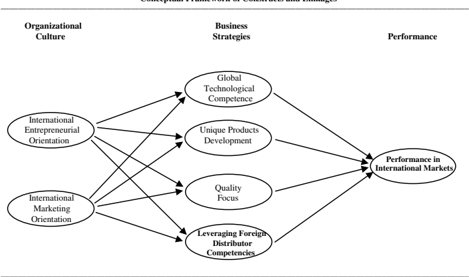
- The survey analysis found that international entrepreneurial orientation significantly predicted global technological competence with a standardized coefficient of 0.28; the link from international marketing orientation to global technological competence was not significant.
- Unique products development was significantly predicted by both international entrepreneurial orientation (0.19) and international marketing orientation (0.24).
- Quality focus was significantly predicted by both international entrepreneurial orientation (0.23) and international marketing orientation (0.35).
- Leveraging foreign distributor competences was significantly predicted by international marketing orientation (0.26) but not by international entrepreneurial orientation; these strategy variables were also significant drivers of performance in international markets: global technological competence (0.21), unique products development (0.14), quality focus (0.30), and leveraging foreign distributor competences (0.18).
## Methods
- The paper uses a two-phase design: first qualitative interviews/case studies to develop constructs and hypotheses, then a cross-industry field survey to test them.
- The qualitative phase included 33 professionals: 24 senior managers at early internationalizing firms, 6 scholars, and 3 international trade experts; the firms were mostly founded after 1985, sold half or more of their sales abroad, and had entered foreign markets within 3 years of founding.
- The survey was mailed to a random sample of 900 manufacturing firms in the United States founded in 1980 or later and exporting at least 25% of total production; 203 usable surveys were returned (about 23% response rate). The main analysis used LISREL8 path analysis, with exploratory factor analysis and confirmatory factor analysis for scale purification and validity checks.
## Limitations
- The paper states that “little empirical work” had been attempted on born globals and that there had been “almost no empirical research” on the factors driving their superior international performance.
- The study itself is focused on U.S. manufacturing firms that were selected using a 25% export threshold, so the evidence is tied to that sample and entry-mode context; this is evident from the text.
- The paper notes that the survey results are based on self-reported measures from responding firms; this is evident from the questionnaire-based design, though the paper does not frame it explicitly as a limitation.
Model-written summary. Check it against the paper before relying on it.
Integrity signals
Registry
Cites
Statistics
Figures
Verification
Claims the paper makes
0 Valid · 0 Not valid · 53 Not checked · 112 Own results and interpretations
A result the paper reports from its own data — it cites no other source for it, so there is none to check. The quote shows it is in the paper.
In the paper
“Despite the scarce resources typical of young firms, our findings reveal that born-global firms leverage a distinctive mix of orientations and strategies that allow them to succeed in diverse international markets.”
plainstates a cause- Asserted: passes — The authors put it forward as true.
- Checkable: passes — It can be checked against evidence.
- Load-bearing: passes — The paper’s conclusions depend on it.
- Based: passes — The paper gives a reason why it holds.
- Rests on an assumption not shown here.
A result the paper reports from its own data — it cites no other source for it, so there is none to check. The quote shows it is in the paper.
In the paper
“The critical role of marketing prowess overseas was also strongly emphasized by virtually all interviewees in the case studies.”
boosted- Asserted: passes — The authors put it forward as true.
- Checkable: passes — It can be checked against evidence.
- Load-bearing: unclear — It is unclear whether the paper’s conclusions depend on it.
- Based: passes — The paper gives a reason why it holds.
A result the paper states — it cites no source for it, so there is none to check. The quote shows it is in the paper.
In the paper
“Most interviewed firms exhibited strong technological capabilities in their respective product or industry categories.”
plain- Asserted: passes — The authors put it forward as true.
- Checkable: passes — It can be checked against evidence.
- Load-bearing: unclear — It is unclear whether the paper’s conclusions depend on it.
- Based: passes — The paper gives a reason why it holds.
A result the paper reports from its own data — it cites no other source for it, so there is none to check. The quote shows it is in the paper.
In the paper
“In general, the qualitative phase of the study revealed that born globals are likely to be formed by entrepreneurs who pursue foreign ventures with a strong marketing orientation.”
hedgedstates an association- Asserted: passes — The authors put it forward as true.
- Checkable: passes — It can be checked against evidence.
- Load-bearing: passes — The paper’s conclusions depend on it.
- Based: passes — The paper gives a reason why it holds.
A result the paper states — it cites no source for it, so there is none to check. The quote shows it is in the paper.
In the paper
“In contrast, born globals leverage a collection of fundamental intangible knowledge-based capabilities in the cultivation of foreign markets early in their evolution.”
plainstates a cause- Asserted: passes — The authors put it forward as true.
- Checkable: passes — It can be checked against evidence.
- Load-bearing: passes — The paper’s conclusions depend on it.
- Based: unclear — It is unclear why the paper says it holds.
- Rests on an assumption not shown here.
84 more claims
Create a free account to see all 165 claims and to verify the 3 references still open.
- It may state two separate claims as one. 33
- Probably not a substantial claim. 54
Citations
Cites
Evaluating Structural Equation Models with Unobservable Variables and Measurement Error
Fornell, C., & Larcker, D. F. (1981) · Journal of Marketing Research · doi:10.2307/3151312 · Cited by 109,314 · cited 2×
“Composite reliability was calculated using the procedures outlined by Fornell and Larcker (1981).”
MethodInfluentialEvaluating structural equation models with unobservable variables and measurement error
Fornell, C., & Larcker, D. F. (1981) · Journal of Marketing Research · doi:10.1177/002224378101800104 · Cited by 109,190
Firm Resources and Sustained Competitive Advantage
Barney, J. (1991) · Journal of Management · doi:10.1177/014920639101700108 · Cited by 48,334
(1994) · Journal of the American Dietetic Association · doi:10.1016/0002-8223(94)92216-0 · Cited by 45,910
Firm resources and sustained competitive advantage
Barney, J. B. (2004) · Advances in Strategic Management · doi:10.1016/s0742-3322(00)17018-4 · Cited by 38,152
Absorptive Capacity: A New Perspective on Learning and Innovation
Cohen, W. M., & Levinthal, D. A. (1990) · Administrative Science Quarterly · doi:10.2307/2393553 · Cited by 35,728
A resource‐based view of the firm
Wernerfelt, B. (1984) · Strategic Management Journal · doi:10.1002/smj.4250050207 · Cited by 25,635
The Theory of Economic Development
Schumpeter, J., & Backhaus, U. (2006) · The European Heritage in Economics and the Social Sciences · doi:10.1007/0-306-48082-4_3 · Cited by 22,506
An Evolutionary Theory of Economic Change.
Loasby, B. J., Nelson, R. R., & Winter, S. G. (1983) · The Economic Journal · doi:10.2307/2232409 · Cited by 21,366
A Dynamic Theory of Organizational Knowledge Creation
Nonaka, I. (1994) · Organization Science · doi:10.1287/orsc.5.1.14 · Cited by 17,809
Research works printed but not linked: 5
- Nikkei Sangyoo Shimbun (1995) Benchaa Shin Sedai (New Generation Ventures) , Nihon Keizai Shimbun: Tokyo.
- Nunnally, J.C. (1978) Psychometric Theory
- Porter, M.E. (1980) Competitive Strategy , The Free Press: New York.
- Rennie, M. (1993) 'Born global', McKinsey Quarterly (4): 45-52. Rosson, P. and Ford, I.D. (1982) 'Manufacturer-overseas distributor relations and export performance', Journal of International Business Studies 13 (2): 57-72.
- Schumpeter, J. (1939) Business Cycles , Vol. 1 McGraw-Hill: New York.
Cited by
Items 1,201–1,300 of 3,020
Seyoum, B., & Lian, Y. (2018) · International Business Review · doi:10.1016/j.ibusrev.2018.01.008 · Cited by 15
Lee, Z.-Y., Chu, M.-T., Chen, S.-S., & Tsai, C.-H. (2018) · Sustainability · doi:10.3390/su10093275 · Cited by 14
“In addition to introducing new products and modes of production, research and development (R&D) departments also support the opening up of new markets and reinventing their businesses to provide the best possible service to these markets [16].”
BackgroundВладимировна, Ц. Т., & Zhang, X. (2019) · Journal of East-West Business · doi:10.1080/10669868.2018.1548405 · Cited by 20
“Some researchers assume that BGs are only those firms that have reached a 25% export share within first three years after foundation (e.g. Madsen and Servais 1997; Knight and Cavusgil 2004).”
BackgroundLusophone-African SME internationalization: A case for born global and international joint ventures
Goncalves, M. V., & Smith, E. C. (2019) · Journal of Transnational Management · doi:10.1080/15475778.2019.1634406 · Cited by 15
“In the case of LAMNEs, despite scarce resources, these relatively young enterprises would, therefore, have to use a mix of strategies that would allow success in diverse international markets, as argued by Knight and Cavusgil (2004).”
BackgroundA review of methodological diversity within the domain of international entrepreneurship
Ahmed, F. U., & Brennan, L. (2021) · Journal of International Entrepreneurship · doi:10.1007/s10843-021-00291-x · Cited by 20
The pre-foundation evolution of proactiveness in born global and non-born global USOs
Messina, L., & Hewitt‐Dundas, N. (2021) · Journal of Small Business Management · doi:10.1080/00472778.2021.1989592 · Cited by 16
“Born globals (BGs) are young and small firms that, despite their asset parsi-mony, internationalize soon after inception (Knight & Cavusgil, 2004) and derive a significant proportion of their sales from international markets (Paul & Rosado-Serrano, 2019).”
BackgroundGao, R., Gao, Q., Zhuang, X., & Sun, K. (2022) · Journal of risk and financial management · doi:10.3390/jrfm15010016 · Cited by 18
Kollmann, T., Hensellek, S., Jung, P. B., & de Cruppe, K. (2022) · The Journal of Technology Transfer · doi:10.1007/s10961-022-09948-8 · Cited by 19
“Similarly, Knight and Cavusgil (2004) and Cavusgil and Knight (2015) highlighted that new firms should leverage their innovativeness and knowledge capabilities to achieve foreign market success—a notion that has been echoed by subsequent studies, which found that innovations help overcome barriers…”
BackgroundSamson, A. T., & Rosli, M. (2014) · Journals & Books Hosting (International Knowledge Sharing Platform) · Cited by 14
Born Globals' foreign market channel strategies
Andersson, S., Gabrielsson, J., & Wictor, I. (2006) · International Journal of Globalisation and Small Business · doi:10.1504/ijgsb.2006.012185 · Cited by 14
“The Born Global can here use the advantage of being young and small, and thus more flexible and less constrained by administrative heritage (Autio, Sapienza and Almeida, 2000; Knight and Cavusgil, 2004).”
MethodNetwork types and performance in SMEs: the mediating effects of technology commercialization
Park, T., & Rhee, J. (2013) · Asian Journal of Technology Innovation · doi:10.1080/19761597.2013.866311 · Cited by 14
“External networks provide firms with access to such resources and capabilities with low costs, thus helping them to overcome the limitation of internal resources (Teece 1986; Knight and Cavusgil 2004; Abell and Nisar 2007).”
BackgroundScalability versus flexibility: firm size and R&D in Indian industry
Majumdar, S. K. (2009) · The Journal of Technology Transfer · doi:10.1007/s10961-009-9147-x · Cited by 15
“Such formalization minimizes firms’ ability to adapt and innovate (Hitt et al. 1990; Knight and Cavusgil 2004 ).”
BackgroundBacq, S. C., & Cœurderoy, R. (2011) · Revue internationale P M E Économie et gestion de la petite et moyenne entreprise · doi:10.7202/045746ar · Cited by 21
Global Online Entrepreneurship and the Impact of Innovation on Brands
İpek, K. R. O. M. (2015) · EMAJ Emerging Markets Journal · doi:10.5195/emaj.2015.90 · Cited by 18
“Globalization of markets and technological advances in ICT are among the two environmental reasons for the early adoption of born globals (Knight and Cavusgil, 2004).”
BackgroundOpen Data Innovation Capabilities: Towards a Framework of How to Innovate with Open Data
Eckartz, S. M., Broek, T. A. V. D., & Ooms, M. (2016) · Lecture notes in computer science · doi:10.1007/978-3-319-44421-5_4 · Cited by 21
Alliance portfolios and firm performance: the moderating role of firms’ strategic positioning
Владимирович, М. А. (2017) · Journal of strategy and management · doi:10.1108/jsma-01-2016-0003 · Cited by 18
Taking your company global: the effect of returnee managers on overseas customers
Dai, Y. (2018) · China Finance Review International · doi:10.1108/cfri-03-2018-0024 · Cited by 14
Ekanem, I. (2018) · International Journal of Entrepreneurial Behaviour & Research · doi:10.1108/ijebr-02-2018-0068 · Cited by 17
Entrepreneurial Level Factors of Early Internationalization: A Cross Country Comparison
Sekliuckienė, J., Jarosiński, M., & Kozma, M. (2019) · Engineering Economics · doi:10.5755/j01.ee.30.2.21185 · Cited by 19
“…abroad immediately or soon after the firm's establishment (Knight & Cavusgil; 2004); 2) firm’s sales revenues in foreign markets exceed 25 % (Knight & Cavusgil, 2004; Dib et al., 2010; Madsen, 2013); 3) a firm must comply with characteristics of SMEs, the number of employees should not…”
BackgroundIsmail, M. R., & Zakaria, Z. (2018) · International Journal of Academic Research in Business and Social Sciences · doi:10.6007/ijarbss/v8-i7/4387 · Cited by 19
“The critical role played by innovativeness in international entrepreneurship research S. Zahra, Hayton, and Salvato (2004) highlights its positive influence on the performance of SMEs that have ventured overseas Knight and Cavusgil (2004).”
BackgroundBhattacharyya, S. S., & Verma, S. (2019) · Review of International Business and Strategy · doi:10.1108/ribs-01-2019-0013 · Cited by 16
Born globals and business incubators: a case analysis
Kuryan, N., Khan, M. S., & Gustafsson, V. (2018) · International journal of organizational analysis · doi:10.1108/ijoa-07-2017-1197 · Cited by 22
Soto, C. G. P. (2018) · Academia Revista Latinoamericana de Administración · doi:10.1108/arla-12-2016-0336 · Cited by 21
Éditorial: La stratégie réticulaire : une compétence distinctive de l'entrepreneur international
Beddi, H., Merino, P. B., & Cœurderoy, R. (2013) · Revue de l’Entrepreneuriat · doi:10.3917/entre.113.0007 · Cited by 20
Knight, G., Khan, Z., & Nummela, N. (2025) · International Business Review · doi:10.1016/j.ibusrev.2025.102421 · Cited by 14
Self-citationLinear and non-linear patterns of internationalisation and funding in academic spin-offs
Alles, M. D. L. L. F., Camelo‐Ordaz, C., Diánez‐González, J. P., & Castillo-Rodríguez, E. C. (2022) · Venture Capital · doi:10.1080/13691066.2022.2139651 · Cited by 15
“First, a cluster analysis was carried out that included the entry time and scale of internationalisation as the relevant factors that determine the internationalisation pattern followed by each group of ASOs (Baum, Schwens, and Kabst 2015; Knight and Cavusgil 2004; Kuivalainen et al. 2012).”
BackgroundMethodInfluentialAbsorptive capacity, learning and profiting from outward FDI: Evidence from Canadian firms
Hejazi, W., Tang, J., & Wang, W. (2023) · Journal of World Business · doi:10.1016/j.jwb.2023.101427 · Cited by 17
Do contingencies matter between organizational capabilities and SME export performance?
Cho, H. J., Jin, B. E., & Shin, D. C. (2023) · Review of International Business and Strategy · doi:10.1108/ribs-12-2021-0163 · Cited by 17
Keßler, A., & Zipper, V. (2023) · Journal of Family Business Management · doi:10.1108/jfbm-01-2023-0005 · Cited by 23
Bekata, A. T., & Kero, C. A. (2024) · Innovation and Development · doi:10.1080/2157930x.2023.2286716 · Cited by 24
“A business is engaging in entrepreneurial activity when it behaves in a manner that actively searches for, makes use of, and pursues opportunities across borders (Knight and Cavusgil 2004).”
Unpacking the relationship between export coopetition activities and export sales performance
Crick, J. M., & Crick, D. (2024) · International Marketing Review · doi:10.1108/imr-02-2024-0030 · Cited by 16
Fraccastoro, S., Vanninen, H., & Gabrielsson, M. (2025) · International Business Review · doi:10.1016/j.ibusrev.2025.102455 · Cited by 16
Interorganisationale Netzwerke und digitale Gemeinschaften
Dobusch, L., & Quack, S. (2011) · Managementforschung · doi:10.1007/978-3-8349-6940-8_5 · Cited by 23
Simba, A., & Ndlovu, T. (2014) · Journal of Small Business & Entrepreneurship · doi:10.1080/08276331.2014.994696 · Cited by 13
Who's Driving Take-up? An Examination of Patterns of Small Business Engagement with Business Link
Atherton, A., Kim, J. Y., & Kim, H. (2010) · Environment and Planning C Government and Policy · doi:10.1068/c09152 · Cited by 13
Lew, Y. K., Khan, Z., Nicholson, R. R., & He, S. (2016) · International Journal of Multinational Corporation Strategy · doi:10.1504/ijmcs.2016.081123 · Cited by 14
Sapouna, P., Dimitratos, P., Larimo, J. A., & Zucchella, A. (2017) · Springer eBooks · doi:10.1007/978-3-319-61385-7_12 · Cited by 14
Remaining Innovative: The Role of Past Performance, Absorptive Capacity, and Internationalization
Garrido, I. L., Parente, R., Gonçalo, C. R., & de Vasconcellos, S. L. (2017) · Brazilian Business Review · doi:10.15728/bbr.2017.14.6.1 · Cited by 26
Reuber, A. R. (2018) · JIBS special collections · doi:10.1007/978-3-319-74228-1_1 · Cited by 22
“Knight and Cavusgil (2004) illustrate that innovativeness needs to be combined with marketing competences in order for new firms to succeed in diverse international markets.”
BackgroundPursuing Innovation: An Investigation of the Foreign Business Relationships of Swedish SMEs*
Hånell, S. M., Nordman, E. R., Tolstoy, D., & Sharma, D. D. (2018) · British Journal of Management · doi:10.1111/1467-8551.12315 · Cited by 19
The long-term trajectory of international new ventures: A longitudinal study of software developers
de Mello, R. C., da Rocha, Â., & da Silva, J. F. (2018) · Journal of International Entrepreneurship · doi:10.1007/s10843-018-0236-5 · Cited by 15
“…entry of new ventures in international markets as a result of globalization, two different groups of researchers studied and theorized upon the new phenomenon, called INV by one group (e.g., Oviatt and McDougall 1994) and born global (BG) by the other (e.g., Knight and Cavusgil 1996, 2004).”
BackgroundLorenzen, M. (2019) · Management and Organization Review · doi:10.1017/mor.2018.53 · Cited by 12
“Consequently, entrepreneurship in global innovation systems involves the development of new capabilities (Knight and Cavusgil, 2004; Zahra et al, 2006).”
BackgroundEtemad, H. (2020) · Journal of International Entrepreneurship · doi:10.1007/s10843-020-00272-6 · Cited by 16
Gabrielsson, M., Fraccastoro, S., Ojala, A., & Rollins, M. (2021) · Hawaii International Conference on System Sciences (HICSS) · doi:10.24251/hicss.2021.617 · Cited by 22
“Second, the liabilities typical of internationalizing ventures, such as newness, smallness, and foreignness [34] may become less of a burden for DEIs [see 3].”
BackgroundMustafa, G., Ali, Z., Bodolica, V., & Kayastha, P. (2021) · International journal of organizational analysis · doi:10.1108/ijoa-03-2021-2689 · Cited by 21
Conceptualizing Innovation in Born-Global Firms
Zijdemans, E., & Tanev, S. (2014) · Technology Innovation Management Review · doi:10.22215/timreview826 · Cited by 13
Appiah, E. K., Galkina, T., & Gabrielsson, P. (2023) · International Business Review · doi:10.1016/j.ibusrev.2023.102176 · Cited by 19
“Early internationalization is a highly complex, risky and ambivalent process (Oviatt and McDougall, 2005; Knight and Cavusgil, 2004), whereby new firms soon after foundation enter foreign markets (Knight and Cavusgil, 2004).”
BackgroundGraciá, V. B., & Cerviño, J. (2011) · Procedia - Social and Behavioral Sciences · doi:10.1016/j.sbspro.2011.09.007 · Cited by 21
Crick, D., & Chaudhry, S. (2006) · Journal of Strategic Marketing · doi:10.1080/09652540600856469 · Cited by 14
International orientation and cross-functional integration in new product development
Cho, J., Kim, E., & Jeong, I. (2017) · Asian Business & Management · doi:10.1057/s41291-017-0024-4 · Cited by 15
Impact of determinants on early internationalization
Santhosh, C. (2019) · Journal of Engineering Design and Technology · doi:10.1108/jedt-01-2019-0001 · Cited by 13
Influência da Internacionalização e da Inovação na Competitividade Empresarial
Filho, A. R. A., Freire, M. M. A., Luca, M. M. M. D., et al. (2019) · Internext · doi:10.18568/internext.v15i1.521 · Cited by 13
“A VBR fundamenta a internacionalização por meio da apropriação de recursos de difícil replicação, aquisição ou substituição que gerem alguma vantagem competitiva para a organização (Barney, 1991; Knight & Cavusgil, 2004; Stal, 2010).”
Emeterio, M. C. S., Ayensa, E. J., & Fernández-Ortiz, R. (2020) · Heliyon · doi:10.1016/j.heliyon.2019.e03148 · Cited by 13
“This is an open access a Born global companies are defined as enterprises that internationalize their activities within three years of their founding and which have 25% of their total sales abroad (Knight and Cavusgil, 2004).”
BackgroundInfluentialCulture and competitiveness in small-scale Latin-American forestry-based enterprising communities
Fernández-Jardón, C. M., & Martínez‐Cobas, X. (2020) · Journal of Enterprising Communities People and Places in the Global Economy · doi:10.1108/jec-05-2019-0040 · Cited by 25
Bringing Nordic Slush to Asia: Entrepreneurial internationalization of an NGO as a social movement
Galkina, T., & Yang, M. (2020) · International Business Review · doi:10.1016/j.ibusrev.2020.101749 · Cited by 16
Brockman, P., Dow, D., Phan, H. L., Rammal, H. G., & Zurbruegg, R. (2021) · Journal of Knowledge Management · doi:10.1108/jkm-05-2021-0375 · Cited by 18
Brazilian Software SME's Export Propensity: Bridging “Born Global” and Stage Approaches
Boehe, D. M. (2009) · Latin American Business Review · doi:10.1080/10978520903238388 · Cited by 17
“Empirical studies on international entrepreneurship have confirmed this relationship (Knight & Cavusgil, 2004).”
BackgroundMethodInfluentialThe Determinants of Turkish Outward Foreign Direct Investment
Armutlulu, I., Anıl, İ., Canel, C., et al. (2011) · Modern Economy · doi:10.4236/me.2011.25080 · Cited by 13
“Having been established without passing through the Uppsala model which resembles Penrose’s company growth theories [20] and through the phases conceptualized in innovation models [21] these companies [22] have been internationalized by reaching the level at which they can sell at least one quarter of their goods abro…”
MethodBodyshopping versus offshoring among Indian software and information technology firms
Majumdar, S. K., Simons, K. L., & Nag, A. K. (2010) · Information Technology and Management · doi:10.1007/s10799-010-0081-2 · Cited by 18
“The example provided by India involves entrepreneurial firms geared from the start toward international markets, in many ways fitting the profile of born-global firms studied for example by Knight and Cavusgil (2004) and Zahra (2005).”
BackgroundInternationalization research: The impact of the Carnegie School
Madsen, T. K. (2005) · Scandinavian Journal of Management · doi:10.1016/j.scaman.2005.09.011 · Cited by 11
Osman, M. H. M., Ahmad, F., Rashid, M. A., & Hussain, G. (2011) · AFRICAN JOURNAL OF BUSINESS MANAGEMENT · doi:10.5897/ajbm11.686 · Cited by 13
“This study made use of the single-informant method as representative of the firm to gather data from WSMBs, as EO and MO have established as firm level constructs and reported firmly rooted in organizations (Knight and Cavusgil, 2004).”
BackgroundMethodPawęta, E. (2015) · Entrepreneurial Business and Economics Review · doi:10.15678/eber.2015.030402 · Cited by 21
“Innovation and technology orientation is a construct often associated with born global entrepreneurs (Rennie, 1993; Knight & Cavusgil, 2004), as it allows them to operate in highly internationalised markets (IT, high-technology industries) or with more traditional industries as it…”
BackgroundInfluentialHandbook of Research on Entrepreneurship, Innovation, and Internationalization
Teixeira, N. M., da Costa, T. G., & Lisboa, I. M. (2018) · Advances in business strategy and competitive advantage book series · doi:10.4018/978-1-5225-8479-7 · Cited by 19
International New Ventures: Revisiting the Influences Behind the ‘Born-Global’ Firm
Fan, T. P. C., & Phan, P. (2018) · JIBS special collections · doi:10.1007/978-3-319-74228-1_5 · Cited by 14
Kuz, D. S. (n.d.) · ProQuest Demo Repository · Cited by 16
Volchek, D. (2013) · LUTPub (LUT University) · Cited by 42
The Capability of the Riau Malay Customary Institution (LAM) in realizing the Riau 2020 Vision
Afandi, S. A., & Pribadi, U. (2019) · Masyarakat Kebudayaan dan Politik · doi:10.20473/mkp.v32i22019.196-208 · Cited by 17
The impact of customs and trade regulations on the operations of African firms
Drinkwater, S., & Robinson, C. (2023) · Journal of Business Research · doi:10.1016/j.jbusres.2023.114046 · Cited by 22
Trade policy revisited: how government support initiatives affect international performance in SMEs?
Jalali, H. S. (2024) · Review of International Business and Strategy · doi:10.1108/ribs-02-2024-0015 · Cited by 12
Dayan, M., Benedetto, C. A. D., Dayan, B., Rumaithi, E. A., & Alzahmi, R. (2024) · Journal of Innovation & Knowledge · doi:10.1016/j.jik.2024.100614 · Cited by 20
An exposition of resource capabilities for SMEs in the emerging markets
Garg, R., & De, K. K. (2014) · South African Journal of Economic and Management Sciences · doi:10.4102/sajems.v17i3.431 · Cited by 32
Cabrol, M., & Nlemvo, F. (2012) · Management & Avenir · doi:10.3917/mav.050.0038 · Cited by 20
The impact of internationalisation on small firms' choice of location and propensity for relocation
Rasmussen, E. S., Jensen, J. M., & Servais, P. (2011) · Journal of Small Business and Enterprise Development · doi:10.1108/14626001111155664 · Cited by 16
“is widely accepted in the field, Knight and Cavusgil (2004”
BackgroundThe internationalization process of Chinese SMEs: does globalizing wholesale markets play a role?
Wang, J., & Ngoasong, M. Z. (2012) · Strategic Change · doi:10.1002/jsc.1900 · Cited by 12
Crespo, N. F., Simões, V. C., & Fontes, M. (2020) · BRQ Business Research Quarterly · doi:10.1177/2340944420916334 · Cited by 19
“However, research comparing the effects of different strategies on INVS’ international performance is in short supply, in spite of few exceptions (e.g., Falahat & Migin, 2017; Knight & Cavusgil, 2004).”
BackgroundResultInfluentialNyu, V., Nilssen, F., & Kandemir, D. (2021) · International Business Review · doi:10.1016/j.ibusrev.2021.101919 · Cited by 18
Innovation Management in Wine Business – Need to Address Front-End, Back-End, or Both?
Dreßler, M. (2022) · Wine Business Journal · doi:10.26813/001c.31770 · Cited by 16
Chaudhuri, R., Vrontis, D., & Chatterjee, S. (2023) · Management Decision · doi:10.1108/md-02-2023-0168 · Cited by 20
A measure of international managers’ mindset
Fatehi, K., & Ghadar, F. (2014) · International Journal of Commerce and Management · doi:10.1108/ijcoma-01-2012-0006 · Cited by 13
The internationalization of an Arab bank: The case of Ahli United Bank of Bahrain
Khan, G. M., Amine, L. S., Uddin, S. J., & Zaman, M. (2011) · Thunderbird International Business Review · doi:10.1002/tie.20436 · Cited by 13
Dias, E. B., & Lopes, D. S. (2014) · Verslas teorija ir praktika · doi:10.3846/btp.2014.448 · Cited by 12
Benchmarking Firm-level Resources, Capabilities, and Postures Driving Export Performance of SMEs
Celec, R., & Globocnik, D. (2017) · Our Economy Journal of Contemporary Issues in Economics and Business · doi:10.1515/ngoe-2017-0005 · Cited by 21
Ojala, A., Rollins, M., Fraccastoro, S., & Gabrielsson, M. (2020) · Hawaii International Conference on System Sciences (HICSS) · doi:10.24251/hicss.2020.571 · Cited by 19
“Digital INVs offer purely digital value offerings, which are particularly relevant in B2B contexts, given that through their platform-based innovations these firms can alter the operational environment of a growing number of industries [20], and they are usually larger players than their B2C counterparts [40; 42].”
BackgroundInfluentialInternational Performance of SMEs’ International Strategic Groups
Cabral, Â. M. R., Carvalho, F. M. P. D. O., & Ferreira, J. V. (2020) · Administrative Sciences · doi:10.3390/admsci10030065 · Cited by 17
“To classify the strategic positioning of the firms to the FSTS, we took the widely used threshold of 25% (e.g., Gerschewski et al. 2015; Knight and Cavusgil 2004).”
MethodNew ventures going global: Cognition and context
DeGhetto, K., Holmes, R. M., Lamont, B. T., Lucianetti, L., & Kasapoğlu, M. M. (2021) · Journal of Small Business Management · doi:10.1080/00472778.2021.1934853 · Cited by 13
“Also, early-stage internationalization “can be survival-enhancing” (Fan & Phan, 2007, p. 1115; Lee et al., 2012) and relates to innovation capabilities (Knight & Cavusgil, 2004; McDougall et al., 2003; Schwens et al., 2018).”
Fernández-Jardón, C. M., & Martínez‐Cobas, X. (2021) · Business Strategy & Development · doi:10.1002/bsd2.184 · Cited by 16
The Relevance of Internationalization Theories: a Contingency Framework
Solberg, C. A., & Askeland, V. (2006) · Palgrave Macmillan UK eBooks · doi:10.1057/9780230800700_2 · Cited by 14
FIRM FUNCTIONS AND THE NATURE OF COMPETITIVE ADVANTAGE IN INTERNATIONALIZING SMEs
Haapanen, L., Hurmelinna‐Laukkanen, P., & Hermes, J. (2018) · International Journal of Innovation Management · doi:10.1142/s1363919618500226 · Cited by 16
Buckley, P. J., Elia, S., Gaur, A. S., Krakowski, S. M., Kuivalainen, O., & Pedota, M. (2026) · Journal of World Business · doi:10.1016/j.jwb.2025.101710 · Cited by 24
Exploring the Roles of Entrepreneurship and Internationalization in Global Business
Kasemsap, K. (2015) · Advances in electronic government, digital divide, and regional development book series · doi:10.4018/978-1-4666-9567-2.ch021 · Cited by 11
Factors Influencing Public Sector Auditees on Implementing Audit Recommendations
Dain, N., & Rahmat, M. M. (2017) · Jurnal Pengurusan · doi:10.17576/pengurusan-2017-51-19 · Cited by 12
Zhou, D., Rong, K., & Parente, R. (2022) · Journal of Digital Economy · doi:10.1016/j.jdec.2023.03.001 · Cited by 12
Born global: antecedents and consequences of innovation capabilities
Malodia, S., Dhir, A., Alshibani, S. M., & Christofi, M. (2023) · Asia Pacific Journal of Management · doi:10.1007/s10490-023-09909-1 · Cited by 21
“These born global companies primarily depend on their distinct product offerings to focus on market segments that traditional MNCs cannot cater to due to the emerging nature of these segments, which require adaptability and flexibility to gain a significant market share (Knight & Cavusgil, 2004 ).”
InfluentialA review on the internationalisation of emerging market SMEs*
Büyükbalcı, P., Urfa, A. M., & Can, E. (2024) · Management Review Quarterly · doi:10.1007/s11301-023-00400-1 · Cited by 13
“…and an outcome is consistent with the stream of IB theories emphasizing the importance of specific capabilities (Sapienza et al. 2006; Teece 2014; Knight and Cavusgil 2004; Weerawardena et al. 2007; Weerawar-dena et al. 2015), resources (Coviello and Cox 2006; Mejri and Umemoto 2010), and the…”
Exploring critical internal enablers to SMEs export performance: evidence from Qatar
Elsharnouby, T. H., Elbanna, S., Farha, A. A., & Mauji, N. I. (2024) · Humanities and Social Sciences Communications · doi:10.1057/s41599-024-02845-5 · Cited by 24
“…can consider the work of Elbanna et al. (2020) on potential theories in the context of internationalization decision-making, as well as that of Knight and Cavusgil (2004) on the Born Global Theory and the role of digitalization and online platforms in enabling SMEs to rapidly export and…”
Durão, N., Pereira, C. S., Lobo, C. A., & Moreira, F. (2024) · Sustainability · doi:10.3390/su16114786 · Cited by 16
Airport construction and entrepreneurship: Evidence from the newly registered company
Zuo, W., & Chen, F. (2024) · Structural Change and Economic Dynamics · doi:10.1016/j.strueco.2024.08.011 · Cited by 16
Unlocking funding success: intercultural entrepreneurship dynamics in European startups
Martielli, F., Laus, V., Salvi, A., & Kotásková, A. (2024) · International Entrepreneurship and Management Journal · doi:10.1007/s11365-024-01038-5 · Cited by 15
“This has led to the emergence of Born Global firms (Evers et al., 2023 ; Ferguson et al., 2021; Cavusgil & Knight, 2009 ; Knight & Cavusgil, 2004), Born Digital firms (Monaghan et al., 2020), and Born Sustainable Firms (Knoppen & Knight, 2022).”
Chaldun, E., Yudoko, G., & Prasetio, E. (2024) · Sustainability · doi:10.3390/su162411132 · Cited by 18
Jalali, S. H. (2025) · Asia-Pacific Journal of Business Administration · doi:10.1108/apjba-11-2024-0621 · Cited by 20
Metadata
- Authors
- Knight, G. A., & Cavusgil, S. T.
- Affiliations
- Florida State University (US)
- Corresponding author
- Knight, Gary A
- ORCID
- Knight, Gary A
- Venue
- Journal of International Business Studies
- Published
- 2004-01-08
- Volume
- 35
- Issue
- 2
- Pages
- 124-141
- ISSN
- 0047-2506 (ISSN-L)
- 1478-6990
- OpenAlex
- W2127709152
- Semantic Scholar
- d24960b5342d0dd3b86be002ab18a80e7b6fb5c9
- Cited by
- 3,013
- References
- 102
- Citations by year
- 2026: 121 · 2025: 123 · 2024: 157 · 2023: 154 · 2022: 182 · 2021: 196 · 2020: 189 · 2019: 180 · 2018: 199 · 2017: 172 · 2016: 188 · 2015: 187 · 2014: 178 · 2013: 167 · 2012: 129
- FWCI
- 137.12
- Type
- journal article
- Language
- en
- Update notices
- correction (2004-07-16)
- Open access
- bronze
- doi.org
- Licence
- www.springer.com/tdm (tdm)
- Locations
- Journal of International Business Studies (publishedVersion)
- RePEc: Research Papers in Economics (submittedVersion)
- Funders
- Michigan State University
- College of Engineering, Michigan State University
- Topics
- Social Sciences › Business, Management and Accounting › Strategy and Management › International Business and FDI
- Social Sciences › Business, Management and Accounting › Strategy and Management › Innovation and Knowledge Management
- Social Sciences › Communication › International Student and Expatriate Challenges
- Keywords
- born global firms, early internationalization, organizational capabilities, innovation, innovation culture, international business strategy, international success, young firms, internationalization of firms
About these checks
Registry, retraction, Cites and statistics results are computed, not judged, with one exception: a printed reference that no index lists is read once by a model before it counts as a citation error. Claims are extracted by a model and kept only when their quote appears verbatim in the text; each cited source is then checked, with a model’s help, for whether it says what the claim relies on. Those verdicts can be wrong — read the claim’s quote and the cited source before relying on one.
A language model drew the claims from the paper on 2026-10-10, under version 3 of the claim definition (model deepseek-v4.1-flash, prompt extract-v3).
A second model labelled each claim on 2026-10-10 (model jev-1.13-20260917, definition revision gold-guideline-v0.2).
Statistics and arithmetic are recomputed, not judged.
Confidence bands are shown only for fields calibrated on our annotated test set. None is calibrated yet, so no band is shown.
What counts as a claim ›How we measure confidence ›How we check this ›
Are you an author, or do you see a problem with this page? Request a review
Data sources
Bibliographic data: Semantic Scholar, OpenAlex, Crossref.
Contains information from the Semantic Scholar Academic Graph Datasets, made available under the ODC Attribution License (ODC-BY 1.0).
Semantic Scholar’s data is described in: Kinney, R., et al. (2023). The Semantic Scholar Open Data Platform. arXiv:2301.10140.
