

Innovation, organizational capabilities, and the born-global firm
Open accessThe DOI matches its Crossref record; 107 of the 107 references it cites were found in a registry or an index; none of the 100 sources its claims cite is checked for support yet.
Overview
CoChat Summary
## TL;DR
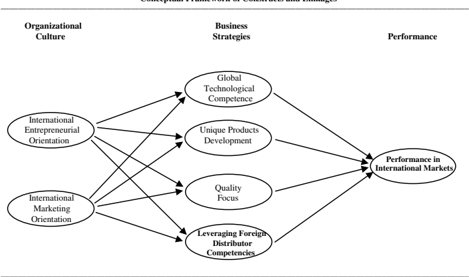
This study argues that born-global firms succeed because early internationalization is supported by an innovative culture and a distinctive set of organizational capabilities. Using qualitative case studies followed by a survey of 203 usable responses, the authors find that several capability links are significant and that these capabilities are associated with performance in international markets.
## Key findings
- The survey analysis found that international entrepreneurial orientation significantly predicted global technological competence with a standardized coefficient of 0.28; the link from international marketing orientation to global technological competence was not significant.
- Unique products development was significantly predicted by both international entrepreneurial orientation (0.19) and international marketing orientation (0.24).
- Quality focus was significantly predicted by both international entrepreneurial orientation (0.23) and international marketing orientation (0.35).
- Leveraging foreign distributor competences was significantly predicted by international marketing orientation (0.26) but not by international entrepreneurial orientation; these strategy variables were also significant drivers of performance in international markets: global technological competence (0.21), unique products development (0.14), quality focus (0.30), and leveraging foreign distributor competences (0.18).
## Methods
- The paper uses a two-phase design: first qualitative interviews/case studies to develop constructs and hypotheses, then a cross-industry field survey to test them.
- The qualitative phase included 33 professionals: 24 senior managers at early internationalizing firms, 6 scholars, and 3 international trade experts; the firms were mostly founded after 1985, sold half or more of their sales abroad, and had entered foreign markets within 3 years of founding.
- The survey was mailed to a random sample of 900 manufacturing firms in the United States founded in 1980 or later and exporting at least 25% of total production; 203 usable surveys were returned (about 23% response rate). The main analysis used LISREL8 path analysis, with exploratory factor analysis and confirmatory factor analysis for scale purification and validity checks.
## Limitations
- The paper states that “little empirical work” had been attempted on born globals and that there had been “almost no empirical research” on the factors driving their superior international performance.
- The study itself is focused on U.S. manufacturing firms that were selected using a 25% export threshold, so the evidence is tied to that sample and entry-mode context; this is evident from the text.
- The paper notes that the survey results are based on self-reported measures from responding firms; this is evident from the questionnaire-based design, though the paper does not frame it explicitly as a limitation.
Model-written summary. Check it against the paper before relying on it.
Integrity signals
Registry
Cites
Statistics
Figures
Verification
Claims the paper makes
0 Valid · 0 Not valid · 53 Not checked · 112 Own results and interpretations
A result the paper reports from its own data — it cites no other source for it, so there is none to check. The quote shows it is in the paper.
In the paper
“Despite the scarce resources typical of young firms, our findings reveal that born-global firms leverage a distinctive mix of orientations and strategies that allow them to succeed in diverse international markets.”
plainstates a cause- Asserted: passes — The authors put it forward as true.
- Checkable: passes — It can be checked against evidence.
- Load-bearing: passes — The paper’s conclusions depend on it.
- Based: passes — The paper gives a reason why it holds.
- Rests on an assumption not shown here.
A result the paper reports from its own data — it cites no other source for it, so there is none to check. The quote shows it is in the paper.
In the paper
“The critical role of marketing prowess overseas was also strongly emphasized by virtually all interviewees in the case studies.”
boosted- Asserted: passes — The authors put it forward as true.
- Checkable: passes — It can be checked against evidence.
- Load-bearing: unclear — It is unclear whether the paper’s conclusions depend on it.
- Based: passes — The paper gives a reason why it holds.
A result the paper states — it cites no source for it, so there is none to check. The quote shows it is in the paper.
In the paper
“Most interviewed firms exhibited strong technological capabilities in their respective product or industry categories.”
plain- Asserted: passes — The authors put it forward as true.
- Checkable: passes — It can be checked against evidence.
- Load-bearing: unclear — It is unclear whether the paper’s conclusions depend on it.
- Based: passes — The paper gives a reason why it holds.
A result the paper reports from its own data — it cites no other source for it, so there is none to check. The quote shows it is in the paper.
In the paper
“In general, the qualitative phase of the study revealed that born globals are likely to be formed by entrepreneurs who pursue foreign ventures with a strong marketing orientation.”
hedgedstates an association- Asserted: passes — The authors put it forward as true.
- Checkable: passes — It can be checked against evidence.
- Load-bearing: passes — The paper’s conclusions depend on it.
- Based: passes — The paper gives a reason why it holds.
A result the paper states — it cites no source for it, so there is none to check. The quote shows it is in the paper.
In the paper
“In contrast, born globals leverage a collection of fundamental intangible knowledge-based capabilities in the cultivation of foreign markets early in their evolution.”
plainstates a cause- Asserted: passes — The authors put it forward as true.
- Checkable: passes — It can be checked against evidence.
- Load-bearing: passes — The paper’s conclusions depend on it.
- Based: unclear — It is unclear why the paper says it holds.
- Rests on an assumption not shown here.
84 more claims
Create a free account to see all 165 claims and to verify the 3 references still open.
- It may state two separate claims as one. 33
- Probably not a substantial claim. 54
Citations
Cites
Evaluating Structural Equation Models with Unobservable Variables and Measurement Error
Fornell, C., & Larcker, D. F. (1981) · Journal of Marketing Research · doi:10.2307/3151312 · Cited by 109,314 · cited 2×
“Composite reliability was calculated using the procedures outlined by Fornell and Larcker (1981).”
MethodInfluentialEvaluating structural equation models with unobservable variables and measurement error
Fornell, C., & Larcker, D. F. (1981) · Journal of Marketing Research · doi:10.1177/002224378101800104 · Cited by 109,190
Firm Resources and Sustained Competitive Advantage
Barney, J. (1991) · Journal of Management · doi:10.1177/014920639101700108 · Cited by 48,334
(1994) · Journal of the American Dietetic Association · doi:10.1016/0002-8223(94)92216-0 · Cited by 45,910
Firm resources and sustained competitive advantage
Barney, J. B. (2004) · Advances in Strategic Management · doi:10.1016/s0742-3322(00)17018-4 · Cited by 38,152
Absorptive Capacity: A New Perspective on Learning and Innovation
Cohen, W. M., & Levinthal, D. A. (1990) · Administrative Science Quarterly · doi:10.2307/2393553 · Cited by 35,728
A resource‐based view of the firm
Wernerfelt, B. (1984) · Strategic Management Journal · doi:10.1002/smj.4250050207 · Cited by 25,635
The Theory of Economic Development
Schumpeter, J., & Backhaus, U. (2006) · The European Heritage in Economics and the Social Sciences · doi:10.1007/0-306-48082-4_3 · Cited by 22,506
An Evolutionary Theory of Economic Change.
Loasby, B. J., Nelson, R. R., & Winter, S. G. (1983) · The Economic Journal · doi:10.2307/2232409 · Cited by 21,366
A Dynamic Theory of Organizational Knowledge Creation
Nonaka, I. (1994) · Organization Science · doi:10.1287/orsc.5.1.14 · Cited by 17,809
Research works printed but not linked: 5
- Nikkei Sangyoo Shimbun (1995) Benchaa Shin Sedai (New Generation Ventures) , Nihon Keizai Shimbun: Tokyo.
- Nunnally, J.C. (1978) Psychometric Theory
- Porter, M.E. (1980) Competitive Strategy , The Free Press: New York.
- Rennie, M. (1993) 'Born global', McKinsey Quarterly (4): 45-52. Rosson, P. and Ford, I.D. (1982) 'Manufacturer-overseas distributor relations and export performance', Journal of International Business Studies 13 (2): 57-72.
- Schumpeter, J. (1939) Business Cycles , Vol. 1 McGraw-Hill: New York.
Cited by
Items 1,001–1,100 of 3,020
Absorptive capacity and in-company routines: modelling knowledge creation in the tourism industry
Ponce-Espinosa, G., Peiró‐Signes, Á., & Segarra‐Oña, M. (2020) · Knowledge Management Research & Practice · doi:10.1080/14778238.2020.1796544 · Cited by 24
“This implies the intensive use of knowledge (Knight & Cavusgil, 2004).”
BackgroundPidduck, R. J., Clark, D. R., & Busenitz, L. W. (2022) · Contributions to management science · doi:10.1007/978-3-030-85950-3_2 · Cited by 30
External resource provision and the international performance of SMEs – A contextual analysis
Child, J., Narooz, R., Hsieh, L., Elbanna, S., Karmowska, J., Marinova, S. T., Puthusserry, P. N., Tsai, T., & Zhang, Y. (2022) · Journal of International Management · doi:10.1016/j.intman.2021.100924 · Cited by 26
Trade openness, global competitiveness, and catching up between the European Union countries
Marčeta, M., & Bojnec, Š. (2022) · Review of International Business and Strategy · doi:10.1108/ribs-12-2021-0155 · Cited by 33
Internationalization and innovation: A multilevel meta‐analysis of national sentiments
Wu, S., & Fan, D. (2024) · Journal of Product Innovation Management · doi:10.1111/jpim.12725 · Cited by 30
Dung, L. T., & Dung, T. T. H. (2024) · Journal of Innovation and Entrepreneurship · doi:10.1186/s13731-024-00391-7 · Cited by 50
“SMEs’ survival and long-term success ultimately depend on their ability to adapt their BM and innovation for internationalisation (Codini et al., 2023; Ferreira et al., 2024; Knight & Cavusgil, 2004; Massa et al., 2014).”
BackgroundRetractedHandbook on International Alliance and Network Research
Torkkeli, L., Saarenketo, S., & Nummela, N. (2015) · Edward Elgar Publishing eBooks · doi:10.4337/9781783475483 · Cited by 20
How to measure born-global firms’ orientation towards international markets?
Torres-Ortega, R., Rialp, A., Criado, J. R., & Stoian, M.-C. (2015) · Revista española de investigación de marketing · doi:10.1016/j.reimke.2015.04.001 · Cited by 25
“Given their strong technological orientation and the unique dynamic conditions associated with their environment, Knight and Cavusgil (2004) and Weerawardena et al. (2007) concluded that dynamic capabilities are perhaps the most appropriate perspective for studying BGs.”
BackgroundResultInfluentialTheoretical Perspectives on the Internationalization of Firms
Rask, M., Strandskov, J., & Håkonsson, D. D. (2008) · Journal of Teaching in International Business · doi:10.1080/08975930802427502 · Cited by 34
“…networks to explain Born Global’s accelerated internationalization process (Freeman & Cavusgil, 2007; Gabrielsson & Manek Kirpalani, 2004; Knight & Cavusgil, 2004; Luostarinen & Gabrielsson, 2006; Madsen & Servais, 1997; Mainela & Puhakka, 2006; Moen & Servais, 2002; Moen, 2002; Moen,…”
BackgroundInternationalization of biotechnology start-ups: Geographic location and mimetic behaviour
Delerue, H., & Lejeune, A. (2011) · International Small Business Journal Researching Entrepreneurship · doi:10.1177/0266242611402565 · Cited by 25
“Mimetic behaviour can explain why SMEs are participating increasingly in international activities shortly after their inception, known as the international born-global phenomenon (Knight and Cavusgil, 2004).”
BackgroundAlliances, Open Innovation and Outside-in Management
Arrigo, E. (2012) · Symphonya Emerging Issues in Management · doi:10.4468/2012.2.05arrigo · Cited by 27
The Internationalisation of the Small and Medium‐sized Firm 1
Rodríguez, J. (2007) · Prometheus · doi:10.1080/08109020701531411 · Cited by 21
Moohammad, A. Y., Yusof, N., & Kamal, E. M. (2014) · Cited by 36
International Entrepreneurship Theory: Past, Present and Way Forward
Allen, I. (2016) · Entrepreneurial Business and Economics Review · doi:10.15678/eber.2016.040406 · Cited by 35
“Reports have indicated that international entrepreneurial orientation (IEO) is a vital cultural attribute of so-called born global firms (Knight & Cavusgil, 2004, p. 129), however other researchers believe that IEO is an immanent element of international entrepreneurship theory in general (Wach,…”
BackgroundEMNEs venturing into advanced economies: Findings from comparative cases of two Indian MNEs
Parthasarathy, S., Momaya, K. S., & Jha, S. K. (2017) · Thunderbird International Business Review · doi:10.1002/tie.21890 · Cited by 25
Dahooie, J. H., Meidutė‐Kavaliauskienė, I., Vanaki, A. S., Podviezko, A., & Abadi, E. B. J. (2020) · Management Decision · doi:10.1108/md-09-2019-1156 · Cited by 23
A double-edged sword? Founder Teams' Prior International Experience and INV International Scale-up
Hashai, N., & Zahra, S. A. (2022) · Journal of World Business · doi:10.1016/j.jwb.2022.101309 · Cited by 24
Gupta, V. K., Javadian, G., & Jalili, N. (2014) · Journal of International Entrepreneurship · doi:10.1007/s10843-014-0120-x · Cited by 27
Kaur, K., & Kumar, S. (2024) · Management Review Quarterly · doi:10.1007/s11301-024-00478-1 · Cited by 58
“Similar to assertions made regarding internation-alization, innovation has been found to have a tangible effect on SMEs and is likely to expand and flourish in global marketplaces (Knight and Cavusgil 2004).”
THURNER, T. W., Анатольевич, Г. М., & Roud, V. (2015) · Journal of International Entrepreneurship · doi:10.1007/s10843-015-0146-8 · Cited by 24
“Born-globals distinguish themselves from other early internationalization strategies as they do not gradually accumulate capabilities and resources (Knight and Cavusgil 2004) but instead pursue business opportunities on international markets right from the start.”
BackgroundInfluentialMeet the “ born efficient ” financial institutions: Evidence from the boom years of US REITs
Isik, I., & Topuz, J. C. (2017) · The Quarterly Review of Economics and Finance · doi:10.1016/j.qref.2017.07.017 · Cited by 26
Small businesses’ internationalization: International readiness in the context of Asian countries
Pinho, J. C., Martins, L., & Soares, A. M. (2018) · Asia-Pacific Journal of Business Administration · doi:10.1108/apjba-05-2017-0043 · Cited by 33
“This perspective is very much in line with the resource-based view (RBV) that considers resources, learning, and knowledge as important drivers of internationalization (Knight and Cavusgil, 2004).”
BackgroundMethodInfluentialThe drivers of the post-entry internationalisation commitment of small and medium-sized enterprises
Zahoor, N., & Lew, Y. K. (2021) · International Small Business Journal Researching Entrepreneurship · doi:10.1177/02662426211042775 · Cited by 26
“To ensure their focus on the post-entry stage, the respondents were asked to evaluate the degree to which their firms had made investments during the first 3 years of initial international market entry, relative to their expectations (Khalid and Bhatti, 2015; Knight and Cavusgil, 2004).”
BackgroundFaroque, A. R., Sultana, H., Ahmed, J. U., Ahmed, F. U., & Rahman, M. (2021) · Critical Perspectives on International Business · doi:10.1108/cpoib-06-2020-0076 · Cited by 27
International business opportunity recognition and development
Gregorio, D. D., Musteen, M., & Thomas, D. E. (2021) · International Journal of Entrepreneurial Behaviour & Research · doi:10.1108/ijebr-03-2021-0227 · Cited by 28
Explaining the Internationalization of iBusiness Firms
Brouthers, K. D., Geisser, K. D., & Rothlauf, F. (2018) · JIBS special collections · doi:10.1007/978-3-319-74228-1_7 · Cited by 29
Deligianni, I. (2022) · International Business Review · doi:10.1016/j.ibusrev.2022.102051 · Cited by 24
Reckendrees, A., Gehlen, B., & Marx, C. (2022) · Business History · doi:10.1080/00076791.2022.2118718 · Cited by 24
“In retrospect, FSCs show similarities with ‘born global’ companies (Knight & Cavusgil, 2004) or ‘International New Ventures’ (Oviatt & McDougall, 1994; Autio, 2005), new organisational forms of the second ‘wave of globalisation’ (Jones & Khanna, 2006).11 Perhaps most importantly, historians stress…”
BackgroundDjibo, B. O. S., Horsey, E. M., & Zhao, S. (2023) · Journal of the Knowledge Economy · doi:10.1007/s13132-023-01120-3 · Cited by 27
“To select this study’s sample, the author followed prior studies’ sampling recommendations (Gerschewski et al., 2018; Knight & Cavusgil, 2004; Wiklund & Shepherd, 2011) and developed a sampling framework from Benin’s Ministry of Trade and Industry database.”
Millán, A. G. L., Martín, J. G., & García-Legaz, F. C. (2023) · Technological Forecasting and Social Change · doi:10.1016/j.techfore.2023.122569 · Cited by 25
Crespo, N. F., Crespo, C. F., & Silva, G. M. (2023) · Technological Forecasting and Social Change · doi:10.1016/j.techfore.2023.123084 · Cited by 27
Huggins, R., Prokop, D., Steffenson, R., Johnston, A., & Clifton, N. (2014) · Journal of General Management · doi:10.1177/030630701404000103 · Cited by 26
Emerging Market Multinationals: Managing Operational Challenges for Sustained International Growth
Cuervo-Cazurra, Á., Newburry, W. E., & Park, S. H. (2016) · Cited by 24
Internationalization and innovation: The case of a born global from Brazil
Zonta, T. C., & Amal, M. (2018) · Internext · doi:10.18568/1980-4865.13163-76 · Cited by 23
“Born Globals are entrepreneurial start-ups that, from or near their inception, seek to derive a considerable proportion of their revenue from the sale of products in international markets (Knight & Cavusgil, 2004).”
BackgroundFerreira, J., Cardim, S., & Branco, F. (2018) · Iberian Conference on Information Systems and Technologies (CISTI) · doi:10.23919/cisti.2018.8399271 · Cited by 41
“developing a competitive advantage [46] [47].”
Hånell, S. M., Nordman, E. R., & Mattsson, L. (2020) · International Marketing Review · doi:10.1108/imr-02-2019-0086 · Cited by 24
International Entrepreneurial Orientation Disposition: Insights into Venture Internationalization
Clark, D. R., & Covin, J. G. (2021) · Emerald Group Publishing Limited eBooks · doi:10.1108/s1074-754020210000022004 · Cited by 25
The international entrepreneurial firms' social networks
Ferreira, M. P., Santos, J. C., & Serra, F. A. R. (2010) · Cadernos EBAPE BR · doi:10.1590/s1679-39512010000100009 · Cited by 28
A Critical Review of Three Theoretical Approaches on Knowledge Transfer in Cooperative Alliances
Ding, Q., Akoorie, M. E. M., & Pavlovich, K. (2009) · International Journal of Business and Management · doi:10.5539/ijbm.v4n1p47 · Cited by 30
R&D and the Export Decision of New Firms
Braymen, C., Briggs, K., & Boulware, J. (2011) · Southern Economic Journal · doi:10.4284/0038-4038-78.1.191 · Cited by 28
Building and transforming an emerging market global enterprise: Lessons from the Infosys journey
Gupta, S., & Shapiro, D. (2013) · Business Horizons · doi:10.1016/j.bushor.2013.10.007 · Cited by 20
Hartsfield, S., Johansen, D., & Knight, G. (2017) · International Business Research · Cited by 35
Self-citationEarly internationalization patterns and export market persistence: a pseudo-panel data analysis
Vaillant, Y., Lafuente, E., & Bayon, M. C. (2018) · Small Business Economics · doi:10.1007/s11187-018-0071-z · Cited by 25
“In recent years, early internationalizing firms, known as ‘born-global firms’ or ‘international new ventures’, have received increased attention (Kalinic and Forza 2012; Knight and Cavusgil 2004; Knight and Liesch 2016; McDougall et al. 1994; Oviatt and McDougall 1994).”
BackgroundInstitutional knowledge in Latin American SMEs
del Pino, C. P., Felzensztein, C., & Chetty, S. (2020) · Journal of Small Business Management · doi:10.1111/jsbm.12518 · Cited by 21
“This is done to begin international operations more quickly (Belso-Martinez, 2006; Crick, 2009; Etemad, 2016; Knight & Cavusgil, 2004; Oviatt & McDougall, 2005).”
BackgroundInsights into the creation of a successful MNE innovation cluster
O’Dwyer, M., O’Malley, L., Murphy, S. T., & McNally, R. C. (2015) · Competitiveness Review An International Business Journal incorporating Journal of Global Competitiveness · doi:10.1108/cr-08-2014-0026 · Cited by 22
“Innovation, knowledge and capabilities have been central themes in strategy and performance research (Knight and Cavusgil, 2004) and although some large organisations may be capable of innovation-based corporate entrepreneurship (Kelley et al.”
BackgroundThe internationalisation of European SMEs
Łoszczyków-Stachowiak, D., & Colantone, I. (2011) · Cited by 48
Zahoor, N., Khan, H., Shamim, S., & Puthusserry, P. N. (2023) · IEEE Transactions on Engineering Management · doi:10.1109/tem.2023.3273028 · Cited by 30
Yang, H., & Stoian, M.-C. (2024) · International Business Review · doi:10.1016/j.ibusrev.2024.102299 · Cited by 25
Born Globals: Investigating The Influence Of Their Business Models On Rapid Internationalization
Bouncken, R. B., Muench, M., & Kraus, S. (2015) · International Business & Economics Research Journal (IBER) · doi:10.19030/iber.v14i2.9109 · Cited by 27
What is the “right” market orientation for new entrepreneurial ventures? A five-country study
Brettel, M., Engélen, A., & Oswald, M. (2011) · Journal of Business Economics · doi:10.1007/s11573-011-0511-6 · Cited by 20
An international learning typology: strategies and outcomes for internationalizing firms
Åkerman, N. (2014) · Baltic Journal of Management · doi:10.1108/bjm-12-2013-0176 · Cited by 27
Tuomisalo, T. (2019) · Journal of International Entrepreneurship · doi:10.1007/s10843-019-00247-2 · Cited by 26
Chung, J. Y., & Yoon, W. (2020) · Managerial and Decision Economics · doi:10.1002/mde.3195 · Cited by 23
Igwe, P. A., Rugara, D. G., & Rahman, M. (2021) · Administrative Sciences · doi:10.3390/admsci12010003 · Cited by 40
Zahra, S. A., & Hashai, N. (2022) · Journal of International Business Policy · doi:10.1057/s42214-021-00128-3 · Cited by 22
“…2022 economic bases and promote technological development, many of these countries have also enacted policies that encourage their local entrepreneurs to scale up to internationalize their operations, or even enter international markets from inception (Hashai, 2011a; Knight & Cavusgil, 2004).”
BackgroundEntrepreneurship in Asia: Entrepreneurship knowledge when East meets West
Wu, J., Si, S., & Liu, Z. (2022) · Asian Business & Management · doi:10.1057/s41291-022-00187-1 · Cited by 28
“Using the entrepreneurial process to create wealth was assumed to be easy to attempt under conditions of uncertainty (Knight & Cavusgil, 2004).”
Pillai, R. D., Wang, P., & Kuah, A. T. H. (2022) · Thunderbird International Business Review · doi:10.1002/tie.22315 · Cited by 17
Mohamad, A., Rizal, A. M., Kamarudin, S., & Sahimi, M. (2022) · Sustainability · doi:10.3390/su142316119 · Cited by 46
Speed of internationalization of new ventures and survival in export markets
Gripsrud, G., Hunneman, A., & Solberg, C. A. (2023) · International Business Review · doi:10.1016/j.ibusrev.2023.102121 · Cited by 21
Huang, S., & Siao, H.-R. (2023) · Sustainability · doi:10.3390/su151612147 · Cited by 34
Disruptive knowledge in international business research: A pipe dream or attainable target?
Tung, R. L., Knight, G., Ghauri, P. N., Prashantham, S., & Fang, T. (2023) · Journal of International Business Studies · doi:10.1057/s41267-023-00656-5 · Cited by 22
Self-citationInternationalization, internalization and the performance of US biopharmaceutical SMEs
Li, L., Li, D., & Shi, W. (2011) · Multinational Business Review · doi:10.1108/15253831111134830 · Cited by 24
“Although SMEs tend to be more entrepreneurial and pay more personal attention to details than large firms ( Knight and Cavusgil, 2004”
BackgroundInternational responsiveness of entrepreneurial new ventures from three leading emerging economies
Khavul, S., Prater, E. L., & Swafford, P. M. (2012) · International Journal of Operations & Production Management · doi:10.1108/01443571211274503 · Cited by 24
“The second type internationalize after they establish a domestic customer base (Oviatt and McDougall, 1994; Knight and Cavusgil, 2004; Fan and Phan, 2007) and retain their primary focus on domestic operations.”
BackgroundPuthusserry, P. N., Khan, Z., & Rodgers, P. (2018) · International Marketing Review · doi:10.1108/imr-01-2017-0001 · Cited by 30
“Such firms generally have the characteristics of being young, knowledge-based organizations, which develop highly innovative, technology-centred products for global markets (Almor, 2011; Knight and Cavusgil, 2004; McDougall and Oviatt, 2000; Oviatt and McDougall, 1994, 1995).”
BackgroundHow Theory Can Inform Strategic Management Education and Learning
Buckley, P. J. (2018) · Academy of Management Learning and Education · doi:10.5465/amle.2017.0076 · Cited by 28
Lee, S., & Chung, Y. K. (2018) · Journal of International Entrepreneurship · doi:10.1007/s10843-018-0234-7 · Cited by 21
Social Media and Small Entrepreneurial Firms’ Internationalization
Hurmelinna‐Laukkanen, P., Haapanen, L., & Holma, S. (2020) · Exploring diversity in entrepreneurship · doi:10.1007/978-3-030-43453-3_8 · Cited by 27
The International Marketing Strategy of Luxury Food SMEs: The Case of Truffle
Milanesi, M., Gigliotti, M., & Runfola, A. (2020) · Journal of Food Products Marketing · doi:10.1080/10454446.2020.1854916 · Cited by 21
Vlačić, B., Santos, I. G. A., Silva, S. C. L. D. C. E., & González‐Loureiro, M. (2022) · International Entrepreneurship and Management Journal · doi:10.1007/s11365-021-00767-1 · Cited by 22
Kumar, N., & Yakhlef, A. (2014) · Journal of Entrepreneurship in Emerging Economies · doi:10.1108/jeee-06-2014-0018 · Cited by 28
Cabrol, M., & Nlemvo, F. (2013) · Revue de l’Entrepreneuriat · doi:10.3917/entre.113.0111 · Cited by 21
Manaf, A. H. A., & Latif, L. A. (2014) · Mediterranean Journal of Social Sciences · doi:10.5901/mjss.2014.v5n20p648 · Cited by 30
“…progression in product life-cycle, and the expansion in complexity of associations with suppliers, customers, employees, and government (Kotabe and Murray, 2004; Knight and ISSN 2039-2117 (online) ISSN 2039-9340 (print) Mediterranean Journal of Social Sciences MCSER Publishing,…”
BackgroundInitiating forces and success factors of born global firms
Holtbrügge, D., & Wessely, B. (2009) · European J of International Management · doi:10.1504/ejim.2009.024324 · Cited by 23
Kumar, N. (2013) · Asian Business & Management · doi:10.1057/abm.2013.20 · Cited by 22
Chamináde, C., & Fuentes, C. D. (2012) · Innovation and Development · doi:10.1080/2157930x.2012.713195 · Cited by 21
“Both the coordination of R&D and innovation activities globally as well as the engagement in research networks requires the introduction of organizational innovations at the firm level (Dunning and Narula, 1995; Knight and Cavusgil, 2004; Sabiola and Zanfei, 2009).”
BackgroundEntrepreneurial approaches to the internationalisation of Portugal’s hotel industry
de Correia, R. J. C., Lengler, J., & Mohsin, A. (2019) · International Journal of Contemporary Hospitality Management · doi:10.1108/ijchm-09-2017-0567 · Cited by 22
Internationalisation path heterogeneity and growth for international new ventures
Guo, B., & Wang, Z. (2020) · International Small Business Journal Researching Entrepreneurship · doi:10.1177/0266242620965792 · Cited by 19
Ambilichu, C. A., Omoteso, K., & Yekini, L. S. (2022) · European Management Review · doi:10.1111/emre.12548 · Cited by 36
Adomako, S. (2023) · Thunderbird International Business Review · doi:10.1002/tie.22353 · Cited by 21
Figueiredo, M., Ferreira, J. J., & Vrontis, D. (2023) · Journal of International Management · doi:10.1016/j.intman.2023.101099 · Cited by 34
Osei-Bonsu, N. (2014) · Cited by 18
Innovation Processes as a Stimulant of Internationalisation Process of Firms
Kosała, M. (2015) · Entrepreneurial Business and Economics Review · doi:10.15678/eber.2015.030206 · Cited by 28
Service innovation and internationalization in SMEs: Implications for growth and performance
Kunttu, A., & Torkkeli, L. (2015) · management revue · doi:10.5771/0935-9915-2015-2-83 · Cited by 18
FOREIGN MARKET KNOWLEDGE, COUNTRY SALES BREADTH AND INNOVATIVE PERFORMANCE OF EMERGING ECONOMY FIRMS
Williams, C., Colovic, A., & ZHU, J. (2016) · International Journal of Innovation Management · doi:10.1142/s1363919616500596 · Cited by 22
“…scholars more recently have shown how firms can rapidly internationalize through networks (Chetty and Blankenburg Holm, 2000; Johanson and Vahlne, 2009; Oviatt and McDougall, 2005) and expand into multiple countries in a short space of time (Knight and Cavusgil, 2004; Oviatt and McDougall, 1994).”
BackgroundPolarizing Effects of Early Exporting on Exit
Deng, Z., Jean, R. “., & Sinkovics, R. R. (2016) · Management International Review · doi:10.1007/s11575-016-0292-9 · Cited by 22
“Because different modes will lead firms to encounter different liabilities of foreignness, it may be an interesting avenue to study these alternative entry modes, even though exporting remains the dominant entry mode of young ventures (Knight and Cavusgil 2004).”
BackgroundConceptualizing Network Configurations as Dynamic Capabilities for Emerging Market Born Globals
Ngasri, N. E. M., & Freeman, S. (2018) · International Studies of Management and Organization · doi:10.1080/00208825.2018.1443742 · Cited by 21
“…for emerging markets (EM) BGs. BGs are the types of SMEs that typically originate from the knowledgeintensive or high-tech industries and rapidly internationalize through extensive use of networking activities (Knight and Cavusgil 2004), therefore providing a suitable lens for this study.”
BackgroundInfluentialWITTKOP, A., Zulauf, K., & Wagner, R. (2017) · RePEc: Research Papers in Economics · doi:10.17170/kobra-202107024227 · Cited by 18
Who is in and who is out? Integration of technological knowledge in the multinational corporation
Blomkvist, K., Kappen, P., & Zander, I. (2018) · Industrial and Corporate Change · doi:10.1093/icc/dty024 · Cited by 21
Running out of steam on emerging markets? The limits of MNE firm-specific advantages in China
Curran, L., & Ng, L. K. (2018) · Multinational Business Review · doi:10.1108/mbr-11-2017-0098 · Cited by 20
Sharing knowledge processes for promoting innovation in small businesses
Harel, R., Schwartz, D., & Kaufmann, D. (2020) · European Journal of Innovation Management · doi:10.1108/ejim-04-2020-0122 · Cited by 23
Foroudi, P., Gupta, S., Patel, P., Batsakis, G. K., Väätänen, J., & Czinkota, M. (2021) · International Business Review · doi:10.1016/j.ibusrev.2021.101893 · Cited by 27
Openness strategies and the success of international entrepreneurship
Gimenez‐Fernandez, E. M., Ferraris, A., Troise, C., & Sandulli, F. D. (2022) · International Journal of Entrepreneurial Behaviour & Research · doi:10.1108/ijebr-09-2021-0745 · Cited by 22
Do they matter? The role of non-academics in the internationalization of academic spin-offs
Franco‐Leal, N., Soetanto, D. P., & Camelo‐Ordaz, C. (2016) · Journal of International Entrepreneurship · doi:10.1007/s10843-016-0184-x · Cited by 18
“However, literature has also highlighted the lack of resources and time as factors that might characterize most businesses that operate internationally from their birth (Knight and Cavusgil 2004; Sapienza et al. 2006; Kumar 2012).”
BackgroundCasado‐Belmonte, M. D. P., Marín-Carrillo, G. M., Terán-Yépez, E., & Capobianco-Uriarte, M. D. L. M. (2020) · Publications · doi:10.3390/publications8010011 · Cited by 29
“Patterns or pathways encompass different models, from the traditional Uppsala model to born global or international new ventures (INVs) [42,69,61] the born-again global firms [70].”
BackgroundThe Internationalization of Chinese Firms
Zheng, N. (2013) · White Rose eTheses Online (University of Leeds, The University of Sheffield, University of York) · Cited by 18
Frimpong, K., Adomako, S., Nguyen, N. P., & Al-Shuridah, O. M. (2024) · Business Strategy and the Environment · doi:10.1002/bse.4043 · Cited by 23
Jafari‐Sadeghi, V. (2021) · International Journal of Entrepreneurship and Small Business · doi:10.1504/ijesb.2021.10039076 · Cited by 35
Aithal, P. S. (2017) · International Journal of Management Technology and Social Sciences · doi:10.47992/ijmts.2581.6012.0028 · Cited by 17
“[10] and Globalisation, economic geography and the strategy of multinational enterprises through scanning home country environment is studied by Buckley et al during 2004 [11].”
Joo, H.-Y., & Min, H. (2022) · Benchmarking An International Journal · doi:10.1108/bij-12-2021-0754 · Cited by 31
The theory of multinational enterprises in the digital era: state-of-the-art and research priorities
Li, F., Chen, Y., Ortiz, J., & Wei, M. (2022) · International Journal of Emerging Markets · doi:10.1108/ijoem-03-2021-0366 · Cited by 24
Metadata
- Authors
- Knight, G. A., & Cavusgil, S. T.
- Affiliations
- Florida State University (US)
- Corresponding author
- Knight, Gary A
- ORCID
- Knight, Gary A
- Venue
- Journal of International Business Studies
- Published
- 2004-01-08
- Volume
- 35
- Issue
- 2
- Pages
- 124-141
- ISSN
- 0047-2506 (ISSN-L)
- 1478-6990
- OpenAlex
- W2127709152
- Semantic Scholar
- d24960b5342d0dd3b86be002ab18a80e7b6fb5c9
- Cited by
- 4,295
- References
- 102
- Citations by year
- 2026: 261 · 2025: 233 · 2024: 216 · 2023: 242 · 2022: 227 · 2021: 274 · 2020: 286 · 2019: 260 · 2018: 291 · 2017: 258 · 2016: 290 · 2015: 246 · 2014: 234 · 2013: 215 · 2012: 171
- FWCI
- 115.46
- Type
- journal article
- Language
- en
- Update notices
- correction (2004-07-16)
- Open access
- bronze
- doi.org
- Licence
- www.springer.com/tdm (tdm)
- Locations
- Journal of International Business Studies (publishedVersion)
- Research Explorer (The University of Manchester) (publishedVersion)
- RePEc: Research Papers in Economics (submittedVersion)
- Funders
- Michigan State University
- College of Engineering, Michigan State University
- Topics
- Social Sciences › Business, Management and Accounting › Strategy and Management › International Business and FDI
- Social Sciences › Business, Management and Accounting › Strategy and Management › Innovation and Knowledge Management
- Social Sciences › Communication › International Student and Expatriate Challenges
- Keywords
- born global firms, early internationalization, organizational capabilities, innovation, innovation culture, international business strategy, international success, young firms, internationalization of firms
About these checks
Registry, retraction, Cites and statistics results are computed, not judged, with one exception: a printed reference that no index lists is read once by a model before it counts as a citation error. Claims are extracted by a model and kept only when their quote appears verbatim in the text; each cited source is then checked, with a model’s help, for whether it says what the claim relies on. Those verdicts can be wrong — read the claim’s quote and the cited source before relying on one.
A language model drew the claims from the paper on 2026-10-10, under version 3 of the claim definition (model deepseek-v4.1-flash, prompt extract-v3).
A second model labelled each claim on 2026-10-10 (model jev-1.13-20260917, definition revision gold-guideline-v0.2).
Statistics and arithmetic are recomputed, not judged.
Confidence bands are shown only for fields calibrated on our annotated test set. None is calibrated yet, so no band is shown.
What counts as a claim ›How we measure confidence ›How we check this ›
Are you an author, or do you see a problem with this page? Request a review
Data sources
Bibliographic data: Semantic Scholar, OpenAlex, Crossref.
Contains information from the Semantic Scholar Academic Graph Datasets, made available under the ODC Attribution License (ODC-BY 1.0).
Semantic Scholar’s data is described in: Kinney, R., et al. (2023). The Semantic Scholar Open Data Platform. arXiv:2301.10140.
