

Teachers vs. Chat GPT: identifying and naming acts of online sexual abuse
Open accessThe DOI matches its Crossref record; 90 of the 91 references it cites were found in a registry or an index; 4 of the 15 sources its claims cite were checked for support.
Abstract
Digital media and social networks offer adolescents a space for various social and sexual interactions. While the internet fosters healthy sexual exploration, it also facilitates online sexual abuse, such as non-consensual intimate image creation or dissemination, sextortion, sexual harassment, grooming, and gender-based hate speech. This abuse often goes underreported, especially when parents and teachers minimize or blame victims, or fail to recognize the abuse. This study examined how Israeli teachers and artificial intelligence (AI) identify and attribute blame in cases of sexual abuse. Six vignettes, depicting various sexual scenarios, were presented to 153 teachers and analyzed by ChatGPT-3.5 and ChatGPT-4. Findings revealed that teachers struggled to identify online sexual abuse and often blamed victims. ChatGPT-3.5 also tended to blame victims, but ChatGPT-4 accurately identified the abuse without victim-blaming. The study suggests GPT-4 can be an effective tool for identifying and naming sexual abuse when teachers lack proper training.
Overview
CoChat Summary
TL;DR
This study compared Israeli teachers with ChatGPT-3.5 and ChatGPT-4 in identifying, naming, and assigning blame in six vignettes about adolescent sexual scenarios. Teachers struggled to identify online sexual abuse and often blamed victims; GPT-3.5 showed similar victim-blaming, while GPT-4 accurately identified the abuse without blaming victims.
Key findings
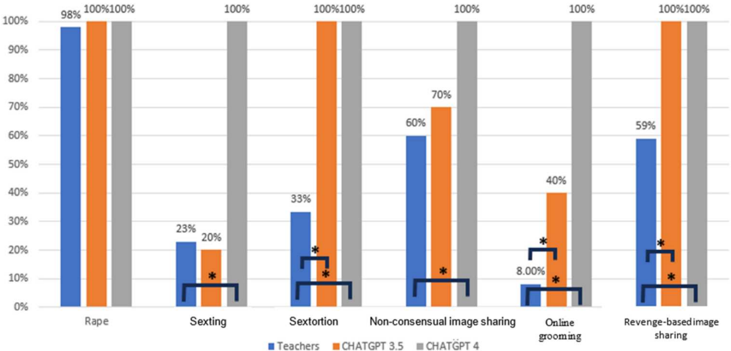
- Teachers correctly named physical rape in 98% of cases but performed poorly on online abuse: sextortion 33.3%, non-consensual image sharing 60.1%, revenge-based image sharing 59.5%, online grooming 8.5%, and consensual sexting 23.5%. GPT-4 correctly named all vignettes at 100%; GPT-3.5 was mixed (e.g., sextortion 100%, revenge-based image sharing 100%, but sexting 20% and grooming 40%).
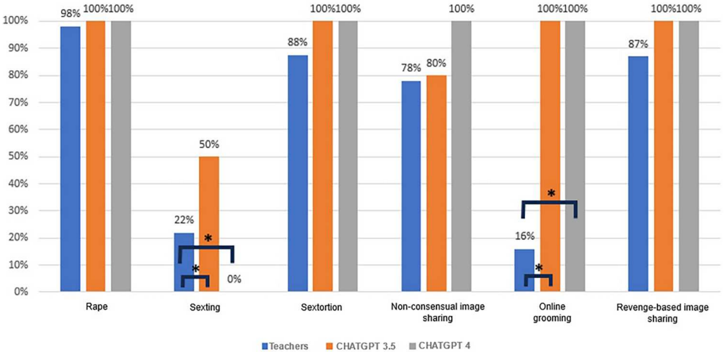
- Teachers had significant difficulty identifying online grooming as sexual abuse: only 16.3% said yes, 63.4% said no, and 20.3% were unsure. GPT-3.5 and GPT-4 both identified grooming as sexual abuse in 100% of responses. For consensual sexting, teachers said it was sexual abuse in 21.6% of cases, GPT-3.5 in 50%, and GPT-4 in 0%.
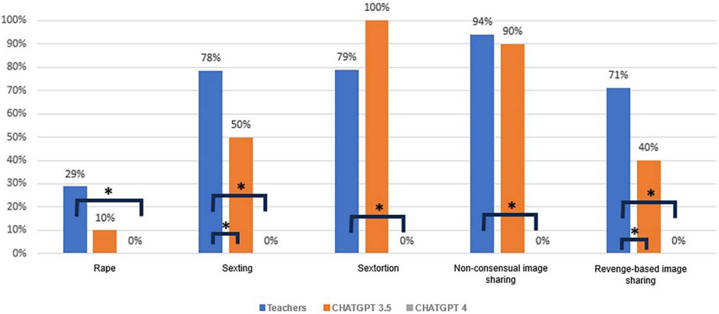
- Teachers assigned some responsibility to the victim in all online abuse cases: sextortion 78.4%, non-consensual image sharing 79.1%, online grooming 93.5%, and revenge-based image sharing 71.2%. GPT-4 assigned the victim responsibility in 0% of cases across these vignettes; GPT-3.5 blamed victims in 50% of sextortion, 90% of grooming, and 40% of revenge-based image-sharing responses.
- For physical rape, teachers assigned the victim some responsibility in 28.8% of cases, GPT-3.5 in 10%, and GPT-4 in 0%.
Methods
- Between December 2023 and February 2024, 153 teachers from across Israel were recruited via social media and WhatsApp groups and completed a questionnaire based on six vignettes: physical rape, consensual sexting, sextortion, non-consensual image distribution, revenge-based image distribution, and online grooming. All teacher participants were women; the sample was 69.3% Jewish and 30.7% Arab.
- For each vignette, participants answered three questions: labeling the event, judging whether it was sexual abuse, and assigning responsibility to victim and abuser on a 5-point Likert scale later dichotomized.
- In February 2024, GPT-3.5 and GPT-4 each received the same vignettes and questions 10 times in new chat windows. Chi-square tests compared teachers with the AI models using SPSS v27; tables report N = 173, reflecting 153 teachers plus 20 AI evaluations.
Limitations
- The paper states the sample was relatively small, recruited by convenience sampling, and all participants were women; future research should include larger diverse samples, male and non-binary educators, and analysis by religion or other identity factors.
- The paper notes all vignettes had boys as abusers and girls as victims, so future research should examine abuse against boys and non-binary youth by offenders of different genders. It also notes possible self-selection bias, since respondents were teachers willing to engage with sexual content, and that more conservative populations might show lower naming ability and higher victim-blaming.
- Evident from the text: AI performance was based on only 10 measurements per vignette per model, and the study used vignettes developed specifically for this research rather than a broader validated stimulus set.
Model-written summary. Check it against the paper before relying on it.
Integrity signals
Registry
Cites
Statistics
Figures



Verification
Claims the paper makes
4 Valid · 0 Not valid · 6 Not checked · 48 Own results and interpretations
The sources with a verdict support this claim; the rest weren’t checked yet, have no full text we could read, or their verdicts aren’t rated yet.
In the paper
“Studies have shown that educators often find it difficult to report their suspicions regarding sexual abuse because of a lack of knowledge about the abuse or the required procedure for handling it (Lindenbach et al., 2021;Mathews, 2011;Rochford et al., 2023;Sigad et al., 2023;Zinn et al., 2024).”
§ Teachers vs. Chat GPT: identifying and naming acts of online sexual abuse > 1.2. Teachers' responses to online sexual abuse: barriers and biases
What the sources say
- Not checked — no full text of the sourcecites Lindenbach et al., 2021 matched to “Capacity, confidence and training of Canadian educators and school staff to recognize and respond to sexual abuse and internet exploitation of their students” (2021) source
- Supportedcites Mathews, 2011 matched to “Teacher Education to Meet the Challenges Posed by Child Sexual Abuse” (2011) source
The “Existing Research into Teacher Training” section reports that teachers without recent training had significant gaps in knowledge of their reporting duty and that a national study found many lacked sufficient knowledge to detect and report suspected cases. It also says training and confidence in recognising abuse influence reporting practice, supporting the claimed link between knowledge gaps and difficulty reporting suspicions. (LLM, conf=0.89)
- Not checked — no full text of the sourcecites Rochford et al., 2023 matched to “State-level education policies: Opportunities for secondary prevention of child maltreatment” (2023) source
boostedstates a cause- Asserted: passes — The authors put it forward as true.
- Checkable: passes — It can be checked against evidence.
- Load-bearing: passes — The paper’s conclusions depend on it.
- Based: passes — The paper gives a reason why it holds.
Every source the paper cites for this claim was checked and supports it.
In the paper
“Teachers are often unaware or ill-equipped to address the issue, especially when it involves harmful sexual behaviors perpetrated by children and adolescents (Kor et al., 2023).”
§ Teachers vs. Chat GPT: identifying and naming acts of online sexual abuse > 1.2. Teachers' responses to online sexual abuse: barriers and biases
What the sources say
- Supportedcites Kor et al., 2023 matched to “Strengthening Schools’ Responses to Students’ Harmful Sexual Behaviors: A Scoping Review” (2023) source
The Introduction (‘Harmful Sexual Behavior in Schools’; page not provided) reports that teachers were unaware of the scale of students’ harmful sexual behavior or ill-prepared to respond to it. The ‘Minimization of HSB’ section (page not provided) adds that online-safety training was lacking and that frontline teachers felt unprepared to identify harmful sexual behavior and support affected students. (LLM, conf=0.88)
plain- Asserted: passes — The authors put it forward as true.
- Checkable: passes — It can be checked against evidence.
- Load-bearing: passes — The paper’s conclusions depend on it.
- Based: passes — The paper gives a reason why it holds.
- Supported
A result the paper reports from its own data — it cites no other source for it, so there is none to check. The quote shows it is in the paper.
In the paper
“Findings revealed that teachers struggled to identify online sexual abuse and often blamed victims.”
- Also stated in: § 4. Discussion · boosted
“The study found overall that teachers had great difficulty naming online sexual abuse.”
- Also stated in: § 5. Conclusion · plain
“The findings underscore the challenges faced by teachers in recognizing and accurately naming various forms of sexual abuse, especially in the online context.”
§ Teachers vs. Chat GPT: identifying and naming acts of online sexual abuse > Abstract
boosted- Asserted: passes — The authors put it forward as true.
- Checkable: passes — It can be checked against evidence.
- Load-bearing: passes — The paper’s conclusions depend on it.
- Based: passes — The paper gives a reason why it holds.
- Also stated in: § 4. Discussion · boosted
A result the paper reports from its own data — it cites no other source for it, so there is none to check. The quote shows it is in the paper.
In the paper
“ChatGPT-3.5 also tended to blame victims, but ChatGPT-4 accurately identified the abuse without victim-blaming.”
- Also stated in: § 4. Discussion · hedged
“GPT-3.5 adopted the same position and appeared to share the same biases in blaming the victims.”
§ Teachers vs. Chat GPT: identifying and naming acts of online sexual abuse > Abstract
plain- Asserted: passes — The authors put it forward as true.
- Checkable: passes — It can be checked against evidence.
- Load-bearing: passes — The paper’s conclusions depend on it.
- Based: passes — The paper gives a reason why it holds.
- Also stated in: § 4. Discussion · hedged
A result the paper reports from its own data — it cites no other source for it, so there is none to check. The quote shows it is in the paper.
In the paper
“The findings revealed significant differences between the three groups of participants in identifying sexual abuse in cases of sexting and online sexual grooming.”
§ Teachers vs. Chat GPT: identifying and naming acts of online sexual abuse > 3.2. Identification of the incident as sexual abuse
plainstates an association- Asserted: passes — The authors put it forward as true.
- Checkable: passes — It can be checked against evidence.
- Load-bearing: passes — The paper’s conclusions depend on it.
- Based: passes — The paper gives a reason why it holds.
30 more claims
Create a free account to see all 58 claims and to verify the 3 references still open.
- Probably not a substantial claim. 13
- It may state two separate claims as one. 16
- The quote only partly states this claim. 2
Self-check
Percentages, sums and reported differences re-computed from the paper’s own numbers.
Each contradiction between two passages listed here was confirmed by an independent check.
Rated major: it would touch a result — a value a result rests on, reported and recomputed p-values on opposite sides of the significance level, two passages that conflict with no sign which is right, or a cited work retracted before this paper was published.
In the paper
§ Teachers vs. Chat GPT: identifying and naming acts of online sexual abuse > 4. Discussion
“The present study found a significant difference between GPT-4 and teachers in the measure of the victim's responsibility for the rape.”
§ Teachers vs. Chat GPT: identifying and naming acts of online sexual abuse > 3.3. Victim blaming
“The study found significant differences between the three groups in identifying responsibility in the case of online sexual abuse, but no differences in the vignettes of rape in the physical space.”
Rated minor: it would not touch a result — a value no result rests on, a p-value that stays on the same side of the significance level, or a conflict that is clerical, resolved elsewhere in the paper, or outside its own findings.
In the paper
“| Secular | 75 (43.4%) |”
§ Teachers vs. Chat GPT: identifying and naming acts of online sexual abuse > 6. Limitations and future directions
Reported 43.4 · recomputed 49.019608
Rated minor: it would not touch a result — a value no result rests on, a p-value that stays on the same side of the significance level, or a conflict that is clerical, resolved elsewhere in the paper, or outside its own findings.
In the paper
“| | ChatGPT-3.5 | 6 (60%) | 4 (4%) | (.61) |”
§ Teachers vs. Chat GPT: identifying and naming acts of online sexual abuse > 6. Limitations and future directions
Reported 4 · recomputed 40
Rated minor: it would not touch a result — a value no result rests on, a p-value that stays on the same side of the significance level, or a conflict that is clerical, resolved elsewhere in the paper, or outside its own findings.
In the paper
“| Religious | 21 (12.1%) |”
§ Teachers vs. Chat GPT: identifying and naming acts of online sexual abuse > 6. Limitations and future directions
Reported 12.1 · recomputed 13.72549
Rated minor: it would not touch a result — a value no result rests on, a p-value that stays on the same side of the significance level, or a conflict that is clerical, resolved elsewhere in the paper, or outside its own findings.
In the paper
§ Teachers vs. Chat GPT: identifying and naming acts of online sexual abuse > 2.2.2. Sexual violence
“After reading each vignette, participants were asked to answer Yes or No to the question: 'Is the described event a case of sexual abuse?'”
§ Teachers vs. Chat GPT: identifying and naming acts of online sexual abuse > 6. Limitations and future directions
“| Sexting | Teachers | 77 (50.3%) | 33 (21.6%) | 43 (28/1%) | 15.78** |”
1 more finding
Create a free account to see every finding of this check.
Citations
Cites
Social Change and Crime Rate Trends: A Routine Activity Approach
Cohen, L. E., & Felson, M. (1979) · American Sociological Review · doi:10.2307/2094589 · Cited by 8,856
Just world research and the attribution process: Looking back and ahead.
Lerner, M. J., & Miller, D. T. (1978) · Psychological Bulletin · doi:10.1037/0033-2909.85.5.1030 · Cited by 1,687 · cited 1×
“The just-world hypothesis (Lerner & Miller, 1978) argues that individuals seek to find logical and just explanations for events, leading them to blame victims as a way of maintaining the belief that bad things happen to those who engage in behavior that invites harm.”
Technology-facilitated sexual violence: A literature review of empirical research
Henry, N., & Powell, A. (2018) · Trauma, Violence, & Abuse · doi:10.1177/1524838016650189 · Cited by 675 · cited 1×
“…(Schoeps et al., 2020), or where the perpetrator threatens to share intimate images of the victim to blackmail them into sending more images, paying money, performing a sexual act, or preventing them from breaking up the relationship (‘sextortion’) (Henry & Powell, 2018; Henry & Umbach, 2024).”
Self-citationTeen girls, sexual double standards and ‘sexting’: Gendered value in digital image exchange
Ringrose, J., Harvey, L., Gill, R., & Livingstone, S. (2013) · Feminist Theory · doi:10.1177/1464700113499853 · Cited by 618 · cited 1×
“…a double sexual standard, whereby abused girls are accused of losing their dignity, whereas the boys who distribute the images are often recognized and valued for their masculinity and sexual prowess (Dolev-Cohen, 2024; Ricciardelli & Adorjan, 2019; Ringrose et al., 2013; Ring-rose et al., 2021).”
ChatGPT makes medicine easy to swallow: an exploratory case study on simplified radiology reports
Jeblick, K., Schachtner, B., Dexl, J., Mittermeier, A., Stüber, A. T., Topalis, J., Weber, T., Wesp, P., Sabel, B. O., Ricke, J., et al. (2023) · European Radiology · doi:10.1007/s00330-023-10213-1 · Cited by 549 · cited 1×
“Both versions are popular and remarkably successful so that ChatGPT has great potential to become a daily assistant for purposes of general or professional consulting (Jeblick et al., 2023).”
Prevalence of Multiple Forms of Sexting Behavior Among Youth: A Systematic Review and Meta-analysis
Madigan, S., Ly, A., Rash, C. L., Van Ouytsel, J., & Temple, J. R. (2018) · JAMA Pediatrics · doi:10.1001/jamapediatrics.2017.5314 · Cited by 519 · cited 2×
“A meta-analysis conducted by Madigan et al. (2018) shows that 8.4% of adolescents reported that sexual images of themselves were distributed without consent, and another study found that 63.9% indicated that subjects had passed on sexting messages without the original sender’s consent…”
InfluentialHow Close is ChatGPT to Human Experts? Comparison Corpus, Evaluation, and Detection
Guo, B., Zhang, X., Wang, Z., Jiang, M., Nie, J., Ding, Y., Yue, J., & Wu, Y. (2023) · arXiv · doi:10.48550/arxiv.2301.07597 · Cited by 318 · cited 1×
“It understands and interprets simple and complex user queries and responds in natural language (Alberts et al., 2023; Guo et al., 2023).”
Kahn, A. S., Jackson, J., Kully, C., Badger, K., & Halvorsen, J. (2003) · Psychology of Women Quarterly · doi:10.1111/1471-6402.00103 · Cited by 278 · cited 1×
“The vignette described stereotypical rape characteristics (i.e., the perpetrator was a stranger and used force, and the victim resisted), which is easier to identify than other rape scenarios (Hammond & Calhoun, 2007; Kahn et al., 1994; Kahn et al., 2003).”
Sextortion of Minors: Characteristics and Dynamics
Wolak, J., Finkelhor, D., Walsh, W., & Treitman, L. (2018) · Journal of Adolescent Health · doi:10.1016/j.jadohealth.2017.08.014 · Cited by 249 · cited 2×
“…several possible explanations for the underreporting of online sexual abuse, including the adolescents’ age, feelings of shame and guilt about the event, attitudes toward receiving help, fear of further harm, and the belief that they cannot be helped (Tomczyk & Kopecký, 2016; Wolak et al., 2018).”
Let’s talk about sexting, baby: Computer-mediated sexual behaviors among young adults
Drouin, M., Vogel, K. N., Surbey, A., & Stills, J. R. (2013) · Computers in Human Behavior · doi:10.1016/j.chb.2012.12.030 · Cited by 241 · cited 1×
“However, Sexting is not necessarily a risky behavior when it is part of a reciprocal and consensual process of flirting and creating intimacy (Bianchi et al., 2021; Dir et al., 2013; Dolev-Cohen, 2023; Drouin et al., 2013; Walker et al., 2013).”
Sexting, consent and young people's ethics: Beyond Megan's Story
Albury, K., & Crawford, K. (2012) · Continuum · doi:10.1080/10304312.2012.665840 · Cited by 236 · cited 1×
“One example of this gendered approach is the widespread adoption of abstinence-based sexting prevention programs in schools, which may inadvertently contribute to under-reporting by perpetuating vic-tim-blaming narratives (Albury & Crawford, 2012; Jørgensen et al., 2019; Karaian, 2014).”
Sexting: Young Women's and Men's Views on Its Nature and Origins
Walker, S., Sanci, L., & Temple-Smith, M. (2013) · Journal of Adolescent Health · doi:10.1016/j.jadohealth.2013.01.026 · Cited by 230 · cited 1×
“However, Sexting is not necessarily a risky behavior when it is part of a reciprocal and consensual process of flirting and creating intimacy (Bianchi et al., 2021; Dir et al., 2013; Dolev-Cohen, 2023; Drouin et al., 2013; Walker et al., 2013).”
Large language models (LLM) and ChatGPT: what will the impact on nuclear medicine be?
Alberts, I. L., Mercolli, L., Pyka, T., Prenosil, G., Shi, K., Rominger, A., & Afshar-Oromieh, A. (2023) · European Journal of Nuclear Medicine and Molecular Imaging · doi:10.1007/s00259-023-06172-w · Cited by 207 · cited 1×
“It understands and interprets simple and complex user queries and responds in natural language (Alberts et al., 2023; Guo et al., 2023).”
Ringrose, J., & Harvey, L. (2015) · Continuum · doi:10.1080/10304312.2015.1022952 · Cited by 200 · cited 1×
“…dynamics shape responses to sexting and image-based abuse. studies have shown that unsolicited sexual images are normalized, with girls subjected to gendered shaming while boys are valorized for participating in these practices (Mishna et al., 2023; Ringrose et al., 2022; Ringrose & Harvey, 2015).”
Lapidot‐Lefler, N., & Dolev-Cohen, M. (2014) · Social Psychology of Education · doi:10.1007/s11218-014-9280-8 · Cited by 195
Self-citationDir, A. L., Coskunpinar, A., Steiner, J. L., & Cyders, M. A. (2013) · Cyberpsychology, Behavior, and Social Networking · doi:10.1089/cyber.2012.0545 · Cited by 194 · cited 1×
“However, Sexting is not necessarily a risky behavior when it is part of a reciprocal and consensual process of flirting and creating intimacy (Bianchi et al., 2021; Dir et al., 2013; Dolev-Cohen, 2023; Drouin et al., 2013; Walker et al., 2013).”
College Students' Perceptions of Intimate Partner Cyber Harassment
Melander, L. A. (2010) · Cyberpsychology, Behavior, and Social Networking · doi:10.1089/cyber.2009.0221 · Cited by 190 · cited 1×
“…be more familiar and easier to identify than sexual abuse in the online space (Dolev-Cohen et al., 2023), and in general, previous studies have found that injuries in the physical space are more easily identifiable than harms in the online space (Lapidot-Lefler & Dolev-Cohen, 2015; Melander, 2010).”
Sext education: pedagogies of sex, gender and shame in the schoolyards of Tagged and Exposed
Dobson, A. S., & Ringrose, J. (2016) · Sex Education · doi:10.1080/14681811.2015.1050486 · Cited by 175 · cited 1×
“Sex education intervention programs often aim to educate girls to avoid risky situations while paying much less attention to the degree of responsibility of boys and the social climate in which adolescents operate (Dobson & Ringrose, 2016).”
Ruvalcaba, Y., & Eaton, A. A. (2020) · Psychology of Violence · doi:10.1037/vio0000233 · Cited by 174 · cited 2×
“…of the parties involved (‘sexting coercion’), when the material is disseminated without consent (‘non-consensual intimate image sharing’) (Mandau, 2021; Ruvalcaba & Eaton, 2020; Wolak & Finkelhor, 2011), as part of criminal manipulation known as ‘grooming’ (Schoeps et al., 2020), or where the…”
Personality profiles of substance and behavioral addictions
Zilberman, N., Yadid, G., Efrati, Y., Neumark, Y., & Rassovsky, Y. (2018) · Addictive Behaviors · doi:10.1016/j.addbeh.2018.03.007 · Cited by 172 · cited 1×
“The demographics questionnaire in the current study included sex, sector, school type, and level of religiosity (secular, traditional, and religious), as self-defined by the teachers (see Zilberman et al., 2018) (Table 1).”
Rape Scripts and Rape Acknowledgment
Kahn, A. S., Mathie, V. A., & Torgler, C. (1994) · Psychology of Women Quarterly · doi:10.1111/j.1471-6402.1994.tb00296.x · Cited by 169 · cited 1×
“The vignette described stereotypical rape characteristics (i.e., the perpetrator was a stranger and used force, and the victim resisted), which is easier to identify than other rape scenarios (Hammond & Calhoun, 2007; Kahn et al., 1994; Kahn et al., 2003).”
Sexting and Psychological Distress: The Role of Unwanted and Coerced Sexts
Klettke, B., Hallford, D. J., Clancy, E., Mellor, D. J., & Toumbourou, J. W. (2019) · Cyberpsychology, Behavior, and Social Networking · doi:10.1089/cyber.2018.0291 · Cited by 160 · cited 1×
“Sexting, one of the most prominent online expressions of sexuality, is one example, defined as sending and receiving texts, images, videos, or emoticons of explicit or implied sexual content via the internet and mobile devices (Klettke et al., 2019; Madigan et al., 2018).”
Black, P. J., Wollis, M., Woodworth, M., & Hancock, J. T. (2015) · Child Abuse & Neglect · doi:10.1016/j.chiabu.2014.12.004 · Cited by 153 · cited 1×
“For some forms of IBSA, the sexual content may be acquired by manipulation and building an intimate relationship with the victim (Black et al., 2015; Schoeps et al., 2020).”
Stages of Sexual Grooming: Recognizing Potentially Predatory Behaviors of Child Molesters
Winters, G. M., & Jeglic, E. L. (2017) · Deviant Behavior · doi:10.1080/01639625.2016.1197656 · Cited by 150 · cited 1×
“This phenomenon is of great concern for parents and teachers alike, and many interventions, including online tools made available to children and adolescents, are geared towards preventing this from occurring (Winters & Jeglic, 2017).”
Are youth sexting rates still on the rise? A meta-analytic update
Mori, C., Park, J., Temple, J. R., & Madigan, S. (2022) · Journal of Adolescent Health · doi:10.1016/j.jadohealth.2021.10.026 · Cited by 136 · cited 1×
“Research shows that sexting is prevalent among adolescents (Molla-Esparza et al., 2023; Mori et al., 2022).”
Karaian, L. (2014) · Theoretical Criminology · doi:10.1177/1362480613504331 · Cited by 134 · cited 1×
“One example of this gendered approach is the widespread adoption of abstinence-based sexting prevention programs in schools, which may inadvertently contribute to under-reporting by perpetuating vic-tim-blaming narratives (Albury & Crawford, 2012; Jørgensen et al., 2019; Karaian, 2014).”
Ringrose, J., Regehr, K., & Whitehead, S. (2021) · Sex Roles · doi:10.1007/s11199-021-01236-3 · Cited by 129
Kloess, J. A., Hamilton-Giachritsis, C. E., & Beech, A. R. (2019) · Sexual Abuse · doi:10.1177/1079063217720927 · Cited by 118 · cited 1×
“As part of the relationship, the offender claims to share a special bond with the victim and uses various tactics to maintain the relationship and lead it in the direction of sexual communication (Kloess et al., 2019).”
Suicide Risk Assessments Through the Eyes of ChatGPT-3.5 Versus ChatGPT-4: Vignette Study
Levkovich, I., & Elyoseph, Z. (2023) · JMIR Mental Health · doi:10.2196/51232 · Cited by 118 · cited 2×
“…and evaluation in fields related to education and psychology, for example, as a tool for effective teaching in the fields of psychiatry (Smith et al., 2023), suicide assessment (Levkovich & Elyoseph, 2023), and as an information source on the topic of sexual consent (Marcantonio et al., 2023).”
ChatGPT, GPT-4, and Other Large Language Models: The Next Revolution for Clinical Microbiology?
Egli, A. (2023) · Clinical Infectious Diseases · doi:10.1093/cid/ciad407 · Cited by 105 · cited 1×
“ChatGPT allows users to ask questions, answering them inter-actively (Egli, 2023).”
Ricciardelli, R. (., & Adorjan, M. (2019) · Journal of Gender Studies · doi:10.1080/09589236.2018.1560245 · Cited by 101 · cited 1×
“…a double sexual standard, whereby abused girls are accused of losing their dignity, whereas the boys who distribute the images are often recognized and valued for their masculinity and sexual prowess (Dolev-Cohen, 2024; Ricciardelli & Adorjan, 2019; Ringrose et al., 2013; Ring-rose et al., 2021).”
Victim-blaming and image-based sexual abuse
Flynn, A., Cama, E. J., Powell, A., & Scott, A. J. (2022) · Journal of Criminology · doi:10.1177/26338076221135327 · Cited by 100 · cited 1×
“Moreover, victims are often blamed for sharing their intimate images in the first place and making themselves targets for abuse (Flynn et al., 2023; Mandau, 2021).”
ChatGPT Makes Medicine Easy to Swallow: An Exploratory Case Study on Simplified Radiology Reports
Jeblick, K., Schachtner, B., Dexl, J., Mittermeier, A., Stüber, A. T., Topalis, J., Weber, T., Wesp, P., Sabel, B., Ricke, J., et al. (2022) · arXiv · doi:10.48550/arxiv.2212.14882 · Cited by 97
Ringrose, J., Regehr, K., & Whitehead, S. (2022) · Journal of Gender Studies · doi:10.1080/09589236.2021.1947206 · Cited by 92 · cited 1×
“…dynamics shape responses to sexting and image-based abuse. studies have shown that unsolicited sexual images are normalized, with girls subjected to gendered shaming while boys are valorized for participating in these practices (Mishna et al., 2023; Ringrose et al., 2022; Ringrose & Harvey, 2015).”
Applications of large language models in psychiatry: a systematic review
Omar, M., Soffer, S., Charney, A. W., Landi, I., Nadkarni, G. N., & Klang, E. (2024) · Frontiers in Psychiatry · doi:10.3389/fpsyt.2024.1422807 · Cited by 84 · cited 1×
“For instance, a meta-analysis on ChatGPT’s applications in psychiatry demonstrated its utility in diagnosing mental health issues, managing depression, evaluating suicide risk, and enhancing educational outcomes in the field (Omar et al., 2024).”
Labeling of Abuse Experiences and Rates of Victimization
Hammond, C., & Calhoun, K. S. (2007) · Psychology of Women Quarterly · doi:10.1111/j.1471-6402.2007.00386.x · Cited by 82 · cited 1×
“The vignette described stereotypical rape characteristics (i.e., the perpetrator was a stranger and used force, and the victim resisted), which is easier to identify than other rape scenarios (Hammond & Calhoun, 2007; Kahn et al., 1994; Kahn et al., 2003).”
Jørgensen, C. R., Weckesser, A., Turner, J., & Wade, A. (2019) · Sex Education · doi:10.1080/14681811.2018.1475283 · Cited by 72 · cited 1×
“One example of this gendered approach is the widespread adoption of abstinence-based sexting prevention programs in schools, which may inadvertently contribute to under-reporting by perpetuating vic-tim-blaming narratives (Albury & Crawford, 2012; Jørgensen et al., 2019; Karaian, 2014).”
Seeking Justice and Redress for Victim-Survivors of Image-Based Sexual Abuse
Rackley, E., McGlynn, C., Johnson, K., Henry, N., Gavey, N., Flynn, A., & Powell, A. (2021) · Feminist Legal Studies · doi:10.1007/s10691-021-09460-8 · Cited by 70 · cited 1×
“5 and GPT-4 in a sexual assault incident, with the understanding that victim-blaming is one of the reasons that hampers reporting (Dolev-Cohen et al., 2020; Mandau, 2021; Meehan, 2022; Sugiura & Smith, 2020), leaving the injured person alone with the serious harm (Rackley et al., 2021).”
Self-citationMandau, M. B. H. (2021) · Journal of Children and Media · doi:10.1080/17482798.2020.1848892 · Cited by 68 · cited 3×
“Moreover, victims are often blamed for sharing their intimate images in the first place and making themselves targets for abuse (Flynn et al., 2023; Mandau, 2021).”
Image-based sexual abuse: Victims and perpetrators
Henry, N., Flynn, A., & Powell, A. (2019) · doi:10.52922/ti09975 · Cited by 67
Self-citationBoniel‐Nissim, M., Efrati, Y., & Dolev-Cohen, M. (2019) · The Journal of Sex Research · doi:10.1080/00224499.2019.1590795 · Cited by 63
Self-citationKopecký, K. (2017) · Telematics and Informatics · doi:10.1016/j.tele.2016.04.004 · Cited by 62 · cited 1×
“For example, a study conducted in the Czech Republic found that 6.45% of all youth aged 11–17 were affected by online sexual extortion (Kopecký, 2017).”
InfluentialJerves, E., López, S., Castro, C., Ortiz, W., Palacios, M., Rober, P., & Enzlin, P. (2013) · Sex Education · doi:10.1080/14681811.2013.814034 · Cited by 58 · cited 1×
“Another explanation is that adults might not believe adolescents are capable of consenting to such practices (Jerves et al., 2014;Padilla-Walker et al., 2020); indeed, in many jurisdictions around the world, consensual sexting between minors is criminalized under ‘child pornography’ legislation…”
Smith, A., Hachen, S., Schleifer, R., Bhugra, D., Buadze, A., & Liebrenz, M. (2023) · International Journal of Social Psychiatry · doi:10.1177/00207640231178451 · Cited by 57 · cited 1×
“…counseling and evaluation in fields related to education and psychology, for example, as a tool for effective teaching in the fields of psychiatry (Smith et al., 2023), suicide assessment (Levkovich & Elyoseph, 2023), and as an information source on the topic of sexual consent (Marcantonio et…”
Teacher Education to Meet the Challenges Posed by Child Sexual Abuse
Mathews, B. (2011) · Australian Journal of Teacher Education · doi:10.14221/ajte.2011v36n11.4 · Cited by 53 · cited 1×
“Studies have shown that educators often find it difficult to report their suspicions regarding sexual abuse because of a lack of knowledge about the abuse or the required procedure for handling it (Lindenbach et al., 2021; Mathews, 2011; Rochford et al., 2023; Sigad et al., 2023; Zinn et al., 2024).”
Gushwa, M., Bernier, J., & Robinson, D. (2019) · Journal of Child Sexual Abuse · doi:10.1080/10538712.2018.1477000 · Cited by 51 · cited 1×
“Given that teachers play a critical role in safeguarding students from sexual abuse, it is essential for schools to provide comprehensive training to all educators (Carmo & Manita, 2023; Gushwa et al., 2019).”
Mishna, F., Milne, E., Cook, C., Slane, A., & Ringrose, J. (2023) · Youth & Society · doi:10.1177/0044118x211058226 · Cited by 48 · cited 1×
“…dynamics shape responses to sexting and image-based abuse. studies have shown that unsolicited sexual images are normalized, with girls subjected to gendered shaming while boys are valorized for participating in these practices (Mishna et al., 2023; Ringrose et al., 2022; Ringrose & Harvey, 2015).”
Children and youth safety on the Internet: Experiences from Czech Republic and Poland
Tomczyk, Ł., & Kopecký, K. (2015) · Telematics and Informatics · doi:10.1016/j.tele.2015.12.003 · Cited by 45 · cited 1×
“…several possible explanations for the underreporting of online sexual abuse, including the adolescents’ age, feelings of shame and guilt about the event, attitudes toward receiving help, fear of further harm, and the belief that they cannot be helped (Tomczyk & Kopecký, 2016; Wolak et al., 2018).”
Barrense‐Dias, Y., Surís, J.-C., & Akré, C. (2019) · Archives of Sexual Behavior · doi:10.1007/s10508-018-1358-5 · Cited by 45 · cited 1×
“Previous research has found that adults were not always able to name sexting despite their familiarity with the practice (Barrense-Dias et al., 2019).”
Perceptions of victim and offender culpability in non-consensual distribution of intimate images
Zvi, L., & Bitton, M. S. (2021) · Psychology, Crime & Law · doi:10.1080/1068316x.2020.1818236 · Cited by 45 · cited 1×
“Consequently, victims whose intimate images are shared online after they sent them to someone else are often blamed for the perceived irresponsibility that resulted in their predicament (Zvi & Bitton, 2021).”
Patrick, K., Heywood, W., Pitts, M. K., & Mitchell, A. (2015) · Sexual Health · doi:10.1071/sh15004 · Cited by 43 · cited 1×
“A study conducted in Australia found that one in ten middle school students passed on a sexually explicit image of someone else without their consent (Patrick et al., 2015).”
Sexual Violence and Harassment in the Digital Era
Powell, A., & Henry, N. (2017) · Springer eBooks · doi:10.1007/978-3-319-55747-2_14 · Cited by 43 · cited 1×
“Adolescents report that digital media and social networks provide them with a space for social and sexual interactions (Dolev-Cohen & Ricon, 2020; Powell & Henry, 2017).”
Self-citationRisk factors for being a victim of online grooming in adolescents
Schoeps, K., Montoya-Castilla, I., Garaigordobil, M., & Peris Hernández, M. (2020) · Psicothema · doi:10.7334/psicothema2019.179 · Cited by 43 · cited 3×
“For some forms of IBSA, the sexual content may be acquired by manipulation and building an intimate relationship with the victim (Black et al., 2015; Schoeps et al., 2020).”
Dolev-Cohen, M., & Ricon, T. (2020) · Cyberpsychology: Journal of Psychosocial Research on Cyberspace · doi:10.5817/cp2020-1-6 · Cited by 41 · cited 3×
“Adolescents report that digital media and social networks provide them with a space for social and sexual interactions (Dolev-Cohen & Ricon, 2020; Powell & Henry, 2017).”
Self-citationCharging children with child pornography – Using the legal system to handle the problem of “sexting”
Zhang, X. (2010) · Computer law & security review · doi:10.1016/j.clsr.2010.03.005 · Cited by 37 · cited 1×
“…is that adults might not believe adolescents are capable of consenting to such practices (Jerves et al., 2014;Padilla-Walker et al., 2020); indeed, in many jurisdictions around the world, consensual sexting between minors is criminalized under ‘child pornography’ legislation (Zhang, 2010).”
Abuse through sexual image sharing in schools: Response and responsibility
Lloyd, J. (2020) · Gender and Education · doi:10.1080/09540253.2018.1513456 · Cited by 37 · cited 1×
“Schools have the ability and responsibility to change social norms associated with abusive sexual practices between students (Lloyd, 2020).”
Victim Blaming, Responsibilization and Resilience in Online Sexual Abuse and Harassment
Sugiura, L., & Smith, A. R. (2020) · Springer eBooks · doi:10.1007/978-3-030-42288-2_3 · Cited by 37 · cited 1×
“5 and GPT-4 in a sexual assault incident, with the understanding that victim-blaming is one of the reasons that hampers reporting (Dolev-Cohen et al., 2020; Mandau, 2021; Meehan, 2022; Sugiura & Smith, 2020), leaving the injured person alone with the serious harm (Rackley et al., 2021).”
GPT-4 vs. GPT-3.5: A Concise Showdown
Koubaa, A. (2023) · doi:10.20944/preprints202303.0422.v1 · Cited by 37
Sasson, S., & Paul, L. A. (2014) · Behavior and Social Issues · doi:10.5210/bsi.v23i0.5215 · Cited by 34 · cited 4×
“Based on Sasson and Paul (2014), participants were asked to indicate the degree of blame for the situation assigned to the victim and the abuser (‘what is the girl’s/boy’s level of responsibility for the event?’) on a 5-point Likert scale ranging from 1 (Entirely responsible) to 5 (Entirely not…”
InfluentialLivingstone, S., & Sylwander, K. R. (2025) · Journal of Children and Media · doi:10.1080/17482798.2024.2435015 · Cited by 34 · cited 1×
“A significant part of young people’s social interactions take place online (Livingstone & Sylwander, 2025).”
Sextortion: Prevalence and correlates in 10 countries
Henry, N., & Umbach, R. (2024) · Computers in Human Behavior · doi:10.1016/j.chb.2024.108298 · Cited by 32 · cited 3×
“Adolescents report that digital media and social networks provide them with a space for social and sexual interactions (Dolev-Cohen & Ricon, 2020; Powell & Henry, 2017).”
Self-citationPatterns of love and sexting in teen dating relationships: The moderating role of conflicts
Bianchi, D., Morelli, M., Baiocco, R., Cattelino, E., & Chirumbolo, A. (2021) · New Directions for Child and Adolescent Development · doi:10.1002/cad.20427 · Cited by 31 · cited 1×
“However, Sexting is not necessarily a risky behavior when it is part of a reciprocal and consensual process of flirting and creating intimacy (Bianchi et al., 2021; Dir et al., 2013; Dolev-Cohen, 2023; Drouin et al., 2013; Walker et al., 2013).”
#WhyIDidntReport: Reasons why young Israelis do not submit complaints regarding sexual abuse
Dolev-Cohen, M., Ricon, T., & Levkovich, I. (2020) · Children and Youth Services Review · doi:10.1016/j.childyouth.2020.105044 · Cited by 30 · cited 2×
“Blaming the victims and holding them responsible for their situation also hampers reporting and help-seeking (Dolev-Cohen et al., 2020).”
Self-citationLindenbach, D., Cullen, O., Bhattarai, A., Perry, R., Diaz, R. L., Patten, S. B., & Dimitropoulos, G. (2021) · Child Abuse & Neglect · doi:10.1016/j.chiabu.2020.104898 · Cited by 28 · cited 2×
“…is reinforced by a study conducted in Canada, which found that most of the participating teachers indicated that they were not confident about identifying online sexual abuse and needed training to be able to identify the manifestations of abuse and report them safely (Lindenbach et al., 2021).”
Padilla‐Walker, L. M., McLean, R. D., Ogles, B. M., & Pollard, B. (2020) · The Journal of Sex Research · doi:10.1080/00224499.2020.1792397 · Cited by 25 · cited 1×
“Another explanation is that adults might not believe adolescents are capable of consenting to such practices (Jerves et al., 2014;Padilla-Walker et al., 2020); indeed, in many jurisdictions around the world, consensual sexting between minors is criminalized under ‘child pornography’ legislation…”
Risk or fun? Adolescent attitude towards sexting and parental practices
Cuccì, G., Olivari, M. G., Colombo, C. C., & Confalonieri, E. (2023) · Journal of Family Studies · doi:10.1080/13229400.2023.2189151 · Cited by 24 · cited 1×
“However, consensual sexting is generally considered by scholars and others as an expression of online sexuality rather than sexual abuse (Cuccì et al., 2024).”
‘Send Nudes?’: Teens’ perspectives of education around sexting, an argument for a balanced approach
Woodley, G., Green, L., & Jacques, C. (2024) · Sexualities · doi:10.1177/13634607241237675 · Cited by 24 · cited 1×
“One possible reason for the mislabeling is that children’s sexuality can be a source of discomfort for some adults, including teachers, especially when concerning expressions of online sexuality and sexting (Dolev-Cohen & Ricon, 2022; Woodley et al., 2024).”
Eaton, A. A., Krieger, M. A., Siegel, J. A., & Miller, A. M. (2024) · Analyses of Social Issues and Public Policy · doi:10.1111/asap.12395 · Cited by 23 · cited 1×
“However, when it comes to non-consensual sexting and other forms of online sexual abuse, reporting rates remain very low, leaving adolescents to cope with the abuse on their own (Dolev-Cohen et al., 2023; Dolev-Cohen & Ricon, 2020; Eaton et al., 2024).”
Schokkenbroek, J. M., Ponnet, K. S., Ouytsel, J. V., Walrave, M., & Hardyns, W. (2023) · Telematics and Informatics · doi:10.1016/j.tele.2023.102036 · Cited by 22
Dolev-Cohen, M., Nezer, I., & Zumt, A. A. (2022) · Sexual Abuse · doi:10.1177/10790632221145925 · Cited by 21
Self-citationHey ChatGPT, Let’s Talk About Sexual Consent
Marcantonio, T. L., Nielsen, K. E., Haikalis, M., Leone, R. M., Woerner, J., Neilson, E. C., & Schipani-McLaughlin, A. M. (2025) · The Journal of Sex Research · doi:10.1080/00224499.2023.2254772 · Cited by 21 · cited 1×
“…and evaluation in fields related to education and psychology, for example, as a tool for effective teaching in the fields of psychiatry (Smith et al., 2023), suicide assessment (Levkovich & Elyoseph, 2023), and as an information source on the topic of sexual consent (Marcantonio et al., 2023).”
Shinan-Altman, S., Elyoseph, Z., & Levkovich, I. (2024) · PeerJ · doi:10.7717/peerj.17468 · Cited by 21 · cited 1×
“5) has limited analytical capabilities, whereas the paid version (GPT-4) demonstrates greater accuracy in assessing human psychological aspects, such as suicide risk assessments (Shinan-Altman et al., 2024).”
Dolev-Cohen, M. (2023) · Violence Against Women · doi:10.1177/10778012231179219 · Cited by 20 · cited 1×
“However, Sexting is not necessarily a risky behavior when it is part of a reciprocal and consensual process of flirting and creating intimacy (Bianchi et al., 2021; Dir et al., 2013; Dolev-Cohen, 2023; Drouin et al., 2013; Walker et al., 2013).”
Self-citationThe association between sexting motives and behavior as a function of parental and peers' role
Dolev-Cohen, M. (2023) · Computers in Human Behavior · doi:10.1016/j.chb.2023.107861 · Cited by 20 · cited 1×
“However, Sexting is not necessarily a risky behavior when it is part of a reciprocal and consensual process of flirting and creating intimacy (Bianchi et al., 2021; Dir et al., 2013; Dolev-Cohen, 2023; Drouin et al., 2013; Walker et al., 2013).”
Self-citationSciacca, B., Mazzone, A., O’Higgins Norman, J., & Foody, M. (2021) · Teaching and Teacher Education · doi:10.1016/j.tate.2021.103354 · Cited by 19 · cited 2×
“This finding reinforces those of previous studies that reported that teachers and other educators tended to blame victims for having sexual self-images distributed (Dolev-Cohen et al., 2023; Sciacca et al., 2021).”
Dysfunctional Parent–Child Communication About Sexting During Adolescence
Dolev-Cohen, M., & Ricon, T. (2022) · Archives of Sexual Behavior · doi:10.1007/s10508-022-02286-8 · Cited by 19 · cited 2×
“One possible reason for the mislabeling is that children’s sexuality can be a source of discomfort for some adults, including teachers, especially when concerning expressions of online sexuality and sexting (Dolev-Cohen & Ricon, 2022; Woodley et al., 2024).”
Self-citationSigad, L. I., Lusky‐Weisrose, E., Malki, A., Roe, D., Moshon-Cohen, T. E., & Tener, D. (2022) · Child & Youth Care Forum · doi:10.1007/s10566-022-09724-7 · Cited by 19 · cited 1×
“Studies have shown that educators often find it difficult to report their suspicions regarding sexual abuse because of a lack of knowledge about the abuse or the required procedure for handling it (Lindenbach et al., 2021; Mathews, 2011; Rochford et al., 2023; Sigad et al., 2023; Zinn et al., 2024).”
An investigation of the linguistic and deceptive characteristics of online grooming types
Broome, L. J., Izura, C., & Davies, J. (2024) · Journal of Sexual Aggression · doi:10.1080/13552600.2023.2300470 · Cited by 19 · cited 1×
“Such techniques might appear – to the victim and others – as harmless and friendly rather than sinister, but are progressive and deceptive (Broome et al., 2024).”
Meehan, C. (2021) · Journal of Gender Studies · doi:10.1080/09589236.2021.1937962 · Cited by 15 · cited 1×
“5 and GPT-4 in a sexual assault incident, with the understanding that victim-blaming is one of the reasons that hampers reporting (Dolev-Cohen et al., 2020; Mandau, 2021; Meehan, 2022; Sugiura & Smith, 2020), leaving the injured person alone with the serious harm (Rackley et al., 2021).”
Efrati, Y., & Gewirtz‐Meydan, A. (2022) · Sexuality Research and Social Policy · doi:10.1007/s13178-022-00778-9 · Cited by 15
State-level education policies: Opportunities for secondary prevention of child maltreatment
Rochford, H. I., Zeiger, K. D., & Peek-Asa, C. (2023) · Child Abuse & Neglect · doi:10.1016/j.chiabu.2022.106018 · Cited by 14 · cited 1×
“Studies have shown that educators often find it difficult to report their suspicions regarding sexual abuse because of a lack of knowledge about the abuse or the required procedure for handling it (Lindenbach et al., 2021; Mathews, 2011; Rochford et al., 2023; Sigad et al., 2023; Zinn et al., 2024).”
Strengthening Schools’ Responses to Students’ Harmful Sexual Behaviors: A Scoping Review
Kor, K., Simpson, H., & Fabrianesi, B. (2023) · Trauma, Violence, & Abuse · doi:10.1177/15248380221111483 · Cited by 13 · cited 1×
“Teachers are often unaware or ill-equipped to address the issue, especially when it involves harmful sexual behaviors perpetrated by children and adolescents (Kor et al., 2023).”
Carmo, E., & Manita, C. (2023) · Journal of Child Sexual Abuse · doi:10.1080/10538712.2023.2234355 · Cited by 13
Zinn, D., Lusky‐Weisrose, E., Shaibe, J., Sigad, L. I., & Tener, D. (2024) · Behavioral Sciences · doi:10.3390/bs14050424 · Cited by 12 · cited 1×
“Studies have shown that educators often find it difficult to report their suspicions regarding sexual abuse because of a lack of knowledge about the abuse or the required procedure for handling it (Lindenbach et al., 2021; Mathews, 2011; Rochford et al., 2023; Sigad et al., 2023; Zinn et al., 2024).”
Molla‐Esparza, C., Losilla, J.-M., & González, E. L. (2022) · Behaviour and Information Technology · doi:10.1080/0144929x.2022.2150563 · Cited by 9 · cited 1×
“Research shows that sexting is prevalent among adolescents (Molla-Esparza et al., 2023; Mori et al., 2022).”
Teachers' Discursive Constructions of Adolescent Sexting, Consent and Gender
Rousaki, A., Seymour‐Smith, S., Kitson‐Boyce, R., & Marriott, M. (2024) · Journal of Community & Applied Social Psychology · doi:10.1002/casp.70002 · Cited by 9 · cited 1×
“Recent research highlights how teachers construct adolescent sexting, consent, and gender in ways that reflect broader societal biases, reinforcing disparities in both blame attribution and victim support (Rousaki et al., 2025).”
Detecting the presence of social bias in GPT-3.5 using association tests
Mhatre, A. (2023) · International Conference on Advanced Computing Technologies and Applications (ICACTA) · doi:10.1109/icacta58201.2023.10392776 · Cited by 8 · cited 1×
“5 exhibited social bias, such as a negative bias towards women (Mhatre, 2023).”
Bitton, M. S., & Jaeger, L. (2020) · Temida · doi:10.2298/tem2001003s · Cited by 6 · cited 1×
“…Israel is a Western country, it is composed of different ethnic groups, which were represented in the study, such as religious Jews and Arabs, who are more conservative and hold more patriarchal views and thus are more likely to assign more blame to the victim (Shechory-Bitton & Jaeger, 2020).”
Evaluating GPT-4 as a Clinical Decision Support Tool in Ischemic Stroke ManagementPreprint
Haim, A., Katson, M., Cohen, M. S., Peretz, S., Aran, D., & Shelly, S. (2024) · medRxiv · doi:10.1101/2024.01.18.24301409 · Cited by 5 · cited 1×
“In March 2023, Open AI launched GPT-4, which marked a significant milestone in the development of AI and its applications in various fields (Haim et al., 2024).”
Perren, S., Corcoran, L., Cowie, H., Dehue, F., Garcia, D., Mc Guckin, C., Sevcikova, A., Tsatsou, P., & Völlink, T. (2012) · Institute for Interdisciplinary Conflict and Violence Research, Bielefeld University · doi:10.4119/unibi/ijcv.244 · cited 1×
“Despite the severe harms of online sexual abuse, it suffers from underre-porting (Perren et al., 2012; Wolak et al., 2018).”
Research works printed but not linked: 1
- Ezioni, L. (2020). The crime of grooming. Child and Family Law Journal, 8(1), 1-18. https:// lawpublications.barry.edu/cgi/viewcontent.cgi?article=1041&context=cflj
Cited by
Dolev-Cohen, M., & Shaul, H. (2025) · Computers in Human Behavior · doi:10.1016/j.chb.2025.108777 · Cited by 14
Self-citationEfrati, Y. (2025) · Children and Youth Services Review · doi:10.1016/j.childyouth.2025.108477 · Cited by 1
Perceptions of Adolescent Sexting: A Cross-Cultural Study of Israeli and Italian Parents
Dolev-Cohen, M., Ricon, T., Colombo, C. C., & Cuccì, G. (2026) · Sexuality & Culture · doi:10.1007/s12119-026-10569-8 · Cited by 1
Self-citationMarcantonio, T. L., Vowels, L. M., LeRoux, S., Bravo, M., Thrash, A., Mueller, A., Niolet, A., Hall, M., Döring, N. M., & Nadarzynski, T. (2026) · The Journal of Sex Research · doi:10.1080/00224499.2026.2686406 · Cited by 1
Dolev-Cohen, M., & Shaul, H. (2026) · Frontiers in Psychology · doi:10.3389/fpsyg.2026.1790264 · Cited by 1
Self-citation
Metadata
- Authors
- Dolev-Cohen, M., & Henry, N.
- Affiliations
- Oranim Academic College of Education (IL)
- RMIT University (AU)
- Corresponding author
- Dolev-Cohen, Michal
- Venue
- Information, Communication & Society
- Publisher
- Informa UK Limited
- Published
- 2025-04-17
- Volume
- 28
- Issue
- 16
- Pages
- 2976-2994
- ISSN
- 1369-118X (ISSN-L)
- 1468-4462
- OpenAlex
- W4409531005
- Semantic Scholar
- 93025f746a08e23329d6cc3e6a8bd2e1977ba534
- Cited by
- 8
- References
- 91
- Citations by year
- 2026: 6 · 2025: 2
- FWCI
- 14.58
- Type
- journal article
- Language
- en
- Open access
- hybrid
- doi.org
- Licence
- Locations
- Information Communication & Society (publishedVersion, cc-by-nc-nd)
- Topics
- Social Sciences › Gender Studies › Sexual Assault and Victimization Studies
- Social Sciences › Education › Artificial Intelligence in Education
- Social Sciences › Psychology › Clinical Psychology › Child Abuse and Trauma
- Keywords
- online sexual abuse, teachers, ChatGPT, blame attribution, victim blaming, sextortion, sexual harassment, online grooming, gender-based hate speech, teacher professional development, adolescents, Israeli teachers
About these checks
Registry, retraction, Cites and statistics results are computed, not judged, with one exception: a printed reference that no index lists is read once by a model before it counts as a citation error. Claims are extracted by a model and kept only when their quote appears verbatim in the text; each cited source is then checked, with a model’s help, for whether it says what the claim relies on. Those verdicts can be wrong — read the claim’s quote and the cited source before relying on one.
The claim verdicts this report counts are experimental: their accuracy is not yet measured.
A language model drew the claims from the paper on 2026-10-10, under version 3 of the claim definition (model deepseek-v4.1-flash, prompt extract-v3).
A second model labelled each claim on 2026-10-10 (model jev-1.13-20260917, definition revision gold-guideline-v0.2).
Cited sources are checked with a language model’s help (gpt-6-sol).
Statistics and arithmetic are recomputed, not judged.
Confidence bands are shown only for fields calibrated on our annotated test set. None is calibrated yet, so no band is shown.
What counts as a claim ›How we measure confidence ›How we check this ›
Are you an author, or do you see a problem with this page? Request a review
Data sources
Bibliographic data: Semantic Scholar, OpenAlex, Crossref.
Contains information from the Semantic Scholar Academic Graph Datasets, made available under the ODC Attribution License (ODC-BY 1.0).
Semantic Scholar’s data is described in: Kinney, R., et al. (2023). The Semantic Scholar Open Data Platform. arXiv:2301.10140.
