

A SWOT analysis of ChatGPT: Implications for educational practice and research
Open accessThe DOI matches its Crossref record; 79 of the 79 references it cites were found in a registry or an index.
Abstract
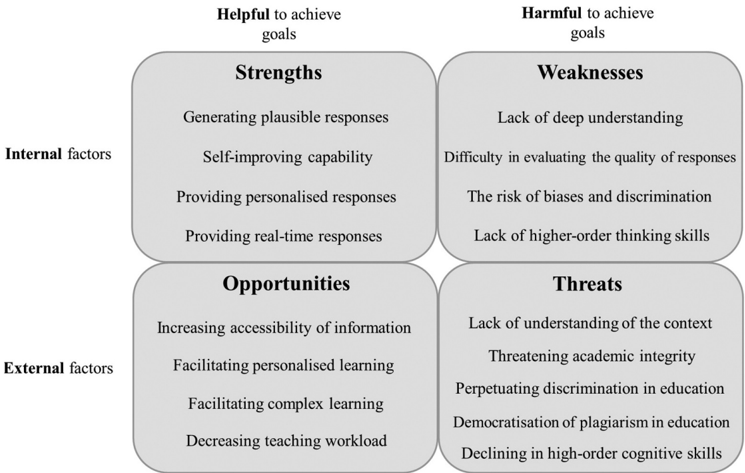
ChatGPT is an AI tool that has sparked debates about its potential implications for education. We used the SWOT analysis framework to outline ChatGPT’s strengths and weaknesses and to discuss its opportunities for and threats to education. The strengths include using a sophisticated natural language model to generate plausible answers, self-improving capability, and providing personalised and real-time responses. As such, ChatGPT can increase access to information, facilitate personalised and complex learning, and decrease teaching workload, thereby making key processes and tasks more efficient. The weaknesses are a lack of deep understanding, difficulty in evaluating the quality of responses, a risk of bias and discrimination, and a lack of higher-order thinking skills. Threats to education include a lack of understanding of the context, threatening academic integrity, perpetuating discrimination in education, democratising plagiarism, and declining high-order cognitive skills. We provide agenda for educational practice and research in times of ChatGPT.
Overview
The claims and statistics of this paper haven’t been checked yet.
Free: it reads the open-access text and checks the first 5 claims that cite a source we can check. Create a free account to check every claim.
Integrity signals
Registry
Cites
Statistics
Figures



Verification
Claims the paper makes
The claims and statistics of this paper haven’t been checked yet.
Free: it reads the open-access text and checks the first 5 claims that cite a source we can check. Create a free account to check every claim.
Claims other papers make about this one
Each is checked against this paper’s own text: does it say what the citing paper says it does?
The source backs part of the claim, not all of it — or backs it for a different population, condition or comparison.
In the citing paper
“Farrokhnia et al. [14] have demonstrated that employing GenAI tools might undermine advanced cognitive capabilities, such as critical and analytical thinking.”
From The Mediating Role of Generative AI Self-Regulation on Students’ Critical Thinking and Problem-Solving (2024) · cites this paper as [14]
Experimental — accuracy not yet measuredThe source backs part of the claim, not all of it — or backs it for a different population, condition or comparison.
In the citing paper
“A possible explanation for this discrepancy lies in the ambiguity surrounding what constitutes plagiarism when using AI-generated content.”
From Chat or cheat? Academic dishonesty, risk perceptions, and ChatGPT usage in higher education students (2025) · cites this paper as Farrokhnia et al., 2023
Experimental — accuracy not yet measuredThe source backs part of the claim, not all of it — or backs it for a different population, condition or comparison.
In the citing paper
“Student perceptions of academic dishonesty have historically been unclear or incomprehensive, and rarely align with teacher expectations (Tatum, 2022), GenAI will only serve to complicate this (Farrokhnia et al., 2023).”
From Not quite eye to A.I.: student and teacher perspectives on the use of generative artificial intelligence in the writing process (2023) · cites this paper as Farrokhnia et al., 2023
Experimental — accuracy not yet measuredThe cited source says what the claim attributes to it.
In the citing paper
“some students may not perceive their use as a policy violation and may unintentionally commit AIgiarism, as its outputs are not verbatim copies of existing texts”
From Chat or cheat? Academic dishonesty, risk perceptions, and ChatGPT usage in higher education students (2025) · cites this paper as Farrokhnia et al., 2023
In the citing paper
“This is echoed in the literature as findings suggest that ChatGPT can provide personalized feedback on essays and become a tutoring system by stimulating critical thinking and debates among students [13].”
From Challenges and Opportunities of Generative AI for Higher Education as Explained by ChatGPT (2023) · cites this paper as [13]
3 more claims about this paper
Create a free account to see every claim other papers make about this one.
Self-check
Percentages, sums and reported differences re-computed from the paper’s own numbers.
The self-check needs the paper’s full text.
Citations
Cites
ChatGPT for good? On opportunities and challenges of large language models for education
Kasneci, E., Sessler, K., Küchemann, S., Bannert, M., Dementieva, D., Fischer, F., Gasser, U., Groh, G., Günnemann, S., Hüllermeier, E., et al. (2023) · Learning and Individual Differences · doi:10.1016/j.lindif.2023.102274 · Cited by 15,365 · cited 3×
“ChatGPT’s superior performance is largely attributed to its massive amount of training data (Kasneci et al., 2023), enabling it to capture a wide range of linguistic patterns and relationships, thereby providing a fair understanding of language and context (Lecler et al., 2023; Wang et al., 2023).”
BackgroundMethodChatGPT for Good? On Opportunities and Challenges of Large Language Models for Education
Kasneci, E., Seßler, K., Küchemann, S., Bannert, M., Dementieva, D., Fischer, F., Gasser, U., Groh, G., Günnemann, S., Hüllermeier, E., et al. (2023) · doi:10.35542/osf.io/5er8f · Cited by 7,552
Best-worst multi-criteria decision-making method
Rezaei, J. (2015) · Omega · doi:10.1016/j.omega.2014.11.009 · Cited by 4,333 · cited 1×
“Therefore, empirical studies with quantitative approaches such as the best-worst method (see Rezaei, 2015) are necessary to extend the current review findings.”
BackgroundKung, T. H., Cheatham, M., ChatGPT, Medenilla, A., Sillos, C., De Leon, L., Elepaño, C., Madriaga, M., Aggabao, R., Diaz-Candido, G., et al. (2022) · doi:10.1101/2022.12.19.22283643 · Cited by 4,115
Kung, T. H., Cheatham, M., Medenilla, A., Sillos, C., De Leon, L., Elepaño, C., Madriaga, M., Aggabao, R., Diaz-Candido, G., Maningo, J., et al. (2023) · PLOS Digital Health · doi:10.1371/journal.pdig.0000198 · Cited by 4,115 · cited 1×
“It is also shown that ChatGPT has the potential to respond sufficiently to exam questions in the fields of medical (Kung et al., 2022) and law (Choi et al., 2023).”
BackgroundSallam, M. (2023) · Healthcare · doi:10.3390/healthcare11060887 · Cited by 3,126
Chatting and cheating: Ensuring academic integrity in the era of ChatGPT
Cotton, D. R. E., Cotton, P. A., & Shipway, J. R. (2024) · Innovations in Education and Teaching International · doi:10.1080/14703297.2023.2190148 · Cited by 3,087 · cited 5×
“…some scholars are concerned about the ethical considerations of ChatGPT (Mhlanga, 2023), as well as its potential negative effects on assessment practices (Rudolph et al., 2023), scientific integrity (Cotton et al., 2023; Shiri, 2023), and students’ higher-order thinking skills (Susnjak, 2022).”
BackgroundMethodInfluentialChatting and Cheating. Ensuring academic integrity in the era of ChatGPT
Cotton, D., Cotton, P., & Shipway, J. R. (2023) · doi:10.35542/osf.io/mrz8h · Cited by 3,079
Doyle, T. (2017) · The Information Society · doi:10.1080/01972243.2017.1354593 · Cited by 3,071 · cited 1×
“AI algorithms can also perpetuate discrimination by focusing on objectives like profits and efficiency without considering unintended consequences such as reinforcing existing biases (O’neil, 2017).”
Background
Research works printed but not linked: 1
- Haque, M. U., Dharmadasa, I., Sworna, Z. T., Rajapakse, R. N., & Ahmad, H. (2022). 'I think this is the most disruptive technology': Exploring sentiments of ChatGPT early adopters using Twitter data. arXiv. https://doi.org/10.48550/arXiv.2303.03836 . · arXiv · doi:10.48550/arxiv.2303.03836 · Paper page
Cited by
Items 901–1,000 of 1,006
Bernstein, E., Ramsamooj, A., Millar, K. L., & Lum, Z. C. (2025) · JMIR AI · doi:10.2196/68603 · Cited by 4
“The field is also exploring AI’s role in reducing teacher workload and providing continuous professional development opportunities [48,51,59,67].”
Toktarova, V. I., & Rebko, O. V. (2025) · Informatics and Education · doi:10.32517/0234-0453-2025-40-2-5-15 · Cited by 3
Ju, Y.-J., Wang, Y., Lee, S., Liu, C., Lee, M., Hou, C.-Y., Yang, C., & Hsieh, C. (2025) · Medical Teacher · doi:10.1080/0142159x.2025.2532783 · Cited by 3
“First, LLMs have advanced language processing abilities [17,20,21], allowing them to analyze large volumes of text quickly [19,22].”
Vārpiņa, Z., & Fredheim, K. (2025) · Springer proceedings in complexity · doi:10.1007/978-3-031-78623-5_13 · Cited by 3
Investigating University Students’ and Lecturers’ Anxiety in the AI-Laden English Online Learning
Santosa, M. H. (2025) · Jurnal Pendidikan dan Pengajaran · doi:10.23887/jpp.v58i2.90847 · Cited by 3
Wang, X., Liu, B., & Li, X. (2025) · Journal of Information Science · doi:10.1177/01655515251362399 · Cited by 4
Bal (2025) · doi:10.54864/planarch.1627965 · Cited by 3
Hsiao, C.-H., & Chiu, C.-H. (2025) · 2025 5th International Conference on Artificial Intelligence and Education (ICAIE) · doi:10.1109/icaie64856.2025.11158580 · Cited by 3
“Research by Farrokhnia et al (2024), Bozkurt et al (2023), Grassini, S. (2023), and Ali (2023) indicate that over-reliance on ChatGPT and similar language models can hinder students’ critical thinking and problem-solving skills.”
dos Santos, A. A. L., Ramos, A. S. M., & de Andrade, A. P. V. (2025) · Gestão org · doi:10.51359/1679-1827.2025.266173 · Cited by 4
Filipova, A. G., Abrosimova, E. E., & Abdiraiymova, G. (2025) · Ойкумена. Регионоведческие исследования · doi:10.63973/1998-6785/2025-3/40-51 · Cited by 4
Edeh, F. O., Mundu, M. M., Pandey, R., Edeh, B. F., & Nabawanuka, H. (2024) · Novatio Journal of Management Technology and Innovation · doi:10.61978/novatio.v2i4.500 · Cited by 3
“Farrokhnia et al. (2023) found that postgraduate students appreciate ChatGPT as it offers an alternative to traditional academic support systems by providing immediate feedback, research help, and content creation, thus helping to overcome certain challenges (Farrokhnia, 2023).”
Examining the Potential Benefits and Ethical Risks of GenAI in Lesson Planning: A TAM Approach
Estocapio, V., Bilog, R. M., Cacananta, J., Corpuz, J. M., Ibasan, B., Paneda, S., & Asuncion, R. J. R. (2025) · Journal of Teaching and Learning · doi:10.22329/jtl.v19i4.10056 · Cited by 3
ProtectTech: a ChatGPT generated scenario activity to foster student decision-making capability
Allison, J. (2025) · Journal of Further and Higher Education · doi:10.1080/0309877x.2025.2583091 · Cited by 3
“Furthermore, other authors suggested that future studies should focus on how ChatGPT can be used within instructional designs to facilitate learning in higher education (Farrokhnia et al. 2023).”
Redefining Education in the Digital Age: The Role of GPT Models in Academic Fraud and Logistics
Sangka, K. B., Pratama, R. D., & Hidayat, R. W. (2025) · Human Behavior and Emerging Technologies · doi:10.1155/hbe2/7118205 · Cited by 3
Liao, F., Wu, J., & Zhou, C. (2025) · International Conference on AI-enabled Education · doi:10.1145/3768421.3768499 · Cited by 3
Primary School Students’ Awareness of the Ethical Aspects of Using Artificial Intelligence Tools
Oreški, P., Oreški, T., & Ružić, I. (2025) · Informatics in Education · doi:10.15388/infedu.2025.18 · Cited by 3
University students’ perception of using ChatGPT toward their writing skills
Chairiah, A. M., Edi, W., & Yana, D. (2025) · Celtic A Journal of Culture English Language Teaching Literature and Linguistics · doi:10.22219/celtic.v12i2.42797 · Cited by 4
Trustworthiness of an LLM in the Classroom Through a Role-Playing Game: The Case of ChatGPT
Matthe, P. I., & Virvou, M. K. (2025) · International Conference on Information, Intelligence, Systems & Applications (IISA) · doi:10.1109/iisa66859.2025.11311301 · Cited by 3
“However, its output is prone to ‘hallucinations’ and biases, generating inaccuracies or reproducing stereotypes [23].”
ChatGPT ‐Generated Versus Teacher‐Prepared Read‐Aloud Plans: A Comparative Effectiveness Study
SÖNMEZ, M., Öksüz, H. İ., Gök, S., & Yıldırım, K. (2026) · European Journal of Education · doi:10.1111/ejed.70458 · Cited by 5
Fan, Q., Li, K., & Hu, P. (2026) · Computer Assisted Language Learning · doi:10.1080/09588221.2026.2617388 · Cited by 4
Lim, K. Y. T., Wong, Y. H., Tran, D. N., Lee, E. T., Thien, M. T. N., Nguyen, D. M. A., & Tan, A. (2026) · Brain Sciences · doi:10.3390/brainsci16020153 · Cited by 3
“In recent years, Large Language Models (LLMs) such as ChatGPT have prompted critical debate on the way educational content is generated and consumed [1].”
From chalkboards to chatbots: generative AI impact on education in emerging economies
Virmani, N., Sharma, D., Sahu, A., & Garza‐Reyes, J. A. (2026) · Interactive Learning Environments · doi:10.1080/10494820.2026.2632172 · Cited by 4
Ju, Y.-J., Wang, Y., Chou, F., Hou, W., Chen, S., & Hsieh, C. (2026) · Archives of Physical Medicine and Rehabilitation · doi:10.1016/j.apmr.2026.02.011 · Cited by 3
González-Videgaray, M. C., Elizondo-Cortés, M., Téliz, E. G., Hernández-Coló, M. D. R., Sosa, M. L. D., Ruiz, R. R., Monroy, V. D. C. Q., Cortés, V. M. R., Ulloa-Arellano, V. M., & Lavín-Alanís, L. M. (2026) · FIGURAS REVISTA ACADÉMICA DE INVESTIGACIÓN · doi:10.22201/fesa.26832917e.2026.7.2.466 · Cited by 3
Towards a Sustainable and Ethical Integration of AI Chatbots in Higher Education
Voicu, M.-C., Sîrghi, N., Mircea, G., & Toth, D. M.-M. (2026) · Sustainability · doi:10.3390/su18052534 · Cited by 3
Xiao, S., & Hu, B. (2026) · Education and Information Technologies · doi:10.1007/s10639-026-13909-1 · Cited by 3
“Researchers note that inaccuracies or oversimplifications may undermine knowledge acquisition and distort students' judgment formation (Cooper, 2023; Farrokhnia et al., 2023; Royer, 2024; Wei et al., 2024).”
Haase, J., Butollo, F., Hoppe, K.-M., Katzinski, A.-K., & Krüger, A. K. (2026) · International Journal of Technology Diffusion · doi:10.4018/ijtd.404029 · Cited by 3
Kaylani, H. A., & Alrifai, B. (2026) · International Journal of the Analytic Hierarchy Process · doi:10.13033/ijahp.v18i1.1262 · Cited by 3
Massouti, A., Baroudi, S., & Shaya, N. (2026) · Cambridge Journal of Education · doi:10.1080/0305764x.2026.2651759 · Cited by 5
“Similarly, Farrokhnia et al. (2023) discussed how AI has the potential to compromise integrity in academic settings, raising concerns about other issues including plagiarism and cheating.”
From rules to language models: a comparative study of chatbot learning assistants
Smutný, P., & Schreiberova, P. (2026) · Frontiers in Education · doi:10.3389/feduc.2026.1794807 · Cited by 3
Designing Generative AI-Based Agents to Empower Collaborative Self-Learning in Higher Education
Banh, L., Holldack, F., & Strobel, G. (2026) · Business & Information Systems Engineering · doi:10.1007/s12599-026-01012-1 · Cited by 3
Li, X., Xian, X., & Du, P. (2026) · Frontiers in Psychology · doi:10.3389/fpsyg.2026.1903784 · Cited by 3
“GenAI can support learning by helping students ask better questions, compare alternative explanations, receive timely feedback, or revise unclear writing (Farrokhnia et al., 2024; Kasneci et al., 2023; Mai et al., 2024; Yan et al., 2024).”
Li, W., Zhang, W., Li, M., & Zhang, Y. (2026) · Journal of Intelligence · doi:10.3390/jintelligence14080185 · Cited by 3
Alvero, J. C. (2026) · Journal of interdisciplinary perspectives · doi:10.69569/jip.2026.433 · Cited by 3
ChatGPT in Language Education: Meta-Analysis
Amrullah, M. I., Firmansyah, Nabilah, A., Hendriwanto, H., & Muntiningsih, R. (2024) · Journal of World Englishes and Educational Practices · doi:10.32996/jweep.2024.6.2.2 · Cited by 3
“Within the realm of artificial intelligence, natural language processing (NLP) has resulted in the development of cutting-edge virtual aids and chatbots capable of comprehending and producing human language (Farrokhnia et al., 2023).”
BackgroundPark, E. S. (2024) · The Korean Association of General Education · doi:10.46392/kjge.2024.18.4.35 · Cited by 3
Comparing the effectiveness of ChatGPT and Google Search in assisting learners to solve problems
Hu, C., Yuadi, I., Chen, M., & Huang, H.-C. (2024) · IEEE International Conference on Consumer Electronics - Taiwan (ICCE-Taiwan) · doi:10.1109/icce-taiwan62264.2024.10674491 · Cited by 3
“Subsequently, in Activity III, participants in both groups undergo an assessment to evaluate their critical thinking skills in the context of academic articles [9].”
BackgroundMindful machines: evaluating ChatGPT’s impact on higher education
Ravichandran, K., Srivastava, M., & Khanna, D. (2025) · International Journal of Systems Assurance Engineering and Management · doi:10.1007/s13198-025-02724-5 · Cited by 4
Improving English language proficiency through text-based activities with the help of ChatGPT
Enamorado, M. Á. J. (2025) · Nordic Journal of Digital Literacy · doi:10.18261/njdl.20.1.8 · Cited by 3
ВПЛИВ ШТУЧНОГО ІНТЕЛЕКТУ НА МЕТОДОЛОГІЮ НАУКОВИХ ДОСЛІДЖЕНЬ У СУЧАСНІЙ ПСИХОЛОГІЇ
Петрик, О. (2025) · Psychological Prospects Journal · doi:10.29038/2227-1376-2025-45-pet · Cited by 4
Lee, K., & Tseng, Y.-F. (2025) · Lecture notes in computer science · doi:10.1007/978-3-031-98197-5_36 · Cited by 3
Pawlak, J., Domingues, P., & de Oliveira, O. J. (2025) · The TQM Journal · doi:10.1108/tqm-12-2024-0520 · Cited by 3
Almulla, N. (2025) · Open Journal of Modern Linguistics · doi:10.4236/ojml.2025.155044 · Cited by 3
AI-Powered Knowledge Assessment: Application of GPT Models in Educational Testing
Melnyk, A., Tymchyshyn, V., Shcherbiak, I., Kozibroda, S., Shevchuk, A., Mudrak, R., & Hudratian, S. (2025) · International Conference on Advanced Computer Information Technologies (ACIT) · doi:10.1109/acit65614.2025.11185592 · Cited by 4
Sadidi, F., & Prestel, T. (2025) · Discover Education · doi:10.1007/s44217-025-01071-8 · Cited by 5
“However, ChatGPT struggles with “higher-order thinking problems”, making it essential to develop tasks involving reflection and critical thinking to assess student competencies [6,7].”
Demystifying the Unknown: ChatGPT and Foreign Language Classrooms in the Voices of EFL Teachers
Dehghan, F. (2023) · Advances in educational technologies and instructional design book series · doi:10.4018/979-8-3693-0353-5.ch004 · Cited by 5
The use of ChatGPT in the study of economics: a SWOT analysis
Pittner, D., Romih, D., & Polančič, G. (2023) · International Scientific Conference on Economics, Management and Information Technologies (ICEMIT) · doi:10.46793/icemit23.157p · Cited by 4
Adverse effects of intelligent support of CSCL—the ethics of conversational agents
Thierfelder, B., Papadopoulos, P. M., Weinberger, A., Demetriadis, S., & Tegos, S. D. (2024) · Elsevier eBooks · doi:10.1016/b978-0-443-18851-0.00015-9 · Cited by 3
Stroud, R. (2024) · Proceedings of the International CALL Research Conference · doi:10.29140/9780648184485-40 · Cited by 3
“…more (Ali et al., 2023), supporting their needs (Kasneci et al., 2023; Xiao & Zhi, 2023), streamlining the achieve - ment of learning objectives (Farrokhnia et al., 2023), personalizing the learning (Firat, 2023; Khasawneh et al., 2023), and promoting self-directed learning (Du & Alm, 2024;…”
BackgroundChatGPT: a force for good? Using the I.D.E.As framework to ’develop and empower’ students
Hack, S. (2024) · Journal of Learning Development in Higher Education · doi:10.47408/jldhe.vi32.1443 · Cited by 3
de Oliveira, E. G., & de Classe, T. M. (2024) · Anais do ... Simpósio Brasileiro de Informática na Educação/Anais do Simpósio Brasileiro de Informática na Educação · doi:10.5753/sbie.2024.242252 · Cited by 3
“Isso ´e, a comunidade educacional pode usar esses sistemas para “trapacear” [Cotton et al. 2024], levantando v´arias preocupac¸˜oes ´eticas, morais e de uso sobre as ferramentas de GenIA [Chaudhry et al. 2023, Halaweh 2023, Rasul et al. 2023, Cotton et al. 2024, Farrokhnia et al. 2024].”
Сугерування штучним інтелектом вибору індивідуальної освітньої траєкторії: психологічний аспект
Дембіцька, С. В. (2024) · Scientific Notes of Junior Academy of Sciences of Ukraine · doi:10.51707/2618-0529-2024-31-02 · Cited by 3
Perceptions of Educators on the Use of Text-Generative AI in South African Higher Education
Coleman, M., & Belle, J.-P. V. (2025) · Lecture notes in electrical engineering · doi:10.1007/978-981-97-9045-6_4 · Cited by 3
Miraz, M. H., Jin, H. H., Mahmood, M., Hasan, M. T., Sarkar, J. B., Salleh, N. M., & Chowdhury, A. Y. (2025) · Multidisciplinary Reviews · doi:10.31893/multirev.2025338 · Cited by 3
Sabado, W. B. (2025) · Heritage and Sustainable Development · doi:10.37868/hsd.v7i2.1272 · Cited by 3
GenAI and BDDL Tools for Academic L2 English Postgraduate Writing in Tourism: A Local Case Study
Fuentes, A. B. C. (2025) · US-China Education Review A · doi:10.17265/2161-623x/2025.08.002 · Cited by 3
Sun, R., Hu, X., Shao, Y., Luo, Z., Liu, B., & Cheng, Y. (2025) · Symmetry · doi:10.3390/sym17101713 · Cited by 3
Saputra, N., Asirah, A., & Syafitri, S. E. (2025) · International Journal of Education Language and Religion · doi:10.35308/ijelr.v7i1.11928 · Cited by 3
Use of LLM Tools within Higher Education: Report 1
Bektik, D., Edwards, C., Whitelock, D. M., & Antonaci, A. (2024) · Open Research Online (The Open University) · doi:10.5281/zenodo.14501258 · Cited by 6
Arruda, E. P., & Arruda, D. E. P. (2025) · Digital education and learning · doi:10.1007/978-3-032-03977-4_3 · Cited by 5
Victor, D. (2024) · SSRN Electronic Journal · doi:10.2139/ssrn.4791569 · Cited by 3
Garousi, V., Jafarov, Z., Mövsümova, A., Namazov, A., & Mirzayev, H. (2025) · SSRN Electronic Journal · doi:10.2139/ssrn.5932827 · Cited by 3
Learning by correcting AI errors: effort is essential
Olney, A. M., & Cade, W. L. (2025) · Lecture Notes in Computer Science · doi:10.1007/978-3-031-98459-4_11 · Cited by 2
The Risks Associated with AI Chatbots in Teaching Future Engineering Graduates: A Systematic Review
Moloi, K., Maladzhi, R. W., Nemavhola, F. J., Mthombeni, N. H., Tšoeu, M. S., & Mashifana, T. (2023) · World Engineering Education Forum - Global Engineering Deans Council (WEEF-GEDC) · doi:10.1109/weef-gedc59520.2023.10343639 · Cited by 5
Incorporating ChatGPT Into Online Discussions in a Literacy Course: Impact and Students' Perceptions
Hu, R., & Lin, X. Y. (2025) · International Journal of Artificial Intelligence · doi:10.4018/ijaitl.366589 · Cited by 3
Qualitative and Quantitative Analysis of Semiconductor Supply Chain Localization
Chen, T. (2025) · Springer eBooks · doi:10.1007/978-3-031-81280-4_4 · Cited by 2
Bakó, M. (2025) · Journal of Agricultural Informatics · doi:10.17700/jai.2024.15.2.730 · Cited by 2
“Numerous scientific publications have highlighted its strengths and weaknesses of ChatGPT (Mohammadreza et al., 2023, Lesson plan, 2023) The literature clearly indicates that ChatGPT should not be banned from higher education but rather integrated into teaching and learning processes (Gentile et…”
Management of Enterprises in the Greek Economy
Χαλλουμής, C. C. Κ., & Eriotis, N. (2025) · Journal of Management World · doi:10.53935/jomw.v2024i4.1039 · Cited by 3
Putri, G. L., Kesuma, A. S., Syukur, I., & Kesuma, M. E.-K. (2025) · KnE Social Sciences · doi:10.18502/kss.v10i8.18471 · Cited by 2
“The SWOT model is a strategic analysis tool used to evaluate the internal strengths and weaknesses of an organization or sector, as well as external opportunities and threats that may affect its performance(21).”
Helgert, A., Weis, L., & Straßmann, C. (2025) · CHI Conference Extended Abstracts on Human Factors in Computing Systems (CHI EA) · doi:10.1145/3706599.3720278 · Cited by 2
Exploring Students' Attitudes and Usage of Artificial Intelligence in the Learning Process
Mohtashami, F., Ghasemtabar, S. A., & Nasab, Y. M. (2025) · International and National Conference on E-Learning and E-Teaching (ICeLeT) · doi:10.1109/icelet66022.2025.11025227 · Cited by 3
Brala-Vukanović, M. (2025) · ELOPE English Language Overseas Perspectives and Enquiries · doi:10.4312/elope.22.1.185-201 · Cited by 2
A Conceptual Framework for Identifying Risks of AI Integration in Higher Education
Al-araibi, A. A. M., & Abdalla, R. (2025) · International Journal of Computer Applications · doi:10.5120/ijca2025925258 · Cited by 4
Solviana, M. D., Anisya, S., Puspita, L., Novitasari, A., & Elice, D. (2025) · KnE Social Sciences · doi:10.18502/kss.v10i14.19108 · Cited by 2
“[5 ] This introduction will further discuss the background to the emergence of the Meta-verse and the role of artificial intelligence in facilitating communication within it.”
Student Perspectives on the Impact of GenAI
Lewis, C., Funnell, P., Fisher, N., & Elston, P. (2025) · Springer eBooks · doi:10.1007/978-3-031-94809-1_2 · Cited by 2
Trusov, S. V. (2025) · Вестник Майкопского государственного технологического университета · doi:10.47370/2078-1024-2025-17-2-99-110 · Cited by 4
AI-powered Language Learning Tools on ESL Learners’ Writing Skills Development
Luo, J. (2025) · SHS Web of Conferences · doi:10.1051/shsconf/202522002012 · Cited by 4
Long, Y., & Yang, Y. (2025) · Frontiers in Education · doi:10.3389/feduc.2025.1483964 · Cited by 2
ACADEMIC INTEGRITY IN PERIL: TEACHERS’ EXPERIENCES TOWARDS GENERATIVE ARTIFICIAL INTELLIGENCE
Lisao, B. C. G., Pal, R. C. M., Tejero, C. B., & Bacasmot, J. B. (2025) · European Journal of Education Studies · doi:10.46827/ejes.v12i9.6162 · Cited by 2
Moore, S., Jackson, L. E., Kwon, C., & Stamper, J. C. (2025) · Lecture notes in computer science · doi:10.1007/978-3-032-03870-8_25 · Cited by 4
Hsieh, M.-Y. (2025) · Research in Science & Technological Education · doi:10.1080/02635143.2025.2546984 · Cited by 3
“…scholars, include: (1) Professional Knowledge Acquisition (‘PLA’), which assesses the application of core concepts and theories to problem-solving (Farrokhnia et al. 2023); (2) Technical Skills Learning (‘TSL’), evaluating proficiency in domain-specific technical abilities (Rahman and Watanobe…”
Case Study on ChatGPT’s Performance in Assisting Students with Physics Tests
Mafudi, I., Kuswanto, H., Jumadi, J., & Fatmawati, I. (2025) · Jurnal Pendidikan Fisika · doi:10.26618/jpf.v13i1.16624 · Cited by 2
Empowering Pre-service Teachers Through Collaborating with ChatGPT to Explore Smartphone Colorimetry
Sirisathitkul, C., Dinmeung, N., Nuanjan, J., & Sirisathitkul, Y. (2025) · Journal of Science Education and Technology · doi:10.1007/s10956-025-10267-4 · Cited by 2
ОРГАНІЗАЦІЯ ОСВІТИ В УМОВАХ НАДЗВИЧАЙНИХ СИТУАЦІЙ
Kolomiiets, A. M., Коломієць, Д. І., Жовнич, О. В., & Тертична, Т. (2025) · doi:10.31652/2978-617-558-359-3 · Cited by 3
Malaquias, R. F., & Hwang, Y. (2025) · Journal of Management History · doi:10.1108/jmh-01-2025-0008 · Cited by 3
Heard, F. (2025) · Research and Education · doi:10.63467/red.12.2025.art2 · Cited by 2
Unlocking medical students’ adoption of AIGC tools: a multi-theory perspective
Zhou, Z., Li, Z., Li, Z., Wang, C., Qi, H., & Guo, L. (2025) · Humanities and Social Sciences Communications · doi:10.1057/s41599-025-06078-y · Cited by 2
“It may also introduce certain simpli fi cations in data analysis (Burger et al., 2023) ChatGPT is also incapable of deduction, has limited mathematical skills(Frieder et al., 2023) and does not assess data reliability well (Farrokhnia et al., 2023).”
Risiko Penggunaan Kecerdasan Buatan (AI) dalam Tugas Perkuliahan: Studi Kualitatif Mahasiswa
Effendi, P. (2024) · Jurnal Teknik Informatika dan Teknologi Informasi · doi:10.55606/jutiti.v4i3.6307 · Cited by 2
Benefits and Challenges of Using ChatGPT: An Exploratory Study on English Language Program
Ali, J. K. M. (2025) · UB Journal for Humanities · doi:10.65073/1658-9343.1092 · Cited by 34
Integration of Generative AI Into Higher Education: Challenges, Opportunities, and Regulations
Volosevici, D., EFTIMIE, S. G., & Ghita, I. A. (2025) · Advances in computational intelligence and robotics book series · doi:10.4018/979-8-3373-7579-3.ch007 · Cited by 2
Adopting AI-Generated Videos in Advertising: Insights from Tunisian Agencies
Zouari, A., Dalhoum, S., & Hmida, I. C. B. (2025) · Journal of African Business · doi:10.1080/15228916.2025.2610568 · Cited by 2
Utami, P. N., Alhamid, I. N., Fadhilah, N. P., Tabitha, A. H., & Aini, A. Q. (2025) · Risenologi · doi:10.21009/risenologi.102.08 · Cited by 4
Exploring GenAI-Powered Listening Test Development
Guo, J. (2026) · Languages · doi:10.3390/languages11010017 · Cited by 2
ChatGPT as a tool for posing of mathematical problems by prospective teachers
Burgos, M., & Tizón-Escamilla, N. (2026) · LUMAT International Journal on Math Science and Technology Education · doi:10.31129/lumat.14.1.2942 · Cited by 3
Gençel, N., Yılmaz, F. G. K., & Yılmaz, R. (2026) · Computers in Human Behavior Artificial Humans · doi:10.1016/j.chbah.2026.100252 · Cited by 4
Generative AI in Academia: How Engineering Students Perceive and Approach Ethical Challenges?
Hariyanto, D., Rafiq, A. A., Triyono, M. B., Murniati, D. E., Adinda, D., & Prihandini, T. F. (2026) · International Journal of Online and Biomedical Engineering (iJOE) · doi:10.3991/ijoe.v22i02.59281 · Cited by 2
Hossain, M., Amin, S. Z., Gordon, B., & Hossain, M. F. (2026) · Technology Knowledge and Learning · doi:10.1007/s10758-025-09952-5 · Cited by 2
Graduate attributes in the age of AI: suggestions for purposeful uses of ChatGPT in higher education
Comerio, G. (2026) · International Journal of Information and Learning Technology · doi:10.1108/ijilt-11-2024-0268 · Cited by 2
Boudouaia, A., Khattala, A., & Bennouioua, H. (2026) · Journal of Computing in Higher Education · doi:10.1007/s12528-026-09491-7 · Cited by 2
“Furthermore, Farrokhnia et al. (2023) highlight the limitations of artificial intelligence tools in enhancing higher-order writing skills like argument structure and coherence, despite their effectiveness in aspects of writing improvement.”
Metadata
- Authors
- Farrokhnia, M., Banihashem, S. K., Noroozi, O., & Wals, A.
- Affiliations
- Wageningen University & Research (NL)
- Open University of the Netherlands (NL)
- Corresponding author
- Noroozi, Omid
- Venue
- Innovations in Education and Teaching International
- Publisher
- Informa UK Limited
- Published
- 2023-03-27
- Volume
- 61
- Issue
- 3
- Pages
- 460-474
- ISSN
- 1470-3297 (ISSN-L)
- 1470-3300
- OpenAlex
- W4361204578
- Semantic Scholar
- e9685cf2c9aff2f7ff7bcfa5b65a11e90687a3ef
- Cited by
- 1,384
- References
- 68
- Citations by year
- 2026: 359 · 2025: 456 · 2024: 396 · 2023: 173
- FWCI
- 324.80
- Type
- journal article
- Language
- en
- Open access
- hybrid
- doi.org
- Licence
- Locations
- Innovations in Education and Teaching International (publishedVersion, cc-by-nc-nd)
- Socio-Environmental Systems Modeling (submittedVersion, cc-by-nc-nd)
- DSpace (Open University in the Netherlands) (submittedVersion, cc-by-nc-nd)
- Data Archiving and Networked Services (DANS) (submittedVersion, other-oa)
- Topics
- Social Sciences › Education › Artificial Intelligence in Education
- Health Sciences › Medicine › Health Informatics › Artificial Intelligence in Healthcare and Education
- Social Sciences › Education › Educational Technology in Learning
- Keywords
- ChatGPT, large language models, artificial intelligence in education, academic integrity, plagiarism, algorithmic bias, higher-order thinking skills, personalized learning, teacher workload, SWOT analysis
About these checks
Registry, retraction, Cites and statistics results are computed, not judged, with one exception: a printed reference that no index lists is read once by a model before it counts as a citation error. Claims are extracted by a model and kept only when their quote appears verbatim in the text; each cited source is then checked, with a model’s help, for whether it says what the claim relies on. Those verdicts can be wrong — read the claim’s quote and the cited source before relying on one.
Statistics and arithmetic are recomputed, not judged.
Confidence bands are shown only for fields calibrated on our annotated test set. None is calibrated yet, so no band is shown.
What counts as a claim ›How we measure confidence ›How we check this ›
Are you an author, or do you see a problem with this page? Request a review
Data sources
Bibliographic data: Semantic Scholar, OpenAlex, Crossref.
Contains information from the Semantic Scholar Academic Graph Datasets, made available under the ODC Attribution License (ODC-BY 1.0).
Semantic Scholar’s data is described in: Kinney, R., et al. (2023). The Semantic Scholar Open Data Platform. arXiv:2301.10140.
