

A SWOT analysis of ChatGPT: Implications for educational practice and research
Open accessThe DOI matches its Crossref record; 79 of the 79 references it cites were found in a registry or an index.
Abstract
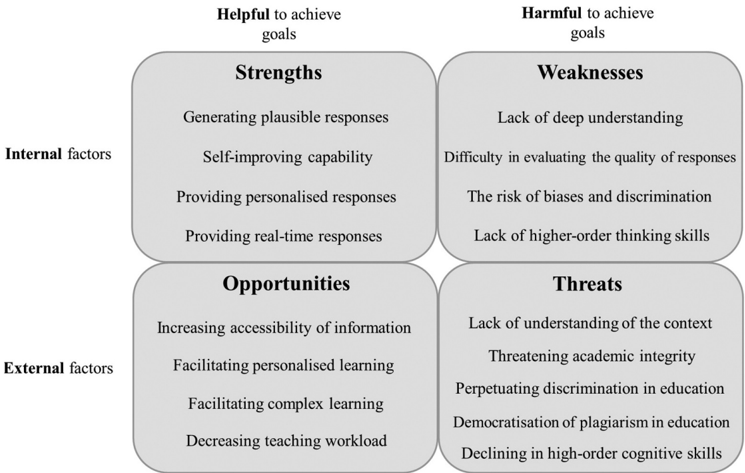
ChatGPT is an AI tool that has sparked debates about its potential implications for education. We used the SWOT analysis framework to outline ChatGPT’s strengths and weaknesses and to discuss its opportunities for and threats to education. The strengths include using a sophisticated natural language model to generate plausible answers, self-improving capability, and providing personalised and real-time responses. As such, ChatGPT can increase access to information, facilitate personalised and complex learning, and decrease teaching workload, thereby making key processes and tasks more efficient. The weaknesses are a lack of deep understanding, difficulty in evaluating the quality of responses, a risk of bias and discrimination, and a lack of higher-order thinking skills. Threats to education include a lack of understanding of the context, threatening academic integrity, perpetuating discrimination in education, democratising plagiarism, and declining high-order cognitive skills. We provide agenda for educational practice and research in times of ChatGPT.
Overview
The claims and statistics of this paper haven’t been checked yet.
Free: it reads the open-access text and checks the first 5 claims that cite a source we can check. Create a free account to check every claim.
Integrity signals
Registry
Cites
Statistics
Figures


Verification
Claims the paper makes
The claims and statistics of this paper haven’t been checked yet.
Free: it reads the open-access text and checks the first 5 claims that cite a source we can check. Create a free account to check every claim.
Claims other papers make about this one
Each is checked against this paper’s own text: does it say what the citing paper says it does?
The source backs part of the claim, not all of it — or backs it for a different population, condition or comparison.
In the citing paper
“Farrokhnia et al. [14] have demonstrated that employing GenAI tools might undermine advanced cognitive capabilities, such as critical and analytical thinking.”
From The Mediating Role of Generative AI Self-Regulation on Students’ Critical Thinking and Problem-Solving (2024) · cites this paper as [14]
Experimental — accuracy not yet measuredThe source backs part of the claim, not all of it — or backs it for a different population, condition or comparison.
In the citing paper
“A possible explanation for this discrepancy lies in the ambiguity surrounding what constitutes plagiarism when using AI-generated content.”
From Chat or cheat? Academic dishonesty, risk perceptions, and ChatGPT usage in higher education students (2025) · cites this paper as Farrokhnia et al., 2023
Experimental — accuracy not yet measuredThe source backs part of the claim, not all of it — or backs it for a different population, condition or comparison.
In the citing paper
“Student perceptions of academic dishonesty have historically been unclear or incomprehensive, and rarely align with teacher expectations (Tatum, 2022), GenAI will only serve to complicate this (Farrokhnia et al., 2023).”
From Not quite eye to A.I.: student and teacher perspectives on the use of generative artificial intelligence in the writing process (2023) · cites this paper as Farrokhnia et al., 2023
Experimental — accuracy not yet measuredThe cited source says what the claim attributes to it.
In the citing paper
“some students may not perceive their use as a policy violation and may unintentionally commit AIgiarism, as its outputs are not verbatim copies of existing texts”
From Chat or cheat? Academic dishonesty, risk perceptions, and ChatGPT usage in higher education students (2025) · cites this paper as Farrokhnia et al., 2023
In the citing paper
“This is echoed in the literature as findings suggest that ChatGPT can provide personalized feedback on essays and become a tutoring system by stimulating critical thinking and debates among students [13].”
From Challenges and Opportunities of Generative AI for Higher Education as Explained by ChatGPT (2023) · cites this paper as [13]
3 more claims about this paper
Create a free account to see every claim other papers make about this one.
Self-check
Percentages, sums and reported differences re-computed from the paper’s own numbers.
The self-check needs the paper’s full text.
Citations
Cites
ChatGPT for Good? On Opportunities and Challenges of Large Language Models for Education
Kasneci, E., Seßler, K., Küchemann, S., Bannert, M., Dementieva, D., Fischer, F., Gasser, U., Groh, G., Günnemann, S., Hüllermeier, E., et al. (2023) · doi:10.35542/osf.io/5er8f · Cited by 7,552
ChatGPT for good? On opportunities and challenges of large language models for education
Kasneci, E., Sessler, K., Küchemann, S., Bannert, M., Dementieva, D., Fischer, F., Gasser, U., Groh, G., Günnemann, S., Hüllermeier, E., et al. (2023) · Learning and Individual Differences · doi:10.1016/j.lindif.2023.102274 · Cited by 7,326 · cited 3×
“ChatGPT’s superior performance is largely attributed to its massive amount of training data (Kasneci et al., 2023), enabling it to capture a wide range of linguistic patterns and relationships, thereby providing a fair understanding of language and context (Lecler et al., 2023; Wang et al., 2023).”
BackgroundMethodBest-worst multi-criteria decision-making method
Rezaei, J. (2015) · Omega · doi:10.1016/j.omega.2014.11.009 · Cited by 4,333 · cited 1×
“Therefore, empirical studies with quantitative approaches such as the best-worst method (see Rezaei, 2015) are necessary to extend the current review findings.”
BackgroundKung, T. H., Cheatham, M., ChatGPT, Medenilla, A., Sillos, C., De Leon, L., Elepaño, C., Madriaga, M., Aggabao, R., Diaz-Candido, G., et al. (2022) · doi:10.1101/2022.12.19.22283643 · Cited by 4,115
Kung, T. H., Cheatham, M., Medenilla, A., Sillos, C., De Leon, L., Elepaño, C., Madriaga, M., Aggabao, R., Diaz-Candido, G., Maningo, J., et al. (2023) · PLOS Digital Health · doi:10.1371/journal.pdig.0000198 · Cited by 4,115 · cited 1×
“It is also shown that ChatGPT has the potential to respond sufficiently to exam questions in the fields of medical (Kung et al., 2022) and law (Choi et al., 2023).”
BackgroundSallam, M. (2023) · Healthcare · doi:10.3390/healthcare11060887 · Cited by 3,126
Chatting and cheating: Ensuring academic integrity in the era of ChatGPT
Cotton, D. R. E., Cotton, P. A., & Shipway, J. R. (2024) · Innovations in Education and Teaching International · doi:10.1080/14703297.2023.2190148 · Cited by 3,087 · cited 5×
“…some scholars are concerned about the ethical considerations of ChatGPT (Mhlanga, 2023), as well as its potential negative effects on assessment practices (Rudolph et al., 2023), scientific integrity (Cotton et al., 2023; Shiri, 2023), and students’ higher-order thinking skills (Susnjak, 2022).”
BackgroundMethodInfluentialChatting and Cheating. Ensuring academic integrity in the era of ChatGPT
Cotton, D., Cotton, P., & Shipway, J. R. (2023) · doi:10.35542/osf.io/mrz8h · Cited by 3,079
Doyle, T. (2017) · The Information Society · doi:10.1080/01972243.2017.1354593 · Cited by 3,071 · cited 1×
“AI algorithms can also perpetuate discrimination by focusing on objectives like profits and efficiency without considering unintended consequences such as reinforcing existing biases (O’neil, 2017).”
Background
Research works printed but not linked: 1
- Haque, M. U., Dharmadasa, I., Sworna, Z. T., Rajapakse, R. N., & Ahmad, H. (2022). 'I think this is the most disruptive technology': Exploring sentiments of ChatGPT early adopters using Twitter data. arXiv. https://doi.org/10.48550/arXiv.2303.03836 . · arXiv · doi:10.48550/arxiv.2303.03836 · Paper page
Cited by
Items 601–700 of 1,006
Zhao, Z., Li, J., Hong, Y., & Yun, T. Y. (2025) · International Journal for Lesson and Learning Studies · doi:10.1108/ijlls-01-2025-0029 · Cited by 10
Responses to the Initial Hype: ChatGPT Supporting Teaching, Learning, and Scholarship?
Cefa, B., Macgilchrist, F., ElGamal, H., Bai, J. Y. H., Zawacki‐Richter, O., & Loglo, F. S. (2025) · Open Praxis · doi:10.55982/openpraxis.17.2.872 · Cited by 10
Cai, Z., Liu, C., Yang, Y., & Li, B. (2025) · The Internet and Higher Education · doi:10.1016/j.iheduc.2025.101044 · Cited by 10
Ximenes, S. M. (2025) · Elementary Mathematics Education Journal · doi:10.5507/emej2025-7-1-501 · Cited by 15
Oben, A. I., Xu, H., Bahtilla, M., & Quanguo, L. (2025) · Innovations in Education and Teaching International · doi:10.1080/14703297.2025.2587333 · Cited by 10
The ETHICAL Protocol for Responsible Use of Generative AI for Research Purposes in Higher Education
Alduais, A. M. S., Qadhi, S., Chaaban, Y., & Khraisheh, M. A. M. (2025) · AI Magazine · doi:10.1002/aaai.70047 · Cited by 12
Yang, C., Chen, J., Hou, S., Wider, W., & Yi, W. L. (2025) · Discover Artificial Intelligence · doi:10.1007/s44163-025-00732-9 · Cited by 15
“Kasneci et al. [46] and Farrokhnia et al. [26] offer strategic, future-oriented perspectives, calling for new literacies and regulatory frameworks to guide responsible AI use in education.”
Bridging AI chatbot use and critical thinking: the mediating role of AI literacy
Badali, M., Shahalizadeh, M., Alimirzaie, M., Noroozi, O., & Banihashem, S. K. (2026) · Interactive Learning Environments · doi:10.1080/10494820.2025.2605487 · Cited by 15
“While the use of AI chatbots holds promising benefits and opportunities for education, there are concerns and risks as well (Farrokhnia et al., 2024).”
Self-citationSu, F., O'Dea, M., Wood, M., & Seidl, E. (2026) · Perspectives Policy and Practice in Higher Education · doi:10.1080/13603108.2025.2601741 · Cited by 14
Bozorgian, H., & Rahimi, H. M. (2025) · Journal of language and Education · doi:10.17323/jle.2025.27195 · Cited by 10
Wang, W., Wu, Y., Fang, J., Chong, Y., & Wen, L. (2026) · BMC Psychology · doi:10.1186/s40359-026-04911-w · Cited by 11
“Several studies have indicated that frequent dependence on AI tools is related to lower perceived learning and less confidence in problem-solving skills, despite improvements in short-term performance [10, 15].”
Integration of Large Language Models into Higher Education: A Perspective from Learners
Zdravkova, K., Dalipi, F., & Ahlgren, F. (2023) · International Symposium on Computers in Education · doi:10.1109/siie59826.2023.10423681 · Cited by 16
“An excessive reliance on ChatGPT might prevent the development of autonomous critical thinking abilities [43].”
BackgroundSTUDENTS’ PERCEPTIONS OF GENERATIVE AI USAGE AND RISKS IN A FINNISH HIGHER EDUCATION INSTITUTION
Suonpää, M., Heikkilä, J., & Dimkar, A. (2024) · INTED proceedings · doi:10.21125/inted.2024.0825 · Cited by 11
Generative AI in CS Education: Literature Review through a SWOT Lens
Roberts, J., & Mohamed, A. (2024) · Western Canadian Conference on Computing Education · doi:10.1145/3660650.3660657 · Cited by 14
“Farrokhnia et al. [4] and Alabool [5] reviewed technical literature to identify the strengths and weaknesses of ChatGPT in higher education in general, and they also discussed the opportunities and threats within a SWOT analysis process.”
BackgroundCan ChatGPT Match the Experts? A Feedback Comparison for Serious Game Development
Tyni, J., Turunen, A., Kahila, J., Bednarik, R., & Tedre, M. (2024) · International Journal of Serious Games · doi:10.17083/ijsg.v11i2.744 · Cited by 10
Alfirević, N., Rendulić, D., Fošner, M., & Fošner, A. (2024) · Informatics · doi:10.3390/informatics11040078 · Cited by 12
The General Education in the Era of Generative AI
Yi, Y., & Park, Y. (2024) · The Korean Association of General Education · doi:10.46392/kjge.2024.18.6.181 · Cited by 13
Gil, K. L., & Mosquera, E. M. (2025) · Revista Virtual Universidad Católica del Norte · doi:10.35575/rvucn.n74a6 · Cited by 10
Zhong, T.-Y., Zhao, W., Zhang, Y.-T., Pan, Y., Dong, P., Jiang, Z., Jiang, H.-Q., Zhou, Y.-F., Kui, X.-Y., Shang, Y.-L., et al. (2025) · IEEE Transactions on Biomedical Engineering · doi:10.1109/tbme.2025.3597325 · Cited by 8
“…(LLMs), known as generative models, provide a user-friendly human-machine interaction platform that brings the powerful capabilities of natural language processing to the public and has been rapidly integrated into various fields of application [32], [33], [34], including radiology [31], [35], [36].”
A Bibliometric Analysis of Artificial Intelligence Chatbots in Language Education
Liu, W., Yu-peng, L., & Yu, Z. (2024) · Social Education Research · doi:10.37256/ser.5120243372 · Cited by 14
“( Farrokhnia et al., 2023; Huang et al., 2022).”
The Effects of Prompt Scaffolding on Learning to Write Arguments with ChatGPT
Jang, J., Eun, S., Lee, H., Choi, J., & Cho, Y. H. (2024) · Proceedings of the International Conference of the Learning Sciences · doi:10.22318/icls2024.831011 · Cited by 9
Dialogues with artificial intelligence: Exploring medical students’ perspectives on ChatGPT
Başaran, M., & Duman, C. (2024) · Medical Teacher · doi:10.1080/0142159x.2024.2438766 · Cited by 12
A review study of the use of ChatGPT in EFL classes: systematic review
Gutai, G., Klímová, B., & Pareja-Lora, A. (2024) · Journal of language and cultural education · doi:10.2478/jolace-2024-0007 · Cited by 12
AI-assisted instructions in collaborative learning in mathematics education: A qualitative approach
Maanu, V., Boateng, F. O., & Larbi, E. (2025) · American Journal of STEM Education · doi:10.32674/68zzkz60 · Cited by 10
“Unlike previous studies (Ertmer & Ottenbreit-Leftwich, 2019; Farrokhnia et al., 2023) that explore AI in general educational settings, this research specifically explores AI’s impact on collaborative learning dynamics in a pre-service mathematics education context, making it a unique addition to…”
Game Changer: Harnessing Artificial Intelligence in Sport for Development
Moustakas, L. (2025) · Social Sciences · doi:10.3390/socsci14030174 · Cited by 9
“In particular, some authors have highlighted how AI tools often generate generic information or analyses that lack a fine-grained understanding of the local context, and that higher-order thinking skills are needed to re-contextualise AI-generated content (Farrokhnia et al. 2024; Ha et al. 2024).”
InfluentialLin, X., Han, X., & Qiu, J. (2025) · CHI Conference Extended Abstracts on Human Factors in Computing Systems (CHI EA) · doi:10.1145/3706599.3719972 · Cited by 10
From the Gender Lens: Student Perceptions of ChatGPT in Higher Education
Fadillah, M. A., & Akbar, M. F. (2025) · Advances in Mobile Learning Educational Research · doi:10.25082/amler.2025.01.015 · Cited by 11
AI-generated content and academic norms: perspectives and reflections of college students
He, Q., You, X., & Shen, J. (2025) · Interactive Learning Environments · doi:10.1080/10494820.2025.2511252 · Cited by 11
Reducing AI plagiarism through assessment of higher-order cognitive skills
Toker, Ş., & Akgun, M. (2025) · Innovations in Education and Teaching International · doi:10.1080/14703297.2025.2514242 · Cited by 9
“Given prior research suggesting that gender may influence the use of AI tools (Farrokhnia et al., 2023; Noroozi et al., 2024; Prinsloo & Khalil, 2024), additional analyses were conducted to examine potential gender effects on similarity scores and AI plagiarism scores.”
A learning agreement for generative AI use in university courses: A pilot study
Beardsley, M., Santos, P., Amarasinghe, I., Theophilou, E., Vujović, M., & Hernández‐Leo, D. (2025) · Innovations in Education and Teaching International · doi:10.1080/14703297.2025.2535444 · Cited by 10
“However, these procedures are challenging to apply when GenAI tools are used by students to replace their expected learning actions (Hern´andez-Leo, 2023), as detection of GenAI use is problematic (Farrokhnia et al., 2023).”
A Structural Model of Distance Education Teachers’ Digital Competencies for Artificial Intelligence
Almenara, J. C., Palacios‐Rodríguez, A., Aguirre, M. I. L., & Pugla-Quirola, D. R. (2025) · Education Sciences · doi:10.3390/educsci15101271 · Cited by 13
A Qualitative Approach to EFL Postgraduates’ GenAI-Assisted Research Writing Within Social Sciences
Fuentes, A. B. C. (2025) · Education Sciences · doi:10.3390/educsci15111521 · Cited by 9
“The reviews examine, among other aspects, advantages such as workload reduction and effective tailored support, and drawbacks such as overreliance, breaches of academic integrity, and insufficient development of critical thinking skills (e.g., Farrokhnia et al., 2024; Rowland, 2023).”
Multidimensional determinants of generative AI acceptance in foreign language education
Xu, T., & Xiong, Y. (2026) · Scientific Reports · doi:10.1038/s41598-026-36700-1 · Cited by 9
“Owing to its personalized and adaptive features, AI technologies can mitigate anxiety and pressure, especially for speaking performance 54,55 .”
Korkmaz, G., & Toraman, Ç. (2026) · BMC Medical Education · doi:10.1186/s12909-026-08675-0 · Cited by 9
“…weakening their ability to make independent decisions, result in reduced awareness of errors and cognitive laziness in the learning process [16, 17] and can lead to a decline in their higher-order cognitive skills such as creativity, critical reasoning, decision making and problem-solving [18, 19].”
Derakhshan, A., Corral-Robles, S., Ortega-Martín, J. L., & Ortega‐Rodríguez, P. (2026) · European Journal of Education · doi:10.1111/ejed.70639 · Cited by 9
Cui, Y. (2026) · Discover Artificial Intelligence · doi:10.1007/s44163-026-01286-0 · Cited by 9
“Incorporating and considering reasonable citations is an important way to provide evidence ( [13] ).”
Understanding EFL teachers’ affective and cognitive responses to ChatGPT in higher education
Wang, C., Zou, B., Zhang, W., Du, Y., & Hu, W. (2026) · Humanities and Social Sciences Communications · doi:10.1057/s41599-026-07360-3 · Cited by 13
Kırcaburun, K. (2026) · Journal of Intelligence · doi:10.3390/jintelligence14070147 · Cited by 11
“This becomes particularly important in GAI-assisted learning because generative systems often produce fluent and persuasive outputs that are weakly grounded or inaccurate, creating epistemic risks when students accept them uncritically (Farrokhnia et al., 2024; Hannigan et al., 2024).”
A Review of ChatGPT in Promoting Teaching and Learning
Rathod, K. D. (2023) · INTERANTIONAL JOURNAL OF SCIENTIFIC RESEARCH IN ENGINEERING AND MANAGEMENT · doi:10.55041/ijsrem24976 · Cited by 10
Employing Large Language Models for Surgical Education: An In-depth Analysis of ChatGPT-4
Siu, A. H. Y., Gibson, D., Mu, X., Seth, I., Siu, A. C. W., Dooreemeah, D., & Lee, A. (2023) · Journal of Medical Education · doi:10.5812/jme-137753 · Cited by 15
“In addition, there is a risk that surgical traineesmaybecomeoverlyreliantonAI-generatedadvice, potentially undermining their critical thinking and decision-making abilities (38).”
BackgroundENHANCING PRAGMATIC KNOWLEDGE WITH CHATGPT: BENEFITS AND CONSIDERATIONS
Puri, A. D., & Baskara, F. R. (2023) · Prosiding Konferensi Linguistik Tahunan Atma Jaya (KOLITA) · doi:10.25170/kolita.21.4828 · Cited by 9
Ahadi, N., Zanjanab, A. G., Sorooshian, S., Monametsi, G. L., Virutamasen, P., Wongpreedee, K., Deebhijarn, S., & Taghipour, A. (2023) · IEEE Region 10 Conference (TENCON) · doi:10.1109/tencon58879.2023.10322527 · Cited by 14
Delving into Chit-Chat with GPT-3.5: Holy Grail or Pandora’s Box?
Griszbacher, N. (2024) · GiLE Journal of Skills Development · doi:10.52398/gjsd.2024.v4.i1.pp4-29 · Cited by 9
The Study of Users’ Satisfaction and Acceptance on Artificial Intelligence (AI)
Liu, Z. (2024) · Journal of Education Humanities and Social Sciences · doi:10.54097/f4hgqw30 · Cited by 9
“ChatGPT can cooperate with universities and scientific labs to get information from them [12].”
BackgroundInfluentialFuture Prospects of ChatGPT in Higher Education
Phutela, N., Grover, P., Singh, P., & Mittal, N. (2024) · International Conference on Reliability, Infocom Technologies and Optimization (Trends and Future Directions) (ICRITO) · doi:10.1109/icrito61523.2024.10522294 · Cited by 11
“The need of the hour is to carefully and critically analyse the possible pros and cons associated with the usage of language models (LLMs) [10],[11].”
BackgroundThe Role of Supportive Environments in Shaping EFL Teachers’ Adoption of ChatGPT
Tram, N. H. M., & Tran–Thanh, V. (2024) · Studies in computational intelligence · doi:10.1007/978-3-031-63447-5_4 · Cited by 11
Navigating AI and chatbot applications in education and research: a holistic approach
Abhishek, N., Devesh, S., Ashoka, M. L., Suraj, N., Acharya, P. S., & Divyashree, M. S. (2024) · Quality Education for All · doi:10.1108/qea-10-2023-0005 · Cited by 9
Using ChatGPT in planning English language classes
Николаевна, С. О. (2024) · Informatics and Education · doi:10.32517/0234-0453-2024-39-4-77-89 · Cited by 11
Swot Analysis of the Use of ChatGPT in Education
DURMUŞ, F. B. (2024) · Journal of Educational Studies and Multidisciplinary Approaches · doi:10.51383/jesma.2024.102 · Cited by 9
Chen, J., Mokmin, N. A. M., & Shen, Q. (2025) · International Journal of Interactive Multimedia and Artificial Intelligence · doi:10.9781/ijimai.2025.02.007 · Cited by 12
Li, Y., Yu, H., & Shen, Z. (2025) · Journal of Retailing and Consumer Services · doi:10.1016/j.jretconser.2025.104289 · Cited by 9
Artificial Intelligence in Education: A Bibliometric Analysis
ATEŞ, S. K., KALECİ, F., & Erdoğan, A. (2025) · Ahmet Keleşoğlu Eğitim Fakültesi Dergisi · doi:10.38151/akef.2025.147 · Cited by 14
The Use of Artificial Intelligence in Education: Applications, Challenges, and the Way Forward
Mupaikwa, E. (2023) · Advances in library and information science (ALIS) book series · doi:10.4018/978-1-6684-8671-9.ch002 · Cited by 12
Assessing Biases in the Names Generated by Generative Artificial Intelligence Chatbots
Mirowsky, J. E. (2024) · Journal of Chemical Education · doi:10.1021/acs.jchemed.4c00844 · Cited by 9
Students' argumentation performance in online learning environments: Bridging culture and gender
Ranjbaran, F., Babaee, M., Parvaneh Akhteh Khaneh, M., Gohari, M., Daneshvar Ghorbani, B., Taghizadeh Kerman, N., Banihashem, S. K., & Noroozi, O. (2023) · International Journal of Technology in Education · doi:10.46328/ijte.460 · Cited by 8
Self-citationAI-Driven Transformations in Higher Education: A Citation and Co-citation Analysis
., S., Gurumayum, P., Tiwari, N., Kaushik, M., Jha, C., & Arora, M. (2024) · International Journal of experimental research and review · doi:10.52756/ijerr.2024.v45spl.021 · Cited by 8
Detecting Learning Behavior in Programming Assignments by Analyzing Versioned Repositories
Chen, J., Lau, S., Leinonen, J., Terragni, V., & Giacaman, N. (2024) · IEEE Access · doi:10.1109/access.2024.3514843 · Cited by 9
Charming or chilling? A comprehensive review of ChatGPT’s in education sector
Bhaskar, P., & Tiwari, C. K. (2025) · International Journal of Information and Learning Technology · doi:10.1108/ijilt-05-2024-0097 · Cited by 9
A learning module for generative AI literacy in a biomedical engineering classroom
Wang, X., Chan, T., & Tamura, A. A. (2025) · Frontiers in Education · doi:10.3389/feduc.2025.1551385 · Cited by 11
Bin‐Nashwan, S. A., Sadallah, M., Benlahcene, A., & Ma’aji, M. M. (2025) · foresight · doi:10.1108/fs-04-2024-0089 · Cited by 10
Exploring the dual impact of AI in post-entry language assessment: Potentials and pitfalls
Zhang, T., Erlam, R., & de Magalhães, M. B. (2025) · Annual Review of Applied Linguistics · doi:10.1017/s0267190525000030 · Cited by 9
“The potential impact of AI on language assessment, in the specific context of a PELA such as DELNA, was analyzed using the SWOT framework – a tool frequently applied in educational contexts (Farrokhnia et al., 2024), as inspired by Liu (2024).”
Chat-GPT in Education: Learning Outcomes and Facilitating Knowledge Acquisition
Malik, N., Kousar, A., & Arshad, K. (2025) · Inverge Journal of Social Sciences · doi:10.63544/ijss.v4i2.131 · Cited by 9
Transforming Physics Teacher Training Through ChatGPT: A Study on Usability and Impact
Zambrano, M. F. G., Alvarado, L. M. S., Valarezo-Chamba, B. S., & Lamilla, E. (2025) · Education Sciences · doi:10.3390/educsci15070887 · Cited by 10
Huang, W., Peng, Y., Tan, Y., Tong, Y., & Ye, D. (2025) · Innovations in Education and Teaching International · doi:10.1080/14703297.2025.2554832 · Cited by 8
Huang, M., Cheong, N., Zhang, Z., & Liu, J. (2025) · IEEE Transactions on Learning Technologies · doi:10.1109/tlt.2025.3610636 · Cited by 12
The ethics of Artificial Intelligence in education: towards responsible and inclusive use
Almenara, J. C., & Osuna, J. B. (2025) · Educação e Pesquisa · doi:10.1590/s1678-4634202551293347en · Cited by 10
Haderlie, T. C., Sewak, S., Agarwal, S., & Lee, J. (2025) · Marketing Education Review · doi:10.1080/10528008.2025.2576159 · Cited by 9
ChatGPT Acceptance Among Students: An Information System View
Berényi, L., Lázár, E., & Madaras, S. (2025) · Education Sciences · doi:10.3390/educsci15111464 · Cited by 11
Mutlu, A. K. (2025) · Journal of Education for Students Placed at Risk (JESPAR) · doi:10.1080/10824669.2025.2579972 · Cited by 8
The Perspectives of Undergraduate Students on the Effects of Generative AI on Academic Achievement
Qawqzeh, Y., & Mohammad, H. (2025) · International Journal of Information and Education Technology · doi:10.18178/ijiet.2025.15.12.2459 · Cited by 8
“Prominent words such as “essays,” “reports,” and “grammar” highlight that many learners rely on AI for writing and language support, a trend documented by [4] and [9], who both identify writing assistance as a key strength of generative AI in educational settings.”
Liu, J. C., Cheung, A., & Yang, H. (2025) · Computers & Education · doi:10.1016/j.compedu.2025.105536 · Cited by 10
Polat, H., Kurşun, E., Taşlıbeyaz, E., Topuz, A. C., & Yıldız, M. (2025) · Ataturk University - AVESIS · doi:10.30191/ets.202507_28(3).sp04 · Cited by 8
Kosbar, Y. (2025) · World Futures Review · doi:10.1177/19467567251406292 · Cited by 9
“Furthermore, several concerns have been expressed regarding its vulnerability to errors, fabrications, plagiarism, and bias (Farrokhnia et al. 2023).”
Encouraging responsible GenAI use in software engineering education: A design-oriented model
Gəruslu, V., Jafarov, Z., Movsumova, A., Namazov, A., & Mirzayev, H. (2026) · Journal of Systems and Software · doi:10.1016/j.jss.2026.112846 · Cited by 13
Zhou, C. (2026) · Frontiers in Psychology · doi:10.3389/fpsyg.2026.1830646 · Cited by 9
“Recent educational analyses have therefore warned that GenAI can become epistemically risky when learners rely on it uncritically or treat machine-generated responses as trustworthy by default (Farrokhnia et al., 2024).”
Gao, L., & Zhang, F. (2026) · Frontiers in Psychology · doi:10.3389/fpsyg.2026.1920947 · Cited by 8
Sichterman, B., van Ginkel, S. O., van Halteren, M., van Tilborg, R., & Noroozi, O. (2023) · International Journal of Technology in Education · doi:10.46328/ijte.462 · Cited by 8
“…environments, there is a shift from teaching and learning in the traditional classrooms into learning and collaborating in virtual settings to make learning processes more effective, efficient, and engaging (Banihashem et al., 2022; Farrokhnia et al., 2023; Noroozi, Järvelä and Kirschner, 2019).”
BackgroundSelf-citationTEACHING AND LEARNING CALCULUS WITH CHATGPT: BENEFITS AND LIMITATIONS
Cruz, J. P., Oliveira, P., & Cação, I. (2023) · ICERI proceedings · doi:10.21125/iceri.2023.0175 · Cited by 9
Tinterri, A., Pelizzari, F., di Padova, M., Palladino, F., Vignoli, G., & Dipace, A. (2024) · Intelligenza Artificiale · doi:10.3233/ia-240030 · Cited by 10
Karu, E. K., & Hoque, M. A. (2024) · Studies in Self-Access Learning Journal · doi:10.37237/150305 · Cited by 10
Alfarraj, Y. F. (2024) · Education as Change · doi:10.25159/1947-9417/16006 · Cited by 10
Kuusemets, L., Parve, K., Ain, K., & Kraav, T. (2024) · International Journal of Education in Mathematics Science and Technology · doi:10.46328/ijemst.4440 · Cited by 11
A Scoping Review on the Educational Applications of Generative AI in Primary and Secondary Education
Ahn, S., Lee, J., Park, J., Jung, S., & Song, J. (2024) · The Journal of Korean Association of Computer Education · doi:10.32431/kace.2024.27.6.002 · Cited by 8
Bachmann, L., Lex, R., Regli, F., Vögeli, S., Mühlhofer, E., McCaughey, J. W., Hanger-Kopp, S., Bresch, D. N., & Kropf, C. M. (2024) · Climate Risk Management · doi:10.1016/j.crm.2024.100665 · Cited by 8
Doğan, E., & Şahin, F. (2024) · Participatory Educational Research · doi:10.17275/per.24.96.11.6 · Cited by 12
AI USEFULNESS IN SYSTEMS MODELLING AND SIMULATION: GPT-4 APPLICATION
du Plooy, C., & Oosthuizen, R. (2023) · The South African Journal of Industrial Engineering · doi:10.7166/34-3-2944 · Cited by 8
“GPT-based enquiries facilitate personalised learning experiences that make it possible for systems thinking skills to be gained through interactive and immediate feedback [19, 20].”
BackgroundNguyen, H. N., Nguyen, D. T. K., Tran, L. P. T., & Nguyen, T. T. H. (2024) · AsiaCALL Online Journal · doi:10.54855/acoj.241514 · Cited by 8
“When compared to the findings in previous investigations, those in the current study collaborate with Kohnke, Moorhouse, and Zou (2023) and Farrokhnia et al. (2023) by revealing that this type of A.I. chatbot can help to provide larger linguistic input, identify the meaning of words in context, and…”
BackgroundMethodResultImplementing AI in Physics Lessons in the High School
Bessas, N., Tzanaki, E., Vavougios, D., & Plagianakos, V. P. (2023) · International Conference on Computational Science and Computational Intelligence (CSCI) · doi:10.1109/csci62032.2023.00293 · Cited by 13
“It may, in fact, loosen students' hands, but it imprisons their minds [19].”
BackgroundHow to Implement a Data Analytics Enabled Accounting Curriculum
Kennedy, D. B., & Stratopoulos, T. C. (2022) · Journal of Emerging Technologies in Accounting · doi:10.2308/jeta-2023-040 · Cited by 8
Chon, Y. V., & Shin, D. (2026) · Journal of Computer Assisted Learning · doi:10.1002/jcal.70259 · Cited by 8
Educational Potential of ChatGPT: Teaching Tool for Students’ Competencies Development
Shabunina, V., Sarancha, V., Maslak, V., Shevchenko, O., & Tur, O. (2023) · 2023 IEEE 5th International Conference on Modern Electrical and Energy System (MEES) · doi:10.1109/mees61502.2023.10402380 · Cited by 7
“…in education [6]; Chung Kwan Lo considered the impact of ChatGPT on education [7]; M. Farrokhniaa et al. proposed a SWOT-analysis of ChatGPT [8]; M. Firat investigated the implications of ChatGPT for students and universities by examining perceptions of scholars and students [9]; M. Javaid…”
BackgroundMethodChatGPT Application in ELT: the International Context, the Moroccan Context, and Future Prospects
OUAHANI, N.-E., & Mahraj, M. (2025) · Journal of English Language Teaching and Applied Linguistics · doi:10.32996/jeltal.2025.7.1.5 · Cited by 10
Collaboration with GenAI in engineering research design
Naghdy, F. (2025) · Data & Knowledge Engineering · doi:10.1016/j.datak.2025.102445 · Cited by 7
Exploring Teachers’ Beliefs About ChatGPT in Arts Education
Kladaki, M., Κώστας, Α., & Alexopoulos, P. (2025) · Education Sciences · doi:10.3390/educsci15070795 · Cited by 9
ICT-based physics learning: what activities are most important to predict students’ confidence?
Fadillah, M. A., Usmeldi, & Ravanis, K. (2025) · International Journal of Science Education · doi:10.1080/09500693.2025.2527377 · Cited by 8
“For example, generative AI can assist educators in identifying and creating relevant teaching materials such as lecture notes and slides, generating lesson plans, and even serving as virtual teaching assistants to simplify complex learning materials (Farrokhnia et al., 2023).”
Zhang, S. (2025) · International Conference on Computer Science and Technologies in Education (CSTE) · doi:10.1109/cste64638.2025.11092084 · Cited by 7
“Using the SWOT analysis framework, another article assesses the strengths, weaknesses, opportunities and threats of ChatGPT in education and proposes an agenda for educational practice and research [11].”
Kusuma, I. P. I., Budiarta, L. G. R., & Maharani, A. A. P. (2025) · LLT Journal A Journal on Language and Language Teaching · doi:10.24071/llt.v28i2.12809 · Cited by 7
“This behavior aligns with broader findings that digital competence now includes ethical AI use, not just technical skill (Farrokhnia et al., 2023; Cotton et al., 2023).”
InfluentialBuilding AI Literacy in Pre-Service Teacher Education in Canada: A Case Study of Two Cohorts
Estaiteyeh, M., & Mindzak, M. (2025) · Journal of Teaching and Learning · doi:10.22329/jtl.v19i4.10041 · Cited by 7
Li, W., & Li, B. (2025) · Humanities and Social Sciences Communications · doi:10.1057/s41599-025-06188-7 · Cited by 7
Utilisation of SWOT Analysis for Decision-Making in Educational Contexts
Keravnos, N., & Orphanos, S. (2025) · European Journal of Educational Management · doi:10.12973/eujem.8.4.219 · Cited by 7
Metadata
- Authors
- Farrokhnia, M., Banihashem, S. K., Noroozi, O., & Wals, A.
- Affiliations
- Wageningen University & Research (NL)
- Open University of the Netherlands (NL)
- Corresponding author
- Noroozi, Omid
- Venue
- Innovations in Education and Teaching International
- Publisher
- Informa UK Limited
- Published
- 2023-03-27
- Volume
- 61
- Issue
- 3
- Pages
- 460-474
- ISSN
- 1470-3297 (ISSN-L)
- 1470-3300
- OpenAlex
- W4361204578
- Cited by
- 1,384
- References
- 68
- Citations by year
- 2026: 359 · 2025: 456 · 2024: 396 · 2023: 173
- FWCI
- 324.80
- Type
- journal article
- Language
- en
- Open access
- hybrid
- doi.org
- Licence
- Locations
- Innovations in Education and Teaching International (publishedVersion, cc-by-nc-nd)
- Socio-Environmental Systems Modeling (submittedVersion, cc-by-nc-nd)
- DSpace (Open University in the Netherlands) (submittedVersion, cc-by-nc-nd)
- Data Archiving and Networked Services (DANS) (submittedVersion, other-oa)
- Topics
- Social Sciences › Education › Artificial Intelligence in Education
- Health Sciences › Medicine › Health Informatics › Artificial Intelligence in Healthcare and Education
- Social Sciences › Education › Educational Technology in Learning
- Keywords
- ChatGPT, large language models, artificial intelligence in education, academic integrity, plagiarism, algorithmic bias, higher-order thinking skills, personalized learning, teacher workload, SWOT analysis
About these checks
Registry, retraction, Cites and statistics results are computed, not judged, with one exception: a printed reference that no index lists is read once by a model before it counts as a citation error. Claims are extracted by a model and kept only when their quote appears verbatim in the text; each cited source is then checked, with a model’s help, for whether it says what the claim relies on. Those verdicts can be wrong — read the claim’s quote and the cited source before relying on one.
Statistics and arithmetic are recomputed, not judged.
Confidence bands are shown only for fields calibrated on our annotated test set. None is calibrated yet, so no band is shown.
What counts as a claim ›How we measure confidence ›How we check this ›
Are you an author, or do you see a problem with this page? Request a review
Data sources
Bibliographic data: Semantic Scholar, OpenAlex, Crossref.
Contains information from the Semantic Scholar Academic Graph Datasets, made available under the ODC Attribution License (ODC-BY 1.0).
Semantic Scholar’s data is described in: Kinney, R., et al. (2023). The Semantic Scholar Open Data Platform. arXiv:2301.10140.
