

A SWOT analysis of ChatGPT: Implications for educational practice and research
Open accessThe DOI matches its Crossref record; 76 of the 77 references it cites were found in a registry or an index, and 1 are not checked yet.
Abstract
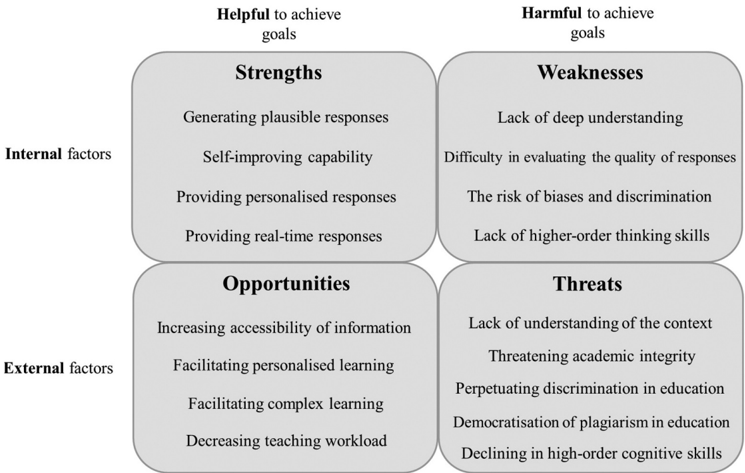
ChatGPT is an AI tool that has sparked debates about its potential implications for education. We used the SWOT analysis framework to outline ChatGPT’s strengths and weaknesses and to discuss its opportunities for and threats to education. The strengths include using a sophisticated natural language model to generate plausible answers, self-improving capability, and providing personalised and real-time responses. As such, ChatGPT can increase access to information, facilitate personalised and complex learning, and decrease teaching workload, thereby making key processes and tasks more efficient. The weaknesses are a lack of deep understanding, difficulty in evaluating the quality of responses, a risk of bias and discrimination, and a lack of higher-order thinking skills. Threats to education include a lack of understanding of the context, threatening academic integrity, perpetuating discrimination in education, democratising plagiarism, and declining high-order cognitive skills. We provide agenda for educational practice and research in times of ChatGPT.
Overview
The claims and statistics of this paper haven’t been checked yet.
Free: it reads the open-access text and checks the first 5 claims that cite a source we can check. Create a free account to check every claim.
Integrity signals
Registry
Cites
Statistics
Figures


Verification
Claims the paper makes
The claims and statistics of this paper haven’t been checked yet.
Free: it reads the open-access text and checks the first 5 claims that cite a source we can check. Create a free account to check every claim.
Claims other papers make about this one
Each is checked against this paper’s own text: does it say what the citing paper says it does?
The source backs part of the claim, not all of it — or backs it for a different population, condition or comparison.
In the citing paper
“Farrokhnia et al. [14] have demonstrated that employing GenAI tools might undermine advanced cognitive capabilities, such as critical and analytical thinking.”
From The Mediating Role of Generative AI Self-Regulation on Students’ Critical Thinking and Problem-Solving (2024) · cites this paper as [14]
Experimental — accuracy not yet measuredThe source backs part of the claim, not all of it — or backs it for a different population, condition or comparison.
In the citing paper
“A possible explanation for this discrepancy lies in the ambiguity surrounding what constitutes plagiarism when using AI-generated content.”
From Chat or cheat? Academic dishonesty, risk perceptions, and ChatGPT usage in higher education students (2025) · cites this paper as Farrokhnia et al., 2023
Experimental — accuracy not yet measuredThe source backs part of the claim, not all of it — or backs it for a different population, condition or comparison.
In the citing paper
“Student perceptions of academic dishonesty have historically been unclear or incomprehensive, and rarely align with teacher expectations (Tatum, 2022), GenAI will only serve to complicate this (Farrokhnia et al., 2023).”
From Not quite eye to A.I.: student and teacher perspectives on the use of generative artificial intelligence in the writing process (2023) · cites this paper as Farrokhnia et al., 2023
Experimental — accuracy not yet measuredThe cited source says what the claim attributes to it.
In the citing paper
“some students may not perceive their use as a policy violation and may unintentionally commit AIgiarism, as its outputs are not verbatim copies of existing texts”
From Chat or cheat? Academic dishonesty, risk perceptions, and ChatGPT usage in higher education students (2025) · cites this paper as Farrokhnia et al., 2023
In the citing paper
“This is echoed in the literature as findings suggest that ChatGPT can provide personalized feedback on essays and become a tutoring system by stimulating critical thinking and debates among students [13].”
From Challenges and Opportunities of Generative AI for Higher Education as Explained by ChatGPT (2023) · cites this paper as [13]
3 more claims about this paper
Create a free account to see every claim other papers make about this one.
Self-check
Percentages, sums and reported differences re-computed from the paper’s own numbers.
The self-check needs the paper’s full text.
Citations
Cites
ChatGPT for Good? On Opportunities and Challenges of Large Language Models for Education
Kasneci, E., Seßler, K., Küchemann, S., Bannert, M., Dementieva, D., Fischer, F., Gasser, U., Groh, G., Günnemann, S., Hüllermeier, E., et al. (2023) · doi:10.35542/osf.io/5er8f · Cited by 7,552
ChatGPT for good? On opportunities and challenges of large language models for education
Kasneci, E., Sessler, K., Küchemann, S., Bannert, M., Dementieva, D., Fischer, F., Gasser, U., Groh, G., Günnemann, S., Hüllermeier, E., et al. (2023) · Learning and Individual Differences · doi:10.1016/j.lindif.2023.102274 · Cited by 7,326 · cited 3×
“ChatGPT’s superior performance is largely attributed to its massive amount of training data (Kasneci et al., 2023), enabling it to capture a wide range of linguistic patterns and relationships, thereby providing a fair understanding of language and context (Lecler et al., 2023; Wang et al., 2023).”
BackgroundMethodBest-worst multi-criteria decision-making method
Rezaei, J. (2015) · Omega · doi:10.1016/j.omega.2014.11.009 · Cited by 4,333 · cited 1×
“Therefore, empirical studies with quantitative approaches such as the best-worst method (see Rezaei, 2015) are necessary to extend the current review findings.”
BackgroundKung, T. H., Cheatham, M., ChatGPT, Medenilla, A., Sillos, C., De Leon, L., Elepaño, C., Madriaga, M., Aggabao, R., Diaz-Candido, G., et al. (2022) · doi:10.1101/2022.12.19.22283643 · Cited by 4,115
Kung, T. H., Cheatham, M., Medenilla, A., Sillos, C., De Leon, L., Elepaño, C., Madriaga, M., Aggabao, R., Diaz-Candido, G., Maningo, J., et al. (2023) · PLOS Digital Health · doi:10.1371/journal.pdig.0000198 · Cited by 4,115 · cited 1×
“It is also shown that ChatGPT has the potential to respond sufficiently to exam questions in the fields of medical (Kung et al., 2022) and law (Choi et al., 2023).”
BackgroundSallam, M. (2023) · Healthcare · doi:10.3390/healthcare11060887 · Cited by 3,126
Chatting and cheating: Ensuring academic integrity in the era of ChatGPT
Cotton, D. R. E., Cotton, P. A., & Shipway, J. R. (2024) · Innovations in Education and Teaching International · doi:10.1080/14703297.2023.2190148 · Cited by 3,087 · cited 5×
“…some scholars are concerned about the ethical considerations of ChatGPT (Mhlanga, 2023), as well as its potential negative effects on assessment practices (Rudolph et al., 2023), scientific integrity (Cotton et al., 2023; Shiri, 2023), and students’ higher-order thinking skills (Susnjak, 2022).”
BackgroundMethodInfluentialChatting and Cheating. Ensuring academic integrity in the era of ChatGPT
Cotton, D., Cotton, P., & Shipway, J. R. (2023) · doi:10.35542/osf.io/mrz8h · Cited by 3,079
Doyle, T. (2017) · The Information Society · doi:10.1080/01972243.2017.1354593 · Cited by 3,071 · cited 1×
“AI algorithms can also perpetuate discrimination by focusing on objectives like profits and efficiency without considering unintended consequences such as reinforcing existing biases (O’neil, 2017).”
Background
Research works printed but not linked: 1
- Haque, M. U., Dharmadasa, I., Sworna, Z. T., Rajapakse, R. N., & Ahmad, H. (2022). 'I think this is the most disruptive technology': Exploring sentiments of ChatGPT early adopters using Twitter data. arXiv. https://doi.org/10.48550/arXiv.2303.03836 . · arXiv · doi:10.48550/arxiv.2303.03836 · Paper page
Cited by
Items 501–600 of 1,006
Karafil, B., & Uyar, A. (2025) · Education and Information Technologies · doi:10.1007/s10639-024-13291-w · Cited by 17
“This reliance on ChatGPT can diminish students’ motivation to conduct research and develop their own learning strategies (Farrokhnia et al., 2023).”
Flavin, E., Hwang, S., & Morales, M. (2025) · Journal of Teacher Education · doi:10.1177/00224871251325079 · Cited by 15
“However, researchers have expressed concern about the overreliance on ChatGPT due to its occasional inaccuracies and fabricated information (Farrokhnia et al., 2024).”
Utilizing ChatGPT in a Data Structures and Algorithms Course: A Teaching Assistant's Perspective
Jamie, P., Hajihashemi, R., & Alipour, S. (2025) · CHI Conference Extended Abstracts on Human Factors in Computing Systems (CHI EA) · doi:10.1145/3706599.3720291 · Cited by 20
“Farrokhnia et al. [12] provide a comprehensive analysis of the strengths, weaknesses, opportunities, and threats (SWOT) associated with the use of ChatGPT in educational settings.”
Asad, M. M., & Ajaz, A. (2025) · The TQM Journal · doi:10.1108/tqm-09-2024-0357 · Cited by 17
Wu, J., Wang, Y., Chen, F., Yin, X., & He, Y. (2025) · IEEE Access · doi:10.1109/access.2025.3571055 · Cited by 15
“A recent SWOT analysis identified personalized learning as one of the key advantages of AI integration in education [32].”
Gökçearslan, Ş., Eşiyok, E., & Küçükergin, K. G. (2025) · Journal of Computational Social Science · doi:10.1007/s42001-025-00387-7 · Cited by 17
La ética de la Inteligência Artificial en la educación: hacia un uso responsable e inclusivo
Almenara, J. C., & Osuna, J. B. (2025) · Educação e Pesquisa · doi:10.1590/s1678-4634202551293347es · Cited by 16
Avello, D., & Estrada-Palavecino, L. (2023) · Cadernos Brasileiros de Terapia Ocupacional · doi:10.1590/2526-8910.ctoen271035342 · Cited by 18
“…with one's own critical thinking, analysis and research is highlighted, and of being aware of the risks associated with dependence on this type of tool, since they can restrict creativity, critical thinking and problem solving (Crawford et al., 2023; Farrokhnia et al., 2023; Tlili et al., 2023).”
BackgroundEvaluating ChatGPT-4’s historical accuracy: a case study on the origins of SWOT analysis
Puyt, R. W., & Madsen, D. Ø. (2024) · Frontiers in Artificial Intelligence · doi:10.3389/frai.2024.1402047 · Cited by 17
“In our view, the enormous popularity and widespread diffusion of SWOT in business practice and business school education (Farrokhnia et al., 2023), as well as the relatively broad and mainstream appeal of the tool, makes it all the much more important to ensure that the history and origins are…”
BackgroundThe ChatGPT application on quality management: a comprehensive review
Atalan, A. (2025) · Journal of Management Analytics · doi:10.1080/23270012.2025.2484225 · Cited by 18
Kılıç, M. E. (2023) · medRxiv · doi:10.1101/2023.07.12.23292564 · Cited by 16
Ceallaigh, T. J. Ó., O’ Brien, E., Tømte, C., Kulaksız, T., & Connolly, C. (2025) · European Journal of Teacher Education · doi:10.1080/02619768.2025.2563696 · Cited by 14
“…student work, offering personalised feedback efficiently, and detecting plagiarism to uphold academic integrity (Dwivedi et al. 2021, Naidu and Sevnarayan 2023), it simultaneously raises concerns about academic dishonesty and misuse (Cotton, Cotton, and Shipway 2023; Farrokhnia et al. 2024).”
An Inquiry Into the Use of Generative AI and Its Implications in Education: Boon or Bane
Baek, E. O., & Wilson, R. V. (2024) · International Journal of Adult Education and Technology · doi:10.4018/ijaet.349233 · Cited by 14
Kamran, M., Faizan, M., Wang, S., Armaghani, D. J., Asteris, P. G., & Pradhan, B. (2025) · Geoscience Frontiers · doi:10.1016/j.gsf.2025.102163 · Cited by 14
The impact of chatbots on emotional intelligence in AI-assisted EFL writing
Kazazoğlu, S., & Özel, G. T. (2025) · Frontiers in Education · doi:10.3389/feduc.2025.1624272 · Cited by 16
Epistemic dependence in AI-mediated learning
Du, Y., & Yuan, Y. (2026) · AI & Society · doi:10.1007/s00146-026-03294-1 · Cited by 21
A democratic curriculum for the challenges of post-truth
Nally, D. (2024) · Curriculum Perspectives · doi:10.1007/s41297-024-00228-z · Cited by 15
“The impact of these trends is compounded by the recent uptake in the use of AI, which has been indicated by Farrokhnia et al. (2023, p. 4) to ‘serve as a starting point for novice teachers who have less teaching experience and pedagogical knowledge’.”
Ivanytska, N., Коляса, О. В., Kovalevska, T., Мацера, О., Tetiana, T., & Tkachuk, T. (2024) · Arab World English Journal · doi:10.24093/awej/chatgpt.21 · Cited by 19
“…academic integrity, entrenchment of discrimination in education, the democratization of plagiarism, and the decline of high-level cognitive skills (Farrokhnia et al., 2023), replacing the authority of teaching staff and administrators (Popenici & Kerr, 2017),lack of skills of teachers to solve…”
BackgroundConversational AI in Higher Education: Opportunities, Challenges, and Ethical Considerations
Venter, I. M., Cranfield, D. J., Blignaut, R. J., Achi, S. E., & Tick, A. (2024) · IEEE International Conference on Intelligent Engineering Systems (INES) · doi:10.1109/ines63318.2024.10629104 · Cited by 17
Artificial intelligence in teaching social disciplines: Opportunities and challenges of tools
Lobanova, A., Hrabovets, I. V., Приходько, О. О., Каритка, В. В., Kalashnikova, L. V., & Chernous, L. (2024) · Educational Technology Quarterly · doi:10.55056/etq.813 · Cited by 15
“…into other systems and platforms used in higher education institutions [38]; self-improvement, expanding access to information, promoting personalised and comprehensive training; reducing the workload of teachers, which will contribute to the productivity of key processes and tasks [8, 11].”
BackgroundHussain, F., & Anwar, M. A. (2024) · Journal of Asian Public Policy · doi:10.1080/17516234.2024.2422917 · Cited by 16
“Just as the telephone’s growing popularity enhanced its practical usefulness (Van Slyke et al., 2007), the widespread integration of ChatGPT usability and effectiveness in academic settings are expected to increase (Cascella et al., 2023; Farrokhnia et al., 2023).”
InfluentialLaunonen, P., Talalakina, E. V., & Dubova, G. (2024) · Półrocznik Językoznawczy Tertium · doi:10.7592/tertium.2024.9.1.274 · Cited by 17
Pesce, M. A., & Blanco, D. F. (2024) · European Journal of Education Studies · doi:10.46827/ejes.v11i12.5687 · Cited by 17
Kim, J., & Danilina, E. A. (2025) · Innovations in Education and Teaching International · doi:10.1080/14703297.2025.2456223 · Cited by 14
“GenAI can also support student writers by assisting collaborative learning (Tan et al., 2023), facilitating authentic interactions (Kohnke et al., 2023), and supporting personalised learning (Farrokhnia et al., 2024).”
Analysis of the influence of ChatGPT on secondary education from the perspective of teachers
Santos, M. L., Lozano, A., & Fontao, C. B. (2025) · Journal of Technology and Science Education · doi:10.3926/jotse.3190 · Cited by 16
“Additionally, AI is considered to improve teacher productivity, reducing the time spent on asynchronous tutoring and mechanical tasks in assessment using scales or rubrics (Farrokhnia et al., 2023).”
InfluentialHoàng, N. H. (2025) · The JALT CALL Journal · doi:10.29140/jaltcall.v21n2.102429 · Cited by 15
Pedagogical shifts in the age of GenAI: Faculty perspectives from a higher education context
Cespedes, A. A. (2025) · Journal of Pedagogical Sociology and Psychology · doi:10.33902/jpsp.202537244 · Cited by 17
Generative AI-driven feedback in higher education: a scoping review
Zhang, K., Li, S., & Huang, Y. (2026) · Assessment & Evaluation in Higher Education · doi:10.1080/02602938.2026.2617157 · Cited by 16
ЗАСТОСУВАННЯ CHATGPT У НАВЧАННІ ФІЗИКИ БАКАЛАВРІВ ТЕХНІЧНОГО УНІВЕРСИТЕТУ
Подласов, С. О., & Матвійчук, О. В. (2023) · Information Technologies and Learning Tools · doi:10.33407/itlt.v97i5.5374 · Cited by 18
Chat GPT sebagai Era Baru dalam Transformasi Pembelajaran: Systematic Literature Review
Kusworo, K., Goreta, G., Hanafi, I., Susanto, T. T. D., & Astuti, I. A. D. (2024) · SAP (Susunan Artikel Pendidikan) · doi:10.30998/sap.v8i3.17991 · Cited by 25
“Salah satu riset ditemukan adanya Implikasi untuk praktik pendidikan dan penelitian dengan menggunakan analisis SWOT [5].”
BackgroundUsing ChatGPT for the Development of Critical Thinking in Youth: Example of Inequality Proof
Drushlyak, M. G., Лукашова, Т., Sabadosh, Y., Melnikov, I., & Семеніхіна, О. В. (2024) · International Convention on Information and Communication Technology, Electronics and Microelectronics · doi:10.1109/mipro60963.2024.10569759 · Cited by 17
“M. Farrokhnia et al. [20] used a SWOT analysis methodology to identify the strengths and weaknesses of ChatGPT.”
MethodMiddle school students’ perspectives on adopting generative AI in K-12 education
Adisa, I. O., & Adefisayo, A. O. (2025) · The Journal of Educational Research · doi:10.1080/00220671.2025.2510393 · Cited by 13
“The ease of access to AI-generated answers can reduce students’ motivation to engage in independent problem-solving and critical thinking (Farrokhnia et al., 2024; Noroozi et al., 2024).”
Kim, Y. S., Moon, H. S., Lee, S., & Lee, T. Y. (2025) · Proceedings of the ACM on Human-Computer Interaction · doi:10.1145/3757534 · Cited by 17
Shen, Y., & Han, Y. (2025) · Thinking Skills and Creativity · doi:10.1016/j.tsc.2025.102045 · Cited by 15
The Role of ChatGPT in Higher Education: Some Reflections from Public Administration Students
Aristovnik, A., Umek, L., Brezovar, N., Keržič, D., & Ravšelj, D. (2023) · Communications in computer and information science · doi:10.1007/978-981-99-8255-4_22 · Cited by 14
Transforming Education With the Power of Artificial Intelligence: Case Studies
Cota-Rivera, E. I., Correa, M. E. G., Marín, L. A. B., Montenegro, M. Y. M., Mercado-Herrera, A., & Martinez, M. A. A. M. (2024) · Advances in higher education and professional development book series · doi:10.4018/979-8-3693-1666-5.ch006 · Cited by 21
Bonnet, S., & Teuteberg, F. (2025) · International Journal of Knowledge Management · doi:10.4018/ijkm.368223 · Cited by 18
Pakdel, F., Khojasteh, L., Kafipour, R., & Shahsavar, Z. (2025) · Language Teaching Research · doi:10.1177/13621688251322953 · Cited by 17
ELT Teachers' perception and usage of ChatGPT as a teaching tool in the Bangladeshi EFL context
Tarannum, T., Ahmed, R., Seraj, P. M. I., & Khan, T. S. (2025) · Education and Information Technologies · doi:10.1007/s10639-025-13515-7 · Cited by 14
“Both the qualitative and quantitative results of this study are supported by the previous studies of Derakhshan and Ghiasvand (2024), Mohamed (2024), Grassini (2023), Farrokhnia et al. (2024), Xiao and Zhi (2023), Kohnke et al. (2023), Kasneci et al. (2023).”
Exploring Implementations of GenAI in Teaching IS Subjects and Student Perceptions
Jiang, Y., & Nakatani, K. (2025) · Journal of Information Systems Education · doi:10.62273/wfho1011 · Cited by 15
“…al., 2023; Sullivan e al., 2023; Van Slyke et al., 2023; Yu, 2024), or evaluations of GenAI capabilities (AlAfnan et al., 2023; Denny et al., 2024; Farrokhnia et al., 2024; Sobania et al., 2023) that do not actually implement GenAI in courses to investigate these issues or exploit possible…”
InfluentialCheng, E. C. K. (2025) · International Journal for Lesson and Learning Studies · doi:10.1108/ijlls-11-2024-0277 · Cited by 15
Saeedi, Z., & Soltani, M. D. (2025) · Computer Assisted Language Learning · doi:10.1080/09588221.2025.2532014 · Cited by 13
Du, C., & Yang, Y. (2025) · System · doi:10.1016/j.system.2025.103828 · Cited by 18
Shang, J., Huang, Y., Xu, M., Huang, Y., Shen, X., Wang, G., Wang, Y., & Zhang, L. (2025) · Computer Assisted Language Learning · doi:10.1080/09588221.2025.2577356 · Cited by 15
Sil'cheva, A. G., Ламзина, А. В., & Pavlova, T. L. (2023) · Perspectives of science and education · doi:10.32744/pse.2023.4.38 · Cited by 13
Students’ Preference in Using Chatbots for Academic Writing
Sasikumar, A., & Sunil, M. V. (2023) · Indian Journal of Science and Technology · doi:10.17485/ijst/v16i36.1850 · Cited by 13
Teaching IT Software Fundamentals: Strategies and Techniques for Inclusion of Large Language Models
Gumina, S., Dalton, T., & Gerdes, J. H. (2023) · Conference on Information Technology Education · doi:10.1145/3585059.3611409 · Cited by 17
Beltozar-Clemente, S., Díaz-Vega, E., Zapata-Paulini, J. E., & Tejeda-Navarrete, R. E. (2024) · International Journal of Engineering Pedagogy (iJEP) · doi:10.3991/ijep.v14i1.46787 · Cited by 13
Wizard-of-Oz vs. GPT-4: A Comparative Study of Perceived Social Intelligence in HRI Brainstorming
Vrins, A., Pruss, E., Ceccato, C., Prinsen, J., de Rooij, A., Alimardani, M., & de Wit, J. (2024) · ACM/IEEE International Conference on Human-Robot Interaction (HRI) · doi:10.1145/3610978.3640755 · Cited by 13
A Systematic Review of the Impact of ChatGPT on Higher Education
You, S. (2024) · International Journal of Technology-Enhanced Education · doi:10.4018/ijtee.343528 · Cited by 13
Sentiment Analysis Classification of ChatGPT on Twitter Big Data in Indonesia Using Fast R-CNN
Pipin, S. J., Sinaga, F. M., Winardi, S., & Hakim, M. N. (2023) · JURNAL MEDIA INFORMATIKA BUDIDARMA · doi:10.30865/mib.v7i4.6816 · Cited by 16
“Moreover, the use of generative AI in education and research raises ethical concerns, such as the potential for unethical usage [6], [7].”
BackgroundEnhancing Management Education Through ChatGPT: A Novel Method for Ease and Efficacy
Dahake, P. S., Mohare, R. V., & Dahake, N. S. (2024) · Advances in business strategy and competitive advantage book series · doi:10.4018/979-8-3693-1734-1.ch012 · Cited by 12
Generative artificial intelligence in education: A narrative literature review
Khan, N., & Saunderson, S. (2024) · World Journal on Educational Technology Current Issues · doi:10.18844/wjet.v16i2.9217 · Cited by 12
Le, X. C. (2024) · Education Research and Perspectives · doi:10.70953/erpv51.2412007 · Cited by 16
AI’s Corrective Feedback vs. Traditional Recasts: which fosters better grammar accuracy?
Chhabriya, M., Babu, N. N., & Kumari, A. S. P. (2024) · DMIHER International Conference on Artificial Intelligence in Healthcare, Education and Industry (IDICAIHEI) · doi:10.1109/idicaiei61867.2024.10842936 · Cited by 13
AI versus tradition: shaping the future of higher education
Venter, I. M., Blignaut, R. J., Cranfield, D. J., Tick, A., & Achi, S. E. (2025) · Journal of Applied Research in Higher Education · doi:10.1108/jarhe-12-2024-0702 · Cited by 12
Carruba, M. C., Caiazzo, A., Scuotto, C., Savioni, L., & Triberti, S. (2025) · Cyberpsychology Behavior and Social Networking · doi:10.1089/cyber.2024.0524 · Cited by 14
“10 The results of this analysis can be summarized as follows (Fig.”
Tohir, A., Muslim, S., & Situmorang, R. (2025) · International Journal of Computational and Experimental Science and Engineering · doi:10.22399/ijcesen.3474 · Cited by 15
Enhancing STEM lesson plans: preservice primary teachers’ collaboration with ChatGPT
Yorulmaz, A., Okulu, H. Z., Muslu, N., & Çokçalışkan, H. (2025) · Education and Information Technologies · doi:10.1007/s10639-025-13736-w · Cited by 15
“…that ChatGPT can significantly enhance educational practices by facilitating personalized learning, expanding learning resources, aiding in lesson planning, providing tutoring and explanations, and promoting interactive learning (Hong, 2023 ; Farrokhnia et al., 2024; Rospigliosi, 2023).”
Chen, C. (2025) · Journal of Computers in Education · doi:10.1007/s40692-025-00372-z · Cited by 12
“In the era of AI, one of the core challenges in education is cultivating students’ ability to effectively utilize and critically evaluate AI-generated information (Farrokhnia et al., 2023).”
InfluentialLiu, Z., Yan, Z., Zuo, H., & Lu, Y. (2025) · Frontiers in Psychology · doi:10.3389/fpsyg.2025.1599478 · Cited by 13
Santosa, M. H., Kusuma, I. P. I., & Budiarta, L. G. R. (2026) · Australian Journal of Applied Linguistics · doi:10.29140/ajal.2026.103446 · Cited by 14
“AI empowers English teachers to deliver personalized and complex learning experiences, and it catered to individual student needs (Cotton et al., 2023; Farrokhnia et al., 2023; Hong, 2023).”
The intersection of artificial intelligence and instructional design practice: a systematic review
Kibar, P. N., & Ilgaz, H. (2026) · Educational Technology Research and Development · doi:10.1007/s11423-026-10624-z · Cited by 12
“Some studies aimed to identify the dimensions and objectives through which AI has been examined in learning contexts (Farrokhnia et al., 2024) and to determine its advantages and disadvantages in educational processes (Arar et al., 2025).”
ChatGPT as an intelligent self-Continuous Professional Development tool for teachers
Fakhar, H., Mohammed, L., Echantoufi, N., Ouadrhiri, K., Khalid, E., & Ajana, L. (2024) · Statistics Optimization & Information Computing · doi:10.19139/soic-2310-5070-2145 · Cited by 16
Generative artificial intelligence in education: an umbrella review of applications and challengesPreprint
Namoun, A., Ibrahim, I. A., Mustafa, E., Alrehaili, A., Tufail, A., Shuja, J., & Bilal, K. (2024) · Research Square · doi:10.21203/rs.3.rs-4892155/v1 · Cited by 14
Vásquez Cardona, F., Carmona García, V., & Pérez Valencia, D. (2025) · Revista de Bioética y Derecho · doi:10.1344/rbd2025.65.49416 · Cited by 11
A closer look at ChatGPT's role in concept map generation for education
Schicchi, D., Limongelli, C., Monteleone, V., & Taibi, D. (2026) · Interactive Learning Environments · doi:10.1080/10494820.2025.2497110 · Cited by 11
“For instance, Farrokhnia et al. (2023) provides a detailed SWOT analysis outlining the system ’ s strengths, such as its capacity to generate text customized to suit varying learning styles and levels.”
Jovic, M., Papakonstantinidis, S., & Kirkpatrick, R. (2025) · Language Testing in Asia · doi:10.1186/s40468-025-00389-2 · Cited by 11
“Notably, research demonstrates that ChatGPT excels at generating comprehensive, descriptive feedback and synthesizing textual infor - mation effectively (Farrokhnia et al., 2024).”
Manyengo, P. R. (2024) · JOURNAL OF ISSUES AND PRACTICE IN EDUCATION · doi:10.61538/jipe.v15i2.1392 · Cited by 12
“Farrokhnia et al. (2023) assert that an introduction and use of ChatGPT has potential opportunities, particularly with regard to content generation, brainstorming ideas, reviewing literature and communication (i.e., language use).”
BackgroundInfluentialExploring the Use of ChatGPT as a Tool for Developing Eportfolios in ESL Classrooms
Anh, L. N. N., Vu, N. N., Nguyen, M. T.-X., & Bo, L. K. (2024) · EAI/Springer Innovations in Communication and Computing · doi:10.1007/978-3-031-50139-5_3 · Cited by 15
Alaqlobi, O., Alduais, A. M. S., Qasem, F. A. A., & Alasmari, M. (2024) · F1000Research · doi:10.12688/f1000research.155378.1 · Cited by 13
Rahardyan, T. M., Susilo, C. H., Iswara, A. M. N., & Hartono, M. L. (2024) · Asia Pacific Fraud Journal · doi:10.21532/apfjournal.v9i2.347 · Cited by 12
“Farrokhnia et al. (2023) and Rahman & Watanobe (2023) agreed that using ChatGPT will potentially threaten academic integrity, e.g., cheating in online exams through ChatGPT.”
Özdemir, S. (2024) · Information Technologies and Learning Tools · doi:10.33407/itlt.v104i6.5859 · Cited by 12
Guo, K., Zhan, C., & Li, X. (2025) · International Journal of Systems Assurance Engineering and Management · doi:10.1007/s13198-025-02772-x · Cited by 16
Qualitative evaluation of a ChatGPT-integrated transcultural nursing course for a diverse group
Gümüş, E. Ç., & Dolu, İ. (2025) · Nurse Education in Practice · doi:10.1016/j.nepr.2025.104491 · Cited by 12
Azmir, S. M., & Atikuzzaman, M. (2025) · The Electronic Library · doi:10.1108/el-01-2025-0038 · Cited by 11
Bringing Cinderella to spotlight? Developing grammar through ChatGPT in writing
Zhou, S., & Preez, G. D. (2025) · Language learning & technology · doi:10.64152/10125/73639 · Cited by 12
Kavitha, K., & Joshith, V. P. (2025) · Journal of Educational Technology Systems · doi:10.1177/00472395251380294 · Cited by 13
“Among these, SAT emerged as the most in fl uential factor, highlighting that high user SAT, driven by ChatGPT ’ s personalized, user-friendly, and interactive nature, encourages sustained engagement (Farrokhnia et al., 2024; Guttierrez-Aguilar et al., 2024).”
Oruç, T., Aktaş, İ., & Kurt, M. (2025) · Journal of Educational Computing Research · doi:10.1177/07356331251409998 · Cited by 14
“Farrokhnia et al. (2023) warn that tools like ChatGPT may “ democratize plagiarism ” by making it easy for students to borrow AI-generated text, blurring the lines of academic honesty.”
InfluentialLindell, T. L., & Stöhr, C. (2026) · Journal of Computing in Higher Education · doi:10.1007/s12528-025-09488-8 · Cited by 13
“Farrokhnia et al. (2024) observe that students driven by superficial goals, such as quickly earning credits, tend to use AI differently than those genuinely invested in learning, potentially developing norms that prioritize expedience over deep learning.”
InfluentialEnhancing college students’ AI literacy through generative AI use: a mixed-methods investigation
Wang, J., Bai, B., & An, Q. (2026) · Frontiers in Psychology · doi:10.3389/fpsyg.2026.1728785 · Cited by 11
“It presents both a historic opportunity to empower personalized learning and unleash creative productivity in higher education and has also sparked extensive concerns regarding academic integrity, cognitive inertia, data privacy, and ethical violations (Mohammadreza et al., 2024).”
ChatGPT-assisted EFL learning beyond the classroom: impact on oral proficiency, enjoyment, and grit
Tai, T. (2026) · Computer Assisted Language Learning · doi:10.1080/09588221.2026.2640087 · Cited by 11
Devadiga, D., & Aithal, P. S. (2026) · Poornaprajna International Journal of Teaching & Research Case Studies (PIJTRCS) · doi:10.64818/pijtrcs.3107.8494.0047 · Cited by 11
Arias, M. D. M. M., Bravo, V. T. F., Santillán, C. M. T., Rengel-Santin, Á. E., & Párraga, A. P. B. (2026) · Saber Estratégico Internacional · doi:10.70577/s.e.v4i3.98 · Cited by 13
Banihashem, S. K., Noroozi, O., Brok, P. J. D., Biemans, H. J. A., Stevens, T. M., & Güney, Ş. (2023) · Innovations in Education and Teaching International · doi:10.1080/14703297.2023.2227616 · Cited by 13
“…education in the blended format may influence their perceptions of education experiences, especially considering the role of emerging technologies such as ChatGPT and learning analytics (K. Banihashem & Macfadyen, 2021; S. K. Banihashem et al., 2022; Farrokhnia et al., 2023; Noroozi et al., 2019).”
Self-citationMicrocreativity with chat generative pre-trained transformer: Learnings in virtual space
Fialho, L. M. F., Neves, V. N. S., & do Nascimento, K. A. S. (2024) · Journal of Technology and Science Education · doi:10.3926/jotse.2338 · Cited by 35
Capturing the full potential of Maltese language learning through ChatGPT
Żammit, J. (2024) · Technology in Language Teaching & Learning · doi:10.29140/tltl.v6n1.1082 · Cited by 14
FROM LEGALITY TO RESPONSIBILITY: CHARTING THE COURSE FOR AI REGULATION IN MALAYSIA
Hossain, M. B., Miraz, M. H., & Ya’u, A. (2024) · IIUM Law Journal · doi:10.31436/iiumlj.v32i1.927 · Cited by 16
Jaber, S. A., Hasan, H. E., Alzoubi, K. H., & Khabour, O. F. (2024) · Heliyon · doi:10.1016/j.heliyon.2024.e41331 · Cited by 11
“The questionnaire was created according to the study aim and a literature review [15 – 20].”
Sain, Z. H., & Kurniati, V. S. D. (2023) · TAMANSISWA INTERNATIONAL JOURNAL IN EDUCATION AND SCIENCE · doi:10.30738/tijes.v5i1.16274 · Cited by 12
Petrič, G. (2024) · International Journal of Technology and Human Interaction · doi:10.4018/ijthi.349225 · Cited by 10
Demirkol, M., & Malkoç, N. (2023) · Educational Process International Journal · doi:10.22521/edupij.2023.124.3 · Cited by 11
“A comprehensive study by Farrokhnia et al. (2023) conducted a SWOT analysis of the educational utility of ChatGPT, and showed that ChatGPT could increase the efficiency of key educational processes and tasks such as facilitating personalized learning, promoting easier access to information, and…”
MethodPavlović, D. Č., Soler-Adillón, J., & Stanisavljević-Petrović, Z. (2024) · Revista Española de Pedagogía · doi:10.22550/2174-0909.4160 · Cited by 11
Can LLMs Facilitate Onboarding Software Developers? An Ongoing Industrial Case Study
Azanza, M., Pereira, J., Irastorza, A., & Galdos, A. (2024) · IEEE International Conference on Software Engineering Education and Training (CSEE&T) · doi:10.1109/cseet62301.2024.10662989 · Cited by 12
Implications of artificial intelligence chatbot models in higher education
Khandakar, H., Fazal, S. A., Afnan, K. F., & Hasan, K. K. (2024) · IAES International Journal of Artificial Intelligence · doi:10.11591/ijai.v13.i4.pp3808-3813 · Cited by 11
“Why Can’t I Use ChatGPT for My Academic Learning?” Voices from Ph.D. Students in a Thai University
Buripakdi, A., & An, L. T. (2024) · LEARN Journal : Language Education and Acquisition Research Network · doi:10.70730/vrvs6900 · Cited by 13
AI-generated SWOT analysis of emerging technologies in air transportation: Potential and limitations
Klophaus, R. (2025) · Research in Transportation Business & Management · doi:10.1016/j.rtbm.2025.101316 · Cited by 12
Demir, S., & Çetin, M. (2025) · Dil Eğitimi ve Araştırmaları Dergisi · doi:10.31464/jlere.1501596 · Cited by 10
Enhancing academic writing in English language education through generative AI integration
Zamorano, C. (2025) · Research Studies in English Language Teaching and Learning · doi:10.62583/rseltl.v3i3.87 · Cited by 14
Using ChatGPT errors to encourage student exploration and self-learning in mathematics
Slobodsky, P., & Durcheva, M. (2025) · International Journal of Mathematical Education in Science and Technology · doi:10.1080/0020739x.2025.2505200 · Cited by 10
Metadata
- Authors
- Farrokhnia, M., Banihashem, S. K., Noroozi, O., & Wals, A.
- Affiliations
- Wageningen University & Research (NL)
- Open University of the Netherlands (NL)
- Corresponding author
- Noroozi, Omid
- Venue
- Innovations in Education and Teaching International
- Publisher
- Informa UK Limited
- Published
- 2023-03-27
- Volume
- 61
- Issue
- 3
- Pages
- 460-474
- ISSN
- 1470-3297 (ISSN-L)
- 1470-3300
- OpenAlex
- W4361204578
- Cited by
- 1,384
- References
- 68
- Citations by year
- 2026: 359 · 2025: 456 · 2024: 396 · 2023: 173
- FWCI
- 324.80
- Type
- journal article
- Language
- en
- Open access
- hybrid
- doi.org
- Licence
- Locations
- Innovations in Education and Teaching International (publishedVersion, cc-by-nc-nd)
- Socio-Environmental Systems Modeling (submittedVersion, cc-by-nc-nd)
- DSpace (Open University in the Netherlands) (submittedVersion, cc-by-nc-nd)
- Data Archiving and Networked Services (DANS) (submittedVersion, other-oa)
- Topics
- Social Sciences › Education › Artificial Intelligence in Education
- Health Sciences › Medicine › Health Informatics › Artificial Intelligence in Healthcare and Education
- Social Sciences › Education › Educational Technology in Learning
- Keywords
- ChatGPT, large language models, artificial intelligence in education, academic integrity, plagiarism, algorithmic bias, higher-order thinking skills, personalized learning, teacher workload, SWOT analysis
About these checks
Registry, retraction, Cites and statistics results are computed, not judged, with one exception: a printed reference that no index lists is read once by a model before it counts as a citation error. Claims are extracted by a model and kept only when their quote appears verbatim in the text; each cited source is then checked, with a model’s help, for whether it says what the claim relies on. Those verdicts can be wrong — read the claim’s quote and the cited source before relying on one.
Statistics and arithmetic are recomputed, not judged.
Confidence bands are shown only for fields calibrated on our annotated test set. None is calibrated yet, so no band is shown.
What counts as a claim ›How we measure confidence ›How we check this ›
Are you an author, or do you see a problem with this page? Request a review
Data sources
Bibliographic data: Semantic Scholar, OpenAlex, Crossref.
Contains information from the Semantic Scholar Academic Graph Datasets, made available under the ODC Attribution License (ODC-BY 1.0).
Semantic Scholar’s data is described in: Kinney, R., et al. (2023). The Semantic Scholar Open Data Platform. arXiv:2301.10140.
