

A SWOT analysis of ChatGPT: Implications for educational practice and research
Open accessThe DOI matches its Crossref record; 79 of the 79 references it cites were found in a registry or an index.
Abstract
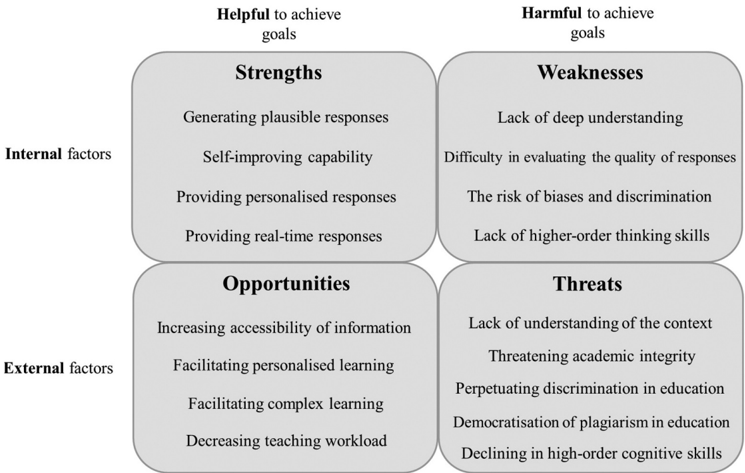
ChatGPT is an AI tool that has sparked debates about its potential implications for education. We used the SWOT analysis framework to outline ChatGPT’s strengths and weaknesses and to discuss its opportunities for and threats to education. The strengths include using a sophisticated natural language model to generate plausible answers, self-improving capability, and providing personalised and real-time responses. As such, ChatGPT can increase access to information, facilitate personalised and complex learning, and decrease teaching workload, thereby making key processes and tasks more efficient. The weaknesses are a lack of deep understanding, difficulty in evaluating the quality of responses, a risk of bias and discrimination, and a lack of higher-order thinking skills. Threats to education include a lack of understanding of the context, threatening academic integrity, perpetuating discrimination in education, democratising plagiarism, and declining high-order cognitive skills. We provide agenda for educational practice and research in times of ChatGPT.
Overview
The claims and statistics of this paper haven’t been checked yet.
Free: it reads the open-access text and checks the first 5 claims that cite a source we can check. Create a free account to check every claim.
Integrity signals
Registry
Cites
Statistics
Figures


Verification
Claims the paper makes
The claims and statistics of this paper haven’t been checked yet.
Free: it reads the open-access text and checks the first 5 claims that cite a source we can check. Create a free account to check every claim.
Claims other papers make about this one
Each is checked against this paper’s own text: does it say what the citing paper says it does?
The source backs part of the claim, not all of it — or backs it for a different population, condition or comparison.
In the citing paper
“Farrokhnia et al. [14] have demonstrated that employing GenAI tools might undermine advanced cognitive capabilities, such as critical and analytical thinking.”
From The Mediating Role of Generative AI Self-Regulation on Students’ Critical Thinking and Problem-Solving (2024) · cites this paper as [14]
Experimental — accuracy not yet measuredThe source backs part of the claim, not all of it — or backs it for a different population, condition or comparison.
In the citing paper
“A possible explanation for this discrepancy lies in the ambiguity surrounding what constitutes plagiarism when using AI-generated content.”
From Chat or cheat? Academic dishonesty, risk perceptions, and ChatGPT usage in higher education students (2025) · cites this paper as Farrokhnia et al., 2023
Experimental — accuracy not yet measuredThe source backs part of the claim, not all of it — or backs it for a different population, condition or comparison.
In the citing paper
“Student perceptions of academic dishonesty have historically been unclear or incomprehensive, and rarely align with teacher expectations (Tatum, 2022), GenAI will only serve to complicate this (Farrokhnia et al., 2023).”
From Not quite eye to A.I.: student and teacher perspectives on the use of generative artificial intelligence in the writing process (2023) · cites this paper as Farrokhnia et al., 2023
Experimental — accuracy not yet measuredThe cited source says what the claim attributes to it.
In the citing paper
“some students may not perceive their use as a policy violation and may unintentionally commit AIgiarism, as its outputs are not verbatim copies of existing texts”
From Chat or cheat? Academic dishonesty, risk perceptions, and ChatGPT usage in higher education students (2025) · cites this paper as Farrokhnia et al., 2023
In the citing paper
“This is echoed in the literature as findings suggest that ChatGPT can provide personalized feedback on essays and become a tutoring system by stimulating critical thinking and debates among students [13].”
From Challenges and Opportunities of Generative AI for Higher Education as Explained by ChatGPT (2023) · cites this paper as [13]
3 more claims about this paper
Create a free account to see every claim other papers make about this one.
Self-check
Percentages, sums and reported differences re-computed from the paper’s own numbers.
The self-check needs the paper’s full text.
Citations
Cites
ChatGPT for good? On opportunities and challenges of large language models for education
Kasneci, E., Sessler, K., Küchemann, S., Bannert, M., Dementieva, D., Fischer, F., Gasser, U., Groh, G., Günnemann, S., Hüllermeier, E., et al. (2023) · Learning and Individual Differences · doi:10.1016/j.lindif.2023.102274 · Cited by 15,365 · cited 3×
“ChatGPT’s superior performance is largely attributed to its massive amount of training data (Kasneci et al., 2023), enabling it to capture a wide range of linguistic patterns and relationships, thereby providing a fair understanding of language and context (Lecler et al., 2023; Wang et al., 2023).”
BackgroundMethodChatGPT for Good? On Opportunities and Challenges of Large Language Models for Education
Kasneci, E., Seßler, K., Küchemann, S., Bannert, M., Dementieva, D., Fischer, F., Gasser, U., Groh, G., Günnemann, S., Hüllermeier, E., et al. (2023) · doi:10.35542/osf.io/5er8f · Cited by 7,552
Best-worst multi-criteria decision-making method
Rezaei, J. (2015) · Omega · doi:10.1016/j.omega.2014.11.009 · Cited by 4,333 · cited 1×
“Therefore, empirical studies with quantitative approaches such as the best-worst method (see Rezaei, 2015) are necessary to extend the current review findings.”
BackgroundKung, T. H., Cheatham, M., ChatGPT, Medenilla, A., Sillos, C., De Leon, L., Elepaño, C., Madriaga, M., Aggabao, R., Diaz-Candido, G., et al. (2022) · doi:10.1101/2022.12.19.22283643 · Cited by 4,115
Kung, T. H., Cheatham, M., Medenilla, A., Sillos, C., De Leon, L., Elepaño, C., Madriaga, M., Aggabao, R., Diaz-Candido, G., Maningo, J., et al. (2023) · PLOS Digital Health · doi:10.1371/journal.pdig.0000198 · Cited by 4,115 · cited 1×
“It is also shown that ChatGPT has the potential to respond sufficiently to exam questions in the fields of medical (Kung et al., 2022) and law (Choi et al., 2023).”
BackgroundSallam, M. (2023) · Healthcare · doi:10.3390/healthcare11060887 · Cited by 3,126
Chatting and cheating: Ensuring academic integrity in the era of ChatGPT
Cotton, D. R. E., Cotton, P. A., & Shipway, J. R. (2024) · Innovations in Education and Teaching International · doi:10.1080/14703297.2023.2190148 · Cited by 3,087 · cited 5×
“…some scholars are concerned about the ethical considerations of ChatGPT (Mhlanga, 2023), as well as its potential negative effects on assessment practices (Rudolph et al., 2023), scientific integrity (Cotton et al., 2023; Shiri, 2023), and students’ higher-order thinking skills (Susnjak, 2022).”
BackgroundMethodInfluentialChatting and Cheating. Ensuring academic integrity in the era of ChatGPT
Cotton, D., Cotton, P., & Shipway, J. R. (2023) · doi:10.35542/osf.io/mrz8h · Cited by 3,079
Doyle, T. (2017) · The Information Society · doi:10.1080/01972243.2017.1354593 · Cited by 3,071 · cited 1×
“AI algorithms can also perpetuate discrimination by focusing on objectives like profits and efficiency without considering unintended consequences such as reinforcing existing biases (O’neil, 2017).”
Background
Research works printed but not linked: 1
- Haque, M. U., Dharmadasa, I., Sworna, Z. T., Rajapakse, R. N., & Ahmad, H. (2022). 'I think this is the most disruptive technology': Exploring sentiments of ChatGPT early adopters using Twitter data. arXiv. https://doi.org/10.48550/arXiv.2303.03836 . · arXiv · doi:10.48550/arxiv.2303.03836 · Paper page
Cited by
Items 801–900 of 1,006
Younes, Z. B. B., Hassan, I., Umar, M. M., Mustafa, N. H., Abdullah, A. T. H., & Azmi, M. N. L. (2024) · Arab World English Journal · doi:10.24093/awej/call10.1 · Cited by 8
Artificial intelligence in education: ChatGPT-based simulations in teachers’ preparation
Drushlyak, M. G., Лукашова, Т., Shamonia, V., & Семеніхіна, О. В. (2025) · Informatyka Automatyka Pomiary w Gospodarce i Ochronie Środowiska · doi:10.35784/iapgos.6180 · Cited by 6
“M. Farrokhnia, S. K. Banihashem, O. Noroozi, and A. Wals [15], based on the results of the SWOT analysis, identified the strengths of ChatGPT (creating plausible responses, self-improvement or self-learning ability, providing personalized responses, real-time response capabilities, especially for…”
From hesitation to integration: A UTAUT model analysis of ChatGPT adoption in Moroccan universities
Touati, A. B., Abdellah, H. A., Hicham, O., Ouidad, B., & Mohamed, E.-S. (2025) · Edelweiss Applied Science and Technology · doi:10.55214/25768484.v9i5.7623 · Cited by 5
“Several research studies highlight the pedagogical benefits of these technologies, which are asserting themselves as tools for assisting learning, personalizing content or even supporting academic writing [15, 16].”
Peng, X. (2025) · Porta Linguarum Revista Interuniversitaria de Didáctica de las Lenguas Extranjeras · doi:10.30827/portalin.vixiii.32420 · Cited by 8
“While the emotional side of AI-mediated L2 education is emerging in recent studies (Yang & Zhao, 2024), the majority of investigations are about the pros and cons of AI tools in different aspects of L2 teaching and learning (Xin & Derakhshan, 2025; Farrokhnia et al., 2023; Pokrivcakova, 2019).”
Zhao, X., Aydeniz, M., & Yuan, F. (2023) · IEEE-EMBS International Conference on Biomedical and Health Informatics (BHI ...) · doi:10.1109/bhi58575.2023.10313394 · Cited by 7
Shi, Y., Wang, M., Chen, Z., Hou, G., Wang, Z., Zheng, Q., & Sun, J. (2024) · Education and Information Technologies · doi:10.1007/s10639-024-12512-6 · Cited by 7
“…Information Technologies (2024) 29:16469–16497 ChatGPT and learning analytics, future research could explore their potential applications in enhancing learning performance, optimizing instructor attention efficiency, and improving lecture delivery (Banihashem et al., 2022; Farrokhnia et al., 2023).”
Public Perception and Sentiment of ChatGPT: Machine Learning Analysis on Weibo Posts
Liao, F. (2023) · International Conference on Electronic Information Engineering and Computer Technology (EIECT) · doi:10.1109/eiect60552.2023.10441978 · Cited by 5
“For example, Farrokhnia et al. [4] have used SWOT analysis to investigate ChatGPT’s strengths and weaknesses and to discuss its opportunities for and threats to education.”
MethodSeo, M., Kim, J., Choi, Y., & Cho, H. (2024) · The Korean Association of General Education · doi:10.46392/kjge.2024.18.3.27 · Cited by 8
Tang, C. M., & Chaw, L. Y. (2024) · The Electronic Journal of e-Learning · doi:10.34190/ejel.22.7.3504 · Cited by 6
“…assessment (Ansari, Ahmad and Bhutta, 2023; Ciampa, Wolfe and Bronstein, 2023; Skavronskaya, Hadinejad and Cotterell, 2023), formative assessment (Farrokhnia et al., 2023), open-ended assessment (Ciampa, Wolfe and Bronstein, 2023), or reasoning-based assessment (Skavronskaya, Hadinejad and…”
BackgroundTürkiye’de Öğretmenlik Mesleğinin ChatGPT ile Dönüşümü: Fırsatlar ve Zorluklar
Taktak, M. (2024) · KIRŞEHİR EĞİTİM FAKÜLTESİ DERGİSİ · doi:10.29299/kefad.1413502 · Cited by 5
Behavioral analysis of ChatGPT users based on the ABC model: Focusing on a socio-technical approach
Liu, Y., Wang, H., & Park, Y. (2025) · European Management Journal · doi:10.1016/j.emj.2024.12.007 · Cited by 7
Sobaih, A. E. E., Mahjoubi, M. N., Brini, R., & Al-Qutaish, A. A. N. (2025) · An-Najah University Journal for Research - B (Humanities) · doi:10.35552/0247.39.4.2370 · Cited by 7
ChatGPT: Forstyrrelse eller forandring?
Kaup, C. F., Møller, A. K., Bundgaard, K., & Boelt, A. M. (2025) · Tidsskriftet Læring og Medier (LOM) · doi:10.7146/lom.v17i31.148825 · Cited by 5
Alieto, E. O., Dumagay, A. H., Eijansantos, A. M., Estigoy, E. B., Vallejo, R. G., & Serdenia, J. R. C. (2025) · Information systems engineering and management · doi:10.1007/978-3-032-05306-0_11 · Cited by 6
Astuty, N. T., & Anggraini, C. (2024) · Jurnal Ilmu Komunikasi UHO Jurnal Penelitian Kajian Ilmu Komunikasi dan Informasi · doi:10.52423/jikuho.v9i2.182 · Cited by 5
“Mengingat paradigma pendidikan yang berubah dengan hadirnya era society 5.0 (Farrokhnia et al., 2023; Sugiarto & Farid, 2023), pendidikan tak lagi bisa dipisahkan dari berbagai teknologi, termasuk AI.”
InfluentialGurung, L., & Ashmita, K. C. (2023) · Journal of Education and Research · doi:10.51474/jer.v13i1.660 · Cited by 5
“Farrokhnia et al. (2023) carried out a SWOT analysis of ChatGPT for educational practice and research.”
BackgroundMethodInfluentialDeng, J. M., Lalani, Z., McDermaid, L. A., & Szozda, A. (2023) · ChemRxiv · doi:10.26434/chemrxiv-2023-24zfl-v2 · Cited by 5
Abhishek, N., Devesh, S., Dinesh, S., Kulal, A., & Suraj, N. (2023) · Research Square · doi:10.21203/rs.3.rs-3321483/v1 · Cited by 6
Generative AI in Higher Education: Guiding Principles for Teaching and Learning (Volume 1)
Oben, A. I. (2025) · Journal of Teaching and Learning · doi:10.22329/jtl.v19i3.9756 · Cited by 5
Measuring Reflective Inquiry in Professional Learning Networks: A Conceptual Framework
Warmoes, A., Brown, C., Decabooter, I., & Consuegra, E. (2025) · Education Sciences · doi:10.3390/educsci15030333 · Cited by 4
“Farrokhnia et al. (2023) further highlighted that ChatGPT lacks a deep understanding of the meaning behind the words it processes.”
Fransızca Yazma Becerisi ve Kültür Öğretiminde ChatGPT Kullanımı: Öğrenci Görüşleri
ZENGİNALOĞLU, K., & Özçelik, N. (2025) · International Journal of Languages Education · doi:10.71084/ijlet.1620923 · Cited by 4
Reis, C., & YiQun, S. (2025) · IGI Global eBooks · doi:10.4018/979-8-3373-1897-4.ch016 · Cited by 4
Opportunities and Threats of the ChatGPT Revolution in Completing Students’ Final Assignments
Mansur, A., Amaliya, W., Lestari, W. A., & Adiba, F. (2025) · Journal of Education Research and Evaluation · doi:10.23887/jere.v9i1.83227 · Cited by 4
“ChatGPT uses deep learning technology to understand, process, and generate human language with a high level of complexity while maintaining high accuracy and utility (Farrokhnia et al., 2024; Mesiono et al., 2024).”
Tudy, R. A., Chin, C. K., Gabales, B., & Tudy, I. (2025) · The Palawan Scientist · doi:10.69721/tps.j.2025.17.2.02 · Cited by 4
“This observation by the informants is not something new, as scholars pointed out that over-reliance on this kind of technology (Gao et al. 2024; Kiryakova and Angelova 2023) could affect the development of critical thinking (Farrokhnia et al. 2023; Fuchs 2023).”
Ayoub, N. N., Joudi, N. S., Saba, M. S. B., & Saba, A. S. B. (2025) · European Scientific Journal ESJ · doi:10.19044/esj.2025.v21n14p37 · Cited by 6
Akın, M., Sir, G. D. B., Aydemir-Karadag, A., & Çerçioğlu, H. (2025) · IEEE Access · doi:10.1109/access.2025.3586502 · Cited by 7
“In education, LLM-PAs are utilized as personalized tutors and automated detectors of AI-generated texts [18], [19].”
InfluentialSalomon, M., Chin, K. D., Holmes, R., Fritz, T., & Murphy, G. C. (2025) · ACM SIGPLAN International Symposium on SPLASH-E (SPLASH-E) · doi:10.1145/3758317.3759680 · Cited by 6
Mulianah, B., Usman, F., Rokhman, M., Fatikh, M. A., Andriana, I., Nabila, M. A., & Kholis, M. M. N. (2025) · Nazhruna Jurnal Pendidikan Islam · doi:10.31538/nzh.v8i3.218 · Cited by 6
“Several researchers have attempted to examine the use of ChatGPT and its impact, including conducting a SWOT analysis to outline ChatGPT's strengths and weaknesses, as well as discuss its opportunities and threats to education (Dwivedi et al., 2021; Farrokhnia et al., 2024).”
Wang, L., & Dai, J. (2025) · European Journal of Education · doi:10.1111/ejed.70279 · Cited by 4
Yetişensoy, O. (2025) · Education and Information Technologies · doi:10.1007/s10639-025-13814-z · Cited by 5
“5 Results, discussion, limitations, and suggestions”
Liao, X. (2025) · International Journal of Web-Based Learning and Teaching Technologies · doi:10.4018/ijwltt.394575 · Cited by 4
Students’ Perspectives on the Educational Benefits of ChatGPT: A Quantitative Exploration
Sohi, D. K., & Kapoor, V. (2025) · Innoeduca International Journal of Technology and Educational Innovation · doi:10.24310/ijtei.112.2025.21927 · Cited by 4
“For example, Farrokhnia et al. (2023) argued primarios mediante cuestionarios estructurados de 515 estudiantes de instituciones de educación superior (IES) de Delhi, Región de la Capital Nacional (NCR), India.”
Automatic Short‐Answer Grading in Sustainability Education: AI –Human Agreement
Emirtekin, E., & Özarslan, Y. (2025) · Journal of Computer Assisted Learning · doi:10.1002/jcal.70160 · Cited by 7
Exploring AI-generated output through assessment in a university setting: a case study
Baylis, R., Helikum, L. J., & Jones, S. C. (2025) · Journal of Learning Development in Higher Education · doi:10.47408/jldhe.vi38.1386 · Cited by 4
Đức, N. M., Trang, V. T., Tuoi, T. T., Pham, H. T. H., & Tuan, N. M. (2025) · Journal of Technology and Science Education · doi:10.3926/jotse.3652 · Cited by 6
Determinants of pre-service teachers behavioral intention to use generative AI in research
Suson, R. (2025) · Discover Education · doi:10.1007/s44217-025-01052-x · Cited by 5
“Due to its advantages, it provides high collaboration, accessibility, and relevancy, that received much attention for its multifaceted abilities to provide educational support [10, 11].”
Can AI Become an Information Literacy Ally? A Survey of Library Instructor Perspectives on ChatGPT
Castillo, M. D., & Kelly, H. (2025) · doi:10.5860/crl.86.5.797 · Cited by 14
Dake, D. K., & Gbagbo, F. Y. (2025) · Discover Education · doi:10.1007/s44217-025-01074-5 · Cited by 4
“Nevertheless, irresponsible adoption of such technologies may exacerbate significant risks, including academic dis-honesty through plagiarism, ethical misbehaviour, breaches of data privacy, and an over-reliance on automated systems that could erode pedagogical integrity [94–96].”
ARIKAN, A. (2025) · Anadolu Kültürel Araştırmalar Dergisi · doi:10.63556/ankad.v9i4.269 · Cited by 5
Science competition-driven teaching optimization for mining engineering
Li, X., Yan, S., Liu, S., Zhou, S., Chen, C., Liu, X., & Wang, R. (2026) · Scientific Reports · doi:10.1038/s41598-025-27460-5 · Cited by 4
“Taking technology competitions as entry points, faculty have extensive opportunities for curriculum innovation 39–41 .”
Kellam, H., & Cortés, L. E. P. (2026) · AI & Society · doi:10.1007/s00146-026-02881-6 · Cited by 4
“Research should focus on identifying optimal instructional uses of AI prompts to create personalized and engaging learning environments for students (Farrokhnia et al. 2023).”
Melchior, C., & Farinosi, M. (2026) · Innovation The European Journal of Social Science Research · doi:10.1080/13511610.2026.2636830 · Cited by 5
Exploring Student and Educator Challenges in AI Competency Development: A Comparative Analysis
Zhao, X., Miao, F., Xie, H., & Chen, X. (2026) · Multimodal Technologies and Interaction · doi:10.3390/mti10030027 · Cited by 4
Jiménez-León, R., & Chacón, E. J. C. (2025) · Reencuentro Análisis de problemas universitarios · doi:10.24275/uamxoc-dcsh/reencuentro/202589-12 · Cited by 5
Alenezi, I. N., Mersal, F. A., & Elbilgahy, A. A. (2026) · PLoS ONE · doi:10.1371/journal.pone.0345726 · Cited by 4
“…several studies reported ethical concern associated with AI use (Owan, et al., (2025); Chan, & Hu, (2023) and Farrokhnia, et al., (2024) [25,39,45] showing that postgraduate learners are often skeptical of AI’s reliability and worry about ethical dilemmas like data privacy and academic…”
Alqahtani, N. R., Alshammari, K. K., Jamshed, M., & Karim, M. R. (2026) · World Journal of English Language · doi:10.5430/wjel.v16n4p234 · Cited by 5
Alam, M. R., Farhaz, S., Haq, S. M. A., & Ferdous, M. (2026) · Computers and Education Open · doi:10.1016/j.caeo.2026.100378 · Cited by 5
Asag, M. A., & Mamun, M. A. A. (2026) · Computers and Education Artificial Intelligence · doi:10.1016/j.caeai.2026.100614 · Cited by 4
Alvero, J. C., & Saldua, M. (2026) · Journal of interdisciplinary perspectives · doi:10.69569/jip.2026.150 · Cited by 5
Developing AI-Supported Classroom Materials
Zerey, M. Ö. (2025) · Journal of Language Teaching and Learning · doi:10.66887/jltl.v15i2.872 · Cited by 7
Minh, Đ. (2026) · Journal of Interdisciplinary Studies in Education · doi:10.32674/nrmwyw65 · Cited by 5
Navigating the AI Frontier: A Personal Reflection on ChatGPT as a Language Learning Companion
Özçelik, N. P. (2026) · Feedback Research in Second Language · doi:10.32038/frsl.2026.04.05 · Cited by 4
Apata, O. E., Kwok, O., & Ajose, S. T. (2026) · Journal of Computer Assisted Learning · doi:10.1002/jcal.70309 · Cited by 4
The potential of chatGPT in digital learning: A Review
Purnamasari, L. (2023) · JOURNAL OF DIGITAL LEARNING AND DISTANCE EDUCATION · doi:10.56778/jdlde.v2i6.278 · Cited by 5
Generative tools of AI in education
Mironova, J., Riiascshenko, V., Bondarenko, A. N., Kinderis, R., & Verdenhofa, O. (2024) · Business and management · doi:10.3846/bm.2024.1241 · Cited by 5
Ashby, S. (2024) · Kairaranga · doi:10.54322/fptqqb79 · Cited by 7
“Farrokhnia et al. (2023) is in agreement, observing that educators would appreciate the automation of tasks such as emails, planning and rubric formation, freeing them to spend more time connecting with their learners.”
Using Chatbots for Feedback Exchanges in Educational Settings
Schluer, J. (2024) · Digitale Gesellschaft · doi:10.1515/9783839475713-016 · Cited by 4
Generative KI im universitären Kontext – Die Perspektive der Studierenden
Roth, C., Kolb, A., Bredl, K., & Matthes, E. (2025) · Zeitschrift für Hochschulentwicklung · doi:10.21240/zfhe/sh-ki-2/05 · Cited by 4
“Anfangs erfolgte die Auseinandersetzung mit dieser Thematik dabei vornehmlich auf theoretischer Ebene (Farrokhina et al., 2023).”
Al-Buraiki, S. A., & Ruheili, H. A. (2025) · International Journal of Learning Teaching and Educational Research · doi:10.26803/ijlter.24.3.26 · Cited by 5
Bessas, N., Tzanaki, E., Vavougios, D., & Plagianakos, V. P. (2025) · Social Sciences & Humanities Open · doi:10.1016/j.ssaho.2025.101610 · Cited by 11
Manideep, A. S., Pasupuleti, R. S., Tulimelli, J., Dokku, Y., Chen, W.-K., & Nalluri, V. (2025) · IEEE International Conference on Social Sciences and Intelligence Management (SSIM) · doi:10.3390/engproc2025098012 · Cited by 5
La inteligencia artificial generativa en la enseñanza de las matemáticas
Guzmán, C. N. (2025) · Revista Enseñanza de las Matemáticas y Experiencias Docentes · doi:10.24844/remed/0102.05 · Cited by 4
Inteligência Artificial e Criatividade Humana: entre reflexo e reflexão
Kotz, S. C. R., Sobrinho, A. B. F., & Santos, R. V. (2025) · Dedica · doi:10.30827/dreh.23.2025.33670 · Cited by 7
ChatGPT in English Language Learning: User Experience and Enjoyment Among Students and Teachers
Putra, I., Santosa, M. H., & Indrayani, L. (2025) · Journal of Educational Study · doi:10.36663/joes.v5i1.973 · Cited by 5
Artificial Intelligence in Education: SWOT Analysis
Panja, S. K. (2025) · Bulletin of Science Technology & Society · doi:10.1177/02704676251371993 · Cited by 4
“One pragmatic strategy may involve conducting a strengths, weaknesses, opportunities, and threats (SWOT) analysis, a method consistent with recommendations in recent literature (Farrokhnia et al., 2024; Salha et al., 2025).”
Embracing the unknown and the novel: Can personality traits shape a teacher s approach to ChatGPT
Kılavuz, D., & Mede, E. (2025) · Journal of Pedagogical Sociology and Psychology · doi:10.33902/jpsp.202535337 · Cited by 5
Radomysler, C. N., Costa, E., & Lemes, M. B. (2025) · Revista Brasileira de Casos de Ensino em Administração · doi:10.12660/gvcasosv15n2hip3 · Cited by 5
Exploring Factors Affecting Intention to Use Chatgpt for Searching Finance-Related Information
Ming, K. L. Y., Yang, L., Jais, M., Ling, P.-S., Lim, A. S. S., & Ling, L. S. (2023) · International Journal of Academic Research in Economics and Management Sciences · doi:10.6007/ijarems/v12-i2/17646 · Cited by 6
“519 concepts behind the words it processes, which can result in responses that lack depth and insight (Farrokhnia et al., 2023).”
Li, H. (2023) · Educational Administration Theory and Practice journal · doi:10.52152/kuey.v29i4.925 · Cited by 4
Haji, J. R., Shiyo, R. J., & Mrutu, N. E. (2023) · Journal of Education and Practice · doi:10.47941/jep.1526 · Cited by 10
“The significance of ICT integration lies in its potential to enhance educational outcomes by facilitating personalized learning, collaboration, and critical thinking (Farrokhnia et al., 2023): (Bruneau et al., 2023).”
BackgroundIntegrating Artificial Intelligence in Naruto Fan Fiction Writing: A Case Study
Stanko, D. (2024) · Arab World English Journal · doi:10.24093/awej/chatgpt.10 · Cited by 4
“…into other systems and platforms (Sabzalieva & Valentini, 2023), self-improvement, expanding access to information, promoting personalized and comprehensive training, reducing the load on teachers, which will contribute productivity of crucial processes and tasks (Farrokhnia et al., 2023).”
BackgroundInfluentialIdentity Matters: A Framework for Bridging Contemporary e-Learning Theory with Online Practice
Charbonneau‐Gowdy, P., & Galdames, C. (2024) · The Electronic Journal of e-Learning · doi:10.34190/ejel.21.7.3529 · Cited by 4
How Artificial Intelligence in Tourist Guidance Education Is Changing the Game
Demir, M. (2024) · Advances in higher education and professional development book series · doi:10.4018/979-8-3693-1666-5.ch005 · Cited by 6
Milner, J., & O'Reilly, S. L. (2024) · Innovations in Education and Teaching International · doi:10.1080/14703297.2024.2382416 · Cited by 4
“The changing nature of work and study accelerated by COVID-19 and the related move to remote working have increased questions and fears around social media distracting students as well as how to address developments such as artificial intelligence, e.g. ChatGPT (Farrokhnia et al., 2023).”
Liu, Y. (2024) · IEEE International Conference on Software Quality, Reliability and Security Companion (QRS-C) · doi:10.1109/qrs-c63300.2024.00169 · Cited by 4
“ChatGPT can enhance access to information, facilitate personalized and complex learning, and reduce teaching workload, thus improving the efficiency of key processes and tasks [4].”
BackgroundA Practical Study of Generative AI Tools for Higher Education Innovative Transformation
Borer, D., Hackenberg, E., McIntosh, N., Lane, A., & Thanh, B. N. (2024) · Emerald Group Publishing Limited eBooks · doi:10.1108/978-1-83549-486-820241003 · Cited by 4
Martínez-Valdez, R. I., Pérez-Martínez, K. S., & Gutiérrez, A. I. C. (2025) · Vinculatégica EFAN · doi:10.29105/vtga11.1-1020 · Cited by 4
Ethical and Cognitive Impacts of Machine Learning in Education: A Stakeholder-Centric Analysis
Ajayi, B., & Ifedayo, A. E. (2025) · Sanskriti. · doi:10.70680/sanskriti.v2i1.8921 · Cited by 4
Change Management in School Technology Integration: Synthesis of Thematic Summaries
Azarshab, E., Ghahramani, M., Abolghasemi, M., & Azimi, E. (2025) · Computers in the Schools · doi:10.1080/07380569.2025.2467626 · Cited by 5
A Scoping Review of AI Literacy for Teachers
Tang, W. K.-W., & Zhang, A. (2025) · Lecture notes in educational technology · doi:10.1007/978-981-96-8931-6_26 · Cited by 5
Silim, F. A., Mislay, M. A., & Boniface, R. M. (2025) · Cogent Education · doi:10.1080/2331186x.2025.2536941 · Cited by 5
“…that SWOT analysis, which emerged in the early 1950s, serves as a strategic planning framework that incorporates multiple stakeholders ’ perspectives on the internal and external conditions affecting organisational development (see, for example, Benzaghta et al., 2021; Mohammadreza et al., 2024).”
Students’ perceptions and effect of ChatGPT on research proposal quality across gender in Indonesia
Otoluwa, M. H., Salim, A., Kadir, K., Saud, I. W., Darise, G. N., & Asma, A. (2025) · IAES International Journal of Artificial Intelligence · doi:10.11591/ijai.v14.i5.pp3613-3623 · Cited by 5
“Despite offering benefits such as assisting in drafting, summarizing articles, and providing instant feedback, there are concerns about accuracy, reliability, and potential ethical issues [35].”
Cheng, E. C. K. (2025) · Signals and communication technology · doi:10.1007/978-3-031-96855-6_5 · Cited by 4
Persepsi Mahasiswa terhadap Pemanfaatan ChatGPT dalam Proses Pembelajaran di Perguruan Tinggi
Mariyadi, Al, A. D. F., Putra, P. I. W. S. W., Budi, M. G., & Grathyo, S. J. (2024) · Didaktika Jurnal Kependidikan · doi:10.58230/27454312.1210 · Cited by 14
Augmented and Virtual Reality in HRM Development
Wadjdi, F., & Yuliza, Y. (2023) · Jurnal Penelitian Pendidikan IPA · doi:10.29303/jppipa.v9i11.5333 · Cited by 5
Avello, D., & Estrada-Palavecino, L. (2023) · Cadernos Brasileiros de Terapia Ocupacional · doi:10.1590/2526-8910.ctoen271035343 · Cited by 8
“…pensamiento crítico, análisis e investigación, y de ser consciente de los riesgos asociados a la dependencia de este tipo de herramienta, ya que pueden coartar la creatividad, el pensamiento crítico y la resolución de problemas (Crawford et al., 2023; Farrokhnia et al., 2023; Tlili et al., 2023).”
BackgroundResearch on Revolutionising Learning with AI-Powered Chatbots and NLP Techniques
Rathod, K. (2024) · INTERANTIONAL JOURNAL OF SCIENTIFIC RESEARCH IN ENGINEERING AND MANAGEMENT · doi:10.55041/ijsrem31253 · Cited by 4
Deng, J. M., Lalani, Z., McDermaid, L. A., & Szozda, A. (2023) · ChemRxiv · doi:10.26434/chemrxiv-2023-24zfl · Cited by 6
Chatgpt as a Research Assistant in Experimental LinguisticsPreprint
Bae, H. J. (2023) · SSRN Electronic Journal · doi:10.2139/ssrn.4585546 · Cited by 5
Harnessing AI for Geosciences Education: A Deep Dive into ChatGPT's ImpactPreprint
Patra, S., Singha, T. S., Kanvinde, M., Mazumdar, A., & Kanjilal, S. (2024) · doi:10.5194/gc-2023-7 · Cited by 5
ChatGPT and Higher Education in China: Opportunities and Challenges
Yu, W., & Wu, Y. (2024) · Springer eBooks · doi:10.1007/978-981-13-2262-4_296-1 · Cited by 4
Discipline-Sensitive Generative AI in Higher Education
López-López, E. M., Bru-Cordero, O., & Correa-Álvarez, C. D. (2026) · Encyclopedia · doi:10.3390/encyclopedia6060119 · Cited by 4
Coetzer, Z., & Aardt, P. V. (2024) · International Journal of Critical Diversity Studies · doi:10.13169/intecritdivestud.6.2.00151 · Cited by 3
“Over-relying on ChatGPT can also be detrimental to students’ development of other academic skills such as reasoning, problem-solving, creativity and academic writing ( Farrokhnia et al., 2023, p. 9).”
Baskara, F. (2023) · International Conference on Language, Literary, and Cultural Studies (ICON LATERALS) · doi:10.4108/eai.11-7-2023.2340636 · Cited by 6
Dertli, Z. G., & Yıldız, B. (2025) · Anatolian Journal of Education · doi:10.29333/aje.2025.1015a · Cited by 8
“Research indicates that while ChatGPT use in educational contexts may have advantages, it also presents limitations and potential risks (Chassignol et al., 2018; Farrokhnia et al., 2023; Susnjak, 2022).”
Lee, K., & Tseng, Y.-F. (2025) · Interactive Learning Environments · doi:10.1080/10494820.2025.2482589 · Cited by 3
“Nonetheless, ChatGPT has demonstrated high accuracy in text generation due to its advanced natural language processing and language modeling, supported by professional reviews (Farrokhnia et al., 2024; Mem-arian & Doleck, 2023).”
Zhang, W., Zavalniuk, I., Bohatko, V., Кухар, Н., & Pavlyuk, O. (2025) · Metaverse Basic and Applied Research · doi:10.56294/mr2025161 · Cited by 3
Artificial Intelligence in Education Challenges and Solutions Through the Eyes of Students
Esfijani, A., Nili, M., & Kazemi, M. S. (2025) · International and National Conference on E-Learning and E-Teaching (ICeLeT) · doi:10.1109/icelet66022.2025.11025304 · Cited by 3
“It also facilitates personalized learning [3] and enhances idea generation for students [4].”
Song, Q., & Zhang, H. (2025) · Buildings · doi:10.3390/buildings15122117 · Cited by 4
Acceptance of ChatGPT by Students in Academic Assessment
Murthiningtyas, N. H., Almas, S. S., & Ismawardi, A. M. (2025) · Journal of Artificial Intelligence and Engineering Applications (JAIEA) · doi:10.59934/jaiea.v4i3.1159 · Cited by 4
Metadata
- Authors
- Farrokhnia, M., Banihashem, S. K., Noroozi, O., & Wals, A.
- Affiliations
- Wageningen University & Research (NL)
- Open University of the Netherlands (NL)
- Corresponding author
- Noroozi, Omid
- Venue
- Innovations in Education and Teaching International
- Publisher
- Informa UK Limited
- Published
- 2023-03-27
- Volume
- 61
- Issue
- 3
- Pages
- 460-474
- ISSN
- 1470-3297 (ISSN-L)
- 1470-3300
- OpenAlex
- W4361204578
- Semantic Scholar
- e9685cf2c9aff2f7ff7bcfa5b65a11e90687a3ef
- Cited by
- 1,384
- References
- 68
- Citations by year
- 2026: 359 · 2025: 456 · 2024: 396 · 2023: 173
- FWCI
- 324.80
- Type
- journal article
- Language
- en
- Open access
- hybrid
- doi.org
- Licence
- Locations
- Innovations in Education and Teaching International (publishedVersion, cc-by-nc-nd)
- Socio-Environmental Systems Modeling (submittedVersion, cc-by-nc-nd)
- DSpace (Open University in the Netherlands) (submittedVersion, cc-by-nc-nd)
- Data Archiving and Networked Services (DANS) (submittedVersion, other-oa)
- Topics
- Social Sciences › Education › Artificial Intelligence in Education
- Health Sciences › Medicine › Health Informatics › Artificial Intelligence in Healthcare and Education
- Social Sciences › Education › Educational Technology in Learning
- Keywords
- ChatGPT, large language models, artificial intelligence in education, academic integrity, plagiarism, algorithmic bias, higher-order thinking skills, personalized learning, teacher workload, SWOT analysis
About these checks
Registry, retraction, Cites and statistics results are computed, not judged, with one exception: a printed reference that no index lists is read once by a model before it counts as a citation error. Claims are extracted by a model and kept only when their quote appears verbatim in the text; each cited source is then checked, with a model’s help, for whether it says what the claim relies on. Those verdicts can be wrong — read the claim’s quote and the cited source before relying on one.
Statistics and arithmetic are recomputed, not judged.
Confidence bands are shown only for fields calibrated on our annotated test set. None is calibrated yet, so no band is shown.
What counts as a claim ›How we measure confidence ›How we check this ›
Are you an author, or do you see a problem with this page? Request a review
Data sources
Bibliographic data: Semantic Scholar, OpenAlex, Crossref.
Contains information from the Semantic Scholar Academic Graph Datasets, made available under the ODC Attribution License (ODC-BY 1.0).
Semantic Scholar’s data is described in: Kinney, R., et al. (2023). The Semantic Scholar Open Data Platform. arXiv:2301.10140.
