

A SWOT analysis of ChatGPT: Implications for educational practice and research
Open accessThe DOI matches its Crossref record; 79 of the 79 references it cites were found in a registry or an index.
Abstract
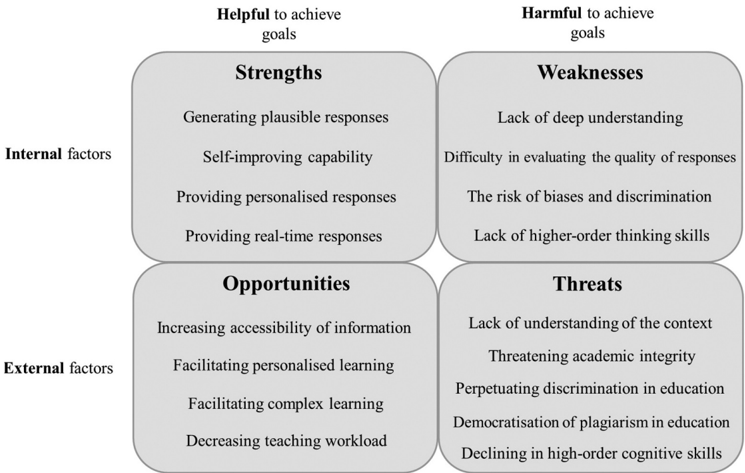
ChatGPT is an AI tool that has sparked debates about its potential implications for education. We used the SWOT analysis framework to outline ChatGPT’s strengths and weaknesses and to discuss its opportunities for and threats to education. The strengths include using a sophisticated natural language model to generate plausible answers, self-improving capability, and providing personalised and real-time responses. As such, ChatGPT can increase access to information, facilitate personalised and complex learning, and decrease teaching workload, thereby making key processes and tasks more efficient. The weaknesses are a lack of deep understanding, difficulty in evaluating the quality of responses, a risk of bias and discrimination, and a lack of higher-order thinking skills. Threats to education include a lack of understanding of the context, threatening academic integrity, perpetuating discrimination in education, democratising plagiarism, and declining high-order cognitive skills. We provide agenda for educational practice and research in times of ChatGPT.
Overview
The claims and statistics of this paper haven’t been checked yet.
Free: it reads the open-access text and checks the first 5 claims that cite a source we can check. Create a free account to check every claim.
Integrity signals
Registry
Cites
Statistics
Figures


Verification
Claims the paper makes
The claims and statistics of this paper haven’t been checked yet.
Free: it reads the open-access text and checks the first 5 claims that cite a source we can check. Create a free account to check every claim.
Claims other papers make about this one
Each is checked against this paper’s own text: does it say what the citing paper says it does?
The source backs part of the claim, not all of it — or backs it for a different population, condition or comparison.
In the citing paper
“Farrokhnia et al. [14] have demonstrated that employing GenAI tools might undermine advanced cognitive capabilities, such as critical and analytical thinking.”
From The Mediating Role of Generative AI Self-Regulation on Students’ Critical Thinking and Problem-Solving (2024) · cites this paper as [14]
Experimental — accuracy not yet measuredThe source backs part of the claim, not all of it — or backs it for a different population, condition or comparison.
In the citing paper
“A possible explanation for this discrepancy lies in the ambiguity surrounding what constitutes plagiarism when using AI-generated content.”
From Chat or cheat? Academic dishonesty, risk perceptions, and ChatGPT usage in higher education students (2025) · cites this paper as Farrokhnia et al., 2023
Experimental — accuracy not yet measuredThe source backs part of the claim, not all of it — or backs it for a different population, condition or comparison.
In the citing paper
“Student perceptions of academic dishonesty have historically been unclear or incomprehensive, and rarely align with teacher expectations (Tatum, 2022), GenAI will only serve to complicate this (Farrokhnia et al., 2023).”
From Not quite eye to A.I.: student and teacher perspectives on the use of generative artificial intelligence in the writing process (2023) · cites this paper as Farrokhnia et al., 2023
Experimental — accuracy not yet measuredThe cited source says what the claim attributes to it.
In the citing paper
“some students may not perceive their use as a policy violation and may unintentionally commit AIgiarism, as its outputs are not verbatim copies of existing texts”
From Chat or cheat? Academic dishonesty, risk perceptions, and ChatGPT usage in higher education students (2025) · cites this paper as Farrokhnia et al., 2023
In the citing paper
“This is echoed in the literature as findings suggest that ChatGPT can provide personalized feedback on essays and become a tutoring system by stimulating critical thinking and debates among students [13].”
From Challenges and Opportunities of Generative AI for Higher Education as Explained by ChatGPT (2023) · cites this paper as [13]
3 more claims about this paper
Create a free account to see every claim other papers make about this one.
Self-check
Percentages, sums and reported differences re-computed from the paper’s own numbers.
The self-check needs the paper’s full text.
Citations
Cites
ChatGPT for Good? On Opportunities and Challenges of Large Language Models for Education
Kasneci, E., Seßler, K., Küchemann, S., Bannert, M., Dementieva, D., Fischer, F., Gasser, U., Groh, G., Günnemann, S., Hüllermeier, E., et al. (2023) · doi:10.35542/osf.io/5er8f · Cited by 7,552
ChatGPT for good? On opportunities and challenges of large language models for education
Kasneci, E., Sessler, K., Küchemann, S., Bannert, M., Dementieva, D., Fischer, F., Gasser, U., Groh, G., Günnemann, S., Hüllermeier, E., et al. (2023) · Learning and Individual Differences · doi:10.1016/j.lindif.2023.102274 · Cited by 7,326 · cited 3×
“ChatGPT’s superior performance is largely attributed to its massive amount of training data (Kasneci et al., 2023), enabling it to capture a wide range of linguistic patterns and relationships, thereby providing a fair understanding of language and context (Lecler et al., 2023; Wang et al., 2023).”
BackgroundMethodBest-worst multi-criteria decision-making method
Rezaei, J. (2015) · Omega · doi:10.1016/j.omega.2014.11.009 · Cited by 4,333 · cited 1×
“Therefore, empirical studies with quantitative approaches such as the best-worst method (see Rezaei, 2015) are necessary to extend the current review findings.”
BackgroundKung, T. H., Cheatham, M., ChatGPT, Medenilla, A., Sillos, C., De Leon, L., Elepaño, C., Madriaga, M., Aggabao, R., Diaz-Candido, G., et al. (2022) · doi:10.1101/2022.12.19.22283643 · Cited by 4,115
Kung, T. H., Cheatham, M., Medenilla, A., Sillos, C., De Leon, L., Elepaño, C., Madriaga, M., Aggabao, R., Diaz-Candido, G., Maningo, J., et al. (2023) · PLOS Digital Health · doi:10.1371/journal.pdig.0000198 · Cited by 4,115 · cited 1×
“It is also shown that ChatGPT has the potential to respond sufficiently to exam questions in the fields of medical (Kung et al., 2022) and law (Choi et al., 2023).”
BackgroundSallam, M. (2023) · Healthcare · doi:10.3390/healthcare11060887 · Cited by 3,126
Chatting and cheating: Ensuring academic integrity in the era of ChatGPT
Cotton, D. R. E., Cotton, P. A., & Shipway, J. R. (2024) · Innovations in Education and Teaching International · doi:10.1080/14703297.2023.2190148 · Cited by 3,087 · cited 5×
“…some scholars are concerned about the ethical considerations of ChatGPT (Mhlanga, 2023), as well as its potential negative effects on assessment practices (Rudolph et al., 2023), scientific integrity (Cotton et al., 2023; Shiri, 2023), and students’ higher-order thinking skills (Susnjak, 2022).”
BackgroundMethodInfluentialChatting and Cheating. Ensuring academic integrity in the era of ChatGPT
Cotton, D., Cotton, P., & Shipway, J. R. (2023) · doi:10.35542/osf.io/mrz8h · Cited by 3,079
Doyle, T. (2017) · The Information Society · doi:10.1080/01972243.2017.1354593 · Cited by 3,071 · cited 1×
“AI algorithms can also perpetuate discrimination by focusing on objectives like profits and efficiency without considering unintended consequences such as reinforcing existing biases (O’neil, 2017).”
Background
Research works printed but not linked: 1
- Haque, M. U., Dharmadasa, I., Sworna, Z. T., Rajapakse, R. N., & Ahmad, H. (2022). 'I think this is the most disruptive technology': Exploring sentiments of ChatGPT early adopters using Twitter data. arXiv. https://doi.org/10.48550/arXiv.2303.03836 . · arXiv · doi:10.48550/arxiv.2303.03836 · Paper page
Cited by
Items 701–800 of 1,006
ВИКОРИСТАННЯ ІНСТРУМЕНТУ DEEP RESEARCH AI В ПЕДАГОГІЧНІЙ І НАУКОВО-ПЕДАГОГІЧНІЙ ДІЯЛЬНОСТІ
Spirin, O. M., Коломієць, А. М., Громов, Є., Жовнич, О. В., Коломієць, Д. І., & Кушнір, О. І. (2025) · Information Technologies and Learning Tools · doi:10.33407/itlt.v110i6.6240 · Cited by 11
Can't stop, won't stop: continuance ChatGPT usage—enhancing performance or creating dependency?
Triangga, B., Noermijati, N., Rohman, F., & Sumiati, S. (2026) · Discover Education · doi:10.1007/s44217-026-01114-8 · Cited by 7
“ChatGPT’s characteristic of delivering immediate and comprehensive responses to academic queries [19] can foster usage patterns that differ from those of traditional learning technologies.”
The utility of artificial intelligence in plain language writing: A scoping review
Ugas, M. A., Huynh, J., Lenarcik-Packham, A., Kukan, A., Deol, A., Fazelzad, R., Fernando, S., Giannopoulos, E., Giuliani, M., Lawrie, K., et al. (2026) · Patient Education and Counseling · doi:10.1016/j.pec.2026.109483 · Cited by 8
The seven roles of generative AI: Potential & pitfalls in combatting misinformation
Nygren, T., Spearing, E. R., Fay, N., Vega, D., Hardwick, I. I., Roozenbeek, J., & Ecker, U. K. H. (2026) · Behavioral Science & Policy · doi:10.1177/23794607261417815 · Cited by 7
Integrating generative AI for comprehensive ELT material development
Aguş, F. S., & Mutlu, M. E. (2026) · Innovation in Language Learning and Teaching · doi:10.1080/17501229.2026.2641791 · Cited by 8
Exploring Iranian university students’ behavioral intention to use ChatGPT for academic purposes
Valızadeh, M., Kotamjani, S. S., & Xodabande, I. (2026) · Discover Psychology · doi:10.1007/s44202-026-00705-8 · Cited by 7
“The integration of generative artificial intelligence (AI) into higher education has attracted increasing scholarly attention, yet empirical research examining students’ perceptions and behavioral intention to adopt these tools remains limited [1, 5, 7].”
InfluentialJiao, Y., & Wang, Q. (2026) · Frontiers in Education · doi:10.3389/feduc.2026.1834085 · Cited by 8
Open Government Data in Educational Programs Curriculum: Current State and Prospects
Papageorgiou, G., Loukis, E., Παππάς, Γ., Rizun, N., Saxena, S., Charalabidis, Y. K., & Alexopoulos, C. (2023) · Lecture notes in business information processing · doi:10.1007/978-3-031-43126-5_22 · Cited by 7
Broadhead, L.-A. (2024) · Journal of Applied Learning & Teaching · doi:10.37074/jalt.2024.7.2.9 · Cited by 7
Analyzing the Use of Chat Generative Pre-Trained Transformer and Artificial Intelligence
Christanto, H. J., Dewi, C., Sutresno, S. A., & Silalahi, A. D. K. (2024) · Revue d intelligence artificielle · doi:10.18280/ria.380423 · Cited by 8
“Integrating real-time data while maintaining reliability is an area for improvement [41].”
Xulu, H. H., Hlongwa, N. S., & Maguraushe, K. (2024) · Atlantis highlights in social sciences, education and humanities/Atlantis Highlights in Social Sciences, Education and Humanities · doi:10.2991/978-94-6463-630-7_28 · Cited by 8
García-Hirschfeld, E. C., Santos, M. Á. R., & López-Martín, C. (2025) · The International Journal of Management Education · doi:10.1016/j.ijme.2024.101124 · Cited by 8
AIEd in Elementary School Nationalism Education: A Systematic Literature Review
Saputra, B. D., Murdiono, M., Tohani, E., & Ibda, H. (2024) · International Journal of Learning Teaching and Educational Research · doi:10.26803/ijlter.23.12.10 · Cited by 11
“The application of AIEd, such as ChatGPT, facilitates students' increased access to information, reduces learning workload, and facilitates more efficient schoolwork and personalized learning in civic education (Farrokhnia et al., 2024).”
Dobre, S.-C., & Popescu, E. (2024) · International Conference on Information Technology Based Higher Education and Training (ITHET) · doi:10.1109/ithet61869.2024.10837650 · Cited by 8
“Strengths, weaknesses, opportunities and threats (SWOT) analysis of ChatGPT was presented in [5].”
A Catalog of Generative AI Tools for Faculty Advancement
Ahmed, K. (2024) · International Conference on Information Technology Based Higher Education and Training (ITHET) · doi:10.1109/ithet61869.2024.10837663 · Cited by 7
Factors influencing undergraduates’ ethical use of ChatGPT: a reasoned goal pursuit approach
Toma, R. B., & Yánez‐Pérez, I. (2025) · Interactive Learning Environments · doi:10.1080/10494820.2025.2457349 · Cited by 7
“This phenomenon refers to the tendency of LLMs to evolve and generate inconsistent and incorrect responses, including hallucinations like creating fake references (Farrokhnia et al., 2024).”
InfluentialHumaira Mariyam, B., & Karthika, V. K. (2025) · Education and Information Technologies · doi:10.1007/s10639-025-13497-6 · Cited by 9
“To address this issue, many have emphasised in their study the importance of reflecting on the implications of LLMs ‘with’ learners (Farrokhnia et al., 2023; Supiano, 2023).”
AI in education and cultural barriers: a mixed-methods study with Argentinean university students
Galvagno, L. G. G., Justo, M. M., Zelaya, M., Hauché, R. A., Ferrero, P. F., Todarello, F., Arruabarrena, L., Domínguez, I., Valenzuela, M. M. S., & Touriño, L. (2025) · Cogent Education · doi:10.1080/2331186x.2025.2559154 · Cited by 8
“On the one hand, personalized and adaptive AIEd tools could enhance students ’ self-efficacy; on the other hand, overreliance on AIEd might hinder critical thinking, autonomy and reflective learning, potentially undermining SRL (Chiu et al., 2023; Farrokhnia et al., 2024).”
Unveiling Chat GPT’s Educational Prospects: A SWOT Analysis
Dar, M. A., Khursheed, T., Ahmad, A., & Fayaz, R. (2024) · International Conference on Computing for Sustainable Global Development · doi:10.23919/indiacom61295.2024.10499038 · Cited by 9
“Increasing accessibility of information: ChatGPT provides more than just a list of references; it offers detailed written responses, making it a more valuable tool compared to traditional search engines [6].”
BackgroundMethodInfluentialElsaadany, M. (2024) · مجلة کلیة الآداب جامعة الفیوم · doi:10.21608/jfafu.2024.280282.2034 · Cited by 8
Kaplan, O. (2024) · Adıyaman Üniversitesi Eğitim Bilimleri Dergisi · doi:10.17984/adyuebd.1463794 · Cited by 10
Valdez, D. D. C., & Maquera, E. J. A. (2024) · INGENIERÍA INVESTIGA · doi:10.47796/ing.v6i00.967 · Cited by 8
Elsa, D., Islami, N., Mahdum, M., Copriady, J., & Putra, Z. H. (2026) · Entrepreneurship Education · doi:10.1007/s41959-026-00174-z · Cited by 7
Evolving techniques and emerging schemes: prospective teachers’ transformation of ChatGPT
Davis, J. D. (2025) · International Journal of Science and Mathematics Education · doi:10.1007/s10763-024-10533-8 · Cited by 6
“AI can assist teachers by helping them to identify and develop teaching materials (Farrokhnia et al., 2024).”
Ni, W., & Li, J. (2026) · Frontiers in Psychology · doi:10.3389/fpsyg.2026.1856854 · Cited by 6
“Continuing on this, Farrokhnia et al. (2023) note the opportunities and threats of GenAI and say that it helps to make people more efficient and can make people too dependent and cause them to lose independent thinking.”
AI and Personalised Grading Criteria
Ahmed, S., Zaki, A., & Bentley, Y. (2024) · Advances in Educational Technologies and Instructional Design · doi:10.4018/979-8-3693-2145-4.ch004 · Cited by 6
AI-Assisted Collaborative Learning in Mathematics Education: A Qualitative Approach
Akosah, E. F. (2025) · International Journal of Technology in Education and Science · doi:10.46328/ijtes.634 · Cited by 9
Is Gen AI a professor in creativity? A case study in postgraduate students
Zhang, H., & Ge, S. (2025) · Education and Information Technologies · doi:10.1007/s10639-025-13644-z · Cited by 8
Generative AI literacy and lifelong learning: A literature overview
Abubakari, M. S. (2025) · Forum for education studies. · doi:10.59400/fes2621 · Cited by 6
Transformation of Islamic values in the era of artificial intelligence
Faizin, N., Ma’ali, A., Hidayatullah, M. F., Nasih, A. M., Faizah, R., & Fauzan, M. (2025) · IAES International Journal of Artificial Intelligence · doi:10.11591/ijai.v14.i5.pp4353-4362 · Cited by 6
Liu, R., & Glave, C. Z. (2025) · Journal of Research in Childhood Education · doi:10.1080/02568543.2025.2578526 · Cited by 6
“…pedagogical, and content knowledge (TPACK) framework (Velander et al., 2023), the self-determination theory (Xia et al., 2022), the universal design for learning (UDL) framework (Jackson et al., 2024), and the SWOT (strength, weakness, opportunity, and threat) framework (Farrokhnia et al., 2024).”
Hamdan-Mansour, R. A., Hardan, F. A. A., Alayasrah, M. A., Nabulsi, H. M. A., Fawaz, M. A., Hamdan‐Mansour, A. M., & AboHanana, R. B. (2025) · BMC Medical Education · doi:10.1186/s12909-025-08453-4 · Cited by 6
“According to the literature, several AI applications are utilized to create solutions to inquiries and to help students generate ideas [6, 7].”
Henze, J., Lademann, J., Bresges, A., & Becker, S. (2025) · Frontiers in Education · doi:10.3389/feduc.2025.1707534 · Cited by 7
Heilala, V., Kelly, R., Järvinen, M., & Hämäläinen, R. (2025) · Technological Forecasting and Social Change · doi:10.1016/j.techfore.2025.124493 · Cited by 6
Huang, B., Xie, S., & Hew, T. K. F. (2026) · Educational Psychology · doi:10.1080/01443410.2025.2611980 · Cited by 7
Dong, T., Kong, Y., Chen, R., & Yang, Z. (2026) · Frontiers in Psychology · doi:10.3389/fpsyg.2025.1701051 · Cited by 10
Molerov, D., Federiakin, D. A., Zlatkin‐Troitschanskaia, O., Shenavai, K., Trierweiler, L., & Nagel, M. (2026) · Unterrichtswissenschaft · doi:10.1007/s42010-026-00242-2 · Cited by 8
“Major strengths and weaknesses of AI-chatbots use for education, including higher education, have been identified (Farrokhnia et al. 2024): Highlighted strengths have been discussed in regard to efficiency, such as generation of plausible answers, self-improving capability, increased access to…”
Sørhaug, J. O. (2026) · Journal of Writing Research · doi:10.17239/jowr-2026.17.03.04 · Cited by 11
“For education, both challenges and opportunities with generative AI are observed and discussed (Adeshola & Adepoju, 2024; Farrokhnia et al., 2024; Hwang & Chang, 2023; Kasneci et al., 2023; Rahman & Watanobe, 2023).”
Zhou, B., Lim, S. P., Kabir, N., Asna, A., & Nan, L. T. (2026) · Problems of Education in the 21st Century · doi:10.33225/pec/26.84.229 · Cited by 6
Al-Obaydi, L. H., & Pikhart, M. (2026) · Contemporary Educational Technology · doi:10.30935/cedtech/18056 · Cited by 8
Local government strategy in managing traditional markets in the city of Pariaman, Indonesia
Netti, H., & Erianjoni, E. (2023) · Otoritas Jurnal Ilmu Pemerintahan · doi:10.26618/ojip.v13i2.11757 · Cited by 6
“competitors in meeting needs visitors which it serves (Farrokhnia et al., 2023; Mayang Anissa & Ratnawati Shinta, 2020).”
BackgroundThe Potential of GPT in Education: Opportunities for Students’ Feedback
Akhyar, Y., & Ningsih, W. (2024) · Buletin Poltanesa · doi:10.51967/tanesa.v25i1.3043 · Cited by 8
“The rapid feedback loop enabled by GPT enhances the learning process (Farrokhnia, Banihashem, Noroozi, & Wals, 2023).”
BackgroundGenç, S., & Sancak, S. (2024) · Dinbilimleri Akademik Araştırma Dergisi · doi:10.33415/daad.1584790 · Cited by 6
Is ChatGPT reliable in education?
Alibrahim, A. A. (2024) · South African Journal of Education · doi:10.15700/saje.v44n4a2557 · Cited by 8
Lee, D., Kim, D., Loeser, M., & Seo, K. (2025) · International Conference on Electronics, Information, and Communication (ICEIC) · doi:10.1109/iceic64972.2025.10879736 · Cited by 6
Zhang, W., & An, S. (2025) · Journal of Language Teaching and Research · doi:10.17507/jltr.1602.35 · Cited by 7
Superior Accreditation Management Strategy Plan with International Reputation
Tharaba, M. F., Asrori, M., Mubaroq, Z., Wahyudin, A., & Tazkiyah, I. (2025) · Munaddhomah Jurnal Manajemen Pendidikan Islam · doi:10.31538/munaddhomah.v6i1.1612 · Cited by 6
Karnan, N., Nair, S., Fidai, F. F., Gurrala, S. V., Salim, J., & Gomma, A. (2025) · Cureus · doi:10.7759/cureus.81993 · Cited by 6
“On December 6, 2023, Google’s DeepMind launched Gemini (Google DeepMind, London, United Kingdom), which is an AI-model featuring visual language model (VLM) technology and incorporates multiple large language models (LLMs) alongside natural language processing (NLP) capabilities [5,6].”
Vissak, T., & Torkkeli, L. (2025) · Review of International Business and Strategy · doi:10.1108/ribs-10-2024-0120 · Cited by 7
Znamenskiy, V. S., Niyazov, R., & Hernandez, J. (2025) · International Journal on Cybernetics & Informatics · doi:10.5121/ijci.2025.140302 · Cited by 7
“On the other hand, concerns are growing about the erosion of academic integrity [5][6], as students increasingly rely on GenAI tools for completing assessments and assignments without genuine engagement, potentially leading to superficial learning and diminished cognitive development.”
Ortiz-Bonnín, S., Rejón‐Guardia, F., & Blahopoulou, J. (2025) · Praxis Educativa · doi:10.5212/praxeduc.v.20.25119.045 · Cited by 7
Leveraging Generative AI in Pre-service Teacher Training: Insights into Assessment as Learning
Busuttil, L. (2025) · Communications in computer and information science · doi:10.1007/978-3-031-94002-6_4 · Cited by 6
Mapping the AI Surge in Higher Education: A Bibliometric Study Spanning a Decade (2015–2025)
Omarsaib, M., Mitha, S. B., Vahed, A., & Mohamed, G. M. (2025) · Informatics · doi:10.3390/informatics12040137 · Cited by 10
Analyzing AI and student responses through the lens of sensemaking and mechanistic reasoning
Zollman, D. A., Sirnoorkar, A., & Laverty, J. T. (2023) · Physics Education Research Conference (PERC) · doi:10.1119/perc.2023.pr.zollman · Cited by 9
“Noting this grammatical and technical sophistication, studies have called for exploring the ways in which AI can be leveraged in promoting valued epistemic practices in learning environments [16].”
BackgroundAnalyzing Sentiment with Self-Organizing Map and Long Short-Term Memory Algorithms
Sinaga, F. M., Pipin, S. J., Winardi, S., Tarigan, K. M., & Brahmana, A. P. (2023) · Matrik Jurnal Manajemen Teknik Informatika dan Rekayasa Komputer · doi:10.30812/matrik.v23i1.3332 · Cited by 6
“Thorough research is needed concerning the resilience, interpretation, and ethical aspects of ChatGPT usage [7].”
BackgroundAdvantages and Disadvantages of Chatgpt in Science Learning: A Systematic Literature Review
Asmiddin, A. M., Nurhuda, P., & Megawati, R. (2023) · Jurnal Penelitian Pendidikan IPA · doi:10.29303/jppipa.v9i12.6576 · Cited by 6
“The advantages of chatgpt in science learning (Javaid et al., 2023b); (Xiao & Zhi, 2023a); (Cooper, 2023a); (Farrokhnia et al., 2023a) Universal Language Capabilities (Gill & Kaur, 2023) Flexibility (Dwivedi et al., 2023a) Creativity Encouragement (Liang et al., 2023); (Farrokhnia et al., 2023b)…”
BackgroundYue, L., & Qi, C. (2023) · International Workshop on Artificial Intelligence and Education (WAIE) · doi:10.1109/waie60568.2023.00019 · Cited by 6
“For example, Farrokhnia et al. [16] employed a SWOT analysis on ChatGPT to discuss its implications for educational practice and research.”
MethodBoudia, C., & Krismadinata, K. (2024) · Edelweiss Applied Science and Technology · doi:10.55214/25768484.v8i5.1729 · Cited by 8
“By handling tasks such as grading, scheduling, and attendance tracking, AI allows educators to focus more on teaching and mentoring, thereby enhancing the overall educational experience [23].”
BackgroundThe Role of ChatGPT and Artificial Intelligence in Education
Martínez, M. Á. Q., Tumaille-Quintana, D.-S., Moran-Burgos, A.-D., & Ríos, M. D. G. (2024) · IEEE Colombian Conference on Communications and Computing (COLCOM) · doi:10.1109/colcom62950.2024.10720308 · Cited by 10
“This approach, guided by innovation and technology, fosters commitment to deeper learning, stimulates creativity and active participation [12], [7], [21], [6], [26], [28], [8], [24], [14] [25], [29], [20], [22] [5], [1], [16], [13].”
BackgroundElia, J. (2024) · Studies in big data · doi:10.1007/978-3-031-71213-5_11 · Cited by 9
Ly, R., & Ly, B. (2025) · AI and Ethics · doi:10.1007/s43681-025-00667-y · Cited by 7
Song, Y., Wang, J., Chen, Y., Zhang, J., & Xu, C. (2025) · Computers & Education · doi:10.1016/j.compedu.2025.105390 · Cited by 9
Reframing Assessments: Designing Authentic Assessments in the Age of Generative AI
Matheis, P., & Jacob-John, J. (2024) · Advances in educational marketing, administration, and leadership book series · doi:10.4018/979-8-3693-0240-8.ch008 · Cited by 9
Tian, K., Phongsatha, T., & Phongsatha, S. (2024) · International Journal of Innovative Research and Scientific Studies · doi:10.53894/ijirss.v7i2.2899 · Cited by 7
“Furthermore, ChatGPT can also provide additional avenues for students and teachers to access information during the teaching and learning process, promoting personalized and complex learning and increasing the efficiency of essential processes and tasks within the learning experience [56].”
BackgroundRicieri, D. D. V., de Farias, A. M. G., Barreto, R. V. G., & de Souza, F. R. (2024) · Peer Review · doi:10.53660/prw-1986-3703 · Cited by 11
A Study on Students’ Critical Thinking Cultivation in English Teaching in the ChatGPT Era
Liu, Y., & Wei, L. (2024) · Advances in Social Science, Education and Humanities Research/Advances in social science, education and humanities research · doi:10.2991/978-2-38476-263-7_10 · Cited by 6
Zhou, T., Zhang, Y., Cao, S., Li, Y., & Wang, T. (2023) · arXiv (Cornell University) · doi:10.48550/arxiv.2311.10344 · Cited by 6
“This was foreseeable since ChatGPT was recognized as not fully understanding the meaning behind words and lacking analytical thinking ability (Farrokhnia et al., 2023).”
BackgroundDEVELOPING MARKETING STRATEGIES TO INCREASE CUSTOMER SATISFACTION
Putri, A. A., & Iriani, I. (2023) · Jurnal Fokus Manajemen Bisnis · doi:10.12928/fokus.v13i2.8402 · Cited by 5
“Internal factors (i.e. strengths and weaknesses) and external factors (i.e. threats and opportunities) may influence the integration of new technologies into education (Farrokhnia et al., 2023).”
BackgroundDifferentiated Tasks by ChatGPT for Secondary Computer Science Education: Useful or not?
Bahr, T., Manzocco, M., & Schuster, D. (2024) · Workshop in Primary and Secondary Computing Education · doi:10.1145/3677619.3678092 · Cited by 5
Competence of Teachers and Ethical Aspects of Implementing AI Technologies in Education
Vorotnykova, I. P. (2025) · Communications in computer and information science · doi:10.1007/978-3-031-83432-5_28 · Cited by 8
ChatGPT na Universidade de Perugia: Potencializando a Interação entre Docentes e Discentes
Brognoli, P. C., & Rodrigues, M. B. (2025) · Encontros Bibli Revista Eletrônica de Biblioteconomia e Ciência da Informação · doi:10.5007/1518-2924.2025.e102135 · Cited by 5
ChatGPT 's Performance Evaluation in Spreadsheets Modelling to Inform Assessments Redesign
Cheong, M. L. F. (2025) · Journal of Computer Assisted Learning · doi:10.1111/jcal.70035 · Cited by 6
Assessing the Use of ChatGPT as a Pedagogical Tool: A Small Study
Otto, L. (2024) · Africa Education Review · doi:10.1080/18146627.2025.2471272 · Cited by 5
“Farrokhnia et al. (2023) add responses to prompts, it lacks deep understanding of the words used in prompting and the concepts that lie behind them, leading to results that lack depth and insight.”
He, H., & Tinsley, J. (2025) · Journal of China Computer-Assisted Language Learning · doi:10.1515/jccall-2025-0004 · Cited by 6
Mututa, A., & Tomaselli, K. G. (2025) · Education as Change · doi:10.25159/1947-9417/18958 · Cited by 6
“( Farrokhnia et al. 2024, 460) The strengths and weaknesses all point to the tool’s performance towards realising human-like cognitive productivity.”
Alharbi, L. Y., Alrashoud, R. R., Alotaibi, B. S., Dera, A. M. A., Alajlan, R. S., AlHuthail, R. R., & Alessa, D. (2025) · JMIR Formative Research · doi:10.2196/73642 · Cited by 7
“This makes communicating complex medical information a significant challenge [25].”
Chen, X., Xu, L., Zou, D., Xie, H., & Wang, F. L. (2025) · Journal of Computers in Education · doi:10.1007/s40692-025-00363-0 · Cited by 5
“…articles regarding the usage of LLM-based applications like ChatGPT in higher education, the majority of the extant academic works have been conducted from a theoretical or exploratory perspective (Cambra-Fierro et al., 2024; Farrokhnia et al., 2024), whereas more empirical evidence is needed.”
Artificial Intelligence Integration in Mathematics Education: A SWOT-BWM Analysis
Şahin, S., & Teke, B. (2025) · Journal of Learning and Teaching in Digital Age · doi:10.53850/joltida.1667650 · Cited by 6
Gu, Y. (2025) · International Conference on Informatics Education and Computer Technology Applications (IECA) · doi:10.1145/3732801.3732826 · Cited by 6
Higher education readiness to implement artifi cial intelligence: a bibliometric analysis
Tunkevichus, O. (2025) · Lomonosov Economics Journal · doi:10.55959/msu0130-0105-6-60-3-14 · Cited by 7
Ghouali, K. (2025) · ONOMAZEIN · doi:10.7764/onomazein.ne16.02 · Cited by 5
Perera, P., Kulathunga, V. K., Perera, N. N., Gunarathna, A., Jayasinghe, P. S. K., & Rajamanthri, L. (2025) · Asian Education and Development Studies · doi:10.1108/aeds-11-2024-0275 · Cited by 10
AI-Informed Pedagogy for a Post-Truth Era
Nally, D. (2025) · Digital Society · doi:10.1007/s44206-025-00230-6 · Cited by 5
“…to leveraging AIs for learning purposes as: a tutor, coach, mentor, teammate, tool, simulator and/or fellow student (Mollick & Mollick, 2023; Farrokhnia et al., 2023 offers a SWOT analysis of the safety/risks; Huang et al., 2023 provides an overview of ethical considerations from the IEEE…”
Kaur, H., Verma, T., Mago, M., & Phoolka, S. (2025) · Journal of International Education in Business · doi:10.1108/jieb-08-2024-0097 · Cited by 6
Redefining lesson planning: Integrating ChatGPT into the teaching practicum experience
Yılmazer, A., & Erümit, B. A. (2025) · Education and Information Technologies · doi:10.1007/s10639-025-13830-z · Cited by 6
“This echoes concerns in the broader literature that habitual use of AI may unintentionally limit opportuni - ties for the development of problem-solving and pedagogical decision-making skills (Farrokhnia et al., 2024 ; Mosaiyebzadeh et al., 2023 ).”
More than skills: How AI literacy shapes student motivation in the age of education 4.0
Ocado, M. K. G. (2025) · Journal of Technology and Science Education · doi:10.3926/jotse.3748 · Cited by 6
DeVito, P., Vallala, A., Mcmahon, S., Hinda, Y., Thaw, B., Zhuang, H., & Kalva, H. (2025) · IEEE Transactions on Computational Social Systems · doi:10.1109/tcss.2025.3630587 · Cited by 8
“One major issue is the threat to academic integrity, as students may use GAI tools to plagiarize and circumvent genuine understanding [24], [25].”
Penggunaan Artificial Intelligence (AI) dalam Pembelajaran Kemampuan Menulis Bahasa Inggris
Nurazizah, S. (2025) · Karimah Tauhid. · doi:10.30997/karimahtauhid.v4i7.19617 · Cited by 5
ChatGPT as economics tutor: Capabilities and limitations
Bröse, N., Spielmann, C., & Tode, C. (2026) · International Review of Economics Education · doi:10.1016/j.iree.2025.100337 · Cited by 7
“Early literature, mostly educators’ subjective reflections, highlighted concerns about academic honesty (e.g., D. R. E. Cotton, P. A. Cotton, and Shipway 2024) and critical thinking skills (Farrokhnia et al. 2024; Kasneci et al. 2023; Michel-Villarreal et al. 2023; Zirar 2023).”
Coba, D. R. Z., Coronel-Cáceres, J. C., Díaz, R. L. G., Benavides, M. T. P., Cerna-Rosales, M. D. R., & Farroñay, Z. I. G. (2026) · Prohominum · doi:10.47606/acven/ph0461 · Cited by 5
Lin, X., Cui, H., & Zhu, X. (2026) · Journal of Special Education Technology · doi:10.1177/01626434261435251 · Cited by 5
Zhileng, X., & Huang, Q. (2026) · Scientific Reports · doi:10.1038/s41598-026-46043-6 · Cited by 5
Use and Acceptance of Generative Artificial Intelligence in Portuguese Higher Education Students
Pedro, A., Dorotea, N. M. T. C., Ribeiras, C., & Azevedo, B. (2026) · Sustainability · doi:10.3390/su18073209 · Cited by 6
Salisu, I., Almutairi, E. M. N., & Al‐Samhi, N. M. (2026) · Acta Psychologica · doi:10.1016/j.actpsy.2026.106825 · Cited by 5
Ansaree, F. N., & Uddın, M. M. (2026) · Asian-Pacific Journal of Second and Foreign Language Education · doi:10.1186/s40862-026-00399-4 · Cited by 7
Üstün, A. G., Kayalı, B., & Yavuz, M. (2026) · SAGE Open · doi:10.1177/21582440261423669 · Cited by 5
“Although SWOT analysis has been used in various applications in the field of education (Farrokhnia et al., 2024), there appears to be a limited number of studies that directly address AI-SOAE systems in higher education within this framework.”
Arpacı, İ., & Балоглу, М. (2026) · Contemporary Educational Technology · doi:10.30935/cedtech/18951 · Cited by 6
Xu, W. M., Chen, Y., & Yang, L.-Y. (2023) · Innovations in Education and Teaching International · doi:10.1080/14703297.2023.2282155 · Cited by 5
“…scaffolding for students and address the issue of tardy and incomplete instructor feedback due to its ability to generate logical responses based on complicated natural language models (Farrokhnia et al., 2023), ChatGPT can be utilised as a teaching aid to strengthen online discussion forums.”
Exploring Instructor Roles in Operating and Integrating ChatGPT into Classroom in Higher Education
Han, H.-J. (2024) · Journal of Digital Contents Society · doi:10.9728/dcs.2024.25.2.465 · Cited by 6
CHATGPT, SMART WRITING ASSISTANT CHATBOT FOR STUDENTS: AN ANALYSIS OF ITS DRAWBACKS
Yazid, S. R., & Dzulfikri, D. (2024) · Abjadia International Journal of Education · doi:10.18860/abj.v9i1.24459 · Cited by 8
“The results of the present study support this notion by outlining ChatGPT's feedback shortcomings, such as its general character and a lack of adequate direction (Farrokhnia et al., 2023; Liao et al., 2023)(Farrokhnia et al., 2023; Liao et al., 2023).”
Result
Metadata
- Authors
- Farrokhnia, M., Banihashem, S. K., Noroozi, O., & Wals, A.
- Affiliations
- Wageningen University & Research (NL)
- Open University of the Netherlands (NL)
- Corresponding author
- Noroozi, Omid
- Venue
- Innovations in Education and Teaching International
- Publisher
- Informa UK Limited
- Published
- 2023-03-27
- Volume
- 61
- Issue
- 3
- Pages
- 460-474
- ISSN
- 1470-3297 (ISSN-L)
- 1470-3300
- OpenAlex
- W4361204578
- Cited by
- 1,384
- References
- 68
- Citations by year
- 2026: 359 · 2025: 456 · 2024: 396 · 2023: 173
- FWCI
- 324.80
- Type
- journal article
- Language
- en
- Open access
- hybrid
- doi.org
- Licence
- Locations
- Innovations in Education and Teaching International (publishedVersion, cc-by-nc-nd)
- Socio-Environmental Systems Modeling (submittedVersion, cc-by-nc-nd)
- DSpace (Open University in the Netherlands) (submittedVersion, cc-by-nc-nd)
- Data Archiving and Networked Services (DANS) (submittedVersion, other-oa)
- Topics
- Social Sciences › Education › Artificial Intelligence in Education
- Health Sciences › Medicine › Health Informatics › Artificial Intelligence in Healthcare and Education
- Social Sciences › Education › Educational Technology in Learning
- Keywords
- ChatGPT, large language models, artificial intelligence in education, academic integrity, plagiarism, algorithmic bias, higher-order thinking skills, personalized learning, teacher workload, SWOT analysis
About these checks
Registry, retraction, Cites and statistics results are computed, not judged, with one exception: a printed reference that no index lists is read once by a model before it counts as a citation error. Claims are extracted by a model and kept only when their quote appears verbatim in the text; each cited source is then checked, with a model’s help, for whether it says what the claim relies on. Those verdicts can be wrong — read the claim’s quote and the cited source before relying on one.
Statistics and arithmetic are recomputed, not judged.
Confidence bands are shown only for fields calibrated on our annotated test set. None is calibrated yet, so no band is shown.
What counts as a claim ›How we measure confidence ›How we check this ›
Are you an author, or do you see a problem with this page? Request a review
Data sources
Bibliographic data: Semantic Scholar, OpenAlex, Crossref.
Contains information from the Semantic Scholar Academic Graph Datasets, made available under the ODC Attribution License (ODC-BY 1.0).
Semantic Scholar’s data is described in: Kinney, R., et al. (2023). The Semantic Scholar Open Data Platform. arXiv:2301.10140.
