

A SWOT analysis of ChatGPT: Implications for educational practice and research
Open accessThe DOI matches its Crossref record; 76 of the 77 references it cites were found in a registry or an index, and 1 are not checked yet.
Abstract
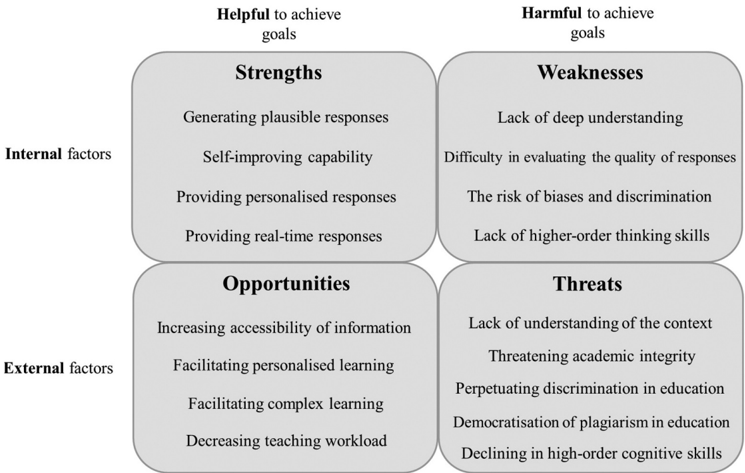
ChatGPT is an AI tool that has sparked debates about its potential implications for education. We used the SWOT analysis framework to outline ChatGPT’s strengths and weaknesses and to discuss its opportunities for and threats to education. The strengths include using a sophisticated natural language model to generate plausible answers, self-improving capability, and providing personalised and real-time responses. As such, ChatGPT can increase access to information, facilitate personalised and complex learning, and decrease teaching workload, thereby making key processes and tasks more efficient. The weaknesses are a lack of deep understanding, difficulty in evaluating the quality of responses, a risk of bias and discrimination, and a lack of higher-order thinking skills. Threats to education include a lack of understanding of the context, threatening academic integrity, perpetuating discrimination in education, democratising plagiarism, and declining high-order cognitive skills. We provide agenda for educational practice and research in times of ChatGPT.
Overview
The claims and statistics of this paper haven’t been checked yet.
Free: it reads the open-access text and checks the first 5 claims that cite a source we can check. Create a free account to check every claim.
Integrity signals
Registry
Cites
Statistics
Figures



Verification
Claims the paper makes
The claims and statistics of this paper haven’t been checked yet.
Free: it reads the open-access text and checks the first 5 claims that cite a source we can check. Create a free account to check every claim.
Claims other papers make about this one
Each is checked against this paper’s own text: does it say what the citing paper says it does?
The source backs part of the claim, not all of it — or backs it for a different population, condition or comparison.
In the citing paper
“Farrokhnia et al. [14] have demonstrated that employing GenAI tools might undermine advanced cognitive capabilities, such as critical and analytical thinking.”
From The Mediating Role of Generative AI Self-Regulation on Students’ Critical Thinking and Problem-Solving (2024) · cites this paper as [14]
Experimental — accuracy not yet measuredThe source backs part of the claim, not all of it — or backs it for a different population, condition or comparison.
In the citing paper
“A possible explanation for this discrepancy lies in the ambiguity surrounding what constitutes plagiarism when using AI-generated content.”
From Chat or cheat? Academic dishonesty, risk perceptions, and ChatGPT usage in higher education students (2025) · cites this paper as Farrokhnia et al., 2023
Experimental — accuracy not yet measuredThe source backs part of the claim, not all of it — or backs it for a different population, condition or comparison.
In the citing paper
“Student perceptions of academic dishonesty have historically been unclear or incomprehensive, and rarely align with teacher expectations (Tatum, 2022), GenAI will only serve to complicate this (Farrokhnia et al., 2023).”
From Not quite eye to A.I.: student and teacher perspectives on the use of generative artificial intelligence in the writing process (2023) · cites this paper as Farrokhnia et al., 2023
Experimental — accuracy not yet measuredThe cited source says what the claim attributes to it.
In the citing paper
“some students may not perceive their use as a policy violation and may unintentionally commit AIgiarism, as its outputs are not verbatim copies of existing texts”
From Chat or cheat? Academic dishonesty, risk perceptions, and ChatGPT usage in higher education students (2025) · cites this paper as Farrokhnia et al., 2023
In the citing paper
“This is echoed in the literature as findings suggest that ChatGPT can provide personalized feedback on essays and become a tutoring system by stimulating critical thinking and debates among students [13].”
From Challenges and Opportunities of Generative AI for Higher Education as Explained by ChatGPT (2023) · cites this paper as [13]
3 more claims about this paper
Create a free account to see every claim other papers make about this one.
Self-check
Percentages, sums and reported differences re-computed from the paper’s own numbers.
The self-check needs the paper’s full text.
Citations
Cites
ChatGPT for Good? On Opportunities and Challenges of Large Language Models for Education
Kasneci, E., Seßler, K., Küchemann, S., Bannert, M., Dementieva, D., Fischer, F., Gasser, U., Groh, G., Günnemann, S., Hüllermeier, E., et al. (2023) · doi:10.35542/osf.io/5er8f · Cited by 7,552
ChatGPT for good? On opportunities and challenges of large language models for education
Kasneci, E., Sessler, K., Küchemann, S., Bannert, M., Dementieva, D., Fischer, F., Gasser, U., Groh, G., Günnemann, S., Hüllermeier, E., et al. (2023) · Learning and Individual Differences · doi:10.1016/j.lindif.2023.102274 · Cited by 7,326 · cited 3×
“ChatGPT’s superior performance is largely attributed to its massive amount of training data (Kasneci et al., 2023), enabling it to capture a wide range of linguistic patterns and relationships, thereby providing a fair understanding of language and context (Lecler et al., 2023; Wang et al., 2023).”
BackgroundMethodBest-worst multi-criteria decision-making method
Rezaei, J. (2015) · Omega · doi:10.1016/j.omega.2014.11.009 · Cited by 4,333 · cited 1×
“Therefore, empirical studies with quantitative approaches such as the best-worst method (see Rezaei, 2015) are necessary to extend the current review findings.”
BackgroundKung, T. H., Cheatham, M., ChatGPT, Medenilla, A., Sillos, C., De Leon, L., Elepaño, C., Madriaga, M., Aggabao, R., Diaz-Candido, G., et al. (2022) · doi:10.1101/2022.12.19.22283643 · Cited by 4,115
Kung, T. H., Cheatham, M., Medenilla, A., Sillos, C., De Leon, L., Elepaño, C., Madriaga, M., Aggabao, R., Diaz-Candido, G., Maningo, J., et al. (2023) · PLOS Digital Health · doi:10.1371/journal.pdig.0000198 · Cited by 4,115 · cited 1×
“It is also shown that ChatGPT has the potential to respond sufficiently to exam questions in the fields of medical (Kung et al., 2022) and law (Choi et al., 2023).”
BackgroundSallam, M. (2023) · Healthcare · doi:10.3390/healthcare11060887 · Cited by 3,126
Chatting and cheating: Ensuring academic integrity in the era of ChatGPT
Cotton, D. R. E., Cotton, P. A., & Shipway, J. R. (2024) · Innovations in Education and Teaching International · doi:10.1080/14703297.2023.2190148 · Cited by 3,087 · cited 5×
“…some scholars are concerned about the ethical considerations of ChatGPT (Mhlanga, 2023), as well as its potential negative effects on assessment practices (Rudolph et al., 2023), scientific integrity (Cotton et al., 2023; Shiri, 2023), and students’ higher-order thinking skills (Susnjak, 2022).”
BackgroundMethodInfluentialChatting and Cheating. Ensuring academic integrity in the era of ChatGPT
Cotton, D., Cotton, P., & Shipway, J. R. (2023) · doi:10.35542/osf.io/mrz8h · Cited by 3,079
Doyle, T. (2017) · The Information Society · doi:10.1080/01972243.2017.1354593 · Cited by 3,071 · cited 1×
“AI algorithms can also perpetuate discrimination by focusing on objectives like profits and efficiency without considering unintended consequences such as reinforcing existing biases (O’neil, 2017).”
Background
Research works printed but not linked: 1
- Haque, M. U., Dharmadasa, I., Sworna, Z. T., Rajapakse, R. N., & Ahmad, H. (2022). 'I think this is the most disruptive technology': Exploring sentiments of ChatGPT early adopters using Twitter data. arXiv. https://doi.org/10.48550/arXiv.2303.03836 . · arXiv · doi:10.48550/arxiv.2303.03836 · Paper page
Cited by
Grassini, S. (2023) · Education Sciences · doi:10.3390/educsci13070692 · Cited by 1,048
“On the other hand, educators should be educated in how to maximize the potential of ChatGPT in lesson preparation and evaluation [29,88], and students should be enlightened about the inherent limitations of ChatGPT [94,95], including its dependency on partial data [96], its circumscribed access to…”
BackgroundChallenges and Opportunities of Generative AI for Higher Education as Explained by ChatGPT
Michel-Villarreal, R., Vilalta-Perdomo, E., Salinas-Navarro, D. E., Thierry-Aguilera, R., & Gerardou, F. S. (2023) · Education Sciences · doi:10.3390/educsci13090856 · Cited by 877
“This is echoed in the literature as findings suggest that ChatGPT can provide personalized feedback on essays and become a tutoring system by stimulating critical thinking and debates among students [13].”
BackgroundBahroun, Z., Anane, C., Ahmed, V., & Zacca, A. (2023) · Sustainability · doi:10.3390/su151712983 · Cited by 784
Ooi, K.-B., Tan, G. W.-H., Al-Emran, M., Al-Sharafi, M. A., Capatina, A., Chakraborty, A., Dwivedi, Y. K., Huang, T.-L., Kar, A. K., Lee, V.-H., et al. (2025) · Journal of Computer Information Systems · doi:10.1080/08874417.2023.2261010 · Cited by 746
“78 Such technology can be harnessed to provide assessments on the students’ work (e.g., tasks, dissertations, and projects) and devise a grading matrix for evaluation.”
AI-generated feedback on writing: insights into efficacy and ENL student preference
Escalante, J., Pack, A., & Barrett, A. (2023) · International Journal of Educational Technology in Higher Education · doi:10.1186/s41239-023-00425-2 · Cited by 589
“Personalized learning through evaluating and giving feedback on essay writing has been identified as a potential strength of GenAI (Chiu et al., 2023; Farrokhnia et al., 2023; Zhu et al., 2023), which can, in turn, help decrease teacher workload (Farrokhnia et al., 2023) and prevent teacher burnout.”
BackgroundWach, K., Duong, C. D., Ejdys, J., Kazlauskaitė, R., Korzynski, P., Mazurek, G., Paliszkiewicz, J., & Ziemba, E. (2023) · Entrepreneurial Business and Economics Review · doi:10.15678/eber.2023.110201 · Cited by 584
“The field of AI is highly homogeneous and dominated by white males, who are responsible for creating training models and selecting the data to train these models (Farrokhnia et al ., 2023; Getahun, 2023).”
BackgroundThe role of ChatGPT in higher education: Benefits, challenges, and future research directions
(2023) · Journal of Applied Learning & Teaching · doi:10.37074/jalt.2023.6.1.29 · Cited by 561
“Educators can automate parts of the feedback process, such as providing formative feedback to students before submitting their final work, to enhance learning (Farrokhnia et al., 2023; Sok & Heng, 2023).”
BackgroundMarzuki, Widiati, U., Rusdin, D., Darwin, & Indrawati, I. (2023) · Cogent Education · doi:10.1080/2331186x.2023.2236469 · Cited by 524
“Furthermore, Farrokhnia et al. (2023) pointed out that while AI tools can improve certain writing skills, they may not be as effective in addressing higher-order writing elements, such as argument structure and coherence.”
Background(2023) · Journal of Applied Learning & Teaching · doi:10.37074/jalt.2023.6.1.23 · Cited by 421
Exploring Artificial Intelligence in Academic Essay: Higher Education Student's Perspective
Malik, A. R., Pratiwi, Y., Andajani, K., Numertayasa, I. W., Suharti, S., Darwis, A., & Marzuki (2023) · International Journal of Educational Research Open · doi:10.1016/j.ijedro.2023.100296 · Cited by 418
Ivanov, S., Soliman, M., Tuomi, A., Alkathiri, N. A., & Al-Alawi, A. N. (2024) · Technology in Society · doi:10.1016/j.techsoc.2024.102521 · Cited by 397
Use of ChatGPT in academia: Academic integrity hangs in the balance
Bin-Nashwan, S. A., Sadallah, M., & Bouteraa, M. (2023) · Technology in Society · doi:10.1016/j.techsoc.2023.102370 · Cited by 394
Barrett, A., & Pack, A. (2023) · International Journal of Educational Technology in Higher Education · doi:10.1186/s41239-023-00427-0 · Cited by 391
“Student perceptions of academic dishonesty have historically been unclear or incomprehensive, and rarely align with teacher expectations (Tatum, 2022), GenAI will only serve to complicate this (Farrokhnia et al., 2023).”
BackgroundNortheastern University, Kostka, I., Toncelli, R., & Northeastern University (2023) · Teaching English as a Second or Foreign Language--TESL-EJ · doi:10.55593/ej.27107int · Cited by 235
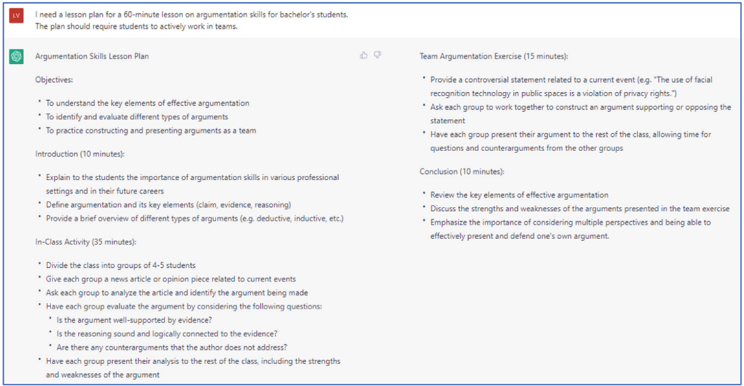
“…an emerging body of literature has explored the potential of ChatGPT for supporting teachers in varying ways, such as using ChatGPT to generate lesson plans (Farrokhnia et al., 2023; Skrabut, 2023) and saving teachers’ time by creating teaching materials, worksheets, and assessments (Finley, 2023).”
BackgroundAI literacy and its implications for prompt engineering strategies
Knoth, N., Tolzin, A., Janson, A., & Leimeister, J. M. (2024) · Computers and Education: Artificial Intelligence · doi:10.1016/j.caeai.2024.100225 · Cited by 368
“…improves student performance and motivation, and refines teaching practices, as evidenced in various recent publications (Alves de Castro, 2023; Crawford, Cowling, & Allen, 2023; Day, 2023; Farrokhnia, Banihashem, Noroozi, & Wals, 2023; Lee, 2023; Rudolph, Tan, & Tan, 2023; Su & Yang, 2023).”
The use of ChatGPT in teaching and learning: a systematic review through SWOT analysis approach
Mai, D. T. T., Da, C. V., & Hanh, N. V. (2024) · Frontiers in Education · doi:10.3389/feduc.2024.1328769 · Cited by 213
“…in education (Mhlanga, 2023; Sullivan et al., 2023), ethical issues related to ChatGPT (Sallam, 2023), SWOT analysis of ChatGPT (Alabool, 2023; Farrokhnia et al., 2023), the impacts of ChatGPT in education (Lo, 2023), application of ChatGPT in higher education (Chamorro-Atalaya et al., 2023;…”
BackgroundGoogle Gemini as a next generation AI educational tool: a review of emerging educational technology
Imran, M., & Almusharraf, N. (2024) · Smart Learning Environments · doi:10.1186/s40561-024-00310-z · Cited by 208
“This AI tool features multiple large language models (LLMs) and natural language processing (NLP) technologies (Farrokhnia et al., 2023).”
BackgroundDabis, A., & Csáki, C. (2024) · Humanities and Social Sciences Communications · doi:10.1057/s41599-024-03526-z · Cited by 318
“…appear in or are considered for higher education, debates about their claimed advantages and potential drawbacks heat up as they are expected to disrupt traditional practices and require teachers to adapt to their potential bene fi ts and drawbacks (as collected by Farrokhnia et al. 2023).”
Derakhshan, A., & Ghiasvand, F. (2024) · International Journal of Applied Linguistics · doi:10.1111/ijal.12561 · Cited by 234
Abdaljaleel, M., Barakat, M., Alsanafi, M., Salim, N. A., Abazid, H., Malaeb, D., Mohammed, A. H., Hassan, B. A. R., Wayyes, A. M., Farhan, S. S., et al. (2023) · doi:10.20944/preprints202309.1541.v1 · Cited by 296
The use of ChatGPT in the digital era: Perspectives on chatbot implementation
(2023) · Journal of Applied Learning & Teaching · doi:10.37074/jalt.2023.6.1.32 · Cited by 216
A multinational study on the factors influencing university students’ attitudes and usage of ChatGPT
Abdaljaleel, M., Barakat, M., Alsanafi, M., Salim, N. A., Abazid, H., Malaeb, D., Mohammed, A. H., Hassan, B. A. R., Wayyes, A. M., Farhan, S. S., et al. (2024) · Scientific Reports · doi:10.1038/s41598-024-52549-8 · Cited by 291
Feedback sources in essay writing: peer-generated or AI-generated feedback?
Banihashem, S. K., Kerman, N. T., Noroozi, O., Moon, J., & Drachsler, H. (2024) · International Journal of Educational Technology in Higher Education · doi:10.1186/s41239-024-00455-4 · Cited by 282
“In the context of feedback, AI-powered ChatGPT introduces what is referred to as AI-generated feedback (Farrokhnia et al., 2023).”
BackgroundMethodSelf-citationLiu, M., Ren, Y., Nyagoga, L. M., Stonier, F., Wu, Z., & Yu, L. (2023) · Future in Educational Research · doi:10.1002/fer3.10 · Cited by 267
ChatGPT in education: Methods, potentials, and limitations
Memarian, B., & Doleck, T. (2023) · Computers in Human Behavior: Artificial Humans · doi:10.1016/j.chbah.2023.100022 · Cited by 266
Camilleri, M. A. (2024) · Technological Forecasting and Social Change · doi:10.1016/j.techfore.2024.123247 · Cited by 261
“Some of them are evaluating their strengths and weaknesses, including of OpenAI ’ s ChatGPT (Farrokhnia et al., 2023; Kasneci et al., 2023).”
BackgroundTian, W., Ge, J., Zhao, Y., & Zheng, X. (2024) · Frontiers in Psychology · doi:10.3389/fpsyg.2024.1268549 · Cited by 188
“Extensive analyses by Dwivedi et al. (2023), Farrokhnia et al. (2023), Su et al. (2023), and Tlili et al. (2023) confirm its superiority over early chatbots in the realms of understanding and generating human-like texts, and providing comprehensive feedback on lengthy textual inputs.”
BackgroundAnalyzing the students' views, concerns, and perceived ethics about chat GPT usage
Farhi, F., Jeljeli, R., Aburezeq, I., Dweikat, F. F., Al-shami, S. A., & Slamene, R. (2023) · Computers and Education: Artificial Intelligence · doi:10.1016/j.caeai.2023.100180 · Cited by 252
Karataş, F., Abedi, F. Y., Ozek Gunyel, F., Karadeniz, D., & Kuzgun, Y. (2024) · Education and Information Technologies · doi:10.1007/s10639-024-12574-6 · Cited by 252
“…as an efficient tool to provide useful information and enables the students to access information effectively, to generate lesson plans and save time by creating teaching materials, worksheets, and assessments (Farrokhnia et al., 2023; Fauzi et al., 2023; Firat, 2023; Stepane-chko & Kozub, 2023).”
A Systematic Review of Generative AI for Teaching and Learning Practice
Ogunleye, B., Zakariyyah, K. I., Ajao, O., Olayinka, O., & Sharma, H. (2024) · Education Sciences · doi:10.3390/educsci14060636 · Cited by 251
Leveraging ChatGPT for Enhancing Critical Thinking Skills
Guo, Y., & Lee, D. (2023) · Journal of Chemical Education · doi:10.1021/acs.jchemed.3c00505 · Cited by 250
Drivers and Consequences of ChatGPT Use in Higher Education: Key Stakeholder Perspectives
Hasanein, A. M., & Sobaih, A. E. E. (2023) · European Journal of Investigation in Health, Psychology and Education · doi:10.3390/ejihpe13110181 · Cited by 246
“Challenges affiliated with reliability involve depending on biased information (i.e., restricted range of data used) [27,28], the lack of updated information (i.e., updated information stopped in 2021) [29] and providing inaccurate/fake data (i.e., presenting fabricated references) [30].”
BackgroundChiu, T. K. F. (2024) · Educational technology research and development · doi:10.1007/s11423-024-10366-w · Cited by 235
“There may also be concerns regarding the accuracy and reliability of AI-generated educational resources (Farrokhnia et al., 2023; Rospigliosi, 2023).”
BackgroundWang, N., Wang, X., & Su, Y.-S. (2024) · Asia Pacific Journal of Education · doi:10.1080/02188791.2024.2305156 · Cited by 154
“For example, some of the concerns are plagiarism and academic misconduct (Cotton et al., 2023), the proliferation of biased and false responses (Farrokhnia et al., 2023), and access gaps leading to further widening of the digital divide (Jeon & Lee, 2023).”
BackgroundMethodInfluentialZou, M., & Huang, L. (2023) · Frontiers in Psychology · doi:10.3389/fpsyg.2023.1259531 · Cited by 150
How to harness the potential of ChatGPT in education?
(2023) · Knowledge Management & E-Learning: An International Journal · doi:10.34105/j.kmel.2023.15.008 · Cited by 151
“Moreover, ChatGPT can also be used to support teachers to generate quizzes or other assessment materials such as open-ended questions, multiple-choice questions, and scenarios for assessment of student performance (Farrokhnia et al., 2023; Lo, 2023).”
BackgroundWang, Y., Derakhshan, A., & Ghiasvand, F. (2025) · System · doi:10.1016/j.system.2025.103791 · Cited by 164
Gao, Y., Wang, Q., & Wang, X. (2024) · Asia Pacific Journal of Education · doi:10.1080/02188791.2024.2305173 · Cited by 170
“Current literatures were mainly focused on examine the effectiveness of such technology (Chiu et al., 2023; Fryer et al., 2020; Huang et al., 2022) or focused on student-centre aspect (Farrokhnia et al., 2023; Perkins, 2023).”
BackgroundChatGPT in the higher education: A systematic literature review and research challenges
Baig, M. I., & Yadegaridehkordi, E. (2024) · International Journal of Educational Research · doi:10.1016/j.ijer.2024.102411 · Cited by 208
Wang, M., Wang, M., Xu, X., Yang, L., Cai, D., & Yin, M. (2024) · IEEE Transactions on Learning Technologies · doi:10.1109/tlt.2023.3324714 · Cited by 156
ChatGPT: Challenges and Benefits in Software Programming for Higher Education
Silva, C. A. G. D., Ramos, F. N., de Moraes, R. V., & Santos, E. L. D. (2024) · Sustainability · doi:10.3390/su16031245 · Cited by 149
“There is a risk that students or researchers may become too reliant on ChatGPT-generated content, potentially leading to a lack of critical thinking and independent research skills [51–53].”
BackgroundAnsari, A. N., Ahmad, S., & Bhutta, S. M. (2024) · Education and Information Technologies · doi:10.1007/s10639-023-12223-4 · Cited by 198
“It also encourages students to broaden their knowledge by relating their conceptual understanding to real-world phenomena (Farrokhnia et al., 2023; Temsah et al., 2023).”
A systematic literature review of empirical research on ChatGPT in education
Albadarin, Y., Saqr, M., Pope, N., & Tukiainen, M. (2024) · Discover Education · doi:10.1007/s44217-024-00138-2 · Cited by 191
“However, it found that frequent use of ChatGPT may result in a decrease in innovative capacities, collaborative skills and cognitive capacities, and students’ motivation to attend classes, as well as could lead to reduced higher-order thinking skills among students [22, 29].”
Akpan, I. J., Kobara, Y. M., Owolabi, J., Akpan, A. A., & Offodile, O. F. (2025) · International Transactions in Operational Research · doi:10.1111/itor.13522 · Cited by 137
Better by You, better than Me? ChatGPT-3 as writing assistance in students’ essays.
Bašić, Ž., Banovac, A., Kružić, I., & Jerković, I. (2023) · doi:10.35542/osf.io/n5m7s · Cited by 189
Effects of chatbot-assisted in-class debates on students’ argumentation skills and task motivation
Guo, K., Zhong, Y., Li, D., & Chu, S. K. W. (2023) · Computers & Education · doi:10.1016/j.compedu.2023.104862 · Cited by 188
ChatGPT is a Remarkable Tool—For Experts
Azaria, A., Azoulay, R., & Reches, S. (2024) · Data Intelligence · doi:10.1162/dint_a_00235 · Cited by 130
“The study by [23] conducted a SWOT (Strengths, Weaknesses, Opportunities, and Threats) analysis of ChatGPT in the education sector.”
MethodGökçearslan, Ş., Tosun, C., & Erdemir, Z. G. (2024) · International Journal of Technology in Education · doi:10.46328/ijte.600 · Cited by 112
“In addition, it is important to develop students' digital literacy skills to effectively integrate AI chatbots into learning processes (Farrokhnia et al., 2023).”
BackgroundAssessing the Usability of ChatGPT for Formal English Language Learning
Shaikh, S., Yayilgan, S. Y., Klimova, B., & Pikhart, M. (2023) · European Journal of Investigation in Health, Psychology and Education · doi:10.3390/ejihpe13090140 · Cited by 183
“SWOT analysis of ChatGPT in language learning and education [39].”
MethodUnveiling Students’ Experiences and Perceptions of Artificial Intelligence Usage in Higher Education
Zhou, X., Zhang, J., & Chan, C. (2024) · Journal of University Teaching and Learning Practice · doi:10.53761/xzjprb23 · Cited by 120
“By acting as on-demand resources and providing immediate feedback, AI tools empower learners from diverse backgrounds to navigate their educational journey more autonomously, making informed decisions based on AI-generated insights and analyses (Farrokhnia et al., 2023; Crompton & Burke, 2023).”
BackgroundChatGPT in physics education: A pilot study on easy-to-implement activities
Bitzenbauer, P. (2023) · Contemporary Educational Technology · doi:10.30935/cedtech/13176 · Cited by 181
“One particularly relevant limitation of AI tools is the lack of higher-order thinking skills as outlined by Farrokhnia et al. (2023).”
BackgroundInfluentialHarnessing Generative AI (GenAI) for Automated Feedback in Higher Education: A Systematic Review
Lee, S. S., & Moore, R. L. (2024) · Online Learning · doi:10.24059/olj.v28i3.4593 · Cited by 181
“This is important because LLM-based GenAI differs from other automated systems in terms of their affordances (Kasneci et al., 2023; Yan et al., 2024).”
BackgroundInfluentialKavadella, A., Dias da Silva, M. A., Kaklamanos, E. G., Stamatopoulos, V., & Giannakopoulos, K. (2024) · JMIR Medical Education · doi:10.2196/51344 · Cited by 133
“…perspective, students using LLMs have the potential to develop new competencies including 21st-century soft skills, such as self-reflection abilities, problem-solving skills, creative and critical thinking, and collaboration, thus becoming motivated and autonomous learners [3,4,16,33,49].”
Kelly, A., Sullivan, M., & Strampel, K. (2023) · Journal of University Teaching and Learning Practice · doi:10.53761/1.20.6.12 · Cited by 177
“Studies to date reflect the need to rethink the typical types of university assessment tasks which could now easily be completed by GenAI tools (Cotton et al, 2023, Crawford et al 2023; Farrokhnia et al, 2023; Perkins 2023; Rudolph et al, 2023).”
Guo, K., Pan, M., Li, Y., & Lai, C. (2024) · The Internet and Higher Education · doi:10.1016/j.iheduc.2024.100962 · Cited by 173
Hashem, R., Ali, N., El Zein, F., Fidalgo, P., & Abu Khurma, O. (2023) · Research and Practice in Technology Enhanced Learning · doi:10.58459/rptel.2024.19023 · Cited by 173
“Several research studies indicate that ChatGPT can support teachers differently (Farrokhnia et al., 2023).”
BackgroundRole of activity-based learning and ChatGPT on students' performance in education
Al Shloul, T., Mazhar, T., Abbas, Q., Iqbal, M., Ghadi, Y. Y., Shahzad, T., Mallek, F., & Hamam, H. (2024) · Computers and Education: Artificial Intelligence · doi:10.1016/j.caeai.2024.100219 · Cited by 173
“Due to this, it is challenging for professionals and educators to carry out their jobs (Farrokhnia et al., 2023).”
BackgroundChatGPT—A Challenging Tool for the University Professors in Their Teaching Practice
Kiryakova, G., & Angelova, N. (2023) · Education Sciences · doi:10.3390/educsci13101056 · Cited by 171
Gallent Torres, C., Zapata González, A., & Ortego Hernando, J. L. (2023) · RELIEVE - Revista Electrónica de Investigación y Evaluación Educativa · doi:10.30827/relieve.v29i2.29134 · Cited by 170
Vetter, M. A., Lucia, B., Jiang, J., & Othman, M. (2024) · Computers & composition/Computers and composition · doi:10.1016/j.compcom.2024.102831 · Cited by 192
Generative AI in Education: Pedagogical, Theoretical, and Methodological Perspectives
Noroozi, O., Soleimani, S., Farrokhnia, M., & Banihashem, S. K. (2024) · International Journal of Technology in Education · doi:10.46328/ijte.845 · Cited by 165
“…environments and improving retention of knowledge (Kadaruddin, 2023), there are some concerns about the ethical considerations of GenAI, as well as its potential negative effects on assessment practices, scientific integrity, and learners’ higher-order thinking skills (Farrokhnia et al., 2023).”
Self-citationYang, L., & Zhao, S. (2024) · Computers in Human Behavior · doi:10.1016/j.chb.2024.108337 · Cited by 164
How understanding large language models can inform the use of ChatGPT in physics education
Polverini, G., & Gregorcic, B. (2024) · European Journal of Physics · doi:10.1088/1361-6404/ad1420 · Cited by 107
“Their use involves potential threats to the students’ development of deep understanding of subject content and higher-order thinking skills, academic integrity and un-biased world views [84,94].”
BackgroundThe Use of Artificial Intelligence in Higher Education
Drach, I., Petroye, O., Borodiyenko, O., Reheilo, I. Y., Базелюк, О., БАЗЕЛЮК, Н. В., & Слободянюк, О. М. (2023) · International Scientific Journal of Universities and Leadership · doi:10.31874/2520-6702-2023-15-66-82 · Cited by 205
Acceptance and use of ChatGPT in the academic community
Strzelecki, A., Cicha, K., Rizun, M., & Rutecka, P. (2024) · Education and Information Technologies · doi:10.1007/s10639-024-12765-1 · Cited by 104
“ChatGPT is also incapable of deduction, has limited mathematical skills (Frieder et al., 2023), and does not assess data reliability well (Farrokhnia et al., 2023).”
InfluentialSaúde, S., Barros, J. P., & Almeida, I. (2024) · Social Sciences · doi:10.3390/socsci13080410 · Cited by 83
“This can be performed to promote innovation in teaching methods, to improve pedagogical content creation, or to enhance the exploration of learning paths that are more focused on the students’ active participation via doubt-based learning or even prompt-based learning (Farrokhnia et al. 2023).”
BackgroundA comprehensive review of large language models: issues and solutions in learning environments
Shahzad, T., Mazhar, T., Tariq, M. U., Ahmad, W., Ouahada, K., & Hamam, H. (2025) · Discover Sustainability · doi:10.1007/s43621-025-00815-8 · Cited by 180
Are Lesson Plans Created by ChatGPT More Effective? An Experimental Study
Karaman, M. R., & Göksu, İ. (2024) · International Journal of Technology in Education · doi:10.46328/ijte.607 · Cited by 96
“SWOT analyses (Farrokhnia et al., 2023) confirm this (Hirsh-Pasek & Blinkoff, 2023).”
BackgroundResultHu, B., Zheng, L., Zhu, J., Ding, L., Wang, Y., & Gu, X. (2024) · IEEE Transactions on Learning Technologies · doi:10.1109/tlt.2024.3384765 · Cited by 109
“This diminishes the practicality of LLM as a universally applicable instructional design tool and limits its widespread adoption in nonelite schools [94].”
BackgroundChatGPT in Teaching and Learning: A Systematic Review
Ali, D., Fatemi, Y., Boskabadi, E., Nikfar, M., Ugwuoke, J., & Ali, H. (2024) · Education Sciences · doi:10.3390/educsci14060643 · Cited by 146
“ChatGPT interprets complex questions, generates relevant responses, and facilitates complex academic tasks, offering substantial opportunities for personalized learning support in educational settings [22].”
BackgroundScaffolding Computational Thinking With ChatGPT
Liao, J., Zhong, L., Zhe, L., Xu, H., Liu, M., & Xie, T. (2024) · IEEE Transactions on Learning Technologies · doi:10.1109/tlt.2024.3392896 · Cited by 108
“Moreover, scholars have claimed that ChatGPT might introduce new challenges and concerns in education [11], [12].”
BackgroundLu, J., Zheng, R., Gong, Z., & Xu, H. (2024) · IEEE Transactions on Learning Technologies · doi:10.1109/tlt.2024.3369690 · Cited by 144
“Thus, Farrokhnia et al. [24] established a SWOT analysis framework by analyzing extensive literature, comprehensively discussing the advantages and disadvantages of ChatGPT, and discussing its opportunities and threats to education.”
MethodThe Educational Affordances and Challenges of ChatGPT: State of the Field
Crompton, H., & Burke, D. (2024) · TechTrends · doi:10.1007/s11528-024-00939-0 · Cited by 141
“The ability of ChatGPT to automate numerous tasks holds great potential to considerably decrease teachers’ busy work-load (Farrokhnia et al., 2023).”
InfluentialChatGPT in higher education - a synthesis of the literature and a future research agenda
Bhullar, P. S., Joshi, M., & Chugh, R. (2024) · Education and Information Technologies · doi:10.1007/s10639-024-12723-x · Cited by 139
“ChatGPT lacks emotional intelligence and empathy, both of which are crucial in effectively addressing the emotional and psychological dimensions of the learning process (Farrokhnia et al., 2023 ; Neumann et al., 2023 ).”
Dalgıç, A., Yaşar, E., & Demir, M. (2024) · Journal of Hospitality Leisure Sport & Tourism Education · doi:10.1016/j.jhlste.2024.100481 · Cited by 159
Gao, Z., Cheah, J., Lim, X., & Luo, X. (2024) · The International Journal of Management Education · doi:10.1016/j.ijme.2024.100958 · Cited by 171
The use of generative AI by students with disabilities in higher education
Zhao, X., Cox, A., & Chen, X. (2025) · The Internet and Higher Education · doi:10.1016/j.iheduc.2025.101014 · Cited by 134
Li, T., Ji, Y., & Zhan, Z. (2024) · Asia Pacific Journal of Education · doi:10.1080/02188791.2024.2305163 · Cited by 133
“This, in turn, frees up cognitive resources for higher-order cognitive activities (Farrokhnia et al., 2023).”
BackgroundWill artificial intelligence drive the advancements in higher education? A tri-phased exploration
Kumar, S., Rao, P., Singhania, S., Verma, S., & Kheterpal, M. (2024) · Technological Forecasting and Social Change · doi:10.1016/j.techfore.2024.123258 · Cited by 131
Tassoti, S. (2024) · Journal of Chemical Education · doi:10.1021/acs.jchemed.4c00212 · Cited by 129
Kumar, H., Musabirov, I., Reza, M., Shi, J., Wang, X., Williams, J. J., Kuzminykh, A., & Liut, M. (2024) · Proceedings of the ACM on Human-Computer Interaction · doi:10.1145/3687038 · Cited by 44
Choi, G. W., Kim, S. H., Lee, D., & Moon, J. (2024) · TechTrends · doi:10.1007/s11528-024-00967-w · Cited by 135
“In fact, generative AI tools opened a new era by enabling learners to interact with AI using conversational language from deep learning technologies and natural language processing (Farrokhnia et al., 2023; Haque et al., 2022; Susnjak, 2022).”
InfluentialPrilop, C. N., Mah, D.-K., Jacobsen, L. J., Hansen, R. R., Weber, K. E., & Hoya, F. (2025) · Computers and Education Artificial Intelligence · doi:10.1016/j.caeai.2025.100471 · Cited by 148
Ayre, J., Mac, O., McCaffery, K., McKay, B. R., Liu, M., Shi, Y., Rezwan, A., & Dunn, A. G. (2024) · Journal of General Internal Medicine · doi:10.1007/s11606-023-08469-w · Cited by 124
“16 12 Although it is not a complete solution, ChatGPT’s strength lies in the speed at which it can redraft plain language content for further review, rather than its ability to generate a ‘final’ public-facing resource.”
BackgroundKarakose, T., Demirkol, M., Yirci, R., Polat, H., Ozdemir, T. Y., & Tülübaş, T. (2023) · Administrative Sciences · doi:10.3390/admsci13070157 · Cited by 86
Monib, W. K., Qazi, A., Apong, R. A. A. H. M., Azizan, M. T., Silva, L. D., & Yassin, H. (2024) · PeerJ Computer Science · doi:10.7717/peerj-cs.2105 · Cited by 133
Pellas, N. (2023) · Smart Learning Environments · doi:10.1186/s40561-023-00276-4 · Cited by 83
“For instance, users can input the text they want to be spoken in the video, and the generative AI will automatically produce a lifelike voice to deliver the dialogue through digital entities represented by humanistic characteristics (avatars) for narration (Farrokhnia et al., 2023).”
BackgroundLai, C. Y., Cheung, K. Y., Chan, C. S., & Law, K. K. (2024) · Computers and Education: Artificial Intelligence · doi:10.1016/j.caeai.2024.100246 · Cited by 122
Generative artificial intelligence and engineering education
Johri, A., Katz, A. S., Qadir, J., & Hingle, A. (2023) · Journal of Engineering Education · doi:10.1002/jee.20537 · Cited by 121
“What, though, is the potential and limit of developing tools and technologies that can mimic and even go beyond what we have conceived of as human intelligence? What potential consequences do technology that can generate novel outputs have for society, especially education in terms of both benefits and harms (Bommasan…”
BackgroundOpportunities, Challenges, and Strategies for Using ChatGPT in Higher Education: A Literature Review
Sok, S., & Heng, K. (2024) · Journal of Digital Educational Technology · doi:10.30935/jdet/14027 · Cited by 120
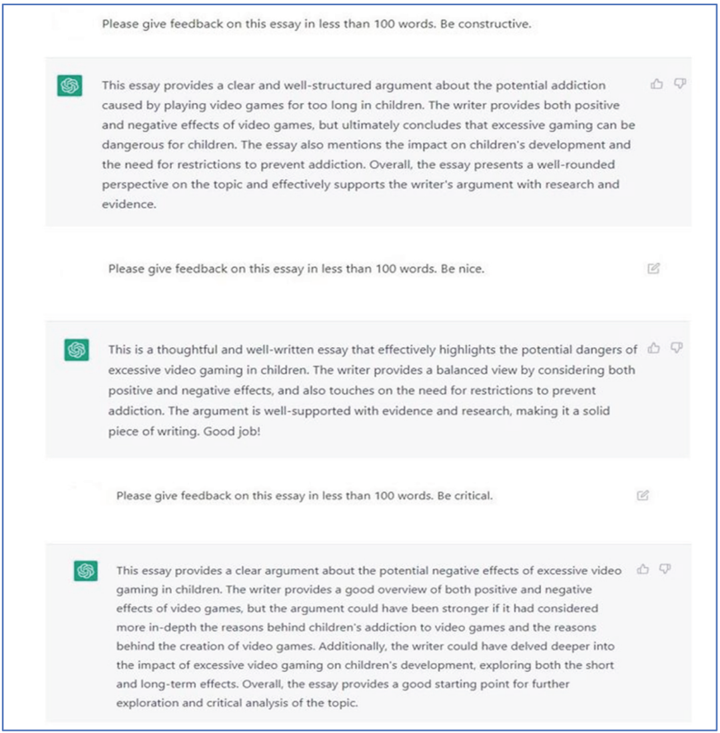
“Therefore, it is convenient for teachers to give feedback to students on their essays in a timely manner (Farrokhnia et al., 2023; Mizumoto & Eguchi, 2023).”
BackgroundInfluentialWhy do students use ChatGPT? Answering through a triangulation approach
Niloy, A. C., Bari, M. A., Sultana, J., Chowdhury, R., Raisa, F. M., Islam, A., Mahmud, S., Jahan, I., Sarkar, M., Akter, S., et al. (2024) · Computers and Education: Artificial Intelligence · doi:10.1016/j.caeai.2024.100208 · Cited by 81
Zhou, X., Teng, D., & Al-Samarraie, H. (2024) · Education Sciences · doi:10.3390/educsci14121302 · Cited by 119
“Farrokhnia et al. [14] have demonstrated that employing GenAI tools might undermine advanced cognitive capabilities, such as critical and analytical thinking. such as critical and analytical thinking.”
Students’ appraisals post-ChatGPT use: Students’ narrative after using ChatGPT for writing
Nugroho, A., Andriyanti, E., Widodo, P., & Mutiaraningrum, I. (2025) · Innovations in Education and Teaching International · doi:10.1080/14703297.2024.2319184 · Cited by 69
“Our findings imply that students are comfortable adopting new technologies, particularly those that can provide real-time assistance and tutoring (Cotton et al., 2023; Farrokhnia et al., 2023).”
Exploring student and teacher perceptions of ChatGPT use in higher education: A Q-Methodology study
Espartinez, A. S. (2024) · Computers and Education Artificial Intelligence · doi:10.1016/j.caeai.2024.100264 · Cited by 139
Transforming education: exploring the influence of generative AI on teaching performance
Mulyani, H., Azim, M. I., Shauki, E. R., Kurniati, F., & Arlinda, H. (2025) · Cogent Education · doi:10.1080/2331186x.2024.2448066 · Cited by 133
“Additionally, it can assist in creating lesson plans tailored to specific parameters and constraints (Farrokhnia et al., 2024).”
InfluentialA systematic literature review of generative artificial intelligence (GenAI) literacy in schools
Park, J. (2025) · Computers and Education Artificial Intelligence · doi:10.1016/j.caeai.2025.100487 · Cited by 155
Kruk, M., & Kałużna, A. (2024) · European Journal of Education · doi:10.1111/ejed.12859 · Cited by 127
Huang, K.-L., Liu, Y.-C., & Dong, M.-Q. (2024) · Thinking Skills and Creativity · doi:10.1016/j.tsc.2024.101508 · Cited by 95
Kohnke, L., Zou, D., & Su, F. (2025) · Computers and Education Artificial Intelligence · doi:10.1016/j.caeai.2025.100371 · Cited by 144
Potential of large language models in health care: Delphi study
Denecke, K., May, R., LLMHealthGroup, & Rivera Romero, O. (2024) · Journal of Medical Internet Research · doi:10.2196/52399 · Cited by 111
“Farrokhnia et al [16] conducted a SWOT analysis and outlined ChatGPT’s strengths and weaknesses with a specific focus on education.”
Method
Metadata
- Authors
- Farrokhnia, M., Banihashem, S. K., Noroozi, O., & Wals, A.
- Affiliations
- Wageningen University & Research (NL)
- Open University of the Netherlands (NL)
- Corresponding author
- Noroozi, Omid
- Venue
- Innovations in Education and Teaching International
- Publisher
- Informa UK Limited
- Published
- 2023-03-27
- Volume
- 61
- Issue
- 3
- Pages
- 460-474
- ISSN
- 1470-3297 (ISSN-L)
- 1470-3300
- OpenAlex
- W4361204578
- Cited by
- 1,384
- References
- 68
- Citations by year
- 2026: 359 · 2025: 456 · 2024: 396 · 2023: 173
- FWCI
- 324.80
- Type
- journal article
- Language
- en
- Open access
- hybrid
- doi.org
- Licence
- Locations
- Innovations in Education and Teaching International (publishedVersion, cc-by-nc-nd)
- Socio-Environmental Systems Modeling (submittedVersion, cc-by-nc-nd)
- DSpace (Open University in the Netherlands) (submittedVersion, cc-by-nc-nd)
- Data Archiving and Networked Services (DANS) (submittedVersion, other-oa)
- Topics
- Social Sciences › Education › Artificial Intelligence in Education
- Health Sciences › Medicine › Health Informatics › Artificial Intelligence in Healthcare and Education
- Social Sciences › Education › Educational Technology in Learning
- Keywords
- ChatGPT, large language models, artificial intelligence in education, academic integrity, plagiarism, algorithmic bias, higher-order thinking skills, personalized learning, teacher workload, SWOT analysis
About these checks
Registry, retraction, Cites and statistics results are computed, not judged, with one exception: a printed reference that no index lists is read once by a model before it counts as a citation error. Claims are extracted by a model and kept only when their quote appears verbatim in the text; each cited source is then checked, with a model’s help, for whether it says what the claim relies on. Those verdicts can be wrong — read the claim’s quote and the cited source before relying on one.
Statistics and arithmetic are recomputed, not judged.
Confidence bands are shown only for fields calibrated on our annotated test set. None is calibrated yet, so no band is shown.
What counts as a claim ›How we measure confidence ›How we check this ›
Are you an author, or do you see a problem with this page? Request a review
Data sources
Bibliographic data: Semantic Scholar, OpenAlex, Crossref.
Contains information from the Semantic Scholar Academic Graph Datasets, made available under the ODC Attribution License (ODC-BY 1.0).
Semantic Scholar’s data is described in: Kinney, R., et al. (2023). The Semantic Scholar Open Data Platform. arXiv:2301.10140.
