

A SWOT analysis of ChatGPT: Implications for educational practice and research
Open accessThe DOI matches its Crossref record; 79 of the 79 references it cites were found in a registry or an index.
Abstract
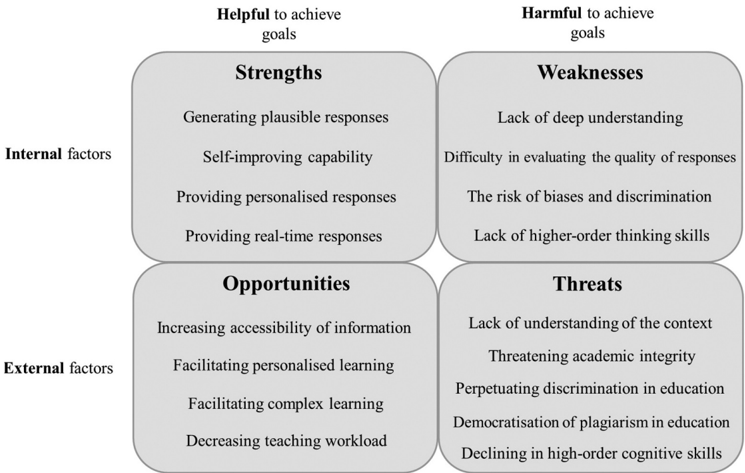
ChatGPT is an AI tool that has sparked debates about its potential implications for education. We used the SWOT analysis framework to outline ChatGPT’s strengths and weaknesses and to discuss its opportunities for and threats to education. The strengths include using a sophisticated natural language model to generate plausible answers, self-improving capability, and providing personalised and real-time responses. As such, ChatGPT can increase access to information, facilitate personalised and complex learning, and decrease teaching workload, thereby making key processes and tasks more efficient. The weaknesses are a lack of deep understanding, difficulty in evaluating the quality of responses, a risk of bias and discrimination, and a lack of higher-order thinking skills. Threats to education include a lack of understanding of the context, threatening academic integrity, perpetuating discrimination in education, democratising plagiarism, and declining high-order cognitive skills. We provide agenda for educational practice and research in times of ChatGPT.
Overview
The claims and statistics of this paper haven’t been checked yet.
Free: it reads the open-access text and checks the first 5 claims that cite a source we can check. Create a free account to check every claim.
Integrity signals
Registry
Cites
Statistics
Figures


Verification
Claims the paper makes
The claims and statistics of this paper haven’t been checked yet.
Free: it reads the open-access text and checks the first 5 claims that cite a source we can check. Create a free account to check every claim.
Claims other papers make about this one
Each is checked against this paper’s own text: does it say what the citing paper says it does?
The source backs part of the claim, not all of it — or backs it for a different population, condition or comparison.
In the citing paper
“Farrokhnia et al. [14] have demonstrated that employing GenAI tools might undermine advanced cognitive capabilities, such as critical and analytical thinking.”
From The Mediating Role of Generative AI Self-Regulation on Students’ Critical Thinking and Problem-Solving (2024) · cites this paper as [14]
Experimental — accuracy not yet measuredThe source backs part of the claim, not all of it — or backs it for a different population, condition or comparison.
In the citing paper
“A possible explanation for this discrepancy lies in the ambiguity surrounding what constitutes plagiarism when using AI-generated content.”
From Chat or cheat? Academic dishonesty, risk perceptions, and ChatGPT usage in higher education students (2025) · cites this paper as Farrokhnia et al., 2023
Experimental — accuracy not yet measuredThe source backs part of the claim, not all of it — or backs it for a different population, condition or comparison.
In the citing paper
“Student perceptions of academic dishonesty have historically been unclear or incomprehensive, and rarely align with teacher expectations (Tatum, 2022), GenAI will only serve to complicate this (Farrokhnia et al., 2023).”
From Not quite eye to A.I.: student and teacher perspectives on the use of generative artificial intelligence in the writing process (2023) · cites this paper as Farrokhnia et al., 2023
Experimental — accuracy not yet measuredThe cited source says what the claim attributes to it.
In the citing paper
“some students may not perceive their use as a policy violation and may unintentionally commit AIgiarism, as its outputs are not verbatim copies of existing texts”
From Chat or cheat? Academic dishonesty, risk perceptions, and ChatGPT usage in higher education students (2025) · cites this paper as Farrokhnia et al., 2023
In the citing paper
“This is echoed in the literature as findings suggest that ChatGPT can provide personalized feedback on essays and become a tutoring system by stimulating critical thinking and debates among students [13].”
From Challenges and Opportunities of Generative AI for Higher Education as Explained by ChatGPT (2023) · cites this paper as [13]
3 more claims about this paper
Create a free account to see every claim other papers make about this one.
Self-check
Percentages, sums and reported differences re-computed from the paper’s own numbers.
The self-check needs the paper’s full text.
Citations
Cites
ChatGPT for good? On opportunities and challenges of large language models for education
Kasneci, E., Sessler, K., Küchemann, S., Bannert, M., Dementieva, D., Fischer, F., Gasser, U., Groh, G., Günnemann, S., Hüllermeier, E., et al. (2023) · Learning and Individual Differences · doi:10.1016/j.lindif.2023.102274 · Cited by 15,365 · cited 3×
“ChatGPT’s superior performance is largely attributed to its massive amount of training data (Kasneci et al., 2023), enabling it to capture a wide range of linguistic patterns and relationships, thereby providing a fair understanding of language and context (Lecler et al., 2023; Wang et al., 2023).”
BackgroundMethodChatGPT for Good? On Opportunities and Challenges of Large Language Models for Education
Kasneci, E., Seßler, K., Küchemann, S., Bannert, M., Dementieva, D., Fischer, F., Gasser, U., Groh, G., Günnemann, S., Hüllermeier, E., et al. (2023) · doi:10.35542/osf.io/5er8f · Cited by 7,552
Best-worst multi-criteria decision-making method
Rezaei, J. (2015) · Omega · doi:10.1016/j.omega.2014.11.009 · Cited by 4,333 · cited 1×
“Therefore, empirical studies with quantitative approaches such as the best-worst method (see Rezaei, 2015) are necessary to extend the current review findings.”
BackgroundKung, T. H., Cheatham, M., ChatGPT, Medenilla, A., Sillos, C., De Leon, L., Elepaño, C., Madriaga, M., Aggabao, R., Diaz-Candido, G., et al. (2022) · doi:10.1101/2022.12.19.22283643 · Cited by 4,115
Kung, T. H., Cheatham, M., Medenilla, A., Sillos, C., De Leon, L., Elepaño, C., Madriaga, M., Aggabao, R., Diaz-Candido, G., Maningo, J., et al. (2023) · PLOS Digital Health · doi:10.1371/journal.pdig.0000198 · Cited by 4,115 · cited 1×
“It is also shown that ChatGPT has the potential to respond sufficiently to exam questions in the fields of medical (Kung et al., 2022) and law (Choi et al., 2023).”
BackgroundSallam, M. (2023) · Healthcare · doi:10.3390/healthcare11060887 · Cited by 3,126
Chatting and cheating: Ensuring academic integrity in the era of ChatGPT
Cotton, D. R. E., Cotton, P. A., & Shipway, J. R. (2024) · Innovations in Education and Teaching International · doi:10.1080/14703297.2023.2190148 · Cited by 3,087 · cited 5×
“…some scholars are concerned about the ethical considerations of ChatGPT (Mhlanga, 2023), as well as its potential negative effects on assessment practices (Rudolph et al., 2023), scientific integrity (Cotton et al., 2023; Shiri, 2023), and students’ higher-order thinking skills (Susnjak, 2022).”
BackgroundMethodInfluentialChatting and Cheating. Ensuring academic integrity in the era of ChatGPT
Cotton, D., Cotton, P., & Shipway, J. R. (2023) · doi:10.35542/osf.io/mrz8h · Cited by 3,079
Doyle, T. (2017) · The Information Society · doi:10.1080/01972243.2017.1354593 · Cited by 3,071 · cited 1×
“AI algorithms can also perpetuate discrimination by focusing on objectives like profits and efficiency without considering unintended consequences such as reinforcing existing biases (O’neil, 2017).”
Background
Research works printed but not linked: 1
- Haque, M. U., Dharmadasa, I., Sworna, Z. T., Rajapakse, R. N., & Ahmad, H. (2022). 'I think this is the most disruptive technology': Exploring sentiments of ChatGPT early adopters using Twitter data. arXiv. https://doi.org/10.48550/arXiv.2303.03836 . · arXiv · doi:10.48550/arxiv.2303.03836 · Paper page
Cited by
Items 201–300 of 1,006
Tu, Y., & Hwang, G. (2023) · Interactive Learning Environments · doi:10.1080/10494820.2023.2286370 · Cited by 57
“With the evolution of technology, ChatGPT, a GAI-based chatbot, has signi fi cantly in fl uenced the educational landscape (Farrokhnia et al., 2023; Hwang & Chen, 2023).”
InfluentialAn integrative decision-making framework to guide policies on regulating ChatGPT usage
Bukar, U. A., Sayeed, M. S., Abdul Razak, S. F., Yogarayan, S., & Ahmed Amodu, O. (2024) · PeerJ Computer Science · doi:10.7717/peerj-cs.1845 · Cited by 43
ChatGPT in the classroom: navigating the generative AI wave in management education
Leelavathi, R., & Surendhranatha, R. C. (2024) · Journal of Research in Innovative Teaching & Learning · doi:10.1108/jrit-01-2024-0017 · Cited by 36
RetractedNguyen, A., Gul, F., Dang, B., Huynh, T.-N., & Tuunanen, T. (2025) · Innovations in Education and Teaching International · doi:10.1080/14703297.2025.2499177 · Cited by 61
“…studies indicate that GenAI and MR offer promising opportunities to create innovative learning experiences and new solutions for promoting regulatory behaviour, enhancing student engagement and learning outcomes (Farrokhnia et al., 2024; Giannakos et al., 2024; Nguyen, Kremantzis, et al., 2024).”
Renkema, M., & Tursunbayeva, A. (2024) · Futures · doi:10.1016/j.futures.2024.103453 · Cited by 62
Yılmaz, F. G. K., & Yılmaz, R. (2025) · Innovations in Education and Teaching International · doi:10.1080/14703297.2025.2484613 · Cited by 63
“Because students with high SRLS levels who are aware of their own cognitive state and know how to solve the current problem may have a more positive attitude towards these GenAI tools (Fabiyi, 2024; Farrokhnia et al., 2024).”
University Educators Perspectives on ChatGPT: A Technology Acceptance Model-Based Study
Barakat, M. M., Salim, N. A., & Sallam, M. (2025) · Open Praxis · doi:10.55982/openpraxis.17.1.718 · Cited by 61
“Opportunities provided by ChatGPT arise through innovative pedagogies, while threats include ethical issues and data privacy issues (Farrokhnia et al., 2023; Franco D’Souza et al., 2024; M. Sallam et al., 2024).”
InfluentialHsiao, Y.-P., Klijn, N., & Chiu, M.-S. (2023) · Learning: Research and Practice · doi:10.1080/23735082.2023.2257234 · Cited by 36
“In Table 1, we provide a summary of the significant weaknesses and limitations of LLMs (Cotton et al., 2023; Crawford et al., 2023; Farrokhnia et al., 2023) as well as their potential implications for formulating course LGs and example LGs (Kuhn, 1999).”
BackgroundAcceptance of ChatGPT by undergraduates in Sri Lanka: a hybrid approach of SEM-ANN
Nawaz, S. S., Sanjeetha, M. B. F., Murshidi, G. H. A., Riyath, M. I. M., Yamin, F. M., & Mohamed, R. (2024) · Interactive Technology and Smart Education · doi:10.1108/itse-11-2023-0227 · Cited by 58
AI in teaching English as a foreign language: Effectiveness and prospects in Kazakh higher education
Kemelbekova, Z., Degtyareva, X., Yessenaman, S., Ismailova, D., & Seidaliyeva, G. (2024) · XLinguae · doi:10.18355/xl.2024.17.01.05 · Cited by 28
Bognár, L., Ágoston, G., Bacsa-Bán, A., Fauszt, T., Gubán, G., Joós, A., Juhász, L. Z., Kocsó, E., Kovács, E., Maczó, E. C., et al. (2024) · Education Sciences · doi:10.3390/educsci14090974 · Cited by 64
The impact of metacognitive scaffolding on deep learning in a GenAI-supported learning environment
Wu, J., Wang, J., Lei, S., Wu, F., & Gao, X. (2025) · Interactive Learning Environments · doi:10.1080/10494820.2025.2479162 · Cited by 36
“…of advanced cognitive skills may lead them to exhibit excessive dependence on the feedback provided by GenAI tools, thus potentially fostering superficial cognitive tendencies and impeding the cultivation of profound cognitive capabilities over time (Bahrini et al., 2023; Farrokhnia et al., 2023).”
Abedi, M., Alshybani, I., Shahadat, M., & Murillo, M. S. (2023) · Qeios · doi:10.32388/md04b0 · Cited by 69
“Furthermore, one concern regarding chatbots is their potential to perpetuate biases and reinforce stereotypes in their training data [162,169].”
BackgroundUnderstanding Teachers’ Perspective toward ChatGPT Acceptance in English Language Teaching
Mutammimah, H., Rejeki, S., Kustini, S., & Amelia, R. (2024) · International Journal of Technology in Education · doi:10.46328/ijte.656 · Cited by 55
“However, teachers need not only positive attitudes but also strategic planning and consideration of technology's strengths, weaknesses, opportunities, and threats to facilitate effective integration (Farrokhnia et al., 2023).”
Reddy, M. R., Walter, N. G., & Sevryugina, Y. V. (2024) · Journal of Chemical Education · doi:10.1021/acs.jchemed.4c00226 · Cited by 56
Blahopoulou, J., & Ortiz-Bonnin, S. (2025) · Education and Information Technologies · doi:10.1007/s10639-025-13575-9 · Cited by 50
“Most report using it for academic and non-academic tasks, particularly for simplifying complex content and managing information overload (Adeshola & Adepoju, 2023; Farrokhnia et al., 2023).”
Bouzar, A., EL Idrissi, K., & Ghourdou, T. (2024) · Arab World English Journal · doi:10.24093/awej/chatgpt.15 · Cited by 50
Solano-Barliza, A. D., Ojeda, A. D., & Aarón-Gonzalvez, M. (2024) · Formación universitaria · doi:10.4067/s0718-50062024000300129 · Cited by 57
Li, B., Bonk, C. J., & Kou, X. (2023) · International Journal of Computer-Assisted Language Learning and Teaching · doi:10.4018/ijcallt.326135 · Cited by 58
Doing Research with Help from ChatGPT: Promising Examples for Coding and Inter-Rater Reliability
Theelen, H., Vreuls, J., & Rutten, J. (2024) · International Journal of Technology in Education · doi:10.46328/ijte.537 · Cited by 52
Humble, N. (2024) · International Journal of Educational Technology in Higher Education · doi:10.1186/s41239-024-00494-x · Cited by 59
“Although similar in scope, the studies by Choi et al. (2024) and Farrokhnia et al. (2024) have some differences from the one presented here.”
Akolekar, H. D., Jhamnani, P., Kumar, V., Tailor, V., Pote, A., Meena, A., Kumar, K., Challa, J. S., & Kumar, D. (2025) · Scientific Reports · doi:10.1038/s41598-025-93871-z · Cited by 57
Chen, J., Mokmin, N. A. M., & Su, H. (2025) · Innovations in Education and Teaching International · doi:10.1080/14703297.2025.2503857 · Cited by 63
“Unlike traditional multimedia instruction, which delivers fixed content, GenAI dynamically interacts with students by offering encouragement, personalised explanations, and scaffolded support tailored to their skill levels (Farrokhnia et al., 2024; Li, 2023).”
Famaye, T., Bailey, C. S., Adisa, I. O., & Irgens, G. A. (2024) · International Journal of Technology in Education · doi:10.46328/ijte.651 · Cited by 54
“In addition to ethical concerns there have been claims about possible limitations and potential negative effect on students’ skill development (Alkaissi & McFarlane, 2023; Farrokhnia et al., 2023).”
BackgroundChatGPT for Science Lesson Planning: An Exploratory Study Based on Pedagogical Content Knowledge
Πέικος, Γ., & Stavrou, D. (2025) · Education Sciences · doi:10.3390/educsci15030338 · Cited by 48
Generative AI in Accounting Education: Evaluating ChatGPT's Role in Assessment and Skill Development
Tharapos, M., Lau, K. H., Peszynski, K., Nguyen, L. A., Magdziarz, S., Morton, E., Borg, V., & Duan, S. X. (2025) · Accounting and Finance · doi:10.1111/acfi.70051 · Cited by 60
Developing Design Principles for Sustainability-Oriented Blended Learning in Higher Education
Versteijlen, M., & Wals, A. E. J. (2023) · Sustainability · doi:10.3390/su15108150 · Cited by 52
Self-citationKee, T., Kuys, B., & King, R. B. (2024) · Journal of Artificial Intelligence in Architecture · doi:10.24002/jarina.v3i1.8347 · Cited by 66
ChatGPT, the perfect virtual teaching assistant? Ideological bias in learner-chatbot interactions
Poucke, M. V. (2024) · Computers & composition/Computers and composition · doi:10.1016/j.compcom.2024.102871 · Cited by 50
Kusuma, I. P. I., Roni, M., Dewi, K. S., & Mahendrayana, G. (2024) · Studies in English Language and Education · doi:10.24815/siele.v11i2.34748 · Cited by 56
“Previous researchers (e.g., Baskara & Mukarto, 2023; Farrokhnia et al., 2023; Kalla & Smith, 2023), who have warned about the potential for ChatGPT to provide generic, discriminatory, and even false information, concur with these findings.”
BackgroundResultInfluentialEngineering a Sustainable Future Through the Integration of Generative AI in Engineering Education
Cañavate, J., Marroquin, E. M., & Colom, X. (2025) · Sustainability · doi:10.3390/su17073201 · Cited by 46
“On the one hand, the strengths and weaknesses of GAI have been studied by Farrokhnia et al. [36], who conducted a SWOT analysis for ChatGPT, as paradigm of generative GAI systems.”
Agyare, B. O., Asare, J., Kraishan, A., Nkrumah, I., & Adjekum, D. K. (2025) · Computers and Education Artificial Intelligence · doi:10.1016/j.caeai.2025.100365 · Cited by 55
Faisal, E. (2024) · Frontiers in Education · doi:10.3389/feduc.2024.1325601 · Cited by 44
Advancing higher education with GenAI: factors influencing educator AI literacy
Ayyoub, A. M., Khlaif, Z. N., Shamali, M., Abu Eideh, B., Assali, A., Hattab, M. K., Barham, K. A., & Bsharat, T. R. K. (2025) · Frontiers in Education · doi:10.3389/feduc.2025.1530721 · Cited by 44
“Natural language processing, data analytics, and machine learning algorithms, and automation are just a few of the numerous AI applications that hold great promise for the education sector (Farrokhnia et al., 2024).”
Surviving ChatGPT in healthcare
Liu, Z., Zhang, L., Wu, Z., Yu, X., Cao, C., Dai, H.-X., Liu, N., Liu, J., Liu, W., Li, Q., et al. (2024) · Frontiers in Radiology · doi:10.3389/fradi.2023.1224682 · Cited by 46
“Moreover, relying on AGI tools to generate content might undermine students ’ capacity for learning, problem-solving, and generalization from known examples (49, 50).”
Chauke, T. A., Mkhize, T. R., Methi, L. M., & Dlamini, N. P. (2024) · Journal of Curriculum Studies Research · doi:10.46303/jcsr.2024.4 · Cited by 62
Exploring the Integration of ChatGPT in Inquiry-based Learning: Teacher Perspectives
Adeyele, V. O., & Ramnarain, U. D. (2024) · International Journal of Technology in Education · doi:10.46328/ijte.638 · Cited by 53
“…and lifelong learning by giving students of all ages access to a vast library of information and resources (Baidoo-Anu & Owusu Ansah, 2023; Farrokhnia et al., 2023; Zhang, 2023), and more effectively coordinate the processes of grading, assessment, and evaluation (Baidoo-Anu & Owusu…”
BackgroundUniversity Students’ Attitudes Toward ChatGPT Profiles and Their Relation to ChatGPT Intentions
Zhang, Y., Yang, X., & Tong, W. (2024) · International Journal of Human-Computer Interaction · doi:10.1080/10447318.2024.2331882 · Cited by 59
“…and believed to have positive effects on university students’ learning while posing challenges, such as influencing their advanced cognitive abilities and upholding academic integrity (Chan & Hu, 2023; Farrokhnia et al., 2023; Grassini, 2023; Jarrah et al., 2023; Montenegro-Rueda et al., 2023).”
Thanasi-Boçe, M., & Hoxha, J. (2024) · Education and Information Technologies · doi:10.1007/s10639-024-12775-z · Cited by 47
Yu, J. H., Chauhan, D., Iqbal, R. A., & Yeoh, E. (2024) · Educational Technology Research and Development · doi:10.1007/s11423-024-10425-2 · Cited by 55
“Researchers note that AI systems can sometimes make errors, and their effectiveness may depend on users’ familiarity with the technology (Farrokhnia et al., 2023).”
Impact of Generative AI on Critical Thinking Skills in Undergraduates: A Systematic Review
Premkumar, P. P., Yatigammana, M. R. K. N., & Kannangara, S. (2024) · The journal of desk research review and analysis. · doi:10.4038/jdrra.v2i1.55 · Cited by 63
“Critics argue that excessive dependence on GenAI may reduce students' motivation to conduct independent research and analysis ( Farrokhnia et al.,2023).”
To adopt or to ban? Student perceptions and use of generative AI in higher education
Farinosi, M., & Melchior, C. (2025) · Humanities and Social Sciences Communications · doi:10.1057/s41599-025-05982-7 · Cited by 51
Dai, K., Liu, Y., & Zhang, X. (2026) · Computers and Education Artificial Intelligence · doi:10.1016/j.caeai.2026.100544 · Cited by 56
Integration of Artificial Intelligence Technology in Distance Learning in Higher Education
Mahmudi, A. A., Fionasari, R., Mardikawati, B., & Judijanto, L. (2023) · Journal of Social Science Utilizing Technology · doi:10.55849/jssut.v1i4.661 · Cited by 61
Chan, C. K. Y., & Lee, K. K. W. (2025) · Computers & Education · doi:10.1016/j.compedu.2025.105399 · Cited by 45
Uludağ, F., Kılıç, E., & Çelik, H. E. (2025) · Humanities and Social Sciences Communications · doi:10.1057/s41599-025-05641-x · Cited by 52
Ji, Y., Zhan, Z., Li, T., Zou, X., & Lyu, S. (2025) · IEEE Transactions on Learning Technologies · doi:10.1109/tlt.2025.3554584 · Cited by 42
“Specifically, ChatGPT can enhance students’ learning by offering tailored support such as demand-based customization, real-time interaction, innovative feedback, creative inspiration, information synthesis, and personalized guidance [34].”
SDG 4, Academic Integrity and Artificial Intelligence: Clash or Win-Win Cooperation?
Artyukhov, A., Wołowiec, T., Artyukhova, N., Bogacki, S., & Vasylieva, T. (2024) · Sustainability · doi:10.3390/su16198483 · Cited by 42
Ülkü, A. (2023) · Tourism & Management Studies · doi:10.18089/tms.2023.190402 · Cited by 49
Li, M., Xie, Q., Enkhtur, A., Meng, S., Chen, L., Yamamoto, B. A., Cheng, F., & Murakami, M. (2026) · Studies in Higher Education · doi:10.1080/03075079.2026.2696496 · Cited by 48
The Basics of Artificial Intelligence in Nursing: Fundamentals and Recommendations for Educators
Schneidereith, T. A., & Thibault, J. (2023) · Journal of Nursing Education · doi:10.3928/01484834-20231006-03 · Cited by 37
Esmaeil, A. A. A. H., Dzulkifli, D. N. A. K., Maakip, I., Mantaluk, O. O., & Marshall, S. (2023) · Jurnal Komunikasi Malaysian Journal of Communication · doi:10.17576/jkmjc-2023-3904-08 · Cited by 46
A bibliometric analysis of publications on ChatGPT in education: Research patterns and topics
ZHELTUKHINA, M. R., Sergeeva, O. V., Masalimova, A. R., Budkevich, R. L., Kosarenko, N. N., & Nesterov, G. V. (2024) · Online Journal of Communication and Media Technologies · doi:10.30935/ojcmt/14103 · Cited by 47
Ji, Y., Zou, X., Li, T., & Zhan, Z. (2023) · Proceedings of the 2023 6th International Conference on Educational Technology Management · doi:10.1145/3637907.3637948 · Cited by 29
Abubakari, M. S., Shafik, W., & Hidayatullah, A. F. (2024) · Advances in educational technologies and instructional design book series · doi:10.4018/979-8-3693-2728-9.ch010 · Cited by 51
Moon, J., Lee, U., Koh, J., Jeong, Y., Lee, Y., Byun, G., & Lim, J. (2024) · Technology Knowledge and Learning · doi:10.1007/s10758-024-09756-z · Cited by 42
“The emergence of GenAI has brought significant attention in education research (Hsu & Ching, 2023 ; Farrokhnia et al., 2023 ).”
Ethical Implications of ChatGPT in Higher Education: A Scoping ReviewPreprint
Li, M., Enkhtur, A., Cheng, F., & Yamamoto, B. A. (2023) · arXiv (Cornell University) · doi:10.48550/arxiv.2311.14378 · Cited by 50
Almanea, M. (2026) · Computer Assisted Language Learning · doi:10.1080/09588221.2024.2410158 · Cited by 40
Bikanga Ada, M. (2024) · Education Sciences · doi:10.3390/educsci14101106 · Cited by 40
“…material in specific contexts, its strict adherence to provided prompts brings into question its ability to adapt to a wide range of learning needs and preferences [58]—it lacks the deeper contextualisation, critical engagement, and human nuance that lecturers bring to the classroom [59].”
Pre-Service Teachers’ Assessment of ChatGPT’s Utility in Higher Education: SWOT and Content Analysis
Markos, A., Prentzas, J., & Sidiropoulou, M. (2024) · Electronics · doi:10.3390/electronics13101985 · Cited by 94
“They emphasize that ChatGPT’s tendency to amalgamate text from multiple sources can, if used uncritically, lead to plagiarism in academic and student projects [24] (p. 9).”
BackgroundMethodResultInfluentialLemke, C., Kirchner, K., Anandarajah, L., & Herfurth, F. (2023) · European Conference on e-Learning · doi:10.34190/ecel.22.1.1828 · Cited by 49
“Farrokhnia et al (2023) or Su and Yang (2023) combine general aspects of generative AI with a close focus on ChatGPT (a specific LLM product) and its adoption in HE.”
BackgroundEmotional Intelligence in the Digital Age: Harnessing AI for Students’ Inner Development
Keshishi, N., & Hack, S. (2023) · Journal of Perspectives in Applied Academic Practice · doi:10.56433/jpaap.v11i3.579 · Cited by 39
Li, Z., & Ironsi, C. S. (2024) · Journal of Science Education and Technology · doi:10.1007/s10956-024-10148-2 · Cited by 44
“However, it may not provide tailored feedback to individual students, which can hinder the development of specific writing skills and address the unique needs of each student (Farrokhnia et al., 2023).”
Unlocking innovation: how enjoyment drives GenAI use in higher education
Cano, J. R., & Núñez, N. A. (2024) · Frontiers in Education · doi:10.3389/feduc.2024.1483853 · Cited by 46
Heo, S., & Na, S. (2025) · Results in Engineering · doi:10.1016/j.rineng.2025.104325 · Cited by 47
Albedah, F. (2025) · Language Teaching Research Quarterly · doi:10.32038/ltrq.2025.49.13 · Cited by 56
Student engagement with AI tools in learning: evidence from a large-scale Estonian survey
Granström, M., & Oppi, P. (2025) · Frontiers in Education · doi:10.3389/feduc.2025.1688092 · Cited by 47
Impact of ChatGPT on Academic Performance among Bangladeshi Undergraduate Students
Tanvir, K., Islam, M. S., Sezan, S. B. K., Sanad, Z. A., & Ataur, A.-J. I. (2023) · International Journal of Research In Science & Engineering · doi:10.55529/ijrise.35.18.28 · Cited by 26
ChatGPT en Educación Superior: explorando sus potencialidades y sus limitaciones
Galli, M. G., & Kanobel, M. C. (2023) · Revista Educación Superior y Sociedad (ESS) · doi:10.54674/ess.v35i2.815 · Cited by 48
Quo Vadis, University? A Roadmap for AI and Ethics in Higher Education
Sirvent, F. C., Roger‐Monzó, V., & Rodrigues, R. G. (2024) · The Electronic Journal of e-Learning · doi:10.34190/ejel.22.6.3267 · Cited by 44
“However, it is proven to be a temporary solution (Rudolph, Tan, and Chan, 2023) (Farrokhnia, et al., 2023).”
Jang, H., & Choi, H. (2024) · Journal of Science Education and Technology · doi:10.1007/s10956-024-10173-1 · Cited by 45
“ChatGPT has strengths and weaknesses (Farrokhnia et al., 2023; Shoufan, 2023).”
ChatGPT in healthcare education: a double-edged sword of trends, challenges, and opportunities
Adarkwah, M. A., Badu, S. A., Osei, E. A., Adu-Gyamfi, E., Odame, J., & Schneider, K. (2025) · Discover Education · doi:10.1007/s44217-024-00393-3 · Cited by 44
“Language, cultural, and economic disparities raise concerns about the uniformity of AI-driven education [33].”
InfluentialHigher education assessment practice in the era of generative AI tools
(2024) · Journal of Applied Learning & Teaching · doi:10.37074/jalt.2024.7.1.28 · Cited by 37
Exploring the Transformative Impact of Generative AI on Higher Education
Malik, T., Hughes, L., Dwivedi, Y. K., & Dettmer, S. (2023) · Lecture notes in computer science · doi:10.1007/978-3-031-50040-4_6 · Cited by 37
Gaze-Driven Adaptive Learning System With ChatGPT-Generated Summaries
Santhosh, J., Dengel, A. R., & Ishimaru, S. (2024) · IEEE Access · doi:10.1109/access.2024.3503059 · Cited by 41
Wang, D., Liu, Y., Jing, X., Liu, Q., & Lu, Q. (2024) · Education and Information Technologies · doi:10.1007/s10639-024-13209-6 · Cited by 48
“Farrokhnia et al. (2023) use the SWOT framework to summarize the opportunities and challenges that AIGC presents to the education industry, noting in particular that it poses a threat to academic integrity and can lead to a decline in students’ higher-order cognitive skills such as innovation,…”
Shahzad, M. F., Xu, S., An, X., Zahid, H., & Asif, M. (2025) · European Journal of Education · doi:10.1111/ejed.70050 · Cited by 44
One year in the classroom with ChatGPT: empirical insights and transformative impacts
Guo, F., Li, T., & Cunningham, C. J. L. (2025) · Frontiers in Education · doi:10.3389/feduc.2025.1574477 · Cited by 43
Chatbots in Education: The impact of Artificial Intelligence based ChatGPT on Teachers and Students
Annuš, N. (2023) · International Journal of Advanced Natural Sciences and Engineering Researches · doi:10.59287/ijanser.739 · Cited by 37
Artificial Intelligence for Education and Research: Pilot Study on Perception of Academic Staff
Titko, J., Steinbergs, K., Achieng, M. S., & Užule, K. (2023) · Virtual Economics · doi:10.34021/ve.2023.06.03(1 · Cited by 41
Li, Y., Castulo, N. J., & Xu, X. (2025) · Frontiers in Education · doi:10.3389/feduc.2025.1505856 · Cited by 47
Jukiewicz, M. (2025) · Frontiers in Education · doi:10.3389/feduc.2025.1594572 · Cited by 42
Huang, Y.-M., Chen, P.-H., Lee, H.-Y., Sandnes, F. E., & Wu, T.-T. (2025) · Computers in Human Behavior · doi:10.1016/j.chb.2025.108659 · Cited by 35
Padiyath, A., Hou, X., Pang, A., Viramontes Vargas, D., Gu, X., Nelson-Fromm, T., Wu, Z., Guzdial, M., & Ericson, B. (2024) · Proceedings of the 2024 ACM Conference on International Computing Education Research - Volume 1 · doi:10.1145/3632620.3671098 · Cited by 35
Concerns About Using ChatGPT in Education
Lin, S.-M., Chung, H.-H., Chung, F., & Lan, Y. (2023) · Lecture notes in computer science · doi:10.1007/978-3-031-40113-8_4 · Cited by 44
TALAYHAN, Ö. G. (2023) · JOURNAL OF CURRENT DEBATES IN SOCIAL SCIENCES · doi:10.29228/cudes.71701 · Cited by 36
ChatGPT and Assessment in Higher Education: A Magic Wand or a Disruptor?
Klyshbekova, M., & Abbott, P. (2024) · Electronic Journal of e-Learning · doi:10.34190/ejel.21.5.3114 · Cited by 23
“These findings r esonate with Farrokhnia et al. (2023), Rudolph, Tan and Tan (2023), and Qadir (2022) who also reported that the chatbot generated made-up reference lists with non-functional links.”
BackgroundElstad, E., & Eriksen, H. (2024) · Nordic Journal of Comparative and International Education (NJCIE) · doi:10.7577/njcie.5736 · Cited by 56
“This development has created both enthusiasm and concern for education professionals (Dell’Acqua et al., 202 3; Farrokhnia et al., 2023; Fischer, 2023; Pea et al., 2022).”
BackgroundEstaiteyeh, M., & McQuirter, R. (2024) · Brock Education Journal · doi:10.26522/brocked.v33i3.1176 · Cited by 42
“This technology holds the promise of personalizing/facilitating learning, decreasing teacher workload, and offering access to a wealth of information (Farrokhnia et al., 2024).”
Kim, D., Majdara, A., & Olson, W. (2024) · International Journal of Technology in Education · doi:10.46328/ijte.691 · Cited by 34
“The global reach of the internet has facilitated online learning (Banihashem et al., 2023), breaking down geographical barriers and connecting students and teachers from different parts of the world.”
Eğitimde Yapay Zekâ Kullanımı: ChatGPT’nin KEFE ve PEST Analizi
Kutlucan, E., & Seferoğlu, S. S. (2024) · Türk Eğitim Bilimleri Dergisi · doi:10.37217/tebd.1368821 · Cited by 41
Shahsavar, Z., Kafipour, R., Khojasteh, L., & Pakdel, F. (2024) · Frontiers in Education · doi:10.3389/feduc.2024.1457744 · Cited by 36
The relationship between students’ self-regulated learning skills and technology acceptance of GenAI
Mirriahi, N., Marrone, R. L., Barthakur, A., Gabriel, F. C., Colton, J., Yeung, T. N., Arthur, P., & Kovanović, V. (2025) · Australasian Journal of Educational Technology · doi:10.14742/ajet.10006 · Cited by 44
Rojas, Ó. A. C., Contero, M., & Hincapié, M. (2025) · Multimodal Technologies and Interaction · doi:10.3390/mti9050045 · Cited by 41
“…Obtaining interpretable models of student performance [11,24], addressing the “black box” nature of DL models Biases in AI-generated feedback [20,22], requiring human mitigation Generation of timely and personalized feedback [11,13] Risk of over-reliance on AI technology [13] Improving student…”
Mustapha, K. B., Mustapha, K. B., Yap, E. H., & Abakr, Y. A. (2024) · Interactive Technology and Smart Education · doi:10.1108/itse-10-2023-0198 · Cited by 39
Teachers' AI readiness in Chinese as a Foreign Language education: Scale development and validation
Li, N., & Liang, Y. (2025) · System · doi:10.1016/j.system.2025.103597 · Cited by 41
Guo, S., & Guo, S. (2025) · Acta Psychologica · doi:10.1111/ijal.12815 · Cited by 40
The role of personality traits in predicting educational use of generative AI in higher education
Arpacı, İ., Kuşci, İ., & Gibreel, O. (2025) · Scientific Reports · doi:10.1038/s41598-025-16339-0 · Cited by 41
“This adaptability can significantly improve the learning experience and foster a sense of individualized attention 13 .”
Farazouli, A., Pargman, T. C., Laksov, K. B., & McGrath, C. (2025) · Studies in Higher Education · doi:10.1080/03075079.2025.2550766 · Cited by 37
“Emerging technologies, such as Generative Artificial Intelligence (GAI) chatbots, are raising new questions and fuelling debate on the opportunities and challenges they may bring to educational practice (Farrokhnia et al. 2023; Ooi et al. 2023).”
The value of GenAI for peer feedback provision: student perceptions and impacts
Noroozi, O., Haddadian, G., Gao, X., Schunn, C. D., Alqassab, M., & Banihashem, S. K. (2025) · International Journal of Educational Technology in Higher Education · doi:10.1186/s41239-025-00558-6 · Cited by 38
“…support, this area is still in its early stages, especially for complimenting peer feedback practices (see Banihashem et al., 2024; Er et al., 2024; Farrokhnia et al., 2024), warranting further exploration to better understand how GenAI tools can be effectively integrated into peer feedback…”
Self-citation
Metadata
- Authors
- Farrokhnia, M., Banihashem, S. K., Noroozi, O., & Wals, A.
- Affiliations
- Wageningen University & Research (NL)
- Open University of the Netherlands (NL)
- Corresponding author
- Noroozi, Omid
- Venue
- Innovations in Education and Teaching International
- Publisher
- Informa UK Limited
- Published
- 2023-03-27
- Volume
- 61
- Issue
- 3
- Pages
- 460-474
- ISSN
- 1470-3297 (ISSN-L)
- 1470-3300
- OpenAlex
- W4361204578
- Semantic Scholar
- e9685cf2c9aff2f7ff7bcfa5b65a11e90687a3ef
- Cited by
- 1,384
- References
- 68
- Citations by year
- 2026: 359 · 2025: 456 · 2024: 396 · 2023: 173
- FWCI
- 324.80
- Type
- journal article
- Language
- en
- Open access
- hybrid
- doi.org
- Licence
- Locations
- Innovations in Education and Teaching International (publishedVersion, cc-by-nc-nd)
- Socio-Environmental Systems Modeling (submittedVersion, cc-by-nc-nd)
- DSpace (Open University in the Netherlands) (submittedVersion, cc-by-nc-nd)
- Data Archiving and Networked Services (DANS) (submittedVersion, other-oa)
- Topics
- Social Sciences › Education › Artificial Intelligence in Education
- Health Sciences › Medicine › Health Informatics › Artificial Intelligence in Healthcare and Education
- Social Sciences › Education › Educational Technology in Learning
- Keywords
- ChatGPT, large language models, artificial intelligence in education, academic integrity, plagiarism, algorithmic bias, higher-order thinking skills, personalized learning, teacher workload, SWOT analysis
About these checks
Registry, retraction, Cites and statistics results are computed, not judged, with one exception: a printed reference that no index lists is read once by a model before it counts as a citation error. Claims are extracted by a model and kept only when their quote appears verbatim in the text; each cited source is then checked, with a model’s help, for whether it says what the claim relies on. Those verdicts can be wrong — read the claim’s quote and the cited source before relying on one.
Statistics and arithmetic are recomputed, not judged.
Confidence bands are shown only for fields calibrated on our annotated test set. None is calibrated yet, so no band is shown.
What counts as a claim ›How we measure confidence ›How we check this ›
Are you an author, or do you see a problem with this page? Request a review
Data sources
Bibliographic data: Semantic Scholar, OpenAlex, Crossref.
Contains information from the Semantic Scholar Academic Graph Datasets, made available under the ODC Attribution License (ODC-BY 1.0).
Semantic Scholar’s data is described in: Kinney, R., et al. (2023). The Semantic Scholar Open Data Platform. arXiv:2301.10140.
