

A SWOT analysis of ChatGPT: Implications for educational practice and research
Open accessThe DOI matches its Crossref record; 79 of the 79 references it cites were found in a registry or an index.
Abstract
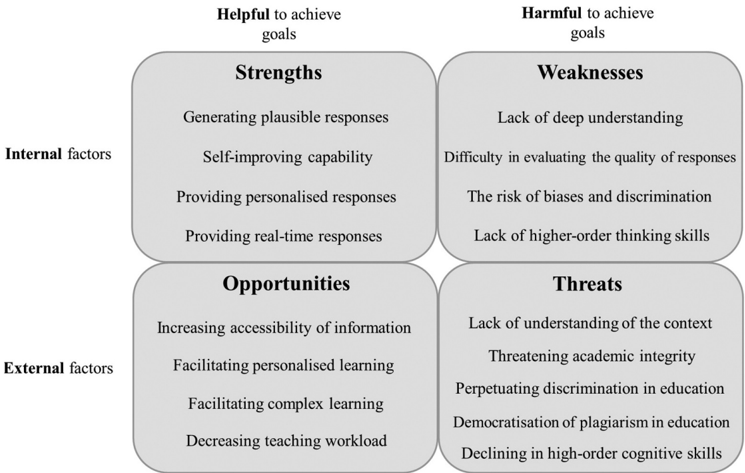
ChatGPT is an AI tool that has sparked debates about its potential implications for education. We used the SWOT analysis framework to outline ChatGPT’s strengths and weaknesses and to discuss its opportunities for and threats to education. The strengths include using a sophisticated natural language model to generate plausible answers, self-improving capability, and providing personalised and real-time responses. As such, ChatGPT can increase access to information, facilitate personalised and complex learning, and decrease teaching workload, thereby making key processes and tasks more efficient. The weaknesses are a lack of deep understanding, difficulty in evaluating the quality of responses, a risk of bias and discrimination, and a lack of higher-order thinking skills. Threats to education include a lack of understanding of the context, threatening academic integrity, perpetuating discrimination in education, democratising plagiarism, and declining high-order cognitive skills. We provide agenda for educational practice and research in times of ChatGPT.
Overview
The claims and statistics of this paper haven’t been checked yet.
Free: it reads the open-access text and checks the first 5 claims that cite a source we can check. Create a free account to check every claim.
Integrity signals
Registry
Cites
Statistics
Figures


Verification
Claims the paper makes
The claims and statistics of this paper haven’t been checked yet.
Free: it reads the open-access text and checks the first 5 claims that cite a source we can check. Create a free account to check every claim.
Claims other papers make about this one
Each is checked against this paper’s own text: does it say what the citing paper says it does?
The source backs part of the claim, not all of it — or backs it for a different population, condition or comparison.
In the citing paper
“Farrokhnia et al. [14] have demonstrated that employing GenAI tools might undermine advanced cognitive capabilities, such as critical and analytical thinking.”
From The Mediating Role of Generative AI Self-Regulation on Students’ Critical Thinking and Problem-Solving (2024) · cites this paper as [14]
Experimental — accuracy not yet measuredThe source backs part of the claim, not all of it — or backs it for a different population, condition or comparison.
In the citing paper
“A possible explanation for this discrepancy lies in the ambiguity surrounding what constitutes plagiarism when using AI-generated content.”
From Chat or cheat? Academic dishonesty, risk perceptions, and ChatGPT usage in higher education students (2025) · cites this paper as Farrokhnia et al., 2023
Experimental — accuracy not yet measuredThe source backs part of the claim, not all of it — or backs it for a different population, condition or comparison.
In the citing paper
“Student perceptions of academic dishonesty have historically been unclear or incomprehensive, and rarely align with teacher expectations (Tatum, 2022), GenAI will only serve to complicate this (Farrokhnia et al., 2023).”
From Not quite eye to A.I.: student and teacher perspectives on the use of generative artificial intelligence in the writing process (2023) · cites this paper as Farrokhnia et al., 2023
Experimental — accuracy not yet measuredThe cited source says what the claim attributes to it.
In the citing paper
“some students may not perceive their use as a policy violation and may unintentionally commit AIgiarism, as its outputs are not verbatim copies of existing texts”
From Chat or cheat? Academic dishonesty, risk perceptions, and ChatGPT usage in higher education students (2025) · cites this paper as Farrokhnia et al., 2023
In the citing paper
“This is echoed in the literature as findings suggest that ChatGPT can provide personalized feedback on essays and become a tutoring system by stimulating critical thinking and debates among students [13].”
From Challenges and Opportunities of Generative AI for Higher Education as Explained by ChatGPT (2023) · cites this paper as [13]
3 more claims about this paper
Create a free account to see every claim other papers make about this one.
Self-check
Percentages, sums and reported differences re-computed from the paper’s own numbers.
The self-check needs the paper’s full text.
Citations
Cites
ChatGPT for good? On opportunities and challenges of large language models for education
Kasneci, E., Sessler, K., Küchemann, S., Bannert, M., Dementieva, D., Fischer, F., Gasser, U., Groh, G., Günnemann, S., Hüllermeier, E., et al. (2023) · Learning and Individual Differences · doi:10.1016/j.lindif.2023.102274 · Cited by 15,365 · cited 3×
“ChatGPT’s superior performance is largely attributed to its massive amount of training data (Kasneci et al., 2023), enabling it to capture a wide range of linguistic patterns and relationships, thereby providing a fair understanding of language and context (Lecler et al., 2023; Wang et al., 2023).”
BackgroundMethodChatGPT for Good? On Opportunities and Challenges of Large Language Models for Education
Kasneci, E., Seßler, K., Küchemann, S., Bannert, M., Dementieva, D., Fischer, F., Gasser, U., Groh, G., Günnemann, S., Hüllermeier, E., et al. (2023) · doi:10.35542/osf.io/5er8f · Cited by 7,552
Best-worst multi-criteria decision-making method
Rezaei, J. (2015) · Omega · doi:10.1016/j.omega.2014.11.009 · Cited by 4,333 · cited 1×
“Therefore, empirical studies with quantitative approaches such as the best-worst method (see Rezaei, 2015) are necessary to extend the current review findings.”
BackgroundKung, T. H., Cheatham, M., ChatGPT, Medenilla, A., Sillos, C., De Leon, L., Elepaño, C., Madriaga, M., Aggabao, R., Diaz-Candido, G., et al. (2022) · doi:10.1101/2022.12.19.22283643 · Cited by 4,115
Kung, T. H., Cheatham, M., Medenilla, A., Sillos, C., De Leon, L., Elepaño, C., Madriaga, M., Aggabao, R., Diaz-Candido, G., Maningo, J., et al. (2023) · PLOS Digital Health · doi:10.1371/journal.pdig.0000198 · Cited by 4,115 · cited 1×
“It is also shown that ChatGPT has the potential to respond sufficiently to exam questions in the fields of medical (Kung et al., 2022) and law (Choi et al., 2023).”
BackgroundSallam, M. (2023) · Healthcare · doi:10.3390/healthcare11060887 · Cited by 3,126
Chatting and cheating: Ensuring academic integrity in the era of ChatGPT
Cotton, D. R. E., Cotton, P. A., & Shipway, J. R. (2024) · Innovations in Education and Teaching International · doi:10.1080/14703297.2023.2190148 · Cited by 3,087 · cited 5×
“…some scholars are concerned about the ethical considerations of ChatGPT (Mhlanga, 2023), as well as its potential negative effects on assessment practices (Rudolph et al., 2023), scientific integrity (Cotton et al., 2023; Shiri, 2023), and students’ higher-order thinking skills (Susnjak, 2022).”
BackgroundMethodInfluentialChatting and Cheating. Ensuring academic integrity in the era of ChatGPT
Cotton, D., Cotton, P., & Shipway, J. R. (2023) · doi:10.35542/osf.io/mrz8h · Cited by 3,079
Doyle, T. (2017) · The Information Society · doi:10.1080/01972243.2017.1354593 · Cited by 3,071 · cited 1×
“AI algorithms can also perpetuate discrimination by focusing on objectives like profits and efficiency without considering unintended consequences such as reinforcing existing biases (O’neil, 2017).”
Background
Research works printed but not linked: 1
- Haque, M. U., Dharmadasa, I., Sworna, Z. T., Rajapakse, R. N., & Ahmad, H. (2022). 'I think this is the most disruptive technology': Exploring sentiments of ChatGPT early adopters using Twitter data. arXiv. https://doi.org/10.48550/arXiv.2303.03836 . · arXiv · doi:10.48550/arxiv.2303.03836 · Paper page
Cited by
Items 101–200 of 1,006
Joshi, I., Budhiraja, R., Dev, H., Kadia, J., Ataullah, M. O., Mitra, S., Akolekar, H. D., & Kumar, D. (2024) · Proceedings of the 55th ACM Technical Symposium on Computer Science Education V. 1 · doi:10.1145/3626252.3630803 · Cited by 58
“As shown by [8], ChatGPT’s strength lies in generating contextually sensitive responses.”
BackgroundRahman, A., Raj, A., Tomy, P., & Hameed, M. S. (2024) · Artificial Intelligence Review · doi:10.1007/s10462-023-10643-9 · Cited by 135
“Artificial Intelligence (AI) holds a pivotal role in rebuilding our society and ‘promising a new era’ in prospective times for its capabilities to act as intelligent beings in various domains including education (Farrokhnia et al. 2023; Górriz et al. 2020).”
Online peer feedback in higher education: A synthesis of the literature
Kerman, N. T., Banihashem, S. K., Karami, M., Er, E., van Ginkel, S., & Noroozi, O. (2024) · Education and Information Technologies · doi:10.1007/s10639-023-12273-8 · Cited by 109
Self-citationChatGPT: The brightest student in the class
Vázquez-Cano, E., Ramírez-Hurtado, J. M., Sáez-López, J. M., & López-Meneses, E. (2023) · Thinking Skills and Creativity · doi:10.1016/j.tsc.2023.101380 · Cited by 84
Jo, H. (2025) · Information Development · doi:10.1177/02666669231202764 · Cited by 84
“One such AI chatbot, garnering signi fi cant attention from researchers, educators, and students alike, is ChatGPT, developed by OpenAI (Farrokhnia et al., 2023; Lund et al., 2023).”
Liang, W., & Wu, Y. (2024) · Thinking Skills and Creativity · doi:10.1016/j.tsc.2024.101645 · Cited by 116
Analyzing ChatGPT adoption drivers with the TOEK framework
Jo, H., & Bang, Y. (2023) · Scientific Reports · doi:10.1038/s41598-023-49710-0 · Cited by 83
“Organizational culture has been found to impact technology adoption in various settings, including educational institutions 32–34 .”
BackgroundŞova, R., Tudor, C. D., Tartavulea, C. V., & Dieaconescu, R. I. (2024) · Electronics · doi:10.3390/electronics13183632 · Cited by 116
“[16] identified limitations that could lead to inaccurate results, such as a lack of deep understanding of the text it processes and difficulty in evaluating the quality of responses.”
InfluentialRezai, A., Namaziandost, E., & Hwang, G. (2024) · Computers in Human Behavior Reports · doi:10.1016/j.chbr.2024.100510 · Cited by 106
Adapting to the Future: ChatGPT as a Means for Supporting Constructivist Learning Environments
Kim, M., & Adlof, L. (2024) · TechTrends · doi:10.1007/s11528-023-00899-x · Cited by 97
“Some have credited this text-generator with the potential to improve productivity and student outcomes (Adiguzel et al., 2023; Farrokhnia et al., 2023; Kasneci et al., 2023), while others have warned against ChatGPT’s limitations regarding misinformation and educators’ concerns over academic…”
InfluentialExploring the impact of language models, such as ChatGPT , on student learning and assessment
Zirar, A. (2023) · Review of Education · doi:10.1002/rev3.3433 · Cited by 69
ChatGPT: A brief narrative review
Gupta, B., Mufti, T., Sohail, S. S., & Madsen, D. Ø. (2023) · Cogent Business & Management · doi:10.1080/23311975.2023.2275851 · Cited by 108
“Many of the studies have looked at ChatGPT’s impact and implications in education (Farrokhnia et al., 2023; Zhai, 2022), business (George & George, 2023; Korzynski et al., 2023) or in the healthcare sector (Li et al., 2023; Sallam, 2023).”
BackgroundMethodBukar, U. A., Sayeed, M. S., Fatimah Abdul Razak, S., Yogarayan, S., & Sneesl, R. (2024) · IEEE Access · doi:10.1109/access.2024.3425172 · Cited by 69
Jing, Y., Wang, H., Chen, X., & Wang, C. (2024) · Humanities and Social Sciences Communications · doi:10.1057/s41599-024-02751-w · Cited by 73
Mohammadkarimi, E. (2023) · Journal of Applied Learning and Teaching · doi:10.37074/jalt.2023.6.2.10 · Cited by 90
“Teachers may struggle to distinguish between genuine effort and fraud as a consequence of learners’ capacity to adapt AI-generated content to seem as if it was their original work (Farrokhnia et al., 2023; Sullivan et al., 2023).”
BackgroundUsing ChatGPT in Education: Human Reflection on ChatGPT’s Self-Reflection
Loos, E., Gröpler, J., & Goudeau, M.-L. S. (2023) · Societies · doi:10.3390/soc13080196 · Cited by 64
“We agree with [22] that the “lack of deep understanding, difficulty in evaluating the quality of responses, the risk of biases and discrimination, lack of higher-order thinking skills” (pp. 6 –7) (weaknesses) and “lack of understanding of the context, threatening academic integrity, perpetuating…”
InfluentialMeron, Y., & Tekmen Araci, Y. (2023) · Design Science · doi:10.1017/dsj.2023.28 · Cited by 74
“This supports what Farrokhnia et al. (2023) argue is a weakness of ChatGPT: its apparent difficulty in evaluating the quality of responses and lack of higher-order thinking.”
BackgroundResultKöhler, C., & Hartig, J. (2024) · Contemporary Educational Technology · doi:10.30935/cedtech/15144 · Cited by 96
Kim, Y., Lee, J., Kim, S., Park, J., & Kim, J. (2024) · Proceedings of the 29th International Conference on Intelligent User Interfaces · doi:10.1145/3640543.3645148 · Cited by 55
Mo, Z., & Crosthwaite, P. R. (2025) · Journal of English for Academic Purposes · doi:10.1016/j.jeap.2025.101499 · Cited by 111
Revolutionizing Language Learning: How ChatGPT and AI are changing the Way We Learn Languages
Solak, E. (2024) · International Journal of Technology in Education · doi:10.46328/ijte.732 · Cited by 47
“Farrokhnia et al. (2023) used the SWOT analysis framework to discuss ChatGPT's advantages, disadvantages, potential, and threats to education.”
MethodExploring EFL students’ prompt engineering in human–AI story writing: an activity theory perspective
Woo, D. J., Guo, K., & Susanto, H. (2024) · Interactive Learning Environments · doi:10.1080/10494820.2024.2361381 · Cited by 92
“If not, students may develop an over-reliance on unethical use cases of NLG tools, such as using NLG text to replace human e ff ort in writing, not least threatening academic integrity and inhibiting the development of students ’ own higher-order cognitive skills (Farrokhnia et al., 2024).”
Generative AI in education: ChatGPT-4 in evaluating students’ written responses
Jauhiainen, J. S., & Guerra, A. G. (2024) · Innovations in Education and Teaching International · doi:10.1080/14703297.2024.2422337 · Cited by 104
“However, the vast majority of articles discuss about the potential of ChatGPT rather than testing and using it in educational contexts (Adiguzel et al., 2023; Baidoo-Anu & Owusu Ansah, 2023; Farrokhnia et al., 2023; Jeon & Lee, 2023; Lo, 2023; Su & Yang, 2023; Yu & Guo, 2023).”
InfluentialRETRACTED: The impact of generative AI on essay revisions and student engagement
Lo, N., Wong, A., & Chan, S. (2025) · Computers and Education Open · doi:10.1016/j.caeo.2025.100249 · Cited by 97
RetractedA Systematic Review of Generative AI and (English Medium Instruction) Higher Education
Bannister, P., Santamaría-Urbieta, A., & Alcalde-Peñalver, E. (2023) · Aula Abierta · doi:10.17811/rifie.52.4.2023.401-409 · Cited by 48
“Several publications were identified that looked into student perceptions of GenAI, which included Abdelwahab et al. (2023), Banihashem et al. (2023), and Martín-Ramallal et al. (2022).”
BackgroundMethodGenerative Artificial Intelligence and Language Teaching
Moorhouse, B. L., & Wong, K. M. (2025) · doi:10.1017/9781009618823 · Cited by 64
Current status of ChatGPT use in medical education: potentials, challenges, and strategies
Xu, T., Weng, H., Liu, F., Yang, L., Luo, Y., Ding, Z., & Wang, Q. (2024) · Journal of Medical Internet Research · doi:10.2196/57896 · Cited by 84
“The ultimate goal is to empower students to transition from mere questioners to creators and decision makers [56].”
Students' Perception of ChatGPT Usage in Education
Valova, I., Mladenova, T., & Kanev, G. (2024) · International Journal of Advanced Computer Science and Applications · doi:10.14569/ijacsa.2024.0150143 · Cited by 56
“The detailed analysis of the possibilities and limitations of ChatGPT made in [13, 14] shows that the use of this technology has great potential for application in the field of education, but it also comes with quite a few limitations and challenges.”
BackgroundRodger, D., Mann, S. P., Earp, B., Savulescu, J., Bobier, C., & Blackshaw, B. P. (2025) · Nurse Education in Practice · doi:10.1016/j.nepr.2025.104461 · Cited by 64
“While some of these approaches can still be partially bypassed by GenAI use, they create a framework where successful bypassing would require developing exactly the kind of critical engagement we should aim to foster (Farrokhnia et al., 2024; Xu et al., 2024).”
Enhancing academic integrity among students in GenAI Era:A holistic framework
Rasul, T., Nair, S., Kalendra, D., Balaji, M. S., Santini, F. D. O., Ladeira, W. J., Rather, R. A., Yasin, N., Rodriguez, R. V., Kokkalis, P., et al. (2024) · The International Journal of Management Education · doi:10.1016/j.ijme.2024.101041 · Cited by 82
Generative artificial intelligence in academic writing in higher education: A systematic review
Chanpradit, T. (2025) · Edelweiss Applied Science and Technology · doi:10.55214/25768484.v9i4.6128 · Cited by 96
“In addition, over-reliance on AI tools can impede the development of critical thinking and analytical skills through reducing students’ engagement with the learning process, limiting their ability to generate original ideas and effectively solve problems [30].”
Gupta, P., Mahajan, R., Badhera, U., & Kushwaha, P. S. (2024) · The International Journal of Management Education · doi:10.1016/j.ijme.2024.101017 · Cited by 101
Chat or cheat? Academic dishonesty, risk perceptions, and ChatGPT usage in higher education students
Ortiz-Bonnin, S., & Blahopoulou, J. (2025) · Social Psychology of Education · doi:10.1007/s11218-025-10080-2 · Cited by 80
“Farrokhnia et al. ( 2023 ) caution that, since ChatGPT’s responses are not direct reproductions of existing texts, some students may use them unknowingly, without realizing they are committing a form of plagiarism.”
InfluentialNelson, A. S., Santamaría, P. V., Javens, J. S., & Ricaurte, M. (2025) · Education Sciences · doi:10.3390/educsci15050611 · Cited by 79
ChatGPT and AI in the Universities: An Introduction to the Near Future
Rezaev, A. V., & Трегубова, Н. Д. (2023) · Высшее образование в России · doi:10.31992/0869-3617-2023-32-6-19-37 · Cited by 101
Pörn, R., Braskén, M., Wingren, M., & Andersson, S. (2024) · LUMAT International Journal on Math Science and Technology Education · doi:10.31129/lumat.12.3.2102 · Cited by 91
“Instead of AI only providing potential useful features, such as individualized learning, more troublesome aspects of AI suddenly seem much more plausible to the public, like job market disruptions and the efficient spreading of misinformation (Farrokhnia et al., 2023).”
BackgroundMooney, P., Cui, W., Guan, B., & Juhász, L. (2023) · ACM SIGSPATIAL International Workshop on AI for Geographic Knowledge Discovery (GeoAI) · doi:10.1145/3615886.3627745 · Cited by 102
Qazi, S., Kadri, M. B., Naveed, M., Khawaja, B. A., Khan, S. Z., Alam, M. M., & Su’ud, M. M. (2024) · Computers, materials & continua/Computers, materials & continua (Print) · doi:10.32604/cmc.2024.048893 · Cited by 101
Application of ChatGPT in Higher Education and Research – A Futuristic Analysis
Aithal, P. S., & Aithal, S. (2023) · International Journal of Applied Engineering and Management Letters · doi:10.47992/ijaeml.2581.7000.0193 · Cited by 94
Liu, J., Li, S., & Dong, Q. (2024) · Journal of Educational Computing Research · doi:10.1177/07356331241242441 · Cited by 60
“For instance, it offers opportunities for communication and writing practice, enhances peer communication skills, helps identify gaps in understanding speci fi c topics, and provides personalized preferences and hints based on individual learning (Farrokhnia et al., 2023).”
Jiang, J., Vetter, M. A., & Lucia, B. (2024) · Postdigital Science and Education · doi:10.1007/s42438-024-00477-1 · Cited by 83
“Although research on AI literacy is still nascent, there is an emerging body of knowledge from communication, technology policy, and computer science fields (AlAfnan et al. 2023; Baidoo-Anu et al. 2023; Cardona et al. 2023; Farrokhnia et al. 2023; Larsson 2020).”
Saihi, A., Ben-Daya, M., Hariga, M., & As'ad, R. (2024) · Computers and Education: Artificial Intelligence · doi:10.1016/j.caeai.2024.100274 · Cited by 75
ChatGPT and ELT: Exploring Teachers’ Voices
Mabuan, R. A. (2024) · International Journal of Technology in Education · doi:10.46328/ijte.523 · Cited by 75
Wang, C., Chen, X., Hu, Z., Jin, S., & Gu, X. (2025) · Journal of Computer Assisted Learning · doi:10.1111/jcal.13117 · Cited by 77
Lademann, J., Henze, J., & Becker, S. (2025) · Physical Review Physics Education Research · doi:10.1103/physrevphyseducres.21.010147 · Cited by 89
Putra, F. W., Rangka, I. B., Aminah, S., & Aditama, M. H. R. (2023) · Journal of Public Health · doi:10.1093/pubmed/fdad120 · Cited by 59
Li, H., Wang, Y., Luo, S., & Huang, C. (2025) · Journal of Asian Public Policy · doi:10.1080/17516234.2024.2363128 · Cited by 60
“…have highlighted the significant potential of large language models in various writing tasks, such as facilitating idea generation (Atlas, 2023), providing mentorship to enhance students’ writing skills (Farrokhnia et al., 2023), and assisting in editing and assessment (Mizumoto & Eguchi, 2023).”
ChatGPT in Education: A Systematic Review on Opportunities, Challenges, and Future Directions
Munaye, Y. Y., Admass, W., Belayneh, Y., Molla, A., & Asmare, M. (2025) · Algorithms · doi:10.3390/a18060352 · Cited by 73
“…to its ability to generate human-like text, assist in tutoring, content creation, and interactive discussions, and support students and educators in diverse learning environments [1] with significant benefits, including personalized learning, automated assessments, and administrative efficiency.”
Effects of AI-Based ChatGPT on Higher Education Libraries
Aithal, S., & Aithal, P. S. (2023) · International Journal of Management, Technology, and Social Sciences · doi:10.47992/ijmts.2581.6012.0272 · Cited by 47
Denecke, K., Glauser, R., & Reichenpfader, D. (2023) · Trends in Higher Education · doi:10.3390/higheredu2040039 · Cited by 89
Potential Benefits and Risks of Artificial Intelligence in Education
Özer, M. (2024) · Bartın University Journal of Faculty of Education · doi:10.14686/buefad.1416087 · Cited by 98
“New approaches are needed to assess and evaluate efforts accurately and determine the contribution of these systems to student performance (Farrokhnia et al., 2023; Lo, 2023; Rudolph et al., 2023; Tili et al., 2023).”
BackgroundMethodAsad, M. M., & Ajaz, A. (2024) · International Journal of Information and Learning Technology · doi:10.1108/ijilt-06-2024-0103 · Cited by 87
Pedagogical framework for hybrid intelligent feedback
Banihashem, S. K., Noroozi, O., Khosravi, H., Schunn, C. D., & Drachsler, H. (2025) · Innovations in Education and Teaching International · doi:10.1080/14703297.2025.2499174 · Cited by 55
Self-citationDaniel, K., Msambwa, M. M., & Wen, Z. (2025) · European Journal of Education · doi:10.1111/ejed.70036 · Cited by 71
Students' reflections on their experience with ChatGPT
Šedlbauer, J., Činčera, J., Slavík, M., & Hartlová, A. (2024) · Journal of Computer Assisted Learning · doi:10.1111/jcal.12967 · Cited by 71
Rahimi, A. R., & Sevilla‐Pavón, A. (2024) · Computers and Education Artificial Intelligence · doi:10.1016/j.caeai.2024.100258 · Cited by 81
GenAI-Infused Adult Learning in the Digital Era: A Conceptual Framework for Higher Education
Adarkwah, M. A. (2024) · Adult Learning · doi:10.1177/10451595241271161 · Cited by 86
Abdelhalim, S. M. (2024) · Journal of Computer Assisted Learning · doi:10.1111/jcal.12948 · Cited by 69
Perceptions of Higher Education Students towards ChatGPT Usage
Das, S. R., & J.V., M. (2024) · International Journal of Technology in Education · doi:10.46328/ijte.583 · Cited by 69
“Other limitations include a lack of contextual understanding and limited depth of comprehension (Farrokhnia et al., 2023; Rahman and Watanobe, 2023).”
BackgroundThe Potentials of ChatGPT for Language Learning: Unpacking its Benefits and Limitations
Nugroho, A., Putro, N. H. P. S., & Syamsi, K. (2023) · Register Journal · doi:10.18326/register.v16i2.224-247 · Cited by 87
“Serving as a virtual assistant, ChatGPT interacts with users, addressing inquiries like an actual person would (Farrokhnia et al., 2023).”
BackgroundThe effect of chatbots on learning: a meta-analysis of empirical research
Alemdag, E. (2025) · Journal of Research on Technology in Education · doi:10.1080/15391523.2023.2255698 · Cited by 67
“…interact with chatbots, receive immediate help and guidance, obtain personalized learning content based on their characteristics, and improve their learning performance and motivation (Farrokhnia et al., 2023; Hsu et al., 2023; Huang et al., 2022; Okonkwo & Ade-Ibijola, 2021; Wollny et al., 2021).”
InfluentialStrengths, Weaknesses, Opportunities, and Threats of Using ChatGPT in Scientific Research
Giray, L., Jacob, J., & Gumalin, D. L. (2024) · International Journal of Technology in Education · doi:10.46328/ijte.618 · Cited by 44
Li, Y., Song, Y., Sun, Y., & Zeng, M. (2024) · Technology in Society · doi:10.1016/j.techsoc.2024.102518 · Cited by 73
Seyri, H., & Ghiasvand, F. (2025) · Computers and Education Open · doi:10.1016/j.caeo.2025.100264 · Cited by 73
Generative AI in Education: Mapping the Research Landscape Through Bibliometric Analysis
Ng, S. L., & Ho, C. (2025) · Information · doi:10.3390/info16080657 · Cited by 81
Perera, P., & Lankathilake, M. (2023) · Journal of Advances in Education and Philosophy · doi:10.36348/jaep.2023.v07i08.001 · Cited by 66
The Content Analysis of the Lesson Plans Created by ChatGPT and Google Gemini
Baytak, A. (2024) · Research in Social Sciences and Technology · doi:10.46303/ressat.2024.19 · Cited by 86
Nazari, M., & Saadi, G. (2024) · Discover Education · doi:10.1007/s44217-024-00122-w · Cited by 69
Mehdaoui, A. (2024) · Futurity Education · doi:10.57125/fed.2024.12.25.06 · Cited by 90
“…2023; Hartmann et al., 2023; Sabzalieva & Valentini, 2023), over-reliance that could hinder critical thinking skills and promote academic laziness (Farrokhnia et al., 2023; Kasneci et al., 2023; Rasul et al., 2023; Yan, 2023), and difficulties in ensuring fair and accurate assessment when…”
BackgroundIsiaku, L., Muhammad, A. S., Kefas, H. I., & Ukaegbu, F. C. (2024) · Quality Education for All · doi:10.1108/qea-07-2024-0055 · Cited by 82
Heine, S., & König, J. (2025) · European Journal of Teacher Education · doi:10.1080/02619768.2025.2540791 · Cited by 78
“Some considered that ChatGPT’s release in November 2022 jeopardised creativity and critical thinking (e.g. Farrokhnia et al. 2023).”
InfluentialEmerging Research and Policy Themes on Academic Integrity in the Age of Chat GPT and Generative AI
Plata, S., De Guzman, M. A., & Quesada, A. (2023) · Asian Journal of University Education · doi:10.24191/ajue.v19i4.24697 · Cited by 65
Mamo, Y., Crompton, H., Burke, D., & Nickel, C. (2024) · TechTrends · doi:10.1007/s11528-024-00954-1 · Cited by 65
“Large language models (LLMs), such as ChatGPT, can perpetuate and amplify existing biases and unfairness in society (Farrokhnia et al., 2023).”
Ma, T. (2024) · Computers and Education Artificial Intelligence · doi:10.1016/j.caeai.2024.100336 · Cited by 81
Artificial intelligence in science and chemistry education: a systematic review
Erümit, A. K., & Sarıalioğlu, R. Ö. (2025) · Discover Education · doi:10.1007/s44217-025-00622-3 · Cited by 78
“Farrokhnia et al. [15] state that ChatGPT produces responses based on the datasets it was trained on and cannot provide individual feedback to students.”
Creative Use of OpenAI in Education: Case Studies from Game Development
French, F., Levi, D., Maczo, C., Simonaityte, A., Triantafyllidis, S., & Varda, G. (2023) · Multimodal Technologies and Interaction · doi:10.3390/mti7080081 · Cited by 64
“[4] also highlight some of the strengths and opportunities of AI in their S.”
BackgroundPlacebo or Assistant? Generative AI Between Externalization and Anthropomorphization
Skulmowski, A. (2024) · Educational Psychology Review · doi:10.1007/s10648-024-09894-x · Cited by 43
“…an unprecedented potential for the automatization of highly complex tasks, the literature contains various hypotheses concerning the effects of AI use in educational contexts (e.g., Bai et al., 2023; Farrokhnia et al., 2023; Gill & Kaur, 2023; Kasneci et al., 2023; Lee, 2023; Skulmowski, 2023).”
A systematic review of the key components of online peer feedback practices in higher education
Gao, X., Noroozi, O., Gulikers, J., Biemans, H. J. A., & Banihashem, S. K. (2024) · Educational Research Review · doi:10.1016/j.edurev.2023.100588 · Cited by 61
Self-citationPotentials of ChatGPT in Computer Programming: Insights from Programming Instructors
Husain, A. (2024) · Journal of Information Technology Education: Research · doi:10.28945/5240 · Cited by 38
“Farrokhnia et al. (2023) use the SWOT analysis to outline the strengths and weaknesses of ChatGPT and discuss its opportunities for and threats to education.”
MethodDesigning a course for pre-service science teachers using ChatGPT: what ChatGPT brings to the table
Okulu, H. Z., & Muslu, N. (2024) · Interactive Learning Environments · doi:10.1080/10494820.2024.2322462 · Cited by 50
“For instance, as our study demonstrated, ChatGPT struggled to comprehend complex prompts, as evidenced by C. Zhu et al. ’ s (2023) study; this stems from a lack of deep understanding and critical thinking skills in ChatGPT (Farrokhnia et al., 2023).”
Xiao, Y., Zhang, T., & He, J. (2024) · Heliyon · doi:10.1016/j.heliyon.2024.e37238 · Cited by 64
“Another instance is the application of “ ChatGPT," which has been utilized in educational settings to facilitate English language learning, including vocabulary acquisition and pronunciation practice [15].”
BackgroundRetractedExploring prompt pattern for generative artificial intelligence in automatic question generation
Wang, L., Song, R., Guo, W., & Yang, H. (2024) · Interactive Learning Environments · doi:10.1080/10494820.2024.2412082 · Cited by 70
“Notably, in December 2022, OpenAI released an LLM called ChatGPT (Chat Generative Pre-trained Transformer) to the public, attracting over a million sub-scribers within its inaugural week (Farrokhnia et al., 2023).”
Exploring the Role of Generative AI in Collaborative Lesson Planning for Pre‐Service Teachers
Sun, Y., & Huang, Y. (2025) · Journal of Computer Assisted Learning · doi:10.1111/jcal.70098 · Cited by 66
Lozano, A., & Blanco Fontao, C. (2023) · Education Sciences · doi:10.3390/educsci13070733 · Cited by 60
“With respect to access and use, the positive results are in agreement with other studies where it has been shown that the student perceives greater ease of access and use of ChatGPT through different technological platforms such as computers, tablets, or cell phones, which increases accessibility to information [18].”
BackgroundResultInfluentialHassija, V., Chakrabarti, A., Singh, A., Chamola, V., & Sikdar, B. (2023) · IEEE Access · doi:10.1109/access.2023.3339553 · Cited by 68
“It often forgets past information, leading to inconsistencies or repetition since it views each input independently, without a conversation history [184].”
BackgroundFokides, E., & Peristeraki, E. (2024) · Education and Information Technologies · doi:10.1007/s10639-024-12912-8 · Cited by 74
“There is a vigorous debate centered on the potential of AI to facilitate cheating and plagiarism among students (e.g., Dehouche, 2021; Farrokhnia et al., 2023), necessitating a reconsideration of the educational paradigm.”
Weng, X., Gu, M. M., Xia, Q., & Chiu, T. K. F. (2025) · Thinking Skills and Creativity · doi:10.1016/j.tsc.2025.101763 · Cited by 65
Strategic view on the current role of AI in advancing environmental sustainability: a SWOT analysis
Greif, L., Kimmig, A., Bobbou, S. E., Jurisch, P., & Ovtcharova, J. (2024) · Discover Artificial Intelligence · doi:10.1007/s44163-024-00146-z · Cited by 66
“…of workflows using machine learning in the oil and gas industry, emphasizing the importance of strategic focus and collaboration [36], and the implications of the AI tool ChatGPT, for education, revealing both the immense potential and the accompanying risks of AI in educational settings [37].”
Shen, Y., & Guo, H. (2024) · Computers in Human Behavior · doi:10.1016/j.chb.2024.108429 · Cited by 57
How Can ChatGPT Facilitate Teaching and Learning: Implications for Contemporary Education
Karaköse, T., & Tülübaş, T. (2023) · Educational Process International Journal · doi:10.22521/edupij.2023.124.1 · Cited by 81
Effects of ChatGPT use on undergraduate students’ creativity: a threat to creative thinking?
Toma, R. B., & Yánez‐Pérez, I. (2024) · Discover Artificial Intelligence · doi:10.1007/s44163-024-00172-x · Cited by 68
“Based on extant literature [2, 6, 15], this study tested the hypothesis that the use of ChatGPT would decrease creativity levels.”
Potential Societal Biases of ChatGPT in Higher Education: A Scoping Review
Li, M., Enkhtur, A., Yamamoto, B. A., Cheng, F., & Chen, L. (2025) · Open Praxis · doi:10.55982/openpraxis.17.1.750 · Cited by 65
Empowering learners with ChatGPT: insights from a systematic literature exploration
Mohebi, L. (2024) · Discover Education · doi:10.1007/s44217-024-00120-y · Cited by 56
“Drawing on the findings of studies such as Spennemann [15] and Farrokhnia et al. [16], the research will dissect the complexities and potential pitfalls associated with such an integration.”
Exploring the potential of AI-Chatbots in organic chemistry: An assessment of ChatGPT and Bard
Hallal, K., Hamdan, R., & Tlais, S. (2023) · Computers and Education: Artificial Intelligence · doi:10.1016/j.caeai.2023.100170 · Cited by 37
Prompt: ChatGPT, Create My Course, Please!
Davis, R. O., & Lee, Y. (2023) · Education Sciences · doi:10.3390/educsci14010024 · Cited by 56
A Bibliometric Analysis of Research on ChatGPT in Education
Polat, H., Topuz, A. C., Yıldız, M., Taşlıbeyaz, E., & Kurşun, E. (2024) · International Journal of Technology in Education · doi:10.46328/ijte.606 · Cited by 35
“Artificial Intelligence (AI) applications exhibit substantial potential for enhancing both the pedagogical and instructional aspects of education (Farrokhnia et al., 2023; Xia et al., 2022).”
BackgroundAlmenara, J. C., Palacios‐Rodríguez, A., Guzmán, H. D. L. Á. R., & Scagliusi, M. V. F. (2025) · Applied Sciences · doi:10.3390/app15063363 · Cited by 57
Underground hydrogen storage in geological formations: A review
Mwakipunda, G. C., Kouassi, A. K. F., Ayimadu, E. T., Komba, N. A., Nadege, M. N., Mgimba, M. M., Ngata, M. R., & Yu, L. (2025) · Journal of Rock Mechanics and Geotechnical Engineering · doi:10.1016/j.jrmge.2025.02.014 · Cited by 68
Abdallah, N., Katmah, R., Khalaf, K., & Jelinek, H. F. (2025) · Social Sciences & Humanities Open · doi:10.1016/j.ssaho.2025.101866 · Cited by 55
Choi, W. (2023) · BMC Medical Education · doi:10.1186/s12909-023-04832-x · Cited by 48
“Artificial intelligence (AI) technology has the potential to revolutionize education [35], offering personalized virtual assistants and adaptive learning experiences for every student [31, 36, 37].”
Background
Metadata
- Authors
- Farrokhnia, M., Banihashem, S. K., Noroozi, O., & Wals, A.
- Affiliations
- Wageningen University & Research (NL)
- Open University of the Netherlands (NL)
- Corresponding author
- Noroozi, Omid
- Venue
- Innovations in Education and Teaching International
- Publisher
- Informa UK Limited
- Published
- 2023-03-27
- Volume
- 61
- Issue
- 3
- Pages
- 460-474
- ISSN
- 1470-3297 (ISSN-L)
- 1470-3300
- OpenAlex
- W4361204578
- Semantic Scholar
- e9685cf2c9aff2f7ff7bcfa5b65a11e90687a3ef
- Cited by
- 1,384
- References
- 68
- Citations by year
- 2026: 359 · 2025: 456 · 2024: 396 · 2023: 173
- FWCI
- 324.80
- Type
- journal article
- Language
- en
- Open access
- hybrid
- doi.org
- Licence
- Locations
- Innovations in Education and Teaching International (publishedVersion, cc-by-nc-nd)
- Socio-Environmental Systems Modeling (submittedVersion, cc-by-nc-nd)
- DSpace (Open University in the Netherlands) (submittedVersion, cc-by-nc-nd)
- Data Archiving and Networked Services (DANS) (submittedVersion, other-oa)
- Topics
- Social Sciences › Education › Artificial Intelligence in Education
- Health Sciences › Medicine › Health Informatics › Artificial Intelligence in Healthcare and Education
- Social Sciences › Education › Educational Technology in Learning
- Keywords
- ChatGPT, large language models, artificial intelligence in education, academic integrity, plagiarism, algorithmic bias, higher-order thinking skills, personalized learning, teacher workload, SWOT analysis
About these checks
Registry, retraction, Cites and statistics results are computed, not judged, with one exception: a printed reference that no index lists is read once by a model before it counts as a citation error. Claims are extracted by a model and kept only when their quote appears verbatim in the text; each cited source is then checked, with a model’s help, for whether it says what the claim relies on. Those verdicts can be wrong — read the claim’s quote and the cited source before relying on one.
Statistics and arithmetic are recomputed, not judged.
Confidence bands are shown only for fields calibrated on our annotated test set. None is calibrated yet, so no band is shown.
What counts as a claim ›How we measure confidence ›How we check this ›
Are you an author, or do you see a problem with this page? Request a review
Data sources
Bibliographic data: Semantic Scholar, OpenAlex, Crossref.
Contains information from the Semantic Scholar Academic Graph Datasets, made available under the ODC Attribution License (ODC-BY 1.0).
Semantic Scholar’s data is described in: Kinney, R., et al. (2023). The Semantic Scholar Open Data Platform. arXiv:2301.10140.
