

A SWOT analysis of ChatGPT: Implications for educational practice and research
Open accessThe DOI matches its Crossref record; 79 of the 79 references it cites were found in a registry or an index.
Abstract
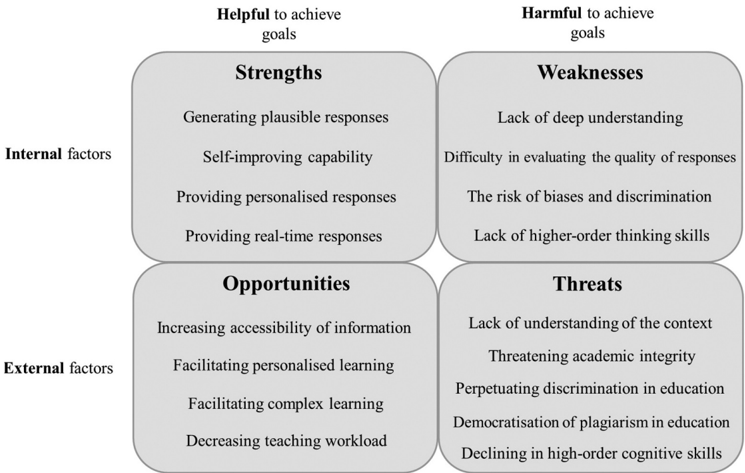
ChatGPT is an AI tool that has sparked debates about its potential implications for education. We used the SWOT analysis framework to outline ChatGPT’s strengths and weaknesses and to discuss its opportunities for and threats to education. The strengths include using a sophisticated natural language model to generate plausible answers, self-improving capability, and providing personalised and real-time responses. As such, ChatGPT can increase access to information, facilitate personalised and complex learning, and decrease teaching workload, thereby making key processes and tasks more efficient. The weaknesses are a lack of deep understanding, difficulty in evaluating the quality of responses, a risk of bias and discrimination, and a lack of higher-order thinking skills. Threats to education include a lack of understanding of the context, threatening academic integrity, perpetuating discrimination in education, democratising plagiarism, and declining high-order cognitive skills. We provide agenda for educational practice and research in times of ChatGPT.
Overview
The claims and statistics of this paper haven’t been checked yet.
Free: it reads the open-access text and checks the first 5 claims that cite a source we can check. Create a free account to check every claim.
Integrity signals
Registry
Cites
Statistics
Figures


Verification
Claims the paper makes
The claims and statistics of this paper haven’t been checked yet.
Free: it reads the open-access text and checks the first 5 claims that cite a source we can check. Create a free account to check every claim.
Claims other papers make about this one
Each is checked against this paper’s own text: does it say what the citing paper says it does?
The source backs part of the claim, not all of it — or backs it for a different population, condition or comparison.
In the citing paper
“Farrokhnia et al. [14] have demonstrated that employing GenAI tools might undermine advanced cognitive capabilities, such as critical and analytical thinking.”
From The Mediating Role of Generative AI Self-Regulation on Students’ Critical Thinking and Problem-Solving (2024) · cites this paper as [14]
Experimental — accuracy not yet measuredThe source backs part of the claim, not all of it — or backs it for a different population, condition or comparison.
In the citing paper
“A possible explanation for this discrepancy lies in the ambiguity surrounding what constitutes plagiarism when using AI-generated content.”
From Chat or cheat? Academic dishonesty, risk perceptions, and ChatGPT usage in higher education students (2025) · cites this paper as Farrokhnia et al., 2023
Experimental — accuracy not yet measuredThe source backs part of the claim, not all of it — or backs it for a different population, condition or comparison.
In the citing paper
“Student perceptions of academic dishonesty have historically been unclear or incomprehensive, and rarely align with teacher expectations (Tatum, 2022), GenAI will only serve to complicate this (Farrokhnia et al., 2023).”
From Not quite eye to A.I.: student and teacher perspectives on the use of generative artificial intelligence in the writing process (2023) · cites this paper as Farrokhnia et al., 2023
Experimental — accuracy not yet measuredThe cited source says what the claim attributes to it.
In the citing paper
“some students may not perceive their use as a policy violation and may unintentionally commit AIgiarism, as its outputs are not verbatim copies of existing texts”
From Chat or cheat? Academic dishonesty, risk perceptions, and ChatGPT usage in higher education students (2025) · cites this paper as Farrokhnia et al., 2023
In the citing paper
“This is echoed in the literature as findings suggest that ChatGPT can provide personalized feedback on essays and become a tutoring system by stimulating critical thinking and debates among students [13].”
From Challenges and Opportunities of Generative AI for Higher Education as Explained by ChatGPT (2023) · cites this paper as [13]
3 more claims about this paper
Create a free account to see every claim other papers make about this one.
Self-check
Percentages, sums and reported differences re-computed from the paper’s own numbers.
The self-check needs the paper’s full text.
Citations
Cites
ChatGPT for Good? On Opportunities and Challenges of Large Language Models for Education
Kasneci, E., Seßler, K., Küchemann, S., Bannert, M., Dementieva, D., Fischer, F., Gasser, U., Groh, G., Günnemann, S., Hüllermeier, E., et al. (2023) · doi:10.35542/osf.io/5er8f · Cited by 7,552
ChatGPT for good? On opportunities and challenges of large language models for education
Kasneci, E., Sessler, K., Küchemann, S., Bannert, M., Dementieva, D., Fischer, F., Gasser, U., Groh, G., Günnemann, S., Hüllermeier, E., et al. (2023) · Learning and Individual Differences · doi:10.1016/j.lindif.2023.102274 · Cited by 7,326 · cited 3×
“ChatGPT’s superior performance is largely attributed to its massive amount of training data (Kasneci et al., 2023), enabling it to capture a wide range of linguistic patterns and relationships, thereby providing a fair understanding of language and context (Lecler et al., 2023; Wang et al., 2023).”
BackgroundMethodBest-worst multi-criteria decision-making method
Rezaei, J. (2015) · Omega · doi:10.1016/j.omega.2014.11.009 · Cited by 4,333 · cited 1×
“Therefore, empirical studies with quantitative approaches such as the best-worst method (see Rezaei, 2015) are necessary to extend the current review findings.”
BackgroundKung, T. H., Cheatham, M., ChatGPT, Medenilla, A., Sillos, C., De Leon, L., Elepaño, C., Madriaga, M., Aggabao, R., Diaz-Candido, G., et al. (2022) · doi:10.1101/2022.12.19.22283643 · Cited by 4,115
Kung, T. H., Cheatham, M., Medenilla, A., Sillos, C., De Leon, L., Elepaño, C., Madriaga, M., Aggabao, R., Diaz-Candido, G., Maningo, J., et al. (2023) · PLOS Digital Health · doi:10.1371/journal.pdig.0000198 · Cited by 4,115 · cited 1×
“It is also shown that ChatGPT has the potential to respond sufficiently to exam questions in the fields of medical (Kung et al., 2022) and law (Choi et al., 2023).”
BackgroundSallam, M. (2023) · Healthcare · doi:10.3390/healthcare11060887 · Cited by 3,126
Chatting and cheating: Ensuring academic integrity in the era of ChatGPT
Cotton, D. R. E., Cotton, P. A., & Shipway, J. R. (2024) · Innovations in Education and Teaching International · doi:10.1080/14703297.2023.2190148 · Cited by 3,087 · cited 5×
“…some scholars are concerned about the ethical considerations of ChatGPT (Mhlanga, 2023), as well as its potential negative effects on assessment practices (Rudolph et al., 2023), scientific integrity (Cotton et al., 2023; Shiri, 2023), and students’ higher-order thinking skills (Susnjak, 2022).”
BackgroundMethodInfluentialChatting and Cheating. Ensuring academic integrity in the era of ChatGPT
Cotton, D., Cotton, P., & Shipway, J. R. (2023) · doi:10.35542/osf.io/mrz8h · Cited by 3,079
Doyle, T. (2017) · The Information Society · doi:10.1080/01972243.2017.1354593 · Cited by 3,071 · cited 1×
“AI algorithms can also perpetuate discrimination by focusing on objectives like profits and efficiency without considering unintended consequences such as reinforcing existing biases (O’neil, 2017).”
Background
Research works printed but not linked: 1
- Haque, M. U., Dharmadasa, I., Sworna, Z. T., Rajapakse, R. N., & Ahmad, H. (2022). 'I think this is the most disruptive technology': Exploring sentiments of ChatGPT early adopters using Twitter data. arXiv. https://doi.org/10.48550/arXiv.2303.03836 . · arXiv · doi:10.48550/arxiv.2303.03836 · Paper page
Cited by
Items 401–500 of 1,006
Goyal, H., Gupta, R., Sharma, S., Mittal, K. C., Mehra, A., Challa, J. S., & Kumar, D. (2026) · ACM Journal on Computing and Sustainable Societies · doi:10.1145/3788679 · Cited by 27
Navigating Ethical Complexities Through Epistemological Analysis of ChatGPT
Chavanayarn, S. (2023) · Bulletin of Science Technology & Society · doi:10.1177/02704676231216355 · Cited by 26
“The notable examples of this are the ongoing debate regarding students ’ utilization of ChatGPT, or the impact of AI in the workplace (Bankins & Formosa, 2023; Farrokhnia et al., 2023; Sullivan et al., 2023).”
BackgroundHuang, L., Zhang, X., Wang, Q., Chen, Z., & Liu, Y. (2024) · Journal of the Knowledge Economy · doi:10.1007/s13132-024-01755-w · Cited by 23
“Farrokhnia et al. (Farrokhnia et al., 2023) used a SWOT analysis framework through a literature analysis to outline ChatGPT’s strengths and weaknesses and discussed its opportunities and threats to education.”
Marciniak, R., & Baksa, M. (2024) · Educatio · doi:10.1556/2063.32.2023.4.4 · Cited by 28
Blasco, A., & Charisi, V. (2024) · SSRN Electronic Journal · doi:10.2139/ssrn.5040921 · Cited by 25
Seker, O., Kwon, K., & Kocak, O. (2025) · Information Development · doi:10.1177/02666669251336368 · Cited by 21
Student reactions to AI versus human feedback in teamwork skills assessment
Kotlyar, I., & Krasman, J. (2025) · International Journal of Educational Technology in Higher Education · doi:10.1186/s41239-025-00555-9 · Cited by 21
Understanding management educators’ perspectives on AI adoption: A qualitative study
Shahzad, F., Avunduk, Z. B., Ullah, Z., & Arslan, A. (2025) · The International Journal of Management Education · doi:10.1016/j.ijme.2025.101274 · Cited by 30
Talukder, M. B., & Kumar, S. (2024) · Advances in information security, privacy, and ethics book series · doi:10.4018/979-8-3693-1511-8.ch005 · Cited by 23
Ibrahim, A.-W., Taura, A. A., Iliyasu, A., Shogbesan, Y. O., & Lukman, S. A. (2024) · Edukasiana Jurnal Inovasi Pendidikan · doi:10.56916/ejip.v3i3.763 · Cited by 34
“Likewise, Farrokhnia et al. (2023) and Xu et al. (2021) defined AI as the “science and engineering of creating systems that are capable of performing tasks commonly associated with intelligent beings such as learning, judgment, and decision-making” (p. 1).”
BackgroundA Bibliometric Analysis of Artificial Intelligence Applications in Global Higher Education
Li, M., & Rohayati, M. I. (2024) · International Journal of Information System Modeling and Design · doi:10.4018/ijismd.365913 · Cited by 26
Khizar, H. M. U., Ashraf, A., Yuan, J., & Al‐Waqfi, M. A. (2025) · Technological Forecasting and Social Change · doi:10.1016/j.techfore.2025.124047 · Cited by 27
Abedi, M., Alshybani, I., Shahadat, M., & Murillo, M. S. (2023) · Qeios · doi:10.32388/md04b0.2 · Cited by 24
Lee, A. V. Y. (2024) · Asia Pacific Journal of Education · doi:10.1080/02188791.2024.2305171 · Cited by 20
“…also opportunities for authentic learning and assessment to take place, by not avoiding generative AI and instead leveraging the technology (e.g., Farrokhnia et al., 2023; Kasneci et al., 2023) to generate diversified responses that a class of students may not be able to provide, thus providing…”
BackgroundGenerative Artificial Intelligence in Instructional System Design
Chai, D. S., Kim, H. S., Kim, K. N., Ha, Y., Shin, S. S. H., & Yoon, S. W. (2025) · Human Resource Development Review · doi:10.1177/15344843251320256 · Cited by 20
“The reasons for biased responses from LLM-based AI tools include speci fi c gender-dominated data, algorithmic injustice, and socio-cultural contexts in which the applications are trained (Farrokhnia et al., 2024).”
InfluentialTransforming Islamic Education: Madrasah-Based Management Strategies for Academic Excellence
Fatihin, M. K., Asnawi, N., & Tharaba, M. F. (2023) · AL-TANZIM JURNAL MANAJEMEN PENDIDIKAN ISLAM · doi:10.33650/al-tanzim.v7i4.6746 · Cited by 27
Orhan, A., Yıldız, T. A., & Yağcı, Ş. Ç. (2024) · Journal of Research on Technology in Education · doi:10.1080/15391523.2024.2437744 · Cited by 24
Yang, Y. (2025) · Asia Pacific Journal of Education · doi:10.1080/02188791.2025.2505664 · Cited by 24
Zhang, H., & Wang, Q. (2025) · International Journal of Educational Technology in Higher Education · doi:10.1186/s41239-025-00544-y · Cited by 22
“Moreover, GenAI’s ability to understand complex queries and deliver real-time, relevant responses enhances learners’ comprehension of the subject matter (Elkhodr et al., 2023; Farrokhnia et al., 2024).”
Stretching AI's reach: Assessing an AI-driven feedback system for extended academic writing
Lo, J., Wong, C., Ng, A., Wong, P., Cheung, D., & Lai, P. P. Y. (2025) · Computers and Education Artificial Intelligence · doi:10.1016/j.caeai.2025.100511 · Cited by 28
Cabezas-Clavijo, Á., & Sidorenko-Bautista, P. (2026) · Journal of Data and Information Science · doi:10.1515/jdis-2025-0326 · Cited by 22
ChatGPT in Higher Education: Design Teaching Model Involving ChatGPT
An, Y., Ouyang, W., & Fu, Z. (2023) · Lecture Notes in Education Psychology and Public Media · doi:10.54254/2753-7048/24/20230560 · Cited by 25
Sampaio, R. C., Chagas, V. H. C. D. S., Sanchez, C. S., Gonçalves, J., Borges, T., Alison, M. B., Tigrinho, C. S., de Souza, J. R., & Paz, F. S. (2024) · Revista Pesquisa Qualitativa · doi:10.33361/rpq.2024.v.12.n.30.729 · Cited by 36
Rahimi, A. R., & Sevilla‐Pavón, A. (2025) · Computer Assisted Language Learning · doi:10.1080/09588221.2025.2477710 · Cited by 23
“…serve as a response to concerns raised in previous studies, which suggested that artificial intelligence might reduce learners’ higher-order thinking, hinder contextual understanding (Farrokhnia et al., 2023), perpetuate discrimination (Farrokhnia et al., 2023), and exacerbate biases in education.”
ChatGPT-Based Simulation Helps to Develop the Pre-Service Mathematics Teachers’ Critical Thinking
Prof. Dr., C. A., Drushlyak, M., Lukashova, T., Prof. Dr., D. O. M., Shamonia, V., Assoc. Prof. Dr., D. O. C. S., Semenikhina, O., & Prof. Dr., D. O. C. S. (2025) · International Journal of Instruction · doi:10.29333/iji.2025.1819a · Cited by 19
Clorion, F. D. D., Alieto, E. O., Fuentes, J. O., Suicano, D. J. B., Natividad, E.-R. R., Miñoza, M. V., Pil, A. I. O., Aidil-Karanain, F., & Vallejo, R. G. (2024) · Springer eBooks · doi:10.1007/978-3-031-65691-0_16 · Cited by 21
Utilization of Generative Artificial Intelligence in Nursing Education: A Topic Modeling Analysis
Seo, W. J., & Kim, M. (2024) · Education Sciences · doi:10.3390/educsci14111234 · Cited by 19
Zhou, B., Pek, L. S., Wang, C., Tiannan, L., Krishnasamy, H. N., Ne’matullah, K. F., & Arar, H. (2025) · International Journal of Learning Teaching and Educational Research · doi:10.26803/ijlter.24.3.9 · Cited by 23
“Farrokhnia et al. (2024) examined the adoption and implications of ChatGPT in education through a SWOT analysis, providing insights into how users perceived and interacted with AI tools in educational settings.”
InfluentialAydın, S., Durukan, A., & Günbatar, M. S. (2025) · Science & Education · doi:10.1007/s11191-025-00677-6 · Cited by 20
“…use of GenAI, science teachers’ workload can be reduced (Li et al., 2023), access to information and the learning process can be facilitated (Farrokhnia et al., 2023), and as a result, it can have positive effects on affective dimensions such as self-efficacy, self-esteem, perceived stress…”
Alvarez-Icaza, I., Miranda, J., Martínez-Arboleda, A., Suárez-Brito, P., & Ramírez-Montoya, M. S. (2025) · Sustainable Futures · doi:10.1016/j.sftr.2025.101312 · Cited by 19
Li, H., Huang, Q.-R., Wen, L.-P., Chen, W., & Xu, Z.-Z. (2025) · SAGE Open · doi:10.1177/21582440251377986 · Cited by 24
“Several scholars (Farrokhnia et al., 2024; Murugesan & Cherukuri, 2023; Parse, 2023) have examined the opportunities and challenges posed by GAI from a theoretical standpoint.”
Wahyono, B., Rapih, S., & Boungou, W. (2023) · Finance research letters · doi:10.1016/j.frl.2023.104576 · Cited by 19
Slow Writing with ChatGPT: Turning the Hype into a Right Way Forward
Sirisathitkul, C. (2023) · Postdigital Science and Education · doi:10.1007/s42438-023-00441-5 · Cited by 19
“However, chatbots are unable to develop new insights (Farrokhnia et al. 2023); a task which remains firmly with the author.”
ШТУЧНИЙ ІНТЕЛЕКТ ЯК ЗАСІБ РОЗВИТКУ КРИТИЧНОГО МИСЛЕННЯ МАЙБУТНІХ УЧИТЕЛІВ МАТЕМАТИКИ
Лукашова, Т., & Drushlyak, M. G. (2023) · Physical and Mathematical Education · doi:10.31110/2413-1571-2023-038-5-003 · Cited by 26
Digital Learning Management using OpenAI ChatGPT: A Systematic Literature Review
Faruq, M. S. S. A., Sunoko, A., Ibda, H., & Wahyudi, K. (2023) · International Journal of Learning Teaching and Educational Research · doi:10.26803/ijlter.22.12.2 · Cited by 33
Exploring Academic Intentions for ChatGPT: A Perspective from the Theory of Planned Behavior
Ahadzadeh, A. S., Wu, S. L., & Xu, S. (2024) · ASR Chiang Mai University Journal of Social Sciences and Humanities · doi:10.12982/cmujasr.2024.016 · Cited by 24
Kumar, J. A., Zhuang, M., & Thomas, S. R. (2024) · Natural sciences education · doi:10.1002/nse2.70003 · Cited by 19
Safe-Child-LLM: A Developmental Benchmark for Evaluating LLM Safety in Child-LLM InteractionsPreprint
Jiao, J., Afroogh, S., Chen, K., Murali, A., Atkinson, D., & Dhurandhar, A. (2025) · arXiv (Cornell University) · doi:10.48550/arxiv.2506.13510 · Cited by 23
Eğin, F., Onan, A., & Durak, H. Y. (2025) · European Journal of Education · doi:10.1111/ejed.12913 · Cited by 18
Trendowski, T. (2025) · Journal of Physical Education Recreation & Dance · doi:10.1080/07303084.2024.2437988 · Cited by 19
“Farrokhnia et al. (2024) stated that a decrease in workload (such as creating new lesson plans) can minimize burnout in teachers, which means decreasing the teacher attrition rate.”
Can generative AI Be an effective Co-Teacher? An experiment
Niloy, A. C., Akter, S., Sultana, J., Rahman, M. A., Sultana, N., Islam, T., Isha, N. J., Afroz, M., Zabeen, M., Tabassum, M., et al. (2025) · Computers and Education Artificial Intelligence · doi:10.1016/j.caeai.2025.100418 · Cited by 21
Mariñas, K. A., Saflor, C. S., Alvarado, P., Uminga, J. M., & Verde, N. A. (2025) · Computers and Education Artificial Intelligence · doi:10.1016/j.caeai.2025.100435 · Cited by 22
Qian, P., & Xie, X.-Z. (2025) · International Journal of Human-Computer Interaction · doi:10.1080/10447318.2025.2526580 · Cited by 26
“Furthermore, individuals with high AI literacy are acutely aware of AI’s limitations, potential biases, and risks of misinformation (Farrokhnia et al., 2024; Su et al., 2023).”
Mesny, A., Roberge‐Maltais, I., & Galy, A. (2025) · The International Journal of Management Education · doi:10.1016/j.ijme.2025.101307 · Cited by 27
Memarian, B., & Doleck, T. (2025) · SN Computer Science · doi:10.1007/s42979-025-04569-y · Cited by 21
“Impact analysis of AI programs was studied the second most within this code [ 52 , 60 , 62 , 68 , 96 , 49 –51, 53, 63 , 64 , 66 , 72 , 73, 76 , 81, 101 , 108].”
InfluentialAlshahrani, A. (2023) · doi:10.1109/icbim59872.2023.10303267 · Cited by 22
“In the work of Farrokhnia et al. [32], a SWOT analysis is employed to examine the strengths, weaknesses, educational opportunities, and threats associated with ChatGPT.”
MethodExploring the Acceptance of ChatGPT as a Learning Tool among Academicians: A Qualitative Study
Mukred, M., Mokhtar, U. A., & Hawash, B. (2023) · Jurnal Komunikasi Malaysian Journal of Communication · doi:10.17576/jkmjc-2023-3904-16 · Cited by 25
Wong, L. H., Park, H., & Looi, C. (2024) · Journal of Computer Assisted Learning · doi:10.1111/jcal.12962 · Cited by 21
Revolutionizing Education of Art and Design Through ChatGPT
Lazkani, O. (2024) · Studies in big data · doi:10.1007/978-3-031-52280-2_4 · Cited by 23
Loos, E. F., & Radicke, J. (2024) · AI and Ethics · doi:10.1007/s43681-024-00470-1 · Cited by 19
“[ 10, p. 1] But there were also negative social imaginaries in the media and academia.”
InfluentialYang, J., Qiu, H., & Yu, W. (2024) · Journal of Asian Public Policy · doi:10.1080/17516234.2024.2429046 · Cited by 18
“Recognizing the significantpotential of ChatGPT in education (Bhullar et al., 2024; Jo, 2024; Farrokhnia et al., 2023), OpenAI has introduced a university-specific version, ‘ChatGPT Edu’, for educational institutions (OpenAI, 2024).”
Artificial Intelligence in Physics Courses to Support Active Learning
Robledo-Rella, V., & Toh, B.-Y. (2024) · International Conference e-Society, e-Learning and e-Technologies · doi:10.1145/3678610.3678631 · Cited by 21
“Farrokhnia et al. (2023) provided a SWOT analysis of ChatGPT, acknowledging its ability to generate convincing responses and improvement over time.”
Moheno, J. M., Calzada, M. A. H., & Ortega-Mohedano, J. (2024) · Educational Media International · doi:10.1080/09523987.2024.2436737 · Cited by 20
“…and confuse students, as they do not have the ability to fully understand the concepts and questions, unlike humans, who can understand the context and subjectivity (Farrokhnia, 2023), so ChatGPT cannot replace the development of critical and reflective thinking skills (Rudolph et al., 2023).”
Amer, M. I. B., Rababah, L. M., & Rababah, M. A. (2025) · Journal of Language Teaching and Research · doi:10.17507/jltr.1601.04 · Cited by 20
“These findings are in line with and validate those of past research that discovered ChatGPT to be significant in several educational pedagogical domains (Farrokhnia et al., 2023).”
AI-supported data analysis boosts student motivation and reduces stress in physics education
Henze, J., Lademann, J., Becker, S., & Bresges, A. (2026) · Frontiers in Education · doi:10.3389/feduc.2026.1719670 · Cited by 21
“However, it remains unclear how effective this feedback is compared to traditional forms (Farrokhnia et al., 2024).”
InfluentialIntegrating AI Technology Into Language Teacher Education: Challenges, Potentials, and Assumptions
Case, R. E., Liu, L., & Mintz, J. (2025) · Computers in the Schools · doi:10.1080/07380569.2025.2458950 · Cited by 24
“AI-based technology can reduce teacher workload by assisting them with developing lessons (Farrokhnia et al., 2024; Skrabut, 2023), worksheets, and assessments (Kohnke, 2023).”
Hu, W., & Shen, X. (2024) · Humanities and Social Sciences Communications · doi:10.1057/s41599-024-04244-2 · Cited by 18
“Tools such as Chatbots, especially ChatGPT (now in its 4.0 version), have also demonstrated effectiveness in supporting language learners (Farrokhnia et al., 2023; Hockly, 2023).”
InfluentialRutecka, P., Cicha, K., Rizun, M., & Strzelecki, A. (2025) · IEEE Transactions on Learning Technologies · doi:10.1109/tlt.2025.3587081 · Cited by 22
“Some researchers point out that LLMs do not cope with assignments requiring critical thinking [7] or communication of scientific concepts [8], and that the use of LLMs in scientific work is unethical [9].”
Wu, R., Wang, X., Nie, Y., Lv, P., & Luo, X. (2025) · Behavioral Sciences · doi:10.3390/bs15091169 · Cited by 17
“These challenges include the generation of inaccurate or fabricated content, the potential weakening of learners’ independent thinking skills (Farrokhnia et al., 2024), and concerns related to academic integrity and ethical risks (Choi et al., 2024).”
Su, Y. (2023) · International Journal of New Developments in Education · doi:10.25236/ijnde.2023.051301 · Cited by 17
Bakare-Fatungase, O. D., Oladokun, T. A., Quadri, G. O., & Idowu-Davies, T. O. (2023) · Advances in educational technologies and instructional design book series · doi:10.4018/979-8-3693-0205-7.ch009 · Cited by 20
A Data-Driven Approach for the Identification of Features for Automated Feedback on Academic Essays
Abbas, M., van Rosmalen, P., & Kalz, M. (2023) · IEEE Transactions on Learning Technologies · doi:10.1109/tlt.2023.3320877 · Cited by 19
Acceptance and Use of ChatGPT Among Accounting and Finance Higher Education Students
Ziemba, E. W., Maruszewska, E. W., Grabara, D., & Renik, K. (2024) · Lecture notes in networks and systems · doi:10.1007/978-3-031-66761-9_16 · Cited by 19
Biyiri, E. W., Dahanayake, S., Dassanayake, D. M. C., Nayyar, A., Dayangana, K. T. L. U. S., & Jayasinghe, J. (2024) · Education and Information Technologies · doi:10.1007/s10639-024-13269-8 · Cited by 20
“For example, Farrokhnia et al. (2023) evaluated the implicational potential of Chat-GPT in education by conducting a SWOT analysis.”
Simamora, N. N., Alrefay, K. A., Qasem, A. A., Lorenzo, A., & Kara, M. K. (2024) · Journal of Educational Technology and Learning Creativity · doi:10.37251/jetlc.v2i2.1412 · Cited by 23
Leveraging ChatGPT AI Model in Academic Writing and Avenues for Further Development: SWOT Framework
Alamri, W., Qasem, F. A. A., Alfotais, A., & Taisan, H. A. A. (2025) · Forum for Linguistic Studies · doi:10.30564/fls.v7i2.8218 · Cited by 21
Madsen, D. Ø., & Toston, D. M. (2025) · Digital · doi:10.3390/digital5030024 · Cited by 18
“This digital divide [129] may exacerbate pre-existing educational inequalities, particularly when generative AI becomes central to learning platforms [18].”
Application of Chatgpt in Higher Education and Research – a Futuristic AnalysisPreprint
Aithal, P. S., & Aithal, S. (2024) · SSRN Electronic Journal · doi:10.2139/ssrn.4674364 · Cited by 17
Examining Student and Teacher Perspectives on Undisclosed Use of Generative AI in Academic Work
Adnin, R., Pandkar, A., Yao, B., Wang, D., & Das, M. (2025) · Proceedings of the 2025 CHI Conference on Human Factors in Computing Systems · doi:10.1145/3706598.3713393 · Cited by 16
“…tools on students’ learning outcomes [41, 55, 61, 69], partic-when students rely on AI-generated responses without fully ng the underlying concepts [61] or verifying their accuracy Moreover, students’ undisclosed use of GenAI in academic is creating tensions in the student-teacher dynamic due to…”
InfluentialNavigating the AI era: university communication strategies and perspectives on generative AI tools
Henke, J. (2024) · Journal of Science Communication · doi:10.22323/2.23030205 · Cited by 16
In the wake of ChatGPT: early reflections on marking open-book online accounting assessments
Dosumu, O. E., Porumb, V., Stafford, A., & Zimmer, A. (2025) · Accounting Education · doi:10.1080/09639284.2025.2487487 · Cited by 16
“Moreover, although ChatGPT can enhance critical thinking skills, over-reliance on it could suppress creativity, problem-solving, and critical thinking due to the ease of obtaining information, potentially encouraging laziness (Farrokhnia et al., 2023; Kasneci et al., 2023; Tlili et al., 2023).”
Peng, Z., & Wan, Y. (2025) · Education and Information Technologies · doi:10.1007/s10639-025-13586-6 · Cited by 19
“…AI technology, AI TAs can now automatically generate answers to course-related and open-ended questions by searching content on the Internet (Farrokhnia et al., 2023; Smutny & Schreiberova, 2020; Mao et al., 2024), providing writing feedback (Banihashem et al., 2024), and facilitating…”
Yang, F., & Stefaniak, J. E. (2025) · Educational Technology Research and Development · doi:10.1007/s11423-025-10509-7 · Cited by 17
“Additionally, it has been demonstrated by Farrokhnia et al. (2023) that ChatGPT excels in delivering tailored and intricate learning experiences, thereby transforming educational practices.”
Al-Thani, S. N., Anjum, S., Bhutta, Z. A., Bashir, S., Majeed, M. A., Khan, A. S., & Bashir, K. (2025) · International Journal of Emergency Medicine · doi:10.1186/s12245-025-00949-6 · Cited by 19
Qin, Z., & Chuaychoowong, M. (2025) · Language Teaching Research Quarterly · doi:10.32038/ltrq.2025.49.04 · Cited by 19
Liu, R., Wu, T., Chu, J., & Qu, P. (2025) · Thinking Skills and Creativity · doi:10.1016/j.tsc.2025.101967 · Cited by 18
Jazim, F., Al‐Mamary, Y. H., & Abubakar, A. A. (2025) · Acta Psychologica · doi:10.1016/j.actpsy.2025.105445 · Cited by 18
Sui, C., Chang, C., & Yen, M.-H. (2025) · Journal of Science Education and Technology · doi:10.1007/s10956-025-10257-6 · Cited by 18
“For instance, individuals who are skeptical of GenAI-generated content may be less likely to accept AI-provided recommendations (Farrokhnia et al., 2023).”
Leveraging Generative AI for sustainable supply chain: adoption challenges and strategic insights
Maghroor, H. R., Madanchi, F., & O’Neal, T. (2025) · Production Planning & Control · doi:10.1080/09537287.2025.2561967 · Cited by 19
Brunton, R., Rhazzafe, S., Moodley, R., Kühn, S., Caraffini, F., Wilford, S., Higginbottom, R., Colreavy‐Donnelly, S., & Góngora, M. (2025) · Social Sciences & Humanities Open · doi:10.1016/j.ssaho.2025.102110 · Cited by 17
Lawan, A. A., Muhammad, B. R., Tahir, A. M., Yarima, K. I., Zakari, A., Abdullahi, A. H., Hussaini, A., Kademi, H. I., Danlami, A. A., Sani, M. A., et al. (2023) · Education Journal · doi:10.11648/j.edu.20231204.14 · Cited by 21
Chawla, U., Mohnot, R., & Singh, H. V. (2024) · Education and Information Technologies · doi:10.1007/s10639-024-12702-2 · Cited by 19
The influence of ChatGPT on digital learning: experience among university students
Komba, M. M. (2024) · Global Knowledge, Memory and Communication · doi:10.1108/gkmc-10-2023-0390 · Cited by 18
Krushinskaia, K., Elen, J., & Raes, A. (2024) · Communications in computer and information science · doi:10.1007/978-3-031-64312-5_49 · Cited by 19
Sallam, M., Al‐Adwan, A. S., Mijwil, M. M., Abdelaziz, D. H., Al-Qaisi, A., Ibrahim, O. M., & Sallam, M. (2025) · Journal of Education and Development · doi:10.20849/jed.v9i3.1511 · Cited by 21
ChatGPT for generating stories and mind-maps in storytelling
Chen, X., Xie, H., Zou, D., & Wang, F. L. (2023) · International Conference on Behavioral, Economic, and Socio-Cultural Computing · doi:10.1109/besc59560.2023.10386441 · Cited by 16
ChatGPT: Systematic Review of Potentials and Limitations in Education
Patrício, M. R., & Gonçalves, B. F. (2024) · Lecture notes in networks and systems · doi:10.1007/978-3-031-54256-5_32 · Cited by 21
Sallam, M., Al‐Farajat, A., & Egger, J. (2024) · Jordan Medical Journal · doi:10.35516/jmj.v58i1.2285 · Cited by 21
Mathew, R., & Stefaniak, J. E. (2024) · TechTrends · doi:10.1007/s11528-024-00964-z · Cited by 15
“However, there is evidence of an urgent need for human oversight of generative AI in education due to privacy concerns, lack of contextual awareness and potential harm especially to those with low ICT backgrounds (Farrokhnia et al., 2023; Rad & Rad, 2023; Tlili et al., 2023).”
Naing, S. Z. S., & Udomwong, P. (2024) · Data Intelligence · doi:10.1162/dint_a_00250 · Cited by 15
“In our comparative analysis of our SWOT analysis results with the previous study by Farrokhnia et al. [21], we found different findings because the scope and focus of both studies are different.”
MethodResultChen, J., Mokmin, N. A. M., & Qi, S. (2025) · The Journal of Educational Research · doi:10.1080/00220671.2025.2510395 · Cited by 15
“GAI enhances intrinsic motivation by enabling self-directed learning, offering personalized explanations, and providing scaffolded support tailored to each student’s skill level through dynamic, interactive feed-back (Chen et al., 2025; Farrokhnia et al., 2024).”
Generative AI and the Future of Democratic Citizenship
Formosa, P., Kashyap, B., & Sahebi, S. (2025) · Digital Government: Research and Practice · doi:10.1145/3674844 · Cited by 15
Sichterman, B., Banihashem, S. K., Verstappen, M., Schipper, M., Waisvisz, P., Noroozi, O., & van Ginkel, S. O. (2025) · Interactive Learning Environments · doi:10.1080/10494820.2025.2521338 · Cited by 19
“One emerging area where AI holds promise for a significant impact is for providing feedback and be regarded as a novel source of feedback (Banihashem et al., 2024; Farrokhnia et al., 2023).”
Self-citationHarnessing Self-Control and AI: Understanding ChatGPT’s Impact on Academic Wellbeing
Beşaltı, M. (2025) · Behavioral Sciences · doi:10.3390/bs15091181 · Cited by 15
“It supports a range of academic activities, from writing assistance and coding to problem-solving techniques and data analysis, all delivered through a conversational interface (Farrokhnia et al., 2023).”
Wu, W. V., Ting, K.-Y., & Lin, P.-H. (2025) · European Journal of Teacher Education · doi:10.1080/02619768.2025.2554682 · Cited by 17
“GenAI instruments give instructors the flexibility to generate dynamic activities and teaching materials that are tailored to the specific needs of students or teachers (e.g. Farrokhnia et al. 2023; Srivani et al. 2022).”
Al-Obaydi, L. H., & Pikhart, M. (2025) · SAGE Open · doi:10.1177/21582440251381683 · Cited by 15
“To improve their speaking and listening abilities, some students might like applications that mimic conversational practice using interactive chatbots (Farrokhnia et al., 2023; Hu, 2025).”
Liu, L. (2023) · Journal of Educational Technology Development and Exchange · doi:10.18785/jetde.1601.03 · Cited by 22
“…in the response outputs (Farrokhnia, 2023; Gao et al., 2023; Gupta et al., 2023), and (b) lack of capability to determine the credibility of the data it was trained on may result in the uncertainties for the quality of responses (Farrokhnia et al., 2023; Lecler et al., 2023; Tlili et al., 2023).”
BackgroundInfluentialUsing ChatGPT to Teach English for Academic Purposes: Perspectives from the Classroom
Glahn, K. (2024) · Journal of Education, Innovation, and Communication. · doi:10.34097/jeicom-5-2-december-23-5 · Cited by 22
Framing Assessment Questions in the Age of Artificial Intelligence: Evidence from ChatGPT 3.5
Farooqui, M. O., Siddiquei, M. I., & Kathpal, S. (2024) · Emerging Science Journal · doi:10.28991/esj-2024-08-03-09 · Cited by 16
“It can assist them in better managing their time, generating initial ideas [31, 32], simplifying complex subjects, and providing personalized learning experiences [33].”
BackgroundExamining Pre-service Mathematics Teachers' Purposes of Using ChatGPT in Lesson Plan Development
Tunç, M. P. (2024) · Sakarya University Journal of Education · doi:10.19126/suje.1476326 · Cited by 17
Metadata
- Authors
- Farrokhnia, M., Banihashem, S. K., Noroozi, O., & Wals, A.
- Affiliations
- Wageningen University & Research (NL)
- Open University of the Netherlands (NL)
- Corresponding author
- Noroozi, Omid
- Venue
- Innovations in Education and Teaching International
- Publisher
- Informa UK Limited
- Published
- 2023-03-27
- Volume
- 61
- Issue
- 3
- Pages
- 460-474
- ISSN
- 1470-3297 (ISSN-L)
- 1470-3300
- OpenAlex
- W4361204578
- Cited by
- 1,384
- References
- 68
- Citations by year
- 2026: 359 · 2025: 456 · 2024: 396 · 2023: 173
- FWCI
- 324.80
- Type
- journal article
- Language
- en
- Open access
- hybrid
- doi.org
- Licence
- Locations
- Innovations in Education and Teaching International (publishedVersion, cc-by-nc-nd)
- Socio-Environmental Systems Modeling (submittedVersion, cc-by-nc-nd)
- DSpace (Open University in the Netherlands) (submittedVersion, cc-by-nc-nd)
- Data Archiving and Networked Services (DANS) (submittedVersion, other-oa)
- Topics
- Social Sciences › Education › Artificial Intelligence in Education
- Health Sciences › Medicine › Health Informatics › Artificial Intelligence in Healthcare and Education
- Social Sciences › Education › Educational Technology in Learning
- Keywords
- ChatGPT, large language models, artificial intelligence in education, academic integrity, plagiarism, algorithmic bias, higher-order thinking skills, personalized learning, teacher workload, SWOT analysis
About these checks
Registry, retraction, Cites and statistics results are computed, not judged, with one exception: a printed reference that no index lists is read once by a model before it counts as a citation error. Claims are extracted by a model and kept only when their quote appears verbatim in the text; each cited source is then checked, with a model’s help, for whether it says what the claim relies on. Those verdicts can be wrong — read the claim’s quote and the cited source before relying on one.
Statistics and arithmetic are recomputed, not judged.
Confidence bands are shown only for fields calibrated on our annotated test set. None is calibrated yet, so no band is shown.
What counts as a claim ›How we measure confidence ›How we check this ›
Are you an author, or do you see a problem with this page? Request a review
Data sources
Bibliographic data: Semantic Scholar, OpenAlex, Crossref.
Contains information from the Semantic Scholar Academic Graph Datasets, made available under the ODC Attribution License (ODC-BY 1.0).
Semantic Scholar’s data is described in: Kinney, R., et al. (2023). The Semantic Scholar Open Data Platform. arXiv:2301.10140.
