

A SWOT analysis of ChatGPT: Implications for educational practice and research
Open accessThe DOI matches its Crossref record; 79 of the 79 references it cites were found in a registry or an index.
Abstract
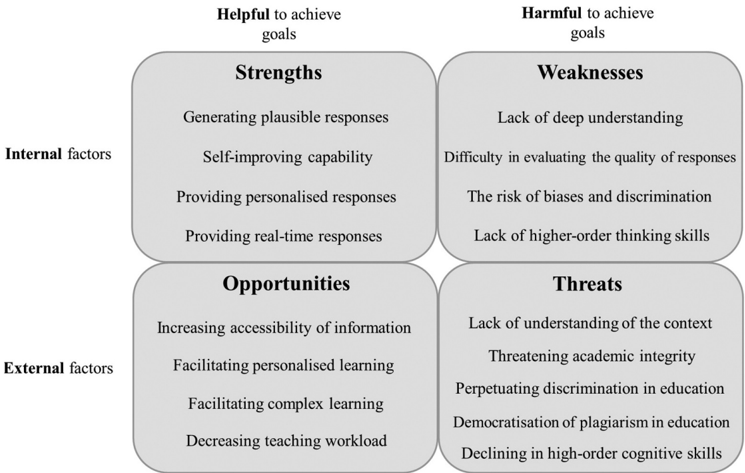
ChatGPT is an AI tool that has sparked debates about its potential implications for education. We used the SWOT analysis framework to outline ChatGPT’s strengths and weaknesses and to discuss its opportunities for and threats to education. The strengths include using a sophisticated natural language model to generate plausible answers, self-improving capability, and providing personalised and real-time responses. As such, ChatGPT can increase access to information, facilitate personalised and complex learning, and decrease teaching workload, thereby making key processes and tasks more efficient. The weaknesses are a lack of deep understanding, difficulty in evaluating the quality of responses, a risk of bias and discrimination, and a lack of higher-order thinking skills. Threats to education include a lack of understanding of the context, threatening academic integrity, perpetuating discrimination in education, democratising plagiarism, and declining high-order cognitive skills. We provide agenda for educational practice and research in times of ChatGPT.
Overview
The claims and statistics of this paper haven’t been checked yet.
Free: it reads the open-access text and checks the first 5 claims that cite a source we can check. Create a free account to check every claim.
Integrity signals
Registry
Cites
Statistics
Figures



Verification
Claims the paper makes
The claims and statistics of this paper haven’t been checked yet.
Free: it reads the open-access text and checks the first 5 claims that cite a source we can check. Create a free account to check every claim.
Claims other papers make about this one
Each is checked against this paper’s own text: does it say what the citing paper says it does?
The source backs part of the claim, not all of it — or backs it for a different population, condition or comparison.
In the citing paper
“Farrokhnia et al. [14] have demonstrated that employing GenAI tools might undermine advanced cognitive capabilities, such as critical and analytical thinking.”
From The Mediating Role of Generative AI Self-Regulation on Students’ Critical Thinking and Problem-Solving (2024) · cites this paper as [14]
Experimental — accuracy not yet measuredThe source backs part of the claim, not all of it — or backs it for a different population, condition or comparison.
In the citing paper
“A possible explanation for this discrepancy lies in the ambiguity surrounding what constitutes plagiarism when using AI-generated content.”
From Chat or cheat? Academic dishonesty, risk perceptions, and ChatGPT usage in higher education students (2025) · cites this paper as Farrokhnia et al., 2023
Experimental — accuracy not yet measuredThe source backs part of the claim, not all of it — or backs it for a different population, condition or comparison.
In the citing paper
“Student perceptions of academic dishonesty have historically been unclear or incomprehensive, and rarely align with teacher expectations (Tatum, 2022), GenAI will only serve to complicate this (Farrokhnia et al., 2023).”
From Not quite eye to A.I.: student and teacher perspectives on the use of generative artificial intelligence in the writing process (2023) · cites this paper as Farrokhnia et al., 2023
Experimental — accuracy not yet measuredThe cited source says what the claim attributes to it.
In the citing paper
“some students may not perceive their use as a policy violation and may unintentionally commit AIgiarism, as its outputs are not verbatim copies of existing texts”
From Chat or cheat? Academic dishonesty, risk perceptions, and ChatGPT usage in higher education students (2025) · cites this paper as Farrokhnia et al., 2023
In the citing paper
“This is echoed in the literature as findings suggest that ChatGPT can provide personalized feedback on essays and become a tutoring system by stimulating critical thinking and debates among students [13].”
From Challenges and Opportunities of Generative AI for Higher Education as Explained by ChatGPT (2023) · cites this paper as [13]
3 more claims about this paper
Create a free account to see every claim other papers make about this one.
Self-check
Percentages, sums and reported differences re-computed from the paper’s own numbers.
The self-check needs the paper’s full text.
Citations
Cites
ChatGPT for Good? On Opportunities and Challenges of Large Language Models for Education
Kasneci, E., Seßler, K., Küchemann, S., Bannert, M., Dementieva, D., Fischer, F., Gasser, U., Groh, G., Günnemann, S., Hüllermeier, E., et al. (2023) · doi:10.35542/osf.io/5er8f · Cited by 7,552
ChatGPT for good? On opportunities and challenges of large language models for education
Kasneci, E., Sessler, K., Küchemann, S., Bannert, M., Dementieva, D., Fischer, F., Gasser, U., Groh, G., Günnemann, S., Hüllermeier, E., et al. (2023) · Learning and Individual Differences · doi:10.1016/j.lindif.2023.102274 · Cited by 7,326 · cited 3×
“ChatGPT’s superior performance is largely attributed to its massive amount of training data (Kasneci et al., 2023), enabling it to capture a wide range of linguistic patterns and relationships, thereby providing a fair understanding of language and context (Lecler et al., 2023; Wang et al., 2023).”
BackgroundMethodBest-worst multi-criteria decision-making method
Rezaei, J. (2015) · Omega · doi:10.1016/j.omega.2014.11.009 · Cited by 4,333 · cited 1×
“Therefore, empirical studies with quantitative approaches such as the best-worst method (see Rezaei, 2015) are necessary to extend the current review findings.”
BackgroundKung, T. H., Cheatham, M., ChatGPT, Medenilla, A., Sillos, C., De Leon, L., Elepaño, C., Madriaga, M., Aggabao, R., Diaz-Candido, G., et al. (2022) · doi:10.1101/2022.12.19.22283643 · Cited by 4,115
Kung, T. H., Cheatham, M., Medenilla, A., Sillos, C., De Leon, L., Elepaño, C., Madriaga, M., Aggabao, R., Diaz-Candido, G., Maningo, J., et al. (2023) · PLOS Digital Health · doi:10.1371/journal.pdig.0000198 · Cited by 4,115 · cited 1×
“It is also shown that ChatGPT has the potential to respond sufficiently to exam questions in the fields of medical (Kung et al., 2022) and law (Choi et al., 2023).”
BackgroundSallam, M. (2023) · Healthcare · doi:10.3390/healthcare11060887 · Cited by 3,126
Chatting and cheating: Ensuring academic integrity in the era of ChatGPT
Cotton, D. R. E., Cotton, P. A., & Shipway, J. R. (2024) · Innovations in Education and Teaching International · doi:10.1080/14703297.2023.2190148 · Cited by 3,087 · cited 5×
“…some scholars are concerned about the ethical considerations of ChatGPT (Mhlanga, 2023), as well as its potential negative effects on assessment practices (Rudolph et al., 2023), scientific integrity (Cotton et al., 2023; Shiri, 2023), and students’ higher-order thinking skills (Susnjak, 2022).”
BackgroundMethodInfluentialChatting and Cheating. Ensuring academic integrity in the era of ChatGPT
Cotton, D., Cotton, P., & Shipway, J. R. (2023) · doi:10.35542/osf.io/mrz8h · Cited by 3,079
Doyle, T. (2017) · The Information Society · doi:10.1080/01972243.2017.1354593 · Cited by 3,071 · cited 1×
“AI algorithms can also perpetuate discrimination by focusing on objectives like profits and efficiency without considering unintended consequences such as reinforcing existing biases (O’neil, 2017).”
BackgroundBarocas, S., & Selbst, A. D. (2014) · doi:10.2139/ssrn.2477899 · Cited by 3,048 · cited 1×
“Following the old ‘garbage-in-garbage-out’ principle, AI algorithms can perpetuate biases through the use of big data that reflects these biases (Barocas & Selbst, 2016).”
Background(2016) · Cited by 2,334
What if the devil is my guardian angel: ChatGPT as a case study of using chatbots in education
Tlili, A., Shehata, B., Adarkwah, M. A., Bozkurt, A., Hickey, D. T., Huang, R., & Agyemang, B. (2023) · Smart Learning Environments · doi:10.1186/s40561-023-00237-x · Cited by 2,003 · cited 2×
“ChatGPT has raised various ethical issues such as encouraging plagiarism and cheating (Gašević et al., 2023) and being prone to errors such as the provision of fake information (Tlili et al., 2023).”
BackgroundChatGPT: Bullshit spewer or the end of traditional assessments in higher education?
(2023) · Journal of Applied Learning & Teaching · doi:10.37074/jalt.2023.6.1.9 · Cited by 1,806 · cited 4×
“Moreover, the ongoing increase of its training data helps ChatGPT to constantly be improved and updated with new data, which means it can become even more accurate over time (Rudolph et al., 2023).”
BackgroundInfluentialChiu, T. K. F., Xia, Q., Zhou, X., Chai, C. S., & Cheng, M. (2023) · Computers and Education: Artificial Intelligence · doi:10.1016/j.caeai.2022.100118 · Cited by 1,181 · cited 1×
“More studies are needed to show how such personalised learning can happen in practice and what is the optimal application of this tool for facilitating students’ personalised learning in different contexts (Xia et al., 2022).”
BackgroundCascella, M., Montomoli, J., Bellini, V., & Bignami, E. (2023) · Journal of Medical Systems · doi:10.1007/s10916-023-01925-4 · Cited by 1,120 · cited 1×
“ChatGPT can find and summarise relevant information (Cascella et al., 2023), making it easier for students to access fine-grained information in a fast manner.”
BackgroundGao, C. A., Howard, F. M., Markov, N. S., Dyer, E. C., Ramesh, S., Luo, Y., & Pearson, A. T. (2022) · doi:10.1101/2022.12.23.521610 · Cited by 1,099 · cited 1×
“Empirical studies showed that ChatGPT can generate research studies at an acceptable level for publication (Dowling & Lucey, 2023) and can write scientific abstracts with fabricated data that may not be detectable by reviewers (C. A. Gao et al., 2022).”
BackgroundGao, C. A., Howard, F. M., Markov, N. S., Dyer, E. C., Ramesh, S., Luo, Y., & Pearson, A. T. (2023) · npj Digital Medicine · doi:10.1038/s41746-023-00819-6 · Cited by 1,099
ChatGPT and other large language models are double-edged swords
Shen, Y., Heacock, L., Elias, J., Hentel, K. D., Reig, B., Shih, G., & Moy, L. (2023) · Radiology · doi:10.1148/radiol.230163 · Cited by 1,008 · cited 3×
“This capability enables ChatGPT to adjust and improve its responses based on input from human evaluators (Shen et al., 2023).”
BackgroundInfluentialChatGPT User Experience: Implications for Education
Zhai, X. (2023) · doi:10.2139/ssrn.4312418 · Cited by 935 · cited 4×
“ChatGPT can perpetuate biases and discrimination (Zhai, 2022).”
BackgroundInfluentialOuyang, F., Zheng, L., & Jiao, P. (2022) · Education and Information Technologies · doi:10.1007/s10639-022-10925-9 · Cited by 831 · cited 1×
“AI has been shown to be successful in solving complex problems in various domains including education (Ouyang et al., 2022).”
BackgroundWhat ChatGPT and generative AI mean for science
Stokel-Walker, C., & Van Noorden, R. (2023) · Nature · doi:10.1038/d41586-023-00340-6 · Cited by 828 · cited 1×
“ChatGPT doesn’t have access to the Internet and currently has limited knowledge of world events after 2021 (Stokel-Walker & van Noorden, 2023).”
BackgroundThe media and the literacies: media literacy, information literacy, digital literacy
Koltay, T. (2011) · Media, Culture & Society · doi:10.1177/0163443710393382 · Cited by 796 · cited 1×
“This can be done by including essential forms of literacy, such as media and digital literacy to enhance students’ capability to properly evaluate, assess, and make use of these new technologies (Koltay, 2011).”
BackgroundComponents of Education 4.0 in 21st Century Skills Frameworks: Systematic Review
González-Pérez, L. I., & Ramírez-Montoya, M. S. (2022) · Sustainability · doi:10.3390/su14031493 · Cited by 752 · cited 1×
“As education becomes more dependent on AI, it is also imperative to focus on developing higher-order learning outcomes such as creativity and critical thinking skills (González-Pérez & Ramírez-Montoya, 2022).”
BackgroundOpen AI in Education, the Responsible and Ethical Use of ChatGPT Towards Lifelong Learning
Mhlanga, D. (2023) · doi:10.2139/ssrn.4354422 · Cited by 719 · cited 1×
“…in terms of providing adaptive and personalised environments (Qadir, 2022), some scholars are concerned about the ethical considerations of ChatGPT (Mhlanga, 2023), as well as its potential negative effects on assessment practices (Rudolph et al., 2023), scientific integrity (Cotton et al., 2023;…”
BackgroundOpen AI in Education, the Responsible and Ethical Use of ChatGPT Towards Lifelong Learning
Mhlanga, D. (2023) · Sustainable Development Goals Series · doi:10.1007/978-3-031-37776-1_17 · Cited by 718
SWOT analysis applications: An integrative literature review
Benzaghta, M. A., Elwalda, A., Mousa, M., Erkan, I., & Rahman, M. (2021) · Journal of Global Business Insights · doi:10.5038/2640-6489.6.1.1148 · Cited by 615 · cited 1×
“SWOT is an acronym that stands for strengths, weaknesses, opportunities, and threats, originally introduced in the early 1950s as a framework to investigate organisational strategies (Benzaghta et al., 2021).”
BackgroundThe benefits and challenges of chatgpt: An overview
Deng, J., & Lin, Y. (2023) · Frontiers in Computing and Intelligent Systems · doi:10.54097/fcis.v2i2.4465 · Cited by 611 · cited 1×
“However, with the use of an advanced natural language processing model, ChatGPT is able to understand complex inquiries and provide relevant answers in real-time (Deng & Lin, 2022).”
MethodGenerating scholarly content with ChatGPT: Ethical challenges for medical publishing
Liebrenz, M., Schleifer, R., Buadze, A., Bhugra, D., & Smith, A. (2023) · The Lancet Digital Health · doi:10.1016/s2589-7500(23)00019-5 · Cited by 594 · cited 1×
“This ethical issue becomes, even more, serious when considering the fact that ChatGPT is prone to generating incorrect and nonsensical answers, increasing the risk of misinformation spreading in scientific publications (Liebrenz et al., 2023).”
BackgroundChatGPT for (Finance) research: The Bananarama Conjecture
Dowling, M., & Lucey, B. (2023) · Finance Research Letters · doi:10.1016/j.frl.2023.103662 · Cited by 591
Authentic assessment: creating a blueprint for course design
Villarroel, V., Bloxham, S., Bruna, D., Bruna, C., & Herrera-Seda, C. (2018) · Assessment & Evaluation in Higher Education · doi:10.1080/02602938.2017.1412396 · Cited by 560 · cited 1×
“Authentic assessment has long been proven to be beneficial in higher education (Villarroel et al., 2018), and now it is time to scale and amplify this approach by engaging students in activities that ChatGPT may not be able to generate an appropriate response for, such as solving real-life problems.”
BackgroundA Categorical Archive of ChatGPT Failures
Borji, A. (2023) · arXiv · doi:10.48550/arxiv.2302.03494 · Cited by 514 · cited 1×
“This may result in responses that are sometimes lacking depth and insight (Borji, 2023) and potentially off-topic (Gupta et al., 2023), particularly for performing tasks that require a nuanced understanding of specific domain knowledge (Dimitrov, 2023).”
BackgroundA Categorical Archive of ChatGPT Failures
Borji, A. (2023) · doi:10.21203/rs.3.rs-2895792/v1 · Cited by 514
Choi, J. H., Hickman, K. E., Monahan, A., & Schwarcz, D. B. (2023) · SSRN Electronic Journal · doi:10.2139/ssrn.4335905 · Cited by 485 · cited 2×
“For instance, when required to include up-to-date references, ChatGPT may fabricate ones that seem plausible but do not point to real-world sources (Choi et al., 2023).”
BackgroundA Literature Survey of Recent Advances in Chatbots
Caldarini, G., Jaf, S., & McGarry, K. (2022) · Information · doi:10.3390/info13010041 · Cited by 470 · cited 1×
“The application of AI in the natural language processing field has resulted in the creation of intelligent chatbots and virtual assistants capable of both understanding and producing human language (Caldarini et al., 2022).”
BackgroundLecler, A., Duron, L., & Soyer, P. (2023) · Diagnostic and Interventional Imaging · doi:10.1016/j.diii.2023.02.003 · Cited by 385 · cited 2×
“ChatGPT’s superior performance is largely attributed to its massive amount of training data (Kasneci et al., 2023), enabling it to capture a wide range of linguistic patterns and relationships, thereby providing a fair understanding of language and context (Lecler et al., 2023; Wang et al., 2023).”
BackgroundChatGPT: The End of Online Exam Integrity?
Susnjak, T. (2022) · arXiv · doi:10.48550/arxiv.2212.09292 · Cited by 370 · cited 4×
“Third, since ChatGPT has shown the potential to facilitate complex learning (Susnjak, 2022), future studies could focus on identifying optimal instructional designs for leveraging this new AI tool in facilitating complex learning among higher education students.”
BackgroundMethodInfluentialEmbedding Blockchain Technology Into IoT for Security: A Survey
Xu, L. D., Lu, Y., & Li, L. (2021) · IEEE Internet of Things Journal · doi:10.1109/jiot.2021.3060508 · Cited by 360 · cited 1×
“Artificial Intelligence (AI) refers to the science and engineering of creating systems that are capable to perform tasks commonly associated with intelligent beings such as learning, judgement, and decision-making (Xu et al., 2021).”
BackgroundAn Analysis of the Automatic Bug Fixing Performance of ChatGPT
Sobania, D., Briesch, M., Hanna, C., & Petke, J. (2023) · 2023 IEEE/ACM International Workshop on Automated Program Repair (APR) · doi:10.1109/apr59189.2023.00012 · Cited by 338 · cited 1×
“These features allow ChatGPT to provide plausible and seemingly more credible responses than other similar AI tools (Sobania et al., 2023).”
BackgroundArtificial intelligence in teaching and learning: what questions should we ask of ChatGPT?
Rospigliosi, P. ‘. (2023) · Interactive Learning Environments · doi:10.1080/10494820.2023.2180191 · Cited by 335 · cited 1×
“In addition, several editorials have been written about how ChatGPT can influence education (Rospigliosi, 2023).”
BackgroundNoroozi, O., Weinberger, A., Biemans, H. J. A., Mulder, M., & Chizari, M. (2012) · Educational Research Review · doi:10.1016/j.edurev.2011.11.006 · Cited by 310 · cited 1×
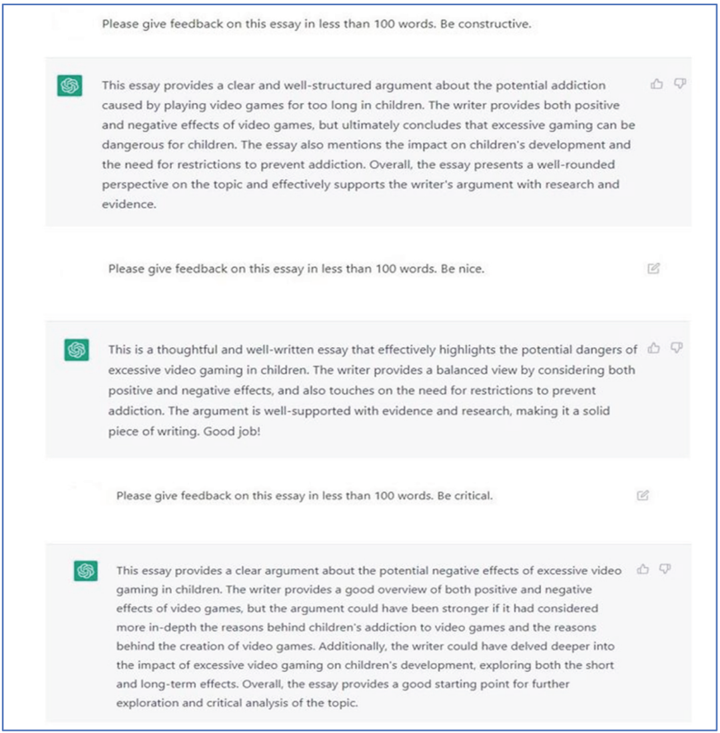
“For example, in the context of argumen-tative essay writing as one of the important learning tasks for higher education students (Noroozi et al., 2012), we asked ChatGPT to give feedback on an anonymous essay about ‘Video Games for Children’ in three different scenarios considering three main…”
MethodSelf-citationFormative assessment: a key to deep learning?
Rushton, A. (2005) · Medical Teacher · doi:10.1080/01421590500129159 · Cited by 291 · cited 1×
“Teachers should use formative assessment, wherein the learning process is monitored through authentic assessment practices such as self-assessment (Rushton, 2005), reflection reports, portfolios, and peer feedback (Banihashem et al., 2022; Noroozi et al., 2016).”
BackgroundEngineering Education in the Era of ChatGPT: Promise and Pitfalls of Generative AI for Education
Qadir, J. (2022) · doi:10.36227/techrxiv.21789434.v1 · Cited by 264
The ChatGPT Storm and What Faculty Can Do
Sun, G. H., & Hoelscher, S. H. (2023) · Nurse Educator · doi:10.1097/nne.0000000000001390 · Cited by 252 · cited 1×
“For instance, its ability to generate higher-level critical thinking – type questions is limited, as these questions require a deeper understanding of the subject matter (Sun & Hoelscher, 2023).”
BackgroundBanihashem, S. K., Noroozi, O., van Ginkel, S., Macfadyen, L. P., & Biemans, H. J. A. (2022) · Educational Research Review · doi:10.1016/j.edurev.2022.100489 · Cited by 246 · cited 1×
“Teachers should use formative assessment, wherein the learning process is monitored through authentic assessment practices such as self-assessment (Rushton, 2005), reflection reports, portfolios, and peer feedback (Banihashem et al., 2022; Noroozi et al., 2016).”
BackgroundSelf-citationEmpowering learners for the age of artificial intelligence
Gašević, D., Siemens, G., & Sadiq, S. (2023) · Computers and Education: Artificial Intelligence · doi:10.1016/j.caeai.2023.100130 · Cited by 234 · cited 3×
“ChatGPT has raised various ethical issues such as encouraging plagiarism and cheating (Gašević et al., 2023) and being prone to errors such as the provision of fake information (Tlili et al., 2023).”
BackgroundCan ChatGPT pass the life support exams without entering the American heart association course?
Fijačko, N., Gosak, L., Štiglic, G., Picard, C. T., & John Douma, M. (2023) · Resuscitation · doi:10.1016/j.resuscitation.2023.109732 · Cited by 206 · cited 1×
“In an empirical study, Fijačko et al. (2023) showed that the answers provided by ChatGPT to the life support exams at a university were on average relevant, accurate, and significantly better congruence with resuscitation guidelines than previous studies using other AI tools.”
ResultWhat Does ChatGPT Say: The DAO from Algorithmic Intelligence to Linguistic Intelligence
Wang, F.-Y., Miao, Q., Li, X., Wang, X., & Lin, Y. (2023) · IEEE/CAA Journal of Automatica Sinica · doi:10.1109/jas.2023.123486 · Cited by 205 · cited 1×
“ChatGPT’s superior performance is largely attributed to its massive amount of training data (Kasneci et al., 2023), enabling it to capture a wide range of linguistic patterns and relationships, thereby providing a fair understanding of language and context (Lecler et al., 2023; Wang et al., 2023).”
BackgroundApplicability of ChatGPT in Assisting to Solve Higher Order Problems in Pathology
Sinha, R. K., Deb Roy, A., Kumar, N., & Mondal, H. (2023) · Cureus · doi:10.7759/cureus.35237 · Cited by 187 · cited 1×
“In an empirical study, ChatGPT exhibited the ability to generate acceptable responses to complex problems in Pathology; however, its responses lacked a deep understanding of the theoretical concepts (Sinha et al., 2023).”
BackgroundThe potential impact of ChatGPT in clinical and translational medicine
Xue, V. W., Lei, P., & Cho, W. C. (2023) · Clinical and Translational Medicine · doi:10.1002/ctm2.1216 · Cited by 184
Relations between scripted online peer feedback processes and quality of written argumentative essay
Noroozi, O., Biemans, H., & Mulder, M. (2016) · The Internet and Higher Education · doi:10.1016/j.iheduc.2016.05.002 · Cited by 176 · cited 1×
“Teachers should use formative assessment, wherein the learning process is monitored through authentic assessment practices such as self-assessment (Rushton, 2005), reflection reports, portfolios, and peer feedback (Banihashem et al., 2022; Noroozi et al., 2016).”
BackgroundSelf-citationGarg, M., & Goel, A. (2021) · Computers & Security · doi:10.1016/j.cose.2021.102544 · Cited by 166 · cited 1×
“With the emergence of ChatGPT, many concerns have been raised about online assessment security and cheating in online exams through ChatGPT (Garg & Goel, 2022).”
BackgroundHS Kumar, A. (2023) · Biology, Engineering, Medicine and Science Reports · doi:10.5530/bems.9.1.5 · Cited by 165 · cited 1×
“In a study to investigate the potential of ChatGPT for academic writing, the response rate by ChatGPT was revealed to be very quick i.e. less than 2 min to give a 300–500 words text output (Kumar, 2023).”
BackgroundRed teaming ChatGPT via Jailbreaking: Bias, Robustness, Reliability and Toxicity
Zhuo, T. Y., Huang, Y., Chen, C., & Xing, Z. (2023) · arXiv · doi:10.48550/arxiv.2301.12867 · Cited by 164 · cited 1×
“In an empirical study, Zhuo et al. (2023) reported that while ChatGPT performs slightly better than other existing AI tools, it still shows evidence of ethical risks, in terms of perpetuating social stereotypes and unfair discrimination.”
BackgroundLatifi, S., Noroozi, O., & Talaee, E. (2021) · British Journal of Educational Technology · doi:10.1111/bjet.13054 · Cited by 163 · cited 1×
“…this implies that they should carefully consider the type of question prompts to give personalised feedback to students since when the feedback is solely critical but not positive, students typically do not uptake the feedback because of psychological and emotional reasons (Latifi et al., 2021).”
BackgroundSelf-citationHapsari, I. P., & Wu, T. (2022) · Lecture notes in computer science · doi:10.1007/978-3-031-15273-3_49 · Cited by 148 · cited 1×
“Previous findings indicated the potential of AI tools in facilitating the development of complex learning such as language learning (F. Jia et al., 2022) and critical thinking (Hapsari & Wu, 2022).”
BackgroundRole of ChatGPT in Computer Programming.
Biswas, S. (2023) · Mesopotamian Journal of Computer Science · doi:10.58496/mjcsc/2023/002 · Cited by 148
ChatGPT: Future Directions and Open possibilities
Aljanabi, M. (2023) · Mesopotamian Journal of CyberSecurity · doi:10.58496/mjcs/2023/003 · Cited by 143 · cited 1×
“Additionally, ChatGPT can generate responses using different tones and structures depending on the user’s preferences and needs (Aljanabi & ChatGPT, 2023).”
MethodProgrammatic creative: AI can think but it cannot feel
Bakpayev, M., Baek, T. H., van Esch, P., & Yoon, S. (2022) · Australasian Marketing Journal · doi:10.1016/j.ausmj.2020.04.002 · Cited by 130 · cited 1×
“This is mainly because of the high dependency of AI tools on the data that are trained without a deep understanding of the context (Dimitrov, 2023), common sense (Baymurzina et al., 2021), and emotions (Bakpayev et al., 2022), which are crucial for higher-order thinking.”
BackgroundAzaria, A. (2022) · doi:10.31219/osf.io/5ue7n · Cited by 111
Incremental Transformer with Deliberation Decoder for Document Grounded Conversations
Li, Z., Niu, C., Meng, F., Feng, Y., Li, Q., & Zhou, J. (2019) · Proceedings of the 57th Annual Meeting of the Association for Computational Linguistics · doi:10.18653/v1/p19-1002 · Cited by 102 · cited 1×
“This architecture allows AI-powered chatbots to model relationships between words in a sentence, preserving context and generating responses that are both coherent and relevant (Li et al., 2019).”
BackgroundLeiber, T., Stensaker, B., & Harvey, L. (2018) · European Journal of Higher Education · doi:10.1080/21568235.2018.1474782 · Cited by 101 · cited 1×
“In the end, it should be noted that while SWOT analysis can provide an in-depth analysis of ChatGPT in education, it has limitations in prioritising the issues identified in each category, as also noted by Leiber et al. (2018).”
MethodExploring the Potential of Using an Ai Language Model for Automated Essay ScoringPreprint
Mizumoto, A., & Eguchi, M. (2023) · SSRN Electronic Journal · doi:10.2139/ssrn.4373111 · Cited by 97 · cited 1×
“Moreover, teachers can simply provide students with feedback on students’ essays in a short amount of time (Mizumoto & Eguchi, 2023).”
BackgroundArtificial Intelligence Discusses the Role of Artificial Intelligence in Translational Medicine
Mann, D. L. (2023) · JACC: Basic to Translational Science · doi:10.1016/j.jacbts.2023.01.001 · Cited by 93 · cited 1×
“GPT is an AI text generator that uses reinforcement learning from human feedback to inform its language model (Mann, 2023).”
BackgroundJia, F., Sun, D., Ma, Q., & Looi, C.-K. (2022) · Sustainability · doi:10.3390/su142315527 · Cited by 90 · cited 1×
“Previous findings indicated the potential of AI tools in facilitating the development of complex learning such as language learning (F. Jia et al., 2022) and critical thinking (Hapsari & Wu, 2022).”
BackgroundFarrokhnia, M., Baggen, Y., Biemans, H. J. A., & Noroozi, O. (2022) · The International Journal of Management Education · doi:10.1016/j.ijme.2022.100632 · Cited by 63 · cited 1×
“With the shift towards high-order learning outcomes, a change in designing learning tasks also seems crucial (Farrokhnia et al., 2022) .”
BackgroundSelf-citationZhu, C., & Kintu, M. J. (2015) · Technology Pedagogy and Education · doi:10.1080/1475939x.2015.1093537 · Cited by 57 · cited 1×
“This framework has been used widely in education to inform strategic planning and decision-making in situations that require considering the perceptions and capabilities of various actors (Zhu & Justice Mugenyi, 2015).”
MethodChatGPT and Academic Integrity
Shiri, A. (2023) · doi:10.2139/ssrn.4360052 · Cited by 56 · cited 1×
“…some scholars are concerned about the ethical considerations of ChatGPT (Mhlanga, 2023), as well as its potential negative effects on assessment practices (Rudolph et al., 2023), scientific integrity (Cotton et al., 2023; Shiri, 2023), and students’ higher-order thinking skills (Susnjak, 2022).”
BackgroundExploring the Feasibility of ChatGPT for Event Extraction
Gao, J., Zhao, H., Yu, C., & Xu, R. (2023) · arXiv (Cornell University) · doi:10.48550/arxiv.2303.03836 · Cited by 53 · cited 1×
“ChatGPT lacks a deep understanding of the meaning of the words it processes (J. Gao et al., 2023).”
BackgroundAn Analysis of the Automatic Bug Fixing Performance of ChatGPT
(2023) · doi:10.48550/arxiv.2301.08653 · Cited by 49 · cited 1×
“These features allow ChatGPT to provide plausible and seemingly more credible responses than other similar AI tools (Sobania et al., 2023).”
BackgroundChatgpt for Designing Course Outlines: A Boon or Bane to Modern Technology
Gupta, P. K., Raturi, S., & Venkateswarlu, P. (2023) · doi:10.2139/ssrn.4386113 · Cited by 34 · cited 1×
“This may result in responses that are sometimes lacking depth and insight (Borji, 2023) and potentially off-topic (Gupta et al., 2023), particularly for performing tasks that require a nuanced understanding of specific domain knowledge (Dimitrov, 2023).”
BackgroundALL-IN-ONE: Multi-Task Learning BERT models for Evaluating Peer Assessments
Jia, Q., Cui, J., Xiao, Y., Liu, C., Rashid, P., & Gehringer, E. F. (2021) · arXiv · doi:10.48550/arxiv.2110.03895 · Cited by 33 · cited 1×
“Furthermore, similar to other pre-trained language representation models (Q. Jia et al. 2021), ChatGPT can assist students to evaluate their peer assessments so that students can learn to improve their feedback.”
BackgroundIncremental Transformer with Deliberation Decoder for Document Grounded ConversationsPreprint
Li, Z., Niu, C., Meng, F., Feng, Y., Li, Q., & Zhou, J. (2019) · arXiv (Cornell University) · doi:10.48550/arxiv.1907.08854 · Cited by 31
Bayat, M., Banihashem, S. K., & Noroozi, O. (2022) · The Journal of Educational Research · doi:10.1080/00220671.2022.2155602 · Cited by 28 · cited 1×
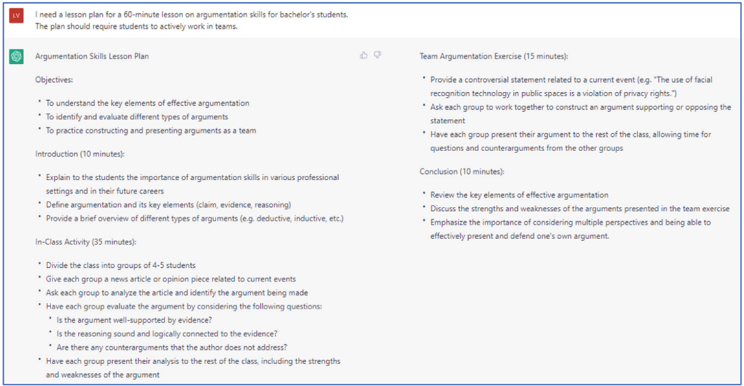
“Given its potential to act as an intelligent conversational agent, it can also provide students with valuable opportunities to improve their argumentation skills as another complex learning outcome through low-stakes practices (Bayat et al., 2022).”
BackgroundSelf-citationUse of Laptops and Other Technology in the Classroom
Spies, A. R., Kjos, A. L., Miesner, A. R., Chesnut, R. J., Fink, J. L., D'Antonio, N., & Russo‐Alvarez, G. (2010) · American Journal of Pharmaceutical Education · doi:10.5688/aj7408152 · Cited by 21 · cited 2×
“This option is not feasible because this generation of students has grown up with technology (Spies et al., 2010) and thus could always find a way to use new technologies such as ChatGPT behind the scene to do their assignments.”
BackgroundDo MOOCs Pose a Threat to Higher Education
Finkle, T. A., & Masters, E. (2014) · Research in higher education journal · Cited by 20
Evaluation of Conversational Skills for Commonsense
Baymurzina, D., Kuratov, Y., Kuznetsov, D., Kornev, D., & Burtsev, M. (2021) · Computational Linguistics and Intellectual Technologies · doi:10.28995/2075-7182-2021-20-1002-1011 · Cited by 7 · cited 1×
“This is mainly because of the high dependency of AI tools on the data that are trained without a deep understanding of the context (Dimitrov, 2023), common sense (Baymurzina et al., 2021), and emotions (Bakpayev et al., 2022), which are crucial for higher-order thinking.”
BackgroundBarbero (2014) · doi:10.1016/j · Cited by 1
Journal of Applied Learning & Teaching
(2019) · Journal of Applied Learning & Teaching · doi:10.37074/jalt
Research works printed but not linked: 1
- Haque, M. U., Dharmadasa, I., Sworna, Z. T., Rajapakse, R. N., & Ahmad, H. (2022). 'I think this is the most disruptive technology': Exploring sentiments of ChatGPT early adopters using Twitter data. arXiv. https://doi.org/10.48550/arXiv.2303.03836 . · arXiv · doi:10.48550/arxiv.2303.03836 · Paper page
Cited by
Grassini, S. (2023) · Education Sciences · doi:10.3390/educsci13070692 · Cited by 1,048
“On the other hand, educators should be educated in how to maximize the potential of ChatGPT in lesson preparation and evaluation [29,88], and students should be enlightened about the inherent limitations of ChatGPT [94,95], including its dependency on partial data [96], its circumscribed access to…”
BackgroundChallenges and Opportunities of Generative AI for Higher Education as Explained by ChatGPT
Michel-Villarreal, R., Vilalta-Perdomo, E., Salinas-Navarro, D. E., Thierry-Aguilera, R., & Gerardou, F. S. (2023) · Education Sciences · doi:10.3390/educsci13090856 · Cited by 877
“This is echoed in the literature as findings suggest that ChatGPT can provide personalized feedback on essays and become a tutoring system by stimulating critical thinking and debates among students [13].”
BackgroundBahroun, Z., Anane, C., Ahmed, V., & Zacca, A. (2023) · Sustainability · doi:10.3390/su151712983 · Cited by 784
Ooi, K.-B., Tan, G. W.-H., Al-Emran, M., Al-Sharafi, M. A., Capatina, A., Chakraborty, A., Dwivedi, Y. K., Huang, T.-L., Kar, A. K., Lee, V.-H., et al. (2025) · Journal of Computer Information Systems · doi:10.1080/08874417.2023.2261010 · Cited by 746
“78 Such technology can be harnessed to provide assessments on the students’ work (e.g., tasks, dissertations, and projects) and devise a grading matrix for evaluation.”
AI-generated feedback on writing: insights into efficacy and ENL student preference
Escalante, J., Pack, A., & Barrett, A. (2023) · International Journal of Educational Technology in Higher Education · doi:10.1186/s41239-023-00425-2 · Cited by 589
“Personalized learning through evaluating and giving feedback on essay writing has been identified as a potential strength of GenAI (Chiu et al., 2023; Farrokhnia et al., 2023; Zhu et al., 2023), which can, in turn, help decrease teacher workload (Farrokhnia et al., 2023) and prevent teacher burnout.”
Background
Metadata
- Authors
- Farrokhnia, M., Banihashem, S. K., Noroozi, O., & Wals, A.
- Affiliations
- Wageningen University & Research (NL)
- Open University of the Netherlands (NL)
- Corresponding author
- Noroozi, Omid
- Venue
- Innovations in Education and Teaching International
- Publisher
- Informa UK Limited
- Published
- 2023-03-27
- Volume
- 61
- Issue
- 3
- Pages
- 460-474
- ISSN
- 1470-3297 (ISSN-L)
- 1470-3300
- OpenAlex
- W4361204578
- Cited by
- 1,384
- References
- 68
- Citations by year
- 2026: 359 · 2025: 456 · 2024: 396 · 2023: 173
- FWCI
- 324.80
- Type
- journal article
- Language
- en
- Open access
- hybrid
- doi.org
- Licence
- Locations
- Innovations in Education and Teaching International (publishedVersion, cc-by-nc-nd)
- Socio-Environmental Systems Modeling (submittedVersion, cc-by-nc-nd)
- DSpace (Open University in the Netherlands) (submittedVersion, cc-by-nc-nd)
- Data Archiving and Networked Services (DANS) (submittedVersion, other-oa)
- Topics
- Social Sciences › Education › Artificial Intelligence in Education
- Health Sciences › Medicine › Health Informatics › Artificial Intelligence in Healthcare and Education
- Social Sciences › Education › Educational Technology in Learning
- Keywords
- ChatGPT, large language models, artificial intelligence in education, academic integrity, plagiarism, algorithmic bias, higher-order thinking skills, personalized learning, teacher workload, SWOT analysis
About these checks
Registry, retraction, Cites and statistics results are computed, not judged, with one exception: a printed reference that no index lists is read once by a model before it counts as a citation error. Claims are extracted by a model and kept only when their quote appears verbatim in the text; each cited source is then checked, with a model’s help, for whether it says what the claim relies on. Those verdicts can be wrong — read the claim’s quote and the cited source before relying on one.
Statistics and arithmetic are recomputed, not judged.
Confidence bands are shown only for fields calibrated on our annotated test set. None is calibrated yet, so no band is shown.
What counts as a claim ›How we measure confidence ›How we check this ›
Are you an author, or do you see a problem with this page? Request a review
Data sources
Bibliographic data: Semantic Scholar, OpenAlex, Crossref.
Contains information from the Semantic Scholar Academic Graph Datasets, made available under the ODC Attribution License (ODC-BY 1.0).
Semantic Scholar’s data is described in: Kinney, R., et al. (2023). The Semantic Scholar Open Data Platform. arXiv:2301.10140.
