

A SWOT analysis of ChatGPT: Implications for educational practice and research
Open accessThe DOI matches its Crossref record; 79 of the 79 references it cites were found in a registry or an index.
Abstract
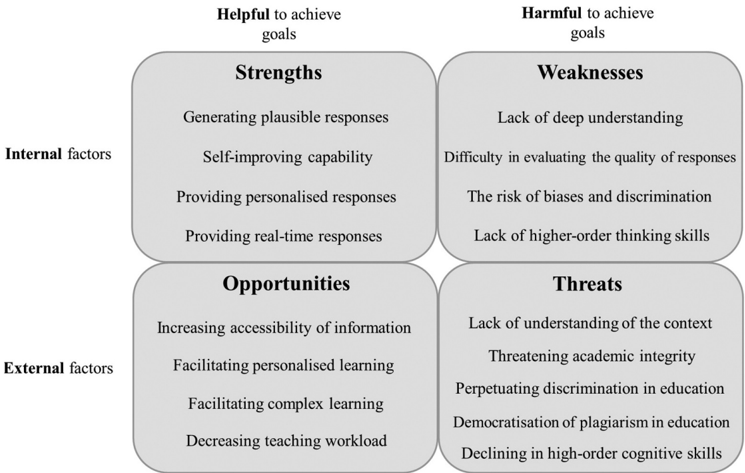
ChatGPT is an AI tool that has sparked debates about its potential implications for education. We used the SWOT analysis framework to outline ChatGPT’s strengths and weaknesses and to discuss its opportunities for and threats to education. The strengths include using a sophisticated natural language model to generate plausible answers, self-improving capability, and providing personalised and real-time responses. As such, ChatGPT can increase access to information, facilitate personalised and complex learning, and decrease teaching workload, thereby making key processes and tasks more efficient. The weaknesses are a lack of deep understanding, difficulty in evaluating the quality of responses, a risk of bias and discrimination, and a lack of higher-order thinking skills. Threats to education include a lack of understanding of the context, threatening academic integrity, perpetuating discrimination in education, democratising plagiarism, and declining high-order cognitive skills. We provide agenda for educational practice and research in times of ChatGPT.
Overview
The claims and statistics of this paper haven’t been checked yet.
Free: it reads the open-access text and checks the first 5 claims that cite a source we can check. Create a free account to check every claim.
Integrity signals
Registry
Cites
Statistics
Figures


Verification
Claims the paper makes
The claims and statistics of this paper haven’t been checked yet.
Free: it reads the open-access text and checks the first 5 claims that cite a source we can check. Create a free account to check every claim.
Claims other papers make about this one
Each is checked against this paper’s own text: does it say what the citing paper says it does?
The source backs part of the claim, not all of it — or backs it for a different population, condition or comparison.
In the citing paper
“Farrokhnia et al. [14] have demonstrated that employing GenAI tools might undermine advanced cognitive capabilities, such as critical and analytical thinking.”
From The Mediating Role of Generative AI Self-Regulation on Students’ Critical Thinking and Problem-Solving (2024) · cites this paper as [14]
Experimental — accuracy not yet measuredThe source backs part of the claim, not all of it — or backs it for a different population, condition or comparison.
In the citing paper
“A possible explanation for this discrepancy lies in the ambiguity surrounding what constitutes plagiarism when using AI-generated content.”
From Chat or cheat? Academic dishonesty, risk perceptions, and ChatGPT usage in higher education students (2025) · cites this paper as Farrokhnia et al., 2023
Experimental — accuracy not yet measuredThe source backs part of the claim, not all of it — or backs it for a different population, condition or comparison.
In the citing paper
“Student perceptions of academic dishonesty have historically been unclear or incomprehensive, and rarely align with teacher expectations (Tatum, 2022), GenAI will only serve to complicate this (Farrokhnia et al., 2023).”
From Not quite eye to A.I.: student and teacher perspectives on the use of generative artificial intelligence in the writing process (2023) · cites this paper as Farrokhnia et al., 2023
Experimental — accuracy not yet measuredThe cited source says what the claim attributes to it.
In the citing paper
“some students may not perceive their use as a policy violation and may unintentionally commit AIgiarism, as its outputs are not verbatim copies of existing texts”
From Chat or cheat? Academic dishonesty, risk perceptions, and ChatGPT usage in higher education students (2025) · cites this paper as Farrokhnia et al., 2023
In the citing paper
“This is echoed in the literature as findings suggest that ChatGPT can provide personalized feedback on essays and become a tutoring system by stimulating critical thinking and debates among students [13].”
From Challenges and Opportunities of Generative AI for Higher Education as Explained by ChatGPT (2023) · cites this paper as [13]
3 more claims about this paper
Create a free account to see every claim other papers make about this one.
Self-check
Percentages, sums and reported differences re-computed from the paper’s own numbers.
The self-check needs the paper’s full text.
Citations
Cites
ChatGPT for good? On opportunities and challenges of large language models for education
Kasneci, E., Sessler, K., Küchemann, S., Bannert, M., Dementieva, D., Fischer, F., Gasser, U., Groh, G., Günnemann, S., Hüllermeier, E., et al. (2023) · Learning and Individual Differences · doi:10.1016/j.lindif.2023.102274 · Cited by 15,365 · cited 3×
“ChatGPT’s superior performance is largely attributed to its massive amount of training data (Kasneci et al., 2023), enabling it to capture a wide range of linguistic patterns and relationships, thereby providing a fair understanding of language and context (Lecler et al., 2023; Wang et al., 2023).”
BackgroundMethodChatGPT for Good? On Opportunities and Challenges of Large Language Models for Education
Kasneci, E., Seßler, K., Küchemann, S., Bannert, M., Dementieva, D., Fischer, F., Gasser, U., Groh, G., Günnemann, S., Hüllermeier, E., et al. (2023) · doi:10.35542/osf.io/5er8f · Cited by 7,552
Best-worst multi-criteria decision-making method
Rezaei, J. (2015) · Omega · doi:10.1016/j.omega.2014.11.009 · Cited by 4,333 · cited 1×
“Therefore, empirical studies with quantitative approaches such as the best-worst method (see Rezaei, 2015) are necessary to extend the current review findings.”
BackgroundKung, T. H., Cheatham, M., ChatGPT, Medenilla, A., Sillos, C., De Leon, L., Elepaño, C., Madriaga, M., Aggabao, R., Diaz-Candido, G., et al. (2022) · doi:10.1101/2022.12.19.22283643 · Cited by 4,115
Kung, T. H., Cheatham, M., Medenilla, A., Sillos, C., De Leon, L., Elepaño, C., Madriaga, M., Aggabao, R., Diaz-Candido, G., Maningo, J., et al. (2023) · PLOS Digital Health · doi:10.1371/journal.pdig.0000198 · Cited by 4,115 · cited 1×
“It is also shown that ChatGPT has the potential to respond sufficiently to exam questions in the fields of medical (Kung et al., 2022) and law (Choi et al., 2023).”
BackgroundSallam, M. (2023) · Healthcare · doi:10.3390/healthcare11060887 · Cited by 3,126
Chatting and cheating: Ensuring academic integrity in the era of ChatGPT
Cotton, D. R. E., Cotton, P. A., & Shipway, J. R. (2024) · Innovations in Education and Teaching International · doi:10.1080/14703297.2023.2190148 · Cited by 3,087 · cited 5×
“…some scholars are concerned about the ethical considerations of ChatGPT (Mhlanga, 2023), as well as its potential negative effects on assessment practices (Rudolph et al., 2023), scientific integrity (Cotton et al., 2023; Shiri, 2023), and students’ higher-order thinking skills (Susnjak, 2022).”
BackgroundMethodInfluentialChatting and Cheating. Ensuring academic integrity in the era of ChatGPT
Cotton, D., Cotton, P., & Shipway, J. R. (2023) · doi:10.35542/osf.io/mrz8h · Cited by 3,079
Doyle, T. (2017) · The Information Society · doi:10.1080/01972243.2017.1354593 · Cited by 3,071 · cited 1×
“AI algorithms can also perpetuate discrimination by focusing on objectives like profits and efficiency without considering unintended consequences such as reinforcing existing biases (O’neil, 2017).”
Background
Research works printed but not linked: 1
- Haque, M. U., Dharmadasa, I., Sworna, Z. T., Rajapakse, R. N., & Ahmad, H. (2022). 'I think this is the most disruptive technology': Exploring sentiments of ChatGPT early adopters using Twitter data. arXiv. https://doi.org/10.48550/arXiv.2303.03836 . · arXiv · doi:10.48550/arxiv.2303.03836 · Paper page
Cited by
Items 301–400 of 1,006
Abdillah, H. Z., Partino, & Madjid, A. (2023) · E3S Web of Conferences · doi:10.1051/e3sconf/202344005005 · Cited by 39
“It facilitates broader access to information, enables personalized and complex learning, and alleviates the teaching workload, ultimately streamlining crucial educational processes and tasks [21].”
BackgroundStyve, A., Virkki, O. T., & Naeem, U. (2024) · 2024 IEEE Global Engineering Education Conference (EDUCON) · doi:10.1109/educon60312.2024.10578746 · Cited by 32
ChatGPT applications in Academic Research: A Review of Benefits, Concerns, and Recommendations
AlZaabi, A., ALAmri, A., Albalushi, H., Aljabri, R., & AalAbdulsalam, A. (2023) · doi:10.1101/2023.08.17.553688 · Cited by 32
“Its ability to learn from interactions and correct errors, with the guidance of experts, was also noted as a valuable feature[126].”
BackgroundInfluentialTowards human-AI collaborative urban science research enabled by pre-trained large language models
Fu, J., Han, H., Su, X., & Fan, C. H. (2024) · Urban Informatics · doi:10.1007/s44212-024-00042-y · Cited by 37
“This bias can persist and be reflected in PLMs after training (Farrokhnia et al., 2023; Jungwirth and Haluza, 2023).”
ChatGPT’s Impact Across Sectors: A Systematic Review of Key Themes and Challenges
Hussein, H., Gordon, M., Hodgkinson, C., Foreman, R., & Wagad, S. (2025) · Big Data and Cognitive Computing · doi:10.3390/bdcc9030056 · Cited by 34
“Given the right prompt, ChatGPT can write emails, provide feedback on writing, proofread, produce code, create images, take minutes, and translate between different languages.”
Xing, H., & Wen, G. J. (2025) · Education and Information Technologies · doi:10.1007/s10639-025-13505-9 · Cited by 37
“Following its launch, ChatGPT has been met with varied reactions from both the general public and scholarly circles (Adeshola & Adepoju, 2023; Farrokhnia et al., 2023; Rasul et al., 2023).”
InfluentialArtificial intelligence and academic integrity: exploring plagiarism in Ecuadorian universities
Torres-Díaz, J. C., Duart, J. M., Rivera-Rogel, D. D., & Flandoli, A. M. B. (2025) · International Journal for Educational Integrity · doi:10.1007/s40979-025-00209-3 · Cited by 32
“Moreover, when students perceive AI as infallible, they may overlook the need to verify information or acknowledge authorship, as emphasized by Farrokhnia et al. (2023).”
Govender, R. (2023) · Pythagoras · doi:10.4102/pythagoras.v44i1.787 · Cited by 32
Teaching English and Artificial Intelligence: EFL Teachers’ Perceptions and Use of ChatGPTPreprint
Dilzhan, B. (2024) · EdArXiv (OSF Preprints) · doi:10.35542/osf.io/fwy92 · Cited by 40
Jiao, J., Afroogh, S., Chen, K., Murali, A., Atkinson, D., & Dhurandhar, A. (2026) · SSRN Electronic Journal · doi:10.2139/ssrn.6836268 · Cited by 32
ChatGPT as a cognitive crutch: Evidence from a randomized controlled trial on knowledge retention
Barcaui, A. (2025) · Social Sciences & Humanities Open · doi:10.1016/j.ssaho.2025.102287 · Cited by 51
Xie, X., Teng, M. F., Zhang, L. J., & Alamer, A. (2025) · International Journal of Applied Linguistics · doi:10.1111/ijal.12798 · Cited by 31
So, H., Jang, H., Kim, M., & Choi, J. (2023) · Asia Pacific Journal of Education · doi:10.1080/02188791.2023.2294699 · Cited by 34
“As delineated in Table 1, the scholarly discourse reveals prevalent themes about the potential benefits of ChatGPT in education (Farrokhnia et al., 2023; Kasneci et al., 2023; Rahman & Watanobe, 2023; Rawas, 2023).”
BackgroundBibliometric Overview of ChatGPT: New Perspectives in Social Sciences
Oliński, M., Krukowski, K., & Sieciński, K. (2024) · Publications · doi:10.3390/publications12010009 · Cited by 36
“Farrokhnia 31]”
MethodGhimire, S. N., Bhattarai, U., & Baral, R. K. (2024) · Higher Education Research & Development · doi:10.1080/07294360.2024.2366323 · Cited by 36
“Likewise, based on their SWOT (strength, weakness, opportunities, and threats) analysis of ChatGPT within the context of HE, Farrokhnia et al. (2023) highlighted its strengths in reducing lesson workloads by generating convincing and self-improved replies, providing personalized and real-time…”
InfluentialGeorge-Reyes, C. E., Vilhunen, E., Martínez, R. A., & López-Caudana, E. O. (2024) · Frontiers in Education · doi:10.3389/feduc.2024.1378564 · Cited by 33
ChatGPT as a Digital Tool in the Transformation of Digital Teaching Competence: A Systematic Review
Cerero, J. F., Rueda, M. M., Graván, P. R., & Fernández‐Batanero, J. M. (2025) · Technologies · doi:10.3390/technologies13050205 · Cited by 39
“Several authors have pointed out its applications, benefits, challenges, and limitations in education [29,30], which reinforce the relevance of a systematic review that gathers and critically analyses this scattered information.”
Tajik, A. (2025) · Research Square · doi:10.21203/rs.3.rs-5788599/v1 · Cited by 36
“We Should Not Be Like a Dinosaur”—Using AI Technologies to Provide Formative Feedback to Students
Burner, T., Lindvig, Y., & Wærness, J. I. (2025) · Education Sciences · doi:10.3390/educsci15010058 · Cited by 30
Shen, Y., & Chen, L. (2026) · Computer Assisted Language Learning · doi:10.1080/09588221.2025.2479141 · Cited by 30
“…promote academic efficiency through human-like text generation, deep concerns arise regarding its potential negative influence on university students’ CT due to over-reliance or misuse of this tool in academic endeavors (Dergaa et al., 2023; Farrokhnia et al., 2023; Stokel-Walker, 2022).”
InfluentialBabu, C. V. S., & Adhithya, S. (2023) · Advances in educational technologies and instructional design book series · doi:10.4018/979-8-3693-0205-7.ch007 · Cited by 32
ChatGPT-Generated and Student-Written Historical Narratives: A Comparative Analysis
Kindenberg, B. (2024) · Education Sciences · doi:10.3390/educsci14050530 · Cited by 35
Analyzing teacher candidates' arguments on AI integration in education via different chatbots
Duran, V. (2024) · Digital Education Review · doi:10.1344/der.2024.45.68-83 · Cited by 38
Who speaks through the machine? Generative AI as discourse and implications for management
Agbon, G. (2024) · Critical Perspectives on Accounting · doi:10.1016/j.cpa.2024.102761 · Cited by 17
ChatGPT: a transformative role in academia-insights into academic staff performance since adoption
Sadallah, M., Bin-Nashwan, S., & Benlahcene, A. (2024) · Journal of Information, Communication and Ethics in Society · doi:10.1108/jices-07-2024-0097 · Cited by 23
Wen, Y., Zhao, X., Li, X., & Zang, Y. (2025) · Sustainability · doi:10.3390/su17031127 · Cited by 39
Zhu, Z., Ren, Y., & Shen, A. (2025) · Education and Information Technologies · doi:10.1007/s10639-025-13551-3 · Cited by 32
“Moreover, they have significantly contributed to real-time problem solving and visualization of design concepts in art education (Cotton et al., 2023; Farrokhnia et al., 2023).”
Unpacking the Factors Shaping TESOL Teachers' GenAI Literacy From an Ecological Perspective
Yang, L., & Derakhshan, A. (2026) · TESOL Quarterly · doi:10.1002/tesq.70095 · Cited by 39
Benefits and risks of using ChatGPT in higher education: A theoretical review
Bermus, A. G. (2024) · Pedagogy Theory & Practice · doi:10.30853/ped20240099 · Cited by 35
Teacher’s Experience Using ChatGPT in Language Teaching: An Exploratory Study
Nugroho, A., Putro, N. H. P. S., Syamsi, K., Mutiaraningrum, I., & Wulandari, F. D. (2024) · Computers in the Schools · doi:10.1080/07380569.2024.2441161 · Cited by 33
Integrating AI in teacher education: exploring the impact on preservice teacher competencies
Lee, H., & Bryan, L. M. (2025) · Professional Development in Education · doi:10.1080/19415257.2025.2490000 · Cited by 15
Zheng, X., & Zhang, J. (2025) · Scientific Reports · doi:10.1038/s41598-025-05026-9 · Cited by 32
Alkaabi, A. M., Abdallah, A. K., Alblooshi, S., Alomari, F., & Alneaimi, S. (2025) · Journal of Education and e-Learning Research · doi:10.20448/jeelr.v12i2.6746 · Cited by 31
“For instance, it can create or recommend lesson materials, lesson plans, curricula , and even perform assessment analyses (Farrokhnia, Banihashem, Noroozi, & Wals, 2024; Lo, 2023; Zhai, 2022).”
van den Berg, G. (2025) · Discover Education · doi:10.1007/s44217-025-00596-2 · Cited by 32
“ChatGPT can, therefore, act as a tutor by providing personalised, explanatory and formative feedback on essays and assignments [13, 32].”
Sharma, D. (2024) · Business and Professional Communication Quarterly · doi:10.1177/23294906241254780 · Cited by 31
“Sometimes, ChatGPT can give very wrong and incorrect answers in a very professional and formal language (Farrokhnia et al., 2023).”
Experimental evidence for the efficacy of generative AI in improving students' writing skills
Ironsi, C. S., & Solomon Ironsi, S. (2025) · Quality Assurance in Education · doi:10.1108/qae-04-2024-0065 · Cited by 28
Watanabe, A. (2024) · The Electronic Journal of e-Learning · doi:10.34190/ejel.21.5.3229 · Cited by 28
“Therefore, not only do AI-assisted teaching and learning practices present new opportunities for higher education, but also challenges and threats (Farrokhnia, et al., 2023; Lo, 2023).”
BackgroundHow can ChatGPT assist hospitality and tourism education?
Zhang, K., Li, X., Ye, H., Lin, K. J., Chen, S., & Law, R. (2024) · Journal of Teaching in Travel & Tourism · doi:10.1080/15313220.2024.2384743 · Cited by 29
“Although recent research has explored the potential benefits of ChatGPT for academic work (Farrokhnia et al., 2023; Ivanov & Soliman, 2023; Skavronskaya et al., 2023), further research is needed to provide practical guidance to educators on integrating LLMs, such as ChatGPT, into contemporary H&T…”
Koroleva, D. O., & Jogezai, N. A. (2024) · Information and Learning Sciences · doi:10.1108/ils-10-2023-0137 · Cited by 30
Rutherford, T. A., Rodrigues, A., Duque-Baird, S., Veng, S., Mykyta‐Chomsky, R., Cao, Y., Chisholm, K., & Bergwall, E. (2025) · Computers and Education Artificial Intelligence · doi:10.1016/j.caeai.2025.100367 · Cited by 36
Sun, C., Huang, S., Sun, B., & Chu, S. (2025) · Discover Artificial Intelligence · doi:10.1007/s44163-025-00252-6 · Cited by 32
Arruda, E. P., & Arruda, D. E. P. (2024) · Sustainable Economies · doi:10.62617/se.v2i2.34 · Cited by 28
“Farrokhnia [12], in turn, states that AI can enable more efficient interactions between students and teachers, changing the way we research and create content.”
BackgroundChang, Y., Silalahi, A. D. K., & Lee, K.-Y. (2024) · International Journal of Human-Computer Interaction · doi:10.1080/10447318.2024.2381930 · Cited by 36
“While studies consistently identify factors contributing to uncertainty, such as ethical challenges (Farrokhnia et al., 2023), privacy concerns (Catherine et al., 2023; Mijwil et al., 2023; Paul et al., 2023), issues of trans-parency (Sallam, 2023), and information accuracy (Foroughi et al., 2023),…”
The shifting landscape of student engagement: A pre-post semester analysis in AI-enhanced classrooms
Bognár, L., & Khine, M. S. (2025) · Computers and Education Artificial Intelligence · doi:10.1016/j.caeai.2025.100395 · Cited by 38
Generative AI Integration in K-12 Settings: Teachers’ Perceptions and Levels of Integration
An, Y., & James, S. (2025) · TechTrends · doi:10.1007/s11528-025-01114-9 · Cited by 30
“Also, GenAI lacks higher-order thinking skills, such as critical and analytical thinking, and it is unable to evaluate the accuracy and quality of the data used to train it or the information it generates (Farrokhnia et al., 2023; Lecler et al., 2023; Sallam, 2023).”
InfluentialReconsidering teacher assessment literacy in GenAI-enhanced environments: A scoping review
Cui, Y. H., Meng, Y., & Tang, L. (2025) · Teaching and Teacher Education · doi:10.1016/j.tate.2025.105163 · Cited by 29
Holzmann, P., Gregori, P., & Schwarz, E. J. (2025) · Education and Information Technologies · doi:10.1007/s10639-025-13708-0 · Cited by 27
“…undesired academic behavior, including unoriginal work, insufficiently trustworthy output, and new forms of plagiarism (Ali et al., 2024; Bin-Nashwan et al., 2023; Chatterjee & Dethlefs, 2023; Farrokhnia et al., 2023; Hughes et al., 2025; Lo et al., 2024; Stokel-Walker, 2022; Wirtz et al., 2019).”
InfluentialRizun, N., Bordean, O. N., Nikiforova, A., Beleiu, I. N., & Revina, A. (2026) · Computers and Education Open · doi:10.1016/j.caeo.2026.100336 · Cited by 36
ChatGPT between opportunities and challenges: an empirical study in Italy
Pasca, M. G., & Arcese, G. (2024) · The TQM Journal · doi:10.1108/tqm-08-2023-0268 · Cited by 32
ChatGPT in early childhood STEM education: Can it be an innovative tool to overcome challenges?
Uğraş, H., & Uğraş, M. (2024) · Education and Information Technologies · doi:10.1007/s10639-024-12960-0 · Cited by 33
“The main reason for this is that educators are concerned about some important challenges and ethical issues (Farrokhnia et al., 2023; Kasneci et al., 2023; Owoc et al., 2021 ).”
Privacy fatigue and its effects on ChatGPT acceptance among undergraduate students: is privacy dead?
Chung, J., & Kwon, H.-Y. (2025) · Education and Information Technologies · doi:10.1007/s10639-024-13198-6 · Cited by 33
“Although concerns regarding ChatGPT are evident, one notable demographic that seems to favor its use is undergraduate students (Cotton et al., 2023 ; Farrokhnia et al., 2023).”
AI chatbots: A disguised enemy for academic integrity?
Niloy, A. C., Hafiz, R., Hossain, B. M., Gulmeher, F., Sultana, N., Islam, K. F., Bushra, F., Islam, S., Hoque, S. I., Rahman, M., et al. (2024) · International Journal of Educational Research Open · doi:10.1016/j.ijedro.2024.100396 · Cited by 26
Zhang, M., & Crosthwaite, P. (2026) · International Review of Applied Linguistics in Language Teaching · doi:10.1515/iral-2024-0196 · Cited by 26
“According to a comprehensive SWOT (Strengths, Weaknesses, Opportunities, Threats) analysis of ChatGPT ’ s impact on education (Farrokhnia et al. 2024), despite strengths in terms of information access, reducing teaching workloads, and personalised learning, weaknesses of ChatGPT include limited…”
Alharbi, W. (2024) · International Journal of Computer-Assisted Language Learning and Teaching · doi:10.4018/ijcallt.351245 · Cited by 26
Using ChatGPT in Teaching Arabic as a Foreign Language
Nasaruddin, N. (2024) · ARABIYATUNA Jurnal Bahasa Arab · doi:10.29240/jba.v8i1.9413 · Cited by 34
Albaloul, O., Marttinen, R. H. J., & Killian, C. M. (2024) · Journal of Physical Education Recreation & Dance · doi:10.1080/07303084.2024.2378776 · Cited by 28
System 2 Thinking in OpenAI’s o1-Preview Model: Near-Perfect Performance on a Mathematics Exam
de Winter, J., Dodou, D., & Eisma, Y. B. (2024) · Computers · doi:10.3390/computers13110278 · Cited by 32
“In education, ChatGPT has transformed teaching practices [2,3], while in academic research, many students and scholars now rely on the tool to assist in writing papers and reports [4,5,6,7,8].”
Backgroundvan den Berg, S., & Papadopoulos, P. M. (2024) · Innovations in Education and Teaching International · doi:10.1080/14703297.2024.2436613 · Cited by 32
“This type of technology is characterised by simulating human intelligence activities and adopting behaviours like learning, judgement, and decision-making (Farrokhnia et al., 2023).”
AI Writing Assistants and Student Competence: A Linguistic Aspect
Pryma, V., Pelivan, O. K., Телецька, Т. В., Цобенко, О. В., & Zagrebelna, N. (2025) · Arab World English Journal · doi:10.24093/awej/ai.18 · Cited by 30
Valentine Joseph Owan, P. D., Chukwu, C. O., Agama, V. U., Owan, T. J., Ogar, J. O., & Etorti, I. J. (2025) · Discover Education · doi:10.1007/s44217-025-00770-6 · Cited by 30
“Although several studies reveal a generally positive disposition among students toward AI-supported learning, acceptance levels remain uneven and may be influenced by factors such as ethical concerns, infrastructural disparities, and varying levels of digital readiness [16, 27, 29].”
InfluentialDu, C., Tang, M., Wang, C., Zou, B., Xia, Y., & Du, Y. (2025) · Innovation in Language Learning and Teaching · doi:10.1080/17501229.2025.2555515 · Cited by 31
Fock, A., & Siller, H.-S. (2025) · International Journal of STEM Education · doi:10.1186/s40594-025-00589-5 · Cited by 30
“SWOT analyses originally stem from management (Helms & Nixon, 2010) but have been used in various other disciplines, including the field of AI in education (e.g., Denecke et al., 2023; Farrokhnia et al., 2024).”
Kortemeyer, G., & Bauer, W. (2024) · Physical Review Physics Education Research · doi:10.1103/physrevphyseducres.20.010145 · Cited by 27
Ardyansyah, A., Yuwono, A. B., Rahayu, S. L., Alsulami, N. M., & Sulistina, O. (2024) · Journal of Chemical Education · doi:10.1021/acs.jchemed.4c00220 · Cited by 29
Banihashem, S. K., Gašević, D., & Noroozi, O. (2025) · Journal of Computer Assisted Learning · doi:10.1111/jcal.70056 · Cited by 31
Self-citationKaniwa, Y., Kuribayashi, M., Kayukawa, S., Sato, D., Takagi, H., Asakawa, C., & Morishima, S. (2024) · Proceedings of the ACM on Human-Computer Interaction · doi:10.1145/3676492 · Cited by 33
Ahmed, F. R., Rushdan, E. E., Al‐Yateem, N., Almaazmi, A. N., Subu, M. A., Hijazi, H. H. A., Abdelbasset, W. K., Mottershead, R., Ahmed, A. A., & AbuRuz, M. E. (2024) · Teaching and learning in nursing · doi:10.1016/j.teln.2024.12.002 · Cited by 26
Teachers’ early uptake of genAI in teaching and learning: important questions and answers
Collie, R. J., & Martin, A. J. (2025) · Social Psychology of Education · doi:10.1007/s11218-025-10052-6 · Cited by 28
“…educational settings (Carvalho et al., 2022). genAI presents numerous opportunities, but also challenges for schooling—from time saving for teachers who can develop lesson plans more quickly, to the risk of increased plagiarism or surface-level learning for students (Farrokhnia et al., 2023 ).”
Arum, R., Leon, M. D. C., Li, X., & Lopes, J. (2025) · AERA Open · doi:10.1177/23328584251331956 · Cited by 33
“Scholars have noted the potential of this tool to encourage technological overreliance and discourage critical thinking among students (Chan & Hu, 2023; Farrokhnia et al., 2024).”
Sok, S., Heng, K., & Pum, M. (2025) · SAGE Open · doi:10.1177/21582440251353575 · Cited by 30
“AI may not fully grasp the nuances of certain subjects, making it unable to provide the depth of analysis and critical thinking that humans can (Farrokhnia et al., 2023; Haleem et al., 2022).”
Pretorius, L., Huynh, H.-H., Pudyanti, A. A. A. R., Li, Z., Noori, A. Q., & Zhou, Z. (2025) · The Internet and Higher Education · doi:10.1016/j.iheduc.2025.101038 · Cited by 28
Kaya, M. H., & Adıgüzel, T. (2025) · Frontiers in Education · doi:10.3389/feduc.2025.1652292 · Cited by 33
The use of AI Chatbots in higher education: the problem of plagiarism
Prokhorova, Y., Gujrati, R., & Uygun, H. (2024) · Review of Artificial Intelligence in Education · doi:10.37497/rev.artif.intell.educ.v5i00.31 · Cited by 26
ARTIFICIAL INTELLIGENCE IN HIGHER EDUCATION. A LITERATURE REVIEW
Heredia–Carroza, J., & Stoica, R. (2024) · Journal of Public Administration Finance and Law · doi:10.47743/jopafl-2023-30-09 · Cited by 28
“In 2023) used SWOT analysis to query ChatGPT’s advantages and disadvantages, as well as its potential benefits and risks for education.”
BackgroundMethodEffects of AI-Based ChatGPT on Higher Education LibrariesPreprint
Aithal, S., & Aithal, P. S. (2023) · SSRN Electronic Journal · doi:10.2139/ssrn.4453581 · Cited by 27
Luke, W. A. N. V., Seow Chong, L., Ban, K. H., Wong, A. H., Zhi Xiong, C., Shuh Shing, L., Taneja, R., Samarasekera, D. D., & Yap, C. T. (2024) · Medical Teacher · doi:10.1080/0142159x.2024.2308779 · Cited by 24
Tang, G., & Eaton, S. E. (2024) · Journal of Scholarly Publishing · doi:10.3138/jsp-2023-0079 · Cited by 25
Xia, T., Pan, X., Cao, M., & Guo, J. (2025) · Education and Information Technologies · doi:10.1007/s10639-025-13491-y · Cited by 27
“Second, the text analysis ability of existing AI technologies is not yet fully mature, and such technologies often fail to answer certain questions asked by users accurately because of a lack of understanding of the context (Farrokhnia et al., 2024).”
AI and ChatGPT in Higher Education: Greek Students’ Perceived Practices, Benefits, and Challenges
Κώστας, Α., Paraschou, V., Spanos, D., Tzortzoglou, F., & Sofos, A. (2025) · Education Sciences · doi:10.3390/educsci15050605 · Cited by 25
Alhusban, M. I., Khatatbeh, I. N., & Alshurafat, H. (2025) · Competitiveness Review An International Business Journal incorporating Journal of Global Competitiveness · doi:10.1108/cr-06-2024-0121 · Cited by 33
Zhao, X., Chen, X., & Cox, A. (2025) · Policy Futures in Education · doi:10.1177/14782103251395436 · Cited by 26
Academic Integrity in a Digital Era: Should the Use of ChatGPT Be Banned in Schools?
f, F., f, F., & f, F. (2023) · GLOBAL BUSINESS & FINANCE REVIEW · doi:10.17549/gbfr.2023.28.7.1 · Cited by 24
Torres, J. M. (2024) · Journal of Business & Finance Librarianship · doi:10.1080/08963568.2024.2321729 · Cited by 25
“…must address concerns about potential copyright violations when using scholarly articles without permission, sharing fraudulent information, and committing plagiarism; they should also ensure that the relevant ethical standards are upheld for the distributed information (Farrokhnia et al., 2023).”
BackgroundAssessing Concepts, Procedures, and Cognitive Demand of ChatGPT-generated Mathematical Tasks
Sapkota, B., & Bondurant, L. (2024) · International Journal of Technology in Education · doi:10.46328/ijte.677 · Cited by 31
“Farrokhnia et al. (2023) listed the following four potential weaknesses of using ChatGPT in education: (a) lack of deep understanding, (b) difficulty in evaluating the quality of responses, (c) the risk of biases and discrimination, and (d) lack of higher-order thinking skills.”
Backgroundvan Rensburg, J. J. (2024) · Discover Education · doi:10.1007/s44217-024-00113-x · Cited by 24
Bukar, U. A., Sayeed, M. S., Razak, A., Yogarayan, S., & Sneesl, R. (2024) · Education Sciences · doi:10.3390/educsci14090959 · Cited by 27
Charkova, D. A. (2024) · Discover Education · doi:10.1007/s44217-024-00225-4 · Cited by 30
“While there is an increasing amount of scientific literature on ChatGPT, the majority of it provides hypothetical projections of its benefits and drawbacks for various educational contexts [2, 4, 6, 13, 15, 24].”
ChatGPT in language education: Centering learner voices
Hellmich, E. A., Vinall, K., Brandt, Z. M., Chen, S., & Sparks, M. M. (2024) · Technology in Language Teaching & Learning · doi:10.29140/tltl.v6n3.1741 · Cited by 26
Huang, H.-W., Teng, D. C.-E., & Tiangco, J. A. N. Z. (2025) · Journal of Science Education and Technology · doi:10.1007/s10956-024-10179-9 · Cited by 23
“Furthermore, AI chatbots have demonstrated the potential to foster active engagement and knowledge acquisition by offering personalized content and immediate feedback, thus promoting a learner-centric approach (Farrokhnia et al., 2023; Yilmaz & Yilmaz, 2023a).”
Guo, X. (2025) · Interactive Learning Environments · doi:10.1080/10494820.2024.2445177 · Cited by 23
“To this end, it is desirable to automate the generation of feedback via AI-power solutions to complement and enhance traditional feedback methods (Farrokhnia et al., 2024).”
Farinosi, M., & Melchior, C. (2025) · European Journal of Education · doi:10.1111/ejed.70094 · Cited by 23
How University students in Bangladesh engage with ChatGPT: A qualitative study
Hasib, M., & Islam, M. S. (2025) · PLoS ONE · doi:10.1371/journal.pone.0333089 · Cited by 29
“Research highlights that ChatGPT’s context-aware responses significantly enhance student engagement and reduce instructional burdens, underlining the importance of balanced integration, digital literacy, and authentic assessment practices [27].”
ChatGPT for Founding Teams: An Entrepreneurial Pedagogical Innovation
Hammoda, B. (2024) · International Journal of Technology in Education · doi:10.46328/ijte.530 · Cited by 18
“The results and recommendations provided by ChatGPT must be subjected to due consideration and reflections by the user to avoid potential bias and inaccuracies, however (Farrokhnia et al., 2023; Mucharraz et al., 2023).”
InfluentialChatGPT als Unterstützung von Lehrkräften – Einordnung, Analyse und Anwendungsbeispiele
Hein, L., Högemann, M., Illgen, K.-M., Stattkus, D., Kochon, E., Reibold, M.-G., Eckle, J., Seiwert, L., Beinke, J. H., Knopf, J., et al. (2024) · HMD Praxis der Wirtschaftsinformatik · doi:10.1365/s40702-024-01052-9 · Cited by 25
Teachers’ perceptions of the risks and benefits of AI in higher education: A case study of ERNIE Bot
Wang, N., & Li, M. (2024) · Innovations in Education and Teaching International · doi:10.1080/14703297.2024.2432429 · Cited by 28
“AI can automate routine tasks, such as grading and administrative work, allowing educators to focus on more critical teaching responsibilities, such as facilitating meaningful discussions and providing individualised support to students (Farrokhnia et al., 2023).”
InfluentialUnderstanding Students' Acceptance of ChatGPT as a Translation Tool: A UTAUT Model AnalysisPreprint
Wang, L., Xu, S., & Liu, K. (2024) · arXiv (Cornell University) · doi:10.48550/arxiv.2406.06254 · Cited by 29
“A thorough understanding of the implications of using ChatGPT in the translation process is crucial for responsible use, particularly among inexperienced students (Farrokhnia et al., 2023).”
BackgroundInfluentialChatGPT-generated versus human direct corrective feedback on L2 writing
Muñoz Muñoz, B. C., Nassaji, H., & Bello Carrillo, F. I. (2025) · System · doi:10.1016/j.system.2025.103805 · Cited by 22
Kangwa, D., Msafiri, M. M., & Fute, A. (2025) · Journal of Computer Assisted Learning · doi:10.1111/jcal.70109 · Cited by 22
Gao, M., Zhang, H., Dong, Y., & Li, J. (2025) · Educational Studies · doi:10.1080/03055698.2025.2483831 · Cited by 25
Sun, N., & Sun, Y. (2025) · Acta Psychologica · doi:10.1016/j.actpsy.2025.105546 · Cited by 25
Metadata
- Authors
- Farrokhnia, M., Banihashem, S. K., Noroozi, O., & Wals, A.
- Affiliations
- Wageningen University & Research (NL)
- Open University of the Netherlands (NL)
- Corresponding author
- Noroozi, Omid
- Venue
- Innovations in Education and Teaching International
- Publisher
- Informa UK Limited
- Published
- 2023-03-27
- Volume
- 61
- Issue
- 3
- Pages
- 460-474
- ISSN
- 1470-3297 (ISSN-L)
- 1470-3300
- OpenAlex
- W4361204578
- Semantic Scholar
- e9685cf2c9aff2f7ff7bcfa5b65a11e90687a3ef
- Cited by
- 1,384
- References
- 68
- Citations by year
- 2026: 359 · 2025: 456 · 2024: 396 · 2023: 173
- FWCI
- 324.80
- Type
- journal article
- Language
- en
- Open access
- hybrid
- doi.org
- Licence
- Locations
- Innovations in Education and Teaching International (publishedVersion, cc-by-nc-nd)
- Socio-Environmental Systems Modeling (submittedVersion, cc-by-nc-nd)
- DSpace (Open University in the Netherlands) (submittedVersion, cc-by-nc-nd)
- Data Archiving and Networked Services (DANS) (submittedVersion, other-oa)
- Topics
- Social Sciences › Education › Artificial Intelligence in Education
- Health Sciences › Medicine › Health Informatics › Artificial Intelligence in Healthcare and Education
- Social Sciences › Education › Educational Technology in Learning
- Keywords
- ChatGPT, large language models, artificial intelligence in education, academic integrity, plagiarism, algorithmic bias, higher-order thinking skills, personalized learning, teacher workload, SWOT analysis
About these checks
Registry, retraction, Cites and statistics results are computed, not judged, with one exception: a printed reference that no index lists is read once by a model before it counts as a citation error. Claims are extracted by a model and kept only when their quote appears verbatim in the text; each cited source is then checked, with a model’s help, for whether it says what the claim relies on. Those verdicts can be wrong — read the claim’s quote and the cited source before relying on one.
Statistics and arithmetic are recomputed, not judged.
Confidence bands are shown only for fields calibrated on our annotated test set. None is calibrated yet, so no band is shown.
What counts as a claim ›How we measure confidence ›How we check this ›
Are you an author, or do you see a problem with this page? Request a review
Data sources
Bibliographic data: Semantic Scholar, OpenAlex, Crossref.
Contains information from the Semantic Scholar Academic Graph Datasets, made available under the ODC Attribution License (ODC-BY 1.0).
Semantic Scholar’s data is described in: Kinney, R., et al. (2023). The Semantic Scholar Open Data Platform. arXiv:2301.10140.
