

The pursuit of quality in grounded theory
Open accessThe DOI matches its Crossref record; 84 of the 85 references it cites were found in a registry or an index, and 1 are not checked yet; 2 of the 63 sources its claims cite were checked for support.
Abstract
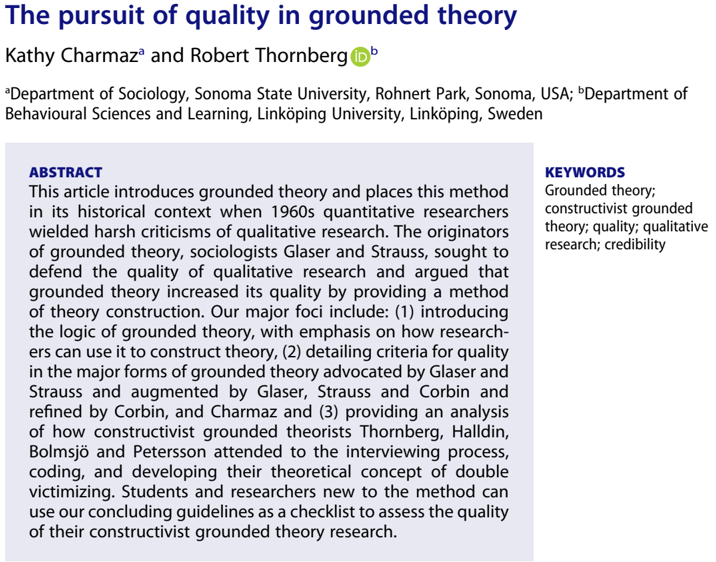
This article introduces grounded theory and places this method in its historical context when 1960s quantitative researchers wielded harsh criticisms of qualitative research. The originators of grounded theory, sociologists Glaser and Strauss, sought to defend the quality of qualitative research and argued that grounded theory increased its quality by providing a method of theory construction. Our major foci include: (1) introducing the logic of grounded theory, with emphasis on how researchers can use it to construct theory, (2) detailing criteria for quality in the major forms of grounded theory advocated by Glaser and Strauss and augmented by Glaser, Strauss and Corbin and refined by Corbin, and Charmaz and (3) providing an analysis of how constructivist grounded theorists Thornberg, Halldin, Bolmsjö and Petersson attended to the interviewing process, coding, and developing their theoretical concept of double victimizing. Students and researchers new to the method can use our concluding guidelines as a checklist to assess the quality of their constructivist grounded theory research.
Verified 2026-11-22 · 1 reference not checked yet
Overview
CoChat Summary
TL;DR
This article reviews grounded theory’s historical development and argues that quality criteria must fit the specific version of grounded theory, culminating in constructivist criteria and a checklist. It illustrates constructivist quality through Thornberg et al.’s (2013) study of school bullying and the concept of double victimizing.
Key findings
- Quality criteria differ across grounded theory versions: original Glaser and Strauss focused on credibility and applicability with fitness, understanding, generality, and control; Glaser added workability, relevance, fit, and modifiability; Strauss and Corbin emphasized data quality, plausibility/value of theory, adequacy of process, and empirical grounding; constructivist Charmaz proposes credibility, originality, resonance, and usefulness.
- The paper argues quality is built through iterative data collection and analysis, line-by-line and focused coding, memo-writing, theoretical sampling and saturation, constant comparison, and reflexivity/methodological self-consciousness.
- In the illustrative constructivist study, Thornberg et al. (2013) distributed 523 open-ended questionnaires to students in three secondary schools and two universities in Sweden; of 511 responses, 168 reported past bullying, 36 volunteered, and 21 who had been bullied for more than one year were interviewed; analysis produced the core category “double victimizing” (external and internal victimizing).
- In psychology, Rubin, Bell, and McCleland (2018) found only 13% of responding graduate psychology programs required a qualitative research course, and respondents described qualitative research as “inaccurate,” “subjective,” and “lacking rigor” while also describing it as providing the “best methods for feminist, community-based, and social justice research.”
Methods
- Design: methodological/conceptual article introducing grounded theory, comparing quality criteria across Glaserian, Straussian, and constructivist versions, and offering guidelines/checklist for constructivist grounded theory.
- Data or sample: no primary empirical sample for the article; it analyzes historical and methodological literature and uses Thornberg et al. (2013) as an illustrative constructivist grounded theory study (523 questionnaires; 511 responses; 168 bullied; 36 volunteers; 21 interviewed).
- Main analysis: narrative synthesis and comparison of quality criteria, with an illustration of coding, constant comparison, memo-writing, theoretical sampling, and category development leading to “double victimizing.”
Limitations
- Stated: the authors caution that checklists risk becoming a “methodological crutch” that avoids deep engagement with method and data (citing Barbour 2001), and present their guidelines as flexible, not substitutes for rigorous research.
- Stated: criteria for quality in qualitative research remain unsettled, with “little consensus” about appropriate evaluation criteria, and meanings of quality markers may differ among researchers.
- Evident from the text: the article is not an empirical validation of the checklist; the double victimizing case is a secondary illustration rather than a new test, and the guidelines are aimed mainly at constructivist grounded theory though claimed mostly applicable to other versions.
Model-written summary. Check it against the paper before relying on it.
Integrity signals
Registry
Cites
Statistics
Figures



Verification
Claims the paper makes
2 Valid · 13 Not valid · 38 Not checked · 38 Own results and interpretations
None of the sources cited for this claim have been checked yet.
In the paper
“Concerns about objectivity, validity, reliability and replicability in qualitative research still pervade academic psychology.”
§ The pursuit of quality in grounded theory > Qualitative research and psychology
plain- Asserted: passes — The authors put it forward as true.
- Checkable: passes — It can be checked against evidence.
- Load-bearing: passes — The paper’s conclusions depend on it.
- Based: passes — The paper gives a reason why it holds.
In the paper
“Until Glaser and Strauss's (1967) statement, little had been written, much less codified into a systematic statement, about how to construct a qualitative theoretical analysis of high quality.”
§ The pursuit of quality in grounded theory > Concerns about quality in the development of grounded theory
What the sources say
- Not matchedcites Glaser and Strauss's (1967)
An author–year citation the paper’s reference list doesn’t settle. We don’t search these by name.
plain- Asserted: passes — The authors put it forward as true.
- Checkable: passes — It can be checked against evidence.
- Load-bearing: unclear — It is unclear whether the paper’s conclusions depend on it.
- Based: passes — The paper gives a reason why it holds.
- Not matched
A statement the paper makes itself — it cites no source for it, so there is none to check. The quote shows it is in the paper.
In the paper
“If, however, researchers only ask the same questions of each participant, they are likely to elicit similar stories about the topic.”
§ The pursuit of quality in grounded theory > Introduction
hedgedstates a possible cause- Asserted: passes — The authors put it forward as true.
- Checkable: passes — It can be checked against evidence.
- Load-bearing: passes — The paper’s conclusions depend on it.
- Based: passes — The paper gives a reason why it holds.
A statement the paper makes itself — it cites no source for it, so there is none to check. The quote shows it is in the paper.
In the paper
“If, however, researchers systematically interrogate their data as they gather it, their early ideas can then inform subsequent data collection.”
§ The pursuit of quality in grounded theory > Introduction
plainstates a possible cause- Asserted: passes — The authors put it forward as true.
- Checkable: passes — It can be checked against evidence.
- Load-bearing: passes — The paper’s conclusions depend on it.
- Based: passes — The paper gives a reason why it holds.
A statement the paper makes itself — it cites no source for it, so there is none to check. The quote shows it is in the paper.
In the paper
“When answering quantitative social scientists' sharp criticisms of its quality, Glaser and Strauss rejected the common practice of evaluating qualitative research according to the tenets of the quantitative tradition.”
§ The pursuit of quality in grounded theory > Concerns about quality in the development of grounded theory
plain- Asserted: passes — The authors put it forward as true.
- Checkable: passes — It can be checked against evidence.
- Load-bearing: unclear — It is unclear whether the paper’s conclusions depend on it.
- Based: passes — The paper gives a reason why it holds.
22 more claims
Create a free account to see all 91 claims and to verify the 7 references still open.
- Probably not a substantial claim. 61
- It may state two separate claims as one. 26
Claims other papers make about this one
Each is checked against this paper’s own text: does it say what the citing paper says it does?
The source backs part of the claim, not all of it — or backs it for a different population, condition or comparison.
In the citing paper
“An explicitly constructivist approach aims to produce an abstract understanding of a phenomenon (rather than an explanation, as in other versions of GTM)”
From Quality Criteria: General and Specific Guidelines for Qualitative Approaches in Psychology Research. A Concise Guide for Novice Researchers and Reviewers (2024) · cites this paper as Charmaz & Thornberg, 2021
Experimental — accuracy not yet measuredThe source backs part of the claim, not all of it — or backs it for a different population, condition or comparison.
In the citing paper
“Constant comparison is a systematic strategy combining the advantages of simultaneous data generation and analysis, enabling a concentration on significant issues (Charmaz and Thornberg, 2021).”
From Application and challenges of using a Constructivist Grounded Theory methodology to address an undertheorized clinical challenge: A discussion paper (2024) · cites this paper as Charmaz and Thornberg, 2021
Experimental — accuracy not yet measuredThe cited source says what the claim attributes to it.
In the citing paper
“focuses on actions, meanings and constructions”
From Quality Criteria: General and Specific Guidelines for Qualitative Approaches in Psychology Research. A Concise Guide for Novice Researchers and Reviewers (2024) · cites this paper as Charmaz & Thornberg, 2021
The cited source says what the claim attributes to it.
In the citing paper
“and acknowledges both subjectivity (of participants and researchers) and context (Charmaz, 2014; Charmaz & Thornberg, 2021).”
From Quality Criteria: General and Specific Guidelines for Qualitative Approaches in Psychology Research. A Concise Guide for Novice Researchers and Reviewers (2024) · cites this paper as Charmaz & Thornberg, 2021
The cited source says what the claim attributes to it.
In the citing paper
“The primary focus is the theory ' s ability to clarify participants ' lives and contribute to knowledge and practice (Charmaz & Thornberg, 2021).”
From Quality Criteria: General and Specific Guidelines for Qualitative Approaches in Psychology Research. A Concise Guide for Novice Researchers and Reviewers (2024) · cites this paper as Charmaz & Thornberg, 2021
6 more claims about this paper
Create a free account to see every claim other papers make about this one.
Citations
Cites
Using thematic analysis in psychology
Braun, V., & Clarke, V. (2006) · Qualitative Research in Psychology · doi:10.1191/1478088706qp063oa · Cited by 194,414
The Discovery of Grounded Theory: Strategies for Qualitative Research.
Wagner, H. R., Glaser, B. G., & Strauss, A. L. (1968) · Social Forces · doi:10.2307/2575405 · Cited by 46,361
The Discovery of Grounded Theory; Strategies for Qualitative Research
Glaser, B. G., Strauss, A. L., & Strutzel, E. (1968) · Nursing Research · doi:10.1097/00006199-196807000-00014 · Cited by 39,449
Basics of Qualitative Research: Grounded Theory Procedures and Techniques.
Ellis, C., Strauss, A., & Corbin, J. (1992) · Contemporary Sociology · doi:10.2307/2074814 · Cited by 29,249
Basics of Qualitative Research (3rd ed.): Techniques and Procedures for Developing Grounded Theory
Corbin, J., & Strauss, A. (2008) · SAGE · doi:10.4135/9781452230153 · Cited by 24,827
(2006) · Cited by 18,730
Self-citationBasics of Qualitative Research
Ozanne, J. L., Strauss, A., & Corbin, J. (1992) · Journal of Marketing Research · doi:10.2307/3172751 · Cited by 17,850 · cited 2×
“In their development of grounded theory, Strauss and Corbin (1990; Corbin and Strauss 1990; Strauss and Corbin 1998) emphasized four general criteria: (1) quality of the data, in other words, grounded theorists need to carefully address and adopt quality criteria related to methods used for data…”
BackgroundMethodBasics of Qualitative Research: Grounded Theory Procedures and Techniques
Long, D. R., Strauss, A., & Corbin, J. (1993) · The Modern Language Journal · doi:10.2307/328955 · Cited by 17,576
(2014) · Cited by 15,747
Self-citationInterviewing as qualitative research a guide for researchers in education and the social sciences
Seidman, I. (2006) · Cited by 12,757
Research works printed but not linked: 5
- 10. Charmaz, K. 1995. Between positivism and postmodernism: implications for methods. In Studies in symbolic interaction, vol. 17, N. K. Denzin (Ed.), pp. 43-72. Greenwich, CT: JAI Press.
- 17. Cisneros-Puebla, C. A. 2007. The deconstructive and reconstructive faces of social construc- tion: Kenneth Gergen in conversation with César A. Cisneros-Puebla. With an introduction by Robert B. Faux [83 paragraphs]. Forum Qualitative Sozialforschung/Forum: Qualitative Social Research 9 (1):Art. 20. http://nbn-resolving.de/urn:nbn:de:0114-fqs0801204 .
- 26. Glaser, B. G. 1978. Theoretical sensitivity. Mill Valley, CA: Sociology Press.
- 27. Glaser, B. G. 1992. Basics of grounded theory analysis. Mill Valley, CA: Sociology Press.
- 30. Glaser, B. G. 2013. No preconceptions: The grounded theory dictum. Mill Valley, CA: Sociology Press.
Cited by
Items 1,001–1,100 of 1,191
Papadaki, E., House, R., & Woodhouse, A. (2026) · Journal of Forensic Practice · doi:10.1108/jfp-12-2025-0111
Incarceration and Re-entry for Provincial Prisoners: Is there Hope?
Zerebeski, K. N. (2023) · doi:10.36939/ir.202307071115
Imagining and Preventing the Future Existence of Bodies with Variations in Sex Characteristics
Danon, L. M., Paperna, T., Daum, H., & Zuckerman, S. (2025) · Archives of Sexual Behavior · doi:10.1007/s10508-025-03261-9
“We collected and analyzed the data based on six stages of thematic analysis (Clarke et al., 2015) and the grounded theory approach (Charmaz & Thornberg, 2021).”
Fernee, C. R., Mattsson, M. T., Lyytinen, P., & Harper, N. J. (2026) · International Journal of Environmental Research and Public Health · doi:10.3390/ijerph23030394
“Theory-generating approaches, such as constructivist grounded theory [33,34], are particularly helpful when attempting to develop new conceptual frameworks from within a discipline and to “move beyond description through constructing new concepts that explicate what is happening” [35] (p. 307).”
Cheffer, M. H., Weizemann, L. P., França, S. G. L., et al. (2025) · Ciência ET Praxis · doi:10.36704/cipraxis.v21i36.8169
Understanding UGC popularity on social media: A grounded theory-based conceptual frameworkPreprint
Zhou, J., Ho, H.-W., & Chen, C. (2026) · Research Square · doi:10.21203/rs.3.rs-10186716/v1
Wu, C., Yin, Z., Hamilton, X. D., Chen, W., & Li, Y. (2026) · Sport Education and Society · doi:10.1080/13573322.2026.2713739 · Cited by 1
Unjust Desserts! Unravelling the Gender-Specific Dimensions of Female Sexual Offending
Worley, R. M., Gummelt, G., & Worley, V. B. (2023) · Deviant Behavior · doi:10.1080/01639625.2023.2214288
A grounded theory model of students’ graphical reasoning on derivative-antiderivative relationships
Haghjoo, S., Radmehr, F., Reyhani, E., & Rafiepour, A. (2026) · Educational Studies in Mathematics · doi:10.1007/s10649-026-10509-1
“As Charmaz and Thornberg (2021) note, grounded theory is further characterized by “the researcher’s analytical focus emerging during the research process, rather than being predetermined before the empirical inquiry begins” (p. 305).”
Sirohi, A., & Wilkin, H. A. (2026) · The Journal of Sex Research · doi:10.1080/00224499.2026.2613212
“Constant comparison of participant responses helped identify themes and sub-themes (Charmaz & Thornberg, 2021; Glaser, 1992).”
Yokoo, M., Nomura, S., Fukui, S., et al. (2025) · Intestinal Research · doi:10.5217/ir.2024.00048
Dissolving Organizational Bounds - Does Blockchain Digitalize Trust?
Holm, K., Mathiasen, J. B., Goduscheit, R. C., & de Haas, H. (2022) · Academy of Management Proceedings · doi:10.5465/ambpp.2022.11934abstract · Cited by 1
Mussert, C. M. A., Kempers, E. K., van Hoorn, E. S., Kerimoğlu, E., Melles, M., Gielen, M. A., Albayrak, A., Ahaus, K., Reitsma, S. H., Gouw, S. C., et al. (2026) · Haemophilia · doi:10.1111/hae.70383
Courtel, N. (2023) · Carleton University's Institutional Repository (MacOdrum Library, Carleton University) · doi:10.22215/etd/2023-15570
Gan, W., Xiao, M., Chen, S., Song, X., & Mohammed, T. A. (2025) · Global Education Bulletin · doi:10.71052/grb2025/ajdd6336
Building Sustainable and Ethical Peace Through Funding in Northern Ireland and the Border Counties
Maiangwa, B., Byrne, S., Sani, M., et al. (2026) · Springer eBooks · doi:10.1007/978-3-032-17458-1_5
van Beekum, J. M., van Geuns, D., Stuit, F., et al. (2026) · Journal of Occupational Medicine and Toxicology · doi:10.1186/s12995-026-00517-5
“Therefore, it was concluded that data saturation had been reached [15].”
Mulenga-Wincierz, M., & Derrer‐Merk, E. (2025) · Research Square · doi:10.21203/rs.3.rs-7837315/v1
Glon, C., & Walker, A. (2025) · Kinésithérapie la Revue · doi:10.1016/j.kine.2025.06.012
Soil and Water Management Practices in Cocoa Production in Ghana and Ecuador
Phelan, L. (2021) · DMU Open Research Archive (De Montfort University)
Kurt, G., Almeamari, F., El-Dardery, H., Kardouh, A., Wong, S., McGrath, M., Klein, L. A., Beetar, A., Lekkeh, S. A., El-Vecih, A., et al. (2025) · medRxiv · doi:10.1101/2025.04.25.25326442
Navigating a learning journey in person-centered leadership: a grounded theory study
Wising, J., Klinga, C., Lalloo, E. C., Carlström, E., & Barenfeld, E. (2026) · BMC Health Services Research · doi:10.1186/s12913-026-14798-3
“Con-GT is well suited for identifying processes and actions [28, 29], and was therefore considered appropriate for exploring how leaders learn within a leadership program focused on person-centered leadership.”
Constructivist Grounded Theory: Appropriateness for Ethical MarketingPreprint
Malik, F. (2023) · SSRN Electronic Journal · doi:10.2139/ssrn.4606654 · Cited by 1
Processo da medicalização infantojuvenil por Metilfenidato: estudo de método misto
Cheffer, M. H., Queiroz, J. F. M., Campos, T. A., et al. (2024) · Contribuciones a las Ciencias Sociales · doi:10.55905/revconv.17n.1-348
von der Forst, M., Popp, E., Schaefer, H., Bikowski, K., Ries, M., & Küllenberg, J. K. (2025) · medRxiv · doi:10.1101/2025.05.01.25326786 · Cited by 1
Pardo, M., & Adlerstein, C. (2024) · Early Years Journal of International Research and Development · doi:10.1080/09575146.2024.2379026 · Cited by 4
“In doing so, the methodology enables the production of middle-range theory with explanatory power based on a coherent and rigorous scientific structure (Glaser 2007; Urquhart 2013) and general qualitative trust-worthiness procedures (Charmaz and Thornberg 2021; Clarke and Reiner 2014).”
Using art to illustrate medical empathy to physician assistants
Cooper, C. K. (2023) · Digital Repository Service (Northeastern University) · doi:10.17760/d20621618
Jeter, S. (2024) · Journal of African American Women and Girls in Education · doi:10.21423/jaawge-v4i2a120 · Cited by 1
Mercado, M. M. C., de Lima, C. M., & Córdoba, A. L. P. (2025) · Educación y Educadores · doi:10.5294/edu.2023.26.3.3 · Cited by 4
“El empleo de la GTC permite aprender de los mundos y la indagación empírica, a través de la in-teracción directa entre los participantes e investi-gadores, sin la exigencia de asumir neutralidad en la construcción de la teoría emergente (Charmaz y Thornberg, 2021).”
Mohamed, M., Sahid, S., & Buang, N. A. (2025) · International Journal of Academic Research in Accounting Finance and Management Sciences · doi:10.6007/ijarafms/v15-i2/25484
Wu, D., Zhao, Y., Attri, R., Gupta, B., & Papa, A. (2026) · Business Strategy and the Environment · doi:10.1002/bse.70500 · Cited by 2
Chum, P. J. (2026) · International journal of evidence based coaching and mentoring · doi:10.1177/17418305261455167
Theory of Quality: Meta-Synthesis and Theory Construction
Liew, C. A. (2024) · Open Journal of Social Sciences · doi:10.4236/jss.2024.1210035 · Cited by 3
Nikbin, A., Kazemian, G., & Sharifzadegan, M. H. (2024) · International Planning Studies · doi:10.1080/13563475.2024.2432903
“Instead, Charmaz and Thornberg (2021) propose four criteria for evaluating constructivist grounded theory: credibility, originality, resonance, and usefulness.”
SEGURANÇA DOS ALIMENTOS EM COZINHAS RESIDENCIAIS
MENDES, S. R., CHAMON, T. A., Bonna, L. D., AQUINO, M. C. B., DOMINGOS, M. M., & José, J. F. B. D. S. (2023) · Editora Terried eBooks · doi:10.48209/978-65-84959-17-9
Knowledge transparency in art education: A visual inquiry reflection
Willcox, L., Goss, S., Grodoski, C., et al. (2025) · Visual Inquiry · doi:10.1386/vi_00120_1
Wentzel, K. E., Rubin, S. C., Coots, C., Mesa, A., Galaviz, V. D., Keltz, J., Stifani, B. M., & Ryntz, T. (2025) · Journal of Minimally Invasive Gynecology · doi:10.1016/j.jmig.2025.10.002
Korean Clients’ Perspectives on the Real Relationship in Counseling: A Qualitative Inquiry
Lee, Y. M., Ha, J. H., & Jue, J. (2026) · SAGE Open · doi:10.1177/21582440261491958
Hardie, A., & Chawansky, M. (2026) · Qualitative Research in Sport Exercise and Health · doi:10.1080/2159676x.2026.2640542
“Together, the authors reached agreement on the broader categories for interpretation on the phenomena and determined clear categorical properties (Charmaz and Thornberg 2021).”
Turelli, F. C., Vaz, A., & Kirk, D. L. (2026) · International Review for the Sociology of Sport · doi:10.1177/10126902261430118
Fulton, T. B., Penner, J. C., Collins, S. A., van der Schaaf, M. F., & OʼBrien, B. C. (2025) · Perspectives on Medical Education · doi:10.5334/pme.1766
An exploration of the concept of integrated palliative cancer care in the Indonesian context
Haroen, H. (2022) · Queensland University of Technology · doi:10.5204/thesis.eprints.228734 · Cited by 3
TESCH, A. D. D. M. R., & SENRA, L. X. (2023) · Editora Terried eBooks · doi:10.48209/978-65-84959-17-b
Barman, L., Weurlander, M., Lindqvist, H., Thornberg, R., & Wernerson, A. M. (2026) · Advances in Health Sciences Education · doi:10.1007/s10459-026-10512-4 · Cited by 2
“Given that inquiries and knowledge are always provisional, fallible, and constantly open to revision, this decision was inevitably based on our subjective interpretation (Thornberg et al., 2023) that sufficient data had been gathered (Charmaz & Thornberg, 2021).”
Self-citationKoch, G., Stumpf, T., & Haque, A. S. M. (2026) · Springer eBooks · doi:10.1007/978-3-658-49157-4_18
Democratizing Academic Entrepreneurship: An Interpretive Insight
Loyola, M. S., & Selby, C. J. (2025) · South Asian Journal of Business and Management Cases · doi:10.1177/22779779251326210 · Cited by 2
“This was carefully done by highlighting the response phrases with different colours by both authors separately while preserving the participants’ original terminology (Charmaz & Thornberg, 2021).”
Watkins, S., Brown, R., Crengle, S. M., Percival, T., & Ward, K. L. (2025) · International Journal of Qualitative Methods · doi:10.1177/16094069251335447
Wu, D., Song, S., Liu, S., Yi, Y., & Wu, S. (2026) · Buildings · doi:10.3390/buildings16142746
de Santana, A. T., Couto, T. M., & de Oliveira, P. S. (2026) · Revista da Escola de Enfermagem da USP · doi:10.1590/1980-220x-reeusp-2025-0331es
Analysis of Qualitative Research
Bitsani, E., Tsekos, T., Thymi, I., & Marava, G. (2026) · Cities, heritage and transformation · doi:10.1007/978-3-032-17584-7_8
Asian Journal of Basic Science & Research
(2020) · Asian Journal of Basic Science & Research · doi:10.38177/ajbsr
The Transformative Impact of AI-based (Smart-care) Technology on Ensuring 3Es:Preprint
Gupta, A. D., Sharma, K., & Tripathi, S. S. (2026) · Research Square · doi:10.21203/rs.3.rs-4838690/v1
Jian, Z., Zhong, W., & Yuan, B. (2026) · SAGE Open · doi:10.1177/21582440261479012
Improving Consent in Trauma: Recall (ICIT: Recall)
Feng, T., Ablett, A. D., Scott, C. E. H., et al. (2025) · Bone & Joint Open · doi:10.1302/2633-1462.63.bjo-2024-0190
“11 It is based on the belief that interviews allow co-construction of meaning through emergent interactions in a mutual exploration of the patient’s perspectives and experiences, allowing interviewers to engage in reflexivity and interpret data using their own theoretical perspectives.”
Future anxiety among young adult Palestinian Arabs in Israel post-October 7th
Elias, H. (2026) · The British Journal of Social Work · doi:10.1093/bjsw/bcag089
Dadashpoor, H., & Dehghan, R. (2026) · City and Environment Interactions · doi:10.1016/j.cacint.2026.100422
Quandt, V. I., & Ondrusch, N. (2024) · International Journal of Higher Education Pedagogies · doi:10.33422/ijhep.v5i2.585 · Cited by 1
“Not all questions had to be answered at each gathering, but each week the protocol had to be handed in. Data analysis was performed through content analysis, with management and comparison of the structured data, based on the grounded theory (Glaser & Strauss, 2017; Charmaz & Thornberg, 2021).”
MethodNielsen, T. R., & Møller, N. H. (2026) · ACM Transactions on Computing for Healthcare · doi:10.1145/3845800
de Santana, A. T., Couto, T. M., & de Oliveira, P. S. (2026) · Revista da Escola de Enfermagem da USP · doi:10.1590/1980-220x-reeusp-2025-0331pt
Individual in online polarization: Development of the online polarized aggression scale (OPAS)
Li, H., Zhou, Z., Cui, X., & Zhao, N. (2026) · Personality and Individual Differences · doi:10.1016/j.paid.2026.113815
Reconceptualizing the Possible: “Warming Up” the Aspirations of Community College Students
Björk, C. (2024) · Community College Journal of Research and Practice · doi:10.1080/10668926.2024.2355877
“Although constant comparison analysis is frequently relied on to generate new theoretical contributions to an issue, Charmaz and Thornberg (2021) posit that this approach is also an effective method for “illumi-nating the situations of people denied a public voice” (p. 306).”
강제된 돌봄을 넘어 회복으로: 가족돌봄청소년 및 청년의 돌봄 경험 과정과 유형에 대한 질적 연구*
임, 소., Kim, J., & 이, 재. (2026) · Journal of Family Relations · doi:10.21321/jfr.31.1.283
Akomolafe, B., Ma, J., & Moreno‐Cruz, J. (2025) · IEEE Electrical Power and Energy Conference (EPEC) · doi:10.1109/epec65543.2025.11230389 · Cited by 1
“Grounded Theory is a research method that derives an abstract theory that offers inductive knowledge of a process, issue or action [26], [27].”
People-centred strategies to integrate disaster and climate resilience in Zimbabwe
Nyahunda, L., Nemakonde, L. D., & Khoza, S. (2025) · International Journal of Disaster Resilience in the Built Environment · doi:10.1108/ijdrbe-09-2024-0100
Thomas, K. A., Malo, L., & Rogers, I. (2026) · Qualitative Social Work · doi:10.1177/14733250261446688
“Analysis of interview data followed a qualitative content analysis approach (Kim et al., 2017) that utilized a two-cycle coding approach informed by Saldaña (2021) and included the grounded theory technique of constant comparison (Charmaz and Thornberg, 2021).”
What are the needs of critical illness survivors during recovery at home in Aotearoa (New Zealand)?
Sutton, L., Bell, E. M., Every‐Palmer, S., & Skirrow, P. M. (2025) · Kōtuitui New Zealand Journal of Social Sciences Online · doi:10.1080/1177083x.2025.2519170 · Cited by 2
“The aim was to co-construct a picture of survivorship recovery, support, and service needs, bringing together the researcher’s and participants’ perspectives, central to the constructivist approach (Charmaz and Thornberg 2021).”
Petiot, O., Hinault, A., Kermarrec, G., et al. (2026) · Quest · doi:10.1080/00336297.2026.2689195
Sharda, H. K., & Nowell, L. S. (2026) · Nurse Education Today · doi:10.1016/j.nedt.2026.107317
Atkinson, A. (2025) · The Canadian Review of Art Education / Revue canadienne d’éducation artistique · doi:10.26443/crae.v51i1.1122 · Cited by 1
How Hate Speech Occurs and is Propagated on Social Media? A Grounded Theory Study
Megersa, T., & Minaye, A. (2025) · Howard Journal of Communications · doi:10.1080/10646175.2025.2590041
Giovannini-Green, Z. E., Mugford, G., & Philpott, D. (2026) · PLOS mental health · doi:10.1371/journal.pmen.0000612
“This study used an approach first pioneered by Glaser and Strauss, referred to as theoretical sampling [28,33].”
InfluentialBecoming Well: A Grounded Theory of Wellness Continuity and Discontinuity Through Fitness Practices
Salvacion, A. J., & Baradillo, D. G. (2026) · Psychology and Education A Multidisciplinary Journal · doi:10.70838/pemj.541004
Smoot, J. A., Valley, S. N., Fitzsimmons, B., & Mollet, A. L. (2026) · International Journal of Transgender Health · doi:10.1080/26895269.2026.2664758
Arquitecturas de la práctica pedagógica en la educación inicial colombiana
Vargas-González, Á. P., & Adlerstein, C. (2025) · Perfiles Educativos · doi:10.22201/iisue.24486167e.2025.47.61834 · Cited by 1
High Priority Traumatic Brain Injury Science: Analysis of the National Trauma Research Action Plan
Rakhit, S., Xiao, D., Alvarado, F. A., et al. (2025) · Journal of Surgical Research · doi:10.1016/j.jss.2025.01.021
Knauf, H. (2022) · Erziehungswissenschaftliche Edition: Persönlichkeitsbildung in Schule · doi:10.1007/978-3-658-36942-2_10
Crafting Empathetic Characters: A Dual Approach to Enhancing Emotional Depth in Character Design
Ribeiro, T., Veloso, A. I., & Brinson, P. (2025) · Lecture notes in computer science · doi:10.1007/978-3-031-92578-8_16
Moisan, M.-G., Chatterjee, A., So, M., Ma, C. T., Hart, J. A., Xiong, S., & Mason, M. (2025) · Children and Youth Services Review · doi:10.1016/j.childyouth.2025.108279
Vitorino, J., Marques, C. L., PEREIRA, M., & Laranjeira, C. (2023) · Editora Terried eBooks · doi:10.48209/978-65-84959-17-2
Head in the clouds, feet on the ground: navigating paradoxes in the twin transitions
Ceschel, F., Marchegiani, L., Bartoli, C., Gerardi, L., & Boccardelli, P. (2026) · Management Decision · doi:10.1108/md-01-2025-0157 · Cited by 2
Breaking Barriers: Navigational Strategies for Latina Entrepreneurs in Male-Dominated Sectors
Asrifan, A., Octaberlina, L. R., Herlina, H., Jakob, J. C., Nurdiansyah, E., Syafaruddin, A. R. A., & Sulaeman, S. (2025) · IGI Global eBooks · doi:10.4018/979-8-3693-5928-0.ch001
How Do Teacher Candidates Develop Their Identities as Teachers? A Philippine Case Study
Vindollo, S. C., & de Guzman, A. B. (2026) · Springer international handbooks of education · doi:10.1007/978-981-95-2423-5_35
Bereaved parents’ experiences of baby loss stigma: A meta-ethnography
Corcoran, R. L., Shirley, L. J., Clancy, A., & Smith, D. M. (2026) · Death Studies · doi:10.1080/07481187.2026.2659895 · Cited by 2
Policies and pre-service teacher perspectives on summative assessment literacy in Sweden and Finland
Fröjdendahl, B., Yıldırım, A., Oscarson, A. D., & Hildén, R. (2026) · Education Inquiry · doi:10.1080/20004508.2026.2676287
Rafferty, K. A., Cox, T. L., & Grande, S. W. (2026) · Frontiers in Global Women s Health · doi:10.3389/fgwh.2026.1891942
“This collaborative decision reflects a more “flexible approach to grounded theory” and the application of an inductive analytic process that allows researchers to elicit new themes and perspectives from the data itself rather than from preconceived hypotheses (33).”
Rathod, R. K., & Tapas, P. (2025) · Management · doi:10.58691/man/211082
“…a systematic yet flexible approach for generating Theory directly from empirical data, particularly suitable when existing theoretical frameworks are insufficient to explain emergent phenomena in complex, dynamic environments (Charmaz, 2006; Charmaz & Thornberg, 2021; Corbin & Strauss, 2014).”
Porter, T. S., Carrico, S., Flores, M., Godden, M., & Draughon, J. E. (2026) · Substance Use & Misuse · doi:10.1080/10826084.2026.2633226 · Cited by 1
“Unexplained gaps in the data were addressed through this continued inductive process until theoretical saturation occurred (Charmaz & Thornberg, 2021).”
Schuler, E., Wilson, N., Koch, S. E., et al. (2026) · American Journal of Hospice and Palliative Medicine® · doi:10.1177/10499091261476560
Valencia-Contrera, M., Avilés, L., & Febré, N. (2025) · Frontiers in Public Health · doi:10.3389/fpubh.2025.1663762 · Cited by 2
“Analysis began with the first round of data collection (50), generating an initial coding phase, followed by an iterative cycle of analysis and additional data collection.”
Stewart, K. (2025) · Journal of Australian indigenous issues · doi:10.3316/informit.t2025070300003400511360526
Jamaludin, K. A., Nasri, N., & Nasri, N. M. (2025) · Innovations in Education and Teaching International · doi:10.1080/14703297.2025.2581304
de Vries, K., Greaves, B., & Brown, J. (2026) · Aging & Mental Health · doi:10.1080/13607863.2025.2606874
“This was part of the co-construction process and offered an opportunity to carry out theoretical sampling and continue to check, develop, and refine categories and identify any gaps in the data (Charmaz 2017; Charmaz and Thornberg 2021; Foley et al. 2021).”
Exploring work-related cosmology events: lessons from the COVID-19 pandemic
Schweitzer, L., Lyons, S. T., Smith, C. J., & Lauch, K. (2025) · International Journal of Organization Theory and Behavior · doi:10.1108/ijotb-07-2024-0127 · Cited by 2
Responsive learning in practice: A grounded theory
Harvey, C., Hocking, C. S., & Jones, M. (2025) · Scandinavian Journal of Occupational Therapy · doi:10.1080/11038128.2025.2578329 · Cited by 1
“An abstract core category was constructed as the most significant code, relating to and accounting for more data than the other categories, subsuming the higher-level categories and explicating the properties and connections between them [25,37].”
Influential
Metadata
- Authors
- Charmaz, K., & Thornberg, R.
- Affiliations
- Sonoma State University (US)
- Linköping University (SE)
- Corresponding author
- Thornberg, Robert
- Venue
- Qualitative Research in Psychology
- Publisher
- Informa UK Limited
- Published
- 2020-06-22
- Volume
- 18
- Issue
- 3
- Pages
- 305-327
- ISSN
- 1478-0887 (ISSN-L)
- 1478-0895
- OpenAlex
- W3036803033
- Cited by
- 1,221
- References
- 81
- Citations by year
- 2026: 264 · 2025: 290 · 2024: 255 · 2023: 221 · 2022: 128 · 2021: 54 · 2020: 8
- FWCI
- 155.56
- Type
- journal article
- Language
- en
- Open access
- hybrid
- doi.org
- Licence
- Locations
- Qualitative Research in Psychology (publishedVersion, cc-by-nc-nd)
- Topics
- Social Sciences › Education › Qualitative Research Methods and Applications
- Social Sciences › Sociology and Political Science › Qualitative Research Methods and Ethics
- Social Sciences › Sociology and Political Science › Sociology and Education Studies
- Keywords
- grounded theory, constructivist grounded theory, qualitative research quality, theory development, Glaser and Strauss, interviewing, coding, history of grounded theory
About these checks
Registry, retraction, Cites and statistics results are computed, not judged, with one exception: a printed reference that no index lists is read once by a model before it counts as a citation error. Claims are extracted by a model and kept only when their quote appears verbatim in the text; each cited source is then checked, with a model’s help, for whether it says what the claim relies on. Those verdicts can be wrong — read the claim’s quote and the cited source before relying on one.
The claim verdicts this report counts are experimental: their accuracy is not yet measured.
A language model drew the claims from the paper on 2026-09-28, under version 3 of the claim definition (model deepseek-v4.1-flash, prompt extract-v3).
A second model labelled each claim on 2026-09-28 (model jev-1.13-20260917, definition revision gold-guideline-v0.2).
Statistics and arithmetic are recomputed, not judged.
Confidence bands are shown only for fields calibrated on our annotated test set. None is calibrated yet, so no band is shown.
What counts as a claim ›How we measure confidence ›How we check this ›
Are you an author, or do you see a problem with this page? Request a review
Data sources
Bibliographic data: Semantic Scholar, OpenAlex, Crossref.
Contains information from the Semantic Scholar Academic Graph Datasets, made available under the ODC Attribution License (ODC-BY 1.0).
Semantic Scholar’s data is described in: Kinney, R., et al. (2023). The Semantic Scholar Open Data Platform. arXiv:2301.10140.
