

The pursuit of quality in grounded theory
Open accessThe DOI matches its Crossref record; 84 of the 85 references it cites were found in a registry or an index, and 1 are not checked yet; 2 of the 63 sources its claims cite were checked for support.
Abstract
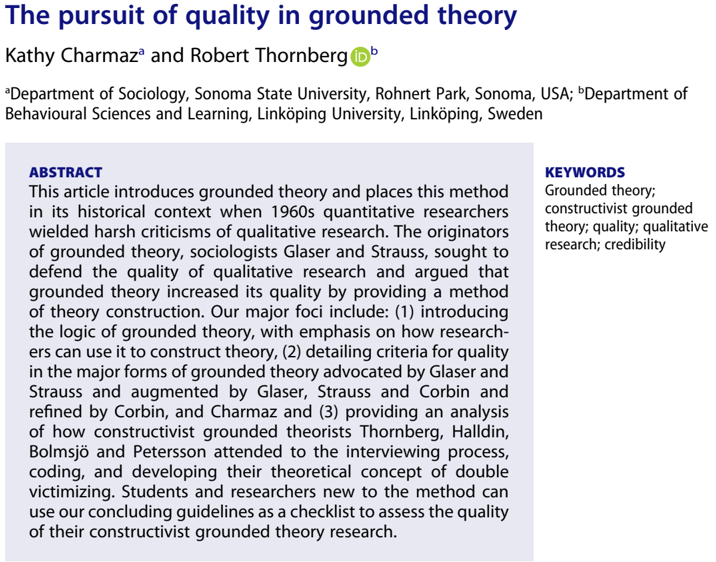
This article introduces grounded theory and places this method in its historical context when 1960s quantitative researchers wielded harsh criticisms of qualitative research. The originators of grounded theory, sociologists Glaser and Strauss, sought to defend the quality of qualitative research and argued that grounded theory increased its quality by providing a method of theory construction. Our major foci include: (1) introducing the logic of grounded theory, with emphasis on how researchers can use it to construct theory, (2) detailing criteria for quality in the major forms of grounded theory advocated by Glaser and Strauss and augmented by Glaser, Strauss and Corbin and refined by Corbin, and Charmaz and (3) providing an analysis of how constructivist grounded theorists Thornberg, Halldin, Bolmsjö and Petersson attended to the interviewing process, coding, and developing their theoretical concept of double victimizing. Students and researchers new to the method can use our concluding guidelines as a checklist to assess the quality of their constructivist grounded theory research.
Verified 2026-11-22 · 1 reference not checked yet
Overview
CoChat Summary
TL;DR
This article reviews grounded theory’s historical development and argues that quality criteria must fit the specific version of grounded theory, culminating in constructivist criteria and a checklist. It illustrates constructivist quality through Thornberg et al.’s (2013) study of school bullying and the concept of double victimizing.
Key findings
- Quality criteria differ across grounded theory versions: original Glaser and Strauss focused on credibility and applicability with fitness, understanding, generality, and control; Glaser added workability, relevance, fit, and modifiability; Strauss and Corbin emphasized data quality, plausibility/value of theory, adequacy of process, and empirical grounding; constructivist Charmaz proposes credibility, originality, resonance, and usefulness.
- The paper argues quality is built through iterative data collection and analysis, line-by-line and focused coding, memo-writing, theoretical sampling and saturation, constant comparison, and reflexivity/methodological self-consciousness.
- In the illustrative constructivist study, Thornberg et al. (2013) distributed 523 open-ended questionnaires to students in three secondary schools and two universities in Sweden; of 511 responses, 168 reported past bullying, 36 volunteered, and 21 who had been bullied for more than one year were interviewed; analysis produced the core category “double victimizing” (external and internal victimizing).
- In psychology, Rubin, Bell, and McCleland (2018) found only 13% of responding graduate psychology programs required a qualitative research course, and respondents described qualitative research as “inaccurate,” “subjective,” and “lacking rigor” while also describing it as providing the “best methods for feminist, community-based, and social justice research.”
Methods
- Design: methodological/conceptual article introducing grounded theory, comparing quality criteria across Glaserian, Straussian, and constructivist versions, and offering guidelines/checklist for constructivist grounded theory.
- Data or sample: no primary empirical sample for the article; it analyzes historical and methodological literature and uses Thornberg et al. (2013) as an illustrative constructivist grounded theory study (523 questionnaires; 511 responses; 168 bullied; 36 volunteers; 21 interviewed).
- Main analysis: narrative synthesis and comparison of quality criteria, with an illustration of coding, constant comparison, memo-writing, theoretical sampling, and category development leading to “double victimizing.”
Limitations
- Stated: the authors caution that checklists risk becoming a “methodological crutch” that avoids deep engagement with method and data (citing Barbour 2001), and present their guidelines as flexible, not substitutes for rigorous research.
- Stated: criteria for quality in qualitative research remain unsettled, with “little consensus” about appropriate evaluation criteria, and meanings of quality markers may differ among researchers.
- Evident from the text: the article is not an empirical validation of the checklist; the double victimizing case is a secondary illustration rather than a new test, and the guidelines are aimed mainly at constructivist grounded theory though claimed mostly applicable to other versions.
Model-written summary. Check it against the paper before relying on it.
Integrity signals
Registry
Cites
Statistics
Figures



Verification
Claims the paper makes
2 Valid · 13 Not valid · 38 Not checked · 38 Own results and interpretations
None of the sources cited for this claim have been checked yet.
In the paper
“Concerns about objectivity, validity, reliability and replicability in qualitative research still pervade academic psychology.”
§ The pursuit of quality in grounded theory > Qualitative research and psychology
plain- Asserted: passes — The authors put it forward as true.
- Checkable: passes — It can be checked against evidence.
- Load-bearing: passes — The paper’s conclusions depend on it.
- Based: passes — The paper gives a reason why it holds.
In the paper
“Until Glaser and Strauss's (1967) statement, little had been written, much less codified into a systematic statement, about how to construct a qualitative theoretical analysis of high quality.”
§ The pursuit of quality in grounded theory > Concerns about quality in the development of grounded theory
What the sources say
- Not matchedcites Glaser and Strauss's (1967)
An author–year citation the paper’s reference list doesn’t settle. We don’t search these by name.
plain- Asserted: passes — The authors put it forward as true.
- Checkable: passes — It can be checked against evidence.
- Load-bearing: unclear — It is unclear whether the paper’s conclusions depend on it.
- Based: passes — The paper gives a reason why it holds.
- Not matched
A statement the paper makes itself — it cites no source for it, so there is none to check. The quote shows it is in the paper.
In the paper
“If, however, researchers only ask the same questions of each participant, they are likely to elicit similar stories about the topic.”
§ The pursuit of quality in grounded theory > Introduction
hedgedstates a possible cause- Asserted: passes — The authors put it forward as true.
- Checkable: passes — It can be checked against evidence.
- Load-bearing: passes — The paper’s conclusions depend on it.
- Based: passes — The paper gives a reason why it holds.
A statement the paper makes itself — it cites no source for it, so there is none to check. The quote shows it is in the paper.
In the paper
“If, however, researchers systematically interrogate their data as they gather it, their early ideas can then inform subsequent data collection.”
§ The pursuit of quality in grounded theory > Introduction
plainstates a possible cause- Asserted: passes — The authors put it forward as true.
- Checkable: passes — It can be checked against evidence.
- Load-bearing: passes — The paper’s conclusions depend on it.
- Based: passes — The paper gives a reason why it holds.
A statement the paper makes itself — it cites no source for it, so there is none to check. The quote shows it is in the paper.
In the paper
“When answering quantitative social scientists' sharp criticisms of its quality, Glaser and Strauss rejected the common practice of evaluating qualitative research according to the tenets of the quantitative tradition.”
§ The pursuit of quality in grounded theory > Concerns about quality in the development of grounded theory
plain- Asserted: passes — The authors put it forward as true.
- Checkable: passes — It can be checked against evidence.
- Load-bearing: unclear — It is unclear whether the paper’s conclusions depend on it.
- Based: passes — The paper gives a reason why it holds.
22 more claims
Create a free account to see all 91 claims and to verify the 7 references still open.
- Probably not a substantial claim. 61
- It may state two separate claims as one. 26
Claims other papers make about this one
Each is checked against this paper’s own text: does it say what the citing paper says it does?
The source backs part of the claim, not all of it — or backs it for a different population, condition or comparison.
In the citing paper
“An explicitly constructivist approach aims to produce an abstract understanding of a phenomenon (rather than an explanation, as in other versions of GTM)”
From Quality Criteria: General and Specific Guidelines for Qualitative Approaches in Psychology Research. A Concise Guide for Novice Researchers and Reviewers (2024) · cites this paper as Charmaz & Thornberg, 2021
Experimental — accuracy not yet measuredThe source backs part of the claim, not all of it — or backs it for a different population, condition or comparison.
In the citing paper
“Constant comparison is a systematic strategy combining the advantages of simultaneous data generation and analysis, enabling a concentration on significant issues (Charmaz and Thornberg, 2021).”
From Application and challenges of using a Constructivist Grounded Theory methodology to address an undertheorized clinical challenge: A discussion paper (2024) · cites this paper as Charmaz and Thornberg, 2021
Experimental — accuracy not yet measuredThe cited source says what the claim attributes to it.
In the citing paper
“focuses on actions, meanings and constructions”
From Quality Criteria: General and Specific Guidelines for Qualitative Approaches in Psychology Research. A Concise Guide for Novice Researchers and Reviewers (2024) · cites this paper as Charmaz & Thornberg, 2021
The cited source says what the claim attributes to it.
In the citing paper
“and acknowledges both subjectivity (of participants and researchers) and context (Charmaz, 2014; Charmaz & Thornberg, 2021).”
From Quality Criteria: General and Specific Guidelines for Qualitative Approaches in Psychology Research. A Concise Guide for Novice Researchers and Reviewers (2024) · cites this paper as Charmaz & Thornberg, 2021
The cited source says what the claim attributes to it.
In the citing paper
“The primary focus is the theory ' s ability to clarify participants ' lives and contribute to knowledge and practice (Charmaz & Thornberg, 2021).”
From Quality Criteria: General and Specific Guidelines for Qualitative Approaches in Psychology Research. A Concise Guide for Novice Researchers and Reviewers (2024) · cites this paper as Charmaz & Thornberg, 2021
6 more claims about this paper
Create a free account to see every claim other papers make about this one.
Citations
Cites
Using thematic analysis in psychology
Braun, V., & Clarke, V. (2006) · Qualitative Research in Psychology · doi:10.1191/1478088706qp063oa · Cited by 194,414
The Discovery of Grounded Theory: Strategies for Qualitative Research.
Wagner, H. R., Glaser, B. G., & Strauss, A. L. (1968) · Social Forces · doi:10.2307/2575405 · Cited by 46,361
The Discovery of Grounded Theory; Strategies for Qualitative Research
Glaser, B. G., Strauss, A. L., & Strutzel, E. (1968) · Nursing Research · doi:10.1097/00006199-196807000-00014 · Cited by 39,449
Basics of Qualitative Research: Grounded Theory Procedures and Techniques.
Ellis, C., Strauss, A., & Corbin, J. (1992) · Contemporary Sociology · doi:10.2307/2074814 · Cited by 29,249
Basics of Qualitative Research (3rd ed.): Techniques and Procedures for Developing Grounded Theory
Corbin, J., & Strauss, A. (2008) · SAGE · doi:10.4135/9781452230153 · Cited by 24,827
(2006) · Cited by 18,730
Self-citationBasics of Qualitative Research
Ozanne, J. L., Strauss, A., & Corbin, J. (1992) · Journal of Marketing Research · doi:10.2307/3172751 · Cited by 17,850 · cited 2×
“In their development of grounded theory, Strauss and Corbin (1990; Corbin and Strauss 1990; Strauss and Corbin 1998) emphasized four general criteria: (1) quality of the data, in other words, grounded theorists need to carefully address and adopt quality criteria related to methods used for data…”
BackgroundMethodBasics of Qualitative Research: Grounded Theory Procedures and Techniques
Long, D. R., Strauss, A., & Corbin, J. (1993) · The Modern Language Journal · doi:10.2307/328955 · Cited by 17,576
(2014) · Cited by 15,747
Self-citationInterviewing as qualitative research a guide for researchers in education and the social sciences
Seidman, I. (2006) · Cited by 12,757
Research works printed but not linked: 5
- 10. Charmaz, K. 1995. Between positivism and postmodernism: implications for methods. In Studies in symbolic interaction, vol. 17, N. K. Denzin (Ed.), pp. 43-72. Greenwich, CT: JAI Press.
- 17. Cisneros-Puebla, C. A. 2007. The deconstructive and reconstructive faces of social construc- tion: Kenneth Gergen in conversation with César A. Cisneros-Puebla. With an introduction by Robert B. Faux [83 paragraphs]. Forum Qualitative Sozialforschung/Forum: Qualitative Social Research 9 (1):Art. 20. http://nbn-resolving.de/urn:nbn:de:0114-fqs0801204 .
- 26. Glaser, B. G. 1978. Theoretical sensitivity. Mill Valley, CA: Sociology Press.
- 27. Glaser, B. G. 1992. Basics of grounded theory analysis. Mill Valley, CA: Sociology Press.
- 30. Glaser, B. G. 2013. No preconceptions: The grounded theory dictum. Mill Valley, CA: Sociology Press.
Cited by
Items 401–500 of 1,191
Blockchain to blockchange? NFTs and DIY entrepreneurship in music production
Venema, P., & Wijngaarden, Y. (2024) · DIY Alternative Cultures & Society · doi:10.1177/27538702241252874 · Cited by 6
Exploring the Variables of Empathy in Gamers: A Comprehensive Survey
Ribeiro, T., Veloso, A. I., & Brinson, P. (2024) · Lecture notes in computer science · doi:10.1007/978-3-031-60692-2_8 · Cited by 4
Discovering Islamic values: a classical grounded theory approach
Saneian, Z. S., Tabataba’i-Nasab, S. M., Ardakani, S. S., & Khodadadi, M. (2022) · Journal of Islamic marketing · doi:10.1108/jima-02-2022-0068 · Cited by 11
Curtiss, S. L., & Stoffers, M. (2024) · Archives of Sexual Behavior · doi:10.1007/s10508-024-03039-5 · Cited by 6
“Considerations of quality and rigor have evolved over time and have taken on a multidimensional conceptualization (Charmaz & Thornberg, 2021).”
Experiential attributes and benefits of transnational festivals
Gedecho, E. K., Kim, S., & Wondirad, A. N. (2024) · International Journal of Tourism Research · doi:10.1002/jtr.2672 · Cited by 4
Healthcare security enabled ocean and coastal management in the context of marine crisis
Sun, J., Zhang, T., Zeng, Q., Zheng, Y., & Zhuang, W. (2024) · Ocean & Coastal Management · doi:10.1016/j.ocecoaman.2024.107388 · Cited by 4
Palmer, N. (2024) · Prospects · doi:10.1007/s11125-024-09692-x · Cited by 6
“Figure 1 The substantive theoretical framework for practical allosyncratic GCE According to Charmaz and Thornberg (2020), resonance demonstrates the researchers’ construction of concepts representing their research participants’ experiences and providing insight to others.”
Medical and psychosocial outcomes of state‐funded population genomic screening
Cannon, A. D., McMillan, O. J. L., Kelley, W. V., East, K. M., Cochran, M. E., Miskell, E. L., Moss, I., Garner, S., Redden, D. T., Might, M., et al. (2023) · Clinical Genetics · doi:10.1111/cge.14394 · Cited by 3
“be adaptive to study data being obtained, rather than influenced by already existing data.(18) Saturation's origin lies in grounded theory and often guarantees qualitative rigor.”
BackgroundSaleha, N., Andreswari, D., Aprilatutini, T., Nurlaili, N., & Komala, E. P. E. (2023) · Iranian Journal of Nursing and Midwifery Research · doi:10.4103/ijnmr.ijnmr_390_21 · Cited by 4
“The grounded theory offers a strategy to develop theoretical analysis to generate new concepts whose applications can be used in professional practice by studying social phenomena from the perspective of symbolic interaction.[8,9]This study aimed to explain a theoretical explanation of the role of mothers and the need…”
BackgroundPower and space in a rentier state: The case of mega mall boom in Tehran, Iran
Nikbin, A., Kazemian, G., & Sharifzadegan, M. H. (2024) · Environment and Planning C Politics and Space · doi:10.1177/23996544241259313 · Cited by 3
“…in the constructivist tradition, introduced by Charmaz, researchers play a speci fi c role in constructing the theory based on their prior knowledge, perspectives, positions, and interactions with the study samples and interviewees (Charmaz, 2014; Charmaz and Thornberg, 2021; Sebastian, 2019).”
Visioli, J., & Petiot, O. (2023) · Revue des sciences de l éducation · doi:10.7202/1110336ar · Cited by 3
Adaranijo, A. A. P., Amzat, J., Abdulrahman, D. A., & Kanmodi, K. K. (2024) · Psycho-Oncology · doi:10.1002/pon.9317 · Cited by 3
Sidharth, G., & Lakra, A. J. (2025) · Current Psychology · doi:10.1007/s12144-025-07784-1 · Cited by 5
“The grounded theory methodology as suggested by Charmaz (Charmaz & Thornberg, 2020; Charmaz, 2006) informed the qualitative research plan for this study.”
InfluentialD’Souza, R. (2023) · International Journal of Leadership in Education · doi:10.1080/13603124.2023.2281357 · Cited by 5
Sobon, K., Herwin, H., Ohoitimur, J., Sartono, E. K. E., & Murdiono, M. (2025) · Frontiers in Education · doi:10.3389/feduc.2025.1575177 · Cited by 20
English School Special Section
Mellish, J. R., Navari, C., Zhang, Y., et al. (2023) · Millennium Journal of International Studies · doi:10.1177/03058298231161166 · Cited by 3
RECONCILING MINERAL ROYALTY TAX REVENUE AND INWARD FOREIGN DIRECT INVESTMENT
Kaonga, O., Haabazoka, L., & Chilolo, B. (2025) · International Journal of Entrepreneurial Knowledge · doi:10.37335/ijek.v13i1.297 · Cited by 4
The identity work of leaders when transitioning to leading COVID-19-induced virtual teams
Coetzee, E., Stanz, K. J., & Luyt, K. (2025) · SA Journal of Human Resource Management · doi:10.4102/sajhrm.v23i0.2982 · Cited by 5
Inductive Empiricism, Theory Specialization and Scientific Idealization in IS Theory Building
Iivari, J. (2023) · Communications of the Association for Information Systems · doi:10.17705/1cais.05243 · Cited by 7
Causes and Consequences of Iranian Elite Athletes’ International Migrations
Salimi, M., Khodaparast, M., & Nikou, P. S. (2023) · Physical Culture and Sport Studies and Research · doi:10.2478/pcssr-2024-0004 · Cited by 5
Clinicians' experiences and perceptions of family therapy in the context of autism
Hsiang, C. H.-T., Campbell, L., & Tavener, M. (2024) · Journal of Family Therapy · doi:10.1111/1467-6427.12467 · Cited by 9
Yan, C. T. (2025) · Affilia · doi:10.1177/08861099241300649 · Cited by 5
“Using grounded theory ’ s concept of saturation, this consists in the action of engaging in further analysis until narrative discourses are no longer analytically useful, namely, no new characteristics or elements emerge (Charmaz & Thornberg, 2021; A. E. Clarke, 2022).”
Becoming Experts in Their Own Treatment: Child and Caregiver Engagement With Burn Scar Treatments
Killey, J., Simons, M., Prescott, S., Kimble, R. M., & Tyack, Z. F. (2023) · Qualitative Health Research · doi:10.1177/10497323231161997 · Cited by 6
Rêgo, A. D. S., Radovanovic, C. A. T., Haddad, M. D. C. F. L., dos Santos, J. L. G., Carreira, L., Salci, M. A., de Andrade, L., & Büscher, A. (2023) · Texto & Contexto - Enfermagem · doi:10.1590/1980-265x-tce-2021-0445pt · Cited by 5
“As bases de dados científicas, temática deste estudo, podem ser livros, artigos, teses, dissertações, comentários e/ou ensaios 9 – 10 , A análise de dados de estudos primários e/ou secundários segue a linha de codificação de dados, dividida em aberta, axial e seletiva.”
BackgroundInfluentialAppraising qualitative health research—towards a differentiated approach
Williams, V., Boylan, A. R., Newhouse, N., & Nunan, D. (2021) · BMJ Evidence-Based Medicine · doi:10.1136/bmjebm-2021-111772 · Cited by 4
Tay, J. R. H., Lim, Y. R. I., Lee, W. Z., Nascimento, G. G., & Ng, E. (2026) · JDR Clinical & Translational Research · doi:10.1177/23800844251325552 · Cited by 3
“A grounded theory approach was utilized to iteratively construct conceptual theories emerging from data rather than testing a preconceived hypothesis (Charmaz and Thornberg 2021).”
Almas, I., & Lordos, A. (2025) · Journal of Forensic Psychiatry and Psychology · doi:10.1080/14789949.2025.2456208 · Cited by 10
Strategic Human Resource Cadre Development in Pesantren: A Roadmap to Organizational Resilience
Prasetyo, M. A. M., Rahman, F., Haekal, M., et al. (2025) · Pertanika journal of social science & humanities · doi:10.47836/pjssh.33.2.19 · Cited by 3
Dávila, C. M., & Prieto, I. T. (2024) · Families Relationships and Societies · doi:10.1332/20467435y2024d000000022 · Cited by 5
Alexander, S. L., Frederico, M., & Long, M. (2022) · Journal of Early Intervention · doi:10.1177/10538151221142794 · Cited by 7
“In CGT, theoretical saturation is sought, meaning that data gathering has reached a point where no new theoretical understandings are emerging to contribute to the developing theory or framework (Charmaz & Thornberg, 2021).”
BackgroundSpalanzani, A., & Zouaghi, I. (2025) · Journal of Management and Business Education · doi:10.35564/jmbe.2025.0010 · Cited by 11
“This iterative reflection allowed the researcher to continuously refine themes, ensuring they were grounded in both observed reality and academic discourse (Charmaz & Thornberg, 2021).”
Calheiros-Lobo, N., Moreira, A., Au‐Yong‐Oliveira, M., & Ferreira, J. V. (2024) · Administrative Sciences · doi:10.3390/admsci14080159 · Cited by 8
“Theoretical Contribution From the interviews (Kvale 1996; Mishler 1979) and the data analysis, and after using line-by-line coding (Charmaz and Thornberg 2021) and trying not to be prejudiced Wimpenny and E7 stressed the importance of contract details, particularly in Germany, and the value of…”
Tyack, Z. F., McPhail, S., Aarons, G. A., McGrath, K., Barron, A., Carter, H. E., Larkins, S., Barnett, A. G., Hummell, E., Tulleners, R., et al. (2024) · Implementation Science · doi:10.1186/s13012-024-01391-7 · Cited by 4
“Trustworthiness of qualitative and mixed methods analyses will be maintained using field notes, reflexive journaling, memoing, and member checking of data [43, 45, 49].”
MethodDaily Deals Usage in the Pandemic Context of the Slovenian Hotels: Technology Adoption Perspective
Bratec, M., Baruca, P. Z., & Minor, K. B. (2023) · Springer proceedings in business and economics · doi:10.1007/978-3-031-25752-0_12 · Cited by 3
Eyal-Lubling, R., Prior, A., Peled, E., & Shilo, G. (2024) · Children and Youth Services Review · doi:10.1016/j.childyouth.2024.107661 · Cited by 4
E-business cooperation between China and West Africa: Investigating the risks and challenges
Bentum‐Micah, G., Zhao, S., Ampofo, J., Kodua, L. T., Luo, A., & Meng, Y. (2025) · Acta Psychologica · doi:10.1016/j.actpsy.2025.105249 · Cited by 8
Akbari, T. T., Putri, D. W., Aruan, D. C. A. L., & Nagy, A. S. (2025) · Journal of Information Communication and Ethics in Society · doi:10.1108/jices-02-2025-0040 · Cited by 7
Geelen, S. J. G., Niemeijer, A. S., Scholten-Jaegers, S. M., van Uden, D., Verwilligen, R. A. F., Bosma, E., & Nieuwenhuis, M. K. (2026) · Patient Education and Counseling · doi:10.1016/j.pec.2026.109538 · Cited by 4
Association Between Family Needs Perception and Satisfaction in Relation to Used ICU Visiting Policy
Mohamed, S. M. M., Mahmoud, H., & Elbana, H. A. (2024) · Menoufia Nursing Journal · doi:10.21608/menj.2024.347069 · Cited by 3
“(Beesley et al., 2018; Charmaz & Thornberg, 2021) Besides, performing caregiving and decision maker roles, family members may face a several challenge such as increase financial demand with increase need for medical services, changing work shift to be compatible with visiting hours, and increase…”
BackgroundNugroho, D. M., & Biasutti, M. (2024) · Journal of University Teaching and Learning Practice · doi:10.53761/3dqqzp79 · Cited by 6
Kambuga, Y. M., & Mgonja, M. (2023) · Indonesian Journal of Education and Social Studies · doi:10.33650/ijess.v2i2.7259 · Cited by 3
Returning Children to the ’Āina and Fanua: Indigenous Survivance in Pacifica Early Childhood
Henward, A. S., & Aikau, H. K. (2023) · Review of Research in Education · doi:10.3102/0091732x231220562 · Cited by 6
“Although strict parallels are unnecessary, similarities in methods, focus, and analysis—constant comparative method (Charmaz & Thornberg, 2021)—aided this qualitative synthesis.”
MethodDiGerolamo, K. A., Frankenberger, W. D., & Birnbaum, S. (2022) · Journal of Pediatric Nursing · doi:10.1016/j.pedn.2022.08.005 · Cited by 3
Unlocking the Transformative Potential of Outdoor Office Work—A Constructivist Grounded Theory Study
Troije, C. P., Jensen, E. L., Redmalm, D., & Gustin, L. W. (2024) · Challenges · doi:10.3390/challe15020025 · Cited by 6
“…of outdoor office work is not only related to experiences of health and enhanced performance, but also to a profound sense of freedom and resonance in relations with others as well as nature, and can as such be seen as a promising path forward, for the promotion of overall sustainable development.”
BackgroundInfluentialRodríguez-Correa, P. A., Patiño-Toro, O. N., Escorcia-González, J. J., & Valencia-Arías, A. (2023) · Formación universitaria · doi:10.4067/s0718-50062023000300051 · Cited by 5
Applying Inter-rater Reliability and Agreement in Grounded Theory Studies in Software EngineeringPreprint
Díaz, J., Pérez, J., Gallardo, C., et al. (2021) · arXiv (Cornell University) · doi:10.48550/arxiv.2107.11449 · Cited by 3
“their data and whether they acknowledge their influence on these data and the subsequent analysis” [5]; and because it shapes the source of the validity of the obtained knowledge.”
BackgroundCancer clinical trial providers’ perspectives on communicating goals of care: A key informant study
Chou, W. S., Falisi, A. L., Castro, K. M., Ferrer, R. A., Gaysynsky, A., Huang, G. C., Mollica, M. A., Peterson, E. B., & Kent, E. E. (2022) · PEC Innovation · doi:10.1016/j.pecinn.2022.100041 · Cited by 6
“Grounded theory [26] and inductive approaches guided the study design and subsequent qualitative thematic analysis.”
MethodCommer, C. O. (2023) · Abolitionist Perspectives in Social Work · doi:10.52713/apsw.v1i1.16 · Cited by 3
“This survey study prioritized local and Indigenous knowledge and wisdom from transracial adoptees to emerge and guide this narrative with constructivist grounded theory (Charmaz, 2006; 2012; 2014; 2017; Charmaz & Belgrave, 2019; Charmaz & Thornberg, 2020).”
BackgroundPester, D. A., Nice, M. L., Hays, D. G., & Lenz, A. S. (2024) · Journal of Counseling & Development · doi:10.1002/jcad.12549 · Cited by 3
Situating data relations in the datafied home: A methodological approach
Amadori, G., & Mascheroni, G. (2024) · Big Data & Society · doi:10.1177/20539517241234268 · Cited by 6
“These aspects are consistent with CGT ’ s emphasis on re fl exivity, theory building and critical inquiry (Charmaz and Thornberg, 2021).”
Lärares förståelse av engagemang i hybrid-, fjärr, och distansundervisning
Bergdahl, N. (2022) · Pedagogisk forskning i Sverige · doi:10.15626/pfs28.03.02 · Cited by 6
Müller, P. O., Schwarzer, U., Collins, D., Frey, R., & Spörri, J. (2025) · Frontiers in Sports and Active Living · doi:10.3389/fspor.2025.1633943 · Cited by 6
“In addition, the underlying concepts of practical knowledge and its interpretation were based on a constructivist approach (39, 40).”
Kara, H., ERSÖZ, S. G., & Oyur, E. (2023) · Nitel Sosyal Bilimler · doi:10.47105/nsb.1276851 · Cited by 4
Grief and grief support needs in Canada: A mixed methods protocol
Cadell, S., Wright, D. K., Dosani, N., Cherblanc, J., Breen, L. J., Aoun, S. M., Sequeira, L., Kortes-Miller, K., Arya, A., Anthony, K., et al. (2025) · Palliative Care and Social Practice · doi:10.1177/26323524251334180 · Cited by 5
“85 In other words, we will have achieved saturation when the analytic categories we create from our data and the relationships between them are well supported by ample and rich data that holds variation, and nuance.”
Hörold, M., Gerhardinger, K., König, M., Rohr, M., Weigt, J., Apfelbacher, C., & Brandstetter, S. (2024) · BMJ Open · doi:10.1136/bmjopen-2024-089751 · Cited by 3
Valencia-Contrera, M., Avilés, L., & Febré, N. (2025) · International Journal of Qualitative Methods · doi:10.1177/16094069251333883 · Cited by 5
Hughes, J. M., Henning, R. A., & Robertson, M. M. (2022) · Proceedings of the Human Factors and Ergonomics Society Annual Meeting · doi:10.1177/1071181322661249 · Cited by 6
“It should be noted that while many modern grounded theory approaches allow for a full review of relevant literature (Charmaz, 2006; Charmaz & Thornberg, 2020; Urquhart et al., 2010), the current phase of this research project is focused on theory development.”
BackgroundKilgore, K., Leinfelder, J., Campbell, J., Wayne, P. M., Hallowell, R. W., & Barakat, A. (2023) · Global Advances in Integrative Medicine and Health · doi:10.1177/27536130231206122 · Cited by 3
“Thematic analysis, employing the constant, comparative method developed by Glazer and Strauss, 38 was used for this study, along with participant observation protocols established by Spradley.”
MethodValencia-Contrera, M., Avilés, L., & Febré, N. (2025) · Healthcare · doi:10.3390/healthcare13101206 · Cited by 5
“This study adhered to the 13 criteria of rigor in constructivist grounded theory [38].”
Prior, A., & Peled, E. (2023) · The Journal of Sex Research · doi:10.1080/00224499.2023.2264273 · Cited by 4
“In the present study, credibility was achieved through strong reflexivity throughout the research process (Charmaz & Thornberg, 2021).”
Empowering Democracy: A Socio-Ethical Theory
Inesia-Forde, A. (2023) · Asian Journal of Basic Science & Research · doi:10.38177/ajbsr.2023.5301 · Cited by 5
Godfrey‐Faussett, T., & Baird, J. (2025) · Oxford Review of Education · doi:10.1080/03054985.2024.2439287 · Cited by 6
“Throughout the analysis process we looked for resonance – a measure of whether the research ‘represent[s] their research participants’ experience, but also provide[s] insight to others’ (Charmaz & Thornberg, 2020, p. 12) – as one indicator of the quality and gener-alisability of the research.”
Butkutė, L., Mortelmans, D., & Sondaitė, J. (2023) · Europe’s Journal of Psychology · doi:10.5964/ejop.9619 · Cited by 6
Mastering the hybrid: influence of managerial presence in team support
Wiatr, A. (2025) · Review of Managerial Science · doi:10.1007/s11846-025-00889-8 · Cited by 9
“The rigour of the study was ensured based on the four evaluation criteria of constructivist grounded theory: credibility, originality, resonance and usefulness (Charmaz and Thornberg 2020).”
Birze, A., Regehr, C., & Regehr, K. (2023) · Emotion, space and society · doi:10.1016/j.emospa.2023.100950 · Cited by 4
Barrett, G. A., & Currin, H. (2023) · Illness Crisis & Loss · doi:10.1177/10541373231187729 · Cited by 6
“The open-ended questions included perceptions of a sense of community during the retreat, and participants ’ perspectives on how they felt they had bene fi tted from the retreat (Charmaz & Thornberg, 2021; Glaser & Strauss, 2017).”
Kruger, E. (2021) · Perspectives in Education · doi:10.18820/2519593x/pie.v39.i1.10 · Cited by 2
Evaluation of Integrative Medicine in Residency-Psychiatry Curriculum
Villagomez, A., Dunne, R., Brooks, A. J., et al. (2024) · Academic Psychiatry · doi:10.1007/s40596-024-02090-7 · Cited by 3
Lee, C., & Wong, J. S. (2024) · Victims & Offenders · doi:10.1080/15564886.2024.2408681 · Cited by 3
“The primary analytic approach was informed by grounded theory (Charmaz & Thornberg, 2021), in which data-driven and emergent results were prioritized.”
Myers, B., & Smith, P. S. (2024) · Journal of Intellectual & Developmental Disability · doi:10.3109/13668250.2024.2424798 · Cited by 4
A cosmetic packaging design method based on online reviews
Gao, Z., & Li, Z. (2025) · Engineering Applications of Artificial Intelligence · doi:10.1016/j.engappai.2025.112865 · Cited by 4
Arok, A., Caringi, J. C., Toevs, S. E., Spivak, M., & Montrose, L. B. (2024) · Atmosphere · doi:10.3390/atmos15040504 · Cited by 3
“As this is an exploratory study and the first of its kind, this was the most appropriate method of analysis [25].”
MethodThornberg, R. (2022) · Studies in symbolic interaction · doi:10.1108/s0163-239620220000056014 · Cited by 4
Self-citationChovpan, G. O. (2024) · ScienceRise Pedagogical Education · doi:10.15587/2519-4984.2024.296502 · Cited by 3
O’Toole, M., Doyle, A. J., Collins, N., Sullivan, C., Mulhall, C. M., Condron, C. M., Doherty, E. M., & Eppich, W. (2024) · Medical Teacher · doi:10.1080/0142159x.2024.2311863 · Cited by 7
“Focused coding enabled us to explore the relationships between categories and elevated our analysis from descriptive to conceptual (Charmaz & Thornberg; 2021; Charmaz 2014).”
Mattson, N. M., Ohlendorf, J. M., & Haglund, K. A. (2023) · Journal of Obstetric, Gynecologic & Neonatal Nursing · doi:10.1016/j.jogn.2023.09.001 · Cited by 4
Cohen-Yatziv, L., Regev, D., & Snir, S. (2025) · The Arts in Psychotherapy · doi:10.1016/j.aip.2025.102362 · Cited by 3
Kurt, G., Almeamari, F., El-Dardery, H., Kardouh, A., Wong, S., McGrath, M., Klein, L. A., Beetar, A., Lekkeh, S. A., El-Vecih, A., et al. (2025) · PLOS Global Public Health · doi:10.1371/journal.pgph.0004635 · Cited by 5
Transforming Curriculum in a Hispanic-Serving Institution
Rantz, R., & McNulty, L. (2023) · Advances in religious and cultural studies (ARCS) book series · doi:10.4018/978-1-6684-8731-0.ch006 · Cited by 3
Responsible but powerless: staff qualitative perspectives on cheating in higher education
Harper, R., & Prentice, F. (2024) · International Journal for Educational Integrity · doi:10.1007/s40979-024-00170-7 · Cited by 8
“Drawing on Glaser and Strauss (1967), Charmaz and Thornberg (2020) highlight that descriptions of data that are ‘detailed’ and ‘vivid’ enough to enable readers to ‘hear and see the participants’ contribute to credibility in grounded theory research (314), which the researchers’ qualitative…”
Liyanaarachchi, G., Kurtaliqi, F., Viglia, G., & Frau, M. (2025) · Journal of Business Research · doi:10.1016/j.jbusres.2025.115810 · Cited by 8
Mabesele, L. A. (2024) · Southern African Journal of Accountability and Auditing Research · doi:10.54483/sajaar.2024.26.1.2 · Cited by 3
Elliott, A., Bauer, J. D., McDonald, C. E., & Gibson, S. (2024) · International Journal of Obesity · doi:10.1038/s41366-024-01697-y · Cited by 4
“Data collection and analysis ceased when theoretical saturation was reached, this was when no new properties of categories were garnered when new data was added, and categories were robust enough to encompass variations as per grounded theory methods [35].”
InfluentialFrom the Screen to the Streets: Technology-Facilitated Violence Against Public Health Professionals
Regehr, K., Regehr, C., Goel, V., Sato, C., Lyons, K. A., & Rudzicz, F. (2024) · Journal of Loss and Trauma · doi:10.1080/15325024.2024.2406509 · Cited by 3
“…2021), CGT’s concern is with maximum variation and information-rich sampling, concurrent data collection and analysis, and the explicit development of new concepts for the theoretical conceptualization of social processes that remain grounded in participant perspectives (Charmaz & Thornberg, 2021).”
Codes of conduct for just coexistence in urban spaces
Lukasik, K. M., Linturi, M., & Aivelo, T. (2025) · npj Urban Sustainability · doi:10.1038/s42949-025-00232-w · Cited by 3
Logic-Driven and Technology-Supported Creativity Development Model in Open-Ended Design Tasks
Li, Y., Lu, S., Xu, W., & Gao, Y. (2025) · Buildings · doi:10.3390/buildings15060871 · Cited by 9
What about data science? An analysis of the market based on Job posts
Barata, B. A. P., Justino, A. F., Jacob, A. F. L., et al. (2023) · doi:10.5753/eniac.2023.234486 · Cited by 3
“Para a avaliac¸˜ao optou-se pela utilizac¸˜ao da abordagem embasada em grounded theory , sendo um m´etodo de pesquisa qualitativo que permite aos pesquisadores discernir pro-cessos expl´ıcitos e impl´ıcitos em seus dados [Charmaz and Thornberg 2021].”
BackgroundRestaurant Startup Training Through Metaverse Simulation: An Experiential Case Study Using Roblox
Jo, M.-N., Lee, J., & Liu, Y. (2025) · International Journal of Tourism Research · doi:10.1002/jtr.70150 · Cited by 4
Smartphone use by older adult in the healthy ageing process: a theory based on data
Gallo, A. M., Araújo, J. P., Baccon, W. C., Marques, F. R. D. M., Salci, M. A., & Carreira, L. (2024) · Revista Latino-Americana de Enfermagem · doi:10.1590/1518-8345.7252.4383 · Cited by 7
Explorers, negotiators, and diplomats: emergent HR roles in flexible hybrid work implementation
Reimers, C. S., Nilsen, E. A., & Olsen, T. H. (2025) · The International Journal of Human Resource Management · doi:10.1080/09585192.2025.2600371 · Cited by 6
“We analyzed the data abductively, with ongoing iterations between our empirical data and relevant theory (Charmaz & Thornberg, 2021).”
Social processes in academic-community partnership in health care. A grounded theory study
Pusa, S., Lind, S., & Häggström, M. (2021) · BMC Nursing · doi:10.1186/s12912-021-00784-z · Cited by 5
“According to Charmaz and Thornberg [22], Credibility includes having sufficient relevant data and making systematic comparisons throughout the research process.”
BackgroundMethodInfluentialGrappling with Infidelity: The Experiences of Therapists
O’Rourke, V., McElvaney, R., & Kirrane, M. (2024) · Journal of Couple & Relationship Therapy · doi:10.1080/15332691.2024.2391965 · Cited by 5
“Detailed guidance on ensuring quality in CGT studies (Charmaz & Thornberg, 2021) was followed.”
Who gets to progress? Multistakeholder negotiations and identity evaluation in academic careers
Donmanige, I., Almeida, S., Frino, B., & Middleton, R. (2026) · Journal of Management & Organization · doi:10.1017/jmo.2025.10078 · Cited by 3
“…was employed not to generate a single-population account of lived experience, but to support comparative, relational analysis of how career progression negotiations are constructed, evaluated, and enacted across institutional positions (Charmaz, 2021; Kassam, Marcellus, Clark & O’Mahony, 2020).”
InfluentialAvides, M., & Leerkes, A. S. (2024) · Journal of Homosexuality · doi:10.1080/00918369.2024.2384936 · Cited by 3
“Initial coding and line-by-line coding were first used to label and compare the data while remaining focused on the meaning this data provided (Charmaz & Thornberg, 2021).”
Perceptions of Body Image of Women with Blindness
Csernák, E., & Gombás, J. (2023) · Journal of Health and Rehabilitation Sciences · doi:10.33700/jhrs.1.1.38 · Cited by 6
Wright-Brown, T., Gaid, D., Najafizada, M., Schwartz, E., Cooper, T., Newell, W. J., Bishop, L. D., & Donnan, J. R. (2025) · PLoS ONE · doi:10.1371/journal.pone.0333706 · Cited by 3
Construcción de teorías científicas: nuevos enfoques e implicaciones en la tesis doctoral
Arias-Odón, F. (2023) · Yachay - Revista Científico Cultural · doi:10.36881/yachay.v12i2.751 · Cited by 2
Hughes, J. M., Henning, R. A., & Robertson, M. M. (2023) · Proceedings of the Human Factors and Ergonomics Society Annual Meeting · doi:10.1177/21695067231193674 · Cited by 6
“The use of several innovative ethnographic, qualitative, and grounded theory techniques (Charmaz, 2006; Charmaz & Thornberg, 2020; Glaser & Strauss, 1967) has yielded several theoretical propositions regarding the emergent properties of organizational sensemaking systems.”
MethodFighting Fires and Battling the Clock: Advance Care Planning in Family Medicine Residency
Apramian, T., Virag, O., Gallagher, E., & Howard, M. (2023) · Family Medicine · doi:10.22454/fammed.2023.678786 · Cited by 4
“45,46”
Muhayimana, T. (2023) · Mentoring & Tutoring Partnership in Learning · doi:10.1080/13611267.2023.2202475 · Cited by 3
Metadata
- Authors
- Charmaz, K., & Thornberg, R.
- Affiliations
- Sonoma State University (US)
- Linköping University (SE)
- Corresponding author
- Thornberg, Robert
- Venue
- Qualitative Research in Psychology
- Publisher
- Informa UK Limited
- Published
- 2020-06-22
- Volume
- 18
- Issue
- 3
- Pages
- 305-327
- ISSN
- 1478-0887 (ISSN-L)
- 1478-0895
- OpenAlex
- W3036803033
- Cited by
- 1,221
- References
- 81
- Citations by year
- 2026: 264 · 2025: 290 · 2024: 255 · 2023: 221 · 2022: 128 · 2021: 54 · 2020: 8
- FWCI
- 155.56
- Type
- journal article
- Language
- en
- Open access
- hybrid
- doi.org
- Licence
- Locations
- Qualitative Research in Psychology (publishedVersion, cc-by-nc-nd)
- Topics
- Social Sciences › Education › Qualitative Research Methods and Applications
- Social Sciences › Sociology and Political Science › Qualitative Research Methods and Ethics
- Social Sciences › Sociology and Political Science › Sociology and Education Studies
- Keywords
- grounded theory, constructivist grounded theory, qualitative research quality, theory development, Glaser and Strauss, interviewing, coding, history of grounded theory
About these checks
Registry, retraction, Cites and statistics results are computed, not judged, with one exception: a printed reference that no index lists is read once by a model before it counts as a citation error. Claims are extracted by a model and kept only when their quote appears verbatim in the text; each cited source is then checked, with a model’s help, for whether it says what the claim relies on. Those verdicts can be wrong — read the claim’s quote and the cited source before relying on one.
The claim verdicts this report counts are experimental: their accuracy is not yet measured.
A language model drew the claims from the paper on 2026-09-28, under version 3 of the claim definition (model deepseek-v4.1-flash, prompt extract-v3).
A second model labelled each claim on 2026-09-28 (model jev-1.13-20260917, definition revision gold-guideline-v0.2).
Statistics and arithmetic are recomputed, not judged.
Confidence bands are shown only for fields calibrated on our annotated test set. None is calibrated yet, so no band is shown.
What counts as a claim ›How we measure confidence ›How we check this ›
Are you an author, or do you see a problem with this page? Request a review
Data sources
Bibliographic data: Semantic Scholar, OpenAlex, Crossref.
Contains information from the Semantic Scholar Academic Graph Datasets, made available under the ODC Attribution License (ODC-BY 1.0).
Semantic Scholar’s data is described in: Kinney, R., et al. (2023). The Semantic Scholar Open Data Platform. arXiv:2301.10140.
