

The pursuit of quality in grounded theory
Open accessThe DOI matches its Crossref record; 84 of the 85 references it cites were found in a registry or an index, and 1 are not checked yet; 2 of the 63 sources its claims cite were checked for support.
Abstract
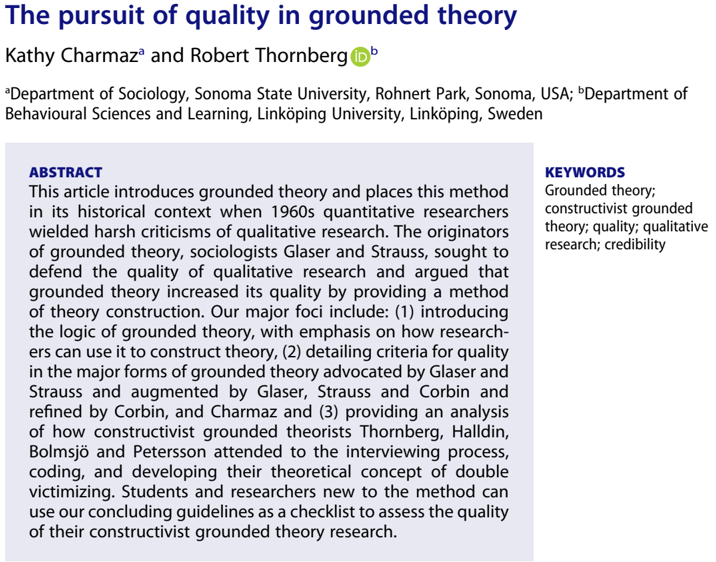
This article introduces grounded theory and places this method in its historical context when 1960s quantitative researchers wielded harsh criticisms of qualitative research. The originators of grounded theory, sociologists Glaser and Strauss, sought to defend the quality of qualitative research and argued that grounded theory increased its quality by providing a method of theory construction. Our major foci include: (1) introducing the logic of grounded theory, with emphasis on how researchers can use it to construct theory, (2) detailing criteria for quality in the major forms of grounded theory advocated by Glaser and Strauss and augmented by Glaser, Strauss and Corbin and refined by Corbin, and Charmaz and (3) providing an analysis of how constructivist grounded theorists Thornberg, Halldin, Bolmsjö and Petersson attended to the interviewing process, coding, and developing their theoretical concept of double victimizing. Students and researchers new to the method can use our concluding guidelines as a checklist to assess the quality of their constructivist grounded theory research.
Verified 2026-11-22 · 1 reference not checked yet
Overview
CoChat Summary
TL;DR
This article reviews grounded theory’s historical development and argues that quality criteria must fit the specific version of grounded theory, culminating in constructivist criteria and a checklist. It illustrates constructivist quality through Thornberg et al.’s (2013) study of school bullying and the concept of double victimizing.
Key findings
- Quality criteria differ across grounded theory versions: original Glaser and Strauss focused on credibility and applicability with fitness, understanding, generality, and control; Glaser added workability, relevance, fit, and modifiability; Strauss and Corbin emphasized data quality, plausibility/value of theory, adequacy of process, and empirical grounding; constructivist Charmaz proposes credibility, originality, resonance, and usefulness.
- The paper argues quality is built through iterative data collection and analysis, line-by-line and focused coding, memo-writing, theoretical sampling and saturation, constant comparison, and reflexivity/methodological self-consciousness.
- In the illustrative constructivist study, Thornberg et al. (2013) distributed 523 open-ended questionnaires to students in three secondary schools and two universities in Sweden; of 511 responses, 168 reported past bullying, 36 volunteered, and 21 who had been bullied for more than one year were interviewed; analysis produced the core category “double victimizing” (external and internal victimizing).
- In psychology, Rubin, Bell, and McCleland (2018) found only 13% of responding graduate psychology programs required a qualitative research course, and respondents described qualitative research as “inaccurate,” “subjective,” and “lacking rigor” while also describing it as providing the “best methods for feminist, community-based, and social justice research.”
Methods
- Design: methodological/conceptual article introducing grounded theory, comparing quality criteria across Glaserian, Straussian, and constructivist versions, and offering guidelines/checklist for constructivist grounded theory.
- Data or sample: no primary empirical sample for the article; it analyzes historical and methodological literature and uses Thornberg et al. (2013) as an illustrative constructivist grounded theory study (523 questionnaires; 511 responses; 168 bullied; 36 volunteers; 21 interviewed).
- Main analysis: narrative synthesis and comparison of quality criteria, with an illustration of coding, constant comparison, memo-writing, theoretical sampling, and category development leading to “double victimizing.”
Limitations
- Stated: the authors caution that checklists risk becoming a “methodological crutch” that avoids deep engagement with method and data (citing Barbour 2001), and present their guidelines as flexible, not substitutes for rigorous research.
- Stated: criteria for quality in qualitative research remain unsettled, with “little consensus” about appropriate evaluation criteria, and meanings of quality markers may differ among researchers.
- Evident from the text: the article is not an empirical validation of the checklist; the double victimizing case is a secondary illustration rather than a new test, and the guidelines are aimed mainly at constructivist grounded theory though claimed mostly applicable to other versions.
Model-written summary. Check it against the paper before relying on it.
Integrity signals
Registry
Cites
Statistics
Figures



Verification
Claims the paper makes
2 Valid · 13 Not valid · 38 Not checked · 38 Own results and interpretations
None of the sources cited for this claim have been checked yet.
In the paper
“Concerns about objectivity, validity, reliability and replicability in qualitative research still pervade academic psychology.”
§ The pursuit of quality in grounded theory > Qualitative research and psychology
plain- Asserted: passes — The authors put it forward as true.
- Checkable: passes — It can be checked against evidence.
- Load-bearing: passes — The paper’s conclusions depend on it.
- Based: passes — The paper gives a reason why it holds.
In the paper
“Until Glaser and Strauss's (1967) statement, little had been written, much less codified into a systematic statement, about how to construct a qualitative theoretical analysis of high quality.”
§ The pursuit of quality in grounded theory > Concerns about quality in the development of grounded theory
What the sources say
- Not matchedcites Glaser and Strauss's (1967)
An author–year citation the paper’s reference list doesn’t settle. We don’t search these by name.
plain- Asserted: passes — The authors put it forward as true.
- Checkable: passes — It can be checked against evidence.
- Load-bearing: unclear — It is unclear whether the paper’s conclusions depend on it.
- Based: passes — The paper gives a reason why it holds.
- Not matched
A statement the paper makes itself — it cites no source for it, so there is none to check. The quote shows it is in the paper.
In the paper
“If, however, researchers only ask the same questions of each participant, they are likely to elicit similar stories about the topic.”
§ The pursuit of quality in grounded theory > Introduction
hedgedstates a possible cause- Asserted: passes — The authors put it forward as true.
- Checkable: passes — It can be checked against evidence.
- Load-bearing: passes — The paper’s conclusions depend on it.
- Based: passes — The paper gives a reason why it holds.
A statement the paper makes itself — it cites no source for it, so there is none to check. The quote shows it is in the paper.
In the paper
“If, however, researchers systematically interrogate their data as they gather it, their early ideas can then inform subsequent data collection.”
§ The pursuit of quality in grounded theory > Introduction
plainstates a possible cause- Asserted: passes — The authors put it forward as true.
- Checkable: passes — It can be checked against evidence.
- Load-bearing: passes — The paper’s conclusions depend on it.
- Based: passes — The paper gives a reason why it holds.
A statement the paper makes itself — it cites no source for it, so there is none to check. The quote shows it is in the paper.
In the paper
“When answering quantitative social scientists' sharp criticisms of its quality, Glaser and Strauss rejected the common practice of evaluating qualitative research according to the tenets of the quantitative tradition.”
§ The pursuit of quality in grounded theory > Concerns about quality in the development of grounded theory
plain- Asserted: passes — The authors put it forward as true.
- Checkable: passes — It can be checked against evidence.
- Load-bearing: unclear — It is unclear whether the paper’s conclusions depend on it.
- Based: passes — The paper gives a reason why it holds.
22 more claims
Create a free account to see all 91 claims and to verify the 7 references still open.
- Probably not a substantial claim. 61
- It may state two separate claims as one. 26
Claims other papers make about this one
Each is checked against this paper’s own text: does it say what the citing paper says it does?
The source backs part of the claim, not all of it — or backs it for a different population, condition or comparison.
In the citing paper
“An explicitly constructivist approach aims to produce an abstract understanding of a phenomenon (rather than an explanation, as in other versions of GTM)”
From Quality Criteria: General and Specific Guidelines for Qualitative Approaches in Psychology Research. A Concise Guide for Novice Researchers and Reviewers (2024) · cites this paper as Charmaz & Thornberg, 2021
Experimental — accuracy not yet measuredThe source backs part of the claim, not all of it — or backs it for a different population, condition or comparison.
In the citing paper
“Constant comparison is a systematic strategy combining the advantages of simultaneous data generation and analysis, enabling a concentration on significant issues (Charmaz and Thornberg, 2021).”
From Application and challenges of using a Constructivist Grounded Theory methodology to address an undertheorized clinical challenge: A discussion paper (2024) · cites this paper as Charmaz and Thornberg, 2021
Experimental — accuracy not yet measuredThe cited source says what the claim attributes to it.
In the citing paper
“focuses on actions, meanings and constructions”
From Quality Criteria: General and Specific Guidelines for Qualitative Approaches in Psychology Research. A Concise Guide for Novice Researchers and Reviewers (2024) · cites this paper as Charmaz & Thornberg, 2021
The cited source says what the claim attributes to it.
In the citing paper
“and acknowledges both subjectivity (of participants and researchers) and context (Charmaz, 2014; Charmaz & Thornberg, 2021).”
From Quality Criteria: General and Specific Guidelines for Qualitative Approaches in Psychology Research. A Concise Guide for Novice Researchers and Reviewers (2024) · cites this paper as Charmaz & Thornberg, 2021
The cited source says what the claim attributes to it.
In the citing paper
“The primary focus is the theory ' s ability to clarify participants ' lives and contribute to knowledge and practice (Charmaz & Thornberg, 2021).”
From Quality Criteria: General and Specific Guidelines for Qualitative Approaches in Psychology Research. A Concise Guide for Novice Researchers and Reviewers (2024) · cites this paper as Charmaz & Thornberg, 2021
6 more claims about this paper
Create a free account to see every claim other papers make about this one.
Citations
Cites
Using thematic analysis in psychology
Braun, V., & Clarke, V. (2006) · Qualitative Research in Psychology · doi:10.1191/1478088706qp063oa · Cited by 194,414
The Discovery of Grounded Theory: Strategies for Qualitative Research.
Wagner, H. R., Glaser, B. G., & Strauss, A. L. (1968) · Social Forces · doi:10.2307/2575405 · Cited by 46,361
The Discovery of Grounded Theory; Strategies for Qualitative Research
Glaser, B. G., Strauss, A. L., & Strutzel, E. (1968) · Nursing Research · doi:10.1097/00006199-196807000-00014 · Cited by 39,449
Basics of Qualitative Research: Grounded Theory Procedures and Techniques.
Ellis, C., Strauss, A., & Corbin, J. (1992) · Contemporary Sociology · doi:10.2307/2074814 · Cited by 29,249
Basics of Qualitative Research (3rd ed.): Techniques and Procedures for Developing Grounded Theory
Corbin, J., & Strauss, A. (2008) · SAGE · doi:10.4135/9781452230153 · Cited by 24,827
(2006) · Cited by 18,730
Self-citationBasics of Qualitative Research
Ozanne, J. L., Strauss, A., & Corbin, J. (1992) · Journal of Marketing Research · doi:10.2307/3172751 · Cited by 17,850 · cited 2×
“In their development of grounded theory, Strauss and Corbin (1990; Corbin and Strauss 1990; Strauss and Corbin 1998) emphasized four general criteria: (1) quality of the data, in other words, grounded theorists need to carefully address and adopt quality criteria related to methods used for data…”
BackgroundMethodBasics of Qualitative Research: Grounded Theory Procedures and Techniques
Long, D. R., Strauss, A., & Corbin, J. (1993) · The Modern Language Journal · doi:10.2307/328955 · Cited by 17,576
(2014) · Cited by 15,747
Self-citationInterviewing as qualitative research a guide for researchers in education and the social sciences
Seidman, I. (2006) · Cited by 12,757
Research works printed but not linked: 5
- 10. Charmaz, K. 1995. Between positivism and postmodernism: implications for methods. In Studies in symbolic interaction, vol. 17, N. K. Denzin (Ed.), pp. 43-72. Greenwich, CT: JAI Press.
- 17. Cisneros-Puebla, C. A. 2007. The deconstructive and reconstructive faces of social construc- tion: Kenneth Gergen in conversation with César A. Cisneros-Puebla. With an introduction by Robert B. Faux [83 paragraphs]. Forum Qualitative Sozialforschung/Forum: Qualitative Social Research 9 (1):Art. 20. http://nbn-resolving.de/urn:nbn:de:0114-fqs0801204 .
- 26. Glaser, B. G. 1978. Theoretical sensitivity. Mill Valley, CA: Sociology Press.
- 27. Glaser, B. G. 1992. Basics of grounded theory analysis. Mill Valley, CA: Sociology Press.
- 30. Glaser, B. G. 2013. No preconceptions: The grounded theory dictum. Mill Valley, CA: Sociology Press.
Cited by
Items 101–200 of 1,191
The entrepreneur identity assimilation process: It's not all work and no play
Smith, C., Liu, S., & Smith, J. B. (2023) · Journal of Business Venturing · doi:10.1016/j.jbusvent.2023.106326 · Cited by 19
Birze, A., Regehr, K., & Regehr, C. (2022) · Journal of Interpersonal Violence · doi:10.1177/08862605221090571 · Cited by 27
“…the core category based on its accommodation of maximal variation in experience, its centrality among the other related concepts, its frequent appearance in the data, and it ’ s power to explain professionals ’ experiences (Charmaz & Thornberg, 2020; Latta & Goodman, 2011; Strauss & Corbin, 1998).”
BackgroundMethodUnderstanding the value of host-guest intimacy behind online reviews of Airbnb
Qiu, W.-W., Yu, H.-T., Tsai, C.-H. K., Zhu, D. (., Chen, M., & Kim, H. J. (2023) · International Journal of Hospitality Management · doi:10.1016/j.ijhm.2023.103599 · Cited by 20
Jenkin, T., D’Cruz, K., Anderson, V. A., Scheinberg, A. M., & Knight, S. (2022) · Disability and Rehabilitation · doi:10.1080/09638288.2022.2121864 · Cited by 21
Why Can the Flipped Classroom Frustrate Students? Experiences from an Engineering Mathematics Course
Nielsen, K. L. (2023) · Education Sciences · doi:10.3390/educsci13040396 · Cited by 29
Grounded Theory: A Guide for a New Generation of Researchers
Yu, M., & Smith, S. (2021) · International journal of doctoral studies · doi:10.28945/4836 · Cited by 53
“Over time, some scholars have added new approaches to aid GT’s further development, e.g., a constructivist grounded theory research guideline (Charmaz, 2014; Charmaz & Thornberg, 2020), and a checklist of saturated concepts (Corbin & Strauss, 2015).”
BackgroundRoss, A., Morgan, A. J., Wake, A. N., Jorm, A. F., & Reavley, N. J. (2021) · Advances in Mental Health · doi:10.1080/18387357.2021.1942101 · Cited by 21
“This study used a thematic analysis methodology, with a theoretical underpinning in constructivist grounded theory (Charmaz & Thornberg, 2020) due to the novel nature of this research topic and gaps in the existing literature.”
MethodSchumm, C. Z., & Niehm, L. S. (2023) · International Journal of Operations & Production Management · doi:10.1108/ijopm-09-2022-0550 · Cited by 18
Wilson, E., Palmer, J. M., Armstrong, A., Messer, B., Presswood, E., & Faull, C. (2024) · BMC Palliative Care · doi:10.1186/s12904-024-01443-1 · Cited by 23
“Throughout the process written summaries, memos and diagrams were used to organised and identify links between codes and themes (29, 30).”
BackgroundMethodThe Utility of Constructivist Grounded Theory in Critical Policy Analysis
Sebeelo, T. B. (2022) · International Journal of Qualitative Methods · doi:10.1177/16094069221090057 · Cited by 15
“Researchers aligned to this tradition argue that actions should be “situated in their social, historical, local and interactional contexts” (Charmaz & Thornberg, 2021: 315).”
BackgroundHassanzadeh, M., & Ranjbar, M. (2022) · Language Teaching Research · doi:10.1177/13621688221090825 · Cited by 17
“The data were also meticulously examined by the researchers to establish trustworthiness even though the theoretical sampling and theoretical saturation of a GT study can further institute trustworthiness (Charmaz, 2020).”
Latent Rural Depopulation in Latin American Open-Pit Mining Scenarios
Uribe-Sierra, S. E., Mansilla–Quiñones, P., & Mora-Rojas, A. I. (2022) · Land · doi:10.3390/land11081342 · Cited by 25
Jiang, W., Ma, S., Zhang, Z., & Xu, Y. (2025) · Journal of Loss Prevention in the Process Industries · doi:10.1016/j.jlp.2025.105704 · Cited by 18
Rahimi, S. A., Shrivastava, R., Brown-Johnson, A., Caïdor, P., Davies, T. C., Janati, A. I., Talla, P. K., Madathil, S. A., Willie, B. M., & Emami, E. (2024) · Journal of Medical Internet Research · doi:10.2196/63356 · Cited by 22
Schuler, C., Waldboth, V., Ntow, G. E., & Agbozo, F. (2023) · Journal of Advanced Nursing · doi:10.1111/jan.15566 · Cited by 20
Quality in qualitative research: a relational process
Timonen, V., Foley, G., & Conlon, C. (2024) · Qualitative Research Journal · doi:10.1108/qrj-07-2024-0153 · Cited by 54
Interaction strategies in online learning: Insights from text analytics on iMOOC
Wang, W., Zhao, Y., Wu, Y. J., & Goh, M. (2022) · Education and Information Technologies · doi:10.1007/s10639-022-11270-7 · Cited by 17
“(4), is used to evaluate the consistency (Charmaz & Thornberg, 2021; Cohen, 1960), where P ( a ) represents the observed agreement between the annotators and automatic text classification, and P ( e ) is the hypothetical probability of a chance agreement.”
MethodLonghurst, P., Aspell, J. E., Todd, J., & Swami, V. (2023) · Body Image · doi:10.1016/j.bodyim.2023.101655 · Cited by 25
Bobbink, P., Larkin, P., & Probst, S. (2024) · International Journal of Nursing Studies Advances · doi:10.1016/j.ijnsa.2024.100199 · Cited by 15
“The epistemological and ontological differences principally address the proposition that theory is either discovered or co-constructed (Bryant, 2017), leading to opposing views on how the steps in the Grounded Theory method are understood (B ø ttcher Berthelsen, 2018; Chun Tie, Birks and Francis, 2019; Tarozzi, P. Bob…”
BackgroundInfluentialLi, Y., Sha, K., Li, H., et al. (2023) · Research in Engineering Design · doi:10.1007/s00163-023-00410-w · Cited by 14
“Based on grounded theory and relevant research (Fernandes et al. 2015; Charmaz and Thornberg 2021), the influence factors (sub-factors) for the 31 CRs are extracted, as shown in Table 6.”
BackgroundMethodBabchuk, W. A., & Boswell, E. (2022) · Elsevier eBooks · doi:10.1016/b978-0-12-818630-5.11013-9 · Cited by 24
Bernard, R. C., & Kermarrec, G. (2022) · Frontiers in Education · doi:10.3389/feduc.2022.732094 · Cited by 35
“This method was chosen as it offers a number of opportunities for the researchers in terms of credibility, originality, resonance and usefulness (Charmaz and Thornberg, 2020).”
BackgroundMethodKolleck, N. (2021) · Educational Management Administration & Leadership · doi:10.1177/17411432211043876 · Cited by 45
“According to this principle, the process of sampling is to be continued until the elaboration of theoretical concepts has reached a point of saturation and when additional analysis no longer contributes to the discovery of anything new about a concept or category (Charmaz and Thornberg, 2020).”
BackgroundKhan, A. U., Qu, X., & Madzikanda, B. (2022) · Creativity and Innovation Management · doi:10.1111/caim.12501 · Cited by 17
Nyahunda, L., Nemakonde, L. D., & Khoza, S. (2024) · Natural Hazards · doi:10.1007/s11069-024-06605-1 · Cited by 21
“Following CGT’s tenets, data were systematically collected, organised and examined after each interview (Charmaz and Thornberg 2021).”
Virtual Guest Speakers in Textile and Apparel Courses: Student Experiences and Expectations
Jablon-Roberts, S., & McCracken, A. (2022) · Clothing and Textiles Research Journal · doi:10.1177/0887302x221075765 · Cited by 16
Wang, T., Zhao, Y., Pang, L. L. L., & Cheng, Q. (2024) · PLoS ONE · doi:10.1371/journal.pone.0311297 · Cited by 18
Academic entrepreneurship: A bibliometric engagement model
Gößling, S., Moyle, B., & Weaver, D. B. (2021) · Annals of Tourism Research · doi:10.1016/j.annals.2021.103270 · Cited by 19
“Flexibility allowed for the open exploration and analysis of inductive data to extrapolate emergent patterns into conceptual categories (Charmaz & Thornberg, 2020).”
BackgroundSilva-Ávila, P., Hernández, J. R., & Barra, R. O. (2025) · Sustainability · doi:10.3390/su17083653 · Cited by 32
Construction of Event Graph for Ship Collision Accident Analysis to Improve Maritime Traffic Safety
Ma, J., Wang, Y., Wang, L., Xu, L., & Zhao, J. (2024) · Complexity · doi:10.1155/2024/4998195 · Cited by 17
The experience of becoming a mother following successful in vitro fertilization: A grounded theory
Boz, İ., Teskereci, G., & Akgün, M. (2021) · Journal of Advanced Nursing · doi:10.1111/jan.14958 · Cited by 18
IMPLEMENTASI KEBIJAKAN PENGEMBANGAN PARIWISATA BERBASIS PEMBERDAYAAN MASYARAKAT
Sinaga, K., Nasution, M. A., & Dewi, A. T. (2021) · Publik Jurnal Manajemen Sumber Daya Manusia Administrasi dan Pelayanan Publik · doi:10.37606/publik.v8i1.163 · Cited by 13
Preregistration and Registered Reports in Sociology: Strengths, Weaknesses, and Other Considerations
Manago, B. N. (2023) · The American Sociologist · doi:10.1007/s12108-023-09563-6 · Cited by 18
“Inductive and abductive research are focused on the development and refinement of theories (Charmaz, 2014; Charmaz and Thornberg 2021; Glaser and Anselm 1967; Timmermans and Tavory 2012).”
BackgroundComeback or evolution? Examining organizational resilience literature in pre and during COVID-19
Paeffgen, T., Lehmann, T., & Feseker, M. (2023) · Continuity & Resilience Review · doi:10.1108/crr-07-2023-0012 · Cited by 25
Maintaining identity and relationships when using mobility aids
Rogers, A., & Musselwhite, C. (2022) · Journal of Transport & Health · doi:10.1016/j.jth.2022.101545 · Cited by 13
Caro-Barek, V. D., Lysne, D. A., Støckert, R., Solbjørg, O. K., & Røren, K. A. F. (2023) · Frontiers in Education · doi:10.3389/feduc.2023.1155374 · Cited by 23
Bevilacqua, S., Ferraris, A., Matzler, K., & Kuděj, M. (2025) · Journal of Business Research · doi:10.1016/j.jbusres.2025.115878 · Cited by 33
“To ensure the rigor and trustworthiness of our qualitative study, we applied established quality criteria: credibility, transparency, and reliability throughout the research process (Charmaz, 2006; Charmaz & Thornberg, 2021; Hautam ¨ aki & Heikinheimo, 2025).”
Brandhorst, J. K., Compton, C. A., Solon, K. N., Huyler, D., McGill, C. M., & Barnhart, L. (2023) · Human Resource Development Review · doi:10.1177/15344843221149309 · Cited by 14
Clarke, V. (2021) · Qualitative Research in Psychology · doi:10.1080/14780887.2021.1995555 · Cited by 26
“…other forms of human expression’ (p. 20), that centre an iterative research process (this perhaps best describes grounded theory methodologies; see Charmaz and Thornberg 2020), that present ‘findings’ in a way that ‘emphasizes their context and situation in time’ (p. 21), and highlight the role…”
BackgroundSallay, V., Klinovszky, A., Csuka, S. I., Buzás, N., & Papp-Zipernovszky, O. (2021) · BMJ Open · doi:10.1136/bmjopen-2021-058885 · Cited by 27
“The results will be partly disseminated through presentations in patient organisations.”
Regehr, C., Regehr, K., Goel, V., Sato, C., Lyons, K. A., & Rudzicz, F. (2023) · BMJ Public Health · doi:10.1136/bmjph-2023-000444 · Cited by 17
Gould, E. E., Ganesh, S. S., Nguyen, R. M., Breton, C. V., Bastain, T. M., Dunton, G. F., & Ceasar, R. C. (2024) · Frontiers in Global Women s Health · doi:10.3389/fgwh.2024.1355375 · Cited by 17
“As data collection continued, emerging ideas aligned with previously observed phenomena, meaning that theoretical saturation was achieved (38, 47).”
BackgroundMethodDeveloping Grounded Theory Systematic Approach for Logistics and Supply Chain Management Research
Wilczewska, M., & Nazarko, J. (2024) · Journal of Business Logistics · doi:10.1111/jbl.12396 · Cited by 16
Buenas prácticas de docentes de educación básica durante la pandemia COVID-19
Nashiki, A. G., & Lovatón, K. Y. Q. (2021) · Revista Innova Educación · doi:10.35622/j.rie.2021.04.001 · Cited by 40
“…no se buscó la representatividad estadística, sino identificar a docentes con experiencias significativas que abonarán a la comprensión del tema (Charmaz & Thornberg, 2020), a partir de tres criterios básicos: 1) laborar en el sector público, en los niveles de preescolar, primaria o secundaria,…”
BackgroundKarlstad, J. L., Moe, C. F., Stokland, R. A., & Brinchmann, B. S. (2022) · Journal of Eating Disorders · doi:10.1186/s40337-022-00669-9 · Cited by 16
“As the findings evolved, further interviews were conducted to refine the categories [32, 36], hence more participants were recruited from the recruiting units and organisations.”
BackgroundDigiwork: how agriculture 4.0 is changing work for farm advisers
Nettle, R. A., Ingram, J., & Ayre, M. L. (2025) · Frontiers in Sustainable Food Systems · doi:10.3389/fsufs.2025.1542007 · Cited by 19
Jiang, A., Li, S., Wang, H., Ni, H., Chen, H., Dai, J., Xu, X., Li, M., & Dong, G.-H. (2025) · Journal of Medical Internet Research · doi:10.2196/66341 · Cited by 13
“The grounded theory establishes a close connection between empirical research and theory construction, enabling researchers to develop concepts and construct theories by systematically analyzing and summarizing empirical data [21,22].”
Relational coding: Enhancing the transparency and trustworthiness of grounded theory research
Rawhani, C. (2023) · Methodological Innovations · doi:10.1177/20597991221144566 · Cited by 28
“Kathy Charmaz, who has also worked with Linda Belgrave, Antony Bryant and Robert Thornberg (Bryant and Charmaz, 2007, 2019; Charmaz and Belgrave, 2019; Charmaz and Thornberg, 2021), emerged as a leading proponent of constructivist GT.”
BackgroundTorok, D., & Ball, J. (2021) · Social Sciences · doi:10.3390/socsci10080296 · Cited by 22
“We analyzed youths’ narratives using grounded theory, a qualitative research method that facilitates a rich, conceptual analysis and that is used to understand phenomena on which limited research is available (Charmaz 2014; Charmaz and Thornberg 2020).”
BackgroundMethodPantiris, P., Pallis, P. L., Chountalas, P. T., & Dasaklis, T. K. (2025) · Logistics · doi:10.3390/logistics9030113 · Cited by 37
Reciprocal burden: Adults with drug-resistant epilepsy reflect upon informal caregiver support
Dewar, S. R., Ranit, L., & Pieters, H. C. (2021) · Seizure · doi:10.1016/j.seizure.2021.04.022 · Cited by 14
“As codes were compared within and across participants one core category with two sub-categories became evident [18].”
Coleman, O. F., McDonnell, J. J., Bowman, J. A., Eichelberger, C., Ryan, J., & Conradi, L. A. (2023) · Exceptionality · doi:10.1080/09362835.2023.2171418 · Cited by 16
“After this meeting, we independently wrote out analytic memos (Charmaz & Thornberg, 2020; Saldaña, 2015) describing SETs’ perceptions of including students with SCD in general education classes.”
BackgroundMethodGanesh, S. S., Gould, E. E., Conner, B. T., Huh, J., Ceasar, R. C., & Bluthenthal, R. N. (2024) · Drug and Alcohol Dependence Reports · doi:10.1016/j.dadr.2024.100257 · Cited by 15
“We analyzed data using constructivist grounded theory methods, where our aim was to develop a conceptual framework or theory via constant comparisons across the data around an area of inquiry, in this case cannabis and opioid co-use (Charmaz and Thornberg, 2021) (Charmaz, 2014) (Charmaz, 2012).”
Nwankwo, C. F. (2024) · SN Social Sciences · doi:10.1007/s43545-024-00854-4 · Cited by 14
“The sample size was determined theoretically as grounded theory uses theoretical sample defined as the point of saturation where newly collected data does not offer new insights compared with previously collected data (Charmaz and Thornberg 2021).”
Marques, F. R. D. M., Laranjeira, C., Carreira, L., Gallo, A. M., Baccon, W. C., Paiano, M., Baldissera, V. D. A., & Salci, M. A. (2023) · Behavioral Sciences · doi:10.3390/bs14010014 · Cited by 13
“The number of participants reached theoretical saturation when no new evidence was found in the face of conceptual exploration [39].”
BackgroundMethodInfluentialCeasar, R. C., Gould, E. E., Stal, J., Laughter, J., Tran, M., Wang, S. D., Granacki, J. J., Ziltzer, R. S., & dos Santos, J. P. (2023) · Women s Health Reports · doi:10.1089/whr.2023.0057 · Cited by 17
Eckardt, V. C., & Dorsch, T. E. (2024) · Psychology of sport and exercise · doi:10.1016/j.psychsport.2024.102746 · Cited by 16
Nurses experience of caring for patients with COVID-19: A phenomenological study
Al-Amer, R. M., Darwish, M., Malak, M. Z., Ali, A. M., weldat, K. A., Alkhamees, A. A., Alshammari, K. S., Abuzied, Y., & Randall, S. (2022) · Frontiers in Psychiatry · doi:10.3389/fpsyt.2022.922410 · Cited by 12
“The sample size was determined based on the saturation, which took place on the 10th participant when the collected data held no new additional findings (19).”
BackgroundEmpirical Formal Methods: Guidelines for Performing Empirical Studies on Formal Methods
ter Beek, M. H., & Ferrari, A. (2022) · Software · doi:10.3390/software1040017 · Cited by 16
Longhini, J., Ambrosi, E., Filippi, M., Evilio, L., & Canzan, F. (2024) · Nurse Education Today · doi:10.1016/j.nedt.2024.106332 · Cited by 11
Adugna, M. B., Ghahari, S., & Lysaght, R. M. (2024) · Disability and Rehabilitation · doi:10.1080/09638288.2024.2356016 · Cited by 17
“This method allowed us the flexibility to address specific questions and emergent interactions to capture the participants’ experience and perspectives [45,46].”
Earle, S., Blackburn, M., Chambers, L., Downing, J. D., Flemming, K., Hale, J., Marston, H. R., O’Dell, L., Sinason, V., Watts, L., et al. (2022) · Qualitative Health Research · doi:10.1177/10497323221131692 · Cited by 11
“However, other scholars would argue that cGT studies provide new insights that are credible, original, resonant, useful and transferable to other similar research problems or fi elds (Charmaz & Thornberg, 2021).”
BackgroundFamilies of Grounded Theory: A Theoretical Structure for Novel Researchers
Mohajan, D., & Mohajan, H. K. (2023) · Studies in Social Science & Humanities · doi:10.56397/sssh.2023.03.08 · Cited by 41
Poole, R., Thompson, D., & Galloway, D. (2023) · Journal of Marketing for HIGHER EDUCATION · doi:10.1080/08841241.2023.2275752 · Cited by 22
“This allowed the organic emergence of specific analytical foci during the data collection, rather than being predicated on previous perspectives exhibited by different demographic groups during their decision-making journey (Charmaz & Thornberg, 2021).”
Bergersen, E., Larsson, M., Lövgren, M., & Olsson, C. (2022) · BMC Palliative Care · doi:10.1186/s12904-022-01055-7 · Cited by 19
“To avoid putting too many interpretations in the data at an early stage, each sentence was given its code, which was closely related to the participants’ original statements [42, 44, 45].”
BackgroundMethodHeutagogical approach to music learning in vocational schools
Sukmayadi, Y., Sella, F., & Midyanti, H. I. (2022) · The Education and science journal · doi:10.17853/1994-5639-2022-6-41-59 · Cited by 15
“Grounded theory is a systematic method of conducting research in the form of data collection and providing an explicit strategy for analysing [43].”
MethodSmart farming technologies and changes to farm work: New insights into on-farm experiences
Nettle, R. A., & Ingram, J. (2025) · Technological Forecasting and Social Change · doi:10.1016/j.techfore.2025.124227 · Cited by 18
Fisher, E., Patel, P. D., Wouk, K., et al. (2024) · Nutrients · doi:10.3390/nu16111565 · Cited by 11
“Following the procedure recommended by the literature [19,20], the transcribed data were coded and analyzed.”
MethodGrounded Theory—An Illustrative Application in the Portuguese Footwear Industry
Monteiro, M., Rosa, Á., Martins, A., & Jayantilal, S. (2023) · Administrative Sciences · doi:10.3390/admsci13020059 · Cited by 21
Hasan, M., Supatminingsih, T., Tahir, T., Guampe, F. A., Huruta, A. D., & Lu, C. Y. (2025) · Journal of Open Innovation Technology Market and Complexity · doi:10.1016/j.joitmc.2025.100466 · Cited by 26
Agans, J. P., & Lerner, R. M. (2021) · Leisure Sciences · doi:10.1080/01490400.2021.1913266 · Cited by 11
The experiences of daily smartphone use among older adults in Brazil: A grounded theory analysis
Gallo, A. M., Laranjeira, C., Araújo, J. P., Marques, F. R. D. M., Baccon, W. C., Salci, M. A., & Carreira, L. (2024) · Heliyon · doi:10.1016/j.heliyon.2024.e35120 · Cited by 11
“Another strategy to increase credibility was reaching data saturation, when selected participants ceased providing new information [38].”
Working from home during lockdown: the impact on performance and wellbeing
Smollan, R. K., Morrison, R. L., & Cooper-Thomas, H. D. (2023) · Journal of Management & Organization · doi:10.1017/jmo.2023.9 · Cited by 16
“Interpretive research facilitates the investigation of new phenomena by exploring actors ’ socially constructed multiple realities (Charmaz & Thornberg, 2021).”
Volunteer officers’ experiences in law enforcement work in Malaysia and the USA
Cheah, P. K., Britton, I., Wolf, R., Tey, T. C. Y., Dobrin, A., & Unnithan, N. P. (2024) · Policing A Journal of Policy and Practice · doi:10.1093/police/paae004 · Cited by 11
Social Constructivist Meta-Ethnography - – A Framework Construction
Soundy, A. (2024) · International Journal of Qualitative Methods · doi:10.1177/16094069241244863 · Cited by 17
“Using methods identi fi ed in phase 3a the meta-ethnographer should demonstrate how questions have been progressively used to focus towards and reveal theory (Charmaz & Thornberg, 2020).”
InfluentialTheoretical sampling process in a Straussian Grounded Theory study
Barreto, M. D. S., Simon, B. S., Marquete, V. F., de Souza, R. R., Girardon-Perlini, N. M. O., & Marcon, S. S. (2021) · Revista da Escola de Enfermagem da USP · doi:10.1590/1980-220x-reeusp-2021-0212 · Cited by 11
Caro-Barek, V. D., & Støckert, R. (2024) · Frontiers in Education · doi:10.3389/feduc.2024.1330804 · Cited by 19
Positive action paradox in UK police recruitment: A critical perspective
Hesketh, I., & Stubbs, G. (2023) · The Police Journal Theory Practice and Principles · doi:10.1177/0032258x231172030 · Cited by 13
“In line with the inductive and deductive methods, codes were generated using both Granovetter ’ s (2017) theoretical framework and without the theoretical framework (Charmaz 2017; Charmaz and Thornberg 2021).”
MethodCormier, D. L., Jørgensen, H., Ferguson, L. J., Gyurcsik, N. C., Briere, J. L., & Kowalski, K. C. (2024) · Qualitative Research in Sport Exercise and Health · doi:10.1080/2159676x.2024.2432653 · Cited by 15
“Our intention was to evaluate the quality of the grounded theory throughout the research process (Charmaz and Thornberg 2020).”
InfluentialKing, R., Downer, T., Lord, B., Flanagan, B., & Oprescu, F. (2025) · Research in Nursing & Health · doi:10.1002/nur.22468 · Cited by 21
Kluit, L., de Wind, A., Oosting, I. J., van Velzen, J. M., Beumer, A., Sluman, M. A., van Bennekom, C. A. M., & de Boer, A. G. E. M. (2022) · Disability and Rehabilitation · doi:10.1080/09638288.2022.2157500 · Cited by 10
“After the analysis of the last two focus groups, data saturation was reached [53].”
BackgroundMethodThe right to health: An examination of health care access for women with disability in Nepal
Pita, Y., Bigler, C., Sony, K. C., & Amacker, M. (2023) · SSM - Qualitative Research in Health · doi:10.1016/j.ssmqr.2023.100315 · Cited by 10
Clarke, E., Näswall, K., Wong, J. W. H., Pawsey, F., & Malinen, S. K. (2024) · Journal of Health Organization and Management · doi:10.1108/jhom-02-2023-0051 · Cited by 16
Petry, H., Pelzelmayer, K., Ernst, J., Thürlimann, E., & Naef, R. (2022) · Journal of Advanced Nursing · doi:10.1111/jan.15486 · Cited by 20
Self-Care for Advanced Practice Nursing Students in Rural Primary Care
Brommelsiek, M., & Peterson, J. A. (2022) · Journal of Nursing Education · doi:10.3928/01484834-20220209-03 · Cited by 13
Managing long COVID symptoms and accessing health services in Brazil: A grounded theory analysis
Marques, F. R. D. M., Laranjeira, C., Carreira, L., Gallo, A. M., Baccon, W. C., Góes, H. L. D. F., & Salci, M. A. (2024) · Heliyon · doi:10.1016/j.heliyon.2024.e28369 · Cited by 12
Patient-Defined Cultural Safety in Perinatal Interventions: A Qualitative Scoping Review
Egger, E. E., Ibrahim, B. B., Nyhan, K., Desibhatla, M., Gleeson, D. E., & Hagaman, A. K. (2024) · Health Equity · doi:10.1089/heq.2023.0152 · Cited by 12
Illuminating the dark corners: a qualitative examination of cryptocurrency’s risk
Mehta, K., & Chawla, S. (2024) · Digital Policy Regulation and Governance · doi:10.1108/dprg-10-2023-0147 · Cited by 16
Seeing Red: A Grounded Theory Study of Women’s Anger after Childbirth
Ou, C. H. K., Hall, W. A., Rodney, P., & Stremler, R. (2022) · Qualitative Health Research · doi:10.1177/10497323221120173 · Cited by 19
“In this study, as indicated by Charmaz and Thornberg (2021), credibility is fostered by having suf fi - cient amounts of relevant data, developing a thorough analysis, and engaging in re fl exivity.”
InfluentialWhat constitutes brilliant aged care? A qualitative study of practices that exceed expectation
Dadich, A., Kearns, R., Harris‐Roxas, B., Chróinín, D. N., Boydell, K., Shé, É. N., LIM, D. J., Gonski, P. N., & Köhler, F. (2023) · Journal of Clinical Nursing · doi:10.1111/jocn.16789 · Cited by 13
Emotional labor in sport coaching: a situational approach in the context of elite French handball
Petiot, O., Fontaine, T., Dugény, S., Visioli, J., & Kermarrec, G. (2025) · International Journal of Sport and Exercise Psychology · doi:10.1080/1612197x.2025.2493686 · Cited by 10
“…identified by drawing inspiration from the procedure developed by Petiot et al. (2024) to analyze those perceived by a professional table tennis player during the critical incidents experienced during his career, again also inspired by the grounded theory approach (Charmaz & Thornberg, 2020).”
Kaniamattam, M., & Oxley, J. D. (2023) · Research in Developmental Disabilities · doi:10.1016/j.ridd.2023.104539 · Cited by 14
Muchira, J. M. (2023) · Information and Learning Sciences · doi:10.1108/ils-03-2022-0043 · Cited by 25
Ross, A., Morgan, A. J., & Reavley, N. J. (2023) · Advances in Mental Health · doi:10.1080/18387357.2023.2223702 · Cited by 9
“…using thematic analysis (Braun & Clarke, 2006; Braun & Clarke, 2019) with a theoretical basis in constructionist Grounded Theory (Charmaz, 2017; Charmaz & Thornberg, 2020), due to the novel nature of this research, to explore the experiences of lived experience advocates with media…”
MethodIttefaq, M. (2024) · Journal of Health Communication · doi:10.1080/10810730.2024.2360021 · Cited by 19
“The constant comparison technique involves six phases: (1) data familiarization, (2) initial coding, (3) comparison, (4) development of categories, (5) refinement, and (6) saturation (Charmaz & Thornberg, 2021).”
MethodYousaf, S., Liu, Y., & Xiang, Y. (2024) · Journal of Sustainable Tourism · doi:10.1080/09669582.2024.2347544 · Cited by 19
“In studying ethnic communities, where cultural nuances play a significant role, this flexibility ensures that the research remains sensitive and relevant to the specific context of the community (Charmaz & Thornberg, 2021).”
Wellbeing in high-performance swimming: A grounded theory study
Uzzell, K. S., Knight, C. J., Pankow, K., & Hill, D. M. (2023) · Psychology of sport and exercise · doi:10.1016/j.psychsport.2023.102557 · Cited by 12
The four “R”s: Strategies for tailoring science for religious publics and their prices
Taragin‐Zeller, L., Golan, O., Tsfati, Y., et al. (2024) · Public Understanding of Science · doi:10.1177/09636625241229415 · Cited by 9
“The first stage included a process of grounded theory (Charmaz and Thornberg, 2021; Glaser and Strauss, 1967; Saldana, 2021) (team 1 and team 3) and content analysis (team 2), aimed at identifying journalist strategies for tailored science; the main themes that emerge in Haredi science-related…”
BackgroundMethodSaragih, J. F. B., & Subroto, T. Y. W. (2022) · Journal of Asian Architecture and Building Engineering · doi:10.1080/13467581.2022.2153061 · Cited by 22
In Between the Lines: Black and Brown Adolescents Creating a Homeplace Across School Settings
Germinaro, K. (2022) · Urban Education · doi:10.1177/00420859221086519 · Cited by 10
“Grounded theory as a method promotes learning about participants ’ lives, along with regularly interacting with the data and developing theory as the inquiry process goes on (Charmaz & Thornberg, 2020).”
Method
Metadata
- Authors
- Charmaz, K., & Thornberg, R.
- Affiliations
- Sonoma State University (US)
- Linköping University (SE)
- Corresponding author
- Thornberg, Robert
- Venue
- Qualitative Research in Psychology
- Publisher
- Informa UK Limited
- Published
- 2020-06-22
- Volume
- 18
- Issue
- 3
- Pages
- 305-327
- ISSN
- 1478-0887 (ISSN-L)
- 1478-0895
- OpenAlex
- W3036803033
- Cited by
- 1,221
- References
- 81
- Citations by year
- 2026: 264 · 2025: 290 · 2024: 255 · 2023: 221 · 2022: 128 · 2021: 54 · 2020: 8
- FWCI
- 155.56
- Type
- journal article
- Language
- en
- Open access
- hybrid
- doi.org
- Licence
- Locations
- Qualitative Research in Psychology (publishedVersion, cc-by-nc-nd)
- Topics
- Social Sciences › Education › Qualitative Research Methods and Applications
- Social Sciences › Sociology and Political Science › Qualitative Research Methods and Ethics
- Social Sciences › Sociology and Political Science › Sociology and Education Studies
- Keywords
- grounded theory, constructivist grounded theory, qualitative research quality, theory development, Glaser and Strauss, interviewing, coding, history of grounded theory
About these checks
Registry, retraction, Cites and statistics results are computed, not judged, with one exception: a printed reference that no index lists is read once by a model before it counts as a citation error. Claims are extracted by a model and kept only when their quote appears verbatim in the text; each cited source is then checked, with a model’s help, for whether it says what the claim relies on. Those verdicts can be wrong — read the claim’s quote and the cited source before relying on one.
The claim verdicts this report counts are experimental: their accuracy is not yet measured.
A language model drew the claims from the paper on 2026-09-28, under version 3 of the claim definition (model deepseek-v4.1-flash, prompt extract-v3).
A second model labelled each claim on 2026-09-28 (model jev-1.13-20260917, definition revision gold-guideline-v0.2).
Statistics and arithmetic are recomputed, not judged.
Confidence bands are shown only for fields calibrated on our annotated test set. None is calibrated yet, so no band is shown.
What counts as a claim ›How we measure confidence ›How we check this ›
Are you an author, or do you see a problem with this page? Request a review
Data sources
Bibliographic data: Semantic Scholar, OpenAlex, Crossref.
Contains information from the Semantic Scholar Academic Graph Datasets, made available under the ODC Attribution License (ODC-BY 1.0).
Semantic Scholar’s data is described in: Kinney, R., et al. (2023). The Semantic Scholar Open Data Platform. arXiv:2301.10140.
