

The pursuit of quality in grounded theory
Open accessThe DOI matches its Crossref record; 84 of the 85 references it cites were found in a registry or an index, and 1 are not checked yet; 2 of the 63 sources its claims cite were checked for support.
Abstract
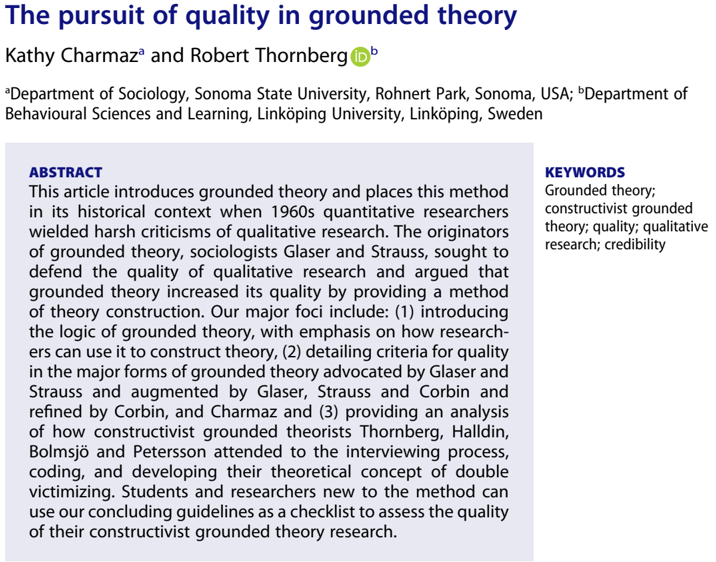
This article introduces grounded theory and places this method in its historical context when 1960s quantitative researchers wielded harsh criticisms of qualitative research. The originators of grounded theory, sociologists Glaser and Strauss, sought to defend the quality of qualitative research and argued that grounded theory increased its quality by providing a method of theory construction. Our major foci include: (1) introducing the logic of grounded theory, with emphasis on how researchers can use it to construct theory, (2) detailing criteria for quality in the major forms of grounded theory advocated by Glaser and Strauss and augmented by Glaser, Strauss and Corbin and refined by Corbin, and Charmaz and (3) providing an analysis of how constructivist grounded theorists Thornberg, Halldin, Bolmsjö and Petersson attended to the interviewing process, coding, and developing their theoretical concept of double victimizing. Students and researchers new to the method can use our concluding guidelines as a checklist to assess the quality of their constructivist grounded theory research.
Verified 2026-11-22 · 1 reference not checked yet
Overview
CoChat Summary
TL;DR
This article reviews grounded theory’s historical development and argues that quality criteria must fit the specific version of grounded theory, culminating in constructivist criteria and a checklist. It illustrates constructivist quality through Thornberg et al.’s (2013) study of school bullying and the concept of double victimizing.
Key findings
- Quality criteria differ across grounded theory versions: original Glaser and Strauss focused on credibility and applicability with fitness, understanding, generality, and control; Glaser added workability, relevance, fit, and modifiability; Strauss and Corbin emphasized data quality, plausibility/value of theory, adequacy of process, and empirical grounding; constructivist Charmaz proposes credibility, originality, resonance, and usefulness.
- The paper argues quality is built through iterative data collection and analysis, line-by-line and focused coding, memo-writing, theoretical sampling and saturation, constant comparison, and reflexivity/methodological self-consciousness.
- In the illustrative constructivist study, Thornberg et al. (2013) distributed 523 open-ended questionnaires to students in three secondary schools and two universities in Sweden; of 511 responses, 168 reported past bullying, 36 volunteered, and 21 who had been bullied for more than one year were interviewed; analysis produced the core category “double victimizing” (external and internal victimizing).
- In psychology, Rubin, Bell, and McCleland (2018) found only 13% of responding graduate psychology programs required a qualitative research course, and respondents described qualitative research as “inaccurate,” “subjective,” and “lacking rigor” while also describing it as providing the “best methods for feminist, community-based, and social justice research.”
Methods
- Design: methodological/conceptual article introducing grounded theory, comparing quality criteria across Glaserian, Straussian, and constructivist versions, and offering guidelines/checklist for constructivist grounded theory.
- Data or sample: no primary empirical sample for the article; it analyzes historical and methodological literature and uses Thornberg et al. (2013) as an illustrative constructivist grounded theory study (523 questionnaires; 511 responses; 168 bullied; 36 volunteers; 21 interviewed).
- Main analysis: narrative synthesis and comparison of quality criteria, with an illustration of coding, constant comparison, memo-writing, theoretical sampling, and category development leading to “double victimizing.”
Limitations
- Stated: the authors caution that checklists risk becoming a “methodological crutch” that avoids deep engagement with method and data (citing Barbour 2001), and present their guidelines as flexible, not substitutes for rigorous research.
- Stated: criteria for quality in qualitative research remain unsettled, with “little consensus” about appropriate evaluation criteria, and meanings of quality markers may differ among researchers.
- Evident from the text: the article is not an empirical validation of the checklist; the double victimizing case is a secondary illustration rather than a new test, and the guidelines are aimed mainly at constructivist grounded theory though claimed mostly applicable to other versions.
Model-written summary. Check it against the paper before relying on it.
Integrity signals
Registry
Cites
Statistics
Figures



Verification
Claims the paper makes
2 Valid · 13 Not valid · 38 Not checked · 38 Own results and interpretations
None of the sources cited for this claim have been checked yet.
In the paper
“Concerns about objectivity, validity, reliability and replicability in qualitative research still pervade academic psychology.”
§ The pursuit of quality in grounded theory > Qualitative research and psychology
plain- Asserted: passes — The authors put it forward as true.
- Checkable: passes — It can be checked against evidence.
- Load-bearing: passes — The paper’s conclusions depend on it.
- Based: passes — The paper gives a reason why it holds.
In the paper
“Until Glaser and Strauss's (1967) statement, little had been written, much less codified into a systematic statement, about how to construct a qualitative theoretical analysis of high quality.”
§ The pursuit of quality in grounded theory > Concerns about quality in the development of grounded theory
What the sources say
- Not matchedcites Glaser and Strauss's (1967)
An author–year citation the paper’s reference list doesn’t settle. We don’t search these by name.
plain- Asserted: passes — The authors put it forward as true.
- Checkable: passes — It can be checked against evidence.
- Load-bearing: unclear — It is unclear whether the paper’s conclusions depend on it.
- Based: passes — The paper gives a reason why it holds.
- Not matched
A statement the paper makes itself — it cites no source for it, so there is none to check. The quote shows it is in the paper.
In the paper
“If, however, researchers only ask the same questions of each participant, they are likely to elicit similar stories about the topic.”
§ The pursuit of quality in grounded theory > Introduction
hedgedstates a possible cause- Asserted: passes — The authors put it forward as true.
- Checkable: passes — It can be checked against evidence.
- Load-bearing: passes — The paper’s conclusions depend on it.
- Based: passes — The paper gives a reason why it holds.
A statement the paper makes itself — it cites no source for it, so there is none to check. The quote shows it is in the paper.
In the paper
“If, however, researchers systematically interrogate their data as they gather it, their early ideas can then inform subsequent data collection.”
§ The pursuit of quality in grounded theory > Introduction
plainstates a possible cause- Asserted: passes — The authors put it forward as true.
- Checkable: passes — It can be checked against evidence.
- Load-bearing: passes — The paper’s conclusions depend on it.
- Based: passes — The paper gives a reason why it holds.
A statement the paper makes itself — it cites no source for it, so there is none to check. The quote shows it is in the paper.
In the paper
“When answering quantitative social scientists' sharp criticisms of its quality, Glaser and Strauss rejected the common practice of evaluating qualitative research according to the tenets of the quantitative tradition.”
§ The pursuit of quality in grounded theory > Concerns about quality in the development of grounded theory
plain- Asserted: passes — The authors put it forward as true.
- Checkable: passes — It can be checked against evidence.
- Load-bearing: unclear — It is unclear whether the paper’s conclusions depend on it.
- Based: passes — The paper gives a reason why it holds.
22 more claims
Create a free account to see all 91 claims and to verify the 7 references still open.
- Probably not a substantial claim. 61
- It may state two separate claims as one. 26
Claims other papers make about this one
Each is checked against this paper’s own text: does it say what the citing paper says it does?
The source backs part of the claim, not all of it — or backs it for a different population, condition or comparison.
In the citing paper
“An explicitly constructivist approach aims to produce an abstract understanding of a phenomenon (rather than an explanation, as in other versions of GTM)”
From Quality Criteria: General and Specific Guidelines for Qualitative Approaches in Psychology Research. A Concise Guide for Novice Researchers and Reviewers (2024) · cites this paper as Charmaz & Thornberg, 2021
Experimental — accuracy not yet measuredThe source backs part of the claim, not all of it — or backs it for a different population, condition or comparison.
In the citing paper
“Constant comparison is a systematic strategy combining the advantages of simultaneous data generation and analysis, enabling a concentration on significant issues (Charmaz and Thornberg, 2021).”
From Application and challenges of using a Constructivist Grounded Theory methodology to address an undertheorized clinical challenge: A discussion paper (2024) · cites this paper as Charmaz and Thornberg, 2021
Experimental — accuracy not yet measuredThe cited source says what the claim attributes to it.
In the citing paper
“focuses on actions, meanings and constructions”
From Quality Criteria: General and Specific Guidelines for Qualitative Approaches in Psychology Research. A Concise Guide for Novice Researchers and Reviewers (2024) · cites this paper as Charmaz & Thornberg, 2021
The cited source says what the claim attributes to it.
In the citing paper
“and acknowledges both subjectivity (of participants and researchers) and context (Charmaz, 2014; Charmaz & Thornberg, 2021).”
From Quality Criteria: General and Specific Guidelines for Qualitative Approaches in Psychology Research. A Concise Guide for Novice Researchers and Reviewers (2024) · cites this paper as Charmaz & Thornberg, 2021
The cited source says what the claim attributes to it.
In the citing paper
“The primary focus is the theory ' s ability to clarify participants ' lives and contribute to knowledge and practice (Charmaz & Thornberg, 2021).”
From Quality Criteria: General and Specific Guidelines for Qualitative Approaches in Psychology Research. A Concise Guide for Novice Researchers and Reviewers (2024) · cites this paper as Charmaz & Thornberg, 2021
6 more claims about this paper
Create a free account to see every claim other papers make about this one.
Citations
Cites
Using thematic analysis in psychology
Braun, V., & Clarke, V. (2006) · Qualitative Research in Psychology · doi:10.1191/1478088706qp063oa · Cited by 194,414
The Discovery of Grounded Theory: Strategies for Qualitative Research.
Wagner, H. R., Glaser, B. G., & Strauss, A. L. (1968) · Social Forces · doi:10.2307/2575405 · Cited by 46,361
The Discovery of Grounded Theory; Strategies for Qualitative Research
Glaser, B. G., Strauss, A. L., & Strutzel, E. (1968) · Nursing Research · doi:10.1097/00006199-196807000-00014 · Cited by 39,449
Basics of Qualitative Research: Grounded Theory Procedures and Techniques.
Ellis, C., Strauss, A., & Corbin, J. (1992) · Contemporary Sociology · doi:10.2307/2074814 · Cited by 29,249
Basics of Qualitative Research (3rd ed.): Techniques and Procedures for Developing Grounded Theory
Corbin, J., & Strauss, A. (2008) · SAGE · doi:10.4135/9781452230153 · Cited by 24,827
(2006) · Cited by 18,730
Self-citationBasics of Qualitative Research
Ozanne, J. L., Strauss, A., & Corbin, J. (1992) · Journal of Marketing Research · doi:10.2307/3172751 · Cited by 17,850 · cited 2×
“In their development of grounded theory, Strauss and Corbin (1990; Corbin and Strauss 1990; Strauss and Corbin 1998) emphasized four general criteria: (1) quality of the data, in other words, grounded theorists need to carefully address and adopt quality criteria related to methods used for data…”
BackgroundMethodBasics of Qualitative Research: Grounded Theory Procedures and Techniques
Long, D. R., Strauss, A., & Corbin, J. (1993) · The Modern Language Journal · doi:10.2307/328955 · Cited by 17,576
(2014) · Cited by 15,747
Self-citationInterviewing as qualitative research a guide for researchers in education and the social sciences
Seidman, I. (2006) · Cited by 12,757
Research works printed but not linked: 5
- 10. Charmaz, K. 1995. Between positivism and postmodernism: implications for methods. In Studies in symbolic interaction, vol. 17, N. K. Denzin (Ed.), pp. 43-72. Greenwich, CT: JAI Press.
- 17. Cisneros-Puebla, C. A. 2007. The deconstructive and reconstructive faces of social construc- tion: Kenneth Gergen in conversation with César A. Cisneros-Puebla. With an introduction by Robert B. Faux [83 paragraphs]. Forum Qualitative Sozialforschung/Forum: Qualitative Social Research 9 (1):Art. 20. http://nbn-resolving.de/urn:nbn:de:0114-fqs0801204 .
- 26. Glaser, B. G. 1978. Theoretical sensitivity. Mill Valley, CA: Sociology Press.
- 27. Glaser, B. G. 1992. Basics of grounded theory analysis. Mill Valley, CA: Sociology Press.
- 30. Glaser, B. G. 2013. No preconceptions: The grounded theory dictum. Mill Valley, CA: Sociology Press.
Cited by
Items 201–300 of 1,191
Bartoli, C., Fasano, F., Cappa, F., & Boccardelli, P. (2025) · IEEE Transactions on Engineering Management · doi:10.1109/tem.2025.3560910 · Cited by 15
Oosting, I. J., Kluit, L., Schaafsma, F. G., Beumer, A., van Bennekom, C. A. M., de Boer, A. G. E. M., & de Wind, A. (2023) · Journal of Occupational and Environmental Medicine · doi:10.1097/jom.0000000000002833 · Cited by 9
“However, no new theoretical insights emerged while analyzing the last two focus groups, so we were able to conclude that data saturation was reached in this study.(41) This study was part of a larger qualitative investigation on CWIC, in which patients' motives for discussing work with their medical specialists and th…”
BackgroundSchuler, C., Agbozo, F., Ntow, G. E., & Waldboth, V. (2023) · BMC Pediatrics · doi:10.1186/s12887-023-04330-5 · Cited by 12
“Charmaz’s [25, 26] quality criteria for grounded theory studies were applied to ensure rigor during the design, data collection, analysis and assessment of strengths and limitations of the study.”
MethodDesarrollo de un modelo de investigación educativa basado en la Teoría Fundamentada Constructivista
Suricalday, Á. S. (2022) · Márgenes Revista de Educación de la Universidad de Málaga · doi:10.24310/mgnmar.v3i2.13082 · Cited by 22
Applying complexity theory perspective to knowledge management in the innovation context
Pacheco, C., & D., B. P. G. (2023) · VINE Journal of Information and Knowledge Management Systems · doi:10.1108/vjikms-08-2022-0279 · Cited by 22
Revealing resilience features: Analyzing informal solutions adopted in emergency situations
ElKady, S. K., Hernantes, J., Martín, E. G., & Labaka, L. (2024) · International Journal of Disaster Risk Reduction · doi:10.1016/j.ijdrr.2024.104267 · Cited by 14
Stängle, S., & Fringer, A. (2022) · BMC Palliative Care · doi:10.1186/s12904-022-00941-4 · Cited by 9
“The developed knowledge can help professionals become aware of the topic and be prepared before being confronted by an individual (Usefulness) [70].”
BackgroundGrant, R., Mooney‐Somers, J., Power, J., McNair, R., Pennay, A. E., Jones, J. B., & Bourne, A. (2023) · International Journal of Qualitative Methods · doi:10.1177/16094069231194204 · Cited by 11
“We will draw upon both narrative (Riessman, 1993) and constant comparison (Charmaz and Thornberg, 2021) methods to explore initiations, transitions and broader experiential sense-making, as well as the ways in which culture shapes, and is shaped by, alcohol or tobacco consumption.”
MethodQin, L., Ho, W. K. Y., Xu, B., & Khoo, S. (2025) · Frontiers in Public Health · doi:10.3389/fpubh.2025.1569222 · Cited by 16
“As a qualitative research method, grounded theory enables researchers to deeply explore the experiences, beliefs, and emotions of research subjects, facilitating a more nuanced understanding and interpretation (50).”
Yan, Z., & Luo, B. (2023) · Journal of Aging Studies · doi:10.1016/j.jaging.2023.101111 · Cited by 9
Doing/Undoing Gender in Research and Innovation – Practicing Downplaying and Doubt
Korvajärvi, P. (2021) · Feminist Encounters A Journal of Critical Studies in Culture and Politics · doi:10.20897/femenc/11164 · Cited by 14
“…theory (Charmaz, 2021) in its aim to explain the analysis transparently: going back and forth between the data and the conceptualisations, making continuous comparisons between them, coding the material accordingly, and memo-writing on the analysis-in-progress (Charmaz and Thornberg, 2020).”
BackgroundLee, A., Jere, A., Plessis, L. D., Gerven, P. W. M. V., Heeneman, S., & Ross, S. (2024) · Medical Education · doi:10.1111/medu.15595 · Cited by 11
“33 CGT provides a systematic method to understand and develop theoretical insight into how perceptions of CoS impact feedback and assessment through studying the actions that occur while acknowledging that our subjective experiences influence the research process.”
Culture, Health and Wellbeing: Yarning with the Victorian Indigenous community
Vance, A. L. A., McGaw, J., O’Rorke, D., White, S., & Eades, S. (2024) · International Journal of Indigenous Health · doi:10.32799/ijih.v19i1.41307 · Cited by 12
Elers, C. N. H., & Dutta, M. J. (2023) · Human Communication Research · doi:10.1093/hcr/hqad027 · Cited by 17
Dadashpoor, H., & Taheri, E. (2022) · GeoJournal · doi:10.1007/s10708-022-10752-y · Cited by 11
“The grounded theory approach is a systematic method of conducting research that defines how data are collected and provides explicit strategies for analyzing them (Charmaz & Thornberg, 2020: 1).”
MethodTao, C., Zhou, X., Wang, Y., & Zhang, X. (2024) · Journal of Travel Research · doi:10.1177/00472875241294047 · Cited by 9
“…approach encourages researchers to interpret data subjectively, offering greater adaptability and vitality to construct a comprehensive theoretical framework (Charmaz & Thornberg, 2021; Mills et al., 2006), and better addressing research questions such as ‘‘what’’ and ‘‘how’’(Gedecho et al., 2023).”
ANALISIS DATA KUALITATIF: MANUAL DATA ANALISIS PROSEDUR
Rofiah, C., & Bungin, B. (2024) · Develop · doi:10.25139/dev.v8i1.7319 · Cited by 62
Educators’ perspectives on the relevance of Social and Emotional Learning skills in South Africa
Marsay, G. (2022) · Perspectives in Education · doi:10.38140/pie.v40i4.6078 · Cited by 10
Islamic household accounting: romance discussion in accounting curriculum
Septyan, K., Triyuwono, I., Rosidi, R., et al. (2022) · Journal of Islamic Accounting and Finance Research · doi:10.21580/jiafr.2022.4.2.12633 · Cited by 8
“Researchers cannot hide their identity; instead, they must know what their self-concept is first (Charmaz, 2019), who the researcher is, and why this topic is so valuable for the researcher (Charmaz & Thornberg, 2020).”
BackgroundArt, Extractivism, and the Ontological Shift: Toward a (Post)Extractivist Aesthetics
Serafini, P. (2024) · Theory Culture & Society · doi:10.1177/02632764241238330 · Cited by 10
“The study therefore draws from and engages with aesthetics as well as political ontology and theories of extractivism, but proposes an understanding of (post)extractivist aesthetics that is grounded and emerges from the data itself (e.g. Charmaz and Thornberg, 2020).”
Öztürk, G. K., BAŞER, E., & Engin, E. (2023) · Journal of Psychiatric and Mental Health Nursing · doi:10.1111/jpm.13003 · Cited by 8
Sanitation struggles and public health concerns in Ghana: insights from Sodom and Gomorrah slum
Ayelazuno, R. A., & Tetteh, S. (2025) · SN Social Sciences · doi:10.1007/s43545-025-01063-3 · Cited by 13
“By leveraging semi-structured interview guides, it ensured flexibility in probing specific issues while maintaining consistency across interviews (Charmaz and Thornberg 2021).”
School Nursing Practice in Education Settings in Spain
Junco, L. A., Martínez, L. A., & Hawrylak, M. F. (2024) · The Journal of School Nursing · doi:10.1177/10598405241264732 · Cited by 11
“The data analysis method comprised three stages: initiation, focus, and theory, as outlined by Charmaz (2006, 2008, 2017) and Charmaz and Thornberg (2021).”
Wu, Y., Xu, L., Lin, J., & Ghani, M. I. (2023) · Systems · doi:10.3390/systems11100507 · Cited by 14
Local Value Chain Models of Healthy Food Access: A Qualitative Study of Two Approaches
Guerra, K. K., Hanks, A., Plakias, Z., Huser, S., Redfern, T., & Garner, J. A. (2021) · Nutrients · doi:10.3390/nu13114145 · Cited by 9
“The rigor of this inquiry and credibility of the findings were enhanced through the development of a detailed, consensus codebook via an iterative, group process of transcript review, codebook application, and codebook revision [78,79]; the sharing, discussion, and “member checking” of preliminary findings with commun…”
BackgroundTaiwo, A. O., Chinyio, E., Hewson, H., & Agberotimi, S. F. (2023) · The European Journal of Counselling Psychology · doi:10.46853/001c.91127 · Cited by 15
“We also acknowledge the complexity of reaching a theoretical saturation (Charmaz & Thornberg, 2021), hence the term “data sufficiency” used in this study.”
Dasaklis, T. K., Kopanaki, E., Chountalas, P. T., Rachaniotis, N. P., Voutsinas, T. G., Giannakis, K., & Chondrokoukis, G. P. (2024) · Logistics · doi:10.3390/logistics8010030 · Cited by 21
“[32] underscores the importance of these elements in maintaining research quality, stressing the need for empirical grounding throughout the study.”
BackgroundTurelli, F. C., Vaz, A. F., & Kirk, D. (2023) · Social Sciences · doi:10.3390/socsci12100538 · Cited by 14
Urban, I., & Plattfaut, R. (2025) · Information Systems Frontiers · doi:10.1007/s10796-025-10610-5 · Cited by 20
“After analysis of 15 interviews, saturation occurred as no more fundamentally new constructs appeared (Charmaz & Thornberg, 2021).”
Secret powers: Acts of Googling in the therapeutic relationship
Trub, L. R., & Magaldi, D. (2021) · Journal of Clinical Psychology · doi:10.1002/jclp.23107 · Cited by 10
Moore, A. L., Miller, T. M., & Ledbetter, C. R. (2021) · Frontiers in Psychology · doi:10.3389/fpsyg.2021.749898 · Cited by 9
“This inductive analysis ensures that themes emerge from the data instead of creating pre-determined themes of expected adherence (Charmaz and Thornberg, 2020).”
BackgroundYao, Y., Xu, H., & Song, H.-Y. (2025) · Sustainability · doi:10.3390/su17041694 · Cited by 14
Lin, S., Zhu, H., Liu, J., et al. (2025) · Land · doi:10.3390/land14020407 · Cited by 7
Norddal, G. A., Wifstad, Å., & Lian, O. S. (2022) · Health Risk & Society · doi:10.1080/13698575.2022.2028742 · Cited by 11
Vochocová, L., & Rosenfeldová, J. (2023) · Journalism Practice · doi:10.1080/17512786.2023.2260364 · Cited by 7
“We employed the flexible approach to this method including theoretical preparation before engaging in research (Charmaz and Thornberg 2021) to inductively, exploratively identify specific categories of media representations of the FFF related to the generational aspects of the issue.”
Baccon, W. C., Salci, M. A., Carreira, L., Gallo, A. M., Marques, F. R. D. M., Paiano, M., Baldissera, V. D. A., & Laranjeira, C. (2023) · International Journal of Environmental Research and Public Health · doi:10.3390/ijerph20156488 · Cited by 9
“Study Rigor and Reflexivity To ensure the accuracy and validity of the research, Charmaz and Thornberg [37] proposed four criteria: credibility, originality, resonance, and usefulness.”
MethodKlem, N.-R., Briggs, A. M., Rowbotham, S. J., Schütze, R., O’Sullivan, P., Smith, A. J., Tory, B., Stinson, J., Lord, S. M., & Slater, H. (2025) · Journal of Pain · doi:10.1016/j.jpain.2025.105412 · Cited by 8
Kyanjo, J. L., Turinawe, A., Hörnell, A., et al. (2025) · BMC Public Health · doi:10.1186/s12889-025-21978-z · Cited by 7
“We ensured the rigour of the study by following the credibility, originality, resonance, and usefulness criteria [41].”
Bigler, C., Pita, Y., & Sony, K. C. (2025) · Women s Studies International Forum · doi:10.1016/j.wsif.2024.103051 · Cited by 12
Identification of stress factors in returning migrants in Latvia
Ozola-Cīrule, I., & Martinsone, B. (2025) · Frontiers in Psychology · doi:10.3389/fpsyg.2024.1515406 · Cited by 7
Das, S., Jha, S., & Datta, S. (2024) · Gender in Management An International Journal · doi:10.1108/gm-05-2022-0175 · Cited by 11
Founder dynamic psychological ownership: Impacts on self and others at work
Zhu, H., Smith, C., & Brown, G. (2023) · Applied Psychology · doi:10.1111/apps.12505 · Cited by 8
Sense of community and well-being in diaspora festivals
Gedecho, E. K., Kim, S., & Xiao, H. (2023) · Tourism Geographies · doi:10.1080/14616688.2023.2280690 · Cited by 12
“This study was evaluated according to the four constructivist grounded theory (CGT) research criteria proposed by Charmaz and Thornberg (2021) to ensure its credibility, originality, resonance, and usefulness.”
MethodHuman-Animal Relationships in Supported Housing: Animal Atmospheres for Mental Health Recovery
Friesinger, J. G., Birkeland, B., & Thorød, A. B. (2021) · Frontiers in Psychology · doi:10.3389/fpsyg.2021.712133 · Cited by 10
“Animals were thereby an important subject already early in fieldwork that was further elaborated with theoretical sampling (Charmaz, 2014; Charmaz and Thornberg, 2020).”
BackgroundMethodMansour, L. (2024) · Higher Education · doi:10.1007/s10734-024-01315-w · Cited by 7
“To bolster the credibility, originality, usefulness, and resonance of this study (Charmaz & Thornberg, 2021), I employed several strategies.”
Constructivist Grounded Theory
Field‐Springer, K. (2022) · The International Encyclopedia of Health Communication · doi:10.1002/9781119678816.iehc0593 · Cited by 7
Datafication of Care: Security and Privacy Issues with Health Technology for People with Diabetes
Bertolazzi, A., Marzęda-Młynarska, K., Kięczkowska, J. M., & Zanier, M. L. (2024) · Societies · doi:10.3390/soc14090163 · Cited by 11
Older Users Acceptance of Smart Products: An Extension of the Technology Acceptance Model
Zeng, H., Zhu, J., Lin, H., & Chen, J. (2024) · IEEE Access · doi:10.1109/access.2024.3383925 · Cited by 9
“To be noted, grounded theory is based not solely on empirical factors, but also on innovative concepts and ideas derived from empirical facts, validated by robust evidence [54].”
BackgroundVirtuNarrator: Crafting museum narratives via spatial layout in creating customized virtual museums
Chen, X., Tang, T., Chen, X., Li, Y., Liu, Q., & Wang, X. (2025) · Visual Informatics · doi:10.1016/j.visinf.2025.100257 · Cited by 12
Adlerstein, C., & Pardo, M. (2023) · SAGE Open · doi:10.1177/21582440231164283 · Cited by 11
“It develops a process based on a coherent and rigorous methodological structure (Charmaz, 2006b; Gilgun, 2009) and general qualitative trustworthiness procedures (Charmaz & Thornberg, 2021; Clarke & Keller, 2014; Denzin & Lincoln, 2005).”
Method‘Being attentive’: art therapy for adults with intellectual disabilities
Harpazi, S., Regev, D., & Snir, S. (2024) · International Journal of Art Therapy · doi:10.1080/17454832.2024.2347898 · Cited by 13
“Specifically, it applied the principles of Grounded Theory, which examines participants’ actions and the meanings they ascribe to these actions to describe and explain a given phenomenon (Charmaz & Thornberg, 2021).”
Dissonance, Disagreement, Difference: Challenging Thematic Consensus to Decolonise Grounded Theory
McGaw, J., & Vance, A. L. A. (2023) · International Journal of Qualitative Methods · doi:10.1177/16094069231220775 · Cited by 9
“( Charmaz & Thornberg, 2021; White & Cooper, 2022).”
BackgroundInfluentialBorges, G. M. (2024) · International Criminology · doi:10.1007/s43576-024-00138-0 · Cited by 12
“The overarching goal was to access refugee women’s narratives, utilizing grounded theory alongside the abduction model (Birks & Mills, 2015; Charmaz & Thornberg, 2021; Charmaz et al., 2017; Charmaz, 2014; 2006) for data analysis.”
Mercado, M., Law, L. E., Ferguson, K. M., & Wolfersteig, W. (2024) · Qualitative Health Research · doi:10.1177/10497323241239209 · Cited by 12
“Grounded theory is a systematic approach aimed at understanding a phenomenon that involves the perspectives and lived experiences of individuals (Birks et al., 2019; Charmaz & Thornberg, 2021).”
Li, Z., & Ma, Z. (2023) · Risk Management and Healthcare Policy · doi:10.2147/rmhp.s428369 · Cited by 9
“35 Therefore, employing the grounded theory approach for conceptualizing utilization willingness for family doctor contracting services is deemed appropriate.”
Ittefaq, M. (2023) · Health Security · doi:10.1089/hs.2023.0002 · Cited by 8
“The author used the constant comparison technique for qualitative data analysis based on grounded theory 34,35 to develop codes and organize themes related to the main challenges faced by LHDs, the issues encountered by communication officials in disseminating information, and their experiences of…”
The challenges of supply side obsolescence: Obsolescence procurement's past, present, and future
Schumm, J., Ralston, P. M., & Schwieterman, M. A. (2024) · Transportation Journal · doi:10.1002/tjo3.12005 · Cited by 7
Organisational practices and social inclusion: Inclusionary place‐making in the library
Kerr, R., & Hopkins, N. (2024) · Journal of Community & Applied Social Psychology · doi:10.1002/casp.2801 · Cited by 11
Hirsch, L. S., Hwang, D., Johns, M., & Isbister, K. (2025) · Designing Interactive Systems Conference · doi:10.1145/3715336.3735695 · Cited by 14
Mira, J. J., Carrillo, I., Gil-Hernández, E., Strametz, R., Krajina, H. K., Schrøder, K., Tella, S., Guerra-Paiva, S., Knežević, B., Panella, M., et al. (2025) · BMJ Open · doi:10.1136/bmjopen-2024-089923 · Cited by 15
“The research team of this study considered the ERNST Consortium to be an optimal vehicle to complement the available literature with specific recommendations emerging from the different current realities of SV support provision in Europe.”
Belongingness challenged: Exploring the impact on older adults during the COVID-19 pandemic.Preprint
Derrer‐Merk, E., Ferson, S., Mannis, A., et al. (2022) · doi:10.31219/osf.io/z7hcx · Cited by 7
How Companies Move to Circularity: Internal Reorganizing and Adjustment of External Collaboration
Fliaster, A., & Bähr, K. (2025) · Business Strategy and the Environment · doi:10.1002/bse.4347 · Cited by 12
The process of nurses' role negotiation in general practice: A grounded theory study
Hewitt, S., Mills, J. E., Hoare, K., & Sheridan, N. (2023) · Journal of Advanced Nursing · doi:10.1111/jan.15938 · Cited by 9
Compassionate Care: A Qualitative Exploration of Nurses’ Inner Resources in the Face of Burnout
Flowers, S.-L. D., Guillén-Solà, M., Sansó, N., & Galiana, L. (2024) · Nursing Reports · doi:10.3390/nursrep14010006 · Cited by 10
The Process Model of Stigmatized Loss: Identity-Threatened Experiences of Bereaved Mothers
Minton, E. A., Wang, C. X., Anthony, C. M., & Fox, A. K. (2023) · Qualitative Health Research · doi:10.1177/10497323231203643 · Cited by 9
“We collected and analyzed the interviews using a grounded theory approach (Charmaz & Thornberg, 2021; Strauss & Corbin, 1990).”
MethodA constructivist grounded theory exploration of Mindfulness for Healthcare Professional students
Braun, S. E., Mladen, S. N., Crawford, M., Edwards, S., & Kinser, P. A. (2022) · Complementary Therapies in Clinical Practice · doi:10.1016/j.ctcp.2022.101689 · Cited by 11
Edman, K., Gustafsson, A. W., & Cuadra, C. B. (2023) · Psychotherapy · doi:10.1037/pst0000511 · Cited by 9
USE OF GROUNDED THEORY IN THE EXTRACTION, CODING AND ANALYSIS OF DATA IN LITERATURE META-ANALYSES
Rêgo, A. D. S., Radovanovic, C. A. T., Haddad, M. D. C. F. L., dos Santos, J. L. G., Carreira, L., Salci, M. A., de Andrade, L., & Büscher, A. (2023) · Texto & Contexto - Enfermagem · doi:10.1590/1980-265x-tce-2021-0445en · Cited by 11
“…analysis is selective coding, in which the previous categories are compared and analyzed continuously, allowing the emergence of the phenomenon 9 – 10 To contextualize the methodological process of meta-analyses using GT, an excerpt from the doctoral thesis entitled “Construction and validation…”
BackgroundMethodInfluentialHaving a Bad Day Is Not an Option: Learner Perspectives on Learner Handover
Shaw, T., LaDonna, K. A., Hauer, K. E., Khalifé, R., Sheu, L. C., Wood, T., Montgomery, A., Rauscher, S., Aggarwal, S., & Humphrey-Murto, S. M. (2023) · Academic Medicine · doi:10.1097/acm.0000000000005433 · Cited by 10
“” 22(p315) This constructivist position is also reflected in our attention to the influence of researcher orientations on the study and our openness to the application of sensitizing concepts from the literature.”
BackgroundPetiot, O. (2022) · Enfances & Psy · doi:10.3917/ep.093.0149 · Cited by 7
Living a good life: Exploring eudaimonic well-being outcomes of diaspora festivals
Gedecho, E. K., & Kim, S. (2025) · Journal of Hospitality and Tourism Management · doi:10.1016/j.jhtm.2025.04.001 · Cited by 8
Reducing risks in complex care transitions in rural areas: a grounded theory
Byberg, I., Näppä, U., Rönning, H., & Häggström, M. (2023) · International Journal of Qualitative Studies on Health and Well-Being · doi:10.1080/17482631.2023.2185964 · Cited by 10
Gokgoz, C., & Kabukçuoğlu, K. (2022) · Research in Developmental Disabilities · doi:10.1016/j.ridd.2022.104217 · Cited by 6
Fingrut, W. B., Chen, A. C., Green, M., Weiss, J. T., Mercer, D., & Allan, D. (2022) · Transfusion · doi:10.1111/trf.16827 · Cited by 7
“In CGT, researchers' experiences in the field and knowledge of the literature are used to inform questions asked, seek confirming and disconfirming views, and facilitate depth of interpretation.(32,33) The focus groups and qualitative analysis were conducted by two donor recruiters (Angela C.”
MethodBeck, L., Bekker, S., Verhagen, E. A. L. M., Bolling, C. S., & Spörri, J. (2024) · BMJ Open Sport & Exercise Medicine · doi:10.1136/bmjsem-2023-001643 · Cited by 10
Ito, H., & Kato, K. (2025) · Journal of Innovation and Entrepreneurship · doi:10.1186/s13731-025-00488-7 · Cited by 9
“…precedes empirical research, it is often difficult to select an extant theory appropriate for a study prior to research (Glaser, 1998), especially when the subject of research is relatively new, such as Woven City, and there may not be sufficient literature for review (Charmaz & Thornberg, 2021).”
Autistic People’s Perspectives on Parental Diagnosis Disclosure: A Grounded Theory Study
Almog, N., Keren, E. H., Gabai, T., & Kassel, O. (2024) · Journal of Autism and Developmental Disorders · doi:10.1007/s10803-024-06468-2 · Cited by 7
“The theory is constructed by working in the field and returning to it to collect more data until a rich and meaningful theory is constructed (Charmaz & Thornberg, 2021).”
InfluentialMa, H., Dong, Y., Jing, B., Zeng, Y., & Sun, J. (2025) · International Journal of STEM Education · doi:10.1186/s40594-025-00548-0 · Cited by 18
“This coding process systematically progresses, utilizing constant comparative methodology to deconstruct data, construct relational networks, and integrate core categories (Charmaz & Thornberg, 2020).”
Pecar, K. D., Anderson, P., Hopkins, S., Rallah-Baker, K. R., & Bentley, S. A. (2022) · Clinical and Experimental Optometry · doi:10.1080/08164622.2022.2102892 · Cited by 6
“worthiness and rigour, the researcher (KDP) engaged in memoing, methodological self-consciousness and reflexive discussions with the whole research group.(22) The purpose of the research, sample specificity, quality of dialogue and analysis strategy informed the information power of the sample to determine it was suff…”
BackgroundKamminga, N. C. W., van der Veldt, A. A. M., Wakkee, M., van den Berge, F. R., van der Beek, L. A. A., Joosen, M. C. W., Joosse, A., de Joode, K., Nijsten, T. E. C., & Lugtenberg, M. (2024) · BMC Cancer · doi:10.1186/s12885-024-12410-7 · Cited by 6
“Constant comparison was applied by comparing each interpretation and finding with new data [23].”
MethodClarke, E., Malinen, S. K., Näswall, K., & Masselot, A. (2025) · German Journal of Human Resource Management Zeitschrift für Personalforschung · doi:10.1177/23970022251337643 · Cited by 22
“Once the coding was completed, we used thematic analysis to develop the initial themes (Thomas, 2006), with similar codes grouped into themes (Charmaz and Thornberg, 2021; Clarke and Braun, 2013).”
Text Mining for Rendering Theory: Integrating Topic Modeling to Grounded TheoryPreprint
Odacioglu, E. C., & Zhang, L. (2022) · SSRN Electronic Journal · doi:10.2139/ssrn.4141372 · Cited by 8
Si, L., & Liu, X. (2024) · Aslib Journal of Information Management · doi:10.1108/ajim-07-2023-0238 · Cited by 8
Integrative subjective well-being in tourism
Qu, Y., Zhou, S., & Zhang, Q. (2025) · Journal Of Vacation Marketing · doi:10.1177/13567667251318770 · Cited by 7
“The method inductively constructs a theory using empirical data and integrates the advantage of thorough interpretation of qualitative research with the rigor and systematic-ness inherent in quantitative research (Charmaz and Thornberg, 2021).”
Walton, Q. L., Coats, J. V., Jeffers, K. S., Blakey, J. M., Hood, A. N., & Washington, T. (2023) · International Journal of Qualitative Studies on Health and Well-Being · doi:10.1080/17482631.2023.2278288 · Cited by 10
“Another way to ensure quality in constructivist grounded theory studies is through resonance, which “demonstrates that the researchers have constructed concepts that not only represent their research participants’ experience, but also provide insight to others” (Charmaz & Thornberg, 2021, p. 12).”
BackgroundInfluentialBaccon, W. C., Salci, M. A., Carreira, L., Gallo, A. M., Marques, F. R. D. M., & Laranjeira, C. (2023) · Healthcare · doi:10.3390/healthcare11172451 · Cited by 7
Mourning for Strangers: Black Women, Sequelae, and the Digital Afterlife of Police Violence
Gonzalez, S. M., Buggs, S. G., & Jackson, J. (2024) · Feminist Criminology · doi:10.1177/15570851241258316 · Cited by 9
“Coding embraced grounded theory, a systematic approach to developing theories from qualitative data relying on comparative, iterative, and interactive methodology to understand and conceptualize social processes (Charmaz, 2006; Charmaz & Thornberg, 2021).”
Adlerstein, C., & Pardo, M. (2024) · Profesorado Revista de Currículum y Formación del Profesorado · doi:10.30827/profesorado.v28i1.29674 · Cited by 10
“La producción y análisis de datos siguió el Método de Comparación Constante propio de la TFC (Bryant & Charmaz, 2019; Charmaz & Thornberg, 2020), entendiendo ambos procesos imbricados en cada etapa y recursivos en las sucesivas etapas.”
BackgroundStone, N. I., Thomson, G., & Tegethoff, D. (2023) · Journal of Advanced Nursing · doi:10.1111/jan.16029 · Cited by 8
Mobile Health Applications towards Sustainable Healthcare: A Healthcare Professionals’Perspective
Thapa, S. B., Rajput, A., Gandhi, A. V., & Raman, R. (2023) · International Conference on Advancement in Computation & Computer Technologies (InCACCT) · doi:10.1109/incacct57535.2023.10141765 · Cited by 6
“The Grounded Theory approach, as a systematic inductive method, aims to build theory through observations and experiences following repeated iterations of the transcript [42].”
MethodPetiot, O., & Kermarrec, G. (2024) · Journal of Teaching in Physical Education · doi:10.1123/jtpe.2024-0236 · Cited by 9
Doyle, A., Seery, N., Gumaelius, L., Canty, D., & Hartell, E. (2023) · International Journal of Technology and Design Education · doi:10.1007/s10798-023-09859-1 · Cited by 11
“This shared platform facilitated theoretical sampling (Charmaz & Thornberg, 2021 ; Thornberg, 2012) whereby explanations from the existing literature were sought to provide clarity on the development of codes, categories, and theoretical relationships.”
Cherniack, M. G., Namazi, S., Brennan, M., Henning, R. A., Dugan, A. G., & Ghaziri, M. E. (2024) · International Journal of Environmental Research and Public Health · doi:10.3390/ijerph21020142 · Cited by 6
Dor-Haim, P. (2025) · Journal of Educational Administration & History · doi:10.1080/00220620.2025.2467730 · Cited by 8
“The analysis was then integrated into a theoretical framework and compared with existing literature (Charmaz 2014; Charmaz and Thornberg 2020), distinguishing emotional regulation, cognitive restructuring, and problem-solving strategies.”
“I don’t need my kid to be high”: prioritizing harm reduction when using cannabis during pregnancy
Gould, E. E., Ganesh, S. S., & Ceasar, R. C. (2024) · Harm Reduction Journal · doi:10.1186/s12954-024-01046-2 · Cited by 7
“This method of iterative revision is aimed at generating richer responses from participants [34, 39].”
MethodChen, P.-Y., Fu, C.-P., & Wang, C. (2023) · Heliyon · doi:10.1016/j.heliyon.2023.e13716 · Cited by 10
“A researcher conducting research and composing narration becomes the chief narrator and is regarded as the contributor to content analyses [11,12].”
BackgroundAdaptive Journeys: Accelerating Cross-Cultural Adaptation Through Study Tours
Huang, Z., Huang, A., & Yin, Z. (2025) · Behavioral Sciences · doi:10.3390/bs15070973 · Cited by 14
“CGT, therefore, offers both the philosophical grounding and methodological flexibility needed to examine how adaptation unfolds within the unique experiential contexts of study tours (Charmaz & Thornberg, 2021).”
Fighting Back, Moving Forward: Refugee Women’s Agency in Stories of Resistance and Resilience
Borges, G. M. (2025) · Critical Criminology · doi:10.1007/s10612-025-09815-6 · Cited by 9
“A constructivist grounded theory approach guided the data analysis (Charmaz and Thornberg 2021; Charmaz et al. 2017).”
Digital ist besser!? – Wie Software das Verständnis von guter Schule neu definiert
Troeger, J., Zakharova, I., Macgilchrist, F., & Jarke, J. (2023) · Springer eBooks · doi:10.1007/978-3-658-38651-1_4 · Cited by 17
Metadata
- Authors
- Charmaz, K., & Thornberg, R.
- Affiliations
- Sonoma State University (US)
- Linköping University (SE)
- Corresponding author
- Thornberg, Robert
- Venue
- Qualitative Research in Psychology
- Publisher
- Informa UK Limited
- Published
- 2020-06-22
- Volume
- 18
- Issue
- 3
- Pages
- 305-327
- ISSN
- 1478-0887 (ISSN-L)
- 1478-0895
- OpenAlex
- W3036803033
- Cited by
- 1,221
- References
- 81
- Citations by year
- 2026: 264 · 2025: 290 · 2024: 255 · 2023: 221 · 2022: 128 · 2021: 54 · 2020: 8
- FWCI
- 155.56
- Type
- journal article
- Language
- en
- Open access
- hybrid
- doi.org
- Licence
- Locations
- Qualitative Research in Psychology (publishedVersion, cc-by-nc-nd)
- Topics
- Social Sciences › Education › Qualitative Research Methods and Applications
- Social Sciences › Sociology and Political Science › Qualitative Research Methods and Ethics
- Social Sciences › Sociology and Political Science › Sociology and Education Studies
- Keywords
- grounded theory, constructivist grounded theory, qualitative research quality, theory development, Glaser and Strauss, interviewing, coding, history of grounded theory
About these checks
Registry, retraction, Cites and statistics results are computed, not judged, with one exception: a printed reference that no index lists is read once by a model before it counts as a citation error. Claims are extracted by a model and kept only when their quote appears verbatim in the text; each cited source is then checked, with a model’s help, for whether it says what the claim relies on. Those verdicts can be wrong — read the claim’s quote and the cited source before relying on one.
The claim verdicts this report counts are experimental: their accuracy is not yet measured.
A language model drew the claims from the paper on 2026-09-28, under version 3 of the claim definition (model deepseek-v4.1-flash, prompt extract-v3).
A second model labelled each claim on 2026-09-28 (model jev-1.13-20260917, definition revision gold-guideline-v0.2).
Statistics and arithmetic are recomputed, not judged.
Confidence bands are shown only for fields calibrated on our annotated test set. None is calibrated yet, so no band is shown.
What counts as a claim ›How we measure confidence ›How we check this ›
Are you an author, or do you see a problem with this page? Request a review
Data sources
Bibliographic data: Semantic Scholar, OpenAlex, Crossref.
Contains information from the Semantic Scholar Academic Graph Datasets, made available under the ODC Attribution License (ODC-BY 1.0).
Semantic Scholar’s data is described in: Kinney, R., et al. (2023). The Semantic Scholar Open Data Platform. arXiv:2301.10140.
