

The pursuit of quality in grounded theory
Open accessThe DOI matches its Crossref record; 84 of the 85 references it cites were found in a registry or an index, and 1 are not checked yet; 2 of the 63 sources its claims cite were checked for support.
Abstract
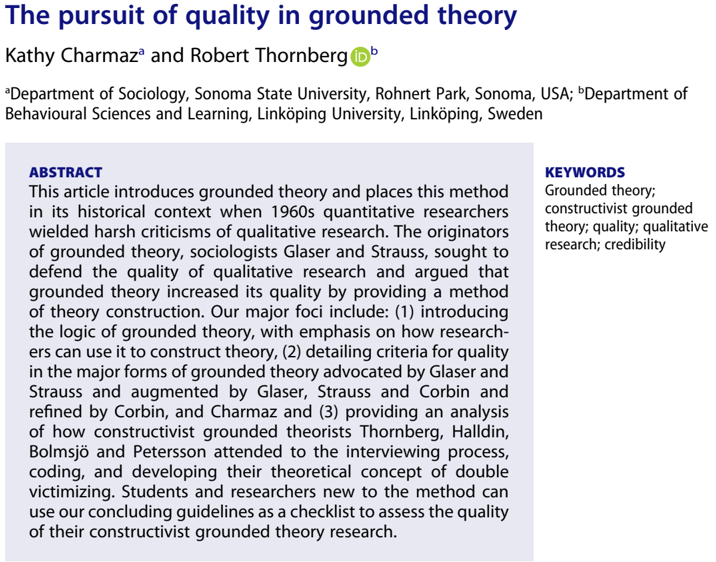
This article introduces grounded theory and places this method in its historical context when 1960s quantitative researchers wielded harsh criticisms of qualitative research. The originators of grounded theory, sociologists Glaser and Strauss, sought to defend the quality of qualitative research and argued that grounded theory increased its quality by providing a method of theory construction. Our major foci include: (1) introducing the logic of grounded theory, with emphasis on how researchers can use it to construct theory, (2) detailing criteria for quality in the major forms of grounded theory advocated by Glaser and Strauss and augmented by Glaser, Strauss and Corbin and refined by Corbin, and Charmaz and (3) providing an analysis of how constructivist grounded theorists Thornberg, Halldin, Bolmsjö and Petersson attended to the interviewing process, coding, and developing their theoretical concept of double victimizing. Students and researchers new to the method can use our concluding guidelines as a checklist to assess the quality of their constructivist grounded theory research.
Verified 2026-11-22 · 1 reference not checked yet
Overview
CoChat Summary
TL;DR
This article reviews grounded theory’s historical development and argues that quality criteria must fit the specific version of grounded theory, culminating in constructivist criteria and a checklist. It illustrates constructivist quality through Thornberg et al.’s (2013) study of school bullying and the concept of double victimizing.
Key findings
- Quality criteria differ across grounded theory versions: original Glaser and Strauss focused on credibility and applicability with fitness, understanding, generality, and control; Glaser added workability, relevance, fit, and modifiability; Strauss and Corbin emphasized data quality, plausibility/value of theory, adequacy of process, and empirical grounding; constructivist Charmaz proposes credibility, originality, resonance, and usefulness.
- The paper argues quality is built through iterative data collection and analysis, line-by-line and focused coding, memo-writing, theoretical sampling and saturation, constant comparison, and reflexivity/methodological self-consciousness.
- In the illustrative constructivist study, Thornberg et al. (2013) distributed 523 open-ended questionnaires to students in three secondary schools and two universities in Sweden; of 511 responses, 168 reported past bullying, 36 volunteered, and 21 who had been bullied for more than one year were interviewed; analysis produced the core category “double victimizing” (external and internal victimizing).
- In psychology, Rubin, Bell, and McCleland (2018) found only 13% of responding graduate psychology programs required a qualitative research course, and respondents described qualitative research as “inaccurate,” “subjective,” and “lacking rigor” while also describing it as providing the “best methods for feminist, community-based, and social justice research.”
Methods
- Design: methodological/conceptual article introducing grounded theory, comparing quality criteria across Glaserian, Straussian, and constructivist versions, and offering guidelines/checklist for constructivist grounded theory.
- Data or sample: no primary empirical sample for the article; it analyzes historical and methodological literature and uses Thornberg et al. (2013) as an illustrative constructivist grounded theory study (523 questionnaires; 511 responses; 168 bullied; 36 volunteers; 21 interviewed).
- Main analysis: narrative synthesis and comparison of quality criteria, with an illustration of coding, constant comparison, memo-writing, theoretical sampling, and category development leading to “double victimizing.”
Limitations
- Stated: the authors caution that checklists risk becoming a “methodological crutch” that avoids deep engagement with method and data (citing Barbour 2001), and present their guidelines as flexible, not substitutes for rigorous research.
- Stated: criteria for quality in qualitative research remain unsettled, with “little consensus” about appropriate evaluation criteria, and meanings of quality markers may differ among researchers.
- Evident from the text: the article is not an empirical validation of the checklist; the double victimizing case is a secondary illustration rather than a new test, and the guidelines are aimed mainly at constructivist grounded theory though claimed mostly applicable to other versions.
Model-written summary. Check it against the paper before relying on it.
Integrity signals
Registry
Cites
Statistics
Figures



Verification
Claims the paper makes
2 Valid · 13 Not valid · 38 Not checked · 38 Own results and interpretations
None of the sources cited for this claim have been checked yet.
In the paper
“Concerns about objectivity, validity, reliability and replicability in qualitative research still pervade academic psychology.”
§ The pursuit of quality in grounded theory > Qualitative research and psychology
plain- Asserted: passes — The authors put it forward as true.
- Checkable: passes — It can be checked against evidence.
- Load-bearing: passes — The paper’s conclusions depend on it.
- Based: passes — The paper gives a reason why it holds.
In the paper
“Until Glaser and Strauss's (1967) statement, little had been written, much less codified into a systematic statement, about how to construct a qualitative theoretical analysis of high quality.”
§ The pursuit of quality in grounded theory > Concerns about quality in the development of grounded theory
What the sources say
- Not matchedcites Glaser and Strauss's (1967)
An author–year citation the paper’s reference list doesn’t settle. We don’t search these by name.
plain- Asserted: passes — The authors put it forward as true.
- Checkable: passes — It can be checked against evidence.
- Load-bearing: unclear — It is unclear whether the paper’s conclusions depend on it.
- Based: passes — The paper gives a reason why it holds.
- Not matched
A statement the paper makes itself — it cites no source for it, so there is none to check. The quote shows it is in the paper.
In the paper
“If, however, researchers only ask the same questions of each participant, they are likely to elicit similar stories about the topic.”
§ The pursuit of quality in grounded theory > Introduction
hedgedstates a possible cause- Asserted: passes — The authors put it forward as true.
- Checkable: passes — It can be checked against evidence.
- Load-bearing: passes — The paper’s conclusions depend on it.
- Based: passes — The paper gives a reason why it holds.
A statement the paper makes itself — it cites no source for it, so there is none to check. The quote shows it is in the paper.
In the paper
“If, however, researchers systematically interrogate their data as they gather it, their early ideas can then inform subsequent data collection.”
§ The pursuit of quality in grounded theory > Introduction
plainstates a possible cause- Asserted: passes — The authors put it forward as true.
- Checkable: passes — It can be checked against evidence.
- Load-bearing: passes — The paper’s conclusions depend on it.
- Based: passes — The paper gives a reason why it holds.
A statement the paper makes itself — it cites no source for it, so there is none to check. The quote shows it is in the paper.
In the paper
“When answering quantitative social scientists' sharp criticisms of its quality, Glaser and Strauss rejected the common practice of evaluating qualitative research according to the tenets of the quantitative tradition.”
§ The pursuit of quality in grounded theory > Concerns about quality in the development of grounded theory
plain- Asserted: passes — The authors put it forward as true.
- Checkable: passes — It can be checked against evidence.
- Load-bearing: unclear — It is unclear whether the paper’s conclusions depend on it.
- Based: passes — The paper gives a reason why it holds.
22 more claims
Create a free account to see all 91 claims and to verify the 7 references still open.
- Probably not a substantial claim. 61
- It may state two separate claims as one. 26
Claims other papers make about this one
Each is checked against this paper’s own text: does it say what the citing paper says it does?
The source backs part of the claim, not all of it — or backs it for a different population, condition or comparison.
In the citing paper
“An explicitly constructivist approach aims to produce an abstract understanding of a phenomenon (rather than an explanation, as in other versions of GTM)”
From Quality Criteria: General and Specific Guidelines for Qualitative Approaches in Psychology Research. A Concise Guide for Novice Researchers and Reviewers (2024) · cites this paper as Charmaz & Thornberg, 2021
Experimental — accuracy not yet measuredThe source backs part of the claim, not all of it — or backs it for a different population, condition or comparison.
In the citing paper
“Constant comparison is a systematic strategy combining the advantages of simultaneous data generation and analysis, enabling a concentration on significant issues (Charmaz and Thornberg, 2021).”
From Application and challenges of using a Constructivist Grounded Theory methodology to address an undertheorized clinical challenge: A discussion paper (2024) · cites this paper as Charmaz and Thornberg, 2021
Experimental — accuracy not yet measuredThe cited source says what the claim attributes to it.
In the citing paper
“focuses on actions, meanings and constructions”
From Quality Criteria: General and Specific Guidelines for Qualitative Approaches in Psychology Research. A Concise Guide for Novice Researchers and Reviewers (2024) · cites this paper as Charmaz & Thornberg, 2021
The cited source says what the claim attributes to it.
In the citing paper
“and acknowledges both subjectivity (of participants and researchers) and context (Charmaz, 2014; Charmaz & Thornberg, 2021).”
From Quality Criteria: General and Specific Guidelines for Qualitative Approaches in Psychology Research. A Concise Guide for Novice Researchers and Reviewers (2024) · cites this paper as Charmaz & Thornberg, 2021
The cited source says what the claim attributes to it.
In the citing paper
“The primary focus is the theory ' s ability to clarify participants ' lives and contribute to knowledge and practice (Charmaz & Thornberg, 2021).”
From Quality Criteria: General and Specific Guidelines for Qualitative Approaches in Psychology Research. A Concise Guide for Novice Researchers and Reviewers (2024) · cites this paper as Charmaz & Thornberg, 2021
6 more claims about this paper
Create a free account to see every claim other papers make about this one.
Citations
Cites
Using thematic analysis in psychology
Braun, V., & Clarke, V. (2006) · Qualitative Research in Psychology · doi:10.1191/1478088706qp063oa · Cited by 194,414
The Discovery of Grounded Theory: Strategies for Qualitative Research.
Wagner, H. R., Glaser, B. G., & Strauss, A. L. (1968) · Social Forces · doi:10.2307/2575405 · Cited by 46,361
The Discovery of Grounded Theory; Strategies for Qualitative Research
Glaser, B. G., Strauss, A. L., & Strutzel, E. (1968) · Nursing Research · doi:10.1097/00006199-196807000-00014 · Cited by 39,449
Basics of Qualitative Research: Grounded Theory Procedures and Techniques.
Ellis, C., Strauss, A., & Corbin, J. (1992) · Contemporary Sociology · doi:10.2307/2074814 · Cited by 29,249
Basics of Qualitative Research (3rd ed.): Techniques and Procedures for Developing Grounded Theory
Corbin, J., & Strauss, A. (2008) · SAGE · doi:10.4135/9781452230153 · Cited by 24,827
(2006) · Cited by 18,730
Self-citationBasics of Qualitative Research
Ozanne, J. L., Strauss, A., & Corbin, J. (1992) · Journal of Marketing Research · doi:10.2307/3172751 · Cited by 17,850 · cited 2×
“In their development of grounded theory, Strauss and Corbin (1990; Corbin and Strauss 1990; Strauss and Corbin 1998) emphasized four general criteria: (1) quality of the data, in other words, grounded theorists need to carefully address and adopt quality criteria related to methods used for data…”
BackgroundMethodBasics of Qualitative Research: Grounded Theory Procedures and Techniques
Long, D. R., Strauss, A., & Corbin, J. (1993) · The Modern Language Journal · doi:10.2307/328955 · Cited by 17,576
(2014) · Cited by 15,747
Self-citationInterviewing as qualitative research a guide for researchers in education and the social sciences
Seidman, I. (2006) · Cited by 12,757
Research works printed but not linked: 5
- 10. Charmaz, K. 1995. Between positivism and postmodernism: implications for methods. In Studies in symbolic interaction, vol. 17, N. K. Denzin (Ed.), pp. 43-72. Greenwich, CT: JAI Press.
- 17. Cisneros-Puebla, C. A. 2007. The deconstructive and reconstructive faces of social construc- tion: Kenneth Gergen in conversation with César A. Cisneros-Puebla. With an introduction by Robert B. Faux [83 paragraphs]. Forum Qualitative Sozialforschung/Forum: Qualitative Social Research 9 (1):Art. 20. http://nbn-resolving.de/urn:nbn:de:0114-fqs0801204 .
- 26. Glaser, B. G. 1978. Theoretical sensitivity. Mill Valley, CA: Sociology Press.
- 27. Glaser, B. G. 1992. Basics of grounded theory analysis. Mill Valley, CA: Sociology Press.
- 30. Glaser, B. G. 2013. No preconceptions: The grounded theory dictum. Mill Valley, CA: Sociology Press.
Cited by
Items 1,101–1,191 of 1,191
Abbasi, M., Mansouri, M., Pashmforosh, M., Keshavarzi, M. H., & Ramezani, G. (2025) · Shiraz E-Medical Journal · doi:10.5812/semj-157743 · Cited by 2
Marked by the journey: Aesthetic reflexivity and existential transformation through travel tattoos
Soulard, J., Du, X., & Liechty, T. (2026) · Annals of Tourism Research · doi:10.1016/j.annals.2026.104240
Rushton, M. A., Howarth, M. L., & Iles-Smith, H. (2026) · PLoS ONE · doi:10.1371/journal.pone.0349948
“This qualitative study used an adapted constructivist grounded theory approach [22] to capture meaningful, subjective data and provide an insight into the participants experience of person-centred discharge planning and education following non-urgent CABG surgery.”
InfluentialRosales, O. (2026) · SSRN Electronic Journal · doi:10.2139/ssrn.6955317
APLIKASI WHATSAPP SEBAGAI MEDIA PEMBELAJARAN DARING DI MTs MUHAMMADIYAH SRUMBUNG, KABUPATEN MAGELANG
Lisnawati, E., & Purwanto, A. (2022) · Galois Jurnal Penelitian Pendidikan Matematika · doi:10.18860/gjppm.v1i2.2146
Kolahchi, M. A., Dehghani, M., & Peyrovane, P. (2026) · Journal of Urban Management · doi:10.1016/j.jum.2026.100542
Marcroft, C., Basu, A. P., Kolehmainen, N., Thomson, R., & Exley, C. (2026) · BMJ Paediatrics Open · doi:10.1136/bmjpo-2026-004772
Kerr, S., & Mack, A. C. (2026) · Frontiers in Human Dynamics · doi:10.3389/fhumd.2026.1844393
Challenges and Opportunities in a Cross-Cultural Mentoring: A Qualitative Study
Soomro, S. A., & Prasai, K. (2025) · Advances in human resources management and organizational development book series · doi:10.4018/979-8-3693-3791-2.ch007
Technology-Facilitated Communications with Clients in Child Welfare Practice
Regehr, C., Mishna, F., Fallon, B., Billard, D., Schiffer, J., & Lefebvre, R. (2026) · Studies in Clinical Social Work Transforming Practice Education and Research · doi:10.1080/28376811.2026.2627305
Petiot, O., & Kermarrec, G. (2025) · Sport Education and Society · doi:10.1080/13573322.2025.2513996
Pathways to Creative Learning and Teaching Online: An Ecological Model
Philip, R. (2022) · Professional and practice-based learning · doi:10.1007/978-981-19-5587-7_14
Insights into self-fulfillment from the lens of elementary school principals
Dor-Haim, P. (2025) · Journal of Professional Capital and Community · doi:10.1108/jpcc-07-2024-0112
Russell, A. C., & Moyer, M. A. (2026) · Social Work Education · doi:10.1080/02615479.2026.2678889
Dunsmore, M. E., Schneider, J. M., McKenzie, H. A., & Gillespie, J. (2025) · Journal of Advanced Nursing · doi:10.1111/jan.70232 · Cited by 3
Towards a Theory of Older Adults’ Well-Being During the COVID-19 Pandemic: A Qualitative Approach
Derrer‐Merk, E., Reyes, M. F., Navarro‐McCarthy, A., Mulenga-Wincierz, M., & Bennett, K. M. (2026) · Journal of Ageing and Longevity · doi:10.3390/jal6010018
Mkhonza, S., & Mpungose, S. (2026) · International Journal of Applied Research in Business and Management · doi:10.51137/wrp.ijarbm.484
Noronen-Juhola, H., Soukka, R., & Grönman, K. (2026) · SSRN Electronic Journal · doi:10.2139/ssrn.6240003
Barros, A. M., Sousa, R. M., & Dinis‐Carvalho, J. (2026) · Public Organization Review · doi:10.1007/s11115-026-01041-0
Kaiser, L. J., Brenk, K., Mix, K. A., Kanbach, D. K., & Kraus, S. (2025) · Entrepreneurship Research Journal · doi:10.1515/erj-2024-0380
“Finally, the results and the fi nal data structure were compared with the existing literature (Charmaz and Thornberg 2021) and transferred into a new framework which will be described in detail in the next section.”
Park, G. M., & Hong, A. J. (2026) · BMC Medical Education · doi:10.1186/s12909-025-08543-3
“…constructivist grounded theory [27], which highlights the co-construction of meaning between researchers and participants, we employed key methodological strategies, such as theoretical sampling, theoretical sensitivity, theoretical saturation, and the constant comparative method [27, 28].”
Ji, H., & Ranon, R. J. K. (2026) · Disasters · doi:10.1111/disa.70044
“We continued gathering data until we reached saturation point and were unable to generate further significant insights (Bryant, 2020; Charmaz and Thornberg, 2021).”
McBeath, K., Riley, J. P., & Cowie, M. (2026) · European Heart Journal - Digital Health · doi:10.1093/ehjdh/ztag146
Exploring sponsorship’s impact on paralympic athletes in Spain
Daimiel, G. B., Virto, N. R., & Estrella, E. C. M. (2026) · Prisma social · doi:10.65598/rps.5974
“The iterative process integrates data, literature, and emerging categories until theoretical saturation is achieved, aligning well with the objectives of exploring sponsorship impacts on Paralympic athletes (Corbin & Strauss, 2015; Charmaz & Thornberg, 2020).”
InfluentialAn Analysis of Brazilian Journalistic Coverage of Complaints Platforms
Fernandez, J. O., Pontes, A. S., Rezende, S. O., Jacob, A. F. L., & Lobato, F. M. F. (2024) · IEEE/WIC/ACM International Conference on Web Intelligence and Intelligent Agent Technology (WI-IAT) · doi:10.1109/wi-iat62293.2024.00079
“The Evaluation step also followed the grounded theory principles, allowing researchers to identify and understand the explicit and implicit processes present in the data [29].”
Perceiving People as a Group: Diversity and Its Interpretation at the Muslim Pilgrimage of the Hajj
Yalcin, E., & Hopkins, N. (2026) · Journal of Community & Applied Social Psychology · doi:10.1002/casp.70251 · Cited by 1
How to Understand the Customer Preferences Regarding Spectacle Frames? A Grounded Theory Approach
Ene, M.-R., Potra, S., Pugna, A. P., & Chincea, R. I. (2025) · Proceedings of the ... International Conference on Business Excellence · doi:10.2478/picbe-2025-0283 · Cited by 1
“It also emphasizes the development of new theories, through an inductive process, contrasting with deductive methods that test existing theories (Charmaz and Thornberg , 2021; Chapman et al ., 2015).”
The American Founding Documents and Democratic Social Change: A Constructivist Grounded TheoryPreprint
Name, N. (2023) · SSRN Electronic Journal · doi:10.2139/ssrn.4453872 · Cited by 7
Caronia, L., Ranzani, F., Benericetti, G., & Chieregato, A. (2026) · SSM - Qualitative Research in Health · doi:10.1016/j.ssmqr.2026.100847
Vanishing Acts: Unraveling the Mystery of Ghosting in Remote Work
Kantola, J., & van Zoonen, W. (2025) · International Journal of Business Communication · doi:10.1177/23294884251342524 · Cited by 3
“In our study, we followed the coding paradigm of grounded theory (Charmaz & Thornberg, 2021).”
Bratec, M., Kuščer, K., Manfreda, A., & Baruca, P. Z. (2026) · Tourism Economics · doi:10.1177/13548166261459894
Henshaw, L., Whitehead, B., & Hodge, B. S. (2026) · International Journal of Nursing Studies Advances · doi:10.1016/j.ijnsa.2026.100509
He, P., Zheng, J., & Chen, W. (2025) · Buildings · doi:10.3390/buildings15152766
Achieving sustainability at the individual and community levels through development assistance
Kim, J., & Shin, Y. A. (2023) · International Review of Public Administration · doi:10.1080/12294659.2023.2265120 · Cited by 1
“Our interaction with the research participants provided empirical insights with which to construct a new theory (Charmaz, 2017, 2021; Charmaz & Thornberg, 2021; Thornberg, 2012; Thornberg & Charmaz, 2014; Thornberg & Dunne, 2019), while the literature review increased our theoretical sensitivity…”
BackgroundMethodInfluentialCampo-Redondo, M., Al-suwaidi, A. S., Al-ketbi, N. N., Henyami, M. M., & Al-marzooqi, F. M. (2022) · Clínica e Investigación Relacional · doi:10.21110/19882939.2022.160111
Parani, R., Faturahman, H., & Purba, H. (2026) · Frontiers in Communication · doi:10.3389/fcomm.2026.1779428 · Cited by 1
Creative Pedagogy in Information Literacy
Newell, Z. (2024) · Proceedings of the ALISE Annual Conference · doi:10.21900/j.alise.2024.1690
The Childhood Place of Memory: A Grounded Theory Study Based on Adults' ExperiencesPreprint
Ghaslani, N., Aghalatifi, A., Mehr, M. A. N., & Nadimi, H. (2026) · SSRN Electronic Journal · doi:10.2139/ssrn.6329080
Solomon, Z. B. H. (2023) · Digital Commons - Michigan Tech (Michigan Technological University) · doi:10.37099/mtu.dc.etdr/1595
Gamification as a Course Organizing Principle in Second Language Curricula
Rutté, A. M. M. D., & Lopez, M. (2022) · L2 Journal · doi:10.5070/l214357978 · Cited by 1
Sun, J., & Yang, L. (2026) · Digital Health · doi:10.1177/20552076251411034
“39”
Aslam, M., & Aslam, M. (2026) · Results in Engineering · doi:10.1016/j.rineng.2026.111134 · Cited by 2
Silverio, S. A. (2021) · QMiP Bulletin · doi:10.53841/bpsqmip.2021.1.31.45
Wang, X., Sun, Z., Lee, G., Dykes, P. C., Hu, Y., Mu, W., Zhang, C., Zou, Z., & Xu, L. (2026) · Journal of Medical Internet Research · doi:10.2196/90982
“Sampling followed CGT principles [30] and combined initial purposive sampling with subsequent theoretical sampling to support theory development.”
Kaczynski, S. (2026) · Race and Justice · doi:10.1177/21533687261466276
Workplace involution behavior in China: a study based on grounded theory
Lu, Y., & Yan, Y. (2026) · Chinese Management Studies · doi:10.1108/cms-12-2024-0983
Meaning Supporting Practices Focused on Mathematical Tasks, Language, and Concepts
Sugimoto, A. T., Pham, A., Melhuish, K., Thanheiser, E., & Sorto, M. A. (2026) · International Journal of Science and Mathematics Education · doi:10.1007/s10763-025-10632-0
“Throughout this initial round of analysis, the team drew upon Grounded Theory’s comparative analytic techniques (Birks & Mills, 2015; Charmaz & Thornberg, 2020; Glaser & Strauss, 1967) to compare one coder’s coding to another, coded excerpts to other coded excerpts, and finally the set of coded…”
NARRATIVA MATERNAL Y SOCIALIZACIÓN. UN ESTUDIO LONGITUDINAL SOBRE OCHO DÍADAS
León, J. R. S. (2023) · Revista de Ciencias Sociales · doi:10.15517/rcs.v0i178.55027
Basister, M. P., Petersson, J., & Baconguis, R. T. (2026) · Frontiers in Education · doi:10.3389/feduc.2026.1810233 · Cited by 3
Mrosso, V., Ndibalema, P. M., & Ephrem, A. (2025) · Educational Dimension · doi:10.55056/ed.892
“Further, the codes were used to create categories that were further developed so as to correlate with themes that led to the creation of potential groups [9].”
Ganany-Dagan, O., Greenberg, Z., & Leizerovitch, M. (2025) · Armed Forces & Society · doi:10.1177/0095327x251337716
“The second phase involved a focus group with seven of the 13 VCoP managers, exploring their motivations for joining, management approaches, and perspectives on community dynamics (Charmaz & Thornberg, 2021).”
Ozola-Cīrule, I., & Martinsone, B. (2026) · Methods in Psychology · doi:10.1016/j.metip.2026.100274 · Cited by 1
The Virtual Third: Conceptualizing Online Couple Therapy Using Grounded Theory
Aviram, A. (2025) · European Family Therapy Association series · doi:10.1007/978-3-031-92225-1_5
Recovery experience of older adults with COVID-19: A grounded-theory study
Kim, H. S., & Park, J. W. (2024) · Journal of Korean Gerontological Nursing · doi:10.17079/jkgn.2023.00192 · Cited by 2
“Theoretical sampling is a process for researchers to determine data to collect based on analyzing prior data to decide the next collection target within a particular context [11].”
Sealy-Jefferson, S., Ross, L. J., Anderson-Mays, T., Jones-McBryde, C., Sanders, K., Oneal, R., Booth, J. M., Brown, J., Anderson, T., Hill, M., et al. (2025) · SSM - Qualitative Research in Health · doi:10.1016/j.ssmqr.2025.100691 · Cited by 4
Katmer, A. N., DERİN, M., BATMAN, H., DEMİREL, A. C., & Tapan, M. G. (2026) · Child Indicators Research · doi:10.1007/s12187-026-10419-x
“The rigour of the study was supported through the criteria of credibility, originality, resonance, and usefulness proposed for constructivist grounded theory (Charmaz, 2014; Charmaz & Thornberg, 2021).”
Scholarship explored: Motivations, practices and perceptions in the research process
Aviv-Reuven, S., Bronstein, J., & Rosenfeld, A. (2026) · Journal of Information Science · doi:10.1177/01655515261425559
Gedecho, E. K., Ketema, A. F., Mihiretu, H. A., Hailu, T. B., & Legendre, T. S. (2026) · International Journal of Hospitality Management · doi:10.1016/j.ijhm.2026.104837 · Cited by 1
Gilmore, G., Kiernan, L. B., White, E. J., & Hartigan, B. (2021) · Proceedings of the Design Society · doi:10.1017/pds.2021.429
“1680 ICED21 Build inductive theoretical analyses inductive theoretical analyses (Charmaz and Thornberg, 2020)”
Gupta, S., & McCarthy, P. J. (2023) · Research Square · doi:10.21203/rs.3.rs-3426945/v1
Inequality, Climate, and Dialectical Problem-Solving
Kinder, T., & Stenvall, J. (2024) · Springer texts in business and economics · doi:10.1007/978-3-031-43230-9_11
Grounded Theory: Unraveling Cultural Complexity in Qualitative Research
Esmeraldo, C. A. (2024) · Advances in library and information science (ALIS) book series · doi:10.4018/979-8-3693-3306-8.ch002 · Cited by 2
Jesus Christ’s Spiritual Legacy: An Inquiry Grounded on Transcendental Data
Vasconcelos, A. F. (2025) · Journal of Cultural and Religious Studies · doi:10.17265/2328-2177/2025.09.001
“Furthermore, the grounded theory allows the researchers “to move beyond description through constructing new concepts that explicate what is happening” (Charmaz & Thornberg, 2021, p. 307), which is vital to the purpose of this endeavor.”
EL SECTOR LABORAL PRIVADO Y LA NUEVA LEY DE TELETRABAJO EN LIMA - 2023
Velit, P. M. M., & Quintana, N. S. O. (2024) · Cadernos Miroslav Milovic · doi:10.46550/cadernosmilovic.v2i1.47
The Consideration of Environment in Black Midwifery Care Practices
Wooten, B. (2026) · Journal of Midwifery & Women s Health · doi:10.1111/jmwh.70090 · Cited by 1
Coworking: Finding Value Through Work Companions
Hymer, C. B., Maltarich, M. A., & Thatcher, S. M. B. (2026) · Organization Science · doi:10.1287/orsc.2022.16202
Piliri, A., & Gravani, M. N. (2025) · Educational Gerontology · doi:10.1080/03601277.2025.2595137 · Cited by 1
Seo, D., Satterfield, N., Alba-Lopez, L., Lee, S. H., Crabtree, C., & Cochran, N. (2023) · Figshare · doi:10.6084/m9.figshare.24452516
Gould, E. E., Ganesh, S. S., & Ceasar, R. C. (2024) · Figshare · doi:10.6084/m9.figshare.26974354
Wilson, E., Palmer, J., Armstrong, A., Messer, B., Presswood, E., & Faull, C. (2024) · Figshare · doi:10.6084/m9.figshare.26715061
Seo, D., Satterfield, N., Alba-Lopez, L., Lee, S. H., Crabtree, C., & Cochran, N. (2024) · Figshare · doi:10.6084/m9.figshare.26633187
Seo, D., Satterfield, N., Alba-Lopez, L., Lee, S. H., Crabtree, C., & Cochran, N. (2024) · Figshare · doi:10.6084/m9.figshare.24452619
Gould, E. E., Ganesh, S. S., & Ceasar, R. C. (2024) · Figshare · doi:10.6084/m9.figshare.26974357
Drgac, D., & Himmelsbach, R. (2023) · Figshare · doi:10.6084/m9.figshare.24564132
Kleinhens Pinto Basto Avides, M. (2024) · Figshare · doi:10.25397/eur.25244713
Wilson, E., Palmer, J., Armstrong, A., Messer, B., Presswood, E., & Faull, C. (2024) · Figshare · doi:10.6084/m9.figshare.26715064
Wilson, E., Palmer, J., Armstrong, A., Messer, B., Presswood, E., & Faull, C. (2024) · Figshare · doi:10.6084/m9.figshare.26715067
Kamminga, N. C. W., van der Veldt, A. A. M., Wakkee, M., van den Berge, F. R., van der Beek, L. A. A., Joosen, M. C. W., Joosse, A., de Joode, K., Nijsten, T. E. C., & Lugtenberg, M. (2024) · Figshare · doi:10.6084/m9.figshare.25940073
Steele, J. (2025) · Journal of English for Academic Purposes · doi:10.1016/j.jeap.2025.101559 · Cited by 3
How Does Modifying a Scratch Game Support Teacher Learning?
Puttick, G. M., Bernstein, D., & Cassidy, M. (2025) · Journal of Science Education and Technology · doi:10.1007/s10956-025-10270-9 · Cited by 1
“Applying our coding to the data was grounded (Charmaz & Thornberg, 2020) through multiple readings and re-readings of the transcribed interview.”
Sukabawa, I. W., Gunada, I. W., Dikta, P. G. A., & Putera, G. N. K. (2026) · Cogent Education · doi:10.1080/2331186x.2026.2733468
Exploring Dimensions of Gendered Racial Identity Development Among Emerging Adult Black Women
Ladd, B. A., Lewis, J. A., & Choukas‐Bradley, S. (2026) · Psychology of Women Quarterly · doi:10.1177/03616843261491317 · Cited by 1
Harris, G., & Keane, E. (2026) · Springer eBooks · doi:10.1007/978-3-032-04504-1_16
Andeh, S. (2026) · International journal of evidence based coaching and mentoring · doi:10.1177/17418305261494385
Metadata
- Authors
- Charmaz, K., & Thornberg, R.
- Affiliations
- Sonoma State University (US)
- Linköping University (SE)
- Corresponding author
- Thornberg, Robert
- Venue
- Qualitative Research in Psychology
- Publisher
- Informa UK Limited
- Published
- 2020-06-22
- Volume
- 18
- Issue
- 3
- Pages
- 305-327
- ISSN
- 1478-0887 (ISSN-L)
- 1478-0895
- OpenAlex
- W3036803033
- Cited by
- 1,221
- References
- 81
- Citations by year
- 2026: 264 · 2025: 290 · 2024: 255 · 2023: 221 · 2022: 128 · 2021: 54 · 2020: 8
- FWCI
- 155.56
- Type
- journal article
- Language
- en
- Open access
- hybrid
- doi.org
- Licence
- Locations
- Qualitative Research in Psychology (publishedVersion, cc-by-nc-nd)
- Topics
- Social Sciences › Education › Qualitative Research Methods and Applications
- Social Sciences › Sociology and Political Science › Qualitative Research Methods and Ethics
- Social Sciences › Sociology and Political Science › Sociology and Education Studies
- Keywords
- grounded theory, constructivist grounded theory, qualitative research quality, theory development, Glaser and Strauss, interviewing, coding, history of grounded theory
About these checks
Registry, retraction, Cites and statistics results are computed, not judged, with one exception: a printed reference that no index lists is read once by a model before it counts as a citation error. Claims are extracted by a model and kept only when their quote appears verbatim in the text; each cited source is then checked, with a model’s help, for whether it says what the claim relies on. Those verdicts can be wrong — read the claim’s quote and the cited source before relying on one.
The claim verdicts this report counts are experimental: their accuracy is not yet measured.
A language model drew the claims from the paper on 2026-09-28, under version 3 of the claim definition (model deepseek-v4.1-flash, prompt extract-v3).
A second model labelled each claim on 2026-09-28 (model jev-1.13-20260917, definition revision gold-guideline-v0.2).
Statistics and arithmetic are recomputed, not judged.
Confidence bands are shown only for fields calibrated on our annotated test set. None is calibrated yet, so no band is shown.
What counts as a claim ›How we measure confidence ›How we check this ›
Are you an author, or do you see a problem with this page? Request a review
Data sources
Bibliographic data: Semantic Scholar, OpenAlex, Crossref.
Contains information from the Semantic Scholar Academic Graph Datasets, made available under the ODC Attribution License (ODC-BY 1.0).
Semantic Scholar’s data is described in: Kinney, R., et al. (2023). The Semantic Scholar Open Data Platform. arXiv:2301.10140.
