

The pursuit of quality in grounded theory
Open accessThe DOI matches its Crossref record; 84 of the 85 references it cites were found in a registry or an index, and 1 are not checked yet; 2 of the 63 sources its claims cite were checked for support.
Abstract
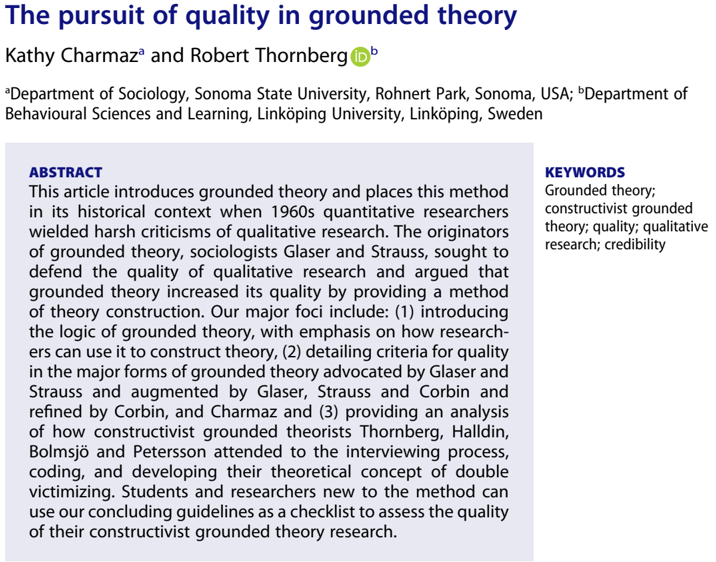
This article introduces grounded theory and places this method in its historical context when 1960s quantitative researchers wielded harsh criticisms of qualitative research. The originators of grounded theory, sociologists Glaser and Strauss, sought to defend the quality of qualitative research and argued that grounded theory increased its quality by providing a method of theory construction. Our major foci include: (1) introducing the logic of grounded theory, with emphasis on how researchers can use it to construct theory, (2) detailing criteria for quality in the major forms of grounded theory advocated by Glaser and Strauss and augmented by Glaser, Strauss and Corbin and refined by Corbin, and Charmaz and (3) providing an analysis of how constructivist grounded theorists Thornberg, Halldin, Bolmsjö and Petersson attended to the interviewing process, coding, and developing their theoretical concept of double victimizing. Students and researchers new to the method can use our concluding guidelines as a checklist to assess the quality of their constructivist grounded theory research.
Verified 2026-11-22 · 1 reference not checked yet
Overview
CoChat Summary
TL;DR
This article reviews grounded theory’s historical development and argues that quality criteria must fit the specific version of grounded theory, culminating in constructivist criteria and a checklist. It illustrates constructivist quality through Thornberg et al.’s (2013) study of school bullying and the concept of double victimizing.
Key findings
- Quality criteria differ across grounded theory versions: original Glaser and Strauss focused on credibility and applicability with fitness, understanding, generality, and control; Glaser added workability, relevance, fit, and modifiability; Strauss and Corbin emphasized data quality, plausibility/value of theory, adequacy of process, and empirical grounding; constructivist Charmaz proposes credibility, originality, resonance, and usefulness.
- The paper argues quality is built through iterative data collection and analysis, line-by-line and focused coding, memo-writing, theoretical sampling and saturation, constant comparison, and reflexivity/methodological self-consciousness.
- In the illustrative constructivist study, Thornberg et al. (2013) distributed 523 open-ended questionnaires to students in three secondary schools and two universities in Sweden; of 511 responses, 168 reported past bullying, 36 volunteered, and 21 who had been bullied for more than one year were interviewed; analysis produced the core category “double victimizing” (external and internal victimizing).
- In psychology, Rubin, Bell, and McCleland (2018) found only 13% of responding graduate psychology programs required a qualitative research course, and respondents described qualitative research as “inaccurate,” “subjective,” and “lacking rigor” while also describing it as providing the “best methods for feminist, community-based, and social justice research.”
Methods
- Design: methodological/conceptual article introducing grounded theory, comparing quality criteria across Glaserian, Straussian, and constructivist versions, and offering guidelines/checklist for constructivist grounded theory.
- Data or sample: no primary empirical sample for the article; it analyzes historical and methodological literature and uses Thornberg et al. (2013) as an illustrative constructivist grounded theory study (523 questionnaires; 511 responses; 168 bullied; 36 volunteers; 21 interviewed).
- Main analysis: narrative synthesis and comparison of quality criteria, with an illustration of coding, constant comparison, memo-writing, theoretical sampling, and category development leading to “double victimizing.”
Limitations
- Stated: the authors caution that checklists risk becoming a “methodological crutch” that avoids deep engagement with method and data (citing Barbour 2001), and present their guidelines as flexible, not substitutes for rigorous research.
- Stated: criteria for quality in qualitative research remain unsettled, with “little consensus” about appropriate evaluation criteria, and meanings of quality markers may differ among researchers.
- Evident from the text: the article is not an empirical validation of the checklist; the double victimizing case is a secondary illustration rather than a new test, and the guidelines are aimed mainly at constructivist grounded theory though claimed mostly applicable to other versions.
Model-written summary. Check it against the paper before relying on it.
Integrity signals
Registry
Cites
Statistics
Figures



Verification
Claims the paper makes
2 Valid · 13 Not valid · 38 Not checked · 38 Own results and interpretations
None of the sources cited for this claim have been checked yet.
In the paper
“Concerns about objectivity, validity, reliability and replicability in qualitative research still pervade academic psychology.”
§ The pursuit of quality in grounded theory > Qualitative research and psychology
plain- Asserted: passes — The authors put it forward as true.
- Checkable: passes — It can be checked against evidence.
- Load-bearing: passes — The paper’s conclusions depend on it.
- Based: passes — The paper gives a reason why it holds.
In the paper
“Until Glaser and Strauss's (1967) statement, little had been written, much less codified into a systematic statement, about how to construct a qualitative theoretical analysis of high quality.”
§ The pursuit of quality in grounded theory > Concerns about quality in the development of grounded theory
What the sources say
- Not matchedcites Glaser and Strauss's (1967)
An author–year citation the paper’s reference list doesn’t settle. We don’t search these by name.
plain- Asserted: passes — The authors put it forward as true.
- Checkable: passes — It can be checked against evidence.
- Load-bearing: unclear — It is unclear whether the paper’s conclusions depend on it.
- Based: passes — The paper gives a reason why it holds.
- Not matched
A statement the paper makes itself — it cites no source for it, so there is none to check. The quote shows it is in the paper.
In the paper
“If, however, researchers only ask the same questions of each participant, they are likely to elicit similar stories about the topic.”
§ The pursuit of quality in grounded theory > Introduction
hedgedstates a possible cause- Asserted: passes — The authors put it forward as true.
- Checkable: passes — It can be checked against evidence.
- Load-bearing: passes — The paper’s conclusions depend on it.
- Based: passes — The paper gives a reason why it holds.
A statement the paper makes itself — it cites no source for it, so there is none to check. The quote shows it is in the paper.
In the paper
“If, however, researchers systematically interrogate their data as they gather it, their early ideas can then inform subsequent data collection.”
§ The pursuit of quality in grounded theory > Introduction
plainstates a possible cause- Asserted: passes — The authors put it forward as true.
- Checkable: passes — It can be checked against evidence.
- Load-bearing: passes — The paper’s conclusions depend on it.
- Based: passes — The paper gives a reason why it holds.
A statement the paper makes itself — it cites no source for it, so there is none to check. The quote shows it is in the paper.
In the paper
“When answering quantitative social scientists' sharp criticisms of its quality, Glaser and Strauss rejected the common practice of evaluating qualitative research according to the tenets of the quantitative tradition.”
§ The pursuit of quality in grounded theory > Concerns about quality in the development of grounded theory
plain- Asserted: passes — The authors put it forward as true.
- Checkable: passes — It can be checked against evidence.
- Load-bearing: unclear — It is unclear whether the paper’s conclusions depend on it.
- Based: passes — The paper gives a reason why it holds.
22 more claims
Create a free account to see all 91 claims and to verify the 7 references still open.
- Probably not a substantial claim. 61
- It may state two separate claims as one. 26
Claims other papers make about this one
Each is checked against this paper’s own text: does it say what the citing paper says it does?
The source backs part of the claim, not all of it — or backs it for a different population, condition or comparison.
In the citing paper
“An explicitly constructivist approach aims to produce an abstract understanding of a phenomenon (rather than an explanation, as in other versions of GTM)”
From Quality Criteria: General and Specific Guidelines for Qualitative Approaches in Psychology Research. A Concise Guide for Novice Researchers and Reviewers (2024) · cites this paper as Charmaz & Thornberg, 2021
Experimental — accuracy not yet measuredThe source backs part of the claim, not all of it — or backs it for a different population, condition or comparison.
In the citing paper
“Constant comparison is a systematic strategy combining the advantages of simultaneous data generation and analysis, enabling a concentration on significant issues (Charmaz and Thornberg, 2021).”
From Application and challenges of using a Constructivist Grounded Theory methodology to address an undertheorized clinical challenge: A discussion paper (2024) · cites this paper as Charmaz and Thornberg, 2021
Experimental — accuracy not yet measuredThe cited source says what the claim attributes to it.
In the citing paper
“focuses on actions, meanings and constructions”
From Quality Criteria: General and Specific Guidelines for Qualitative Approaches in Psychology Research. A Concise Guide for Novice Researchers and Reviewers (2024) · cites this paper as Charmaz & Thornberg, 2021
The cited source says what the claim attributes to it.
In the citing paper
“and acknowledges both subjectivity (of participants and researchers) and context (Charmaz, 2014; Charmaz & Thornberg, 2021).”
From Quality Criteria: General and Specific Guidelines for Qualitative Approaches in Psychology Research. A Concise Guide for Novice Researchers and Reviewers (2024) · cites this paper as Charmaz & Thornberg, 2021
The cited source says what the claim attributes to it.
In the citing paper
“The primary focus is the theory ' s ability to clarify participants ' lives and contribute to knowledge and practice (Charmaz & Thornberg, 2021).”
From Quality Criteria: General and Specific Guidelines for Qualitative Approaches in Psychology Research. A Concise Guide for Novice Researchers and Reviewers (2024) · cites this paper as Charmaz & Thornberg, 2021
6 more claims about this paper
Create a free account to see every claim other papers make about this one.
Citations
Cites
Using thematic analysis in psychology
Braun, V., & Clarke, V. (2006) · Qualitative Research in Psychology · doi:10.1191/1478088706qp063oa · Cited by 194,414
The Discovery of Grounded Theory: Strategies for Qualitative Research.
Wagner, H. R., Glaser, B. G., & Strauss, A. L. (1968) · Social Forces · doi:10.2307/2575405 · Cited by 46,361
The Discovery of Grounded Theory; Strategies for Qualitative Research
Glaser, B. G., Strauss, A. L., & Strutzel, E. (1968) · Nursing Research · doi:10.1097/00006199-196807000-00014 · Cited by 39,449
Basics of Qualitative Research: Grounded Theory Procedures and Techniques.
Ellis, C., Strauss, A., & Corbin, J. (1992) · Contemporary Sociology · doi:10.2307/2074814 · Cited by 29,249
Basics of Qualitative Research (3rd ed.): Techniques and Procedures for Developing Grounded Theory
Corbin, J., & Strauss, A. (2008) · SAGE · doi:10.4135/9781452230153 · Cited by 24,827
(2006) · Cited by 18,730
Self-citationBasics of Qualitative Research
Ozanne, J. L., Strauss, A., & Corbin, J. (1992) · Journal of Marketing Research · doi:10.2307/3172751 · Cited by 17,850 · cited 2×
“In their development of grounded theory, Strauss and Corbin (1990; Corbin and Strauss 1990; Strauss and Corbin 1998) emphasized four general criteria: (1) quality of the data, in other words, grounded theorists need to carefully address and adopt quality criteria related to methods used for data…”
BackgroundMethodBasics of Qualitative Research: Grounded Theory Procedures and Techniques
Long, D. R., Strauss, A., & Corbin, J. (1993) · The Modern Language Journal · doi:10.2307/328955 · Cited by 17,576
(2014) · Cited by 15,747
Self-citationInterviewing as qualitative research a guide for researchers in education and the social sciences
Seidman, I. (2006) · Cited by 12,757
Research works printed but not linked: 5
- 10. Charmaz, K. 1995. Between positivism and postmodernism: implications for methods. In Studies in symbolic interaction, vol. 17, N. K. Denzin (Ed.), pp. 43-72. Greenwich, CT: JAI Press.
- 17. Cisneros-Puebla, C. A. 2007. The deconstructive and reconstructive faces of social construc- tion: Kenneth Gergen in conversation with César A. Cisneros-Puebla. With an introduction by Robert B. Faux [83 paragraphs]. Forum Qualitative Sozialforschung/Forum: Qualitative Social Research 9 (1):Art. 20. http://nbn-resolving.de/urn:nbn:de:0114-fqs0801204 .
- 26. Glaser, B. G. 1978. Theoretical sensitivity. Mill Valley, CA: Sociology Press.
- 27. Glaser, B. G. 1992. Basics of grounded theory analysis. Mill Valley, CA: Sociology Press.
- 30. Glaser, B. G. 2013. No preconceptions: The grounded theory dictum. Mill Valley, CA: Sociology Press.
Cited by
Items 301–400 of 1,191
Yao, Q. (2023) · Integrative Psychological and Behavioral Science · doi:10.1007/s12124-023-09792-x · Cited by 15
“Inductive research, such as the grounded theory approach preferred by mostly qualitative researchers (Charmaz & Thornberg, 2021; Mokgohloa et al., 2021; Veen, 2021) but also some quantitative researchers (Tie et al., 2019), is the pattern identification or theorization based on data observation and…”
Local understandings and global challenges: exploring sense of place in sustainability transitions
Balestreri, C., Kurucz, E. C., McIlwraith, T. F., et al. (2023) · Ecology and Society · doi:10.5751/es-13895-280133 · Cited by 6
McDonald, C. E., Granger, C. L., Said, C. M., & Remedios, L. J. (2022) · Qualitative Health Research · doi:10.1177/10497323211051672 · Cited by 6
“Theoretical saturation was defined as thorough checking of constructed categories against data and no new properties or characteristics being identified (Charmaz & Thornberg, 2020).”
BackgroundMethodInfluentialPetiot, O., Kermarrec, G., Dugény, S., et al. (2024) · European Journal of Education · doi:10.1111/ejed.12810 · Cited by 6
Developing a spectrum model of engagement in services for first episode psychosis: beyond attendance
Ferrari, M., MacDonald, K., Sabetti, J., Cowan, T., & Iyer, S. N. (2024) · Frontiers in Psychiatry · doi:10.3389/fpsyt.2024.1429135 · Cited by 5
“The postmodern iteration of grounded theory developed by Charmaz (35 – 37) and selected to guide this study avoids a rigid prescription of tasks in favor of a set of principles for theorizing peoples ’ experiences in a novel construction of reality.”
Unveiling the Potential of Corporate Digital Responsibility (CDR)
Basu, S., Jha, S., Ooi, K., & Cham, T. (2024) · Journal of Computer Information Systems · doi:10.1080/08874417.2024.2445745 · Cited by 12
Townley, A. L., Soares, L. B., & Rahimi, R. (2023) · Education Sciences · doi:10.3390/educsci13070656 · Cited by 10
Murray, G., & Shmidheiser, M. (2024) · Brain Injury · doi:10.1080/02699052.2024.2311334 · Cited by 7
“…participant and employed an additional Wilcoxon Signed-Rank Test to examine the change in pretest and posttest scores between those who received the beach versus mountain VRMM. Data from the brief open-ended interviews (see Online Appendix) were analyzed using a grounded theory approach (20,21).”
MethodSantos, G. A., Laranjeira, C., Carreira, L., Baldissera, V. D. A., Tostes, M. F. D. P., Meireles, V. C., Ageno, R. S., & Salci, M. A. (2025) · Health Expectations · doi:10.1111/hex.70409 · Cited by 5
“The research met methodological rigour following the criteria of credibility, originality, resonance and usefulness, as proposed by Charmaz [54, 55].”
Pease, E., Hustinx, L., & de Peer, A. V. (2024) · International Journal of Fashion Studies · doi:10.1386/infs_00118_1 · Cited by 6
Grounded theory modeling based on multisource evidence fusion
Du, Y., Fan, Y., & Zhong, J.-J. (2024) · Technological Forecasting and Social Change · doi:10.1016/j.techfore.2024.123826 · Cited by 8
Xu, K., Wen, S., Duan, K., & Hua, W. (2025) · Land · doi:10.3390/land14122393 · Cited by 11
Modern distress and lifestyle migration: The false promise of a pure relationship with one's self
Kliger, R., & Kidron, C. A. (2024) · Ethos · doi:10.1111/etho.12447 · Cited by 5
Millard, S. K., Murphy, S., Barton, G., Rixon, L., Shepstone, L., Sims, E. J., & Joffe, V. L. (2025) · Journal of Fluency Disorders · doi:10.1016/j.jfludis.2025.106114 · Cited by 7
Decolonising the TESOL Curriculum in Thailand through Global Englishes: A Wake-up Call
Sameephet, B. (2025) · LEARN Journal : Language Education and Acquisition Research Network · doi:10.70730/oonq6505 · Cited by 8
The human and social impacts of an Australian mouse plague
Carter, L., Collins, K., Mankad, A., Okello, W. O., & Brown, P. (2025) · Wildlife Research · doi:10.1071/wr25016 · Cited by 5
Aagaard, T. V., Skou, S. T., Brorson, S., & Madsen, U. R. (2024) · Journal of Wound Care · doi:10.12968/jowc.2022.0265 · Cited by 7
Beyond pain medication: striving toward more patient-centered placement of intrauterine devices
Dempsey, A. R., Aucoin, C., Stallings, W., Kulangara, A. J., & Sundstrom, B. L. (2025) · Contraception · doi:10.1016/j.contraception.2025.110944 · Cited by 5
Yang, X., Zhang, J., Yu, Y., & Qiao, X.-J. (2024) · Land · doi:10.3390/land13071097 · Cited by 6
“This method helps in understanding the experiences and perspectives of the respondents, thus reducing the limitations of the analysis and conclusions [27,43].”
MethodBailey, P., Selman, L. E., Exley, C., Griffin, S., Hancock, A., Maxted, P., & Noyes, J. (2023) · International Journal of Qualitative Methods · doi:10.1177/16094069231168485 · Cited by 7
“This requires strong re fl exivity and openness to scrutinizing who the researcher is, why the researcher has chosen the speci fi c topic, methodology and methods, what assumptions have been made, and how these fi t with the research objectives (Charmaz & Thornberg, 2020).”
BackgroundMethodTeaching older immigrants active ageing: narratives of peer English instructors
Zhang, W., Zhu, Y., Liu, X., & Qiu, Y. (2021) · International Journal of Lifelong Education · doi:10.1080/02601370.2021.1968972 · Cited by 8
“It shapes data collection and provides strategies for data analysis (Charmaz & Thornberg, 2020), potentially allowing researchers to reach ‘theoretical saturation’ (Strauss & Corbin, 1998:143).”
MethodPost-conflict Reconciliation in Aceh, Indonesia: Perspectives from the Victims
Manan, A. H., Hadi, A., & Saputra, I. R. (2022) · Jurnal Ilmu Sosial dan Ilmu Politik · doi:10.22146/jsp.66177 · Cited by 5
Brommelsiek, M., Javid, K., Said, T., et al. (2024) · The American Journal of Surgery · doi:10.1016/j.amjsurg.2024.115976 · Cited by 5
Lehmann, T., Benner, M., & Kapo, A. (2022) · Innovation The European Journal of Social Science Research · doi:10.1080/13511610.2022.2092075 · Cited by 8
“Qualitative research has been widely criticized for its lack of rigid procedures and its lack of generalizability (Charmaz and Thornberg 2021; Eisenhardt 1991; Eisenhardt, Graeb-ner, and Sonenshein 2016; Flyvbjerg 2006).”
Influentialde Vries, I., Ebrahem, S., Donninger, D., van der Meer, B., & van Bemmel, S. (2025) · Child Abuse & Neglect · doi:10.1016/j.chiabu.2025.107439 · Cited by 23
Du, N., Wang, Y., & Huang, Y. (2024) · Qualitative Health Research · doi:10.1177/10497323241232351 · Cited by 5
“This iterative process helps identify emerging themes and concepts from the data, allowing for the development of tentative theories (Charmaz & Thornberg, 2021).”
InfluentialRoss, A., Dickson, K., Morgan, A. J., Paton, E., McNaught, G., & Reavley, N. J. (2024) · Journalism · doi:10.1177/14648849241274105 · Cited by 6
“The transcripts were analysed using inductive thematic analysis (Braun and Clarke, 2006, 2019) with a methodological underpinning in grounded theory (Charmaz, 2017; Charmaz and Thornberg, 2020) to identify patterns and generate themes in participant responses.”
Decolonizing feminist knowledge: The standpoint of majority world feminist activists in Perú
Grabe, S. (2022) · Feminism & Psychology · doi:10.1177/09593535221123410 · Cited by 9
Mohamadianmansoor, S., & Khanian, M. (2022) · Geoheritage · doi:10.1007/s12371-022-00663-2 · Cited by 5
“1 3 Charmaz and Thornberg (2020) suggest that the grounded theory as a qualitative research tool can be applied whenever new concepts are produced from the current condition.”
BackgroundThelen, M., Brearley, S. G., & Walshe, C. (2023) · Palliative Medicine · doi:10.1177/02692163231195989 · Cited by 8
“22,45 Credibility, having sufficient relevant data for asking questions about the data, making systematic comparisons throughout the research process, and developing a thorough analysis, was enhanced by use of an iterative inter-view guide; the multiple coding rounds during analysis; researcher…”
BackgroundMcDonald, C. E., Remedios, L. J., Cameron, K. L., Said, C. M., & Granger, C. L. (2021) · HERD Health Environments Research & Design Journal · doi:10.1177/19375867211032926 · Cited by 5
“Recruitment ceased when theoretical saturation was achieved where new data ceased to reveal new theoretical insights (Charmaz & Thornberg, 2020).”
BackgroundLawrence, V. C., Samsi, K., & Keady, J. D. (2021) · International Journal of Geriatric Psychiatry · doi:10.1002/gps.5634 · Cited by 5
Bobbink, P., Gschwind, G., Larkin, P. J., & Probst, S. (2024) · Qualitative Health Research · doi:10.1177/10497323241285692 · Cited by 9
“Pursuing quality in CGT is central (Charmaz & Thornberg, 2021) to enhance its use in practice.”
Sädeharju, S. (2025) · Journal of Rural Studies · doi:10.1016/j.jrurstud.2025.103656 · Cited by 8
Monsonís, O. B., Balsiger, P., Verhagen, E. A. L. M., Gouttebarge, V., Spörri, J., & Bolling, C. S. (2024) · Sports Medicine · doi:10.1007/s40279-024-02106-0 · Cited by 7
“In parallel to data collection, collected data were analysed to inform the ongoing data collection [38].”
Supervisor Training Needs to Work with Emerging Multilingual Supervisees
Tang, H., & Grothaus, T. (2023) · International Journal for the Advancement of Counselling · doi:10.1007/s10447-023-09517-0 · Cited by 5
“…line‑by‑line coding, focused coding, consensus coding, constant comparison, and theoretical sampling procedures to examine relationships among ideas and to generate connections of ideas and concepts in order to develop a theory of supervisor multicultural training needs (Charmaz & Thornberg, 2021).”
BackgroundMofokeng, J. T., & Aphane, M. P. (2022) · International Journal of Research in Business and Social Science (2147-4478) · doi:10.20525/ijrbs.v11i2.1692 · Cited by 10
“The authors utilized a grounded theory approach and employed constructivist grounded theory research guidelines (Charmaz, 2014; Charmaz & Thornberg, 2021), and a checklist of saturated concepts (Corbin & Strauss, 2015).”
MethodYi, K., Wu, Y., & Chen, J. (2025) · Journal of Environmental Management · doi:10.1016/j.jenvman.2025.127499 · Cited by 8
The challenges of nursing care for patients with lumbar discectomy: A qualitative study
Haghighat, S., Yazdi, K., Mahmoodi‐Shan, G. R., & Sabzi, Z. (2024) · Nursing Open · doi:10.1002/nop2.2137 · Cited by 6
“Other techniques to ensure the trustworthiness of the data and the findings were concurrent data collection and analysis, selection of key informants, prolonged engagement with the data, and provision of clear explanations about the data (Charmaz & Thornberg, 2021; Hamilton, 2020).”
Method‘We’ share but ‘They’ cheat: student qualitative perspectives on cheating in higher education
Harper, R., & Prentice, F. (2024) · International Journal for Educational Integrity · doi:10.1007/s40979-024-00171-6 · Cited by 17
“Drawing on Glaser and Strauss (1967), Charmaz and Thornberg (2020) highlight that descriptions of data that are ‘detailed’ and ‘vivid’ enough to enable readers to ‘hear and see the participants’ contribute to credibility in grounded theory research (314), which the researchers’ qualitative…”
Paradoxical tensions at multiple levels: A model of unbalanced supranational coopetition
Ólafsdóttir, B., Kristjánsdóttir, E. S., & Freeman, S. (2024) · Scandinavian Journal of Management · doi:10.1016/j.scaman.2024.101365 · Cited by 7
Horoub, I. M. (2023) · Journalism Practice · doi:10.1080/17512786.2023.2288588 · Cited by 8
“Concepts and analytical techniques are then merged to create themes that provide meaningful results (Charmaz and Thornberg 2021; Lindlof and Taylor 2017; Thornberg and Dunne 2019).”
Logan, V., Bamsey, A., Carter, N., Hughes, D., Turner, A., & Jordan, S. E. (2022) · Pharmacy · doi:10.3390/pharmacy10030052 · Cited by 7
“Grounded theory is widely used in qualitative interview studies [65] and will facilitate developing ideas generated in early interviews as the interview work progresses to generate credibility, originality, resonance and usefulness [66].”
MethodBeaugard, C. A., Walley, A. Y., & Amodeo, M. (2024) · Harm Reduction Journal · doi:10.1186/s12954-024-01002-0 · Cited by 7
“Writing after each interview allowed authors to disentangle participants’ construction of the concepts from their impressions and anticipated responses [31].”
BackgroundThe Core of Caring: Human Dignity in Nursing Through a Constructivist Grounded Theory
Yıldırım, D., & Korhan, E. A. (2026) · Scandinavian Journal of Caring Sciences · doi:10.1111/scs.70222 · Cited by 7
“In this study, credibility and transferability were applied to ensure validity, whereas confirmability and dependability were applied to ensure reliability [25, 26].”
Ali, Y., Wright, N., Charnock, D., Henshaw, H., Morris, H., & Hoare, D. J. (2024) · Ear and Hearing · doi:10.1097/aud.0000000000001459 · Cited by 10
“It has been agreed that, because of the fluid nature of the methodology, general guidelines are most suitable to evaluate grounded theory studies, and are essential for ensuring methodological quality (Charmaz & Thornberg 2020).”
BackgroundMethodInfluentialAbsence or presence: Silent discourse in the operating room and impact on surgical team action
Brommelsiek, M., Said, T., Gray, M., Kanter, S. L., & Sutkin, G. (2020) · The American Journal of Surgery · doi:10.1016/j.amjsurg.2020.09.017 · Cited by 8
Schiller, B., Kuška, M., Becher-Urbaniak, S., Wimmer, E., Reisinger, M., & Mörtl, K. (2024) · Heliyon · doi:10.1016/j.heliyon.2024.e29464 · Cited by 6
“The methodology adhered to established standards, including those proposed by Lincoln and Guba (1985) [37], Mayring (2007) [38], Charmaz, and Thornberg (2021) [39], to strengthen the credibility of the results.”
MethodLarson, R. W., Orson, C. N., & McGovern, G. (2022) · Journal of Adolescent Research · doi:10.1177/07435584221099599 · Cited by 5
Yan, H. (2023) · IEEE Access · doi:10.1109/access.2023.3317251 · Cited by 7
“nomena, behaviors, and experiences [26], [27], [28].”
Acts of negotiation: toward a grounded theory of nursing practice in chronic wound care in Austria
Drgac, D., & Himmelsbach, R. (2023) · BMC Health Services Research · doi:10.1186/s12913-023-10276-2 · Cited by 6
“The principles of credibility, resonance, originality, and usefulness are used as quality criteria in the CGT [26].”
MethodBarnes-Najor, J. V., Stonefish, B., Wentworth, C., Gartner, D. R., Saucedo, J. S., Howard, H., Koval, P., Burnett, R., Martin, L. A., Leask, M., et al. (2024) · Early Childhood Research Quarterly · doi:10.1016/j.ecresq.2023.12.014 · Cited by 10
Lawrence, D., Stubbings, D. R., Watt, A. A., & Mercer, J. (2025) · Issues in Mental Health Nursing · doi:10.1080/01612840.2025.2451161 · Cited by 5
“Transparency is another criteria of quality in qualitative research (Charmaz & Thornberg, 2021).”
InfluentialMedina-Gómez, D. C., Gutiérrez, J. S. C., de Sarmiento, M. O., et al. (2024) · International Journal of Religion · doi:10.61707/p9156r22 · Cited by 4
“The triangulation strategy helps researchers enhance the validity and credibility of findings and mitigate the presence of any research biases in this research (Charmaza & Thornberg, 2021).”
Walsh, C. S., Leslie, C. E., Ross, K. M., Santana, A., Radabaugh, S. A., Edmonds, T., & Sullivan, T. N. (2023) · Journal of Community Psychology · doi:10.1002/jcop.23091 · Cited by 4
Norris, G., Savundranayagam, M. Y., Teachman, G., & Vafaei, A. (2025) · Educational Gerontology · doi:10.1080/03601277.2025.2515564 · Cited by 6
“Axial coding was used to refine and consolidate the initial codes into broader, more conceptual themes (Charmaz & Thornberg, 2021).”
Research methodologies in genetic counseling: Grounded theory
Fishler, K. P., & Carmichael, N. E. (2025) · Journal of Genetic Counseling · doi:10.1002/jgc4.70060 · Cited by 11
“Charmaz and Thornberg ( 2021 ) delve further into what con - stitutes quality grounded theory research among these and other grounded theory methodologies.”
Dong, J., Jiang, M., Xing, Y., Zhang, D., Kong, J., & Wang, H. (2025) · International Journal for Equity in Health · doi:10.1186/s12939-025-02720-y · Cited by 5
“The study sample size was determined based on the principle of theoretical saturation, defined as the point at which no new properties or characteristics emerged after thorough comparison of the constructed categories with the data [44].”
Tang, C., Zhang, J., Zhang, Q., Fisher, E., & Park, K. (2023) · Journal of Service Research · doi:10.1177/10946705231215150 · Cited by 5
“Following the procedure outlined by Charmaz and Thornberg (2021) and Hsieh and Shannon (2005), the transcribed data were coded and analyzed.”
Herbst, J.-P., Ahlers, M., & Barber, S. (2024) · Creative Industries Journal · doi:10.1080/17510694.2024.2366163 · Cited by 5
The Embodied Formation of Destination Attachment
Qu, Y., & Dong, Y. (2025) · Journal of Travel Research · doi:10.1177/00472875251332947 · Cited by 7
“The grounded theory is based on data and coding to determine the core concepts reflecting social phenomena and the connection between concepts (Charmaz & Thornberg, 2021).”
Hashtags and resistance on TikTok: cultural, discursive, and algorithmic dimensions
Martínez-Borda, R., Rubio-López, N., Infante-Pineda, S., & Lacasa, P. (2026) · Frontiers in Communication · doi:10.3389/fcomm.2026.1687271 · Cited by 4
Héroes, ídolos y Jóvenes influencers: Industrias Culturales y modelos de identidad en TikTok
Lacasa, P., Bernal, N. C., Duran-Bonavila, S., & Pulido, P. C. (2022) · TECHNO REVIEW International Technology Science and Society Review /Revista Internacional de Tecnología Ciencia y Sociedad · doi:10.37467/revtechno.v11.4391 · Cited by 10
Mahat, M. (2022) · Facilities · doi:10.1108/f-06-2022-0086 · Cited by 5
Mapping migration detention: Mixed methods, grounded theory, transdisciplinary encounters
Manek, J., Nethery, A., Esposito, F., Pérez‐Sales, P., & Horz, H. (2023) · Methods in Psychology · doi:10.1016/j.metip.2023.100129 · Cited by 7
Chen, X., & Chua, A. Y. K. (2024) · Internet Research · doi:10.1108/intr-07-2023-0595 · Cited by 7
Grandparent couples’ experiences of family leisure
Juris, J. J., Zvonkovic, A., Allen, K. R., Few‐Demo, A. L., & Crawford, A. (2024) · Journal of Leisure Research · doi:10.1080/00222216.2024.2408382 · Cited by 5
“A grounded theory approach is “a systematic method of conducting research that shapes collecting data and provides explicit strategies for analyzing them” (Charmaz & Thornberg, 2020, p. 305).”
King, A. A., & Russon, J. (2023) · Journal of Marital and Family Therapy · doi:10.1111/jmft.12646 · Cited by 5
Dahlawi, N., Milnes, L. J., & Swallow, V. M. (2024) · Health Expectations · doi:10.1111/hex.13959 · Cited by 3
“To verify the rigour and accuracy of data collection, interpretations and reporting, guidelines provided by Charmaz 16 on ensuring the quality of constructivist GT were followed, thus ensuring credibility, originality, resonance and usefulness 21 (Table 5).”
MethodEl-Khodary, B., Christensen, I. R., Abou-Dagga, S. I., Raji, S., & Lyden, S. C. (2021) · Frontiers in Psychology · doi:10.3389/fpsyg.2021.761303 · Cited by 6
“Study Design This study is a comparative case study (Blömeke and Paine, 2008; Flyvbjerg, 2011), and takes on a qualitative grounded theory approach (Glaser and Strauss, 1967; Charmaz and Thornberg, 2020), to the psychosocial support of kindergarten teachers in Palestine and Norway.”
BackgroundFraboni, P. F. L., Sabatini, A., Marcone, M. R., & Temperini, V. (2024) · British Food Journal · doi:10.1108/bfj-03-2023-0208 · Cited by 5
Murphy, N. B., Lingard, L., Blackstock, L., et al. (2022) · BMJ Open · doi:10.1136/bmjopen-2022-067515 · Cited by 4
Mushonga, S. (2022) · Alcoholism Treatment Quarterly · doi:10.1080/07347324.2022.2101905 · Cited by 7
Røset, L., Green, K., Cale, L., Sigurjónsson, T., Tjomsland, H. E., & Thurston, M. N. (2022) · Sport Education and Society · doi:10.1080/13573322.2022.2159361 · Cited by 6
Investigating Mobile Apps Post-Adoption Behaviour: A Grounded Theory Investigation
Lamichhane, R., Ward, P., Shrestha, A., & Bhattacharjee, B. (2025) · International Journal of Human-Computer Interaction · doi:10.1080/10447318.2025.2518332 · Cited by 5
“As Charmaz and Thornberg (2021) advised, qualitative research enables researchers to identify both explicit and implicit processes within their data.”
Will you speak up, digitally? A high-context communication perspective
Chen, M. Y.-C., Hsu, R. S., & Chen, A. P. (2025) · European Management Journal · doi:10.1016/j.emj.2025.06.009 · Cited by 6
Sun, G., Li, M., Dong, J.-Y., Wan, S., & Feng, J. (2023) · Axioms · doi:10.3390/axioms12100971 · Cited by 10
“Grounded theory enhances quality through the method of theoretical construction [41].”
MethodComplementary Assets, Organizational Modularization, and Platform Enterprise Value Innovation
Rong, K., & Hu, L. (2023) · Systems · doi:10.3390/systems11070323 · Cited by 4
Sandrin, S., Ball, B. A., & Arora, I. (2024) · Education Sciences · doi:10.3390/educsci14060620 · Cited by 5
Mumin, K. H. A., Maideen, A. A., Lupat, A., Mohd-Alipah, S. N.-D., Mohammad-Alli, R. H., Abd-Manaf, H.-N. H., Osman, A.-R., Fata, H. M. R. A., busrah, N., Darling‐Fisher, C. S., et al. (2023) · International Journal of Environmental Research and Public Health · doi:10.3390/ijerph20176629 · Cited by 6
“Data were analyzed using the step-by-step thematic analysis underpinned by the principles of constructivist grounded theory [44,45].”
MethodThe Use of Bergamot Essential Oil for PTSD Symptomology: A Qualitative Study
Daniel, D. R., & Zolnikov, T. R. (2023) · American Journal of Qualitative Research · doi:10.29333/ajqr/13596 · Cited by 5
Design Thinking: How Preservice Teachers Develop Capacity for Designing Inquiry-Based Lessons
Odebiyi, O. M. (2023) · The Teacher Educator · doi:10.1080/08878730.2023.2184889 · Cited by 4
“In grounded theory, the analytical focus is generated through the research process rather than predetermined before the empirical investigation begins, which make visible the systematic generation of findings (Charmaz & Thornberg, 2021).”
Background“Perinatal loss, a devastating cyclone”: A situation‐specific nursing theory
Furtado‐Eraso, S., Fernández, B. M., & Escalada‐Hernández, P. (2024) · Journal of Nursing Scholarship · doi:10.1111/jnu.12996 · Cited by 4
A Model Proposal for Sustainable Career Management in Hospitality: Grounded Theory Perspective
AŞKUN, V., & ÇİZEL, R. (2024) · Advances in Hospitality and Tourism Research (AHTR) · doi:10.30519/ahtr.1495507 · Cited by 6
The use of coaching as a tool to improve coping in victims of workplace bullying
Quiun, L., & Herrero, M. (2022) · The Coaching Psychologist · doi:10.53841/bpstcp.2022.18.2.58 · Cited by 3
Wang, A., & Whyke, T. W. (2025) · Asian Studies Review · doi:10.1080/10357823.2024.2449350 · Cited by 8
“This three-stage approach is fundamental in qualitative research as it enables researchers to systematically move from raw data to theoretical understanding while maintaining analytical rigour (Charmaz & Thornberg, 2021).”
Abortion Near Me? The Implications of Semantic Media on Accessing Health Information
Tripodi, F. B., & Dave, A. (2023) · Social Media + Society · doi:10.1177/20563051231195548 · Cited by 6
“Grounded theory makes space for iterative analysis where findings can emerge simultaneously during data collection (Charmaz & Thornberg, 2021).”
BackgroundPike, C., & Rebar, A. L. (2024) · Psychiatry Psychology and Law · doi:10.1080/13218719.2024.2343783 · Cited by 6
“This would normally require the researcher to continue to collect data (and not limit the sample size) until the researcher achieved theoretical saturation of the emerging concepts (i.e. they find no new properties emerging from the data; Charmaz & Thornberg, 2021).”
BackgroundPakistani Immigrants' Nuanced Beliefs About Shame and Its Regulation
Collardeau, F., Aftab, M. U. B., Jibeen, T., & Woodin, E. M. (2021) · International Perspectives in Psychology · doi:10.1027/2157-3891/a000004 · Cited by 7
Abeysiriwardana, P. C., & Jayasinghe-Mudalige, U. K. (2025) · Sustainable Futures · doi:10.1016/j.sftr.2025.100459 · Cited by 9
Virto, N. R. (2025) · SSRN Electronic Journal · doi:10.2139/ssrn.5027264 · Cited by 4
Pagano, L., Long, J. C., Francis‐Auton, E., Hirschhorn, A. D., Arnolda, G., Braithwaite, J., & Sarkies, M. (2025) · Implementation Science Communications · doi:10.1186/s43058-025-00699-9 · Cited by 7
“These methods not only help researchers to synthesise data but assist them to move beyond description through to constructing new concepts that explain what is happening [34].”
InfluentialMapping and Measuring Leadership Practices Intended to Foster Meaningful Work
Mercurio, Z. A., Myles, T., Adams, W., & Clifton, J. D. W. (2023) · Occupational Health Science · doi:10.1007/s41542-023-00161-z · Cited by 13
“We used a grounded theory methodology to identify patterns and relevant practices in use by leaders versus applying an existing leadership theory (Charmaz & Thornberg, 2021).”
Sädeharju, S., Höyssä, M., & Salonen, A. O. (2025) · Agriculture and Human Values · doi:10.1007/s10460-025-10817-x · Cited by 7
“This kind of research requires a researcher to gain ‘method-ological self-consciousness’ (Charmaz 2017c) and therefore rigorously reflect on their hidden beliefs and possible pre - conceptions (Charmaz and Thornberg 2021).”
Montesi, M. (2022) · Journal of Documentation · doi:10.1108/jd-03-2022-0056 · Cited by 7
Exploring frustration: Insights from Israeli elementary school principals’ diverse perspectives
Dor-Haim, P. (2024) · Educational Management Administration & Leadership · doi:10.1177/17411432241267997 · Cited by 6
“Afterward, the expressions of frustration described by school principals were compared with existing theoretical literature, revealing both similarities and discrepancies (Charmaz, 2014; Charmaz and Thornberg, 2020).”
Lee, J., & Joo, C. (2025) · Geriatric Nursing · doi:10.1016/j.gerinurse.2025.04.032 · Cited by 7
Qualitative research interviews for health professions education: AMEE Guide No. 185
Kahlke, R., OʼBrien, B. C., & Varpio, L. (2025) · Medical Teacher · doi:10.1080/0142159x.2025.2536697 · Cited by 11
“…Malterud et al. [49] offers a framework for evaluating whether interview data and analyses have sufficient information power to answer a research question, though some methodologies may use terms like saturation or sufficiency to describe what constitutes ‘ enough ’ data and/or analysis [50,51].”
Günbayı, İ., & AŞKUN, V. (2023) · İnönü Üniversitesi Eğitim Fakültesi Dergisi · doi:10.17679/inuefd.1331239 · Cited by 7
Overcoming the Digital Dilemmas: How Do Enterprises Develop Digital Transformative Capability?
Gao, Y., Zhang, H., Ding, L., Zhang, S., & Zeng, C. (2025) · IEEE Transactions on Engineering Management · doi:10.1109/tem.2025.3558022 · Cited by 5
Metadata
- Authors
- Charmaz, K., & Thornberg, R.
- Affiliations
- Sonoma State University (US)
- Linköping University (SE)
- Corresponding author
- Thornberg, Robert
- Venue
- Qualitative Research in Psychology
- Publisher
- Informa UK Limited
- Published
- 2020-06-22
- Volume
- 18
- Issue
- 3
- Pages
- 305-327
- ISSN
- 1478-0887 (ISSN-L)
- 1478-0895
- OpenAlex
- W3036803033
- Cited by
- 1,221
- References
- 81
- Citations by year
- 2026: 264 · 2025: 290 · 2024: 255 · 2023: 221 · 2022: 128 · 2021: 54 · 2020: 8
- FWCI
- 155.56
- Type
- journal article
- Language
- en
- Open access
- hybrid
- doi.org
- Licence
- Locations
- Qualitative Research in Psychology (publishedVersion, cc-by-nc-nd)
- Topics
- Social Sciences › Education › Qualitative Research Methods and Applications
- Social Sciences › Sociology and Political Science › Qualitative Research Methods and Ethics
- Social Sciences › Sociology and Political Science › Sociology and Education Studies
- Keywords
- grounded theory, constructivist grounded theory, qualitative research quality, theory development, Glaser and Strauss, interviewing, coding, history of grounded theory
About these checks
Registry, retraction, Cites and statistics results are computed, not judged, with one exception: a printed reference that no index lists is read once by a model before it counts as a citation error. Claims are extracted by a model and kept only when their quote appears verbatim in the text; each cited source is then checked, with a model’s help, for whether it says what the claim relies on. Those verdicts can be wrong — read the claim’s quote and the cited source before relying on one.
The claim verdicts this report counts are experimental: their accuracy is not yet measured.
A language model drew the claims from the paper on 2026-09-28, under version 3 of the claim definition (model deepseek-v4.1-flash, prompt extract-v3).
A second model labelled each claim on 2026-09-28 (model jev-1.13-20260917, definition revision gold-guideline-v0.2).
Statistics and arithmetic are recomputed, not judged.
Confidence bands are shown only for fields calibrated on our annotated test set. None is calibrated yet, so no band is shown.
What counts as a claim ›How we measure confidence ›How we check this ›
Are you an author, or do you see a problem with this page? Request a review
Data sources
Bibliographic data: Semantic Scholar, OpenAlex, Crossref.
Contains information from the Semantic Scholar Academic Graph Datasets, made available under the ODC Attribution License (ODC-BY 1.0).
Semantic Scholar’s data is described in: Kinney, R., et al. (2023). The Semantic Scholar Open Data Platform. arXiv:2301.10140.
