

The pursuit of quality in grounded theory
Open accessThe DOI matches its Crossref record; 84 of the 85 references it cites were found in a registry or an index, and 1 are not checked yet; 2 of the 63 sources its claims cite were checked for support.
Abstract
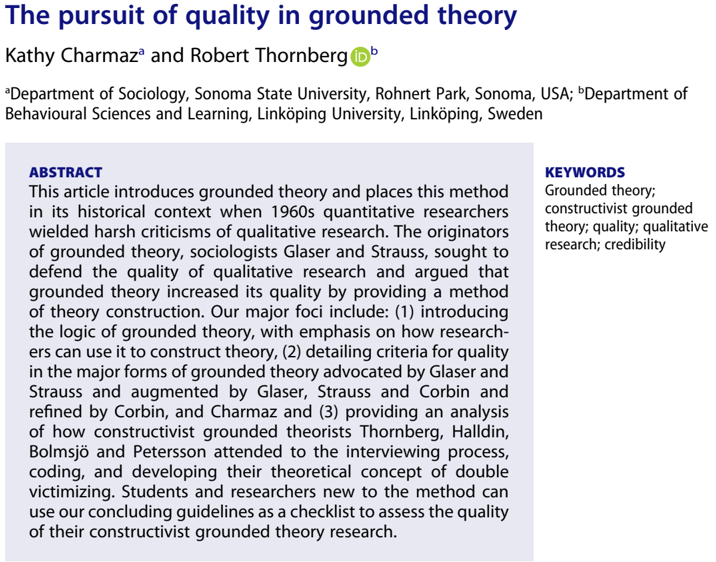
This article introduces grounded theory and places this method in its historical context when 1960s quantitative researchers wielded harsh criticisms of qualitative research. The originators of grounded theory, sociologists Glaser and Strauss, sought to defend the quality of qualitative research and argued that grounded theory increased its quality by providing a method of theory construction. Our major foci include: (1) introducing the logic of grounded theory, with emphasis on how researchers can use it to construct theory, (2) detailing criteria for quality in the major forms of grounded theory advocated by Glaser and Strauss and augmented by Glaser, Strauss and Corbin and refined by Corbin, and Charmaz and (3) providing an analysis of how constructivist grounded theorists Thornberg, Halldin, Bolmsjö and Petersson attended to the interviewing process, coding, and developing their theoretical concept of double victimizing. Students and researchers new to the method can use our concluding guidelines as a checklist to assess the quality of their constructivist grounded theory research.
Verified 2026-11-22 · 1 reference not checked yet
Overview
CoChat Summary
TL;DR
This article reviews grounded theory’s historical development and argues that quality criteria must fit the specific version of grounded theory, culminating in constructivist criteria and a checklist. It illustrates constructivist quality through Thornberg et al.’s (2013) study of school bullying and the concept of double victimizing.
Key findings
- Quality criteria differ across grounded theory versions: original Glaser and Strauss focused on credibility and applicability with fitness, understanding, generality, and control; Glaser added workability, relevance, fit, and modifiability; Strauss and Corbin emphasized data quality, plausibility/value of theory, adequacy of process, and empirical grounding; constructivist Charmaz proposes credibility, originality, resonance, and usefulness.
- The paper argues quality is built through iterative data collection and analysis, line-by-line and focused coding, memo-writing, theoretical sampling and saturation, constant comparison, and reflexivity/methodological self-consciousness.
- In the illustrative constructivist study, Thornberg et al. (2013) distributed 523 open-ended questionnaires to students in three secondary schools and two universities in Sweden; of 511 responses, 168 reported past bullying, 36 volunteered, and 21 who had been bullied for more than one year were interviewed; analysis produced the core category “double victimizing” (external and internal victimizing).
- In psychology, Rubin, Bell, and McCleland (2018) found only 13% of responding graduate psychology programs required a qualitative research course, and respondents described qualitative research as “inaccurate,” “subjective,” and “lacking rigor” while also describing it as providing the “best methods for feminist, community-based, and social justice research.”
Methods
- Design: methodological/conceptual article introducing grounded theory, comparing quality criteria across Glaserian, Straussian, and constructivist versions, and offering guidelines/checklist for constructivist grounded theory.
- Data or sample: no primary empirical sample for the article; it analyzes historical and methodological literature and uses Thornberg et al. (2013) as an illustrative constructivist grounded theory study (523 questionnaires; 511 responses; 168 bullied; 36 volunteers; 21 interviewed).
- Main analysis: narrative synthesis and comparison of quality criteria, with an illustration of coding, constant comparison, memo-writing, theoretical sampling, and category development leading to “double victimizing.”
Limitations
- Stated: the authors caution that checklists risk becoming a “methodological crutch” that avoids deep engagement with method and data (citing Barbour 2001), and present their guidelines as flexible, not substitutes for rigorous research.
- Stated: criteria for quality in qualitative research remain unsettled, with “little consensus” about appropriate evaluation criteria, and meanings of quality markers may differ among researchers.
- Evident from the text: the article is not an empirical validation of the checklist; the double victimizing case is a secondary illustration rather than a new test, and the guidelines are aimed mainly at constructivist grounded theory though claimed mostly applicable to other versions.
Model-written summary. Check it against the paper before relying on it.
Integrity signals
Registry
Cites
Statistics
Figures



Verification
Claims the paper makes
2 Valid · 13 Not valid · 38 Not checked · 38 Own results and interpretations
None of the sources cited for this claim have been checked yet.
In the paper
“Concerns about objectivity, validity, reliability and replicability in qualitative research still pervade academic psychology.”
§ The pursuit of quality in grounded theory > Qualitative research and psychology
plain- Asserted: passes — The authors put it forward as true.
- Checkable: passes — It can be checked against evidence.
- Load-bearing: passes — The paper’s conclusions depend on it.
- Based: passes — The paper gives a reason why it holds.
In the paper
“Until Glaser and Strauss's (1967) statement, little had been written, much less codified into a systematic statement, about how to construct a qualitative theoretical analysis of high quality.”
§ The pursuit of quality in grounded theory > Concerns about quality in the development of grounded theory
What the sources say
- Not matchedcites Glaser and Strauss's (1967)
An author–year citation the paper’s reference list doesn’t settle. We don’t search these by name.
plain- Asserted: passes — The authors put it forward as true.
- Checkable: passes — It can be checked against evidence.
- Load-bearing: unclear — It is unclear whether the paper’s conclusions depend on it.
- Based: passes — The paper gives a reason why it holds.
- Not matched
A statement the paper makes itself — it cites no source for it, so there is none to check. The quote shows it is in the paper.
In the paper
“If, however, researchers only ask the same questions of each participant, they are likely to elicit similar stories about the topic.”
§ The pursuit of quality in grounded theory > Introduction
hedgedstates a possible cause- Asserted: passes — The authors put it forward as true.
- Checkable: passes — It can be checked against evidence.
- Load-bearing: passes — The paper’s conclusions depend on it.
- Based: passes — The paper gives a reason why it holds.
A statement the paper makes itself — it cites no source for it, so there is none to check. The quote shows it is in the paper.
In the paper
“If, however, researchers systematically interrogate their data as they gather it, their early ideas can then inform subsequent data collection.”
§ The pursuit of quality in grounded theory > Introduction
plainstates a possible cause- Asserted: passes — The authors put it forward as true.
- Checkable: passes — It can be checked against evidence.
- Load-bearing: passes — The paper’s conclusions depend on it.
- Based: passes — The paper gives a reason why it holds.
A statement the paper makes itself — it cites no source for it, so there is none to check. The quote shows it is in the paper.
In the paper
“When answering quantitative social scientists' sharp criticisms of its quality, Glaser and Strauss rejected the common practice of evaluating qualitative research according to the tenets of the quantitative tradition.”
§ The pursuit of quality in grounded theory > Concerns about quality in the development of grounded theory
plain- Asserted: passes — The authors put it forward as true.
- Checkable: passes — It can be checked against evidence.
- Load-bearing: unclear — It is unclear whether the paper’s conclusions depend on it.
- Based: passes — The paper gives a reason why it holds.
22 more claims
Create a free account to see all 91 claims and to verify the 7 references still open.
- Probably not a substantial claim. 61
- It may state two separate claims as one. 26
Claims other papers make about this one
Each is checked against this paper’s own text: does it say what the citing paper says it does?
The source backs part of the claim, not all of it — or backs it for a different population, condition or comparison.
In the citing paper
“An explicitly constructivist approach aims to produce an abstract understanding of a phenomenon (rather than an explanation, as in other versions of GTM)”
From Quality Criteria: General and Specific Guidelines for Qualitative Approaches in Psychology Research. A Concise Guide for Novice Researchers and Reviewers (2024) · cites this paper as Charmaz & Thornberg, 2021
Experimental — accuracy not yet measuredThe source backs part of the claim, not all of it — or backs it for a different population, condition or comparison.
In the citing paper
“Constant comparison is a systematic strategy combining the advantages of simultaneous data generation and analysis, enabling a concentration on significant issues (Charmaz and Thornberg, 2021).”
From Application and challenges of using a Constructivist Grounded Theory methodology to address an undertheorized clinical challenge: A discussion paper (2024) · cites this paper as Charmaz and Thornberg, 2021
Experimental — accuracy not yet measuredThe cited source says what the claim attributes to it.
In the citing paper
“focuses on actions, meanings and constructions”
From Quality Criteria: General and Specific Guidelines for Qualitative Approaches in Psychology Research. A Concise Guide for Novice Researchers and Reviewers (2024) · cites this paper as Charmaz & Thornberg, 2021
The cited source says what the claim attributes to it.
In the citing paper
“and acknowledges both subjectivity (of participants and researchers) and context (Charmaz, 2014; Charmaz & Thornberg, 2021).”
From Quality Criteria: General and Specific Guidelines for Qualitative Approaches in Psychology Research. A Concise Guide for Novice Researchers and Reviewers (2024) · cites this paper as Charmaz & Thornberg, 2021
The cited source says what the claim attributes to it.
In the citing paper
“The primary focus is the theory ' s ability to clarify participants ' lives and contribute to knowledge and practice (Charmaz & Thornberg, 2021).”
From Quality Criteria: General and Specific Guidelines for Qualitative Approaches in Psychology Research. A Concise Guide for Novice Researchers and Reviewers (2024) · cites this paper as Charmaz & Thornberg, 2021
6 more claims about this paper
Create a free account to see every claim other papers make about this one.
Citations
Cites
Using thematic analysis in psychology
Braun, V., & Clarke, V. (2006) · Qualitative Research in Psychology · doi:10.1191/1478088706qp063oa · Cited by 194,414
The Discovery of Grounded Theory: Strategies for Qualitative Research.
Wagner, H. R., Glaser, B. G., & Strauss, A. L. (1968) · Social Forces · doi:10.2307/2575405 · Cited by 46,361
The Discovery of Grounded Theory; Strategies for Qualitative Research
Glaser, B. G., Strauss, A. L., & Strutzel, E. (1968) · Nursing Research · doi:10.1097/00006199-196807000-00014 · Cited by 39,449
Basics of Qualitative Research: Grounded Theory Procedures and Techniques.
Ellis, C., Strauss, A., & Corbin, J. (1992) · Contemporary Sociology · doi:10.2307/2074814 · Cited by 29,249
Basics of Qualitative Research (3rd ed.): Techniques and Procedures for Developing Grounded Theory
Corbin, J., & Strauss, A. (2008) · SAGE · doi:10.4135/9781452230153 · Cited by 24,827
(2006) · Cited by 18,730
Self-citationBasics of Qualitative Research
Ozanne, J. L., Strauss, A., & Corbin, J. (1992) · Journal of Marketing Research · doi:10.2307/3172751 · Cited by 17,850 · cited 2×
“In their development of grounded theory, Strauss and Corbin (1990; Corbin and Strauss 1990; Strauss and Corbin 1998) emphasized four general criteria: (1) quality of the data, in other words, grounded theorists need to carefully address and adopt quality criteria related to methods used for data…”
BackgroundMethodBasics of Qualitative Research: Grounded Theory Procedures and Techniques
Long, D. R., Strauss, A., & Corbin, J. (1993) · The Modern Language Journal · doi:10.2307/328955 · Cited by 17,576
(2014) · Cited by 15,747
Self-citationInterviewing as qualitative research a guide for researchers in education and the social sciences
Seidman, I. (2006) · Cited by 12,757
Research works printed but not linked: 5
- 10. Charmaz, K. 1995. Between positivism and postmodernism: implications for methods. In Studies in symbolic interaction, vol. 17, N. K. Denzin (Ed.), pp. 43-72. Greenwich, CT: JAI Press.
- 17. Cisneros-Puebla, C. A. 2007. The deconstructive and reconstructive faces of social construc- tion: Kenneth Gergen in conversation with César A. Cisneros-Puebla. With an introduction by Robert B. Faux [83 paragraphs]. Forum Qualitative Sozialforschung/Forum: Qualitative Social Research 9 (1):Art. 20. http://nbn-resolving.de/urn:nbn:de:0114-fqs0801204 .
- 26. Glaser, B. G. 1978. Theoretical sensitivity. Mill Valley, CA: Sociology Press.
- 27. Glaser, B. G. 1992. Basics of grounded theory analysis. Mill Valley, CA: Sociology Press.
- 30. Glaser, B. G. 2013. No preconceptions: The grounded theory dictum. Mill Valley, CA: Sociology Press.
Cited by
Items 801–900 of 1,191
Abbott, L. S., Leon, J. D., Stearns, E., Killian, M., & Graven, L. J. (2026) · American Journal of Lifestyle Medicine · doi:10.1177/15598276261471135
Importance of Unconscious Conditioning: Case Study of Mithila
Mishra, S. (2024) · South Asian Journal of Business and Management Cases · doi:10.1177/22779779241262465
“All of these exercises mentioned above ensured that the qualitative research was done as per the chosen methodology of constructivist grounded theory as suggested by Kathy Charmaz (Charmaz, 2014; Charmaz & Thornberg, 2020; Tie et al., 2019).”
Bombardieri, K. (2024) · Nota bene · doi:10.5206/notabene.v17i1.17195 · Cited by 2
Teachers’ pedagogical tact in craft-art learning situations
Ojala, M., Karppinen, S., Syrjäläinen, E., et al. (2022) · FormAkademisk - forskningstidsskrift for design og designdidaktikk · doi:10.7577/formakademiskmisk.4822
A qualitative study of shift-work nurses’ sleep adaptation process
Yang, H., Kim, S., Kim, S., & Chung, H. C. (2025) · Occupational Medicine · doi:10.1093/occmed/kqaf035 · Cited by 1
Aeberhard, R., Sy, M., & Kramer-Roy, D. (2024) · Cadernos Brasileiros de Terapia Ocupacional · doi:10.1590/2526-8910.ctoao278136222
AGED PEOPLE'S HEALTH NEEDS IN THE FACE OF LONG COVID-19 AND ACCESS TO HEALTH SERVICES
Cavalaro, J. D. O., Gallo, A. M., Derhun, F. M., Marques, F. R. D. M., Baccon, W. C., Pires, G. A. R., Salci, M. A., & Carreira, L. (2023) · Texto & Contexto - Enfermagem · doi:10.1590/1980-265x-tce-2023-0088en · Cited by 2
“As qualitative research studies seek to understand human meanings, actions and interrelationships, the participants’ and researchers’ subjectivity is part of the result and is influenced by their social, historical, local and interactional contexts 15 .”
BackgroundSynergistic connectedness – a foundation for resilience in return-to-work after injury
Nega, A., Lysaght, R. M., Addissie, A., Wami, S. D., & Finlayson, M. L. (2026) · Disability and Rehabilitation · doi:10.1080/09638288.2026.2619818
“Then, we continued recruiting further participants, following the principles of theoretical sampling [40,47].”
Amini, N., Faizi, M., & Khakzand, M. (2023) · Journal of Urbanism International Research on Placemaking and Urban Sustainability · doi:10.1080/17549175.2023.2257192
“The question for this research was initially built upon SPIDER tool (Cooke, Smith, and Booth 2012); however, it was further refined during the research with respect to grounded analysis criteria (Charmaz and Thornberg 2021).”
Platformed indie : Poptimism in Italian digital music culture
Raffa, M. (2025) · Popular Music · doi:10.1017/s0261143025101207 · Cited by 1
“The constructivist grounded theory framework supported this reflexive posture by treating findings as co-produced (Charmaz and Thornberg 2021), while maintaining a strong commitment to empirical grounding and methodological accountability.”
Student internships within higher education institutions: an emergent conceptual typology
Hendry, F., Mynott, J. P., Gillespie, K., Kifasi, A., & Hutchison, J. (2026) · PRACTICE · doi:10.1080/25783858.2026.2734715
García, H. G., Cuellar, J. P. R., Bracho, A. A. S., Sánchez, L. F. M., & Vasquez, J. C. G. (2024) · Región Científica · doi:10.58763/rc2024266
The paradoxical salesperson – an attempt to gauge multidexterity
Aman, M. A. (2026) · Journal of Business and Industrial Marketing · doi:10.1108/jbim-02-2026-0167 · Cited by 1
False promises and false hopes: credentialization and games education
Sooknanan, V., Gordon, K., Emembolu, I., Weststar, J., Whitson, J. R., Harvey, A., & Gouglas, S. W. (2026) · Cogent Education · doi:10.1080/2331186x.2026.2642450
Let the good times roll: redefining consumer fun through e-scooter experiences
Nygaard-Petersen, K. (2026) · World Leisure Journal · doi:10.1080/16078055.2026.2720866
Waruwu, B. K. (2026) · Critical Arts · doi:10.1080/02560046.2026.2630690
“The recruitment and analysis occurred in lockstep following theoretical sampling (Charmaz and Thornberg 2020), where respondents were chosen for their potential to illuminate key analytical categories in the data.”
Discursive barriers to Wushu's Olympic inclusion: Between tradition and global sport standards
Shen, D., & Zhu, D. (2026) · International Review for the Sociology of Sport · doi:10.1177/10126902261478969
Taylor, E. P., & Haile, C. (2024) · SSRN Electronic Journal · doi:10.2139/ssrn.4833118
How Patients With Amyotrophic Lateral Sclerosis Perceive Respiratory Interventions
Ackrivo, J., Bracy, D., Elman, L. B., et al. (2025) · Neurology Clinical Practice · doi:10.1212/cpj.0000000000200560
Integrative Modelling of Three Complementary Research Strands: The Model of Biocultural City
Bitsani, E., Tsekos, T., Thymi, I., et al. (2026) · Cities, heritage and transformation · doi:10.1007/978-3-032-17584-7_9
Tshenyego, S. B., & Mnguni, P. P. (2025) · Springer eBooks · doi:10.1007/978-3-032-05973-4_6
Mempertahankan Uma: Rumah Pemersatu dan Kebangkitan Spiritual Suku Mentawai
Hutahaean, H., Illu, J., Paparang, S. R., et al. (2024) · Jurnal Ilmu Sosial dan Humaniora · doi:10.23887/jish.v13i3.85049
“Penelitian ini menggunakan pendekatan kualitatif (Hamzah, 2020), dimana data primer diperoleh dari wawancara yang mendalam (Charmaz & Thornberg, 2021) baik ketika di lokasi ( live in ) maupun via telepon, khususnya ‘pola kesukuan, praktik adat, budaya dan filosofi suatu kegiatan atau simbol yang…”
Professionals’ Perceived Influence on Outcomes of Multisystem-Involved Youth
Grayson, A., Spurlock, K. R., Thompson, B., & Parnell, J. (2023) · The Journal of Special Education · doi:10.1177/00224669231218452
“Charmaz and Thornberg (2021) define GT as a systematic research methodology designed for collecting and analyzing data with the purpose of constructing a theory that provides an abstract understanding of the core constructs under investigation.”
InfluentialSummerfield, E. D., Volk, N. J., Specht, A. R., & Claflin, K. (2025) · Journal of Agricultural Education · doi:10.5032/jae.v66i1.2608 · Cited by 1
Kaonga, O., Haabazoka, L., & Chilolo, B. (2026) · Climate change management · doi:10.1007/978-3-032-20106-5_30 · Cited by 3
Costes-Onishi, P., Teng, S.-S., & Vignesh, V. (2026) · Multicultural Education Review · doi:10.1080/2005615x.2026.2705686
“This study employed a qualitative grounded theory approach (Charmaz, 2014; Charmaz & Thornberg, 2021) to investigate the processes through which Artist Educators (AEs) adapt their pedagogy to make multicultural learning possible.”
Taşdizen, B. (2025) · Nitel Sosyal Bilimler · doi:10.47105/nsb.1767436
SOUSA, C. M., & FERREIRA, L. (2023) · Editora Terried eBooks · doi:10.48209/978-65-84959-17-6
Ancillai, C., Sabatini, A., Rocca, A. L., & Perna, A. (2026) · European Journal of Innovation Management · doi:10.1108/ejim-03-2025-0357
Proposing a multiple infrastructure model for the utilization of bitcoin
Sharifi, A. S., & Ghorbanpour, M. Z. (2022) · Retos · doi:10.17163/ret.n23.2022.07
Conducting Grounded Theories in midwifery research: practical insightsPreprint
Barbieri, M., Timmins, F., Zanini, M. P., et al. (2026) · SSRN Electronic Journal · doi:10.2139/ssrn.6664287
Mason, M. (2024) · SSRN Electronic Journal · doi:10.2139/ssrn.4762183
Planning Nature-Based Solutions for Adaptation in France: Drivers, Barriers, and ChallengesPreprint
Salmon, B., & da Cunha, C. (2025) · SSRN Electronic Journal · doi:10.2139/ssrn.5348004
Love leadership: an exploration of agapé in leadership practice
Klipan, H. (2022) · Sheffield Hallam University · doi:10.7190/shu-thesis-00573
Transforming logistics systems towards sustainability and circular economy
Jayarathna, C. P. (2023) · Queensland University of Technology · doi:10.5204/thesis.eprints.239276
Cultural Sector in the Pandemic Period: A Case Study of Oksid Association
Malenica, K., & Kovačević, V. (2025) · Interdisciplinary Description of Complex Systems · doi:10.7906/indecs.23.1.2
Zhang, M., Wang, L., Xu, H., et al. (2025) · Total Quality Management & Business Excellence · doi:10.1080/14783363.2025.2578683
“Moreover, scholars have pointed out that when grounded theorists collect more data and find that no new attributes or characteristics emerge within their categories, theoretical saturation has been reached (Charmaz & Thornberg, 2021).”
Midwifery Counseling Strategies to Prevent Unintended Pregnancies among Young Mothers
Umrah, A. S., Dahlan, A. K., & Juliani, J. (2025) · Journal of Applied Nursing and Health · doi:10.55018/janh.v7i2.319
Guo, C., Chen, Y., Tian, S., & Lili, C. (2024) · Greener Journal of Educational Research · doi:10.15580/gjer.2024.1.071824096
Qualitative Method Design and Data Analysis
Zumitzavan, V. (2025) · Springer eBooks · doi:10.1007/978-981-95-4318-2_9
PERSONAL QUALITIES IN TEACHERS THROUGH CONSTRUCTIVIST GROUNDED THEORY STUDY
Noor, N. S. B. M., & Isa, N. J. M. (2026) · International Journal of Entrepreneurship and Management Practices · doi:10.35631/ijepc.1163065
Amanollahi, Z., GhasemiNiaei, F., Davarani, F. F., & Esfahan, M. M. (2025) · Journal of Autism and Developmental Disorders · doi:10.1007/s10803-025-06917-6
Araújo, A. D. S., Kinsella, E. A., de Mello, A. C. C., & Marcolino, T. Q. (2024) · Cadernos Brasileiros de Terapia Ocupacional · doi:10.1590/2526-8910.ctoao288837502
How to Mentor But Not to Helicopter Students in Inclusive Higher Education
Hawelka, V., Kreilinger, M., Penn, C., et al. (2025) · British Journal of Learning Disabilities · doi:10.1111/bld.12646
Conceptual Development Informing the Kidney Failure Patient Life Goals Survey
Dahlerus, C., Carlozzi, N. E., Hirth, R. A., Price, K., Sardone, J., Miner, J. A., Segal, J. H., Andress, J., Roach, J. L., Balovlenkov, E., et al. (2025) · Kidney Medicine · doi:10.1016/j.xkme.2025.101203 · Cited by 1
“Qualitative methods based on grounded theory were used to analyze the data collected in each stage 7-9 to identify an initial set of major themes and subthemes from each stage.”
Fostering ICC Through AI-Integrated Visual Arts in COIL-Based Vietnamese Higher Education
Hong, H. C. M. (2026) · Advances in computational intelligence and robotics book series · doi:10.4018/979-8-3373-6325-7.ch012
The Role of Resilience in Social Services During the COVID-19 Pandemic
Jindra, I. W., & Graves, D. M. (2024) · Clinical Social Work Journal · doi:10.1007/s10615-024-00943-0 · Cited by 3
“The continued back and forth between the data and the list of emerging categories ensures the trustworthiness of the analysis in grounded theory (Charmaz & Thornberg, 2021; Corbin & Strauss, 2015).”
New Yorkers Speak Up: Community Perspectives on Improving Healthcare Experiences in New York City
Srinivasulu, S., Romero, D. R., Goldman, D., Weckesser, S., Gallego, A. I., Jackson, J., Ayedun, A. A., Clippinger, E., Myers, G., Friedman, R., et al. (2025) · Journal of Urban Health · doi:10.1007/s11524-025-01036-0
“We employed constructivist grounded theory methodology to analyze transcript data to, first, explore participants’ overall healthcare experiences and perceptions, and then focus on the subdomain of key takeaways and perspectives for improving healthcare in NYC [20].”
Undergraduate Medical Spanish: The Role of Assessment in Teaching and Learning
Nate, A., Galarreta-Aima, D., & Rutté, A. M. M. D. (2024) · Global business languages · doi:10.4079/gbl.v24.4
Zhou, Q., Hu, L., Zou, X., & Zhang, X. (2026) · Behavioral Sciences · doi:10.3390/bs16040476 · Cited by 1
“This flexible and open-ended interview design is consistent with qualitative and grounded theory research, which emphasizes participants’ meanings and inductive category development (Corbin & Strauss, 1990; Charmaz & Thornberg, 2021).”
Shao, H., Jin, H., & Yu, Z. (2025) · Journal of Visual Impairment & Blindness · doi:10.1177/0145482x251392917
“” Recent literature addressing quality indicators in grounded theory can be seen in Charmaz and Thornberg (2020).”
Ralph, T., Cook, L., Peters, A. J., & Lawrence, D. (2025) · Journal of Police and Criminal Psychology · doi:10.1007/s11896-025-09788-w
“These steps allowed for transparency in the analytic process which is a criteria of quality in qualitative research (Charmaz & Thornberg, 2021).”
Qualitative Research in Transpersonal Psychology
Greenberg, S. E., & Wade, J. (2026) · Wiley eBooks · doi:10.1002/9781394215683.ch14
Restoring wonder: play, inquiry, and humanizing pedagogies in early childhood teacher education
Angleton, C., Zhao, X., & Anggriawan, R. (2025) · Journal of Early Childhood Teacher Education · doi:10.1080/10901027.2025.2581008 · Cited by 1
Silva, G. O., Aredes, N. D., Siqueira, K. M., Fonseca, L. M. M., VIEIRA, F. V. M., Cavalcante, Á. M. R. Z., & Campbell, S. H. (2026) · Journal of Clinical Nursing · doi:10.1111/jocn.70392 · Cited by 3
Ganany-Dagan, O., & Schorr, A. V. (2026) · Women s Studies International Forum · doi:10.1016/j.wsif.2026.103325
Fafard, M., Lukens-Bull, K., Pinard, M., & Bautista, M. (2025) · Journal of Participatory Research Methods · doi:10.35844/001c.131829
Schiller, B., Neuhold, K., David, H. P., & Mörtl, K. (2025) · Alcoholism Treatment Quarterly · doi:10.1080/07347324.2025.2569877
“Grounded Theory was chosen to explore meaning-making processes inductively, building on previous research into creative practices as recovery resources (Dourdouma & Mörtl, 2013; Rennie, 2000).”
Contextual power: A power-sensitive extension of the community capitals framework
Ipsen, A. (2026) · Local Development & Society · doi:10.1080/26883597.2026.2685565
Thomas, M. (2025) · Digital Commons - DU (University of Denver) · doi:10.56902/etdcrp.2025.212
Universiti Malaysia Sabah, M., & Loo, D. (2023) · The English Teacher · doi:10.52696/thlw4870
The Impact of a Community Mindfulness Program on Online Student Persistence
BELLIN, Z. J., Mazyck, P., Zaporowski, N., Espinoza, A., & Burgos, J. (2026) · Journal of Online Graduate Education · doi:10.65201/001c.158669
Lombardi, M., & Patriarca, R. (2026) · Engineering Applications of Artificial Intelligence · doi:10.1016/j.engappai.2026.114738
Zhang, D., Luo, S., Liu, Y., Zhang, X., Hu, Y., Shen, J., Yi, P., Zhao, K., & Liu, W. (2026) · Humanities and Social Sciences Communications · doi:10.1057/s41599-026-06738-7 · Cited by 5
Foster, L., Uribe‐Zarain, X., & Obafemi-Ajayi, T. (2023) · Equality Diversity and Inclusion An International Journal · doi:10.1108/edi-12-2022-0364
Atwood, K. A., Sangpukdee, A., Hoffman, R. K., et al. (2026) · Journal of Substance Use and Addiction Treatment · doi:10.1016/j.josat.2026.210073
Ramos, M. A. G., Marquez, R. J. A., Natarte, G. I. A., & Villanueva, M. A. L. P. (2026) · AIDS Care · doi:10.1080/09540121.2026.2684011
Conducting grounded theories in midwifery research: Practical insights
Barbieri, M., Timmins, F., Zanini, M. P., Sasso, L., Bagnasco, A., & Catania, G. (2026) · MethodsX · doi:10.1016/j.mex.2026.104047
“…’ accounts were understood as situated interpretations rather than neutral descriptions of a single reality, and because the analytic account was developed through interaction between participants ’ meanings, the researcher ’ s interpretive work, and the wider empirical context (Charmaz, 2021).”
Park, J. W., & Kim, H. S. (2025) · Research in Community and Public Health Nursing · doi:10.12799/rcphn.2024.00913
“Quantitative research often centers on policy, offering a limited perspective on the situation [29].”
Pecar, K. D. (2024) · Queensland University of Technology · doi:10.5204/thesis.eprints.251513
Jensen, T. W., & Nordentoft, H. M. (2022) · Journal of Academic Writing · doi:10.18552/joaw.v12i1.840 · Cited by 3
“Line-by-line coding was used for all passages where the students talked about writing, and codes that could meaningfully subsume related codes were selected as focused codes (Charmaz & Thornberg, 2021).”
MethodSimpson, K. B., Kheni, N. A., & Boateng, I. (2026) · Journal of Building Construction and Planning Research · doi:10.4236/jbcpr.2026.141003
Fernández, R. F., Miras, R. M. S., & Requena, A. T. (2023) · Third World Quarterly · doi:10.1080/01436597.2023.2183835 · Cited by 1
Cross-temporal protests: the indexical role of monument contestation in times of unrest
Rajevic, M. B., & Wagner-Pacifici, R. E. (2026) · Social movement studies · doi:10.1080/14742837.2026.2616454 · Cited by 1
Penser les conditions d'impossibilité de la solidarité inclusive
Boursier, T. (2023) · theses.fr (ABES) · doi:10.70675/90d5856bz32d2z4369za9b8z12e787000a70 · Cited by 1
What Does It Mean to Be Mentally Healthy? How Practitioners Enact Mental Health in Psychotherapy
Slinger, M., & Halpin, M. (2026) · Emerald Group Publishing Limited eBooks · doi:10.1108/s0163-239620260000062002
Morone, P., & Santos, S. (2025) · Circular Economy and Sustainability · doi:10.1007/s43615-025-00660-x
“This method utilises a systematic coding process, involving the inductive selection of text fragments, phrases, and words to generate new interpretive categories [51], thereby constructing thematic patterns [52, 53] (S3).”
Experiences of Spanish-Speaking Families with a Remote Neurodevelopmental Assessment
Kinard, J. L., López-Vázquez, M., Robinson, L. E., moreno-lizarazo, O. J., Litwin, S. G., Aguirre, A. N., Ramirez, C. G., Brooks, L., DeRamus, M., Grzadzinski, R., et al. (2024) · Journal of Autism and Developmental Disorders · doi:10.1007/s10803-024-06538-5 · Cited by 1
“The coders independently analyzed the transcripts using an inductive, grounded theory approach, and met weekly to achieve consensus on themes (Charmaz & Thornberg, 2021; Rubin & Rubin, 2011; Saldana, 2020).”
Factors Influencing Sense of Work Gain Dilemma of Chinese Delivery Riders: Based on Grounded TheoryPreprint
Li, D., & Zhang, Y. (2024) · SSRN Electronic Journal · doi:10.2139/ssrn.4776628
Understanding Customers’ Behavioral Perspectives Behind Opportunistic Returns in E-Commerce
Nandy, I., Sahu, A. K., Zhang, Z., Padhy, R., & Srivastava, P. R. (2026) · Journal of Organizational Computing and Electronic Commerce · doi:10.1080/10919392.2026.2620010 · Cited by 2
“After 21 interviews, the process was discontinued as theoretical saturation was achieved (Charmaz and Thornberg 2021) because of receiving repeated similar responses.”
Byers, K. D., Barton, J. L., Vanchy, P., Cizek, M., Erwin, K., & Wilson, P. (2026) · Child Maltreatment · doi:10.1177/10775595261485311 · Cited by 1
SILVA, G. M., NERY, I. G., SERVO, M. L. S., & MOREIRA, R. M. (2023) · Editora Terried eBooks · doi:10.48209/978-65-84959-17-1
Kofinti, H. K., Fearon, S., & Doucet, A. (2026) · Social Sciences · doi:10.3390/socsci15090611
Designing with an Assembly of Many
Pestana, J., Pestana, M., Carvalhais, M., & Nunes, N. (2025) · Biannual Conference of the Italian SIGCHI Chapter (CHItaly) · doi:10.1145/3750069.3750443
“Grounded theory is a systematic research method that guides data collection used by many researchers for conducting thematic analyses [9] .”
Bringing lung cancer above ground through storytelling: Creating a lung cancer advocacy network
Imhausen-Slaughter, D., & Hoffmann-Longtin, K. J. (2026) · PEC Innovation · doi:10.1016/j.pecinn.2026.100499
Hart, S., Steane, V., Parnell, K. J., Plant, K. L., Soorati, M. D., & Young, M. S. (2026) · Theoretical Issues in Ergonomics Science · doi:10.1080/1463922x.2026.2718460
Graduate students' understanding, perception, and preference of time management in online learning
Ali, M. (2021) · Scholars Archive - University at Albany (University at Albany, State University of New York) · doi:10.54014/32wm-1tcn
Bobbink, P., Larkin, P., & Probst, S. (2026) · Global Qualitative Nursing Research · doi:10.1177/23333936251413205 · Cited by 1
“Nevertheless, Charmaz and Thornberg (2020), highlight the difficulties of universal criteria according to the variety of qualitative methods and methodologies.”
Mokwenye, R. C. (2025) · Journal of Public Health Research · doi:10.1177/22799036251368446 · Cited by 1
“He maintained memos and field notes, which allowed data to evolve (see Figure 1) into higher-level concepts and constructionist ideas 23,42,51,52 The field notes were written records of observational data produced by fieldwork, 53 which consisted of descriptions of social interactions and their…”
Mumin, K. H. A., Maideen, A. A., Lupat, A., Mohd-Alipah, S. N.-D., Mohammad-Alli, R. H., Abd-Manaf, H.-N. H., Osman, A.-R., Fata, H. M. R. A., busrah, N., Darling‐Fisher, C. S., et al. (2022) · Research Square · doi:10.21203/rs.3.rs-2160729/v1
Petiot, O., Dugény, S., & Kermarrec, G. (2023) · Revue française de pédagogie · doi:10.4000/rfp.12752 · Cited by 3
Algorithmicized bodies: Account nurturing behaviors on Chinese short video platforms
Quan, Y. (2026) · Big Data & Society · doi:10.1177/20539517251407955 · Cited by 1
“Under the guidance of the grounded theory of constructivism (Charmaz and Thornberg, 2021), my main goal is to establish a theoretical explanation from scratch.”
Metersky, K., Guruge, S., Al‐Hamad, A., Wang, L., Yasin, Y. M., Yang, L., Zhuang, Z. C., Catallo, C., Amanzai, H., Kirkwood, M., et al. (2026) · Journal of International Migration and Integration / Revue de l integration et de la migration internationale · doi:10.1007/s12134-026-01387-w
Mission valence of civil servants: development and validation of a three-dimensional scale
刘曦, Zhao, M., & Zheng, W. (2026) · Frontiers in Psychology · doi:10.3389/fpsyg.2025.1734019
“Grounded theory is a qualitative research method that requires researchers to inductively derive empirical generalizations from direct observations or raw data, and then elevate them to systematic theories (Charmaz and Thornberg, 2021).”
Burkholder, C., Hill, M., & Keehn, M. (2026) · Youth · doi:10.3390/youth6030124
Aging and late-life in Colombian Trans Women: A Grounded Theory ApproachPreprint
Reyes, M. F., Derrer‐Merk, E., & Bennett, K. M. (2023) · OSF Preprints (OSF Preprints) · doi:10.31219/osf.io/xv6y4 · Cited by 1
The Varieties of College Students’ Self-Reported Habits: A Grounded Exploration
Madsen, S. E., Smith, A. T., Glanzer, P. L., Melton, K. K., & Schnitker, S. A. (2025) · Journal of College and Character · doi:10.1080/2194587x.2024.2442725 · Cited by 1
“From this expanded conceptualization, we also offer implications and recommendations for practice, such that campus administrators, faculty, and leaders can more fully support the formation of student habits in college (Charmaz & Thornberg, 2021).”
InfluentialO’Connor, K. (2021) · Lancaster EPrints (Lancaster University)
Metadata
- Authors
- Charmaz, K., & Thornberg, R.
- Affiliations
- Sonoma State University (US)
- Linköping University (SE)
- Corresponding author
- Thornberg, Robert
- Venue
- Qualitative Research in Psychology
- Publisher
- Informa UK Limited
- Published
- 2020-06-22
- Volume
- 18
- Issue
- 3
- Pages
- 305-327
- ISSN
- 1478-0887 (ISSN-L)
- 1478-0895
- OpenAlex
- W3036803033
- Cited by
- 1,221
- References
- 81
- Citations by year
- 2026: 264 · 2025: 290 · 2024: 255 · 2023: 221 · 2022: 128 · 2021: 54 · 2020: 8
- FWCI
- 155.56
- Type
- journal article
- Language
- en
- Open access
- hybrid
- doi.org
- Licence
- Locations
- Qualitative Research in Psychology (publishedVersion, cc-by-nc-nd)
- Topics
- Social Sciences › Education › Qualitative Research Methods and Applications
- Social Sciences › Sociology and Political Science › Qualitative Research Methods and Ethics
- Social Sciences › Sociology and Political Science › Sociology and Education Studies
- Keywords
- grounded theory, constructivist grounded theory, qualitative research quality, theory development, Glaser and Strauss, interviewing, coding, history of grounded theory
About these checks
Registry, retraction, Cites and statistics results are computed, not judged, with one exception: a printed reference that no index lists is read once by a model before it counts as a citation error. Claims are extracted by a model and kept only when their quote appears verbatim in the text; each cited source is then checked, with a model’s help, for whether it says what the claim relies on. Those verdicts can be wrong — read the claim’s quote and the cited source before relying on one.
The claim verdicts this report counts are experimental: their accuracy is not yet measured.
A language model drew the claims from the paper on 2026-09-28, under version 3 of the claim definition (model deepseek-v4.1-flash, prompt extract-v3).
A second model labelled each claim on 2026-09-28 (model jev-1.13-20260917, definition revision gold-guideline-v0.2).
Statistics and arithmetic are recomputed, not judged.
Confidence bands are shown only for fields calibrated on our annotated test set. None is calibrated yet, so no band is shown.
What counts as a claim ›How we measure confidence ›How we check this ›
Are you an author, or do you see a problem with this page? Request a review
Data sources
Bibliographic data: Semantic Scholar, OpenAlex, Crossref.
Contains information from the Semantic Scholar Academic Graph Datasets, made available under the ODC Attribution License (ODC-BY 1.0).
Semantic Scholar’s data is described in: Kinney, R., et al. (2023). The Semantic Scholar Open Data Platform. arXiv:2301.10140.
