

The pursuit of quality in grounded theory
Open accessThe DOI matches its Crossref record; 84 of the 85 references it cites were found in a registry or an index, and 1 are not checked yet; 2 of the 63 sources its claims cite were checked for support.
Abstract
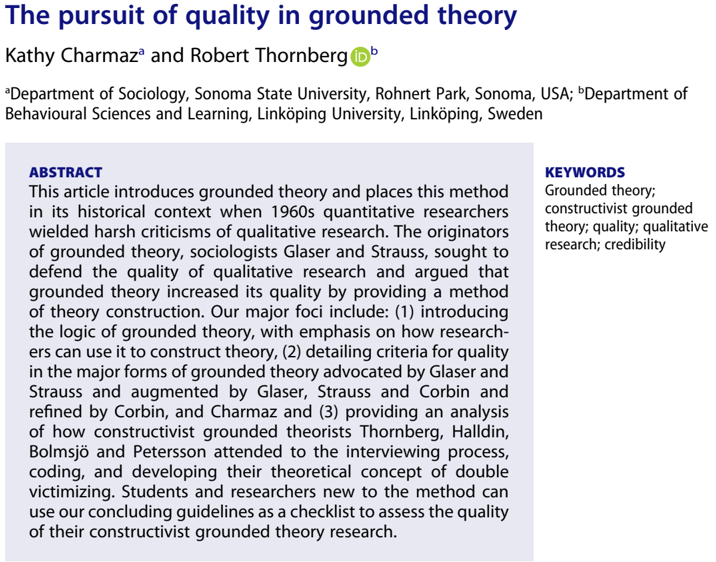
This article introduces grounded theory and places this method in its historical context when 1960s quantitative researchers wielded harsh criticisms of qualitative research. The originators of grounded theory, sociologists Glaser and Strauss, sought to defend the quality of qualitative research and argued that grounded theory increased its quality by providing a method of theory construction. Our major foci include: (1) introducing the logic of grounded theory, with emphasis on how researchers can use it to construct theory, (2) detailing criteria for quality in the major forms of grounded theory advocated by Glaser and Strauss and augmented by Glaser, Strauss and Corbin and refined by Corbin, and Charmaz and (3) providing an analysis of how constructivist grounded theorists Thornberg, Halldin, Bolmsjö and Petersson attended to the interviewing process, coding, and developing their theoretical concept of double victimizing. Students and researchers new to the method can use our concluding guidelines as a checklist to assess the quality of their constructivist grounded theory research.
Verified 2026-11-22 · 1 reference not checked yet
Overview
CoChat Summary
TL;DR
This article reviews grounded theory’s historical development and argues that quality criteria must fit the specific version of grounded theory, culminating in constructivist criteria and a checklist. It illustrates constructivist quality through Thornberg et al.’s (2013) study of school bullying and the concept of double victimizing.
Key findings
- Quality criteria differ across grounded theory versions: original Glaser and Strauss focused on credibility and applicability with fitness, understanding, generality, and control; Glaser added workability, relevance, fit, and modifiability; Strauss and Corbin emphasized data quality, plausibility/value of theory, adequacy of process, and empirical grounding; constructivist Charmaz proposes credibility, originality, resonance, and usefulness.
- The paper argues quality is built through iterative data collection and analysis, line-by-line and focused coding, memo-writing, theoretical sampling and saturation, constant comparison, and reflexivity/methodological self-consciousness.
- In the illustrative constructivist study, Thornberg et al. (2013) distributed 523 open-ended questionnaires to students in three secondary schools and two universities in Sweden; of 511 responses, 168 reported past bullying, 36 volunteered, and 21 who had been bullied for more than one year were interviewed; analysis produced the core category “double victimizing” (external and internal victimizing).
- In psychology, Rubin, Bell, and McCleland (2018) found only 13% of responding graduate psychology programs required a qualitative research course, and respondents described qualitative research as “inaccurate,” “subjective,” and “lacking rigor” while also describing it as providing the “best methods for feminist, community-based, and social justice research.”
Methods
- Design: methodological/conceptual article introducing grounded theory, comparing quality criteria across Glaserian, Straussian, and constructivist versions, and offering guidelines/checklist for constructivist grounded theory.
- Data or sample: no primary empirical sample for the article; it analyzes historical and methodological literature and uses Thornberg et al. (2013) as an illustrative constructivist grounded theory study (523 questionnaires; 511 responses; 168 bullied; 36 volunteers; 21 interviewed).
- Main analysis: narrative synthesis and comparison of quality criteria, with an illustration of coding, constant comparison, memo-writing, theoretical sampling, and category development leading to “double victimizing.”
Limitations
- Stated: the authors caution that checklists risk becoming a “methodological crutch” that avoids deep engagement with method and data (citing Barbour 2001), and present their guidelines as flexible, not substitutes for rigorous research.
- Stated: criteria for quality in qualitative research remain unsettled, with “little consensus” about appropriate evaluation criteria, and meanings of quality markers may differ among researchers.
- Evident from the text: the article is not an empirical validation of the checklist; the double victimizing case is a secondary illustration rather than a new test, and the guidelines are aimed mainly at constructivist grounded theory though claimed mostly applicable to other versions.
Model-written summary. Check it against the paper before relying on it.
Integrity signals
Registry
Cites
Statistics
Figures



Verification
Claims the paper makes
2 Valid · 13 Not valid · 38 Not checked · 38 Own results and interpretations
None of the sources cited for this claim have been checked yet.
In the paper
“Concerns about objectivity, validity, reliability and replicability in qualitative research still pervade academic psychology.”
§ The pursuit of quality in grounded theory > Qualitative research and psychology
plain- Asserted: passes — The authors put it forward as true.
- Checkable: passes — It can be checked against evidence.
- Load-bearing: passes — The paper’s conclusions depend on it.
- Based: passes — The paper gives a reason why it holds.
In the paper
“Until Glaser and Strauss's (1967) statement, little had been written, much less codified into a systematic statement, about how to construct a qualitative theoretical analysis of high quality.”
§ The pursuit of quality in grounded theory > Concerns about quality in the development of grounded theory
What the sources say
- Not matchedcites Glaser and Strauss's (1967)
An author–year citation the paper’s reference list doesn’t settle. We don’t search these by name.
plain- Asserted: passes — The authors put it forward as true.
- Checkable: passes — It can be checked against evidence.
- Load-bearing: unclear — It is unclear whether the paper’s conclusions depend on it.
- Based: passes — The paper gives a reason why it holds.
- Not matched
A statement the paper makes itself — it cites no source for it, so there is none to check. The quote shows it is in the paper.
In the paper
“If, however, researchers only ask the same questions of each participant, they are likely to elicit similar stories about the topic.”
§ The pursuit of quality in grounded theory > Introduction
hedgedstates a possible cause- Asserted: passes — The authors put it forward as true.
- Checkable: passes — It can be checked against evidence.
- Load-bearing: passes — The paper’s conclusions depend on it.
- Based: passes — The paper gives a reason why it holds.
A statement the paper makes itself — it cites no source for it, so there is none to check. The quote shows it is in the paper.
In the paper
“If, however, researchers systematically interrogate their data as they gather it, their early ideas can then inform subsequent data collection.”
§ The pursuit of quality in grounded theory > Introduction
plainstates a possible cause- Asserted: passes — The authors put it forward as true.
- Checkable: passes — It can be checked against evidence.
- Load-bearing: passes — The paper’s conclusions depend on it.
- Based: passes — The paper gives a reason why it holds.
A statement the paper makes itself — it cites no source for it, so there is none to check. The quote shows it is in the paper.
In the paper
“When answering quantitative social scientists' sharp criticisms of its quality, Glaser and Strauss rejected the common practice of evaluating qualitative research according to the tenets of the quantitative tradition.”
§ The pursuit of quality in grounded theory > Concerns about quality in the development of grounded theory
plain- Asserted: passes — The authors put it forward as true.
- Checkable: passes — It can be checked against evidence.
- Load-bearing: unclear — It is unclear whether the paper’s conclusions depend on it.
- Based: passes — The paper gives a reason why it holds.
22 more claims
Create a free account to see all 91 claims and to verify the 7 references still open.
- Probably not a substantial claim. 61
- It may state two separate claims as one. 26
Claims other papers make about this one
Each is checked against this paper’s own text: does it say what the citing paper says it does?
The source backs part of the claim, not all of it — or backs it for a different population, condition or comparison.
In the citing paper
“An explicitly constructivist approach aims to produce an abstract understanding of a phenomenon (rather than an explanation, as in other versions of GTM)”
From Quality Criteria: General and Specific Guidelines for Qualitative Approaches in Psychology Research. A Concise Guide for Novice Researchers and Reviewers (2024) · cites this paper as Charmaz & Thornberg, 2021
Experimental — accuracy not yet measuredThe source backs part of the claim, not all of it — or backs it for a different population, condition or comparison.
In the citing paper
“Constant comparison is a systematic strategy combining the advantages of simultaneous data generation and analysis, enabling a concentration on significant issues (Charmaz and Thornberg, 2021).”
From Application and challenges of using a Constructivist Grounded Theory methodology to address an undertheorized clinical challenge: A discussion paper (2024) · cites this paper as Charmaz and Thornberg, 2021
Experimental — accuracy not yet measuredThe cited source says what the claim attributes to it.
In the citing paper
“focuses on actions, meanings and constructions”
From Quality Criteria: General and Specific Guidelines for Qualitative Approaches in Psychology Research. A Concise Guide for Novice Researchers and Reviewers (2024) · cites this paper as Charmaz & Thornberg, 2021
The cited source says what the claim attributes to it.
In the citing paper
“and acknowledges both subjectivity (of participants and researchers) and context (Charmaz, 2014; Charmaz & Thornberg, 2021).”
From Quality Criteria: General and Specific Guidelines for Qualitative Approaches in Psychology Research. A Concise Guide for Novice Researchers and Reviewers (2024) · cites this paper as Charmaz & Thornberg, 2021
The cited source says what the claim attributes to it.
In the citing paper
“The primary focus is the theory ' s ability to clarify participants ' lives and contribute to knowledge and practice (Charmaz & Thornberg, 2021).”
From Quality Criteria: General and Specific Guidelines for Qualitative Approaches in Psychology Research. A Concise Guide for Novice Researchers and Reviewers (2024) · cites this paper as Charmaz & Thornberg, 2021
6 more claims about this paper
Create a free account to see every claim other papers make about this one.
Citations
Cites
Using thematic analysis in psychology
Braun, V., & Clarke, V. (2006) · Qualitative Research in Psychology · doi:10.1191/1478088706qp063oa · Cited by 194,414
The Discovery of Grounded Theory: Strategies for Qualitative Research.
Wagner, H. R., Glaser, B. G., & Strauss, A. L. (1968) · Social Forces · doi:10.2307/2575405 · Cited by 46,361
The Discovery of Grounded Theory; Strategies for Qualitative Research
Glaser, B. G., Strauss, A. L., & Strutzel, E. (1968) · Nursing Research · doi:10.1097/00006199-196807000-00014 · Cited by 39,449
Basics of Qualitative Research: Grounded Theory Procedures and Techniques.
Ellis, C., Strauss, A., & Corbin, J. (1992) · Contemporary Sociology · doi:10.2307/2074814 · Cited by 29,249
Basics of Qualitative Research (3rd ed.): Techniques and Procedures for Developing Grounded Theory
Corbin, J., & Strauss, A. (2008) · SAGE · doi:10.4135/9781452230153 · Cited by 24,827
(2006) · Cited by 18,730
Self-citationBasics of Qualitative Research
Ozanne, J. L., Strauss, A., & Corbin, J. (1992) · Journal of Marketing Research · doi:10.2307/3172751 · Cited by 17,850 · cited 2×
“In their development of grounded theory, Strauss and Corbin (1990; Corbin and Strauss 1990; Strauss and Corbin 1998) emphasized four general criteria: (1) quality of the data, in other words, grounded theorists need to carefully address and adopt quality criteria related to methods used for data…”
BackgroundMethodBasics of Qualitative Research: Grounded Theory Procedures and Techniques
Long, D. R., Strauss, A., & Corbin, J. (1993) · The Modern Language Journal · doi:10.2307/328955 · Cited by 17,576
(2014) · Cited by 15,747
Self-citationInterviewing as qualitative research a guide for researchers in education and the social sciences
Seidman, I. (2006) · Cited by 12,757
Research works printed but not linked: 5
- 10. Charmaz, K. 1995. Between positivism and postmodernism: implications for methods. In Studies in symbolic interaction, vol. 17, N. K. Denzin (Ed.), pp. 43-72. Greenwich, CT: JAI Press.
- 17. Cisneros-Puebla, C. A. 2007. The deconstructive and reconstructive faces of social construc- tion: Kenneth Gergen in conversation with César A. Cisneros-Puebla. With an introduction by Robert B. Faux [83 paragraphs]. Forum Qualitative Sozialforschung/Forum: Qualitative Social Research 9 (1):Art. 20. http://nbn-resolving.de/urn:nbn:de:0114-fqs0801204 .
- 26. Glaser, B. G. 1978. Theoretical sensitivity. Mill Valley, CA: Sociology Press.
- 27. Glaser, B. G. 1992. Basics of grounded theory analysis. Mill Valley, CA: Sociology Press.
- 30. Glaser, B. G. 2013. No preconceptions: The grounded theory dictum. Mill Valley, CA: Sociology Press.
Cited by
Items 501–600 of 1,191
Práca na podloženej teórii v kvalitatívnom výskume
Kusá, Z. (2021) · doi:10.31577/2021.9788089897292 · Cited by 7
Ecommerce Fraud Incident Response: A Grounded Theory Study
Dwight, J. (2023) · Interdisciplinary Journal of Information Knowledge and Management · doi:10.28945/5110 · Cited by 4
“The quality criteria are credibility, originality, resonance, and usefulness (Charmaz & Thornberg, 2020).”
BackgroundInfluentialNavigating Rural Care Transitions: A Qualitative Study of Nursing Leaders’ Unit‐Focused Approaches
Winqvist, I., Näppä, U., & Häggström, M. (2025) · Journal of Nursing Management · doi:10.1155/jonm/8388833 · Cited by 4
Navigating Public Sector Innovation Under Populist Contexts: Insights from Israel
Golstein-Galperin, R., Cohen, N., & Cinar, E. (2025) · The American Review of Public Administration · doi:10.1177/02750740251400754 · Cited by 2
“We used a two-stage inductive methodology (Charmaz & Thornberg, 2021) to examine how high and mid-level Israeli bureaucrats experience and navigate populist challenges to promote public sector innovation.”
Vital yet Fragile: Informal Networks of Support Among Young People Navigating Long Covid
Clarke, Z., Cowan, H., Rhodes, T., Fernes, P. K., Haines, A., & Leal, L. (2026) · Health Expectations · doi:10.1111/hex.70611 · Cited by 2
“We took grounded theory as a ‘nodal point’ [35] for our data analysis, aiming to stay close to the data and use an iterative process to challenge and develop theoretical ideas around ‘informal care’.”
Schrøder, L., & Sickinger, P. (2024) · Journal of Pragmatics · doi:10.1016/j.pragma.2024.11.004 · Cited by 2
Holliday, N., Muhali, M. K., Lembani, M., Nonkeneza, H., Feni, M., Mchiza, Z. J., Hill, J., Klinger, C., Rehfuess, E. A., von Philipsborn, P., et al. (2025) · BMC Public Health · doi:10.1186/s12889-025-24210-0 · Cited by 3
“…activities (mostly in low-income areas), the Consumer Goods Council of South Africa signed an agreement with the City of Cape Town to enable police escorts and other safety measures to ensure delivery of their products to markets, while informal retailers were not included in this agreement [26].”
The POE paradigm in architecture: practices and perspectives of Canadian practitioners
Boissonneault, A., & Peters, T. (2025) · Building Research & Information · doi:10.1080/09613218.2025.2457940 · Cited by 4
“Per Charmaz and Thornberg (2021) and consistent with Hay et al. (2018), rigour was ensured by meeting four criteria: credibility, originality, resonance and usefulness, including but not limited to: data saturation, researcher reflexivity, constant comparison, thorough analysis, new…”
Zou, P., Wu, Y., & Zhang, J. (2022) · Occupational Therapy International · doi:10.1155/2022/7982808 · Cited by 3
“Based on the previous study [8].”
RetractedSchiller, B., Becher-Urbaniak, S., Wimmer, E., Winter, L., & Mörtl, K. (2025) · Frontiers in Psychology · doi:10.3389/fpsyg.2025.1413134 · Cited by 5
“…process allowed for ongoing validation, extension and elaboration of the emerging theory, enhancing the credibility of the study (Lincoln and Guba, 1985; Elliott et al., 1999; Mayring, 2007; Steinke, 2007; Dourdouma and Mörtl, 2013; Loh, 2015; Stahl and King, 2020; Charmaz and Thornberg, 2021).”
InfluentialWilson, E., Turner, N., Palmer, J., Davidson, S., Turner, M. R., & Faull, C. (2025) · Disability and Rehabilitation · doi:10.1080/09638288.2025.2574536 · Cited by 3
“A constant comparison approach was taken throughout by NT and EW to engage in an iterative process of data collection, reflection, and interpretation [24].”
Han, M., & Liu, Y. (2025) · Applied Soft Computing · doi:10.1016/j.asoc.2025.113715 · Cited by 2
qaf’an, E. A., Alford, S., Mack, H. A., Sekhon, R., Gray, S., Song, K., Willson, K., Kelly, G., & LIM, D. J. (2025) · International Journal of Environmental Research and Public Health · doi:10.3390/ijerph22010126 · Cited by 7
“Reflective journals were kept by the researchers, and fortnightly investigators/supervisory meetings were held to extend the confirmability of the research [32].”
Araújo, A. D. S., Kinsella, E. A., de Mello, A. C. C., & Marcolino, T. Q. (2024) · Cadernos Brasileiros de Terapia Ocupacional · doi:10.1590/2526-8910.ctoao288837501 · Cited by 2
From hierarchical to matrix structure: tensions in negotiating shared leadership configurations
Gibeau, E. M. (2024) · International Journal of Organization Theory and Behavior · doi:10.1108/ijotb-12-2022-0235 · Cited by 2
Invisible Barriers: Institutional Discrimination Against Asylum-Seeking Women in Portugal
Borges, G. M. (2025) · Healthcare · doi:10.3390/healthcare13222967 · Cited by 3
“This study adopted a constructivist grounded theory approach, emphasizing the participants’ construction of meaning [32,33], complemented by an abductive approach to uncover emerging concepts.”
Mertens, B., Cuyvers, K., Mæyer, S. D., & Donche, V. (2025) · Learning and Instruction · doi:10.1016/j.learninstruc.2024.102075 · Cited by 5
Refugee Entrepreneurship in Germany: An Institutional Voids Perspective
Lehmann, T., Albaba, H., & Kreiter-Sammet, S. (2022) · Contributions to management science · doi:10.1007/978-3-030-97079-6_6 · Cited by 3
Wen, M., Wang, X., Mei, Z., Yin, Z., Yuan, S., & Liu, S. (2025) · Frontiers in Public Health · doi:10.3389/fpubh.2025.1510035 · Cited by 3
“Several tests and checks were conducted to ensure the reliability and validity of the coding process (53, ).”
Curado, C., & Gonçalves, T. (2025) · Knowledge management and organizational learning · doi:10.1007/978-3-031-80197-6_6 · Cited by 2
Parani, R., Niyu, N., Dwihadiah, D. L., et al. (2025) · INJECT (Interdisciplinary Journal of Communication) · doi:10.18326/inject.v10i1.4425 · Cited by 2
“Shō ga nai yo ne”: Interembodied experiences of menstrual pain among young Japanese women
Stephens-Chu, M. (2025) · Social Science & Medicine · doi:10.1016/j.socscimed.2025.118349 · Cited by 3
Inesia-Forde, A. (2023) · Asian Journal of Basic Science & Research · doi:10.38177/ajbsr.2023.5305 · Cited by 4
“The four criteria are credibility, originality, resonance, and usefulness (Charmaz & Thornberg, 2021).”
BackgroundMethodDecision-Making around Psychedelics for Depression and Anxiety: a Model Based on Online Discussions
Kryszajtys, D. T., Bender, J. L., Rush, B. R., & Strıke, C. (2023) · International Journal of Mental Health and Addiction · doi:10.1007/s11469-023-01148-1 · Cited by 6
“We followed CGT-recommended strategies to enhance the quality of our findings (see Table 2) (Charmaz & Thornberg, 2020).”
Dong, J., Yu, S., Qin, Y., Jin, X., Xing, Y., & Wang, H. (2025) · Qualitative Health Research · doi:10.1177/10497323251324127 · Cited by 3
“Theoretical saturation was de fi ned as thorough checking of constructed categories against data and no new properties or characteristics being identi fi ed (Charmaz & Thornberg, 2021).”
Emotional intelligence, helping others and generativity: perspectives of community sport coaches
Crisp, P. (2025) · Leisure/Loisir · doi:10.1080/14927713.2025.2503186 · Cited by 5
Methane Regulation in the EU: Stakeholder Perspectives on Mrv and Emissions ReductionsPreprint
Olczak, M., Piebalgs, A., & Balcombe, P. (2022) · SSRN Electronic Journal · doi:10.2139/ssrn.4096797 · Cited by 2
Koh, A. (2020) · British Journal of Educational Studies · doi:10.1080/00071005.2020.1843595 · Cited by 4
Kabay, S., Yoshikawa, H., & Brown, L. E. (2025) · Compare A Journal of Comparative and International Education · doi:10.1080/03057925.2025.2452493 · Cited by 4
“This process of line-by-line coding, memo writing, and analysis was informed by a grounded theory approach (Charmaz and Thornberg 2021; Glaser and Strauss 1967).”
Samra, R., Lucassen, M. F. G., García, A. N., Brown, K., Rimes, K. A., & WALLACE, L. M. (2024) · Psychology and Psychotherapy Theory Research and Practice · doi:10.1111/papt.12548 · Cited by 3
“In contrast, approaches that are highly data-driven such as grounded theory or interpretive phenomenological analysis (Charmaz & Thornberg, 2021; Smith et al., 2013) require greater homogeneity in participant sampling and as such would be inappropriate for the current relatively diverse set of…”
Ricks, S. J., Johnson, J., Ayers, K., et al. (2025) · Journal of Genetic Counseling · doi:10.1002/jgc4.70033 · Cited by 2
“Initial coding was followed by focused coding (Charmaz & Thornberg, 2021; Rieger, 2019; Saldaña, 2016 ).”
InfluentialRhodus, E. K., Aisen, P. S. S., Grill, J. D., Rentz, D. M., Petersen, R. C., Sperling, R. A., Salloway, S., Pierce, D., & Raman, R. (2022) · The Journal of Prevention of Alzheimer s Disease · doi:10.14283/jpad.2022.79 · Cited by 2
“This approach yields a framework illustrating the process behind the researched phenomena (12).”
BackgroundStreaming forward: Adoption considerations for the major recorded music markets in CARICOM
Joseph, F. J. (2023) · Convergence The International Journal of Research into New Media Technologies · doi:10.1177/13548565231203983 · Cited by 3
“Charmaz and Thornberg (2021) highlight Grounded Theory as a strategy of inquiry in which the researcher derives a general, abstract theory of a process, action or interaction which is grounded in the views of the participants.”
Ojala, M., Karppinen, S., Syrjäläinen, E., & Kokko, S. (2022) · FormAkademisk - forskningstidsskrift for design og designdidaktikk · doi:10.7577/formakademisk.4822 · Cited by 6
Marcos, Á. D. L., & Quesada-Cubo, V. (2026) · Cities · doi:10.1016/j.cities.2025.106730 · Cited by 2
Feu, A. M. A., Welsing, G. L., da Silva, A. L. S., Luz, P. P., & de Moura, P. R. G. (2025) · Journal of Chemical Education · doi:10.1021/acs.jchemed.5c00027 · Cited by 2
Why is the mathematics educator called inspiring?
Simamora, R. E., Darmayasa, J. B., & Kamara, J. G. (2022) · Journal of Honai Math · doi:10.30862/jhm.v5i2.334 · Cited by 5
“Initial coding, focused coding, and categorization were carried out in this study (Charmaz, 2014; Charmaz & Thornberg, 2021).”
BackgroundMethodInfluential“This is part of the body” – Student nurses' de-sexualisation of intimate care for patients
Mao, A., Van, I., Cheong, P. L., & Tam, H. L. (2024) · Nurse Education Today · doi:10.1016/j.nedt.2024.106209 · Cited by 4
With Visual Integrity and Care: A Framework for Mixed Methods Research on Visual Social Data
Lutz, N., Schafer, J. S., Dhawka, P., Tinn, P., & Starbird, K. (2026) · CHI Conference on Human Factors in Computing Systems · doi:10.1145/3772318.3791623 · Cited by 3
“When quantitative methods are used, we, like Charmaz and contemporaries, insist on human interpretation and involvement to construct results [32, 33, 35].”
McMillan, J., & Soundy, A. (2025) · Behavioral Sciences · doi:10.3390/bs15101399 · Cited by 3
“This methodology generates a theory that is co-created from the literature and inevitably the authors interpretations, biases, and experiences [39].”
Olsson, T., Thornberg, R., Forsberg, C., & Jungert, T. (2025) · Behavioral Sciences · doi:10.3390/bs15121656 · Cited by 2
“…and constant comparison guided this analytic process, ensuring that pre-existing theories could be informed, but not constrain, the analysis, maintaining groundedness (Charmaz & Thornberg, 2021), in other words, making sure that our constructed grounded theory would be grounded in the data.”
Self-citationMacfarlane, H., Paton, A., & Bush, J. P. (2024) · Currents in Pharmacy Teaching and Learning · doi:10.1016/j.cptl.2024.102271 · Cited by 3
Dohig, R. K., O’Sullivan, K. C., Telfar-Barnard, L., & Howden‐Chapman, P. (2024) · International Journal of Housing Policy · doi:10.1080/19491247.2024.2438294 · Cited by 4
“The first author maintained reflexive practice through rigorous note-taking throughout the research (Charmaz, 2015; Charmaz & Thornberg, 2021), sense-checking codes and categories with colleagues, and within the context of the wider literature, to determine the resonance and usefulness of the…”
InfluentialKarakısla, F. S., Fidanci, C., Aydın, R., & Kabukçuoğlu, K. (2024) · Issues in Mental Health Nursing · doi:10.1080/01612840.2024.2371940 · Cited by 3
“Theoretical saturation occurs when the point is reached where these categories are sufficiently explained by the features in the analyzed data set and no new features are discovered (Charmaz & Thornberg, 2021; Strauss & Corbin, 1998).”
InfluentialStrategic human resource management: Lived experiences
Wahitu, F. H., & Gladys, M. (2025) · SA Journal of Human Resource Management · doi:10.4102/sajhrm.v23i0.2869 · Cited by 3
“Charmaz avowed that, ‘no one goes into a study without prior knowledge’ about the subject area (Charmaz & Thornberg, 2021; O’Reilly et al., 2012).”
Gupta, S., & McCarthy, P. J. (2024) · Discover Psychology · doi:10.1007/s44202-024-00169-8 · Cited by 9
“To ensure objectivity and recognise bias, the authors periodically checked assumptions by making comparisons within data and with memos in line with grounded theory techniques [108] and by striving to achieve methodological self-congruence [14, 15].”
MethodKulkarni, D. (2022) · Interactive Film and Media Journal · doi:10.32920/ifmj.v2i3.1507 · Cited by 2
Loss and Grief Among Bereaved Family Members During COVID-19 in Brazil: A Grounded Theory Analysis
de Lima, P. K. G. C., Laranjeira, C., Carreira, L., Baldissera, V. D. A., Meireles, V. C., Baccon, W. C., Dias, L. E., Ali, A. M., Mello, F. F., Tostes, M. F. D. P., et al. (2025) · Behavioral Sciences · doi:10.3390/bs15060829 · Cited by 3
“Charmaz offered the following four criteria to ensure the correctness and validity of research: credibility, originality, resonance, and usefulness (Charmaz & Thornberg, 2020).”
Connectivity: Person-Centred Research Principles to Inform Constructivist Grounded Theory
Pratt, H., Middleton, R., Molloy, L., & Moroney, T. L. (2023) · International Journal of Qualitative Methods · doi:10.1177/16094069231205788 · Cited by 3
“She has presented a helpful series of questions and guidelines to support constructivist grounded theorists to consider the quality and rigour of their studies (see Charmaz, 2014, pp. 337 – 338; Charmaz & Thornberg, 2021, pp. 321 – 322).”
BackgroundMethodChang, W., Ganz, T., Kang, S., Hu, K., Mark, C., Frank, A. C., Lee, B., Lee, D. J., Coley, R. B., Ceasar, R. C., et al. (2025) · Movement Disorders Clinical Practice · doi:10.1002/mdc3.70132 · Cited by 5
Ding, X., Gopannagari, M., Sun, K., Tao, A., Zhao, D., Varadhan, S., Hardy, B., Dalpiaz, D., Vogiatzis, C., Angrave, L., et al. (2024) · ASEE Annual Conference & Exposition · doi:10.18260/1-2--47360 · Cited by 6
“Although different branches of grounded theory have different naming systems, what is shared in common is the inductive process for more concrete descriptive qualitative data to form increasingly abstract categories, themes, and theoretical threads [12, 13].”
BackgroundHu, D., Zhou, S., Crowley‐McHattan, Z. J., & Liu, Z. (2025) · Frontiers in Psychology · doi:10.3389/fpsyg.2025.1430002 · Cited by 2
Dating Violence on Post Secondary Campuses: Men’s Experiences
Warthe, D. G., Carter‐Snell, C., & Choate, P. W. (2025) · Social Sciences · doi:10.3390/socsci14090544 · Cited by 4
Bridle, H. L., Donnelly, R., Padwick, A., et al. (2025) · Early Childhood Education Journal · doi:10.1007/s10643-025-01858-2 · Cited by 2
“Qualitative responses were analysed taking a grounded theory approach (Charmaz & Thornberg, 2020), with the interview transcripts processed using Dedoose (https:// www. dedoo se. com /), going through the text line by line noting common themes.”
Miller, D. (2022) · The Qualitative Report · doi:10.46743/2160-3715/2022.5067 · Cited by 11
“I also developed a memo, titled Contradictions, that was firmly anchored in the data (Charmaz & Thornberg, 2021).”
MethodThe Relational Domains of Adolescence: Changes and Possibilities During COVID Era
Marzana, D., Rochira, A., Napoli, I. D., Albanesi, C., Mannarini, T., Fedi, A., Procentese, F., Aresi, G., Barbieri, I., Calandri, E., et al. (2023) · Journal of Adolescent Research · doi:10.1177/07435584231199425 · Cited by 2
“According to Constructivist Grounded Theory (Charmaz & Thornberg, 2020), the data collection and analysis phase was characterized by a constant reflexivity-based iterative process.”
Zhang, Y., & Li, X. (2024) · Disability & Society · doi:10.1080/09687599.2024.2328574 · Cited by 3
“Advocates of constructivist grounded theory maintain an open and critical perspective when engaging with the existing literature, data, and analysis (Charmaz and Thornberg 2021).”
Andersson, R. (2023) · doi:10.15626/lud.493.2023 · Cited by 7
Lowe, P. L., Jakimowicz, S., Levett-Jones, T. L., et al. (2024) · Nurse Researcher · doi:10.7748/nr.2024.e1947 · Cited by 2
Liu, H., Zhang, W., & Huang, Y. (2025) · Journal of Consumer Protection and Food Safety · doi:10.1007/s00003-025-01566-4 · Cited by 2
“With increasing emphasis on theory development, it is ideal for building theory from data (Jha and Chopra 2022) and providing abstract insights into core issues (Charmaz and Thornberg 2021).”
Earle, S., Blackburn, M., Chambers, L., Downing, J. D., Flemming, K., Hale, J., Marston, H. R., O’Dell, L., & Sinason, V. (2024) · Progress in Palliative Care · doi:10.1080/09699260.2024.2375823 · Cited by 3
“41”
From Blind Spot to Boardroom Agenda: A Grounded Theory of Forced Labor Risk Management
Schumm, J. R., Montabon, F. L., & Rose, W. J. (2025) · Journal of Business Logistics · doi:10.1111/jbl.70042 · Cited by 4
Lernen auf Distanz während der Coronapandemie
Knauf, H. (2023) · Zeitschrift für Grundschulforschung · doi:10.1007/s42278-023-00168-z · Cited by 2
Integrating minds: adaptive knowledge sharing strategies for ML team synergy
Toscani, G. (2025) · Cognition Technology & Work · doi:10.1007/s10111-025-00822-9 · Cited by 6
An Assessment of Contemporary Methods and Data-Enabled Approaches for Early Cataract Detection
Muchibwa, C., Eldaw, M. H. S., Mu, M., & Agyeman, M. O. (2023) · F1000Research · doi:10.12688/f1000research.138294.1 · Cited by 8
Saavedra, A., Schwartz, D. L., & Blair, K. P. (2025) · The Journal of Environmental Education · doi:10.1080/00958964.2025.2541892 · Cited by 3
“We coded responses using grounded theory analysis (Charmaz & Thornberg, 2021).”
Investigating New Zealand radiation therapy student perceptions about their degree curriculum
Kane, P., Gladman, T., Stein, S., & Timmermans, J. A. (2022) · BMC Medical Education · doi:10.1186/s12909-022-03973-9 · Cited by 3
“These are credibility, originality, resonance and usefulness [23, 27].”
BackgroundMangwegape, D. S., Moagi, M. M., Moloko-Phiri, S. S., Matsipane, M. J., & Machailo, R. M. (2025) · Qualitative Health Research · doi:10.1177/10497323241309232 · Cited by 4
Agbaria, N., Finkelstein, A., Zwas, D. R., & Daoud, N. (2024) · Nicotine & Tobacco Research · doi:10.1093/ntr/ntad257 · Cited by 3
Wang, A., Whyke, T. W., & Song, Z. (2025) · Creative Industries Journal · doi:10.1080/17510694.2025.2583652 · Cited by 3
Theorising intention to buy second-hand wedding dresses: a ZMET study
Thomas, L. J., Hancock, C., & Boardman, R. (2025) · Journal of Marketing Management · doi:10.1080/0267257x.2025.2558906 · Cited by 7
“A key part of the interview process which creates a visual map of the snapshot of thoughts, providing a holistic perspective of the overall thoughts on the topic. can be assessed by its ability to meet the criteria of credibility, originality, resonance, and usefulness (Charmaz & Thornberg, 2021).”
Löfgren, U., Wälivaara, B., Strömbäck, U., & Lindberg, B. (2025) · Journal of Advanced Nursing · doi:10.1111/jan.70080 · Cited by 7
Sealy-Jefferson, S. M., ROSS, L. J., Gavin, V., Mishra, S., Sanders, K., Anderson-Mays, T., Booth, J., Brown, J., Anderson, T., Jones-McBryde, C., et al. (2026) · SSM - Qualitative Research in Health · doi:10.1016/j.ssmqr.2026.100789 · Cited by 2
Turelli, F. C., Vaz, A., & Kirk, D. (2026) · Sport Education and Society · doi:10.1080/13573322.2026.2618752 · Cited by 2
Market Overview in Social CRM: An Analysis of Job Advertisements
de Menezes, P. C. F., Justino, A. F., Barata, B. A. P., Jacob, A. F. L., & Lobato, F. M. F. (2023) · IEEE/WIC/ACM International Conference on Web Intelligence and Intelligent Agent Technology (WI-IAT) · doi:10.1109/wi-iat59888.2023.00092 · Cited by 2
“The evaluation stage was based on the grounded theory approach, which consists of a qualitative research method that allows researchers to discern explicit and implicit processes in their data [27].”
MethodAbidin, A., Purnawarman, P., Hamied, F. A., & Muslim, A. B. (2026) · Reflective Practice · doi:10.1080/14623943.2026.2631429 · Cited by 2
“The mediation model Qualitative data underwent systematic analysis using constructivist grounded theory procedures (Charmaz, 2014; Charmaz & Thornberg, 2021), as theoretical sampling and saturation were not feasible within study constraints.”
Costa, A. R. (2024) · CoDesign · doi:10.1080/15710882.2024.2363925 · Cited by 9
“Through an interactive and inductive approach, we analysed the participants contributions and classified the most relevant themes presented and discussed (Charmaz and Thornberg 2020).”
Chao, Y.-H., Wang, S., & Sheu, S. (2023) · European Journal of Oncology Nursing · doi:10.1016/j.ejon.2023.102375 · Cited by 2
“I’m Treated Way Differently”: The Intersectional Risk Environment of Maternal Cannabis Use
Gould, E. E., Ganesh, S. S., & Ceasar, R. C. (2025) · Substance Use & Misuse · doi:10.1080/10826084.2025.2568153 · Cited by 2
“(Ligita, et al., 2019; Charmaz & Thornberg, 2021).”
A konfliktuskezelés kulturális összehasonlításban
Gálos, K., & Vinkóczi, T. (2023) · Vezetéstudomány / Budapest Management Review · doi:10.14267/veztud.2023.03.04 · Cited by 8
Thambinathan, V., Lena, S., Ramnarine, J., Chuang, H., Ogbaselassie, L., Dagher, M., Goulbourne, E., Wijayasinghe, S., Bawden, J., Kennedy, L., et al. (2024) · BMC Health Services Research · doi:10.1186/s12913-023-10140-3 · Cited by 2
“These practices enhanced credibility, consistency, and resonance of our study’s findings with respect to the participants’ experiences and overall context [21].”
BackgroundMethodRiding the wave: A grounded theory of transplant transition in adolescents and youth adults
Lim, A., & Marcellus, L. (2023) · Health Care Transitions · doi:10.1016/j.hctj.2023.100019 · Cited by 3
“37”
von Knorring, J., Lehti, A., Lindvall, K., & Semb, O. (2025) · Journal of Patient Experience · doi:10.1177/23743735251369702 · Cited by 4
Meeting Children in the Margins: A Grounded Theory Study of Montessori Education’s Global Reach
Johnson, V. J., Dalla, R. L., & Babchuk, W. A. (2025) · Journal of Research in Childhood Education · doi:10.1080/02568543.2025.2538461 · Cited by 6
“…and quality of this study were guided by intersecting four criteria of quality (i.e., credibility, originality, resonance, and usefulness) for grounded theory identified by Charmaz and Thornberg (2021) with validation strategies for qualitative studies identified by Creswell and Poth (2018).”
Tharani, A. J., Hecke, A. V., Ali, T. S., & Duprez, V. (2023) · Research in Nursing & Health · doi:10.1002/nur.22339 · Cited by 4
Yazdanpanah, M., Mousavi, M., Sharifi, Z., Lamm, A. J., Löhr, K., & Sieber, S. (2025) · Environment Development and Sustainability · doi:10.1007/s10668-025-06800-5 · Cited by 6
Organizational Factors in the Prevention and Management of Violence Against Employees
Elvegård, K., & Almvik, R. (2023) · Human Services Organizations Management Leadership & Governance · doi:10.1080/23303131.2023.2280532 · Cited by 6
“The analysis of these six themes followed constructivist grounded theory (Charmaz, 2006; Charmaz & Thornberg, 2020).”
BackgroundThe pronounced embeddedness of commercial and social entrepreneurship in rural communities
Ganany-Dagan, O., Greenberg, Z., Gimmon, E., et al. (2024) · The International Journal of Entrepreneurship and Innovation · doi:10.1177/14657503241261230 · Cited by 2
Franklyn, G. (2022) · Social Science & Medicine · doi:10.1016/j.socscimed.2022.115611 · Cited by 2
Child with epilepsy in school environment – The development of a conceptual model
Brabcova, D. B., Kohout, J., Komzáková, M., Nohavová, A., & Tegelová, V. (2024) · Epilepsy & Behavior · doi:10.1016/j.yebeh.2024.110246 · Cited by 3
The culturally valued domains in talent studies in Iran: experts views
Zardkhaneh, S. A., Maralani, F. M., Fathabadi, J., & SHAHSAVARİ, M. (2022) · Journal for the Education of Gifted Young Scientists · doi:10.17478/jegys.1071484 · Cited by 4
Impact of a Web-Based Lifestyle Medicine Intervention: A Qualitative Study Among Rural Participants
Abbott, L. S., Leon, J. D., & Graven, L. J. (2025) · Nursing Reports · doi:10.3390/nursrep15070227 · Cited by 2
“Grounded theory was the chosen method to understand the unique perspectives of rural program participants and elicit themes that can be practically applied in future public health program planning [25].”
Kaseje, N. C., Odhiambo, G., Omondi, B., Haines, A., & Ranganathan, M. (2025) · BMC Health Services Research · doi:10.1186/s12913-025-13162-1 · Cited by 2
“We defined codes as described by Charmaz [32].”
Everyone loves a good story: Learning design in massive open online courses for language learning
Caro-Barek, V. D. (2022) · Frontiers in Education · doi:10.3389/feduc.2022.1007091 · Cited by 5
“In this way, one could obtain what (Charmaz and Thornberg, 2020, p. 16), quoting Strauss and Corbin (1998), call “empirical grounding,” when a theory and its concepts fit with the data.”
MethodSacchi, S., Buonaccorso, L., Tanzi, S., Balestra, G. L., & Ghirotto, L. (2025) · BMC Palliative Care · doi:10.1186/s12904-025-01821-3 · Cited by 2
“Consistent with the adaptability inherent to GT methodology [42, 46], we extended data collection by incorporating new participants (patients and other key informants) and re-analyzing earlier data to deepen theoretical insights to answer the new research question.”
Does Grounded Theory Have a Place in Graduate Research?
Finley, S., & Howard, A. K. (2024) · American Journal of Qualitative Research · doi:10.29333/ajqr/14889 · Cited by 5
Art Therapists’ and Group Supervisors’ Perspectives on Practices in Time-Limited Art Therapy
Abraham, R., Snir, S., & Regev, D. (2026) · Art Therapy · doi:10.1080/07421656.2026.2616105 · Cited by 2
“The analysis focused on the therapists’ and supervisors’ perspectives of their actions and decisions in the clinical setting, and the meanings they attributed to key therapeutic processes (Charmaz & Thornberg, 2021).”
Cuevas, H. T., & Rapiman, D. R. Q. (2024) · Cogent Education · doi:10.1080/2331186x.2024.2396187 · Cited by 14
“The research behind this article considers a comprehensive interpretative paradigm using Grounded Theory, which, according to Charmaz and Thornberg (2021), alludes to the fact that the researcher ’ s analytical approach emerges during the research process through the construction and interaction…”
Dolan, E., Cosgrave, C., Killackey, E. J., & Allott, K. (2023) · Australian Journal of Rural Health · doi:10.1111/ajr.13039 · Cited by 2
Applying MAXQDA in a Grounded Theory Study: Evaluation of an Enterprise Education Research Project
Rizzo, A., Aquilina, R., & Falzon, R. (2024) · Lecture notes in networks and systems · doi:10.1007/978-3-031-65735-1_11 · Cited by 6
Metadata
- Authors
- Charmaz, K., & Thornberg, R.
- Affiliations
- Sonoma State University (US)
- Linköping University (SE)
- Corresponding author
- Thornberg, Robert
- Venue
- Qualitative Research in Psychology
- Publisher
- Informa UK Limited
- Published
- 2020-06-22
- Volume
- 18
- Issue
- 3
- Pages
- 305-327
- ISSN
- 1478-0887 (ISSN-L)
- 1478-0895
- OpenAlex
- W3036803033
- Cited by
- 1,221
- References
- 81
- Citations by year
- 2026: 264 · 2025: 290 · 2024: 255 · 2023: 221 · 2022: 128 · 2021: 54 · 2020: 8
- FWCI
- 155.56
- Type
- journal article
- Language
- en
- Open access
- hybrid
- doi.org
- Licence
- Locations
- Qualitative Research in Psychology (publishedVersion, cc-by-nc-nd)
- Topics
- Social Sciences › Education › Qualitative Research Methods and Applications
- Social Sciences › Sociology and Political Science › Qualitative Research Methods and Ethics
- Social Sciences › Sociology and Political Science › Sociology and Education Studies
- Keywords
- grounded theory, constructivist grounded theory, qualitative research quality, theory development, Glaser and Strauss, interviewing, coding, history of grounded theory
About these checks
Registry, retraction, Cites and statistics results are computed, not judged, with one exception: a printed reference that no index lists is read once by a model before it counts as a citation error. Claims are extracted by a model and kept only when their quote appears verbatim in the text; each cited source is then checked, with a model’s help, for whether it says what the claim relies on. Those verdicts can be wrong — read the claim’s quote and the cited source before relying on one.
The claim verdicts this report counts are experimental: their accuracy is not yet measured.
A language model drew the claims from the paper on 2026-09-28, under version 3 of the claim definition (model deepseek-v4.1-flash, prompt extract-v3).
A second model labelled each claim on 2026-09-28 (model jev-1.13-20260917, definition revision gold-guideline-v0.2).
Statistics and arithmetic are recomputed, not judged.
Confidence bands are shown only for fields calibrated on our annotated test set. None is calibrated yet, so no band is shown.
What counts as a claim ›How we measure confidence ›How we check this ›
Are you an author, or do you see a problem with this page? Request a review
Data sources
Bibliographic data: Semantic Scholar, OpenAlex, Crossref.
Contains information from the Semantic Scholar Academic Graph Datasets, made available under the ODC Attribution License (ODC-BY 1.0).
Semantic Scholar’s data is described in: Kinney, R., et al. (2023). The Semantic Scholar Open Data Platform. arXiv:2301.10140.
