

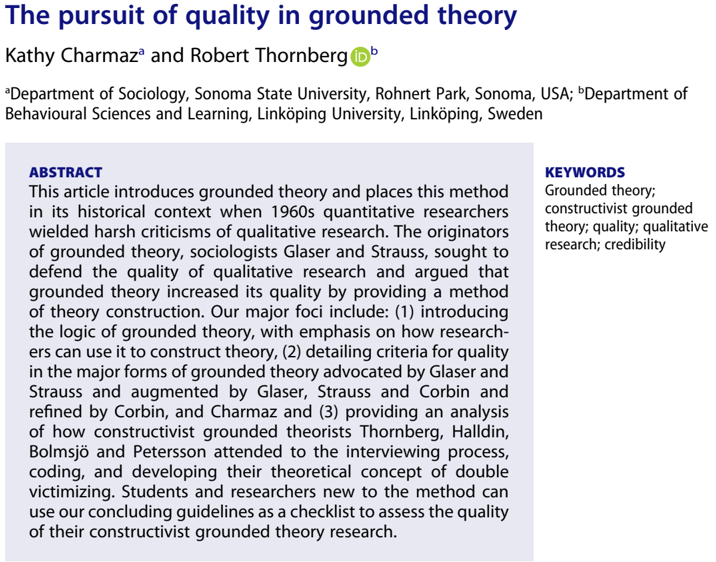
The pursuit of quality in grounded theory
Open accessThe DOI matches its Crossref record; 84 of the 85 references it cites were found in a registry or an index, and 1 are not checked yet; 2 of the 63 sources its claims cite were checked for support.
Abstract
This article introduces grounded theory and places this method in its historical context when 1960s quantitative researchers wielded harsh criticisms of qualitative research. The originators of grounded theory, sociologists Glaser and Strauss, sought to defend the quality of qualitative research and argued that grounded theory increased its quality by providing a method of theory construction. Our major foci include: (1) introducing the logic of grounded theory, with emphasis on how researchers can use it to construct theory, (2) detailing criteria for quality in the major forms of grounded theory advocated by Glaser and Strauss and augmented by Glaser, Strauss and Corbin and refined by Corbin, and Charmaz and (3) providing an analysis of how constructivist grounded theorists Thornberg, Halldin, Bolmsjö and Petersson attended to the interviewing process, coding, and developing their theoretical concept of double victimizing. Students and researchers new to the method can use our concluding guidelines as a checklist to assess the quality of their constructivist grounded theory research.
Verified 2026-11-22 · 1 reference not checked yet
Overview
CoChat Summary
TL;DR
This article reviews grounded theory’s historical development and argues that quality criteria must fit the specific version of grounded theory, culminating in constructivist criteria and a checklist. It illustrates constructivist quality through Thornberg et al.’s (2013) study of school bullying and the concept of double victimizing.
Key findings
- Quality criteria differ across grounded theory versions: original Glaser and Strauss focused on credibility and applicability with fitness, understanding, generality, and control; Glaser added workability, relevance, fit, and modifiability; Strauss and Corbin emphasized data quality, plausibility/value of theory, adequacy of process, and empirical grounding; constructivist Charmaz proposes credibility, originality, resonance, and usefulness.
- The paper argues quality is built through iterative data collection and analysis, line-by-line and focused coding, memo-writing, theoretical sampling and saturation, constant comparison, and reflexivity/methodological self-consciousness.
- In the illustrative constructivist study, Thornberg et al. (2013) distributed 523 open-ended questionnaires to students in three secondary schools and two universities in Sweden; of 511 responses, 168 reported past bullying, 36 volunteered, and 21 who had been bullied for more than one year were interviewed; analysis produced the core category “double victimizing” (external and internal victimizing).
- In psychology, Rubin, Bell, and McCleland (2018) found only 13% of responding graduate psychology programs required a qualitative research course, and respondents described qualitative research as “inaccurate,” “subjective,” and “lacking rigor” while also describing it as providing the “best methods for feminist, community-based, and social justice research.”
Methods
- Design: methodological/conceptual article introducing grounded theory, comparing quality criteria across Glaserian, Straussian, and constructivist versions, and offering guidelines/checklist for constructivist grounded theory.
- Data or sample: no primary empirical sample for the article; it analyzes historical and methodological literature and uses Thornberg et al. (2013) as an illustrative constructivist grounded theory study (523 questionnaires; 511 responses; 168 bullied; 36 volunteers; 21 interviewed).
- Main analysis: narrative synthesis and comparison of quality criteria, with an illustration of coding, constant comparison, memo-writing, theoretical sampling, and category development leading to “double victimizing.”
Limitations
- Stated: the authors caution that checklists risk becoming a “methodological crutch” that avoids deep engagement with method and data (citing Barbour 2001), and present their guidelines as flexible, not substitutes for rigorous research.
- Stated: criteria for quality in qualitative research remain unsettled, with “little consensus” about appropriate evaluation criteria, and meanings of quality markers may differ among researchers.
- Evident from the text: the article is not an empirical validation of the checklist; the double victimizing case is a secondary illustration rather than a new test, and the guidelines are aimed mainly at constructivist grounded theory though claimed mostly applicable to other versions.
Model-written summary. Check it against the paper before relying on it.
Integrity signals
Registry
Cites
Statistics
Figures



Verification
Claims the paper makes
2 Valid · 13 Not valid · 38 Not checked · 38 Own results and interpretations
None of the sources cited for this claim have been checked yet.
In the paper
“Concerns about objectivity, validity, reliability and replicability in qualitative research still pervade academic psychology.”
§ The pursuit of quality in grounded theory > Qualitative research and psychology
plain- Asserted: passes — The authors put it forward as true.
- Checkable: passes — It can be checked against evidence.
- Load-bearing: passes — The paper’s conclusions depend on it.
- Based: passes — The paper gives a reason why it holds.
In the paper
“Until Glaser and Strauss's (1967) statement, little had been written, much less codified into a systematic statement, about how to construct a qualitative theoretical analysis of high quality.”
§ The pursuit of quality in grounded theory > Concerns about quality in the development of grounded theory
What the sources say
- Not matchedcites Glaser and Strauss's (1967)
An author–year citation the paper’s reference list doesn’t settle. We don’t search these by name.
plain- Asserted: passes — The authors put it forward as true.
- Checkable: passes — It can be checked against evidence.
- Load-bearing: unclear — It is unclear whether the paper’s conclusions depend on it.
- Based: passes — The paper gives a reason why it holds.
- Not matched
A statement the paper makes itself — it cites no source for it, so there is none to check. The quote shows it is in the paper.
In the paper
“If, however, researchers only ask the same questions of each participant, they are likely to elicit similar stories about the topic.”
§ The pursuit of quality in grounded theory > Introduction
hedgedstates a possible cause- Asserted: passes — The authors put it forward as true.
- Checkable: passes — It can be checked against evidence.
- Load-bearing: passes — The paper’s conclusions depend on it.
- Based: passes — The paper gives a reason why it holds.
A statement the paper makes itself — it cites no source for it, so there is none to check. The quote shows it is in the paper.
In the paper
“If, however, researchers systematically interrogate their data as they gather it, their early ideas can then inform subsequent data collection.”
§ The pursuit of quality in grounded theory > Introduction
plainstates a possible cause- Asserted: passes — The authors put it forward as true.
- Checkable: passes — It can be checked against evidence.
- Load-bearing: passes — The paper’s conclusions depend on it.
- Based: passes — The paper gives a reason why it holds.
A statement the paper makes itself — it cites no source for it, so there is none to check. The quote shows it is in the paper.
In the paper
“When answering quantitative social scientists' sharp criticisms of its quality, Glaser and Strauss rejected the common practice of evaluating qualitative research according to the tenets of the quantitative tradition.”
§ The pursuit of quality in grounded theory > Concerns about quality in the development of grounded theory
plain- Asserted: passes — The authors put it forward as true.
- Checkable: passes — It can be checked against evidence.
- Load-bearing: unclear — It is unclear whether the paper’s conclusions depend on it.
- Based: passes — The paper gives a reason why it holds.
22 more claims
Create a free account to see all 91 claims and to verify the 7 references still open.
- Probably not a substantial claim. 61
- It may state two separate claims as one. 26
Claims other papers make about this one
Each is checked against this paper’s own text: does it say what the citing paper says it does?
The source backs part of the claim, not all of it — or backs it for a different population, condition or comparison.
In the citing paper
“An explicitly constructivist approach aims to produce an abstract understanding of a phenomenon (rather than an explanation, as in other versions of GTM)”
From Quality Criteria: General and Specific Guidelines for Qualitative Approaches in Psychology Research. A Concise Guide for Novice Researchers and Reviewers (2024) · cites this paper as Charmaz & Thornberg, 2021
Experimental — accuracy not yet measuredThe source backs part of the claim, not all of it — or backs it for a different population, condition or comparison.
In the citing paper
“Constant comparison is a systematic strategy combining the advantages of simultaneous data generation and analysis, enabling a concentration on significant issues (Charmaz and Thornberg, 2021).”
From Application and challenges of using a Constructivist Grounded Theory methodology to address an undertheorized clinical challenge: A discussion paper (2024) · cites this paper as Charmaz and Thornberg, 2021
Experimental — accuracy not yet measuredThe cited source says what the claim attributes to it.
In the citing paper
“focuses on actions, meanings and constructions”
From Quality Criteria: General and Specific Guidelines for Qualitative Approaches in Psychology Research. A Concise Guide for Novice Researchers and Reviewers (2024) · cites this paper as Charmaz & Thornberg, 2021
The cited source says what the claim attributes to it.
In the citing paper
“and acknowledges both subjectivity (of participants and researchers) and context (Charmaz, 2014; Charmaz & Thornberg, 2021).”
From Quality Criteria: General and Specific Guidelines for Qualitative Approaches in Psychology Research. A Concise Guide for Novice Researchers and Reviewers (2024) · cites this paper as Charmaz & Thornberg, 2021
The cited source says what the claim attributes to it.
In the citing paper
“The primary focus is the theory ' s ability to clarify participants ' lives and contribute to knowledge and practice (Charmaz & Thornberg, 2021).”
From Quality Criteria: General and Specific Guidelines for Qualitative Approaches in Psychology Research. A Concise Guide for Novice Researchers and Reviewers (2024) · cites this paper as Charmaz & Thornberg, 2021
6 more claims about this paper
Create a free account to see every claim other papers make about this one.
Citations
Cites
Using thematic analysis in psychology
Braun, V., & Clarke, V. (2006) · Qualitative Research in Psychology · doi:10.1191/1478088706qp063oa · Cited by 194,414
The Discovery of Grounded Theory: Strategies for Qualitative Research.
Wagner, H. R., Glaser, B. G., & Strauss, A. L. (1968) · Social Forces · doi:10.2307/2575405 · Cited by 46,361
The Discovery of Grounded Theory; Strategies for Qualitative Research
Glaser, B. G., Strauss, A. L., & Strutzel, E. (1968) · Nursing Research · doi:10.1097/00006199-196807000-00014 · Cited by 39,449
Basics of Qualitative Research: Grounded Theory Procedures and Techniques.
Ellis, C., Strauss, A., & Corbin, J. (1992) · Contemporary Sociology · doi:10.2307/2074814 · Cited by 29,249
Basics of Qualitative Research (3rd ed.): Techniques and Procedures for Developing Grounded Theory
Corbin, J., & Strauss, A. (2008) · SAGE · doi:10.4135/9781452230153 · Cited by 24,827
(2006) · Cited by 18,730
Self-citationBasics of Qualitative Research
Ozanne, J. L., Strauss, A., & Corbin, J. (1992) · Journal of Marketing Research · doi:10.2307/3172751 · Cited by 17,850 · cited 2×
“In their development of grounded theory, Strauss and Corbin (1990; Corbin and Strauss 1990; Strauss and Corbin 1998) emphasized four general criteria: (1) quality of the data, in other words, grounded theorists need to carefully address and adopt quality criteria related to methods used for data…”
BackgroundMethodBasics of Qualitative Research: Grounded Theory Procedures and Techniques
Long, D. R., Strauss, A., & Corbin, J. (1993) · The Modern Language Journal · doi:10.2307/328955 · Cited by 17,576
(2014) · Cited by 15,747
Self-citationInterviewing as qualitative research a guide for researchers in education and the social sciences
Seidman, I. (2006) · Cited by 12,757
Research works printed but not linked: 5
- 10. Charmaz, K. 1995. Between positivism and postmodernism: implications for methods. In Studies in symbolic interaction, vol. 17, N. K. Denzin (Ed.), pp. 43-72. Greenwich, CT: JAI Press.
- 17. Cisneros-Puebla, C. A. 2007. The deconstructive and reconstructive faces of social construc- tion: Kenneth Gergen in conversation with César A. Cisneros-Puebla. With an introduction by Robert B. Faux [83 paragraphs]. Forum Qualitative Sozialforschung/Forum: Qualitative Social Research 9 (1):Art. 20. http://nbn-resolving.de/urn:nbn:de:0114-fqs0801204 .
- 26. Glaser, B. G. 1978. Theoretical sensitivity. Mill Valley, CA: Sociology Press.
- 27. Glaser, B. G. 1992. Basics of grounded theory analysis. Mill Valley, CA: Sociology Press.
- 30. Glaser, B. G. 2013. No preconceptions: The grounded theory dictum. Mill Valley, CA: Sociology Press.
Cited by
Items 901–1,000 of 1,191
Harrison, H., & Berragan, E. (2025) · International Journal of Migration Health and Social Care · doi:10.1108/ijmhsc-02-2025-0010
Grounded Theory in Elderly Care: From Theory to Practice
Pires, S., Nabais, A., Roquette-Viana, M. C., et al. (2026) · Lecture notes in bioengineering · doi:10.1007/978-3-032-23747-7_10
Feng, O., Murray, C., & Duncan, L. R. (2026) · Journal of Applied Sport Psychology · doi:10.1080/10413200.2026.2700214
Attachment Security and Host–Guest Relationship Quality: A Qualitative Inquiry
Qu, Y., Han, R., & He, Z. (2026) · Journal of Hospitality & Tourism Research · doi:10.1177/10963480261488455
Ago, J. L., Kilgour, A., & Smith, C. L. (2026) · International Journal of Qualitative Methods · doi:10.1177/16094069261462095
Deterring Greenwashing in Travel: A Multistakeholder Action Framework
Kaur, P., Nijjer, S., Nicolau, J. L., & Dhir, A. (2026) · Journal of Travel Research · doi:10.1177/00472875261475650
CommTech y la comunicación interna. Una mirada desde las experiencias de profesionales ecuatorianos
Abad, K. C. V., Jumbo, R. P. V., & Quichimbo, J. Y. (2026) · INNOVA Research Journal · doi:10.33890/innova.v11.n1.especial.2026.2867
Deconstructing Empathy for Social Responsibility in Engineering Education
Brown, O., Pigozzi, L., & Brichacek, K. (2025) · IEEE International Symposium on Ethics in Engineering, Science, and Technology (ETHICS) · doi:10.1109/ethics65148.2025.11098345
“Additionally, grounded theory requires researchers to remain reflexive throughout their study, following our supporting theories and philosophies [48].”
Vianna, F. R. P. M., Calderari, E. B., Meneghetti, F. K., & Wanderley, S. E. D. P. V. (2025) · Management Learning · doi:10.1177/13505076251390719 · Cited by 1
Dong, B. (2023) · Decision Making Applications in Management and Engineering · doi:10.31181/dmame060120032023b
Accountability perspectives in the context of AI in intelligence and security investigations
Constantino, J., van Krimpen, F., van Gerwen, S., & Wagner, B. (2026) · Frontiers in Political Science · doi:10.3389/fpos.2026.1812399
Hempfling, M., & Hüther-Pape, L. (2022) · Research Square · doi:10.21203/rs.3.rs-1173078/v1 · Cited by 1
How can the tourism short videos shaping destination emotional attachment?
Zhang, X., & Zhu, J. J. (2026) · International Journal of Hospitality Management · doi:10.1016/j.ijhm.2026.104843
Abu, V. K. (2024) · SSRN Electronic Journal · doi:10.2139/ssrn.4875068
Zhao, J., & Liu, Q. (2026) · Frontiers in Psychology · doi:10.3389/fpsyg.2026.1836705
“Data analysis followed the procedures of constructivist grounded theory, employing a three-stage coding process consisting of open coding, axial coding, and selective coding (Charmaz and Thornberg, 2021).”
Older, Wiser, and Much More Daring: On Kathy Charmaz's Creative Explosion c1995–2020
Clarke, A. E. (2022) · Studies in symbolic interaction · doi:10.1108/s0163-239620220000056003 · Cited by 3
Faletehan, A. F. (2026) · Journal of Religion & Spirituality in Social Work Social Thought · doi:10.1080/15426432.2026.2724485
An Introduction to Basics of Grounded Theory Methodology
Ravindran, V. P. (2024) · Indian Journal of Continuing Nursing Education · doi:10.4103/ijcn.ijcn_71_24
Anantharaman, D., Liddle, J., Flynn, A., Vandemeulebroucke, T., King, C., Redman, B., Roache, K. E., Woodhouse, G., & Koh, W. Q. (2026) · International Journal of Qualitative Methods · doi:10.1177/16094069261434236
A qualitative study of factors that shape owners’ attitudes towards the vaccination of dogs and cats
Bloodworth, S., Perkins, E., & Pinchbeck, G. L. (2026) · Preventive Veterinary Medicine · doi:10.1016/j.prevetmed.2026.107016
Page, E., Vass, V., & Sabucedo, P. (2024) · Psychosis · doi:10.1080/17522439.2024.2430479
Identity, Religion, and Radicalization
Kabir, N. A. (2023) · Springer eBooks · doi:10.1007/978-3-031-43795-3_1
An, Y., Liang, S., & Chi, Y. (2026) · Library & Information Science Research · doi:10.1016/j.lisr.2026.101412
Hope as Praxis: A Process Model of Black Women's Radical Hope and Activism
Baker, B. A., Anyanso, V. E., Flint, J. R., & Endale, T. (2025) · Journal of Community Psychology · doi:10.1002/jcop.70077 · Cited by 2
Malacarne, G. T., Feu, A. M. A., Damm, B. M., Ferreira, R. Q., de Moura, P. R. G., & Filgueiras, P. R. (2026) · Journal of Chemical Education · doi:10.1021/acs.jchemed.6c00631
Rubio, L., Lee, A., Clark, H., Campbell, S., & Pote, H. L. (2026) · doi:10.2196/preprints.94441
Gallo, A. M., Araújo, J. P., Baccon, W. C., Marques, F. R. D. M., Salci, M. A., & Carreira, L. (2024) · Revista Latino-Americana de Enfermagem · doi:10.1590/1518-8345.7252.4384 · Cited by 2
Xie, Lai, P., Chaopaisarn, P., Jang, H., & Yang, C. (2026) · Maritime Policy & Management · doi:10.1080/03088839.2026.2731631
Performance Strategies for Latin American Dancesport: A Convergent Mixed-Method Design
Cordova, A. J., & Villaganas, E. J. (2026) · Psychology and Education A Multidisciplinary Journal · doi:10.70838/pemj.600509
Puttaraju, N. (2026) · Advances in computational intelligence and robotics book series · doi:10.4018/979-8-3373-6650-0.ch011
Shaker, M., & Zarzeczny, A. (2026) · Regenerative Medicine · doi:10.1080/17460751.2026.2665221
NOGUEIRA, M. J., Teixeira, D., GÓMEZ, I., Sánchez, P. A. P., CANOSA, S., & RODRÍGUEZ, T. (2023) · Editora Terried eBooks · doi:10.48209/978-65-84959-17-v
Dávalos-Almeyda, M., CARRIÓN, N. F., CEVALLOS-CARDENAS, M. J., CABALLERO-MONTAÑEZ, C., IBARRA-BOBER, A., & Livia-Córdova, G. N. (2023) · Editora Terried eBooks · doi:10.48209/978-65-84959-17-3
Montesi, M., Valero, P. P., & Álvarez-Bornstein, B. (2025) · Journal of Librarianship and Information Science · doi:10.1177/09610006251320088 · Cited by 2
“Constructivist grounded theory was considered especially suitable for the research considering researchers’ intense involvement in the project and the need to achieve a holistic integration of participants’ multiple perspectives (Charmaz, 2014; Charmaz and Thornberg, 2021).”
Elias, H. (2026) · Family Relations · doi:10.1111/fare.70085 · Cited by 1
Turner, J. W., & Foss, S. K. (2024) · Philosophies · doi:10.3390/philosophies9060173
La rigueur en théorisation ancrée : une expérience doctorale
Mohand, M. S., Maltais, N., Genest, C., & Rassy, J. (2023) · Recherches qualitatives · doi:10.7202/1100244ar · Cited by 3
Goodman, M. A., Conroy, K., Plieseis, J., et al. (2026) · Innovative Higher Education · doi:10.1007/s10755-026-09959-5
Feeling Heard Flips the Switch: Defining the Power of Professional Nurses
Dawes, J. (2026) · Advances in Nursing Science · doi:10.1097/ans.0000000000000644
Panorama do mercado no Social CRM: uma análise dos anúncios de emprego
de Menezes, P. C. F., Justino, A. F., Barata, B. A. P., et al. (2023) · doi:10.5753/erad-no2.2023.236281
“A avaliac¸ ˜ ao foi ba-seada no modelo da grounded theory , que consiste em uma abordagem de pesquisa qualitativa que proporciona aos pesquisadores discernir processos expl´ıcitos e impl´ıcitos [Charmaz and Thornberg 2021].”
BackgroundUn futuro diverso è possibile? Fattori facilitanti nelle storie di vita dei care leaver
Moretti, P. (2026) · MALTRATTAMENTO E ABUSO ALL INFANZIA · doi:10.3280/mal2026-002003
Memory, Archives, History: The Intellectual Legacies of Carter J. Eckert
Lynn, H. G. (2026) · The journal of Korean studies · doi:10.1215/07311613-12178368
Amirbekova, D., & Narbaev, T. (2022) · Eurasian studies in business and economics · doi:10.1007/978-3-031-15531-4_16 · Cited by 1
Johnston, J. H., McKenna, L., Malik, G., et al. (2024) · SSRN Electronic Journal · doi:10.2139/ssrn.4814386
Roh, H., Park, K. H., Oh, J., & Choi, H. (2023) · Research Square · doi:10.21203/rs.3.rs-3423047/v1
Mandirola, S. (2026) · Qualitative Research in Financial Markets · doi:10.1108/qrfm-07-2025-0240
Brockinton, A., Salnitri, M., Kooner-Evans, F., McAlaney, J., & Thompson, S. (2025) · Technology in Society · doi:10.1016/j.techsoc.2025.103000 · Cited by 2
Tapan, M. G., Kuddaş, N. B., DEMİREL, A. C., et al. (2026) · The British Journal of Social Work · doi:10.1093/bjsw/bcag108
Gaze on belonging : investigating rural preservice teachers' experiences at a flagship university
Woods, S. L. (2021) · MOspace Institutional Repository (University of Missouri) · doi:10.32469/10355/90103
Identifying Suicidality in Autistic People and Discussing It with Them: A Qualitative Study
Huckridge, J., Steel, J., & Howard, D. (2025) · Autism in Adulthood · doi:10.1177/25739581251391618
Sun, N., Jia, X., & Xu, X. (2026) · Qualitative Research Reports in Communication · doi:10.1080/17459435.2026.2678852
Seeing into the air: Media practices of blind vloggers and the visual paradox of mediated visibility
Song, S. (2026) · New Media & Society · doi:10.1177/14614448261437810
Beyond the game: racism, crisis management and social responsibility in professional football
Vieira, B. M., Azevedo, A., & Fonseca, M. J. (2025) · International journal of organizational analysis · doi:10.1108/ijoa-02-2025-5256 · Cited by 1
Donorfio, L. K. M., Chapman, B. G., Highberg, N. P., Bernhardt, A. B., & Tomasino, D. F. (2026) · Research on Aging · doi:10.1177/01640275261469195
Miao, K., Tian, Y., Qiao, R., Niu, S., & Chen, Y. (2026) · Lecture notes in computer science · doi:10.1007/978-3-032-29842-3_2
Zero, D. (2021) · ThinkIR: The University of Louisville's Institutional Repository (University of Louisville) · doi:10.18297/etd/3709
Protecting and Promoting the Wellbeing of High-Performance Swimmers
Uzzell, K. S. (2023) · Cronfa (Swansea University) · doi:10.23889/suthesis.62923
The health burdens of segregation for older incarcerated adults
Novisky, M. A., & Prost, S. G. (2025) · Journal of Criminal Justice · doi:10.1016/j.jcrimjus.2025.102479
“Considering the evolution of grounded theory over the last several decades and the increasing flexibility of its meaning, many pathways exist for authors to incorporate it into their work (Charmaz & Thornberg, 2020).”
Corradi, A., Meyer, H. G., & Ramey, D. M. (2024) · American Journal of Criminal Justice · doi:10.1007/s12103-024-09785-5
“As recommended by Charmaz and Thornberg (2021), coding was conducted line by line for all request justifications.”
Understanding motivation among NEET youth: Pathways towards education and work
Markovič, D. (2026) · SHS Web of Conferences · doi:10.1051/shsconf/202623802008
Modelling Sociotechnical Aspects of R&D in the Dutch High-Tech Equipment Industries
Doornbos, R., Teixeira, J., & Goosen, P. (2026) · Procedia Computer Science · doi:10.1016/j.procs.2026.08.204
Chen, X., Wang, J., Duan, B. Y., Hu, X., & Zhang, Z. (2026) · Research Square · doi:10.21203/rs.3.rs-8922431/v1
Barns delaktighet: en mikrosociologisk studie av barn- och familjeterapeutiska samtal
Edman, K. (2025) · doi:10.24834/isbn.9789178775859 · Cited by 6
Song, H., Chen, Y., & Zhou, Z. (2024) · International Journal of Education and Humanities · doi:10.54097/zmx9mz56
“This step requires researchers to code selectively to enrich core variable [21].”
BackgroundMendonça, S. M. S., Nogueira, M. J., & Ramos, A. F. (2023) · Lecture notes in bioengineering · doi:10.1007/978-3-031-29067-1_34
Utomo, S. L., & Utomo, S. L. (2023) · Journal of Southwest Jiaotong University · doi:10.35741/issn.0258-2724.58.1.45
Cascading Disasters, Perinatal Wellbeing, and Infant Feeding Practices in South Alabama
Locke, E., & Horan, H. L. (2026) · NEW SOLUTIONS A Journal of Environmental and Occupational Health Policy · doi:10.1177/10482911261423972 · Cited by 1
Rizzo, A., Aquilina, R., & Falzon, R. (2024) · Journal of Enterprising Culture · doi:10.1142/s0218495824500031 · Cited by 3
Cole, K., Gilchrist, H., & Driscoll, T. (2026) · SSRN Electronic Journal · doi:10.2139/ssrn.7404662
Curvey, R. M. G., White, S. C., Englis, M. T., Jensen, K. C., Bosco, M. K., Thompson, M. E., Hargons, C. N., Leavens, S., & Murphy, E. A. (2022) · The Sport Psychologist · doi:10.1123/tsp.2022-0025
In Their Own Words: Prosecutors on the Politics of Backlash
Davis, J. M., & Taylor, W. K. (2026) · Law & Policy · doi:10.1111/lapo.70024
Bitsani, E., Tsekos, T., Thymi, I., & Marava, G. (2026) · Cities, heritage and transformation · doi:10.1007/978-3-032-17584-7_10
Smålander, E., & Andersson, R. (2025) · Quality Assurance in Education · doi:10.1108/qae-04-2025-0081
Ziv, R., & Benjamin, O. (2026) · Journal of Family Issues · doi:10.1177/0192513x261483282
Souza, J. C., da Costa, C. E. S., da Silva, V., et al. (2022) · Revista organizações em contexto/Organizações em Contexto · doi:10.15603/1982-8756/roc.v18n35p293-315
Expansive Intimacies: Celebrating the Intimacy of Asexual and Aromantic People
Mollet, A. L., Valley, S. N., & Fitzsimmons, B. (2026) · The Journal of Sex Research · doi:10.1080/00224499.2026.2658111 · Cited by 1
Febriza, N. A., Arisyi, M. F., & Silitonga, S. W. B. (2026) · Health Technologies · doi:10.58962/ht.322
Clientelism and Subservience in Organizational Behaviour and Professional Practice
Nekmahmud, M., & Patwary, M. A. (2023) · Global Business Review · doi:10.1177/09721509221143206 · Cited by 2
A kézműves sörgyártás vizsgálata gazdasági és élelmiszerbiztonsági szempontból
Albert, A., & Kelemen-Erdős, A. (2022) · Acta Carolus Robertus · doi:10.33032/acr.3246
Contreras, J., Castillo, C., & Valério, N. I. (2026) · Educational Evaluation and Policy Analysis · doi:10.3102/01623737261438810
Gallo, A. M., Laranjeira, C., Araújo, J. P., Baccon, W. C., Marques, F. R. D. M., Siraichi, J. T. G., Ali, A. M., Fekih‐Romdhane, F., Salci, M. A., & CARREIRA, L. (2026) · Societies · doi:10.3390/soc16090276
Gordon, M., Clements, A., Ismail, M., & Salvati, C. (2026) · Disaster Prevention and Management An International Journal · doi:10.1108/dpm-04-2025-0132
Pesan Asertif dalam Dokumen Kebijakan Pendidikan Kurikulum Merdeka: Sebuah Tinjauan Isi Wacana
Syafiudin, A. S., Roekhan, R., & Andajani, K. (2024) · Jurnal Onoma Pendidikan Bahasa dan Sastra · doi:10.30605/onoma.v10i3.3895 · Cited by 2
Exploring Professionalism in the Gaming Industry: Perspectives from Macao Casino Employees
Lam, C. S., Ho, H.-W., & Liu, S. (2026) · Highlights of Sustainability · doi:10.54175/hsustain5010013
Buchstaller, I., & da Silva, D. V. (2026) · Linguistic Landscape An international journal · doi:10.1075/ll.25082.buc
Cano, A. M. C., Lugo, M. D. L. C. H., & Zapata, E. M. J. (2025) · PSIQUEMAG/ Revista Científica Digital de Psicología · doi:10.18050/psiquemag.v14i2.3853 · Cited by 1
Tan, W., Hu, Q., Liu, S., & Jiang, Y. (2026) · Journal of Nursing Management · doi:10.1155/jonm/1897994
Lee, C., & Wong, J. S. (2025) · Police Practice and Research · doi:10.1080/15614263.2025.2594776
“The analytic approach was informed by grounded theory and thematic analysis to focus on data-driven and patterned results (Braun & Clarke, 2006; Charmaz & Thornberg, 2021).”
Reuben, S. (2024) · Children and Youth Services Review · doi:10.1016/j.childyouth.2024.107798 · Cited by 1
Nelson, A. M. L., & Krueger, R. B. (2025) · Occupational Therapy In Health Care · doi:10.1080/07380577.2025.2526049
“Grounded theory was chosen to systematically ground a process or framework in the data collected from participants who were stakeholders in that process (Charmaz & Thornberg, 2021; Reiter et al., 2011).”
Ofori-Boadu, A. N., & Bonku, R. (2026) · Frontiers in Psychology · doi:10.3389/fpsyg.2026.1797683
“We comply with the four GT quality criteria of credibility, originality, resonance, and usefulness (Charmaz and Thornberg, 2021).”
Das, A., Ray, S., & Choudhury, A. (2025) · Journal of Asian and African Studies · doi:10.1177/00219096251332933
“As a qualitative and an inductive method, such a method ‘shapes collected data and provides explicit strategies for analysing them’ while leading well-built pathways for ‘learning about the participants’ lives’ (Charmaz and Thornberg, 2021: 305).”
Quevedo, D. G., & Kuri, J. (2026) · Springer eBooks · doi:10.1007/978-3-032-08872-7_8
SOUSA, C. M., & FERREIRA, L. (2023) · Editora Terried eBooks · doi:10.48209/978-65-84959-17-x · Cited by 12
ALBERT, A. (2023) · Present Environment and Sustainable Development · doi:10.47743/pesd2023171012 · Cited by 3
“Line-by-line coding helps researchers understand the experiences and perspectives of their research participants (Charmaz & Thornberg, 2020).”
Prijanka, M., Lemy, D. M., & Tan, J. D. (2026) · Tourism and Hospitality · doi:10.3390/tourhosp7070188
“…explanations, constructivist grounded theory recognizes knowledge as co-constructed through interaction between researcher and participants and seeks to generate theoretically meaningful insights grounded in participants’ experiences and interpretations (Charmaz, 2006; Charmaz & Thornberg, 2021).”
Influential
Metadata
- Authors
- Charmaz, K., & Thornberg, R.
- Affiliations
- Sonoma State University (US)
- Linköping University (SE)
- Corresponding author
- Thornberg, Robert
- Venue
- Qualitative Research in Psychology
- Publisher
- Informa UK Limited
- Published
- 2020-06-22
- Volume
- 18
- Issue
- 3
- Pages
- 305-327
- ISSN
- 1478-0887 (ISSN-L)
- 1478-0895
- OpenAlex
- W3036803033
- Cited by
- 1,221
- References
- 81
- Citations by year
- 2026: 264 · 2025: 290 · 2024: 255 · 2023: 221 · 2022: 128 · 2021: 54 · 2020: 8
- FWCI
- 155.56
- Type
- journal article
- Language
- en
- Open access
- hybrid
- doi.org
- Licence
- Locations
- Qualitative Research in Psychology (publishedVersion, cc-by-nc-nd)
- Topics
- Social Sciences › Education › Qualitative Research Methods and Applications
- Social Sciences › Sociology and Political Science › Qualitative Research Methods and Ethics
- Social Sciences › Sociology and Political Science › Sociology and Education Studies
- Keywords
- grounded theory, constructivist grounded theory, qualitative research quality, theory development, Glaser and Strauss, interviewing, coding, history of grounded theory
About these checks
Registry, retraction, Cites and statistics results are computed, not judged, with one exception: a printed reference that no index lists is read once by a model before it counts as a citation error. Claims are extracted by a model and kept only when their quote appears verbatim in the text; each cited source is then checked, with a model’s help, for whether it says what the claim relies on. Those verdicts can be wrong — read the claim’s quote and the cited source before relying on one.
The claim verdicts this report counts are experimental: their accuracy is not yet measured.
A language model drew the claims from the paper on 2026-09-28, under version 3 of the claim definition (model deepseek-v4.1-flash, prompt extract-v3).
A second model labelled each claim on 2026-09-28 (model jev-1.13-20260917, definition revision gold-guideline-v0.2).
Statistics and arithmetic are recomputed, not judged.
Confidence bands are shown only for fields calibrated on our annotated test set. None is calibrated yet, so no band is shown.
What counts as a claim ›How we measure confidence ›How we check this ›
Are you an author, or do you see a problem with this page? Request a review
Data sources
Bibliographic data: Semantic Scholar, OpenAlex, Crossref.
Contains information from the Semantic Scholar Academic Graph Datasets, made available under the ODC Attribution License (ODC-BY 1.0).
Semantic Scholar’s data is described in: Kinney, R., et al. (2023). The Semantic Scholar Open Data Platform. arXiv:2301.10140.
