

The pursuit of quality in grounded theory
Open accessThe DOI matches its Crossref record; 84 of the 85 references it cites were found in a registry or an index, and 1 are not checked yet; 2 of the 63 sources its claims cite were checked for support.
Abstract
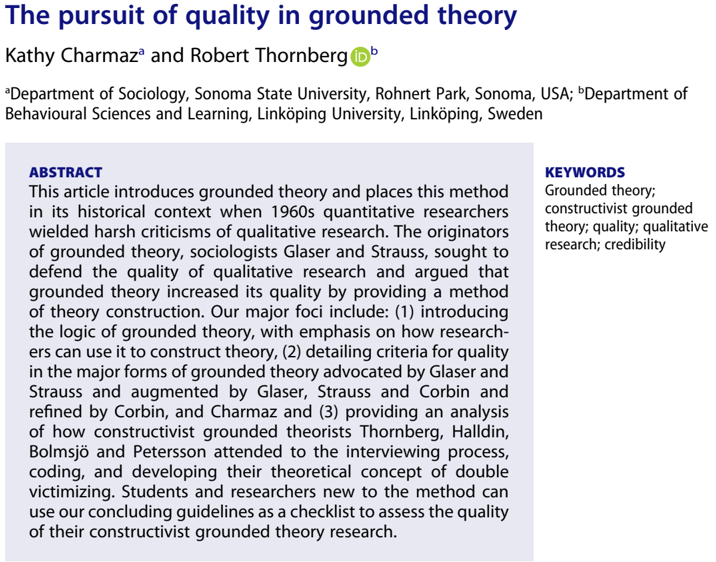
This article introduces grounded theory and places this method in its historical context when 1960s quantitative researchers wielded harsh criticisms of qualitative research. The originators of grounded theory, sociologists Glaser and Strauss, sought to defend the quality of qualitative research and argued that grounded theory increased its quality by providing a method of theory construction. Our major foci include: (1) introducing the logic of grounded theory, with emphasis on how researchers can use it to construct theory, (2) detailing criteria for quality in the major forms of grounded theory advocated by Glaser and Strauss and augmented by Glaser, Strauss and Corbin and refined by Corbin, and Charmaz and (3) providing an analysis of how constructivist grounded theorists Thornberg, Halldin, Bolmsjö and Petersson attended to the interviewing process, coding, and developing their theoretical concept of double victimizing. Students and researchers new to the method can use our concluding guidelines as a checklist to assess the quality of their constructivist grounded theory research.
Verified 2026-11-22 · 1 reference not checked yet
Overview
CoChat Summary
TL;DR
This article reviews grounded theory’s historical development and argues that quality criteria must fit the specific version of grounded theory, culminating in constructivist criteria and a checklist. It illustrates constructivist quality through Thornberg et al.’s (2013) study of school bullying and the concept of double victimizing.
Key findings
- Quality criteria differ across grounded theory versions: original Glaser and Strauss focused on credibility and applicability with fitness, understanding, generality, and control; Glaser added workability, relevance, fit, and modifiability; Strauss and Corbin emphasized data quality, plausibility/value of theory, adequacy of process, and empirical grounding; constructivist Charmaz proposes credibility, originality, resonance, and usefulness.
- The paper argues quality is built through iterative data collection and analysis, line-by-line and focused coding, memo-writing, theoretical sampling and saturation, constant comparison, and reflexivity/methodological self-consciousness.
- In the illustrative constructivist study, Thornberg et al. (2013) distributed 523 open-ended questionnaires to students in three secondary schools and two universities in Sweden; of 511 responses, 168 reported past bullying, 36 volunteered, and 21 who had been bullied for more than one year were interviewed; analysis produced the core category “double victimizing” (external and internal victimizing).
- In psychology, Rubin, Bell, and McCleland (2018) found only 13% of responding graduate psychology programs required a qualitative research course, and respondents described qualitative research as “inaccurate,” “subjective,” and “lacking rigor” while also describing it as providing the “best methods for feminist, community-based, and social justice research.”
Methods
- Design: methodological/conceptual article introducing grounded theory, comparing quality criteria across Glaserian, Straussian, and constructivist versions, and offering guidelines/checklist for constructivist grounded theory.
- Data or sample: no primary empirical sample for the article; it analyzes historical and methodological literature and uses Thornberg et al. (2013) as an illustrative constructivist grounded theory study (523 questionnaires; 511 responses; 168 bullied; 36 volunteers; 21 interviewed).
- Main analysis: narrative synthesis and comparison of quality criteria, with an illustration of coding, constant comparison, memo-writing, theoretical sampling, and category development leading to “double victimizing.”
Limitations
- Stated: the authors caution that checklists risk becoming a “methodological crutch” that avoids deep engagement with method and data (citing Barbour 2001), and present their guidelines as flexible, not substitutes for rigorous research.
- Stated: criteria for quality in qualitative research remain unsettled, with “little consensus” about appropriate evaluation criteria, and meanings of quality markers may differ among researchers.
- Evident from the text: the article is not an empirical validation of the checklist; the double victimizing case is a secondary illustration rather than a new test, and the guidelines are aimed mainly at constructivist grounded theory though claimed mostly applicable to other versions.
Model-written summary. Check it against the paper before relying on it.
Integrity signals
Registry
Cites
Statistics
Figures



Verification
Claims the paper makes
2 Valid · 13 Not valid · 38 Not checked · 38 Own results and interpretations
None of the sources cited for this claim have been checked yet.
In the paper
“Concerns about objectivity, validity, reliability and replicability in qualitative research still pervade academic psychology.”
§ The pursuit of quality in grounded theory > Qualitative research and psychology
plain- Asserted: passes — The authors put it forward as true.
- Checkable: passes — It can be checked against evidence.
- Load-bearing: passes — The paper’s conclusions depend on it.
- Based: passes — The paper gives a reason why it holds.
In the paper
“Until Glaser and Strauss's (1967) statement, little had been written, much less codified into a systematic statement, about how to construct a qualitative theoretical analysis of high quality.”
§ The pursuit of quality in grounded theory > Concerns about quality in the development of grounded theory
What the sources say
- Not matchedcites Glaser and Strauss's (1967)
An author–year citation the paper’s reference list doesn’t settle. We don’t search these by name.
plain- Asserted: passes — The authors put it forward as true.
- Checkable: passes — It can be checked against evidence.
- Load-bearing: unclear — It is unclear whether the paper’s conclusions depend on it.
- Based: passes — The paper gives a reason why it holds.
- Not matched
A statement the paper makes itself — it cites no source for it, so there is none to check. The quote shows it is in the paper.
In the paper
“If, however, researchers only ask the same questions of each participant, they are likely to elicit similar stories about the topic.”
§ The pursuit of quality in grounded theory > Introduction
hedgedstates a possible cause- Asserted: passes — The authors put it forward as true.
- Checkable: passes — It can be checked against evidence.
- Load-bearing: passes — The paper’s conclusions depend on it.
- Based: passes — The paper gives a reason why it holds.
A statement the paper makes itself — it cites no source for it, so there is none to check. The quote shows it is in the paper.
In the paper
“If, however, researchers systematically interrogate their data as they gather it, their early ideas can then inform subsequent data collection.”
§ The pursuit of quality in grounded theory > Introduction
plainstates a possible cause- Asserted: passes — The authors put it forward as true.
- Checkable: passes — It can be checked against evidence.
- Load-bearing: passes — The paper’s conclusions depend on it.
- Based: passes — The paper gives a reason why it holds.
A statement the paper makes itself — it cites no source for it, so there is none to check. The quote shows it is in the paper.
In the paper
“When answering quantitative social scientists' sharp criticisms of its quality, Glaser and Strauss rejected the common practice of evaluating qualitative research according to the tenets of the quantitative tradition.”
§ The pursuit of quality in grounded theory > Concerns about quality in the development of grounded theory
plain- Asserted: passes — The authors put it forward as true.
- Checkable: passes — It can be checked against evidence.
- Load-bearing: unclear — It is unclear whether the paper’s conclusions depend on it.
- Based: passes — The paper gives a reason why it holds.
22 more claims
Create a free account to see all 91 claims and to verify the 7 references still open.
- Probably not a substantial claim. 61
- It may state two separate claims as one. 26
Claims other papers make about this one
Each is checked against this paper’s own text: does it say what the citing paper says it does?
The source backs part of the claim, not all of it — or backs it for a different population, condition or comparison.
In the citing paper
“An explicitly constructivist approach aims to produce an abstract understanding of a phenomenon (rather than an explanation, as in other versions of GTM)”
From Quality Criteria: General and Specific Guidelines for Qualitative Approaches in Psychology Research. A Concise Guide for Novice Researchers and Reviewers (2024) · cites this paper as Charmaz & Thornberg, 2021
Experimental — accuracy not yet measuredThe source backs part of the claim, not all of it — or backs it for a different population, condition or comparison.
In the citing paper
“Constant comparison is a systematic strategy combining the advantages of simultaneous data generation and analysis, enabling a concentration on significant issues (Charmaz and Thornberg, 2021).”
From Application and challenges of using a Constructivist Grounded Theory methodology to address an undertheorized clinical challenge: A discussion paper (2024) · cites this paper as Charmaz and Thornberg, 2021
Experimental — accuracy not yet measuredThe cited source says what the claim attributes to it.
In the citing paper
“focuses on actions, meanings and constructions”
From Quality Criteria: General and Specific Guidelines for Qualitative Approaches in Psychology Research. A Concise Guide for Novice Researchers and Reviewers (2024) · cites this paper as Charmaz & Thornberg, 2021
The cited source says what the claim attributes to it.
In the citing paper
“and acknowledges both subjectivity (of participants and researchers) and context (Charmaz, 2014; Charmaz & Thornberg, 2021).”
From Quality Criteria: General and Specific Guidelines for Qualitative Approaches in Psychology Research. A Concise Guide for Novice Researchers and Reviewers (2024) · cites this paper as Charmaz & Thornberg, 2021
The cited source says what the claim attributes to it.
In the citing paper
“The primary focus is the theory ' s ability to clarify participants ' lives and contribute to knowledge and practice (Charmaz & Thornberg, 2021).”
From Quality Criteria: General and Specific Guidelines for Qualitative Approaches in Psychology Research. A Concise Guide for Novice Researchers and Reviewers (2024) · cites this paper as Charmaz & Thornberg, 2021
6 more claims about this paper
Create a free account to see every claim other papers make about this one.
Citations
Cites
Using thematic analysis in psychology
Braun, V., & Clarke, V. (2006) · Qualitative Research in Psychology · doi:10.1191/1478088706qp063oa · Cited by 194,414
The Discovery of Grounded Theory: Strategies for Qualitative Research.
Wagner, H. R., Glaser, B. G., & Strauss, A. L. (1968) · Social Forces · doi:10.2307/2575405 · Cited by 46,361
The Discovery of Grounded Theory; Strategies for Qualitative Research
Glaser, B. G., Strauss, A. L., & Strutzel, E. (1968) · Nursing Research · doi:10.1097/00006199-196807000-00014 · Cited by 39,449
Basics of Qualitative Research: Grounded Theory Procedures and Techniques.
Ellis, C., Strauss, A., & Corbin, J. (1992) · Contemporary Sociology · doi:10.2307/2074814 · Cited by 29,249
Basics of Qualitative Research (3rd ed.): Techniques and Procedures for Developing Grounded Theory
Corbin, J., & Strauss, A. (2008) · SAGE · doi:10.4135/9781452230153 · Cited by 24,827
(2006) · Cited by 18,730
Self-citationBasics of Qualitative Research
Ozanne, J. L., Strauss, A., & Corbin, J. (1992) · Journal of Marketing Research · doi:10.2307/3172751 · Cited by 17,850 · cited 2×
“In their development of grounded theory, Strauss and Corbin (1990; Corbin and Strauss 1990; Strauss and Corbin 1998) emphasized four general criteria: (1) quality of the data, in other words, grounded theorists need to carefully address and adopt quality criteria related to methods used for data…”
BackgroundMethodBasics of Qualitative Research: Grounded Theory Procedures and Techniques
Long, D. R., Strauss, A., & Corbin, J. (1993) · The Modern Language Journal · doi:10.2307/328955 · Cited by 17,576
(2014) · Cited by 15,747
Self-citationInterviewing as qualitative research a guide for researchers in education and the social sciences
Seidman, I. (2006) · Cited by 12,757
Research works printed but not linked: 5
- 10. Charmaz, K. 1995. Between positivism and postmodernism: implications for methods. In Studies in symbolic interaction, vol. 17, N. K. Denzin (Ed.), pp. 43-72. Greenwich, CT: JAI Press.
- 17. Cisneros-Puebla, C. A. 2007. The deconstructive and reconstructive faces of social construc- tion: Kenneth Gergen in conversation with César A. Cisneros-Puebla. With an introduction by Robert B. Faux [83 paragraphs]. Forum Qualitative Sozialforschung/Forum: Qualitative Social Research 9 (1):Art. 20. http://nbn-resolving.de/urn:nbn:de:0114-fqs0801204 .
- 26. Glaser, B. G. 1978. Theoretical sensitivity. Mill Valley, CA: Sociology Press.
- 27. Glaser, B. G. 1992. Basics of grounded theory analysis. Mill Valley, CA: Sociology Press.
- 30. Glaser, B. G. 2013. No preconceptions: The grounded theory dictum. Mill Valley, CA: Sociology Press.
Cited by
Items 601–700 of 1,191
Bartholomew, T. T., Par, B. T., & Zathang, J. C. M. (2023) · Journal of Cross-Cultural Psychology · doi:10.1177/00220221231171347 · Cited by 3
Determinants of academic research quality: The case at three Ethiopian public universities
Aga, F. J. (2023) · Social Sciences & Humanities Open · doi:10.1016/j.ssaho.2023.100409 · Cited by 6
Gordon, R., Thomas-Francois, K., & Somogyi, S. A. (2025) · Journal of Hospitality and Tourism Insights · doi:10.1108/jhti-01-2025-0102 · Cited by 4
QUALITATIVE RESEARCH DESIGN IN EDUCATION: TOOLS, CHALLENGES, AND PRACTICAL IMPLICATIONS
Daněk, A., & URGOŠÍKOVÁ, M. (2024) · AD ALTA Journal of Interdisciplinary Research · doi:10.33543/j.1402.385389 · Cited by 6
Brinkley, C. K., Regalado, S., & Boswell, M. R. (2026) · Journal of Planning Education and Research · doi:10.1177/0739456x251398452 · Cited by 2
Pasechnik, A., & Kharkhurin, A. V. (2024) · Journal of Constructivist Psychology · doi:10.1080/10720537.2024.2388037 · Cited by 6
“Constructing a theory based on gathered data and comparing it with existing perspectives often leads to discovering new phenomena (Charmaz & Thornberg, 2021).”
Rethinking agricultural district as an innovation system
del Puente, F., Giudice, T. D., Sapio, A., & Menna, C. (2026) · Agricultural and Food Economics · doi:10.1186/s40100-025-00439-6 · Cited by 4
“Then, documents have been re-analysed repeating the process several times by several researchers; re-evaluating codes; splitting existing ones; and creating new ones until saturation as in Charmaz & Thornberg (2021).”
Puppetry to educate social work practitioners: Telling the refugee story
Segal, U. A., Davenport, F., Marshall, R., & Romano, D. “. (2024) · Journal of Social Work · doi:10.1177/14680173231225422 · Cited by 2
“Emergent themes and response patterns were identi fi ed using the NVivo software (Charmaz & Thornberg, 2021; Ozkan, 2004).”
Petiot, O., Kermarrec, G., Desbıens, J.-F., & Visioli, J. (2025) · Frontiers in Psychology · doi:10.3389/fpsyg.2025.1646782 · Cited by 5
The Paths of Corruption in Brazilian Municipalities: Where They Come from and Where They Are Going
Grin, E. J., Fernandes, G. A. D. A. L., Teixeira, M. A. C., et al. (2024) · Contributions to Public Administration and Public Policy · doi:10.1007/978-3-031-64117-6_7 · Cited by 2
The Un(daunting) Grounded Theory and Narrative Research
Mishra, S. (2024) · South Asian Journal of Business and Management Cases · doi:10.1177/22779779241276672 · Cited by 1
“While that remains true, GT is also used due to the robustness of its method (Charmaz & Thornberg, 2021).”
Worley, R. M. (2025) · Deviant Behavior · doi:10.1080/01639625.2025.2505042 · Cited by 1
“It does not rely on the conventional restraints of what Glaser and Strauss (1967) have dubbed the grounded theory approach where researchers authoritatively investigate a culture while pretending to have zero prejudices or biases (see Charmaz and Thornberg 2021).”
Li, H., & Peters, H. C. (2025) · Journal of Counselor Leadership and Advocacy · doi:10.1080/2326716x.2025.2550939 · Cited by 1
“Consistent with trustworthiness literature, we utilized post-positivistic trustworthiness to enhance our study’s credibility, transferability, dependability, confirmability, originality, resonance, and usefulness (Charmaz & Thornberg, 2021; Hays & Singh, 2023).”
Huang, H. D. (2024) · Language Teaching Research · doi:10.1177/13621688241283153 · Cited by 2
Losing fun: adolescents’ experiences of participating and dropping out of team sports
Back, J., Carlsson, I., Hedström, P., Johnson, U., Svedberg, P., & Ivarsson, A. (2025) · International Journal of Sport and Exercise Psychology · doi:10.1080/1612197x.2025.2563311 · Cited by 3
Liu, X. Q., Zhou, X., Li, Z., Yang, K., Huang, S., Zeng, M., Lai, X., Han, H., Li, W., & Sun, J. (2024) · Current Psychology · doi:10.1007/s12144-024-06427-1 · Cited by 2
“…use of GT not only signifies an open-minded approach to understanding participants’ lives but also involves making the research transparent by demonstrating how the study is conducted thoroughly and systematically, rendering the knowledge gained by researchers explicit (Charmaz & Thornberg, 2021).”
Mrosso, V., Ndibalema, P. M., & Ephrem, A. (2025) · Educational Technology Quarterly · doi:10.55056/etq.886 · Cited by 4
“The codes were critically analysed so as to create categories that were further developed to create potential themes [7].”
Brown, M. N. (2021) · Queensland University of Technology · doi:10.5204/thesis.eprints.213045 · Cited by 2
The Professional Status of Adult Educators: A Case Study from Cyprus in the Era of Pandemic
Piliri, A., & Gravani, M. N. (2023) · Andragoška spoznanja · doi:10.4312/as/14455 · Cited by 3
Borges, G. M. (2024) · Research Square · doi:10.21203/rs.3.rs-3856468/v1 · Cited by 1
Wei, J., & Welch, A. R. (2026) · Higher Education Policy · doi:10.1057/s41307-026-00446-2 · Cited by 1
Nanda, P. K. (2026) · International Journal of Human-Computer Interaction · doi:10.1080/10447318.2026.2697344 · Cited by 1
In the name of time: Duration as a distinct stressor during an enduring conflictual divorce
Butkutė, L., Mortelmans, D., & Sondaitė, J. (2024) · Journal of Family Trauma Child Custody & Child Development · doi:10.1080/26904586.2024.2423407 · Cited by 2
Kryszajtys, D. T., Strıke, C., Rush, B. R., & Bender, J. L. (2026) · General Hospital Psychiatry · doi:10.1016/j.genhosppsych.2026.02.002 · Cited by 1
GÜLER, C., & Engin, E. (2026) · Journal of Psychiatric and Mental Health Nursing · doi:10.1111/jpm.70113 · Cited by 1
Good practices of basic education teachers during the COVID-19 pandemic
Nashiki, A. G., & Lovatón, K. Y. Q. (2021) · Revista Innova Educación · doi:10.35622/j.rie.2021.04.001.en · Cited by 2
“…was not sought, but rather to identify teachers with significant experiences that will contribute to the understanding of the subject (Charmaz & Thornberg, 2020), based on three basic criteria: 1) working in the sector public, at the preschool, R ev is ta I nn ov a Ed uc ac ió n V ol…”
BackgroundGalarreta-Aima, D., Nate, A., & Rickabaugh, C. (2026) · Journal of Spanish Language Teaching · doi:10.1080/23247797.2026.2650861 · Cited by 1
Wang, Y., Hou, R., Yang, S., & Yu, X. (2025) · Operations Management Research · doi:10.1007/s12063-025-00576-7 · Cited by 1
““Time” refers to the number of hours spent on each individual interview coding approach was adopted on the basis of the characteristics of the data (Charmaz & Thornberg 2020).”
Gao, L., & Zhang, F. (2026) · Frontiers in Psychology · doi:10.3389/fpsyg.2026.1920947 · Cited by 8
“The study primarily followed a procedural grounded theory logic while drawing on broader quality criteria for credibility, analytic fit, and theoretical usefulness (Corbin and Strauss, 1990; Chun Tie et al., 2019; Charmaz and Thornberg, 2021).”
Kaur‐Gill, S. (2024) · Health Communication · doi:10.1080/10410236.2024.2365494 · Cited by 1
“I used modified grounded theory to analyze the translated data inductively guided by the CCA’s emphasis on the culture-structure-agency framework as a sensitizing lens (Charmaz, 1990; Charmaz & Thornberg, 2021).”
O PAPEL DO ENFERMEIRO NA PROMOÇÃO DA SAÚDE MENTAL NA GRAVIDEZ E PÓS-PARTO: UMA REVISÃO INTEGRATIVA
NOGUEIRA, M. J., SARMENTO, A., Teixeira, A. V., LOPES, G., PIRES, M., & ROMAN, P. (2023) · Editora Terried eBooks · doi:10.48209/978-65-84959-17-4 · Cited by 1
AI-Assisted Formal Buyer-Seller Marketing Theory
Inesia-Forde, A. (2024) · Asian Journal of Basic Science & Research · doi:10.38177/ajbsr.2024.6201 · Cited by 4
Debono, D., Aquilina, R., & Brincat, J. P. (2024) · Preprints.org · doi:10.20944/preprints202405.0861.v2 · Cited by 1
EMBABUENA, S. M. T. (2024) · International Journal of Innovative Science and Research Technology (IJISRT) · doi:10.38124/ijisrt/ijisrt24mar260 · Cited by 1
NECESSIDADES DE SAÚDE DOS IDOSOS FRENTE À COVID LONGA E O ACESSO AOS SERVIÇOS DE SAÚDE
Cavalaro, J. D. O., Gallo, A. M., Derhun, F. M., Marques, F. R. D. M., Baccon, W. C., Pires, G. A. R., Salci, M. A., & Carreira, L. (2023) · Texto & Contexto - Enfermagem · doi:10.1590/1980-265x-tce-2023-0088pt · Cited by 1
“Uma vez que as investigações qualitativas buscam compreender significados, ações e a inter-relação humana, a subjetividade dos participantes e pesquisadores é parte do resultado e influenciada pelos seus contextos sociais, históricos, locais e interacionais 15 .”
Background“Smoke on the Water”: Wildfire Smoke Impacts on Commercial River Recreation
Fery, P., Rahman, S. M. A., Hendrick, M., Zajchowski, C. A. B., & Rose, J. (2025) · Journal of Travel Research · doi:10.1177/00472875241307898 · Cited by 2
“Fourth, we continued to recruit interviewees past data saturation (Charmaz & Thornberg, 2021), or, in other words, past when additional interviews did not yield new information or insights, due to a lack of representation within the snowball sample from two major commercial water bodies; sampling…”
Religious Disaffiliates’ Experiences and Challenges with Sex, Sexuality, and Body Image
Orr, Z., Zalcman, B. G., Romem, A., et al. (2024) · Archives of Sexual Behavior · doi:10.1007/s10508-024-02961-y · Cited by 1
“According to the grounded theory approach, our analytic framework emerged throughout the empirical research process (Charmaz & Thornberg, 2021).”
The Why-When-How-What Model: Autistic Persons Advise Parents on Diagnosis DisclosurePreprint
Almog, N., Keren, E. H., Gabai, T., & Kassel, O. (2023) · Research Square · doi:10.21203/rs.3.rs-3173767/v1 · Cited by 1
Methodological challenges in the analysis of agrifood systems: a mixed-method approach
Zarza, M. F., Cabedo, C. L., Amaya‐Corchuelo, S., & Criado, E. A. (2022) · Entreciencias diálogos en la Sociedad del Conocimiento · doi:10.22201/enesl.20078064e.2022.24.81563 · Cited by 1
Amani, Z., Hossain, A., & Nawaz, I. Y. (2023) · The Business & Management Review · doi:10.24052/bmr/v14nu03/art-14 · Cited by 1
“Charmaz & Thornberg (2021) define theoretical sampling as one of the iterative sampling procedures which is dependent on appearing theoretical concepts.”
BackgroundLi, J., & Kim, K. (2022) · Research Square · doi:10.21203/rs.3.rs-1605922/v1 · Cited by 1
Resilient Self-Talk in University Students Raised by Alcohol-Misusing Caregivers in Lesotho
Mushonga, S., & Magaiza, G. (2023) · Alcoholism Treatment Quarterly · doi:10.1080/07347324.2023.2275607 · Cited by 2
“Embedded in grounded theory, we applied a constructivist approach emphasizing constructing rather than discovering ideas from the data (Charmaz & Thornberg, 2020).”
MethodInfluentialGrounded Theory for a Doctoral Thesis: Retrospective and Prospective Insights
Chakabwata, W. (2024) · Advances in library and information science (ALIS) book series · doi:10.4018/979-8-3693-3069-2.ch009 · Cited by 2
Concept development assessment game – suitable collecting framework in scientific military research
TOROI, G.-I. (2025) · BULLETIN OF CAROL I NATIONAL DEFENCE UNIVERSITY · doi:10.53477/2284-9378-24-56 · Cited by 1
Ieong, F. F., & CHEANG, T. (2025) · Salud Ciencia y Tecnología · doi:10.56294/saludcyt20252726
Debono, D., Aquilina, R., & Brincat, J. P. (2024) · Preprints.org · doi:10.20944/preprints202405.0861.v3 · Cited by 1
Gustafsson, U., Olofsson, A., & Bergström, P. (2024) · Education and Information Technologies · doi:10.1007/s10639-024-12581-7 · Cited by 2
“…as how data were collected, this study’s transparency can also be addressed by describing the analytical process, which was conducted in four steps (Charmaz & Thornberg, 2021; Tuval-Mashiach, 2017) and with the intention to reflect qualities rather than frequencies in the findings (Altheide &…”
Digital Innovation: Theoretical Foundation and Empirical Evidence
Hund, A. (2022) · doi:10.20378/irb-58024 · Cited by 2
Embodied renegotiation: Redefining male body image through yoga in Korea.
Kim, J., & Heo, J. (2026) · Body Image · doi:10.1016/j.bodyim.2026.102035 · Cited by 1
Industrial espionage from a human factor perspective
Mészáros, A. Á., & Kelemen-Erdős, A. (2023) · JOURNAL OF INTERNATIONAL STUDIES · doi:10.14254/2071-8330.2023/16-3/5 · Cited by 9
Godfrey‐Faussett, T., French, N., Simpkin, A., Turner, J., Riseborough, T., Coles, N., & Thompson, I. (2026) · British Educational Research Journal · doi:10.1002/berj.70195 · Cited by 2
Mazzone, O., Conroy, R., Jenkin, T., Scheinberg, A. M., & Knight, S. (2024) · Neuropsychological Rehabilitation · doi:10.1080/09602011.2024.2383337 · Cited by 2
“Credibility was supported by the inclusion of multiple data sources, including interview transcripts, written memos, reflective journal entries, and diagrams (Charmaz & Thornberg, 2021).”
InfluentialMulvale, G. M., Green, J., Moll, S. E., Vackerberg, N., Robert, G., Larkin, M., Kjellström, S., Hossain, P., Bhaskar, L.-T., Lim, E., et al. (2025) · SSM - Qualitative Research in Health · doi:10.1016/j.ssmqr.2025.100688 · Cited by 3
O’Toole, O. (2024) · Półrocznik Językoznawczy Tertium · doi:10.7592/tertium.2024.9.1.282 · Cited by 6
Geelen, S. J. G., Niemeijer, A. S., Scholten-Jaegers, S. M. H. J., van Uden, D., Verwilligen, R. A. F., Bosma, E., & Nieuwenhuis, M. K. (2025) · SSRN Electronic Journal · doi:10.2139/ssrn.5244075 · Cited by 1
The Survivorship Journey Through Critical Illness in Aotearoa New Zealand: A Grounded Theory Study
Sutton, L., Bell, E. M., Every‐Palmer, S., & Skirrow, P. M. (2025) · Nursing Praxis in Aotearoa New Zealand · doi:10.36951/001c.136966 · Cited by 2
Cortés, R. J., & Soto, A. E. H. (2024) · Revista de Investigación Educativa · doi:10.6018/rie.547061 · Cited by 6
“Sense for Gambling” Among Jewish Ultra-Orthodox Men With Gambling Disorder
Vana, N., Itzhaki‐Braun, Y., & Gavriel-Fried, B. (2024) · Qualitative Health Research · doi:10.1177/10497323231218846 · Cited by 2
“The quality of such research can be evaluated based on four core criteria: credibility, originality, resonance, and usefulness (Charmaz & Thornberg, 2021).”
BackgroundAddiction et accès aux soins : une enquête qualitative auprès de femmes consommatrices de substances
Guendi, S. E. (2025) · Drogues santé et société · doi:10.7202/1123904ar · Cited by 2
Ajorlou, E., Pourmatin, M., Farhadzadeh, A., Ghayoomi, M., & Hewitt, E. (2026) · PLoS ONE · doi:10.1371/journal.pone.0345154 · Cited by 1
Fairchild, L., & Duncan, L. G. (2024) · Early Childhood Research Quarterly · doi:10.1016/j.ecresq.2024.08.002 · Cited by 2
Micallef, B., Ghio, S., & Falzon, R. (2026) · Frontiers in Education · doi:10.3389/feduc.2026.1795801 · Cited by 1
Qualitative-Based Versus Quantitative-Based Research
Papajorgji, P. J., & Moskowitz, H. (2024) · Springer eBooks · doi:10.1007/978-3-031-78078-3_4 · Cited by 2
Prior, A., Eyal-Lubling, R., Shilo, G., & Peled, E. (2026) · Children and Youth Services Review · doi:10.1016/j.childyouth.2026.109116 · Cited by 1
Garbolino, S., Santos, M. D., Pimond, O., et al. (2025) · Harm Reduction Journal · doi:10.1186/s12954-025-01209-9 · Cited by 1
“Drawing on grounded theory [35, 36], we selected themes using inductive logic and then prioritized until a taxonomy was obtained that could answer the research questions.”
The Effect of COVID-19 on a Short-Term Teacher-Education Program: The Israeli Case
Fisher, Y., Schatz‐Oppenheimer, O., & Elyashiv, R. A. (2024) · Education Sciences · doi:10.3390/educsci14090958 · Cited by 1
Billings, A. C., Brimhall, A. S., Reed‐Fitzke, K., & Jensen, J. F. (2026) · Contemporary Family Therapy · doi:10.1007/s10591-026-09783-1 · Cited by 1
Delgado, D. J., Yang, J. Y., Al-Ramahi, M. A., & Lee, Y. (2025) · Critical Sociology · doi:10.1177/08969205251355278 · Cited by 1
“Drawing out these themes enabled the creation of conceptual frameworks and argumentation consistent with research illustrating inequality in city spaces (Charmaz and Thornberg, 2021).”
Sheehan, C. A., Butler, J. E., & O’Neill, C. (2024) · Education Sciences · doi:10.3390/educsci14121385 · Cited by 4
Cuskelly, K., Norton, M. J., Delaney, G., & Leen, B. (2025) · The British Journal of Social Work · doi:10.1093/bjsw/bcaf282 · Cited by 1
Scholarly Podcasting: Lessons From Disseminating Grounded Theory Findings on Singing Facilitation
Densley, B., Dickson‐Swift, V., & Mills, J. E. (2025) · International Journal of Qualitative Methods · doi:10.1177/16094069251364617 · Cited by 1
“Research design includes the dissemination of fi ndings, and design resonance refers to the fi t between the study topic and the way the research is conducted (Charmaz & Thornberg, 2021).”
Mbilla, S. A. E. (2023) · doi:10.29086/10413/22405 · Cited by 1
Johnston, J. H., McKenna, L., Malik, G., et al. (2024) · Nursing Outlook · doi:10.1016/j.outlook.2024.102294 · Cited by 1
Byers, T. H., Gibbs, M., & Nansen, B. (2026) · CHI Conference on Human Factors in Computing Systems · doi:10.1145/3772318.3790636 · Cited by 3
“We selected constructivist grounded theory (CGT) [18] for analysis given that temporal game design is an underdefined and under-theorised area of game development.”
InfluentialAdorjan, A. (2023) · Communications in computer and information science · doi:10.1007/978-3-031-42941-5_58 · Cited by 16
Zhao, H., Ma, J. Q., Zhang, C., & Chen, M. L. (2026) · Frontiers in Psychology · doi:10.3389/fpsyg.2026.1767701 · Cited by 3
“This comparison thus served both a methodological function—con-textualizing retrospective accounts—and an analytic function— revealing cognitive restructuring as an unfolding process (Charmaz and Thornberg, 2021).”
Ganany-Dagan, O. (2025) · Journal of Intellectual & Developmental Disability · doi:10.3109/13668250.2024.2437767 · Cited by 1
“In the last step, the categories were organised under agreed logical structures and definitions of each central theme, as described in Charmaz and Thornberg (2021).”
Empathic Characters for Digital Games: A Prototype Proposal
Ribeiro, T., Veloso, A. I., & Brinson, P. (2024) · Lecture notes in computer science · doi:10.1007/978-3-031-60695-3_17 · Cited by 2
Siwahla-Madiba, N. D., & Costa, K. (2022) · AfricArXiv (OSF Preprints) · doi:10.31730/osf.io/9rhfu · Cited by 1
College student volunteering as a channel toward the virtue of generosity in higher education
Madsen, S. E., Smith, A. T., Glanzer, P. L., Schnitker, S. A., & Melton, K. K. (2026) · Journal of Moral Education · doi:10.1080/03057240.2026.2648192 · Cited by 2
Tobah, S., Donelle, L., Hall, J., et al. (2025) · Qualitative Health Research · doi:10.1177/10497323251367171 · Cited by 1
Conducting a Grounded Theory Study in the Wake of a Traumatic Event: A Research Protocol
Ferguson, A., Ward, K. L., & Parke, R. L. (2025) · International Journal of Qualitative Methods · doi:10.1177/16094069241312019 · Cited by 2
“In addition, during analysis, theoretical sampling diminishes the potential bias of the lead researcher by intentionally seeking diverse perspectives and integrating multiple data sources, such as semi-structured interviews and additional media sources (Charmaz, 2014; Charmaz & Thornberg, 2021).”
Chand, M. S. P., & Lee, R. E. (2021) · Contemporary Family Therapy · doi:10.1007/s10591-021-09581-x
Palawi, A., Situmorang, S. R., & Nugroho, R. A. A. E. (2021) · International Journal of Visual and Performing Arts · doi:10.31763/viperarts.v3i2.509 · Cited by 1
“By combining data from various sources, we were able to create a more robust and thorough hypothesis than we could have done by relying on only one or two data sources [14].”
MethodLean learning landscape in industrial context: instructors and trainees’ perspectives
Witeck, G. R., & Alves, A. C. (2025) · International Journal of Lean Six Sigma · doi:10.1108/ijlss-04-2024-0068 · Cited by 3
‘Las Vegas’ lights don’t shine here:’ Tourism placemaking in the Historic Westside
Soligo, M., White, C., & Bernhard, B. J. (2025) · Tourism Geographies · doi:10.1080/14616688.2025.2584356 · Cited by 1
Müller, M., dos Santos, N. E. G., Kubátová, J., & Cardoso, L. M. (2026) · European Journal of Innovation Management · doi:10.1108/ejim-03-2025-0305 · Cited by 3
Navigating paradox through strategic agility: A case study from the mobility sector
Boccardelli, P., Bartoli, C., & Gerardi, L. (2025) · Journal of Management & Organization · doi:10.1017/jmo.2025.10042 · Cited by 6
Bejerholm, U., Lindqvist, D., Westling, S., Argentzell, E., Lexén, A., & Knutagård, M. (2026) · International Journal of Integrated Care · doi:10.5334/ijic.9832 · Cited by 3
Contreras, W. M. R., Contreras, D., & Duarte, A. O. (2023) · doi:10.24054/seu.47 · Cited by 2
Koch, K., Damico, H. L., Damico, J. S., & Nelson, R. L. (2025) · American Journal of Speech-Language Pathology · doi:10.1044/2025_ajslp-25-00046 · Cited by 3
Blitch, M., Marentes, C. P., Andelkovic, J., Butterbaugh, N., Aguilar, E., Koszarek, A., Carlson, N. H., Lieberknecht, K., & Stephens, K. K. (2026) · Management Communication Quarterly · doi:10.1177/08933189251415165 · Cited by 2
“Throughout the process the researchers aimed to follow as closely as possible to Charmaz and Thornberg ’ s (2021) guidelines for conducting a grounded theory study.”
In good days, in “disaster” days: Grounded theory of couple dynamics post‐2023 Türkiye earthquake
Bakır, A. E., & Doğan, T. (2025) · Family Relations · doi:10.1111/fare.70114 · Cited by 1
Aslam, Y., Liu, Z., & Rahman, M. M. (2026) · SAGE Open · doi:10.1177/21582440261422023 · Cited by 6
“Qualitative Coding Procedure: The constructivist grounded theory (GT) was selected to design thematic analysis because it allows us to set the model component from the collective interpretation of the collected data (Charmaz, 2021; Makri & Neely, 2021; Rahman et al., 2025).”
Mussert, C. M. A., Kamminga, N. C. W., van Hoorn, E. S., Eekelaar, T. M., Dehli, S. R., Hoff, C. V. D. V. ‘., Andeweg, S., Reitsma, S. H., Nooteboom, A., Diekstra, A., et al. (2025) · Haemophilia · doi:10.1111/hae.70063 · Cited by 1
Craw, E. S. (2022) · Chapman University Digital Commons (Chapman University) · doi:10.36837/chapman.000365 · Cited by 5
House, J. (2025) · MAST. Maritime studies/Maritime studies · doi:10.1007/s40152-025-00448-7 · Cited by 1
“Though grounded theory is generally used for theory construction, it has found use in exploring new research areas and in understanding marginalised people experiences (Charmaz and Thornberg 2021).”
Mythen, G., Horton, J., & Astley, J. (2025) · British Journal of Educational Studies · doi:10.1080/00071005.2025.2537437 · Cited by 1
“The interview data was coded and analysed via thematic analysis, adhering to the principles of grounded theory (see Charmaz and Thornberg, 2020).”
Metadata
- Authors
- Charmaz, K., & Thornberg, R.
- Affiliations
- Sonoma State University (US)
- Linköping University (SE)
- Corresponding author
- Thornberg, Robert
- Venue
- Qualitative Research in Psychology
- Publisher
- Informa UK Limited
- Published
- 2020-06-22
- Volume
- 18
- Issue
- 3
- Pages
- 305-327
- ISSN
- 1478-0887 (ISSN-L)
- 1478-0895
- OpenAlex
- W3036803033
- Cited by
- 1,221
- References
- 81
- Citations by year
- 2026: 264 · 2025: 290 · 2024: 255 · 2023: 221 · 2022: 128 · 2021: 54 · 2020: 8
- FWCI
- 155.56
- Type
- journal article
- Language
- en
- Open access
- hybrid
- doi.org
- Licence
- Locations
- Qualitative Research in Psychology (publishedVersion, cc-by-nc-nd)
- Topics
- Social Sciences › Education › Qualitative Research Methods and Applications
- Social Sciences › Sociology and Political Science › Qualitative Research Methods and Ethics
- Social Sciences › Sociology and Political Science › Sociology and Education Studies
- Keywords
- grounded theory, constructivist grounded theory, qualitative research quality, theory development, Glaser and Strauss, interviewing, coding, history of grounded theory
About these checks
Registry, retraction, Cites and statistics results are computed, not judged, with one exception: a printed reference that no index lists is read once by a model before it counts as a citation error. Claims are extracted by a model and kept only when their quote appears verbatim in the text; each cited source is then checked, with a model’s help, for whether it says what the claim relies on. Those verdicts can be wrong — read the claim’s quote and the cited source before relying on one.
The claim verdicts this report counts are experimental: their accuracy is not yet measured.
A language model drew the claims from the paper on 2026-09-28, under version 3 of the claim definition (model deepseek-v4.1-flash, prompt extract-v3).
A second model labelled each claim on 2026-09-28 (model jev-1.13-20260917, definition revision gold-guideline-v0.2).
Statistics and arithmetic are recomputed, not judged.
Confidence bands are shown only for fields calibrated on our annotated test set. None is calibrated yet, so no band is shown.
What counts as a claim ›How we measure confidence ›How we check this ›
Are you an author, or do you see a problem with this page? Request a review
Data sources
Bibliographic data: Semantic Scholar, OpenAlex, Crossref.
Contains information from the Semantic Scholar Academic Graph Datasets, made available under the ODC Attribution License (ODC-BY 1.0).
Semantic Scholar’s data is described in: Kinney, R., et al. (2023). The Semantic Scholar Open Data Platform. arXiv:2301.10140.
