

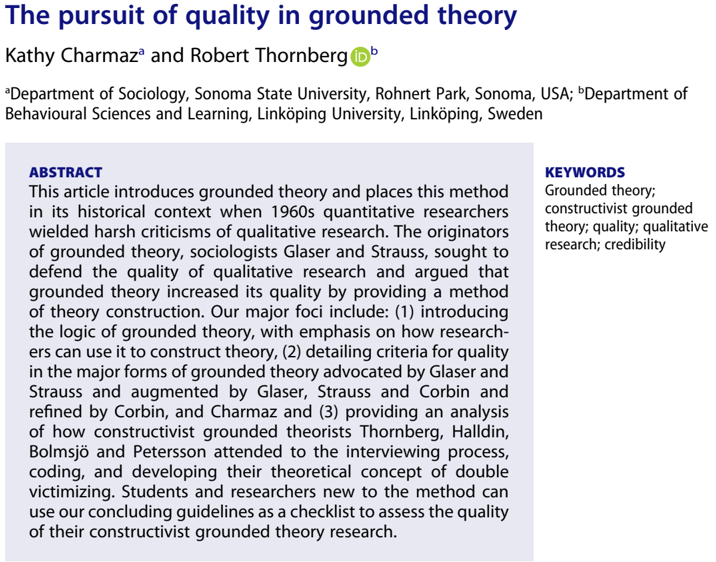
The pursuit of quality in grounded theory
Open accessThe DOI matches its Crossref record; 84 of the 85 references it cites were found in a registry or an index, and 1 are not checked yet; 2 of the 63 sources its claims cite were checked for support.
Abstract
This article introduces grounded theory and places this method in its historical context when 1960s quantitative researchers wielded harsh criticisms of qualitative research. The originators of grounded theory, sociologists Glaser and Strauss, sought to defend the quality of qualitative research and argued that grounded theory increased its quality by providing a method of theory construction. Our major foci include: (1) introducing the logic of grounded theory, with emphasis on how researchers can use it to construct theory, (2) detailing criteria for quality in the major forms of grounded theory advocated by Glaser and Strauss and augmented by Glaser, Strauss and Corbin and refined by Corbin, and Charmaz and (3) providing an analysis of how constructivist grounded theorists Thornberg, Halldin, Bolmsjö and Petersson attended to the interviewing process, coding, and developing their theoretical concept of double victimizing. Students and researchers new to the method can use our concluding guidelines as a checklist to assess the quality of their constructivist grounded theory research.
Verified 2026-11-22 · 1 reference not checked yet
Overview
CoChat Summary
TL;DR
This article reviews grounded theory’s historical development and argues that quality criteria must fit the specific version of grounded theory, culminating in constructivist criteria and a checklist. It illustrates constructivist quality through Thornberg et al.’s (2013) study of school bullying and the concept of double victimizing.
Key findings
- Quality criteria differ across grounded theory versions: original Glaser and Strauss focused on credibility and applicability with fitness, understanding, generality, and control; Glaser added workability, relevance, fit, and modifiability; Strauss and Corbin emphasized data quality, plausibility/value of theory, adequacy of process, and empirical grounding; constructivist Charmaz proposes credibility, originality, resonance, and usefulness.
- The paper argues quality is built through iterative data collection and analysis, line-by-line and focused coding, memo-writing, theoretical sampling and saturation, constant comparison, and reflexivity/methodological self-consciousness.
- In the illustrative constructivist study, Thornberg et al. (2013) distributed 523 open-ended questionnaires to students in three secondary schools and two universities in Sweden; of 511 responses, 168 reported past bullying, 36 volunteered, and 21 who had been bullied for more than one year were interviewed; analysis produced the core category “double victimizing” (external and internal victimizing).
- In psychology, Rubin, Bell, and McCleland (2018) found only 13% of responding graduate psychology programs required a qualitative research course, and respondents described qualitative research as “inaccurate,” “subjective,” and “lacking rigor” while also describing it as providing the “best methods for feminist, community-based, and social justice research.”
Methods
- Design: methodological/conceptual article introducing grounded theory, comparing quality criteria across Glaserian, Straussian, and constructivist versions, and offering guidelines/checklist for constructivist grounded theory.
- Data or sample: no primary empirical sample for the article; it analyzes historical and methodological literature and uses Thornberg et al. (2013) as an illustrative constructivist grounded theory study (523 questionnaires; 511 responses; 168 bullied; 36 volunteers; 21 interviewed).
- Main analysis: narrative synthesis and comparison of quality criteria, with an illustration of coding, constant comparison, memo-writing, theoretical sampling, and category development leading to “double victimizing.”
Limitations
- Stated: the authors caution that checklists risk becoming a “methodological crutch” that avoids deep engagement with method and data (citing Barbour 2001), and present their guidelines as flexible, not substitutes for rigorous research.
- Stated: criteria for quality in qualitative research remain unsettled, with “little consensus” about appropriate evaluation criteria, and meanings of quality markers may differ among researchers.
- Evident from the text: the article is not an empirical validation of the checklist; the double victimizing case is a secondary illustration rather than a new test, and the guidelines are aimed mainly at constructivist grounded theory though claimed mostly applicable to other versions.
Model-written summary. Check it against the paper before relying on it.
Integrity signals
Registry
Cites
Statistics
Figures



Verification
Claims the paper makes
2 Valid · 13 Not valid · 38 Not checked · 38 Own results and interpretations
None of the sources cited for this claim have been checked yet.
In the paper
“Concerns about objectivity, validity, reliability and replicability in qualitative research still pervade academic psychology.”
§ The pursuit of quality in grounded theory > Qualitative research and psychology
plain- Asserted: passes — The authors put it forward as true.
- Checkable: passes — It can be checked against evidence.
- Load-bearing: passes — The paper’s conclusions depend on it.
- Based: passes — The paper gives a reason why it holds.
In the paper
“Until Glaser and Strauss's (1967) statement, little had been written, much less codified into a systematic statement, about how to construct a qualitative theoretical analysis of high quality.”
§ The pursuit of quality in grounded theory > Concerns about quality in the development of grounded theory
What the sources say
- Not matchedcites Glaser and Strauss's (1967)
An author–year citation the paper’s reference list doesn’t settle. We don’t search these by name.
plain- Asserted: passes — The authors put it forward as true.
- Checkable: passes — It can be checked against evidence.
- Load-bearing: unclear — It is unclear whether the paper’s conclusions depend on it.
- Based: passes — The paper gives a reason why it holds.
- Not matched
A statement the paper makes itself — it cites no source for it, so there is none to check. The quote shows it is in the paper.
In the paper
“If, however, researchers only ask the same questions of each participant, they are likely to elicit similar stories about the topic.”
§ The pursuit of quality in grounded theory > Introduction
hedgedstates a possible cause- Asserted: passes — The authors put it forward as true.
- Checkable: passes — It can be checked against evidence.
- Load-bearing: passes — The paper’s conclusions depend on it.
- Based: passes — The paper gives a reason why it holds.
A statement the paper makes itself — it cites no source for it, so there is none to check. The quote shows it is in the paper.
In the paper
“If, however, researchers systematically interrogate their data as they gather it, their early ideas can then inform subsequent data collection.”
§ The pursuit of quality in grounded theory > Introduction
plainstates a possible cause- Asserted: passes — The authors put it forward as true.
- Checkable: passes — It can be checked against evidence.
- Load-bearing: passes — The paper’s conclusions depend on it.
- Based: passes — The paper gives a reason why it holds.
A statement the paper makes itself — it cites no source for it, so there is none to check. The quote shows it is in the paper.
In the paper
“When answering quantitative social scientists' sharp criticisms of its quality, Glaser and Strauss rejected the common practice of evaluating qualitative research according to the tenets of the quantitative tradition.”
§ The pursuit of quality in grounded theory > Concerns about quality in the development of grounded theory
plain- Asserted: passes — The authors put it forward as true.
- Checkable: passes — It can be checked against evidence.
- Load-bearing: unclear — It is unclear whether the paper’s conclusions depend on it.
- Based: passes — The paper gives a reason why it holds.
22 more claims
Create a free account to see all 91 claims and to verify the 7 references still open.
- Probably not a substantial claim. 61
- It may state two separate claims as one. 26
Claims other papers make about this one
Each is checked against this paper’s own text: does it say what the citing paper says it does?
The source backs part of the claim, not all of it — or backs it for a different population, condition or comparison.
In the citing paper
“An explicitly constructivist approach aims to produce an abstract understanding of a phenomenon (rather than an explanation, as in other versions of GTM)”
From Quality Criteria: General and Specific Guidelines for Qualitative Approaches in Psychology Research. A Concise Guide for Novice Researchers and Reviewers (2024) · cites this paper as Charmaz & Thornberg, 2021
Experimental — accuracy not yet measuredThe source backs part of the claim, not all of it — or backs it for a different population, condition or comparison.
In the citing paper
“Constant comparison is a systematic strategy combining the advantages of simultaneous data generation and analysis, enabling a concentration on significant issues (Charmaz and Thornberg, 2021).”
From Application and challenges of using a Constructivist Grounded Theory methodology to address an undertheorized clinical challenge: A discussion paper (2024) · cites this paper as Charmaz and Thornberg, 2021
Experimental — accuracy not yet measuredThe cited source says what the claim attributes to it.
In the citing paper
“focuses on actions, meanings and constructions”
From Quality Criteria: General and Specific Guidelines for Qualitative Approaches in Psychology Research. A Concise Guide for Novice Researchers and Reviewers (2024) · cites this paper as Charmaz & Thornberg, 2021
The cited source says what the claim attributes to it.
In the citing paper
“and acknowledges both subjectivity (of participants and researchers) and context (Charmaz, 2014; Charmaz & Thornberg, 2021).”
From Quality Criteria: General and Specific Guidelines for Qualitative Approaches in Psychology Research. A Concise Guide for Novice Researchers and Reviewers (2024) · cites this paper as Charmaz & Thornberg, 2021
The cited source says what the claim attributes to it.
In the citing paper
“The primary focus is the theory ' s ability to clarify participants ' lives and contribute to knowledge and practice (Charmaz & Thornberg, 2021).”
From Quality Criteria: General and Specific Guidelines for Qualitative Approaches in Psychology Research. A Concise Guide for Novice Researchers and Reviewers (2024) · cites this paper as Charmaz & Thornberg, 2021
6 more claims about this paper
Create a free account to see every claim other papers make about this one.
Citations
Cites
Using thematic analysis in psychology
Braun, V., & Clarke, V. (2006) · Qualitative Research in Psychology · doi:10.1191/1478088706qp063oa · Cited by 194,414
The Discovery of Grounded Theory: Strategies for Qualitative Research.
Wagner, H. R., Glaser, B. G., & Strauss, A. L. (1968) · Social Forces · doi:10.2307/2575405 · Cited by 46,361
The Discovery of Grounded Theory; Strategies for Qualitative Research
Glaser, B. G., Strauss, A. L., & Strutzel, E. (1968) · Nursing Research · doi:10.1097/00006199-196807000-00014 · Cited by 39,449
Basics of Qualitative Research: Grounded Theory Procedures and Techniques.
Ellis, C., Strauss, A., & Corbin, J. (1992) · Contemporary Sociology · doi:10.2307/2074814 · Cited by 29,249
Basics of Qualitative Research (3rd ed.): Techniques and Procedures for Developing Grounded Theory
Corbin, J., & Strauss, A. (2008) · SAGE · doi:10.4135/9781452230153 · Cited by 24,827
(2006) · Cited by 18,730
Self-citationBasics of Qualitative Research
Ozanne, J. L., Strauss, A., & Corbin, J. (1992) · Journal of Marketing Research · doi:10.2307/3172751 · Cited by 17,850 · cited 2×
“In their development of grounded theory, Strauss and Corbin (1990; Corbin and Strauss 1990; Strauss and Corbin 1998) emphasized four general criteria: (1) quality of the data, in other words, grounded theorists need to carefully address and adopt quality criteria related to methods used for data…”
BackgroundMethodBasics of Qualitative Research: Grounded Theory Procedures and Techniques
Long, D. R., Strauss, A., & Corbin, J. (1993) · The Modern Language Journal · doi:10.2307/328955 · Cited by 17,576
(2014) · Cited by 15,747
Self-citationInterviewing as qualitative research a guide for researchers in education and the social sciences
Seidman, I. (2006) · Cited by 12,757
Research works printed but not linked: 5
- 10. Charmaz, K. 1995. Between positivism and postmodernism: implications for methods. In Studies in symbolic interaction, vol. 17, N. K. Denzin (Ed.), pp. 43-72. Greenwich, CT: JAI Press.
- 17. Cisneros-Puebla, C. A. 2007. The deconstructive and reconstructive faces of social construc- tion: Kenneth Gergen in conversation with César A. Cisneros-Puebla. With an introduction by Robert B. Faux [83 paragraphs]. Forum Qualitative Sozialforschung/Forum: Qualitative Social Research 9 (1):Art. 20. http://nbn-resolving.de/urn:nbn:de:0114-fqs0801204 .
- 26. Glaser, B. G. 1978. Theoretical sensitivity. Mill Valley, CA: Sociology Press.
- 27. Glaser, B. G. 1992. Basics of grounded theory analysis. Mill Valley, CA: Sociology Press.
- 30. Glaser, B. G. 2013. No preconceptions: The grounded theory dictum. Mill Valley, CA: Sociology Press.
Cited by
Items 701–800 of 1,191
Caring About Value: A grounded theory of the quest to move towards higher value care in hospitals
Tyack, Z. F., Allen, M. J., Scott, I. A., Campbell, K. L., Kimble, R. M., Chang, A. B., & McPhail, S. (2025) · SSM - Qualitative Research in Health · doi:10.1016/j.ssmqr.2025.100653 · Cited by 3
Panorama do mercado de jogos eletrônicos: um estudo de caso de vagas de emprego
de Moraes, E. L., Albuquerque, M., do Carmo, F. A., et al. (2024) · doi:10.5753/sbgames.2024.241205 · Cited by 1
Strategic Planning by State Chief Information Officers
Na, S., & Russ-Eft, D. F. (2025) · Advances in human resources management and organizational development book series · doi:10.4018/979-8-3693-3791-2.ch004 · Cited by 1
Ayaya, O. (2024) · Journal of Management and Business Education · doi:10.35564/jmbe.2024.0029 · Cited by 1
Move Analysis of Sri Lankan Legal Letters of Demand for Teaching English for Specific Purposes (ESP)
Kothalawala, C., Kothalawala, T., & Pereira, S. S. (2023) · OUSL Journal · doi:10.4038/ouslj.v18i1.7583 · Cited by 1
Borda, R. M., Pineda, S. I., Vega, A. G., & Lara, I. B. (2024) · European Public & Social Innovation Review · doi:10.31637/epsir-2024-1638 · Cited by 2
Beddard, M., Baker, J., Jones, N., Withers, K. L., Morris, R., & Torkington, J. (2025) · BMJ Open · doi:10.1136/bmjopen-2024-088074 · Cited by 4
Navigating a maze: Midwives’ identity response to the enactment of an abortion law in Chile
Carvajal, B., White, H., Brooks, J., Thomson, A. M., & Cooke, A. (2024) · Midwifery · doi:10.1016/j.midw.2024.103938 · Cited by 2
Danko, L., Haubrich, G. F., & Belvončíková, E. (2022) · Netcom · doi:10.4000/netcom.6899 · Cited by 1
Mansoor, T., Puteh, S. E. W., Aizuddin, A. N., et al. (2024) · Cureus · doi:10.7759/cureus.59383 · Cited by 1
“The sample size depended on data saturation, which was attained on the 10th participant, as the collected data revealed no new findings [19].”
BackgroundValencia-Contrera, M., Avilés, L., & Febré, N. (2025) · Healthcare · doi:10.3390/healthcare13172134 · Cited by 2
“Furthermore, the development of this study adhered to the 13 rigor criteria for constructivist grounded theory (CGT) proposed by Charmaz & Thornberg [70].”
Damon, H., & Ayling, R. (2025) · Qualitative Research · doi:10.1177/14687941251390799 · Cited by 1
IJARAH ASSET CONTRACT: A PRODUCT INNOVATION FOR ISLAMIC MICROFINANCE
Khasanah, U., Wicaksono, A. T. S., & Rahmawati, A. (2025) · Jurnal Ekonomi dan Bisnis Islam (Journal of Islamic Economics and Business) · doi:10.20473/jebis.v11i1.68167 · Cited by 5
Makuyana, T., & du Plessis, E. (2023) · Schriftenreihe des Deutschen Instituts für Tourismusforschung · doi:10.37307/b.978-3-503-21195-1.09 · Cited by 1
Daněk, A. (2025) · Problems of Education in the 21st Century · doi:10.33225/pec/25.83.645 · Cited by 2
Kamaludin, M. F., Xavier, J. A., Selvachandran, G., & Quek, S. G. (2026) · Journal of Social Entrepreneurship · doi:10.1080/19420676.2026.2619098 · Cited by 2
Debono, D., Aquilina, R., & Brincat, J. P. (2024) · Preprints.org · doi:10.20944/preprints202405.0861.v1 · Cited by 1
Paunović, I., Apostolopoulos, S., Αποστολόπουλος, Ν., Newbery, R., Miljković, I. B., Maniatopoulos, G., & King, M. (2026) · Small Business Economics · doi:10.1007/s11187-026-01187-7 · Cited by 1
“Both stages were conducted by following the procedure laid out by Noble and Mitchell (2016) and expanded with further notion from Charmaz and Thornberg (2021) Eight rounds of discussion and iteration were conducted with seven researchers in four different international rural contexts.”
Henderson, H., Shipway, R., & Jones, I. (2025) · Qualitative Inquiry · doi:10.1177/10778004251401846 · Cited by 4
Conceptualizing the Impacts of Racism on Racialized Midwives in Ontario: An Alert to the Profession
Ramlogan‐Salanga, C., Lee, V., Munroe, M., Cates, E. C., MacKenzie, R. K., Wilson‐Mitchell, K., & Darling, E. K. (2025) · Journal of Midwifery & Women s Health · doi:10.1111/jmwh.13773 · Cited by 2
“27 This led to a recognition that this study has a close relationship to our diverse research teams’ lived experiences both as people who The research suggests that there are some strategies that might be helpful in improving mental health and well-being for health care workers.”
InfluentialYata, A., Ohta, R., & Iwashita, Y. (2026) · Cureus · doi:10.7759/cureus.103944 · Cited by 1
“This study employed a constructivist grounded theory approach, as articulated by Charmaz and Thornberg, to explore how collaboration between CNs and local businesses redefines and implements regional sustainability and revitalization in Japan [15].”
Necesidades y propuestas para la intervención con menores y violencia de género desde la educación
Soto, A. E. H. (2023) · Qualitative Research in Education · doi:10.17583/qre.11603 · Cited by 1
Amick, E. E., Yebei, V. N., Bucher, S., & Henry, B. W. (2023) · JMIR Research Protocols · doi:10.2196/41836 · Cited by 1
“This approach is ideal for studies, such as this one, exploring under-researched areas of inquiry such as local perspectives on GHEs in Kenya [56].”
BackgroundChen, H., Jia, H., & Liu, L. (2025) · npj Heritage Science · doi:10.1038/s40494-025-02010-4 · Cited by 6
Curated eLearning in South Africa: A user burgeoning perspective
Goosen, W. (2023) · American Journal of Online and Distance Learning · doi:10.47672/ajodl.1477 · Cited by 1
Harmonising Theory: Integrating Singing With Grounded Theory Methods
Densley, B., Dickson‐Swift, V., & Mills, J. E. (2025) · International Journal of Qualitative Methods · doi:10.1177/16094069241312042 · Cited by 3
“These aspects of the workshop demonstrated design resonance which is a quality measure in qualitative research (Charmaz & Thornberg, 2021).”
Essential Entities and Relationships for Keeping Smart Libraries Up-To-Date: The Role of Librarians
Ketheeswaren, S. (2024) · Technical Services Quarterly · doi:10.1080/07317131.2024.2319969 · Cited by 1
“Furthermore, with respect to the literature on research techniques, Charmaz and Thornberg (2021) have indicated that the grounded theory approach involves the review of data in order to develop models.”
ResultPinder, M., Denniston, C., & Carr, S. (2025) · Anaesthesia and Intensive Care · doi:10.1177/0310057x251382957 · Cited by 1
“The interview was a dynamic process, in keeping with GTM, 26,28–30 and the questions were refined as the study progressed, based on data derived from earlier interviews.”
Foulger, T. S., King, A., & González-Doğan, S. (2025) · International Journal for the Scholarship of Teaching and Learning · doi:10.20429/ijsotl.2025.190103 · Cited by 1
Li, J., & Zhang, X. (2026) · International Journal of Educational Management · doi:10.1108/ijem-05-2024-0251 · Cited by 2
Eco-anxiety in the times of climate crisis: a grounded theory inquiry
Aston, N., Tribe, R., Narvaez, J. C. D. M., & Moura, H. F. (2026) · Geopsychiatry · doi:10.1016/j.geopsy.2026.100051 · Cited by 3
Wang, Y., Zheng, C., & Wang, L. (2026) · Frontiers in Public Health · doi:10.3389/fpubh.2025.1713532 · Cited by 2
“According to the constructivist approach advocated by Charmaz and Thornberg (46), this study operationalized the process through theoretical sampling and continuous analytical questioning, exemplified by inquiries such as “Which main categories exert the most influential role in triggering accidents?” and “In what way…”
Cammarota, A., AVALLONE, F., Marino, V., & Resciniti, R. (2024) · The International Journal of Management Education · doi:10.1016/j.ijme.2024.101014 · Cited by 4
Married women's response to spousal pornography use: A grounded theory
Crawford, M. D., Butler, M. H., Marks, L. D., & Leavitt, C. E. (2023) · Journal of Marital and Family Therapy · doi:10.1111/jmft.12672 · Cited by 6
How arts-based adult community learning transforms community well-being: from isolation to belonging
Cairns, A. (2024) · Journal of Vocational Education and Training · doi:10.1080/13636820.2024.2393111 · Cited by 2
“In focus coding, recurring patterns were identified allowing for ‘tentative analytic cate-gories’ to be generated (K. Charmaz and Thornberg 2021, 3), including those pertaining to the ACL classroom, ACL learners, and transformation.”
Tooth, C., Fischer, L., Leclerc, S., Douryang, M., Aminake, G. N., Delvaux, F. H., Seil, R., Hannouche, D., Martens, G., Verhagen, E. A. L. M., et al. (2026) · Journal of science and medicine in sport · doi:10.1016/j.jsams.2026.03.010 · Cited by 2
Deshmukh, M., & Sharma, D. (2026) · Qualitative Research in Psychology · doi:10.1080/14780887.2026.2613430 · Cited by 1
Simamora, R. E., & Kamara, J. G. (2023) · JNPM (Jurnal Nasional Pendidikan Matematika) · doi:10.33603/jnpm.v7i1.7689 · Cited by 1
Design of the Nursing Products and System in Infection Ward in Post-epidemic Era
Qiao, R., Niu, S., Yang, Y., Wu, Y., Zhang, S., & Chen, Y. (2025) · Lecture notes in computer science · doi:10.1007/978-3-031-93227-4_24 · Cited by 2
Barr, S., & Oliver, W. (2023) · Journal of Dance Education · doi:10.1080/15290824.2023.2221241 · Cited by 1
“Rather than attempting to prove a particular idea, this methodology emerges through a means “of thinking about, constructing, and interacting with data throughout the research process” (Charmaz and Thornberg 2021, 305).”
Fighting back, moving forward: Refugee women's agency in stories of resistance and resiliencePreprint
Borges, G. M. (2024) · Research Square · doi:10.21203/rs.3.rs-3835058/v1 · Cited by 1
Dearn, E., D’Cruz, K., Brown, M. G., Douglas, J. M., & Winkler, D. (2025) · Australian Journal of Social Issues · doi:10.1002/ajs4.70061 · Cited by 1
Reconstruction at the meso level: Rebuilding everyday life in post‐conflict Malakand, Pakistan
Ali, S. R., Sanaullah, Ahmad, N., et al. (2025) · Peace & Change · doi:10.1111/pech.12726 · Cited by 1
“In line with the grounded theory approach (Charmaz & Thornberg, 2021; Glaser & Anselm, 1967), the data collection and analysis process was iterative, continuing until the researchers felt saturation was reached.”
Mohamad, S., Hamedani, S. S., Yunos, A. B. M., Wahid, M. N. B. A., & Hamdan, M. D. B. M. (2026) · Multidisciplinary Science Journal · doi:10.31893/multiscience.2026484 · Cited by 1
“This study uses Grounded Theory as a method to allow insights to come out of the participants lived experiences instead of just using predetermined assumptions (Charmaz & Thornberg, 2021).”
Social Constructivist Meta-Ethnography
(2023) · doi:10.20944/preprints202306.1380.v1 · Cited by 1
Qualitative Methodology Selection: Key Considerations for Dissertation Scholars
Asrifan, A., Pratiwi, W. R., Bahri, A., Jabu, B., Rossydi, A., & Mulyadi, M. (2024) · Advances in library and information science (ALIS) book series · doi:10.4018/979-8-3693-3069-2.ch002 · Cited by 2
Hu, W., Zhang, L., Wang, Y., & Wu, J. (2025) · Journal of theoretical and applied electronic commerce research · doi:10.3390/jtaer20020128 · Cited by 7
La lectura digital y sus conceptos: una propuesta analítica desde la Teoría Fundamentada
López-Andrada, C. (2022) · Tarbiya: Revista de investigación e innovación educativa · doi:10.15366/tarbiya2022.50.006 · Cited by 2
Bravington, A., Johnson, M. J., & Macleod, U. (2024) · Qualitative Health Research · doi:10.1177/10497323231219389 · Cited by 2
“Charmaz and Thornberg (2021) have identi fi ed credibility, originality, and resonance as key elements of rigour in grounded theory studies.”
BackgroundHeinzel, V., Georgiades, S., Engstler, M., & Randecker, L. (2025) · Springer eBooks · doi:10.1007/978-3-031-76902-3_11 · Cited by 1
The alchemy of ACME: turning ‘land rent’ into art in the London real estate market
Lithgow, M., & Wall, K. (2026) · International Journal of Cultural Policy · doi:10.1080/10286632.2025.2608325 · Cited by 1
Feng, Y., & Chen, H. (2025) · Qualitative Market Research An International Journal · doi:10.1108/qmr-10-2024-0213 · Cited by 5
Haldane, V. E., Perera, N., Ratnapalan, S., Samaraweera, S., & Wei, X. (2025) · Infection Disease & Health · doi:10.1016/j.idh.2025.03.003 · Cited by 1
Luces Verdes, Amarillas y Rojas al Innovar la Enseñanza de las Ciencias
Furman, M., & Luzuriaga, M. (2024) · Revista Internacional de Educación para la Justicia Social · doi:10.15366/riejs2022.13.1.002 · Cited by 1
“Se realizó un análisis temático del contenido de las reflexiones escritas, utilizando el enfoque de teoría fundamentada (Charmaz y Thornberg, 2021).”
BackgroundThe Impact of Backlash on Reform Prosecutors
Davis, J. M., & Taylor, W. K. (2026) · Journal of Law and Courts · doi:10.1017/jlc.2026.10018 · Cited by 1
Stoner, M. C. D., Sukhija-Cohen, A. C., Castellanos-Usigli, A., Katz, A. W. K., Cestero, A. R., Granados, Y., Robinson, A. C., & Maragh‐Bass, A. C. (2026) · AIDS Care · doi:10.1080/09540121.2025.2609899 · Cited by 1
“Using constant comparison and grounded theory, coding is exploring ways in which care retention could be strengthened by sexual pleasure–based counseling and diversifying PrEP formulations to better meet client needs (Charmaz & Thornberg, 2021; Mathieson et al., 2024; Mortelmans, 2025).”
InfluentialNum, K. S. F., Aizuddin, A. N., Hashim, S. M., & Said, M. S. M. (2025) · PLoS ONE · doi:10.1371/journal.pone.0335192 · Cited by 1
“Analytical memos were documented throughout this stage to capture emerging patterns that were aligned with research objectives [47,48].”
Exploring institutional dynamics in a multi-level analysis in Southeast Europe
Lehmann, T. (2024) · Post-Communist Economies · doi:10.1080/14631377.2024.2378622 · Cited by 5
“Our efforts to ensure credibility (Charmaz & Thornberg, 2020) include multiple reflection rounds with co-workers and colleagues during international conferences, as well as a comprehensive review phase within the coding process.”
Montesi, M. (2023) · Ibersid revista de sistemas de información y documentación · doi:10.54886/ibersid.v17i1.4847 · Cited by 1
Fake news, real needs: A qualitative study on Sino-Japanese theurgy fighting
Gao, Q., & Fu, Q. (2025) · Heliyon · doi:10.1016/j.heliyon.2025.e42255 · Cited by 2
“Through inductive thinking, we related coding categories and attributes [41,43].”
Rong, B., Conlon, C., & Gilligan, R. (2026) · Population Space and Place · doi:10.1002/psp.70216 · Cited by 4
Dual edge: exploring technological affordances and constraints of video technology in e-leadership
Koponen, J. P., Salin, L., & Cortellazzo, L. (2026) · Information Technology and People · doi:10.1108/itp-09-2024-1157 · Cited by 5
Azad, G., Eisler, L., Taormina, I., & Herrera, V. L. M. (2025) · Journal of Research in Childhood Education · doi:10.1080/02568543.2025.2456613 · Cited by 2
“Our data analyses approach has been used in the literature to explicate and understand processes (in our case, the process of transitioning to school for children on the AS) (Charmaz & Thornberg, 2021).”
InfluentialAgeing and late-life: an analysis of the barriers and resources experienced by colombian trans women
Reyes, M. F., Derrer‐Merk, E., Barrero, S., Colonia-Vélez, M., Jimenez, J. D., Leal, L., Patiño, J. P. M., & Bennett, K. M. (2025) · Ageing and Society · doi:10.1017/s0144686x25100196 · Cited by 3
“We chose CGT as a method to explore an under-researched area in Colombia, aligning with Charmaz and Thornberg (2021, p. 306), who noted that ‘many researchers use this method for a variety of worthy purposes instead of or in conjunction with theory construction, as the exploration of a new area of…”
Technology-facilitated violence against child welfare workers: A qualitative analysis
Regehr, C., Mishna, F., Billard, D., Fallon, B., Schiffer, J., & Lefebvre, R. (2025) · Child Protection and Practice · doi:10.1016/j.chipro.2025.100241 · Cited by 3
Marvin, A. F., & Buckingham, S. L. (2024) · Journal of Prevention & Intervention in the Community · doi:10.1080/10852352.2024.2332124 · Cited by 1
“The use of a grounded theory approach (Charmaz & Thornberg, 2020) would be fitting to use to identify more TP elements, examining any differences between housing status (e.g., homeless, housing first, privately housed, shelters) and by recovery strategy (e.g., abstinence, harm-reduction, natural…”
MethodSocioeconomic Arguments in the Discourse on Girl-Child Right to Education in Nigeria
Diriwari, W. (2022) · International Journal of Social Science Studies · doi:10.11114/ijsss.v10i2.5464
Guthová, T., Guth, K., & Kokaisl, P. (2026) · Nationalities Papers · doi:10.1017/nps.2026.10177
Perspectives of community-based peer recovery specialists: systems integration and challenges
Atwood, K. A., Ali, B., Sangpukdee, A., Andrews, E. E., Park, A., Appel, A., Albrecht, W., & Beyene, H. (2025) · Journal of Social Work Practice in the Addictions · doi:10.1080/1533256x.2025.2475030
“Grounded Theory guided the qualitative analysis allowing us to explore peer experiences without reliance on a predefined theory (Charmaz & Thornberg, 2020; Chun Tie et al., 2019; Mills et al., 2014).”
Sahu, A., Kler, S. S., & Siglar, F. M. (2026) · The Counseling Psychologist · doi:10.1177/00110000261429059 · Cited by 1
“Consistent with the application of CGT, we practiced ongoing re fl exivity in critically examining our perspectives and collective experiences shaping the co-construction of knowledge (Charmaz & Thornberg, 2021).”
InfluentialCarreira, C., Ramos, A., Mateus, M. J., Pinto, P., Ali, A. M., Fekih‐Romdhane, F., Yıldırım, S., Yıldırım, M., & Laranjeira, C. (2026) · Healthcare · doi:10.3390/healthcare14152312 · Cited by 2
“Finally, usefulness concerns the analytical and practical value of the theory [41].”
InfluentialMondal, S., & Samaddar, K. (2025) · Facilities · doi:10.1108/f-03-2025-0047 · Cited by 1
Kaonga, O., Haabazoka, L., & Chilolo, B. (2025) · Finance Accounting and Business Analysis · doi:10.37075/faba.2025.2.01
الصراع فی المجتمع الأكادیمی رؤیة سوسیوأخلاقیة باستخدام منهجیة النظریة المجذرة (جامعة الفیوم نموذجا)
عبدالله, س. ع., & عويس, و. ع. (2022) · مجلة جامعة الفيوم للعلوم التربوية والنفسية · doi:10.21608/jfust.2022.292609
School-Based Behavior Analysts: A Grounded Theory Study on How They See Their Roles
Layden, S. J., Lorio-Barsten, D. K., Holthaus, L. M., Hollins, N. A., Rhodes, L., Austin, K., & Berlin, K. L. (2026) · Journal of Positive Behavior Interventions · doi:10.1177/10983007251389273 · Cited by 1
“Thus, the researchers’ analytic focus emerges during the research process, allowing them to focus on the most significant issues in the field of study (Charmaz & Thornberg, 2021).”
Singh, S. R., & Haas, S. M. (2026) · LGBTQ+ Family An Interdisciplinary Journal · doi:10.1080/27703371.2026.2695608
Sharing the load: Can we minimize the need to self-advocate for hearing loss consideration?
Wallhagen, M. I., & Smith, A. K. (2026) · Geriatric Nursing · doi:10.1016/j.gerinurse.2026.104083
IS SUSTAINABLE COMPETITIVE ADVANTAGE ANTEDILUVIAN?
Kriel, V., & Goldman, G. A. (2024) · Eastern European Journal for Regional Studies · doi:10.53486/2537-6179.10-1.04 · Cited by 1
Honra, J. R., Dizon-Yi, J. B., Maulion, R. J., Cruz, M. K. D., Ollero, J. C., & VILLANUEVA, J. C. P. (2026) · International Conference on e-Education, e-Business, e-Management and e-Learning · doi:10.1109/ic4e69618.2026.11631366
“This study followed a grounded theory approach to develop an emergent explanatory framework on AI-proof assessment based on rich, triangulated qualitative data [9].”
Chonzi, A. R., Ashmore, R., & Smith, S. K. (2026) · Nurse Researcher · doi:10.7748/nr.2026.e2015
Hermans, T., Mubita, T., Roux-Pullen, L. L., van der Sluis, M., Klostermann, J. E. M., Conijn, J. G., Wang, Y., Kruft, K., Bockline, B., Kigiri, D., et al. (2026) · Society & Natural Resources · doi:10.1080/08941920.2026.2724508
Fra rollen som miljøterapeut til rollen som forsker: Fra deltaker til tilskuer?
Karlstad, J. L. (2024) · Tidsskrift for psykisk helsearbeid · doi:10.18261/tph.21.3.3
Ideation by mouse click – human creativity and generative artificial intelligence
Quiel, J., Mix, K. A., Salmony, F. U., Kanbach, D. K., & Kraus, S. (2026) · European Journal of Innovation Management · doi:10.1108/ejim-01-2026-0019 · Cited by 3
Ahmadi, M., Kocatürk, T., Piadeh, F., Hasan, A., & Hosseini, M. R. (2026) · Engineering Construction & Architectural Management · doi:10.1108/ecam-05-2025-0742 · Cited by 3
“…is adopted as the methodological approach for this study because it enables the identification of patterns and conceptual categories that emerge inductively from empirical data, particularly in research areas where existing theoretical explanations remain limited (Charmaz and Thornberg, 2021).”
The Socio-educational Theory of the “Invisible Hand”
Lisauskienė, D., & Aleksienė, V. (2023) · SOCIAL WELFARE INTERDISCIPLINARY APPROACH · doi:10.15388/sw.2023.13.11
Help-Seeking for Suicidality Among Rural LGBTQ+ Youth: A Constructivist Grounded Theory Study
Ouellet, S., Kia, H., Oliffe, J. L., & Ferlatte, O. (2026) · Qualitative Health Research · doi:10.1177/10497323261470619
Gallo, A. M., Araújo, J. P., Baccon, W. C., Marques, F. R. D. M., Salci, M. A., & Carreira, L. (2024) · Revista Latino-Americana de Enfermagem · doi:10.1590/1518-8345.7252.4382 · Cited by 1
Breathing the Asylum System: Gendering Portugal's Reception Conditions and Integration Practices
Borges, G. M. (2024) · Advances in information security, privacy, and ethics book series · doi:10.4018/979-8-3693-5436-0.ch004
Conard, M. A. (2026) · Acta Psychologica · doi:10.1016/j.actpsy.2026.107751
Journeying and everydayness as a framework for literacy research and teaching practice
Boateng, S., Jin, C., Karki, J., Lee, R., Ojha, L. P., Sugiarto, T., & Watson, V. W. M. (2025) · English Teaching Practice & Critique · doi:10.1108/etpc-10-2024-0167
Ofori-Boadu, A. N., Akanmu, A., Yusuf, A. O., Clayton, C., Vigilance, K., & Murzi, H. (2026) · ASEE Annual Conference & Exposition · doi:10.18260/1-2--59762
ANÁLISE COMPARATIVA DA QUALIDADE DE VIDA ENTRE INDIVÍDUOS CADEIRANTES ATIVOS E SEDENTÁRIOS
CONCEIÇÃO, D. R. P., MACHADO, F. A. R., CAMARGOS, M. F., CRUZ, R. K. A., Rodrigues, R. A., & GOMES, D. S. (2023) · Editora Terried eBooks · doi:10.48209/978-65-84959-17-7
White, B., & Bourjolly, J. N. (2025) · Journal of Religion & Spirituality in Social Work Social Thought · doi:10.1080/15426432.2025.2537670
“The study utilizes a grounded theory approach, which is most widely used in qualitative research (Charmaz & Thornberg, 2021;).”
Fraser, B., Chisholm, E., & Pierse, N. (2025) · International Journal of Qualitative Methods · doi:10.1177/16094069251337871 · Cited by 3
“Charmaz and Thornberg (2021) argue against the mechanistic application of a speci fi c procedure in grounded theory studies.”
Thorp, M. (2026) · Armed Forces & Society · doi:10.1177/0095327x251415373
Metadata
- Authors
- Charmaz, K., & Thornberg, R.
- Affiliations
- Sonoma State University (US)
- Linköping University (SE)
- Corresponding author
- Thornberg, Robert
- Venue
- Qualitative Research in Psychology
- Publisher
- Informa UK Limited
- Published
- 2020-06-22
- Volume
- 18
- Issue
- 3
- Pages
- 305-327
- ISSN
- 1478-0887 (ISSN-L)
- 1478-0895
- OpenAlex
- W3036803033
- Cited by
- 1,221
- References
- 81
- Citations by year
- 2026: 264 · 2025: 290 · 2024: 255 · 2023: 221 · 2022: 128 · 2021: 54 · 2020: 8
- FWCI
- 155.56
- Type
- journal article
- Language
- en
- Open access
- hybrid
- doi.org
- Licence
- Locations
- Qualitative Research in Psychology (publishedVersion, cc-by-nc-nd)
- Topics
- Social Sciences › Education › Qualitative Research Methods and Applications
- Social Sciences › Sociology and Political Science › Qualitative Research Methods and Ethics
- Social Sciences › Sociology and Political Science › Sociology and Education Studies
- Keywords
- grounded theory, constructivist grounded theory, qualitative research quality, theory development, Glaser and Strauss, interviewing, coding, history of grounded theory
About these checks
Registry, retraction, Cites and statistics results are computed, not judged, with one exception: a printed reference that no index lists is read once by a model before it counts as a citation error. Claims are extracted by a model and kept only when their quote appears verbatim in the text; each cited source is then checked, with a model’s help, for whether it says what the claim relies on. Those verdicts can be wrong — read the claim’s quote and the cited source before relying on one.
The claim verdicts this report counts are experimental: their accuracy is not yet measured.
A language model drew the claims from the paper on 2026-09-28, under version 3 of the claim definition (model deepseek-v4.1-flash, prompt extract-v3).
A second model labelled each claim on 2026-09-28 (model jev-1.13-20260917, definition revision gold-guideline-v0.2).
Statistics and arithmetic are recomputed, not judged.
Confidence bands are shown only for fields calibrated on our annotated test set. None is calibrated yet, so no band is shown.
What counts as a claim ›How we measure confidence ›How we check this ›
Are you an author, or do you see a problem with this page? Request a review
Data sources
Bibliographic data: Semantic Scholar, OpenAlex, Crossref.
Contains information from the Semantic Scholar Academic Graph Datasets, made available under the ODC Attribution License (ODC-BY 1.0).
Semantic Scholar’s data is described in: Kinney, R., et al. (2023). The Semantic Scholar Open Data Platform. arXiv:2301.10140.
