

The DOI matches its Crossref record; 212 of the 214 references it cites were found in a registry or an index; 3 of the 126 sources its claims cite were checked for support.
Microbiome–microglia connections via the gut–brain axis
Open accessAbstract
Microglia, the resident immune cells in the brain, are essential for modulating neurogenesis, influencing synaptic remodeling, and regulating neuroinflammation by surveying the brain microenvironment. Microglial dysfunction has been implicated in the onset and progression of several neurodevelopmental and neurodegenerative diseases; however, the multitude of factors and signals influencing microglial activity have not been fully elucidated. Microglia not only respond to local signals within the brain but also receive input from the periphery, including the gastrointestinal (GI) tract. Recent preclinical findings suggest that the gut microbiome plays a pivotal role in regulating microglial maturation and function, and altered microbial community composition has been reported in neurological disorders with known microglial involvement in humans. Collectively, these findings suggest that bidirectional crosstalk between the gut and the brain may influence disease pathogenesis. Herein, we discuss recent studies showing a role for the gut microbiome in modulating microglial development and function in homeostatic and disease conditions and highlight possible future research to develop novel microbial treatments for disorders of the brain.
Overview
AI snapshot
Written from the paper’s full text.
TL;DR
This review synthesizes evidence that the gut microbiota influences microglial maturation, identity, and function through gut–brain axis pathways including the vagus nerve, systemic circulation, and microbial metabolites. It argues that dysbiosis may contribute to microglial dysfunction in neurodevelopmental and neurodegenerative disorders such as autism spectrum disorder (ASD) and Parkinson’s disease (PD).
Key findings
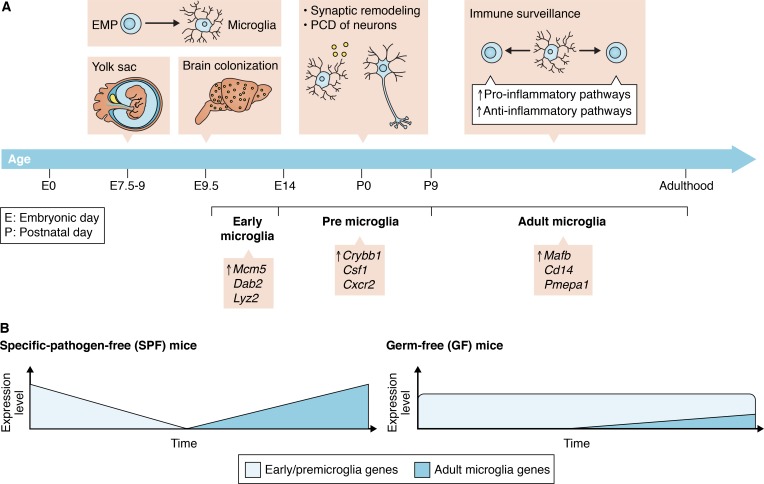
- Microglia make up ∼5–15% of total brain cells and mature stepwise from early to pre- to adult microglia. Germ-free (GF) mice show immature microglial gene expression and morphology, with impaired responses to LPS and lymphocytic choriomeningitis virus; a diverse microbiota—not just bacterial exposure—is required, and antibiotic depletion in adulthood reverts microglia toward an immature phenotype.
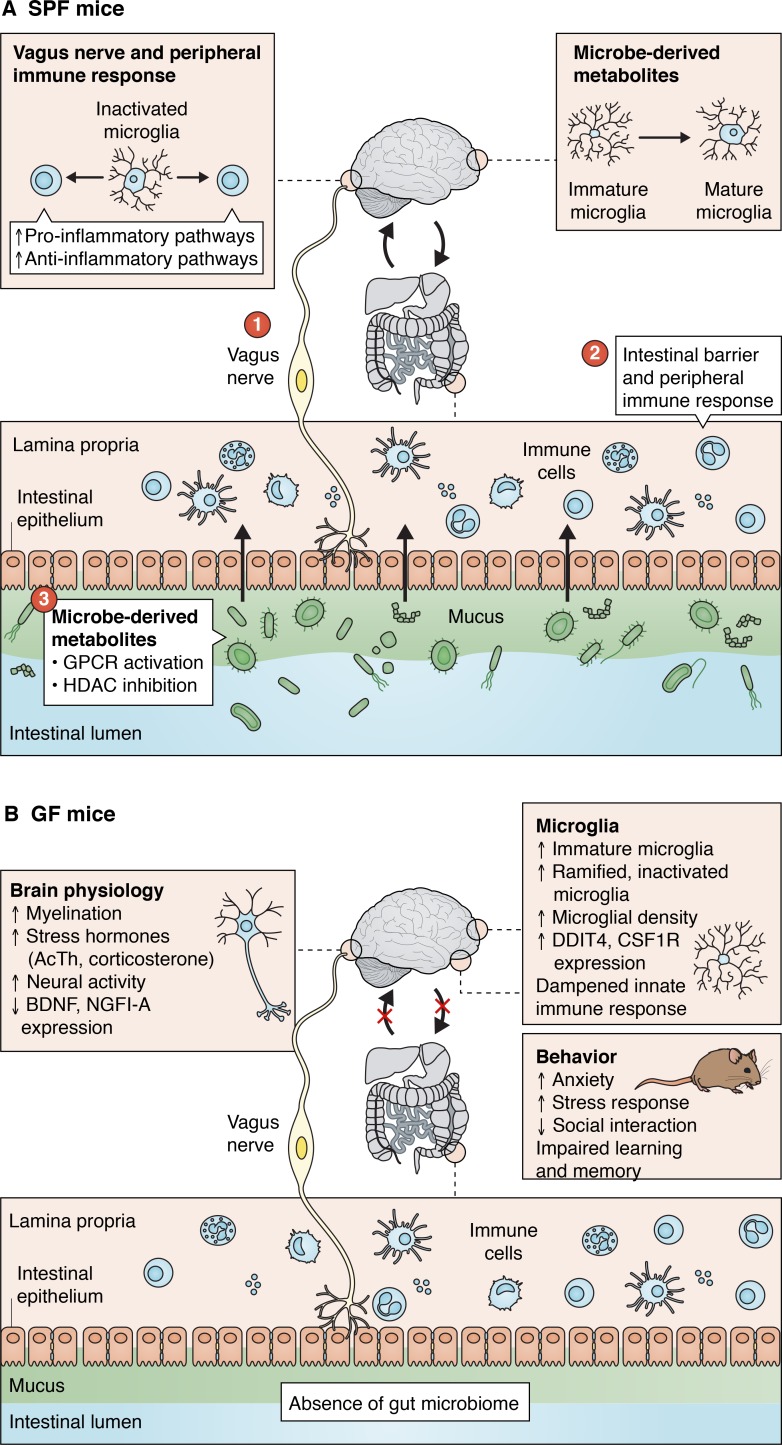
- Gut–brain communication routes include the vagus nerve, intestinal barrier/peripheral immune signaling, and bacterial metabolites. Short-chain fatty acids (SCFAs; acetic, propionic, and butyric acid make up ∼95% of gut SCFAs) rescue the immature microglial phenotype in GF mice, while FFAR2-deficient SPF mice resemble GF mice. Other microbial neuroactive substances include serotonin (90% produced in the gut), tryptophan metabolites, GABA, and acetylcholine.
- Disease associations include ASD, where GI symptoms occur in 23–70% of patients and fecal samples show increased Clostridium and Lactobacillus with decreased Bacteroidetes and Bifidobacterium; maternal immune activation models show microglial maturation disruption, and Bacteroides fragilis administration rescues behavioral and GI defects. In PD, >80% of patients report GI dysfunction 10–20 yr before motor symptoms, SIBO occurs in 25–54.5%, and GF α-synuclein-overexpressing mice show reduced motor deficits, GI dysfunction, and microglial activation; SCFA feeding restores deficits. Table 1 also lists schizophrenia, major depressive disorder, Alzheimer’s disease, amyotrophic lateral sclerosis, and multiple sclerosis as neuropathologies with both microglial dysfunction and microbial dysbiosis.
Methods
- Narrative review; no primary data are reported. It synthesizes published human and animal studies on the gut microbiome, microglia, and gut–brain axis.
- Evidence discussed includes GF and specific pathogen–free mice, antibiotic depletion, fecal microbiota transplant, probiotics/prebiotics, SCFA supplementation, vagotomy and vagus nerve stimulation, human postmortem brain tissue, PET imaging, and fecal microbiota analyses.
- Main analysis is qualitative integration of mechanisms and disease associations; no systematic search strategy or meta-analysis is described.
Limitations
- Stated in the paper: ASD pilot studies have small sample sizes; the maternal immune activation model has limitations in replicating complex ASD symptomatology; exact SCFA signaling pathways and how GI signals propagate to the CNS are poorly understood; whether disease-associated microbial alterations are a cause or consequence of altered brain function is unclear; the role of SCFAs in PD models is uncertain due to concentration- and region-dependent effects; interindividual variation in PD microbiota is high.
- Evident from the text: as a narrative review, it does not systematically assess study quality or quantify effects; many conclusions rely on animal models and correlative human data, so causality in humans remains unestablished.
Model-written summary. Check it against the paper before relying on it.
Integrity signals
Registry
Cites
Statistics
Figures
Verification
Claims the paper makes
86 Not checked yet · 41 Own interpretation · 1 Supported · 1 Partly supported · 1 Own method · accuracy not yet measured
None of the sources cited for this claim have been checked yet.
In the paper
“microglial activity is now known to be influenced by factors originating outside the CNS, including the gut.”
§ Microbiome–microglia connections via the gut–brain axis > Introduction
What the sources say
boosteddirect- Asserted: passes — The authors put it forward as true.
- Checkable: passes — It can be checked against evidence.
- Load-bearing: passes — The paper’s conclusions depend on it.
- Based: passes — The paper gives a reason why it holds.
A conclusion the paper draws from its own results — it cites no other source for it, so there is none to check. The quote shows it is in the paper.
In the paper
“This review highlights evidence demonstrating the various mechanisms by which the gut microbiota can influence microglia in both homeostatic and disease conditions.”
§ Microbiome–microglia connections via the gut–brain axis > Abstract
boosteddirect- Asserted: passes — The authors put it forward as true.
- Checkable: passes — It can be checked against evidence.
- Load-bearing: passes — The paper’s conclusions depend on it.
- Based: passes — The paper gives a reason why it holds.
None of the sources cited for this claim have been checked yet.
In the paper
“Microglia from adult GF mice also display differential expression of genes associated with microglial maturation, including down-regulation of genes that regulate cell activation and immune system defense pathways, such as Mapk8, IL-1α, Ly86, Jak3, and Stat1, all of which are normally highly expressed in adult microglia (Fig. 1; Erny et al., 2015; Matcovitch-Natan et al., 2016).”
§ Microbiome–microglia connections via the gut–brain axis > Gut–brain axis influences microglia development and function > Diverse gut microbiota is a prerequisite for adult microglial maturation and function
What the sources say
plaincorrelational- Asserted: passes — The authors put it forward as true.
- Checkable: passes — It can be checked against evidence.
- Load-bearing: passes — The paper’s conclusions depend on it.
- Based: passes — The paper gives a reason why it holds.
None of the sources cited for this claim have been checked yet.
In the paper
“Sophisticated crosstalk between the CNS and the gut microbiome (known as the gut–brain axis) is critical for several facets of CNS physiology, including microglial development and function (Mayer et al., 2015; Fung et al., 2017).”
§ Microbiome–microglia connections via the gut–brain axis > Introduction
What the sources say
plaindirect- Asserted: passes — The authors put it forward as true.
- Checkable: passes — It can be checked against evidence.
- Load-bearing: passes — The paper’s conclusions depend on it.
- Based: passes — The paper gives a reason why it holds.
A conclusion the paper draws from its own results — it cites no other source for it, so there is none to check. The quote shows it is in the paper.
In the paper
“Taken together, the gene expression profile and behavior of microglia from GF mice or under microbiota-depleted conditions is reminiscent of an immature microglial phenotype, indicating that input from gut microbiota is required for microglia to progress to later stages of cellular maturation and adequately fulfill their role in immune surveillance.”
§ Microbiome–microglia connections via the gut–brain axis > Gut–brain axis influences microglia development and function > Diverse gut microbiota is a prerequisite for adult microglial maturation and function
hedgeddirect- Asserted: passes — The authors put it forward as true.
- Checkable: passes — It can be checked against evidence.
- Load-bearing: passes — The paper’s conclusions depend on it.
- Based: passes — The paper gives a reason why it holds.
In the paper
“In SPF mice, a diverse gut microbiota promotes microglial development and maturation.”
§ Microbiome–microglia connections via the gut–brain axis > Microglia during development and adulthood > Microglia maturation
What the sources say
- Not checked yetcites Erny et al., 2015 source
plaindirect- Asserted: passes — The authors put it forward as true.
- Checkable: passes — It can be checked against evidence.
- Load-bearing: passes — The paper’s conclusions depend on it.
- Based: passes — The paper gives a reason why it holds.
A conclusion the paper draws from its own results — it cites no other source for it, so there is none to check. The quote shows it is in the paper.
In the paper
“Gut microbiota influences microglial development and maturation.”
§ Microbiome–microglia connections via the gut–brain axis > Microglia during development and adulthood > Microglia maturation
plaindirect- Asserted: passes — The authors put it forward as true.
- Checkable: passes — It can be checked against evidence.
- Load-bearing: passes — The paper’s conclusions depend on it.
- Based: passes — The paper gives a reason why it holds.
A conclusion the paper draws from its own results — it cites no other source for it, so there is none to check. The quote shows it is in the paper.
In the paper
“Thus, the presence of a complex and diverse microbial community, rather than exposure to gut bacteria per se, appears to be a prerequisite for proper microglial development and function.”
§ Microbiome–microglia connections via the gut–brain axis > Gut–brain axis influences microglia development and function > Diverse gut microbiota is a prerequisite for adult microglial maturation and function
hedgedconditional- Asserted: passes — The authors put it forward as true.
- Checkable: passes — It can be checked against evidence.
- Load-bearing: passes — The paper’s conclusions depend on it.
- Based: passes — The paper gives a reason why it holds.
In the paper
“recent genetic studies provide evidence that microglia contribute to the pathogenesis of several neurodegenerative and neurodevelopmental disorders (Salter and Stevens, 2017).”
§ Microbiome–microglia connections via the gut–brain axis > Introduction
What the sources say
- Not checked yetcites Salter and Stevens, 2017 source
plaindirect- Asserted: passes — The authors put it forward as true.
- Checkable: passes — It can be checked against evidence.
- Load-bearing: passes — The paper’s conclusions depend on it.
- Based: passes — The paper gives a reason why it holds.
In the paper
“Consistent with patterns observed prenatally, microglia from adult GF mice, lacking constant postnatal input from gut microbiota, show distinct differences in density and morphology compared with those derived from SPF mice (Erny et al., 2015).”
§ Microbiome–microglia connections via the gut–brain axis > Gut–brain axis influences microglia development and function > Diverse gut microbiota is a prerequisite for adult microglial maturation and function
What the sources say
- Not checked yetcites Erny et al., 2015 source
plaincorrelational- Asserted: passes — The authors put it forward as true.
- Checkable: passes — It can be checked against evidence.
- Load-bearing: passes — The paper’s conclusions depend on it.
- Based: passes — The paper gives a reason why it holds.
In the paper
“The immature gene expression profile resulting from the absence of gut microbiota contributes to the inability of microglia to properly respond to immunostimulants such as LPS and the lymphocytic choriomeningitis virus, both of which failed to elicit an appropriate activation response in microglia from GF mice (Erny et al., 2015).”
§ Microbiome–microglia connections via the gut–brain axis > Gut–brain axis influences microglia development and function > Diverse gut microbiota is a prerequisite for adult microglial maturation and function
What the sources say
- Not checked yetcites Erny et al., 2015 source
plaindirect- Asserted: passes — The authors put it forward as true.
- Checkable: passes — It can be checked against evidence.
- Load-bearing: passes — The paper’s conclusions depend on it.
- Based: passes — The paper gives a reason why it holds.
A conclusion the paper draws from its own results — it cites no other source for it, so there is none to check. The quote shows it is in the paper.
In the paper
“This arrest in microglial maturation impedes their ability to initiate a sufficient immune response during infection.”
§ Microbiome–microglia connections via the gut–brain axis > Microglia during development and adulthood > Microglia maturation
plaindirect- Asserted: passes — The authors put it forward as true.
- Checkable: passes — It can be checked against evidence.
- Load-bearing: passes — The paper’s conclusions depend on it.
- Based: unclear — It is unclear why the paper says it holds.
In the paper
“Concurrently, genes highly expressed in microglia during early developmental stages that promote cell proliferation and survival, including Csf1r and Ddit4, are aberrantly up-regulated in microglia isolated from adult GF mice.”
§ Microbiome–microglia connections via the gut–brain axis > Gut–brain axis influences microglia development and function > Diverse gut microbiota is a prerequisite for adult microglial maturation and function
What the sources say
- Not checked yetcites Erny et al., 2015 source
plaincorrelational- Asserted: passes — The authors put it forward as true.
- Checkable: passes — It can be checked against evidence.
- Load-bearing: passes — The paper’s conclusions depend on it.
- Based: passes — The paper gives a reason why it holds.
A conclusion the paper draws from its own results — it cites no other source for it, so there is none to check. The quote shows it is in the paper.
In the paper
“These findings suggest that the gut microbiota is likely imperative for an adequate microglia-mediated immune response against pathogens invading the CNS.”
§ Microbiome–microglia connections via the gut–brain axis > Gut–brain axis influences microglia development and function > Diverse gut microbiota is a prerequisite for adult microglial maturation and function
hedgedconditional- Asserted: passes — The authors put it forward as true.
- Checkable: passes — It can be checked against evidence.
- Load-bearing: passes — The paper’s conclusions depend on it.
- Based: passes — The paper gives a reason why it holds.
In the paper
“Indeed, treatment of microglial cells in vitro with various SCFAs, including valproic acid and butyric acid, elevates levels of acetylation of histone H3 (Chen et al., 2007).”
§ Microbiome–microglia connections via the gut–brain axis > Gut–brain communication pathways: Vagal transmission and systemic circulation > Bacterial-derived neuroactive substances
What the sources say
- Not checked yetcites Chen et al., 2007 source
plaindirect- Asserted: passes — The authors put it forward as true.
- Checkable: passes — It can be checked against evidence.
- Load-bearing: passes — The paper’s conclusions depend on it.
- Based: passes — The paper gives a reason why it holds.
A conclusion the paper draws from its own results — it cites no other source for it, so there is none to check. The quote shows it is in the paper.
In the paper
“Microbe-derived neuroactive metabolites are additional contributors to gut–brain crosstalk.”
§ Microbiome–microglia connections via the gut–brain axis > Gut–brain communication pathways: Vagal transmission and systemic circulation > Bacterial-derived neuroactive substances
plainconditional- Asserted: passes — The authors put it forward as true.
- Checkable: passes — It can be checked against evidence.
- Load-bearing: passes — The paper’s conclusions depend on it.
- Based: passes — The paper gives a reason why it holds.
In the paper
“When microbe-associated molecular patterns produced by pathogenic invaders bind to pattern recognition receptors, such as TLRs, on host cells, they influence the production of both pro- and anti-inflammatory cytokines (Fung et al., 2017).”
§ Microbiome–microglia connections via the gut–brain axis > Gut–brain communication pathways: Vagal transmission and systemic circulation > Regulation of the intestinal barrier and peripheral immune response
What the sources say
- Not checked yetcites Fung et al., 2017 source
plaindirect- Asserted: passes — The authors put it forward as true.
- Checkable: passes — It can be checked against evidence.
- Load-bearing: passes — The paper’s conclusions depend on it.
- Based: passes — The paper gives a reason why it holds.
In the paper
“In a recent study using the experimental autoimmune encephalomyelitis (EAE) mouse model of MS, peripheral metabolism of dietary tryptophan by the gut microbiota was shown to generate metabolites that dampen the ability of microglia to induce pro-inflammatory responses in astrocytes, thereby ameliorating disease (Rothhammer et al., 2018).”
§ Microbiome–microglia connections via the gut–brain axis > Gut–brain communication pathways: Vagal transmission and systemic circulation > Bacterial-derived neuroactive substances
What the sources say
- Not checked yetcites Rothhammer et al., 2018 source
boosteddirect- Asserted: passes — The authors put it forward as true.
- Checkable: passes — It can be checked against evidence.
- Load-bearing: passes — The paper’s conclusions depend on it.
- Based: passes — The paper gives a reason why it holds.
In the paper
“At E14.5, embryonic microglia from offspring of GF dams display minor differences in gene expression compared with their SPF counterparts, whereas microglia collected close to birth (E18.5) demonstrate marked differences in gene expression, chromatin accessibility, morphology, and regional distribution (Thion et al., 2018).”
§ Microbiome–microglia connections via the gut–brain axis > Gut–brain axis influences microglia development and function > Maternal microbiota shapes prenatal microglial maturation and function
What the sources say
- Not checked yetcites Thion et al., 2018 source
boostedcorrelational- Asserted: passes — The authors put it forward as true.
- Checkable: passes — It can be checked against evidence.
- Load-bearing: passes — The paper’s conclusions depend on it.
- Based: passes — The paper gives a reason why it holds.
None of the sources cited for this claim have been checked yet.
In the paper
“By altering expression levels of tight junction proteins along the epithelial wall, and thus the level of bacterial infiltration in the mucosal layer, the gut microbiota can fine-tune the level of intestinal permeability (Karczewski et al., 2010; Alaish et al., 2013).”
§ Microbiome–microglia connections via the gut–brain axis > Gut–brain communication pathways: Vagal transmission and systemic circulation > Regulation of the intestinal barrier and peripheral immune response
What the sources say
plaindirect- Asserted: passes — The authors put it forward as true.
- Checkable: passes — It can be checked against evidence.
- Load-bearing: passes — The paper’s conclusions depend on it.
- Based: passes — The paper gives a reason why it holds.
In the paper
“SPF mice lacking the free fatty acid receptor 2 (FFAR2), a GPCR required for SCFA signaling in the gut, exhibited a microglial phenotype similar to that observed in GF mice (Erny et al., 2015).”
§ Microbiome–microglia connections via the gut–brain axis > Gut–brain communication pathways: Vagal transmission and systemic circulation > Bacterial-derived neuroactive substances
What the sources say
- Not checked yetcites Erny et al., 2015 source
plaincorrelational- Asserted: passes — The authors put it forward as true.
- Checkable: passes — It can be checked against evidence.
- Load-bearing: passes — The paper’s conclusions depend on it.
- Based: passes — The paper gives a reason why it holds.
A conclusion the paper draws from its own results — it cites no other source for it, so there is none to check. The quote shows it is in the paper.
In the paper
“These studies provide further confirmation of the intimate link between peripheral inflammation, influenced in part by the gut microbiota, and microglial activation and neuroinflammation.”
§ Microbiome–microglia connections via the gut–brain axis > Gut–brain communication pathways: Vagal transmission and systemic circulation > Regulation of the intestinal barrier and peripheral immune response
boostedcorrelational- Asserted: passes — The authors put it forward as true.
- Checkable: passes — It can be checked against evidence.
- Load-bearing: passes — The paper’s conclusions depend on it.
- Based: passes — The paper gives a reason why it holds.
None of the sources cited for this claim have been checked yet.
In the paper
“Increased circulation of BBB-permeable pro-inflammatory cytokines and neurotoxic compounds may contribute to heightened microglial activation and production of pro-inflammatory cytokines in the brain (Qin et al., 2008; Riazi et al., 2008).”
§ Microbiome–microglia connections via the gut–brain axis > Gut–brain communication pathways: Vagal transmission and systemic circulation > Regulation of the intestinal barrier and peripheral immune response
What the sources say
hedgedconditional- Asserted: passes — The authors put it forward as true.
- Checkable: passes — It can be checked against evidence.
- Load-bearing: passes — The paper’s conclusions depend on it.
- Based: passes — The paper gives a reason why it holds.
None of the sources cited for this claim have been checked yet.
In the paper
“Circulation of microbe-derived neurotransmitters, including acetylcholine (Lactobacillus), GABA (Bifidobacteria and Lactobacillus), and serotonin (Enterococcus and Streptococcus), can potentially influence microglial activation through direct and indirect means (Komatsuzaki et al., 2005; Yano et al., 2015; Pokusaeva et al., 2017).”
§ Microbiome–microglia connections via the gut–brain axis > Gut–brain communication pathways: Vagal transmission and systemic circulation > Bacterial-derived neuroactive substances
What the sources say
plainconditional- Asserted: passes — The authors put it forward as true.
- Checkable: passes — It can be checked against evidence.
- Load-bearing: passes — The paper’s conclusions depend on it.
- Based: passes — The paper gives a reason why it holds.
In the paper
“While the womb is likely a sterile environment, new findings suggests that signals from maternal gut microbes may shape the developmental trajectory of fetal microglia close to the time of birth (Thion et al., 2018).”
§ Microbiome–microglia connections via the gut–brain axis > Gut–brain axis influences microglia development and function > Maternal microbiota shapes prenatal microglial maturation and function
What the sources say
- Not checked yetcites Thion et al., 2018 source
hedgedconditional- Asserted: passes — The authors put it forward as true.
- Checkable: passes — It can be checked against evidence.
- Load-bearing: passes — The paper’s conclusions depend on it.
- Based: passes — The paper gives a reason why it holds.
- Rests on an assumption: The womb is likely a sterile environment.
In the paper
“Supplementation of drinking water with a mixture of three primary SCFAs (acetic acid, propionic acid, and butyric acid) rescued the immature genetic and morphological phenotype of microglia from GF mice (Erny et al., 2015).”
§ Microbiome–microglia connections via the gut–brain axis > Gut–brain communication pathways: Vagal transmission and systemic circulation > Bacterial-derived neuroactive substances
What the sources say
- Not checked yetcites Erny et al., 2015 source
plaindirect- Asserted: passes — The authors put it forward as true.
- Checkable: passes — It can be checked against evidence.
- Load-bearing: passes — The paper’s conclusions depend on it.
- Based: passes — The paper gives a reason why it holds.
A conclusion the paper draws from its own results — it cites no other source for it, so there is none to check. The quote shows it is in the paper.
In the paper
“In addition to GPCR signaling, the ability of SCFAs to permeate the BBB and infiltrate the CNS suggests potential direct influences on microglia.”
§ Microbiome–microglia connections via the gut–brain axis > Gut–brain communication pathways: Vagal transmission and systemic circulation > Bacterial-derived neuroactive substances
hedgedconditional- Asserted: passes — The authors put it forward as true.
- Checkable: passes — It can be checked against evidence.
- Load-bearing: passes — The paper’s conclusions depend on it.
- Based: passes — The paper gives a reason why it holds.
In the paper
“Interestingly, sex-related differences have been observed with regard to the influence of the maternal gut microbiota on microglial function in offspring.”
§ Microbiome–microglia connections via the gut–brain axis > Gut–brain axis influences microglia development and function > Maternal microbiota shapes prenatal microglial maturation and function
What the sources say
- Not checked yetcites Thion et al., 2018 source
plaincorrelational- Asserted: passes — The authors put it forward as true.
- Checkable: passes — It can be checked against evidence.
- Load-bearing: passes — The paper’s conclusions depend on it.
- Based: passes — The paper gives a reason why it holds.
A conclusion the paper draws from its own results — it cites no other source for it, so there is none to check. The quote shows it is in the paper.
In the paper
“This suggests that input of maternal gut microbes may have a greater impact on early microglia and premicroglia in male offspring than in females.”
§ Microbiome–microglia connections via the gut–brain axis > Gut–brain axis influences microglia development and function > Maternal microbiota shapes prenatal microglial maturation and function
hedgedconditional- Asserted: passes — The authors put it forward as true.
- Checkable: passes — It can be checked against evidence.
- Load-bearing: passes — The paper’s conclusions depend on it.
- Based: passes — The paper gives a reason why it holds.
In the paper
“Communication between intestinal microbes and vagal afferents also appears to influence microglia and the level of inflammation in the CNS (Forsythe et al., 2014).”
§ Microbiome–microglia connections via the gut–brain axis > Gut–brain communication pathways: Vagal transmission and systemic circulation > The vagus nerve
What the sources say
- Not checked yetcites Forsythe et al., 2014 source
hedgedconditional- Asserted: passes — The authors put it forward as true.
- Checkable: passes — It can be checked against evidence.
- Load-bearing: passes — The paper’s conclusions depend on it.
- Based: passes — The paper gives a reason why it holds.
A conclusion the paper draws from its own results — it cites no other source for it, so there is none to check. The quote shows it is in the paper.
In the paper
“Proper microglial maturation and behavior is dependent on crosstalk along the gut–brain axis.”
§ Microbiome–microglia connections via the gut–brain axis > Gut–brain communication pathways: Vagal transmission and systemic circulation
plaindirect- Asserted: passes — The authors put it forward as true.
- Checkable: passes — It can be checked against evidence.
- Load-bearing: passes — The paper’s conclusions depend on it.
- Based: unclear — It is unclear why the paper says it holds.
- Rests on an assumption: BBB-permeable bacterial metabolites, including SCFAs, modulate microglial maturation.
In the paper
“At E14.5, embryonic microglia from offspring of GF dams display minor differences in gene expression compared with their SPF counterparts, whereas microglia collected close to birth (E18.5) demonstrate marked differences in gene expression, chromatin accessibility, morphology, and regional distribution (Thion et al., 2018).”
§ Microbiome–microglia connections via the gut–brain axis > Gut–brain axis influences microglia development and function > Maternal microbiota shapes prenatal microglial maturation and function
What the sources say
- Not checked yetcites Thion et al., 2018 source
plain- Asserted: passes — The authors put it forward as true.
- Checkable: passes — It can be checked against evidence.
- Load-bearing: unclear — It is unclear whether the paper’s conclusions depend on it.
- Based: passes — The paper gives a reason why it holds.
A conclusion the paper draws from its own results — it cites no other source for it, so there is none to check. The quote shows it is in the paper.
In the paper
“These findings provide further confirmation of the role of gut microbiota in influencing behavioral and physiological functions previously thought to be exclusively controlled by local factors in the brain.”
§ Microbiome–microglia connections via the gut–brain axis > Gut–brain communication pathways: Vagal transmission and systemic circulation > Bacterial-derived neuroactive substances
boosteddirect- Asserted: passes — The authors put it forward as true.
- Checkable: passes — It can be checked against evidence.
- Load-bearing: passes — The paper’s conclusions depend on it.
- Based: passes — The paper gives a reason why it holds.
In the paper
“Binding of serotonin to 5-HT receptors on microglia induces release of cytokine-carrying exosomes, providing another mechanism for gut-induced modulation of neuroinflammation (Glebov et al., 2015).”
§ Microbiome–microglia connections via the gut–brain axis > Gut–brain communication pathways: Vagal transmission and systemic circulation > Bacterial-derived neuroactive substances
What the sources say
- Not checked yetcites Glebov et al., 2015 source
plaindirect- Asserted: passes — The authors put it forward as true.
- Checkable: passes — It can be checked against evidence.
- Load-bearing: unclear — It is unclear whether the paper’s conclusions depend on it.
- Based: passes — The paper gives a reason why it holds.
A conclusion the paper draws from its own results — it cites no other source for it, so there is none to check. The quote shows it is in the paper.
In the paper
“The absence of FFAR2 expression on microglia suggests that SCFAs may influence microglial maturation through signals that originate in the GI tract.”
§ Microbiome–microglia connections via the gut–brain axis > Gut–brain communication pathways: Vagal transmission and systemic circulation > Bacterial-derived neuroactive substances
hedgedconditional- Asserted: passes — The authors put it forward as true.
- Checkable: passes — It can be checked against evidence.
- Load-bearing: passes — The paper’s conclusions depend on it.
- Based: passes — The paper gives a reason why it holds.
None of the sources cited for this claim have been checked yet.
In the paper
“SCFAs have been shown to activate sympathetic nervous system activity and alleviate intestinal inflammation, and altered SCFA production has been demonstrated in a variety of neuropathologies such as PD and ASD (Smith et al., 2013; MacFabe, 2015; Unger et al., 2016).”
§ Microbiome–microglia connections via the gut–brain axis > Gut–brain communication pathways: Vagal transmission and systemic circulation > Bacterial-derived neuroactive substances
What the sources say
boostedcorrelational- Asserted: passes — The authors put it forward as true.
- Checkable: passes — It can be checked against evidence.
- Load-bearing: unclear — It is unclear whether the paper’s conclusions depend on it.
- Based: passes — The paper gives a reason why it holds.
In the paper
“Studies have demonstrated that 90% of serotonin required for the regulation of mood, behavior, sleep, and several other functions within the CNS and GI tract is produced in the gut.”
§ Microbiome–microglia connections via the gut–brain axis > Gut–brain communication pathways: Vagal transmission and systemic circulation > Bacterial-derived neuroactive substances
What the sources say
- Not checked yetcites Glebov et al., 2015 source
boosteddirect- Asserted: passes — The authors put it forward as true.
- Checkable: passes — It can be checked against evidence.
- Load-bearing: unclear — It is unclear whether the paper’s conclusions depend on it.
- Based: passes — The paper gives a reason why it holds.
In the paper
“The presence of bacteria along the GI tract is critical for the maintenance of the intestinal barrier, which facilitates the exchange of nutrients, water, and electrolytes and prevents the passage of harmful substances and pathogens from the intestinal lumen into the bloodstream (Jakobsson et al., 2015).”
§ Microbiome–microglia connections via the gut–brain axis > Gut–brain communication pathways: Vagal transmission and systemic circulation > Regulation of the intestinal barrier and peripheral immune response
What the sources say
- Not checked yetcites Jakobsson et al., 2015 source
plaindirect- Asserted: passes — The authors put it forward as true.
- Checkable: passes — It can be checked against evidence.
- Load-bearing: passes — The paper’s conclusions depend on it.
- Based: passes — The paper gives a reason why it holds.
A conclusion the paper draws from its own results — it cites no other source for it, so there is none to check. The quote shows it is in the paper.
In the paper
“The circulation and subsequent entry of these cytokines into the brain acts locally on CNS cells, including microglia, that express the appropriate cytokine receptors, thereby influencing the state of inflammation in the brain.”
§ Microbiome–microglia connections via the gut–brain axis > Gut–brain communication pathways: Vagal transmission and systemic circulation > Regulation of the intestinal barrier and peripheral immune response
plaindirect- Asserted: passes — The authors put it forward as true.
- Checkable: passes — It can be checked against evidence.
- Load-bearing: passes — The paper’s conclusions depend on it.
- Based: passes — The paper gives a reason why it holds.
In the paper
“Decreased strength of the intestinal barrier due to dysbiosis and other factors permits entry of pathogenic, immune-stimulating, and neuroactive substances into the systemic circulation (Kelly et al., 2015).”
§ Microbiome–microglia connections via the gut–brain axis > Gut–brain communication pathways: Vagal transmission and systemic circulation > Regulation of the intestinal barrier and peripheral immune response
What the sources say
- Not checked yetcites Kelly et al., 2015 source
plaindirect- Asserted: passes — The authors put it forward as true.
- Checkable: passes — It can be checked against evidence.
- Load-bearing: passes — The paper’s conclusions depend on it.
- Based: passes — The paper gives a reason why it holds.
A conclusion the paper draws from its own results — it cites no other source for it, so there is none to check. The quote shows it is in the paper.
In the paper
“Effective vagal nerve signaling is critical for sending appropriate signals to microglia in order to modulate levels of neuroinflammation.”
§ Microbiome–microglia connections via the gut–brain axis > Gut–brain communication pathways: Vagal transmission and systemic circulation > The vagus nerve
plaindirect- Asserted: passes — The authors put it forward as true.
- Checkable: passes — It can be checked against evidence.
- Load-bearing: passes — The paper’s conclusions depend on it.
- Based: passes — The paper gives a reason why it holds.
None of the sources cited for this claim have been checked yet.
In the paper
“Indeed, increased intestinal inflammation driven by either LPS or bacterial infection correlates with elevated levels of microglial activation and release of pro-inflammatory cytokines (Riazi et al., 2008; Henry et al., 2009).”
§ Microbiome–microglia connections via the gut–brain axis > Gut–brain communication pathways: Vagal transmission and systemic circulation > Regulation of the intestinal barrier and peripheral immune response
What the sources say
plaincorrelational- Asserted: passes — The authors put it forward as true.
- Checkable: passes — It can be checked against evidence.
- Load-bearing: passes — The paper’s conclusions depend on it.
- Based: passes — The paper gives a reason why it holds.
None of the sources cited for this claim have been checked yet.
In the paper
“Along with affecting the level of permeability along the intestinal tract, gut microbiota can influence the state of peripheral inflammation through interactions with nearby immune cells.”
§ Microbiome–microglia connections via the gut–brain axis > Gut–brain communication pathways: Vagal transmission and systemic circulation > Regulation of the intestinal barrier and peripheral immune response
What the sources say
plaindirect- Asserted: passes — The authors put it forward as true.
- Checkable: passes — It can be checked against evidence.
- Load-bearing: passes — The paper’s conclusions depend on it.
- Based: passes — The paper gives a reason why it holds.
A conclusion the paper draws from its own results — it cites no other source for it, so there is none to check. The quote shows it is in the paper.
In the paper
“These findings support the role of the vagus nerve as a physical conduit between gut microbial activity and neuroinflammation.”
§ Microbiome–microglia connections via the gut–brain axis > Gut–brain communication pathways: Vagal transmission and systemic circulation > The vagus nerve
plaindirect- Asserted: passes — The authors put it forward as true.
- Checkable: passes — It can be checked against evidence.
- Load-bearing: passes — The paper’s conclusions depend on it.
- Based: passes — The paper gives a reason why it holds.
None of the sources cited for this claim have been checked yet.
In the paper
“Heightened microglial activation results in the release of pro-inflammatory cytokines (e.g., IL-6 and TNF-α) and a variety of other neurotoxic compounds into their immediate extracellular environment (Zhang et al., 2005; Kim and Joh, 2006).”
§ Microbiome–microglia connections via the gut–brain axis > Microglial dysfunction and microbial dysbiosis in disease > PD
What the sources say
plaindirect- Asserted: passes — The authors put it forward as true.
- Checkable: passes — It can be checked against evidence.
- Load-bearing: passes — The paper’s conclusions depend on it.
- Based: passes — The paper gives a reason why it holds.
A conclusion the paper draws from its own results — it cites no other source for it, so there is none to check. The quote shows it is in the paper.
In the paper
“Microglia from young MIA offspring show increased expression of inflammation-related genes typically associated with an adult microglial phenotype and down-regulation of genes expressed during earlier developmental stages (e.g., Pu.1 and Irf8), suggesting that maternal inflammation disrupts the timeline of normal microglial maturation (Matcovitch-Natan et al., 2016).”
§ Microbiome–microglia connections via the gut–brain axis > Microglial dysfunction and microbial dysbiosis in disease > ASD
hedgeddirect- Asserted: passes — The authors put it forward as true.
- Checkable: passes — It can be checked against evidence.
- Load-bearing: passes — The paper’s conclusions depend on it.
- Based: passes — The paper gives a reason why it holds.
A conclusion the paper draws from its own results — it cites no other source for it, so there is none to check. The quote shows it is in the paper.
In the paper
“These changes may ultimately trigger a neuropathogenic microglial phenotype that facilitates and accelerates PD pathology.”
§ Microbiome–microglia connections via the gut–brain axis > Microglial dysfunction and microbial dysbiosis in disease > PD
hedgedconditional- Asserted: passes — The authors put it forward as true.
- Checkable: passes — It can be checked against evidence.
- Load-bearing: passes — The paper’s conclusions depend on it.
- Based: passes — The paper gives a reason why it holds.
A conclusion the paper draws from its own results — it cites no other source for it, so there is none to check. The quote shows it is in the paper.
In the paper
“A collective consequence of microglial dysfunction is stunted neuronal development and immature brain circuitry, which could ultimately manifest in the ASD behavioral phenotypes.”
§ Microbiome–microglia connections via the gut–brain axis > Microglial dysfunction and microbial dysbiosis in disease > ASD
hedgedconditional- Asserted: passes — The authors put it forward as true.
- Checkable: passes — It can be checked against evidence.
- Load-bearing: passes — The paper’s conclusions depend on it.
- Based: passes — The paper gives a reason why it holds.
None of the sources cited for this claim have been checked yet.
In the paper
“Evidence for this theory is supported by both preclinical and clinical evidence demonstrating the presence of α-synuclein deposits in enteric neurons of the gut before the detection of misfolded α-synuclein in the CNS (Braak et al., 2004; Bencsik et al., 2014).”
§ Microbiome–microglia connections via the gut–brain axis > Microglial dysfunction and microbial dysbiosis in disease > PD
What the sources say
boostedcorrelational- Asserted: passes — The authors put it forward as true.
- Checkable: passes — It can be checked against evidence.
- Load-bearing: unclear — It is unclear whether the paper’s conclusions depend on it.
- Based: passes — The paper gives a reason why it holds.
A conclusion the paper draws from its own results — it cites no other source for it, so there is none to check. The quote shows it is in the paper.
In the paper
“Perturbations in the composition of gut microbes during early developmental stages due to maternal infection, mode of delivery, antibiotic use, and early-age infections increase an individual’s predisposition to atypical behavioral patterns.”
§ Microbiome–microglia connections via the gut–brain axis > Microglial dysfunction and microbial dysbiosis in disease > ASD
plaindirect- Asserted: passes — The authors put it forward as true.
- Checkable: passes — It can be checked against evidence.
- Load-bearing: passes — The paper’s conclusions depend on it.
- Based: unclear — It is unclear why the paper says it holds.
A conclusion the paper draws from its own results — it cites no other source for it, so there is none to check. The quote shows it is in the paper.
In the paper
“While the etiology of ASD is complex and incompletely determined, microglia may influence the course of the disease.”
§ Microbiome–microglia connections via the gut–brain axis > Microglial dysfunction and microbial dysbiosis in disease > ASD
hedgedconditional- Asserted: passes — The authors put it forward as true.
- Checkable: passes — It can be checked against evidence.
- Load-bearing: passes — The paper’s conclusions depend on it.
- Based: passes — The paper gives a reason why it holds.
A conclusion the paper draws from its own results — it cites no other source for it, so there is none to check. The quote shows it is in the paper.
In the paper
“Given the possible crosstalk between the gut microbiota and microglia, the composition of intestinal bacteria may modulate disease pathogenesis.”
§ Microbiome–microglia connections via the gut–brain axis > Microglial dysfunction and microbial dysbiosis in disease > PD
hedgedconditional- Asserted: passes — The authors put it forward as true.
- Checkable: passes — It can be checked against evidence.
- Load-bearing: passes — The paper’s conclusions depend on it.
- Based: passes — The paper gives a reason why it holds.
None of the sources cited for this claim have been checked yet.
In the paper
“Adult MIA offspring exhibit heightened microglial activation, as noted by increased levels of IL-6 and TNF-α (Pratt et al., 2013; Mattei et al., 2017).”
§ Microbiome–microglia connections via the gut–brain axis > Microglial dysfunction and microbial dysbiosis in disease > ASD
What the sources say
plaincorrelational- Asserted: passes — The authors put it forward as true.
- Checkable: passes — It can be checked against evidence.
- Load-bearing: unclear — It is unclear whether the paper’s conclusions depend on it.
- Based: passes — The paper gives a reason why it holds.
None of the sources cited for this claim have been checked yet.
In the paper
“Given the requirement for constant input from the gut microbiota for normal microglial development and function, it is plausible that microbial effects on neural development and behavior may occur through changes in microglial activity (Erny et al., 2015; Thion et al., 2018).”
§ Microbiome–microglia connections via the gut–brain axis > Microglial dysfunction and microbial dysbiosis in disease > ASD
What the sources say
hedgedconditional- Asserted: passes — The authors put it forward as true.
- Checkable: passes — It can be checked against evidence.
- Load-bearing: passes — The paper’s conclusions depend on it.
- Based: passes — The paper gives a reason why it holds.
A conclusion the paper draws from its own results — it cites no other source for it, so there is none to check. The quote shows it is in the paper.
In the paper
“These findings indicate that the effects of maternal inflammation on microglial development and behavior in offspring may be restricted to a narrow developmental window, after which microglia revert to a relatively normal phenotype in adulthood.”
§ Microbiome–microglia connections via the gut–brain axis > Microglial dysfunction and microbial dysbiosis in disease > ASD
hedgedconditional- Asserted: passes — The authors put it forward as true.
- Checkable: passes — It can be checked against evidence.
- Load-bearing: passes — The paper’s conclusions depend on it.
- Based: passes — The paper gives a reason why it holds.
None of the sources cited for this claim have been checked yet.
In the paper
“The sustained activation of microglia due to external cues from both misfolded α-synuclein and damaged neurons likely instigates a cycle of chronic inflammation that further perpetuates the death of dopaminergic neurons and accelerates progression of the disease (Zhang et al., 2005; Kim and Joh, 2006).”
§ Microbiome–microglia connections via the gut–brain axis > Microglial dysfunction and microbial dysbiosis in disease > PD
What the sources say
hedgedconditional- Asserted: passes — The authors put it forward as true.
- Checkable: passes — It can be checked against evidence.
- Load-bearing: unclear — It is unclear whether the paper’s conclusions depend on it.
- Based: passes — The paper gives a reason why it holds.
A conclusion the paper draws from its own results — it cites no other source for it, so there is none to check. The quote shows it is in the paper.
In the paper
“This suggests that the ability of SCFAs to influence microglial behavior in vivo might occur through a combination of GPCR signaling and histone deacetylase inhibition.”
§ Microbiome–microglia connections via the gut–brain axis > Gut–brain communication pathways: Vagal transmission and systemic circulation > Bacterial-derived neuroactive substances
hedgedconditional- Asserted: passes — The authors put it forward as true.
- Checkable: passes — It can be checked against evidence.
- Load-bearing: passes — The paper’s conclusions depend on it.
- Based: passes — The paper gives a reason why it holds.
None of the sources cited for this claim have been checked yet.
In the paper
“One prevailing theory to explain synucleinopathies is that progressive alterations in the microenvironment of microglia, such as increased deposition of α-synuclein, can change microglial behavior and function (Zhang et al., 2005; Su et al., 2008).”
§ Microbiome–microglia connections via the gut–brain axis > Microglial dysfunction and microbial dysbiosis in disease > PD
What the sources say
- Not checked yetcites Zhang et al., 2005 source
- Not checked yetcites Su et al., 2008
plaindirect- Asserted: passes — The authors put it forward as true.
- Checkable: passes — It can be checked against evidence.
- Load-bearing: passes — The paper’s conclusions depend on it.
- Based: passes — The paper gives a reason why it holds.
In the paper
“Impaired synaptic remodeling by microglia might contribute to the increased density of dendritic spines and excitatory synapses found in the brains of patients with ASD (Martínez-Cerdeño, 2017).”
§ Microbiome–microglia connections via the gut–brain axis > Microglial dysfunction and microbial dysbiosis in disease > ASD
What the sources say
- Not checked yetcites Martínez-Cerdeño, 2017 source
hedgedconditional- Asserted: passes — The authors put it forward as true.
- Checkable: passes — It can be checked against evidence.
- Load-bearing: unclear — It is unclear whether the paper’s conclusions depend on it.
- Based: passes — The paper gives a reason why it holds.
In the paper
“Similarly, provision of Lactobacillus reuteri to offspring of dams fed a high-fat diet attenuates their social deficits, further supporting a role for the gut microbiota in influencing outcomes of neurodevelopmental disorders (Buffington et al., 2016).”
§ Microbiome–microglia connections via the gut–brain axis > Microglial dysfunction and microbial dysbiosis in disease > ASD
What the sources say
- Not checked yetcites Buffington et al., 2016 source
plaindirect- Asserted: passes — The authors put it forward as true.
- Checkable: passes — It can be checked against evidence.
- Load-bearing: unclear — It is unclear whether the paper’s conclusions depend on it.
- Based: passes — The paper gives a reason why it holds.
In the paper
“Provision of IL-17 promoting segmented filamentous bacteria to MIA mothers further enhances behavioral abnormities in MIA offspring (Kim et al., 2017).”
§ Microbiome–microglia connections via the gut–brain axis > Microglial dysfunction and microbial dysbiosis in disease > ASD
What the sources say
- Not checked yetcites Kim et al., 2017 source
plaindirect- Asserted: passes — The authors put it forward as true.
- Checkable: passes — It can be checked against evidence.
- Load-bearing: unclear — It is unclear whether the paper’s conclusions depend on it.
- Based: passes — The paper gives a reason why it holds.
In the paper
“In addition, symptoms of gut dysfunction such as irritable bowel syndrome, chronic diarrhea, and/or constipation are found in 23–70% of patients with ASD (Chaidez et al., 2014).”
§ Microbiome–microglia connections via the gut–brain axis > Microglial dysfunction and microbial dysbiosis in disease > ASD
What the sources say
- Not checked yetcites Chaidez et al., 2014 source
plaincorrelational- Asserted: passes — The authors put it forward as true.
- Checkable: passes — It can be checked against evidence.
- Load-bearing: unclear — It is unclear whether the paper’s conclusions depend on it.
- Based: passes — The paper gives a reason why it holds.
In the paper
“In the MIA model, offspring of mice injected with polyinosinic-polycytidylic acid (poly(I:C)), a synthetic viral mimic that activates TLR3, demonstrate core symptoms of ASD, including repetitive behaviors, communication deficits, and decreased sociability (Malkova et al., 2012).”
§ Microbiome–microglia connections via the gut–brain axis > Microglial dysfunction and microbial dysbiosis in disease > ASD
What the sources say
- Not checked yetcites Malkova et al., 2012 source
boosteddirect- Asserted: passes — The authors put it forward as true.
- Checkable: passes — It can be checked against evidence.
- Load-bearing: passes — The paper’s conclusions depend on it.
- Based: passes — The paper gives a reason why it holds.
None of the sources cited for this claim have been checked yet.
In the paper
“Second, dysbiosis is observed in several neurological conditions in which microglial dysfunction is thought to be a contributing factor to disease development, including ASD and PD (Table 1; Hsiao et al., 2013; Sampson et al., 2016).”
§ Microbiome–microglia connections via the gut–brain axis > Microglial dysfunction and microbial dysbiosis in disease
What the sources say
plaincorrelational- Asserted: passes — The authors put it forward as true.
- Checkable: passes — It can be checked against evidence.
- Load-bearing: passes — The paper’s conclusions depend on it.
- Based: passes — The paper gives a reason why it holds.
None of the sources cited for this claim have been checked yet.
In the paper
“Nonmotor symptoms, including chronic constipation and GI distress, precede motor symptoms in up to 80% of PD patients (O’Sullivan et al., 2008; Poirier et al., 2016; Unger et al., 2016).”
§ Microbiome–microglia connections via the gut–brain axis > Microglial dysfunction and microbial dysbiosis in disease > PD
What the sources say
plaincorrelational- Asserted: passes — The authors put it forward as true.
- Checkable: passes — It can be checked against evidence.
- Load-bearing: unclear — It is unclear whether the paper’s conclusions depend on it.
- Based: passes — The paper gives a reason why it holds.
In the paper
“However, the differences in the microglial transcriptome seen in offspring from MIA versus healthy dams decline as mice reach adulthood.”
§ Microbiome–microglia connections via the gut–brain axis > Microglial dysfunction and microbial dysbiosis in disease > ASD
What the sources say
- Not checked yetcites Matcovitch-Natan et al., 2016 source
plain- Asserted: passes — The authors put it forward as true.
- Checkable: passes — It can be checked against evidence.
- Load-bearing: passes — The paper’s conclusions depend on it.
- Based: passes — The paper gives a reason why it holds.
A conclusion the paper draws from its own results — it cites no other source for it, so there is none to check. The quote shows it is in the paper.
In the paper
“Because of our increased awareness of the gut–brain axis, it has become clear that various neurological diseases, once thought to originate exclusively in the brain, are influenced by peripheral factors.”
§ Microbiome–microglia connections via the gut–brain axis > Microglial dysfunction and microbial dysbiosis in disease
boostedcorrelational- Asserted: passes — The authors put it forward as true.
- Checkable: passes — It can be checked against evidence.
- Load-bearing: passes — The paper’s conclusions depend on it.
- Based: passes — The paper gives a reason why it holds.
None of the sources cited for this claim have been checked yet.
In the paper
“Several different microbiome-targeted approaches, including prebiotic, probiotic, and FMT strategies, have shown promising results for a variety of GI conditions in preclinical and clinical models and could be extended to pathologies involving microglia in the near future (Fond et al., 2015; Winek et al., 2016).”
§ Microbiome–microglia connections via the gut–brain axis > Future directions and challenges
What the sources say
plaindirect- Asserted: passes — The authors put it forward as true.
- Checkable: passes — It can be checked against evidence.
- Load-bearing: unclear — It is unclear whether the paper’s conclusions depend on it.
- Based: passes — The paper gives a reason why it holds.
In the paper
“FMT from healthy mice into mice injected with 1-methyl-4-phenyl-1,2,3,6-tetrahydropyridine (MPTP), a toxin-induced model of PD, attenuated microglial activation and motor deficits and decreased SCFA levels”
§ Microbiome–microglia connections via the gut–brain axis > Microglial dysfunction and microbial dysbiosis in disease > PD
What the sources say
- Not checked yetcites Sun et al., 2018 source
plaindirect- Asserted: passes — The authors put it forward as true.
- Checkable: passes — It can be checked against evidence.
- Load-bearing: passes — The paper’s conclusions depend on it.
- Based: passes — The paper gives a reason why it holds.
In the paper
“For example, the application of single-cell sequencing to study microglia has also paved the way for potential identification of unique microglial subsets with neuroprotective roles in the context of neurodegenerative disease (Keren-Shaul et al., 2017).”
§ Microbiome–microglia connections via the gut–brain axis > Future directions and challenges
What the sources say
- Not checked yetcites Keren-Shaul et al., 2017 source
hedgedconditional- Asserted: passes — The authors put it forward as true.
- Checkable: passes — It can be checked against evidence.
- Load-bearing: unclear — It is unclear whether the paper’s conclusions depend on it.
- Based: passes — The paper gives a reason why it holds.
None of the sources cited for this claim have been checked yet.
In the paper
“Small intestinal bacterial overgrowth is an additional defining disease feature in 25–54.5% of PD patients (Fasano et al., 2013; Tan et al., 2014a).”
§ Microbiome–microglia connections via the gut–brain axis > Microglial dysfunction and microbial dysbiosis in disease > PD
What the sources say
- Not checked yetcites Fasano et al., 2013 source
- Not checked yetcites Tan et al., 2014a
plaincorrelational- Asserted: passes — The authors put it forward as true.
- Checkable: passes — It can be checked against evidence.
- Load-bearing: unclear — It is unclear whether the paper’s conclusions depend on it.
- Based: passes — The paper gives a reason why it holds.
In the paper
“overall fecal SCFA concentrations were reduced in patients with PD compared with controls, while some specific SCFAs were relatively increased (Unger et al., 2016).”
§ Microbiome–microglia connections via the gut–brain axis > Microglial dysfunction and microbial dysbiosis in disease > PD
What the sources say
- Not checked yetcites Unger et al., 2016 source
plaincorrelational- Asserted: passes — The authors put it forward as true.
- Checkable: passes — It can be checked against evidence.
- Load-bearing: unclear — It is unclear whether the paper’s conclusions depend on it.
- Based: passes — The paper gives a reason why it holds.
In the paper
“overall fecal SCFA concentrations were reduced in patients with PD compared with controls, while some specific SCFAs were relatively increased (Unger et al., 2016).”
§ Microbiome–microglia connections via the gut–brain axis > Microglial dysfunction and microbial dysbiosis in disease > PD
What the sources say
- Not checked yetcites Unger et al., 2016 source
plaincorrelational- Asserted: passes — The authors put it forward as true.
- Checkable: passes — It can be checked against evidence.
- Load-bearing: unclear — It is unclear whether the paper’s conclusions depend on it.
- Based: passes — The paper gives a reason why it holds.
In the paper
“FMT from healthy mice into mice injected with 1-methyl-4-phenyl-1,2,3,6-tetrahydropyridine (MPTP), a toxin-induced model of PD, attenuated microglial activation and motor deficits and decreased SCFA levels”
§ Microbiome–microglia connections via the gut–brain axis > Microglial dysfunction and microbial dysbiosis in disease > PD
What the sources say
- Not checked yetcites Sun et al., 2018 source
plaindirect- Asserted: passes — The authors put it forward as true.
- Checkable: passes — It can be checked against evidence.
- Load-bearing: unclear — It is unclear whether the paper’s conclusions depend on it.
- Based: passes — The paper gives a reason why it holds.
In the paper
“Support for the notion that the microbiota may drive the pathogenesis of PD was provided by studies in GF mice that overexpress human α-synuclein.”
§ Microbiome–microglia connections via the gut–brain axis > Microglial dysfunction and microbial dysbiosis in disease > PD
What the sources say
- Not checked yetcites Sampson et al., 2016 source
hedgedconditional- Asserted: passes — The authors put it forward as true.
- Checkable: passes — It can be checked against evidence.
- Load-bearing: passes — The paper’s conclusions depend on it.
- Based: passes — The paper gives a reason why it holds.
A conclusion the paper draws from its own results — it cites no other source for it, so there is none to check. The quote shows it is in the paper.
In the paper
“enabling a greater appreciation of the multifaceted role microglia might play in driving neuropathological phenotypes and potentially accelerating the development of microglia-targeted therapies.”
§ Microbiome–microglia connections via the gut–brain axis > Future directions and challenges
hedgedconditional- Asserted: passes — The authors put it forward as true.
- Checkable: passes — It can be checked against evidence.
- Load-bearing: passes — The paper’s conclusions depend on it.
- Based: passes — The paper gives a reason why it holds.
A conclusion the paper draws from its own results — it cites no other source for it, so there is none to check. The quote shows it is in the paper.
In the paper
“The current uncertainties in the role of SCFAs in various PD models may stem from concentration- and region-dependent effects of SCFAs on host physiology.”
§ Microbiome–microglia connections via the gut–brain axis > Microglial dysfunction and microbial dysbiosis in disease > PD
hedgedconditional- Asserted: passes — The authors put it forward as true.
- Checkable: passes — It can be checked against evidence.
- Load-bearing: passes — The paper’s conclusions depend on it.
- Based: passes — The paper gives a reason why it holds.
In the paper
“Moreover, differences in the gut microbiota composition, bacterial load, and levels of bacterial metabolites have been observed in patients with PD when compared with healthy individuals (Hill-Burns et al., 2017).”
§ Microbiome–microglia connections via the gut–brain axis > Microglial dysfunction and microbial dysbiosis in disease > PD
What the sources say
- Not checked yetcites Hill-Burns et al., 2017 source
plaincorrelational- Asserted: passes — The authors put it forward as true.
- Checkable: passes — It can be checked against evidence.
- Load-bearing: passes — The paper’s conclusions depend on it.
- Based: passes — The paper gives a reason why it holds.
A conclusion the paper draws from its own results — it cites no other source for it, so there is none to check. The quote shows it is in the paper.
In the paper
“preliminary findings, precisely how the gut microbiota and microbial metabolites influence motor symptoms and neuroinflammation in PD remains poorly understood.”
§ Microbiome–microglia connections via the gut–brain axis > Microglial dysfunction and microbial dysbiosis in disease > PD
plain- Asserted: passes — The authors put it forward as true.
- Checkable: passes — It can be checked against evidence.
- Load-bearing: passes — The paper’s conclusions depend on it.
- Based: passes — The paper gives a reason why it holds.
In the paper
“Similar to neurodevelopmental disorders, this trend suggests that microbiota-driven changes in microglial behavior might have a larger role in the onset or progression of neurodegenerative disorders than previously thought (Buford, 2017).”
§ Microbiome–microglia connections via the gut–brain axis > Microglial dysfunction and microbial dysbiosis in disease > PD
What the sources say
- Not checked yetcites Buford, 2017 source
hedgedconditional- Asserted: passes — The authors put it forward as true.
- Checkable: passes — It can be checked against evidence.
- Load-bearing: passes — The paper’s conclusions depend on it.
- Based: passes — The paper gives a reason why it holds.
In the paper
“These studies have shifted the narrative from the notion of exclusively pathogenic microglia to one of a more nuanced mixture of microglial subsets, including some with neuroprotective properties”
§ Microbiome–microglia connections via the gut–brain axis > Future directions and challenges
What the sources say
- Not checked yetcites Keren-Shaul et al., 2017 source
plaindirect- Asserted: passes — The authors put it forward as true.
- Checkable: passes — It can be checked against evidence.
- Load-bearing: passes — The paper’s conclusions depend on it.
- Based: passes — The paper gives a reason why it holds.
In the paper
“The presence of both microbial dysbiosis and microglial dysfunction has been characterized in behavioral (schizophrenia and depression), neuroinflammatory (MS), and neurodegenerative (AD and amyotrophic lateral sclerosis [ALS]) disorders (Table 1).”
§ Microbiome–microglia connections via the gut–brain axis > Microglial dysfunction and microbial dysbiosis in disease > PD
What the sources say
- Not checked yetcites Table 1
plaincorrelational- Asserted: passes — The authors put it forward as true.
- Checkable: passes — It can be checked against evidence.
- Load-bearing: passes — The paper’s conclusions depend on it.
- Based: passes — The paper gives a reason why it holds.
In the paper
“suggesting that active signals from the gut microbiota may influence PD outcomes (Sun et al., 2018).”
§ Microbiome–microglia connections via the gut–brain axis > Microglial dysfunction and microbial dysbiosis in disease > PD
What the sources say
- Not checked yetcites Sun et al., 2018 source
hedgedconditional- Asserted: passes — The authors put it forward as true.
- Checkable: passes — It can be checked against evidence.
- Load-bearing: passes — The paper’s conclusions depend on it.
- Based: passes — The paper gives a reason why it holds.
In the paper
“This observation suggests that the gut microbiota, along with genetic predisposition, may be required for disease onset and/or progression.”
§ Microbiome–microglia connections via the gut–brain axis > Microglial dysfunction and microbial dysbiosis in disease > PD
What the sources say
- Not checked yetcites Sampson et al., 2016 source
hedgedconditional- Asserted: passes — The authors put it forward as true.
- Checkable: passes — It can be checked against evidence.
- Load-bearing: passes — The paper’s conclusions depend on it.
- Based: passes — The paper gives a reason why it holds.
None of the sources cited for this claim have been checked yet.
In the paper
“Gradual changes in microbiota composition have been observed as normal features of aging, including changes in microbial resilience, stability, and diversity, which are features that occur alongside changes in microglial physiology with age (Zapata and Quagliarello, 2015; Buford, 2017).”
§ Microbiome–microglia connections via the gut–brain axis > Microglial dysfunction and microbial dysbiosis in disease > PD
What the sources say
plaincorrelational- Asserted: passes — The authors put it forward as true.
- Checkable: passes — It can be checked against evidence.
- Load-bearing: passes — The paper’s conclusions depend on it.
- Based: passes — The paper gives a reason why it holds.
None of the sources cited for this claim have been checked yet.
In the paper
“Gradual changes in microbiota composition have been observed as normal features of aging, including changes in microbial resilience, stability, and diversity, which are features that occur alongside changes in microglial physiology with age (Zapata and Quagliarello, 2015; Buford, 2017).”
§ Microbiome–microglia connections via the gut–brain axis > Microglial dysfunction and microbial dysbiosis in disease > PD
What the sources say
plaincorrelational- Asserted: passes — The authors put it forward as true.
- Checkable: passes — It can be checked against evidence.
- Load-bearing: passes — The paper’s conclusions depend on it.
- Based: passes — The paper gives a reason why it holds.
- It may state two separate claims as one. 39
- Probably not a substantial claim. 11
The cited sources support only part of this claim — read each source’s verdict below.
In the paper
“Cross-sectional studies comparing the gut microbiota composition between healthy and ASD individuals have revealed an altered microbiota profile in patients with ASD, with several studies reporting increased levels of Clostridium and Lactobacillus along with elevated levels of SCFAs, including propionic and butyric acid (Wang et al., 2012, 2013; De Angelis et al., 2013; Kang et al., 2013).”
§ Microbiome–microglia connections via the gut–brain axis > Microglial dysfunction and microbial dysbiosis in disease > ASD
What the sources say
- Not matchedcites Wang et al., 2012, 2013
Couldn’t be matched to a paper in Crossref, so it can’t be checked.
- Partly supportedcites De Angelis et al., 2013 sourceExperimental — accuracy not yet measured
Split into 2 atoms — 1 confirmed, 1 partially supported, 0 disputed, 0 misattributed, 0 unverifiable. Expand the claim to see per-atom verdicts.
- Partly supportedcites Kang et al., 2013 sourceExperimental — accuracy not yet measured
Split into 2 atoms — 1 confirmed, 1 partially supported, 0 disputed, 0 misattributed, 0 unverifiable. Expand the claim to see per-atom verdicts.
plaincorrelational- Asserted: passes — The authors put it forward as true.
- Checkable: passes — It can be checked against evidence.
- Load-bearing: unclear — It is unclear whether the paper’s conclusions depend on it.
- Based: passes — The paper gives a reason why it holds.
It may state two separate claims as one.
- Not matched
Every source the paper cites for this claim was checked and supports it.
In the paper
“These mice display reduced motor deficits, GI dysfunction, and microglial activation when compared with mice with an intact gut microbiota (Sampson et al., 2016).”
§ Microbiome–microglia connections via the gut–brain axis > Microglial dysfunction and microbial dysbiosis in disease > PD
What the sources say
- Supportedcites Sampson et al., 2016 source
In “Gut Microbes Promote Motor and GI Dysfunction” (pp. 4–5), germ-free α-synuclein-overexpressing mice have reduced motor deficits and GI defects compared with mice harboring a microbiota. “α-Syn-Dependent Microglia Activation by the Microbiota” (p. 5) reports greater microglial activation in mice with a microbiota than in germ-free counterparts. (LLM, conf=0.94)
plaindirect- Asserted: passes — The authors put it forward as true.
- Checkable: passes — It can be checked against evidence.
- Load-bearing: passes — The paper’s conclusions depend on it.
- Based: passes — The paper gives a reason why it holds.
It may state two separate claims as one.
- Supported
A conclusion the paper draws from its own results — it cites no other source for it, so there is none to check. The quote shows it is in the paper.
In the paper
“A role for the gut microbiome in facilitating microglial maturation and shaping microglial physiology has emerged in recent years.”
§ Microbiome–microglia connections via the gut–brain axis > Abstract
plaindirect- Asserted: passes — The authors put it forward as true.
- Checkable: passes — It can be checked against evidence.
- Load-bearing: passes — The paper’s conclusions depend on it.
- Based: unclear — It is unclear why the paper says it holds.
It may state two separate claims as one.
- Rests on an assumption: Environmental factors and mechanisms shaping the developmental, homeostatic, and pathogenic program of microglia remain poorly understood.
In the paper
“Microglial development appears arrested in GF mice, as supported by high expression of genes characteristic of early and premicroglia in microglia from adult GF mice.”
§ Microbiome–microglia connections via the gut–brain axis > Microglia during development and adulthood > Microglia maturation
What the sources say
- Not checked yetcites Erny et al., 2015 source
hedgeddirect- Asserted: passes — The authors put it forward as true.
- Checkable: passes — It can be checked against evidence.
- Load-bearing: passes — The paper’s conclusions depend on it.
- Based: passes — The paper gives a reason why it holds.
It may state two separate claims as one.
In the paper
“Another microbial metabolite that influences microglia activity is tryptophan, a serotonin precursor.”
§ Microbiome–microglia connections via the gut–brain axis > Gut–brain communication pathways: Vagal transmission and systemic circulation > Bacterial-derived neuroactive substances
What the sources say
- Not checked yetcites Feng et al., 2017 source
plaindirect- Asserted: passes — The authors put it forward as true.
- Checkable: passes — It can be checked against evidence.
- Load-bearing: fails — The paper’s conclusions may not depend on it.
- Based: passes — The paper gives a reason why it holds.
Probably not a substantial claim. The paper’s conclusions may not depend on it.
In the paper
“In female offspring, by contrast, disruption was most notable in adults, and differentially expressed genes were primarily involved in immune and transcriptional signaling (Thion et al., 2018).”
§ Microbiome–microglia connections via the gut–brain axis > Gut–brain axis influences microglia development and function > Maternal microbiota shapes prenatal microglial maturation and function
What the sources say
- Not checked yetcites Thion et al., 2018 source
plaincorrelational- Asserted: passes — The authors put it forward as true.
- Checkable: passes — It can be checked against evidence.
- Load-bearing: passes — The paper’s conclusions depend on it.
- Based: passes — The paper gives a reason why it holds.
It may state two separate claims as one.
In the paper
“Once in the circulation, these substances activate a pro-inflammatory immune response mediated by peripheral T cells and macrophages and compromise the integrity of the BBB (Rochfort et al., 2014).”
§ Microbiome–microglia connections via the gut–brain axis > Gut–brain communication pathways: Vagal transmission and systemic circulation > Regulation of the intestinal barrier and peripheral immune response
What the sources say
- Not checked yetcites Rochfort et al., 2014 source
plaindirect- Asserted: passes — The authors put it forward as true.
- Checkable: passes — It can be checked against evidence.
- Load-bearing: passes — The paper’s conclusions depend on it.
- Based: passes — The paper gives a reason why it holds.
It may state two separate claims as one.
None of the sources cited for this claim have been checked yet.
In the paper
“SCFAs have been shown to activate sympathetic nervous system activity and alleviate intestinal inflammation, and altered SCFA production has been demonstrated in a variety of neuropathologies such as PD and ASD (Smith et al., 2013; MacFabe, 2015; Unger et al., 2016).”
§ Microbiome–microglia connections via the gut–brain axis > Gut–brain communication pathways: Vagal transmission and systemic circulation > Bacterial-derived neuroactive substances
What the sources say
boosteddirect- Asserted: passes — The authors put it forward as true.
- Checkable: passes — It can be checked against evidence.
- Load-bearing: unclear — It is unclear whether the paper’s conclusions depend on it.
- Based: passes — The paper gives a reason why it holds.
It may state two separate claims as one.
In the paper
“For example, microglia from E18.5 embryos from GF mothers show an increased density in various brain regions, with increased numbers of microglia exhibiting a ramified morphology, indicative of a resting state.”
§ Microbiome–microglia connections via the gut–brain axis > Gut–brain axis influences microglia development and function > Maternal microbiota shapes prenatal microglial maturation and function
What the sources say
- Not checked yetcites Thion et al., 2018 source
plaincorrelational- Asserted: passes — The authors put it forward as true.
- Checkable: passes — It can be checked against evidence.
- Load-bearing: passes — The paper’s conclusions depend on it.
- Based: passes — The paper gives a reason why it holds.
It may state two separate claims as one.
In the paper
“Approximately 70–80% of immune cells in the human body are found in the gut, allowing for direct gut–immune cell interactions (Vighi et al., 2008).”
§ Microbiome–microglia connections via the gut–brain axis > Gut–brain communication pathways: Vagal transmission and systemic circulation > Regulation of the intestinal barrier and peripheral immune response
What the sources say
- Not checked yetcites Vighi et al., 2008 source
plaindirect- Asserted: passes — The authors put it forward as true.
- Checkable: passes — It can be checked against evidence.
- Load-bearing: unclear — It is unclear whether the paper’s conclusions depend on it.
- Based: passes — The paper gives a reason why it holds.
It may state two separate claims as one.
In the paper
“Vagus nerve stimulation combined with LPS challenge has also been reported to decrease microglial production of the pro-inflammatory cytokines IL-6, IL-1β, and TNFα in the brain, an effect no longer observed following vagotomy (Meneses et al., 2016).”
§ Microbiome–microglia connections via the gut–brain axis > Gut–brain communication pathways: Vagal transmission and systemic circulation > The vagus nerve
What the sources say
- Not checked yetcites Meneses et al., 2016 source
hedgeddirect- Asserted: passes — The authors put it forward as true.
- Checkable: passes — It can be checked against evidence.
- Load-bearing: passes — The paper’s conclusions depend on it.
- Based: passes — The paper gives a reason why it holds.
It may state two separate claims as one.
In the paper
“Metabolism of tryptophan by activated microglia produces the neurotoxin quinolinic acid, an N-methyl-D-aspartate agonist implicated in several neurological conditions including Huntington’s disease and depression (Feng et al., 2017).”
§ Microbiome–microglia connections via the gut–brain axis > Gut–brain communication pathways: Vagal transmission and systemic circulation > Bacterial-derived neuroactive substances
What the sources say
- Not checked yetcites Feng et al., 2017 source
plaindirect- Asserted: passes — The authors put it forward as true.
- Checkable: passes — It can be checked against evidence.
- Load-bearing: unclear — It is unclear whether the paper’s conclusions depend on it.
- Based: passes — The paper gives a reason why it holds.
It may state two separate claims as one.
A conclusion the paper draws from its own results — it cites no other source for it, so there is none to check. The quote shows it is in the paper.
In the paper
“These findings suggest that microglia are highly sensitive to perturbations in the gut microbial community during adulthood and require continual input from a complex gut microbiota to maintain homeostasis in the adult.”
§ Microbiome–microglia connections via the gut–brain axis > Gut–brain axis influences microglia development and function > Diverse gut microbiota is a prerequisite for adult microglial maturation and function
hedgeddirect- Asserted: passes — The authors put it forward as true.
- Checkable: passes — It can be checked against evidence.
- Load-bearing: passes — The paper’s conclusions depend on it.
- Based: passes — The paper gives a reason why it holds.
It may state two separate claims as one.
None of the sources cited for this claim have been checked yet.
In the paper
“SCFAs can exert physiological effects in the CNS via two primary mechanisms: activation of G protein–coupled receptors (GPCRs) expressed in the liver, spleen, and large intestine and inhibition of histone deacetylases (Kimura et al., 2011; Tan et al., 2014b).”
§ Microbiome–microglia connections via the gut–brain axis > Gut–brain communication pathways: Vagal transmission and systemic circulation > Bacterial-derived neuroactive substances
What the sources say
- Not checked yetcites Kimura et al., 2011 source
- Not checked yetcites Tan et al., 2014b
plaindirect- Asserted: passes — The authors put it forward as true.
- Checkable: passes — It can be checked against evidence.
- Load-bearing: unclear — It is unclear whether the paper’s conclusions depend on it.
- Based: passes — The paper gives a reason why it holds.
It may state two separate claims as one.
In the paper
“Among the most abundantly produced SCFAs are acetic acid, propionic acid, and butyric acid, which collectively make up ∼95% of SCFAs synthesized in the gut (Cook and Sellin, 1998).”
§ Microbiome–microglia connections via the gut–brain axis > Gut–brain communication pathways: Vagal transmission and systemic circulation > Bacterial-derived neuroactive substances
What the sources say
- Not checked yetcites Cook and Sellin, 1998
plain- Asserted: passes — The authors put it forward as true.
- Checkable: passes — It can be checked against evidence.
- Load-bearing: fails — The paper’s conclusions may not depend on it.
- Based: passes — The paper gives a reason why it holds.
Probably not a substantial claim. The paper’s conclusions may not depend on it.
A conclusion the paper draws from its own results — it cites no other source for it, so there is none to check. The quote shows it is in the paper.
In the paper
“Information about the state of peripheral inflammation and GI health is received in the CNS via vagal afferents that innervate the GI tract and can influence microglial activation and neuroinflammation.”
§ Microbiome–microglia connections via the gut–brain axis > Gut–brain communication pathways: Vagal transmission and systemic circulation
plaindirect- Asserted: passes — The authors put it forward as true.
- Checkable: passes — It can be checked against evidence.
- Load-bearing: passes — The paper’s conclusions depend on it.
- Based: fails — The paper may give no reason why it holds.
Probably not a substantial claim. The paper may give no reason why it holds. It may state two separate claims as one.
In the paper
“Altered microglial morphology and density, as well as attenuated inflammatory responses, are also observed in offspring of GF dams immediately after birth, a time when microglia typically exhibit an activated phenotype (Castillo-Ruiz et al., 2018).”
§ Microbiome–microglia connections via the gut–brain axis > Gut–brain axis influences microglia development and function > Maternal microbiota shapes prenatal microglial maturation and function
What the sources say
- Not checked yetcites Castillo-Ruiz et al., 2018 source
plaincorrelational- Asserted: passes — The authors put it forward as true.
- Checkable: passes — It can be checked against evidence.
- Load-bearing: passes — The paper’s conclusions depend on it.
- Based: passes — The paper gives a reason why it holds.
It may state two separate claims as one.
A conclusion the paper draws from its own results — it cites no other source for it, so there is none to check. The quote shows it is in the paper.
In the paper
“The heterogeneity of microglial behavior in response to both intrinsic and extrinsic factors provides further evidence of their complexity, with the gut microbiome representing a key contributing factor in microglial development and function.”
§ Microbiome–microglia connections via the gut–brain axis > Gut–brain axis influences microglia development and function > Maternal microbiota shapes prenatal microglial maturation and function
plaincorrelational- Asserted: passes — The authors put it forward as true.
- Checkable: passes — It can be checked against evidence.
- Load-bearing: passes — The paper’s conclusions depend on it.
- Based: passes — The paper gives a reason why it holds.
It may state two separate claims as one.
In the paper
“In male offspring of GF dams, disruption of the transcriptomic profile and morphology of microglia was greatest during the embryonic phase of development, and differentially regulated genes were mostly associated with metabolic and translational pathways (Thion et al., 2018).”
§ Microbiome–microglia connections via the gut–brain axis > Gut–brain axis influences microglia development and function > Maternal microbiota shapes prenatal microglial maturation and function
What the sources say
- Not checked yetcites Thion et al., 2018 source
plaincorrelational- Asserted: passes — The authors put it forward as true.
- Checkable: passes — It can be checked against evidence.
- Load-bearing: passes — The paper’s conclusions depend on it.
- Based: passes — The paper gives a reason why it holds.
It may state two separate claims as one.
In the paper
“Short-chain fatty acids (SCFAs) are metabolic byproducts of bacterial dietary fiber fermentation that can enter the systemic circulation and cross the BBB (Conn et al., 1983).”
§ Microbiome–microglia connections via the gut–brain axis > Gut–brain communication pathways: Vagal transmission and systemic circulation > Bacterial-derived neuroactive substances
What the sources say
- Not checked yetcites Conn et al., 1983
plaindirect- Asserted: passes — The authors put it forward as true.
- Checkable: passes — It can be checked against evidence.
- Load-bearing: passes — The paper’s conclusions depend on it.
- Based: passes — The paper gives a reason why it holds.
It may state two separate claims as one.
A conclusion the paper draws from its own results — it cites no other source for it, so there is none to check. The quote shows it is in the paper.
In the paper
“Gut–brain communication may influence microglia via two routes: the vagus nerve and the circulatory system.”
§ Microbiome–microglia connections via the gut–brain axis > Gut–brain communication pathways: Vagal transmission and systemic circulation
hedgedconditional- Asserted: passes — The authors put it forward as true.
- Checkable: passes — It can be checked against evidence.
- Load-bearing: passes — The paper’s conclusions depend on it.
- Based: fails — The paper may give no reason why it holds.
Probably not a substantial claim. The paper may give no reason why it holds. It may state two separate claims as one.
A conclusion the paper draws from its own results — it cites no other source for it, so there is none to check. The quote shows it is in the paper.
In the paper
“Fine-tuning of the intestinal barrier by gut microbiota and their interactions with gut immune cells modulates peripheral inflammation and can trigger downstream inflammatory responses in the CNS.”
§ Microbiome–microglia connections via the gut–brain axis > Gut–brain communication pathways: Vagal transmission and systemic circulation
plaindirect- Asserted: passes — The authors put it forward as true.
- Checkable: passes — It can be checked against evidence.
- Load-bearing: passes — The paper’s conclusions depend on it.
- Based: unclear — It is unclear why the paper says it holds.
It may state two separate claims as one.
A conclusion the paper draws from its own results — it cites no other source for it, so there is none to check. The quote shows it is in the paper.
In the paper
“First is the critical role of gut-derived factors in regulating microglial function in the healthy state, which suggests that signals originating from the gut microbiota might also drive a pathogenic microglial phenotype that promotes disease.”
§ Microbiome–microglia connections via the gut–brain axis > Microglial dysfunction and microbial dysbiosis in disease
hedgedconditional- Asserted: passes — The authors put it forward as true.
- Checkable: passes — It can be checked against evidence.
- Load-bearing: passes — The paper’s conclusions depend on it.
- Based: passes — The paper gives a reason why it holds.
Probably not a substantial claim. It may state two separate claims as one.
A conclusion the paper draws from its own results — it cites no other source for it, so there is none to check. The quote shows it is in the paper.
In the paper
“This dysbiosis is potentially sufficient to markedly disrupt microglial function and subsequently facilitate disease pathogenesis.”
§ Microbiome–microglia connections via the gut–brain axis > Microglial dysfunction and microbial dysbiosis in disease
hedgedconditional- Asserted: passes — The authors put it forward as true.
- Checkable: passes — It can be checked against evidence.
- Load-bearing: passes — The paper’s conclusions depend on it.
- Based: unclear — It is unclear why the paper says it holds.
It may state two separate claims as one.
None of the sources cited for this claim have been checked yet.
In the paper
“These MIA offspring also exhibit increased intestinal permeability and intestinal inflammation, two GI symptoms commonly found in children with ASD (Hsiao et al., 2013; Chaidez et al., 2014).”
§ Microbiome–microglia connections via the gut–brain axis > Microglial dysfunction and microbial dysbiosis in disease > ASD
What the sources say
plaincorrelational- Asserted: passes — The authors put it forward as true.
- Checkable: passes — It can be checked against evidence.
- Load-bearing: unclear — It is unclear whether the paper’s conclusions depend on it.
- Based: passes — The paper gives a reason why it holds.
It may state two separate claims as one.
None of the sources cited for this claim have been checked yet.
In the paper
“While this pattern of α-synuclein spreading is not observed in all cases of sporadic PD, vagotomy may be associated with reduced risk of developing PD in humans, potentially implicating peripheral influences on disease development (Svensson et al., 2015; Liu et al., 2017).”
§ Microbiome–microglia connections via the gut–brain axis > Microglial dysfunction and microbial dysbiosis in disease > PD
What the sources say
hedgedcorrelational- Asserted: passes — The authors put it forward as true.
- Checkable: passes — It can be checked against evidence.
- Load-bearing: passes — The paper’s conclusions depend on it.
- Based: passes — The paper gives a reason why it holds.
It may state two separate claims as one.
In the paper
“Similar to its ameliorative effect in colitis, oral administration of Bacteroides fragilis to offspring of MIA mice at weaning rescues the integrity of the intestinal barrier, reduces anxiety, and improves communication and repetitive behaviors (Hsiao et al., 2013).”
§ Microbiome–microglia connections via the gut–brain axis > Microglial dysfunction and microbial dysbiosis in disease > ASD
What the sources say
- Not checked yetcites Hsiao et al., 2013 source
plaindirect- Asserted: passes — The authors put it forward as true.
- Checkable: passes — It can be checked against evidence.
- Load-bearing: passes — The paper’s conclusions depend on it.
- Based: passes — The paper gives a reason why it holds.
It may state two separate claims as one.
None of the sources cited for this claim have been checked yet.
In the paper
“Mice lacking the fractalkine receptor Cx3cr1 demonstrate a temporary reduction in the number of microglia during early postnatal development, as well as increased synaptic density, immature brain circuitry, and signal transmission deficits that persist into adulthood (Paolicelli et al., 2011; Zhan et al., 2014).”
§ Microbiome–microglia connections via the gut–brain axis > Microglial dysfunction and microbial dysbiosis in disease > ASD
What the sources say
boosteddirect- Asserted: passes — The authors put it forward as true.
- Checkable: passes — It can be checked against evidence.
- Load-bearing: passes — The paper’s conclusions depend on it.
- Based: passes — The paper gives a reason why it holds.
It may state two separate claims as one.
In the paper
“Pathological hallmarks of PD include death of dopaminergic neurons of the substantia nigra pars compacta and intraneuronal accumulation of the α-synuclein protein (Goedert et al., 2013).”
§ Microbiome–microglia connections via the gut–brain axis > Microglial dysfunction and microbial dysbiosis in disease > PD
What the sources say
- Not checked yetcites Goedert et al., 2013 source
plain- Asserted: passes — The authors put it forward as true.
- Checkable: passes — It can be checked against evidence.
- Load-bearing: fails — The paper’s conclusions may not depend on it.
- Based: passes — The paper gives a reason why it holds.
Probably not a substantial claim. The paper’s conclusions may not depend on it. It may state two separate claims as one.
None of the sources cited for this claim have been checked yet.
In the paper
“Postmortem analysis of brain tissue collected from ASD patients show perturbations in microglial immune surveillance and synaptic remodeling, with evidence for heightened microglial activation, including increased expression of MHC II, elevated levels of pro- and anti-inflammatory cytokines, and increased microglial density (Vargas et al., 2005; Morgan et al., 2010; Voineagu et al., 2011; Gupta et”
§ Microbiome–microglia connections via the gut–brain axis > Microglial dysfunction and microbial dysbiosis in disease > ASD
What the sources say
plaincorrelational- Asserted: passes — The authors put it forward as true.
- Checkable: passes — It can be checked against evidence.
- Load-bearing: passes — The paper’s conclusions depend on it.
- Based: passes — The paper gives a reason why it holds.
It may state two separate claims as one.
A conclusion the paper draws from its own results — it cites no other source for it, so there is none to check. The quote shows it is in the paper.
In the paper
“Studies of ASD and other neurodevelopmental disorders provide evidence for a potential pathogenic role for both dysbiosis and microglial dysfunction, and suggests that microglia may link early-life dysbiosis to long-lasting neurological abnormalities.”
§ Microbiome–microglia connections via the gut–brain axis > Microglial dysfunction and microbial dysbiosis in disease > ASD
hedgedconditional- Asserted: passes — The authors put it forward as true.
- Checkable: passes — It can be checked against evidence.
- Load-bearing: passes — The paper’s conclusions depend on it.
- Based: passes — The paper gives a reason why it holds.
It may state two separate claims as one.
In the paper
“Children with ASD present with a wide range of cognitive and behavioral symptoms, including delayed language development, impaired social and communication skills, and repetitive behavior, depending on where they lie on the spectrum of disease severity (Plauche Johnson, 2004).”
§ Microbiome–microglia connections via the gut–brain axis > Microglial dysfunction and microbial dysbiosis in disease > ASD
What the sources say
- Not checked yetcites Plauche Johnson, 2004 source
plaincorrelational- Asserted: passes — The authors put it forward as true.
- Checkable: passes — It can be checked against evidence.
- Load-bearing: fails — The paper’s conclusions may not depend on it.
- Based: passes — The paper gives a reason why it holds.
Probably not a substantial claim. The paper’s conclusions may not depend on it.
In the paper
“PD is the second most common neurodegenerative disorder and is defined by the presence of motor symptoms including bradykinesia, rigidity, and resting tremor (Postuma et al., 2015).”
§ Microbiome–microglia connections via the gut–brain axis > Microglial dysfunction and microbial dysbiosis in disease > PD
What the sources say
- Not checked yetcites Postuma et al., 2015 source
plain- Asserted: passes — The authors put it forward as true.
- Checkable: passes — It can be checked against evidence.
- Load-bearing: fails — The paper’s conclusions may not depend on it.
- Based: passes — The paper gives a reason why it holds.
Probably not a substantial claim. The paper’s conclusions may not depend on it. It may state two separate claims as one.
In the paper
“A complex interplay of genetic and environmental factors is thought to drive the pathogenesis of PD, eventually leading to mitochondrial and autophagic dysfunction (Shulman et al., 2011).”
§ Microbiome–microglia connections via the gut–brain axis > Microglial dysfunction and microbial dysbiosis in disease > PD
What the sources say
- Not checked yetcites Shulman et al., 2011 source
hedgeddirect- Asserted: passes — The authors put it forward as true.
- Checkable: passes — It can be checked against evidence.
- Load-bearing: fails — The paper’s conclusions may not depend on it.
- Based: passes — The paper gives a reason why it holds.
Probably not a substantial claim. The paper’s conclusions may not depend on it.
What the paper did — it cites no source for this, so there is none to check. The quote shows it is in the paper.
In the paper
“While the MIA model has limitations in terms of replicating the complex symptomatology of ASD, the model faithfully recapitulates abnormalities in both microglial behavior and GI function that are frequently observed in patients.”
§ Microbiome–microglia connections via the gut–brain axis > Microglial dysfunction and microbial dysbiosis in disease > ASD
plaincorrelational- Asserted: passes — The authors put it forward as true.
- Checkable: passes — It can be checked against evidence.
- Load-bearing: passes — The paper’s conclusions depend on it.
- Based: unclear — It is unclear why the paper says it holds.
It may state two separate claims as one.
A conclusion the paper draws from its own results — it cites no other source for it, so there is none to check. The quote shows it is in the paper.
In the paper
“This in turn could compromise neuronal function and eventually lead to synaptic degeneration and neuronal death.”
§ Microbiome–microglia connections via the gut–brain axis > Microglial dysfunction and microbial dysbiosis in disease > PD
hedgedconditional- Asserted: passes — The authors put it forward as true.
- Checkable: passes — It can be checked against evidence.
- Load-bearing: passes — The paper’s conclusions depend on it.
- Based: passes — The paper gives a reason why it holds.
It may state two separate claims as one.
In the paper
“Microglia from young MIA offspring show increased expression of inflammation-related genes typically associated with an adult microglial phenotype and down-regulation of genes expressed during earlier developmental stages (e.g., Pu.1 and Irf8), suggesting that maternal inflammation disrupts the timeline of normal microglial maturation (Matcovitch-Natan et al., 2016).”
§ Microbiome–microglia connections via the gut–brain axis > Microglial dysfunction and microbial dysbiosis in disease > ASD
What the sources say
- Not checked yetcites Matcovitch-Natan et al., 2016 source
plaindirect- Asserted: passes — The authors put it forward as true.
- Checkable: passes — It can be checked against evidence.
- Load-bearing: passes — The paper’s conclusions depend on it.
- Based: passes — The paper gives a reason why it holds.
It may state two separate claims as one.
A conclusion the paper draws from its own results — it cites no other source for it, so there is none to check. The quote shows it is in the paper.
In the paper
“Given their wide spectrum of physiological functions and myriad roles in development and homeostasis, microglia are believed to be involved in the pathogenesis of several neurodevelopmental and neurodegenerative disorders.”
§ Microbiome–microglia connections via the gut–brain axis > Microglial dysfunction and microbial dysbiosis in disease
hedgedconditional- Asserted: passes — The authors put it forward as true.
- Checkable: passes — It can be checked against evidence.
- Load-bearing: passes — The paper’s conclusions depend on it.
- Based: fails — The paper may give no reason why it holds.
Probably not a substantial claim. The paper may give no reason why it holds.
None of the sources cited for this claim have been checked yet.
In the paper
“While commensal symbiotic bacteria are critical for proper microglial maturation, induction of infection in pregnant dams can have disruptive effects on the progression of microglial development in offspring (Pratt et al., 2013; Matcovitch-Natan et al., 2016; Mattei et al., 2017).”
§ Microbiome–microglia connections via the gut–brain axis > Microglial dysfunction and microbial dysbiosis in disease > ASD
What the sources say
plaindirect- Asserted: passes — The authors put it forward as true.
- Checkable: passes — It can be checked against evidence.
- Load-bearing: passes — The paper’s conclusions depend on it.
- Based: passes — The paper gives a reason why it holds.
It may state two separate claims as one.
A conclusion the paper draws from its own results — it cites no other source for it, so there is none to check. The quote shows it is in the paper.
In the paper
“The shift in microbial communities may contribute to the elevated levels of peripheral inflammation and intestinal permeability that are frequently seen in PD patients and might drive misfolding of α-synuclein in the gut and its retrograde propagation to the CNS.”
§ Microbiome–microglia connections via the gut–brain axis > Microglial dysfunction and microbial dysbiosis in disease > PD
hedgedconditional- Asserted: passes — The authors put it forward as true.
- Checkable: passes — It can be checked against evidence.
- Load-bearing: passes — The paper’s conclusions depend on it.
- Based: unclear — It is unclear why the paper says it holds.
It may state two separate claims as one.
None of the sources cited for this claim have been checked yet.
In the paper
“While interindividual variation is high, PD patients often exhibit increased levels of Enterobacteriaceae and decreased levels of Bacteroidetes and Prevotellaceae (Keshavarzian et al., 2015; Unger et al., 2016).”
§ Microbiome–microglia connections via the gut–brain axis > Microglial dysfunction and microbial dysbiosis in disease > PD
What the sources say
plaincorrelational- Asserted: passes — The authors put it forward as true.
- Checkable: passes — It can be checked against evidence.
- Load-bearing: unclear — It is unclear whether the paper’s conclusions depend on it.
- Based: passes — The paper gives a reason why it holds.
It may state two separate claims as one.
In the paper
“Feeding these GF transgenic mice a mixture of three SCFAs up-regulated microglial activation and induced motor deficits similar to those observed in colonized animals (Sampson et al., 2016).”
§ Microbiome–microglia connections via the gut–brain axis > Microglial dysfunction and microbial dysbiosis in disease > PD
What the sources say
- Not checked yetcites Sampson et al., 2016 source
plaindirect- Asserted: passes — The authors put it forward as true.
- Checkable: passes — It can be checked against evidence.
- Load-bearing: passes — The paper’s conclusions depend on it.
- Based: passes — The paper gives a reason why it holds.
It may state two separate claims as one.
None of the sources cited for this claim have been checked yet.
In the paper
“Studies show altered abundance of certain bacterial strains in patients with PD, changes that may correlate with severity of motor deficits (Scheperjans et al., 2015; Mertsalmi et al., 2017).”
§ Microbiome–microglia connections via the gut–brain axis > Microglial dysfunction and microbial dysbiosis in disease > PD
What the sources say
hedgedcorrelational- Asserted: passes — The authors put it forward as true.
- Checkable: passes — It can be checked against evidence.
- Load-bearing: unclear — It is unclear whether the paper’s conclusions depend on it.
- Based: passes — The paper gives a reason why it holds.
It may state two separate claims as one.
A conclusion the paper draws from its own results — it cites no other source for it, so there is none to check. The quote shows it is in the paper.
In the paper
“Signals originating from the gut microbiota and transmitted to the brain have the potential to alleviate or exacerbate disease pathogenesis, changes that may operate through gut-mediated changes in microglial behavior.”
§ Microbiome–microglia connections via the gut–brain axis > Future directions and challenges
hedgedconditional- Asserted: passes — The authors put it forward as true.
- Checkable: passes — It can be checked against evidence.
- Load-bearing: passes — The paper’s conclusions depend on it.
- Based: fails — The paper may give no reason why it holds.
Probably not a substantial claim. The paper may give no reason why it holds. It may state two separate claims as one.
The paper relies on this without support.
Environmental factors and mechanisms shaping the developmental, homeostatic, and pathogenic program of microglia remain poorly understood.
“However, environmental factors and mechanisms shaping the developmental, homeostatic, and pathogenic program of microglia remain poorly understood.”
The paper relies on this without support.
The womb is likely a sterile environment.
“While the womb is likely a sterile environment”
The paper relies on this without support.
BBB-permeable bacterial metabolites, including SCFAs, modulate microglial maturation.
“BBB-permeable bacterial metabolites, including SCFAs, modulate microglial maturation through mechanisms that are yet to be determined.”
Claims other papers make about this one
Each is checked against this paper’s own text: does it say what the citing paper says it does?
The source backs part of the claim, not all of it — or backs it for a different population, condition or comparison.
In the citing paper
“Moreover, gut bacteria can also affect CNS inflammation by binding to specific receptors, such as the proinflammatory tachykinin/neurokinin receptors, in the vagus nerve fiber.104”
From Role of neuroinflammation in neurodegeneration development (2023) · cites this paper as [104]
Experimental — accuracy not yet measuredThe cited source says what the claim attributes to it.
In the citing paper
“As alluded to in earlier sections microbiota-microglia interactions are receiving much attention of late as key mechanisms underlying microbiota-immune-brain interactions (Abdel-Haq et al., 2019;Rea et al., 2016;Vuong et al., 2017).”
From The Microbiota-Gut-Brain Axis (2019) · cites this paper as Abdel-Haq et al., 2019
In the citing paper
“Throughout the host lifespan, the gut microbiome provides essential signals to microglia during health and disease.59,60,187,188”
From Microbiota–gut–brain axis and its therapeutic applications in neurodegenerative diseases (2024) · cites this paper as [187]
In the citing paper
“There is increasing evidence that interactions between the gut microbiome and the CNS innate immune system (gut-brain axis) may modulate AD pathogenesis.”
From Alzheimer Disease: An Update on Pathobiology and Treatment Strategies (2019) · cites this paper as Abdel-Haq et al., 2019
In the citing paper
“Various aspects of CNS physiology are regulated by the microbiome, including microglial maturation and function (Abdel-Haq et al., 2019).”
From Alzheimer Disease: An Update on Pathobiology and Treatment Strategies (2019) · cites this paper as Abdel-Haq et al., 2019
In the citing paper
“Both microbial dysbiosis and microglial dysfunction have been described in several neurological diseases, including behavioral, inflammatory and neurodegenerative disorders.243”
From Interaction between microbiota and immunity in health and disease (2020) · cites this paper as [243]
In the citing paper
“The GM appears to influence microglial development and maturation (120, 121), and animal models have demonstrated downstream effects on various aspects of neurocognitive function (19, 45, 60, 114, 115).”
From Signalling cognition: The gut microbiota and hypothalamic-pituitary-adrenal axis (2023) · cites this paper as [121]
In the citing paper
“SCFAs may also improve neuronal homeostasis and function by influencing neurotrophic factors such as nerve growth factor, glial cell line-derived neurotrophic factor, and BDNF (119–122).”
From Signalling cognition: The gut microbiota and hypothalamic-pituitary-adrenal axis (2023) · cites this paper as [121]
Self-check
Percentages, sums and reported differences re-computed from the paper’s own numbers.
Each contradiction between two passages listed here was confirmed by an independent check.
Rated major: it would touch a result — a value a result rests on, reported and recomputed p-values on opposite sides of the significance level, two passages that conflict with no sign which is right, or a cited work retracted before this paper was published.
In the paper
§ Microbiome–microglia connections via the gut–brain axis > Microglial dysfunction and microbial dysbiosis in disease
“Decreased SCFA levels in ASD patients compared to healthy controls.”
§ Microbiome–microglia connections via the gut–brain axis > Microglial dysfunction and microbial dysbiosis in disease > ASD
“several studies reporting increased levels of Clostridium and Lactobacillus along with elevated levels of SCFAs, including propionic and butyric acid”
Rated minor: it would not touch a result — a value no result rests on, a p-value that stays on the same side of the significance level, or a conflict that is clerical, resolved elsewhere in the paper, or outside its own findings.
In the paper
§ Microbiome–microglia connections via the gut–brain axis > Microglial dysfunction and microbial dysbiosis in disease
“>80% of PD patients report GI dysfunction (e.g., increased intestinal permeability, constipation, and nausea) 10–20 yr prior to onset of motor symptoms.”
§ Microbiome–microglia connections via the gut–brain axis > Microglial dysfunction and microbial dysbiosis in disease > PD
“Nonmotor symptoms, including chronic constipation and GI distress, precede motor symptoms in up to 80% of PD patients”
Citations
Cites
Diversity of the Human Intestinal Microbial Flora
Eckburg, P. B., Bik, E. M., Bernstein, C. N., Purdom, E., Dethlefsen, L., Sargent, M., Gill, S. R., Nelson, K. E., & Relman, D. A. (2005) · Science · doi:10.1126/science.1110591 · Cited by 7,913 · cited 1×
“By the age of 5, the gut microbiota stabilizes and begins to resemble that of an adult, with members of Bacteroidetes and Firmicutes becoming most abundant (Eckburg et al., 2005).”
BackgroundMDS clinical diagnostic criteria for Parkinson’s disease
Postuma, R. B., Berg, D., Stern, M., Poewe, W., Olanow, C. W., Oertel, W., Obeso, J., Marek, K., Litvan, I., Lang, A. E., et al. (2015) · Movement Disorders · doi:10.1002/mds.26424 · Cited by 7,653
The gut microbiota as an environmental factor that regulates fat storage
Bäckhed, F., Ding, H., Wang, T., Hooper, L. V., Koh, G. Y., Nagy, A., Semenkovich, C. F., & Gordon, J. I. (2004) · Proceedings of the National Academy of Sciences · doi:10.1073/pnas.0407076101 · Cited by 6,245 · cited 1×
“Along with preserving the integrity of the intestinal–epithelial barrier along the gastrointestinal (GI) tract, gut bacteria are critical for the development and maturation of the host’s innate and adaptive immune systems, nutrient absorption, host metabolism, and protection against foreign invaders (Hooper et al., 20…”
BackgroundResting microglial cells are highly dynamic surveillants of brain parenchyma in vivo
Nimmerjahn, A., Kirchhoff, F., & Helmchen, F. (2005) · Science · doi:10.1126/science.1110647 · Cited by 5,827 · cited 3×
“Under steady-state conditions, surveying microglia have a ramified morphology with a small cell body and many long extended processes that are used to continuously scan and assess the health of cells in close proximity—a process critical for maintaining homeostasis in the absence of pathology (Nimmerjahn et al., 2005;…”
BackgroundA Unique Microglia Type Associated with Restricting Development of Alzheimer’s Disease
Keren-Shaul, H., Spinrad, A., Weiner, A., Matcovitch-Natan, O., Dvir-Szternfeld, R., Ulland, T. K., David, E., Baruch, K., Lara-Astaiso, D., Toth, B., et al. (2017) · Cell · doi:10.1016/j.cell.2017.05.018 · Cited by 5,493
The Microbial Metabolites, Short-Chain Fatty Acids, Regulate Colonic T reg Cell Homeostasis
Smith, P. M., Howitt, M. R., Panikov, N., Michaud, M., Gallini, C. A., Bohlooly-Y, M., Glickman, J. N., & Garrett, W. S. (2013) · Science · doi:10.1126/science.1241165 · Cited by 5,413 · cited 1×
“SCFAs have been shown to activate sympathetic nervous system activity and alleviate intestinal inflammation, and altered SCFA production has been demonstrated in a variety of neuropathologies such as PD and ASD (Smith et al., 2013; MacFabe, 2015; Unger et al., 2016).”
BackgroundFate Mapping Analysis Reveals That Adult Microglia Derive from Primitive Macrophages
Ginhoux, F., Greter, M., Leboeuf, M., Nandi, S., See, P., Gokhan, S., Mehler, M. F., Conway, S. J., Ng, L. G., Stanley, E. R., et al. (2010) · Science · doi:10.1126/science.1194637 · Cited by 5,175 · cited 3×
“The maturation and differentiation of erythromyeloid progenitors into microglia within the yolk sac requires several transcription factors, including RUNX1, JUN, PU.1, and IRF8, the expression of which coincides with that of microglial markers, including CX3CR1, CD11b, and F4/80 (Ginhoux et al., 2010; Matcovitch-Natan…”
BackgroundDominguez-Bello, M. G., Costello, E. K., Contreras, M., Magris, M., Hidalgo, G., Fierer, N., & Knight, R. (2010) · Proceedings of the National Academy of Sciences · doi:10.1073/pnas.1002601107 · Cited by 4,774 · cited 1×
“Initial microbial colonization of the gut happens at birth and is heavily influenced by the mode of delivery (cesarean section versus vaginal birth; Dominguez-Bello et al., 2010; Rodríguez et al., 2015).”
BackgroundMacrophage biology in development, homeostasis and disease
Wynn, T. A., Chawla, A., & Pollard, J. W. (2013) · Nature · doi:10.1038/nature12034 · Cited by 4,684 · cited 1×
“During early development, microglia actively regulate neuronal cell numbers and synaptic refinement, ultimately shaping neural circuitry (Sierra et al., 2010; Paolicelli et al., 2011; Wynn et al., 2013).”
BackgroundMeta-Analysis of 74,046 Individuals Identifies 11 New Susceptibility Loci for Alzheimer’s Disease
(EADI), E. A. D. I., Lambert, J.-C., (GERAD), G. A. E. R. I. A. D., Alzheimer's Disease Genetic Consortium (ADGC), (CHARGE), C. F. H. A. A. R. I. G. E., Ibrahim-Verbaas, C. A., Harold, D., Naj, A. C., Sims, R., Bellenguez, C., et al. (2013) · Nature Genetics · doi:10.1038/ng.2802 · Cited by 4,336
Cited by
Sorted by citations
Cryan, J. F., O'Riordan, K. J., Cowan, C. S. M., Sandhu, K. V., Bastiaanssen, T. F. S., Boehme, M., Codagnone, M. G., Cussotto, S., Fulling, C., Golubeva, A. V., et al. (2019) · Physiological Reviews · doi:10.1152/physrev.00018.2018 · Cited by 5,286
“As alluded to in earlier sections, microbiota-microglia interactions are receiving much attention of late as key mechanisms underlying microbiota-immune-brain interactions (3, 1243, 1576).”
BackgroundInteraction between microbiota and immunity in health and disease
Zheng, D., Liwinski, T., & Elinav, E. (2020) · Cell Research · doi:10.1038/s41422-020-0332-7 · Cited by 3,947
Alzheimer Disease: An Update on Pathobiology and Treatment Strategies
Long, J. M., & Holtzman, D. M. (2019) · Cell · doi:10.1016/j.cell.2019.09.001 · Cited by 3,204
“physiology are regulated by the microbiome, including microglial maturation and function (Abdel-Haq et al., 2019).”
The Role of Short-Chain Fatty Acids From Gut Microbiota in Gut-Brain Communication
Silva, Y. P., Bernardi, A., & Frozza, R. L. (2020) · Frontiers in Endocrinology · doi:10.3389/fendo.2020.00025 · Cited by 3,043
“These neurotransmitters can potentially influence microglial activation and several cerebral functions (54).”
BackgroundThe gut microbiota–brain axis in behaviour and brain disorders
Morais, L. H., Schreiber, H. L., & Mazmanian, S. K. (2021) · Nature Reviews Microbiology · doi:10.1038/s41579-020-00460-0 · Cited by 2,149
Self-citation
Metadata
- Authors
- Abdel-Haq, R., Schlachetzki, J. C. M., Glass, C. K., & Mazmanian, S. K.
- Affiliations
- California Institute of Technology (US)
- University of California San Diego (US)
- Corresponding author
- Abdel-Haq, Reem
- Mazmanian, Sarkis K.
- Venue
- Journal of Experimental Medicine
- Publisher
- Rockefeller University Press
- Published
- 2018-11-01
- Volume
- 216
- Issue
- 1
- Pages
- 41-59
- ISSN
- 0022-1007 (ISSN-L)
- 1540-9538
- PMC
- PMC6314531
- OpenAlex
- W2899046125
- Cited by
- 471
- References
- 214
- Citations by year
- 2026: 51 · 2025: 78 · 2024: 70 · 2023: 76 · 2022: 77 · 2021: 46 · 2020: 38 · 2019: 33
- FWCI
- 2.77
- Type
- journal article
- Language
- en
- Open access
- hybrid
- doi.org
- Licence
- Locations
- The Journal of Experimental Medicine (publishedVersion, cc-by-nc-sa)
- Europe PMC (PubMed Central) (publishedVersion, cc-by-nc-sa)
- PubMed Central (publishedVersion, cc-by-nc-sa)
- PubMed (publishedVersion)
- CaltechAUTHORS (California Institute of Technology) (submittedVersion, cc-by-nc-sa)
- eScholarship (California Digital Library) (submittedVersion)
- eScholarship (California Digital Library) (submittedVersion, cc-by-nc-sa)
- Funders
- U.S. Department of Defense (PD160030)
- Donna and Benjamin M. Rosen Bioengineering Center
- National Institutes of Health (AG057706, NS096170, MH100556, NS085910)
- Heritage Medical Research Institute
- Simons Foundation (322839)
- Topics
- Life Sciences › Neuroscience › Neurology › Neuroinflammation and Neurodegeneration Mechanisms
- Life Sciences › Biochemistry, Genetics and Molecular Biology › Molecular Biology › Gut microbiota and health
- Life Sciences › Neuroscience › Biological Psychiatry › Tryptophan and brain disorders
- Keywords
- gut microbiota, microglia, gut-brain axis, neuroinflammation, microglial maturation, neurodevelopmental disorders, neurodegenerative diseases, microbial treatment, brain microenvironment
- MeSH terms
- Gastrointestinal Microbiome, Animals, Brain, Humans, Intestines, Microglia, Neurodegenerative Diseases, Neurodevelopmental Disorders
About these checks
Registry, retraction, Cites and statistics results are computed, not judged, with one exception: a printed reference that no index lists is read once by a model before it counts as a citation error. Claims are extracted by a model and kept only when their quote appears verbatim in the text; each cited source is then checked, with a model’s help, for whether it says what the claim relies on. Those verdicts can be wrong — read the claim’s quote and the cited source before relying on one.
A language model drew the claims from the paper on 2026-10-06, under version 3 of the claim definition (model deepseek-v4.1-flash, prompt extract-v3).
A second model labelled each claim on 2026-10-06 (model jev-1.13-20260917, definition revision gold-guideline-v0.2).
Cited sources are checked with a language model’s help (gpt-6-sol).
Statistics and arithmetic are recomputed, not judged.
Confidence bands are shown only for fields calibrated on our annotated test set. None is calibrated yet, so no band is shown.
What counts as a claim ›How we measure confidence ›How we check this ›
Are you an author, or do you see a problem with this page? Request a review
