

Negative emissions—Part 2: Costs, potentials and side effects
Open accessThe DOI matches its Crossref record; 399 of the 402 references it cites were found in a registry or an index.
Abstract
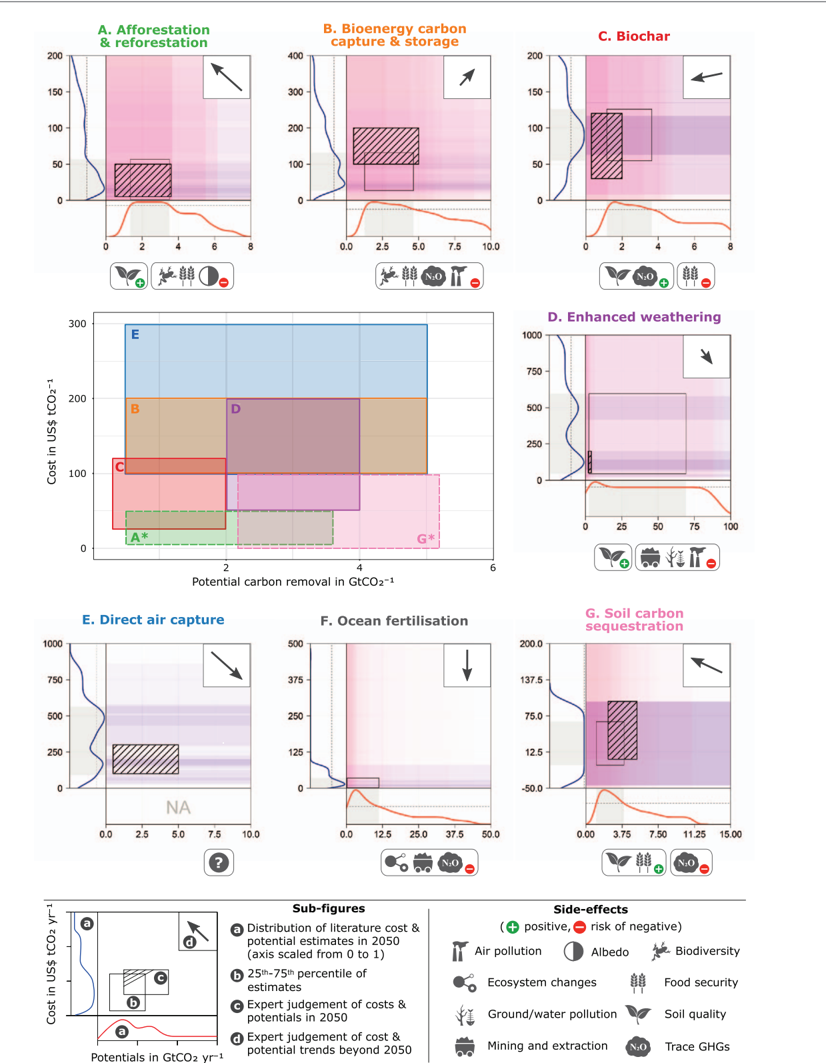
The most recent IPCC assessment has shown an important role for negative emissions technologies (NETs) in limiting global warming to 2 °C cost-effectively. However, a bottom-up, systematic, reproducible, and transparent literature assessment of the different options to remove CO 2 from the atmosphere is currently missing. In part 1 of this three-part review on NETs, we assemble a comprehensive set of the relevant literature so far published, focusing on seven technologies: bioenergy with carbon capture and storage (BECCS), afforestation and reforestation, direct air carbon capture and storage (DACCS), enhanced weathering, ocean fertilisation, biochar, and soil carbon sequestration. In this part, part 2 of the review, we present estimates of costs, potentials, and side-effects for these technologies, and qualify them with the authors' assessment. Part 3 reviews the innovation and scaling challenges that must be addressed to realise NETs deployment as a viable climate mitigation strategy. Based on a systematic review of the literature, our best estimates for sustainable global NET potentials in 2050 are 0.5–3.6 GtCO 2 yr −1 for afforestation and reforestation, 0.5–5 GtCO 2 yr −1 for BECCS, 0.5–2 GtCO 2 yr −1 for biochar, 2–4 GtCO 2 yr −1 for enhanced weathering, 0.5–5 GtCO 2 yr −1 for DACCS, and up to 5 GtCO 2 yr −1 for soil carbon sequestration. Costs vary widely across the technologies, as do their permanency and cumulative potentials beyond 2050. It is unlikely that a single NET will be able to sustainably meet the rates of carbon uptake described in integrated assessment pathways consistent with 1.5 °C of global warming.
Overview
The claims and statistics of this paper haven’t been checked yet.
Free: it reads the open-access text and checks the first 5 claims that cite a source we can check. Create a free account to check every claim.
Integrity signals
Registry
Cites
Statistics
Figures
Verification
Claims the paper makes
The claims and statistics of this paper haven’t been checked yet.
Free: it reads the open-access text and checks the first 5 claims that cite a source we can check. Create a free account to check every claim.
Claims other papers make about this one
Each is checked against this paper’s own text: does it say what the citing paper says it does?
The cited source doesn’t support the claim as written.
In the citing paper
“Previous reviews 18,28,[52][53][54] have shown that these pathways offer substantial CO 2 removal potential:”
From The technological and economic prospects for CO2 utilization and removal (2019) · cites this paper as [28]
Checked by a reasoning model — may be wrong.
Experimental — accuracy not yet measuredThe source backs part of the claim, not all of it — or backs it for a different population, condition or comparison.
In the citing paper
“Plausibly, all bioenergy that can be sourced sustainably (about 100 EJ 3,25 primary energy) could be allocated to BECCS, so that about 4.2-5.6Gt CO 2 per year could be sequestered (reflecting losses in energy and CO 2 in along different steps in the process).”
From The mutual dependence of negative emission technologies and energy systems (2019) · cites this paper as [3]
Experimental — accuracy not yet measuredThe source backs part of the claim, not all of it — or backs it for a different population, condition or comparison.
In the citing paper
“Removal costs are estimated at $5-$50/tCO 2 (Fuss et al. 2018).”
From Strategies for mitigation of climate change: a review (2020) · cites this paper as Fuss et al. 2018
Experimental — accuracy not yet measuredThe source backs part of the claim, not all of it — or backs it for a different population, condition or comparison.
In the citing paper
“Side effects of ocean fertilization that are discussed in the literature include ocean acidification, deep and mid-water oxygen decrease or depletion, increase in production of further greenhouse gases, unpredictable impact on food cycles, creation of toxic algal blooms as well as mixed effects on the seafloor and upper ocean ecosystems (Fuss et al. 2018;Williamson et al. 2012).”
From Strategies for mitigation of climate change: a review (2020) · cites this paper as Fuss et al. 2018
Experimental — accuracy not yet measuredThe source backs part of the claim, not all of it — or backs it for a different population, condition or comparison.
In the citing paper
“In the context of our CDR targets, ERW has a similar potential to that of other CDR strategies 23 estimated for 2050, including bio-energy with carbon capture and storage (BECCS), widely adopted in IPCC future scenarios (0.5-5 Gt CO2 yr -1 ), direct air carbon capture and storage (DAC) (0.5-5 Gt CO2 yr -1 ), biochar (0.5 to 2 Gt CO2 yr -1 ), soil organic carbon (SOC) sequestration (0.5-5 Gt CO2 yr”
From Potential for large-scale CO2 removal via enhanced rock weathering with croplands (2020) · cites this paper as [23]
Experimental — accuracy not yet measured
55 more claims about this paper
Create a free account to see every claim other papers make about this one.
Self-check
Percentages, sums and reported differences re-computed from the paper’s own numbers.
The self-check needs the paper’s full text.
Citations
Cites
Soil Carbon Sequestration Impacts on Global Climate Change and Food Security
Lal, R. (2004) · Science · doi:10.1126/science.1097396 · Cited by 8,376 · cited 6×
“Of the 22 articles (Batjes 1998, Benbi 2013, Conant 2011, Henderson et al 2015, Lal 2003b, 2003a, 2004a, 2004c, 2004b, 2010, 2011, 2013, Lassaletta and Aguilera 2015, Lorenz and Lal 2014, Powlson et al 2014, Salati et al 2010, Smith 2012, 2016, Sommer and Bossio 2014, Minasny et al 2017, Metting et…”
BackgroundInfluentialRiahi, K., van Vuuren, D. P., Kriegler, E., Edmonds, J., O’Neill, B. C., Fujimori, S., Bauer, N., Calvin, K., Dellink, R., Fricko, O., et al. (2017) · Global Environmental Change · doi:10.1016/j.gloenvcha.2016.05.009 · Cited by 6,607
Self-citationThe next generation of scenarios for climate change research and assessment
Moss, R. H., Edmonds, J. A., Hibbard, K. A., Manning, M. R., Rose, S. K., van Vuuren, D. P., Carter, T. R., Emori, S., Kainuma, M., Kram, T., et al. (2010) · Nature · doi:10.1038/nature08823 · Cited by 6,467
Brennan, L., & Owende, P. (2010) · Renewable and Sustainable Energy Reviews · doi:10.1016/j.rser.2009.10.009 · Cited by 4,894 · cited 2×
“24 Although achievable scales are not clear yet, there is also research on third-generation biofuels, derived from algal biomass (Brennan and Owende 2010) with the potential to enhance yields by improving microalgal biology through genetic or metabolic engineering (Tandon and Jin 2017).”
BackgroundCarbon capture and storage (CCS): the way forward
Bui, M., Adjiman, C. S., Bardow, A., Anthony, E. J., Boston, A., Brown, S., Fennell, P. S., Fuss, S., Galindo, A., Hackett, L. A., et al. (2018) · Energy & Environmental Science · doi:10.1039/c7ee02342a · Cited by 4,374
Self-citationGlobal effects of land use on local terrestrial biodiversity
Newbold, T., Hudson, L. N., Hill, S. L. L., Contu, S., Lysenko, I., Senior, R. A., Börger, L., Bennett, D. J., Choimes, A., Collen, B., et al. (2015) · Nature · doi:10.1038/nature14324 · Cited by 4,352
Soil carbon sequestration to mitigate climate change
Lal, R. (2004) · Geoderma · doi:10.1016/j.geoderma.2004.01.032 · Cited by 3,936 · cited 6×
“Of the 22 articles (Batjes 1998, Benbi 2013, Conant 2011, Henderson et al 2015, Lal 2003b, 2003a, 2004a, 2004c, 2004b, 2010, 2011, 2013, Lassaletta and Aguilera 2015, Lorenz and Lal 2014, Powlson et al 2014, Salati et al 2010, Smith 2012, 2016, Sommer and Bossio 2014, Minasny et al 2017, Metting et…”
BackgroundInfluentialGriscom, B. W., Adams, J., Ellis, P. W., Houghton, R. A., Lomax, G., Miteva, D. A., Schlesinger, W. H., Shoch, D., Siikamäki, J. V., Smith, P., et al. (2017) · Proceedings of the National Academy of Sciences · doi:10.1073/pnas.1710465114 · Cited by 3,481
Self-citationO’Neill, B. C., Kriegler, E., Ebi, K. L., Kemp-Benedict, E., Riahi, K., Rothman, D. S., van Ruijven, B. J., van Vuuren, D. P., Birkmann, J., Kok, K., et al. (2017) · Global Environmental Change · doi:10.1016/j.gloenvcha.2015.01.004 · Cited by 3,359
Irreversible climate change due to carbon dioxide emissions
Solomon, S., Plattner, G.-K., Knutti, R., & Friedlingstein, P. (2009) · Proceedings of the National Academy of Sciences · doi:10.1073/pnas.0812721106 · Cited by 3,217 · cited 1×
“…et al 2015, Riahi et al 2015, Eom et al 2015), temperature overshoot carries additional risks associated with higher levels of warming and the resulting impacts and climate feedbacks that could occur (van Vuuren et al 2013, Solomon et al 2009, Friedlingstein et al 2006, Clarke et al 2014).”
Background
Research works printed but not linked: 32
- Bruckner T ed Edenhofer E, 2014, Contribution of Working Group III to the Fifth Assessment Report of the Intergovernmental Panel on Climate Change
- Bui M, 2018, Energy Environ. Sci.
- Ciais P ed Stocker T F, 2013, Climate Change 2013: The Physical Science Basis. Contribution of Working Group I to the Fifth Assessment Report of the Intergovernmental Panel on Climate Change
- Clarke L E ed Edenhofer O, 2014, Clim. Change 2014 Mitig. Clim. Change Contrib. Work. Gr. III to Fifth Assess. Rep. Intergov. Panel Clim. Change, 413
- Coelho S T, 2012, Chapter 20—land and water: linkages to bioenergy, 1459
- Corathers L A, 2015, Earth
- d’Hotman D V, 1961, Int. Sugar J., 63, 363
- Dale V H, 2010, Biofuels: implications for Land Use and Biodiversity
- Díaz S, 2009, Biodiversity, Ecosystem Functioning, and Human Wellbeing
- Fuss S, 2017, Oxf. Res. Encycl. Clim. Sci., 1
- Gale J J, 2004, Geol. Belgica, 7, 99
- Haberl H ed Dewulf J, 2015, Sustainability Assessment of Renewables-Based Products, 1
- Hassani N, 2016, Pet. Res., 25, 4
- IEA GHG, 2005, Building the Cost Curves for CO
- IEA GHG, 1998, Enhanced Coal Bed Methane Recovery with CO
- IPCC ed Metz B, 2005, Carbon Dioxide Capture and Storage (SRCCS)
- IPCC ed Qin D, 2013, Contribution of Working Group I to the Fifth Assessment Report of the Intergovernmental Panel on Climate Change
- IPCC ed Edenhofer O, 2014, Contribution of Working Group III to the Fifth Assessment Report of the Intergovernmental Panel on Climate Change
- IPCC ed Pachauri R K, 2014, Contribution of Working Groups I, II and III to the Fifth Assessment Report of the Intergovernmental Panel on Climate Change
- Liu W W, 2016, Acta Ecol. Sin., 36, 2113
- Lopes A S, 1996, Better Crop. Int., 10, 10
- Magill B, 2017, Clim. Cent.
- Markels M, 2001, Poster Presentation for NETL Conference on Carbon Sequestration, 14
- 10.1088/1748-9326/aabf9 · doi:10.1088/1748-9326/aabf9
- Minx J, 2017, Environ. Res. Lett., 12
- National Academy of Sciences, 2015, Climate Intervention
- 53. Nkouathio D G, Wandji P, Bardintzeff J M, Tematio P, Dongmo A K and Tchoua F 2008 Utilisation des roches volcaniques pour la remineralisation des sols ferrallitiques des regions tropicales. Cas des pyroclastites basaltiques du graben de Tombel (Ligne volcanique du Cameroun) Bull. Soc. Vaudoise Sci. Nat. 91 1-14
- 122. Sedjo R A and Solomon A M 1991 Climate and forests Greenhouse Warming: Abatement and Adaptation (Resources for the Future)
- Strefler J, 2018, Environ. Res. Lett., 13
- Strefler J, 2018, Environ. Res. Lett., 13
- UNEP, 2017, The Emissions Gap Report 2017
- USDOE, 2014, Report
Cited by
Items 1,001–1,001 of 1,001
Meeting climate targets by direct CO 2 injections: what price would the ocean have to pay?
Reith, F., Koeve, W., Keller, D. P., Getzlaff, J., & Oschlies, A. (2019) · Earth System Dynamics · doi:10.5194/esd-10-711-2019 · Cited by 4
Metadata
- Authors
- Fuss, S., Lamb, W. F., Callaghan, M. W., Hilaire, J., Creutzig, F., Amann, T., Beringer, T., de Oliveira Garcia, W., Hartmann, J., Khanna, T., Luderer, G., Nemet, G. F., Rogelj, J., Smith, P., Vicente, J. L. V., Wilcox, J., del Mar Zamora Dominguez, M., & Minx, J. C.
- Affiliations
- Mercator Research Institute on Global Commons and Climate Change (DE)
- University of Leeds (GB)
- Universität Hamburg (DE)
- Potsdam Institute for Climate Impact Research (DE)
- University of Wisconsin–Madison (US)
- International Institute for Applied Systems Analysis (AT)
- University of Aberdeen (GB)
- Colorado School of Mines (US)
- Corresponding author
- Fuss, Sabine
- ORCID
- Venue
- Environmental Research Letters
- Publisher
- IOP Publishing
- Published
- 2018-05-21
- Volume
- 13
- Issue
- 6
- Pages
- 063002
- ISSN
- 1748-9326 (ISSN-L)
- OpenAlex
- W2804406438
- Semantic Scholar
- ca2b06bf3d1bd787e7941d46ef0e673b8e288399
- Cited by
- 1,525
- References
- 402
- Citations by year
- 2026: 128 · 2025: 225 · 2024: 231 · 2023: 262 · 2022: 264 · 2021: 200 · 2020: 117 · 2019: 84 · 2018: 13
- FWCI
- 66.25
- Type
- journal article
- Language
- en
- Open access
- gold
- doi.org
- Licence
- cc-by
- iopscience.iop.org/info/page/text-and-data-mining (tdm, 1 d)
- creativecommons.org/licenses/by/3.0/ (vor, 1 d)
- Locations
- Environmental Research Letters (publishedVersion, cc-by)
- White Rose Research Online (University of Leeds, The University of Sheffield, University of York) (acceptedVersion)
- Aberdeen University Research Archive (Aberdeen University) (submittedVersion)
- DOAJ (DOAJ: Directory of Open Access Journals) (submittedVersion)
- Publication Database PIK (Potsdam Institute for Climate Impact Research (PIK)) (submittedVersion, other-oa)
- Spiral (Imperial College London) (submittedVersion, cc-by)
- Repository for Publications and Research Data (ETH Zurich) (submittedVersion, cc-by)
- ETH Zürich Research Collection (cc-by)
- Funders
- Bundesministerium für Bildung und Forschung (01LS1610B, 03EK3046B)
- UK Energy Research Centre (UKERC/FFR2/3)
- Deutsche Forschungsgemeinschaft (SSP-1689)
- Natural Environment Research Council (NE/P019455/1, NE/P019900/1)
- Topics
- Physical Sciences › Chemical Engineering › Filtration and Separation › Carbon Dioxide Capture Technologies
- Social Sciences › Economics, Econometrics and Finance › Economics and Econometrics › Climate Change Policy and Economics
- Physical Sciences › Environmental Science › Global and Planetary Change › Climate Change and Geoengineering
- Keywords
- negative emissions technologies, bioenergy with carbon capture and storage, afforestation and reforestation, direct air capture, enhanced weathering, biochar, soil carbon sequestration, climate change mitigation, 2°C target, 1.5°C target
About these checks
Registry, retraction, Cites and statistics results are computed, not judged, with one exception: a printed reference that no index lists is read once by a model before it counts as a citation error. Claims are extracted by a model and kept only when their quote appears verbatim in the text; each cited source is then checked, with a model’s help, for whether it says what the claim relies on. Those verdicts can be wrong — read the claim’s quote and the cited source before relying on one.
Statistics and arithmetic are recomputed, not judged.
Confidence bands are shown only for fields calibrated on our annotated test set. None is calibrated yet, so no band is shown.
What counts as a claim ›How we measure confidence ›How we check this ›
Are you an author, or do you see a problem with this page? Request a review
Data sources
Bibliographic data: Semantic Scholar, OpenAlex, Crossref.
Contains information from the Semantic Scholar Academic Graph Datasets, made available under the ODC Attribution License (ODC-BY 1.0).
Semantic Scholar’s data is described in: Kinney, R., et al. (2023). The Semantic Scholar Open Data Platform. arXiv:2301.10140.
