

Negative emissions—Part 2: Costs, potentials and side effects
Open accessThe DOI matches its Crossref record; 399 of the 402 references it cites were found in a registry or an index.
Abstract
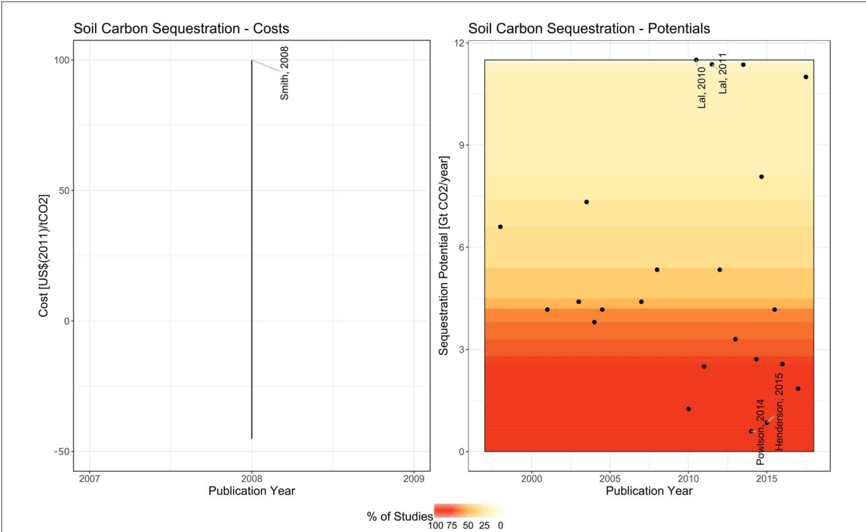
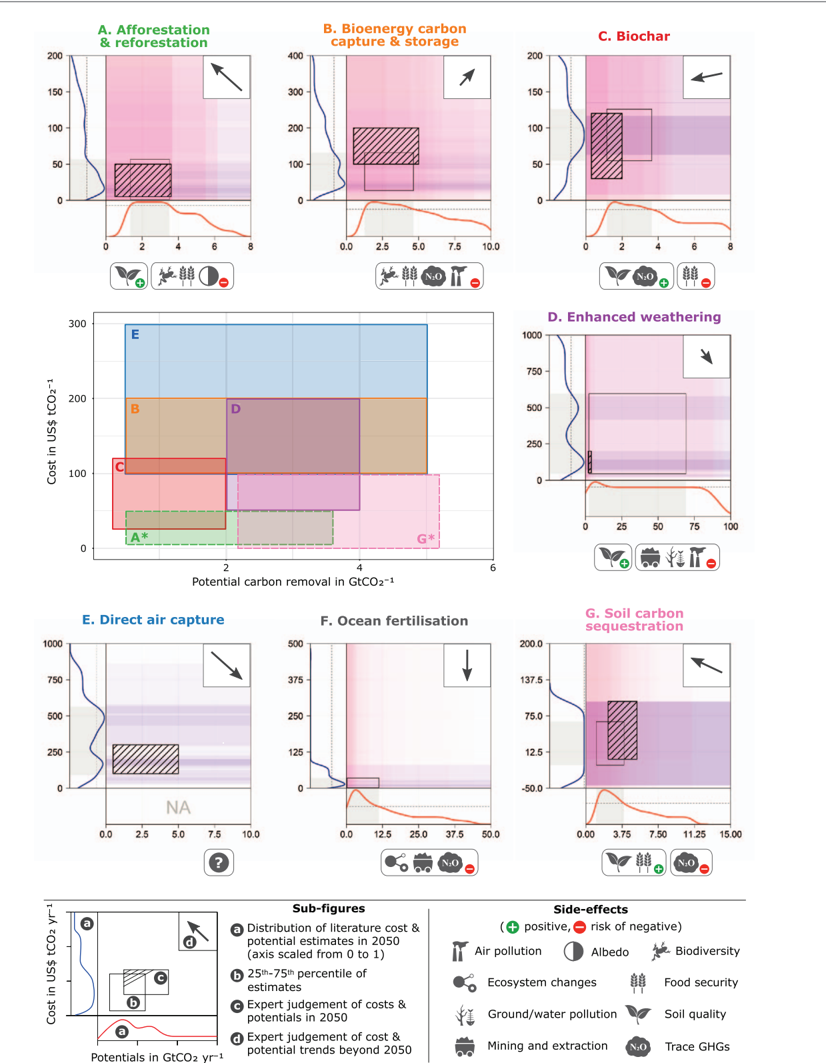
The most recent IPCC assessment has shown an important role for negative emissions technologies (NETs) in limiting global warming to 2 °C cost-effectively. However, a bottom-up, systematic, reproducible, and transparent literature assessment of the different options to remove CO 2 from the atmosphere is currently missing. In part 1 of this three-part review on NETs, we assemble a comprehensive set of the relevant literature so far published, focusing on seven technologies: bioenergy with carbon capture and storage (BECCS), afforestation and reforestation, direct air carbon capture and storage (DACCS), enhanced weathering, ocean fertilisation, biochar, and soil carbon sequestration. In this part, part 2 of the review, we present estimates of costs, potentials, and side-effects for these technologies, and qualify them with the authors' assessment. Part 3 reviews the innovation and scaling challenges that must be addressed to realise NETs deployment as a viable climate mitigation strategy. Based on a systematic review of the literature, our best estimates for sustainable global NET potentials in 2050 are 0.5–3.6 GtCO 2 yr −1 for afforestation and reforestation, 0.5–5 GtCO 2 yr −1 for BECCS, 0.5–2 GtCO 2 yr −1 for biochar, 2–4 GtCO 2 yr −1 for enhanced weathering, 0.5–5 GtCO 2 yr −1 for DACCS, and up to 5 GtCO 2 yr −1 for soil carbon sequestration. Costs vary widely across the technologies, as do their permanency and cumulative potentials beyond 2050. It is unlikely that a single NET will be able to sustainably meet the rates of carbon uptake described in integrated assessment pathways consistent with 1.5 °C of global warming.
Overview
The claims and statistics of this paper haven’t been checked yet.
Free: it reads the open-access text and checks the first 5 claims that cite a source we can check. Create a free account to check every claim.
Integrity signals
Registry
Cites
Statistics
Figures
Verification
Claims the paper makes
The claims and statistics of this paper haven’t been checked yet.
Free: it reads the open-access text and checks the first 5 claims that cite a source we can check. Create a free account to check every claim.
Claims other papers make about this one
Each is checked against this paper’s own text: does it say what the citing paper says it does?
The cited source doesn’t support the claim as written.
In the citing paper
“Previous reviews 18,28,[52][53][54] have shown that these pathways offer substantial CO 2 removal potential:”
From The technological and economic prospects for CO2 utilization and removal (2019) · cites this paper as [28]
Checked by a reasoning model — may be wrong.
Experimental — accuracy not yet measuredThe source backs part of the claim, not all of it — or backs it for a different population, condition or comparison.
In the citing paper
“Plausibly, all bioenergy that can be sourced sustainably (about 100 EJ 3,25 primary energy) could be allocated to BECCS, so that about 4.2-5.6Gt CO 2 per year could be sequestered (reflecting losses in energy and CO 2 in along different steps in the process).”
From The mutual dependence of negative emission technologies and energy systems (2019) · cites this paper as [3]
Experimental — accuracy not yet measuredThe source backs part of the claim, not all of it — or backs it for a different population, condition or comparison.
In the citing paper
“Removal costs are estimated at $5-$50/tCO 2 (Fuss et al. 2018).”
From Strategies for mitigation of climate change: a review (2020) · cites this paper as Fuss et al. 2018
Experimental — accuracy not yet measuredThe source backs part of the claim, not all of it — or backs it for a different population, condition or comparison.
In the citing paper
“Side effects of ocean fertilization that are discussed in the literature include ocean acidification, deep and mid-water oxygen decrease or depletion, increase in production of further greenhouse gases, unpredictable impact on food cycles, creation of toxic algal blooms as well as mixed effects on the seafloor and upper ocean ecosystems (Fuss et al. 2018;Williamson et al. 2012).”
From Strategies for mitigation of climate change: a review (2020) · cites this paper as Fuss et al. 2018
Experimental — accuracy not yet measuredThe source backs part of the claim, not all of it — or backs it for a different population, condition or comparison.
In the citing paper
“In the context of our CDR targets, ERW has a similar potential to that of other CDR strategies 23 estimated for 2050, including bio-energy with carbon capture and storage (BECCS), widely adopted in IPCC future scenarios (0.5-5 Gt CO2 yr -1 ), direct air carbon capture and storage (DAC) (0.5-5 Gt CO2 yr -1 ), biochar (0.5 to 2 Gt CO2 yr -1 ), soil organic carbon (SOC) sequestration (0.5-5 Gt CO2 yr”
From Potential for large-scale CO2 removal via enhanced rock weathering with croplands (2020) · cites this paper as [23]
Experimental — accuracy not yet measured
55 more claims about this paper
Create a free account to see every claim other papers make about this one.
Self-check
Percentages, sums and reported differences re-computed from the paper’s own numbers.
The self-check needs the paper’s full text.
Citations
Cites
Soil Carbon Sequestration Impacts on Global Climate Change and Food Security
Lal, R. (2004) · Science · doi:10.1126/science.1097396 · Cited by 8,376 · cited 6×
“Of the 22 articles (Batjes 1998, Benbi 2013, Conant 2011, Henderson et al 2015, Lal 2003b, 2003a, 2004a, 2004c, 2004b, 2010, 2011, 2013, Lassaletta and Aguilera 2015, Lorenz and Lal 2014, Powlson et al 2014, Salati et al 2010, Smith 2012, 2016, Sommer and Bossio 2014, Minasny et al 2017, Metting et…”
BackgroundInfluentialRiahi, K., van Vuuren, D. P., Kriegler, E., Edmonds, J., O’Neill, B. C., Fujimori, S., Bauer, N., Calvin, K., Dellink, R., Fricko, O., et al. (2017) · Global Environmental Change · doi:10.1016/j.gloenvcha.2016.05.009 · Cited by 6,607
Self-citationThe next generation of scenarios for climate change research and assessment
Moss, R. H., Edmonds, J. A., Hibbard, K. A., Manning, M. R., Rose, S. K., van Vuuren, D. P., Carter, T. R., Emori, S., Kainuma, M., Kram, T., et al. (2010) · Nature · doi:10.1038/nature08823 · Cited by 6,467
Brennan, L., & Owende, P. (2010) · Renewable and Sustainable Energy Reviews · doi:10.1016/j.rser.2009.10.009 · Cited by 4,894 · cited 2×
“24 Although achievable scales are not clear yet, there is also research on third-generation biofuels, derived from algal biomass (Brennan and Owende 2010) with the potential to enhance yields by improving microalgal biology through genetic or metabolic engineering (Tandon and Jin 2017).”
BackgroundCarbon capture and storage (CCS): the way forward
Bui, M., Adjiman, C. S., Bardow, A., Anthony, E. J., Boston, A., Brown, S., Fennell, P. S., Fuss, S., Galindo, A., Hackett, L. A., et al. (2018) · Energy & Environmental Science · doi:10.1039/c7ee02342a · Cited by 4,374
Self-citationGlobal effects of land use on local terrestrial biodiversity
Newbold, T., Hudson, L. N., Hill, S. L. L., Contu, S., Lysenko, I., Senior, R. A., Börger, L., Bennett, D. J., Choimes, A., Collen, B., et al. (2015) · Nature · doi:10.1038/nature14324 · Cited by 4,352
Soil carbon sequestration to mitigate climate change
Lal, R. (2004) · Geoderma · doi:10.1016/j.geoderma.2004.01.032 · Cited by 3,936 · cited 6×
“Of the 22 articles (Batjes 1998, Benbi 2013, Conant 2011, Henderson et al 2015, Lal 2003b, 2003a, 2004a, 2004c, 2004b, 2010, 2011, 2013, Lassaletta and Aguilera 2015, Lorenz and Lal 2014, Powlson et al 2014, Salati et al 2010, Smith 2012, 2016, Sommer and Bossio 2014, Minasny et al 2017, Metting et…”
BackgroundInfluentialGriscom, B. W., Adams, J., Ellis, P. W., Houghton, R. A., Lomax, G., Miteva, D. A., Schlesinger, W. H., Shoch, D., Siikamäki, J. V., Smith, P., et al. (2017) · Proceedings of the National Academy of Sciences · doi:10.1073/pnas.1710465114 · Cited by 3,481
Self-citationO’Neill, B. C., Kriegler, E., Ebi, K. L., Kemp-Benedict, E., Riahi, K., Rothman, D. S., van Ruijven, B. J., van Vuuren, D. P., Birkmann, J., Kok, K., et al. (2017) · Global Environmental Change · doi:10.1016/j.gloenvcha.2015.01.004 · Cited by 3,359
Irreversible climate change due to carbon dioxide emissions
Solomon, S., Plattner, G.-K., Knutti, R., & Friedlingstein, P. (2009) · Proceedings of the National Academy of Sciences · doi:10.1073/pnas.0812721106 · Cited by 3,217 · cited 1×
“…et al 2015, Riahi et al 2015, Eom et al 2015), temperature overshoot carries additional risks associated with higher levels of warming and the resulting impacts and climate feedbacks that could occur (van Vuuren et al 2013, Solomon et al 2009, Friedlingstein et al 2006, Clarke et al 2014).”
Background
Research works printed but not linked: 32
- Bruckner T ed Edenhofer E, 2014, Contribution of Working Group III to the Fifth Assessment Report of the Intergovernmental Panel on Climate Change
- Bui M, 2018, Energy Environ. Sci.
- Ciais P ed Stocker T F, 2013, Climate Change 2013: The Physical Science Basis. Contribution of Working Group I to the Fifth Assessment Report of the Intergovernmental Panel on Climate Change
- Clarke L E ed Edenhofer O, 2014, Clim. Change 2014 Mitig. Clim. Change Contrib. Work. Gr. III to Fifth Assess. Rep. Intergov. Panel Clim. Change, 413
- Coelho S T, 2012, Chapter 20—land and water: linkages to bioenergy, 1459
- Corathers L A, 2015, Earth
- d’Hotman D V, 1961, Int. Sugar J., 63, 363
- Dale V H, 2010, Biofuels: implications for Land Use and Biodiversity
- Díaz S, 2009, Biodiversity, Ecosystem Functioning, and Human Wellbeing
- Fuss S, 2017, Oxf. Res. Encycl. Clim. Sci., 1
- Gale J J, 2004, Geol. Belgica, 7, 99
- Haberl H ed Dewulf J, 2015, Sustainability Assessment of Renewables-Based Products, 1
- Hassani N, 2016, Pet. Res., 25, 4
- IEA GHG, 2005, Building the Cost Curves for CO
- IEA GHG, 1998, Enhanced Coal Bed Methane Recovery with CO
- IPCC ed Metz B, 2005, Carbon Dioxide Capture and Storage (SRCCS)
- IPCC ed Qin D, 2013, Contribution of Working Group I to the Fifth Assessment Report of the Intergovernmental Panel on Climate Change
- IPCC ed Edenhofer O, 2014, Contribution of Working Group III to the Fifth Assessment Report of the Intergovernmental Panel on Climate Change
- IPCC ed Pachauri R K, 2014, Contribution of Working Groups I, II and III to the Fifth Assessment Report of the Intergovernmental Panel on Climate Change
- Liu W W, 2016, Acta Ecol. Sin., 36, 2113
- Lopes A S, 1996, Better Crop. Int., 10, 10
- Magill B, 2017, Clim. Cent.
- Markels M, 2001, Poster Presentation for NETL Conference on Carbon Sequestration, 14
- 10.1088/1748-9326/aabf9 · doi:10.1088/1748-9326/aabf9
- Minx J, 2017, Environ. Res. Lett., 12
- National Academy of Sciences, 2015, Climate Intervention
- 53. Nkouathio D G, Wandji P, Bardintzeff J M, Tematio P, Dongmo A K and Tchoua F 2008 Utilisation des roches volcaniques pour la remineralisation des sols ferrallitiques des regions tropicales. Cas des pyroclastites basaltiques du graben de Tombel (Ligne volcanique du Cameroun) Bull. Soc. Vaudoise Sci. Nat. 91 1-14
- 122. Sedjo R A and Solomon A M 1991 Climate and forests Greenhouse Warming: Abatement and Adaptation (Resources for the Future)
- Strefler J, 2018, Environ. Res. Lett., 13
- Strefler J, 2018, Environ. Res. Lett., 13
- UNEP, 2017, The Emissions Gap Report 2017
- USDOE, 2014, Report
Cited by
Items 101–200 of 1,001
Young, J., García-Díez, E., Garcia, S., & van der Spek, M. (2021) · Energy & Environmental Science · doi:10.1039/d1ee01272j · Cited by 184
Evaluating the use of BECCS and afforestation under China’s carbon-neutral target for 2060
Weng, Y., Cai, W., & Wang, C. (2021) · Applied Energy · doi:10.1016/j.apenergy.2021.117263 · Cited by 183
Overconfidence in climate overshoot
Schleussner, C.-F., Ganti, G., Lejeune, Q., Zhu, B., Pfleiderer, P., Prütz, R., Ciais, P., Frölicher, T. L., Fuss, S., Gasser, T., et al. (2024) · Nature · doi:10.1038/s41586-024-08020-9 · Cited by 177
Self-citationA new strategy for membrane-based direct air capture
Fujikawa, S., Selyanchyn, R., & Kunitake, T. (2021) · Polymer Journal · doi:10.1038/s41428-020-00429-z · Cited by 177
Equity in allocating carbon dioxide removal quotas
Pozo, C., Galán-Martín, Á., Reiner, D. M., Mac Dowell, N., & Guillén-Gosálbez, G. (2020) · Nature Climate Change · doi:10.1038/s41558-020-0802-4 · Cited by 172
Feasible deployment of carbon capture and storage and the requirements of climate targets
Kazlou, T., Cherp, A., & Jewell, J. (2024) · Nature Climate Change · doi:10.1038/s41558-024-02104-0 · Cited by 172
“The integrated assessment modelling community has addressed concerns about the outsized role of CCS in mitigation pathways 2,62 by developing scenarios, including illustrative mitigation pathways, with low or no (BE)CCS 10,34,56,64–67 .”
Operationalizing the net-negative carbon economy
Bednar, J., Obersteiner, M., Baklanov, A., Thomson, M., Wagner, F., Geden, O., Allen, M., & Hall, J. W. (2021) · Nature · doi:10.1038/s41586-021-03723-9 · Cited by 171
Considering technology characteristics to project future costs of direct air capture
Sievert, K., Schmidt, T. S., & Steffen, B. (2024) · Joule · doi:10.1016/j.joule.2024.02.005 · Cited by 164
(2022) · Climate Change and Land · doi:10.1017/9781009157988.007 · Cited by 163
Kinetics of Olivine Weathering in Seawater: An Experimental Study
Fuhr, M., Geilert, S., Schmidt, M., Liebetrau, V., Vogt, C., Ledwig, B., & Wallmann, K. (2022) · Frontiers in Climate · doi:10.3389/fclim.2022.831587 · Cited by 161
Sabatino, F., Mehta, M., Grimm, A., Gazzani, M., Gallucci, F., Kramer, G. J., & van Sint Annaland, M. (2020) · Industrial & Engineering Chemistry Research · doi:10.1021/acs.iecr.9b05641 · Cited by 161
Influence of Fire on the Carbon Cycle and Climate
Lasslop, G., Coppola, A. I., Voulgarakis, A., Yue, C., & Veraverbeke, S. (2019) · Current Climate Change Reports · doi:10.1007/s40641-019-00128-9 · Cited by 161
Environmental trade-offs of direct air capture technologies in climate change mitigation toward 2100
Qiu, Y., Lamers, P., Daioglou, V., McQueen, N., de Boer, H.-S., Harmsen, M., Wilcox, J., Bardow, A., & Suh, S. (2022) · Nature Communications · doi:10.1038/s41467-022-31146-1 · Cited by 160
Self-citationAssessing the influence of ocean alkalinity enhancement on a coastal phytoplankton community
Ferderer, A., Chase, Z., Kennedy, F., Schulz, K. G., & Bach, L. T. (2022) · Biogeosciences · doi:10.5194/bg-19-5375-2022 · Cited by 160
Challenges to the Reforestation Pipeline in the United States
Fargione, J., Haase, D. L., Burney, O. T., Kildisheva, O. A., Edge, G., Cook‐Patton, S. C., Chapman, T. B., Rempel, A., Hurteau, M. D., Davis, K. T., et al. (2021) · Frontiers in Forests and Global Change · doi:10.3389/ffgc.2021.629198 · Cited by 184
“…for tree planting is gaining momentum, with multiple ambitious goals set forth to restore forest cover for climate mitigation (Griscom et al., 2017; Fuss et al., 2018; Bastin et al., 2019; Holl and Brancalion, 2020) and other environmental co-benefits such as soil stabilization, watershed…”
BackgroundEnhanced Weathering and related element fluxes – a cropland mesocosm approach
Amann, T., Hartmann, J., Struyf, E., Garcia, W. D. O., Fischer, E. K., Janssens, I. A., Meire, P. M., & Schoelynck, J. (2020) · Biogeosciences · doi:10.5194/bg-17-103-2020 · Cited by 205
Self-citationMitigation Pathways Compatible with 1.5°C in the Context of Sustainable Development
(2022) · Global Warming of 1.5°C · doi:10.1017/9781009157940.004 · Cited by 154
Lefebvre, D., Goglio, P., Williams, A., Manning, D. A. C., de Azevedo, A. C., Bergmann, M., Meersmans, J., & Smith, P. (2019) · Journal of Cleaner Production · doi:10.1016/j.jclepro.2019.06.099 · Cited by 153
Self-citationRole of Carbon Capture, Storage, and Utilization to Enable a Net-Zero-CO2-Emissions Aviation Sector
Becattini, V., Gabrielli, P., & Mazzotti, M. (2021) · Industrial & Engineering Chemistry Research · doi:10.1021/acs.iecr.0c05392 · Cited by 153
Lopez, G., Farfan, J., & Breyer, C. (2022) · Journal of Cleaner Production · doi:10.1016/j.jclepro.2022.134182 · Cited by 173
Goglio, P., Williams, A. G., Balta‐Ozkan, N., Harris, N., Williamson, P. C., Huisingh, D., Zhang, Z., & Tavoni, M. (2019) · Journal of Cleaner Production · doi:10.1016/j.jclepro.2019.118896 · Cited by 175
Fair-share carbon dioxide removal increases major emitter responsibility
Fyson, C. L., Baur, S., Gidden, M., & Schleussner, C. (2020) · Nature Climate Change · doi:10.1038/s41558-020-0857-2 · Cited by 173
An Overview of the Role of Forests in Climate Change Mitigation
Psistaki, K., Τsantopoulos, G., & Paschalidou, A. Κ. (2024) · Sustainability · doi:10.3390/su16146089 · Cited by 222
Issaka, E., Fapohunda, F. O., Amu-Darko, J. N. O., Yeboah, L., Yakubu, S., Varjani, S., Ali, N., & Bilal, M. (2022) · Chemosphere · doi:10.1016/j.chemosphere.2022.134163 · Cited by 144
Wiegner, J. F., Grimm, A., Weimann, L., & Gazzani, M. (2022) · Industrial & Engineering Chemistry Research · doi:10.1021/acs.iecr.2c00681 · Cited by 162
Energy and sustainable development nexus: A review
Pan, X., Shao, T., Zheng, X., Zhang, Y., Ma, X., & Zhang, Q. (2023) · Energy Strategy Reviews · doi:10.1016/j.esr.2023.101078 · Cited by 184
Opportunities and challenges in using remaining carbon budgets to guide climate policy
Matthews, H. D., Tokarska, K. B., Nicholls, Z., Rogelj, J., Canadell, J. G., Friedlingstein, P., Frölicher, T. L., Forster, P. M. D. F., Gillett, N. P., Ilyina, T., et al. (2020) · Nature Geoscience · doi:10.1038/s41561-020-00663-3 · Cited by 174
Self-citationKazemifar, F. (2021) · Greenhouse Gases Science and Technology · doi:10.1002/ghg.2131 · Cited by 180
Achieving net-zero emissions in agriculture: a review
Rosa, L., & Gabrielli, P. (2023) · Environmental Research Letters · doi:10.1088/1748-9326/acd5e8 · Cited by 186
“Enhanced rock weathering involves the release of base cations that generate alkalinity, converting atmospheric CO2 into dissolved inorganic carbon that is removed via soil drainage waters [142].”
BackgroundInfluentialBioenergy for climate change mitigation: Scale and sustainability
Calvin, K., Cowie, A., Berndes, G., Arneth, A., Cherubini, F., Portugal‐Pereira, J., Grassi, G., House, J. I., Johnson, F. X., Popp, A., et al. (2021) · GCB Bioenergy · doi:10.1111/gcbb.12863 · Cited by 185
“, 2015), and the definition of ‘marginal’, the accuracy of land classification and the status as ‘unused’ are contested (ArizaMontobbio et al., 2010; Fuss et al., 2018).”
BackgroundSelf-citationImpacts of 1.5°C Global Warming on Natural and Human Systems
IPCC (2022) · Cambridge University Press eBooks · doi:10.1017/9781009157940.005 · Cited by 218
Potential implications of carbon dioxide removal for the sustainable development goals
Honegger, M., Michaelowa, A., & Roy, J. (2020) · Climate Policy · doi:10.1080/14693062.2020.1843388 · Cited by 156
“Groundwater chemistry and drinking water quality could be adversely affected (Wilkin & DiGiulio, 2010); seismic activities might be triggered by geological sequestration (Fuss et al., 2018) +”
BackgroundInfluentialRestoring Abandoned Farmland to Mitigate Climate Change on a Full Earth
Yang, Y., Hobbie, S. E., Hernandez, R. R., Fargione, J., Grodsky, S. M., Tilman, D., Zhu, Y.-G., Luo, Y., Smith, T. M., Jungers, J. M., et al. (2020) · One Earth · doi:10.1016/j.oneear.2020.07.019 · Cited by 133
“Although capturing and storing combusted C is possible, this technology still faces many geographic, technological, and economic constraints and uncertainties that limit widespread application.(100) One advantage of biomass is that it can be stored inexpensively, allowing electricity to be produced on demand.”
BackgroundAdvances in subsea carbon dioxide utilization and storage
Luo, J., Xie, Y., Hou, Z., Xiong, Y., Wu, X., Lüddeke, C. T., & Huang, L. (2023) · Energy Reviews · doi:10.1016/j.enrev.2023.100016 · Cited by 155
Quantifying the potential scale of mitigation deterrence from greenhouse gas removal techniques
McLaren, D. P. (2020) · Climatic Change · doi:10.1007/s10584-020-02732-3 · Cited by 165
Schreyer, F., Luderer, G., Rodrigues, R., Pietzcker, R., Baumstark, L., Sugiyama, M., Brecha, R. J., & Ueckerdt, F. (2020) · Environmental Research Letters · doi:10.1088/1748-9326/abb852 · Cited by 153
“However, there is considerable uncertainty regarding LUC CDR potentials as estimates depend on assumptions on land availability and management practices (Bryan et al 2014, Fuss et al 2018).”
BackgroundInfluentialSelf-citationLow, S., & Schäfer, S. (2020) · Energy Research & Social Science · doi:10.1016/j.erss.2019.101326 · Cited by 134
Stampi-Bombelli, V., van der Spek, M. W., & Mazzotti, M. (2020) · Adsorption · doi:10.1007/s10450-020-00249-w · Cited by 145
Tropical and Boreal Forest – Atmosphere Interactions: A Review
Artaxo, P. E., Hansson, H., Andreae, M. O., Bäck, J. K., Alves, E. G., Barbosa, H. M. J., Bender, F. A. ‐., Bourtsoukidis, E., Carbone, S., Chi, J., et al. (2022) · Tellus B · doi:10.16993/tellusb.34 · Cited by 167
How to make climate-neutral aviation fly
Sacchi, R., Becattini, V., Gabrielli, P., Cox, B., Dirnaichner, A., Bauer, C., & Mazzotti, M. (2023) · Nature Communications · doi:10.1038/s41467-023-39749-y · Cited by 161
Considering sustainability thresholds for BECCS in IPCC and biodiversity assessments
Creutzig, F., Erb, K., Haberl, H., Hof, C., Hunsberger, C. A., & Roe, S. (2021) · GCB Bioenergy · doi:10.1111/gcbb.12798 · Cited by 165
“5 and 5 Gt CO2/year in 2050 (Fuss et al., 2018), with the lower threshold exceeded by 91% and the upper threshold exceeded by 33% of all scenarios meeting the goals of the Paris Agreement.”
BackgroundInfluentialSelf-citationSykes, A. J., MacLeod, M. J., Eory, V., Rees, R. M., Payen, F. T., Myrgiotis, V., Williams, M., Sohi, S., Hillier, J., Moran, D., et al. (2019) · Global Change Biology · doi:10.1111/gcb.14844 · Cited by 155
“…et al., 2017; Vågen, Lal, & Singh, 2005), practice‐specific (Lehmann, Gaunt, & Rondon, 2006; Lorenz & Lal, 2014; McSherry & Ritchie, 2013) or have assessed global po‐ tentials without considering explicitly the practices used to deliver SCS (Fuss et al., 2018; Griscom et al., 2017; Smith, 2016).”
InfluentialSelf-citationVicca, S., Goll, D. S., Hagens, M., Hartmann, J., Janssens, I. A., Neubeck, A., Peñuelas, J., Poblador, S., Rijnders, J., Sardans, J., et al. (2021) · Global Change Biology · doi:10.1111/gcb.15993 · Cited by 168
Self-citationSocio-political feasibility of coal power phase-out and its role in mitigation pathways
Muttitt, G., Price, J., Pye, S., & Welsby, D. (2023) · Nature Climate Change · doi:10.1038/s41558-022-01576-2 · Cited by 151
An emission pathway classification reflecting the Paris Agreement climate objectives
Schleussner, C., Ganti, G., Rogelj, J., & Gidden, M. (2022) · Communications Earth & Environment · doi:10.1038/s43247-022-00467-w · Cited by 154
Self-citationHow do we best synergize climate mitigation actions to co‐benefit biodiversity?
Smith, P., Arneth, A., Barnes, D. K. A., Ichii, K., Marquet, P. A., Popp, A., Pörtner, H., Rogers, A. D., Scholes, R. J., Strassburg, B., et al. (2022) · Global Change Biology · doi:10.1111/gcb.16056 · Cited by 129
“…of seawater through seeding the ocean with natural or artificial alkaline materials to sequester CO2 as bicarbonate and carbonate ions (HCO3- , CO3 2−) in the ocean (technical potential: 1– 100 Gt CO2e year −1; Fuss et al., 2018) – similar to enhancing mineral weathering (see Section 2.3.7).”
BackgroundInfluentialSelf-citationGoren, A. Y., Erdemir, D., & Dinçer, İ. (2023) · Environmental Research · doi:10.1016/j.envres.2023.117503 · Cited by 159
Negative emissions technologies: A complementary solution for climate change mitigation
Pires, J. C. M. (2019) · Science of The Total Environment · doi:10.1016/j.scitotenv.2019.04.004 · Cited by 128
Closing the Knowledge-Action Gap in Climate Change
Knutti, R. (2019) · One Earth · doi:10.1016/j.oneear.2019.09.001 · Cited by 153
Cowie, A., Berndes, G., Bentsen, N. S., Brandão, M., Cherubini, F., Egnell, G., George, B. H., Gustavsson, L., Hanewinkel, M., Harris, Z. M., et al. (2021) · GCB Bioenergy · doi:10.1111/gcbb.12844 · Cited by 166
“Various bioenergy options contribute to these mitigation pathways, including substantial use of biomass for heat and liquid fuel applications (Fuss et al., 2018).”
BackgroundAgricultural acceleration of soil carbonate weathering
Kim, J. H., Jobbágy, E. G., Richter, D. D., Trumbore, S. E., & Jackson, R. B. (2020) · Global Change Biology · doi:10.1111/gcb.15207 · Cited by 127
“In the context of enhanced weathering as a means to achieve negative emissions (Fuss et al., 2018; Lawrence et al., 2018), our evidence for a sensitive SIC pool reacting to hydrological changes, along with the quantity, rate, and extent of the SIC losses, highlights the need for further evaluation…”
BackgroundRadical interventions for climate-impacted systems
Morrison, T. H., Adger, W. N., Agrawal, A., Brown, K., Hornsey, M. J., Hughes, T. P., Jain, M., Lemos, M. C., McHugh, L. H., O’Neill, S. J., et al. (2022) · Nature Climate Change · doi:10.1038/s41558-022-01542-y · Cited by 164
“Contemporary examples include unproven technologies such as carbon capture and storage 39 alongside geoengineering and bioengineering stopgaps, such as warm-water berms for glaciers, site-specific solar radiation management for coral reefs, and cryopreservation for temperate forest species 40–45 .”
BackgroundAtmospheric methane removal: a research agenda
Jackson, R. B., Abernethy, S., Canadell, J. G., Cargnello, M., Davis, S. J., Feron, S. C., Fuss, S., Heyer, A. J., Hong, C., JONES, C. D., et al. (2021) · Philosophical Transactions of the Royal Society A Mathematical Physical and Engineering Sciences · doi:10.1098/rsta.2020.0454 · Cited by 163
Self-citationIs carbon removal delaying emission reductions?
Carton, W., Hougaard, I., Markusson, N. O., & Lund, J. F. (2023) · Wiley Interdisciplinary Reviews Climate Change · doi:10.1002/wcc.826 · Cited by 158
“…amounts of carbon will need to be removed from the atmosphere, the argument goes, to compensate for continued emissions in “ hard-to-abate ” sectors, and/or to bring temperatures down again after a temporary overshoot of the 1.5 – 2 C temperature targets (Luderer et al., 2018; Rogelj et al., 2019).”
BackgroundInfluentialCarbon dioxide removal technologies are not born equal
Strefler, J., Bauer, N., Humpenöder, F., Klein, D., Popp, A., & Kriegler, E. (2021) · Environmental Research Letters · doi:10.1088/1748-9326/ac0a11 · Cited by 156
Low energy carbon capture via electrochemically induced pH swing with electrochemical rebalancing
Jin, S., Wu, M., Jing, Y., Gordon, R. G., & Aziz, M. J. (2022) · Nature Communications · doi:10.1038/s41467-022-29791-7 · Cited by 145
Ratcheting of climate pledges needed to limit peak global warming
Iyer, G. C., Ou, Y., Edmonds, J., Fawcett, A. A., Hultman, N., MCFARLAND, J. R., Fuhrman, J., WALDHOFF, S. T., & McJeon, H. C. (2022) · Nature Climate Change · doi:10.1038/s41558-022-01508-0 · Cited by 146
Inorganic carbon is overlooked in global soil carbon research: A bibliometric analysis
Raza, S., Irshad, A., Margenot, A. J., Zamanian, K., Li, N., Ullah, S., Mehmood, K., Khan, M. A., Siddique, N., Zhou, J., et al. (2024) · Geoderma · doi:10.1016/j.geoderma.2024.116831 · Cited by 137
“SOC sequestration in a technically feasible manner can remove 0.8 – 1.5 Pg C yr (cid:0) 1 from the atmosphere (Fuss et al., 2018 The SIC pool is larger than the atmospheric CO 2 pool or terrestrial plant biomass C.”
BackgroundInfluentialOil palm biomass in Indonesia: Thermochemical upgrading and its utilization
Nabila, R., Hidayat, W., Haryanto, A., Hasanudin, U., Iryani, D. A., Lee, S., Kim, S., Kim, S., Chun, D., Choi, H., et al. (2023) · Renewable and Sustainable Energy Reviews · doi:10.1016/j.rser.2023.113193 · Cited by 204
Review on 100% Renewable Energy System Analyses—A Bibliometric Perspective
Khalili, S., & Breyer, C. (2022) · IEEE Access · doi:10.1109/access.2022.3221155 · Cited by 130
“relevant CO2 direct removal (CDR) options [10], [627], while the LUT-ESTM has recently embarked to introduce the direct air carbon capture and storage (DACCS) [134] applied in full energy system integration for Egypt [628].”
BackgroundRisk management and decision-making in relation to sustainable development
Change, I. P. O. C. (2022) · Cambridge University Press eBooks · doi:10.1017/9781009157988.009 · Cited by 124
The contribution of living organisms to rock weathering in the critical zone
Wild, B., Gerrits, R., & Bonneville, S. (2022) · npj Materials Degradation · doi:10.1038/s41529-022-00312-7 · Cited by 137
Jat, M. L., Chakraborty, D., Ladha, J. K., Parihar, C. M., Datta, A., Mandal, B., Nayak, H. S., Maity, P. P., Rana, D. S., Chaudhari, S. K., et al. (2022) · Crop and Environment · doi:10.1016/j.crope.2022.03.005 · Cited by 144
Reducing sectoral hard-to-abate emissions to limit reliance on carbon dioxide removal
Edelenbosch, O. Y., Hof, A. F., van den Berg, M., de Boer, H. S., Chen, H.-H., Daioglou, V., Dekker, M., Doelman, J., den Elzen, M. G. J., Harmsen, M. J. H. M., et al. (2024) · Nature Climate Change · doi:10.1038/s41558-024-02025-y · Cited by 152
“However, total bioenergy use exceeds 60 EJ yr −1 as it includes residue use, which does not require additional land 46,47 .”
Negative emissions and international climate goals—learning from and about mitigation scenarios
Hilaire, J., Minx, J. C., Callaghan, M. W., Edmonds, J., Luderer, G., Nemet, G. F., Rogelj, J., & del Mar Zamora, M. (2019) · Climatic Change · doi:10.1007/s10584-019-02516-4 · Cited by 110
“Importantly, this review allowed us to identify important research gaps, some of which have been underscored in Fuss et al. (2018) and Rogelj et al. (2018b).”
BackgroundInfluentialSelf-citationDirect Air Capture of CO 2 Using Amine/Alumina Sorbents at Cold Temperature
Priyadarshini, P., Rim, G., Rosu, C., Song, M., & Jones, C. W. (2023) · ACS Environmental Au · doi:10.1021/acsenvironau.3c00010 · Cited by 120
Moving toward Net-Zero Emissions Requires New Alliances for Carbon Dioxide Removal
Fuss, S., Canadell, J. G., Ciais, P., Jackson, R. B., JONES, C. D., Lyngfelt, A., Peters, G. P., & van Vuuren, D. P. (2020) · One Earth · doi:10.1016/j.oneear.2020.08.002 · Cited by 128
“for some CDR options such as afforestation but will also be key to feeding a growing population.(5) Decision makers are turning to the international research and development (R&D) community for answers, requiring”
BackgroundSelf-citationA policy roadmap for negative emissions using direct air capture
Meckling, J., & Biber, E. (2021) · Nature Communications · doi:10.1038/s41467-021-22347-1 · Cited by 127
Fuhrman, J., Clarens, A. F., Calvin, K., Doney, S. C., Edmonds, J., O’Rourke, P., Patel, P., Pradhan, S., Shobe, W., & McJeon, H. C. (2021) · Environmental Research Letters · doi:10.1088/1748-9326/ac2db0 · Cited by 127
Sendi, M., Bui, M., Dowell, N. M., & Fennell, P. S. (2022) · One Earth · doi:10.1016/j.oneear.2022.09.003 · Cited by 131
Environmental sustainability of negative emissions technologies: A review
Jeswani, H. K., Saharudin, D. M., & Azapagic, A. (2022) · Sustainable Production and Consumption · doi:10.1016/j.spc.2022.06.028 · Cited by 133
A multimodel analysis of post-Glasgow climate targets and feasibility challenges
de Ven, D.-J. V., Mittal, S., Gambhir, A., Lamboll, R., Doukas, H., Giarola, S., Hawkes, A. D., Koasidis, K., Köberle, A. C., McJeon, H. C., et al. (2023) · Nature Climate Change · doi:10.1038/s41558-023-01661-0 · Cited by 129
Self-citationPrinciples for Thinking about Carbon Dioxide Removal in Just Climate Policy
Morrow, D. R., Thompson, M. S., Anderson, A., Batres, M., Buck, H. J., Dooley, K., Geden, O., Ghosh, A., Low, S., Njamnshi, A., et al. (2020) · One Earth · doi:10.1016/j.oneear.2020.07.015 · Cited by 121
Self-citationArneth, A., Olsson, L., Cowie, A., Erb, K.-H., Hurlbert, M., Kurz, W. A., Mirzabaev, A., & Rounsevell, M. D. A. (2021) · Annual Review of Environment and Resources · doi:10.1146/annurev-environ-012320-054809 · Cited by 131
Zhu, X., Ge, T., Yang, F., & Wang, R. Z. (2020) · Renewable and Sustainable Energy Reviews · doi:10.1016/j.rser.2020.110651 · Cited by 114
The carbon dioxide removal gap
Lamb, W. F., Gasser, T., Román-Cuesta, R. M., Grassi, G., Gidden, M., Powis, C. M., Geden, O., Nemet, G. F., Pratama, Y. W., Riahi, K., et al. (2024) · Nature Climate Change · doi:10.1038/s41558-024-01984-6 · Cited by 158
“Scenarios at the upper end of the below 2 °C range (95th percentile) feature CDR deployments of −14 GtCO 2 yr −1 in 2050—levels that probably encounter feasibility constraints in terms of scale-up and bioenergy resource availability 25 .”
Self-citationNegative-emissions technology portfolios to meet the 1.5 °C target
Rueda, O., Mogollón, J. M., Tukker, A., & Scherer, L. (2021) · Global Environmental Change · doi:10.1016/j.gloenvcha.2021.102238 · Cited by 133
“The seven promising NETs evaluated are: afforestation and reforestation (AR), biochar (BC), bioenergy with carbon capture and storage (BECCS), direct air carbon capture and storage (DACCS), enhanced weathering on land and in oceans (EW), ocean fertilization (OF), and soil carbon sequestration (SCS) (Fuss et al., 2018;…”
BackgroundMethodInfluentialPotential of Maritime Transport for Ocean Liming and Atmospheric CO2 Removal
Caserini, S., Pagano, D., Campo, F., Abbà, A., De Marco, S., Righi, D., Renforth, P., & Grosso, M. (2021) · Frontiers in Climate · doi:10.3389/fclim.2021.575900 · Cited by 105
All options, not silver bullets, needed to limit global warming to 1.5 °C: a scenario appraisal
Warszawski, L., Kriegler, E., Lenton, T. M., Gaffney, O., Jacob, D., Klingenfeld, D., Koide, R., Costa, M. M., Messner, D., Nakićenović, N., et al. (2021) · Environmental Research Letters · doi:10.1088/1748-9326/abfeec · Cited by 125
Rosa, L., Becattini, V., Gabrielli, P., Andreotti, A., & Mazzotti, M. (2022) · Resources Conservation and Recycling · doi:10.1016/j.resconrec.2022.106436 · Cited by 111
A comparative analysis of the efficiency, timing, and permanence of CO 2 removal pathways
Chiquier, S., Patrizio, P., Bui, M., Sunny, N., & Dowell, N. M. (2022) · Energy & Environmental Science · doi:10.1039/d2ee01021f · Cited by 114
Yadav, N. K., Patel, A. B., Singh, S. K., Mehta, N. K., Anand, V., Lal, J., Dekari, D., & Devi, N. C. (2024) · Environmental Science and Pollution Research · doi:10.1007/s11356-024-33397-5 · Cited by 129
“Other than this increasing inputs and/or reducing losses can also help encourage soil carbon storage (Royal Society 2018; Fuss et al. 2018).”
Capturing CO2 from air: Technical performance and process control improvement
E. Bajamundi, C. J., Koponen, J., Ruuskanen, V., Elfving, J., Kosonen, A., Kauppinen, J., & Ahola, J. (2019) · Journal of CO2 Utilization · doi:10.1016/j.jcou.2019.02.002 · Cited by 97
Irrigation of biomass plantations may globally increase water stress more than climate change
Stenzel, F., Greve, P., Lucht, W., Tramberend, S., Wada, Y., & Gerten, D. (2021) · Nature Communications · doi:10.1038/s41467-021-21640-3 · Cited by 128
Chowdhury, S., Kumar, Y., Shrivastava, S. K., Patel, S. K., & Sangwai, J. S. (2023) · Energy & Fuels · doi:10.1021/acs.energyfuels.2c03971 · Cited by 114
Rinder, T., & von Hagke, C. (2021) · Journal of Cleaner Production · doi:10.1016/j.jclepro.2021.128178 · Cited by 124
Dunnett, S., Holland, R. A., Taylor, G., & Eigenbrod, F. (2022) · Proceedings of the National Academy of Sciences · doi:10.1073/pnas.2104764119 · Cited by 109
“While there has been a substantial focus on the land use implications of bioenergy expansion (12), with one forecast that an area the size of India will be required for energy crop production (13, 14), less attention has been given to other forms of renewable energy.”
The Climate Change Crisis: A Review of Its Causes and Possible Responses
Gabric, A. J. (2023) · Atmosphere · doi:10.3390/atmos14071081 · Cited by 142
“If land management practices are improved, it is estimated that sequestering organic carbon in soil could potentially remove up to 1.54 GtC yr − 1 from the atmosphere, while afforestation and reforestation could remove up to 0.98 GtC yr − 1 [74].”
InfluentialDonnison, C. L., Holland, R. A., Hastings, A., Armstrong, L., Eigenbrod, F., & Taylor, G. (2020) · GCB Bioenergy · doi:10.1111/gcbb.12695 · Cited by 102
“5–5 Gt CO2 removal per year by 2050 and that whilst this could increase by 2100, deployment of 10–20 Gt CO2 removal per year could not be achieved without severe adverse effects (Fuss et al., 2017).”
BackgroundLand-based climate change mitigation potentials within the agenda for sustainable development
Frank, S., Gusti, M. I., Havlík, P., Lauri, P., Fulvio, F. D., Forsell, N., Hasegawa, T., Krisztin, T., Palazzo, A., & Valin, H. (2021) · Environmental Research Letters · doi:10.1088/1748-9326/abc58a · Cited by 119
Honegger, M., Poralla, M., Michaelowa, A., & Ahonen, H.-M. (2021) · Frontiers in Climate · doi:10.3389/fclim.2021.672996 · Cited by 108
Delaying carbon dioxide removal in the European Union puts climate targets at risk
Galán‐Martín, Á., Vázquez, D., Cobo, S., Dowell, N. M., Caballero, J. A., & Guillén‐Gosálbez, G. (2021) · Nature Communications · doi:10.1038/s41467-021-26680-3 · Cited by 106
Baum, C. M., Fritz, L., Low, S., & Sovacool, B. K. (2024) · Nature Communications · doi:10.1038/s41467-024-46341-5 · Cited by 125
“Here, we oriented discussions around the negative impacts listed in Fuss et al. 9 , Part 2, Table 2, thus with one main socio-economic and one main environmental risk – the same approach was also tailored to the SRM options.”
Potential accumulation of toxic trace elements in soils during enhanced rock weathering
Dupla, X., Möller, B., Baveye, P. C., & Grand, S. (2023) · European Journal of Soil Science · doi:10.1111/ejss.13343 · Cited by 115
“Among the possible CDR technologies currently being evaluated, terrestrial enhanced rock weathering (ERW) has attracted considerable attention (Beerling et al., 2018, 2020; Fuss et al., 2018; Hartmann et al., 2013; Kantzas et al., 2022; Renforth et al., 2015; Schuiling & Krijgsman, 2006).”
BackgroundViebahn, P., Scholz, A., & Zelt, O. (2019) · Energies · doi:10.3390/en12183443 · Cited by 106
“One group of climate scientists assessed the global CO2 removal potential, cost, and relevant side effects of DAC and other NETs on a global level by way of a refereed literature review [9,10,12].”
BackgroundFarmer perspectives on carbon markets incentivizing agricultural soil carbon sequestration
Barbato, C. T., & Strong, A. (2023) · npj Climate Action · doi:10.1038/s44168-023-00055-4 · Cited by 126
“NETs include afforestation, reforestation, forest management, coastal and marine carbon sequestration, and soil carbon sequestration in agricultural lands 4 .”
Leonzio, G., Fennell, P. S., & Shah, N. (2022) · Applied Sciences · doi:10.3390/app12052618 · Cited by 99
Soil carbon sequestration simulated in CMIP6-LUMIP models: implications for climatic mitigation
Ito, A., Hajima, T., Lawrence, D. M., Brovkin, V. A., Delire, C., Guenet, B., JONES, C. D., Malyshev, S. L., Materia, S., McDermid, S., et al. (2020) · Environmental Research Letters · doi:10.1088/1748-9326/abc912 · Cited by 99
Löffler, K., Burandt, T., Hainsch, K., & Oei, P.-Y. (2019) · Energy Strategy Reviews · doi:10.1016/j.esr.2019.100422 · Cited by 111
Elfving, J., & Sainio, T. (2021) · Chemical Engineering Science · doi:10.1016/j.ces.2021.116885 · Cited by 92
Metadata
- Authors
- Fuss, S., Lamb, W. F., Callaghan, M. W., Hilaire, J., Creutzig, F., Amann, T., Beringer, T., de Oliveira Garcia, W., Hartmann, J., Khanna, T., Luderer, G., Nemet, G. F., Rogelj, J., Smith, P., Vicente, J. L. V., Wilcox, J., del Mar Zamora Dominguez, M., & Minx, J. C.
- Affiliations
- Mercator Research Institute on Global Commons and Climate Change (DE)
- University of Leeds (GB)
- Universität Hamburg (DE)
- Potsdam Institute for Climate Impact Research (DE)
- University of Wisconsin–Madison (US)
- International Institute for Applied Systems Analysis (AT)
- University of Aberdeen (GB)
- Colorado School of Mines (US)
- Corresponding author
- Fuss, Sabine
- ORCID
- Venue
- Environmental Research Letters
- Publisher
- IOP Publishing
- Published
- 2018-05-21
- Volume
- 13
- Issue
- 6
- Pages
- 063002
- ISSN
- 1748-9326 (ISSN-L)
- OpenAlex
- W2804406438
- Semantic Scholar
- ca2b06bf3d1bd787e7941d46ef0e673b8e288399
- Cited by
- 1,525
- References
- 402
- Citations by year
- 2026: 128 · 2025: 225 · 2024: 231 · 2023: 262 · 2022: 264 · 2021: 200 · 2020: 117 · 2019: 84 · 2018: 13
- FWCI
- 66.25
- Type
- journal article
- Language
- en
- Open access
- gold
- doi.org
- Licence
- cc-by
- iopscience.iop.org/info/page/text-and-data-mining (tdm, 1 d)
- creativecommons.org/licenses/by/3.0/ (vor, 1 d)
- Locations
- Environmental Research Letters (publishedVersion, cc-by)
- White Rose Research Online (University of Leeds, The University of Sheffield, University of York) (acceptedVersion)
- Aberdeen University Research Archive (Aberdeen University) (submittedVersion)
- DOAJ (DOAJ: Directory of Open Access Journals) (submittedVersion)
- Publication Database PIK (Potsdam Institute for Climate Impact Research (PIK)) (submittedVersion, other-oa)
- Spiral (Imperial College London) (submittedVersion, cc-by)
- Repository for Publications and Research Data (ETH Zurich) (submittedVersion, cc-by)
- ETH Zürich Research Collection (cc-by)
- Funders
- Bundesministerium für Bildung und Forschung (01LS1610B, 03EK3046B)
- UK Energy Research Centre (UKERC/FFR2/3)
- Deutsche Forschungsgemeinschaft (SSP-1689)
- Natural Environment Research Council (NE/P019455/1, NE/P019900/1)
- Topics
- Physical Sciences › Chemical Engineering › Filtration and Separation › Carbon Dioxide Capture Technologies
- Social Sciences › Economics, Econometrics and Finance › Economics and Econometrics › Climate Change Policy and Economics
- Physical Sciences › Environmental Science › Global and Planetary Change › Climate Change and Geoengineering
- Keywords
- negative emissions technologies, bioenergy with carbon capture and storage, afforestation and reforestation, direct air capture, enhanced weathering, biochar, soil carbon sequestration, climate change mitigation, 2°C target, 1.5°C target
About these checks
Registry, retraction, Cites and statistics results are computed, not judged, with one exception: a printed reference that no index lists is read once by a model before it counts as a citation error. Claims are extracted by a model and kept only when their quote appears verbatim in the text; each cited source is then checked, with a model’s help, for whether it says what the claim relies on. Those verdicts can be wrong — read the claim’s quote and the cited source before relying on one.
Statistics and arithmetic are recomputed, not judged.
Confidence bands are shown only for fields calibrated on our annotated test set. None is calibrated yet, so no band is shown.
What counts as a claim ›How we measure confidence ›How we check this ›
Are you an author, or do you see a problem with this page? Request a review
Data sources
Bibliographic data: Semantic Scholar, OpenAlex, Crossref.
Contains information from the Semantic Scholar Academic Graph Datasets, made available under the ODC Attribution License (ODC-BY 1.0).
Semantic Scholar’s data is described in: Kinney, R., et al. (2023). The Semantic Scholar Open Data Platform. arXiv:2301.10140.
