

Detecting galaxy tidal features using self-supervised representation learning
Open accessThe DOI matches its Crossref record; 94 of the 94 references it cites were found in a registry or an index; 38 of the 48 sources its claims cite were checked for support.
Abstract
Low surface brightness substructures around galaxies, known as tidal features, are a valuable tool in the detection of past or ongoing galaxy mergers, and their properties can answer questions about the progenitor galaxies involved in the interactions. The assembly of current tidal feature samples is primarily achieved using visual classification, making it difficult to construct large samples and draw accurate and statistically robust conclusions about the galaxy evolution process. With upcoming large optical imaging surveys such as the Vera C. Rubin Observatory’s Legacy Survey of Space and Time, predicted to observe billions of galaxies, it is imperative that we refine our methods of detecting and classifying samples of merging galaxies. This paper presents promising results from a self-supervised machine learning model, trained on data from the Ultradeep layer of the Hyper Suprime-Cam Subaru Strategic Program optical imaging survey, designed to automate the detection of tidal features. We find that self-supervised models are capable of detecting tidal features, and that our model outperforms previous automated tidal feature detection methods, including a fully supervised model. An earlier method applied to real galaxy images achieved 76 per cent completeness for 22 per cent contamination, while our model achieves considerably higher (96 per cent) completeness for the same level of contamination. We emphasize a number of advantages of self-supervised models over fully supervised models including maintaining excellent performance when using only 50 labelled examples for training, and the ability to perform similarity searches using a single example of a galaxy with tidal features.
Overview
CoChat Summary
TL;DR
The paper presents a self-supervised NNCLR model with a linear classifier to detect galaxy tidal features in HSC-SSP Ultradeep imaging, and compares it to supervised models on SDSS and HSC data. It reports high completeness and ROC AUC, with strong performance even when only 50 labelled examples are used.
Key findings
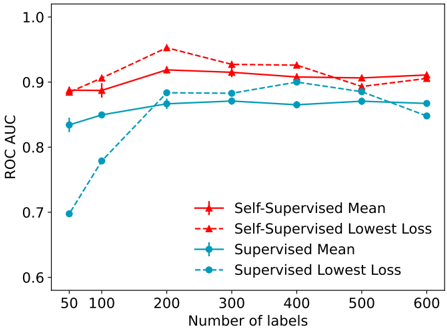
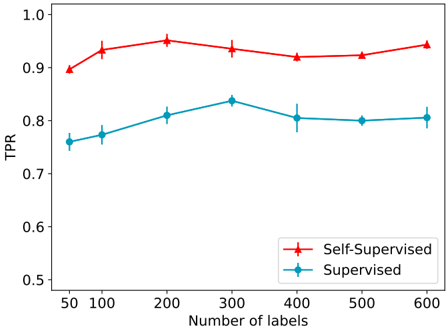
- On HSC-SSP, the SSL model reaches ROC AUC = 0.911 ± 0.002 and TPR = 0.94 ± 0.1 at FPR = 0.20; with only 50 labels, it maintains ROC AUC = 0.89 ± 0.01 and TPR = 0.90 ± 0.1 at FPR = 0.2.
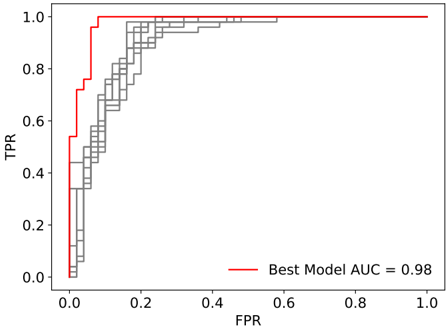
- The model reaches 96% completeness for 22% contamination, compared with 76% completeness for 22% contamination from an earlier automated method.
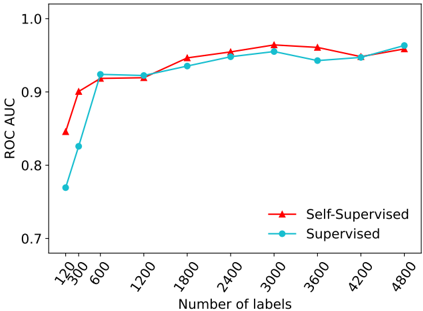
- On SDSS merger classification, with 120 unique labels the SSL model reaches AUC = 0.85 while the supervised model drops to 0.77; with larger label sets both reach similar ROC AUC ≈ 0.96. On HSC, the SSL model consistently outperforms the supervised model (maximum ROC AUC 0.911 ± 0.002 vs 0.867 ± 0.004; at 50 labels 0.89 ± 0.01 vs 0.83 ± 0.01).
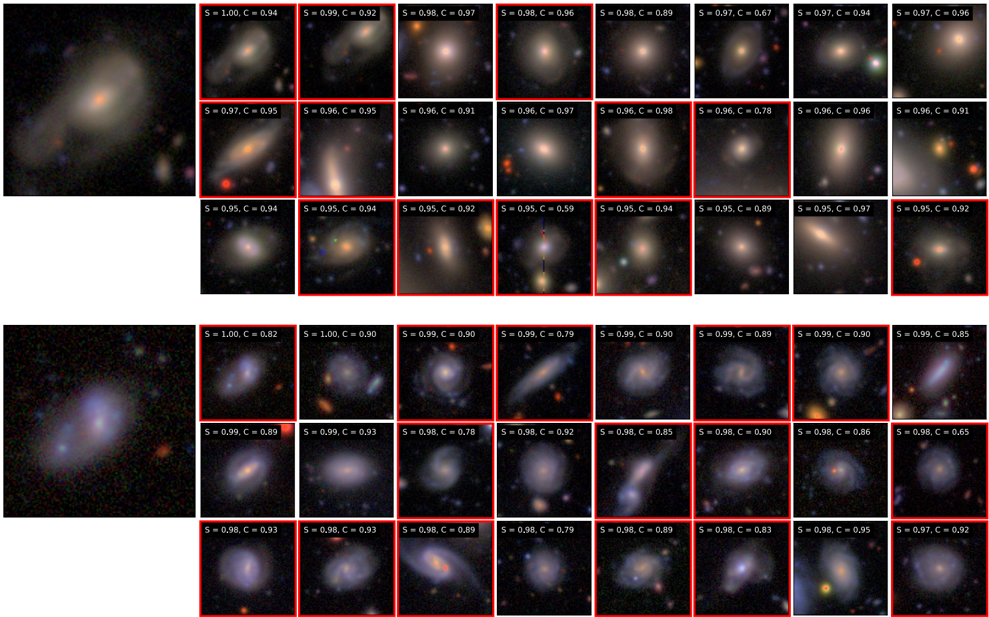
- Training is inexpensive: the encoder required ∼30 minutes for 25 epochs on a single GPU, and the linear classifier ∼1 minute for 50 epochs; a similarity search using one labelled tidal-feature example retrieves other candidates from ∼44,000 unlabelled galaxies.
Methods
- Two datasets: HSC-SSP PDR2 Ultradeep, with ∼44,000 unlabelled galaxies after filtering and a labelled sample of 760 galaxies (380 tidal, 380 non-tidal) split 600/60/100 for training/validation/testing; and SDSS DR7/Pearson et al. (2019), with 6000 galaxies (3000 merging, 3000 non-merging) split 4800/600/600, plus an unlabelled SDSS set expanded to 50,000 via rotations.
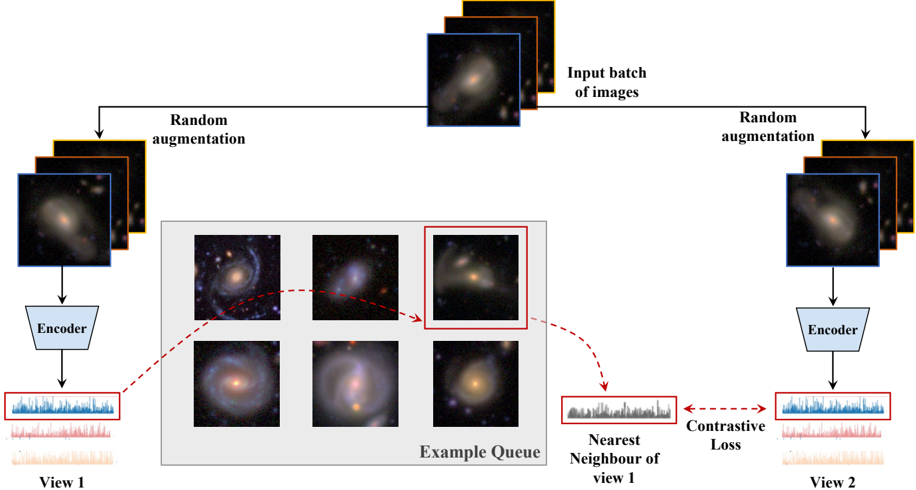
- Model: NNCLR self-supervised encoder using ResNet-20, 128-dimensional representations, queue size 10,000, temperature 0.1, trained for 25 epochs on unlabelled data; a linear classifier with sigmoid activation, Adam optimiser, and binary cross entropy trained for 50 epochs on labelled data. Augmentations include random flips, Gaussian noise, and jitter/crop.
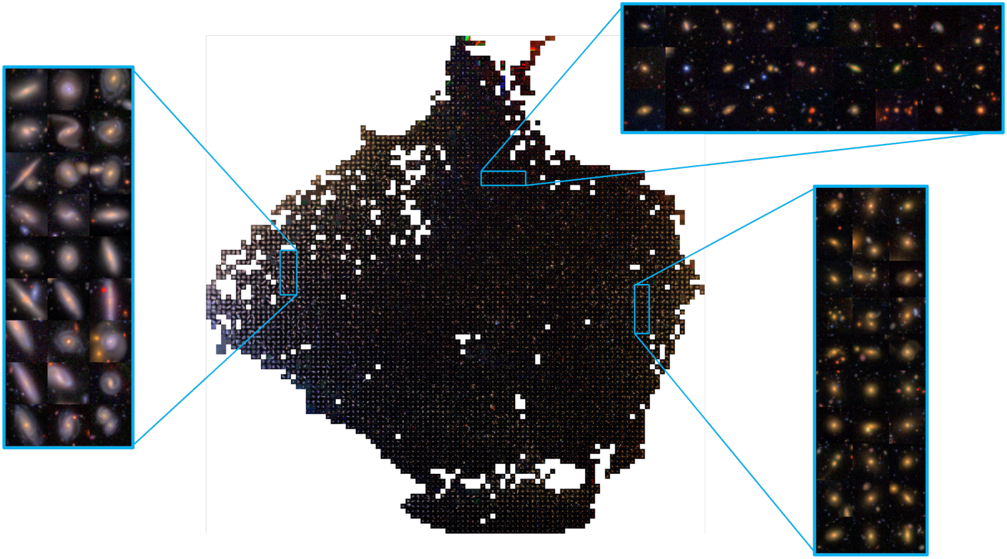
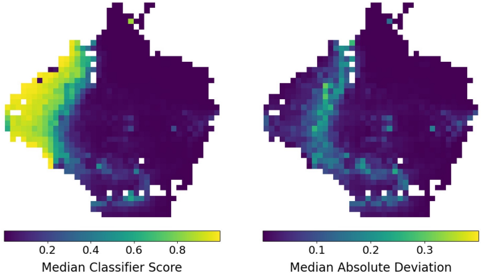
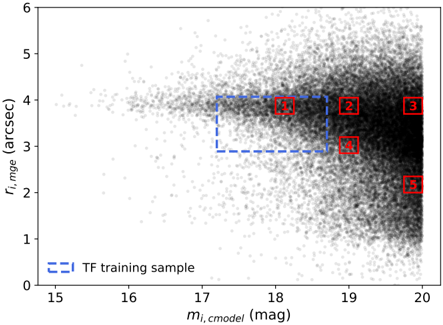
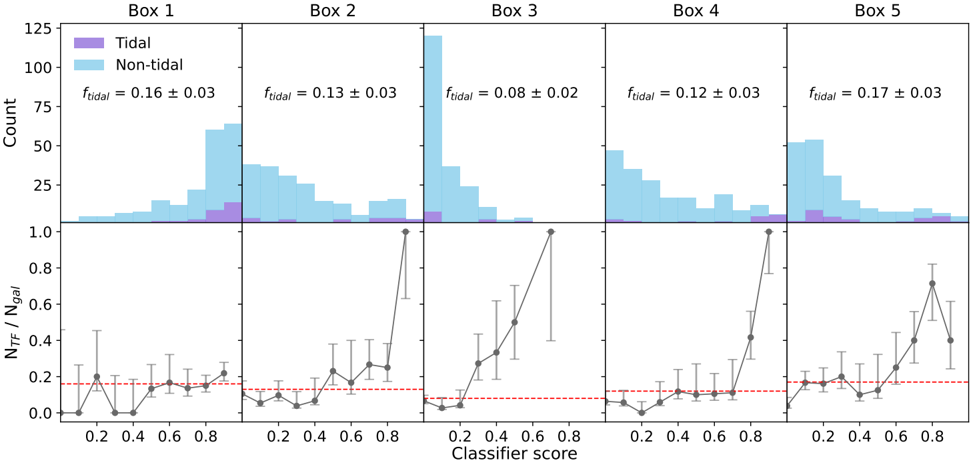
- Evaluation: ROC AUC and TPR at FPR = 0.2, averaged over ten runs with outliers beyond 3σ removed; UMAP visualisation of encoded representations, similarity searches, and performance across five magnitude-radius regions with 200 galaxies each.
Limitations
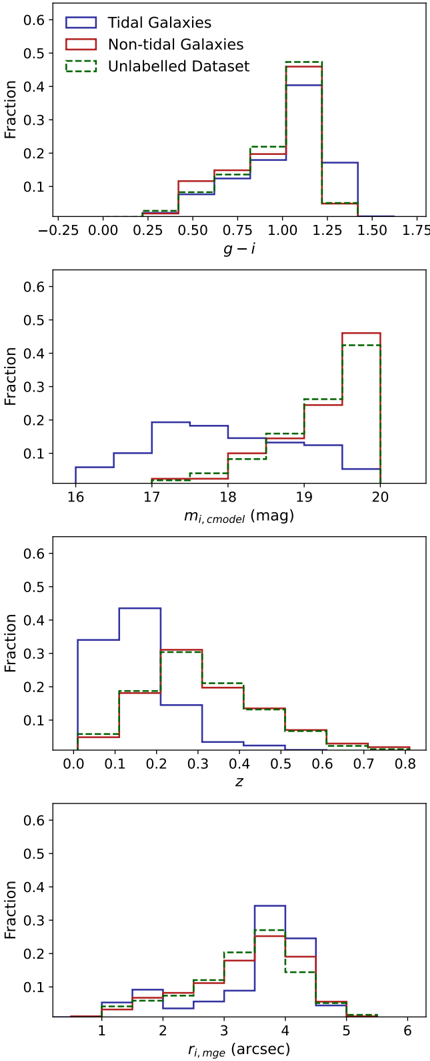
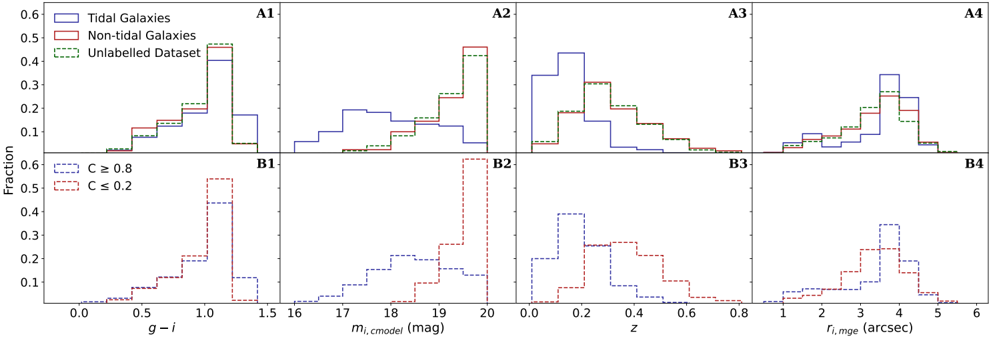
- The paper states that the labelled tidal-feature sample is brighter, lower-redshift, and slightly larger in apparent radius than the unlabelled and non-tidal samples, so the model is biased toward assigning high classifier scores to brighter galaxies; contamination is expected mainly from bright, larger, low-redshift non-tidal galaxies.
- The paper states that validation and testing sets are very small (60 and 100 galaxies), making evaluation difficult; the SDSS dataset is selected for obvious interacting mergers rather than tidal features, and SDSS surface-brightness limits mean only the brightest tidal features would be visible.
- The paper states that comparison with other works is limited by the scarcity of similar studies, and that the model is intended for use with visual classification rather than as a fully automated classifier; no optimal threshold is specified because the TPR/FPR trade-off is application-dependent.
Model-written summary. Check it against the paper before relying on it.
Integrity signals
Registry
Cites
Statistics
Figures
Verification
Claims the paper makes
30 Valid · 9 Not valid · 3 Not checked · 76 Own results and interpretations
The cited sources support only part of this claim — read each source’s verdict below.
In the paper
“Another benefit to self-supervised models, other than training on unlabelled data, is the computational cost, self-supervised models have been shown to need only 1% of the computational power needed by supervised models (Hayat et al. 2021).”
- Also stated in: § 1 INTRODUCTION · boosted
“self-supervised models have been shown to need only 1% of the computational power needed by supervised models (Hayat et al. 2021).”
What the sources say
- Partly supportedcites Hayat et al. 2021 sourceExperimental — accuracy not yet measured
Section 3.2 reports that a linear classifier trained on self-supervised representations takes about 0.5–10 seconds on a GPU, versus up to two hours on eight GPUs for supervised training. But Appendix C.2 says those times exclude the compute needed to learn the self-supervised representations. The paper therefore supports lower compute for this downstream classifier, not the claim that self-supervised models generally need only 1% as much computational power. (LLM, conf=0.88)
boostedstates a cause- Asserted: passes — The authors put it forward as true.
- Checkable: passes — It can be checked against evidence.
- Load-bearing: unclear — It is unclear whether the paper’s conclusions depend on it.
- Based: passes — The paper gives a reason why it holds.
- Also stated in: § 1 INTRODUCTION · boosted
Every source the paper cites for this claim was checked and supports it.
In the paper
“Hence, using tidal features to study galaxy evolution can provide important observational confirmation on the contribution of low-mass galaxies to the merging process (e.g. Johnston et al. 2008).”
What the sources say
- Supportedcites Johnston et al. 2008 source
The Introduction (page not supplied) describes stellar-halo substructure as a consequence of large galaxies accreting dwarf galaxies. The Conclusions and Future Prospects sections say that studying such features can reveal progenitor masses and constrain observed merger histories, supporting the claim's proposed observational use. (LLM, conf=0.90)
plainstates a cause- Asserted: passes — The authors put it forward as true.
- Checkable: passes — It can be checked against evidence.
- Load-bearing: passes — The paper’s conclusions depend on it.
- Based: passes — The paper gives a reason why it holds.
- Supported
The cited sources support only part of this claim — read each source’s verdict below.
In the paper
“which is predicted to reach 𝜇 𝑟 ∼ 30.3 mag arcsec -2 (Martin et al. 2022)”
What the sources say
- Partly supportedcites Martin et al. 2022 sourceExperimental — accuracy not yet measured
Section 2.3.3 (page unavailable) reports predictions for LSST’s final limiting surface brightness ranging from approximately 29.5 to 31 mag arcsec⁻². That supports a limit around 30.3 mag arcsec⁻², but the paper does not identify 30.3 as a specific prediction; it also says the achieved depth depends on data reduction. (LLM, conf=0.86)
plain- Asserted: passes — The authors put it forward as true.
- Checkable: passes — It can be checked against evidence.
- Load-bearing: passes — The paper’s conclusions depend on it.
- Based: passes — The paper gives a reason why it holds.
- Partly supported
The cited sources support only part of this claim — read each source’s verdict below.
In the paper
“but billions of galaxies are virtually impossible to classify visually by humans, even using large community based projects such as Galaxy Zoo (Lintott et al. 2008; Darg et al. 2010a)”
What the sources say
- Partly supportedcites Lintott et al. 2008 sourceExperimental — accuracy not yet measured
The Introduction says modern survey catalogues are too large for astronomers to inspect in full. The Conclusion reports that Galaxy Zoo volunteers successfully classified hundreds of thousands of galaxies, but the paper does not establish that classifying billions would be virtually impossible even with a community project. Page numbers were not provided in our copy. (LLM, conf=0.85)
- Not matchedcites Darg et al. 2010a
Couldn’t be matched to a paper in Crossref, so it can’t be checked.
plain- Asserted: passes — The authors put it forward as true.
- Checkable: passes — It can be checked against evidence.
- Load-bearing: passes — The paper’s conclusions depend on it.
- Based: passes — The paper gives a reason why it holds.
- Partly supported
The cited sources support only part of this claim — read each source’s verdict below.
In the paper
“SDSS imaging is incomplete at surface brightnesses fainter than 𝜇 𝑟 ≤ 23 mag arcsec -2 (Strauss et al. 2002)”
What the sources say
- Partly supportedcites Strauss et al. 2002 sourceExperimental — accuracy not yet measured
Section 4.4 (page unavailable) says imaging detection limits create an implicit surface-brightness cut for redshift surveys. But its 23 mag arcsec⁻² value marks where the main sample stops targeting all eligible galaxies without an additional criterion; it does not establish that SDSS imaging becomes incomplete there. The paper describes imaging candidates and selected spectroscopic targets at fainter surface brightnesses. (LLM, conf=0.83)
plain- Asserted: passes — The authors put it forward as true.
- Checkable: passes — It can be checked against evidence.
- Load-bearing: passes — The paper’s conclusions depend on it.
- Based: passes — The paper gives a reason why it holds.
- Partly supported
45 more claims · 8 with their cited sources checked
Create a free account to see all 118 claims and every source verdict.
- It may state two separate claims as one. 56
- Probably not a substantial claim. 27
- Borderline: one of the tests for a substantial claim is unclear. 1
Self-check
Percentages, sums and reported differences re-computed from the paper’s own numbers.
Each contradiction between two passages listed here was confirmed by an independent check.
Rated minor: it would not touch a result — a value no result rests on, a p-value that stays on the same side of the significance level, or a conflict that is clerical, resolved elsewhere in the paper, or outside its own findings.
In the paper
§ 4 DISCUSSION AND CONCLUSIONS
“high completeness (TPR = 0. 94 ± 0.1) for low contamination (FPR = 0.20) and high area under the ROC curve (ROC AUC = 0.91 ± 0.002).”
§ 3.1 Self-Supervised vs. Supervised Performance
“only dropping from TPR = 0.94 ± 0.01 at 600 training labels to TPR = 0.90 ± 0.01 with a mere 50 training labels.”
Rated minor: it would not touch a result — a value no result rests on, a p-value that stays on the same side of the significance level, or a conflict that is clerical, resolved elsewhere in the paper, or outside its own findings.
In the paper
§ 3.2.1 Similarity
“In Figure 8 the query image is shown on the right alongside the 24 galaxies which received the highest similarity scores.”
§ 3.2.3 Dependence of Model Performance on Galaxy Properties
“The two query galaxies are displayed on the left, alongside the top 24 galaxies with the highest similarity scores for each similarity search.”
Rated minor: it would not touch a result — a value no result rests on, a p-value that stays on the same side of the significance level, or a conflict that is clerical, resolved elsewhere in the paper, or outside its own findings.
In the paper
§ 2.2 Image Pre-processing and Augmentations
“For HSC-SSP images we crop the 128 × 128 pixel image to the central 109 × 109 pixels before randomly cropping the image to 96 × 96pixels.”
§ 2.2 Image Pre-processing and Augmentations
“Random cropping means the image centre is translated, or 'jittered', along each respective axis by 𝑖 , 𝑗 pixels where 𝑖 , 𝑗 ∼ U (-13,13) before cropping to the central 96 × 96 pixels.”
Citations
Cites
Deep Residual Learning for Image Recognition
He, K., Zhang, X., Ren, S., & Sun, J. (2016) · 2016 IEEE Conference on Computer Vision and Pattern Recognition (CVPR) · doi:10.1109/cvpr.2016.90 · Cited by 235,474
Adam: A Method for Stochastic Optimization
Kingma, D. P., & Ba, J. (2014) · arXiv · doi:10.48550/arxiv.1412.6980 · Cited by 98,946
Momentum Contrast for Unsupervised Visual Representation LearningPreprint
He, K., Fan, H., Wu, Y., Xie, S., & Girshick, R. B. (2019) · Computer Vision and Pattern Recognition · doi:10.48550/arxiv.1911.05722 · Cited by 16,321
Proceedings of IEEE Conference on Computer Vision and Pattern Recognition
(1993) · Proceedings of IEEE Conference on Computer Vision and Pattern Recognition · doi:10.1109/cvpr.1993.341010 · Cited by 14,265
Momentum Contrast for Unsupervised Visual Representation Learning
He, K., Fan, H., Wu, Y., Xie, S., & Girshick, R. (2020) · 2020 IEEE/CVF Conference on Computer Vision and Pattern Recognition (CVPR) · doi:10.1109/cvpr42600.2020.00975 · Cited by 13,347
A simple framework for contrastive learning of visual representations
Chen, T., Kornblith, S., Norouzi, M., & Hinton, G. (2020) · arXiv · doi:10.48550/arxiv.2002.05709 · Cited by 10,857
The Sloan Digital Sky Survey: Technical Summary
York, D. G., Adelman, J., Anderson, Jr., Anderson, S. F., Annis, J., Bahcall, N. A., Bakken, J. A., Barkhouser, R., Bastian, S., Berman, E., et al. (2000) · The Astronomical Journal · doi:10.1086/301513 · Cited by 10,366
TensorFlow: Large-Scale Machine Learning on Heterogeneous Distributed Systems
Abadi, M., Agarwal, A., Barham, P., Brevdo, E., Chen, Z., Citro, C., Corrado, G. S., Davis, A., Dean, J., Devin, M., et al. (2016) · arXiv · doi:10.48550/arxiv.1603.04467 · Cited by 9,408
UMAP: Uniform Manifold Approximation and Projection for Dimension Reduction
McInnes, L., Healy, J., & Melville, J. (2018) · arXiv · doi:10.48550/arxiv.1802.03426 · Cited by 7,101
Representation Learning with Contrastive Predictive Coding
Oord, A. V. D., Li, Y., & Vinyals, O. (2018) · arXiv · doi:10.48550/arxiv.1807.03748 · Cited by 6,242
THE SEVENTH DATA RELEASE OF THE SLOAN DIGITAL SKY SURVEY
Abazajian, K. N., Adelman-McCarthy, J. K., Agüeros, M. A., Allam, S. S., Prieto, C. A., An, D., Anderson, K. S. J., Anderson, S. F., Annis, J., Bahcall, N. A., et al. (2009) · The Astrophysical Journal Supplement Series · doi:10.1088/0067-0049/182/2/543 · Cited by 5,341
Dimensionality Reduction by Learning an Invariant Mapping
Hadsell, R., Chopra, S., & LeCun, Y. (2006) · 2006 IEEE Computer Society Conference on Computer Vision and Pattern Recognition - Volume 2 (CVPR'06) · doi:10.1109/cvpr.2006.100 · Cited by 5,336
LSST: From Science Drivers to Reference Design and Anticipated Data Products
Ivezić, Ž., Kahn, S. M., Tyson, J. A., Abel, B., Acosta, E., Allsman, R., Alonso, D., AlSayyad, Y., Anderson, S. F., Andrew, J., et al. (2019) · The Astrophysical Journal · doi:10.3847/1538-4357/ab042c · Cited by 4,357
Exploring Simple Siamese Representation Learning
Chen, X., & He, K. (2021) · 2021 IEEE/CVF Conference on Computer Vision and Pattern Recognition (CVPR) · doi:10.1109/cvpr46437.2021.01549 · Cited by 3,725
Toomre, A., & Toomre, J. (1972) · The Astrophysical Journal · doi:10.1086/151823 · Cited by 2,555
Vogelsberger, M., Genel, S., Springel, V., Torrey, P., Sijacki, D., Xu, D., Snyder, G., Nelson, D., & Hernquist, L. (2014) · Monthly Notices of the Royal Astronomical Society · doi:10.1093/mnras/stu1536 · Cited by 2,260
Improved Baselines with Momentum Contrastive Learning
Chen, X., Fan, H., Girshick, R., & He, K. (2020) · arXiv (Cornell University) · doi:10.48550/arxiv.2003.04297 · Cited by 1,956
Cole, S., Lacey, C. G., Baugh, C. M., & Frenk, C. S. (2002) · Monthly Notices of the Royal Astronomical Society · doi:10.1046/j.1365-8711.2000.03879.x · Cited by 1,952
Spectroscopic Target Selection in the Sloan Digital Sky Survey: The Main Galaxy Sample
Strauss, M. A., Weinberg, D. H., Lupton, R. H., Narayanan, V. K., Annis, J., Bernardi, M., Blanton, M., Burles, S., Connolly, A. J., Dalcanton, J., et al. (2002) · The Astronomical Journal · doi:10.1086/342343 · Cited by 1,909
First results from the IllustrisTNG simulations: the galaxy colour bimodality
Nelson, D., Pillepich, A., Springel, V., Weinberger, R., Hernquist, L., Pakmor, R., Genel, S., Torrey, P., Vogelsberger, M., Kauffmann, G., et al. (2018) · Monthly Notices of the Royal Astronomical Society · doi:10.1093/mnras/stx3040 · Cited by 1,550
Lintott, C. J., Schawinski, K., Slosar, A., Land, K., Bamford, S., Thomas, D., Raddick, M. J., Nichol, R. C., Szalay, A., Andreescu, D., et al. (2008) · Monthly Notices of the Royal Astronomical Society · doi:10.1111/j.1365-2966.2008.13689.x · Cited by 1,488
Properties of galaxies reproduced by a hydrodynamic simulation
Vogelsberger, M., Genel, S., Springel, V., Torrey, P., Sijacki, D., Xu, D., Snyder, G., Bird, S., Nelson, D., & Hernquist, L. (2014) · Nature · doi:10.1038/nature13316 · Cited by 1,289
The Hyper Suprime-Cam SSP Survey: Overview and survey design
Aihara, H., Arimoto, N., Armstrong, R., Arnouts, S., Bahcall, N. A., Bickerton, S., Bosch, J., Bundy, K., Capak, P. L., Chan, J. H. H., et al. (2018) · Publications of the Astronomical Society of Japan · doi:10.1093/pasj/psx066 · Cited by 1,087
Galaxy and Mass Assembly (GAMA): survey diagnostics and core data release
Driver, S. P., Hill, D. T., Kelvin, L. S., Robotham, A. S. G., Liske, J., Norberg, P., Baldry, I. K., Bamford, S. P., Hopkins, A. M., Loveday, J., et al. (2011) · Monthly Notices of the Royal Astronomical Society · doi:10.1111/j.1365-2966.2010.18188.x · Cited by 1,086
Self-citationIntroducing the Illustris project: the evolution of galaxy populations across cosmic time
Genel, S., Vogelsberger, M., Springel, V., Sijacki, D., Nelson, D., Snyder, G., Rodriguez-Gomez, V., Torrey, P., & Hernquist, L. (2014) · Monthly Notices of the Royal Astronomical Society · doi:10.1093/mnras/stu1654 · Cited by 1,057
Wide-Field InfrarRed Survey Telescope-Astrophysics Focused Telescope Assets WFIRST-AFTA 2015 Report
Spergel, D. N., Gehrels, N. A., Baltay, C., Bennett, D. P., Breckinridge, J. B., Donahue, M. E., Dressler, A. M., Gaudi, B. S., Greene, T. P., Guyon, O., et al. (2015) · arXiv (Cornell University) · doi:10.48550/arxiv.1503.03757 · Cited by 957
The Hyper Suprime-Cam SSP Survey: Overview and survey design
Aihara, H., Arimoto, N., Armstrong, R., Arnouts, S., Bahcall, N. A., Bickerton, S. J., Bosch, J., Bundy, K. A., Capak, P. L., Chan, J. H. H., et al. (2018) · RECERCAT (Consorci de Serveis Universitaris de Catalunya) · Cited by 749
Merger rates in hierarchical models of galaxy formation – II. Comparison with N-body simulations
Lacey, C., & Cole, S. (1994) · Monthly Notices of the Royal Astronomical Society · doi:10.1093/mnras/271.3.676 · Cited by 703
Galaxy And Mass Assembly (GAMA): end of survey report and data release 2
Liske, J., Baldry, I. K., Driver, S. P., Tuffs, R. J., Alpaslan, M., Andrae, E., Brough, S., Cluver, M. E., Grootes, M. W., Gunawardhana, M. L. P., et al. (2015) · Monthly Notices of the Royal Astronomical Society · doi:10.1093/mnras/stv1436 · Cited by 592
Self-citationThe Hyper Suprime-Cam software pipeline
Bosch, J., Armstrong, R., Bickerton, S., Furusawa, H., Ikeda, H., Koike, M., Lupton, R., Mineo, S., Price, P., Takata, T., et al. (2018) · Publications of the Astronomical Society of Japan · doi:10.1093/pasj/psx080 · Cited by 551
Efficient multi-Gaussian expansion of galaxies
Cappellari, M. (2002) · Monthly Notices of the Royal Astronomical Society · doi:10.1046/j.1365-8711.2002.05412.x · Cited by 519
Second data release of the Hyper Suprime-Cam Subaru Strategic Program
Aihara, H., AlSayyad, Y., Ando, M., Armstrong, R., Bosch, J., Egami, E., Furusawa, H., Furusawa, J., Goulding, A., Harikane, Y., et al. (2019) · Publications of the Astronomical Society of Japan · doi:10.1093/pasj/psz103 · Cited by 511
Cameron, E. (2011) · Publications of the Astronomical Society of Australia · doi:10.1071/as10046 · Cited by 455
THE MAJOR AND MINOR GALAXY MERGER RATES AT z < 1.5
Lotz, J. M., Jonsson, P., Cox, T. J., Croton, D., Primack, J. R., Somerville, R. S., & Stewart, K. (2011) · The Astrophysical Journal · doi:10.1088/0004-637x/742/2/103 · Cited by 450
Big Self-Supervised Models are Strong Semi-Supervised Learners
Chen, T., Kornblith, S., Swersky, K., Norouzi, M., & Hinton, G. E. (2020) · arXiv (Cornell University) · doi:10.48550/arxiv.2006.10029 · Cited by 421
Preparing Red‐Green‐Blue Images from CCD Data
Lupton, R., Blanton, M. R., Fekete, G., Hogg, D. W., O’Mullane, W., Szalay, A., & Wherry, N. (2004) · Publications of the Astronomical Society of the Pacific · doi:10.1086/382245 · Cited by 420
Johnston, K. V., Bullock, J. S., Sharma, S., Font, A., Robertson, B. E., & Leitner, S. N. (2008) · The Astrophysical Journal · doi:10.1086/592228 · Cited by 416
With a Little Help from My Friends: Nearest-Neighbor Contrastive Learning of Visual Representations
Dwibedi, D., Aytar, Y., Tompson, J., Sermanet, P., & Zisserman, A. (2021) · arXiv · doi:10.48550/arxiv.2104.14548 · Cited by 405
With a Little Help from My Friends: Nearest-Neighbor Contrastive Learning of Visual Representations
Dwibedi, D., Aytar, Y., Tompson, J., Sermanet, P., & Zisserman, A. (2021) · 2021 IEEE/CVF International Conference on Computer Vision (ICCV) · doi:10.1109/iccv48922.2021.00945 · Cited by 404
Exploring Simple Siamese Representation Learning
Chen, X., & He, K. (2020) · arXiv · doi:10.48550/arxiv.2011.10566 · Cited by 381
Third data release of the Hyper Suprime-Cam Subaru Strategic Program
Aihara, H., AlSayyad, Y., Ando, M., Armstrong, R., Bosch, J., Egami, E., Furusawa, H., Furusawa, J., Harasawa, S., Harikane, Y., et al. (2022) · Publications of the Astronomical Society of Japan · doi:10.1093/pasj/psab122 · Cited by 360
Tal, T., van Dokkum, P. G., Nelan, J., & Bezanson, R. (2009) · The Astronomical Journal · doi:10.1088/0004-6256/138/5/1417 · Cited by 274
Darg, D. W., Kaviraj, S., Lintott, C. J., Schawinski, K., Sarzi, M., Bamford, S., Silk, J., Andreescu, D., Murray, P., Nichol, R. C., et al. (2010) · Monthly Notices of the Royal Astronomical Society · doi:10.1111/j.1365-2966.2009.15786.x · Cited by 202
Galaxy Zoo: the fraction of merging galaxies in the SDSS and their morphologies
Darg, D. W., Kaviraj, S., Lintott, C. J., Schawinski, K., Sarzi, M., Bamford, S., Silk, J., Proctor, R., Andreescu, D., Murray, P., et al. (2010) · Monthly Notices of the Royal Astronomical Society · doi:10.1111/j.1365-2966.2009.15686.x · Cited by 202
Galaxy And Mass Assembly (GAMA): galaxy close pairs, mergers and the future fate of stellar mass
Robotham, A. S. G., Driver, S. P., Davies, L. J. M., Hopkins, A. M., Baldry, I. K., Agius, N. K., Bauer, A. E., Bland-Hawthorn, J., Brough, S., Brown, M. J. I., et al. (2014) · Monthly Notices of the Royal Astronomical Society · doi:10.1093/mnras/stu1604 · Cited by 165
Self-citationTHE CANADA-FRANCE-HAWAII TELESCOPE LEGACY SURVEY: STACKED IMAGES AND CATALOGS
Gwyn, S. D. J. (2012) · The Astronomical Journal · doi:10.1088/0004-6256/143/2/38 · Cited by 162
The role of mergers in driving morphological transformation over cosmic time
Martin, G., Kaviraj, S., Devriendt, J. E. G., Dubois, Y., & Pichon, C. (2018) · Monthly Notices of the Royal Astronomical Society · doi:10.1093/mnras/sty1936 · Cited by 136
FAINT TIDAL FEATURES IN GALAXIES WITHIN THE CANADA-FRANCE-HAWAII TELESCOPE LEGACY SURVEY WIDE FIELDS
Atkinson, A. M., Abraham, R. G., & Ferguson, A. M. N. (2013) · The Astrophysical Journal · doi:10.1088/0004-637x/765/1/28 · Cited by 122
Deep learning predictions of galaxy merger stage and the importance of observational realism
Bottrell, C., Hani, M. H., Teimoorinia, H., Ellison, S. L., Moreno, J., Torrey, P., Hayward, C. C., Thorp, M., Simard, L., & Hernquist, L. (2019) · Monthly Notices of the Royal Astronomical Society · doi:10.1093/mnras/stz2934 · Cited by 113
Huang, S., Leauthaud, A., Greene, J. E., Bundy, K., Lin, Y.-T., Tanaka, M., Miyazaki, S., & Komiyama, Y. (2018) · Monthly Notices of the Royal Astronomical Society · doi:10.1093/mnras/stx3200 · Cited by 113
The Canada–France Imaging Survey: First Results from the u-Band Component
Ibata, R. A., McConnachie, A., Cuillandre, J.-C., Fantin, N., Haywood, M., Martin, N. F., Bergeron, P., Beckmann, V., Bernard, E., Bonifacio, P., et al. (2017) · The Astrophysical Journal · doi:10.3847/1538-4357/aa855c · Cited by 106
The Dawes Review 10: The impact of deep learning for the analysis of galaxy surveys
Huertas-Company, M., & Lanusse, F. (2023) · Publications of the Astronomical Society of Australia · doi:10.1017/pasa.2022.55 · Cited by 102
Self-citationTidal debris morphology and the orbits of satellite galaxies
Hendel, D., & Johnston, K. V. (2015) · Monthly Notices of the Royal Astronomical Society · doi:10.1093/mnras/stv2035 · Cited by 99
An automatic taxonomy of galaxy morphology using unsupervised machine learning
Hocking, A., Geach, J. E., Sun, Y., & Davey, N. (2018) · Monthly Notices of the Royal Astronomical Society · doi:10.1093/mnras/stx2351 · Cited by 90
Identifying galaxy mergers in observations and simulations with deep learning
Pearson, W. J., Wang, L., Trayford, J. W., Petrillo, C. E., & van der Tak, F. F. S. (2019) · Astronomy & Astrophysics · doi:10.1051/0004-6361/201935355 · Cited by 90
Galaxy morphological classification in deep-wide surveys via unsupervised machine learning
Martin, G., Kaviraj, S., Hocking, A., Read, S. C., & Geach, J. E. (2020) · Monthly Notices of the Royal Astronomical Society · doi:10.1093/mnras/stz3006 · Cited by 87
Statistically-informed deep learning for gravitational wave parameter estimation
Shen, H., Huerta, E. A., O’Shea, E., Kumar, P., & Zhao, Z. (2021) · Machine Learning Science and Technology · doi:10.1088/2632-2153/ac3843 · Cited by 87
Convolutional neural network identification of galaxy post-mergers in UNIONS using IllustrisTNG
Bickley, R. W., Bottrell, C., Hani, M. H., Ellison, S. L., Teimoorinia, H., Yi, K. M., Wilkinson, S., Gwyn, S., & Hudson, M. J. (2021) · Monthly Notices of the Royal Astronomical Society · doi:10.1093/mnras/stab806 · Cited by 84
Bílek, M., Duc, P.-A., Cuillandre, J.-C., Gwyn, S., Cappellari, M., Bekaert, D. V., Bonfini, P., Bitsakis, T., Paudel, S., Krajnović, D., et al. (2020) · Monthly Notices of the Royal Astronomical Society · doi:10.1093/mnras/staa2248 · Cited by 84
Self-supervised Representation Learning for Astronomical Images
Hayat, M. A., Stein, G., Harrington, P., Lukić, Z., & Mustafa, M. (2021) · The Astrophysical Journal Letters · doi:10.3847/2041-8213/abf2c7 · Cited by 79
Martin, G., Bazkiaei, A. E., Spavone, M., Iodice, E., Mihos, J. C., Montes, M., Benavides, J. A., Brough, S., Carlin, J. L., Collins, C. A., et al. (2022) · Monthly Notices of the Royal Astronomical Society · doi:10.1093/mnras/stac1003 · Cited by 76
Self-citationKado-Fong, E., Greene, J. E., Hendel, D., Price-Whelan, A. M., Greco, J. P., Goulding, A. D., Huang, S., Johnston, K. V., Komiyama, Y., Lee, C.-H., et al. (2018) · The Astrophysical Journal · doi:10.3847/1538-4357/aae0f0 · Cited by 69
Walmsley, M., Ferguson, A. M. N., Mann, R. G., & Lintott, C. J. (2019) · Monthly Notices of the Royal Astronomical Society · doi:10.1093/mnras/sty3232 · Cited by 66
Snyder, G. F., Rodriguez-Gomez, V., Lotz, J. M., Torrey, P., Quirk, A. C. N., Hernquist, L., Vogelsberger, M., & Freeman, P. E. (2019) · Monthly Notices of the Royal Astronomical Society · doi:10.1093/mnras/stz1059 · Cited by 65
The Origin of Faint Tidal Features around Galaxies in the RESOLVE Survey
Hood, C. E., Kannappan, S. J., Stark, D. V., Dell’Antonio, I. P., Moffett, A. J., Eckert, K. D., Norris, M. A., & Hendel, D. (2018) · The Astrophysical Journal · doi:10.3847/1538-4357/aab719 · Cited by 64
Euclidpreparation: XVI. Exploring the ultra-low surface brightness Universe withEuclid/VIS
Borlaff, A. S., Gómez-Alvarez, P., Altieri, B., Marcum, P. M., Vavrek, R., Laureijs, R. J., Kohley, R., Buitrago, F., Cuillandre, J., Duc, P., et al. (2021) · Astronomy and Astrophysics · doi:10.1051/0004-6361/202141935 · Cited by 61
POST-MERGER SIGNATURES OF RED-SEQUENCE GALAXIES IN RICH ABELL CLUSTERS AT z ≲ 0.1
Sheen, Y.-K., Yi, S. K., Ree, C. H., & Lee, J. (2012) · The Astrophysical Journal Supplement Series · doi:10.1088/0067-0049/202/1/8 · Cited by 57
Vega-Ferrero, J., Costantin, L., Pérez‐González, P. G., Sarmiento, R., Kartaltepe, J. S., Pillepich, A., Bagley, M. B., Finkelstein, S. L., McGrath, E. J., Knapen, J. H., et al. (2024) · The Astrophysical Journal · doi:10.3847/1538-4357/ad05bb · Cited by 55
Mining for Strong Gravitational Lenses with Self-supervised Learning
Stein, G., Blaum, J., Harrington, P., Medan, T., & Lukić, Z. (2022) · The Astrophysical Journal · doi:10.3847/1538-4357/ac6d63 · Cited by 52
Huang, S., Leauthaud, A., Hearin, A., Behroozi, P., Bradshaw, C., Ardila, F., Speagle, J., Tenneti, A., Bundy, K., Greene, J., et al. (2020) · Monthly Notices of the Royal Astronomical Society · doi:10.1093/mnras/stz3314 · Cited by 49
Li, J., Huang, S., Leauthaud, A., Moustakas, J., Danieli, S., Greene, J. E., Abraham, R. G., Ardila, F., Kado-Fong, E., Lokhorst, D., et al. (2022) · Monthly Notices of the Royal Astronomical Society · doi:10.1093/mnras/stac2121 · Cited by 39
Bars formed in galaxy merging and their classification with deep learning
Cavanagh, M. K., & Bekki, K. (2020) · Astronomy and Astrophysics · doi:10.1051/0004-6361/202037963 · Cited by 36
Towards Galaxy Foundation Models with Hybrid Contrastive LearningPreprint
Walmsley, M., Slijepcevic, I. V., Bowles, M., & Scaife, A. M. M. (2022) · arXiv (Cornell University) · doi:10.48550/arxiv.2206.11927 · Cited by 29
Euclid preparation : XVI. Exploring the ultra-low surface brightness Universe with Euclid/VIS
Euclid Collaboration, Borlaff, A. S., Altieri, B., & Potter, D. (2022) · Zurich Open Repository and Archive (University of Zurich) · doi:10.5167/uzh-227330 · Cited by 28
Identification of tidal features in deep optical galaxy images with convolutional neural networks
Sánchez, H. D., Martin, G., Damjanov, I., Buitrago, F., Huertas-Company, M., Bottrell, C., Bernardi, M., Knapen, J. H., Vega-Ferrero, J., Hausen, R., et al. (2023) · Monthly Notices of the Royal Astronomical Society · doi:10.1093/mnras/stad750 · Cited by 28
Martínez-Lombilla, C., Brough, S., Montes, M., Baena-Gallé, R., Akhlaghi, M., Infante-Sainz, R., Driver, S. P., Holwerda, B. W., Pimbblet, K. A., & Robotham, A. S. G. (2022) · Monthly Notices of the Royal Astronomical Society · doi:10.1093/mnras/stac3119 · Cited by 27
Self-citationUnsupervised Galaxy Morphological Visual Representation with Deep Contrastive Learning
Wei, S., Li, Y., Lu, W., Li, N., Liang, B., Dai, W., & Zhang, Z. (2022) · Publications of the Astronomical Society of the Pacific · doi:10.1088/1538-3873/aca04e · Cited by 27
Bars formed in galaxy merging and their classification with deep learning
Cavanagh, M. K., & Bekki, K. (2020) · Springer Link (Chiba Institute of Technology) · doi:10.1051/0004-6361/202037963/pdf · Cited by 23
Massive Early-type Galaxies in the HSC-SSP: Flux Fraction of Tidal Features and Merger Rates
Huang 黄, Q. 齐., & Fan 范, L. 璐. (2022) · The Astrophysical Journal Supplement Series · doi:10.3847/1538-4365/ac85b1 · Cited by 19
Desmons, A., Brough, S., Martínez-Lombilla, C., De Propris, R., Holwerda, B., & López-Sánchez, Á. R. (2023) · Monthly Notices of the Royal Astronomical Society · doi:10.1093/mnras/stad1639 · Cited by 18
Self-citationUncovering tidal treasures: automated classification of faint tidal features in DECaLS data
Gordon, A. J., Ferguson, A. M. N., & Mann, R. G. (2024) · Monthly Notices of the Royal Astronomical Society · doi:10.1093/mnras/stae2169 · Cited by 18
A brief review of contrastive learning applied to astrophysicsPreprint
M. Huertas-Company, Sarmiento, R., & Knapen, J. (2023) · arXiv.org · doi:10.48550/arxiv.2306.05528 · Cited by 17
Learning useful representations for radio astronomy "in the wild" with contrastive learningPreprint
Slijepcevic, I. V., Scaife, A. M. M., Walmsley, M., & Bowles, M. (2022) · arXiv (Cornell University) · doi:10.48550/arxiv.2207.08666 · Cited by 16
Self-supervised similarity search for large scientific datasets
Stein, G., Harrington, P., Blaum, J., Medan, T., & Lukic, Z. (2021) · arXiv · doi:10.48550/arxiv.2110.13151 · Cited by 13
Classifying the formation processes of S0 galaxies using Convolutional Neural Networks
Diaz, J. D., Bekki, K., Forbes, D. A., Couch, W. J., Drinkwater, M. J., & Deeley, S. (2019) · Monthly Notices of the Royal Astronomical Society · doi:10.1093/mnras/stz1057 · Cited by 12
Merger identification through photometric bands, colours, and their errors
Suelves, L. E., Pearson, W., & Pollo, A. (2022) · Astronomy and Astrophysics · doi:10.1051/0004-6361/202244509 · Cited by 10
Scaling Laws for Galaxy Images
Walmsley, M., Bowles, M., Scaife, A. M. M., Makechemu, J. S., Gordon, A. J., Ferguson, A. M. N., Mann, R. G., Pearson, J., Popp, J. J., Bovy, J., et al. (2024) · arXiv · doi:10.48550/arxiv.2404.02973 · Cited by 2
Ćiprijanović, A., Lewis, A., Pedro, K., Madireddy, S., Nord, B., Perdue, G. N., & Wild, S. M. (2023) · arXiv · doi:10.48550/arxiv.2302.02005 · Cited by 2
Capturing the physics of MaNGA galaxies with self-supervised Machine Learning
Sarmiento, R., Huertas-Company, M., Knapen, J. H., Sánchez, S. F., Domínguez Sánchez, H., Drory, N., & Falcón-Barroso, J. (2021) · The Astrophysical Journal · doi:10.3847/1538-4357/ac1dac · Cited by 1
Deep-SWIM: A few-shot learning approach to classify Solar WInd Magnetic field structuresPreprint
Lamdouar, H., Sundaresan, S., Jungbluth, A., et al. (2022) · arXiv (Cornell University) · doi:10.48550/arxiv.2203.01184 · Cited by 1
Uncovering Tidal Treasures: Automated Classification of Faint Tidal Features in DECaLS DataPreprint
Gordon, A. J., Ferguson, A. M. N., & Mann, R. G. (2024) · arXiv (Cornell University) · doi:10.48550/arxiv.2404.06487 · Cited by 1
Vega-Ferrero, J., M. Huertas-Company, Costantin, L., et al. (2023) · arXiv · doi:10.48550/arxiv.2302.07277
Slijepcevic, I. V., Scaife, A. M. M., Walmsley, M., et al. (2023) · arXiv · doi:10.48550/arxiv.2305.16127
Mining for Strong Gravitational Lenses with Self-supervised Learning
Stein, G., Blaum, J., Harrington, P., et al. (2021) · arXiv · doi:10.48550/arxiv.2110.00023
Research works printed but not linked: 2
- Ćiprijanović, 2023, MLST, 4, 025013
- Huang, 2019, Unagi
Cited by
Galaxy Morphology Classification via Deep Semisupervised Learning with Limited Labeled Data
Luo, Z., Chen, J., Chen, Z., Zhang, S., Fu, L., Xiao, H., & Shu, C. (2025) · The Astrophysical Journal Supplement Series · doi:10.3847/1538-4365/addb4c · Cited by 16
“This approach is particularly advantageous in scenarios where annotation costs are high or where labeled data is limited, such as in the search for strong gravitational lenses (Stein et al. 2022), the detection of galaxy tidal features (Desmons et al. 2024), and other similar applications.”
Uncovering tidal treasures: automated classification of faint tidal features in DECaLS data
Gordon, A. J., Ferguson, A. M. N., & Mann, R. G. (2024) · Monthly Notices of the Royal Astronomical Society · doi:10.1093/mnras/stae2169 · Cited by 18
STRRINGS: STReams in Residual Images of Nearby GalaxieS
Sola, E., Chemaly, D., Belokurov, V. A., Müller, O., Arentsen, A., Davies, E. Y., Laguna-Miralles, J., Myeong, G., Panagiotakis, K., Zhang, H., et al. (2025) · Monthly Notices of the Royal Astronomical Society · doi:10.1093/mnras/staf1647 · Cited by 17
Detecting Galactic Rings in the DESI Legacy Imaging Surveys with Semisupervised Deep Learning
Chen, J., Luo, Z., Cheng, C., Hou, J., Zhang, S., & Shu, C. (2025) · The Astrophysical Journal Supplement Series · doi:10.3847/1538-4365/adec98 · Cited by 4
“…such as galaxy morphology classification (S. Wei et al. 2022; A. ´Ciprijanovi´c et al. 2023; J. Vega-Ferrero et al. 2024; Z. Luo et al. 2025a), black hole property estimation (H. Shen et al. 2021), detection of tidal features in galaxies(A. Desmons et al. 2024), radio galaxy classification (I.”
Measuring the Intracluster Light Fraction with Machine Learning
Canepa, L., Brough, S., Lanusse, F., Montes, M., & Hatch, N. A. (2025) · The Astrophysical Journal · doi:10.3847/1538-4357/adabc7 · Cited by 10
Self-citation
Metadata
- Authors
- Desmons, A., Brough, S., & Lanusse, F.
- Affiliations
- UNSW Sydney (AU)
- AIM, CEA, CNRS, Université Paris-Saclay, Université Paris Diderot , Sorbonne Paris Cité, F-91191 Gif-sur-Yvette , France
- Corresponding author
- Desmons, Alice
- Venue
- Monthly Notices of the Royal Astronomical Society
- Publisher
- Oxford University Press (OUP)
- Published
- 2024-06-05
- Volume
- 531
- Issue
- 4
- Pages
- 4070-4084
- ISSN
- 0035-8711 (ISSN-L)
- 1365-2966
- OpenAlex
- W4399363409
- Cited by
- 15
- References
- 93
- Citations by year
- 2026: 6 · 2025: 7 · 2024: 1
- FWCI
- 2.63
- Type
- journal article
- Language
- en
- Open access
- gold
- doi.org
- Licence
- Locations
- Monthly Notices of the Royal Astronomical Society (publishedVersion, cc-by)
- arXiv (Cornell University) (submittedVersion, cc-by)
- HAL (submittedVersion, cc-by)
- arXiv (Cornell University) (cc-by)
- Funders
- Australian Research Council (DP190101943)
- Topics
- Physical Sciences › Physics and Astronomy › Astronomy and Astrophysics › Galaxies: Formation, Evolution, Phenomena
- Physical Sciences › Physics and Astronomy › Astronomy and Astrophysics › Stellar, planetary, and galactic studies
- Physical Sciences › Physics and Astronomy › Astronomy and Astrophysics › Astrophysical Phenomena and Observations
- Keywords
- tidal features, galaxy mergers, self-supervised representation learning, automated feature detection, galaxy interactions, Hyper Suprime-Cam Subaru Strategic Program, Vera C. Rubin Observatory Legacy Survey of Space and Time, similarity search, galaxy evolution
About these checks
Registry, retraction, Cites and statistics results are computed, not judged, with one exception: a printed reference that no index lists is read once by a model before it counts as a citation error. Claims are extracted by a model and kept only when their quote appears verbatim in the text; each cited source is then checked, with a model’s help, for whether it says what the claim relies on. Those verdicts can be wrong — read the claim’s quote and the cited source before relying on one.
The claim verdicts this report counts are experimental: their accuracy is not yet measured.
A language model drew the claims from the paper on 2026-10-08, under version 3 of the claim definition (model deepseek-v4.1-flash, prompt extract-v3).
A second model labelled each claim on 2026-10-08 (model jev-1.13-20260917, definition revision gold-guideline-v0.2).
Cited sources are checked with a language model’s help (gpt-6-sol).
Statistics and arithmetic are recomputed, not judged.
Confidence bands are shown only for fields calibrated on our annotated test set. None is calibrated yet, so no band is shown.
What counts as a claim ›How we measure confidence ›How we check this ›
Are you an author, or do you see a problem with this page? Request a review
Data sources
Bibliographic data: Semantic Scholar, OpenAlex, Crossref.
Contains information from the Semantic Scholar Academic Graph Datasets, made available under the ODC Attribution License (ODC-BY 1.0).
Semantic Scholar’s data is described in: Kinney, R., et al. (2023). The Semantic Scholar Open Data Platform. arXiv:2301.10140.
