

Childhood Adversities Increase the Risk of Psychosis: A Meta-analysis of Patient-Control, Prospective- and Cross-sectional Cohort Studies
Open accessThe DOI matches its Crossref record; 72 of the 74 references it cites were found in a registry or an index.
Abstract
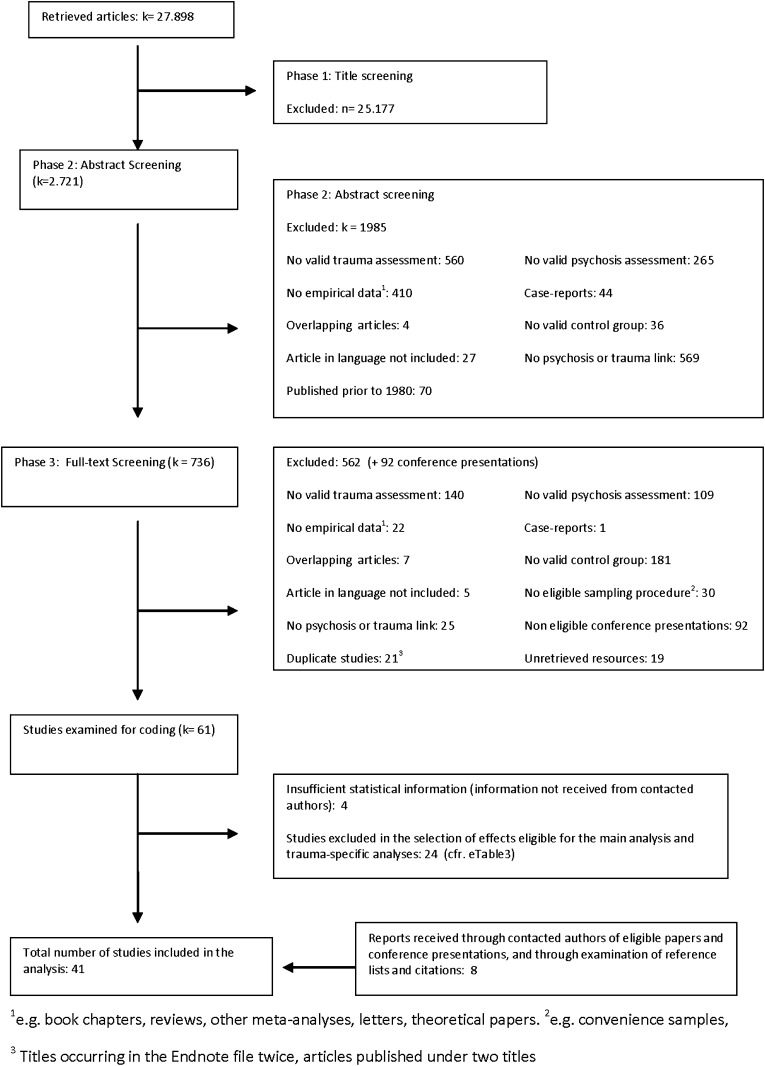
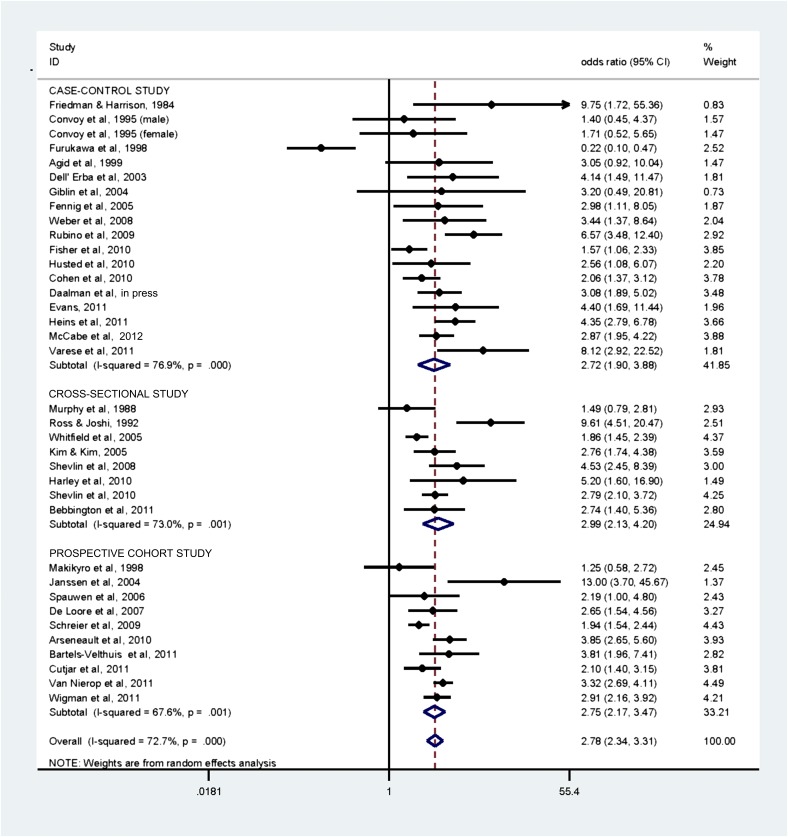
Evidence suggests that adverse experiences in childhood are associated with psychosis. To examine the association between childhood adversity and trauma (sexual abuse, physical abuse, emotional/psychological abuse, neglect, parental death, and bullying) and psychosis outcome, MEDLINE, EMBASE, PsychINFO, and Web of Science were searched from January 1980 through November 2011. We included prospective cohort studies, large-scale cross-sectional studies investigating the association between childhood adversity and psychotic symptoms or illness, case-control studies comparing the prevalence of adverse events between psychotic patients and controls using dichotomous or continuous measures, and case-control studies comparing the prevalence of psychotic symptoms between exposed and nonexposed subjects using dichotomous or continuous measures of adversity and psychosis. The analysis included 18 case-control studies (n = 2048 psychotic patients and 1856 nonpsychiatric controls), 10 prospective and quasi-prospective studies (n = 41,803) and 8 population-based cross-sectional studies (n = 35,546). There were significant associations between adversity and psychosis across all research designs, with an overall effect of OR = 2.78 (95% CI = 2.34-3.31). The integration of the case-control studies indicated that patients with psychosis were 2.72 times more likely to have been exposed to childhood adversity than controls (95% CI = 1.90-3.88). The association between childhood adversity and psychosis was also significant in population-based cross-sectional studies (OR = 2.99 [95% CI = 2.12-4.20]) as well as in prospective and quasi-prospective studies (OR = 2.75 [95% CI = 2.17-3.47]). The estimated population attributable risk was 33% (16%-47%). These findings indicate that childhood adversity is strongly associated with increased risk for psychosis.
Overview
The claims and statistics of this paper haven’t been checked yet.
Free: it reads the open-access text and checks the first 5 claims that cite a source we can check. Create a free account to check every claim.
Integrity signals
Registry
Cites
Statistics
Figures
Verification
Claims the paper makes
The claims and statistics of this paper haven’t been checked yet.
Free: it reads the open-access text and checks the first 5 claims that cite a source we can check. Create a free account to check every claim.
Claims other papers make about this one
Each is checked against this paper’s own text: does it say what the citing paper says it does?
The source backs part of the claim, not all of it — or backs it for a different population, condition or comparison.
In the citing paper
“by study design on obesity and psychosis,7,9”
From Long-term outcomes of childhood sexual abuse: an umbrella review (2019) · cites this paper as [7]
Experimental — accuracy not yet measuredThe source backs part of the claim, not all of it — or backs it for a different population, condition or comparison.
In the citing paper
“A recent meta-ana lysis calculated a population attributable risk of 33%, meaning that if the six types of child adversity studied were to disappear, a third of new psychosis cases would be avoided [13] .”
From The traumagenic neurodevelopmental model of psychosis revisited (2014) · cites this paper as [13]
Experimental — accuracy not yet measuredThe source backs part of the claim, not all of it — or backs it for a different population, condition or comparison.
In the citing paper
“and experiencing physical or sexual abuse (112).”
From Aberrant Salience, Information Processing, and Dopaminergic Signaling in People at Clinical High Risk for Psychosis (2020) · cites this paper as [112]
Experimental — accuracy not yet measuredThe cited source says what the claim attributes to it.
In the citing paper
“Recent studies indicate this is not an evidence-based belief [12,13,167] .”
From The traumagenic neurodevelopmental model of psychosis revisited (2014) · cites this paper as [13]
The cited source says what the claim attributes to it.
In the citing paper
“Furthermore, numerous studies and reviews note that the relationship between child abuse and psychosis remains after controlling for family history of psychosis [9-13,17] .”
From The traumagenic neurodevelopmental model of psychosis revisited (2014) · cites this paper as [13]
8 more claims about this paper
Create a free account to see every claim other papers make about this one.
Self-check
Percentages, sums and reported differences re-computed from the paper’s own numbers.
The self-check needs the paper’s full text.
Citations
Cites
Measuring inconsistency in meta-analyses
Higgins, J. P. T., Thompson, S. G., Deeks, J. J., & Altman, D. G. (2003) · BMJ · doi:10.1136/bmj.327.7414.557 · Cited by 63,139 · cited 1×
“Heterogeneity analyses were carried out using the Q and I(2) statistics to examine and quantify the amount of observed variance accounted for by true heterogeneity rather than sampling error.(57) Meta-regression analysis was subsequently used to determine whether (1) differences in study design and (2) inclusion of ad…”
MethodBias in meta-analysis detected by a simple, graphical test
Egger, M., Smith, G. D., Schneider, M., & Minder, C. (1997) · BMJ · doi:10.1136/bmj.315.7109.629 · Cited by 56,722
Meta-analysis of Observational Studies in Epidemiology<SUBTITLE>A Proposal for Reporting</SUBTITLE>
Stroup, D. F. (2000) · JAMA · doi:10.1001/jama.283.15.2008 · Cited by 20,623
Borenstein, M., Hedges, L. V., Higgins, J. P. T., & Rothstein, H. R. (2009) · doi:10.1002/9780470743386 · Cited by 14,225
Borenstein, M., Hedges, L. V., Higgins, J. P. T., & Rothstein, H. R. (2021) · doi:10.1002/9781119558378 · Cited by 9,799
The Handbook of Research Synthesis and Meta-Analysis
(2019) · doi:10.7758/9781610448864 · Cited by 4,553
Zhang, J., & Yu, K. F. (1998) · JAMA · doi:10.1001/jama.280.19.1690 · Cited by 4,138 · cited 1×
“Risk ratios were treated as ORs without further adjustment as the incidence of psychosis in the studied populations was low (ie, <10%).(56)”
MethodA Nonparametric “Trim and Fill” Method of Accounting for Publication Bias in Meta-Analysis
Duval, S., & Tweedie, R. (2000) · Journal of the American Statistical Association · doi:10.1080/01621459.2000.10473905 · Cited by 2,955
Validity of adult retrospective reports of adverse childhood experiences: review of the evidence
Hardt, J., & Rutter, M. (2004) · Journal of Child Psychology and Psychiatry · doi:10.1111/j.1469-7610.2004.00218.x · Cited by 2,827
Childhood adversities and adult psychopathology in the WHO World Mental Health Surveys
Kessler, R. C., McLaughlin, K. A., Green, J. G., Gruber, M. J., Sampson, N. A., Zaslavsky, A. M., Aguilar-Gaxiola, S., Alhamzawi, A. O., Alonso, J., Angermeyer, M., et al. (2010) · British Journal of Psychiatry · doi:10.1192/bjp.bp.110.080499 · Cited by 2,640 · cited 1×
“Adverse childhood events including trauma is a common experience worldwide, with some estimates suggesting that about a third of the general population may be affected.(1) Evidence suggests that its effects in adulthood may include a range of negative social outcomes, including higher criminality,(2) a lower education…”
Background
Research works printed but not linked: 12
- 15. Dell'Erba G, Venturi P, Tallarico V. Childhood stressful experiences in familial and sporadic schizophrenic patients [Italian] Italian J Psychopathol. 2003;9:32–39.
- 25. Evans G. Trauma and psychosis: investigating dissociation and self-concept clarity [Unpublished doctoral dissertation] University of Liverpool, UK; 2011
- 60. Schreier A, Wolke D, Thomas K, et al. Prospective study of peer victimization in childhood and psychotic symptoms in a nonclinical population at age 12 years. Arch Gen Psychiatry. 2009;66:527–536. doi: 10.1001/archgenpsychiatry.2009.23. · DOI · Paper page
- 63. Janssen I, Krabbendam L, Bak M, et al. Childhood abuse as a risk factor for psychotic experiences. Acta Psychiatr Scand. 2004;109:38–45. doi: 10.1046/j.0001-690x.2003.00217.x. · DOI · Paper page
- 64. Spauwen J, Krabbendam L, Lieb R, Wittchen H-U, van Os J. Impact of psychological trauma on the development of psychotic symptoms: relationship with psychosis proneness. Br J Psychiatry. 2006;188:527–533. doi: 10.1192/bjp.bp.105.011346. · DOI · Paper page
- 65. Nishida A, Tanii H, Nishimura Y, et al. Associations between psychotic-like experiences and mental health status and other psychopathologies among Japanese early teens. Schizophr Res. 2008;99:125–133. doi: 10.1016/j.schres.2007.11.038. · DOI
- 66. Shevlin M, Houston JE, Dorahy MJ, Adamson G. Cumulative traumas and psychosis: an analysis of the National Comorbidity Survey and the British Psychiatric Morbidity Survey. Schizophr Bull. 2008;34:193–199. doi: 10.1093/schbul/sbm069. · DOI · Paper page
- 67. Arseneault L, Cannon M, Fisher HL, et al. Psychotic symptoms: a genetically sensitive longitudinal cohort study. Am J Psychiatry. 2010;168:65–72. doi: 10.1176/appi.ajp.2010.10040567. · DOI · Paper page
- 69. De Loore E, Drukker M, Gunther N, et al. Childhood negative experiences and subclinical psychosis in adolescence: a longitudinal general population study. Early Interv Psychiatry. 2007;1:201–207. · DOI · Paper page
- 70. Whitfield CL, Dube SR, Felitti VJ, Anda RF. Adverse childhood experiences and hallucinations. Child Abuse & Neglect. 2005;29:797–810. doi: 10.1016/j.chiabu.2005.01.004. · DOI · Paper page
- 72. Houston JE, Murphy J, Adamson G, Stringer M, Shevlin M. Childhood sexual abuse, early cannabis use, and psychosis: testing an interaction model based on the National Comorbidity Survey. Schizophr Bull. 2008;34:580–585. doi: 10.1093/schbul/sbm127. · DOI · Paper page
- 73. Husted JA, Ahmed R, Chow EWC, Brzustowicz LM, Bassett AS. Childhood trauma and genetic factors in familial schizophrenia associated with the NOS1AP gene. Schizophr Res. 2010;121:187–192. doi: 10.1016/j.schres.2010.05.021. · DOI
Cited by
Items 1,001–1,008 of 1,008
Farrelly, S., Peters, E., Azis, M., David, A., & Hunter, E. C. (2016) · Pilot and Feasibility Studies · doi:10.1186/s40814-016-0086-7 · Cited by 15
“It is also now well established that rates of trauma are high in psychosis [15].”
BackgroundAkün, E. (2017) · Comprehensive Psychiatry · doi:10.1016/j.comppsych.2017.05.002 · Cited by 12
Core beliefs in psychosis: a systematic review and meta-analysis
Jorovat, A., Twumasi, R., Mechelli, A., & Georgiades, A. (2025) · Schizophrenia · doi:10.1038/s41537-025-00577-2 · Cited by 11
“Trauma has repeatedly been implicated in the onset and exacerbation of psychosis 1,2 , with 89% of individuals with a First Episode Psychosis (FEP) reporting one or more adversities compared to 37% of controls 3 .”
Making meaning of trauma in psychosis
van Sambeek, N., Franssen, G., van Geelen, S., & Scheepers, F. (2023) · Frontiers in Psychiatry · doi:10.3389/fpsyt.2023.1272683 · Cited by 10
Jones, H. J., Hammerton, G., McCloud, T., Hines, L. A., Wright, C., Gage, S. H., Holmans, P., Jones, P. B., Davey Smith, G., Linden, D. E. J., et al. (2022) · Psychological Medicine · doi:10.1017/s0033291720001798 · Cited by 9
“Based on the evidence of association with both genetic/familial risk for schizophrenia, and with substance use, these included peer-victimization, poorer social relationships, deficits in cognitive ability and impulsivity, and emotional or behavioral problems during childhood (Courtney, Mejia, & Jacobus, 2017; Varese…”
BackgroundKnolle, F., Sen, P., Culbreth, A., Koch, K., Schmitz-Koep, B., Gürsel, D. A., Wunderlich, K., Avram, M., Berberich, G., Sorg, C., et al. (2024) · Journal of Psychiatry and Neuroscience · doi:10.1503/jpn.240020 · Cited by 9
“78 Childhood stress responses in the hypothalamic–pituitary–adrenal axis have also been shown to cause disruption in the neurodevelopment of reward and emotion processing, contributing to psychiatric illnesses such as psychosis, depression, and posttraumatic stress disorder.”
Ferrara, P., Cammisa, I., Zona, M., Pacucci, I., Grimaldi, M. T., Scaltrito, F., Giardino, I., Verrotti, A., & Pettoello-Mantovani, M. (2025) · Current Pediatric Reviews · doi:10.2174/0115733963316599240704061209 · Cited by 5
Une approche psychologique des hallucinations : mécanismes psychologiques (partie I)
Bortolon, C., & Raffard, S. (2021) · Annales Médico-psychologiques revue psychiatrique · doi:10.1016/j.amp.2020.08.009
Metadata
- Authors
- Varese, F., Smeets, F., Drukker, M., Lieverse, R., Lataster, T., Viechtbauer, W., Read, J., van Os, J., & Bentall, R. P.
- Affiliations
- University of Liverpool (GB)
- Maastricht University (NL)
- University of Auckland (NZ)
- ORCID
- Venue
- Schizophrenia Bulletin
- Publisher
- Oxford University Press (OUP)
- Published
- 2012-03-29
- Volume
- 38
- Issue
- 4
- Pages
- 661-671
- ISSN
- 0586-7614 (ISSN-L)
- 1745-1701
- PMC
- PMC3406538
- OpenAlex
- W2097940171
- Semantic Scholar
- e74a0894053502319556985b4d9811ec75c1f7bd
- Cited by
- 2,436
- References
- 74
- Citations by year
- 2026: 153 · 2025: 158 · 2024: 156 · 2023: 216 · 2022: 206 · 2021: 192 · 2020: 240 · 2019: 190 · 2018: 183 · 2017: 181 · 2016: 177 · 2015: 141 · 2014: 125 · 2013: 87 · 2012: 27
- FWCI
- 17.70
- Type
- journal article
- Language
- en
- Open access
- hybrid
- doi.org
- Licence
- cc-by-nc
- Locations
- Schizophrenia Bulletin (publishedVersion, cc-by-nc)
- Europe PMC (PubMed Central) (publishedVersion, cc-by-nc)
- PubMed Central (publishedVersion, cc-by-nc)
- PubMed (publishedVersion)
- Research Publications (Maastricht University) (publishedVersion, cc-by-nc)
- UEL Research Repository (University of East London) (acceptedVersion)
- Lirias (submittedVersion, cc-by-nc)
- Lancaster EPrints (Lancaster University) (submittedVersion)
- Research Explorer (The University of Manchester) (submittedVersion)
- UEL Research Repository (University of East London) (submittedVersion, cc-by-nc)
- Swinburne figshare (Swinburne University of Technology) (submittedVersion)
- Research Publications (Maastricht University) (submittedVersion, other-oa)
- Funders
- Economic and Social Research Council (ES/I015043/1, ES/I015043/2, RES-000-)
- Topics
- Social Sciences › Psychology › Clinical Psychology › Child Abuse and Trauma
- Health Sciences › Medicine › Psychiatry and Mental health › Schizophrenia research and treatment
- Social Sciences › Psychology › Clinical Psychology › Posttraumatic Stress Disorder Research
- Keywords
- childhood adversity, childhood trauma
- MeSH terms
- Adolescent, Adult, Child, Child Abuse, Cross-Sectional Studies, Humans, Prospective Studies, Psychotic Disorders, Risk Factors, Cohort Studies, Case-Control Studies, Adult Survivors of Child Abuse, Bullying, Parental Death
About these checks
Registry, retraction, Cites and statistics results are computed, not judged, with one exception: a printed reference that no index lists is read once by a model before it counts as a citation error. Claims are extracted by a model and kept only when their quote appears verbatim in the text; each cited source is then checked, with a model’s help, for whether it says what the claim relies on. Those verdicts can be wrong — read the claim’s quote and the cited source before relying on one.
Statistics and arithmetic are recomputed, not judged.
Confidence bands are shown only for fields calibrated on our annotated test set. None is calibrated yet, so no band is shown.
What counts as a claim ›How we measure confidence ›How we check this ›
Are you an author, or do you see a problem with this page? Request a review
Data sources
Bibliographic data: Semantic Scholar, OpenAlex, Crossref.
Contains information from the Semantic Scholar Academic Graph Datasets, made available under the ODC Attribution License (ODC-BY 1.0).
Semantic Scholar’s data is described in: Kinney, R., et al. (2023). The Semantic Scholar Open Data Platform. arXiv:2301.10140.
