

Childhood Adversities Increase the Risk of Psychosis: A Meta-analysis of Patient-Control, Prospective- and Cross-sectional Cohort Studies
Open accessThe DOI matches its Crossref record; 72 of the 74 references it cites were found in a registry or an index.
Abstract
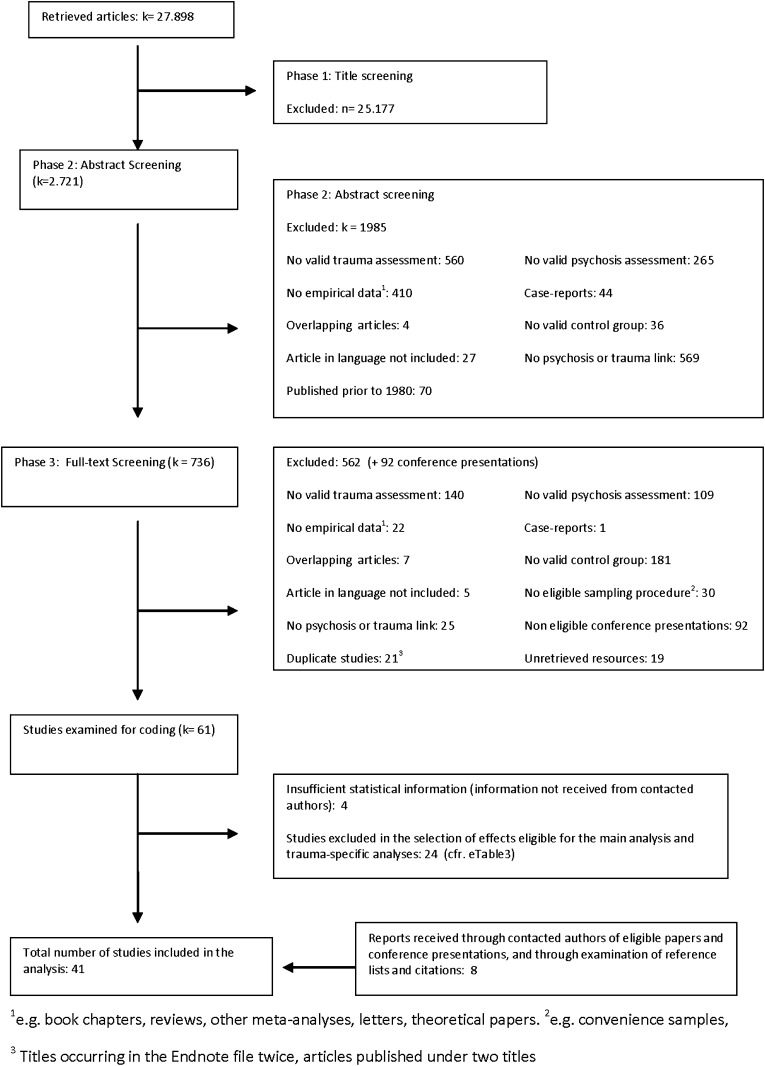
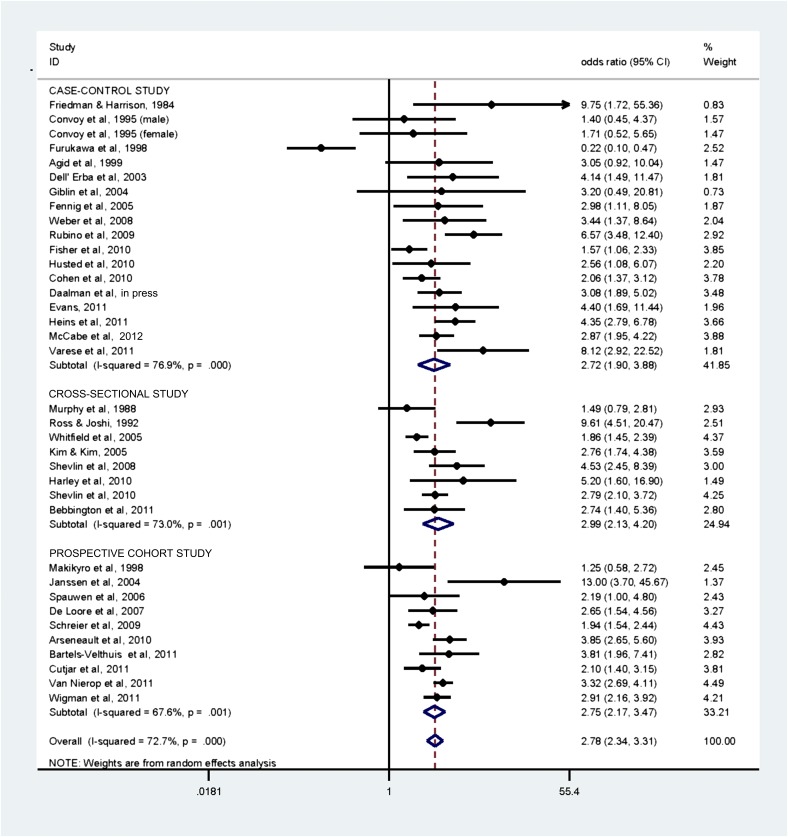
Evidence suggests that adverse experiences in childhood are associated with psychosis. To examine the association between childhood adversity and trauma (sexual abuse, physical abuse, emotional/psychological abuse, neglect, parental death, and bullying) and psychosis outcome, MEDLINE, EMBASE, PsychINFO, and Web of Science were searched from January 1980 through November 2011. We included prospective cohort studies, large-scale cross-sectional studies investigating the association between childhood adversity and psychotic symptoms or illness, case-control studies comparing the prevalence of adverse events between psychotic patients and controls using dichotomous or continuous measures, and case-control studies comparing the prevalence of psychotic symptoms between exposed and nonexposed subjects using dichotomous or continuous measures of adversity and psychosis. The analysis included 18 case-control studies (n = 2048 psychotic patients and 1856 nonpsychiatric controls), 10 prospective and quasi-prospective studies (n = 41,803) and 8 population-based cross-sectional studies (n = 35,546). There were significant associations between adversity and psychosis across all research designs, with an overall effect of OR = 2.78 (95% CI = 2.34-3.31). The integration of the case-control studies indicated that patients with psychosis were 2.72 times more likely to have been exposed to childhood adversity than controls (95% CI = 1.90-3.88). The association between childhood adversity and psychosis was also significant in population-based cross-sectional studies (OR = 2.99 [95% CI = 2.12-4.20]) as well as in prospective and quasi-prospective studies (OR = 2.75 [95% CI = 2.17-3.47]). The estimated population attributable risk was 33% (16%-47%). These findings indicate that childhood adversity is strongly associated with increased risk for psychosis.
Overview
The claims and statistics of this paper haven’t been checked yet.
Free: it reads the open-access text and checks the first 5 claims that cite a source we can check. Create a free account to check every claim.
Integrity signals
Registry
Cites
Statistics
Figures
Verification
Claims the paper makes
The claims and statistics of this paper haven’t been checked yet.
Free: it reads the open-access text and checks the first 5 claims that cite a source we can check. Create a free account to check every claim.
Claims other papers make about this one
Each is checked against this paper’s own text: does it say what the citing paper says it does?
The source backs part of the claim, not all of it — or backs it for a different population, condition or comparison.
In the citing paper
“by study design on obesity and psychosis,7,9”
From Long-term outcomes of childhood sexual abuse: an umbrella review (2019) · cites this paper as [7]
Experimental — accuracy not yet measuredThe source backs part of the claim, not all of it — or backs it for a different population, condition or comparison.
In the citing paper
“A recent meta-ana lysis calculated a population attributable risk of 33%, meaning that if the six types of child adversity studied were to disappear, a third of new psychosis cases would be avoided [13] .”
From The traumagenic neurodevelopmental model of psychosis revisited (2014) · cites this paper as [13]
Experimental — accuracy not yet measuredThe source backs part of the claim, not all of it — or backs it for a different population, condition or comparison.
In the citing paper
“and experiencing physical or sexual abuse (112).”
From Aberrant Salience, Information Processing, and Dopaminergic Signaling in People at Clinical High Risk for Psychosis (2020) · cites this paper as [112]
Experimental — accuracy not yet measuredThe cited source says what the claim attributes to it.
In the citing paper
“Recent studies indicate this is not an evidence-based belief [12,13,167] .”
From The traumagenic neurodevelopmental model of psychosis revisited (2014) · cites this paper as [13]
The cited source says what the claim attributes to it.
In the citing paper
“Furthermore, numerous studies and reviews note that the relationship between child abuse and psychosis remains after controlling for family history of psychosis [9-13,17] .”
From The traumagenic neurodevelopmental model of psychosis revisited (2014) · cites this paper as [13]
8 more claims about this paper
Create a free account to see every claim other papers make about this one.
Self-check
Percentages, sums and reported differences re-computed from the paper’s own numbers.
The self-check needs the paper’s full text.
Citations
Cites
Measuring inconsistency in meta-analyses
Higgins, J. P. T., Thompson, S. G., Deeks, J. J., & Altman, D. G. (2003) · BMJ · doi:10.1136/bmj.327.7414.557 · Cited by 63,139 · cited 1×
“Heterogeneity analyses were carried out using the Q and I(2) statistics to examine and quantify the amount of observed variance accounted for by true heterogeneity rather than sampling error.(57) Meta-regression analysis was subsequently used to determine whether (1) differences in study design and (2) inclusion of ad…”
MethodBias in meta-analysis detected by a simple, graphical test
Egger, M., Smith, G. D., Schneider, M., & Minder, C. (1997) · BMJ · doi:10.1136/bmj.315.7109.629 · Cited by 56,722
Meta-analysis of Observational Studies in Epidemiology<SUBTITLE>A Proposal for Reporting</SUBTITLE>
Stroup, D. F. (2000) · JAMA · doi:10.1001/jama.283.15.2008 · Cited by 20,623
Borenstein, M., Hedges, L. V., Higgins, J. P. T., & Rothstein, H. R. (2009) · doi:10.1002/9780470743386 · Cited by 14,225
Borenstein, M., Hedges, L. V., Higgins, J. P. T., & Rothstein, H. R. (2021) · doi:10.1002/9781119558378 · Cited by 9,799
The Handbook of Research Synthesis and Meta-Analysis
(2019) · doi:10.7758/9781610448864 · Cited by 4,553
Zhang, J., & Yu, K. F. (1998) · JAMA · doi:10.1001/jama.280.19.1690 · Cited by 4,138 · cited 1×
“Risk ratios were treated as ORs without further adjustment as the incidence of psychosis in the studied populations was low (ie, <10%).(56)”
MethodA Nonparametric “Trim and Fill” Method of Accounting for Publication Bias in Meta-Analysis
Duval, S., & Tweedie, R. (2000) · Journal of the American Statistical Association · doi:10.1080/01621459.2000.10473905 · Cited by 2,955
Validity of adult retrospective reports of adverse childhood experiences: review of the evidence
Hardt, J., & Rutter, M. (2004) · Journal of Child Psychology and Psychiatry · doi:10.1111/j.1469-7610.2004.00218.x · Cited by 2,827
Childhood adversities and adult psychopathology in the WHO World Mental Health Surveys
Kessler, R. C., McLaughlin, K. A., Green, J. G., Gruber, M. J., Sampson, N. A., Zaslavsky, A. M., Aguilar-Gaxiola, S., Alhamzawi, A. O., Alonso, J., Angermeyer, M., et al. (2010) · British Journal of Psychiatry · doi:10.1192/bjp.bp.110.080499 · Cited by 2,640 · cited 1×
“Adverse childhood events including trauma is a common experience worldwide, with some estimates suggesting that about a third of the general population may be affected.(1) Evidence suggests that its effects in adulthood may include a range of negative social outcomes, including higher criminality,(2) a lower education…”
Background
Research works printed but not linked: 12
- 15. Dell'Erba G, Venturi P, Tallarico V. Childhood stressful experiences in familial and sporadic schizophrenic patients [Italian] Italian J Psychopathol. 2003;9:32–39.
- 25. Evans G. Trauma and psychosis: investigating dissociation and self-concept clarity [Unpublished doctoral dissertation] University of Liverpool, UK; 2011
- 60. Schreier A, Wolke D, Thomas K, et al. Prospective study of peer victimization in childhood and psychotic symptoms in a nonclinical population at age 12 years. Arch Gen Psychiatry. 2009;66:527–536. doi: 10.1001/archgenpsychiatry.2009.23. · DOI · Paper page
- 63. Janssen I, Krabbendam L, Bak M, et al. Childhood abuse as a risk factor for psychotic experiences. Acta Psychiatr Scand. 2004;109:38–45. doi: 10.1046/j.0001-690x.2003.00217.x. · DOI · Paper page
- 64. Spauwen J, Krabbendam L, Lieb R, Wittchen H-U, van Os J. Impact of psychological trauma on the development of psychotic symptoms: relationship with psychosis proneness. Br J Psychiatry. 2006;188:527–533. doi: 10.1192/bjp.bp.105.011346. · DOI · Paper page
- 65. Nishida A, Tanii H, Nishimura Y, et al. Associations between psychotic-like experiences and mental health status and other psychopathologies among Japanese early teens. Schizophr Res. 2008;99:125–133. doi: 10.1016/j.schres.2007.11.038. · DOI
- 66. Shevlin M, Houston JE, Dorahy MJ, Adamson G. Cumulative traumas and psychosis: an analysis of the National Comorbidity Survey and the British Psychiatric Morbidity Survey. Schizophr Bull. 2008;34:193–199. doi: 10.1093/schbul/sbm069. · DOI · Paper page
- 67. Arseneault L, Cannon M, Fisher HL, et al. Psychotic symptoms: a genetically sensitive longitudinal cohort study. Am J Psychiatry. 2010;168:65–72. doi: 10.1176/appi.ajp.2010.10040567. · DOI · Paper page
- 69. De Loore E, Drukker M, Gunther N, et al. Childhood negative experiences and subclinical psychosis in adolescence: a longitudinal general population study. Early Interv Psychiatry. 2007;1:201–207. · DOI · Paper page
- 70. Whitfield CL, Dube SR, Felitti VJ, Anda RF. Adverse childhood experiences and hallucinations. Child Abuse & Neglect. 2005;29:797–810. doi: 10.1016/j.chiabu.2005.01.004. · DOI · Paper page
- 72. Houston JE, Murphy J, Adamson G, Stringer M, Shevlin M. Childhood sexual abuse, early cannabis use, and psychosis: testing an interaction model based on the National Comorbidity Survey. Schizophr Bull. 2008;34:580–585. doi: 10.1093/schbul/sbm127. · DOI · Paper page
- 73. Husted JA, Ahmed R, Chow EWC, Brzustowicz LM, Bassett AS. Childhood trauma and genetic factors in familial schizophrenia associated with the NOS1AP gene. Schizophr Res. 2010;121:187–192. doi: 10.1016/j.schres.2010.05.021. · DOI
Cited by
Items 901–1,000 of 1,008
Birth weight and obstetric complications determine age at onset in first episode of psychosis
Rubio‐Abadal, E., Ochoa, S., Barajas, A., Baños, I., Dolz, M., Sánchez, B., Cacho, N. D., Carlson, J., Huerta‐Ramos, E., & Usall, J. (2015) · Journal of Psychiatric Research · doi:10.1016/j.jpsychires.2015.03.018 · Cited by 25
Mother–child incest, psychosis, and the dynamics of relatedness
Haliburn, J. (2017) · Journal of Trauma & Dissociation · doi:10.1080/15299732.2017.1295424 · Cited by 22
Psychotic disorders in sexually abused youth: A prospective matched-cohort study
Bourgeois, C., Lecomte, T., & Daigneault, I. (2018) · Schizophrenia Research · doi:10.1016/j.schres.2018.03.020 · Cited by 27
Ciufolini, S., Gayer-Anderson, C. E., Fisher, H. L., Marques, T. R., Taylor, H., Forti, M. D., Zunszain, P. A., Morgan, C., Murray, R. M., Pariante, C. M., et al. (2018) · Schizophrenia Research · doi:10.1016/j.schres.2018.05.002 · Cited by 23
Catalán, A., Díaz, A., Angosto, V., Zamalloa, I., Martínez, N., Guede, D., Aguirregomoscorta, F., Bustamante, S. E. Z., Larrañaga, L., Osa, L., et al. (2018) · Revista de Psiquiatría y Salud Mental · doi:10.1016/j.rpsm.2018.10.003 · Cited by 26
Aydın, O., Balıkçı, K., Taş, C., Ünal‐Aydın, P., Taneli, F., & Esen-Danacı, A. (2019) · Nordic Journal of Psychiatry · doi:10.1080/08039488.2018.1554698 · Cited by 20
“These two subtypes of childhood adversities were found to be associated with high risk for psychosis [9].”
BackgroundGianfrancesco, O., Bubb, V. J., & Quinn, J. P. (2019) · Frontiers in Psychiatry · doi:10.3389/fpsyt.2019.00009 · Cited by 29
Çevik, B., Çalışır, Ö. M., Atbaşoğlu, E. C., Saka, M. C., Alptekın, K., Üçok, A., Sırmatel, B., Gülöksüz, S., Tükün, A., van Os, J., et al. (2019) · Journal of Psychiatric Research · doi:10.1016/j.jpsychires.2019.01.022 · Cited by 21
Amiri, S., Dizaji, R., Momeny, M., Gauvin, E., & Hosseini, M. (2021) · Neuropharmacology · doi:10.1016/j.neuropharm.2021.108503 · Cited by 22
Emerging themes in coping with lifetime stress and implication for stress management education
Amnie, A. G. (2018) · SAGE Open Medicine · doi:10.1177/2050312118782545 · Cited by 35
Specific type of childhood trauma and borderline personality disorder in Chinese patients
Wu, Y., Zheng, Y., Wang, J., & Zhang, T. (2022) · Frontiers in Psychiatry · doi:10.3389/fpsyt.2022.936739 · Cited by 19
Auditory hallucinations and PTSD in ex-POWS
Crompton, L., Lahav, Y., & Solomon, Z. (2017) · Journal of Trauma & Dissociation · doi:10.1080/15299732.2016.1267682 · Cited by 19
“This includes grief (Baethge, 2002), sensory deprivation (Leiderman, Mendelson, Wexler, & Solomon, 1958), solitary confinement (Shalev, 2008), captivity (Ohry, 2003), and following childhood trauma (Perona-Garcelán et al., 2014; Varese et al., 2012).”
BackgroundBortolon, C., & Raffard, S. (2019) · Cognitive Neuropsychiatry · doi:10.1080/13546805.2019.1670152 · Cited by 19
“…research providing evidence of the association between previous adverse experiences, in particular during childhood, and the experience of hallucinations/hearing voices (for three reviews, please see Read, Bentall, & Fosse, 2009; Read, van Os, Morrison, & Ross, 2005; Varese et al., 2012).”
BackgroundBipolar disorders and schizophrenia: discrete disorders?
Dines, M., Kes, M., Ailán, D., Cetkovich, M., Born, C., & Grunze, H. (2024) · Frontiers in Psychiatry · doi:10.3389/fpsyt.2024.1352250 · Cited by 27
Belief Updating, Childhood Maltreatment, and Paranoia in Schizophrenia-Spectrum Disorders
Sloan, A. F., Kittleson, A. R., Torregrossa, L., Feola, B., Rossi-Goldthorpe, R. A., Corlett, P. R., & Sheffield, J. M. (2024) · Schizophrenia Bulletin · doi:10.1093/schbul/sbae057 · Cited by 24
“5,23,42 We further reveal that greater exposure to childhood maltreatment was associated with higher expectations of volatility (that the environment is frequently changing).”
Reconceptualizing Psychosis: The Hearing Voices Movement and Social Approaches to Health.
Higgs, R. (2020) · PubMed Central · Cited by 37
Brandt, J. M., Hemager, N., Gregersen, M., Søndergaard, A., Krantz, M. F., Ohland, J., Wilms, M., Rohd, S. B., Hjorthøj, C. R., Veddum, L., et al. (2022) · British Journal of Clinical Psychology · doi:10.1111/bjc.12364 · Cited by 25
Berry, K., Raphael, J., Haddock, G., Bucci, S., Price, O., Lovell, K., Drake, R., Clayton, J., Penn, G., & Edge, D. (2022) · BJPsych Open · doi:10.1192/bjo.2022.513 · Cited by 19
“This is despite the fact that psychosocial factors such as childhood trauma and social adversity are risk factors for the development of psychosis, 17 and CBT is an evidence-based approach for psychosis.”
Dardani, C., Schalbroeck, R., Madley‐Dowd, P., Jones, H. J., Strelchuk, D., Hammerton, G., Croft, J., Sullivan, S. A., Zammit, S., Selten, J., et al. (2022) · Schizophrenia Bulletin · doi:10.1093/schbul/sbac167 · Cited by 20
“The experience of trauma in childhood is a well-established risk factor for psychosis.(15,55) However, despite reports of elevated rates of trauma in autistic individuals or individuals with autistic traits,(22,56) studies of its mental health consequences are lacking.”
BackgroundBhui, K. S., Shakoor, S., Mankee‐Williams, A., & Otis, M. (2022) · Nature Communications · doi:10.1038/s41467-022-35466-0 · Cited by 22
Cullen, A. E., Labad, J., Oliver, D., Al‐Diwani, A., Minichino, A., & Fusar‐Poli, P. (2023) · Current Neuropharmacology · doi:10.2174/1570159x21666230322145049 · Cited by 31
“These experiences have been robustly associated with the onset of psychosis (OR = 2.87, 95% CI: 2.07 to 3.98) [79-83], even when restricted to prospective studies (OR = 2.52, 95% CI: 1.27 to 5.02) [80].”
BackgroundInfluentialCloutier, B., Lecomte, T., Diotte, F., Lamontagne, J., Abdel‐Baki, A., Daneault, J.-G., Rabbath, M. E. G., de Connor, A., & Perrine, C. (2023) · Behavior Modification · doi:10.1177/01454455231186586 · Cited by 20
“Indeed, traumatic and discriminatory experiences are frequently reported (Van Dorn et al., 2005; Varese et al., 2012), as are low self-esteem and poor communication skills (Dickinson et al., 2007; Lysaker et al., 2007).”
BackgroundChildhood attachment and schizophrenia: The “attachment-developmental-cognitive” (ADC) hypothesis
Rajkumar, R. P. (2014) · Medical Hypotheses · doi:10.1016/j.mehy.2014.05.017 · Cited by 22
“(1) The association between schizophrenia and not only abuse and neglect [21,42], but parental separation as well [20,23], as all these could lead to the consequences described above.”
BackgroundMagliano, L., Read, J., Sagliocchi, A., Patalano, M., & Oliviero, N. (2013) · Psychiatry Research · doi:10.1016/j.psychres.2013.07.022 · Cited by 25
Self-citationTai, S. (2016) · American Journal of Psychotherapy · doi:10.1176/appi.psychotherapy.2016.70.1.125 · Cited by 20
Taylor, C. D. J., Bee, P., KELLY, J. A., & Haddock, G. (2018) · Cognitive and Behavioral Practice · doi:10.1016/j.cbpra.2018.10.002 · Cited by 25
“These images are often linked with stressful events or previous trauma, which can be common in psychosis (Varese et al., 2012) and lead to the development of negative beliefs about the self and others (Fowler et al., 2006).”
BackgroundCounotte, J., Bergink, V., Pot-Kolder, R., Drexhage, H. A., Hoek, H. W., & Veling, W. (2019) · PLoS ONE · doi:10.1371/journal.pone.0219139 · Cited by 20
“Childhood trauma was consistently shown to be associated with psychotic disorders in a dose-response manner, across varying designs including large prospective studies [11].”
ResultEarly Parental Death and Risk of Psychosis in Offspring: A Six-Country Case-Control Study
Misra, S., Gelaye, B., Koenen, K. C., Williams, D. R., Borba, C. P. C., Quattrone, D., Forti, M. D., Cascia, C. L., Barbera, D. L., Tarricone, I., et al. (2019) · Journal of Clinical Medicine · doi:10.3390/jcm8071081 · Cited by 20
“However, current evidence on the relation between early parental death and psychosis is mixed and inconclusive [1,2].”
BackgroundAyesa‐Arriola, R., Setién‐Suero, E., Marqués-Feixa, L., Neergaard, K. D., Butjosa, A., Vázquez-Bourgón, J., Fañanás, L., & Crespo‐Facorro, B. (2019) · Acta Psychiatrica Scandinavica · doi:10.1111/acps.13114 · Cited by 25
“72 times more likely to have experienced childhood adversities than HC (36).”
BackgroundPsychosis in children of separated parents: A systematic review and meta-analysis
Ayerbe, L., Pérez-Piñar, M., Boreu, Q. F., & Ayis, S. A. (2020) · European Psychiatry · doi:10.1192/j.eurpsy.2019.15 · Cited by 24
“Evidence reported in two other systematic reviews also shows an increased risk of psychosis in people who have experienced other adversities during childhood such as physical or sexual abuse [10,11].”
Doi, S. K., Fujiwara, T., & Isumi, A. (2020) · Child Abuse & Neglect · doi:10.1016/j.chiabu.2020.104478 · Cited by 25
Capuzzi, E., Caldiroli, A., Besana, F., Cova, F., Buoli, M., & Clerici, M. (2020) · Journal of Substance Abuse Treatment · doi:10.1016/j.jsat.2020.108104 · Cited by 22
Chu, M., Xu, T., Wang, Y., Wang, P., Gu, Q., Liu, Q., Cheung, E. F. C., Chan, R. C. K., & Wang, Z. (2020) · Psychological Medicine · doi:10.1017/s0033291720004328 · Cited by 22
Sideli, L., Schimmenti, A., Barbera, D. L., Cascia, C. L., Ferraro, L., Aas, M., Alameda, L., Velthorst, E., Fisher, H. L., Caretti, V., et al. (2022) · Schizophrenia Bulletin · doi:10.1093/schbul/sbac004 · Cited by 22
“26,27 Since all these factors have been associated with both childhood adversities and cognition, they might reduce the association between early adversities and cognition.”
Galletti, C., Paolini, E., Tortorella, A. A. V., & Compton, M. T. (2017) · Psychiatry Research · doi:10.1016/j.psychres.2017.04.056 · Cited by 20
Cacna1c: Protecting young hippocampal neurons in the adult brain
Jesús‐Cortés, H. D., Rajadhyaksha, A. M., & Pieper, A. A. (2016) · Neurogenesis · doi:10.1080/23262133.2016.1231160 · Cited by 19
“NAD is important in regulating essential substrates for mitochondrial metabolism, and is also a major substrate for ATP production important to neuronal survival.(37) Thus, P7C3 compounds, or other pharmacologic interventions with neuroprotective or NAD-augmenting capa-”
BackgroundIrshad, S., & Lone, A. (2025) · BMC Psychology · doi:10.1186/s40359-025-02565-8 · Cited by 50
“In Saudi Arabia, 87.7% of participants reported having at least one adverse childhood experience, while 49.2% reported having four or more [35, 36].”
InfluentialTrauma, Posttraumatic Stress, and Psychosis
Hardy, A., van de Giessen, I., & van den Berg, D. P. G. (2019) · Elsevier eBooks · doi:10.1016/b978-0-12-815012-2.00010-9 · Cited by 25
Childhood Trauma Is Nominally Associated With Elevated Cortisol Metabolism in Severe Mental Disorder
Aas, M., Ueland, T., Inova, A., Melle, I., Andreassen, O. A., & Steen, N. E. (2020) · Frontiers in Psychiatry · doi:10.3389/fpsyt.2020.00391 · Cited by 18
“Patients with a schizophrenia (SZ) or a bipolar disorder (BD) report more often childhood traumatic experiences than the general population (2, 3), with HPA axis correlates (1).”
BackgroundAn emotional regulation approach to psychosis recovery: The Living Through Psychosis group programme
Ryan, A., Crehan, E., Khondoker, M. R., Fell, M., Curtin, R., & Johns, L. (2021) · Journal of Behavior Therapy and Experimental Psychiatry · doi:10.1016/j.jbtep.2021.101651 · Cited by 19
Ho, G. W. K., Hyland, P., Karatzias, T., Bressington, D. T., & Shevlin, M. E. (2021) · European Journal of Psychotraumatology · doi:10.1080/20008198.2021.2009271 · Cited by 24
“…interpersonal trauma has been identified as a major risk factor for both CPTSD (Cloitre, Garvert, Brewin, Bryant, & Maercker, 2013; Hyland et al., 2017; Karatzias et al., 2017) and psychosis (Arseneault et al., 2011; Bailey et al., 2018; Gibson, Alloy, & Ellman, 2016; Varese et al., 2012).”
BackgroundŚmierciak, N., Szwajca, M., Popiela, T. J., Bryll, A., Karcz, P., Donicz, P., Turek, A., Krzyściak, W., & Pilecki, M. W. (2022) · Journal of Personalized Medicine · doi:10.3390/jpm12020247 · Cited by 19
“, patients with psychosis report adverse experiences in childhood almost three times more often than in control subjects [20].”
BackgroundBenedetto, M. G. D., Scassellati, C., Cattane, N., Riva, M. A., & Cattaneo, A. (2022) · Journal of Affective Disorders · doi:10.1016/j.jad.2022.03.071 · Cited by 20
Ranu, J., Kalebic, N., Meléndez‐Torres, G. J., & Taylor, P. J. (2022) · Trauma Violence & Abuse · doi:10.1177/15248380221122818 · Cited by 21
“A further study, investigating six ACEs, found that, of these, only parental death was not significantly related to later psychosis; emotional abuse had the strongest association (Varese et al., 2012).”
BackgroundTest-retest reliability of the Childhood Trauma Questionnaire in psychotic disorders
Cay, M., Chouinard, V., Hall, M., & Shinn, A. K. (2022) · Journal of Psychiatric Research · doi:10.1016/j.jpsychires.2022.09.053 · Cited by 21
Burger, S., van der Linden, T., Hardy, A., de Bont, P. A. J. M., van der Vleugel, B. M., Staring, A. B. P., de Roos, C., van Zelst, C., Gottlieb, J. D., Mueser, K. T., et al. (2022) · Trials · doi:10.1186/s13063-022-06808-6 · Cited by 23
“Experiencing childhood trauma increases the likelihood of developing psychotic symptoms [2, 3] and is associated with persistence of psychosis [4].”
BackgroundChildhood Adversity and Emerging Psychotic Experiences: A Network Perspective
Qiao, Z., Lafit, G., Lecei, A., Achterhof, R., Kirtley, O. J., Hiekkaranta, A. P., Hagemann, N., Hermans, K. S. F. M., Boets, B., Reininghaus, U., et al. (2023) · Schizophrenia Bulletin · doi:10.1093/schbul/sbad079 · Cited by 25
Mulligan, L. D., Varese, F., Harris, K., & Haddock, G. (2023) · Psychological Medicine · doi:10.1017/s0033291723002738 · Cited by 25
Self-citationCunningham, T., Shannon, C., Crothers, I., Hoy, K., Fitzsimmons, C., McCann, R., O’Hare, J., & Mulholland, C. (2016) · Psychosis · doi:10.1080/17522439.2015.1115542 · Cited by 18
“Studies using both clinical and non-clinical populations have found associations between a history of trauma and the presence of psychotic symptoms (e.g. Varese et al., 2012).”
MethodHsieh, C. J., Godwin, D., & Mamah, D. T. (2016) · Frontiers in Psychiatry · doi:10.3389/fpsyt.2016.00149 · Cited by 21
“In addition, several reports have associated childhood adversity with risk of psychosis (58, 83), suggesting the importance of documenting lifetime stressors.”
BackgroundRidenour, J. M., Knauss, D. P. C., & Hamm, J. A. (2018) · Journal of Contemporary Psychotherapy · doi:10.1007/s10879-018-9392-0 · Cited by 24
“Finally, more work could be done to appreciate the impact that trauma and dissociation have on deficits in mentalization and psychotic symptoms (Varese et al. 2012).”
BackgroundDoes childhood trauma predict poorer metacognitive abilities in people with first-episode psychosis?
Trauelsen, A. M., Gumley, A. I., Jansen, J. E., Pedersen, M. B., Nielsen, H. L., Haahr, U., & Simonsen, E. H. (2019) · Psychiatry Research · doi:10.1016/j.psychres.2019.01.018 · Cited by 25
“People with psychosis are highly likely to have experienced childhood trauma (Trauelsen et al., 2015; Varese et al., 2012) and they exhibit lower metacognitive abilities than non-clinical controls (Healey et al.”
BackgroundPiotrowski, P., Rymaszewska, J., Stańczykiewicz, B., Małecka, M., Kotowicz, K., Samochowiec, J., Samochowiec, A., Plichta, P., Kalinowska, S., & Misiak, B. (2019) · Early Intervention in Psychiatry · doi:10.1111/eip.12880 · Cited by 20
Cognitive mechanisms in cannabis-related paranoia; Initial testing and model proposal
Newman‐Taylor, K., Richardson, T. H., Sood, M., Sopp, M., Perry, E., & Bolderston, H. (2020) · Psychosis · doi:10.1080/17522439.2020.1757742 · Cited by 20
Aberizk, K., Collins, M. A., Addington, J., Bearden, C. E., Cadenhead, K. S., Cornblatt, B. A., Mathalon, D. H., McGlashan, T. H., Perkins, D. O., Tsuang, M. T., et al. (2021) · Biological Psychiatry Cognitive Neuroscience and Neuroimaging · doi:10.1016/j.bpsc.2021.04.011 · Cited by 24
Circumcision of Infants and Children: Short-Term Trauma and Long-Term Psychosexual Harm
Boyle, G. J. (2015) · Advances in Sexual Medicine · doi:10.4236/asm.2015.52004 · Cited by 22
“” There is also evidence that infant or childhood traumatic events (which would include traumatic circumcision) may be associated with subsequent psychotic breakdown [93]-[97].”
BackgroundKline, E. R., Hendel, V., Friedman‐Yakoobian, M. S., Mesholam‐Gately, R. I., Findeisen, A., Zimmet, S. V., Wojcik, J., Petryshen, T. L., Woo, T.-U. W., Goldstein, J. M., et al. (2018) · Social Psychiatry and Psychiatric Epidemiology · doi:10.1007/s00127-018-1631-x · Cited by 19
“Another limitation is that reliable data reflecting participants’ socioeconomic status and experiences of childhood adversity both of which have been implicated as potential risk factors for psychosis development and chronicity [33, 34] was not collected.”
Haarmans, M., McKenzie, K. J., Kidd, S. A., & Bentall, R. P. (2018) · Clinical Psychology & Psychotherapy · doi:10.1002/cpp.2307 · Cited by 19
Self-citationNg, L. C., Petruzzi, L. J., Greene, M. C., Mueser, K. T., Borba, C. P. C., & Henderson, D. C. (2016) · Journal of Nervous & Mental Disease · doi:10.1097/nmd.0000000000000523 · Cited by 17
“…symptoms (Hassan et al., 2015; Heins et al., 2011; Kelleher et al., 2013; Lysaker and Larocco, 2008; Mueser et al., 2004a; Ramsay et al., 2011; Varese et al., 2012) and worse medication adherence (Conus et al., 2010), benefit less from treat-ment (Hassan et al., 2015), and are prescribed…”
BackgroundAbufarsakh, B., Okoli, C. T. C., Darville, A. K., Williams, L. B., Garcia, A. R., & Martin, C. A. (2023) · Addictive Behaviors · doi:10.1016/j.addbeh.2023.107948 · Cited by 21
A Transdiagnostic Network Analysis of Childhood Trauma and Psychopathology
Huang, Y., Liu, C., Zhang, J., Li, S., Wang, L., Hu, H., Cai, Y., Zhu, Z., Chu, M., Wang, Y., et al. (2024) · Schizophrenia Bulletin · doi:10.1093/schbul/sbae137 · Cited by 26
Steine, I. M., Winje, D., Krystal, J. H., Milde, A. M., Bjorvatn, B., Nordhus, I. H., Grønli, J., & Pallesen, S. (2020) · Child Abuse & Neglect · doi:10.1016/j.chiabu.2020.104566 · Cited by 27
“A large literature shows that CSA is a strong general risk factor for life-long negative health consequences including a wide range of complex mental and somatic health disorders (Chen et al., 2010; Irish, Kobayashi, & Delahanty, 2010; Kendler et al., 2000; Maniglio, 2009; Paras et al., 2009; Varese et al., 2012) as w…”
BackgroundLee, K. A., Sacco, P., & Bright, C. L. (2021) · Child Abuse & Neglect · doi:10.1016/j.chiabu.2021.105273 · Cited by 19
Berthelot, N., Garon‐Bissonnette, J., Jomphe, V., Doucet-Beaupré, H., Bureau, A., & Maziade, M. (2022) · Schizophrenia Bulletin Open · doi:10.1093/schizbullopen/sgac017 · Cited by 23
“…not surprisingly high given that more than 50% of patients affected by schizophrenia or bipolar disorder have consistently reported having experienced childhood trauma, 3,6,8 and given that a parental history of childhood trauma would be among the most important risk factors for child maltreatment.”
Lu, W., Yanos, P. T., Waynor, W. R., Jia, Y., Siriram, A., Leong, A., Gill, K. J., & Mueser, K. T. (2022) · European Journal of Psychotraumatology · doi:10.1080/20008198.2022.2038924 · Cited by 19
“Furthermore, there is evidence that traumatic events such as childhood sexual abuse are related to increased frequency and severity of psychotic symptoms (Muenzenmaier et al., 2015; Shevlin, Dorahy, & Adamson, 2007; Varese et al., 2012).”
BackgroundRek, S. V., Reinhard, M. A., Bühner, M., Freeman, D. H., Adorjan, K., Falkai, P., & Padberg, F. (2022) · Scientific Reports · doi:10.1038/s41598-022-13205-1 · Cited by 22
Bridgwater, M. A., Petti, E., Giljen, M., Akouri-Shan, L., DeLuca, J. S., Rouhakhtar, P. R., Millar, C., Karcher, N. R., Martin, E. A., DeVylder, J., et al. (2023) · Frontiers in Psychiatry · doi:10.3389/fpsyt.2023.1117022 · Cited by 23
“Additionally, a systematic review of the existing literature found that childhood trauma and adversity were significantly associated with higher risk for psychosis, even while accounting for other factors such as genetic risk (53).”
BackgroundEarly Life Stress, Neuroinflammation, and Psychiatric Illness of Adulthood
Shin, S. H., & Kim, Y. (2023) · Advances in experimental medicine and biology · doi:10.1007/978-981-19-7376-5_6 · Cited by 20
Harris, A. W. F. (2023) · Internal Medicine Journal · doi:10.1111/imj.16068 · Cited by 25
Bendall, S., Eastwood, O., Spelman, T. D., McGorry, P. D., Hickie, I. B., Yung, A. R., Amminger, G. P., Wood, S. J., Pantelis, C., Purcell, R., et al. (2023) · Australian & New Zealand Journal of Psychiatry · doi:10.1177/00048674231177223 · Cited by 19
“These findings are underscored by meta-analytic research demonstrating robust associations between childhood trauma and psychosis (Varese et al., 2012), anxiety (Fernandes and Osorio, 2015), depression (Mandelli et al.”
BackgroundInfluentialThe influence of economic policies on social environments and mental health
Occhipinti, J., Skinner, A., Doraiswamy, P. M., Saxena, S., Eyre, H. A., Hynes, W. M., Geli, P., Jeste, D. V., Graham, C. L., Song, C., et al. (2024) · Bulletin of the World Health Organization · doi:10.2471/blt.23.290286 · Cited by 25
“36 Adverse experiences early in life can have profound effects on mental health and development, increasing rates of psychological distress, substance mis-use, physical health issues, behavioural challenges and suicidal behaviour, 37–40 and can perpetuate intergenerational disadvantage.”
BackgroundSchnackenberg, J., & Martin, C. R. (2013) · Journal of Psychiatric and Mental Health Nursing · doi:10.1111/jpm.12084 · Cited by 22
Reavley, N. J., & Jorm, A. F. (2014) · Psychiatry Research · doi:10.1016/j.psychres.2014.07.016 · Cited by 20
“This view of the multi-factorial nature of mental health problems is in line with the beliefs of mental health professionals and the research evidence, including that linking childhood adversity with risk of psychosis (Varese et al., 2012).”
ResultGajwani, R., Larkin, M., & Jackson, C. (2017) · Early Intervention in Psychiatry · doi:10.1111/eip.12425 · Cited by 38
“Evidence that childhood adversity increases the risk of psychosis has been strongly established (Varese et al., 2012); however, the mechanisms linking childhood adversity and suicidality in psychosis remain underdeveloped.”
BackgroundGibson, L. E., Cooper, S., Reeves, L. E., Anglin, D. M., & Ellman, L. M. (2017) · Psychiatry Research · doi:10.1016/j.psychres.2017.02.047 · Cited by 19
“We predicted three symptom domains would withstand conservative adjustments in their relationship to TLEs: posttraumatic stress disorder (PTSD), borderline personality disorder (BPD), and attenuated positive psychotic symptoms (APPS).”
BackgroundInfluentialMansueto, G., van Nierop, M. M., Schruers, K. R. J., Alizadeh, B. Z., Bartels‐Velthuis, A. A., van Beveren, N. J. M., Bruggeman, R., Cahn, W., de Haan, L., Delespaul, P., et al. (2017) · Schizophrenia Research · doi:10.1016/j.schres.2017.04.003 · Cited by 22
“In conclusion, although cognition and CT have been related to psychosis (Aas et al., 2013; de Gracia Dominguez et al., 2009; Varese et al., 2012), and cognitive functioning could be affected by CT exposure (Aas et al.”
BackgroundInfluentialSara, G. E., Lappin, J., Dobbins, T., Dunlop, A. J., & Degenhardt, L. J. (2017) · Drug and Alcohol Dependence · doi:10.1016/j.drugalcdep.2017.08.009 · Cited by 18
“These risk factors include prior trauma, neurological conditions, the presence of subclinical psychotic experiences and a family history of psychosis (Fusar-Poli et al., 2013; Varese et al., 2012).”
BackgroundHindocha, C., Quattrone, D., Freeman, T. P., Murray, R. M., Mondelli, V., Breen, G. D., Curtis, C. J. C., Morgan, C. J. A., Curran, H. V., & Forti, M. D. (2020) · Translational Psychiatry · doi:10.1038/s41398-020-0823-9 · Cited by 23
Associations between childhood adversity, cognitive schemas and attenuated psychotic symptoms
LoPilato, A. M., Zhang, Y., Pike, M. R., Addington, J., Bearden, C. E., Cadenhead, K. S., Cannon, T. D., Cornblatt, B. A., Mathalon, D. H., McGlashan, T. H., et al. (2020) · Early Intervention in Psychiatry · doi:10.1111/eip.13017 · Cited by 19
Fekih‐Romdhane, F., Nefzi, H., Sassi, H., Cherif, W., & Cheour, M. (2020) · Early Intervention in Psychiatry · doi:10.1111/eip.13058 · Cited by 19
“To date, there is no clear consensus on the aetiology of schizophrenia; however, contributing factors appear to include genetic, environmental and neurodevelopmental factors (Rapoport, Giedd, & Gogtay, 2012; Varese et al., 2012).”
BackgroundFosse, R., Eidhammer, G., Selmer, L. E., Knutzen, M., & Bjørkly, S. K. (2021) · Frontiers in Psychiatry · doi:10.3389/fpsyt.2020.628734 · Cited by 24
Misra, S., Gelaye, B., Williams, D. R., Koenen, K. C., Borba, C. P. C., Quattrone, D., Forti, M. D., Tripoli, G., Cascia, C. L., Barbera, D. L., et al. (2021) · Psychological Medicine · doi:10.1017/s0033291721000453 · Cited by 23
“Much of the evidence to date for the role of social adversities on the risk of psychosis points to the role of early life adversities, the influence of early life adversities on later life adversities, and the cumulative experience of adversities across the life course (e.g. Morgan et al., 2014; Stilo et al., 2017; Va…”
BackgroundDevelopment of the Korea-Polyenvironmental Risk Score for Psychosis
Jeon, E., Kang, S. H., Piao, Y. H., Kim, S., Kim, J., Lee, B. J., Yu, J., Lee, K. Y., Won, S., Lee, S., et al. (2022) · Psychiatry Investigation · doi:10.30773/pi.2021.0328 · Cited by 20
“However, considering its increasing importance in Korean society, more detailed categorizations 25 were used for the K-PERS-II.”
Cotter, J., Bucci, S., Drake, R., Yung, A. R., Carney, R., & Edge, D. (2018) · Early Intervention in Psychiatry · doi:10.1111/eip.12560 · Cited by 19
“This emphasises the importance of assessing traumatic childhood experiences and ongoing abuse in adulthood in individuals presenting to mental health services (Cotter, Drake, & Yung, 2016; Cotter, Kaess, & Yung, 2015; Hovens et al., 2012; Varese et al., 2012).”
BackgroundEpigenetic mechanisms, trauma, and psychopathology: targeting chromatin remodeling complexes
Bielawski, T., Misiak, B., Moustafa, A. A., & Frydecka, D. (2019) · Reviews in the Neurosciences · doi:10.1515/revneuro-2018-0055 · Cited by 19
Pawils, S., Nick, S., Metzner, F., Lotzin, A., & Schäfer, I. (2017) · Bundesgesundheitsblatt - Gesundheitsforschung - Gesundheitsschutz · doi:10.1007/s00103-017-2601-2 · Cited by 21
Adverse childhood experiences and childhood obesity: a path analysis approach
Ahn, S., Zhang, H., Berlin, K. S., Levy, M., & Kabra, R. (2019) · Children s Health Care · doi:10.1080/02739615.2019.1697928 · Cited by 19
Anti-stress Properties of Atypical Antipsychotics
Sanson, A., & Riva, M. A. (2020) · Pharmaceuticals · doi:10.3390/ph13100322 · Cited by 19
“Childhood trauma, including physical, psychological, or sexual abuse, as well as physical and emotional neglect, is a severe form of stress that sharply increases the risk of developing psychosis and schizophrenia later in life [65,66].”
BackgroundRemmers, M. C. C., Reijs, R. P., & Hoebe, C. J. P. A. (2024) · Scandinavian Journal of Public Health · doi:10.1177/14034948241260105 · Cited by 31
“The age of measurement usually ranged from 0 to 18 years [50,52,62-65] or during childhood [25,29,58,63,64,66] and adolescence [64]. some studies used different age ranges, like an age below 16 years [52,57].”
Mechanisms of childhood trauma: an integrative review of a multimodal, transdiagnostic pathway
Pasteuning, J., Broeder, C., Broeders, T. A. A., Busby, R. M., Gathier, A. W., Kuzminskaite, E., Linsen, F., Souama, C., Verhoeven, J. E., Sep, M. S. C., et al. (2025) · Neurobiology of Stress · doi:10.1016/j.ynstr.2025.100737 · Cited by 24
“CT is linked to a range of disorders, including psychosis (Varese et al., 2012), bipolar disorder (Palmier-Claus et al., 2016), alcohol dependence (Brady and Back, 2012), eating disorders (Molendijk et al., 2017), cardiovascular disease (Suglia et al., 2018) and diabetes (Widom et al., 2012).”
Traumatic Events in Dual Disorders: Prevalence and Clinical Characteristics
Blanco, L., Sio-Eroles, A., Hogg, B., Esteve, R., Raduà, J., Solanes, A., Gardoki-Souto, I., Sauras-Quetcuti, R. B., Farré, A., Castillo, C., et al. (2020) · Journal of Clinical Medicine · doi:10.3390/jcm9082553 · Cited by 19
“This might have influenced these results, as adversity in childhood is an etiological risk factor for developing psychosis and might therefore be more prevalent in dual disorder than in patients with mood or anxiety disorders [56].”
BackgroundResultRossi, R., Collazzoni, A., Talevi, D., Gibertoni, D., Quarta, E., Rossi, A., Stratta, P., Lorenzo, G. D., & Pacitti, F. (2020) · Early Intervention in Psychiatry · doi:10.1111/eip.13111 · Cited by 18
“On the other extreme, a recent meta-analysis has established a significant association between childhood adversities and psychosis (Varese et al., 2012) with odd ratios of 2.”
BackgroundD’Andrea, G., Lal, J., Tosato, S., Gayer-Anderson, C. E., Jongsma, H. E., Stilo, S. A., van der Ven, E., Quattrone, D., Velthorst, E., Berardi, D., et al. (2022) · Psychological Medicine · doi:10.1017/s003329172200335x · Cited by 19
“Several meta-analyses (Arango et al., 2021; Varese et al., 2012) have shown that the odds of developing psychosis among those exposed to maltreatment is around 2 – 3 times the odds among those not exposed.”
InfluentialCheli, S. (2022) · New Ideas in Psychology · doi:10.1016/j.newideapsych.2022.100993 · Cited by 20
Jin, Y., Xu, S., Wang, Y., Li, H., Wang, X., Xi, S., & Wang, Y. Y. (2022) · European Journal of Psychotraumatology · doi:10.1080/20008066.2022.2141508 · Cited by 21
“For instance, both theoretical and empirical studies have proposed a specific relationship between CSA and hallucinations in which dissociation plays a mediating role (Bentall, 2014; Kratzer, 2018; Varese et al., 2012).”
BackgroundTrotta, G., Rodríguez, V., Quattrone, D., Spinazzola, E., Tripoli, G., Gayer-Anderson, C. E., Freeman, T. P., Jongsma, H. E., Sideli, L., Aas, M., et al. (2023) · Psychological Medicine · doi:10.1017/s0033291723000995 · Cited by 23
“However, the risk of developing psychosis tends to be higher in those exposed to more severe experiences of abuse (Varese et al., 2012).”
InfluentialSelf-citationThomas, M., Rakesh, D., Whittle, S., Sheridan, M. A., Upthegrove, R., & Cropley, V. (2023) · Psychoneuroendocrinology · doi:10.1016/j.psyneuen.2023.106371 · Cited by 18
“Childhood adversity is an established risk factor for the development of psychosis, yet the biological mechanisms underpinning this relationship remain unclear (Varese et al., 2012).”
Grady, S., Twomey, C. D., Cullen, C., & Gaynor, K. (2024) · Schizophrenia Research · doi:10.1016/j.schres.2024.01.008 · Cited by 20
“People with experiences of psychosis report high rates of prior trauma (De Vries et al., 2019) and a prospective, dose-responsive relationship between trauma and psychosis has been established (Bentall et al., 2014; Shevlin et al., 2007; Varese et al., 2012).”
BackgroundLinking childhood trauma to the psychopathology of schizophrenia: the role of oxytocin
Chen, Y.-J., Lu, M., Chiu, Y.-H., Chen, C., Santos, V. H. J., & Goh, K. K. (2024) · Schizophrenia · doi:10.1038/s41537-024-00433-9 · Cited by 23
“Research has consistently identi fi ed increased risks of developing psychotic disorders and schizophrenia in the context of various factors among individuals with the experience of child adversity or trauma 4,5 , though establishing direct causality remains complex.”
BackgroundResultVeru, F., Rho, A., King, S., Joober, R., Pruessner, M., MALLA, A. K., & Iyer, S. N. (2018) · The Canadian Journal of Psychiatry · doi:10.1177/0706743718762097 · Cited by 18
Metadata
- Authors
- Varese, F., Smeets, F., Drukker, M., Lieverse, R., Lataster, T., Viechtbauer, W., Read, J., van Os, J., & Bentall, R. P.
- Affiliations
- University of Liverpool (GB)
- Maastricht University (NL)
- University of Auckland (NZ)
- ORCID
- Venue
- Schizophrenia Bulletin
- Publisher
- Oxford University Press (OUP)
- Published
- 2012-03-29
- Volume
- 38
- Issue
- 4
- Pages
- 661-671
- ISSN
- 0586-7614 (ISSN-L)
- 1745-1701
- PMC
- PMC3406538
- OpenAlex
- W2097940171
- Semantic Scholar
- e74a0894053502319556985b4d9811ec75c1f7bd
- Cited by
- 2,436
- References
- 74
- Citations by year
- 2026: 153 · 2025: 158 · 2024: 156 · 2023: 216 · 2022: 206 · 2021: 192 · 2020: 240 · 2019: 190 · 2018: 183 · 2017: 181 · 2016: 177 · 2015: 141 · 2014: 125 · 2013: 87 · 2012: 27
- FWCI
- 17.70
- Type
- journal article
- Language
- en
- Open access
- hybrid
- doi.org
- Licence
- cc-by-nc
- Locations
- Schizophrenia Bulletin (publishedVersion, cc-by-nc)
- Europe PMC (PubMed Central) (publishedVersion, cc-by-nc)
- PubMed Central (publishedVersion, cc-by-nc)
- PubMed (publishedVersion)
- Research Publications (Maastricht University) (publishedVersion, cc-by-nc)
- UEL Research Repository (University of East London) (acceptedVersion)
- Lirias (submittedVersion, cc-by-nc)
- Lancaster EPrints (Lancaster University) (submittedVersion)
- Research Explorer (The University of Manchester) (submittedVersion)
- UEL Research Repository (University of East London) (submittedVersion, cc-by-nc)
- Swinburne figshare (Swinburne University of Technology) (submittedVersion)
- Research Publications (Maastricht University) (submittedVersion, other-oa)
- Funders
- Economic and Social Research Council (ES/I015043/1, ES/I015043/2, RES-000-)
- Topics
- Social Sciences › Psychology › Clinical Psychology › Child Abuse and Trauma
- Health Sciences › Medicine › Psychiatry and Mental health › Schizophrenia research and treatment
- Social Sciences › Psychology › Clinical Psychology › Posttraumatic Stress Disorder Research
- Keywords
- childhood adversity, childhood trauma
- MeSH terms
- Adolescent, Adult, Child, Child Abuse, Cross-Sectional Studies, Humans, Prospective Studies, Psychotic Disorders, Risk Factors, Cohort Studies, Case-Control Studies, Adult Survivors of Child Abuse, Bullying, Parental Death
About these checks
Registry, retraction, Cites and statistics results are computed, not judged, with one exception: a printed reference that no index lists is read once by a model before it counts as a citation error. Claims are extracted by a model and kept only when their quote appears verbatim in the text; each cited source is then checked, with a model’s help, for whether it says what the claim relies on. Those verdicts can be wrong — read the claim’s quote and the cited source before relying on one.
Statistics and arithmetic are recomputed, not judged.
Confidence bands are shown only for fields calibrated on our annotated test set. None is calibrated yet, so no band is shown.
What counts as a claim ›How we measure confidence ›How we check this ›
Are you an author, or do you see a problem with this page? Request a review
Data sources
Bibliographic data: Semantic Scholar, OpenAlex, Crossref.
Contains information from the Semantic Scholar Academic Graph Datasets, made available under the ODC Attribution License (ODC-BY 1.0).
Semantic Scholar’s data is described in: Kinney, R., et al. (2023). The Semantic Scholar Open Data Platform. arXiv:2301.10140.
