

Occipital sleep spindles predict sequence learning in a visuo-motor task
Open accessThe DOI matches its Crossref record; 154 of the 154 references it cites were found in a registry or an index.
Abstract
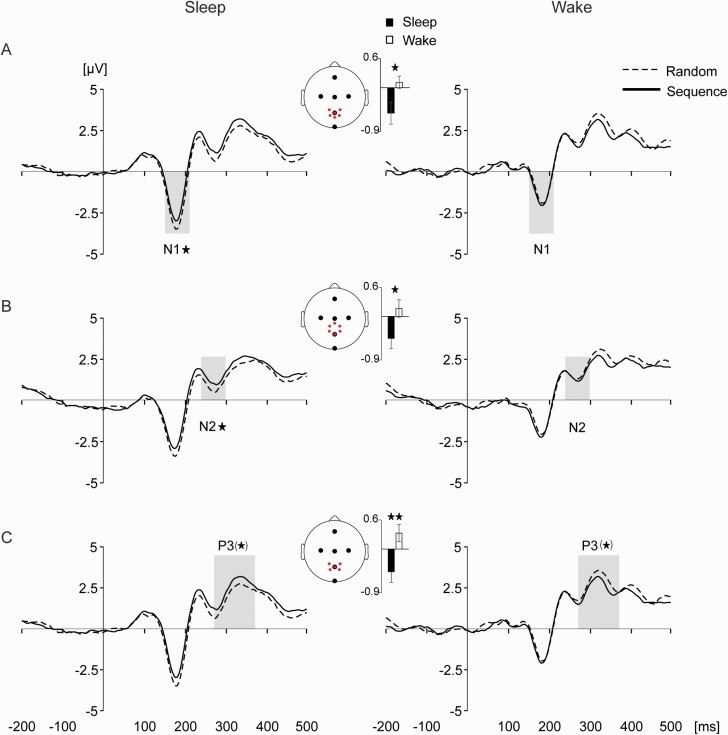
Study Objectives: The brain appears to use internal models to successfully interact with its environment via active predictions of future events. Both internal models and the predictions derived from them are based on previous experience. However, it remains unclear how previously encoded information is maintained to support this function, especially in the visual domain. In the present study, we hypothesized that sleep consolidates newly encoded spatio-temporal regularities to improve predictions afterwards. Methods: We tested this hypothesis using a novel sequence-learning paradigm that aimed to dissociate perceptual from motor learning. We recorded behavioral performance and high-density electroencephalography (EEG) in male human participants during initial training and during testing two days later, following an experimental night of sleep (n = 16, including high-density EEG recordings) or wakefulness (n = 17). Results: Our results show sleep-dependent behavioral improvements correlated with sleep-spindle activity specifically over occipital cortices. Moreover, event-related potential (ERP) responses indicate a shift of attention away from predictable to unpredictable sequences after sleep, consistent with enhanced automaticity in the processing of predictable sequences. Conclusions: These findings suggest a sleep-dependent improvement in the prediction of visual sequences, likely related to visual cortex reactivation during sleep spindles. Considering that controls in our experiments did not fully exclude oculomotor contributions, future studies will need to address the extent to which these effects depend on purely perceptual versus oculomotor sequence learning.
Overview
The claims and statistics of this paper haven’t been checked yet.
Free: it reads the open-access text and checks the first 5 claims that cite a source we can check. Create a free account to check every claim.
Integrity signals
Registry
Cites
Statistics
Figures



Verification
Claims the paper makes
The claims and statistics of this paper haven’t been checked yet.
Free: it reads the open-access text and checks the first 5 claims that cite a source we can check. Create a free account to check every claim.
Self-check
Percentages, sums and reported differences re-computed from the paper’s own numbers.
The self-check needs the paper’s full text.
Citations
Cites
Controlling the False Discovery Rate: A Practical and Powerful Approach to Multiple Testing
Benjamini, Y., & Hochberg, Y. (1995) · Journal of the Royal Statistical Society Series B: Statistical Methodology · doi:10.1111/j.2517-6161.1995.tb02031.x · Cited by 109,482 · cited 1×
“…correct for multiple correlations with the different spindle measures, we used false discovery rate (FDR)-correction following the Benjamini–Hochberg procedure and report FDR-corrected p values for all correlation measures, both for the correlations and the topographical specificity tests [83, 84].”
MethodThe assessment and analysis of handedness: The Edinburgh inventory
Oldfield, R. C. (1971) · Neuropsychologia · doi:10.1016/0028-3932(71)90067-4 · Cited by 35,900
Rechtschaffen, A. (1968) · Medical Entomology and Zoology · Cited by 12,637
Oostenveld, R., Fries, P., Maris, E., & Schoffelen, J.-M. (2011) · Computational Intelligence and Neuroscience · doi:10.1155/2011/156869 · Cited by 10,323 · cited 1×
“We used FieldTrip (RRID:SCR_004849) [81] to filter EEG, EOG and mastoid electrodes between 0.5 and 40 Hz, and EMG electrodes be-tween 5 and 90 Hz (fourth-order two-pass Butterworth bandpass filters).”
MethodInfluentialUpdating P300: An integrative theory of P3a and P3b
Polich, J. (2007) · Clinical Neurophysiology · doi:10.1016/j.clinph.2007.04.019 · Cited by 7,919 · cited 2×
“Effects of sequence learning on P3 have been reported in numerous studies [55–57, 60, 90, 128], in accordance with the component’s role in stimulus-driven memory processing (for reviews, see [53, 129]).”
BackgroundResult(2005) · Cited by 5,977
Whatever next? Predictive brains, situated agents, and the future of cognitive science
Clark, A. (2013) · Behavioral and Brain Sciences · doi:10.1017/s0140525x12000477 · Cited by 5,924
Rao, R. P. N., & Ballard, D. H. (1999) · Nature Neuroscience · doi:10.1038/4580 · Cited by 5,483 · cited 1×
“…involved in generating holistic representations, that is, internal models of critical environmental features, thereby allowing for predictions of future events and adaptive behaviors [3–6, 8, 9, 34, 105, 106] Behaviorally, we found shorter reaction times for sequence compared with random blocks.”
BackgroundA self-assessment questionnaire to determine morningness- eveningness in human circadian rhythms
Home, J. K. (1976) · Medical Entomology and Zoology · Cited by 4,783
Tests for comparing elements of a correlation matrix
Steiger, J. H. (1980) · Psychological Bulletin · doi:10.1037/0033-2909.87.2.245 · Cited by 4,621 · cited 1×
“To test for differences between correlations of Training and Test, we used Steiger’s Z test [85, 86].”
Method(1976) · PubMed · Cited by 3,979
Diekelmann, S., & Born, J. (2010) · Nature Reviews Neuroscience · doi:10.1038/nrn2762 · Cited by 3,760 · cited 1×
“Sleep, as a pivotal factor in memory consolidation [10, 11], may support the extraction and consolidation of regularities.”
BackgroundAttentional requirements of learning: Evidence from performance measures
Nissen, M. J., & Bullemer, P. (1987) · Cognitive Psychology · doi:10.1016/0010-0285(87)90002-8 · Cited by 2,963 · cited 1×
“Most previous studies investigating sequence learning, also in the context of sleep, employ some version of the serial reaction-time task (SRTT [13, 14, 20, 25, 30, 64]), in which perceptual and motor learning can be difficult to disentangle [65, 66].”
BackgroundRasch, B., & Born, J. (2013) · Physiological Reviews · doi:10.1152/physrev.00032.2012 · Cited by 2,783 · cited 4×
“Sleep, as a pivotal factor in memory consolidation [10, 11], may support the extraction and consolidation of regularities.”
BackgroundResultInfluentialInfluence of cognitive control and mismatch on the N2 component of the ERP: A review
Folstein, J. R., & Van Petten, C. (2008) · Psychophysiology · doi:10.1111/j.1469-8986.2007.00602.x · Cited by 2,567
Quantification of Sleepiness: A New Approach
Hoddes, E., Zarcone, V., Smythe, H., Phillips, R., & Dement, W. C. (1973) · Psychophysiology · doi:10.1111/j.1469-8986.1973.tb00801.x · Cited by 2,538 · cited 1×
“After placement of the high-density EEG net, participants were tested on their vigilance and subjective sleepiness (Stanford Sleepiness Scale [76, 77]).”
MethodGlickman, M. E., Rao, S. R., & Schultz, M. R. (2014) · Journal of Clinical Epidemiology · doi:10.1016/j.jclinepi.2014.03.012 · Cited by 1,542 · cited 1×
“…correct for multiple correlations with the different spindle measures, we used false discovery rate (FDR)-correction following the Benjamini–Hochberg procedure and report FDR-corrected p values for all correlation measures, both for the correlations and the topographical specificity tests [83, 84].”
MethodEvent-related brain potentials in the study of visual selective attention
Hillyard, S. A., & Anllo-Vento, L. (1998) · Proceedings of the National Academy of Sciences · doi:10.1073/pnas.95.3.781 · Cited by 1,525
Effects of sleep deprivation on cognition
Killgore, W. D. S. (2010) · Progress in Brain Research · doi:10.1016/b978-0-444-53702-7.00007-5 · Cited by 1,421
Human memory and the medial temporal region of the brain.
Corsi, P. M. (1972) · McGill University · doi:10.82308/6355 · Cited by 1,294
Duncan, C. C., Barry, R. J., Connolly, J. F., Fischer, C., Michie, P. T., Näätänen, R., Polich, J., Reinvang, I., & Van Petten, C. (2009) · Clinical Neurophysiology · doi:10.1016/j.clinph.2009.07.045 · Cited by 1,191 · cited 1×
“Effects of sequence learning on P3 have been reported in numerous studies [55–57, 60, 90, 128], in accordance with the component’s role in stimulus-driven memory processing (for reviews, see [53, 129]).”
ResultMechanisms of systems memory consolidation during sleep
Klinzing, J. G., Niethard, N., & Born, J. (2019) · Nature Neuroscience · doi:10.1038/s41593-019-0467-3 · Cited by 1,176 · cited 3×
“We were especially interested in fast spindles (~12– 15 Hz; Figure 3, A), which are most pronounced over posterior regions [87], are thought to be involved in memory systems consolidation during sleep [11, 33, 38], and have been shown to be implicated in visuo-spatial processing [43, 44].”
BackgroundCortical sources of the early components of the visual evoked potential
Di Russo, F., Martínez, A., Sereno, M. I., Pitzalis, S., & Hillyard, S. A. (2002) · Human Brain Mapping · doi:10.1002/hbm.10010 · Cited by 1,170
The proactive brain: using analogies and associations to generate predictions
Bar, M. (2007) · Trends in Cognitive Sciences · doi:10.1016/j.tics.2007.05.005 · Cited by 1,144 · cited 1×
“…involved in generating holistic representations, that is, internal models of critical environmental features, thereby allowing for predictions of future events and adaptive behaviors [3–6, 8, 9, 34, 105, 106] Behaviorally, we found shorter reaction times for sequence compared with random blocks.”
BackgroundEvent-related potential studies of attention
Luck, S. J., Woodman, G. F., & Vogel, E. K. (2000) · Trends in Cognitive Sciences · doi:10.1016/s1364-6613(00)01545-x · Cited by 1,142
Wagner, U., Gais, S., Haider, H., Verleger, R., & Born, J. (2004) · Nature · doi:10.1038/nature02223 · Cited by 1,012 · cited 1×
“Nevertheless, these data offer only tentative evidence that sleep may transform implicit to explicit knowledge [30, 96] in the present task.”
BackgroundExpectation (and attention) in visual cognition
Summerfield, C., & Egner, T. (2009) · Trends in Cognitive Sciences · doi:10.1016/j.tics.2009.06.003 · Cited by 950 · cited 1×
“…selected electrodes of interest that contributed strongest to the components with the highest (P3) or lowest (N1 and N2) peak voltages (i.e. electrodes 61, 62, 67, 72, 77, and 78 of the EGI system for N1; electrodes 54, 55, 61, 62, 78, and 79 for N2; electrodes 61, 62, 67, 77, and 78 for the P3).”
BackgroundVan Essen, D. C., Newsome, W. T., & Maunsell, J. H. R. (1984) · Vision Research · doi:10.1016/0042-6989(84)90041-5 · Cited by 929
Gregory, R. L. (1980) · Philosophical Transactions of the Royal Society of London. B, Biological Sciences · doi:10.1098/rstb.1980.0090 · Cited by 789 · cited 1×
“…involved in generating holistic representations, that is, internal models of critical environmental features, thereby allowing for predictions of future events and adaptive behaviors [3–6, 8, 9, 34, 105, 106] Behaviorally, we found shorter reaction times for sequence compared with random blocks.”
BackgroundAttention improves or impairs visual performance by enhancing spatial resolution
Yeshurun, Y., & Carrasco, M. (1998) · Nature · doi:10.1038/23936 · Cited by 767 · cited 1×
“Retinotopic asymmetries in visual processing are frequently observed in humans [92–94, 130– 132] and other Our results are in general agreement with studies finding sleep effects on memory consolidation when compared to either daytime or nighttime wakefulness [11].”
ResultExperience-dependent changes in cerebral activation during human REM sleep
Maquet, P., Laureys, S., Peigneux, P., Fuchs, S., Petiau, C., Phillips, C., Aerts, J., Del Fiore, G., Degueldre, C., Meulemans, T., et al. (2000) · Nature Neuroscience · doi:10.1038/77744 · Cited by 747 · cited 1×
“Most previous studies investigating sequence learning, also in the context of sleep, employ some version of the serial reaction-time task (SRTT [13, 14, 20, 25, 30, 64]), in which perceptual and motor learning can be difficult to disentangle [65, 66].”
BackgroundPrevic, F. H. (1990) · Behavioral and Brain Sciences · doi:10.1017/s0140525x00080018 · Cited by 675
System consolidation of memory during sleep
Born, J., & Wilhelm, I. (2012) · Psychological Research · doi:10.1007/s00426-011-0335-6 · Cited by 667 · cited 1×
“Current models suggest that sleep spindles contribute to the reprocessing of discrete memory traces in local networks [11, 111] and thus play a key role in active systems consolidation during sleep [38, 39, 112–114].”
BackgroundRedundancy reduction revisited
Barlow, H. (2001) · Network: Computation in Neural Systems · doi:10.1080/net.12.3.241.253 · Cited by 620 · cited 1×
“Theories of efficient coding originally proposed that regularities are discarded during perception to reduce the amount of information transmitted along sensory hierarchies [2].”
BackgroundMechanisms of human attention: event-related potentials and oscillations
Herrmann, C. S., & Knight, R. T. (2001) · Neuroscience & Biobehavioral Reviews · doi:10.1016/s0149-7634(01)00027-6 · Cited by 600 · cited 1×
“We were especially interested in early (N1 and N2), as well as later (P3) event-related potential (ERP) components based on a large body of evidence showing that these components are most closely linked to attention [49–53].”
BackgroundEffects of sleep and circadian rhythm on the human immune system
Lange, T., Dimitrov, S., & Born, J. (2010) · Annals of the New York Academy of Sciences · doi:10.1111/j.1749-6632.2009.05300.x · Cited by 591
Neuronal mechanisms of visual stability
Wurtz, R. H. (2008) · Vision Research · doi:10.1016/j.visres.2008.03.021 · Cited by 591 · cited 1×
“Future investigations will need to address the relative contribution of perceptual and oculomotor [125, 126] learning to this spindle-based mechanism of visual memory consolidation.”
BackgroundMölle, M., Bergmann, T. O., Marshall, L., & Born, J. (2011) · Sleep · doi:10.5665/sleep.1290 · Cited by 557 · cited 1×
“We were especially interested in fast spindles (~12– 15 Hz; Figure 3, A), which are most pronounced over posterior regions [87], are thought to be involved in memory systems consolidation during sleep [11, 33, 38], and have been shown to be implicated in visuo-spatial processing [43, 44].”
BackgroundDaytime naps, motor memory consolidation and regionally specific sleep spindles
Nishida, M., & Walker, M. P. (2007) · PLoS ONE · doi:10.1371/journal.pone.0000341 · Cited by 531 · cited 2×
“…in memory processing [37–39], and several studies have reported modality-specific correlations between spindle activity and behavioral performance: Nishida and Walker [40], Tamaki et al. [41], and Johnson et al. [42] found that sleep spindles over premotor regions contribute to motor learning.”
BackgroundAwareness Modifies the Skill-Learning Benefits of Sleep
Robertson, E. M., Pascual-Leone, A., & Press, D. Z. (2004) · Current Biology · doi:10.1016/j.cub.2004.01.027 · Cited by 450 · cited 2×
“However, the literature is inconclusive in this respect: whereas some studies found beneficial effects of sleep on implicit regularity extraction [12–24], others found no effect [25–31] (for reviews, see [32, 33]).”
BackgroundResultThe Serial Reaction Time Task: Implicit Motor Skill Learning?: Figure 1.
Robertson, E. M. (2007) · The Journal of Neuroscience · doi:10.1523/jneurosci.2747-07.2007 · Cited by 450 · cited 1×
“Most previous studies investigating sequence learning, also in the context of sleep, employ some version of the serial reaction-time task (SRTT [13, 14, 20, 25, 30, 64]), in which perceptual and motor learning can be difficult to disentangle [65, 66].”
BackgroundAttention reverses the effect of prediction in silencing sensory signals
Kok, P., Rahnev, D., Jehee, J. F. M., Lau, H. C., & de Lange, F. P. (2012) · Cerebral Cortex · doi:10.1093/cercor/bhr310 · Cited by 430 · cited 1×
“More generally, predictions have been suggested to interact with attention, thereby enhancing the precision of perceptual inference [61–63].”
BackgroundThe Freiburg Visual Acuity Test-Variability unchanged by post-hoc re-analysis
Bach, M. (2006) · Graefe's Archive for Clinical and Experimental Ophthalmology · doi:10.1007/s00417-006-0474-4 · Cited by 397 · cited 1×
“Control tests During the adaptation session before the main experiment, participants were screened using several tests: a visual acuity test (Freiburg Vision Test, [FrACT] [98], RRID:SCR_016439), an ocular dominance test (based on the Dolman method [99, 100]), an online color vision test (http://www.”
MethodNeural correlates of perceptual learning: A functional MRI study of visual texture discrimination
Schwartz, S., Maquet, P., & Frith, C. (2002) · Proceedings of the National Academy of Sciences · doi:10.1073/pnas.242414599 · Cited by 390 · cited 1×
“Activity in early visual areas is known to change in response to visual-perceptual learning [93, 117–119], and especially during sleep after learning [120, 121].”
BackgroundDiversity of mammalian photoreceptor properties: Adaptations to habitat and lifestyle?
Peichl, L. (2005) · The Anatomical Record Part A: Discoveries in Molecular, Cellular, and Evolutionary Biology · doi:10.1002/ar.a.20262 · Cited by 389 · cited 1×
“Retinotopic asymmetries in visual processing are frequently observed in humans [92–94, 130–132] and other species [95, 133].”
BackgroundSynergistic effect of combined temporal and spatial expectations on visual attention
Doherty, J. R., Rao, A., Mesulam, M. M., & Nobre, A. C. (2005) · The Journal of Neuroscience · doi:10.1523/jneurosci.1821-05.2005 · Cited by 357
Visual mismatch negativity: a predictive coding view
Stefanics, G., KremláÄek, J., & Czigler, I. (2014) · Frontiers in Human Neuroscience · doi:10.3389/fnhum.2014.00666 · Cited by 340 · cited 2×
“More recent theories of hierarchical predictive coding extended this notion to claim that, instead of being discarded, regularities are represented at different levels of a hierarchical system, and are used to predict future perceptions as well as the consequences of behavior [3–9].”
BackgroundBlatter, K., & Cajochen, C. (2007) · Physiology & Behavior · doi:10.1016/j.physbeh.2006.09.009 · Cited by 335
Different Dynamics of Performance and Brain Activation in the Time Course of Perceptual Learning
Yotsumoto, Y., Watanabe, T., & Sasaki, Y. (2008) · Neuron · doi:10.1016/j.neuron.2008.02.034 · Cited by 326 · cited 1×
“Activity in early visual areas is known to change in response to visual-perceptual learning [93, 117–119], and especially during sleep after learning [120, 121].”
BackgroundThe Critical Role of Sleep Spindles in Hippocampal-Dependent Memory: A Pharmacology Study
Mednick, S. C., McDevitt, E. A., Walsh, J. K., Wamsley, E., Paulus, M., Kanady, J. C., & Drummond, S. P. A. (2013) · The Journal of Neuroscience · doi:10.1523/jneurosci.3127-12.2013 · Cited by 317 · cited 1×
“There is accumulating evidence that sleep spindles are involved in memory processing [37–39], and several studies have reported modality-specific correlations between spindle activity and behavioral performance: Nishida and Walker [40], Tamaki et al. [41], and Johnson et al. [42] found that sleep…”
BackgroundPeigneux, P., Laureys, S., Fuchs, S., Destrebecqz, A., Collette, F., Delbeuck, X., Phillips, C., Aerts, J., Del Fiore, G., Degueldre, C., et al. (2003) · NeuroImage · doi:10.1016/s1053-8119(03)00278-7 · Cited by 308 · cited 1×
“Most previous studies investigating sequence learning, also in the context of sleep, employ some version of the serial reaction-time task (SRTT [13, 14, 20, 25, 30, 64]), in which perceptual and motor learning can be difficult to disentangle [65, 66].”
BackgroundSleep Oscillations in the Thalamocortical System Induce Long-Term Neuronal Plasticity
Chauvette, S., Seigneur, J., & Timofeev, I. (2012) · Neuron · doi:10.1016/j.neuron.2012.08.034 · Cited by 304
The history and use of the Stanford sleepiness scale
Hoddes, E. (1971) · Psychophysiology · Cited by 285
Off-line learning of motor skill memory: A double dissociation of goal and movement
Cohen, D. A., Pascual-Leone, A., Press, D. Z., & Robertson, E. M. (2005) · Proceedings of the National Academy of Sciences · doi:10.1073/pnas.0506072102 · Cited by 283 · cited 2×
“Sleep effects have most consistently been demonstrated for perceptual sequence learning [17, 67–69] (but see [70]).”
BackgroundCircadian rhythms and memory formation
Gerstner, J. R., & Yin, J. C. P. (2010) · Nature Reviews Neuroscience · doi:10.1038/nrn2881 · Cited by 256
Cortical circuit activity underlying sleep slow oscillations and spindles
Niethard, N., Ngo, H.-V. V., Ehrlich, I., & Born, J. (2018) · Proceedings of the National Academy of Sciences · doi:10.1073/pnas.1805517115 · Cited by 245 · cited 1×
“Current models suggest that sleep spindles contribute to the reprocessing of discrete memory traces in local networks [11, 111] and thus play a key role in active systems consolidation during sleep [38, 39, 112–114].”
BackgroundOff-Line Learning and the Primary Motor Cortex
Robertson, E. M., Press, D. Z., & Pascual-Leone, A. (2005) · The Journal of Neuroscience · doi:10.1523/jneurosci.1851-05.2005 · Cited by 240
Sleep Spindles: Where They Come From, What They Do
Lüthi, A. (2014) · The Neuroscientist · doi:10.1177/1073858413500854 · Cited by 233
Bergmann, T. O., Mölle, M., Diedrichs, J., Born, J., & Siebner, H. R. (2012) · NeuroImage · doi:10.1016/j.neuroimage.2011.10.036 · Cited by 228 · cited 2×
“Most studies have focused on explicit learning on various declarative tasks [43, 44, 46], whereas investigations of perceptual learning have been rare [45].”
BackgroundDetecting and Quantifying Mind Wandering during Simulated Driving
Baldwin, C. L., Roberts, D. M., Barragan, D., Lee, J. D., Lerner, N., & Higgins, J. S. (2017) · Frontiers in Human Neuroscience · doi:10.3389/fnhum.2017.00406 · Cited by 226 · cited 1×
“1-Hz high-pass filtered data [79], which were used in all further analyses.”
MethodTop-down effects on early visual processing in humans: A predictive coding framework
Rauss, K., Schwartz, S., & Pourtois, G. (2011) · Neuroscience & Biobehavioral Reviews · doi:10.1016/j.neubiorev.2010.12.011 · Cited by 219
Self-citationImplicit Learning–Explicit Knowing: A Role for Sleep in Memory System Interaction
Fischer, S., Drosopoulos, S., Tsen, J., & Born, J. (2006) · Journal of Cognitive Neuroscience · doi:10.1162/jocn.2006.18.3.311 · Cited by 215 · cited 2×
“Nevertheless, these data offer only tentative evidence that sleep may transform implicit to explicit knowledge [30, 96] in the present task.”
BackgroundSelf-citationSleep after Vaccination Boosts Immunological Memory
Lange, T., Dimitrov, S., Bollinger, T., Diekelmann, S., & Born, J. (2011) · The Journal of Immunology · doi:10.4049/jimmunol.1100015 · Cited by 201 · cited 1×
“…deprivation procedures in humans have shown that the increase in stress hormone levels which might affect consolidation during the nocturnal vigil (e.g. cortisol and norepinephrine) is numerically small and remains far below the levels typical for responses to stressful stimuli (e.g. [149–152]).”
BackgroundAge-related decline of sleep-dependent consolidation
Spencer, R. M. C., Gouw, A. M., & Ivry, R. B. (2007) · Learning & Memory · doi:10.1101/lm.569407 · Cited by 201
Sleeping on the motor engram: The multifaceted nature of sleep-related motor memory consolidation
King, B. R., Hoedlmoser, K., Hirschauer, F., Dolfen, N., & Albouy, G. (2017) · Neuroscience & Biobehavioral Reviews · doi:10.1016/j.neubiorev.2017.04.026 · Cited by 201 · cited 3×
“The role of sleep in consolidating sequence learning has long remained unclear (for reviews, see [32, 33]).”
BackgroundResultSleep-dependent consolidation of statistical learning.
Durrant, S. J., Taylor, C., Cairney, S., & Lewis, P. A. (2011) · Neuropsychologia · doi:10.1016/j.neuropsychologia.2011.02.015 · Cited by 197
Robertson, E. M., Tormos, J. M., Maeda, F., & Pascual-Leone, A. (2001) · Cerebral Cortex · doi:10.1093/cercor/11.7.628 · Cited by 196 · cited 1×
“To facilitate learning [12, 73, 74], stimulus color was fully correlated with the location sequence in sequence blocks (Figure 1, B); in random blocks, there was no correlation between location and color ( r = 0.0, p = 1.00).”
MethodInfluentialKang, J.-H., & Chen, S.-C. (2009) · BMC Public Health · doi:10.1186/1471-2458-9-248 · Cited by 192
Clemens, Z., Fabó, D., & Halász, P. (2006) · Neuroscience Letters · doi:10.1016/j.neulet.2006.04.035 · Cited by 179 · cited 3×
“In the visual domain, similar results have been reported for high-level declarative learning [43, 44] and low-level perceptual learning [45], with increased spindle activity over posterior cortices correlating with better retention.”
BackgroundResultEffects of perceptual learning on primary visual cortex activity in humans
Pourtois, G., Rauss, K. S., Vuilleumier, P. O., & Schwartz, S. (2007) · Vision Research · doi:10.1016/j.visres.2007.10.027 · Cited by 165 · cited 1×
“Activity in early visual areas is known to change in response to visual-perceptual learning [93, 117–119], and especially during sleep after learning [120, 121].”
BackgroundSelf-citationIsoeccentric locations are not equivalent: The extent of the vertical meridian asymmetry
Abrams, J., Nizam, A., & Carrasco, M. (2012) · Vision Research · doi:10.1016/j.visres.2011.10.016 · Cited by 164
Number and Function of Circulating Human Antigen Presenting Cells Regulated by Sleep
Dimitrov, S., Lange, T., Nohroudi, K., & Born, J. (2007) · Sleep · doi:10.1093/sleep/30.4.401 · Cited by 164 · cited 1×
“…deprivation procedures in humans have shown that the increase in stress hormone levels which might affect consolidation during the nocturnal vigil (e.g. cortisol and norepinephrine) is numerically small and remains far below the levels typical for responses to stressful stimuli (e.g. [149–152]).”
BackgroundSelf-citationSleep-dependent reactivation of ensembles in motor cortex promotes skill consolidation
Ramanathan, D. S., Gulati, T., & Ganguly, K. (2015) · PLOS Biology · doi:10.1371/journal.pbio.1002263 · Cited by 164
Multidimensional visual statistical learning.
Turk-Browne, N. B., Isola, P. J., Scholl, B. J., & Treat, T. A. (2008) · Journal of Experimental Psychology: Learning, Memory, and Cognition · doi:10.1037/0278-7393.34.2.399 · Cited by 163 · cited 1×
“Alternatively, our protocol may be described in terms of multidimensional learning [110], as the location sequence uses the same modality as the motor task and contains reliable information for performing the latter.”
BackgroundAssociation of Ocular Dominance and Anisometropic Myopia
Cheng, C.-Y., Yen, M.-Y., Lin, H.-Y., Hsia, W.-W., & Hsu, W.-M. (2004) · Investigative Opthalmology & Visual Science · doi:10.1167/iovs.03-0878 · Cited by 161 · cited 1×
“Control tests During the adaptation session before the main experiment, participants were screened using several tests: a visual acuity test (Freiburg Vision Test, [FrACT] [98], RRID:SCR_016439), an ocular dominance test (based on the Dolman method [99, 100]), an online color vision test (http://www.”
MethodThe Upper and Lower Visual Field of Man: Electrophysiological and Functional Differences
Skrandies, W. (1987) · Progress in Sensory Physiology · doi:10.1007/978-3-642-71060-5_1 · Cited by 159
Generalized lessons about sequence learning from the study of the serial reaction time task
Schwarb, H. D., & Schumacher, E. (2012) · Advances in Cognitive Psychology · doi:10.5709/acp-0113-1 · Cited by 153
Sex and modulatory menstrual cycle effects on sleep related memory consolidation
Genzel, L., Kiefer, T., Renner, L. A., Wehrle, R., Kluge, M., Grözinger, M., Steiger, A., & Dresler, M. (2011) · Psychoneuroendocrinology · doi:10.1016/j.psyneuen.2011.11.006 · Cited by 152
What is Bottom-Up and What is Top-Down in Predictive Coding?
Rauss, K., & Pourtois, G. (2013) · Frontiers in Psychology · doi:10.3389/fpsyg.2013.00276 · Cited by 147 · cited 1×
“…involved in generating holistic representations, that is, internal models of critical environmental features, thereby allowing for predictions of future events and adaptive behaviors [3–6, 8, 9, 34, 105, 106] Behaviorally, we found shorter reaction times for sequence compared with random blocks.”
BackgroundSelf-citationSleep Spindles and Memory Reprocessing
Antony, J. W., Schönauer, M., Staresina, B. P., & Cairney, S. A. (2019) · Trends in Neurosciences · doi:10.1016/j.tins.2018.09.012 · Cited by 146 · cited 1×
“Current models suggest that sleep spindles contribute to the reprocessing of discrete memory traces in local networks [11, 111] and thus play a key role in active systems consolidation during sleep [38, 39, 112–114].”
BackgroundFischer, S., Wilhelm, I., & Born, J. (2007) · Journal of Cognitive Neuroscience · doi:10.1162/jocn.2007.19.2.214 · Cited by 142 · cited 1×
“Most previous studies investigating sequence learning, also in the context of sleep, employ some version of the serial reaction-time task (SRTT [13, 14, 20, 25, 30, 64]), in which perceptual and motor learning can be difficult to disentangle [65, 66].”
BackgroundSleep-Dependent Consolidation of Contextual Learning
Spencer, R. M. C., Sunm, M., & Ivry, R. B. (2006) · Current Biology · doi:10.1016/j.cub.2006.03.094 · Cited by 138 · cited 2×
“To facilitate learning [12, 73, 74], stimulus color was fully correlated with the location sequence in sequence blocks (Figure 1, B); in random blocks, there was no correlation between location and color ( r = 0.0, p = 1.00).”
MethodResultInfluentialAlbouy, G., Fogel, S., Pottiez, H., Nguyen, V. A., Ray, L., Lungu, O., Carrier, J., Robertson, E., & Doyon, J. (2013) · PLoS ONE · doi:10.1371/journal.pone.0052805 · Cited by 136 · cited 3×
“Sleep effects have most consistently been demonstrated for perceptual sequence learning [17, 67–69] (but see [70]).”
BackgroundAttentional load modifies early activity in human primary visual cortex
Rauss, K. S., Pourtois, G., Vuilleumier, P., & Schwartz, S. (2009) · Human Brain Mapping · doi:10.1002/hbm.20636 · Cited by 135 · cited 1×
“Retinotopic asymmetries in visual processing are frequently observed in humans [92–94, 130– 132] and other Our results are in general agreement with studies finding sleep effects on memory consolidation when compared to either daytime or nighttime wakefulness [11].”
ResultSelf-citationLocation-Specific Cortical Activation Changes during Sleep after Training for Perceptual Learning
Yotsumoto, Y., Sasaki, Y., Chan, P., Vasios, C. E., Bonmassar, G., Ito, N., Náñez, J. E., Shimojo, S., & Watanabe, T. (2009) · Current Biology · doi:10.1016/j.cub.2009.06.011 · Cited by 132 · cited 1×
“Activity in early visual areas is known to change in response to visual-perceptual learning [93, 117–119], and especially during sleep after learning [120, 121].”
BackgroundExplicit and implicit learning of event sequences: Evidence from event-related brain potentials.
Eimer, M., Goschke, T., Schlaghecken, F., & Stürmer, B. (1996) · Journal of Experimental Psychology: Learning, Memory, and Cognition · doi:10.1037//0278-7393.22.4.970 · Cited by 127 · cited 4×
“It is well established that stimuli of high compared to low predictability elicit smaller amplitudes for both the N1 [58] and the N2 [54–57, 60, 88, 90, 91, 128].”
BackgroundMethodInfluentialIs predictability salient? A study of attentional capture by auditory patterns
Southwell, R., Baumann, A., Gal, C., Barascud, N., Friston, K., & Chait, M. (2017) · Philosophical Transactions of the Royal Society B: Biological Sciences · doi:10.1098/rstb.2016.0105 · Cited by 127
Local sleep spindle modulations in relation to specific memory cues
Cox, R., Hofman, W. F., de Boer, M., & Talamini, L. M. (2014) · NeuroImage · doi:10.1016/j.neuroimage.2014.05.028 · Cited by 125 · cited 3×
“In the visual domain, similar results have been reported for high-level declarative learning [43, 44] and low-level perceptual learning [45], with increased spindle activity over posterior cortices correlating with better retention.”
BackgroundResultDurrant, S. J., Cairney, S. A., & Lewis, P. A. (2013) · Cerebral Cortex · doi:10.1093/cercor/bhs244 · Cited by 124 · cited 1×
“However, the literature is inconclusive in this respect: whereas some studies found beneficial effects of sleep on implicit regularity extraction [12–24], others found no effect [25–31] (for reviews, see [32, 33]).”
ResultThe Functional Anatomy of Sleep-dependent Visual Skill Learning
Walker, M. P., Stickgold, R., Jolesz, F. A., & Yoo, S.-S. (2005) · Cerebral Cortex · doi:10.1093/cercor/bhi043 · Cited by 121
Sharper, Stronger, Faster Upper Visual Field Representation in Primate Superior Colliculus
Hafed, Z. M., & Chen, C.-Y. (2016) · Current Biology · doi:10.1016/j.cub.2016.04.059 · Cited by 121 · cited 1×
“To account for known asymmetries in visual evoked responses [92–95], ERP components were extracted separately for the p = .035, for N1 and N2, respectively; Figure 5).”
MethodRüsseler, J., & Rösler, F. (2000) · Acta Psychologica · doi:10.1016/s0001-6918(99)00053-0 · Cited by 119 · cited 2×
“Effects of sequence learning on P3 have been reported in numerous studies [55–57, 60, 90, 128], in accordance with the component’s role in stimulus-driven memory processing (for reviews, see [53, 129]).”
BackgroundResultNovitskaya, Y., Sara, S. J., Logothetis, N. K., & Eschenko, O. (2016) · Learning & Memory · doi:10.1101/lm.040923.115 · Cited by 109 · cited 1×
“Importantly, spindle activity has been shown to be coupled not only to learning success but also to subsequent reactivation of task-relevant cortices during sleep [46–48].”
BackgroundGeneralized lessons about sequence learning from the study of the serial reaction time task.
Schwarb, H. D., & Schumacher, E. H. (2012) · PubMed · doi:10.2478/v10053-008-0113-1 · Cited by 106 · cited 2×
“In this interpretation, the motor task impairs sequence learning, similar to dual-task conditions investigated in many SRTT studies (for a review, see [66]).”
BackgroundImplicit oculomotor sequence learning in humans: Time course of offline processing
Albouy, G., Ruby, P. M., Phillips, C. L. M., Luxen, A., Peigneux, P., & Maquet, P. (2006) · Brain Research · doi:10.1016/j.brainres.2006.03.076 · Cited by 98
The what and why of perceptual asymmetries in the visual domain
Karim, A. K. M. R., & Kojima, H. (2010) · Advances in Cognitive Psychology · doi:10.2478/v10053-008-0080-6 · Cited by 97
Tamaki, M., Matsuoka, T., Nittono, H., & Hori, T. (2009) · Clinical Neurophysiology · doi:10.1016/j.clinph.2009.03.006 · Cited by 97 · cited 1×
“…in memory processing [37–39], and several studies have reported modality-specific correlations between spindle activity and behavioral performance: Nishida and Walker [40], Tamaki et al. [41], and Johnson et al. [42] found that sleep spindles over premotor regions contribute to motor learning.”
BackgroundSleep spindles as facilitators of memory formation and learning
Ulrich, D. (2016) · Neural Plasticity · doi:10.1155/2016/1796715 · Cited by 94 · cited 1×
“Correlations between spindle activity and memory consolidation are well established in different learning paradigms [38, 115, 116], with robust evidence in the motor domain (e.g. [29, 40–42]), but effects on perception being less clear.”
BackgroundDurkin, J., Suresh, A. K., Colbath, J., Broussard, C., Wu, J., Zochowski, M., & Aton, S. J. (2017) · Proceedings of the National Academy of Sciences · doi:10.1073/pnas.1710613114 · Cited by 94 · cited 2×
“The networks involved would then be reactivated during sleep, with increased synchrony in cortico-cortical and cortico-thalamic networks [123] supporting consolidation of the regularities encoded during wakefulness.”
BackgroundCued memory reactivation during slow-wave sleep promotes explicit knowledge of a motor sequence
Cousins, J. N., El-Deredy, W., Parkes, L. M., Hennies, N., & Lewis, P. A. (2014) · The Journal of Neuroscience · doi:10.1523/jneurosci.1011-14.2014 · Cited by 92
The differential consolidation of perceptual and motor learning in skill acquisition
Hallgató, E., Győri-Dani, D., Pekár, J., Janacsek, K., & Németh, D. (2012) · Cortex · doi:10.1016/j.cortex.2012.01.002 · Cited by 90 · cited 2×
“Sleep effects have most consistently been demonstrated for perceptual sequence learning [17, 67–69] (but see [70]).”
BackgroundCousins, J. N., El-Deredy, W., Parkes, L. M., Hennies, N., & Lewis, P. A. (2016) · PLOS Biology · doi:10.1371/journal.pbio.1002451 · Cited by 90
Silva, M. F., Brascamp, J. W., Ferreira, S., Castelo-Branco, M. S., Dumoulin, S. O., & Harvey, B. M. (2017) · NeuroImage · doi:10.1016/j.neuroimage.2017.11.021 · Cited by 89
Predictive coding, precision and synchrony
Friston, K. (2012) · Cognitive Neuroscience · doi:10.1080/17588928.2012.691277 · Cited by 86 · cited 2×
“More recent theories of hierarchical predictive coding extended this notion to claim that, instead of being discarded, regularities are represented at different levels of a hierarchical system, and are used to predict future perceptions as well as the consequences of behavior [3–9].”
BackgroundError and Deviance Processing in Implicit and Explicit Sequence Learning
Ferdinand, N. K., Mecklinger, A., & Kray, J. (2008) · Journal of Cognitive Neuroscience · doi:10.1162/jocn.2008.20046 · Cited by 83 · cited 2×
“It is well established that stimuli of high compared to low predictability elicit smaller amplitudes for both the N1 [58] and the N2 [54–57, 60, 88, 90, 91, 128].”
BackgroundResultOculomotor evidence of sequence learning on the serial reaction time task
Marcus, D. J., Karatekin, C., & Markiewicz, S. (2006) · Memory & Cognition · doi:10.3758/bf03193419 · Cited by 80 · cited 2×
“However, we note that implicit learning of the location sequence may reflect a combination of perceptual and oculomotor learning [19, 59], as we cannot exclude a role of eye movements in the current dataset.”
BackgroundRüsseler, J., Hennighausen, E., Münte, T. F., & Rösler, F. (2002) · Cognitive Brain Research · doi:10.1016/s0926-6410(02)00145-3 · Cited by 79
Kóbor, A., Takács, Á., Kardos, Z., Janacsek, K., Horváth, K., Csépe, V., & Németh, D. (2018) · Biological Psychology · doi:10.1016/j.biopsycho.2018.04.001 · Cited by 78 · cited 6×
“This effect has been linked to attentional processing, with reduced amplitudes reflecting reduced spatial attention allocated to predictable stimuli (e.g. [58–60]).”
BackgroundMethodResultInfluentialThalamic Circuit Mechanisms Link Sensory Processing in Sleep and Attention
Chen, Z., Wimmer, R. D., Wilson, M. A., & Halassa, M. M. (2016) · Frontiers in Neural Circuits · doi:10.3389/fncir.2015.00083 · Cited by 77 · cited 1×
“It has recently been shown that such changes may depend on spindle-based interactions between thalamus and cortex, particularly during sleep [122, 123].”
BackgroundSleep to Implement an Intention
Diekelmann, S., Wilhelm, I., Wagner, U., & Born, J. (2013) · Sleep · doi:10.5665/sleep.2322 · Cited by 76 · cited 1×
“com/colorarrangement-test/), a standard handedness test (Edinburgh Handedness Inventory [101]), a chronotype test (MorningnessEveningness Questionnaire Self-Assessment Version [MEQ-SA] [102]), and a standard vigilance test [103].”
MethodStatistical Learning and Its Consequences
Turk‐Browne, N. B. (2012) · Nebraska Symposium on Motivation/The Nebraska symposium on motivation · doi:10.1007/978-1-4614-4794-8_6 · Cited by 76 · cited 1×
“Our environment contains a multitude of statistical regularities which we exploit during perception and action [1].”
BackgroundSleep spindles are locally modulated by training on a brain–computer interface
Johnson, L. A., Blakely, T., Hermes, D., Hakimian, S., Ramsey, N. F., & Ojemann, J. G. (2012) · Proceedings of the National Academy of Sciences · doi:10.1073/pnas.1207532109 · Cited by 74 · cited 2×
“…in memory processing [37–39], and several studies have reported modality-specific correlations between spindle activity and behavioral performance: Nishida and Walker [40], Tamaki et al. [41], and Johnson et al. [42] found that sleep spindles over premotor regions contribute to motor learning.”
BackgroundAn ERP analysis of implicit structured sequence learning
BALDWIN, K. B., & KUTAS, M. (1997) · Psychophysiology · doi:10.1111/j.1469-8986.1997.tb02418.x · Cited by 68
Learning and Recognition of a Non-conscious Sequence of Events in Human Primary Visual Cortex
Rosenthal, C. R., Andrews, S. K., Antoniades, C. A., Kennard, C., & Soto, D. (2016) · Current Biology · doi:10.1016/j.cub.2016.01.040 · Cited by 65 · cited 1×
“Thus, our location sequence followed a second-order conditional (SOC) rule [35, 75], i.e. a stimulus at a given location can fully and only be predicted by a combination of the two preceding stimulus locations.”
MethodLerner, I., & Gluck, M. A. (2019) · Sleep Medicine Reviews · doi:10.1016/j.smrv.2019.05.004 · Cited by 64 · cited 2×
“The role of sleep in consolidating sequence learning has long remained unclear (for reviews, see [32, 33]).”
BackgroundResultChunking processes in the learning of event sequences: Electrophysiological indicators
Schlaghecken, F., Stürmer, B., & Eimer, M. (2000) · Memory & Cognition · doi:10.3758/bf03198417 · Cited by 63 · cited 2×
“It is well established that stimuli of high compared to low predictability elicit smaller amplitudes for both the N1 [58] and the N2 [54–57, 60, 88, 90, 91, 128].”
BackgroundResultLocation specific sleep spindle activity in the early visual areas and perceptual learning
Bang, J. W., Khalilzadeh, O., Hämäläinen, M., Watanabe, T., & Sasaki, Y. (2014) · Vision Research · doi:10.1016/j.visres.2013.12.014 · Cited by 62 · cited 2×
“In the visual domain, similar results have been reported for high-level declarative learning [43, 44] and low-level perceptual learning [45], with increased spindle activity over posterior cortices correlating with better retention.”
BackgroundResultTime of day accounts for overnight improvement in sequence learning
Keisler, A., Ashe, J., & Willingham, D. T. (2007) · Learning & Memory · doi:10.1101/lm.751807 · Cited by 57
Hartsock, M. J., & Spencer, R. L. (2020) · Neuroscience & Biobehavioral Reviews · doi:10.1016/j.neubiorev.2020.07.023 · Cited by 56 · cited 1×
“However, while circadian differences during encoding and retrieval may confound results when comparing nighttime sleep to daytime wakefulness [142–145], sleep deprivation disrupts the normal function of nighttime sleep and is associated with severe cognitive deficits [146, 147].”
BackgroundMagnocellular and parvocellular visual pathway contributions to visual field anisotropies
McAnany, J. J., & Levine, M. W. (2007) · Vision Research · doi:10.1016/j.visres.2007.05.013 · Cited by 54
Brain Rhythms During Sleep and Memory Consolidation: Neurobiological Insights
Marshall, L., Cross, N., Binder, S., & Dang-Vu, T. T. (2020) · Physiology · doi:10.1152/physiol.00004.2019 · Cited by 52 · cited 2×
“There is accumulating evidence that sleep spindles are involved in memory processing [37–39], and several studies have reported modality-specific correlations between spindle activity and behavioral performance: Nishida and Walker [40], Tamaki et al. [41], and Johnson et al. [42] found that sleep…”
BackgroundRecovery of Cognitive Performance and Fatigue after One Night of Sleep Deprivation
Ikegami, K., Ogyu, S., Arakomo, Y., Suzuki, K., Mafune, K., Hiro, H., & Nagata, S. (2009) · Journal of Occupational Health · doi:10.1539/joh.l8127 · Cited by 51 · cited 1×
“In the present study, young and healthy participants recovered from the deprivation procedure during two nights of sleep at home, after which normal cognitive functioning is thought to be fully restored [148].”
BackgroundSilva, M. F., Mateus, C., Reis, A., Nunes, S. G., Fonseca, P., & Castelo-Branco, M. S. (2010) · Journal of Vision · doi:10.1167/10.6.26 · Cited by 50
Sleep and plasticity in the visual cortex: more than meets the eye
Frank, M. G. (2017) · Current Opinion in Neurobiology · doi:10.1016/j.conb.2017.01.001 · Cited by 47 · cited 1×
“Activity in early visual areas is known to change in response to visual-perceptual learning [93, 117–119], and especially during sleep after learning [120, 121].”
BackgroundPractice and sleep form different aspects of skill
Song, S., & Cohen, L. G. (2014) · Nature Communications · doi:10.1038/ncomms4407 · Cited by 45
The effect of blinks and saccadic eye movements on visual reaction times
Johns, M. W., Crowley, K. E., Chapman, R. J., Tucker, A., & Hocking, C. (2009) · Attention Perception & Psychophysics · doi:10.3758/app.71.4.783 · Cited by 45 · cited 1×
“Epochs containing stereotypical eye blink and eye movement artifacts were detected and rejected at a later stage using algorithms implemented in ERPLAB (see below) [78, 80].”
MethodERP correlates of associative learning
Rose, M., Verleger, R., & Wascher, E. (2001) · Psychophysiology · doi:10.1111/1469-8986.3830440 · Cited by 43 · cited 6×
“This effect has been linked to attentional processing, with reduced amplitudes reflecting reduced spatial attention allocated to predictable stimuli (e.g. [58–60]).”
BackgroundMethodInfluentialLearning without consciously knowing: Evidence from event-related potentials in sequence learning
Fu, Q., Bin, G., Dienes, Z. P., Fu, X., & Gao, X. (2012) · Consciousness and Cognition · doi:10.1016/j.concog.2012.10.008 · Cited by 42 · cited 2×
“It is well established that stimuli of high compared to low predictability elicit smaller amplitudes for both the N1 [58] and the N2 [54–57, 60, 88, 90, 91, 128].”
BackgroundResultLange, T., Dimitrov, S., Fehm, H., & Jan Born, A. (2005) · International Immunopharmacology · doi:10.1016/j.intimp.2005.08.006 · Cited by 42
Probabilistic Models of Attention Based on Iconic Representations and Predictive Coding
Rao, R. P. N., & Ballard, D. H. (2005) · Elsevier eBooks · doi:10.1016/b978-012375731-9/50095-1 · Cited by 40
Cross-modal transfer of statistical information benefits from sleep
Durrant, S. J., Cairney, S. A., & Lewis, P. A. (2016) · Cortex · doi:10.1016/j.cortex.2016.02.011 · Cited by 39
Keeping time in your sleep: Overnight consolidation of temporal rhythm
Lewis, P. A., Couch, T. J., & Walker, M. P. (2011) · Neuropsychologia · doi:10.1016/j.neuropsychologia.2010.10.025 · Cited by 38
Can sleep deprivation studies explain why human adults sleep?
Brown, L. K. (2012) · Current Opinion in Pulmonary Medicine · doi:10.1097/mcp.0b013e3283596740 · Cited by 37 · cited 1×
“However, while circadian differences during encoding and retrieval may confound results when comparing nighttime sleep to daytime wakefulness [142–145], sleep deprivation disrupts the normal function of nighttime sleep and is associated with severe cognitive deficits [146, 147].”
BackgroundIncreasing Explicit Sequence Knowledge by Odor Cueing during Sleep in Men but not Women
Diekelmann, S., Born, J., & Rasch, B. (2016) · Frontiers in Behavioral Neuroscience · doi:10.3389/fnbeh.2016.00074 · Cited by 36
Lum, J. A. G., Lammertink, I. L., Clark, G. M., Fuelscher, I. T., Hyde, C. E., Enticott, P. G., & Ullman, M. T. (2018) · Psychophysiology · doi:10.1111/psyp.13292 · Cited by 34
Dual enhancement mechanisms for overnight motor memory consolidation
Breton, J., & Robertson, E. M. (2017) · Nature Human Behaviour · doi:10.1038/s41562-017-0111 · Cited by 33 · cited 1×
“In a similar vein, additional studies are needed to clarify whether the spindles detected over occipital areas originate from visual or parietal cortices [127].”
BackgroundAge-related changes in consolidation of perceptual and muscle-based learning of motor skills
Pace-Schott, E. F., & Spencer, R. M. C. (2013) · Frontiers in Aging Neuroscience · doi:10.3389/fnagi.2013.00083 · Cited by 32 · cited 3×
“The sample size in our experimental design was determined by a statistical power calculation based on previous perceptual sequence learning studies [ 17”
BackgroundMethodYordanova, J., Kolev, V., Bruns, E., Kirov, R., & Verleger, R. (2017) · Sleep · doi:10.1093/sleep/zsx151 · Cited by 32 · cited 1×
“Correlations between spindle activity and memory consolidation are well established in different learning paradigms [38, 115, 116], with robust evidence in the motor domain (e.g. [29, 40–42]), but effects on perception being less clear.”
BackgroundAspects of sensory guidance in sequence learning
Robertson, E. M., & Pascual‐Leone, Á. (2001) · Experimental Brain Research · doi:10.1007/s002210000673 · Cited by 31 · cited 1×
“To facilitate learning [12, 73, 74], stimulus color was fully correlated with the location sequence in sequence blocks (Figure 1, B); in random blocks, there was no correlation between location and color ( r = 0.0, p = 1.00).”
MethodInfluentialChaurasia, B. D., & Mathur, B. B. L. (1976) · Cells Tissues Organs · doi:10.1159/000144681 · Cited by 30
Sleep strengthens predictive sequence coding
Lutz, N. D., Wolf, I., Hübner, S., Born, J., & Rauss, K. (2018) · The Journal of Neuroscience · doi:10.1523/jneurosci.1352-18.2018 · Cited by 27 · cited 4×
“As to the question of how sleep affects responses to predicted vs. unpredicted stimuli, our previous behavioral results showed that sleep, while enhancing responses to predicted stimuli, impairs performance (i.e. increases error rates and reaction times) for unpredicted stimuli [35].”
BackgroundMethodResultInfluentialSelf-citationKlos, C., Miner, D. C., & Triesch, J. (2018) · PLoS Computational Biology · doi:10.1371/journal.pcbi.1006187 · Cited by 26 · cited 1×
“These considerations extend current models of stimulus-induced sequence replay in the primary visual cortex [124].”
BackgroundVerleger, R., Seitz, A., Yordanova, J., & Kolev, V. (2015) · Neurobiology of Learning and Memory · doi:10.1016/j.nlm.2015.07.012 · Cited by 23 · cited 2×
“It is well established that stimuli of high compared to low predictability elicit smaller amplitudes for both the N1 [58] and the N2 [54–57, 60, 88, 90, 91, 128].”
BackgroundMethodDiminished Nap Effects on Memory Consolidation Are Seen Under Oral Contraceptive Use
Genzel, L., Bäurle, A., Potyka, A., Wehrle, R., Adamczyk, M., Friess, E., Steiger, A., & Dresler, M. (2014) · Neuropsychobiology · doi:10.1159/000369022 · Cited by 23 · cited 1×
“…selected electrodes of interest that contributed strongest to the components with the highest (P3) or lowest (N1 and N2) peak voltages (i.e. electrodes 61, 62, 67, 72, 77, and 78 of the EGI system for N1; electrodes 54, 55, 61, 62, 78, and 79 for N2; electrodes 61, 62, 67, 77, and 78 for the P3).”
BackgroundResponse Anticipation Processes in the Learning of a Sensorimotor Sequence
Rüsseler, J., Hennighausen, E., & Rösler, F. (2001) · Journal of Psychophysiology · doi:10.1027//0269-8803.15.2.95 · Cited by 21 · cited 3×
“It is well established that stimuli of high compared to low predictability elicit smaller amplitudes for both the N1 [58] and the N2 [54–57, 60, 88, 90, 91, 128].”
BackgroundMethodResultChildren's initial sleep‐associated changes in motor skill are unrelated to long‐term skill levels
Zinke, K., Wilhelm, I., Bayramoglu, M., Klein, S., & Born, J. (2016) · Developmental Science · doi:10.1111/desc.12463 · Cited by 19 · cited 1×
“However, the literature is inconclusive in this respect: whereas some studies found beneficial effects of sleep on implicit regularity extraction [12–24], others found no effect [25–31] (for reviews, see [32, 33]).”
ResultSkill Memory Escaping from Distraction by Sleep—Evidence from Dual-Task Performance
Ertelt, D., Witt, K., Reetz, K., Frank, W., Junghanns, K., Backhaus, J., Tadić, V., Pellicano, A., Born, J., & Binkofski, F. (2012) · PLoS ONE · doi:10.1371/journal.pone.0050983 · Cited by 17
A Role of Sleep in Forming Predictive Codes
Rauss, K. S., & Born, J. (2017) · Studies in neuroscience, psychology and behavioral economics · doi:10.1007/978-3-319-45066-7_8 · Cited by 15 · cited 2×
“In particular, it remains unclear whether sleep plays a role in extracting and distributing predictive templates [34].”
BackgroundSelf-citationVisual-oculomotor interactions facilitate consolidation of perceptual learning
Klorfeld-Auslender, S., & Censor, N. (2019) · Journal of Vision · doi:10.1167/19.6.11 · Cited by 15 · cited 1×
“Future investigations will need to address the relative contribution of perceptual and oculomotor [125, 126] learning to this spindle-based mechanism of visual memory consolidation.”
BackgroundWaddell, A. M., Punch, J. M., Stafford, J., & Jeffers, N. M. R. (2015) · Journal of Visualization · doi:10.1007/s12650-015-0305-y · Cited by 14
Local contextual processing in major depressive disorder
Fogelson, N., Peled, A., Marmor, S., Fernández‐del‐Olmo, M., & Klein, E. (2013) · Clinical Neurophysiology · doi:10.1016/j.clinph.2013.09.001 · Cited by 11 · cited 1×
“Compared with unpredictable orientation trials, processing of these predictable orientation trials likely requires less attention [58, 60, 107–109].”
Asymmetric representations of upper and lower visual fields in egocentric and allocentric references
Zhou, Y., Yu, G., Yu, X., Wu, S., & Zhang, M. (2017) · Journal of Vision · doi:10.1167/17.1.9 · Cited by 9 · cited 1×
“Retinotopic asymmetries in visual processing are frequently observed in humans [92–94, 130– 132] and other Our results are in general agreement with studies finding sleep effects on memory consolidation when compared to either daytime or nighttime wakefulness [11].”
ResultAnatomic and functional asymmetries interactively shape human early visual cortex responses
Herde, L. D., Uhl, J., & Rauss, K. S. (2020) · Journal of Vision · doi:10.1167/jov.20.6.3 · Cited by 5 · cited 1×
“Importantly, results from complementary studies in our lab have revealed significantly reduced upper visual field responses to textures containing spatial frequencies similar to the stimuli used here [141], as well as unmasking of attentional modulations of upper visual field responses by individually adapting spatial…”
BackgroundSelf-citationUpdating Internal Cognitive Models during Sleep
Ballesio, A., & Cellini, N. (2019) · Journal of Neuroscience · doi:10.1523/jneurosci.2926-18.2019 · Cited by 3 · cited 1×
“However, first, the sleep-associated neural events underlying this selective consolidation and transformation remain to be determined [36], and second, it is unclear how sleep affects subsequent neural responses to predicted vs. unpre-dicted stimuli.”
Background
Research works printed but not linked: 1
- Lüthi, 2014, Sleep spindles, Neurosci, 20, 243
Cited by
Sleep—A brain-state serving systems memory consolidation
Brodt, S., Inostroza, M., Niethard, N., & Born, J. (2023) · Neuron · doi:10.1016/j.neuron.2023.03.005 · Cited by 343
Long term effects of cueing procedural memory reactivation during NREM sleep
Rakowska, M., Abdellahi, M. E. A., Bagrowska, P., Navarrete, M., & Lewis, P. A. (2021) · NeuroImage · doi:10.1016/j.neuroimage.2021.118573 · Cited by 50
“The literature reports spindle-related changes over brain areas inolved in learning ( Cox et al., 2014 ) which often predict behavioural mprovements ( Bergmann et al., 2012 ; Lutz et al., 2021 ; Fogel et al., 017 ; Barakat et al., 2013 ).”
BackgroundSpindle-dependent memory consolidation in healthy adults: a meta-analysis
Kumral, D., Matzerath, A., Leonhart, R., & Schönauer, M. (2023) · Neuropsychologia · doi:10.1016/j.neuropsychologia.2023.108661 · Cited by 32
Sleep’s contribution to memory formation
Lutz, N. D., Harkotte, M., & Born, J. (2025) · Physiological Reviews · doi:10.1152/physrev.00054.2024 · Cited by 59
Self-citationSleep shapes the associative structure underlying pattern completion in multielement event memory
Lutz, N. D., Martínez-Albert, E., Friedrich, H., Born, J., & Besedovsky, L. (2024) · Proceedings of the National Academy of Sciences · doi:10.1073/pnas.2314423121 · Cited by 20
“Based on our previous findings (65), our analyses focused on power density in the fast spindle band and fast spindle amplitude (i.e., the mean amplitude of discrete fast spindle events, measured from trough to peak).”
Self-citation
Metadata
- Authors
- Lutz, N. D., Admard, M., Genzoni, E., Born, J., & Rauss, K.
- Affiliations
- University of Tübingen (DE)
- École Polytechnique Fédérale de Lausanne (CH)
- Institute of Medical Psychology and Behavioral Neurobiology, University of Tübingen , Tübingen , Germany
- Corresponding author
- Rauss, Karsten
- Venue
- SLEEP
- Publisher
- Oxford University Press (OUP)
- Published
- 2021-03-20
- Volume
- 44
- Issue
- 8
- ISSN
- 0161-8105 (ISSN-L)
- 1550-9109
- PMC
- PMC8361350
- OpenAlex
- W3136107328
- Cited by
- 12
- References
- 153
- Citations by year
- 2026: 2 · 2025: 1 · 2024: 3 · 2023: 5 · 2021: 1
- FWCI
- 1.18
- Type
- journal article
- Language
- en
- Open access
- hybrid
- doi.org
- Licence
- Locations
- SLEEP (publishedVersion, cc-by-nc)
- PubMed Central (publishedVersion, cc-by-nc)
- PubMed (publishedVersion)
- Site cant be reached (submittedVersion, cc-by-nc)
- PuSH - Publication Server of Helmholtz Zentrum München (submittedVersion, cc-by-nc)
- Funders
- Deutsche Forschungsgemeinschaft (276693517)
- European Research Council (AdG 883098)
- Topics
- Life Sciences › Neuroscience › Cognitive Neuroscience › Sleep and Wakefulness Research
- Life Sciences › Neuroscience › Cognitive Neuroscience › Memory and Neural Mechanisms
- Life Sciences › Neuroscience › Cognitive Neuroscience › Neural dynamics and brain function
- Keywords
- sleep spindles, sequence learning, visuomotor task, sleep-dependent memory consolidation, internal models, prediction, perceptual learning, motor learning, attentional shift, automaticity, event-related potentials
- MeSH terms
- Brain, Electroencephalography, Humans, Learning, Male, Sleep
About these checks
Registry, retraction, Cites and statistics results are computed, not judged, with one exception: a printed reference that no index lists is read once by a model before it counts as a citation error. Claims are extracted by a model and kept only when their quote appears verbatim in the text; each cited source is then checked, with a model’s help, for whether it says what the claim relies on. Those verdicts can be wrong — read the claim’s quote and the cited source before relying on one.
Statistics and arithmetic are recomputed, not judged.
Confidence bands are shown only for fields calibrated on our annotated test set. None is calibrated yet, so no band is shown.
What counts as a claim ›How we measure confidence ›How we check this ›
Are you an author, or do you see a problem with this page? Request a review
Data sources
Bibliographic data: Semantic Scholar, OpenAlex, Crossref.
Contains information from the Semantic Scholar Academic Graph Datasets, made available under the ODC Attribution License (ODC-BY 1.0).
Semantic Scholar’s data is described in: Kinney, R., et al. (2023). The Semantic Scholar Open Data Platform. arXiv:2301.10140.
