

Streams, Substructures, and the Early History of the Milky Way
Open accessThe DOI matches its Crossref record; 366 of the 422 references it cites were found in a registry or an index; 76 of the 135 sources its claims cite were checked for support.
Abstract
The advent of the second data release of the Gaia mission, in combination with data from large spectroscopic surveys, is revolutionizing our understanding of the Galaxy. Thanks to these transformational data sets and the knowledge accumulated thus far, a new, more mature picture of the evolution of the early Milky Way is currently emerging. ▪ Two of the traditional Galactic components, namely, the stellar halo and the thick disk, appear to be intimately linked: Stars with halo-like kinematics originate in similar proportions from a heated (thick) disk and from debris from a system named Gaia-Enceladus. Gaia-Enceladus was the last big merger event experienced by the Milky Way and was completed around 10 Gyr ago. The puffed-up stars now present in the halo as a consequence of the merger have thus exposed the existence of a disk component at z ∼ 1.8. This is likely related to the previously known metal-weak thick disk and may be traceable to metallicities [Fe/H] −4. As importantly, there is evidence that the merger with Gaia-Enceladus triggered star formation in the early Milky Way, plausibly leading to the appearance of the thick disk as we know it. ▪ Other merger events have been characterized better, and new ones have been uncovered. These include, for example, the Helmi streams, Sequoia, and Thamnos, which add to the list of those discovered in wide-field photometric surveys, such as the Sagittarius streams. Current knowledge of their progenitors’ properties, star formation, and chemical evolutionary histories is still incomplete. ▪ Debris from different objects shows different degrees of overlap in phase-space. This sometimes confusing situation can be improved by determining membership probabilities via quantitative statistical methods. A task for the next few years will be to use ongoing and planned spectroscopic surveys for chemical labeling and to disentangle events from one another using dimensions other than phase-space, metallicity, or [α/Fe]. ▪ These large surveys will also provide line-of-sight velocities missing for faint stars in Gaia releases and more accurate distance determinations for distant objects, which in combination with other surveys could also lead to more accurate age dating. The resulting samples of stars will cover a much wider volume of the Galaxy, allowing, for example, the linking of kinematic substructures found in the inner halo to spatial overdensities in the outer halo. ▪ All the results obtained so far are in line with the expectations of current cosmological models. Nonetheless, tailored hydrodynamical simulations to reproduce in detail the properties of the merger debris, as well as constrained cosmological simulations of the Milky Way, are needed. Such simulations will undoubtedly unravel more connections between the different Galactic components and their substructures, and will aid in pushing our knowledge of the assembly of the Milky Way to the earliest times.
Overview
CoChat Summary
## TL;DR
This review argues that Gaia DR2 plus large spectroscopic surveys transformed Galactic archaeology by revealing that the Milky Way’s inner halo and thick disk are tightly linked. The central result is that a major merger, Gaia-Enceladus, occurred about 10 Gyr ago and likely built much of the inner halo while perturbing a pre-existing disk.
## Key findings
- Gaia DR2 and spectroscopic surveys made it possible to identify a major merger event, Gaia-Enceladus, which the paper says was the Milky Way’s last big merger and occurred approximately 10 Gyr ago.
- The paper states that Gaia-Enceladus debris accounts for a large fraction of the inner stellar halo; it also reports that near the Sun, roughly 44% of stars with halo-like kinematics are in the hot thick disk region, while about 60%–80% of the remainder are in the elongated Gaia-Enceladus structure, depending on the exact definition.
- The paper reports a mean retrograde motion for Gaia-Enceladus debris of v_\u03c6 = -21.1 ± 1.8 km s^-1 within 1 kpc of the Sun (6 stars) and -16.1 ± 2.8 km s^-1 within 2 kpc (23 stars).
- For the Helmi streams, the paper reports a progenitor stellar mass of about 10^8 M_\u2609 and an infall time between 5 and 8 Gyr ago; for Sequoia and Thamnos, it cites approximate progenitor masses of ~10^7 M_\u2609 and ~5 × 10^6 M_\u2609, respectively.
## Methods
- This is a narrative review, not an original data-analysis paper; it synthesizes evidence from Gaia DR2, APOGEE, RAVE, LAMOST, SDSS, Pan-STARRS, DES, and prior literature.
- The main analytical framework is Galactic archaeology: using stellar chemical abundances, ages, kinematics, and integrals of motion / orbital properties to identify accretion debris and reconstruct the Milky Way’s assembly history.
- The paper also discusses comparisons to cosmological and hydrodynamical simulations, orbital integrations, and clustering/statistical methods such as Gaussian mixture models, HDBSCAN, Fourier analysis, and k-means as tools for interpreting substructure.
## Limitations
- The paper explicitly says that many questions remain open, that the picture is still “sketchy” and “in a state of flux,” and that more data will be needed over the next 5 to 10 years.
- It states that current simulations have important limitations: limited resolution, difficulty tracing stars from systems below about 10^6 M_\u2609, and incomplete treatment of chemical enrichment.
- It also says the evidence for some structures is ambiguous because debris from different objects overlaps in phase space; this is evident from the text’s repeated calls for membership probabilities and more detailed chemical abundances.
Model-written summary. Check it against the paper before relying on it.
Integrity signals
Registry
Cites
Statistics
Figures
Verification
Claims the paper makes
55 Valid · 15 Not valid · 32 Not checked · 82 Own results and interpretations
At least one cited source doesn’t support this claim or points to a different paper, and none confirmed it — see the verdicts below.
In the paper
“As Gallart et al. (2019) showed, the majority of the thick disk stars likely formed during/after the merger with Gaia-Enceladus and not before.”
§ Streams, Substructures, and the Early History of the Milky Way > 5.2. Formation Paths
What the sources say
- Disputedcites Gallart et al. (2019) matched to “Uncovering the birth of the Milky Way through accurate stellar ages with Gaia” (2019) sourceExperimental — accuracy not yet measured
The age-distribution passage (p. 2) says 50% of thick-disc stars had formed by 10.5 billion years ago; the paper dates the Gaia-Enceladus merger to about 10 billion years ago (p. 3). Thus at least half had formed before the merger, contrary to the claim that the majority formed during or after it. The paper does say thick-disc star formation continued after the merger. (LLM, conf=0.88)
Checked by a reasoning model — may be wrong.
hedgedstates a cause- Asserted: passes — The authors put it forward as true.
- Checkable: passes — It can be checked against evidence.
- Load-bearing: unclear — It is unclear whether the paper’s conclusions depend on it.
- Based: passes — The paper gives a reason why it holds.
- Disputed
At least one cited source doesn’t support this claim or points to a different paper, and none confirmed it — see the verdicts below.
In the paper
“More detailed high-resolution chemical elemental abundance studies demonstrated that thick disk stars organize themselves in a segregated sequence from that of the thin disk stars in the solar neighborhood in, for example, [α/Fe] versus [Fe/H] (Gilmore et al. 1995).”
§ Streams, Substructures, and the Early History of the Milky Way > 5.1. Overview of Its Properties
What the sources say
- Disputedcites Gilmore et al. 1995 matched to “A determination of the thick disk chemical abundance distribution: Implications for galaxy evolution” (1995) sourceExperimental — accuracy not yet measured
Section 4.3 (p. 17) describes continuity of element ratios between thick- and thin-disk stars and says the populations are plausibly chemically connected, rather than occupying segregated sequences. The paper reports its own iron-abundance distribution, not a separate [α/Fe]–[Fe/H] sequence for thick-disk stars. (LLM, conf=0.87)
Checked by a reasoning model — may be wrong.
boostedstates an association- Asserted: passes — The authors put it forward as true.
- Checkable: passes — It can be checked against evidence.
- Load-bearing: unclear — It is unclear whether the paper’s conclusions depend on it.
- Based: passes — The paper gives a reason why it holds.
- Disputed
The cited sources support only part of this claim — read each source’s verdict below.
In the paper
“Helmi & White (1999) estimated analytically (this was later confirmed using cosmological simulations by Helmi et al. 2003, Gómez et al. 2013) that if the whole stellar halo had been built via mergers, approximately 500 streams would be expected in the halo near the Sun (independently of whether 10 or 100 galaxies had been accreted).”
§ Streams, Substructures, and the Early History of the Milky Way > 3.3. Kinematical Properties of Stars: Dynamics as a Tool
What the sources say
- Not matchedcites Helmi & White 1999
More than one paper fits this citation.
- Partly supportedcites Helmi et al. 2003 matched to “The phase-space structure of cold dark matter haloes: insights into the Galactic halo” (2003) sourceExperimental — accuracy not yet measured
The Introduction estimates 300–500 merger- and accretion-origin structures near the Sun. The Discussion says the simulations show reasonable agreement with earlier work and that its stellar-stream estimates “may indeed apply”; it does not establish the estimate independently of whether 10 or 100 galaxies were accreted, or confirm 500 stellar streams outright. No page numbers are available in our copy. (LLM, conf=0.85)
- Partly supportedcites Gómez et al. 2013 matched to “Streams in the Aquarius stellar haloes” (2013) sourceExperimental — accuracy not yet measured
Section 4.1 (p. 7) reports that the simulated solar-neighbourhood stream counts fall within the approximately 300–500 range predicted by Helmi & White, supporting the claim that Gómez et al. confirmed the approximate count. Our copy does not say that the count is independent of whether 10 or 100 galaxies were accreted. (LLM, conf=0.84)
hedgedstates a cause- Asserted: passes — The authors put it forward as true.
- Checkable: passes — It can be checked against evidence.
- Load-bearing: passes — The paper’s conclusions depend on it.
- Based: passes — The paper gives a reason why it holds.
- Not matched
Every source the paper cites for this claim was checked and supports it.
In the paper
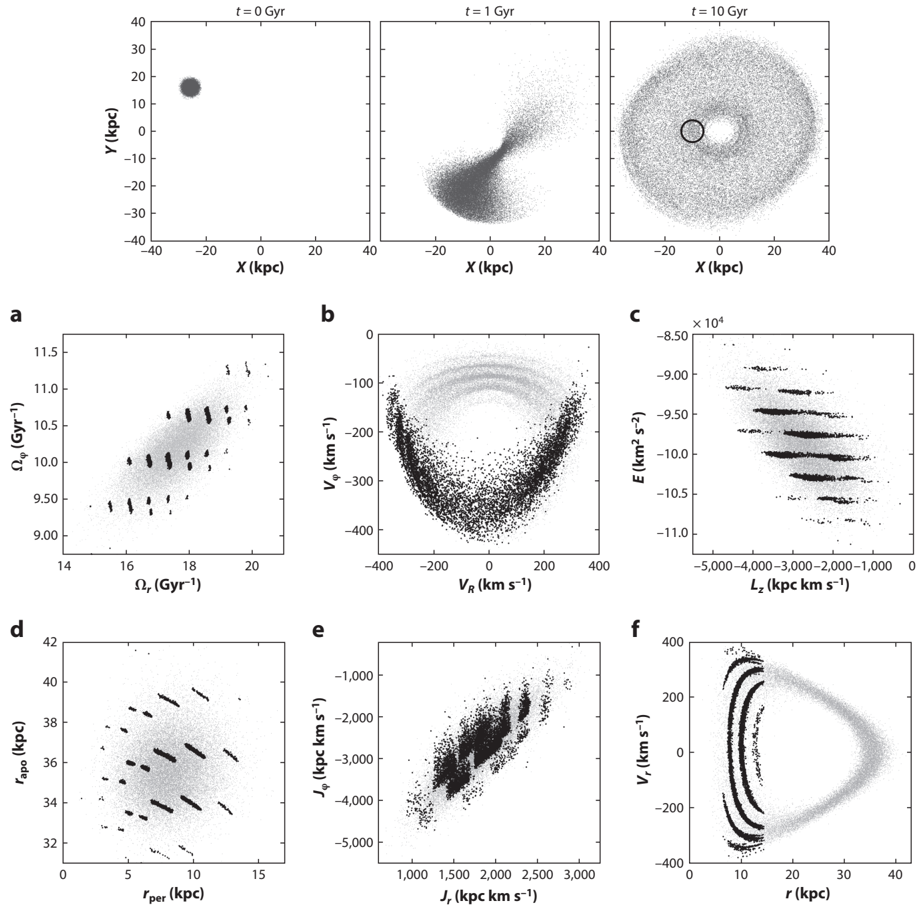
“Individual streams or portions of streams are particularly apparent in frequency space, as can be seen in Figure 4a.This is because the individual streams each have their own characteristic frequency (which defines their phase along the orbit; see McMillan & Binney 2008, Gómez & Helmi 2010).”
§ Streams, Substructures, and the Early History of the Milky Way > 218 Helmi
What the sources say
- Supportedcites McMillan & Binney 2008 matched to “Disassembling the Galaxy with angle-action coordinates” (2008) source
Section 4.1 (pp. 4–5) shows that particles from a disrupted satellite remain in distinct patches in frequency space, even after their spatial distribution becomes nearly featureless. Section 2 (p. 2) explains that orbital angles increase linearly with time at rates given by the orbital frequencies, supporting the claim’s connection between frequency and orbital phase. (LLM, conf=0.89)
- Supportedcites Gómez & Helmi 2010 matched to “On the identification of substructure in phase space using orbital frequencies” (2010) source
Section 3.1 (p. 3) says that particles with different frequencies form multiple streams, each with its own characteristic frequency, as their orbital angles evolve. Sections 3.2.2 (p. 6) and 6 (p. 15) say that frequency space makes those streams readily identifiable. (LLM, conf=0.92)
plainstates a cause- Asserted: passes — The authors put it forward as true.
- Checkable: passes — It can be checked against evidence.
- Load-bearing: passes — The paper’s conclusions depend on it.
- Based: passes — The paper gives a reason why it holds.
- Supported
Every source the paper cites for this claim was checked and supports it.
In the paper
“Nonetheless, Gómez et al. (2013) and Simpson et al. (2019), for example, have shown that substructure is still present in these spaces, even in simulations of the full hierarchical assembly of the halo.”
§ Streams, Substructures, and the Early History of the Milky Way > 218 Helmi
What the sources say
- Supportedcites Gómez et al. 2013 matched to “Streams in the Aquarius stellar haloes” (2013) source
Section 4.1 (p. 8) says substructure is clearly visible in integrals-of-motion space despite merger-driven changes to the host potential and chaotic orbital behaviour. The paper describes its stellar-halo simulations as fully cosmological (p. 2), supporting the claim's hierarchical-assembly context. (LLM, conf=0.94)
- Supportedcites Simpson et al. 2019 matched to “Simulating cosmological substructure in the solar neighbourhood” (2019) source
Section 3 reports clear stellar substructure in energy–angular-momentum (E–Lz) space in the cosmological Auriga simulations, with structures arising from accreted satellites. This supports the claim that substructure remains visible in an integrals-of-motion space in simulations of hierarchical assembly. Page numbers are not provided in our copy. (LLM, conf=0.93)
boosted- Asserted: passes — The authors put it forward as true.
- Checkable: passes — It can be checked against evidence.
- Load-bearing: passes — The paper’s conclusions depend on it.
- Based: passes — The paper gives a reason why it holds.
- Supported
79 more claims · 19 with their cited sources checked
Create a free account to see all 184 claims and to verify the 25 references still open.
- It may state two separate claims as one. 77
- The quote only partly states this claim. 2
- Probably not a substantial claim. 36
Claims other papers make about this one
Each is checked against this paper’s own text: does it say what the citing paper says it does?
The source backs part of the claim, not all of it — or backs it for a different population, condition or comparison.
In the citing paper
“Kraken may represent the tip of the iceberg of several further accretion events hidden towards the Galactic centre (Helmi 2020), where the identification of substructure is complicated by high stellar densities and phase space mixing on short orbital time-scales.”
From Kraken reveals itself – the merger history of the Milky Way reconstructed with the E-MOSAICS simulations (2020) · cites this paper as Helmi 2020
Experimental — accuracy not yet measured
Citations
Cites
Items 201–367 of 367
The total stellar halo mass of the Milky Way
Deason, A. J., Belokurov, V., & Sanders, J. L. (2019) · Monthly Notices of the Royal Astronomical Society · doi:10.1093/mnras/stz2793 · Cited by 144
Response of the Milky Way's disc to the Large Magellanic Cloud in a first infall scenario
Laporte, C. F. P., Gómez, F. A., Besla, G., Johnston, K. V., & Garavito-Camargo, N. (2018) · Monthly Notices of the Royal Astronomical Society · doi:10.1093/mnras/stx2146 · Cited by 142
The shape of the Galactic halo with Gaia DR2 RR Lyrae. Anatomy of an ancient major merger
Iorio, G., & Belokurov, V. (2019) · Monthly Notices of the Royal Astronomical Society · doi:10.1093/mnras/sty2806 · Cited by 139
Stellar haloes of simulated Milky-Way-like galaxies: chemical and kinematic properties
Tissera, P. B., Scannapieco, C., Beers, T. C., & Carollo, D. (2013) · Monthly Notices of the Royal Astronomical Society · doi:10.1093/mnras/stt691 · Cited by 137
Characterization and history of the Helmi streams with Gaia DR2
Koppelman, H. H., Helmi, A., Massari, D., Roelenga, S., & Bastian, U. (2019) · Astronomy & Astrophysics · doi:10.1051/0004-6361/201834769 · Cited by 137
Self-citationThe origin of galactic metal-rich stellar halo components with highly eccentric orbits
Fattahi, A., Belokurov, V., Deason, A. J., Frenk, C. S., Gómez, F. A., Grand, R. J. J., Marinacci, F., Pakmor, R., & Springel, V. (2019) · Monthly Notices of the Royal Astronomical Society · doi:10.1093/mnras/stz159 · Cited by 137
Cheng, J. Y., Rockosi, C. M., Morrison, H. L., Lee, Y. S., Beers, T. C., Bizyaev, D., Harding, P., Malanushenko, E., Malanushenko, V., Oravetz, D., et al. (2012) · The Astrophysical Journal · doi:10.1088/0004-637x/752/1/51 · Cited by 134
Weighing the stellar constituents of the galactic halo with APOGEE red giant stars
Mackereth, J. T., & Bovy, J. (2020) · Monthly Notices of the Royal Astronomical Society · doi:10.1093/mnras/staa047 · Cited by 132
Phase‐Space Distributions of Chemical Abundances in Milky Way–Type Galaxy Halos
Font, A. S., Johnston, K. V., Bullock, J. S., & Robertson, B. E. (2006) · The Astrophysical Journal · doi:10.1086/505131 · Cited by 131
Piercing the Milky Way: an all-sky view of the Orphan Stream
Koposov, S. E., Belokurov, V, Li, T. S., Mateu, C., Erkal, D., Grillmair, C. J., Hendel, D., Price-Whelan, A. M., Laporte, C. F. P., Hawkins, K., et al. (2019) · Monthly Notices of the Royal Astronomical Society · doi:10.1093/mnras/stz457 · Cited by 130
Majewski, S. R., Munn, J. A., & Hawley, S. L. (1996) · The Astrophysical Journal · doi:10.1086/309944 · Cited by 128
The phase-space structure of cold dark matter haloes: insights into the Galactic halo
Helmi, A., White, S. D. M., & Springel, V. (2003) · Monthly Notices of the Royal Astronomical Society · doi:10.1046/j.1365-8711.2003.06227.x · Cited by 128
Self-citationLinear perturbation theory for tidal streams and the small-scale CDM power spectrum
Bovy, J., Erkal, D., & Sanders, J. L. (2017) · Monthly Notices of the Royal Astronomical Society · doi:10.1093/mnras/stw3067 · Cited by 128
Xue, X.-X., Rix, H.-W., Ma, Z., Morrison, H., Bovy, J., Sesar, B., & Janesh, W. (2015) · The Astrophysical Journal · doi:10.1088/0004-637x/809/2/144 · Cited by 126
A box full of chocolates: The rich structure of the nearby stellar halo revealed by Gaia and RAVE
Helmi, A., Veljanoski, J., Breddels, M. A., Tian, H., & Sales, L. V. (2017) · Astronomy & Astrophysics · doi:10.1051/0004-6361/201629990 · Cited by 124
Self-citationIdentification of the long stellar stream of the prototypical massive globular cluster ω Centauri
Ibata, R. A., Bellazzini, M., Malhan, K., Martin, N., & Bianchini, P. (2019) · Nature Astronomy · doi:10.1038/s41550-019-0751-x · Cited by 124
Schuster, W. J., Moreno, E., Nissen, P. E., & Pichardo, B. (2012) · Astronomy & Astrophysics · doi:10.1051/0004-6361/201118035 · Cited by 123
STREAMFINDER – I. A new algorithm for detecting stellar streams
Malhan, K., & Ibata, R. A. (2018) · Monthly Notices of the Royal Astronomical Society · doi:10.1093/mnras/sty912 · Cited by 123
A synoptic map of halo substructures from the Pan-STARRS1 3π survey
Bernard, E. J., Ferguson, A. M. N., Schlafly, E. F., Martin, N. F., Rix, H.-W., Bell, E. F., Finkbeiner, D. P., Goldman, B., Martínez-Delgado, D., Sesar, B., et al. (2016) · Monthly Notices of the Royal Astronomical Society · doi:10.1093/mnras/stw2134 · Cited by 122
Stellar Streams and Clouds in the Galactic Halo
Grillmair, C. J., & Carlin, J. L. (2015) · Astrophysics and space science library · doi:10.1007/978-3-319-19336-6_4 · Cited by 120
Tracing the formation of the Milky Way through ultra metal-poor stars
Sestito, F., Longeard, N., Martin, N. F., Starkenburg, E., Fouesneau, M., González Hernández, J. I., Arentsen, A., Ibata, R., Aguado, D. S., Carlberg, R. G., et al. (2019) · Monthly Notices of the Royal Astronomical Society · doi:10.1093/mnras/stz043 · Cited by 119
Halo substructure in the SDSS--Gaia catalogue: streams and clumps
Myeong, G. C., Evans, N. W., Belokurov, V, Amorisco, N. C., & Koposov, S. E. (2018) · Monthly Notices of the Royal Astronomical Society · doi:10.1093/mnras/stx3262 · Cited by 118
Vogelsberger, M., White, S. D. M., Helmi, A., & Springel, V. (2008) · Monthly Notices of the Royal Astronomical Society · doi:10.1111/j.1365-2966.2007.12746.x · Cited by 114
Self-citationOn the kinematic detection of accreted streams in the Gaia era: a cautionary tale
Jean-Baptiste, I., Di Matteo, P., Haywood, M., Gómez, A., Montuori, M., Combes, F., & Semelin, B. (2017) · Astronomy & Astrophysics · doi:10.1051/0004-6361/201629691 · Cited by 114
VOLATILE DELIVERY TO PLANETS FROM WATER-RICH PLANETESIMALS AROUND LOW-MASS STARS
Ciesla, F. J., Mulders, G. D., Pascucci, I., & Apai, D. (2015) · The Astrophysical Journal · doi:10.1088/0004-637x/804/1/9 · Cited by 112
A review of action estimation methods for galactic dynamics
Sanders, J. L., & Binney, J. (2016) · Monthly Notices of the Royal Astronomical Society · doi:10.1093/mnras/stw106 · Cited by 111
Rauer, H., Aerts, C., Cabrera, J., et al. (2016) · Astronomische Nachrichten · doi:10.1002/asna.201612408 · Cited by 110
The QUEST RR Lyrae Survey. I. The First Catalog
Vivas, A. K., Zinn, R., Abad, C., Andrews, P., Bailyn, C., Baltay, C., Bongiovanni, A., Briceo, C., Bruzual, G., Coppi, P., et al. (2004) · The Astronomical Journal · doi:10.1086/380929 · Cited by 109
Martell, S. L., Shetrone, M. D., Lucatello, S., Schiavon, R. P., Mészáros, S., Prieto, C. A., García-Hernández, D. A., Beers, T. C., & Nidever, D. L. (2016) · The Astrophysical Journal · doi:10.3847/0004-637x/825/2/146 · Cited by 109
Under the FIRElight: Stellar Tracers of the Local Dark Matter Velocity Distribution in the Milky Way
Necib, L., Lisanti, M., Garrison-Kimmel, S., Wetzel, A., Sanderson, R. E., Hopkins, P. F., Faucher-Giguère, C.-A., & Kereš, D. (2019) · The Astrophysical Journal · doi:10.3847/1538-4357/ab3afc · Cited by 109
Stream–orbit misalignment – I. The dangers of orbit-fitting
Sanders, J. L., & Binney, J. (2013) · Monthly Notices of the Royal Astronomical Society · doi:10.1093/mnras/stt806 · Cited by 108
Halo Star Streams in the Solar Neighborhood
Kepley, A. A., Morrison, H. L., Helmi, A., Kinman, T. D., Van Duyne, J., Martin, J. C., Harding, P., Norris, J. E., & Freeman, K. C. (2007) · The Astronomical Journal · doi:10.1086/521429 · Cited by 107
Self-citationRoederer, I. U., Hattori, K., & Valluri, M. (2018) · The Astronomical Journal · doi:10.3847/1538-3881/aadd9c · Cited by 105
Galactic Archaeology: The dwarfs that survived and perished
Belokurov, V. (2013) · New Astronomy Reviews · doi:10.1016/j.newar.2013.07.001 · Cited by 104
Helmi, A., White, S. D. M., & Springel, V. (2002) · Physical Review D · doi:10.1103/physrevd.66.063502 · Cited by 104
Self-citationThe gravitational force field of the Galaxy measured from the kinematics of RR Lyrae in Gaia
Wegg, C., Gerhard, O., & Bieth, M. (2019) · Monthly Notices of the Royal Astronomical Society · doi:10.1093/mnras/stz572 · Cited by 104
Identifying true satellites of the Magellanic Clouds
Sales, L. V., Navarro, J. F., Kallivayalil, N., & Frenk, C. S. (2017) · Monthly Notices of the Royal Astronomical Society · doi:10.1093/mnras/stw2816 · Cited by 101
Tremaine, S. (1999) · Monthly Notices of the Royal Astronomical Society · doi:10.1046/j.1365-8711.1999.02690.x · Cited by 100
Tidal debris morphology and the orbits of satellite galaxies
Hendel, D., & Johnston, K. V. (2015) · Monthly Notices of the Royal Astronomical Society · doi:10.1093/mnras/stv2035 · Cited by 99
Orbital eccentricity as a probe of thick disc formation scenarios
Sales, L. V., Helmi, A., Abadi, M. G., Brook, C. B., Gómez, F. A., Roškar, R., Debattista, V. P., House, E., Steinmetz, M., & Villalobos, Á. (2009) · Monthly Notices of the Royal Astronomical Society: Letters · doi:10.1111/j.1745-3933.2009.00763.x · Cited by 98
Self-citationFragkoudi, F., Matteo, P. D., Haywood, M., Schultheis, M., Александрович, Х. С., Gómez, A., & Combes, F. (2018) · Astronomy and Astrophysics · doi:10.1051/0004-6361/201732509 · Cited by 98
Chiba, M., & Yoshii, Y. (1998) · The Astronomical Journal · doi:10.1086/300177 · Cited by 96
Why the Milky Way’s bulge is not only a bar formed from a cold thin disk
Matteo, P. D., Gómez, A., Haywood, M., Combes, F., Lehnert, M. D., Ness, M., Snaith, O. N., Katz, D., & Semelin, B. (2015) · Astronomy and Astrophysics · doi:10.1051/0004-6361/201424457 · Cited by 96
Khanna, S., Sharma, S., Tepper-Garcia, T., Bland-Hawthorn, J., Hayden, M., Asplund, M., Buder, S., Chen, B., De Silva, G. M., Freeman, K. C., et al. (2019) · Monthly Notices of the Royal Astronomical Society · doi:10.1093/mnras/stz2462 · Cited by 96
Fourteen candidate RR Lyrae star streams in the inner Galaxy
Mateu, C., Read, J. I., & Kawata, D. (2017) · Monthly Notices of the Royal Astronomical Society · doi:10.1093/mnras/stx2937 · Cited by 95
On the alleged duality of the Galactic halo: On the alleged halo duality
Schönrich, R., Asplund, M., & Casagrande, L. (2011) · Monthly Notices of the Royal Astronomical Society · doi:10.1111/j.1365-2966.2011.19003.x · Cited by 94
The oxygen abundance in metal-poor stars
Sneden, C., Lambert, D. L., & Whitaker, R. W. (1979) · The Astrophysical Journal · doi:10.1086/157580 · Cited by 94
Beers, T. C., Drilling, J. S., Rossi, S., Chiba, M., Rhee, J., Führmeister, B., Norris, J. E., & von Hippel, T. (2002) · The Astronomical Journal · doi:10.1086/341377 · Cited by 94
Vacca, W. D., & Sandell, G. (2011) · The Astrophysical Journal · doi:10.1088/0004-637x/732/1/8 · Cited by 93
Skúladóttir, Á., Hansen, C. J., Salvadori, S., & Choplin, A. (2019) · Astronomy and Astrophysics · doi:10.1051/0004-6361/201936125 · Cited by 91
Disassembling the Galaxy with angle-action coordinates
McMillan, P. J., & Binney, J. J. (2008) · Monthly Notices of the Royal Astronomical Society · doi:10.1111/j.1365-2966.2008.13767.x · Cited by 90
Eadie, G., & Jurić, M. (2019) · The Astrophysical Journal · doi:10.3847/1538-4357/ab0f97 · Cited by 90
FASHIONABLY LATE? BUILDING UP THE MILKY WAY'S INNER HALO
Morrison, H. L., Helmi, A., Sun, J., Liu, P., Gu, R., Norris, J. E., Harding, P., Kinman, T. D., Kepley, A. A., Freeman, K. C., et al. (2009) · The Astrophysical Journal · doi:10.1088/0004-637x/694/1/130 · Cited by 89
Self-citationThe oldest and most metal-poor stars in the APOSTLE Local Group simulations
Starkenburg, E., Oman, K. A., Navarro, J. F., Crain, R. A., Fattahi, A., Frenk, C. S., Sawala, T., & Schaye, J. (2017) · Monthly Notices of the Royal Astronomical Society · doi:10.1093/mnras/stw2873 · Cited by 85
TIDAL HEATING IN MULTILAYERED TERRESTRIAL EXOPLANETS
Henning, W. G., & Hurford, T. A. (2014) · The Astrophysical Journal · doi:10.1088/0004-637x/789/1/30 · Cited by 84
On the identification of substructure in phase space using orbital frequencies
Gómez, F. A., & Helmi, A. (2010) · Monthly Notices of the Royal Astronomical Society · doi:10.1111/j.1365-2966.2009.15841.x · Cited by 83
Self-citationGalactic Halo Stars in Phase Space: A Hint of Satellite Accretion?
Brook, C. B., Kawata, D., Gibson, B. K., & Flynn, C. (2003) · The Astrophysical Journal · doi:10.1086/374306 · Cited by 82
uvby-β photometry of high-velocity and metal-poor stars: XI. Ages of halo and old disk stars
Schuster, W. J., Moitinho, A., Márquez, A., Parrao, L., & Covarrubias, E. (2006) · Astronomy & Astrophysics · doi:10.1051/0004-6361:20053796 · Cited by 82
The slight spin of the old stellar halo
Deason, A. J., Belokurov, V., Koposov, S. E., Gómez, F. A., Grand, R. J., Marinacci, F., & Pakmor, R. (2017) · Monthly Notices of the Royal Astronomical Society · doi:10.1093/mnras/stx1301 · Cited by 81
Chaotic dispersal of tidal debris
Price-Whelan, A. M., Johnston, K. V., Valluri, M., Pearson, S., Küpper, A. H. W., & Hogg, D. W. (2016) · Monthly Notices of the Royal Astronomical Society · doi:10.1093/mnras/stv2383 · Cited by 80
Casey, A. R., Hawkins, K., Hogg, D. W., Ness, M., Rix, H.-W., Kordopatis, G., Kunder, A., Steinmetz, M., Koposov, S., Enke, H., et al. (2017) · The Astrophysical Journal · doi:10.3847/1538-4357/aa69c2 · Cited by 78
Self-citationVelocity substructure from Gaia and direct searches for dark matter
O’Hare, C. A. J., Evans, N. W., McCabe, C., Myeong, G., & Belokurov, V. A. (2020) · Physical review. D/Physical review. D. · doi:10.1103/physrevd.101.023006 · Cited by 78
CARBON-ENHANCED METAL-POOR STARS: CEMP-s and CEMP-no SUBCLASSES IN THE HALO SYSTEM OF THE MILKY WAY
Carollo, D., Freeman, K., Beers, T. C., Placco, V. M., Tumlinson, J., & Martell, S. L. (2014) · The Astrophysical Journal · doi:10.1088/0004-637x/788/2/180 · Cited by 77
Wyse, R. F. G., Gilmore, G., Norris, J. E., Wilkinson, M. I., Kleyna, J. T., Koch, A., Evans, N. W., & Grebel, E. K. (2006) · The Astrophysical Journal · doi:10.1086/501228 · Cited by 76
THE RELATIONSHIP BETWEEN MONO-ABUNDANCE AND MONO-AGE STELLAR POPULATIONS IN THE MILKY WAY DISK
Minchev, I., Steinmetz, M., Chiappini, C., Martig, M., Anders, F., Matijevič, G., & de Jong, R. S. (2016) · The Astrophysical Journal · doi:10.3847/1538-4357/834/1/27 · Cited by 76
On the alleged duality of the Galactic haloPreprint
(2016) · Cited by 76
Gómez, F. A., Minchev, I., Villalobos, Á., O’Shea, B. W., & Williams, M. E. K. (2012) · Monthly Notices of the Royal Astronomical Society · doi:10.1111/j.1365-2966.2011.19867.x · Cited by 75
Predicted Extension of the Sagittarius Stream to the Milky Way Virial Radius
Dierickx, M. I. P., & Loeb, A. (2017) · The Astrophysical Journal · doi:10.3847/1538-4357/836/1/92 · Cited by 74
Galactic simulations of r-process elemental abundances
Haynes, C. J., & Kobayashi, C. (2018) · Monthly Notices of the Royal Astronomical Society · doi:10.1093/mnras/sty3389 · Cited by 73
Clues to the formation of the Milky Way’s thick disk
Haywood, M., Di Matteo, P., Snaith, O., & Lehnert, M. D. (2015) · Astronomy & Astrophysics · doi:10.1051/0004-6361/201425459 · Cited by 72
LIMB-DARKENING COEFFICIENTS FOR ECLIPSING WHITE DWARFS
Gianninas, A., Strickland, B. D., Kilic, M., & Bergeron, P. (2013) · The Astrophysical Journal · doi:10.1088/0004-637x/766/1/3 · Cited by 72
Martell, S. L., & Mészáros, S. (2016) · Repository of the Academy's Library (Library of the Hungarian Academy of Sciences) · Cited by 72
Fernández-Alvar, E., Carigi, L., Schuster, W. J., Hayes, C. R., Ávila-Vergara, N., Majewski, S. R., Allende Prieto, C., Beers, T. C., Sánchez, S. F., Zamora, O., et al. (2018) · The Astrophysical Journal · doi:10.3847/1538-4357/aa9ced · Cited by 68
Malhan, K., Ibata, R., Carlberg, R. G., Valluri, M., & Freese, K. (2019) · The Astrophysical Journal · doi:10.3847/1538-4357/ab2e07 · Cited by 68
Aurigaia: mock Gaia DR2 stellar catalogues from the auriga cosmological simulations
Grand, R. J. J., Helly, J., Fattahi, A., Cautun, M., Cole, S., Cooper, A. P., Deason, A. J., Frenk, C., Gómez, F. A., Hunt, J. A. S., et al. (2018) · Monthly Notices of the Royal Astronomical Society · doi:10.1093/mnras/sty2403 · Cited by 64
Common origin for Hercules-Aquila and Virgo Clouds in Gaia DR2
Simion, I. T., Belokurov, V., & Koposov, S. E. (2019) · Monthly Notices of the Royal Astronomical Society · doi:10.1093/mnras/sty2744 · Cited by 64
Roman, N. G. (1950) · The Astrophysical Journal · doi:10.1086/145367 · Cited by 62
Halo streams in the solar neighborhood
Klement, R. J. (2010) · The Astronomy and Astrophysics Review · doi:10.1007/s00159-010-0034-0 · Cited by 60
A deeper look at the GD1 stream: density variations and wiggles
de Boer, T. J. L., Belokurov, V. A., Koposov, S. E., Ferrarese, L., Erkal, D., Côté, P., & Navarro, J. F. (2018) · Monthly Notices of the Royal Astronomical Society · doi:10.1093/mnras/sty677 · Cited by 60
Majewski, S. R., Munn, J. A., & Hawley, S. L. (1994) · The Astrophysical Journal · doi:10.1086/187359 · Cited by 59
Population studies. 12: The duality of the galactic halo
Norris, J. E. (1994) · The Astrophysical Journal · doi:10.1086/174516 · Cited by 58
OBSERVATIONAL EVIDENCE FROM SDSS FOR A MERGER ORIGIN OF THE MILKY WAY'S THICK DISK
Dierickx, M., Klement, R., Rix, H.-W., & Liu, C. (2010) · The Astrophysical Journal Letters · doi:10.1088/2041-8205/725/2/l186 · Cited by 57
Identifying stellar streams in Gaia DR2 with data mining techniques
Borsato, N. W., Martell, S. L., & Simpson, J. D. (2019) · Monthly Notices of the Royal Astronomical Society · doi:10.1093/mnras/stz3479 · Cited by 57
Simulations of minor mergers - II. The phase-space structure of thick discs
Villalobos, Á., & Helmi, A. (2009) · Monthly Notices of the Royal Astronomical Society · doi:10.1111/j.1365-2966.2009.15085.x · Cited by 56
Self-citationWilson, M. L., Helmi, A., Morrison, H. L., Breddels, M. A., Bienaymé, O., Binney, J., Bland-Hawthorn, J., Campbell, R., Freeman, K. C., Fulbright, J. P., et al. (2011) · Monthly Notices of the Royal Astronomical Society · doi:10.1111/j.1365-2966.2011.18298.x · Cited by 56
Self-citationStreams in the Aquarius stellar haloes
Gómez, F. A., Helmi, A., Cooper, A. P., Frenk, C. S., Navarro, J. F., & White, S. D. M. (2013) · Monthly Notices of the Royal Astronomical Society · doi:10.1093/mnras/stt1838 · Cited by 56
Self-citationWhere Are the First Stars Now?
White, S. D. M., & Springel, V. (2006) · ESO ASTROPHYSICS SYMPOSIA · doi:10.1007/10719504_62 · Cited by 55
Kinman, T. D., Cacciari, C., Bragaglia, A., Buzzoni, A., & Spagna, A. (2007) · Monthly Notices of the Royal Astronomical Society · doi:10.1111/j.1365-2966.2006.11394.x · Cited by 54
Liu, C., & van de Ven, G. (2012) · Monthly Notices of the Royal Astronomical Society · doi:10.1111/j.1365-2966.2012.21551.x · Cited by 54
Di Matteo, P., Lehnert, M. D., Qu, Y., & van Driel, W. (2011) · Astronomy & Astrophysics · doi:10.1051/0004-6361/201015822 · Cited by 54
Neutral Oxygen in Late-Type Stars
Conti, P. S., Greenstein, J. L., Spinard, H., Wallerstein, G., & Vardya, M. S. (1967) · The Astrophysical Journal · doi:10.1086/149130 · Cited by 51
The Origin of r-process Enhanced Metal-poor Halo Stars In Now-destroyed Ultra-faint Dwarf Galaxies
Brauer, K., Ji, A. P., Frebel, A., Dooley, G. A., Gómez, F. A., & O’Shea, B. W. (2019) · The Astrophysical Journal · doi:10.3847/1538-4357/aafafb · Cited by 47
Bottom-up Acceleration of Ultra-high-energy Cosmic Rays in the Jets of Active Galactic Nuclei
Mbarek, R., & Caprioli, D. (2019) · The Astrophysical Journal · doi:10.3847/1538-4357/ab4a08 · Cited by 46
Matteo, P. D., Lehnert, M. D., Qu, Y., & van Driel, W. (2010) · Springer Link (Chiba Institute of Technology) · doi:10.1051/0004-6361/201015822/pdf · Cited by 45
0 Observational Evidence from SDSS for a Merger Origin of the Milky Way’s Thick Disk
Dierickx, M., Klement, R. J., Rix, H., & Liu, C. (2010) · Max Planck Institute for Plasma Physics · Cited by 44
Creating mock catalogues of stellar haloes from cosmological simulations
Lowing, B., Wang, W., Cooper, A., Kennedy, R., Helly, J., Cole, S., & Frenk, C. (2015) · Monthly Notices of the Royal Astronomical Society · doi:10.1093/mnras/stu2257 · Cited by 42
A Disk Origin for the Monoceros Ring and A13 Stellar Overdensities
Sheffield, A. A., Price-Whelan, A. M., Tzanidakis, A., Johnston, K. V., Laporte, C. F. P., & Sesar, B. (2018) · The Astrophysical Journal · doi:10.3847/1538-4357/aaa4b6 · Cited by 42
Evidence for the accretion origin of halo stars with an extreme r-process enhancement
Xing, Q., Zhao, G., Aoki, W., Honda, S., Li, H., Ishigaki, M. N., & Matsuno, T. (2019) · Nature Astronomy · doi:10.1038/s41550-019-0764-5 · Cited by 42
Fardal, M. A., van der Marel, R. P., Law, D. R., Sohn, S. T., Sesar, B., Hernitschek, N., & Rix, H.-W. (2019) · Monthly Notices of the Royal Astronomical Society · doi:10.1093/mnras/sty3428 · Cited by 41
ANOTHER LOOK AT THE EASTERN BANDED STRUCTURE: A STELLAR DEBRIS STREAM AND A POSSIBLE PROGENITOR
Grillmair, C. J. (2011) · The Astrophysical Journal · doi:10.1088/0004-637x/738/1/98 · Cited by 41
On the relative ages of the α-rich and α-poor stellar populations in the Galactic halo
Hawkins, K., Jofré, P., Gilmore, G., & Masseron, T. (2014) · Monthly Notices of the Royal Astronomical Society · doi:10.1093/mnras/stu1910 · Cited by 40
The mass profile of the Milky Way to the virial radius from the Illustris simulation
Taylor, C., Boylan-Kolchin, M., Torrey, P., Vogelsberger, M., & Hernquist, L. (2016) · Monthly Notices of the Royal Astronomical Society · doi:10.1093/mnras/stw1522 · Cited by 40
Milky Way's thick and thin disk: Is there a distinct thick disk?
Kawata, D., & Chiappini, C. (2016) · Astronomische Nachrichten · doi:10.1002/asna.201612421 · Cited by 40
Gas Accretion onto the Milky Way
Richter, P. (2017) · Astrophysics and space science library · doi:10.1007/978-3-319-52512-9_2 · Cited by 40
The Virgo Overdensity Explained
Donlon, T., Newberg, H. J., Weiss, J., Amy, P., & Thompson, J. (2019) · The Astrophysical Journal · doi:10.3847/1538-4357/ab4f72 · Cited by 39
Is the dark halo of the Milky Way prolate?
Bowden, A., Evans, N. W., & Williams, A. A. (2016) · Monthly Notices of the Royal Astronomical Society · doi:10.1093/mnras/stw994 · Cited by 38
Valentini, M., Chiappini, C., Davies, G. R., Elsworth, Y., Mosser, B., Lund, M. N., Miglio, A., Chaplin, W. J., Rodrigues, T. S., Boeche, C., et al. (2017) · Astronomy and Astrophysics · doi:10.1051/0004-6361/201629701 · Cited by 38
Self-citationChemical evolution models for the dwarf spheroidal galaxies Leo 1 and Leo 2
Lanfranchi, G. A., & Matteucci, F. (2010) · Astronomy and Astrophysics · doi:10.1051/0004-6361/200913045 · Cited by 37
Zheng, Y., Peek, J. E. G., Putman, M. E., & Werk, J. K. (2019) · The Astrophysical Journal · doi:10.3847/1538-4357/aaf6eb · Cited by 37
Berg, M. A., Howk, J. C., Lehner, N., Wotta, C. B., O’Meara, J. M., Bowen, D. V., Burchett, J. N., Peeples, M. S., & Tejos, N. (2019) · The Astrophysical Journal · doi:10.3847/1538-4357/ab378e · Cited by 34
Through thick and thin: Structure of the Galactic thick disc from extragalactic surveys
Kordopatis, G., Hill, V., Irwin, M., Gilmore, G. F., Wyse, R. F. G., Tolstoy, E., de Laverny, P., Recio-Blanco, A., Battaglia, G., & Starkenburg, E. (2013) · Astronomy and Astrophysics · doi:10.1051/0004-6361/201321470 · Cited by 32
3C 279 Multiwavelength Monitoring. II. The Ground-based Campaign
Grandi, P., Urry, C. M., Maraschi, L., et al. (1996) · The Astrophysical Journal · doi:10.1086/176869 · Cited by 32
An Upper Limit on the Granularity of the Local Stellar Halo
Gould, A. P. (2003) · The Astrophysical Journal · doi:10.1086/377525 · Cited by 31
Isochrone fitting in the Gaia era
Mints, A., & Hekker, S. (2018) · Astronomy & Astrophysics · doi:10.1051/0004-6361/201832739 · Cited by 31
Lee, Y. S., Beers, T. C., & Kim, Y. K. (2019) · The Astrophysical Journal · doi:10.3847/1538-4357/ab4791 · Cited by 31
Stellar Stream Candidates in the Solar Neighborhood Found in the LAMOST DR3 and TGAS
Liang, X., Zhao, J., Oswalt, T. D., et al. (2017) · The Astrophysical Journal · doi:10.3847/1538-4357/aa7cf7 · Cited by 30
A Large Asymmetry in the Galactic Distribution of Faint Halo/Thick Disk Stars
Larsen, J. A., & Humphreys, R. M. (1996) · The Astrophysical Journal · doi:10.1086/310243 · Cited by 28
Fiorentin, P. R., Lattanzi, M. G., Spagna, A., & Curir, A. (2015) · The Astronomical Journal · doi:10.1088/0004-6256/150/4/128 · Cited by 28
Reversals in the Direction of Polarization Rotation in OJ 287
Cohen, M. H., Aller, H. D., Aller, M. F., et al. (2018) · MPG.PuRe (Max Planck Society) · Cited by 28
THE KAPTEYN MOVING GROUP IS NOT TIDAL DEBRIS FROMωCENTAURI
Navarrete, C., Chanamé, J., Ramírez, I., Meza, A., Anglada-Escudé, G., & Shkolnik, E. (2015) · The Astrophysical Journal · doi:10.1088/0004-637x/808/1/103 · Cited by 27
Homma, H., Murayama, T., Kobayashi, M. A. R., & Taniguchi, Y. (2015) · The Astrophysical Journal · doi:10.1088/0004-637x/799/2/230 · Cited by 27
Reversals in the Direction of Polarization Rotation in OJ 287
Cohen, M. H., Aller, H. D., Aller, M. F., Hovatta, T., Kharb, P., Kovalev, Y. Y., Lister, M. L., Meier, D. L., Pushkarev, A. B., & Savolainen, T. (2018) · The Astrophysical Journal · doi:10.3847/1538-4357/aacb31 · Cited by 27
An Upper Limit on the Granularity of the Local Stellar Halo
Gould, A. P. (2003) · CERN Document Server (European Organization for Nuclear Research) · Cited by 27
Kinematics of metal-poor giants in an inner-halo field, with implications for disk formation
Morrison, H. (1993) · The Astronomical Journal · doi:10.1086/116451 · Cited by 26
EFFECT OF HALO BIAS AND LYMAN LIMIT SYSTEMS ON THE HISTORY OF COSMIC REIONIZATION
Kaurov, A. A., & Gnedin, N. Y. (2013) · The Astrophysical Journal · doi:10.1088/0004-637x/771/1/35 · Cited by 25
The evolution of streams in a time-dependent potential
Buist, H. J. T., & Helmi, A. (2015) · Astronomy & Astrophysics · doi:10.1051/0004-6361/201526203 · Cited by 25
Self-citationThe Baryon Halo of the Milky Way: A Fossil Record of Its Formation
Bland‐Hawthorn, J., & Freeman, K. C. (2000) · Science · doi:10.1126/science.287.5450.79 · Cited by 24
Simple Distance Estimates for Gaia DR2 Stars with Radial Velocities
McMillan, P. J. (2018) · Research Notes of the AAS · doi:10.3847/2515-5172/aaca93 · Cited by 24
SOLAR Hα OSCILLATIONS FROM INTENSITY AND DOPPLER OBSERVATIONS
Jackiewicz, J., & Balasubramaniam, K. (2013) · The Astrophysical Journal · doi:10.1088/0004-637x/765/1/15 · Cited by 22
Milky Way's Thick and Thin disk: is there distinct thick disk?
Kawata, D., & Chiappini, C. (2016) · UCL Discovery (University College London) · Cited by 22
Simulating cosmological substructure in the solar neighbourhood
Simpson, C. M., Gargiulo, I., Gómez, F. A., Grand, R. J. J., Maffione, N., Cooper, A. P., Deason, A. J., Frenk, C., Helly, J., Marinacci, F., et al. (2019) · Monthly Notices of the Royal Astronomical Society: Letters · doi:10.1093/mnrasl/slz142 · Cited by 22
HERCULES X-1: USING ECLIPSE TO MEASURE THE X-RAY CORONA
Leahy, D. A. (2015) · The Astrophysical Journal · doi:10.1088/0004-637x/800/1/32 · Cited by 21
Sie, N.-E., Caro, G. M. M., Huang, Z.-H., Martín-Doménech, R., Fuente, A., & Chen, Y.-J. (2019) · The Astrophysical Journal · doi:10.3847/1538-4357/ab06be · Cited by 20
Voyage 2050 White Paper: All-Sky Visible and Near Infrared Space AstrometryPreprint
Hobbs, D., Brown, A. G. A., Høg, E., Jordi, C., Kawata, D., Tanga, P., Klioner, S. A., Sozzetti, A., Wyrzykowski, Ł., Walton, N., et al. (2019) · HAL (Le Centre pour la Communication Scientifique Directe) · doi:10.48550/arxiv.1907.12535 · Cited by 19
SPIRITS 16tn in NGC 3556: A Heavily Obscured and Low-luminosity Supernova at 8.8 Mpc
Jencson, J. E., Kasliwal, M. M., Adams, S. M., et al. (2018) · The Astrophysical Journal · doi:10.3847/1538-4357/aacf8b · Cited by 17
Kinematically Detected Halo Streams
Smith, M. C. (2015) · Astrophysics and space science library · doi:10.1007/978-3-319-19336-6_5 · Cited by 16
Storage ring cross section measurements for electron impact ionization of Fe 8+
Hahn, M., Becker, A., Bernhardt, D., Grieser, M., Krantz, C., Lestinsky, M., Müller, A., Novotný, O., Pindzola, M. S., Repnow, R., et al. (2016) · Journal of Physics B Atomic Molecular and Optical Physics · doi:10.1088/0953-4075/49/8/084006 · Cited by 16
Effects of22Ne sedimentation and metallicity on the local 40 pc white dwarf luminosity function
Tononi, J., Torres, S., García-Berro, E., Camisassa, M. E., Althaus, L. G., & Rebassa-Mansergas, A. (2019) · Astronomy and Astrophysics · doi:10.1051/0004-6361/201834267 · Cited by 16
MAPPING THE ASYMMETRIC THICK DISK. II. DISTANCE, SIZE, AND MASS OF THE HERCULES THICK DISK CLOUD
Larsen, J. A., Cabanela, J. E., & Humphreys, R. M. (2011) · The Astronomical Journal · doi:10.1088/0004-6256/141/4/130 · Cited by 13
STORAGE RING CROSS SECTION MEASUREMENTS FOR ELECTRON IMPACT IONIZATION OF Fe7+
Hahn, M., Becker, A., Bernhardt, D., et al. (2015) · The Astrophysical Journal · doi:10.1088/0004-637x/813/1/16 · Cited by 12
The Stellar Content of the Infalling Molecular Clump G286.21+0.17
Andersen, M., Barnes, P. J., Tan, J. C., et al. (2017) · The Astrophysical Journal · doi:10.3847/1538-4357/aa9072 · Cited by 12
Properties of Decaying Plasma Turbulence at Subproton Scales
Olshevsky, V., Servidio, S., Pucci, F., Primavera, L., & Lapenta, G. (2018) · The Astrophysical Journal · doi:10.3847/1538-4357/aac1bd · Cited by 12
Shocked POststarburst Galaxy Survey. III. The Ultraviolet Properties of SPOGs
Ardila, F., Alatalo, K., Lanz, L., Appleton, P. N., Beaton, R. L., Bitsakis, T., Cales, S., Falcón‐Barroso, J., Kewley, L. J., Medling, A. M., et al. (2018) · The Astrophysical Journal · doi:10.3847/1538-4357/aad0a3 · Cited by 12
Stonkutė, E., Tautvaišienė, G., Nordström, B. B., & Ženovienė, R. (2012) · Astronomy and Astrophysics · doi:10.1051/0004-6361/201118760 · Cited by 11
Origins and Interpretation of Tidal Debris
Johnston, K. V. (2015) · Astrophysics and space science library · doi:10.1007/978-3-319-19336-6_6 · Cited by 11
GLOBULAR CLUSTER POPULATIONS: RESULTS INCLUDING S4G LATE-TYPE GALAXIES
Zaritsky, D., McCabe, K., Aravena, M., Athanassoula, E., Bosma, A., Comerón, S., Courtois, H. M., Elmegreen, B. G., Elmegreen, D. M., Erroz-Ferrer, S., et al. (2016) · The Astrophysical Journal · doi:10.3847/0004-637x/818/1/99 · Cited by 10
MORE PIECES OF THE PUZZLE: CHEMISTRY AND SUBSTRUCTURES IN THE GALACTIC THICK DISK
Helmi, A., Williams, M. E. K., Freeman, K. C., Bland‐Hawthorn, J., & Silva, G. M. D. (2014) · The Astrophysical Journal · doi:10.1088/0004-637x/791/2/135 · Cited by 9
Self-citationYang, T., Boruah, S. S., & Afshordi, N. (2020) · Monthly Notices of the Royal Astronomical Society · doi:10.1093/mnras/staa441 · Cited by 9 · cited 1×
“The density profile of the dark halo has received less attention thus far (but see Taylor et al. 2016, Fardal et al. 2019, Eadie & Jurić 2019, Yang et al. 2019).”
BackgroundStonkutė, E., Tautvaišienė, G., Nordström, B. B., & Ženovienė, R. (2013) · Astronomy and Astrophysics · doi:10.1051/0004-6361/201321437 · Cited by 9
DEPENDENCE OF NEBULAR HEAVY-ELEMENT ABUNDANCE ON H I CONTENT FOR SPIRAL GALAXIES
Robertson, P. M., Shields, G. A., Davé, R., et al. (2013) · The Astrophysical Journal · doi:10.1088/0004-637x/773/1/4 · Cited by 8
A Hyperfine-resolved Rotation–Vibration Line List of Ammonia (NH3)
Coles, P. A., Owens, A., Küpper, J., et al. (2018) · The Astrophysical Journal · doi:10.3847/1538-4357/aaef7e · Cited by 8
Ženovienė, R., Tautvaišienė, G., Nordström, B. B., Stonkutė, E., & Barisevičius, G. (2015) · Astronomy and Astrophysics · doi:10.1051/0004-6361/201425088 · Cited by 8
SPIRITS 16tn in NGC 3556: A Heavily Obscured and Low-luminosity Supernova at 8.8 Mpc
Jencson, J. E., Kasliwal, M. M., Adams, S. M., et al. (2018) · Liverpool John Moores University · doi:10.3847/1538-435/aacf8b · Cited by 8
Nancy Grace Roman and the Dawn of Space Astronomy
Roman, N. G. (2019) · Annual Review of Astronomy and Astrophysics · doi:10.1146/annurev-astro-091918-104446 · Cited by 7
Bland‐Hawthorn, J. (1999) · Nature · doi:10.1038/22230 · Cited by 6
Behaviour of streams in angle and frequency spaces in different potentials
Buist, H. J. T., & Helmi, A. (2017) · Astronomy and Astrophysics · doi:10.1051/0004-6361/201527930 · Cited by 6
Self-citationStatistical Analysis of Acoustic Wave Power and Flows around Solar Active Regions
Rabello-Soares, M. C., Bogart, R. S., & Scherrer, P. H. (2018) · The Astrophysical Journal · doi:10.3847/1538-4357/aabba5 · Cited by 5
Tidal streams in the local group and beyond : observations and implications
Newberg, H. J., & Carlin, J. L. (2016) · CERN Document Server (European Organization for Nuclear Research) · doi:10.1007/978-3-319-19336-6 · Cited by 4
Applying Liouville's Theorem to Gaia DataPreprint
Buckley, M. R., Hogg, D. W., & Price-Whelan, A. M. (2019) · arXiv (Cornell University) · doi:10.48550/arxiv.1907.00987 · Cited by 4 · cited 1×
“…and substructures 15 ∆6w ∼ ∆3x∆3v and since ∆3x (the spatial extent covered by the debris or 1/ρ) grows in time, this means that ∆3v decreases with time locally as shown by Helmi & White (1999, and see Buckley et al. (2019) for a slightly different and interesting application of these concepts).”
MethodChemical abundances of field halo stars - Implications for the building blocks of the Milky Way
Ishigaki, M. N. (2019) · Proceedings of the International Astronomical Union · doi:10.1017/s1743921319007865 · Cited by 4
The Third Stromlo Symposium—The Galactic Halo: Bright Stars and Dark Matter
de Zeeuw, P. T., & Norris, J. (1999) · Publications of the Astronomical Society of the Pacific · doi:10.1086/316363 · Cited by 3 · cited 1×
“This spirit is particularly evident in the 3rd Stromlo symposium on the Galactic halo edited by Gibson et al. (1999) which took place in Canberra in 1998.”
BackgroundBehaviour of streams in angle and frequency spaces in different potentials
Buist, H. J. T., & Helmi, A. (2017) · Springer Link (Chiba Institute of Technology) · doi:10.1051/0004-6361/201527930/pdf · Cited by 3
Self-citationGalactic dynamics in the era of Gaia
Hagen, J. (2020) · doi:10.33612/diss.111512030 · Cited by 1
33. Structure and Dynamics of the Galactic System (Structure Et Dynamique Du Systeme Galactique)
Burton, W. B., Mayor, M., Bahcall, J., et al. (1988) · Transactions of the International Astronomical Union · doi:10.1017/s0251107x00007240 · Cited by 1
Origin of the Heaviest Elements: the Rapid Neutron-Capture Process
Cowan, J. J., Sneden, C., Lawler, J. E., et al. (2019) · arXiv · doi:10.48550/arxiv.1901.01410
A massive mess: When a large dwarf and a Milky Way-like galaxy merge
Koppelman, H. H., Bos, R. O. Y., & Helmi, A. (2020) · arXiv · doi:10.48550/arxiv.2006.07620
Self-citationChasing Accreted Structures within Gaia DR2 using Deep Learning
Necib, L., Ostdiek, B., Lisanti, M., et al. (2019) · arXiv · doi:10.48550/arxiv.1907.07681
Research works printed but not linked: 37
- 36. Bisterzo S, Gallino R, Straniero O, Cristallo S, Käppeler F. 2010. MNRAS 404:1529-44
- 57. Burton WB. 1988. Trans. Int. Astron. Union Ser. A 20A:377-421
- 68. Chaplin WJ, Basu S, Huber D, et al. 2014. Ap. J. Suppl. 210:1
- 74. Christlieb N, Battistini C, Bonifacio P, et al. 2019. Messenger 175:26-29
- 75. Conroy C, Bonaca A, Cargile P, et al. 2020. Ap. J. 883:107
- 2016, Ground-based and Airborne Instrumentation for Astronomy VI, 9908
- 82. de Jong RS, Agertz O, Berbel AA, et al. 2019. Messenger 175:3-11
- 98. Dierickx M, Klement R, Rix HW, Liu C. 2010. Ap. J. Lett. 725:L186-90
- 100. Dinescu DI. 2002. In Omega Centauri, A Unique Window into Astrophysics, ed. F van Leeuwen, JD Hughes, G Piotto, pp. 143-54. San Francisco: Astron. Soc. Pac. 250
- 106. Eneev TM, Kozlov NN, Sunyaev RA. 1973. Astron. Astrophys. 22:41
- 124. Gerin M, Combes F, Athanassoula E. 1990. Astron. Astrophys. 230:37-54
- 134. Gouda N. 2015. IAU Gen. Assembl. 29:2247720
- 136. Grand RJJ, Gómez FA, Marinacci F, et al. 2017. MNRAS 467:179-207
- 141. Grillmair CJ, Carlin JL. 2016. In Tidal Streams in the Local Group and Beyond, ed. HJ Newberg, JL Carlin, pp. 87-112. New York: Springer
- 153. Helmi A, de Zeeuw PT. 2000. MNRAS 319:657-65
- 154. Helmi A, Irwin M, Deason A, et al. 2019. Messenger 175:23-25
- 155. Helmi A, Navarro JF, Nordström B, et al. 2006. MNRAS 365:1309-23
- 172. Ishigaki MN. 2019. In Star Clusters: From the Milky Way to the Early Universe, ed. A Bragaglia, M Davies, A Sills, E Vesperini, pp. 24-33. Cambridge, UK: Cambridge Univ. Press
- 178. Johnston KV. 2016. In Tidal Streams in the Local Group and Beyond, ed. HJ Newberg, JL Carlin, pp. 141-67. New York: Springer
- 192. Kollmeier J, Fuller J, Gaensicke B, et al. 2019. Bull. Am. Astron. Soc. 51:503
- 211. Levi M, Allen LE, Raichoor A, et al. 2019. Bull. Am. Astron. Soc. 51:57
- 234. McMillan PJ. 2018. Res. Notes Am. Astron. Soc. 2:51
- 258. Ness M, Bird J, Johnson J, et al. 2019. Bull. Am. Astron. Soc. 51:238
- 262. Nissen PE, Schuster WJ. 1997. Astron. Astrophys. 326:751-62
- 269. Pasquini L, Delabre B, Ellis RS, et al. 2018. In Rediscovering Our Galaxy, ed. C Chiappini, I Minchev, E Starkenburg, M Valentini, pp. 242-47. Cambridge, UK: Cambridge Univ. Press
- 270. Perryman MAC, Lindegren L, Kovalevsky J, et al. 1997. Astron. Astrophys. 500:501-4
- 281. Purcell CW, Bullock JS, Kazantzidis S. 2010. MNRAS 404:1711-18
- 288. Richter P. 2017. In Gas Accretion onto Galaxies, ed. A Fox, R Davé, pp. 15-48. New York: Springer
- 289. Ricker GR, Winn JN, Vanderspek R, et al. 2015. J. Astron. Telesc. Instrum. Syst. 1:014003
- 293. Roman NG. 2019. Annu. Rev. Astron. Astrophys. 57:1-34
- 312. Shen J, Rich RM, Kormendy J, et al. 2010. Ap. J. Lett. 720:L72-76
- 317. Smith MC. 2016. In Tidal Streams in the Local Group and Beyond, ed. HJ Newberg, JL Carlin, pp. 113-39. New York: Springer
- 322. Spite F, Spite M. 1979. Messenger 16:7-8
- 328. Tamura N, Takato N, Shimono A, et al. 2016. In Ground-based and Airborne Instrumentation for Astronomy VI, Vol. 9908, ed. CJ Evans, L Simard, H Takami. Bellingham, WA: SPIE Taylor C, Boylan-Kolchin M, Torrey P, Vogelsberger M, Hernquist L. 2016. MNRAS 461:3483-93
- 329. Tinsley BM. 1980. Fundam. Cosmic Phys. 5:287-388
- 339. Turon C, Primas F, Binney J, et al. 2008. Messenger 134:46-49
- 366. Zoccali M. 2019. Bol. Asoc. Argent. Astron. 61:137-44
Cited by
The GALAH+ survey: Third data release
Buder, S., Sharma, S., Kos, J., Amarsi, A. M., Nordlander, T., Lind, K., Martell, S. L., Asplund, M., Bland-Hawthorn, J., Casey, A. R., et al. (2021) · Monthly Notices of the Royal Astronomical Society · doi:10.1093/mnras/stab1242 · Cited by 610
“The overdensity of stars around 𝐿𝑍∼0 kpc km s−1 with higher radial actions is typical for stars of the Galactic halo, especially those of the GES (see e.g. Helmi 2020, and references therein).”
BackgroundResultInfluentialRecio-Blanco, A., de Laverny, P., Palicio, P. A., Kordopatis, G., Álvarez, M. A., Schultheis, M., Contursi, G., Zhao, H., Torralba Elipe, G., Ordenovic, C., et al. (2023) · Astronomy & Astrophysics · doi:10.1051/0004-6361/202243750 · Cited by 256
Kruijssen, J. M. D., Pfeffer, J. L., Chevance, M., Bonaca, A., Trujillo-Gomez, S., Bastian, N., Reina-Campos, M., Crain, R. A., & Hughes, M. E. (2020) · Monthly Notices of the Royal Astronomical Society · doi:10.1093/mnras/staa2452 · Cited by 252
“Kraken may represent the tip of the iceberg of several further accretion events hidden towards the Galactic centre (Helmi 2020), where the identification of substructure is complicated by high stellar densities and phase space mixing on short orbital time-scales.”
BackgroundAnders, F., Khalatyan, A., Queiroz, A. B. A., Chiappini, C., Ardèvol, J., Casamiquela, L., Figueras, F., Jiménez-Arranz, Ó., Jordi, C., Monguió, M., et al. (2022) · Astronomy & Astrophysics · doi:10.1051/0004-6361/202142369 · Cited by 240
A time-resolved picture of our Milky Way’s early formation history
Xiang, M., & Rix, H.-W. (2022) · Nature · doi:10.1038/s41586-022-04496-5 · Cited by 226
Metadata
- Authors
- Helmi, A.
- Affiliations
- University of Groningen (NL)
- Corresponding author
- Helmi, Amina
- ORCID
- Helmi, Amina
- Venue
- Annual Review of Astronomy and Astrophysics
- Publisher
- Annual Reviews
- Published
- 2020-08-18
- Volume
- 58
- Issue
- 1
- Pages
- 205-256
- ISSN
- 0066-4146 (ISSN-L)
- 1545-4282
- OpenAlex
- W3006524504
- Semantic Scholar
- 3597f052fce203991b184a60cea662d7e179e4b5
- Cited by
- 407
- References
- 422
- Citations by year
- 2026: 50 · 2025: 70 · 2024: 65 · 2023: 79 · 2022: 58 · 2021: 67 · 2020: 18
- FWCI
- 4.68
- Type
- journal article
- Language
- en
- Open access
- hybrid
- doi.org
- Licence
- cc-by-sa
- Locations
- Annual Review of Astronomy and Astrophysics (publishedVersion, cc-by-sa)
- University of Groningen research database (University of Groningen / Centre for Information Technology) (publishedVersion, other-oa)
- arXiv (Cornell University) (submittedVersion)
- University of Groningen research database (University of Groningen / Centre for Information Technology) (submittedVersion, other-oa)
- arXiv (Cornell University)
- Funders
- European Space Agency
- Nederlandse Organisatie voor Wetenschappelijk Onderzoek
- Topics
- Physical Sciences › Physics and Astronomy › Astronomy and Astrophysics › Stellar, planetary, and galactic studies
- Physical Sciences › Physics and Astronomy › Astronomy and Astrophysics › Galaxies: Formation, Evolution, Phenomena
- Physical Sciences › Physics and Astronomy › Astronomy and Astrophysics › Astrophysics and Star Formation Studies
- Keywords
- Milky Way formation, stellar streams, thick disk, stellar halo, Helmi streams, Sagittarius stream, chemical tagging, membership probability, chemical evolution, star formation history, galactic chemical evolution, fluid simulation, chemical substructures
About these checks
Registry, retraction, Cites and statistics results are computed, not judged, with one exception: a printed reference that no index lists is read once by a model before it counts as a citation error. Claims are extracted by a model and kept only when their quote appears verbatim in the text; each cited source is then checked, with a model’s help, for whether it says what the claim relies on. Those verdicts can be wrong — read the claim’s quote and the cited source before relying on one.
The claim verdicts this report counts are experimental: their accuracy is not yet measured.
A language model drew the claims from the paper on 2026-10-08, under version 3 of the claim definition (model deepseek-v4.1-flash, prompt extract-v3).
A second model labelled each claim on 2026-10-08 (model jev-1.13-20260917, definition revision gold-guideline-v0.2).
Cited sources are checked with a language model’s help (gpt-6-sol).
Statistics and arithmetic are recomputed, not judged.
Confidence bands are shown only for fields calibrated on our annotated test set. None is calibrated yet, so no band is shown.
What counts as a claim ›How we measure confidence ›How we check this ›
Are you an author, or do you see a problem with this page? Request a review
Data sources
Bibliographic data: Semantic Scholar, OpenAlex, Crossref.
Contains information from the Semantic Scholar Academic Graph Datasets, made available under the ODC Attribution License (ODC-BY 1.0).
Semantic Scholar’s data is described in: Kinney, R., et al. (2023). The Semantic Scholar Open Data Platform. arXiv:2301.10140.
