

The Regulation of Entry
Open accessThe DOI matches its Crossref record, with a small difference in title or year; 39 of the 39 references it cites were found in a registry or an index; none of the 13 sources its claims cite is checked for support yet.
Abstract
1%(5 :25.,1* 3$3(5 6(5,(6 7+( 5(*8/$7,21 2) (175< 6LPHRQ 'MDQNRY 5DIDHO /D 3RUWD )ORUHQ.LR /RSH]GH6LODQHV $QGUHL 6KOHLIHU :RUNLQJ 3DSHU KWWSZZZQEHURUJSDSHUVZ 1$7,21$/ %85($8 2) (&2120,& 5(6($5&+ 0DVVD.KXVHWWV $YHQXH &DPEULGJH 0$ 6HSWHPEHU :H WKDQN 2OJD ,RIIH 7DWLDQD 1HQRYD DQG (NDWHULQD 7UL]ORYD IRU DEOH UHVHDU.K DVVLVWDQ.H DQG +DPLG $ODYL ,ULQD $VWUDNKDQ $EKLMLW %DQHUMHH 5L.KDUG &DYHV -D.TXHOLQH &RROLGJH -DPHV (PHU\ 1LKDO (O0DJKDUEHO -HDQ 3DXO *DXWKLHU (G *ODHVHU 6LPRQ -RKQVRQ /DZUHQ.H .DW] 3HWHU .X.HUD 'DYLG /DLEVRQ ,UD /LHEHUPDQ 'DYLQ 0D.NLQ]LH 0DULH )UDQ.RLVH 0DULH1HOO\ 0DU.HOR 2ODUUHDJD *X\ 3IHIIHUPDQQ 6DQWLDJR 6HGD.D /HLOD :HEVWHU 3HWHU :ULJKW DQG VHPLQDU SDUWL.LSDQWV DW WKH 8QLYHUVLW\ RI 0DU\ODQG DW &ROOHJH 3DUN IRU KHOSIXO .RPPHQWV 7KH .ROOH.WLRQ RI GDWD IRU WKLV SDSHU ZDV RUJDQL]HG DQG ILQDQ.HG E\ WKH :RUOG %DQN $Q DSSHQGL[ GHV
Overview
CoChat Summary
TL;DR
This paper assembles a new cross-country dataset on business entry regulation in 75 countries and uses it to compare the helping-hand, capture, and tollbooth theories of regulation. The evidence is most consistent with the tollbooth view: heavier entry regulation is associated with more corruption, a larger unofficial economy, and less representative, more autocratic governments.
Key findings
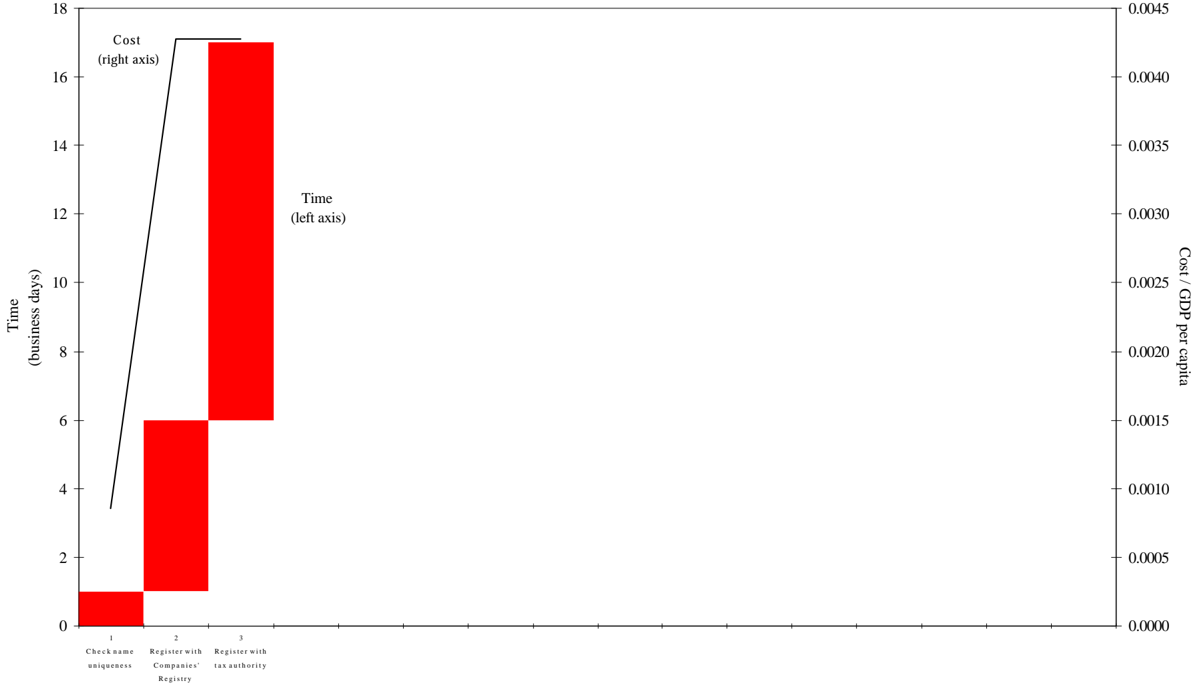
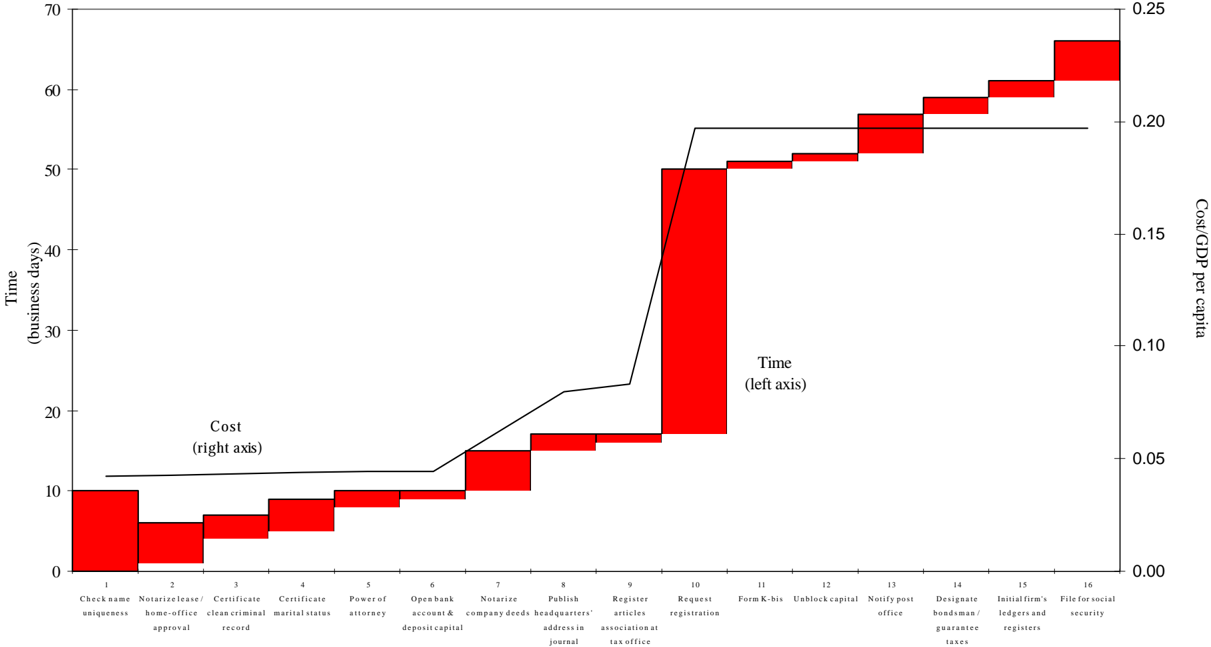
- Across the 75-country sample, the number of entry procedures ranges from 2 in Canada to 20 in Bolivia, with a sample average of 10.17 procedures; the average official time is 63.05 business days and the average cost is 0.34 of GDP per capita.
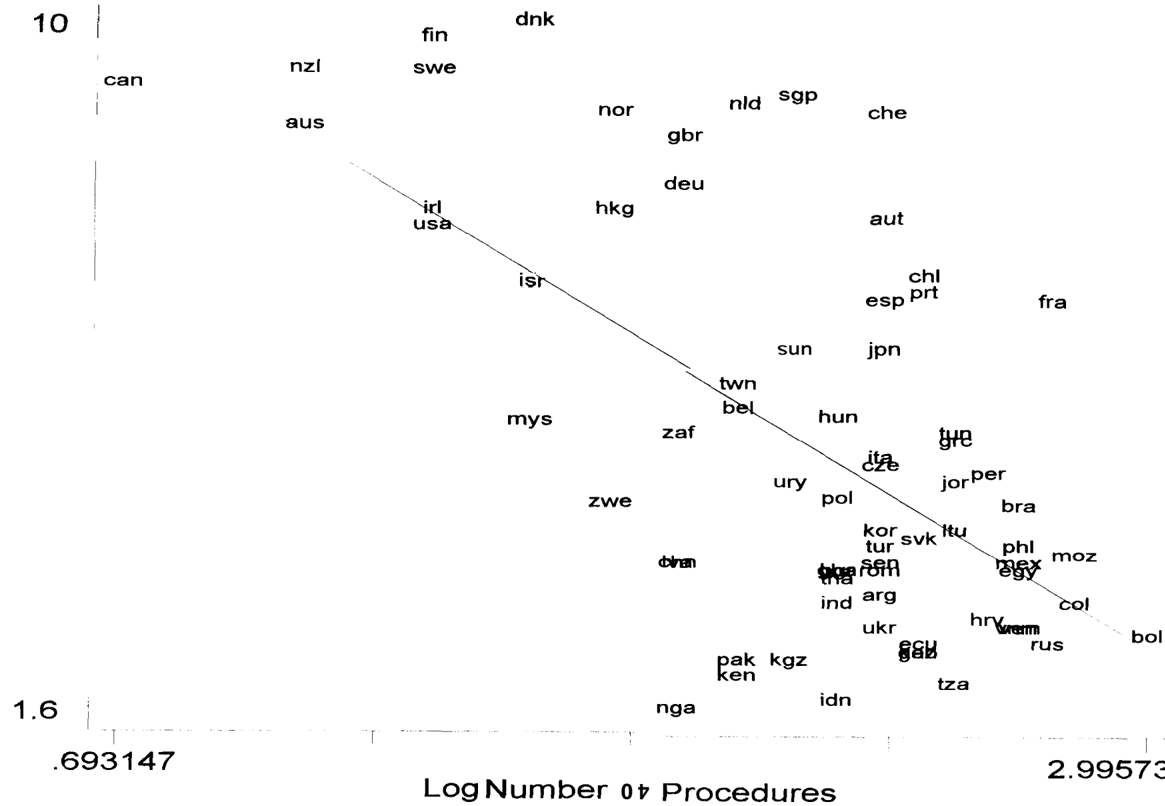
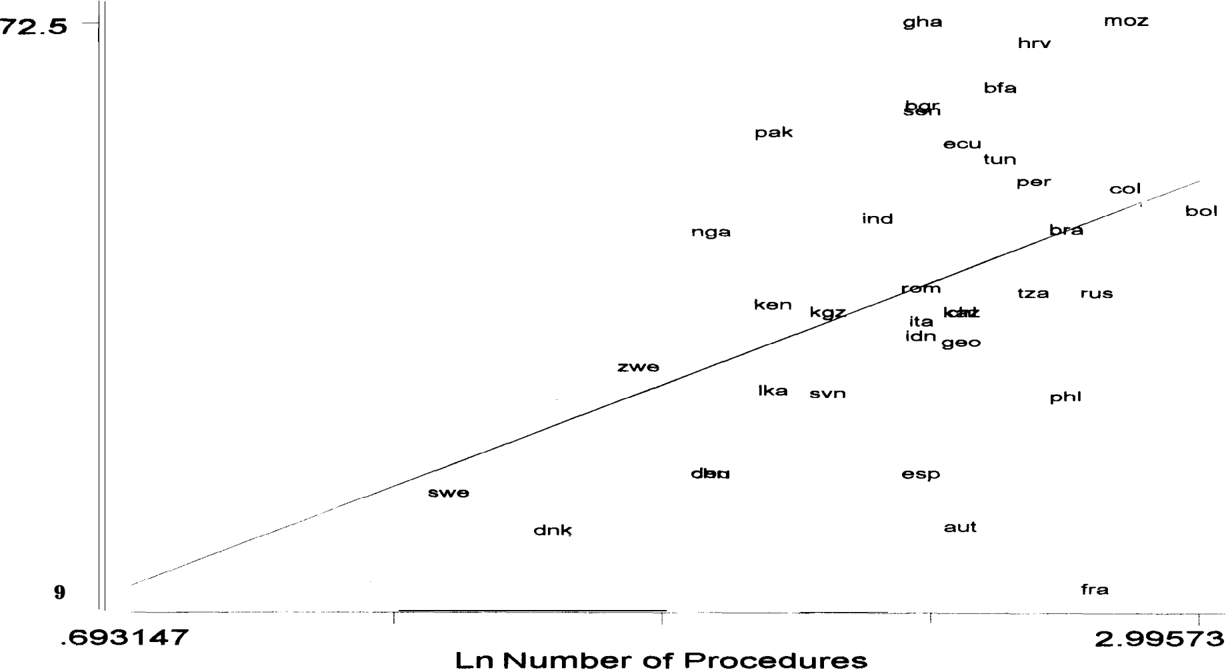
- The number of procedures is strongly correlated with time and cost: the paper reports correlations of 0.75 with log time and 0.62 with log cost.
- The helping-hand tests do not support a beneficial-regulation story: in Table IV, more procedures are associated with lower ISO quality standards (e.g. coefficient -0.2646) and larger unofficial economy measures (e.g. coefficient 13.6277 for size of unofficial economy; 19.8763 for employment in the unofficial economy), while pollution and health outcomes do not improve.
- The tollbooth evidence is stronger: Table VI reports that more procedures are associated with worse corruption scores, with a coefficient of -3.2809 (and -1.7249 with GDP per capita controls) for the corruption regressions.
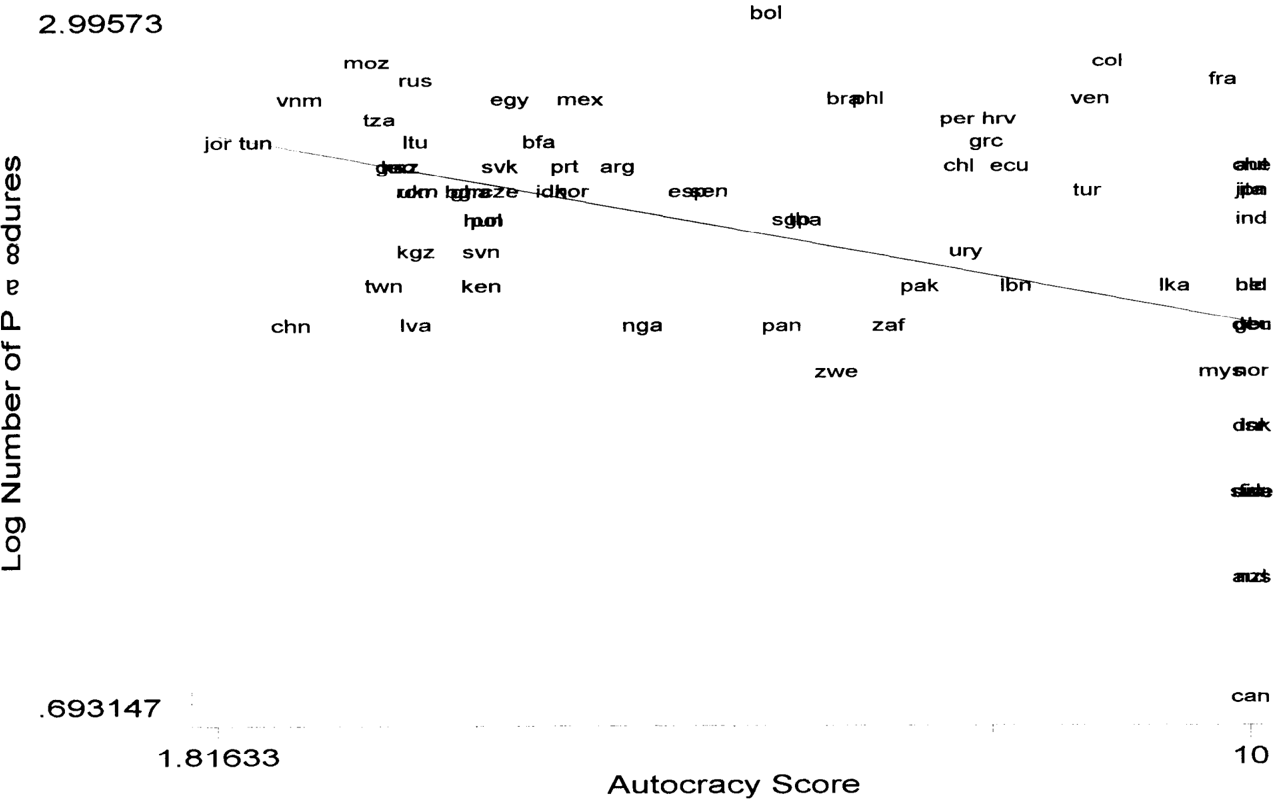
- In Table VIII, better government is associated with lighter regulation; the paper states that countries with more limited and representative governments have statistically significantly fewer procedures using 5 out of 6 measures of better government, and that more autocratic countries regulate more heavily.
Methods
- The paper builds a new database on entry regulation for 75 countries, focusing on the legal requirements, official time, and official cost for a standardized start-up firm.
- Data were gathered from written government sources, World Bank- and USAID-sponsored studies, government web pages, direct contacts with agencies, and independent double-checks in 73 countries via local consulting reports; the remaining 2 countries were double-checked through government contacts.
- The main analysis uses cross-country OLS regressions relating entry regulation measures to outcomes such as quality, pollution, unofficial economy, corruption, political institutions, legal origin, and GDP per capita; the paper also reports correlations and test-of-means comparisons across income quartiles.
Limitations
- The paper itself notes that the capture-theory tests are based on crude measures and that the data are probably least suited to test the capture hypothesis.
- The authors say the data almost surely underestimate the cost and complexity of entry because they focus on the capital city, omit industry-specific requirements and foreign-ownership steps, and ignore some informal delays and bribes.
- Evident from the text: the study is cross-sectional and based on official procedures/costs, so causal interpretation is limited and informal corruption/bureaucratic delays are not directly measured except indirectly through correlations.
Model-written summary. Check it against the paper before relying on it.
Integrity signals
Registry
Cites
Statistics
Figures
Verification
Claims the paper makes
0 Valid · 3 Not valid · 13 Not checked · 114 Own results and interpretations
A result the paper reports from its own data — it cites no other source for it, so there is none to check. The quote shows it is in the paper.
In the paper
“Very few entry regulations cover tax and labor issues.”
plain- Asserted: passes — The authors put it forward as true.
- Checkable: passes — It can be checked against evidence.
- Load-bearing: unclear — It is unclear whether the paper’s conclusions depend on it.
- Based: passes — The paper gives a reason why it holds.
In the paper
“The data show that the numbers of entry and of labor market regulations are positively correlated across countries, contrary to the substitutes hypothesis.”
What the sources say
- Not matchedcites Djankov et al., 2000
An author–year citation the paper’s reference list doesn’t settle. We don’t search these by name.
plainstates an association- Asserted: passes — The authors put it forward as true.
- Checkable: passes — It can be checked against evidence.
- Load-bearing: unclear — It is unclear whether the paper’s conclusions depend on it.
- Based: passes — The paper gives a reason why it holds.
- Not matched
A result the paper reports from its own data — it cites no other source for it, so there is none to check. The quote shows it is in the paper.
In the paper
“It often takes the form of screening procedures.”
- Also stated in: § III. Basic Results. · plain
“Instead, much of what governments do to regulate entry falls into the category of screening procedures.”
plain- Asserted: passes — The authors put it forward as true.
- Checkable: passes — It can be checked against evidence.
- Load-bearing: unclear — It is unclear whether the paper’s conclusions depend on it.
- Based: passes — The paper gives a reason why it holds.
- Also stated in: § III. Basic Results. · plain
A result the paper reports from its own data — it cites no other source for it, so there is none to check. The quote shows it is in the paper.
In the paper
“First, the cost-to-per-capita-GDP ratio decreases uniformly with GDP per capita.”
plainstates an association- Asserted: passes — The authors put it forward as true.
- Checkable: passes — It can be checked against evidence.
- Load-bearing: unclear — It is unclear whether the paper’s conclusions depend on it.
- Based: passes — The paper gives a reason why it holds.
A result the paper reports from its own data — it cites no other source for it, so there is none to check. The quote shows it is in the paper.
In the paper
“In contrast, countries in the other three quartiles of per capita income are not statistically different from each other in terms of the number of procedures and the time required to fulfill them.”
plain- Asserted: passes — The authors put it forward as true.
- Checkable: passes — It can be checked against evidence.
- Load-bearing: passes — The paper’s conclusions depend on it.
- Based: passes — The paper gives a reason why it holds.
49 more claims
Create a free account to see all 130 claims and every source verdict.
- Probably not a substantial claim. 21
- It may state two separate claims as one. 54
- The quote only partly states this claim. 26
Claims other papers make about this one
Each is checked against this paper’s own text: does it say what the citing paper says it does?
The source backs part of the claim, not all of it — or backs it for a different population, condition or comparison.
In the citing paper
“Our findings suggest an explanation for the low level of incorporation in Italy: the average direct cost associated with fulfilling the bureaucratic regulations for registering a new corporation in Italy is 20% of per capita GNP compared to 10% of per capita GNP on average for other G-7 European countries.”
From Entry regulation as a barrier to entrepreneurship (2006) · cites this paper as Djankov et al. (2002)
Experimental — accuracy not yet measuredThe cited source says what the claim attributes to it.
In the citing paper
“Given the explicit link made by Djankov et al . (2002) between the speed and ease with which businesses may be established in a country and its economic performance - and the enthusiasm with which this link has been grasped by European Union policy makers - our findings imply this link needs reconsidering.”
From The Effect of Business Regulations on Nascent and Young Business Entrepreneurship (2007) · cites this paper as Djankov et al . (2002)
Citations
Cites
La Porta, R., Lopez‐de‐Silanes, F., Shleifer, A., & Vishny, R. W. (1998) · Journal of Political Economy · doi:10.1086/250042 · Cited by 18,025
Self-citationThe Theory of Economic Regulation
Stigler, G. J. (1971) · The Bell Journal of Economics and Management Science · doi:10.2307/3003160 · Cited by 8,098
Journal of Economic Literature
(2019) · AEA Papers and Proceedings · doi:10.1257/pandp.109.633 · Cited by 7,468
The Quarterly Journal of Economics
Kuznets, S. (2024) · Business Cycle Theory, Part I Volume 4 · doi:10.4324/9781003549741-8 · Cited by 7,176
La Porta, R. (1999) · Journal of Law, Economics, and Organization · doi:10.1093/jleo/15.1.222 · Cited by 5,699 · cited 2×
“Legal origin has been viewed as a proxy for the government’s proclivity to intervene in the economy and the stance of the law toward the security of property rights in a country [La Porta et al. 1999].”
The Theory of Economic Regulation
Stigler, G. J. (2021) · The Political Economy · doi:10.4324/9781315495811-8 · Cited by 5,483
Pigou, A. C. (1933) · The Economic Journal · doi:10.2307/2224491 · Cited by 5,137
Toward a More General Theory of Regulation
Peltzman, S. (1976) · The Journal of Law and Economics · doi:10.1086/466865 · Cited by 4,729
Moffitt, R. A. (2009) · American Economic Review · doi:10.1257/aer.99.2.660 · Cited by 4,694
Shleifer, A., & Vishny, R. W. (1993) · The Quarterly Journal of Economics · doi:10.2307/2118402 · Cited by 3,778
Self-citation
Research works printed but not linked: 7
- McLiesh Caralee, 2001, NBER Working Paper No., 8288
- Kasnako lu, Zehra, and Münür Yayla, 'Unrecorded Economy in Turkey: A Monetary Approach', 1999. "Unrecorded Economy in Turkey (A Monetary Approach)" in Informal Sector in Turkey (I), Tuncer Bulutay (ed.), SIS, Ankara, forthcoming.
- Fred, 1987, Journal of Legal Studies, 101
- Olson, Mancur, 1991, 'Autocracy, Democracy, and Prosperity,' in Richard Zeckhauser, ed., Strategy of Choice, Cambridge, MA: MIT Press.
- 1967, Western Economic Journal, 232
- World Economic Forum (1999), The Global Competitiveness Report 1999 , Schwab, Klaus et al., eds., New York: Oxford University Press.
- World Economic Forum, The Global Competitiveness Report 2001, Klaus Schwab et al., eds. (New York, NY: Oxford University Press, 2001).
Cited by
Items 1,301–1,400 of 3,986
How Does Personal Bankruptcy Law Affect Start-Ups?Preprint
Cerqueiro, G., & Penas, M. F. (2011) · SSRN Electronic Journal · doi:10.2139/ssrn.1934198 · Cited by 25
The Impact of Regulations and Institutional Quality on EntrepreneurshipPreprint
Chambers, D., & Munemo, J. (2017) · SSRN Electronic Journal · doi:10.2139/ssrn.3066312 · Cited by 25
“Similar to Djankov et al. (2002) and World Bank (2003), these results favor the public choice theory: Stricter regulation of entry is associated with greater inefficiency of public institutions, which results in negative outcomes (less entrepreneurial activity in this case).”
InfluentialPopulation and RegulationPreprint
Mulligan, C. B., & Shleifer, A. (2004) · SSRN Electronic Journal · doi:10.2139/ssrn.485722 · Cited by 25
Self-citationInformality and productivity in the labor market in Peru
Chong, A. E., Galdo, J. C., & Saavedra-Chanduví, J. (2008) · Journal of Economic Policy Reform · doi:10.1080/17487870802543480 · Cited by 37
Regional differences in self-employment in China
Luo, B., & Chong, T. T. (2018) · Small Business Economics · doi:10.1007/s11187-018-0063-z · Cited by 28
Brieger, S. A., Clercq, D. D., Hessels, J., & Pfeifer, C. (2020) · International Journal of Entrepreneurial Behaviour & Research · doi:10.1108/ijebr-03-2019-0185 · Cited by 28
Culture from Overseas and Corporate Transparency: Evidence from China
Hao, Y., Han, D., Ning, C., & Liao, J. (2017) · International Journal of Finance & Economics · doi:10.1002/ijfe.1917 · Cited by 27
Regulatory barriers to trade in services: A new database and composite indices
Benz, S., Ferencz, J., & Nordås, H. K. (2020) · World Economy · doi:10.1111/twec.13032 · Cited by 24
Yusuf, H. A., Afolabi, L. O., Shittu, W. O., Gold, K. L., & Muhammad, M. (2021) · Insight on Africa · doi:10.1177/0975087820987174 · Cited by 27
“For example, Djankov et al. (2002) based their studies on the regulation of entry.”
Sethuram, S., Taussig, M. D., & Gaur, A. S. (2021) · Global Strategy Journal · doi:10.1002/gsj.1402 · Cited by 26
Factors Influencing Entrepreneurial Intention among Foreigners in Kazakhstan
Yu, T., Khalid, N., & Ahmed, U. (2021) · Sustainability · doi:10.3390/su13137066 · Cited by 44
The impact of weak formal institutions on the different phases of the entrepreneurial process
Junaid, D., He, Z., & Afzal, F. (2022) · Journal of Business Research · doi:10.1016/j.jbusres.2022.01.040 · Cited by 33
Lu, H. Y., Du, D., & Qin, X. (2022) · Systems · doi:10.3390/systems10020023 · Cited by 28
Institutional outlook of the entrepreneurial climate in Ghana
Adomako, S., Danso, A., & Ampadu, E. (2015) · International Journal of Social Economics · doi:10.1108/ijse-09-2013-0206 · Cited by 34
ICT incidence on the entrepreneurial activity at country level
Alderete, M. V. (2014) · International Journal of Entrepreneurship and Small Business · doi:10.1504/ijesb.2014.059472 · Cited by 27
Srinidhi, B. N., Lim, C. Y., & Hossain, M. (2009) · Journal of Contemporary Accounting & Economics · doi:10.1016/j.jcae.2009.03.001 · Cited by 31
A Causal Interpretation of Extensive and Intensive Margin Effects in Generalized Tobit Models
Staub, K. E. (2013) · The Review of Economics and Statistics · doi:10.1162/rest_a_00350 · Cited by 33
Analysis of the cost of governance and options for its reduction in Nigeria
Adewole, A. M., & Osabuohien, E. S. C. (2007) · Covenant University Repository (Covenant University) · Cited by 32
Digital dark matter within product service systems
Vendrell-Herrero, F., Myrthianos, V., Parry, G., & Bustinza, Ó. F. (2017) · Competitiveness Review An International Business Journal incorporating Journal of Global Competitiveness · doi:10.1108/cr-11-2014-0037 · Cited by 36
Economic growth, the high-tech sector, and the high skilled: Theory and quantitative implications
Gil, P. M., Afonso, Ó., & Brito, P. (2019) · Structural Change and Economic Dynamics · doi:10.1016/j.strueco.2019.07.003 · Cited by 24
Regulator supervisory power and bank loan contracting
He, Z., Qiao, G., Zhang, L., & Zhang, W. (2021) · Journal of Banking & Finance · doi:10.1016/j.jbankfin.2021.106062 · Cited by 26
Urbano, D., Felix, C., & Aparicio, S. (2021) · Journal of Business Research · doi:10.1016/j.jbusres.2021.04.073 · Cited by 33
The development round of trade negotiations in the aftermath of Cancun
Stiglitz, J. E., & Charlton, A. (2004) · Medical Entomology and Zoology · Cited by 24
Crecimiento económico en Chile: Evidencia, fuentes y perspectivas
Gregorio, J. D. (2005) · Estudios Públicos · doi:10.38178/cep.vi98.637 · Cited by 58
Economic Systems of Developing Nations
Pryor, F. L. (2006) · Comparative Economic Studies · doi:10.1057/palgrave.ces.8100072 · Cited by 28
VAT Revisited A New Look at the Value Added Tax in Developing and Transitional Countries
Bird, R. M., Gendron, P.-P., & Rotman, J. L. (2005) · Cited by 40
STATEHOOD EXPERIENCE, LEGAL TRADITIONS, AND CLIMATE CHANGE POLICIES
Ang, J. B., & Fredriksson, P. G. (2017) · Economic Inquiry · doi:10.1111/ecin.12441 · Cited by 25
Environmental Taxes and the Double Dividend
Bovenberg, A. L. (1998) · Empirica · doi:10.1023/a:1006836720884 · Cited by 30
What Drives the Comparability Effect of Mandatory IFRS Adoption?Preprint
Cascino, S., & Gassen, J. (2009) · SSRN Electronic Journal · doi:10.2139/ssrn.1402206 · Cited by 24
The Effects of Business Environments on Development: Surveying New Firm-Level EvidencePreprint
Xu, L. C. (2010) · SSRN Electronic Journal · doi:10.2139/ssrn.1641228 · Cited by 23
Modelling the Egyptian Shadow Economy: A Currency Demand and A MIMIC Model ApproachPreprint
Hassan, M., & SCHNEIDER, F. G. (2016) · SSRN Electronic Journal · doi:10.2139/ssrn.2743153 · Cited by 65
“Based on a study by Djankov et al. (2002), they concluded that a new entrant to the market in Egypt must at least go through 11 procedures at governmental agencies and wait at least 51 business days to obtain a legal status to operate a business.”
Law, Finance and Investment: Does Legal Origin Matter in Africa?Preprint
Asongu, S. A. (2014) · SSRN Electronic Journal · doi:10.2139/ssrn.2493143 · Cited by 24
Measuring Firm Exposure to Government AgenciesPreprint
Armstrong, D. M., Glaeser, S. A., & Hoopes, J. L. (2023) · SSRN Electronic Journal · doi:10.2139/ssrn.4428258 · Cited by 24
Harmful Procompetitive Effects of Trade in Presence of Credit Market Frictions
Foellmi, R., & Oechslin, M. (2019) · Journal of money credit and banking · doi:10.1111/jmcb.12634 · Cited by 25
“(R1) 8Such fixed costs of entry may include the cost of complying with entry regulations, which tend to be particularly high in low-income countries (Djankov et al., 2002).”
Measuring the Effect of Bankruptcy Laws on Entrepreneurship Across Countries
Cumming, D. J. (2012) · The Journal of Entrepreneurial Finance · doi:10.57229/2373-1761.1007 · Cited by 36
“Related work shows how the costs of incorporation affect entrepreneurial activity (Djankov et al., 2002; Klapper et al., 2006; Van Stel et al., 2007).”
Daubanes, J., & Rochet, J.-C. M. (2019) · American Economic Journal Economic Policy · doi:10.1257/pol.20180027 · Cited by 49
Nogueira, M. C., & Madaleno, M. (2021) · Sustainability · doi:10.3390/su13116003 · Cited by 23
“Several authors have also empirically verified the important relationship between human capital and economic growth [22,30,55].”
InfluentialEconomic and Non-Economic Variables Affecting Fraud in European Countries
Ahmad, B., Ciupac-Ulici, M.-L., & Beju, D.-G. (2021) · Risks · doi:10.3390/risks9060119 · Cited by 23
Is the Third Sector an Emerging Economic Institution? Social Preferences Versus Poverty Traps
Amendola, A., Garofalo, M. R., & Nese, A. (2010) · Nonprofit and Voluntary Sector Quarterly · doi:10.1177/0899764010371232 · Cited by 33
“As an example, Diankov et al. (2002) compare the regulatory systems and their respective juridical apparatus in 85 countries; they investigate how the formal and informal institutions enabling new firms to gain access to a market (e.g., the number of procedures and the time needed to carry them…”
Understanding the effects of technology shocks
Wang, P., & Wen, Y. (2010) · Review of Economic Dynamics · doi:10.1016/j.red.2010.03.004 · Cited by 23
Anti-corruption campaign in China: good news or bad news for firm value?
Ying, Q., & Liu, J. (2017) · Applied Economics Letters · doi:10.1080/13504851.2017.1406651 · Cited by 23
“Theoretically, industry entry regulations lead to higher corruption, and benefit politicians and bureaucrats (Djankov et al., 2002).”
Legal System and Trade Credit: Evidence from Emerging Economies
Li, Y., Zhou, M., Du, Y., & Zhao, W. (2018) · Emerging Markets Finance and Trade · doi:10.1080/1540496x.2018.1460271 · Cited by 26
“…developed financial institutions (Djankov, McLiesh, and Shleifer 2007; La Porta et al. 1997, 1998), less regulation of entry and less corruption (Djankov et al. 2002), less government ownership of banks and lower interest rates (La Porta, LopezdeSilanes, and Shleifer 2002), higher quality of…”
Financialisation, institutions and financing constraints in developing countries
Mertzanis, C. (2019) · Cambridge Journal of Economics · doi:10.1093/cje/bez015 · Cited by 26
Dau, L. A., Moore, E. M., & Newburry, W. E. (2020) · Journal of International Business Policy · doi:10.1057/s42214-020-00049-7 · Cited by 25
Governance of Financial Supervisors and its Effects - A Stocktaking Exercise
Quintyn, M. (2007) · RePEc: Research Papers in Economics · Cited by 33
Innovation and the trade elasticity
Rubini, L. (2014) · Journal of Monetary Economics · doi:10.1016/j.jmoneco.2014.04.002 · Cited by 27
Reforming The Investment Climate : Lessons For Practitioners
Kikeri, S., Kenyon, T., & Palmade, V. (2006) · World Bank, Washington, DC eBooks · doi:10.1596/1813-9450-3986 · Cited by 23
Product Market Regulation and Endogenous Union FormationPreprint
Haefke, C., & Ebell, M. (2006) · SSRN Electronic Journal · doi:10.2139/ssrn.921389 · Cited by 23
“(2001)) and Djankov, et. al.”
An End to Consensus? The Selective Impact of Corporate Law Reform on Financial DevelopmentPreprint
Deakin, S. F., Sarkar, P., & Singh, A. (2011) · SSRN Electronic Journal · doi:10.2139/ssrn.1934737 · Cited by 24
How does entry regulation influence entry into self-employment and occupational mobility?
Spitz‐Oener, A., & Prantl, S. (2009) · Working paper series - Institute for Fiscal Studies/Working papers · doi:10.1920/wp.ifs.2009.0914 · Cited by 22
An Analysis of the Underground Economy and its Macroeconomic ConsequencesPreprint
Dabla‐Norris, E., & Feltenstein, A. (2003) · SSRN Electronic Journal · doi:10.2139/ssrn.879098 · Cited by 23
The Guarantees of FreedomPreprint
Porta, R. L., de Silanes, F. L., Pop-Eleches, C., & Shleifer, A. (2002) · SSRN Electronic Journal · doi:10.2139/ssrn.297145 · Cited by 23
Self-citationInstitutions, Networks and Entrepreneurship Development in Russia: An ExplorationPreprint
Aidis, R., & Estrin, S. (2006) · SSRN Electronic Journal · doi:10.2139/ssrn.924422 · Cited by 25
Jin, X., Yu, J., Yuan, G., & Zang, R. (2024) · Corporate Governance An International Review · doi:10.1111/corg.12619 · Cited by 32
Political regimes and stock market development
Francis, B. B., & Ofori, E. (2015) · Eurasian economic review : · doi:10.1007/s40822-015-0018-5 · Cited by 23
Altin, M., Memili, E., & Sönmez, S. (2017) · Tourism Economics · doi:10.1177/1354816617689869 · Cited by 28
“Regulations concerning new ventures can include a number of procedures, time, and cost (Djankov et al., 2002).”
Александрова, Е. А., Gerry, C. J., & Verkhovskaya, O. R. (2019) · Journal of Entrepreneurship in Emerging Economies · doi:10.1108/jeee-11-2018-0133 · Cited by 23
Owning your future: Entrepreneurship and the prospects of upward mobility in China
Wang, L., Liu, L., & Dai, Y. (2021) · Economic Modelling · doi:10.1016/j.econmod.2021.105637 · Cited by 26
Gao, X., Meng, J., Ling, Y., Liao, M., & Cao, M. (2022) · Structural Change and Economic Dynamics · doi:10.1016/j.strueco.2022.02.009 · Cited by 23
“A high level of entrepreneurship leads to sustainable economic growth and radical technical change (Djankov et al., 2002; Fusari and Reati, 2013).”
Salinas, A., Ortiz, C. A., Changoluisa, J., & Muffatto, M. (2023) · Economic Analysis and Policy · doi:10.1016/j.eap.2023.03.016 · Cited by 33
Formal Firms with Bribery in a Dynamic Business Environment
Nam, V. H., Nguyen, T.-A., Hoang, T. B., & Nguyen, C. V. (2023) · Journal of Business Ethics · doi:10.1007/s10551-023-05469-y · Cited by 26
“For instance, discussing the relationship between entry regulations and the level of corruption, Djankov et al. (2002) find that higher corruption is associated with heavier regulations.”
At what cost? Environmental regulation and corporate cash holdings
Alexander, A., Vito, A. D., & Menicacci, L. (2023) · Finance research letters · doi:10.1016/j.frl.2023.104960 · Cited by 25
Baek, C., Jung, E.-Y., & Lee, J. (2014) · Energy Policy · doi:10.1016/j.enpol.2014.04.025 · Cited by 23
Rule of law and the size of government
Holcombe, R. G., & Rodet, C. S. (2011) · Journal of Institutional Economics · doi:10.1017/s1744137411000348 · Cited by 22
Regulation effects on the adoption of new medicines
Costa‐Font, J., McGuire, A. J., & Varol, N. (2015) · Empirical Economics · doi:10.1007/s00181-014-0903-x · Cited by 22
Foreign Direct Investors as Change Agents
Fogel, K., Lee, K. K., Lee, W. Y., & Palmberg, J. (2012) · Corporate Governance An International Review · doi:10.1111/corg.12035 · Cited by 30
An incentive-based model of international entrepreneurship in emerging and transition economies
Ngo, V. D., Janssen, F., & Falize, M. (2016) · Journal of International Entrepreneurship · doi:10.1007/s10843-016-0165-0 · Cited by 27
“Based on the insights of prior studies (e.g., Acemoglu and Johnson 2005; Besley 1995; Brunetti and Weder 1998; Djankov et al. 2002, 2003; Knack and Keefer 1995; Malesky and Taussig 2009; Svensson 1998; Teisberg 1993), there are four key institutional attributes that emerge: specificity, stability, predictability, and…”
InfluentialConclusion: an agenda for EMNC research
Cuervo-Cazurra, Á., & Ramamurti, R. (2014) · Cambridge University Press eBooks · doi:10.1017/cbo9781107587632.018 · Cited by 21
A tale of soil and seeds: the external environment and entrepreneurial entry
Patti, D. M. A., Mudambi, R., Navarra, P. M., & Baglieri, D. (2016) · Small Business Economics · doi:10.1007/s11187-016-9744-7 · Cited by 26
Challenges faced by small to medium scale enterprises: a case study of Chitungwiza, Zimbabwe
Gombarume, F. B. (2014) · Greener Journal of Business and Management Studies · doi:10.15580/gjbms.2014.4.102113910 · Cited by 23
“…has mainly been attributed to lack of networking in the developing world (Atieno, 2009; Coulth and Loos, 2007, Nyoni, 2010). www.gjournals.org 105 Djankov et al. (2002) opined that high entry costs prevents informal SMEs to turn formal whilst Nyoni (2004) observed that in Zimbabwe in particular,…”
Acemoğlu, D. (2010) · Palgrave Macmillan UK eBooks · doi:10.1057/9780230280823_16 · Cited by 22
Büttner, B. (2006) · Economics Letters · doi:10.1016/j.econlet.2006.04.009 · Cited by 26
Measuring Good Governance Using Time Series Data: Fiji Islands
Gani, A., & Duncan, R. (2007) · Journal of the Asia Pacific Economy · doi:10.1080/13547860701405979 · Cited by 21
Sam, I. O. (2014) · American journal of rural development · doi:10.12691/ajrd-2-1-3 · Cited by 22
From Corruption to Lobbying and Economic Growth
Harstad, B., & Svensson, J. (2006) · Cited by 24
Friesen, J., & Wacker, K. M. (2013) · SSRN Electronic Journal · doi:10.2139/ssrn.2267998 · Cited by 32
The Distorted Effect of Financial Development on International Trade FlowsPreprint
Berthou, A. (2010) · RePEc: Research Papers in Economics · Cited by 31
Economic Growth in Chile: Evidence, Sources and ProspectsPreprint
Gregorio, J. D. (2004) · RePEc: Research Papers in Economics · Cited by 24
The Quality of the Legal System and Firm SizePreprint
Laeven, L. A., & Woodruff, C. (2004) · SSRN Electronic Journal · doi:10.2139/ssrn.509582 · Cited by 22
Monetary Policy in the presence of Informal Labour MarketsPreprint
Paul Castillo, B., & Montoro, C. (2010) · RePEc: Research Papers in Economics · Cited by 22
The Impact of Renewable Versus Non-renewable Natural Capital on Economic Growth
Gasmi, F., Virto, L. R., & Couvet, D. (2020) · Environmental and Resource Economics · doi:10.1007/s10640-020-00495-0 · Cited by 25
Past performance and entry in procurement: An experimental investigation
Butler, J. V., Carbone, E., Conzo, P., & Spagnolo, G. (2020) · Journal of Economic Behavior & Organization · doi:10.1016/j.jebo.2020.02.019 · Cited by 30
How does regulatory complexity affect business demography? Evidence from Spain
Mora‐Sanguinetti, J. S., & Pérez-Valls, R. (2020) · European Journal of Law and Economics · doi:10.1007/s10657-020-09650-w · Cited by 28
Firm Growth: A review of the empirical literature
Vaz, R. (2021) · Revista Galega de Economía · doi:10.15304/rge.30.2.7190 · Cited by 43
Democracy and Firm Productivity: Evidence from Indonesia
Abeberese, A. B., Barnwal, P., Chaurey, R., & Mukherjee, P. (2023) · The Review of Economics and Statistics · doi:10.1162/rest_a_01077 · Cited by 35
Does competition from the informal sector affect firms’ energy intensity? Evidence from China
Zhao, N., Liu, X., & Zhang, Z. (2022) · Structural Change and Economic Dynamics · doi:10.1016/j.strueco.2022.04.008 · Cited by 22
Foreign ownership and the financing constraints of firms operating in a multinational environment
Kampouris, I., Mertzanis, C., & Samitas, A. (2022) · International Review of Financial Analysis · doi:10.1016/j.irfa.2022.102328 · Cited by 29
Hu, D., Zhai, C., & Zhen, Y. (2023) · China Economic Review · doi:10.1016/j.chieco.2023.101965 · Cited by 28
Towards Better Regulatory Governance?
Zhang, Y. (2010) · Public Management Review · doi:10.1080/14719037.2010.488865 · Cited by 21
“…and Scarpetta 2003; Estache 2004) suggesting that good governance in general and regulatory governance in particular is critical to a sustainable development process; while excessive regulation has negative effects on private investment, international trade and growth (e.g. Djankov et al. 2002).”
ARE THE BRIC ECONOMIES ENTREPRENEUR-FRIENDLY? AN INSTITUTIONAL PERSPECTIVE
Eunni, R. V., & Manolova, T. S. (2012) · Journal of Enterprising Culture · doi:10.1142/s0218495812500082 · Cited by 24
An Innovation Policy Framework: Bridging the Gap Between Industrial Dynamics and Growth
Braunerhjelm, P., & Henrekson, M. (2016) · International studies in entrepreneurship · doi:10.1007/978-3-319-26677-0_4 · Cited by 28
Bruhn, M., & McKenzie, D. J. (2013) · Journal of Development Effectiveness · doi:10.1080/19439342.2013.813959 · Cited by 28
“Djankov et al. (2002) show that countries with more burdensome entry regulations have larger informal sectors, while Klapper, Laeven, and Rajan (2006) find that costly entry regulations are associated with the creation of fewer limited liability companies.”
Small business tax policy and informality: evidence from Georgia
Bruhn, M., & Loeprick, J. (2015) · International Tax and Public Finance · doi:10.1007/s10797-015-9385-9 · Cited by 35
Corruption on the road: A case study of Russian traffic police
Олейник, А. (2015) · IATSS Research · doi:10.1016/j.iatssr.2015.12.001 · Cited by 22
“Several configurations are possible: the official gains and the other party loses (as predicted by the “tollbooth hypothesis” [7,21]), the official loses and the other party wins (regulatory capture theory examines this case [34]), and both parties involved win, however unequal their gainsmight be.”
Social Barriers to Entrepreneurship in Africa: The Forced Mutual Help Hypothesis ⁄
Alby, P., & Auriol, E. (2010) · Cited by 25
Haar, J., & Price, J. (2008) · Palgrave Macmillan US eBooks · doi:10.1057/9780230610477 · Cited by 21
Property Rights in Sequential Exchange
Arruñada, B., Zanarone, G., & Garoupa, N. M. (2018) · The Journal of Law Economics and Organization · doi:10.1093/jleo/ewy023 · Cited by 21
Porfírio, J. A., Carrilho, T., & Felício, J. A. (2018) · International Entrepreneurship and Management Journal · doi:10.1007/s11365-018-0501-z · Cited by 27
Patel, P. C., Doh, J. P., & Bagchi, S. (2018) · Business & Society · doi:10.1177/0007650318797103 · Cited by 24
“Lower ease in startup procedures is rooted in the tollbooth theory, where regulating new firm entry benefits bureaucrats and politicians through rent seeking and rent generation (Djankov et al., 2002).”
Quality of Institutions and the Allocation of Talent: Cross‐National Evidence
Natkhov, T., & Polishchuk, L. (2019) · Kyklos · doi:10.1111/kykl.12211 · Cited by 26
“This counterintuitive result reflects the role of institutions affecting both variables – informal economy is inversely related to institutional quality (De Soto 1989; Djankov et al., 2002), and the latter, as demonstrated above, is in its turn negatively correlated with the graduation in law.”
Metadata
- Authors
- Djankov, S., La Porta, R., Lopez-de-Silanes, F., & Shleifer, A.
- Affiliations
- World Bank (US)
- National Bureau of Economic Research (US)
- ORCID
- Djankov, S.
- Venue
- The Quarterly Journal of Economics
- Publisher
- Oxford University Press (OUP)
- Published
- 2002-02-01
- Volume
- 117
- Issue
- 1
- Pages
- 1-37
- ISSN
- 0033-5533
- 1531-4650
- OpenAlex
- W2139896179
- Cited by
- 3,956
- References
- 30
- Citations by year
- 2026: 223 · 2025: 185 · 2024: 157 · 2023: 120 · 2022: 140 · 2021: 150 · 2020: 151 · 2019: 161 · 2018: 157 · 2017: 162 · 2016: 166 · 2015: 193 · 2014: 200 · 2013: 183 · 2012: 193
- Type
- report
- Language
- en
- Open access
- green
- doi.org
- Licence
- other-oa
- Locations
- World Bank, Washington, DC eBooks (publishedVersion)
- The Quarterly Journal of Economics (publishedVersion)
- The World Bank Open Knowledge Repository (World Bank) (publishedVersion)
- National Bureau of Economic Research (publishedVersion, other-oa)
- RePEc: Research Papers in Economics (submittedVersion)
- Digital Access to Scholarship at Harvard (DASH) (Harvard University) (submittedVersion, cc-by)
- SSRN Electronic Journal (submittedVersion)
- OpenGrey (Institut de l'Information Scientifique et Technique) (submittedVersion)
- The World Bank Open Knowledge Repository (World Bank) (submittedVersion, cc-by)
- Topics
- Social Sciences › Sociology and Political Science › Corruption and Economic Development
- Social Sciences › Economics, Econometrics and Finance › Economics and Econometrics › Taxation and Compliance Studies
- Social Sciences › Business, Management and Accounting › Strategy and Management › Political Influence and Corporate Strategies
- Keywords
- start-up firms, bureaucratic procedures, corruption, informal economy, democracy, government size, public choice theory, public interest theory
About these checks
Registry, retraction, Cites and statistics results are computed, not judged, with one exception: a printed reference that no index lists is read once by a model before it counts as a citation error. Claims are extracted by a model and kept only when their quote appears verbatim in the text; each cited source is then checked, with a model’s help, for whether it says what the claim relies on. Those verdicts can be wrong — read the claim’s quote and the cited source before relying on one.
A language model drew the claims from the paper on 2026-10-01, under version 3 of the claim definition (model deepseek-v4.1-flash, prompt extract-v3).
A second model labelled each claim on 2026-10-01 (model jev-1.13-20260917, definition revision gold-guideline-v0.2).
Statistics and arithmetic are recomputed, not judged.
Confidence bands are shown only for fields calibrated on our annotated test set. None is calibrated yet, so no band is shown.
What counts as a claim ›How we measure confidence ›How we check this ›
Are you an author, or do you see a problem with this page? Request a review
Data sources
Bibliographic data: Semantic Scholar, OpenAlex, Crossref.
Contains information from the Semantic Scholar Academic Graph Datasets, made available under the ODC Attribution License (ODC-BY 1.0).
Semantic Scholar’s data is described in: Kinney, R., et al. (2023). The Semantic Scholar Open Data Platform. arXiv:2301.10140.
