

The Regulation of Entry
Open accessThe DOI matches its Crossref record, with a small difference in title or year; 39 of the 39 references it cites were found in a registry or an index; none of the 13 sources its claims cite is checked for support yet.
Abstract
1%(5 :25.,1* 3$3(5 6(5,(6 7+( 5(*8/$7,21 2) (175< 6LPHRQ 'MDQNRY 5DIDHO /D 3RUWD )ORUHQ.LR /RSH]GH6LODQHV $QGUHL 6KOHLIHU :RUNLQJ 3DSHU KWWSZZZQEHURUJSDSHUVZ 1$7,21$/ %85($8 2) (&2120,& 5(6($5&+ 0DVVD.KXVHWWV $YHQXH &DPEULGJH 0$ 6HSWHPEHU :H WKDQN 2OJD ,RIIH 7DWLDQD 1HQRYD DQG (NDWHULQD 7UL]ORYD IRU DEOH UHVHDU.K DVVLVWDQ.H DQG +DPLG $ODYL ,ULQD $VWUDNKDQ $EKLMLW %DQHUMHH 5L.KDUG &DYHV -D.TXHOLQH &RROLGJH -DPHV (PHU\ 1LKDO (O0DJKDUEHO -HDQ 3DXO *DXWKLHU (G *ODHVHU 6LPRQ -RKQVRQ /DZUHQ.H .DW] 3HWHU .X.HUD 'DYLG /DLEVRQ ,UD /LHEHUPDQ 'DYLQ 0D.NLQ]LH 0DULH )UDQ.RLVH 0DULH1HOO\ 0DU.HOR 2ODUUHDJD *X\ 3IHIIHUPDQQ 6DQWLDJR 6HGD.D /HLOD :HEVWHU 3HWHU :ULJKW DQG VHPLQDU SDUWL.LSDQWV DW WKH 8QLYHUVLW\ RI 0DU\ODQG DW &ROOHJH 3DUN IRU KHOSIXO .RPPHQWV 7KH .ROOH.WLRQ RI GDWD IRU WKLV SDSHU ZDV RUJDQL]HG DQG ILQDQ.HG E\ WKH :RUOG %DQN $Q DSSHQGL[ GHV
Overview
CoChat Summary
TL;DR
This paper assembles a new cross-country dataset on business entry regulation in 75 countries and uses it to compare the helping-hand, capture, and tollbooth theories of regulation. The evidence is most consistent with the tollbooth view: heavier entry regulation is associated with more corruption, a larger unofficial economy, and less representative, more autocratic governments.
Key findings
- Across the 75-country sample, the number of entry procedures ranges from 2 in Canada to 20 in Bolivia, with a sample average of 10.17 procedures; the average official time is 63.05 business days and the average cost is 0.34 of GDP per capita.
- The number of procedures is strongly correlated with time and cost: the paper reports correlations of 0.75 with log time and 0.62 with log cost.
- The helping-hand tests do not support a beneficial-regulation story: in Table IV, more procedures are associated with lower ISO quality standards (e.g. coefficient -0.2646) and larger unofficial economy measures (e.g. coefficient 13.6277 for size of unofficial economy; 19.8763 for employment in the unofficial economy), while pollution and health outcomes do not improve.
- The tollbooth evidence is stronger: Table VI reports that more procedures are associated with worse corruption scores, with a coefficient of -3.2809 (and -1.7249 with GDP per capita controls) for the corruption regressions.
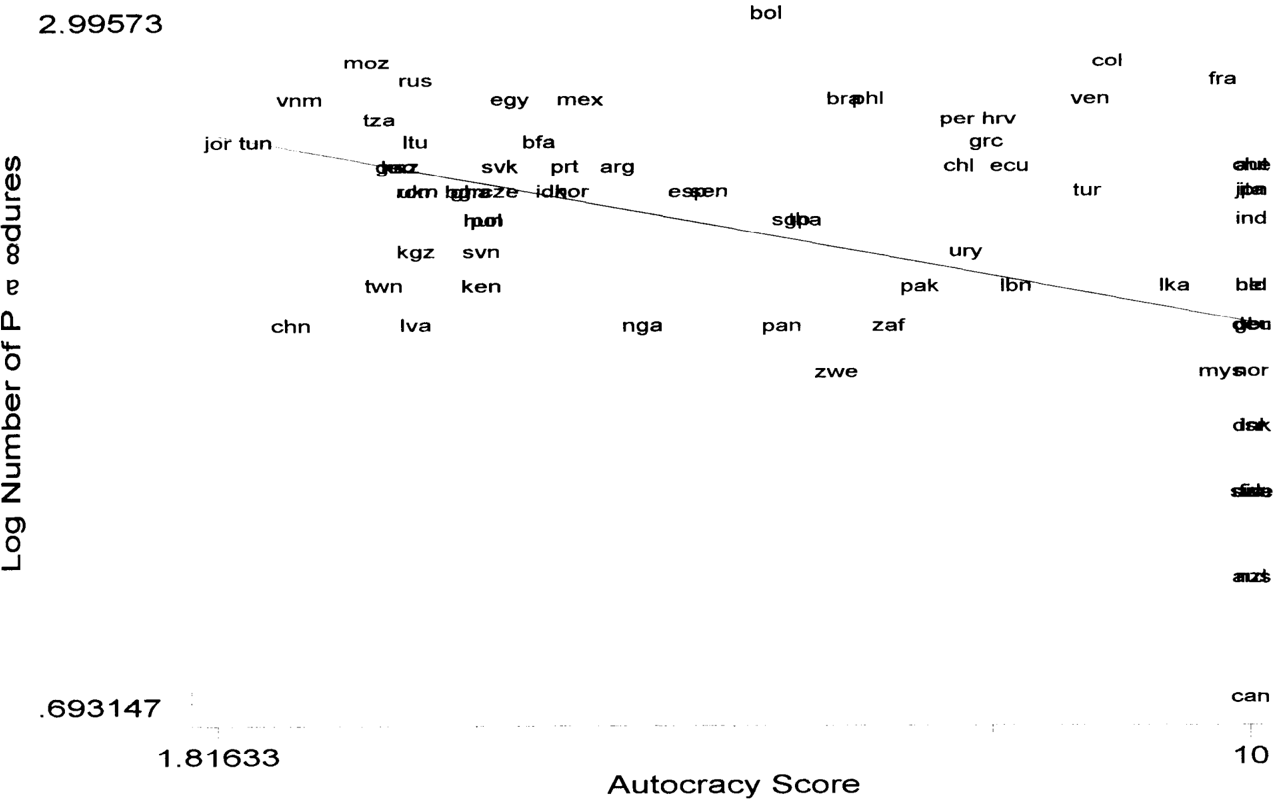
- In Table VIII, better government is associated with lighter regulation; the paper states that countries with more limited and representative governments have statistically significantly fewer procedures using 5 out of 6 measures of better government, and that more autocratic countries regulate more heavily.
Methods
- The paper builds a new database on entry regulation for 75 countries, focusing on the legal requirements, official time, and official cost for a standardized start-up firm.
- Data were gathered from written government sources, World Bank- and USAID-sponsored studies, government web pages, direct contacts with agencies, and independent double-checks in 73 countries via local consulting reports; the remaining 2 countries were double-checked through government contacts.
- The main analysis uses cross-country OLS regressions relating entry regulation measures to outcomes such as quality, pollution, unofficial economy, corruption, political institutions, legal origin, and GDP per capita; the paper also reports correlations and test-of-means comparisons across income quartiles.
Limitations
- The paper itself notes that the capture-theory tests are based on crude measures and that the data are probably least suited to test the capture hypothesis.
- The authors say the data almost surely underestimate the cost and complexity of entry because they focus on the capital city, omit industry-specific requirements and foreign-ownership steps, and ignore some informal delays and bribes.
- Evident from the text: the study is cross-sectional and based on official procedures/costs, so causal interpretation is limited and informal corruption/bureaucratic delays are not directly measured except indirectly through correlations.
Model-written summary. Check it against the paper before relying on it.
Integrity signals
Registry
Cites
Statistics
Figures
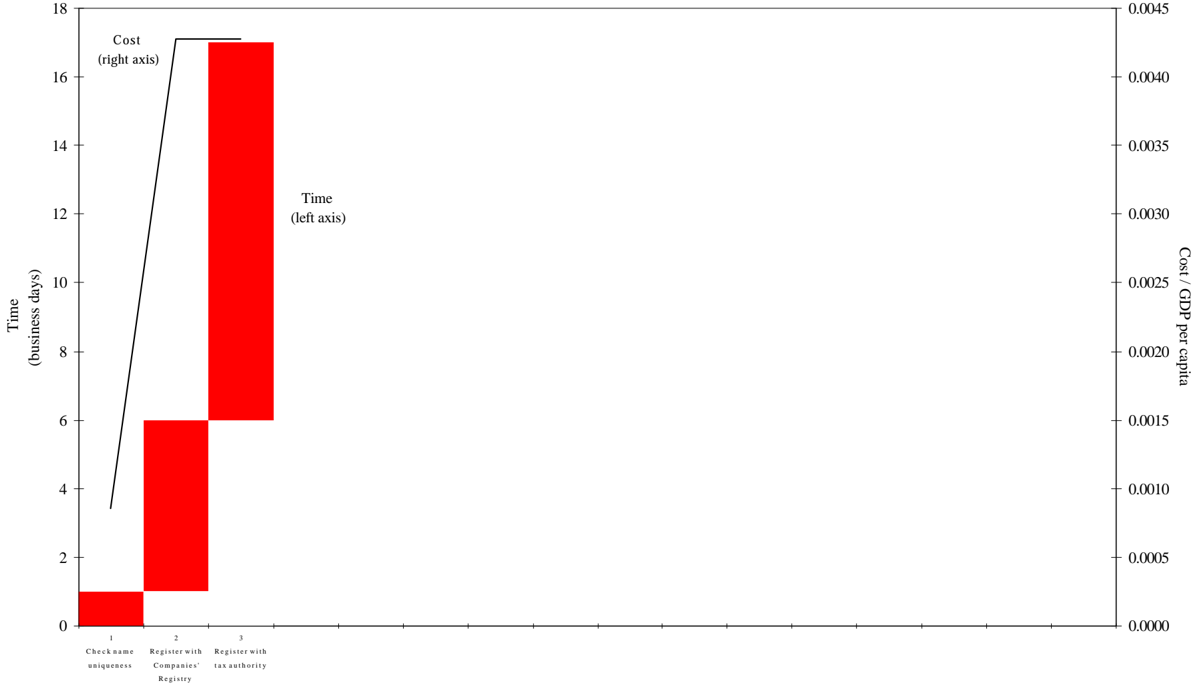
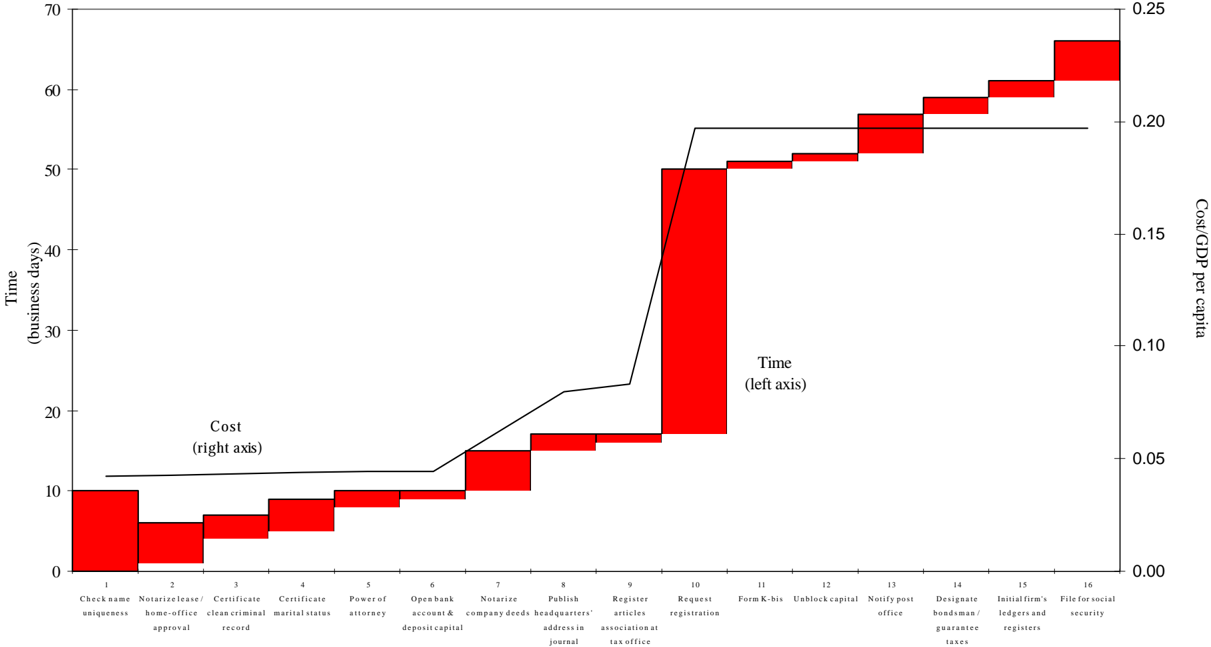
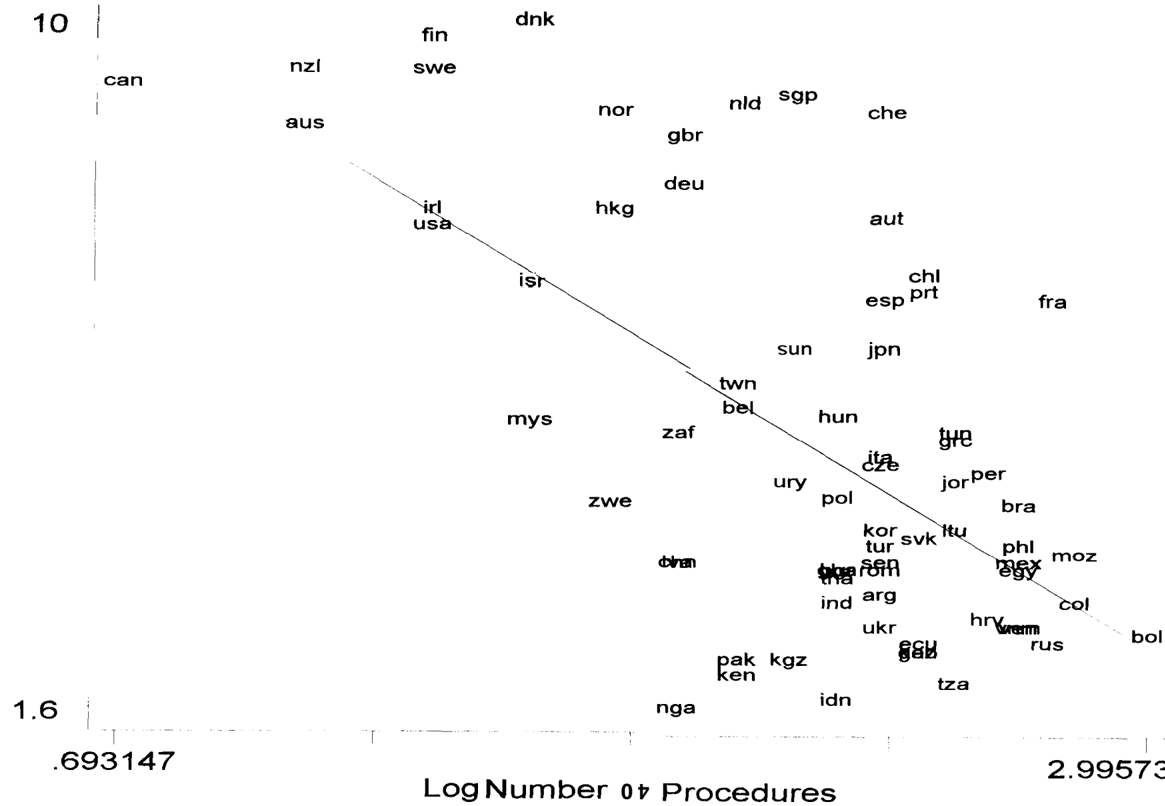
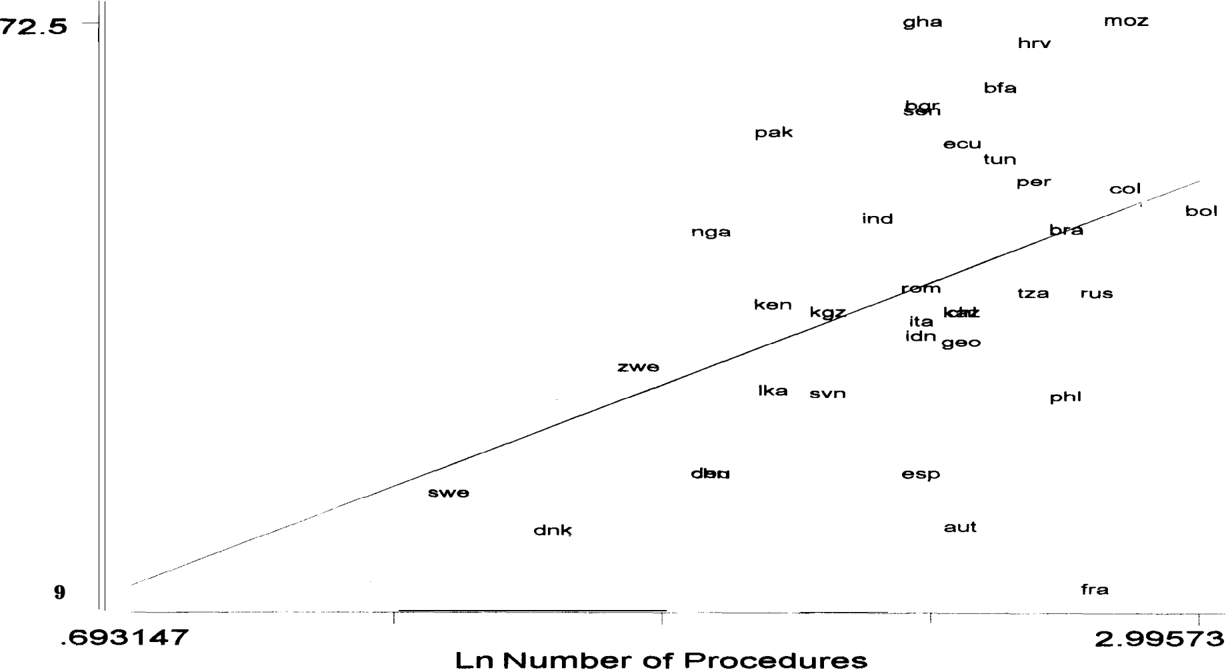
Verification
Claims the paper makes
0 Valid · 3 Not valid · 13 Not checked · 114 Own results and interpretations
A result the paper reports from its own data — it cites no other source for it, so there is none to check. The quote shows it is in the paper.
In the paper
“Very few entry regulations cover tax and labor issues.”
plain- Asserted: passes — The authors put it forward as true.
- Checkable: passes — It can be checked against evidence.
- Load-bearing: unclear — It is unclear whether the paper’s conclusions depend on it.
- Based: passes — The paper gives a reason why it holds.
In the paper
“The data show that the numbers of entry and of labor market regulations are positively correlated across countries, contrary to the substitutes hypothesis.”
What the sources say
- Not matchedcites Djankov et al., 2000
An author–year citation the paper’s reference list doesn’t settle. We don’t search these by name.
plainstates an association- Asserted: passes — The authors put it forward as true.
- Checkable: passes — It can be checked against evidence.
- Load-bearing: unclear — It is unclear whether the paper’s conclusions depend on it.
- Based: passes — The paper gives a reason why it holds.
- Not matched
A result the paper reports from its own data — it cites no other source for it, so there is none to check. The quote shows it is in the paper.
In the paper
“It often takes the form of screening procedures.”
- Also stated in: § III. Basic Results. · plain
“Instead, much of what governments do to regulate entry falls into the category of screening procedures.”
plain- Asserted: passes — The authors put it forward as true.
- Checkable: passes — It can be checked against evidence.
- Load-bearing: unclear — It is unclear whether the paper’s conclusions depend on it.
- Based: passes — The paper gives a reason why it holds.
- Also stated in: § III. Basic Results. · plain
A result the paper reports from its own data — it cites no other source for it, so there is none to check. The quote shows it is in the paper.
In the paper
“First, the cost-to-per-capita-GDP ratio decreases uniformly with GDP per capita.”
plainstates an association- Asserted: passes — The authors put it forward as true.
- Checkable: passes — It can be checked against evidence.
- Load-bearing: unclear — It is unclear whether the paper’s conclusions depend on it.
- Based: passes — The paper gives a reason why it holds.
A result the paper reports from its own data — it cites no other source for it, so there is none to check. The quote shows it is in the paper.
In the paper
“In contrast, countries in the other three quartiles of per capita income are not statistically different from each other in terms of the number of procedures and the time required to fulfill them.”
plain- Asserted: passes — The authors put it forward as true.
- Checkable: passes — It can be checked against evidence.
- Load-bearing: passes — The paper’s conclusions depend on it.
- Based: passes — The paper gives a reason why it holds.
49 more claims
Create a free account to see all 130 claims and every source verdict.
- Probably not a substantial claim. 21
- It may state two separate claims as one. 54
- The quote only partly states this claim. 26
Claims other papers make about this one
Each is checked against this paper’s own text: does it say what the citing paper says it does?
The source backs part of the claim, not all of it — or backs it for a different population, condition or comparison.
In the citing paper
“Our findings suggest an explanation for the low level of incorporation in Italy: the average direct cost associated with fulfilling the bureaucratic regulations for registering a new corporation in Italy is 20% of per capita GNP compared to 10% of per capita GNP on average for other G-7 European countries.”
From Entry regulation as a barrier to entrepreneurship (2006) · cites this paper as Djankov et al. (2002)
Experimental — accuracy not yet measuredThe cited source says what the claim attributes to it.
In the citing paper
“Given the explicit link made by Djankov et al . (2002) between the speed and ease with which businesses may be established in a country and its economic performance - and the enthusiasm with which this link has been grasped by European Union policy makers - our findings imply this link needs reconsidering.”
From The Effect of Business Regulations on Nascent and Young Business Entrepreneurship (2007) · cites this paper as Djankov et al . (2002)
Citations
Cites
La Porta, R., Lopez‐de‐Silanes, F., Shleifer, A., & Vishny, R. W. (1998) · Journal of Political Economy · doi:10.1086/250042 · Cited by 18,025
Self-citationThe Theory of Economic Regulation
Stigler, G. J. (1971) · The Bell Journal of Economics and Management Science · doi:10.2307/3003160 · Cited by 8,098
Journal of Economic Literature
(2019) · AEA Papers and Proceedings · doi:10.1257/pandp.109.633 · Cited by 7,468
The Quarterly Journal of Economics
Kuznets, S. (2024) · Business Cycle Theory, Part I Volume 4 · doi:10.4324/9781003549741-8 · Cited by 7,176
La Porta, R. (1999) · Journal of Law, Economics, and Organization · doi:10.1093/jleo/15.1.222 · Cited by 5,699 · cited 2×
“Legal origin has been viewed as a proxy for the government’s proclivity to intervene in the economy and the stance of the law toward the security of property rights in a country [La Porta et al. 1999].”
The Theory of Economic Regulation
Stigler, G. J. (2021) · The Political Economy · doi:10.4324/9781315495811-8 · Cited by 5,483
Pigou, A. C. (1933) · The Economic Journal · doi:10.2307/2224491 · Cited by 5,137
Toward a More General Theory of Regulation
Peltzman, S. (1976) · The Journal of Law and Economics · doi:10.1086/466865 · Cited by 4,729
Moffitt, R. A. (2009) · American Economic Review · doi:10.1257/aer.99.2.660 · Cited by 4,694
Shleifer, A., & Vishny, R. W. (1993) · The Quarterly Journal of Economics · doi:10.2307/2118402 · Cited by 3,778
Self-citation
Research works printed but not linked: 7
- McLiesh Caralee, 2001, NBER Working Paper No., 8288
- Kasnako lu, Zehra, and Münür Yayla, 'Unrecorded Economy in Turkey: A Monetary Approach', 1999. "Unrecorded Economy in Turkey (A Monetary Approach)" in Informal Sector in Turkey (I), Tuncer Bulutay (ed.), SIS, Ankara, forthcoming.
- Fred, 1987, Journal of Legal Studies, 101
- Olson, Mancur, 1991, 'Autocracy, Democracy, and Prosperity,' in Richard Zeckhauser, ed., Strategy of Choice, Cambridge, MA: MIT Press.
- 1967, Western Economic Journal, 232
- World Economic Forum (1999), The Global Competitiveness Report 1999 , Schwab, Klaus et al., eds., New York: Oxford University Press.
- World Economic Forum, The Global Competitiveness Report 2001, Klaus Schwab et al., eds. (New York, NY: Oxford University Press, 2001).
Cited by
Items 1,101–1,200 of 3,986
Institutions and economic development in Brazil
Cavalcanti, T. V. D. V., Magalhães, A. M., & Tavares, J. (2007) · The Quarterly Review of Economics and Finance · doi:10.1016/j.qref.2006.12.019 · Cited by 39
Lee, M., Yin, X., Lee, S., Weng, D. H., & Peng, M. (2014) · International Entrepreneurship and Management Journal · doi:10.1007/s11365-014-0316-5 · Cited by 44
“To be sure, domestic sales are associated with various activities involving home country government officials, including land acquisition, labor hiring, and product regulations (Djankov et al. 2002).”
Vazyakova, Y. (2009) · International Organisations Research Journal · Cited by 32
Drivers of the Underground Economy Around the Millienium: A Long Term Look for the United States
Goel, R. K., Saunoris, J. W., & SCHNEIDER, F. G. (2017) · The Quarterly Review of Economics and Finance · doi:10.1016/j.qref.2018.07.005 · Cited by 39
Why ‘Doing Business’ with the World Bank May Be Bad for You
McCormack, G. (2018) · European Business Organization Law Review · doi:10.1007/s40804-018-0116-4 · Cited by 41
Trust, regulation, and contracting institutions
Cline, B. N., & Williamson, C. R. (2020) · European Financial Management · doi:10.1111/eufm.12253 · Cited by 40
Boudreaux, C. J., Jha, A., & Escaleras, M. P. (2021) · Entrepreneurship Theory and Practice · doi:10.1177/10422587211002185 · Cited by 43
“…Rothstein et al., 2013), we argue the efficacy of foreign aid ultimately depends on the quality of government and entrepreneurship critically depends on the ease of doing business and the extent of regulation in the economy (Bailey & Thomas, 2017; Djankov et al., 2002; Lucas & Boudreaux, 2020).”
Kaul, A., Ganco, M., & Raffiee, J. (2021) · Academy of Management Review · doi:10.5465/amr.2020.0113 · Cited by 34
CREDIT RATIONING, RISK AVERSION, AND INDUSTRIAL EVOLUTION IN DEVELOPING COUNTRIES
Bond, E. W. W., Tybout, J. R., & Utar, H. (2015) · International Economic Review · doi:10.1111/iere.12119 · Cited by 37
“3 Surveying entry regulations in 85 countries, Djankov et al (2002) conclude that “business entry is extremely expensive, especially in the countries outside the top quartile of the income distribution.””
The Institutional Foundations of Inequality and Growth
Davis, L., & Hopkins, M. S. (2011) · The Journal of Development Studies · doi:10.1080/00220388.2010.527953 · Cited by 42
“De Soto (1989), Djankov et al. (2002), Bertola et al.”
Does Better Local Governance Improve District Growth Performance in Indonesia?
McCulloch, N., & Malesky, E. J. (2011) · IDS Working Papers · doi:10.1111/j.2040-0209.2011.00369_2.x · Cited by 36
Public funding for startups in Argentina: an impact evaluation
Butler, I., Galassi, G., & Ruffo, H. (2015) · Small Business Economics · doi:10.1007/s11187-015-9684-7 · Cited by 41
Determinants of Firm Innovation in Indonesia: The Role of Institutions and Access to Finance
Mahendra, E., Zuhdi, U., & Muyanto, R. (2015) · Economics and Finance in Indonesia · doi:10.7454/efi.v61i3.512 · Cited by 39
Investment climate in Russia and challenges for foreign business: The case of Japanese companies
Ershova, N. V. (2017) · Journal of Eurasian Studies · doi:10.1016/j.euras.2017.03.001 · Cited by 37
Development and Transition : Idea, Strategy, and ViabilityPreprint
Lin, J. Y. (2007) · RePEc: Research Papers in Economics · Cited by 32
Osili, U., & Paulson, A. L. (2004) · SSRN Electronic Journal · doi:10.2139/ssrn.624190 · Cited by 32
Are Burdensome Registration Procedures an Important Barrier on Firm Creation? Evidence from MexicoPreprint
Kaplan, D. S., Piedra, E., & Seira, E. (2007) · RePEc: Research Papers in Economics · Cited by 35
Entrepreneurship in transition countries: a reviewPreprint
Aidis, R. (2005) · RePEc: Research Papers in Economics · Cited by 50
The Economy of Puerto Rico: Restoring Growth
Collins, S. M., Bosworth, B., & Soto-Class, M. A. (2006) · Cited by 73
Cao, C., Li, X., & Liu, G. (2023) · Economics and Politics · doi:10.1111/ecpo.12240 · Cited by 42
Amin, M., & Motta, V. (2023) · Journal of Financial Stability · doi:10.1016/j.jfs.2023.101175 · Cited by 51
Anyanwu, J. C. (2014) · African Development Review · doi:10.1111/1467-8268.12077 · Cited by 36
Corruption and emerging markets: Systematic review of the most cited
Cintra, R. F., Cassol, A., Ribeiro, I., & de Carvalho, A. O. (2017) · Research in International Business and Finance · doi:10.1016/j.ribaf.2017.07.177 · Cited by 36
Ghura, H., Li, X., & Harraf, A. (2017) · World Journal of Entrepreneurship Management and Sustainable Development · doi:10.1108/wjemsd-06-2017-0031 · Cited by 43
The impacts of institutional quality and infrastructure on overall and intra-Africa trade
Yushi, J., & Borojo, D. G. (2019) · Economics · doi:10.5018/economics-ejournal.ja.2019-10 · Cited by 31
Corruption and economic growth in India and Nigeria
Obamuyi, T. M., Akure, N., & Olayiwola, S. O. (2019) · Journal of Economics and Management · doi:10.22367/jem.2019.35.05 · Cited by 31
Cost of doing business index in Latin America
Bernardes, P., Ekel, P., Rezende, S. F. L., Júnior, J. G. P., dos Santos, A. C. G., da Costa, M. A. R., Carvalhais, R. L., & Libório, M. P. (2021) · Quality & Quantity · doi:10.1007/s11135-021-01221-8 · Cited by 33
MEASURING TRANSACTION COSTS: DIVERGING APPROACHES, CONTENDING PRACTICES
Wang, N. (2007) · Division of Labour & Transaction Costs · doi:10.1142/s0219871107000324 · Cited by 40
Thießen, U. (2010) · International Economic Journal · doi:10.1080/10168737.2010.525986 · Cited by 48
The historical origins of corruption in the developing world: a comparative analysis of East Asia
Hellmann, O. (2017) · Crime Law and Social Change · doi:10.1007/s10611-016-9679-6 · Cited by 51
“, [17, 21]] and a resource-rich economy [e.”
Product Market Regulation and Market Work: A Benchmark Analysis
Fang, L., & Rogerson, R. D. (2011) · American Economic Journal Macroeconomics · doi:10.1257/mac.3.2.163 · Cited by 31
“But he calibrates the size of the entry by using data from Djankov et al (2002), which is based on measures of time costs.”
InfluentialWhere Do Transactions Come from? A Perspective from Engineering DesignPreprint
Clark, K., & Baldwin, C. Y. (2002) · SSRN Electronic Journal · doi:10.2139/ssrn.328921 · Cited by 37
Electricity Connections and Firm Performance in 183 Countries
Geginat, C., & Ramalho, R. M. (2015) · World Bank, Washington, DC eBooks · doi:10.1596/1813-9450-7460 · Cited by 31
“This finding is consistent with similar findings by Djankov et al. (2002) for the number of start-up procedures and corruption.”
Firm Competitiveness and Detection of BriberyPreprint
Serafeim, G. (2013) · SSRN Electronic Journal · doi:10.2139/ssrn.2302589 · Cited by 33
“I use of measure of product market competition from Djankov et al. (2002) which is the natural logarithm of the number of steps needed to start a business.”
China’s Financial System: Opportunities and ChallengesPreprint
Allen, F., Qian, J. “., Zhang, C., & Zhao, M. (2011) · SSRN Electronic Journal · doi:10.2139/ssrn.1945259 · Cited by 35
“The Hybrid Sector grew at an annual rate of over 23% between 1998 and 2009, while the State and Listed Sectors combined grew at around 15% during the same period.(35) In addition, the growth rates for investment in fixed assets of these sectors are comparable (China Statistics Yearbooks; and AQQ (2005)), which implies…”
Labor Market Power, Self-Employment, and DevelopmentPreprint
Amodio, F., Medina, P., & Morlacco, M. (2025) · Social Science Research Network · doi:10.2139/ssrn.4188288 · Cited by 18
“Multiple barriers to firm growth, such as high entry costs, a shortage of skilled labor, and inadequate infrastructure, result in the concentration of employment among a few firms (Djankov et al., 2002; Hsieh and Klenow, 2010; Rud and Trapeznikova, 2021; Hjort, Malmberg and Schoellman, 2022).”
The effects of national culture and ethno‐linguistic diversity on innovativeness
Puia, G. M., & Ofori‐Dankwa, J. C. (2013) · Baltic Journal of Management · doi:10.1108/bjom-jan-2012-0002 · Cited by 39
Romero, J. P., & Britto, G. (2016) · Cambridge Journal of Economics · doi:10.1093/cje/bew030 · Cited by 44
Bankruptcy delay and firms’ dynamics
Melcarne, A., & Ramello, G. B. (2018) · Small Business Economics · doi:10.1007/s11187-018-0041-5 · Cited by 30
“However, while most literature has focused its attention on entry regulation (Djankov et al. 2002), not as much has been done with respect to those institutions that regulate the final stage of a firm’s lifecycle.”
Laviada, A. F., Gutiérrez, C. L., & Pérez, A. (2020) · Sustainability · doi:10.3390/su12030826 · Cited by 37
Institutional entry barriers and spatial technology diffusion: Evidence from the broadband industry
Skiti, T. (2020) · Strategic Management Journal · doi:10.1002/smj.3146 · Cited by 32
Types of Institutions and Well-Being of Self-Employed and Paid Employees in Europe
Fritsch, M. J., Sorgner, A., & Wyrwich, M. (2019) · Small Business Economics · doi:10.1007/s11187-019-00274-2 · Cited by 37
The economic theory of regulation and inequality
Chambers, D., & O’Reilly, C. (2021) · Public Choice · doi:10.1007/s11127-021-00922-w · Cited by 37
“One of the earliest empirical studies to estimate the negative effects of entry regulation on entrepreneurship is Djankov (2002, 2009), which examines startup procedures (time, procedural steps, and cost) in 85 countries, finding that more stringent startup regulations are associated with more…”
Institutions, uncertainty, and entrepreneurial judgment
Frølund, C. W. (2021) · Journal of Institutional Economics · doi:10.1017/s1744137421000485 · Cited by 35
Entrepreneurial growth aspirations at re-entry after failure
Fuentelsaz, L., González, C., & Mickiewicz, T. M. (2023) · International Journal of Entrepreneurial Behaviour & Research · doi:10.1108/ijebr-05-2022-0433 · Cited by 40
García, J. C. S. (2009) · Revista Latinoamericana de Psicología · doi:10.14349/rlp.v41i1.559 · Cited by 94
Banking regulation and supervision: can it enhance stability in Europe?
Bouheni, F. B. (2014) · Journal of Financial Economic Policy · doi:10.1108/jfep-11-2013-0059 · Cited by 30
Effect of business regulation on investment in emerging market economies
Korutaro, B., & Biekpe, N. B. (2013) · Review of Development Finance · doi:10.1016/j.rdf.2013.01.001 · Cited by 35
Knowledge spillovers and intellectual property rights
Samaniego, R. M. (2012) · International Journal of Industrial Organization · doi:10.1016/j.ijindorg.2012.11.001 · Cited by 41
What fundamentally drives growth? Revisiting the institutions and economic performance debate
Decker, J. H., & Lim, J. J. (2008) · Journal of International Development · doi:10.1002/jid.1454 · Cited by 52
Reforms and Entry: Some Evidence from the Indian Manufacturing Sector
Bhaumik, S. K., Gangopadhyay, S., & Krishnan, S. (2009) · Review of Development Economics · doi:10.1111/j.1467-9361.2009.00519.x · Cited by 33
Legal Origins and Climate Change Policies in Former Colonies
Fredriksson, P. G., & Wollscheid, J. R. (2015) · Environmental and Resource Economics · doi:10.1007/s10640-015-9957-2 · Cited by 29
The Quality of Local Government and Firm Performance: The Case of China's Provinces
Choi, J. J., Jiang, C., & Shenkar, O. (2015) · Management and Organization Review · doi:10.1017/mor.2015.46 · Cited by 38
Informal Firms and Financial Inclusion: Status and Determinants
Farazi, S. (2014) · Journal of International Commerce Economics and Policy · doi:10.1142/s1793993314400110 · Cited by 30
The Informal Sector in Developing Countries
Quintin, E. (2006) · Cited by 30
Sustaining and Sharing Economic Growth in Tanzania
Utz, R. J. (2007) · World Bank, Washington, DC eBooks · doi:10.1596/978-0-8213-7195-4 · Cited by 31
The Other Invisible Hand: High Bandwidth Development Policy
Hausmann, R. (2009) · Brookings Institution Press eBooks · doi:10.2139/ssrn.1314799 · Cited by 35
“8 For example, Djankov et al (2002) state that the evidence on the regulation of entry of firms “is inconsistent with public interest theories of regulation, but supports the public choice view that entry regulation benefits politicians and bureaucrats.””
The Pecking Order of Cross-Border InvestmentPreprint
Daude, C., & Fratzscher, M. (2006) · SSRN Electronic Journal · doi:10.2139/ssrn.885321 · Cited by 30
Why Doesn't Capitalism Flow to Poor Countries?Preprint
MacCulloch, R., & Tella, R. D. (2003) · SSRN Electronic Journal · doi:10.2139/ssrn.361560 · Cited by 36
Trapping the tigers: Regulation of market entry and the rule of law in SE Asia
Touchton, M. M. (2015) · The Social Science Journal · doi:10.1016/j.soscij.2013.10.010 · Cited by 29
“Djankov et al. (2002, 2003) and La Porta et. al.”
Fiscal decentralization and public sector efficiency: Do natural disasters matter?
Afonso, A., Jalles, J. T., & Venâncio, A. (2024) · Economic Modelling · doi:10.1016/j.econmod.2024.106763 · Cited by 59
Does Financial Integration Increase Exports? Evidence from International Industry-Level Data
Gür, N. (2013) · Emerging Markets Finance and Trade · doi:10.2753/ree1540-496x4905s507 · Cited by 30
“…development Beck et al. (2010) RULE Rule of law World Bank Governance Indicators LR Labor regulations Botero et al. (2004) ER Entry regulations Djankov et al. (2002) MARCAP Stock market capitalization over GDP Beck et al. (2010) GDP Per capita GDP Penn World Tables C Physical capital per…”
The Impact of Earthquakes on the Domestic Stock Market
Scholtens, B., & Voorhorst, Y. (2013) · Earthquake Spectra · doi:10.1193/1.4000103 · Cited by 39
“Albala– Bertrand (1993) and Hallegatte et al. (2007) investigate the impact of earthquakes on the economic growth rate. Ramcharan (2007) finds that the exchange rate regime does impact on the economy’s adjustment after real shocks like earthquakes and hurricanes. Wein and Rose (2011) investigate the cost of business i…”
InfluentialEntrepreneurship policy and globalization
Norbäck, P., Persson, L., & Douhan, R. (2014) · Journal of Development Economics · doi:10.1016/j.jdeveco.2014.04.006 · Cited by 39
“The World Bank s Doing Business project was initiated by Djankov et al. (2002), and collects country-level data on the cost of setting up a limited liability company.15 Djankov et al. (2002) collected data for entry barriers for a sample of 85 countries in 1999.”
InfluentialNever Waste a Good Crisis: An Historical Perspective on Comparative Corporate Governance
Mørck, R., & Yeung, B. Y. (2009) · Annual Review of Financial Economics · doi:10.1146/annurev.financial.050808.114257 · Cited by 36
“Ironically, neither apparently grasped how regulation becomes an entry barrier (Djankov et al. 2000), for the large business groups soon ran virtual “embassies” in New Delhi, staffed with former officials familiar with every nuance of the bureaucracy.”
Tax Compliance Costs: Cost Burden and Cost Reliability
Eichfelder, S., & Hechtner, F. (2017) · Public Finance Review · doi:10.1177/1091142117691603 · Cited by 38
Corruption in space: A closer look at the world's subnations
Borsky, S., & Kalkschmied, K. (2019) · European Journal of Political Economy · doi:10.1016/j.ejpoleco.2019.05.004 · Cited by 43
An anatomy of entrepreneurial pursuits in relation to poverty
Cumming, D. J., Johan, S., & Uzuegbunam, I. S.-P. (2019) · Entrepreneurship and Regional Development · doi:10.1080/08985626.2019.1640475 · Cited by 31
Trust, regulation, and redistribution why some governments overregulate and under‐redistribute
Charron, N., Harring, N., & Lapuente, V. (2019) · Regulation & Governance · doi:10.1111/rego.12277 · Cited by 41
Public relations expenditure, media tone, and regulatory decisions
Wu, Y., & Tian, G. G. (2020) · Journal of Corporate Finance · doi:10.1016/j.jcorpfin.2020.101793 · Cited by 30
Dividend Taxes, Employment, and Firm Productivity
Jacob, M. (2020) · Journal of Corporate Finance · doi:10.1016/j.jcorpfin.2021.102040 · Cited by 53
Jobs and Growth: Supporting the European Recovery
Berger, H., Schindler, M., & Bakker, B. B. (2014) · Cited by 29
The Impact of Bribery Relationships on Firm Growth in Transition Economies
Jung, H. J., & Lee, S. (2022) · Organization Science · doi:10.1287/orsc.2022.1575 · Cited by 34
He, W., Chen, X., & Liu, Z. J. (2022) · Journal of Asian Economics · doi:10.1016/j.asieco.2022.101473 · Cited by 30
POLICY ANALYSIS IN A MATCHING MODEL WITH INTENSIVE AND EXTENSIVE MARGINS*
Fang, L., & Rogerson, R. D. (2009) · International Economic Review · doi:10.1111/j.1468-2354.2009.00563.x · Cited by 29
Intention of offspring to join the family enterprise: a study of Indian businesses
Rastogi, S., & Agrawal, R. (2010) · Annals of Innovation & Entrepreneurship · doi:10.3402/aie.v1i1.5641 · Cited by 32
Total Factor Productivity Approach in Competitive and Regulated World
Machek, O., & Hnilica, J. (2012) · Procedia - Social and Behavioral Sciences · doi:10.1016/j.sbspro.2012.09.1178 · Cited by 29
“The effect is strengthened by entry barriers of the market; for instance, starting business in Russia takes two times longer than in Central Europe, which had negative impact on TFP changes after opening markets to competition [32].”
Trade, Migration and Integration – Evidence and Policy Implications
Hatzigeorgiou, A., & Lodefalk, M. (2014) · World Economy · doi:10.1111/twec.12236 · Cited by 43
Cross, F. B., & Donelson, D. C. (2010) · Journal of Empirical Legal Studies · doi:10.1111/j.1740-1461.2010.01186.x · Cited by 31
How Do Investment Climate Conditions Vary Across Countries, Regions and Types of Firms?
Hallward‐Driemeier, M., & Stewart, D. (2004) · World Bank, Washington, DC eBooks · doi:10.1596/9129 · Cited by 29
Hadfield, G. K. (2011) · Journal of Economic Behavior & Organization · doi:10.1016/j.jebo.2011.02.006 · Cited by 38
Financial and Institutional Reforms for an Entrepreneurial Society
Economidou, C., Grilli, L., Henrekson, M., & Sanders, M. W. J. L. (2018) · Small Business Economics · doi:10.1007/s11187-018-0001-0 · Cited by 38
“To date, a large literature covers the effects of taxes and startup costs on entrepreneurship rates (Gentry and Hubbard 2000; Djankov et al. 2002; Lundström and Stevenson 2005; Klapper et al. 2006; Braunerhjelm and Eklund 2014).”
Case, A. C. (2006) · Oxford University Press eBooks · doi:10.1093/0195305191.003.0018 · Cited by 36
Can institutions or education explain world poverty? An augmented Solow model provides some insights
Breton, T. R. (2004) · The Journal of Socio-Economics · doi:10.1016/j.socec.2003.12.004 · Cited by 42
Improving access to infrastructure services by the poor: institutional and policy responses
Brook, P. J. S., & Smith, W. (2001) · Cited by 29
Corruption and CompetitionPreprint
Allen, F., Qian, J., & Shen, L. (2015) · SSRN Electronic Journal · doi:10.2139/ssrn.2685219 · Cited by 31
Trade, Inequality, and the Political Economy of InstitutionsPreprint
Levchenko, A. A., & Do, Q. (2006) · SSRN Electronic Journal · doi:10.2139/ssrn.879746 · Cited by 29
The Role of Product Market Regulations in the Process of Structural ChangePreprint
Messina, J. (2003) · SSRN Electronic Journal · doi:10.2139/ssrn.388281 · Cited by 29
Banking System Control, Capital Allocation and Economy PerformancePreprint
Mørck, R., Yavuz, M. D., & Yeung, B. Y. (2009) · SSRN Electronic Journal · doi:10.2139/ssrn.1503431 · Cited by 28
“There are other barriers to entry such as regulation (Djankov et al. 2002), tax favors (Gentry & Hubbard 2000), subsidies (Krueger 2002), trade barriers (Krueger 1974; Krueger 2004).”
Tied Aid, Trade-Facilitating Aid or Trade-Diverting Aid?Preprint
Johansson, L., & Pettersson, J. (2008) · RePEc: Research Papers in Economics · Cited by 30
The Globalization of Angel Investments: Evidence across CountriesPreprint
Lerner, J., Schoar, A., Sokolinski, S., et al. (2015) · SSRN Electronic Journal · doi:10.2139/ssrn.2706546 · Cited by 29
“24 associations), and in the barriers to entrepreneurial activity, measured by the number of steps required to start a business, as reported by Djankov et al. (2002).”
Business Regulations and Poverty
Djankov, S., Georgieva, D., & Ramalho, R. M. (2019) · World Bank, Washington, DC eBooks · doi:10.1596/1813-9450-8763 · Cited by 29
Self-citationSocietal Institutions and Tax Effort in Developing CountriesPreprint
Bird, R. M., Martínez-Vázquez, J., & Torgler, B. (2004) · Annals of economics and finance · Cited by 78
How European Markets Became Free: A Study of Institutional Drift
Gutierrez, G., & Philippon, T. (2022) · Journal of the European Economic Association · doi:10.1093/jeea/jvac071 · Cited by 34
Kafka, K. I., & Kostis, P. C. (2023) · Technological Forecasting and Social Change · doi:10.1016/j.techfore.2023.123027 · Cited by 35
The Impact of Business Environment Reforms on New Registrations of Limited Liability Companies
Klapper, L. F., & Love, I. (2014) · The World Bank Economic Review · doi:10.1093/wber/lhu007 · Cited by 30
“A methodology for measuring the effectiveness of the regulatory framework for firm registration was developed by Djankov et al. (2002).”
The Perception of the State’s Influence on its Business Environment in the SMEs from Czech Republic
Virglerová, Z., Dobeš, K., & Vojtovič, S. (2016) · RePEc: Research Papers in Economics · Cited by 28
Has the Swedish business sector become more entrepreneurial than the US business sector?
Heyman, F., Norbäck, P.-J., Persson, L., & Andersson, F. (2019) · Research Policy · doi:10.1016/j.respol.2019.04.007 · Cited by 20
“Politicians use regulations both to create rents and to extract them through campaign contributions, votes, and bribes (Djankov et al., 2002).”
Economic freedom and materialism: an empirical analysis
Teague, M. V., Storr, V. H., & Fike, R. (2020) · Constitutional Political Economy · doi:10.1007/s10602-019-09296-0 · Cited by 29
Business regulations and poverty
Djankov, S., Georgieva, D., & Ramalho, R. M. (2018) · Economics Letters · doi:10.1016/j.econlet.2018.02.002 · Cited by 28
Self-citation
Metadata
- Authors
- Djankov, S., La Porta, R., Lopez-de-Silanes, F., & Shleifer, A.
- Affiliations
- World Bank (US)
- National Bureau of Economic Research (US)
- ORCID
- Djankov, S.
- Venue
- The Quarterly Journal of Economics
- Publisher
- Oxford University Press (OUP)
- Published
- 2002-02-01
- Volume
- 117
- Issue
- 1
- Pages
- 1-37
- ISSN
- 0033-5533
- 1531-4650
- OpenAlex
- W2139896179
- Cited by
- 3,956
- References
- 30
- Citations by year
- 2026: 223 · 2025: 185 · 2024: 157 · 2023: 120 · 2022: 140 · 2021: 150 · 2020: 151 · 2019: 161 · 2018: 157 · 2017: 162 · 2016: 166 · 2015: 193 · 2014: 200 · 2013: 183 · 2012: 193
- Type
- report
- Language
- en
- Open access
- green
- doi.org
- Licence
- other-oa
- Locations
- World Bank, Washington, DC eBooks (publishedVersion)
- The Quarterly Journal of Economics (publishedVersion)
- The World Bank Open Knowledge Repository (World Bank) (publishedVersion)
- National Bureau of Economic Research (publishedVersion, other-oa)
- RePEc: Research Papers in Economics (submittedVersion)
- Digital Access to Scholarship at Harvard (DASH) (Harvard University) (submittedVersion, cc-by)
- SSRN Electronic Journal (submittedVersion)
- OpenGrey (Institut de l'Information Scientifique et Technique) (submittedVersion)
- The World Bank Open Knowledge Repository (World Bank) (submittedVersion, cc-by)
- Topics
- Social Sciences › Sociology and Political Science › Corruption and Economic Development
- Social Sciences › Economics, Econometrics and Finance › Economics and Econometrics › Taxation and Compliance Studies
- Social Sciences › Business, Management and Accounting › Strategy and Management › Political Influence and Corporate Strategies
- Keywords
- start-up firms, bureaucratic procedures, corruption, informal economy, democracy, government size, public choice theory, public interest theory
About these checks
Registry, retraction, Cites and statistics results are computed, not judged, with one exception: a printed reference that no index lists is read once by a model before it counts as a citation error. Claims are extracted by a model and kept only when their quote appears verbatim in the text; each cited source is then checked, with a model’s help, for whether it says what the claim relies on. Those verdicts can be wrong — read the claim’s quote and the cited source before relying on one.
A language model drew the claims from the paper on 2026-10-01, under version 3 of the claim definition (model deepseek-v4.1-flash, prompt extract-v3).
A second model labelled each claim on 2026-10-01 (model jev-1.13-20260917, definition revision gold-guideline-v0.2).
Statistics and arithmetic are recomputed, not judged.
Confidence bands are shown only for fields calibrated on our annotated test set. None is calibrated yet, so no band is shown.
What counts as a claim ›How we measure confidence ›How we check this ›
Are you an author, or do you see a problem with this page? Request a review
Data sources
Bibliographic data: Semantic Scholar, OpenAlex, Crossref.
Contains information from the Semantic Scholar Academic Graph Datasets, made available under the ODC Attribution License (ODC-BY 1.0).
Semantic Scholar’s data is described in: Kinney, R., et al. (2023). The Semantic Scholar Open Data Platform. arXiv:2301.10140.
