

The Regulation of Entry
Open accessThe DOI matches its Crossref record, with a small difference in title or year; 39 of the 39 references it cites were found in a registry or an index; none of the 13 sources its claims cite is checked for support yet.
Abstract
1%(5 :25.,1* 3$3(5 6(5,(6 7+( 5(*8/$7,21 2) (175< 6LPHRQ 'MDQNRY 5DIDHO /D 3RUWD )ORUHQ.LR /RSH]GH6LODQHV $QGUHL 6KOHLIHU :RUNLQJ 3DSHU KWWSZZZQEHURUJSDSHUVZ 1$7,21$/ %85($8 2) (&2120,& 5(6($5&+ 0DVVD.KXVHWWV $YHQXH &DPEULGJH 0$ 6HSWHPEHU :H WKDQN 2OJD ,RIIH 7DWLDQD 1HQRYD DQG (NDWHULQD 7UL]ORYD IRU DEOH UHVHDU.K DVVLVWDQ.H DQG +DPLG $ODYL ,ULQD $VWUDNKDQ $EKLMLW %DQHUMHH 5L.KDUG &DYHV -D.TXHOLQH &RROLGJH -DPHV (PHU\ 1LKDO (O0DJKDUEHO -HDQ 3DXO *DXWKLHU (G *ODHVHU 6LPRQ -RKQVRQ /DZUHQ.H .DW] 3HWHU .X.HUD 'DYLG /DLEVRQ ,UD /LHEHUPDQ 'DYLQ 0D.NLQ]LH 0DULH )UDQ.RLVH 0DULH1HOO\ 0DU.HOR 2ODUUHDJD *X\ 3IHIIHUPDQQ 6DQWLDJR 6HGD.D /HLOD :HEVWHU 3HWHU :ULJKW DQG VHPLQDU SDUWL.LSDQWV DW WKH 8QLYHUVLW\ RI 0DU\ODQG DW &ROOHJH 3DUN IRU KHOSIXO .RPPHQWV 7KH .ROOH.WLRQ RI GDWD IRU WKLV SDSHU ZDV RUJDQL]HG DQG ILQDQ.HG E\ WKH :RUOG %DQN $Q DSSHQGL[ GHV
Overview
CoChat Summary
TL;DR
This paper assembles a new cross-country dataset on business entry regulation in 75 countries and uses it to compare the helping-hand, capture, and tollbooth theories of regulation. The evidence is most consistent with the tollbooth view: heavier entry regulation is associated with more corruption, a larger unofficial economy, and less representative, more autocratic governments.
Key findings
- Across the 75-country sample, the number of entry procedures ranges from 2 in Canada to 20 in Bolivia, with a sample average of 10.17 procedures; the average official time is 63.05 business days and the average cost is 0.34 of GDP per capita.
- The number of procedures is strongly correlated with time and cost: the paper reports correlations of 0.75 with log time and 0.62 with log cost.
- The helping-hand tests do not support a beneficial-regulation story: in Table IV, more procedures are associated with lower ISO quality standards (e.g. coefficient -0.2646) and larger unofficial economy measures (e.g. coefficient 13.6277 for size of unofficial economy; 19.8763 for employment in the unofficial economy), while pollution and health outcomes do not improve.
- The tollbooth evidence is stronger: Table VI reports that more procedures are associated with worse corruption scores, with a coefficient of -3.2809 (and -1.7249 with GDP per capita controls) for the corruption regressions.
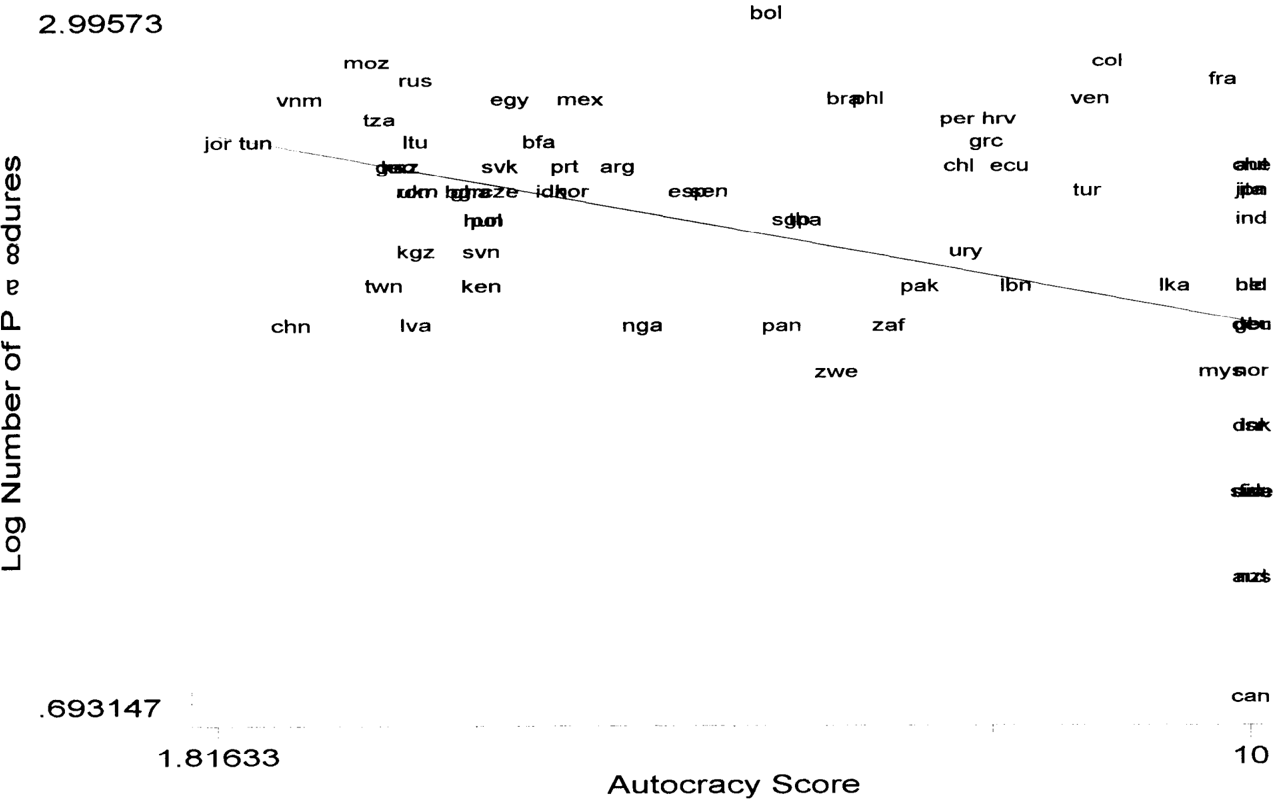
- In Table VIII, better government is associated with lighter regulation; the paper states that countries with more limited and representative governments have statistically significantly fewer procedures using 5 out of 6 measures of better government, and that more autocratic countries regulate more heavily.
Methods
- The paper builds a new database on entry regulation for 75 countries, focusing on the legal requirements, official time, and official cost for a standardized start-up firm.
- Data were gathered from written government sources, World Bank- and USAID-sponsored studies, government web pages, direct contacts with agencies, and independent double-checks in 73 countries via local consulting reports; the remaining 2 countries were double-checked through government contacts.
- The main analysis uses cross-country OLS regressions relating entry regulation measures to outcomes such as quality, pollution, unofficial economy, corruption, political institutions, legal origin, and GDP per capita; the paper also reports correlations and test-of-means comparisons across income quartiles.
Limitations
- The paper itself notes that the capture-theory tests are based on crude measures and that the data are probably least suited to test the capture hypothesis.
- The authors say the data almost surely underestimate the cost and complexity of entry because they focus on the capital city, omit industry-specific requirements and foreign-ownership steps, and ignore some informal delays and bribes.
- Evident from the text: the study is cross-sectional and based on official procedures/costs, so causal interpretation is limited and informal corruption/bureaucratic delays are not directly measured except indirectly through correlations.
Model-written summary. Check it against the paper before relying on it.
Integrity signals
Registry
Cites
Statistics
Figures
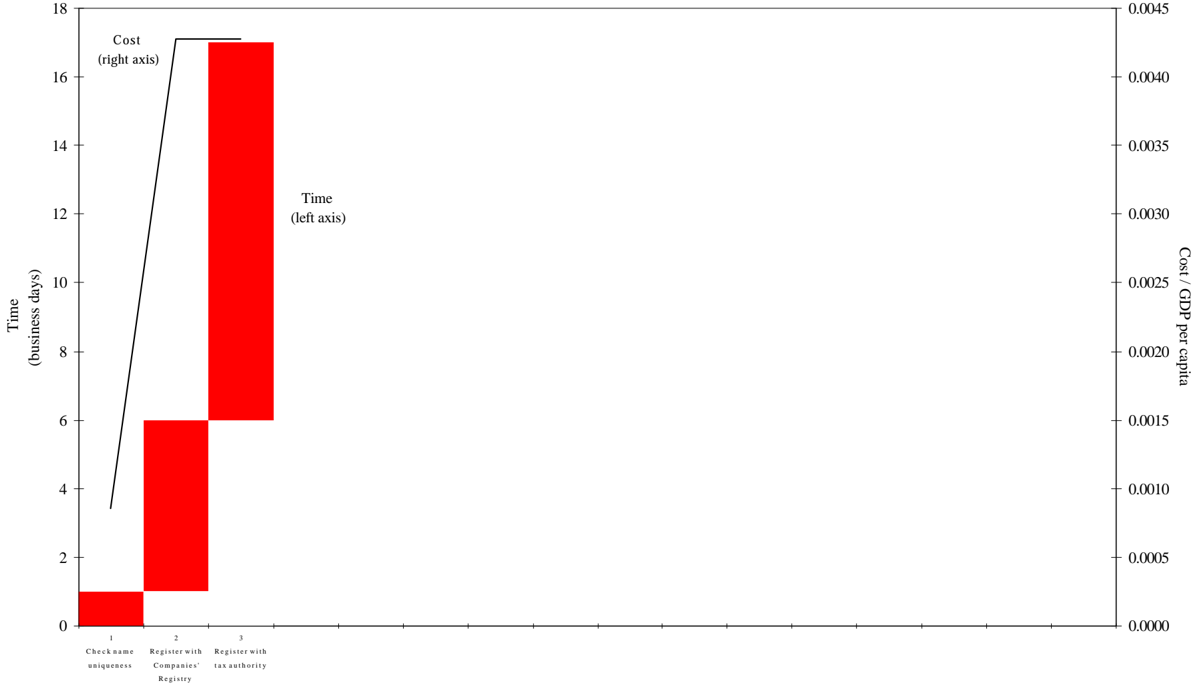
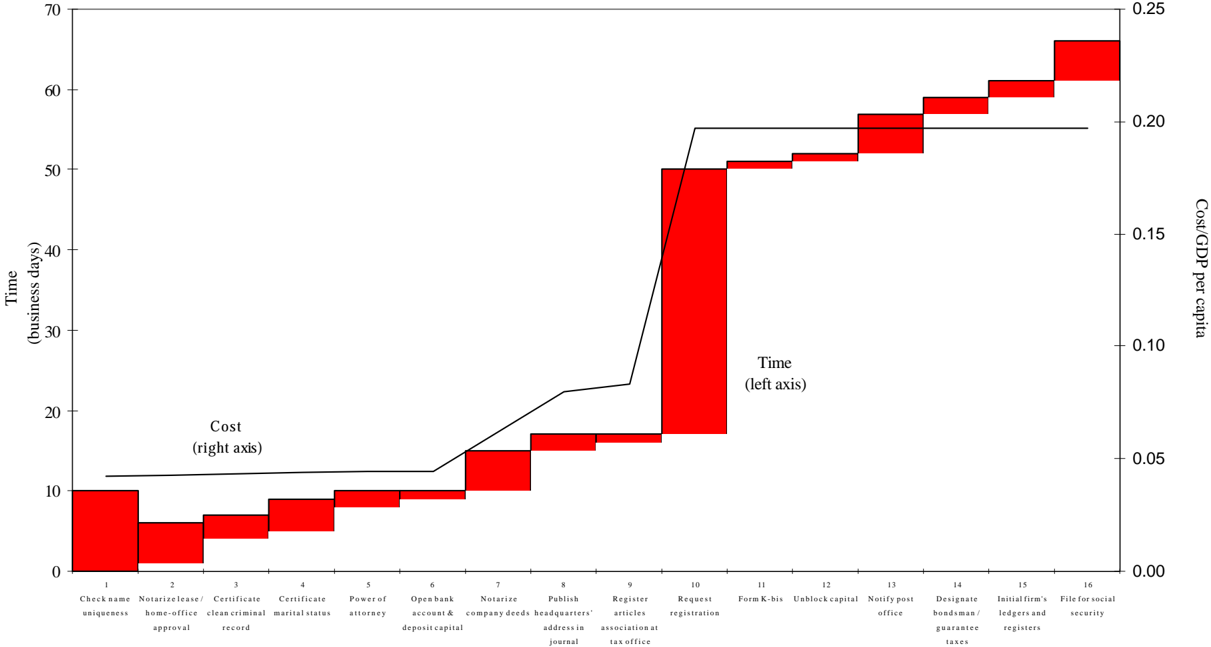
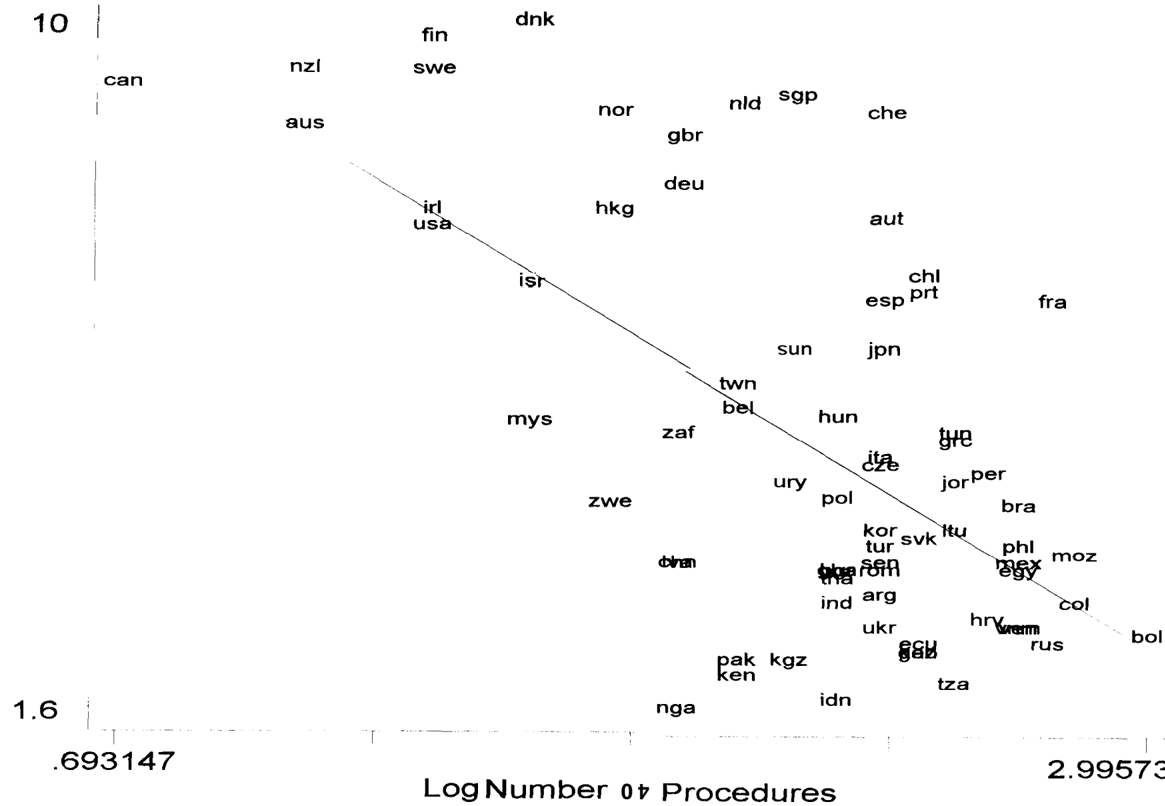
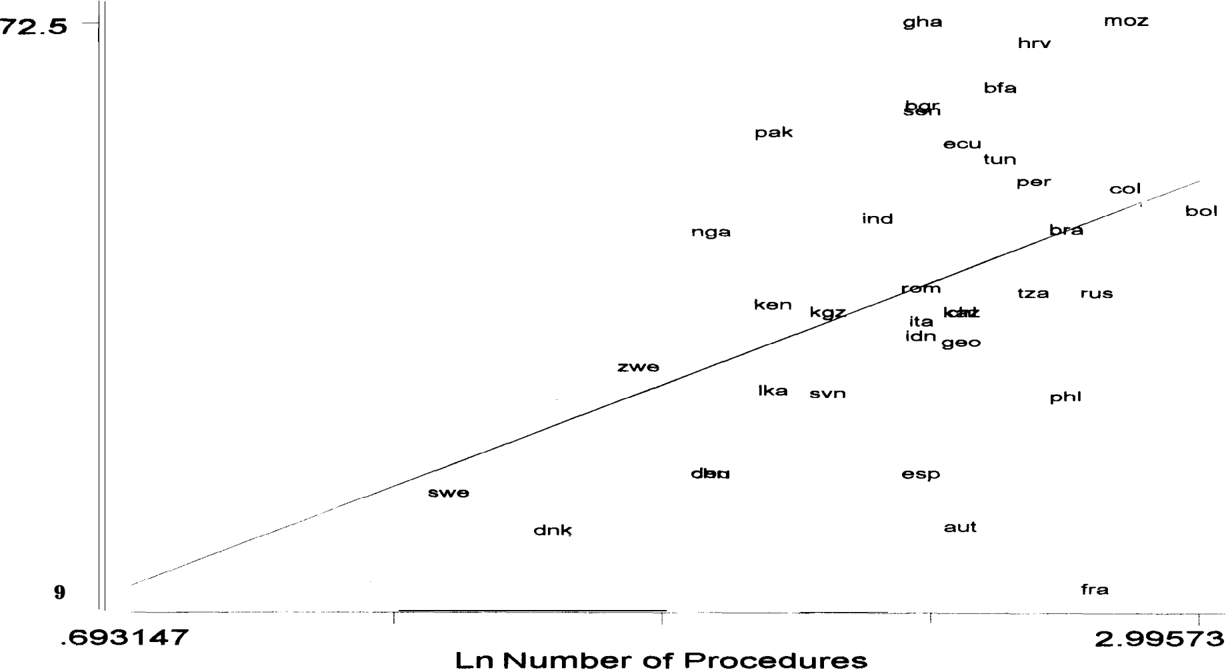
Verification
Claims the paper makes
0 Valid · 3 Not valid · 13 Not checked · 114 Own results and interpretations
A result the paper reports from its own data — it cites no other source for it, so there is none to check. The quote shows it is in the paper.
In the paper
“Very few entry regulations cover tax and labor issues.”
plain- Asserted: passes — The authors put it forward as true.
- Checkable: passes — It can be checked against evidence.
- Load-bearing: unclear — It is unclear whether the paper’s conclusions depend on it.
- Based: passes — The paper gives a reason why it holds.
In the paper
“The data show that the numbers of entry and of labor market regulations are positively correlated across countries, contrary to the substitutes hypothesis.”
What the sources say
- Not matchedcites Djankov et al., 2000
An author–year citation the paper’s reference list doesn’t settle. We don’t search these by name.
plainstates an association- Asserted: passes — The authors put it forward as true.
- Checkable: passes — It can be checked against evidence.
- Load-bearing: unclear — It is unclear whether the paper’s conclusions depend on it.
- Based: passes — The paper gives a reason why it holds.
- Not matched
A result the paper reports from its own data — it cites no other source for it, so there is none to check. The quote shows it is in the paper.
In the paper
“It often takes the form of screening procedures.”
- Also stated in: § III. Basic Results. · plain
“Instead, much of what governments do to regulate entry falls into the category of screening procedures.”
plain- Asserted: passes — The authors put it forward as true.
- Checkable: passes — It can be checked against evidence.
- Load-bearing: unclear — It is unclear whether the paper’s conclusions depend on it.
- Based: passes — The paper gives a reason why it holds.
- Also stated in: § III. Basic Results. · plain
A result the paper reports from its own data — it cites no other source for it, so there is none to check. The quote shows it is in the paper.
In the paper
“First, the cost-to-per-capita-GDP ratio decreases uniformly with GDP per capita.”
plainstates an association- Asserted: passes — The authors put it forward as true.
- Checkable: passes — It can be checked against evidence.
- Load-bearing: unclear — It is unclear whether the paper’s conclusions depend on it.
- Based: passes — The paper gives a reason why it holds.
A result the paper reports from its own data — it cites no other source for it, so there is none to check. The quote shows it is in the paper.
In the paper
“In contrast, countries in the other three quartiles of per capita income are not statistically different from each other in terms of the number of procedures and the time required to fulfill them.”
plain- Asserted: passes — The authors put it forward as true.
- Checkable: passes — It can be checked against evidence.
- Load-bearing: passes — The paper’s conclusions depend on it.
- Based: passes — The paper gives a reason why it holds.
49 more claims
Create a free account to see all 130 claims and every source verdict.
- Probably not a substantial claim. 21
- It may state two separate claims as one. 54
- The quote only partly states this claim. 26
Claims other papers make about this one
Each is checked against this paper’s own text: does it say what the citing paper says it does?
The source backs part of the claim, not all of it — or backs it for a different population, condition or comparison.
In the citing paper
“Our findings suggest an explanation for the low level of incorporation in Italy: the average direct cost associated with fulfilling the bureaucratic regulations for registering a new corporation in Italy is 20% of per capita GNP compared to 10% of per capita GNP on average for other G-7 European countries.”
From Entry regulation as a barrier to entrepreneurship (2006) · cites this paper as Djankov et al. (2002)
Experimental — accuracy not yet measuredThe cited source says what the claim attributes to it.
In the citing paper
“Given the explicit link made by Djankov et al . (2002) between the speed and ease with which businesses may be established in a country and its economic performance - and the enthusiasm with which this link has been grasped by European Union policy makers - our findings imply this link needs reconsidering.”
From The Effect of Business Regulations on Nascent and Young Business Entrepreneurship (2007) · cites this paper as Djankov et al . (2002)
Citations
Cites
La Porta, R., Lopez‐de‐Silanes, F., Shleifer, A., & Vishny, R. W. (1998) · Journal of Political Economy · doi:10.1086/250042 · Cited by 18,025
Self-citationThe Theory of Economic Regulation
Stigler, G. J. (1971) · The Bell Journal of Economics and Management Science · doi:10.2307/3003160 · Cited by 8,098
Journal of Economic Literature
(2019) · AEA Papers and Proceedings · doi:10.1257/pandp.109.633 · Cited by 7,468
The Quarterly Journal of Economics
Kuznets, S. (2024) · Business Cycle Theory, Part I Volume 4 · doi:10.4324/9781003549741-8 · Cited by 7,176
La Porta, R. (1999) · Journal of Law, Economics, and Organization · doi:10.1093/jleo/15.1.222 · Cited by 5,699 · cited 2×
“Legal origin has been viewed as a proxy for the government’s proclivity to intervene in the economy and the stance of the law toward the security of property rights in a country [La Porta et al. 1999].”
The Theory of Economic Regulation
Stigler, G. J. (2021) · The Political Economy · doi:10.4324/9781315495811-8 · Cited by 5,483
Pigou, A. C. (1933) · The Economic Journal · doi:10.2307/2224491 · Cited by 5,137
Toward a More General Theory of Regulation
Peltzman, S. (1976) · The Journal of Law and Economics · doi:10.1086/466865 · Cited by 4,729
Moffitt, R. A. (2009) · American Economic Review · doi:10.1257/aer.99.2.660 · Cited by 4,694
Shleifer, A., & Vishny, R. W. (1993) · The Quarterly Journal of Economics · doi:10.2307/2118402 · Cited by 3,778
Self-citation
Research works printed but not linked: 7
- McLiesh Caralee, 2001, NBER Working Paper No., 8288
- Kasnako lu, Zehra, and Münür Yayla, 'Unrecorded Economy in Turkey: A Monetary Approach', 1999. "Unrecorded Economy in Turkey (A Monetary Approach)" in Informal Sector in Turkey (I), Tuncer Bulutay (ed.), SIS, Ankara, forthcoming.
- Fred, 1987, Journal of Legal Studies, 101
- Olson, Mancur, 1991, 'Autocracy, Democracy, and Prosperity,' in Richard Zeckhauser, ed., Strategy of Choice, Cambridge, MA: MIT Press.
- 1967, Western Economic Journal, 232
- World Economic Forum (1999), The Global Competitiveness Report 1999 , Schwab, Klaus et al., eds., New York: Oxford University Press.
- World Economic Forum, The Global Competitiveness Report 2001, Klaus Schwab et al., eds. (New York, NY: Oxford University Press, 2001).
Cited by
Items 1,201–1,300 of 3,986
Financial performance and safety in the aviation industry
Fardnia, P., Kaspereit, T., Walker, T. J., & Xu, S. (2020) · International Journal of Managerial Finance · doi:10.1108/ijmf-03-2019-0095 · Cited by 38
ElKelish, W. W. (2021) · Journal of Applied Accounting Research · doi:10.1108/jaar-12-2019-0164 · Cited by 32
Institutions and entrepreneurship in a non‐ergodic world
Li, D., Hitt, M. A., Batjargal, B., Ireland, R. D., Miller, T. L., & Cuervo-Cazurra, Á. (2021) · Global Strategy Journal · doi:10.1002/gsj.1425 · Cited by 30
The evolution of regional entrepreneurship policies: “no one size fits all”
Ortega‐Argilés, R. (2022) · The Annals of Regional Science · doi:10.1007/s00168-022-01128-8 · Cited by 48
Qayyum, U., & Haider, A. (2012) · The Pakistan Development Review · doi:10.30541/v51i4iipp.97-116 · Cited by 28
“-5- property rights (Djankov et al., 2002) to stimulate economic growth rather than concentrating on political institutions.”
Institutional Quality Mediates the Effect of Human Capital on Economic Performance
Adams‐Kane, J., & Lim, J. J. (2016) · Review of Development Economics · doi:10.1111/rode.12236 · Cited by 37
Entrepreneurship policy and targets: the case of a low absorptive capacity region
Más‐Verdú, F., Baviera‐Puig, A., & Martínez-Gómez, V. (2009) · International Entrepreneurship and Management Journal · doi:10.1007/s11365-009-0112-9 · Cited by 31
“Contrary to this view, other authors (Duckett 2001; Djankov et al. 2002; Pages et al. 2003) indicate that both the lack of explicit public support and administrative obstacles may hinder latent entrepreneurship.”
Duanmu, J., & Gűney, Y. (2012) · International Business Review · doi:10.1016/j.ibusrev.2012.02.009 · Cited by 39
Foreign bank presence and business regulations
Κουρέτας, Γ. Π., & Tsoumas, C. (2016) · Journal of Financial Stability · doi:10.1016/j.jfs.2016.04.006 · Cited by 28
“Heavier firm entry regulations are also associated with less democratic governments operating for the benefit of politicians and bureaucrats, and are positively related to the size of the shadow economy, but not to the quality of goods produced (Djankov et al., 2002).”
Runst, P., Thomä, J., Haverkamp, K., & Müller, K. (2018) · Empirical Economics · doi:10.1007/s00181-018-1457-0 · Cited by 42
How does entry regulation influence entry into self‐employment and occupational mobility?1
Prantl, S., & Spitz‐Oener, A. (2009) · Economics of Transition · doi:10.1111/j.1468-0351.2009.00374.x · Cited by 44
The Effects of Employment Protection and Product Market Regulations on the Italian Labour Market
Kugler, A. D., & Pica, G. (2006) · Edward Elgar Publishing eBooks · doi:10.4337/9781845428969.00010 · Cited by 32
Informality, the State and the social contract in Latin America: A preliminary exploration
Saavedra, J., & Tommasi, M. (2007) · International Labour Review · doi:10.1111/j.1564-913x.2007.00016.x · Cited by 46
The Roles of Freedom, Growth, and Religion in the Taste for Revolution
MacCulloch, R., & Pezzini, S. (2010) · The Journal of Law and Economics · doi:10.1086/605093 · Cited by 35
The effect of judicial independence on entrepreneurship in the US states
Dove, J. A. (2015) · Economic Systems · doi:10.1016/j.ecosys.2014.06.006 · Cited by 29
“…number of studies have demonstrated the impact that institutional quality has on economic growth and development (Acemoglu et al., 2002; Acemoglu and Johnson, 2005; Djankov et al., 2002; La Porta et al., 1997; Lopez De Silanes et al., 1998; DeSoto, 2001; North, 1994; Weingast, 1995; Besley, 1995).”
Institutions and contracts: Franchising
Pfister, É., Deffains, B., Doriat-Duban, M., & Saussier, S. (2006) · European Journal of Law and Economics · doi:10.1007/s10657-006-5671-4 · Cited by 31
Aron, J., Muellbauer, J. N. J., & Prinsloo, J. (2008) · Oxford University Press eBooks · doi:10.1093/acprof:oso/9780199548880.003.0010 · Cited by 61
Quantifying Regulatory Barriers to Services Trade
Nordås, H. K., & Kox, H. L. M. (2009) · OECD trade policy working papers · doi:10.1787/5kgkcjqsm6kd-en · Cited by 53
“A different measurement approach is adopted by the Cost of Doing Business project of the World Bank, following prior work by a group of Harvard economists (Djankov et al. 2002; 2008).”
Entry Barriers in Italian Retail TradePreprint
Viviano, E., & Schivardi, F. (2007) · SSRN Electronic Journal · doi:10.2139/ssrn.970295 · Cited by 28
How Bribery Distorts Firm Growth: Differences by Firm Attributes
Şeker, M., & Yang, J. S. (2012) · World Bank, Washington, DC eBooks · doi:10.1596/1813-9450-6046 · Cited by 38
The Divergence of Legal ProceduresPreprint
Balas, A., de Silanes, F. L., Porta, R. L., et al. (2008) · SSRN Electronic Journal · doi:10.2139/ssrn.1091232 · Cited by 28
“We could not rely on practicing attorneys, as was done by Djankov et al. (2003a), since they are generally unfamiliar with historical data.”
InfluentialSelf-citationAnti-Competitive Conduct, In-House R&D, and GrowthPreprint
Grossmann, V., & Steger, T. M. (2007) · SSRN Electronic Journal · doi:10.2139/ssrn.982789 · Cited by 28
Law, Finance, and Politics: The Case of IndiaPreprint
Armour, J. H., & Lele, P. P. (2008) · SSRN Electronic Journal · doi:10.2139/ssrn.1116608 · Cited by 28
Informality, Corruption, and InequalityPreprint
Mishra, A. K., & Ray, R. (2010) · RePEc: Research Papers in Economics · Cited by 53
Do Political Connections Affect the Conservative Financial Reporting of Family Firms?
Chi, H.-Y., Weng, T.-C., Chen, G.-Z., & Chen, S.-P. (2019) · Sustainability · doi:10.3390/su11205563 · Cited by 13
Entrepreneurial ecosystems in conflict regions: evidence from Ukraine
Belitski, M., Cherkas, N., & Khlystova, O. (2022) · The Annals of Regional Science · doi:10.1007/s00168-022-01203-0 · Cited by 44
“Should this happen legal protections are challenged, and formal institutions may be either ignored or mistrusted, with other forms of entrepreneurial activity become more important (Djankov et al. 2002; Desai 2011).”
The effectiveness of entry deregulation: Novel evidence from removing minimum capital requirements
Cheng, H., Ding, S., & Liu, Y. (2024) · Journal of Development Economics · doi:10.1016/j.jdeveco.2024.103304 · Cited by 40
The determinants of venture creation time: a cross-country perspective
Misra, K., Memili, E., Welsh, D. H. B., & Sarkar, S. (2012) · International Entrepreneurship and Management Journal · doi:10.1007/s11365-012-0226-3 · Cited by 32
“Minimizing the barriers to entry can encourage entrepreneurs to enter into the markets and a higher number of entrants can enhance the standard of living through economic growth (Djankov et al. 2002).”
InfluentialDo corruption and regulations matter for home country nascent international entrepreneurship?
Chowdhury, F., & Audretsch, D. B. (2020) · The Journal of Technology Transfer · doi:10.1007/s10961-020-09797-3 · Cited by 31
Is a Corruption Crackdown Really Good for the Economy? Firm-Level Evidence from China
Chen, Z., Jin, X., & Xu, X. (2020) · The Journal of Law Economics and Organization · doi:10.1093/jleo/ewaa014 · Cited by 26
Zorell, C. V. (2020) · Sustainability · doi:10.3390/su122410418 · Cited by 38
A dynamic analysis of entry regulations and productivity in retail trade
Maican, F. G., & Orth, M. (2015) · International Journal of Industrial Organization · doi:10.1016/j.ijindorg.2015.03.006 · Cited by 37
Press freedom and corruption in business-state interactions
Binhadab, N., Breen, M., & Gillanders, R. (2021) · Economic Systems · doi:10.1016/j.ecosys.2021.100922 · Cited by 41
Political corruption and green innovation
Quan, X., Zhang, K., Zhong, R., & Zhu, Y. (2023) · Pacific-Basin Finance Journal · doi:10.1016/j.pacfin.2023.102169 · Cited by 32
Are there Cultural Determinants of Entrepreneurship
Iyer, R., & Schoar, A. (2010) · NBER Chapters · doi:10.7208/9780226473109-009 · Cited by 27
The Latin American Development Problem: An Interpretation
Restuccia, D. (2013) · Economía · doi:10.1353/eco.2013.a511861 · Cited by 37
Location advantage: Emergent and guided co-evolutions
Cuervo-Cazurra, Á., de Holan, P. M., & Sanz, L. (2013) · Journal of Business Research · doi:10.1016/j.jbusres.2013.11.007 · Cited by 27
Comparative Economic Systems and the New Comparative Economics
Dallago, B. (2003) · RePEc: Research Papers in Economics · Cited by 28
Firm entry and exit during a crisis period: Evidence from Russian regions
Iwasaki, I., Maurel, M., & Meunier, B. (2016) · Russian Journal of Economics · doi:10.1016/j.ruje.2016.06.005 · Cited by 30
Institutional framework and entrepreneurial failure
Ramos, C. G., Álvarez, N. G., & Antolín, M. N. (2017) · Journal of Small Business and Enterprise Development · doi:10.1108/jsbed-10-2016-0153 · Cited by 35
Rent extraction, revolutionary threat, and coups in non-democracies
Dorsch, M., & Maarek, P. (2018) · Journal of Comparative Economics · doi:10.1016/j.jce.2018.04.002 · Cited by 28
The impact of firm entry regulation on long-living entrants
Prantl, S. (2010) · Small Business Economics · doi:10.1007/s11187-010-9293-4 · Cited by 36
Legislation and Unintended Consequences for Crime
Morgan, R., & Clarke, R. V. (2007) · European Journal on Criminal Policy and Research · doi:10.1007/s10610-006-9026-z · Cited by 27
Social Attitudes and Macroeconomic Performance: An Epidemiological Approach 1
Algan, Y., & Cahuc, P. (2007) · Cited by 26
The effect of foreign bank presence on firm entry and exit in transition economies
Havrylchyk, O. (2012) · Journal of Banking & Finance · doi:10.1016/j.jbankfin.2012.01.015 · Cited by 31
Trust and Regulation: Addressing a Cultural BiasPreprint
Pinotti, P. (2009) · SSRN Electronic Journal · doi:10.2139/ssrn.1523626 · Cited by 29
“Djankov et al. (2002) also present one further specification in which they include on the right-hand side the level of country development, as measured by the log of GDP per capita, arguing that this variable controls for the risk and severity of market failure.”
InfluentialOut with the sleaze, in with the ease: Insufficient for entrepreneurial development?Preprint
Naudé, W. A. (2009) · RePEc: Research Papers in Economics · Cited by 29
When Do Enterprises Prefer Informal Credit?
Safavian, M. S., & Wimpey, J. S. (2007) · World Bank, Washington, DC eBooks · doi:10.1596/1813-9450-4435 · Cited by 50
“The original methodology is developed in Djankov et al. (2002) and Botero et al. (2004).”
Entrepreneurship in China and Russia ComparedPreprint
Djankov, S., Qian, Y., Roland, G., et al. (2006) · SSRN Electronic Journal · doi:10.2139/ssrn.893326 · Cited by 27
Self-citationMoney Laundering and its RegulationPreprint
Chong, A. E., & López‐de‐Silanes, F. (2007) · SSRN Electronic Journal · doi:10.2139/ssrn.1820066 · Cited by 27
Self-citationChemin, M. (2007) · SSRN Electronic Journal · doi:10.2139/ssrn.1018901 · Cited by 27
The Political Economy of Corruption and the Role of Financial InstitutionsPreprint
Börner, K., & Hainz, C. (2006) · RePEc: Research Papers in Economics · doi:10.5282/ubm/epub.13416 · Cited by 33
Legal origins: reconciling law and finance and comparative lawPreprint
Siems, M. (2006) · RePEc: Research Papers in Economics · Cited by 27
Interlinking institutions, entrepreneurship and economic performance
Ferreira, J. J., Fernandes, C., Veiga, P. M., & Gerschewski, S. (2023) · International Journal of Entrepreneurial Behaviour & Research · doi:10.1108/ijebr-07-2022-0640 · Cited by 30
The Microeconomic Dimensions of the Eurozone Crisis and Why European Politics Cannot Solve Them
Thimann, C. (2015) · The Journal of Economic Perspectives · doi:10.1257/jep.29.3.141 · Cited by 56
Corruption, Financial Resources and Exports
Liu, Q., Lu, R., & Ma, X. (2015) · Review of International Economics · doi:10.1111/roie.12194 · Cited by 31
Cross-border alliances and risk management
Bodnaruk, A., Manconi, A., & Massa, M. (2016) · Journal of International Economics · doi:10.1016/j.jinteco.2016.05.002 · Cited by 29
Xiao, Z., & Lam, J. S. L. (2020) · Transportation Research Part A Policy and Practice · doi:10.1016/j.tra.2019.12.023 · Cited by 33
Job Creation and Wages in Least Developed Countries: Evidence from Sub-Saharan Africa
Rud, J. P., & Trapeznikova, I. (2020) · The Economic Journal · doi:10.1093/ej/ueaa110 · Cited by 29
“We 25This finding is in line with other empirical and theoretical work (see for instance, Ghatak and Nien-Huei Jiang (2002), Ayyagari, Demirgüç-Kunt and Maksimovic (2008), Djankov et al. (2002) and Herrendorf and Teixeira (2011), among others).”
Almobaireek, W. N., Alshumaimeri, A. A., & Manolova, T. S. (2014) · International Entrepreneurship and Management Journal · doi:10.1007/s11365-014-0322-7 · Cited by 33
Melguizo, Ã., Bosch, M., & Pagés, C. (2015) · Journal of Pensions Economics and Finance · doi:10.1017/s1474747215000190 · Cited by 26
“…coverage assuming that when gross domestic product (GDP) per capita doubles, the share of workers contributing increases by 10 percentage points, i.e., an elasticity growth-formality of 0.1, following Packard (2001), Djankov et al. (2002), Loayza et al. (2004) and Loayza and Rigolini (2011).”
InfluentialUnderstanding the Investment Climate
Smith, W., & Hallward‐Driemeier, M. (2005) · Finance & development · doi:10.5089/9781451953909.022.a014 · Cited by 26
Ease of Doing Business and FDI Inflows in ASEAN
Vogiatzoglu, K. (2016) · Southeast Asian Economies · doi:10.1355/ae33-3d · Cited by 26
Multi-destination firms and the impact of exchange-rate risk on trade
Héricourt, J., & Nedoncelle, C. (2018) · Journal of Comparative Economics · doi:10.1016/j.jce.2018.07.016 · Cited by 29
Commitment and Regulatory Independence in Practice in Latin American and Caribbean Countries
Trillas, F., & Montoya, M. Á. (2011) · Competition and Regulation in Network Industries · doi:10.1177/178359171101200102 · Cited by 25
“levy and spiller (1996) stress this point for the case of the regulation of privatized utilities.”
InfluentialDistortions and the size distribution of plants: evidence from cross-country data
García‐Santana, M., & Ramos, R. (2015) · SERIEs · doi:10.1007/s13209-015-0129-y · Cited by 33
Social Attitudes and Economic Development: An Epidemiological ApproachPreprint
Algan, Y., & Cahuc, P. (2007) · SSRN Electronic Journal · doi:10.2139/ssrn.1004495 · Cited by 46
“…which isolate the impact of social attitudes on economic development independently of other factors already documented in the growth literature such as time-invariant institutions (Hall and Jones, 1999, Acemoglu et al., 2001, Rodrick, 1999, Djankov et al., 2002) or geography (Sachs, 2003).”
Pasiouras, F., Tanna, S., & Zopounidis, C. (2007) · SSRN Electronic Journal · doi:10.2139/ssrn.970373 · Cited by 35
Measuring Legal SystemsPreprint
Rosenthal, H. L., & Voeten, E. (2006) · SSRN Electronic Journal · doi:10.2139/ssrn.924175 · Cited by 26
What can We Learn About Financial Access from U.S. Immigrants?Preprint
Osili, U., & Paulson, A. L. (2008) · SSRN Electronic Journal · doi:10.2139/ssrn.1139798 · Cited by 27
Corruption and the Shadow EconomyPreprint
Choi, J. P., & Thum, M. (2002) · SSRN Electronic Journal · doi:10.2139/ssrn.297602 · Cited by 26
Comparative Law and Finance: Past, Present and Future Research
Siems, M., & Deakin, S. F. (2009) · Journal of Institutional and Theoretical Economics JITE · doi:10.2139/ssrn.1428247 · Cited by 93
Financial Dependence, Formal Credit and Informal Jobs: New Evidence from Brazilian Household Data
Catão, L., Pagés, C., & Rosales, M. F. (2009) · doi:10.18235/0010726 · Cited by 41
The Role of Regulation on Entry: Evidence from the Italian ProvincesPreprint
Bripi, F. (2013) · SSRN Electronic Journal · doi:10.2139/ssrn.2358439 · Cited by 28
The Guarantees of FreedomPreprint
Porta, R. L., López‐de‐Silanes, F., Pop-Eleches, C., & Shleifer, A. (2002) · SSRN Electronic Journal · doi:10.2139/ssrn.298057 · Cited by 26
Self-citationCorruption, political connection, and firm investments
Nguyen, H. Q. (2023) · International Review of Financial Analysis · doi:10.1016/j.irfa.2023.102864 · Cited by 29
China’s Financial System: Growth and Risk
Allen, F., Qian, J. “., & Gu, X. (2015) · Foundations and Trends® in Finance · doi:10.1561/0500000029 · Cited by 32
Głodowska, A. (2017) · Entrepreneurial Business and Economics Review · doi:10.15678/eber.2017.050409 · Cited by 26
Głodowska, A., & Pera, B. (2019) · Economies · doi:10.3390/economies7020054 · Cited by 33
“In the field of entrepreneurship research, one can notice the correlation of business environment and productivity, investment, innovativeness or efficiency of factors of production, based on methodology employed by the World Bank (Djankov et al. 2002; Hanusch 2012; Haider 2012; Ani 2015).”
Do initial financial conditions determine the exit routes of start-up firms?
Honjo, Y., & Kato, M. (2019) · Journal of Evolutionary Economics · doi:10.1007/s00191-019-00623-0 · Cited by 25
The impact of state legitimacy on entrepreneurial activity
Diéz‐Martín, F., Blanco‐González, A., & Miotto, G. (2021) · International Entrepreneurship and Management Journal · doi:10.1007/s11365-020-00724-4 · Cited by 30
“Bureaucracy, taxation, or a large number of laws have a detrimental effect on business activity and discourage entrepreneurship (Djankov et al. 2002).”
Zhou, Q., Du, M., & Ren, S. (2022) · Frontiers in Energy Research · doi:10.3389/fenrg.2022.878065 · Cited by 26
RetractedThe role of trade in economic development
Atkin, D., & Donaldson, D. (2022) · Handbook of international economics · doi:10.1016/bs.hesint.2022.02.001 · Cited by 44
Mukesh, H. V. (2022) · The Journal of Entrepreneurship · doi:10.1177/09713557221097158 · Cited by 38
“…corruption level [Anokhin & Wincent, 2014]; economic freedom, entrepreneurial alertness, education [Fuentelsaz et al., 2018]; finance for new ventures The Journal of Entrepreneurship 31(2) [Djankov et al., 2002]; risk tolerance (RT) [Koellinger, 2008]; and human capital [Kato et al., 2015]).”
Conceptualizing network approaches for a successful farm entrepreneurship using ATLAS.ti®
Gulsia, O., & Yadav, S. (2022) · Sustainable Technology and Entrepreneurship · doi:10.1016/j.stae.2022.100026 · Cited by 37
Regulatory reform and governance: A survey of selected developing and transition economies
Zhang, Y., & Thomas, M. (2009) · Public Administration and Development · doi:10.1002/pad.534 · Cited by 25
Bank Regulation and Market Discipline around the World
Hosono, K., Iwaki, H., & Tsuru, K. (2008) · RePEc: Research Papers in Economics · Cited by 25
The Role of Income Uncertainty in the Corruption–Growth Nexus
Dzhumashev, R. (2016) · The B E Journal of Economic Analysis & Policy · doi:10.1515/bejeap-2015-0056 · Cited by 25
Vučković, M., Bobek, V., Maček, A., Skoko, H., & Horvat, T. (2020) · Economic Research-Ekonomska Istraživanja · doi:10.1080/1331677x.2019.1710228 · Cited by 30
White, G. O., Boddewyn, J. J., Rajwani, T. S., & Hemphill, T. A. (2018) · Management International Review · doi:10.1007/s11575-018-0351-5 · Cited by 33
Innovation through R&D activities in the European context: antecedents and consequences
Urbano, D., Turró, A., & Aparicio, S. (2019) · The Journal of Technology Transfer · doi:10.1007/s10961-019-09752-x · Cited by 33
The Bankruptcy Reform Act of 2005 and Entrepreneurial Activity
Paik, Y. (2013) · Journal of Economics & Management Strategy · doi:10.1111/jems.12011 · Cited by 33
Labour market institutions, learning and self-employment
Malchow‐Møller, N., Markusen, J. R., & Skaksen, J. R. (2008) · Small Business Economics · doi:10.1007/s11187-008-9147-5 · Cited by 33
Endogenous enforcement institutions
Aldashev, G., & Zanarone, G. (2017) · Journal of Development Economics · doi:10.1016/j.jdeveco.2017.05.002 · Cited by 28
“Examples of the latter would be efficient judicial institutions guaranteeing the enforcement of contracts (La Porta et al. 1999; Djankov et al. 2002) and the in rem enforcement of property rights (Arruñada 2003).”
Chen, Y., & Funke, M. (2007) · European Journal of Political Economy · doi:10.1016/j.ejpoleco.2007.03.003 · Cited by 60
“27 The gulf between the Anglo-American world and Europe is striking: According to Djankov et al. (2002) establishing a firm in the US costs less than 1% of per capita GDP, while establishing a firm in continental Europe costs 18.”
The Polish Generic Private Sector in Transition: Developments and Characteristics
Winiecki, J. (2002) · Europe Asia Studies · doi:10.1080/09668130120098223a · Cited by 25
“A large-scale comparative study of the regulation of entry by Djankov et al. (2000), measuring the number of administrative and other procedures necessary, the average time of completion, as well as the costs incurred, put Poland in 28–29th place among 75 countries under study.”
Migrant Entrepreneurs and Credit Constraints Under Labour Market DiscriminationPreprint
Frijters, P., Kong, T., & Meng, X. (2011) · SSRN Electronic Journal · doi:10.2139/ssrn.1929667 · Cited by 37
“Porter et al. (2000), Djankov et al. (2002), Fonseca et al. (2007), and Ardagna and Lusardi (2008) for instance nd that in countries with greater entry costs (such as longer waiting times for a permit), the number of entrepreneurs is lower.6 Studies of entrepreneurship in China are limited and many…”
Where Do Transactions Come From? A Network Design Perspective on the Theory of the FirmPreprint
Clark, K. B., & Baldwin, C. Y. (2006) · SSRN Electronic Journal · doi:10.2139/ssrn.901790 · Cited by 26
On the Foundations of Corporate Social ResponsibilityPreprint
Liang, H., & Renneboog, L. D. R. (2013) · SSRN Electronic Journal · doi:10.2139/ssrn.2360633 · Cited by 30
Start-Up Banks’ Default and the Role of CapitalPreprint
Libertucci, M., & Piersante, F. (2012) · SSRN Electronic Journal · doi:10.2139/ssrn.2206389 · Cited by 27
Metadata
- Authors
- Djankov, S., La Porta, R., Lopez-de-Silanes, F., & Shleifer, A.
- Affiliations
- World Bank (US)
- National Bureau of Economic Research (US)
- ORCID
- Djankov, S.
- Venue
- The Quarterly Journal of Economics
- Publisher
- Oxford University Press (OUP)
- Published
- 2002-02-01
- Volume
- 117
- Issue
- 1
- Pages
- 1-37
- ISSN
- 0033-5533
- 1531-4650
- OpenAlex
- W2139896179
- Cited by
- 3,956
- References
- 30
- Citations by year
- 2026: 223 · 2025: 185 · 2024: 157 · 2023: 120 · 2022: 140 · 2021: 150 · 2020: 151 · 2019: 161 · 2018: 157 · 2017: 162 · 2016: 166 · 2015: 193 · 2014: 200 · 2013: 183 · 2012: 193
- Type
- report
- Language
- en
- Open access
- green
- doi.org
- Licence
- other-oa
- Locations
- World Bank, Washington, DC eBooks (publishedVersion)
- The Quarterly Journal of Economics (publishedVersion)
- The World Bank Open Knowledge Repository (World Bank) (publishedVersion)
- National Bureau of Economic Research (publishedVersion, other-oa)
- RePEc: Research Papers in Economics (submittedVersion)
- Digital Access to Scholarship at Harvard (DASH) (Harvard University) (submittedVersion, cc-by)
- SSRN Electronic Journal (submittedVersion)
- OpenGrey (Institut de l'Information Scientifique et Technique) (submittedVersion)
- The World Bank Open Knowledge Repository (World Bank) (submittedVersion, cc-by)
- Topics
- Social Sciences › Sociology and Political Science › Corruption and Economic Development
- Social Sciences › Economics, Econometrics and Finance › Economics and Econometrics › Taxation and Compliance Studies
- Social Sciences › Business, Management and Accounting › Strategy and Management › Political Influence and Corporate Strategies
- Keywords
- start-up firms, bureaucratic procedures, corruption, informal economy, democracy, government size, public choice theory, public interest theory
About these checks
Registry, retraction, Cites and statistics results are computed, not judged, with one exception: a printed reference that no index lists is read once by a model before it counts as a citation error. Claims are extracted by a model and kept only when their quote appears verbatim in the text; each cited source is then checked, with a model’s help, for whether it says what the claim relies on. Those verdicts can be wrong — read the claim’s quote and the cited source before relying on one.
A language model drew the claims from the paper on 2026-10-01, under version 3 of the claim definition (model deepseek-v4.1-flash, prompt extract-v3).
A second model labelled each claim on 2026-10-01 (model jev-1.13-20260917, definition revision gold-guideline-v0.2).
Statistics and arithmetic are recomputed, not judged.
Confidence bands are shown only for fields calibrated on our annotated test set. None is calibrated yet, so no band is shown.
What counts as a claim ›How we measure confidence ›How we check this ›
Are you an author, or do you see a problem with this page? Request a review
Data sources
Bibliographic data: Semantic Scholar, OpenAlex, Crossref.
Contains information from the Semantic Scholar Academic Graph Datasets, made available under the ODC Attribution License (ODC-BY 1.0).
Semantic Scholar’s data is described in: Kinney, R., et al. (2023). The Semantic Scholar Open Data Platform. arXiv:2301.10140.
