

The Regulation of Entry
Open accessThe DOI matches its Crossref record, with a small difference in title or year; 39 of the 39 references it cites were found in a registry or an index; none of the 13 sources its claims cite is checked for support yet.
Abstract
1%(5 :25.,1* 3$3(5 6(5,(6 7+( 5(*8/$7,21 2) (175< 6LPHRQ 'MDQNRY 5DIDHO /D 3RUWD )ORUHQ.LR /RSH]GH6LODQHV $QGUHL 6KOHLIHU :RUNLQJ 3DSHU KWWSZZZQEHURUJSDSHUVZ 1$7,21$/ %85($8 2) (&2120,& 5(6($5&+ 0DVVD.KXVHWWV $YHQXH &DPEULGJH 0$ 6HSWHPEHU :H WKDQN 2OJD ,RIIH 7DWLDQD 1HQRYD DQG (NDWHULQD 7UL]ORYD IRU DEOH UHVHDU.K DVVLVWDQ.H DQG +DPLG $ODYL ,ULQD $VWUDNKDQ $EKLMLW %DQHUMHH 5L.KDUG &DYHV -D.TXHOLQH &RROLGJH -DPHV (PHU\ 1LKDO (O0DJKDUEHO -HDQ 3DXO *DXWKLHU (G *ODHVHU 6LPRQ -RKQVRQ /DZUHQ.H .DW] 3HWHU .X.HUD 'DYLG /DLEVRQ ,UD /LHEHUPDQ 'DYLQ 0D.NLQ]LH 0DULH )UDQ.RLVH 0DULH1HOO\ 0DU.HOR 2ODUUHDJD *X\ 3IHIIHUPDQQ 6DQWLDJR 6HGD.D /HLOD :HEVWHU 3HWHU :ULJKW DQG VHPLQDU SDUWL.LSDQWV DW WKH 8QLYHUVLW\ RI 0DU\ODQG DW &ROOHJH 3DUN IRU KHOSIXO .RPPHQWV 7KH .ROOH.WLRQ RI GDWD IRU WKLV SDSHU ZDV RUJDQL]HG DQG ILQDQ.HG E\ WKH :RUOG %DQN $Q DSSHQGL[ GHV
Overview
CoChat Summary
TL;DR
This paper assembles a new cross-country dataset on business entry regulation in 75 countries and uses it to compare the helping-hand, capture, and tollbooth theories of regulation. The evidence is most consistent with the tollbooth view: heavier entry regulation is associated with more corruption, a larger unofficial economy, and less representative, more autocratic governments.
Key findings
- Across the 75-country sample, the number of entry procedures ranges from 2 in Canada to 20 in Bolivia, with a sample average of 10.17 procedures; the average official time is 63.05 business days and the average cost is 0.34 of GDP per capita.
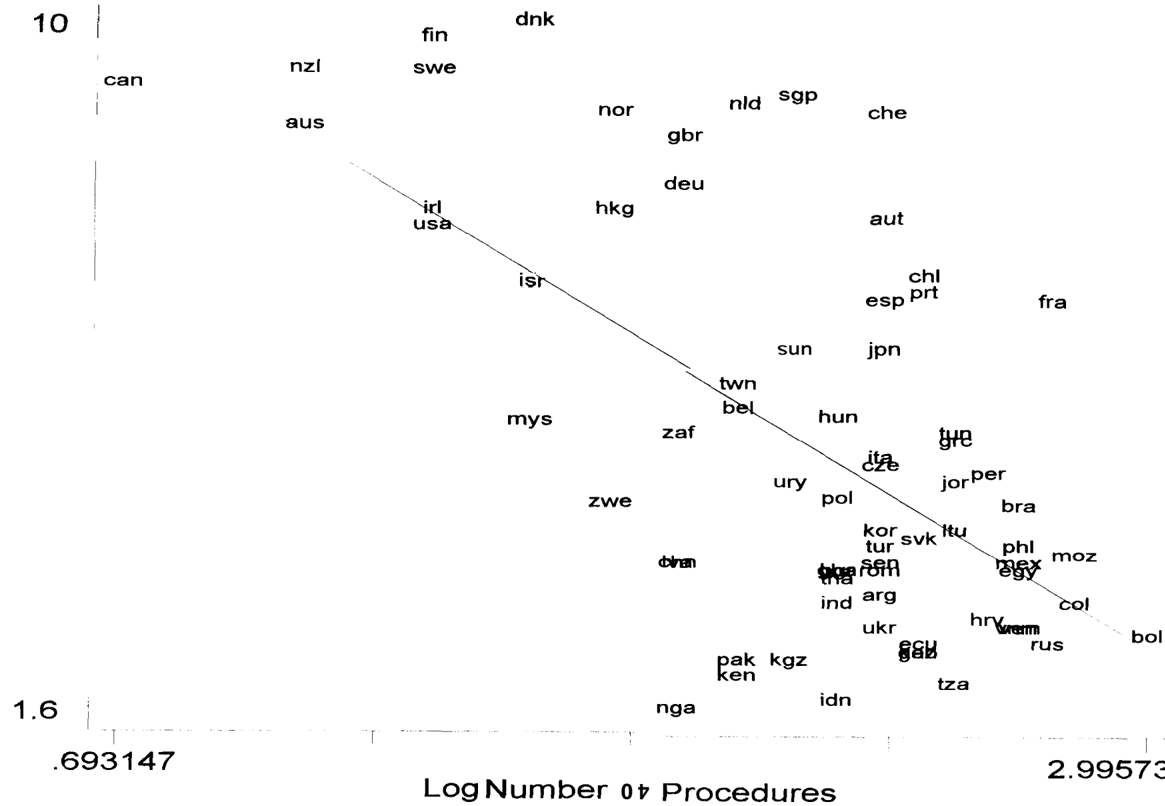
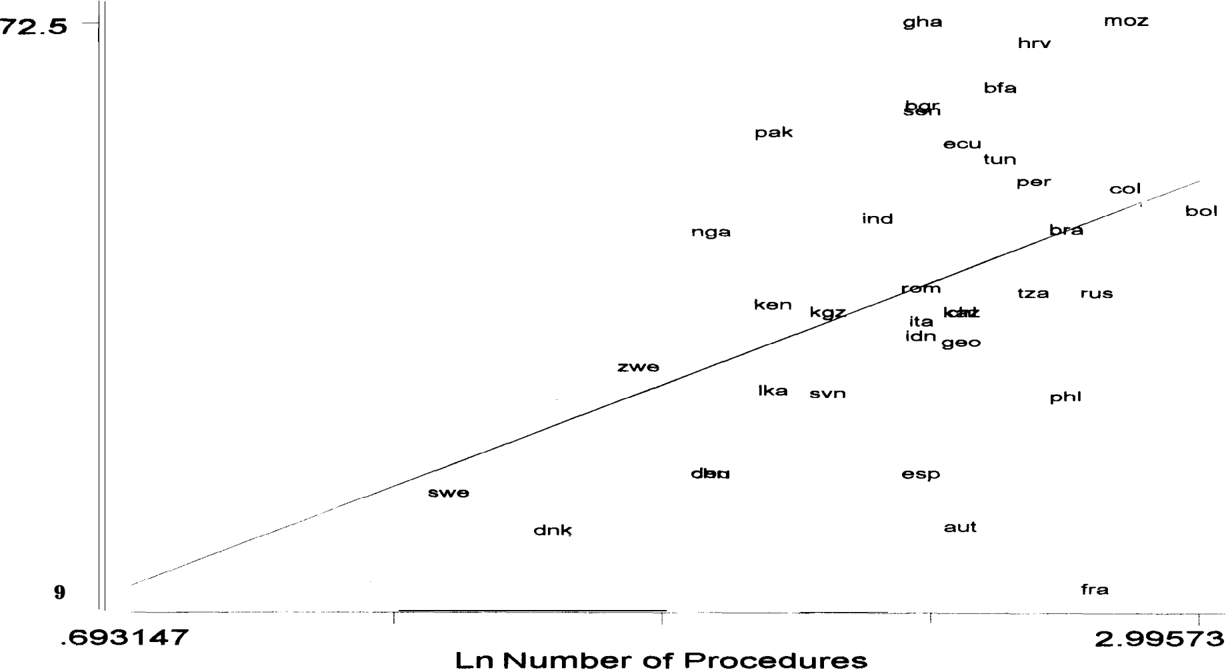
- The number of procedures is strongly correlated with time and cost: the paper reports correlations of 0.75 with log time and 0.62 with log cost.
- The helping-hand tests do not support a beneficial-regulation story: in Table IV, more procedures are associated with lower ISO quality standards (e.g. coefficient -0.2646) and larger unofficial economy measures (e.g. coefficient 13.6277 for size of unofficial economy; 19.8763 for employment in the unofficial economy), while pollution and health outcomes do not improve.
- The tollbooth evidence is stronger: Table VI reports that more procedures are associated with worse corruption scores, with a coefficient of -3.2809 (and -1.7249 with GDP per capita controls) for the corruption regressions.
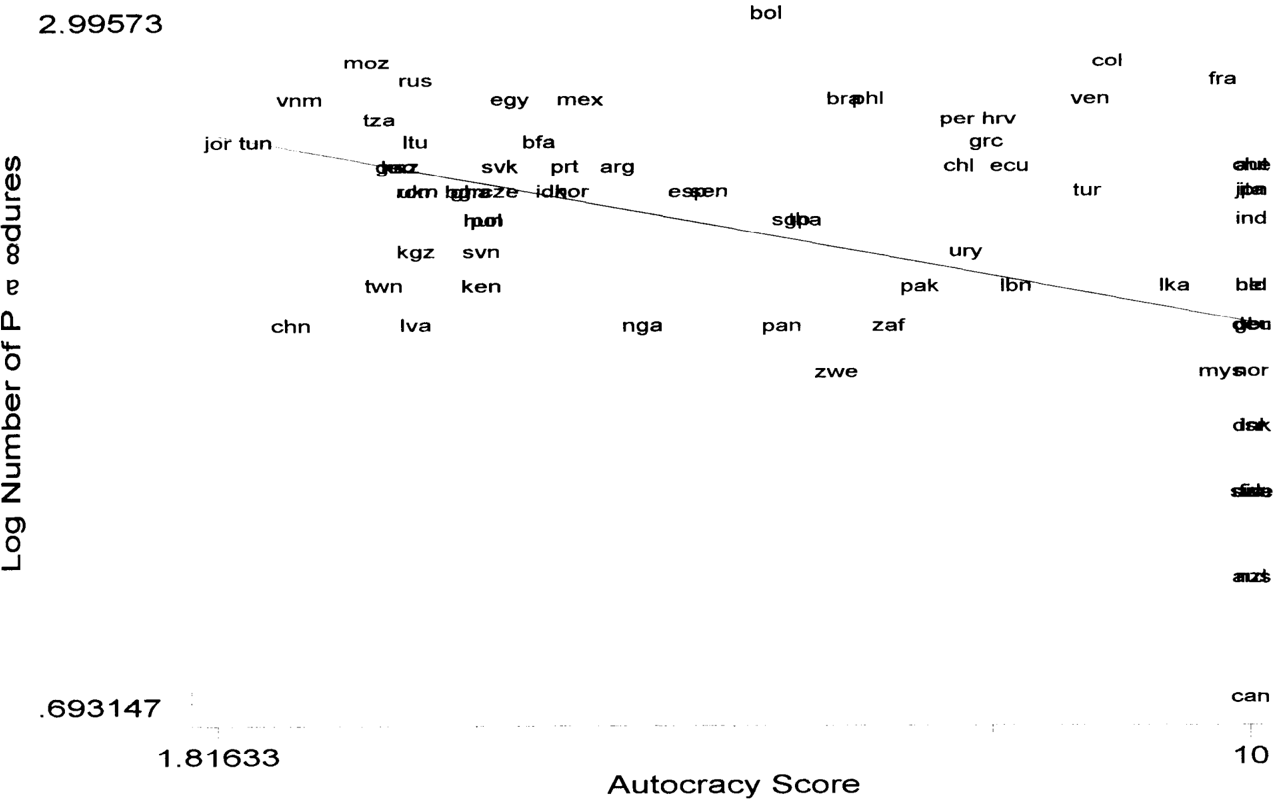
- In Table VIII, better government is associated with lighter regulation; the paper states that countries with more limited and representative governments have statistically significantly fewer procedures using 5 out of 6 measures of better government, and that more autocratic countries regulate more heavily.
Methods
- The paper builds a new database on entry regulation for 75 countries, focusing on the legal requirements, official time, and official cost for a standardized start-up firm.
- Data were gathered from written government sources, World Bank- and USAID-sponsored studies, government web pages, direct contacts with agencies, and independent double-checks in 73 countries via local consulting reports; the remaining 2 countries were double-checked through government contacts.
- The main analysis uses cross-country OLS regressions relating entry regulation measures to outcomes such as quality, pollution, unofficial economy, corruption, political institutions, legal origin, and GDP per capita; the paper also reports correlations and test-of-means comparisons across income quartiles.
Limitations
- The paper itself notes that the capture-theory tests are based on crude measures and that the data are probably least suited to test the capture hypothesis.
- The authors say the data almost surely underestimate the cost and complexity of entry because they focus on the capital city, omit industry-specific requirements and foreign-ownership steps, and ignore some informal delays and bribes.
- Evident from the text: the study is cross-sectional and based on official procedures/costs, so causal interpretation is limited and informal corruption/bureaucratic delays are not directly measured except indirectly through correlations.
Model-written summary. Check it against the paper before relying on it.
Integrity signals
Registry
Cites
Statistics
Figures
Verification
Claims the paper makes
0 Valid · 3 Not valid · 13 Not checked · 114 Own results and interpretations
A result the paper reports from its own data — it cites no other source for it, so there is none to check. The quote shows it is in the paper.
In the paper
“Very few entry regulations cover tax and labor issues.”
plain- Asserted: passes — The authors put it forward as true.
- Checkable: passes — It can be checked against evidence.
- Load-bearing: unclear — It is unclear whether the paper’s conclusions depend on it.
- Based: passes — The paper gives a reason why it holds.
In the paper
“The data show that the numbers of entry and of labor market regulations are positively correlated across countries, contrary to the substitutes hypothesis.”
What the sources say
- Not matchedcites Djankov et al., 2000
An author–year citation the paper’s reference list doesn’t settle. We don’t search these by name.
plainstates an association- Asserted: passes — The authors put it forward as true.
- Checkable: passes — It can be checked against evidence.
- Load-bearing: unclear — It is unclear whether the paper’s conclusions depend on it.
- Based: passes — The paper gives a reason why it holds.
- Not matched
A result the paper reports from its own data — it cites no other source for it, so there is none to check. The quote shows it is in the paper.
In the paper
“It often takes the form of screening procedures.”
- Also stated in: § III. Basic Results. · plain
“Instead, much of what governments do to regulate entry falls into the category of screening procedures.”
plain- Asserted: passes — The authors put it forward as true.
- Checkable: passes — It can be checked against evidence.
- Load-bearing: unclear — It is unclear whether the paper’s conclusions depend on it.
- Based: passes — The paper gives a reason why it holds.
- Also stated in: § III. Basic Results. · plain
A result the paper reports from its own data — it cites no other source for it, so there is none to check. The quote shows it is in the paper.
In the paper
“First, the cost-to-per-capita-GDP ratio decreases uniformly with GDP per capita.”
plainstates an association- Asserted: passes — The authors put it forward as true.
- Checkable: passes — It can be checked against evidence.
- Load-bearing: unclear — It is unclear whether the paper’s conclusions depend on it.
- Based: passes — The paper gives a reason why it holds.
A result the paper reports from its own data — it cites no other source for it, so there is none to check. The quote shows it is in the paper.
In the paper
“In contrast, countries in the other three quartiles of per capita income are not statistically different from each other in terms of the number of procedures and the time required to fulfill them.”
plain- Asserted: passes — The authors put it forward as true.
- Checkable: passes — It can be checked against evidence.
- Load-bearing: passes — The paper’s conclusions depend on it.
- Based: passes — The paper gives a reason why it holds.
49 more claims
Create a free account to see all 130 claims and every source verdict.
- Probably not a substantial claim. 21
- It may state two separate claims as one. 54
- The quote only partly states this claim. 26
Claims other papers make about this one
Each is checked against this paper’s own text: does it say what the citing paper says it does?
The source backs part of the claim, not all of it — or backs it for a different population, condition or comparison.
In the citing paper
“Our findings suggest an explanation for the low level of incorporation in Italy: the average direct cost associated with fulfilling the bureaucratic regulations for registering a new corporation in Italy is 20% of per capita GNP compared to 10% of per capita GNP on average for other G-7 European countries.”
From Entry regulation as a barrier to entrepreneurship (2006) · cites this paper as Djankov et al. (2002)
Experimental — accuracy not yet measuredThe cited source says what the claim attributes to it.
In the citing paper
“Given the explicit link made by Djankov et al . (2002) between the speed and ease with which businesses may be established in a country and its economic performance - and the enthusiasm with which this link has been grasped by European Union policy makers - our findings imply this link needs reconsidering.”
From The Effect of Business Regulations on Nascent and Young Business Entrepreneurship (2007) · cites this paper as Djankov et al . (2002)
Citations
Cites
La Porta, R., Lopez‐de‐Silanes, F., Shleifer, A., & Vishny, R. W. (1998) · Journal of Political Economy · doi:10.1086/250042 · Cited by 18,025
Self-citationThe Theory of Economic Regulation
Stigler, G. J. (1971) · The Bell Journal of Economics and Management Science · doi:10.2307/3003160 · Cited by 8,098
Journal of Economic Literature
(2019) · AEA Papers and Proceedings · doi:10.1257/pandp.109.633 · Cited by 7,468
The Quarterly Journal of Economics
Kuznets, S. (2024) · Business Cycle Theory, Part I Volume 4 · doi:10.4324/9781003549741-8 · Cited by 7,176
La Porta, R. (1999) · Journal of Law, Economics, and Organization · doi:10.1093/jleo/15.1.222 · Cited by 5,699 · cited 2×
“Legal origin has been viewed as a proxy for the government’s proclivity to intervene in the economy and the stance of the law toward the security of property rights in a country [La Porta et al. 1999].”
The Theory of Economic Regulation
Stigler, G. J. (2021) · The Political Economy · doi:10.4324/9781315495811-8 · Cited by 5,483
Pigou, A. C. (1933) · The Economic Journal · doi:10.2307/2224491 · Cited by 5,137
Toward a More General Theory of Regulation
Peltzman, S. (1976) · The Journal of Law and Economics · doi:10.1086/466865 · Cited by 4,729
Moffitt, R. A. (2009) · American Economic Review · doi:10.1257/aer.99.2.660 · Cited by 4,694
Shleifer, A., & Vishny, R. W. (1993) · The Quarterly Journal of Economics · doi:10.2307/2118402 · Cited by 3,778
Self-citation
Research works printed but not linked: 7
- McLiesh Caralee, 2001, NBER Working Paper No., 8288
- Kasnako lu, Zehra, and Münür Yayla, 'Unrecorded Economy in Turkey: A Monetary Approach', 1999. "Unrecorded Economy in Turkey (A Monetary Approach)" in Informal Sector in Turkey (I), Tuncer Bulutay (ed.), SIS, Ankara, forthcoming.
- Fred, 1987, Journal of Legal Studies, 101
- Olson, Mancur, 1991, 'Autocracy, Democracy, and Prosperity,' in Richard Zeckhauser, ed., Strategy of Choice, Cambridge, MA: MIT Press.
- 1967, Western Economic Journal, 232
- World Economic Forum (1999), The Global Competitiveness Report 1999 , Schwab, Klaus et al., eds., New York: Oxford University Press.
- World Economic Forum, The Global Competitiveness Report 2001, Klaus Schwab et al., eds. (New York, NY: Oxford University Press, 2001).
Cited by
Items 1,001–1,100 of 3,986
Innovation and Growth: The Schumpeterian Perspective
Aghion, P., & Akcigit, U. (2017) · Cambridge University Press eBooks · doi:10.1017/9781316636404.003 · Cited by 43
Borojo, D. G., & Yushi, J. (2019) · Economic Research-Ekonomska Istraživanja · doi:10.1080/1331677x.2019.1696691 · Cited by 39
The Political Economy of Financial SystemsPreprint
Haber, S. H., & Perotti, E. C. (2008) · RePEc: Research Papers in Economics · Cited by 60
Ács, Z. J., Desai, S., & Klapper, L. F. (2008) · World Bank, Washington, DC eBooks · doi:10.1596/1813-9450-4667 · Cited by 51
Correspondence: The Doing Business Project: How It Started
Djankov, S. (2016) · The Journal of Economic Perspectives · doi:10.1257/jep.30.1.247 · Cited by 59
Self-citationChina's Financial System and the Law *
Allen, F., & Qian, J. “. (2014) · Cornell international law journal · Cited by 51
Duvanova, D. (2012) · British Journal of Political Science · doi:10.1017/s0007123411000457 · Cited by 47
Are economic rents good for development? Evidence from the manufacturing sector
Schwab, D., & Werker, E. D. (2014) · World Development · doi:10.1016/j.worlddev.2018.07.014 · Cited by 52
Structural Reforms and Elections: Evidence from a World-Wide New Dataset
Alesina, A., Furceri, D., Ostry, J. D., Papageorgiou, C., & Quinn, D. P. (2023) · Journal of the European Economic Association · doi:10.1093/jeea/jvad075 · Cited by 55
Institutional enablers of electric vehicle market: Evidence from 30 countries
Khatua, A., Kumar, R. R., & De, S. K. (2023) · Transportation Research Part A Policy and Practice · doi:10.1016/j.tra.2023.103612 · Cited by 50
Informality and Regulations: What Drives the Growth of Firms?
Dabla‐Norris, E., & Inchauste, G. (2008) · IMF Staff Papers · doi:10.1057/palgrave.imfsp.9450030 · Cited by 49
What can Okun teach Polanyi? Efficiency, regulation and equality in the OECD
Hopkin, J., & Blyth, M. M. (2011) · Review of International Political Economy · doi:10.1080/09692290.2010.526469 · Cited by 38
“International institutions such as the World Bank, the IMF, the OECD and the European Union have all exhorted advanced industrial countries to lighten the regulatory load on economic activity, freeing up markets from distortions and restrictions (Conway et al., 2005; Djankov et al., 2002).”
Dynamics of monetary policy spillover: The role of exchange rate regimes
Rohit, A., & Dash, P. (2018) · Economic Modelling · doi:10.1016/j.econmod.2018.09.007 · Cited by 38
Malesky, E. J., & Taussig, M. D. (2018) · American Political Science Review · doi:10.1017/s0003055418000849 · Cited by 43
Entry of Providers Onto a Sharing Economy Platform: Macro-Level Factors and Social Interaction
Gerwe, O., Silva, R., & Castro, J. O. D. (2020) · Entrepreneurship Theory and Practice · doi:10.1177/1042258720903404 · Cited by 46
TAX RATES, GOVERNANCE, AND THE INFORMAL ECONOMY IN HIGH‐INCOME COUNTRIES
Kuehn, Z. (2013) · Economic Inquiry · doi:10.1111/ecin.12021 · Cited by 48
Inequality, democracy and taxation: Lessons from the post-communist transition
Gerry, C. J., & Mickiewicz, T. M. (2008) · Europe Asia Studies · doi:10.1080/09668130701760356 · Cited by 40
“One can link Acemoglu (2006) with an earlier seminal paper on regulation of entry by Djankov et al. (2002).”
Cross-border acquisitions in the global food sector
Herger, N., Kotsogiannis, C., & McCorriston, S. (2008) · European Review of Agricultural Economics · doi:10.1093/erae/jbn033 · Cited by 43
“23 See Djankov et al. (2002) for a discussion of issues relating to the costs of regulation across a large sample of countries.”
InfluentialThe Divergence of Legal Procedures
Balas, A., Porta, R. L., López‐de‐Silanes, F., & Shleifer, A. (2009) · American Economic Journal Economic Policy · doi:10.1257/pol.1.2.138 · Cited by 84
Self-citationGroh, A. P., & Liechtenstein, H. V. (2009) · SSRN Electronic Journal · doi:10.2139/ssrn.1413766 · Cited by 34
Regulation and GrowthPreprint
Djankov, S., McLiesh, C., & Ramalho, R. M. (2006) · SSRN Electronic Journal · doi:10.2139/ssrn.893321 · Cited by 38
Self-citationThe Saudi monarchy and economic familism in an era of business environment reforms
Mazaheri, N. (2013) · Business and Politics · doi:10.1515/bap-2012-0039 · Cited by 37
Greasing the Turbines? Corruption and access to electricity in Africa
Cummins, M., & Gillanders, R. (2019) · Energy Policy · doi:10.1016/j.enpol.2019.111188 · Cited by 38
Sen, K., & Steer, L. (2005) · Bulletin of Indonesian Economic Studies · doi:10.1080/00074910500306577 · Cited by 37
“7 A study of regulation of entry in 85 countries suggests that countries that regulate the entry of new firms more heavily tend to have higher corruption and larger unofficial economies, but not better quality of public or private goods (Djankov et al. 2002).”
McMullen, J. S., Wood, M. S., & Kier, A. S. (2016) · Academy of Management Perspectives · doi:10.5465/amp.2015.0139 · Cited by 42
The impact of institutions on the entrepreneurial orientation‐performance relationship
Wales, W. J., Shirokova, G., Beliaeva, T., Micelotta, E. R., & Marino, L. (2021) · Global Strategy Journal · doi:10.1002/gsj.1418 · Cited by 57
Corporation as a Crucial Ally Against Corruption
Calderón, R., Álvarez, J. L., & Mayoral, S. (2008) · Journal of Business Ethics · doi:10.1007/s10551-008-9796-y · Cited by 42
Do global banks facilitate foreign direct investment?
Poelhekke, S. (2015) · European Economic Review · doi:10.1016/j.euroecorev.2015.01.014 · Cited by 47
“33 The data is from Djankov et al. (2002) and only observed for 1999, although used in Helpman et al. (2008) to (successfully) determine trade in 1986.”
Ownership structure and access to finance in developing countries
Mertzanis, C. (2016) · Applied Economics · doi:10.1080/00036846.2016.1257106 · Cited by 44
“Djankov et al. (2002) argued that less representative and democratic regimes suppress entry and competition in the banking sector.”
Decades Lost and Found: Mexico and Chile Since 1980
Raphael Bergoeing, V., Kehoe, P. J., Kehoe, T. J., & Soto, R. (2002) · Quarterly Review · doi:10.21034/qr.2611 · Cited by 40
National Systems of Entrepreneurship
Ács, Z. J., Szerb, L., & Autio, E. (2015) · SpringerBriefs in economics · doi:10.1007/978-3-319-14932-5_2 · Cited by 40
Investor Protection and EntryPreprint
Perotti, E. C., & Volpin, P. F. (2007) · RePEc: Research Papers in Economics · Cited by 57
Aterido, R., & Hallward-Driemeier, M. C. (2010) · The World Bank Open Knowledge Repository (World Bank) · doi:10.1596/1813-9450-5218 · Cited by 58
“…that examine a particular dimension of the investment climate using aggregate data have found significant results (e.g. the effect of labor regulations (Botero et al, 2004; Heckman and Pages, 2004), regulations of entry (Djankov et al, 2002, Klapper et al. 2006.) or creditor rights (Levine, 2005)).”
Transaction Structures in the Developing World: Evidence from Private EquityPreprint
Schoar, A., & Lerner, J. (2004) · SSRN Electronic Journal · doi:10.2139/ssrn.511202 · Cited by 37
Georgiou, M. N. (2009) · SSRN Electronic Journal · doi:10.2139/ssrn.1478903 · Cited by 37
“Finally, the cost to start-up a company as well as the related regulations and legislation are off-putting (Djankov et al., 2002).”
Does Career Risk Deter Potential Entrepreneurs?
Gottlieb, J. D., TOWNSEND, R. R., & Xu, T. (2016) · National Bureau of Economic Research · doi:10.3386/w22446 · Cited by 46
10 What Constrains Indian Manufacturing?
Gupta, P. G., Hasan, R., & Kumar, U. (2010) · Oxford University Press eBooks · doi:10.1093/acprof:oso/9780199575077.003.0010 · Cited by 34
Regulation and Comparative Corporate Governance
Aguilera, R. V., Goyer, M., & de Castro, L. R. K. (2013) · Oxford University Press eBooks · doi:10.1093/oxfordhb/9780199642007.013.0002 · Cited by 43
Berens, S. (2015) · Socio-Economic Review · doi:10.1093/ser/mwu039 · Cited by 43
Gao, Y. (2010) · Australian Journal of Management · doi:10.1177/0312896210370082 · Cited by 45
Culture, legal heritage and the regulation of labor
Ang, J. B., & Fredriksson, P. G. (2017) · Journal of Comparative Economics · doi:10.1016/j.jce.2017.11.007 · Cited by 42
Red tape reduction and firm entry: New evidence from an Italian reform
Amici, M., Giacomelli, S., Manaresi, F., et al. (2016) · Economics Letters · doi:10.1016/j.econlet.2016.06.031 · Cited by 36
Amin, M., & Soh, Y. C. (2020) · The World Bank Economic Review · doi:10.1093/wber/lhaa007 · Cited by 50
Do African resource rents promote rent-seeking at the expense of entrepreneurship?
Munemo, J. (2021) · Small Business Economics · doi:10.1007/s11187-021-00461-0 · Cited by 39
Entrepreneurship and productivity in Africa: the role of institutions
Ajide, F. M. (2021) · Journal of Sustainable Finance & Investment · doi:10.1080/20430795.2021.1939645 · Cited by 46
Chowdhury, F., & Audretsch, D. B. (2014) · Eurasian economic review : · doi:10.1007/s40821-014-0008-7 · Cited by 46
Benmelech, E., & Moskowitz, T. J. (2006) · SSRN Electronic Journal · doi:10.2139/ssrn.891663 · Cited by 38
Employment Protection and Gross Job Flows: A Differences-in-Differences Approach
Pagés, C., & Micco, A. (2004) · doi:10.18235/0010730 · Cited by 55
Keeping Secrets: The Economics of Access Deterrence
Henry, E., & Ruiz‐Aliseda, F. (2016) · American Economic Journal Microeconomics · doi:10.1257/mic.20140190 · Cited by 39
Cooperatives and happiness. Cross-country evidence on the role of relational capital
Bruni, L., Rosa, D. D., & Ferri, G. (2019) · Applied Economics · doi:10.1080/00036846.2019.1575944 · Cited by 14
“7Following the influential paper by Djankov et al. (2002), the World Bank compiles data on the various factors of the ease of doing business.”
Krammer, S. M. S., Lashitew, A. A., Doh, J. P., & Bapuji Hari, B. (2022) · Journal of International Business Studies · doi:10.1057/s41267-022-00535-5 · Cited by 36
Organized Crime and Firms: Evidence from Antimafia Enforcement Actions
Slutzky, P., & Zeume, S. (2018) · Management Science · doi:10.1287/mnsc.2021.00859 · Cited by 63
“We show that organized crime is associated with less competition, the presence of potentially inefficient firms, and barriers to entry, all of which likely foster corruption and hence are detrimental to economic growth (Shleifer and Vishny 1993; Mauro 1995; Djankov et al. 2002; Pinotti 2015a,b).”
Perceptions regarding strategic and structural entry barriers
Lutz, C. H. M., Kemp, R. G. M., & Dijkstra, S. G. (2009) · Small Business Economics · doi:10.1007/s11187-008-9159-1 · Cited by 73
“This result concerning government regulations is not in line with Djankov et al. (2002), but supports the findings presented by Van Stel et al. (2006, 2007) that administrative considerations do not seem to influence nascent or young business formation.”
Confidence Games: How Does Regulation Constitute Markets?
Carpenter, D. P. (2009) · Cambridge University Press eBooks · doi:10.1017/cbo9780511657504.006 · Cited by 35
“This discretionary feature of approval regulation, combined with experimentation hurdles, renders its institutions quite different from those of “fee for entry” licensure, which is practiced by many national and local governments worldwide (Djankov et al. 2002).”
Institutions, regulations and initial coin offerings: An international perspective
Shrestha, P., Arslan‐Ayaydin, Ö., Thewissen, J., & Torsin, W. (2020) · International Review of Economics & Finance · doi:10.1016/j.iref.2020.10.014 · Cited by 42
Regulation, trade and economic growth
Silberberger, M., & Königer, J. (2016) · Economic Systems · doi:10.1016/j.ecosys.2016.05.001 · Cited by 63
Culture and the regulation of insider trading across countries
Cline, B. N., Williamson, C. R., & Xiong, H. (2021) · Journal of Corporate Finance · doi:10.1016/j.jcorpfin.2021.101917 · Cited by 36
How a Good Governance of Institutions Can Reduce Poverty and Inequality in Society?
Coccia, M. (2021) · Contributions to management science · doi:10.1007/978-3-030-60978-8_4 · Cited by 65
Ragmoun, W. (2022) · Review of International Business and Strategy · doi:10.1108/ribs-10-2021-0136 · Cited by 53
History matters: New evidence on the long run impact of colonial rule on institutions
Jones, P. (2012) · Journal of Comparative Economics · doi:10.1016/j.jce.2012.04.002 · Cited by 44
Fiscal decentralization and institutional quality on the business environment
Escaleras, M. P., & Chiang, E. P. (2017) · Economics Letters · doi:10.1016/j.econlet.2017.07.019 · Cited by 35
Developing Africa’s energy mix
Schwerhoff, G., & Sy, M. (2018) · Climate Policy · doi:10.1080/14693062.2018.1459293 · Cited by 49
“Djankov, La Porta, Lopez-de-Silanes, and Shleifer (2002) present empirical evidence that market entry is more difficult and expensive in countries with higher corruption.”
López‐de‐Silanes, F. (2002) · Economía · doi:10.1353/eco.2002.0001 · Cited by 51
Self-citationTaxation and Conditional CooperationPreprint
Frey, B. S., & Torgler, B. (2005) · SSRN Electronic Journal · doi:10.2139/ssrn.662083 · Cited by 39
Big Business Stability and Economic Growth: Is What's Good for General Motors Good for America?Preprint
Fogel, K., Mørck, R., & Yeung, B. Y. (2006) · SSRN Electronic Journal · doi:10.2139/ssrn.916547 · Cited by 36
What's thePreprint
Golec, J. H., & Vernon, J. A. (2009) · SSRN Electronic Journal · Cited by 35
People, Governance and Forests—The Stumbling Blocks in Forest Governance Reform in Latin America
Contreras-Hermosilla, A. (2011) · Forests · doi:10.3390/f2010168 · Cited by 44
The Role of Innovation in Development
Fagerberg, J., Srholec, M., & Verspagen, B. (2018) · Edward Elgar Publishing eBooks · doi:10.4337/9781788110266.00009 · Cited by 36
“…law and order prevails, independence of courts, whether (intellectual) property rights are enforced, political stability or how widespread corruption is conceived to be (Djankov et al., 2002 and 2003; Kaufmann et al., 2003; Botero et al., 2004; La Porta et al., 2004; Park, 2008; World Bank, 2009).”
Small and Medium Enterprises Facing Institutional Barriers in Kosovo
Peci, F., Kutllovci, E., Tmava, Q., et al. (2012) · International Journal of Marketing Studies · doi:10.5539/ijms.v4n1p95 · Cited by 34
“The excessive and inadequate overload of these formal rules causes an increase of informal activities, such as corruption and nepotism (Bartlett and Bukvić 2001; Smallbone and Welter 2001; Djankov et al, 2002).”
The cost of registering property: does legal origin matter?
Amin, M., & Haidar, J. I. (2011) · Empirical Economics · doi:10.1007/s00181-011-0479-7 · Cited by 36
“…studies show differences across the two legal traditions in the quality of property rights protection and contract enforcement (Djankov et al. 2003), entry regulation (Djankov et al. 2002), labor laws (Botero et al. 2004) and financial development (La Porta et al. 1997, Djankov et al. 2008).”
Governance quality, foreign direct investment, and entrepreneurship in emerging markets
Tran, N. H., & Le, C. D. (2019) · Journal of Asian Business and Economic Studies · doi:10.1108/jabes-09-2018-0063 · Cited by 43
Moving from Intentions to Actions in Youth Entrepreneurship: An Institutional Perspective
Shirokova, G., Osiyevskyy, O., Bogatyreva, K., Edelman, L. F., & Manolova, T. S. (2022) · Entrepreneurship Research Journal · doi:10.1515/erj-2019-0201 · Cited by 52
Antecedents of entrepreneurial employee activity: does gender play a role?
Turró, A., Noguera, M., & Urbano, D. (2020) · International Journal of Entrepreneurial Behaviour & Research · doi:10.1108/ijebr-09-2019-0529 · Cited by 44
CEO gender, institutional context and firm exports
Audretsch, D. B., Belitski, M., Chowdhury, F., & Desai, S. (2022) · International Business Review · doi:10.1016/j.ibusrev.2022.102008 · Cited by 41
Gate Fees: The Pervasive Effect of IPO Restrictions on Chinese Equity Markets
Lee, C. M. C., Qu, Y., & Shen, T. (2022) · European Finance Review · doi:10.1093/rof/rfac044 · Cited by 37
Impact of Shadow Economy on Sustainable Development in Africa
Ajide, F. M., Dada, J. T., Arnaut, M., et al. (2023) · International Journal of Public Administration · doi:10.1080/01900692.2023.2207117 · Cited by 34
“Therefore, the shadow economy is seen as a source of distortion into the formal economic system, undermines governance, regulation and negatively influences sustainable economic development (Djankov et al., 2002; Dreher & Schneider, 2006; Hoinaru, 2017; Mauro, 1995).”
The Links between Finance and Inequality: Channels and Evidence
Claessens, S., & Perotti, E. C. (2005) · World Bank, Washington, DC eBooks · doi:10.1596/9227 · Cited by 42
Wang, C.-A. (2012) · Emerging Markets Finance and Trade · doi:10.2753/ree1540-496x480201 · Cited by 34
The Growth and Welfare Effects of Deficit-Financed Dividend Tax Cuts
Peretto, P. F. (2011) · Journal of money credit and banking · doi:10.1111/j.1538-4616.2011.00399.x · Cited by 34
The institutional basis of efficiency in resource-rich countries
Hartwell, C. A. (2016) · Economic Systems · doi:10.1016/j.ecosys.2016.02.004 · Cited by 35
Investor Protection and Real Investment by U.S. Multinationals
Kelley, E. K., & Woidtke, T. (2006) · Journal of Financial and Quantitative Analysis · doi:10.1017/s0022109000002532 · Cited by 36
Improving City Competitiveness Through the Investment Climate: Ranking 23 Chinese CitiesPreprint
Dollar, D., Wang, S., Xu, L. C., et al. (2004) · SSRN Electronic Journal · doi:10.2139/ssrn.530744 · Cited by 34
Haggerty, L., & Bank, W. (2004) · doi:10.1596/1813-9450-3286 · Cited by 34
Orlova, N. V. ;. (2016) · Problems of Economic Transition · doi:10.1080/10611991.2016.1200389 · Cited by 33
Military conscription as a means of stabilizing democratic regimes
Adam, A. (2010) · Public Choice · doi:10.1007/s11127-010-9725-3 · Cited by 39
Long-term finance and entrepreneurship
Léon, F. (2019) · Economic Systems · doi:10.1016/j.ecosys.2018.10.004 · Cited by 41
Why is stock market concentration bad for the economy?
Bae, K., Bailey, W. B., & Kang, J. (2021) · Journal of Financial Economics · doi:10.1016/j.jfineco.2021.01.002 · Cited by 54
Jones, C. M., Temouri, Y., Kirollos, K., & Du, J. (2022) · Journal of Business Research · doi:10.1016/j.jbusres.2022.113373 · Cited by 38
Institutions and economic growth in Portugal: a quantitative exploration
Tavares, J. M. H. (2004) · Portuguese Economic Journal · doi:10.1007/s10258-004-0029-8 · Cited by 33
Investigating capitalism aversion
Landier, A., Thesmar, D., & Thoenig, M. (2008) · Economic Policy · doi:10.1111/j.1468-0327.2008.00205.x · Cited by 62
“…institutions: a de jure index of product market deregulation (defined as the opposite of the index of regulatory barriers to entry taken from Djankov et al., 2002); a de facto measure of financial development (see Section 3); a de jure measure of financial development (from Kaminsky and…”
InfluentialNugent, J. B., & Sukiassyan, G. (2009) · Contemporary Economic Policy · doi:10.1111/j.1465-7287.2009.00171.x · Cited by 33
Is the asymmetric cost behavior affected by competition factors?
Cheung, J., Kim, H., Kim, S., et al. (2016) · Asia-Pacific Journal of Accounting & Economics · doi:10.1080/16081625.2016.1266271 · Cited by 33
“2008), and competition environments (Djankov et al. 2002; Dyck and Zingales 2004) may affect our results.”
InfluentialEntrepreneurial Motivations, Culture, and the Law
Licht, A. N. (2009) · Springer eBooks · doi:10.1007/978-3-540-87910-7_2 · Cited by 42
Growth and Reforms in Latin America: A Survey of Facts and Arguments
Zettelmeyer, J. (2006) · IMF Working Paper · doi:10.2139/ssrn.941272 · Cited by 79
Haefke, C., & Ebell, M. (2004) · RePEc: Research Papers in Economics · Cited by 36
An economic analysis of the retail market for fever and malaria treatment in rural Tanzania
Goodman, C. A. (2013) · LSHTM Research Online (London School of Hygiene and Tropical Medicine) · doi:10.17037/pubs.00682327 · Cited by 33
Bank Supervision, Regulation, and Instability During the Great Depression
Mitchener, K. J. (2004) · National Bureau of Economic Research · doi:10.3386/w10475 · Cited by 41
The Form of Property Rights: Oligarchic Vs. Democratic SocietiesPreprint
Acemoğlu, D. (2003) · SSRN Electronic Journal · doi:10.2139/ssrn.457724 · Cited by 37
Administrative Burdens on Business Activities: Regional DisparitiesPreprint
Bianco, M., & Bripi, F. (2010) · SSRN Electronic Journal · doi:10.2139/ssrn.1562722 · Cited by 35
“Djankov et al. (2006) show that the growth of per capita GDP in 135 countries is negatively correlated with an aggregate index of business regulations in seven areas ––––– 1 See Forti and Ranci (2008) for a survey of the indicators available and their characteristics (weaknesses and strengths).”
Construction corrupts: empirical evidence from a panel of 42 countries
Kyriacou, A. P., Muinelo‐Gallo, L., & Roca‐Sagalés, O. (2015) · Public Choice · doi:10.1007/s11127-015-0297-0 · Cited by 37
“Legal origins have also been linked to the regulation of entry of new firms to the economy and from there to the size of unofficial economies (Djankov et al. 2002).”
Metadata
- Authors
- Djankov, S., La Porta, R., Lopez-de-Silanes, F., & Shleifer, A.
- Affiliations
- World Bank (US)
- National Bureau of Economic Research (US)
- ORCID
- Djankov, S.
- Venue
- The Quarterly Journal of Economics
- Publisher
- Oxford University Press (OUP)
- Published
- 2002-02-01
- Volume
- 117
- Issue
- 1
- Pages
- 1-37
- ISSN
- 0033-5533
- 1531-4650
- OpenAlex
- W2139896179
- Cited by
- 3,956
- References
- 30
- Citations by year
- 2026: 223 · 2025: 185 · 2024: 157 · 2023: 120 · 2022: 140 · 2021: 150 · 2020: 151 · 2019: 161 · 2018: 157 · 2017: 162 · 2016: 166 · 2015: 193 · 2014: 200 · 2013: 183 · 2012: 193
- Type
- report
- Language
- en
- Open access
- green
- doi.org
- Licence
- other-oa
- Locations
- World Bank, Washington, DC eBooks (publishedVersion)
- The Quarterly Journal of Economics (publishedVersion)
- The World Bank Open Knowledge Repository (World Bank) (publishedVersion)
- National Bureau of Economic Research (publishedVersion, other-oa)
- RePEc: Research Papers in Economics (submittedVersion)
- Digital Access to Scholarship at Harvard (DASH) (Harvard University) (submittedVersion, cc-by)
- SSRN Electronic Journal (submittedVersion)
- OpenGrey (Institut de l'Information Scientifique et Technique) (submittedVersion)
- The World Bank Open Knowledge Repository (World Bank) (submittedVersion, cc-by)
- Topics
- Social Sciences › Sociology and Political Science › Corruption and Economic Development
- Social Sciences › Economics, Econometrics and Finance › Economics and Econometrics › Taxation and Compliance Studies
- Social Sciences › Business, Management and Accounting › Strategy and Management › Political Influence and Corporate Strategies
- Keywords
- start-up firms, bureaucratic procedures, corruption, informal economy, democracy, government size, public choice theory, public interest theory
About these checks
Registry, retraction, Cites and statistics results are computed, not judged, with one exception: a printed reference that no index lists is read once by a model before it counts as a citation error. Claims are extracted by a model and kept only when their quote appears verbatim in the text; each cited source is then checked, with a model’s help, for whether it says what the claim relies on. Those verdicts can be wrong — read the claim’s quote and the cited source before relying on one.
A language model drew the claims from the paper on 2026-10-01, under version 3 of the claim definition (model deepseek-v4.1-flash, prompt extract-v3).
A second model labelled each claim on 2026-10-01 (model jev-1.13-20260917, definition revision gold-guideline-v0.2).
Statistics and arithmetic are recomputed, not judged.
Confidence bands are shown only for fields calibrated on our annotated test set. None is calibrated yet, so no band is shown.
What counts as a claim ›How we measure confidence ›How we check this ›
Are you an author, or do you see a problem with this page? Request a review
Data sources
Bibliographic data: Semantic Scholar, OpenAlex, Crossref.
Contains information from the Semantic Scholar Academic Graph Datasets, made available under the ODC Attribution License (ODC-BY 1.0).
Semantic Scholar’s data is described in: Kinney, R., et al. (2023). The Semantic Scholar Open Data Platform. arXiv:2301.10140.
