

The Regulation of Entry
Open accessThe DOI matches its Crossref record, with a small difference in title or year; 39 of the 39 references it cites were found in a registry or an index; none of the 13 sources its claims cite is checked for support yet.
Abstract
1%(5 :25.,1* 3$3(5 6(5,(6 7+( 5(*8/$7,21 2) (175< 6LPHRQ 'MDQNRY 5DIDHO /D 3RUWD )ORUHQ.LR /RSH]GH6LODQHV $QGUHL 6KOHLIHU :RUNLQJ 3DSHU KWWSZZZQEHURUJSDSHUVZ 1$7,21$/ %85($8 2) (&2120,& 5(6($5&+ 0DVVD.KXVHWWV $YHQXH &DPEULGJH 0$ 6HSWHPEHU :H WKDQN 2OJD ,RIIH 7DWLDQD 1HQRYD DQG (NDWHULQD 7UL]ORYD IRU DEOH UHVHDU.K DVVLVWDQ.H DQG +DPLG $ODYL ,ULQD $VWUDNKDQ $EKLMLW %DQHUMHH 5L.KDUG &DYHV -D.TXHOLQH &RROLGJH -DPHV (PHU\ 1LKDO (O0DJKDUEHO -HDQ 3DXO *DXWKLHU (G *ODHVHU 6LPRQ -RKQVRQ /DZUHQ.H .DW] 3HWHU .X.HUD 'DYLG /DLEVRQ ,UD /LHEHUPDQ 'DYLQ 0D.NLQ]LH 0DULH )UDQ.RLVH 0DULH1HOO\ 0DU.HOR 2ODUUHDJD *X\ 3IHIIHUPDQQ 6DQWLDJR 6HGD.D /HLOD :HEVWHU 3HWHU :ULJKW DQG VHPLQDU SDUWL.LSDQWV DW WKH 8QLYHUVLW\ RI 0DU\ODQG DW &ROOHJH 3DUN IRU KHOSIXO .RPPHQWV 7KH .ROOH.WLRQ RI GDWD IRU WKLV SDSHU ZDV RUJDQL]HG DQG ILQDQ.HG E\ WKH :RUOG %DQN $Q DSSHQGL[ GHV
Overview
CoChat Summary
TL;DR
This paper assembles a new cross-country dataset on business entry regulation in 75 countries and uses it to compare the helping-hand, capture, and tollbooth theories of regulation. The evidence is most consistent with the tollbooth view: heavier entry regulation is associated with more corruption, a larger unofficial economy, and less representative, more autocratic governments.
Key findings
- Across the 75-country sample, the number of entry procedures ranges from 2 in Canada to 20 in Bolivia, with a sample average of 10.17 procedures; the average official time is 63.05 business days and the average cost is 0.34 of GDP per capita.
- The number of procedures is strongly correlated with time and cost: the paper reports correlations of 0.75 with log time and 0.62 with log cost.
- The helping-hand tests do not support a beneficial-regulation story: in Table IV, more procedures are associated with lower ISO quality standards (e.g. coefficient -0.2646) and larger unofficial economy measures (e.g. coefficient 13.6277 for size of unofficial economy; 19.8763 for employment in the unofficial economy), while pollution and health outcomes do not improve.
- The tollbooth evidence is stronger: Table VI reports that more procedures are associated with worse corruption scores, with a coefficient of -3.2809 (and -1.7249 with GDP per capita controls) for the corruption regressions.
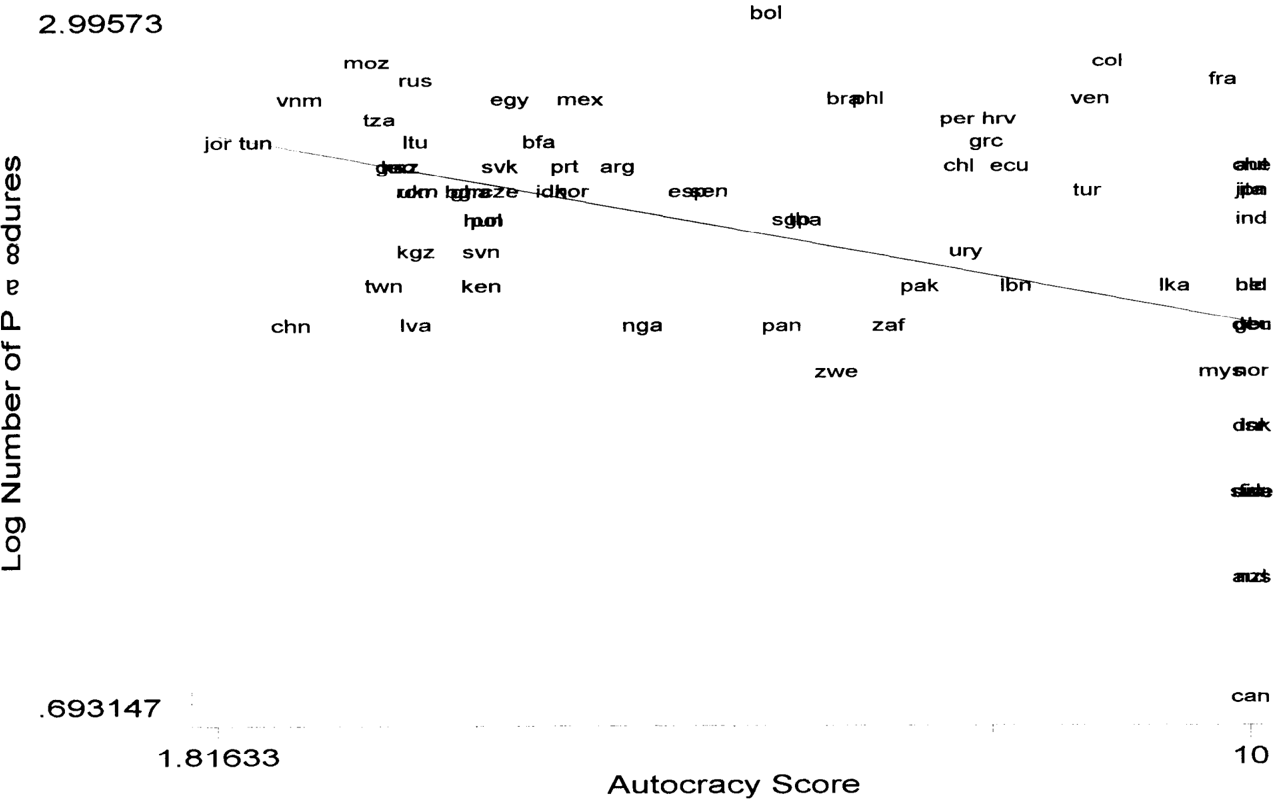
- In Table VIII, better government is associated with lighter regulation; the paper states that countries with more limited and representative governments have statistically significantly fewer procedures using 5 out of 6 measures of better government, and that more autocratic countries regulate more heavily.
Methods
- The paper builds a new database on entry regulation for 75 countries, focusing on the legal requirements, official time, and official cost for a standardized start-up firm.
- Data were gathered from written government sources, World Bank- and USAID-sponsored studies, government web pages, direct contacts with agencies, and independent double-checks in 73 countries via local consulting reports; the remaining 2 countries were double-checked through government contacts.
- The main analysis uses cross-country OLS regressions relating entry regulation measures to outcomes such as quality, pollution, unofficial economy, corruption, political institutions, legal origin, and GDP per capita; the paper also reports correlations and test-of-means comparisons across income quartiles.
Limitations
- The paper itself notes that the capture-theory tests are based on crude measures and that the data are probably least suited to test the capture hypothesis.
- The authors say the data almost surely underestimate the cost and complexity of entry because they focus on the capital city, omit industry-specific requirements and foreign-ownership steps, and ignore some informal delays and bribes.
- Evident from the text: the study is cross-sectional and based on official procedures/costs, so causal interpretation is limited and informal corruption/bureaucratic delays are not directly measured except indirectly through correlations.
Model-written summary. Check it against the paper before relying on it.
Integrity signals
Registry
Cites
Statistics
Figures
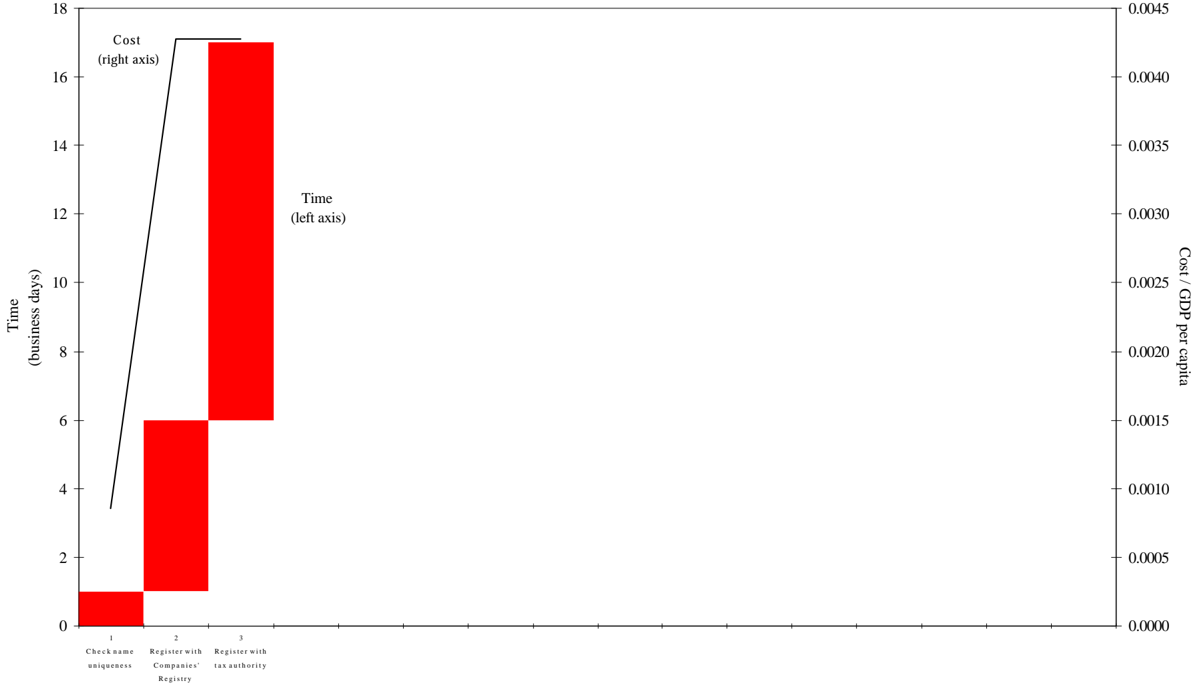
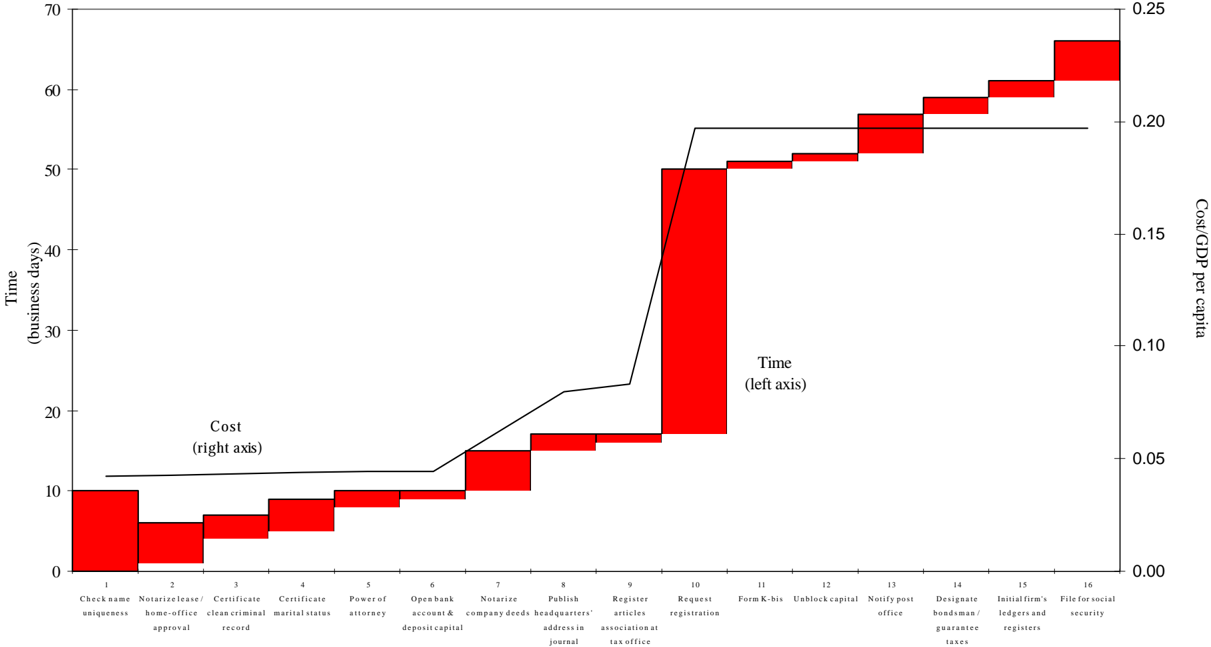
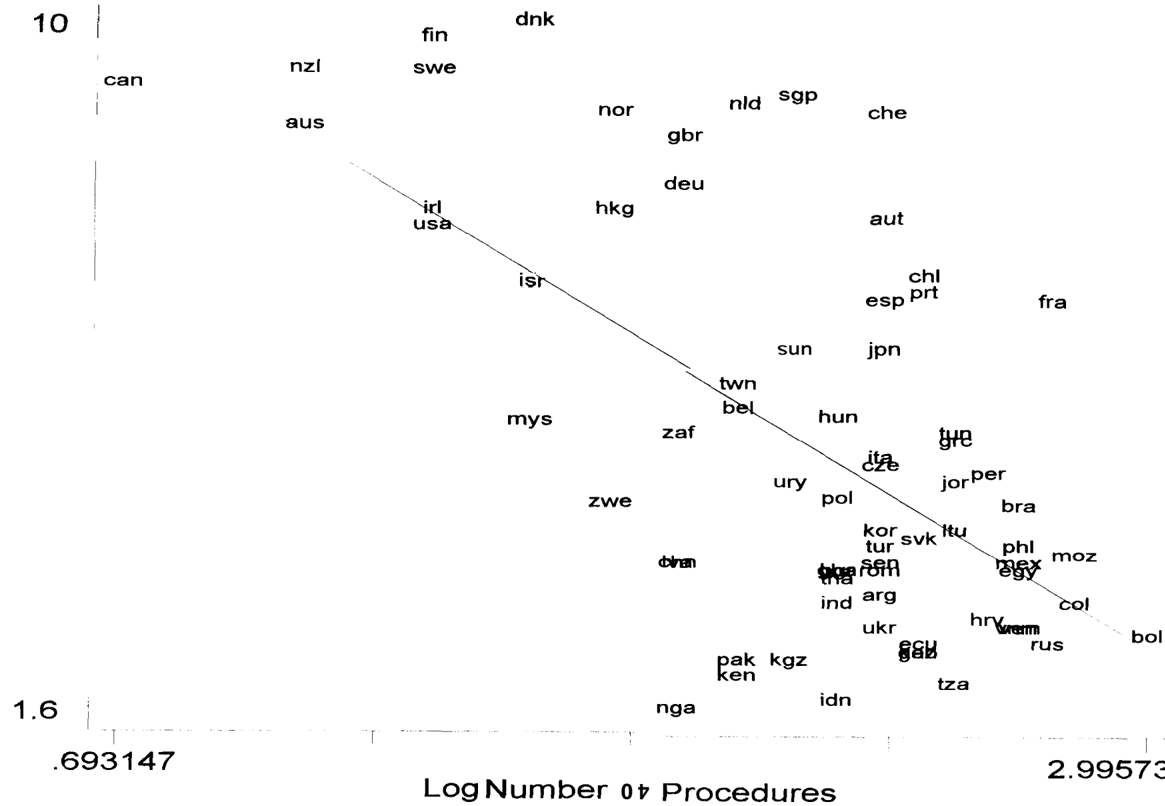
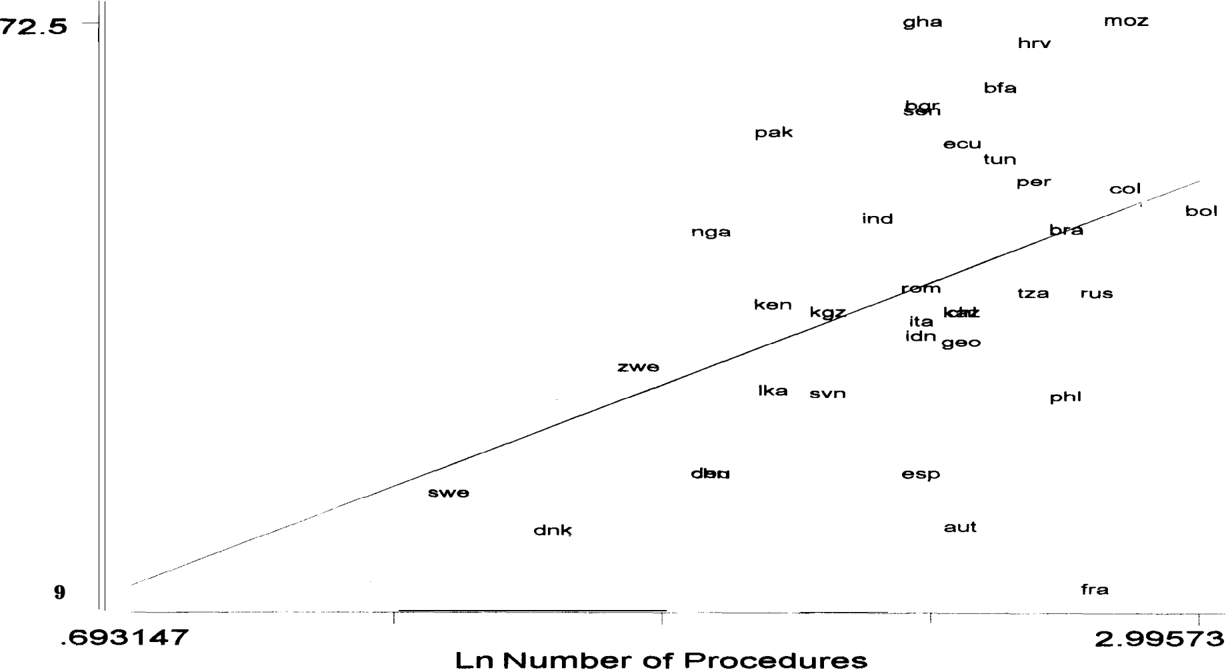
Verification
Claims the paper makes
0 Valid · 3 Not valid · 13 Not checked · 114 Own results and interpretations
A result the paper reports from its own data — it cites no other source for it, so there is none to check. The quote shows it is in the paper.
In the paper
“Very few entry regulations cover tax and labor issues.”
plain- Asserted: passes — The authors put it forward as true.
- Checkable: passes — It can be checked against evidence.
- Load-bearing: unclear — It is unclear whether the paper’s conclusions depend on it.
- Based: passes — The paper gives a reason why it holds.
In the paper
“The data show that the numbers of entry and of labor market regulations are positively correlated across countries, contrary to the substitutes hypothesis.”
What the sources say
- Not matchedcites Djankov et al., 2000
An author–year citation the paper’s reference list doesn’t settle. We don’t search these by name.
plainstates an association- Asserted: passes — The authors put it forward as true.
- Checkable: passes — It can be checked against evidence.
- Load-bearing: unclear — It is unclear whether the paper’s conclusions depend on it.
- Based: passes — The paper gives a reason why it holds.
- Not matched
A result the paper reports from its own data — it cites no other source for it, so there is none to check. The quote shows it is in the paper.
In the paper
“It often takes the form of screening procedures.”
- Also stated in: § III. Basic Results. · plain
“Instead, much of what governments do to regulate entry falls into the category of screening procedures.”
plain- Asserted: passes — The authors put it forward as true.
- Checkable: passes — It can be checked against evidence.
- Load-bearing: unclear — It is unclear whether the paper’s conclusions depend on it.
- Based: passes — The paper gives a reason why it holds.
- Also stated in: § III. Basic Results. · plain
A result the paper reports from its own data — it cites no other source for it, so there is none to check. The quote shows it is in the paper.
In the paper
“First, the cost-to-per-capita-GDP ratio decreases uniformly with GDP per capita.”
plainstates an association- Asserted: passes — The authors put it forward as true.
- Checkable: passes — It can be checked against evidence.
- Load-bearing: unclear — It is unclear whether the paper’s conclusions depend on it.
- Based: passes — The paper gives a reason why it holds.
A result the paper reports from its own data — it cites no other source for it, so there is none to check. The quote shows it is in the paper.
In the paper
“In contrast, countries in the other three quartiles of per capita income are not statistically different from each other in terms of the number of procedures and the time required to fulfill them.”
plain- Asserted: passes — The authors put it forward as true.
- Checkable: passes — It can be checked against evidence.
- Load-bearing: passes — The paper’s conclusions depend on it.
- Based: passes — The paper gives a reason why it holds.
49 more claims
Create a free account to see all 130 claims and every source verdict.
- Probably not a substantial claim. 21
- It may state two separate claims as one. 54
- The quote only partly states this claim. 26
Claims other papers make about this one
Each is checked against this paper’s own text: does it say what the citing paper says it does?
The source backs part of the claim, not all of it — or backs it for a different population, condition or comparison.
In the citing paper
“Our findings suggest an explanation for the low level of incorporation in Italy: the average direct cost associated with fulfilling the bureaucratic regulations for registering a new corporation in Italy is 20% of per capita GNP compared to 10% of per capita GNP on average for other G-7 European countries.”
From Entry regulation as a barrier to entrepreneurship (2006) · cites this paper as Djankov et al. (2002)
Experimental — accuracy not yet measuredThe cited source says what the claim attributes to it.
In the citing paper
“Given the explicit link made by Djankov et al . (2002) between the speed and ease with which businesses may be established in a country and its economic performance - and the enthusiasm with which this link has been grasped by European Union policy makers - our findings imply this link needs reconsidering.”
From The Effect of Business Regulations on Nascent and Young Business Entrepreneurship (2007) · cites this paper as Djankov et al . (2002)
Citations
Cites
La Porta, R., Lopez‐de‐Silanes, F., Shleifer, A., & Vishny, R. W. (1998) · Journal of Political Economy · doi:10.1086/250042 · Cited by 18,025
Self-citationThe Theory of Economic Regulation
Stigler, G. J. (1971) · The Bell Journal of Economics and Management Science · doi:10.2307/3003160 · Cited by 8,098
Journal of Economic Literature
(2019) · AEA Papers and Proceedings · doi:10.1257/pandp.109.633 · Cited by 7,468
The Quarterly Journal of Economics
Kuznets, S. (2024) · Business Cycle Theory, Part I Volume 4 · doi:10.4324/9781003549741-8 · Cited by 7,176
La Porta, R. (1999) · Journal of Law, Economics, and Organization · doi:10.1093/jleo/15.1.222 · Cited by 5,699 · cited 2×
“Legal origin has been viewed as a proxy for the government’s proclivity to intervene in the economy and the stance of the law toward the security of property rights in a country [La Porta et al. 1999].”
The Theory of Economic Regulation
Stigler, G. J. (2021) · The Political Economy · doi:10.4324/9781315495811-8 · Cited by 5,483
Pigou, A. C. (1933) · The Economic Journal · doi:10.2307/2224491 · Cited by 5,137
Toward a More General Theory of Regulation
Peltzman, S. (1976) · The Journal of Law and Economics · doi:10.1086/466865 · Cited by 4,729
Moffitt, R. A. (2009) · American Economic Review · doi:10.1257/aer.99.2.660 · Cited by 4,694
Shleifer, A., & Vishny, R. W. (1993) · The Quarterly Journal of Economics · doi:10.2307/2118402 · Cited by 3,778
Self-citation
Research works printed but not linked: 7
- McLiesh Caralee, 2001, NBER Working Paper No., 8288
- Kasnako lu, Zehra, and Münür Yayla, 'Unrecorded Economy in Turkey: A Monetary Approach', 1999. "Unrecorded Economy in Turkey (A Monetary Approach)" in Informal Sector in Turkey (I), Tuncer Bulutay (ed.), SIS, Ankara, forthcoming.
- Fred, 1987, Journal of Legal Studies, 101
- Olson, Mancur, 1991, 'Autocracy, Democracy, and Prosperity,' in Richard Zeckhauser, ed., Strategy of Choice, Cambridge, MA: MIT Press.
- 1967, Western Economic Journal, 232
- World Economic Forum (1999), The Global Competitiveness Report 1999 , Schwab, Klaus et al., eds., New York: Oxford University Press.
- World Economic Forum, The Global Competitiveness Report 2001, Klaus Schwab et al., eds. (New York, NY: Oxford University Press, 2001).
Cited by
Items 1,401–1,500 of 3,986
Firm entry deregulation, competition and returns to education and skill
Fernandes, A. P., Ferreira, P., & Winters, L. A. (2014) · European Economic Review · doi:10.1016/j.euroecorev.2014.04.004 · Cited by 28
The Role of Similar Accounting Standards in Cross‐Border Mergers and Acquisitions
Francis, J. R., Huang, S. X., & Khurana, I. K. (2015) · Contemporary Accounting Research · doi:10.1111/1911-3846.12176 · Cited by 114
Capelleras, J., & Hoxha, D. (2010) · Post-Communist Economies · doi:10.1080/14631377.2010.498687 · Cited by 22
Support policy for the tourism business: a comparative case study in Spain
Urbano, D., Toledano, N., & Soriano, D. R. (2009) · Service Industries Journal · doi:10.1080/02642060802252050 · Cited by 21
Schrank, A. M. (2005) · Comparative Politics · doi:10.2307/20072912 · Cited by 21
Economics and finance in Indonesia
Masyarakat, L. P. E. D. (2015) · Cited by 21
Jurajda, Š., & Mitchell, J. (2003) · Palgrave Macmillan UK eBooks · doi:10.1057/9781403990105_4 · Cited by 22
Improving the Investment Climate in China
Dollar, D., Hallward‐Driemeier, M., Shi, A., et al. (2003) · Cited by 21
Institutions, Networks and Entrepreneurship Development in Russia: An ExplorationPreprint
Aidis, R., & Estrin, S. (2006) · SSRN Electronic Journal · doi:10.2139/ssrn.910224 · Cited by 32
“…able to develop high levels of productive entrepreneurship with the formal institutional environment being identified as the main barrier to entrepreneurship development within its new institutional environment (Djankov and Murrell, 2002), though there is surprisingly little empirical evidence.”
Institutional Quality and the Gains from TradePreprint
Borrmann, A., Busse, M., & Neuhaus, S. (2006) · SSRN Electronic Journal · doi:10.2139/ssrn.895242 · Cited by 21
The Role of Freedom, Growth and Religion in the Taste for RevolutionPreprint
MacCulloch, R., & Pezzini, S. (2004) · SSRN Electronic Journal · doi:10.2139/ssrn.561922 · Cited by 20
FDI, Regulations and GrowthPreprint
Busse, M., & Groizard, J. L. (2006) · SSRN Electronic Journal · doi:10.2139/ssrn.895243 · Cited by 28
Incorporation and Taxation: Theory and Firm-Level EvidencePreprint
Egger, P. H., Keuschnigg, C., & Winner, H. (2008) · SSRN Electronic Journal · doi:10.2139/ssrn.1288025 · Cited by 24
“It comprises information about the number of procedures, the time, and the costs involved in launching a commercial or industrial fi rm with up to 50 employees and start-up capital of 10 times the economy’s GDP per capita (see Djankov et al., 2002).”
US-Europe Differences in Technology-Driven Growth: Quantifying the Role of Education
Krueger, D., & Kumar, K. (2003) · National Bureau of Economic Research · doi:10.3386/w10001 · Cited by 21
Labor Market Regulations and Income Inequality: Evidence for a Panel of CountriesPreprint
Calderón, C. A., Chong, A. E., & Valdés, R. (2011) · SSRN Electronic Journal · doi:10.2139/ssrn.1818715 · Cited by 21
Measuring the Immeasurable: How to Turn Law into NumbersPreprint
Siems, M. (2011) · SSRN Electronic Journal · Cited by 25
Huang, Y. (2005) · SSRN Electronic Journal · doi:10.2139/ssrn.721221 · Cited by 21
Kuckertz, A., Berger, E. S. C., & Allmendinger, M. (2015) · SSRN Electronic Journal · Cited by 38
Al‐Ubaydli, O., & McLaughlin, P. A. (2012) · SSRN Electronic Journal · doi:10.2139/ssrn.2099814 · Cited by 21
“However, the complexity of the political process means that regulations may not always be virtuously conceived (Stigler, 1971; McChesney, 1987), and the intricacy of the modern economy means that regulations may have adverse unintended consequences (see Peltzman [1975]; for a more thorough discussion of the different…”
State Regulations, Job Search and Wage Bargaining: A Study in the Economics of the Informal SectorPreprint
Bouev, M. (2005) · SSRN Electronic Journal · doi:10.2139/ssrn.729307 · Cited by 25
“Thus a second term in (23) and (24) is increasing in φ and θ.”
InfluentialExploring the effect of institutions on entrepreneurial ecosystems: A meta–analysis
Goletsis, Y., Christogeorgou, K., & Mylonidis, N. (2024) · Journal of Small Business Management · doi:10.1080/00472778.2024.2363845 · Cited by 32
“Santos et al. (2019) suggest that economic institutions are associated with business entry regulations (Djankov et al., 2002), regulations that affect the daily operations of a business (Levie & Autio, 2011), bankruptcy laws and regulations (Ayotte, 2007; Lee et al., 2011) and the regulation of…”
Ma, M., Yu, Z., Li-li, M., & Guo, W. (2024) · Economic Analysis and Policy · doi:10.1016/j.eap.2024.12.026 · Cited by 27
Vasilyeva, R. I., & Mariev, O. S. (2021) · Economy of Regions · doi:10.17059/ekon.reg.2021-4-24 · Cited by 39
“Foreign direct investment inflows also depend on legal system efficiency [29, 30], regulation and entry barriers [31] and property rights protection [32].”
Morales, H., Porporato, M., & Epelbaum, N. (2022) · Journal of Economics Finance and Administrative Science · doi:10.1108/jefas-07-2021-0113 · Cited by 35
Cultural Roots of Entrepreneurship: Evidence from Second-Generation Immigrants
Kleinhempel, J., Klasing, M. J., & Beugelsdijk, S. (2022) · Organization Science · doi:10.1287/orsc.2022.1645 · Cited by 35
Laajaj, R., Eslava, M., & Kinda, T. (2023) · Journal of Public Economics · doi:10.1016/j.jpubeco.2023.104969 · Cited by 35
Structural reforms and income distribution: new evidence for OECD countries
Wiese, R., Jalles, J. T., & de Haan, J. (2024) · Oxford Economic Papers · doi:10.1093/oep/gpae002 · Cited by 38
Jerbashian, V., & Kochanova, A. (2017) · Scandinavian Journal of Economics · doi:10.1111/sjoe.12183 · Cited by 28
“We obtain the measure and the data for the bureaucratic costs of entry from Djankov et al. (2002). These costs include all identifiable official expenses in a country.”
What Do We Talk About When We Talk About Corruption?
Méndez, F., & Sepúlveda, F. (2009) · The Journal of Law Economics and Organization · doi:10.1093/jleo/ewp003 · Cited by 29
Supermarkets competition in England and planning regulation
Griffith, R., & Harmgart, H. (2012) · The International Review of Retail Distribution and Consumer Research · doi:10.1080/09593969.2011.634071 · Cited by 20
Institutional Support of the Firm: A Theory of Business Registries
Arruñada, B. (2010) · The Journal of Legal Analysis · doi:10.1093/jla/2.2.525 · Cited by 20
“…of the law in supporting property rights against third parties (for the latter, see especially pp. 451-52). lack a theory of business formalization, seeing it only as a set of bureaucratic constraints often captured by private interests (De Soto, 1989; Djankov et al. , 2002; World Bank, 2003-2009).”
Institutions, Transparency, and Economic Growth
Sumanjeet (2015) · Emerging Economy Studies · doi:10.1177/2394901515599272 · Cited by 29
Investment climate and firm productivity: an application to Vietnamese manufacturing firms
Trung, N. B., & Kaizoji, T. (2017) · Applied Economics · doi:10.1080/00036846.2017.1282148 · Cited by 22
“By contrast, red tape and bureaucracy lead to adverse impacts (Djankov et al. 2002; World Bank 2002; Djankov, McLiesh, and Ramalho 2006; Aterido, Hallward-Driemeier, and Carmen 2011).”
The growth effect of democracy and technology: An industry disaggregated approach
Zuazu, I. (2018) · European Journal of Political Economy · doi:10.1016/j.ejpoleco.2018.07.009 · Cited by 26
Malone, T., Koumpias, A. M., & Bylund, P. L. (2019) · Journal of Regulatory Economics · doi:10.1007/s11149-019-09375-y · Cited by 23
dos Santos, R. C., Orso, L. É., Machado, M. C. R., & Sousa, A. M. R. (2019) · Corporate Governance · doi:10.1108/cg-02-2019-0072 · Cited by 26
Business regulation, rule of law and formal entrepreneurship: evidence from developing countries
Salinas, A., Ortiz, C. A., & Muffatto, M. (2019) · Journal of Entrepreneurship and Public Policy · doi:10.1108/jepp-03-2019-0019 · Cited by 25
Poverty in Sub-Saharan Africa: The Role of Business Regulations, Policies and Institutions
Dwumfour, R. A. (2020) · Social Indicators Research · doi:10.1007/s11205-020-02277-z · Cited by 20
Reforming the Entrepreneurship Ecosystem in Post-Revolutionary Egypt and Tunisia
Adly, A. (2014) · Cited by 30
Does location matter for disclosure? Evidence from geographic segments
Leung, E., & Verriest, A. (2019) · Journal of Business Finance & Accounting · doi:10.1111/jbfa.12375 · Cited by 23
Future orientation and taxes: Evidence from big data
Petutschnig, M. (2017) · Journal of International Accounting Auditing and Taxation · doi:10.1016/j.intaccaudtax.2017.03.003 · Cited by 25
Informal Sector and Employment Generation in Nigeria: An Error Correction Model
Fasanya, I. O., & Onakoya, A. B. (2012) · Research on humanities and social sciences · Cited by 20
Elango, B., & Lahiri, S. (2014) · Thunderbird International Business Review · doi:10.1002/tie.21608 · Cited by 22
Compliance obstacles to competitiveness
Doyle, E. (2007) · Corporate Governance · doi:10.1108/14720700710827194 · Cited by 20
Business perceptions of regulative institutions in Central and Eastern Europe
Kshetri, N. (2010) · Baltic Journal of Management · doi:10.1108/17465261011079758 · Cited by 20
Measuring Institutions in russian regions: Methodology, Sources of data, Analysis
Baranov, A. O., Malkov, E., Polishchuk, L., Rochlitz, M., & Syunyaev, G. (2015) · Voprosy Ekonomiki · doi:10.32609/0042-8736-2015-2-69-103 · Cited by 29
The Effects of NAFTA/CUSFTA on Agricultural Trade Flows: An Empirical Investigation
Ghazalian, P. L. (2016) · Canadian Journal of Agricultural Economics/Revue canadienne d agroeconomie · doi:10.1111/cjag.12119 · Cited by 30
Politics and entrepreneurship in the US
Beland, L., & Unel, B. (2019) · Canadian Journal of Economics/Revue canadienne d économique · doi:10.1111/caje.12365 · Cited by 30
Anti-competitive conduct, in-house R&D, and growth
Grossmann, V., & Steger, T. M. (2007) · European Economic Review · doi:10.1016/j.euroecorev.2007.10.005 · Cited by 51
Smyth, R., & Qian, J. X. (2008) · Economics Letters · doi:10.1016/j.econlet.2008.11.006 · Cited by 20
Hawk, A. L., Pacheco‐de‐Almeida, G., & Yeung, B. Y. (2012) · SSRN Electronic Journal · doi:10.2139/ssrn.1988143 · Cited by 20
Trade and migration : firm-level evidencePreprint
Hatzigeorgiou, A., & Lodefalk, M. (2011) · RePEc: Research Papers in Economics · Cited by 25
Kozluk, T. J. (2014) · OECD Economics Department working papers · doi:10.1787/5jxrjnbnbm8v-en · Cited by 25
“The general nature of businesses concerned in this exercise is heavily reflected in the data – for 1999 where Djankov et al. (2002) report the underlying data, the only OECD country with a non-zero value for environmental procedures is Mexico (meaning businesses are subject to some kind of environmental procedure).”
InfluentialResource Curse: A Corporate Transparency ChannelPreprint
Durnev, A., Guriev, S. M., Errunza, S. V., Fortin, S., Mehrotra, V., Morck, A., Pirrong, C., Singer, Z., & Also, D. T. W. (2011) · RePEc: Research Papers in Economics · Cited by 20
Sustaining Growth Accelerations and Pro-Poor Growth in AfricaPreprint
Pattillo, C., & Gupta, S. (2005) · SSRN Electronic Journal · doi:10.2139/ssrn.888064 · Cited by 39
Entrepreneurship in Advanced and Developing Countries: A Microeconomic PerspectivePreprint
Vivarelli, M. (2012) · SSRN Electronic Journal · doi:10.2139/ssrn.2051356 · Cited by 31
“…as the amount of the initial investment to proxy the MES (see Geroski and Schwalbach, 1991) or the presence of bureaucratic entry regulations (see Djankov et al., 2002; Klapper, Laeven and Rajan, 2006), and on the other hand by endogenous entry barriers such as R&D and advertising expenditures…”
India's Financial SystemPreprint
Allen, F., Chakrabarti, R., & De, S. (2008) · SSRN Electronic Journal · doi:10.2139/ssrn.1261244 · Cited by 22
Levers of Legal Design: Institutional Determinants of the Quality of LawPreprint
Hadfield, G. K. (2007) · SSRN Electronic Journal · doi:10.2139/ssrn.988800 · Cited by 20
Fintech Venture CapitalPreprint
Cumming, D. J., & Schwienbacher, A. (2016) · SSRN Electronic Journal · doi:10.2139/ssrn.2784797 · Cited by 20
An Alternative View on Law, Institutions, Finance and GrowthPreprint
Allen, F., & Zhang, C. (2011) · RePEc: Research Papers in Economics · Cited by 32
Entrepreneurship, Firm Entry, and the Taxation of Corporate Income: Evidence from EuropePreprint
Rin, M. D., Giacomo, M. D., & Sembenelli, A. (2008) · SSRN Electronic Journal · doi:10.2139/ssrn.1262204 · Cited by 20
Entry Deregulation, Market Turnover, and Efficiency: China's Business Registration ReformPreprint
Barwick, P. J., Chen, L., Li, S., et al. (2022) · SSRN Electronic Journal · doi:10.2139/ssrn.4090077 · Cited by 20
Bendig, D., Kleine-Stegemann, L., Mazur, M. A., & Zapkau, F. B. (2024) · International Business Review · doi:10.1016/j.ibusrev.2024.102303 · Cited by 29
Corporate Tax Enforcement and Business Activity
Gallemore, J., & Jacob, M. (2022) · The Accounting Review · doi:10.2308/tar-2023-0011 · Cited by 28
Urban-rural population mobility, government governance and regional coordinated development
Miao, S., & Li, S. (2025) · International Review of Economics & Finance · doi:10.1016/j.iref.2025.104229 · Cited by 25
Zhang, X., Xu, R., Nguyen, H. T., & Zhou, H. (2026) · International Review of Finance · doi:10.1111/irfi.70065 · Cited by 23
The measurement of regulator independence in practice: Latin America and the Caribbean
Montoya, M. Á., & Trillas, F. (2008) · International Journal of Public Policy · doi:10.1504/ijpp.2009.021550 · Cited by 19
Pal, D., Mitra, S. K., & Chatterjee, S. (2021) · Journal of Business Research · doi:10.1016/j.jbusres.2021.08.066 · Cited by 19
Rashid, S. A., Masron, T. A., & Malim, N. A. K. (2022) · Socio-Economic Planning Sciences · doi:10.1016/j.seps.2022.101476 · Cited by 29
Administrative reform and the disposal of zombie enterprises: evidence from China
Fan, L., Tang, T., & Yang, G. (2023) · Small Business Economics · doi:10.1007/s11187-023-00752-8 · Cited by 20
Ngo, V. D., Leonidou, L. C., Janssen, F., & Christodoulides, P. (2023) · Journal of Business Research · doi:10.1016/j.jbusres.2023.114315 · Cited by 32
Liu, Y., & Liu, W. (2024) · Finance research letters · doi:10.1016/j.frl.2024.106300 · Cited by 25
Macro shocks and costly political action in non-democracies
Dorsch, M., Dunz, K., & Maarek, P. (2015) · Public Choice · doi:10.1007/s11127-015-0239-x · Cited by 21
“Second, as in Dorsch and Maarek (2015), we stress the role of institutional political grievances rather than distributional ones.1 Third, we provide an empirical demonstration that the political effect of macroeconomic shocks in non-democratic countries can be heterogeneous across some structural…”
InfluentialTrade liberalisation and innovation under sector heterogeneity
Navas, A. (2014) · Regional Science and Urban Economics · doi:10.1016/j.regsciurbeco.2014.08.007 · Cited by 19
“1) 13Details about the derivation of equation (21) are provided in Appendix 1 (section 7.”
Business regulation and taxation: effects on cross-country corruption
Goel, R. K. (2012) · Journal of Economic Policy Reform · doi:10.1080/17487870.2012.692468 · Cited by 20
“This finding is consistent with the notion that more regulatory hurdles present more opportunities to collect rents and with the ‘tollbooth theory’ of Djankov et al. (2002).10 Business startup costs (STARTc), on the other hand, while showing a positive impact on corruption, were statistically…”
InfluentialKachwamba, M. A., & Sæbø, Ø. (2011) · International Journal of Marketing Studies · doi:10.5539/ijms.v3n4p2 · Cited by 22
Impact of E-Government on Transaction Cost and FDI Inflows: A Proposed Conceptual Framework
Kachwamba, M. A. (2011) · International Journal of Business and Management · doi:10.5539/ijbm.v6n11p285 · Cited by 27
The Quality of Government Dataset Codebook
Samanni, M., Holmberg, S., & Rothstein, B. (2011) · Cited by 19
Coyne, C. J., & Leeson, P. T. (2005) · ISTITUZIONI E SVILUPPO ECONOMICO · Cited by 20
Political Corruption and Electoral Funding: A Cross-National Analysis
Evertsson, N. (2013) · International Criminal Justice Review · doi:10.1177/1057567713476886 · Cited by 27
Importance of Investment Climates for Inflows of Foreign Direct Investment in Developing Countries
Bayraktar, N. (2015) · Business and Economic Research · doi:10.5296/ber.v5i1.6762 · Cited by 27
The reformers’ dilemma: media, policy ownership, and reform
Leeson, P. T., & Coyne, C. J. (2007) · European Journal of Law and Economics · doi:10.1007/s10657-007-9013-y · Cited by 22
Medieval European Traditions in Representation and State Capacity Today
Pavlik, J. B., & Young, A. T. (2018) · Economics of Governance · doi:10.1007/s10101-020-00236-5 · Cited by 20
Misuse of Institutions: Its Causes and Consequences
Polishchuk, L. (2008) · Voprosy Ekonomiki · doi:10.32609/0042-8736-2008-8-28-44 · Cited by 19
Optimal Stabilization Policy with Endogenous Firm EntryPreprint
Berentsen, A., & Waller, C. J. (2009) · SSRN Electronic Journal · doi:10.2139/ssrn.1444899 · Cited by 19
“Djankov et al (2002) estimates the cost of starting a new business for the US to be = 0:017 (as a fraction of GDP per capita in 1999).”
Crime, Corruption and InstitutionsPreprint
Chatterjee, I., & Ray, R. (2009) · RePEc: Research Papers in Economics · Cited by 19
Financial Dependence, Formal Credit and Informal JobsPreprint
Catão, L., Pagés, C., & Rosales, M. R. (2011) · SSRN Electronic Journal · doi:10.2139/ssrn.1817195 · Cited by 18
The Political Economy of Entry: Lobbying and Financial DevelopmentPreprint
Perotti, E. C., & Volpin, P. F. (2005) · SSRN Electronic Journal · doi:10.2139/ssrn.643997 · Cited by 19
“(ii) They can raise funds on the capital market as external equity.10 (We will consider a private equity market later) We denote αik as the stake held by agent i in firm k, and αjj is the equity stake owned by the entrepreneur j in his own firm.”
Growth, Governance and Corruption in the Presence of Threshold Effects: Theory and EvidencePreprint
Aidt, T. S., Dutta, J., & Sena, V. (2006) · RePEc: Research Papers in Economics · doi:10.17863/cam.5060 · Cited by 24
“…on the context, the cost of getting the necessary permits to operate in that sector.12 Public services should be interpreted 12De Soto (1990) and Djankov et al. (2002) have shown that this is an important consideration in many 8 as law and order, legal services and so on that individuals have…”
Regulations and productivity growth in bankingPreprint
Delis, M. D., Molyneux, P., & Pasiouras, F. (2009) · RePEc: Research Papers in Economics · Cited by 19
Kim, Y.-H., Kim, W., & Yang, T. (2011) · SSRN Electronic Journal · doi:10.2139/ssrn.1964835 · Cited by 19
Institutions and Economic Growth: A Cross Country EvidencePreprint
Siddiqui, D. A., & Ahmed, Q. M. (2009) · RePEc: Research Papers in Economics · Cited by 38
The Impact of Worker Bargaining Power on the Organization of Global FirmsPreprint
Carluccio, J., & Bas, M. (2013) · SSRN Electronic Journal · doi:10.2139/ssrn.2351142 · Cited by 21
An Assessment of the factors affecting the growth in real estate investment in Kenya.
Nzalu, F. M. (2013) · Cited by 19
Asongu, S. A. (2011) · International journal of institutions and economies/Institutions and economies · doi:10.2139/ssrn.2493155 · Cited by 22
“Djankov et al. (2002) observe the number of steps an entrepreneur must complete in order to begin operating a business legally.”
GDPR and the Localness of Venture InvestmentPreprint
Jia, J., Jin, G. Z., & Wagman, L. (2019) · SSRN Electronic Journal · doi:10.2139/ssrn.3436535 · Cited by 23
R&D and Productivity: Estimating Production Functions when Productivity is EndogenousPreprint
Doraszelski, U., & Jaumandreu, J. (2008) · RePEc: Research Papers in Economics · Cited by 36
What Determines Financial Development? Culture, Institutions or Trade
Herger, N., Hodler, R., & Lobsiger, M. (2008) · Review of World Economics · doi:10.1007/s10290-008-0160-1 · Cited by 115
DRIVERS OF ENVIRONMENTAL REGULATION COSTS AND THEIR PERCEPTION BY FIRMS: EVIDENCE FROM SLOVENIA
Lah, L. M., & Kotnik, Ž. (2025) · Journal of Cleaner Production · doi:10.1016/j.jclepro.2025.145274 · Cited by 17
Searching for the sources of productivity from macro to micro and back
Bartelsman, E. J. (2010) · Industrial and Corporate Change · doi:10.1093/icc/dtq059 · Cited by 20
Metadata
- Authors
- Djankov, S., La Porta, R., Lopez-de-Silanes, F., & Shleifer, A.
- Affiliations
- World Bank (US)
- National Bureau of Economic Research (US)
- ORCID
- Djankov, S.
- Venue
- The Quarterly Journal of Economics
- Publisher
- Oxford University Press (OUP)
- Published
- 2002-02-01
- Volume
- 117
- Issue
- 1
- Pages
- 1-37
- ISSN
- 0033-5533
- 1531-4650
- OpenAlex
- W2139896179
- Cited by
- 3,956
- References
- 30
- Citations by year
- 2026: 223 · 2025: 185 · 2024: 157 · 2023: 120 · 2022: 140 · 2021: 150 · 2020: 151 · 2019: 161 · 2018: 157 · 2017: 162 · 2016: 166 · 2015: 193 · 2014: 200 · 2013: 183 · 2012: 193
- Type
- report
- Language
- en
- Open access
- green
- doi.org
- Licence
- other-oa
- Locations
- World Bank, Washington, DC eBooks (publishedVersion)
- The Quarterly Journal of Economics (publishedVersion)
- The World Bank Open Knowledge Repository (World Bank) (publishedVersion)
- National Bureau of Economic Research (publishedVersion, other-oa)
- RePEc: Research Papers in Economics (submittedVersion)
- Digital Access to Scholarship at Harvard (DASH) (Harvard University) (submittedVersion, cc-by)
- SSRN Electronic Journal (submittedVersion)
- OpenGrey (Institut de l'Information Scientifique et Technique) (submittedVersion)
- The World Bank Open Knowledge Repository (World Bank) (submittedVersion, cc-by)
- Topics
- Social Sciences › Sociology and Political Science › Corruption and Economic Development
- Social Sciences › Economics, Econometrics and Finance › Economics and Econometrics › Taxation and Compliance Studies
- Social Sciences › Business, Management and Accounting › Strategy and Management › Political Influence and Corporate Strategies
- Keywords
- start-up firms, bureaucratic procedures, corruption, informal economy, democracy, government size, public choice theory, public interest theory
About these checks
Registry, retraction, Cites and statistics results are computed, not judged, with one exception: a printed reference that no index lists is read once by a model before it counts as a citation error. Claims are extracted by a model and kept only when their quote appears verbatim in the text; each cited source is then checked, with a model’s help, for whether it says what the claim relies on. Those verdicts can be wrong — read the claim’s quote and the cited source before relying on one.
A language model drew the claims from the paper on 2026-10-01, under version 3 of the claim definition (model deepseek-v4.1-flash, prompt extract-v3).
A second model labelled each claim on 2026-10-01 (model jev-1.13-20260917, definition revision gold-guideline-v0.2).
Statistics and arithmetic are recomputed, not judged.
Confidence bands are shown only for fields calibrated on our annotated test set. None is calibrated yet, so no band is shown.
What counts as a claim ›How we measure confidence ›How we check this ›
Are you an author, or do you see a problem with this page? Request a review
Data sources
Bibliographic data: Semantic Scholar, OpenAlex, Crossref.
Contains information from the Semantic Scholar Academic Graph Datasets, made available under the ODC Attribution License (ODC-BY 1.0).
Semantic Scholar’s data is described in: Kinney, R., et al. (2023). The Semantic Scholar Open Data Platform. arXiv:2301.10140.
