

The Regulation of Entry
Open accessThe DOI matches its Crossref record, with a small difference in title or year; 39 of the 39 references it cites were found in a registry or an index; none of the 13 sources its claims cite is checked for support yet.
Abstract
1%(5 :25.,1* 3$3(5 6(5,(6 7+( 5(*8/$7,21 2) (175< 6LPHRQ 'MDQNRY 5DIDHO /D 3RUWD )ORUHQ.LR /RSH]GH6LODQHV $QGUHL 6KOHLIHU :RUNLQJ 3DSHU KWWSZZZQEHURUJSDSHUVZ 1$7,21$/ %85($8 2) (&2120,& 5(6($5&+ 0DVVD.KXVHWWV $YHQXH &DPEULGJH 0$ 6HSWHPEHU :H WKDQN 2OJD ,RIIH 7DWLDQD 1HQRYD DQG (NDWHULQD 7UL]ORYD IRU DEOH UHVHDU.K DVVLVWDQ.H DQG +DPLG $ODYL ,ULQD $VWUDNKDQ $EKLMLW %DQHUMHH 5L.KDUG &DYHV -D.TXHOLQH &RROLGJH -DPHV (PHU\ 1LKDO (O0DJKDUEHO -HDQ 3DXO *DXWKLHU (G *ODHVHU 6LPRQ -RKQVRQ /DZUHQ.H .DW] 3HWHU .X.HUD 'DYLG /DLEVRQ ,UD /LHEHUPDQ 'DYLQ 0D.NLQ]LH 0DULH )UDQ.RLVH 0DULH1HOO\ 0DU.HOR 2ODUUHDJD *X\ 3IHIIHUPDQQ 6DQWLDJR 6HGD.D /HLOD :HEVWHU 3HWHU :ULJKW DQG VHPLQDU SDUWL.LSDQWV DW WKH 8QLYHUVLW\ RI 0DU\ODQG DW &ROOHJH 3DUN IRU KHOSIXO .RPPHQWV 7KH .ROOH.WLRQ RI GDWD IRU WKLV SDSHU ZDV RUJDQL]HG DQG ILQDQ.HG E\ WKH :RUOG %DQN $Q DSSHQGL[ GHV
Overview
CoChat Summary
TL;DR
This paper assembles a new cross-country dataset on business entry regulation in 75 countries and uses it to compare the helping-hand, capture, and tollbooth theories of regulation. The evidence is most consistent with the tollbooth view: heavier entry regulation is associated with more corruption, a larger unofficial economy, and less representative, more autocratic governments.
Key findings
- Across the 75-country sample, the number of entry procedures ranges from 2 in Canada to 20 in Bolivia, with a sample average of 10.17 procedures; the average official time is 63.05 business days and the average cost is 0.34 of GDP per capita.
- The number of procedures is strongly correlated with time and cost: the paper reports correlations of 0.75 with log time and 0.62 with log cost.
- The helping-hand tests do not support a beneficial-regulation story: in Table IV, more procedures are associated with lower ISO quality standards (e.g. coefficient -0.2646) and larger unofficial economy measures (e.g. coefficient 13.6277 for size of unofficial economy; 19.8763 for employment in the unofficial economy), while pollution and health outcomes do not improve.
- The tollbooth evidence is stronger: Table VI reports that more procedures are associated with worse corruption scores, with a coefficient of -3.2809 (and -1.7249 with GDP per capita controls) for the corruption regressions.
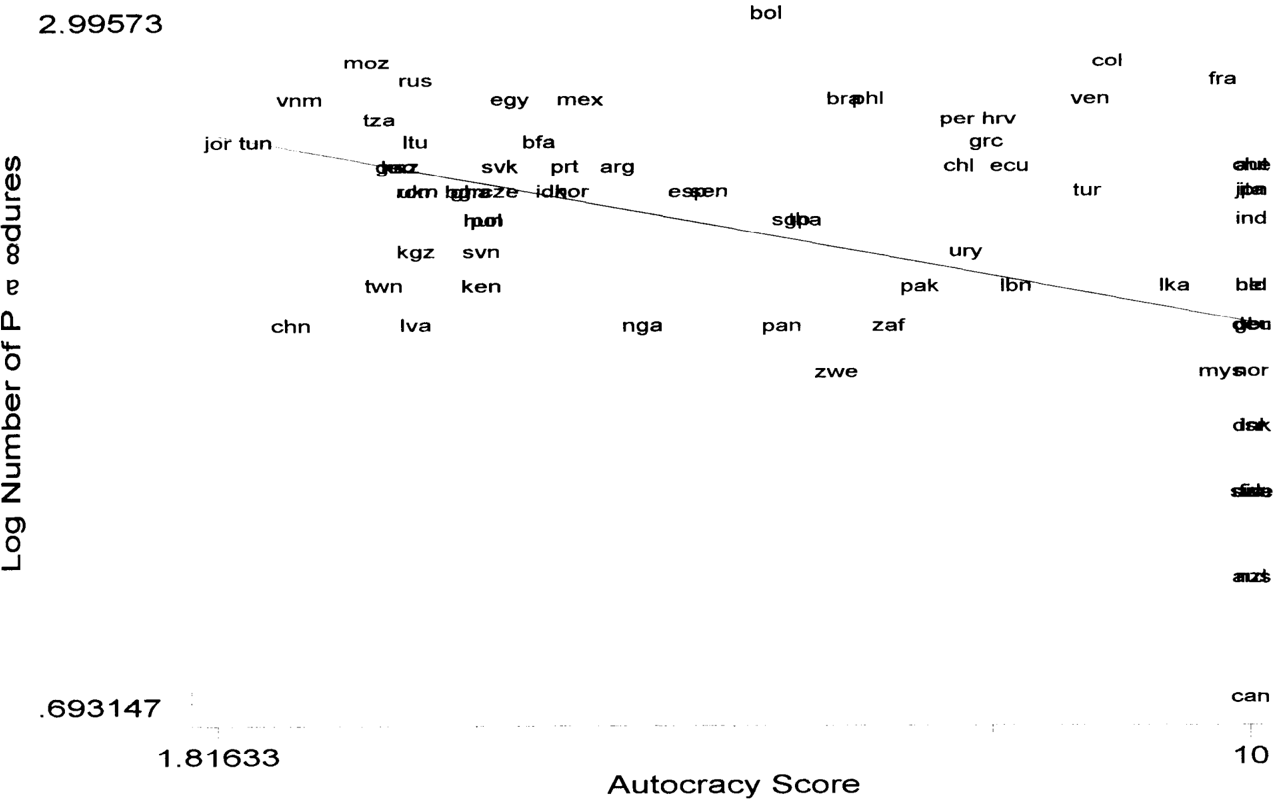
- In Table VIII, better government is associated with lighter regulation; the paper states that countries with more limited and representative governments have statistically significantly fewer procedures using 5 out of 6 measures of better government, and that more autocratic countries regulate more heavily.
Methods
- The paper builds a new database on entry regulation for 75 countries, focusing on the legal requirements, official time, and official cost for a standardized start-up firm.
- Data were gathered from written government sources, World Bank- and USAID-sponsored studies, government web pages, direct contacts with agencies, and independent double-checks in 73 countries via local consulting reports; the remaining 2 countries were double-checked through government contacts.
- The main analysis uses cross-country OLS regressions relating entry regulation measures to outcomes such as quality, pollution, unofficial economy, corruption, political institutions, legal origin, and GDP per capita; the paper also reports correlations and test-of-means comparisons across income quartiles.
Limitations
- The paper itself notes that the capture-theory tests are based on crude measures and that the data are probably least suited to test the capture hypothesis.
- The authors say the data almost surely underestimate the cost and complexity of entry because they focus on the capital city, omit industry-specific requirements and foreign-ownership steps, and ignore some informal delays and bribes.
- Evident from the text: the study is cross-sectional and based on official procedures/costs, so causal interpretation is limited and informal corruption/bureaucratic delays are not directly measured except indirectly through correlations.
Model-written summary. Check it against the paper before relying on it.
Integrity signals
Registry
Cites
Statistics
Figures
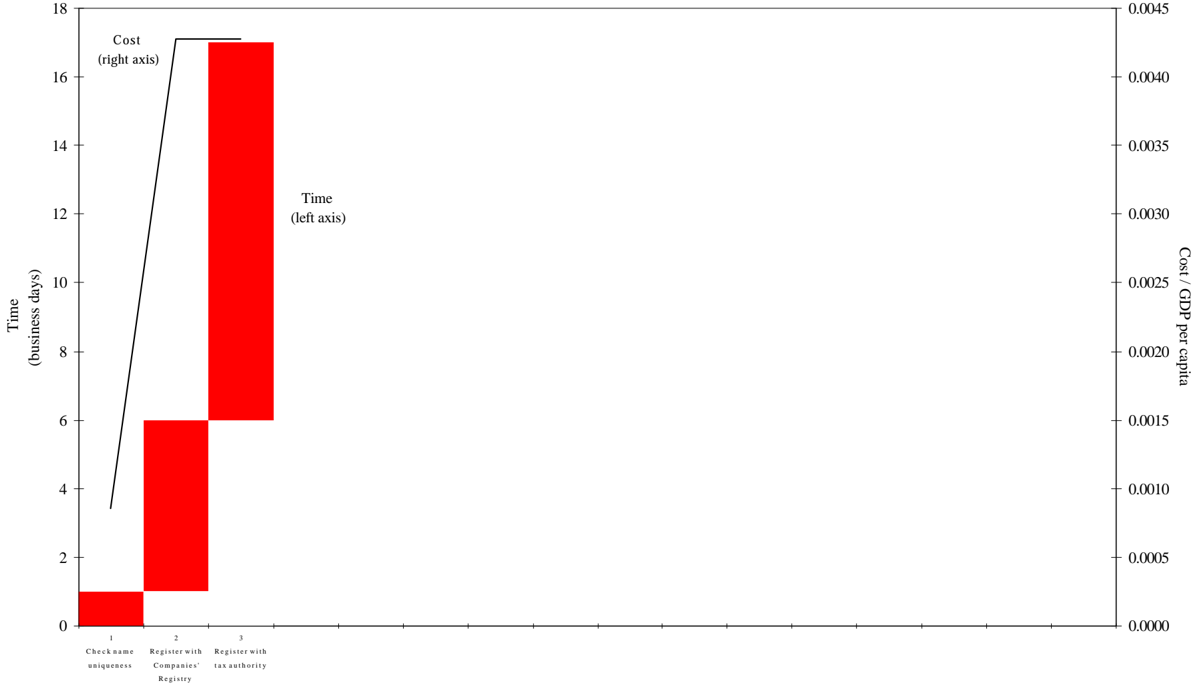
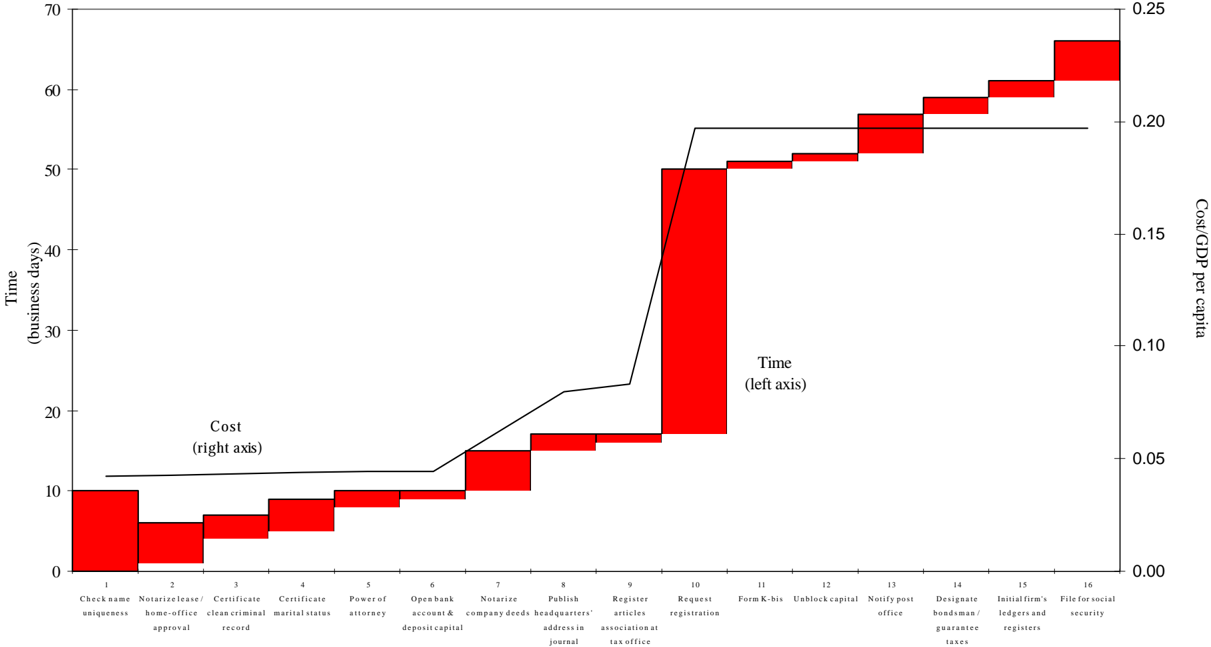
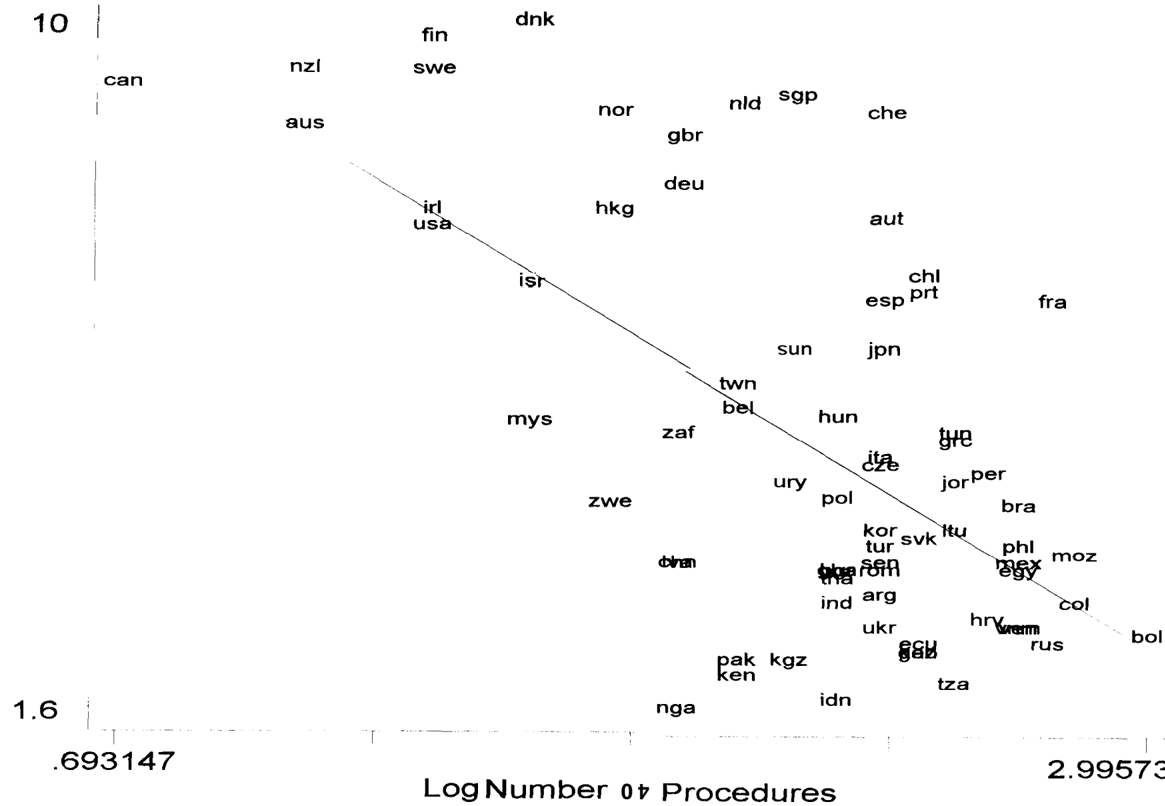
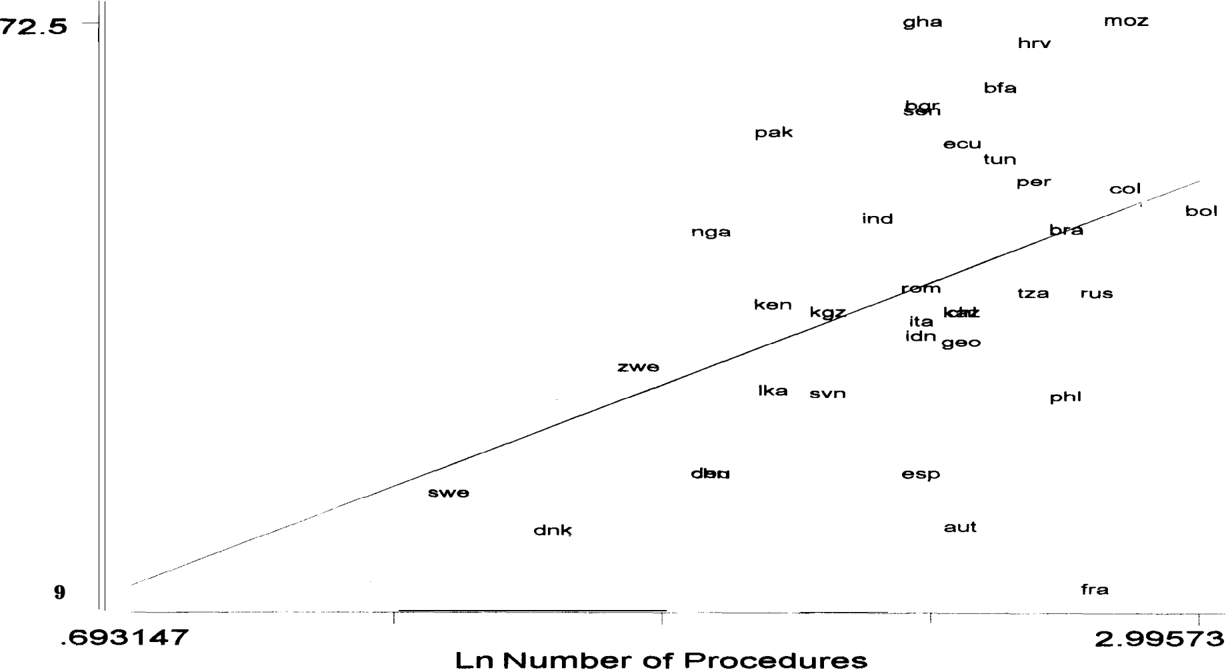
Verification
Claims the paper makes
0 Valid · 3 Not valid · 13 Not checked · 114 Own results and interpretations
A result the paper reports from its own data — it cites no other source for it, so there is none to check. The quote shows it is in the paper.
In the paper
“Very few entry regulations cover tax and labor issues.”
plain- Asserted: passes — The authors put it forward as true.
- Checkable: passes — It can be checked against evidence.
- Load-bearing: unclear — It is unclear whether the paper’s conclusions depend on it.
- Based: passes — The paper gives a reason why it holds.
In the paper
“The data show that the numbers of entry and of labor market regulations are positively correlated across countries, contrary to the substitutes hypothesis.”
What the sources say
- Not matchedcites Djankov et al., 2000
An author–year citation the paper’s reference list doesn’t settle. We don’t search these by name.
plainstates an association- Asserted: passes — The authors put it forward as true.
- Checkable: passes — It can be checked against evidence.
- Load-bearing: unclear — It is unclear whether the paper’s conclusions depend on it.
- Based: passes — The paper gives a reason why it holds.
- Not matched
A result the paper reports from its own data — it cites no other source for it, so there is none to check. The quote shows it is in the paper.
In the paper
“It often takes the form of screening procedures.”
- Also stated in: § III. Basic Results. · plain
“Instead, much of what governments do to regulate entry falls into the category of screening procedures.”
plain- Asserted: passes — The authors put it forward as true.
- Checkable: passes — It can be checked against evidence.
- Load-bearing: unclear — It is unclear whether the paper’s conclusions depend on it.
- Based: passes — The paper gives a reason why it holds.
- Also stated in: § III. Basic Results. · plain
A result the paper reports from its own data — it cites no other source for it, so there is none to check. The quote shows it is in the paper.
In the paper
“First, the cost-to-per-capita-GDP ratio decreases uniformly with GDP per capita.”
plainstates an association- Asserted: passes — The authors put it forward as true.
- Checkable: passes — It can be checked against evidence.
- Load-bearing: unclear — It is unclear whether the paper’s conclusions depend on it.
- Based: passes — The paper gives a reason why it holds.
A result the paper reports from its own data — it cites no other source for it, so there is none to check. The quote shows it is in the paper.
In the paper
“In contrast, countries in the other three quartiles of per capita income are not statistically different from each other in terms of the number of procedures and the time required to fulfill them.”
plain- Asserted: passes — The authors put it forward as true.
- Checkable: passes — It can be checked against evidence.
- Load-bearing: passes — The paper’s conclusions depend on it.
- Based: passes — The paper gives a reason why it holds.
49 more claims
Create a free account to see all 130 claims and every source verdict.
- Probably not a substantial claim. 21
- It may state two separate claims as one. 54
- The quote only partly states this claim. 26
Claims other papers make about this one
Each is checked against this paper’s own text: does it say what the citing paper says it does?
The source backs part of the claim, not all of it — or backs it for a different population, condition or comparison.
In the citing paper
“Our findings suggest an explanation for the low level of incorporation in Italy: the average direct cost associated with fulfilling the bureaucratic regulations for registering a new corporation in Italy is 20% of per capita GNP compared to 10% of per capita GNP on average for other G-7 European countries.”
From Entry regulation as a barrier to entrepreneurship (2006) · cites this paper as Djankov et al. (2002)
Experimental — accuracy not yet measuredThe cited source says what the claim attributes to it.
In the citing paper
“Given the explicit link made by Djankov et al . (2002) between the speed and ease with which businesses may be established in a country and its economic performance - and the enthusiasm with which this link has been grasped by European Union policy makers - our findings imply this link needs reconsidering.”
From The Effect of Business Regulations on Nascent and Young Business Entrepreneurship (2007) · cites this paper as Djankov et al . (2002)
Citations
Cites
La Porta, R., Lopez‐de‐Silanes, F., Shleifer, A., & Vishny, R. W. (1998) · Journal of Political Economy · doi:10.1086/250042 · Cited by 18,025
Self-citationThe Theory of Economic Regulation
Stigler, G. J. (1971) · The Bell Journal of Economics and Management Science · doi:10.2307/3003160 · Cited by 8,098
Journal of Economic Literature
(2019) · AEA Papers and Proceedings · doi:10.1257/pandp.109.633 · Cited by 7,468
The Quarterly Journal of Economics
Kuznets, S. (2024) · Business Cycle Theory, Part I Volume 4 · doi:10.4324/9781003549741-8 · Cited by 7,176
La Porta, R. (1999) · Journal of Law, Economics, and Organization · doi:10.1093/jleo/15.1.222 · Cited by 5,699 · cited 2×
“Legal origin has been viewed as a proxy for the government’s proclivity to intervene in the economy and the stance of the law toward the security of property rights in a country [La Porta et al. 1999].”
The Theory of Economic Regulation
Stigler, G. J. (2021) · The Political Economy · doi:10.4324/9781315495811-8 · Cited by 5,483
Pigou, A. C. (1933) · The Economic Journal · doi:10.2307/2224491 · Cited by 5,137
Toward a More General Theory of Regulation
Peltzman, S. (1976) · The Journal of Law and Economics · doi:10.1086/466865 · Cited by 4,729
Moffitt, R. A. (2009) · American Economic Review · doi:10.1257/aer.99.2.660 · Cited by 4,694
Shleifer, A., & Vishny, R. W. (1993) · The Quarterly Journal of Economics · doi:10.2307/2118402 · Cited by 3,778
Self-citation
Research works printed but not linked: 7
- McLiesh Caralee, 2001, NBER Working Paper No., 8288
- Kasnako lu, Zehra, and Münür Yayla, 'Unrecorded Economy in Turkey: A Monetary Approach', 1999. "Unrecorded Economy in Turkey (A Monetary Approach)" in Informal Sector in Turkey (I), Tuncer Bulutay (ed.), SIS, Ankara, forthcoming.
- Fred, 1987, Journal of Legal Studies, 101
- Olson, Mancur, 1991, 'Autocracy, Democracy, and Prosperity,' in Richard Zeckhauser, ed., Strategy of Choice, Cambridge, MA: MIT Press.
- 1967, Western Economic Journal, 232
- World Economic Forum (1999), The Global Competitiveness Report 1999 , Schwab, Klaus et al., eds., New York: Oxford University Press.
- World Economic Forum, The Global Competitiveness Report 2001, Klaus Schwab et al., eds. (New York, NY: Oxford University Press, 2001).
Cited by
Items 1,501–1,600 of 3,986
Grünhagen, M., & Berg, H. (2011) · International Journal of Technology Policy and Management · doi:10.1504/ijtpm.2011.042085 · Cited by 21
“those based on data from the World Bank’s Doing Business Reports, seem to indicate that business and other regulation have an impact on entrepreneurial propensity (Djankov et al., 2002; Grilo and Irigoyen, 2006; Ho and Wong, 2007).”
Are large firms born or made? Evidence from developing countries
Ayyagari, M., Demirgüç‐Kunt, A., & Maksimovic, V. (2020) · Small Business Economics · doi:10.1007/s11187-019-00303-0 · Cited by 23
Competition Politics: Interest Groups, Democracy, and Antitrust Reform in Developing Countries
Weymouth, S. J. (2016) · The Antitrust Bulletin · doi:10.1177/0003603x16644122 · Cited by 37
The effect of regulation‐driven trade barriers and governance quality on export entrepreneurship
Munemo, J. (2021) · Regulation & Governance · doi:10.1111/rego.12384 · Cited by 15
Mishra, P., Prabhala, N. R., & Rajan, R. G. (2019) · Review of Financial Studies · doi:10.1093/rfs/hhab118 · Cited by 26
Hertog, S. (2022) · Cambridge University Press eBooks · doi:10.1017/9781009042444 · Cited by 18
A New Index of the Business Environment for Microfinance
Cull, R., Navajas, S., Nishida, I., et al. (2015) · World Development · doi:10.1016/j.worlddev.2014.11.023 · Cited by 18
Impediments on the way to entrepreneurship. Some new evidence from the EU's post-socialist world
Batsakis, G. K. (2014) · Journal of Small Business and Enterprise Development · doi:10.1108/jsbed-04-2014-0062 · Cited by 19
“, 2003), and lack of efficient business support (Djankov et al., 2002; Smallbone and Piasecki, 1995).”
InfluentialDoes Financial Liberalisation Improve Access to Investment Finance in Developing Countries?
O’Toole, C. M. (2014) · Journal of Globalization and Development · doi:10.1515/jgd-2013-0028 · Cited by 18
“Legal origin is used to instrument the effect of governance on financial development and financial outcomes by La Porta et al. (1997) and La Porta et al. (1998) and entry regulations on enterprise start ups by Djankov et al. (2002).”
InfluentialAre institutions in developing countries malleable?
Kant, C. (2016) · Journal of Policy Modeling · doi:10.1016/j.jpolmod.2016.01.002 · Cited by 20
Open Borders for Business? Causes and Consequences of the Regulation of Foreign Entry
Davis, L., & Williamson, C. R. (2018) · Southern Economic Journal · doi:10.1002/soej.12301 · Cited by 17
I Know What I Need: Optimization of Bribery
Yan, Y., & Qi, S. (2020) · Journal of Business Ethics · doi:10.1007/s10551-020-04608-z · Cited by 21
Institutions and firms’ technological changes and productivity growth
Ghulam, Y. (2021) · Technological Forecasting and Social Change · doi:10.1016/j.techfore.2021.120993 · Cited by 22
“7 government and subsequent exercise of power, the capacity of government in devising and implementing policies effectively, and citizen's respect for law, state, and institutions that ultimately would govern their interactions (Djankov et al., 2002; and Kaufmann et al., 2008).”
Workplace practices and firm performance in manufacturing: A comparative study of Italy and Britain
Cristini, A., & Pozzoli, D. (2010) · International Journal of Manpower · doi:10.1108/01437721011081617 · Cited by 20
Regional Integration and Trade Costs in South Asia
Banik, N., & Gilbert, J. (2010) · Edward Elgar Publishing eBooks · doi:10.4337/9781849806527.00008 · Cited by 18
“Source: Djankov et al. (2002).”
Identifying the Effect of Institutions on Economic Growth
B, F. D. A. (2014) · Springer eBooks · doi:10.1007/978-3-642-54660-0_2 · Cited by 27
Contractual Dualism, Market Power and Informality
Basu, K., Chau, N. H., & Kanbur, R. (2014) · The Economic Journal · doi:10.1111/ecoj.12222 · Cited by 18
5 Law, Institutions, and Finance in China and India
Allen, F., Chakrabarti, R., De, S., Qian, J. “., & Qian, M. (2010) · Oxford University Press eBooks · doi:10.1093/acprof:oso/9780199575077.003.0005 · Cited by 20
Family ties and access to finance in an Islamic environment
Mertzanis, C. (2016) · Journal of International Financial Markets Institutions and Money · doi:10.1016/j.intfin.2016.12.001 · Cited by 21
INEQUALITY, INFORMALITY, AND CREDIT MARKET IMPERFECTIONS
Dell’Anno, R. (2017) · Macroeconomic Dynamics · doi:10.1017/s1365100516000663 · Cited by 21
“Djankov (2002) empirically validates this hypothesis, finding that, at a crosscountry level, countries with more burdensome entry regulations have larger informal sectors.”
Legal traditions and competition policy
Lee, C. (2005) · The Quarterly Review of Economics and Finance · doi:10.1016/j.qref.2005.01.002 · Cited by 25
“Djankov et al (2002) uses data on the regulation of entry of start-up firms in 85 countries to examine the determinants of the cost of entry.”
Ioniţă, S. (2005) · Public Administration and Development · doi:10.1002/pad.365 · Cited by 18
Market Institutions and Judicial Rulemaking
Arruñada, B., & Andonova, V. (2005) · Springer eBooks · doi:10.1007/0-387-25092-1_11 · Cited by 25
A Configurational Approach to Comparative Corporate GovernancePreprint
Aguilera, R. V., Desender, K. A., & de Castro, L. R. K. (2011) · RePEc: Research Papers in Economics · Cited by 26
Entrepreneurship in Brazil, China, and RussiaPreprint
Djankov, S., Qian, Y., Roland, G., & Zhuravskaya, E. V. (2006) · RePEc: Research Papers in Economics · Cited by 29
Self-citationAsymmetric Effects of Corruption on FDI: Evidence from Swedish Multinational FirmsPreprint
Svaleryd, H., Hakkala, K. N., & Norbäck, P. (2005) · SSRN Electronic Journal · doi:10.2139/ssrn.735364 · Cited by 18
Organized Crime and Firms: Evidence from ItalyPreprint
Slutzky, P., & Zeume, S. (2018) · SSRN Electronic Journal · doi:10.2139/ssrn.3242495 · Cited by 17
Does the Wage Gap between Private and Public Sectors Encourage Political Corruption?Preprint
Podobnik, B., Vuković, V., & Stanley, H. E. (2015) · SSRN Electronic Journal · doi:10.2139/ssrn.2656874 · Cited by 18
Inequality, Institutions, and Informality
Gradstein, M., & Chong, A. E. (2004) · doi:10.18235/0010954 · Cited by 28
Tang, X., Wang, Q., Noor, S., Nazir, R., Nasrullah, M. J., Hussain, P., & Larik, S. A. (2024) · Sustainability · doi:10.3390/su16188047 · Cited by 19
Grittersová, J., & Mahutga, M. C. (2019) · Journal of International Relations and Development · doi:10.1057/s41268-019-00172-w · Cited by 18
Bank competition, regulation, and efficiency: evidence from the Asia-Pacific region
Li, S., & Li, X. (2020) · Asia-Pacific Journal of Accounting & Economics · doi:10.1080/16081625.2020.1787854 · Cited by 21
“Conversely, other analyses claim that higher supervisory power leads to higher corruption and larger unofficial economies (Djankov et al. 2002), which significantly contributed to deepening several recent systemic banking crises (Quintyn and Taylor 2003).”
Dheer, R. J. S., & Treviño, L. J. (2021) · Journal of International Business Policy · doi:10.1057/s42214-020-00098-y · Cited by 21
Aklin, M. (2020) · Energy Research & Social Science · doi:10.1016/j.erss.2020.101830 · Cited by 19
Sorgner, A., & Wyrwich, M. (2022) · Journal of Business Venturing · doi:10.1016/j.jbusvent.2022.106246 · Cited by 24
Time to change lanes: How pro‐market reforms affect informal ventures' formalization speed
Weng, D. H., Lee, S., & Yamakawa, Y. (2021) · Global Strategy Journal · doi:10.1002/gsj.1421 · Cited by 19
Rampant corruption: The dilemma facing economic diversification in oil-abundant MENA countries
Matallah, S. (2022) · Resources Policy · doi:10.1016/j.resourpol.2021.102541 · Cited by 17
Cordier, I., & Bade, M. (2022) · Small Business Economics · doi:10.1007/s11187-022-00707-5 · Cited by 25
Caught in the Revolving Door: Firm-Government Employee Mobility as a Fleeting Regulatory Advantage
Katic, I. V., & Kim, J. W. (2023) · Organization Science · doi:10.1287/orsc.2023.1669 · Cited by 19
Bribery, regulation and firm performance: evidence from a threshold model
Chen, C., Pinar, M., & Stengos, T. (2023) · Empirical Economics · doi:10.1007/s00181-023-02456-0 · Cited by 24
“Even though most of the existing literature finds that excessive regulation increases corruption and hampers economic growth (e.g., Djankov et al. 2002), recent analyses show that regulation could also improve firm performance (Kitching et al. 2015 ).”
Are electronic government innovations helpful to deter corruption? Evidence from across the world
Martins, J., Veiga, L. G., & Fernandes, B. (2023) · Economics and Politics · doi:10.1111/ecpo.12255 · Cited by 32
The “Matthew effect” in rebates: How does VAT rebates allocation affect firm export performance
Lu, B., & Ma, H. (2023) · Journal of Public Economics · doi:10.1016/j.jpubeco.2023.104982 · Cited by 20
Misuse of Institutions: Lessons from Transition
Polishchuk, L. (2012) · Palgrave Macmillan UK eBooks · doi:10.1057/9780230361836_8 · Cited by 21
“5 Djankov et al. (2002) consider two possible patterns of the regulation of entry capture: by the bureaucracy operating the entry process (a ‘tollbooth’ view) and by vested interests which are based outside the government but can influence the latter.”
InfluentialCan Trade Agreements Curtail Trade Creation and Prevent Trade Diversion?
Cheong, J., Kwak, D. W., & Tang, K. K. (2014) · Review of International Economics · doi:10.1111/roie.12162 · Cited by 24
“However, using the regulation costs data which is available from Djankov et al. (2002) causes a substantial drop-off in the number of obeservations.”
Entrepreneurship, College, and Credit: The Golden Triangle
Samaniego, R. M., & Sun, J. Y. (2018) · Journal of money credit and banking · doi:10.1111/jmcb.12584 · Cited by 20
“We did not consider that because the formal cost of starting a firm in the US is very small —see Djankov et al (2002).”
Economic development and business creation
Nica, M. (2020) · Economic Change and Restructuring · doi:10.1007/s10644-020-09274-9 · Cited by 22
Twenty Years of 'Law and Finance': Time to Take Law Seriously
Schnyder, G., Siems, M., & Aguilera, R. V. (2018) · Socio-Economic Review · doi:10.1093/ser/mwy041 · Cited by 30
Systemic Banking Crises, Institutional Environment, and Corporate Leverage
Öztekin, Ö. (2020) · Journal of Financial and Quantitative Analysis · doi:10.1017/s0022109020000861 · Cited by 17
Does inflation targeting weaken financial stability? Assessing the role of institutional quality
Owoundi, J. P. F., Mbassi, C. M., & Owoundi, F. (2021) · The Quarterly Review of Economics and Finance · doi:10.1016/j.qref.2021.03.003 · Cited by 21
The importance of export diversification for national entrepreneurship density
Nguyen, C. P., Nguyen, B., & Su, T. D. (2022) · Structural Change and Economic Dynamics · doi:10.1016/j.strueco.2022.05.003 · Cited by 22
Corruption, Investment and Growth in Developing Countries
Everhart, S. S., McNab, R. M., & Martínez-Vázquez, J. (2005) · Cited by 16
Engineers or Lawyers? Institutions and Demand for Higher Education
Natkhov, T., & Polishchuk, L. (2012) · Voprosy Ekonomiki · doi:10.32609/0042-8736-2012-10-30-51 · Cited by 29
Tian, L. (2007) · Economic Systems · doi:10.1016/j.ecosys.2007.08.002 · Cited by 17
The political economy of entry barriers
Mukoyama, T., & Popov, L. (2013) · Review of Economic Dynamics · doi:10.1016/j.red.2013.11.002 · Cited by 17
Legal origin and intellectual property rights: an empirical study in the prerecorded music sector
Montoro‐Pons, J. D., & García, M. C. (2008) · European Journal of Law and Economics · doi:10.1007/s10657-008-9056-8 · Cited by 17
Kinda, T. (2011) · Applied Economics Letters · doi:10.1080/13504851.2011.587765 · Cited by 23
Do cost-sharing and entry deregulation curb pharmaceutical innovation?
Grossmann, V. (2013) · Journal of Health Economics · doi:10.1016/j.jhealeco.2013.06.001 · Cited by 24
Does crime deter South Africans from self-employment?
Grabrucker, K., & Grimm, M. (2017) · Journal of Comparative Economics · doi:10.1016/j.jce.2017.11.003 · Cited by 18
What Factors Are Necessary for Sustaining Entrepreneurship?
Lee, H. J. (2019) · Sustainability · doi:10.3390/su11113022 · Cited by 27
Competition, regulation and regulatory governance: an overview
Cook, P., Kirkpatrick, C. H., Minogue, M., et al. (2004) · Edward Elgar Publishing eBooks · doi:10.4337/9781845420659.00009 · Cited by 17
“State regulation will then be associated with restricting market entry rather than the promotion of competition, even though the latter would lead to greater economic good (Djankov et al., 2002).”
Law, Finance and Investment: Does Legal Origin Matter in Africa?
Asongu, S. A. (2014) · The Review of Black Political Economy · doi:10.1007/s12114-013-9173-7 · Cited by 42
“…these studies use such measures as dividend payouts (La Porta et al., 2000a), the ratio of stock market capitalization to GDP, the voting premium, the pace of public offering activity (Dyck & Zingales, 2004), Tobin’s Q (La Porta et al., 2002) and ownership dispersion (La Porta et al., 1999a).”
InfluentialCan technical change exacerbate the effects of labor market sclerosis?
Samaniego, R. M. (2007) · Journal of Economic Dynamics and Control · doi:10.1016/j.jedc.2007.02.004 · Cited by 22
Informality and Regulations: What Drives Firm Growth?
Dabla‐Norris, E., & Inchauste, G. (2007) · IMF Working Paper · doi:10.2139/ssrn.986811 · Cited by 29
Labor market regulation and the legal system
Hefeker, C., & Neugart, M. (2010) · International Review of Law and Economics · doi:10.1016/j.irle.2010.03.004 · Cited by 24
“See, e.g., La Porta et al. (1998), Djankov et al. (2002), Djankov et al. (2003), La Porta et al. (2004), and Botero et al. (2005).”
Entrepreneurship: First Results from RussiaPreprint
Djankov, S., Miguel, E. A., Qian, Y., Roland, G., & Zhuravskaya, E. V. (2005) · SSRN Electronic Journal · doi:10.2139/ssrn.641721 · Cited by 19
Self-citationEntry Costs, Misallocation, and Cross-Country Income and TFP DifferencesPreprint
Barseghyan, L., & DiCecio, R. (2009) · RePEc: Research Papers in Economics · Cited by 17
Risk Determinants of direct democracy across EuropePreprint
Fiorino, N., & Ricciuti, R. (2006) · RePEc: Research Papers in Economics · Cited by 16
Asset Growth and Stock Returns: Evidence from Asian Financial MarketsPreprint
Yao, T., Yu, T., Zhang, T., et al. (2010) · SSRN Electronic Journal · doi:10.2139/ssrn.1683784 · Cited by 17
“For corporate governance characteristics, we use a set of measures from the existing literature, based on legal origin, corruption index, and investors’ right (La Porta, Lopez-de-Silanes, Shleifer, and Vishny, 1997, 1998, 1999, 2000, 2002, hereafter LLSV; Djankov et al., 2002; Wurgler, 2000).”
Do Institutions Not Matter in China? Evidence from Manufacturing EnterprisesPreprint
Lu, Y., Png, I., & Tao, Z. (2008) · SSRN Electronic Journal · doi:10.2139/ssrn.1129647 · Cited by 17
Institutions and Economic Performance: What Can Be Explained?Preprint
Commander, S. J., & Nikoloski, Z. (2010) · SSRN Electronic Journal · doi:10.2139/ssrn.1696850 · Cited by 17
Active Investment, Liquidity Externalities, and Markets for InformationPreprint
Lee, S. (2009) · SSRN Electronic Journal · doi:10.2139/ssrn.1300706 · Cited by 19
Pircher, B. (2022) · JCMS Journal of Common Market Studies · doi:10.1111/jcms.13412 · Cited by 19
Prokopenko, O. V., Sitenko, D., Zhanybayeva, Z., et al. (2025) · Journal of risk and financial management · doi:10.3390/jrfm18030131 · Cited by 16
Contractual Efficiency of PPP Infrastructure Projects: An Incomplete Contract Model
Shi, L., Zhang, L., Onishi, M., et al. (2018) · Mathematical Problems in Engineering · doi:10.1155/2018/3631270 · Cited by 16
Park, S.-H. (2022) · International Review of Financial Analysis · doi:10.1016/j.irfa.2022.102146 · Cited by 18
Grotteria, M. (2018) · The Review of Economic Studies · doi:10.1093/restud/rdad041 · Cited by 24
Entry, Exit, and Productivity in Tunisian Manufacturing Industries
Jelili, R. B., & Goaïed, M. (2009) · Springer eBooks · doi:10.1007/978-1-4419-1037-0_4 · Cited by 19
“Dixit (1981) has discussed the use of investment as an entry barrier.”
Is there an Asian model of technological emergence?
Reslinger, C. (2013) · Socio-Economic Review · doi:10.1093/ser/mwt001 · Cited by 22
Global Diffusion of the Internet XII: The Internet Growth in Africa: Some Empirical Results
Bagchi, K. K., Udo, G. G., & Kirs, P. J. (2007) · Communications of the Association for Information Systems · doi:10.17705/1cais.01916 · Cited by 18
How much does job autonomy vary across countries and other extra-organizational contexts?
van Hoorn, A. (2016) · The International Journal of Human Resource Management · doi:10.1080/09585192.2016.1192052 · Cited by 23
What is the Relationship between Competition Law and Policy and Economic Development
Evenett, S. J. (2005) · Alexandria (UniSG) (University of St.Gallen) · Cited by 16
Jang, Y., Lee, W. J., & Hadley, B. (2020) · Sustainability · doi:10.3390/su12135280 · Cited by 25
The impact of worker bargaining power on the organization of global firms
Carluccio, J., & Bas, M. (2015) · Journal of International Economics · doi:10.1016/j.jinteco.2014.12.008 · Cited by 20
“GDP in 1999) from Djankov et al. (2002). “IPR protection” in 2000 is drawn from Ginarte and Park (1997).”
InfluentialThe Movement of U.S. Criminal and Administrative Law: Processes of Transplanting and Translating
Goldbach, Brake, & Katzenstein (2013) · Indiana Journal of Global Legal Studies · doi:10.2979/indjglolegstu.20.1.141 · Cited by 19
Godlewska, M. (2021) · Engineering Economics · doi:10.5755/j01.ee.32.1.27390 · Cited by 19
Entrepreneurship and Regulatory Voids: The Case of Ridesharing
Deerfield, A., & Elert, N. (2022) · Entrepreneurship Theory and Practice · doi:10.1177/10422587221093300 · Cited by 23
“While cross-country evidence suggests, e.g., that excessive entry regulations deter entrepreneurship (e.g., Djankov et al. 2002; Klapper et al. 2006), research in this vein also indicates that, overall, “a functional regulatory environment incentivizes entrepreneurs” (Audretsch et al., 2019, p.…”
Entrepreneurship Policy and SME Development during Pandemic Crisis in Russia
Земцов, С. П., Баринова, В. А., Semenova, R., & Михайлов, А. А. (2022) · Regional Research of Russia · doi:10.1134/s2079970522700071 · Cited by 25
“The improvement of the investment climate, which encourages productive opportunity-driven entrepreneurship (Belitski et al., 2021; Djankov et al., 2002; Smallbone and Welter, 2020), is one of the most important areas of business policy.”
Biswas, M. (2015) · Journal of Business Ethics · doi:10.1007/s10551-014-2524-x · Cited by 18
The quality of governance and economic growth in Croatia
Bađun, M. (2006) · Occasional paper series · doi:10.3326/ops.29 · Cited by 16
Reducing Start‐up Costs for New Firms: The Double Dividend on the Labor Market*
Dulleck, U., Frijters, P., & Winter‐Ebmer, R. (2006) · Scandinavian Journal of Economics · doi:10.1111/j.1467-9442.2006.00455.x · Cited by 18
Licit and Illicit Responses to Regulation
Benham, L. (2008) · Springer eBooks · doi:10.1007/978-3-540-69305-5_24 · Cited by 16
The Impact of Customs Procedures on Business Performance: Evidence From Kosovo
Holzner, M., & Peci, F. (2012) · World Customs Journal · doi:10.55596/001c.92738 · Cited by 16
“Such regulatory overload causes an increase in corruption and nepotism (Bartlett & Bukvič 2001; Smallbone & Welter 2001a; Djankov et al. 2002).”
National Competitiveness in Comparative Perspective: Evidence from Latin America
Weymouth, S. J., & Feinberg, R. (2011) · Latin American Politics and Society · doi:10.1111/j.1548-2456.2011.00128.x · Cited by 21
Zhang, Q., & Liu, M. (2010) · Business and Politics · doi:10.2202/1469-3569.1265 · Cited by 16
“9 Djankov et al. 2002; Henderson and Kuncoro 2006.”
Tornikoski, E. T., & Renko, M. (2014) · M n gement · doi:10.3917/mana.173.0193 · Cited by 27
“! Given that new enterprises are an important source of innovations and an engine of economic growth, speeding up the gestation and emergence of viable new organizations may be desirable from a macroeconomic perspective (Birch, 1987; Djankov et al., 2002).”
Effective Corporate Tax Rates and the Size Distribution of Firms
Heshmati, A., Johansson, D., & Bjuggren, C. M. (2010) · Journal of Industry Competition and Trade · doi:10.1007/s10842-010-0085-y · Cited by 16
Jäntti, M., & Sierminska, E. M. (2008) · Oxford University Press eBooks · doi:10.1093/acprof:oso/9780199548880.003.0002 · Cited by 18
Carpenter, D. P., & Moss, D. A. (2013) · Cambridge University Press eBooks · doi:10.1017/cbo9781139565875.002 · Cited by 43
Économie non observée et emploi informel dans les pays de l'Union européenne
Adair, P. (2009) · Revue économique · doi:10.3917/reco.605.1117 · Cited by 16
The role of political and economic institutions in informal entrepreneurship
Santos, E., Fernandes, C., & Ferreira, J. J. (2019) · World Journal of Entrepreneurship Management and Sustainable Development · doi:10.1108/wjemsd-05-2019-0035 · Cited by 17
Metadata
- Authors
- Djankov, S., La Porta, R., Lopez-de-Silanes, F., & Shleifer, A.
- Affiliations
- World Bank (US)
- National Bureau of Economic Research (US)
- ORCID
- Djankov, S.
- Venue
- The Quarterly Journal of Economics
- Publisher
- Oxford University Press (OUP)
- Published
- 2002-02-01
- Volume
- 117
- Issue
- 1
- Pages
- 1-37
- ISSN
- 0033-5533
- 1531-4650
- OpenAlex
- W2139896179
- Cited by
- 3,956
- References
- 30
- Citations by year
- 2026: 223 · 2025: 185 · 2024: 157 · 2023: 120 · 2022: 140 · 2021: 150 · 2020: 151 · 2019: 161 · 2018: 157 · 2017: 162 · 2016: 166 · 2015: 193 · 2014: 200 · 2013: 183 · 2012: 193
- Type
- report
- Language
- en
- Open access
- green
- doi.org
- Licence
- other-oa
- Locations
- World Bank, Washington, DC eBooks (publishedVersion)
- The Quarterly Journal of Economics (publishedVersion)
- The World Bank Open Knowledge Repository (World Bank) (publishedVersion)
- National Bureau of Economic Research (publishedVersion, other-oa)
- RePEc: Research Papers in Economics (submittedVersion)
- Digital Access to Scholarship at Harvard (DASH) (Harvard University) (submittedVersion, cc-by)
- SSRN Electronic Journal (submittedVersion)
- OpenGrey (Institut de l'Information Scientifique et Technique) (submittedVersion)
- The World Bank Open Knowledge Repository (World Bank) (submittedVersion, cc-by)
- Topics
- Social Sciences › Sociology and Political Science › Corruption and Economic Development
- Social Sciences › Economics, Econometrics and Finance › Economics and Econometrics › Taxation and Compliance Studies
- Social Sciences › Business, Management and Accounting › Strategy and Management › Political Influence and Corporate Strategies
- Keywords
- start-up firms, bureaucratic procedures, corruption, informal economy, democracy, government size, public choice theory, public interest theory
About these checks
Registry, retraction, Cites and statistics results are computed, not judged, with one exception: a printed reference that no index lists is read once by a model before it counts as a citation error. Claims are extracted by a model and kept only when their quote appears verbatim in the text; each cited source is then checked, with a model’s help, for whether it says what the claim relies on. Those verdicts can be wrong — read the claim’s quote and the cited source before relying on one.
A language model drew the claims from the paper on 2026-10-01, under version 3 of the claim definition (model deepseek-v4.1-flash, prompt extract-v3).
A second model labelled each claim on 2026-10-01 (model jev-1.13-20260917, definition revision gold-guideline-v0.2).
Statistics and arithmetic are recomputed, not judged.
Confidence bands are shown only for fields calibrated on our annotated test set. None is calibrated yet, so no band is shown.
What counts as a claim ›How we measure confidence ›How we check this ›
Are you an author, or do you see a problem with this page? Request a review
Data sources
Bibliographic data: Semantic Scholar, OpenAlex, Crossref.
Contains information from the Semantic Scholar Academic Graph Datasets, made available under the ODC Attribution License (ODC-BY 1.0).
Semantic Scholar’s data is described in: Kinney, R., et al. (2023). The Semantic Scholar Open Data Platform. arXiv:2301.10140.
