

The Regulation of Entry
Open accessThe DOI matches its Crossref record, with a small difference in title or year; 39 of the 39 references it cites were found in a registry or an index; none of the 13 sources its claims cite is checked for support yet.
Abstract
1%(5 :25.,1* 3$3(5 6(5,(6 7+( 5(*8/$7,21 2) (175< 6LPHRQ 'MDQNRY 5DIDHO /D 3RUWD )ORUHQ.LR /RSH]GH6LODQHV $QGUHL 6KOHLIHU :RUNLQJ 3DSHU KWWSZZZQEHURUJSDSHUVZ 1$7,21$/ %85($8 2) (&2120,& 5(6($5&+ 0DVVD.KXVHWWV $YHQXH &DPEULGJH 0$ 6HSWHPEHU :H WKDQN 2OJD ,RIIH 7DWLDQD 1HQRYD DQG (NDWHULQD 7UL]ORYD IRU DEOH UHVHDU.K DVVLVWDQ.H DQG +DPLG $ODYL ,ULQD $VWUDNKDQ $EKLMLW %DQHUMHH 5L.KDUG &DYHV -D.TXHOLQH &RROLGJH -DPHV (PHU\ 1LKDO (O0DJKDUEHO -HDQ 3DXO *DXWKLHU (G *ODHVHU 6LPRQ -RKQVRQ /DZUHQ.H .DW] 3HWHU .X.HUD 'DYLG /DLEVRQ ,UD /LHEHUPDQ 'DYLQ 0D.NLQ]LH 0DULH )UDQ.RLVH 0DULH1HOO\ 0DU.HOR 2ODUUHDJD *X\ 3IHIIHUPDQQ 6DQWLDJR 6HGD.D /HLOD :HEVWHU 3HWHU :ULJKW DQG VHPLQDU SDUWL.LSDQWV DW WKH 8QLYHUVLW\ RI 0DU\ODQG DW &ROOHJH 3DUN IRU KHOSIXO .RPPHQWV 7KH .ROOH.WLRQ RI GDWD IRU WKLV SDSHU ZDV RUJDQL]HG DQG ILQDQ.HG E\ WKH :RUOG %DQN $Q DSSHQGL[ GHV
Overview
CoChat Summary
TL;DR
This paper assembles a new cross-country dataset on business entry regulation in 75 countries and uses it to compare the helping-hand, capture, and tollbooth theories of regulation. The evidence is most consistent with the tollbooth view: heavier entry regulation is associated with more corruption, a larger unofficial economy, and less representative, more autocratic governments.
Key findings
- Across the 75-country sample, the number of entry procedures ranges from 2 in Canada to 20 in Bolivia, with a sample average of 10.17 procedures; the average official time is 63.05 business days and the average cost is 0.34 of GDP per capita.
- The number of procedures is strongly correlated with time and cost: the paper reports correlations of 0.75 with log time and 0.62 with log cost.
- The helping-hand tests do not support a beneficial-regulation story: in Table IV, more procedures are associated with lower ISO quality standards (e.g. coefficient -0.2646) and larger unofficial economy measures (e.g. coefficient 13.6277 for size of unofficial economy; 19.8763 for employment in the unofficial economy), while pollution and health outcomes do not improve.
- The tollbooth evidence is stronger: Table VI reports that more procedures are associated with worse corruption scores, with a coefficient of -3.2809 (and -1.7249 with GDP per capita controls) for the corruption regressions.
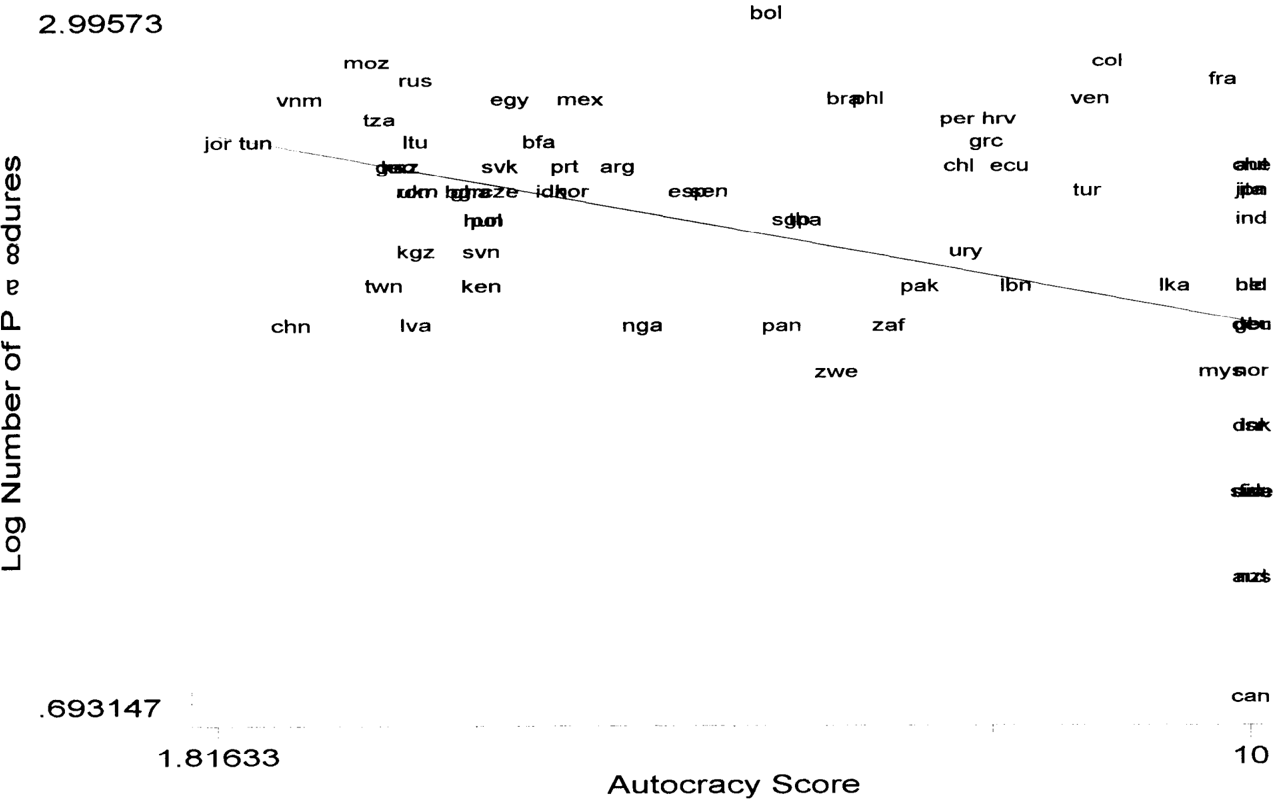
- In Table VIII, better government is associated with lighter regulation; the paper states that countries with more limited and representative governments have statistically significantly fewer procedures using 5 out of 6 measures of better government, and that more autocratic countries regulate more heavily.
Methods
- The paper builds a new database on entry regulation for 75 countries, focusing on the legal requirements, official time, and official cost for a standardized start-up firm.
- Data were gathered from written government sources, World Bank- and USAID-sponsored studies, government web pages, direct contacts with agencies, and independent double-checks in 73 countries via local consulting reports; the remaining 2 countries were double-checked through government contacts.
- The main analysis uses cross-country OLS regressions relating entry regulation measures to outcomes such as quality, pollution, unofficial economy, corruption, political institutions, legal origin, and GDP per capita; the paper also reports correlations and test-of-means comparisons across income quartiles.
Limitations
- The paper itself notes that the capture-theory tests are based on crude measures and that the data are probably least suited to test the capture hypothesis.
- The authors say the data almost surely underestimate the cost and complexity of entry because they focus on the capital city, omit industry-specific requirements and foreign-ownership steps, and ignore some informal delays and bribes.
- Evident from the text: the study is cross-sectional and based on official procedures/costs, so causal interpretation is limited and informal corruption/bureaucratic delays are not directly measured except indirectly through correlations.
Model-written summary. Check it against the paper before relying on it.
Integrity signals
Registry
Cites
Statistics
Figures
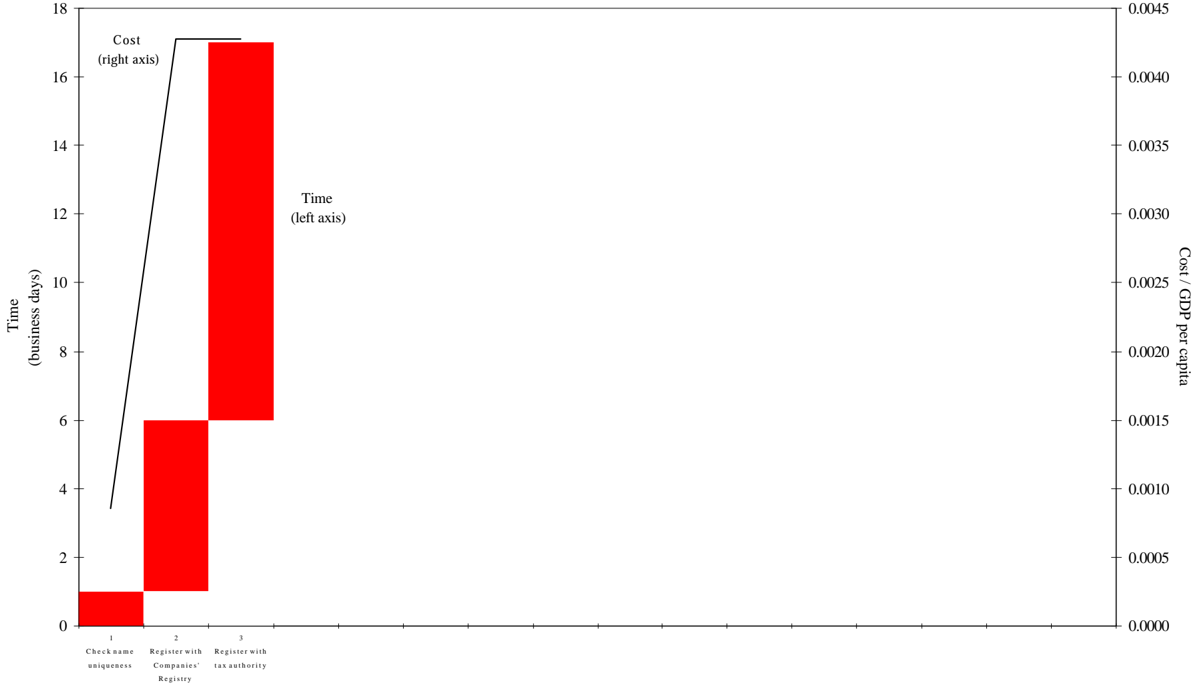
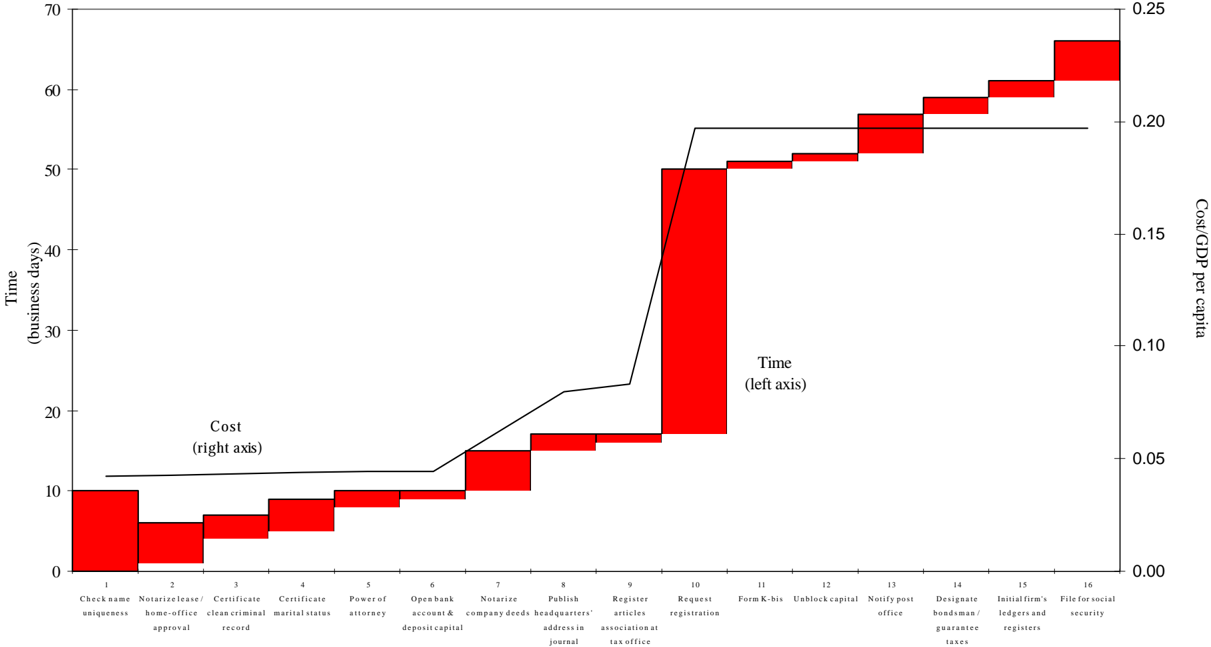
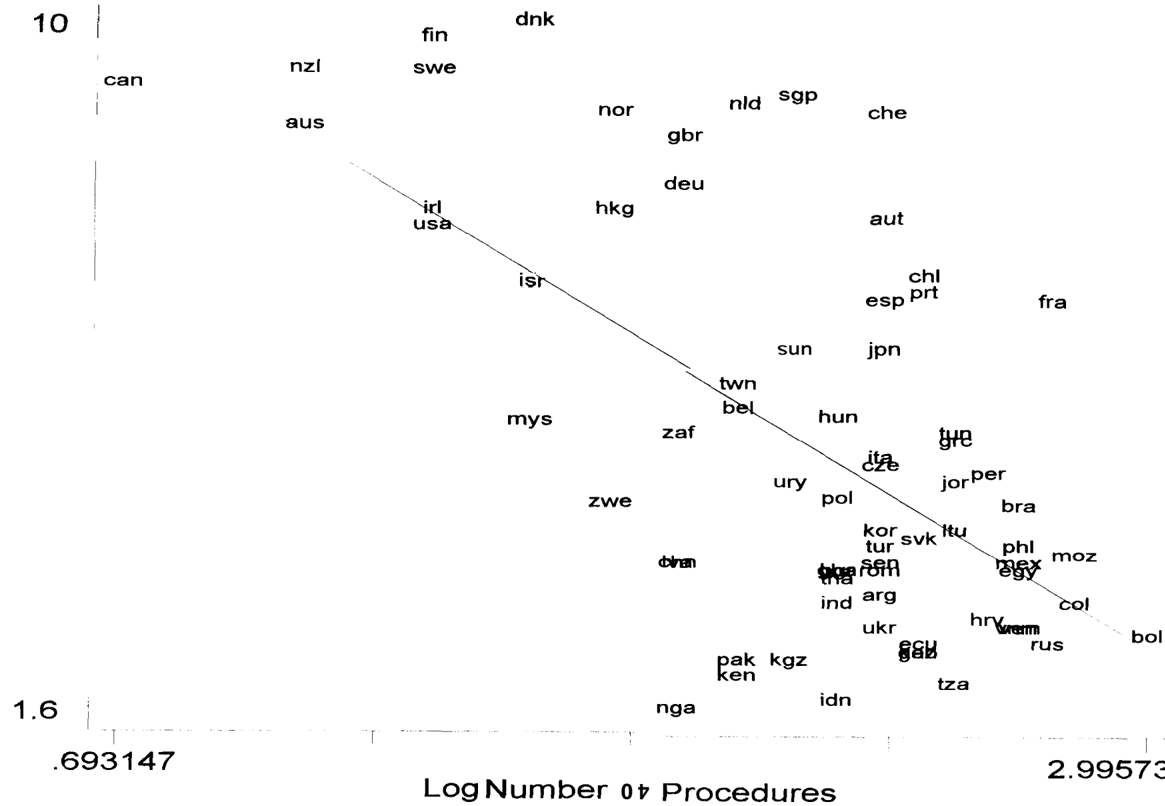
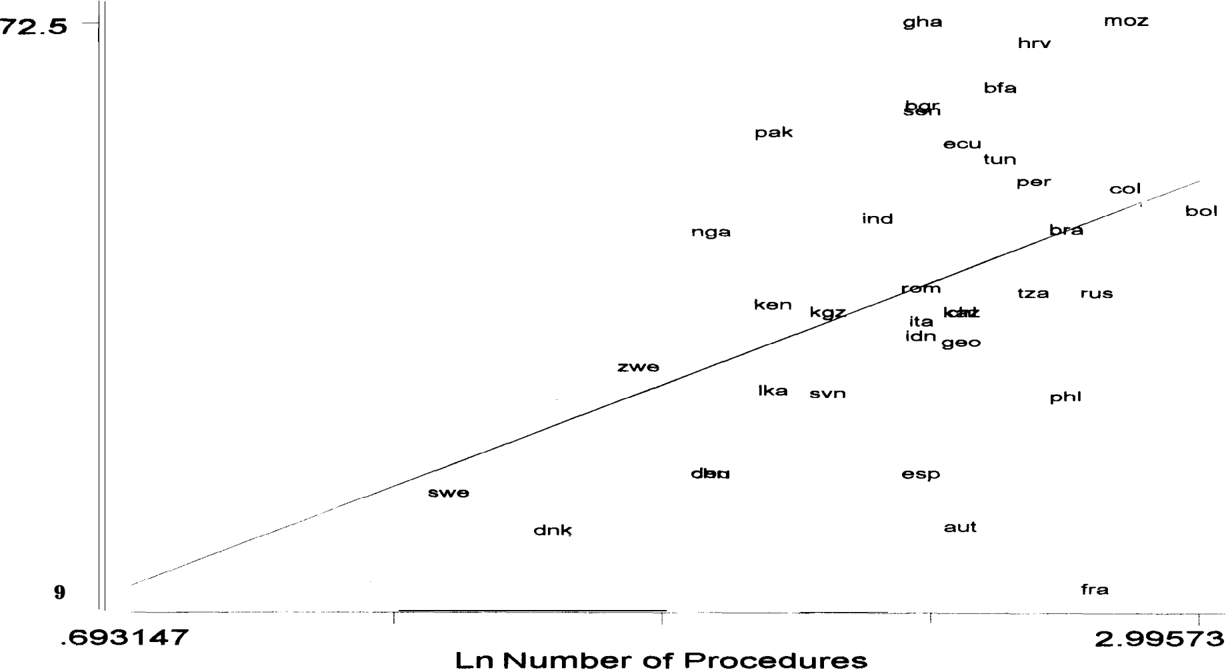
Verification
Claims the paper makes
0 Valid · 3 Not valid · 13 Not checked · 114 Own results and interpretations
A result the paper reports from its own data — it cites no other source for it, so there is none to check. The quote shows it is in the paper.
In the paper
“Very few entry regulations cover tax and labor issues.”
plain- Asserted: passes — The authors put it forward as true.
- Checkable: passes — It can be checked against evidence.
- Load-bearing: unclear — It is unclear whether the paper’s conclusions depend on it.
- Based: passes — The paper gives a reason why it holds.
In the paper
“The data show that the numbers of entry and of labor market regulations are positively correlated across countries, contrary to the substitutes hypothesis.”
What the sources say
- Not matchedcites Djankov et al., 2000
An author–year citation the paper’s reference list doesn’t settle. We don’t search these by name.
plainstates an association- Asserted: passes — The authors put it forward as true.
- Checkable: passes — It can be checked against evidence.
- Load-bearing: unclear — It is unclear whether the paper’s conclusions depend on it.
- Based: passes — The paper gives a reason why it holds.
- Not matched
A result the paper reports from its own data — it cites no other source for it, so there is none to check. The quote shows it is in the paper.
In the paper
“It often takes the form of screening procedures.”
- Also stated in: § III. Basic Results. · plain
“Instead, much of what governments do to regulate entry falls into the category of screening procedures.”
plain- Asserted: passes — The authors put it forward as true.
- Checkable: passes — It can be checked against evidence.
- Load-bearing: unclear — It is unclear whether the paper’s conclusions depend on it.
- Based: passes — The paper gives a reason why it holds.
- Also stated in: § III. Basic Results. · plain
A result the paper reports from its own data — it cites no other source for it, so there is none to check. The quote shows it is in the paper.
In the paper
“First, the cost-to-per-capita-GDP ratio decreases uniformly with GDP per capita.”
plainstates an association- Asserted: passes — The authors put it forward as true.
- Checkable: passes — It can be checked against evidence.
- Load-bearing: unclear — It is unclear whether the paper’s conclusions depend on it.
- Based: passes — The paper gives a reason why it holds.
A result the paper reports from its own data — it cites no other source for it, so there is none to check. The quote shows it is in the paper.
In the paper
“In contrast, countries in the other three quartiles of per capita income are not statistically different from each other in terms of the number of procedures and the time required to fulfill them.”
plain- Asserted: passes — The authors put it forward as true.
- Checkable: passes — It can be checked against evidence.
- Load-bearing: passes — The paper’s conclusions depend on it.
- Based: passes — The paper gives a reason why it holds.
49 more claims
Create a free account to see all 130 claims and every source verdict.
- Probably not a substantial claim. 21
- It may state two separate claims as one. 54
- The quote only partly states this claim. 26
Claims other papers make about this one
Each is checked against this paper’s own text: does it say what the citing paper says it does?
The source backs part of the claim, not all of it — or backs it for a different population, condition or comparison.
In the citing paper
“Our findings suggest an explanation for the low level of incorporation in Italy: the average direct cost associated with fulfilling the bureaucratic regulations for registering a new corporation in Italy is 20% of per capita GNP compared to 10% of per capita GNP on average for other G-7 European countries.”
From Entry regulation as a barrier to entrepreneurship (2006) · cites this paper as Djankov et al. (2002)
Experimental — accuracy not yet measuredThe cited source says what the claim attributes to it.
In the citing paper
“Given the explicit link made by Djankov et al . (2002) between the speed and ease with which businesses may be established in a country and its economic performance - and the enthusiasm with which this link has been grasped by European Union policy makers - our findings imply this link needs reconsidering.”
From The Effect of Business Regulations on Nascent and Young Business Entrepreneurship (2007) · cites this paper as Djankov et al . (2002)
Citations
Cites
La Porta, R., Lopez‐de‐Silanes, F., Shleifer, A., & Vishny, R. W. (1998) · Journal of Political Economy · doi:10.1086/250042 · Cited by 18,025
Self-citationThe Theory of Economic Regulation
Stigler, G. J. (1971) · The Bell Journal of Economics and Management Science · doi:10.2307/3003160 · Cited by 8,098
Journal of Economic Literature
(2019) · AEA Papers and Proceedings · doi:10.1257/pandp.109.633 · Cited by 7,468
The Quarterly Journal of Economics
Kuznets, S. (2024) · Business Cycle Theory, Part I Volume 4 · doi:10.4324/9781003549741-8 · Cited by 7,176
La Porta, R. (1999) · Journal of Law, Economics, and Organization · doi:10.1093/jleo/15.1.222 · Cited by 5,699 · cited 2×
“Legal origin has been viewed as a proxy for the government’s proclivity to intervene in the economy and the stance of the law toward the security of property rights in a country [La Porta et al. 1999].”
The Theory of Economic Regulation
Stigler, G. J. (2021) · The Political Economy · doi:10.4324/9781315495811-8 · Cited by 5,483
Pigou, A. C. (1933) · The Economic Journal · doi:10.2307/2224491 · Cited by 5,137
Toward a More General Theory of Regulation
Peltzman, S. (1976) · The Journal of Law and Economics · doi:10.1086/466865 · Cited by 4,729
Moffitt, R. A. (2009) · American Economic Review · doi:10.1257/aer.99.2.660 · Cited by 4,694
Shleifer, A., & Vishny, R. W. (1993) · The Quarterly Journal of Economics · doi:10.2307/2118402 · Cited by 3,778
Self-citation
Research works printed but not linked: 7
- McLiesh Caralee, 2001, NBER Working Paper No., 8288
- Kasnako lu, Zehra, and Münür Yayla, 'Unrecorded Economy in Turkey: A Monetary Approach', 1999. "Unrecorded Economy in Turkey (A Monetary Approach)" in Informal Sector in Turkey (I), Tuncer Bulutay (ed.), SIS, Ankara, forthcoming.
- Fred, 1987, Journal of Legal Studies, 101
- Olson, Mancur, 1991, 'Autocracy, Democracy, and Prosperity,' in Richard Zeckhauser, ed., Strategy of Choice, Cambridge, MA: MIT Press.
- 1967, Western Economic Journal, 232
- World Economic Forum (1999), The Global Competitiveness Report 1999 , Schwab, Klaus et al., eds., New York: Oxford University Press.
- World Economic Forum, The Global Competitiveness Report 2001, Klaus Schwab et al., eds. (New York, NY: Oxford University Press, 2001).
Cited by
Items 1,601–1,700 of 3,986
Regulation and the Macroeconomy
Dawson, J. W. (2007) · Kyklos · doi:10.1111/j.1467-6435.2007.00357.x · Cited by 16
Corruption Perceptions and Capital Fragility: Evidence from Hedge Funds Around the World
Aragon, G. O., Nanda, V. K., & Zhao, H. (2018) · Review of Financial Studies · doi:10.1093/rfs/hhaa051 · Cited by 19
Heterogeneous firms and informality: the effects of trade liberalization on labour markets
Becker, D. (2017) · Oxford Economic Papers · doi:10.1093/oep/gpx029 · Cited by 26
Avila, Y. T., Schmutzler, J., Rodriguez, P. B. M., & Gómez‐Araujo, E. (2021) · Academia Revista Latinoamericana de Administración · doi:10.1108/arla-07-2020-0170 · Cited by 23
An empirical investigaton of political economy factors behind structural reforms in OECD countries
Høj, J., Galasso, V., Nicoletti, G., & Dang, T.-T. (2007) · OECD Economic Studies · doi:10.1787/eco_studies-v2006-art3-en · Cited by 17
“An additional institutional factor favouring regulatory status quo is when heavy administrative procedures increase the leverage power of bureaucrats (Djankov et al., 2002).”
Informal Sector and Economic Growth: The Supply of Credit Channel
Massenot, B., & Straub, S. (2011) · Toulouse 1 Capitole Publications (Université Toulouse I Capitole) · Cited by 16
The effect of business regulations on nascent and actual entrepreneurship
van Stel, A. J., STOREY, D. J., & Thurik, R. (2006) · Cited by 22
Robson, M. (2009) · Springer eBooks · doi:10.1007/978-3-540-87910-7_12 · Cited by 18
Uptake, Distribution and Subcellular Transport of Sulfate
Hawkesford, M. J. (2008) · Advances in photosynthesis and respiration · doi:10.1007/978-1-4020-6863-8_2 · Cited by 18
Accounting for the Growth of Government
Becker, G. S., & Mulligan, C. B. (2020) · Studies in public choice · doi:10.1007/978-3-030-55081-3_1 · Cited by 16
Identifying the Obstacles to High-Impact Entrepreneurship in Latin America and the CaribbeanPreprint
Ács, Z. J., & Correa, P. G. (2014) · SSRN Electronic Journal · doi:10.2139/ssrn.2534412 · Cited by 26
“2005); another characterizes the national regulatory framework for new business entry (Djankov et al. 2002).”
Labour Reform in South Africa: Measuring Regulation and a Synthesis of Policy SuggestionsPreprint
Bhorat, H. I., & Cheadle, H. (2012) · SSRN Electronic Journal · doi:10.2139/ssrn.2176756 · Cited by 15
The Trade Comovement Puzzle and the Margins of International TradePreprint
Liao, W. Y., & Santacreu, A. M. (2011) · SSRN Electronic Journal · doi:10.2139/ssrn.1931653 · Cited by 16
Cyclical Informality and UnemploymentPreprint
Bosch, M., & Esteban‐Pretel, J. (2009) · RePEc: Research Papers in Economics · Cited by 16
The Political Economy of Investor ProtectionPreprint
Tommasino, P. (2007) · SSRN Electronic Journal · doi:10.2139/ssrn.954907 · Cited by 20
Entry and Regulation - Evidence from Health Care ProfessionsPreprint
Schaumans, C., & Verboven, F. (2006) · SSRN Electronic Journal · doi:10.2139/ssrn.885288 · Cited by 16
Policies Facilitating Firm Adjustment to Globalization
Hoekman, B. M., & Javorcik, B. S. (2004) · World Bank, Washington, DC eBooks · doi:10.1596/1813-9450-3441 · Cited by 19
Monetary Policy and the Quest for Robust Political EconomyPreprint
Boettke, P. J., & Smith, D. J. (2011) · SSRN Electronic Journal · doi:10.2139/ssrn.1764267 · Cited by 18
THE LISBON AGENDA FROM 2000 TO 2010Preprint
Johansson, B., Karlsson, C., Bäckman, M., & Juusola, P. (2007) · RePEc: Research Papers in Economics · Cited by 17
The Determinants of International Commercial Real Estate InvestmentPreprint
Lieser, K., & Groh, A. P. (2011) · SSRN Electronic Journal · doi:10.2139/ssrn.1928615 · Cited by 16
Global Leverage Adjustments, Uncertainty, and Country Institutional Strength
Çolak, G., Gungoraydinoglu, A., & Öztekin, Ö. (2017) · Journal of Financial Intermediation · doi:10.1016/j.jfi.2018.01.010 · Cited by 157
Herrera-Echeverry, H., Jerry, H., & Benavides, J. (2013) · SSRN Electronic Journal · doi:10.2139/ssrn.2456892 · Cited by 17
Reforms, Entry and Productivity: Some Evidence from the Indian Manufacturing SectorPreprint
Bhaumik, S. K., Gangopadhyay, S., & Krishnan, S. (2006) · SSRN Electronic Journal · doi:10.2139/ssrn.918079 · Cited by 16
The role of communication in restaurant crowdfunding success
Salvi, A., Raimo, N., Petruzzella, F., & Vitolla, F. (2022) · British Food Journal · doi:10.1108/bfj-07-2021-0797 · Cited by 16
Competing against ‘invisibles’: the effect of competition from informal firms on formal firms’ R&D
Kouakou, D. (2022) · Eurasian economic review : · doi:10.1007/s40821-022-00217-0 · Cited by 17
“The importance of the informal sector in DCs is strengthened by the fact that informal firms face significantly lower entry costs on the market than formal ones (Djankov et al., 2002; McKenzie & Sakho, 2010; Ulyssea, 2010).”
Digital technology usage and entrepreneurship in Africa
Ajide, F. M., & Osinubi, T. T. (2023) · African Journal of Science Technology Innovation and Development · doi:10.1080/20421338.2023.2209476 · Cited by 23
Sodokin, K., Egbeleo, E., Kuessi, R., Couchoro, M. K., & Agbodji, A. E. (2023) · Cogent Economics & Finance · doi:10.1080/23322039.2023.2256127 · Cited by 23
“…market hindrances such as informational and enforcement costs could obstruct private oversight, government failures might lead to detrimental effects if regulators are authorized, causing more harm than good (Bace et al., 2020; Djankov et al., 2002; Shleifer & Vishny, 1998; Taylor & Quintyn, 2002).”
Wage Bargaining and the Boundaries of the Multinational Firm
Bas, M., & Carluccio, J. (2009) · London School of Economics and Political Science Research Online (London School of Economics and Political Science) · Cited by 19
Heterogeneity in the Egyptian informal labour market: choice or obligation?
Harati, R. (2013) · Revue d économie politique · doi:10.3917/redp.234.0623 · Cited by 15
1 An Overview of Personal Wealth
(2008) · Oxford University Press eBooks · doi:10.1093/acprof:oso/9780199548880.003.0001 · Cited by 15
Goel, R. K., Mazhar, U., & Saunoris, J. W. (2020) · Australian Economic Papers · doi:10.1111/1467-8454.12226 · Cited by 18
The Impact of Economic Regulation on Growth: Survey and Synthesis
Broughel, J., & Hahn, R. W. (2020) · Regulation & Governance · doi:10.1111/rego.12376 · Cited by 21
Corporatism and the Ghost of the Third Way
Mørck, R., & Yeung, B. Y. (2010) · Capitalism and Society · doi:10.2202/1932-0213.1076 · Cited by 21
“Empirical work linking productivity to corporate turnover (Fogel et al. 2008) and easy entry (Djankov et al. 2000) supports the young upstart as the better innovator.”
INFORMAL SECTOR AND ECONOMIC DEVELOPMENT: THE CREDIT SUPPLY CHANNEL
Massenot, B., & Straub, S. (2015) · Economic Inquiry · doi:10.1111/ecin.12301 · Cited by 19
Choice of Enterprise Form: Spain, 1886–1936
Guinnane, T. W., & guez, S. M. ⁄. N.-R. ⁄. (2017) · The Journal of Law Economics and Organization · doi:10.1093/jleo/ewx015 · Cited by 15
Beyond government size: Types of government intervention and corruption
Bel, G. (2021) · Regulation & Governance · doi:10.1111/rego.12399 · Cited by 20
“Djankov et al. (2002) investigated the number of procedures an entrepreneur must face before they can operate a business legally and the effect this has on corruption.”
Countries’ governance and competitiveness: business environment mediating effect
Bontempo, P. C. (2021) · RAUSP Management Journal · doi:10.1108/rausp-11-2020-0253 · Cited by 15
The effect of female board representation on the level of ownership in foreign acquisitions
Askarzadeh, F., Lewellyn, K. B., Islam, H., & Moghaddam, K. (2022) · Corporate Governance An International Review · doi:10.1111/corg.12433 · Cited by 19
Entrepreneurship turnover and endogenous returns to ability
Crifo, P., & Sami, H. (2008) · Economic Modelling · doi:10.1016/j.econmod.2007.10.005 · Cited by 15
“According to Djankov et al. (2002), the start-up process may take up to 66 days and 16 different legal and administrative steps in France while requiring 7 days and 4 steps in the United States, and such differences are definitely likely to inhibit business creation (see Fonseca et al., 2001). to…”
Spence, M., & Brady, D. (2010) · World Bank, Washington, DC eBooks · doi:10.1596/978-0-8213-8100-7 · Cited by 18
Barriers to Retail Competition and Prices
Hoffmaister, A. W. (2006) · Oxford Economic Papers · doi:10.1093/oep/gpp035 · Cited by 15
INSTITUTIONAL BARRIERS TO BUSINESS ENTRY IN ADVANCED ECONOMIES
Kosi, T., & Bojnec, Š. (2013) · Journal of Business Economics and Management · doi:10.3846/16111699.2011.633348 · Cited by 17
“More evidence on the adverse effect of PMR on the setting up of businesses is provided by Djankov et al. (2002), Desai et al. (2003) and Loayza et al. (2005).”
Judiciaries in corrupt societies
Priks, M. (2010) · Economics of Governance · doi:10.1007/s10101-010-0082-y · Cited by 22
Income Tax Compliance Costs of Working Individuals: Empirical Evidence from Germany
Blaufus, K., Eichfelder, S., & Hundsdoerfer, J. (2011) · Public Finance Review · doi:10.1177/1091142113488162 · Cited by 37
“This fits well with the result of Eichfelder et al. (2012) that the demand of German taxpayers for tax advice increases in negative income and accounts for the compliance costs of a tax loss relief.”
InfluentialHeterodox Reform Symbioses: The Political Economy of Investment Climate Reforms in Solo, Indonesia*
von Lübke, C., McCulloch, N., & Patunru, A. A. (2009) · Asian Economic Journal · doi:10.1111/j.1467-8381.2009.02012.x · Cited by 20
ENTRY COSTS, FINANCIAL FRICTIONS, AND CROSS-COUNTRY DIFFERENCES IN INCOME AND TFP
Bah, E.-H. M., & Fang, L. (2014) · Macroeconomic Dynamics · doi:10.1017/s1365100514000649 · Cited by 16
“The simulations with entry cost data from Djankov et al. (2002) deliver similar results.”
Frontier economies and economic growth: Evidence from European and Central Asian Countries
Bajra, U. Q., Halili, Z., & Berisha, N. S. (2020) · Borsa Istanbul Review · doi:10.1016/j.bir.2020.04.002 · Cited by 21
Institutions, entrepreneurial adaptation, and the legal form of the organization
Khurana, I., Krichevskiy, D., Dempster, G. M., & Stimpson, S. (2020) · Journal of Entrepreneurship and Public Policy · doi:10.1108/jepp-10-2019-0087 · Cited by 19
Assessment of tariff equivalents for services considering the zero flows
Guillin, A. (2013) · World Trade Review · doi:10.1017/s1474745612000559 · Cited by 19
“Following Helpman et al. (2008), I replace religion by regulation costs provided by Djankov et al. (2002).”
Business Environment and New Firm Creation: An International Comparison
Dyck, A. J., & Ovaska, T. (2011) · Journal of Small Business & Entrepreneurship · doi:10.1080/08276331.2011.10593540 · Cited by 18
“7 A full table of descriptive statistics is available in Appendix D. the previous studies by Djankov et al. (2002), and Ovaska and Sobel (2005).”
Campos, N. F., & Iootty, M. (2007) · Economic Systems · doi:10.1016/j.ecosys.2007.08.001 · Cited by 24
Creditor protection and the dynamics of the distribution in oligarchic societies
Oechslin, M. (2009) · Journal of Economic Growth · doi:10.1007/s10887-009-9047-9 · Cited by 17
“Sources: Number of days to enforce a simple debt contract in court: Djankov et al. (2005); cost as a share of per capita GDP to open a small business (and p.”
Chen, D., Fan, J. P. H., & Wong, T. J. (2002) · Cited by 15
License Reform in India: Theory and Evidence
Chari, A. V. (2007) · Cited by 13
Entrepreneurial Profile of the UK in the Light of the Global Entrepreneurship and Development IndexPreprint
Autio, E., Cleevely, M., Hart, M., Levie, J., Ács, Z. J., & Szerb, L. (2012) · SSRN Electronic Journal · doi:10.2139/ssrn.2070320 · Cited by 24
From Mine to Coast: Transport Infrastructure and the Direction of Trade in Developing CountriesPreprint
Bonfatti, R., & Poelhekke, S. (2013) · SSRN Electronic Journal · doi:10.2139/ssrn.2230307 · Cited by 15
“DURS), which come from the Doing Business project (Djankov et al., 2002).”
Latin America in the Rearview MirrorPreprint
Cole, H. L., Ohanian, L. E., Riascos, A. J., et al. (2004) · doi:10.21034/sr.351 · Cited by 15
Imperfect Transmission of Tacit Knowledge and Other Barriers to EntrepreneurshipPreprint
Poutvaara, P., & Kanniainen, V. (2007) · SSRN Electronic Journal · doi:10.2139/ssrn.998465 · Cited by 26
“We now introduce the risk.(11) Denoting θ = the probability”
Musacchio, A. (2008) · SSRN Electronic Journal · doi:10.2139/ssrn.1086225 · Cited by 15
Entry Regulation and Intersectoral ReallocationPreprint
Ciccone, A., & Papaioannou, E. (2008) · RePEc: Research Papers in Economics · Cited by 17
Regulatory Harmonization and Trade in Services: Volumes and Choice of ModePreprint
Kox, H. L. M., & Nordås, H. K. (2016) · SSRN Electronic Journal · doi:10.2139/ssrn.2872076 · Cited by 15
Employment Protection, Technology Choice, and Worker AllocationPreprint
Bartelsman, E. J., Gautier, P. A., & de Wind, J. (2011) · SSRN Electronic Journal · doi:10.2139/ssrn.1951839 · Cited by 16
Growth, Private Investment, and the Cost of Doing Business in Tunisia: A Comparative PerspectivePreprint
Casero, P. A. (2006) · SSRN Electronic Journal · doi:10.2139/ssrn.938039 · Cited by 15
Instituições, estabilidade política e desempenho económico implicações para PortugalPreprint
Veiga, F. J. (2013) · RePEc: Research Papers in Economics · Cited by 19
Commodity taxation and regulatory competition
Moriconi, S., Picard, P. M., & Zanaj, S. (2018) · International Tax and Public Finance · doi:10.1007/s10797-018-9521-4 · Cited by 16
Small business in Russia: institutions, market potential, taxes and digitalization
Земцов, С. П., Tsareva, Y., Баринова, В. А., Belitski, M., & Krasnoselskikh, A. (2022) · Post-Communist Economies · doi:10.1080/14631377.2022.2108244 · Cited by 22
Gender wage discrimination with employer prejudice and trade openness
Yahmed, S. B. (2023) · World Development · doi:10.1016/j.worlddev.2023.106319 · Cited by 17
Yang, Z., & Ding, H. D. (2024) · Energy Economics · doi:10.1016/j.eneco.2024.107828 · Cited by 15
Do Indirect Questions Reduce Lying about Corruption? Evidence from a Quasi-Field Experiment
Clarke, G. R. G., Friesenbichler, K. S., & Wong, M. (2015) · Comparative Economic Studies · doi:10.1057/ces.2014.43 · Cited by 15
Does Mandating Social Insurance Affect Entrepreneurial Activity?
Benzarti, Y., Harju, J., & Matikka, T. (2020) · American Economic Review Insights · doi:10.1257/aeri.20190097 · Cited by 14
“For example, Djankov et al. [2002] and Klapper et al. [2006] show that entry regulations are likely”
Azmeh, C. (2019) · Journal of Financial Regulation and Compliance · doi:10.1108/jfrc-08-2018-0111 · Cited by 14
Zhao, Y., Chen, X., Miao, X.-H., Tan, Y.-R., & Song, X. (2019) · Emerging Markets Finance and Trade · doi:10.1080/1540496x.2019.1643318 · Cited by 14
Opportunity entrepreneurship and regulation: a state-level analysis
Dove, J. A. (2019) · Applied Economics Letters · doi:10.1080/13504851.2019.1654080 · Cited by 16
“…of this regards a jurisdiction’s formal institutional arrangements and specifically its regulatory environment, with most research finding that greater regulatory burdens tend to dampen entrepreneurship (DeSoto 2000; Dreher andGassebner 2013; Klapper, Laevena, and Rajan 2006; Djankov et al. 2002).”
Barriers hindering the entry of new firms to the competitive market and profitability of incumbents
Islami, X., Islami, V., Латковиќ, М. Т., et al. (2019) · Management · doi:10.30924/mjcmi.24.2.9 · Cited by 14
“Both processes limit entrepreneurial opportunities for nonincumbents” (Djankov et al., 2002).”
Ahmed, K., Khan, B., & Öztürk, İ. (2020) · International Journal of Finance & Economics · doi:10.1002/ijfe.1821 · Cited by 15
Promoting Rwanda’s business environment: Impact of reforms and drivers of change
Bernatzki, T., Busse, M., & Hoekstra, R. (2021) · Development Policy Review · doi:10.1111/dpr.12578 · Cited by 14
Impact of institutional and regulatory quality on FDI inflow: case of a developing Indian economy
Kaushal, L. A. (2021) · Cogent Economics & Finance · doi:10.1080/23322039.2021.1985201 · Cited by 18
“The EoSB score is a proxy for entry-focused regulations imposed by the government concerning the multinational enterprises (MNEs) entry into a new market or starting a business (Djankov et al., 2002).”
Johnson, D. (2022) · Administration & Society · doi:10.1177/00953997221100373 · Cited by 15
“Local investors and prospective entrepreneurs are less likely to engage in entrepreneurial activities where the business environment is saturated with burdens (Eifert, 2009; Djankov et al., 2002, 2006).”
Lê, Q., Lien, V. T. P., Anh, V. P., et al. (2022) · International Review of Economics & Finance · doi:10.1016/j.iref.2022.06.021 · Cited by 14
6 China and India: A Tale of Two Trade Integration Approaches
Kowalski, P. A. (2010) · Oxford University Press eBooks · doi:10.1093/acprof:oso/9780199575077.003.0006 · Cited by 14
Jacquemin, A., & Janssen, F. (2015) · Environment and Planning C Government and Policy · doi:10.1068/c11180b · Cited by 19
The determinants of cross-border corruption
Escresa, L., & Picci, L. (2019) · Public Choice · doi:10.1007/s11127-019-00764-7 · Cited by 17
Valuing start-ups – selected approaches and their modification based on external factors
Dušátková, M. S., & Zinecker, M. (2016) · Verslas teorija ir praktika · doi:10.3846/btp.17.11129 · Cited by 14
A comparative study of net entrepreneurial productivity in developed and post-transition economies
Borozan, D., Arnerić, J., & Ćorić, I. (2016) · International Entrepreneurship and Management Journal · doi:10.1007/s11365-016-0427-2 · Cited by 17
Property Rights, Deregulation, and Entrepreneurial Development in a Transition Economy
Zhou, W. (2017) · Management and Organization Review · doi:10.1017/mor.2016.59 · Cited by 17
Institutions and Export Performance in 26 Transition Economies
Krasniqi, B. A., & Desai, S. (2017) · Societies and political orders in transition · doi:10.1007/978-3-319-57342-7_4 · Cited by 14
Rizwan, M. S., Moinuddin, M., L’Huillier, B. M., & Ashraf, D. (2017) · Journal of Regulatory Economics · doi:10.1007/s11149-017-9340-z · Cited by 17
An Empirical Investigation into Institutions Unlocking Entrepreneurial Activity
Urban, B., & Muzamhindo, A. (2018) · The Journal of Entrepreneurship · doi:10.1177/0971355717738597 · Cited by 20
“…theory, which claims that regulations are inefficient and are a mechanism which benefits bureaucrats (by extracting rents from entrepreneurs), politicians (through the collection of bribes from entrants) and existing firms (by deterring competition from potential entrants) (Djankov et al., 2002).”
Institutional Quality and Globalization in Developing Countries
Samadi, A. H. (2019) · Contributions to economics · doi:10.1007/978-3-030-14370-1_6 · Cited by 14
Public interest or regulatory capture: Theory and evidence from China’s airfare deregulation
Li, K., Long, C. X., & Wan, W. (2019) · Journal of Economic Behavior & Organization · doi:10.1016/j.jebo.2019.03.019 · Cited by 12
Wang, Y., Chen, S., & Yao, J. (2019) · Journal of Cleaner Production · doi:10.1016/j.jclepro.2019.06.312 · Cited by 14
Shedding Light on the Doing Business Index: a Machine Learning Approach
Maričić, M., Bulajić, M., Radojicic, Z. A., & Jeremić, V. (2019) · Business Systems Research Journal · doi:10.2478/bsrj-2019-019 · Cited by 15
“Also, Djankov et al. (2002) showed that the chosen set of indicators, which make the DBI, comply with the theoretical basis of foreign investment.”
Law and Finance in Britain c.1900
Coyle, C. A., Musacchio, A., & Turner, J. D. (2019) · Financial History Review · doi:10.1017/s0968565019000179 · Cited by 13
Legal Institutions and Economic Development
Beck, T. (2012) · Oxford University Press eBooks · doi:10.1093/oxfordhb/9780195391176.013.0003 · Cited by 16
The Impact of Worker Bargaining Power on the Organization of Global Firms
Bas, M., & Carluccio, J. (2015) · HAL · Cited by 15
Dynastic entrepreneurship, entry, and non-compete enforcement
Rauch, J. E. (2015) · European Economic Review · doi:10.1016/j.euroecorev.2015.12.004 · Cited by 20
Reforms in Business Regulation: Evidence from Russia
Yakovlev, E., Zhuravskaya, E. V., Alesina, A., Berglöf, E., Djankov, S., Egorov, G., Сергеевич, Е. Р., Glaeser, E. L., Guriev, S. M., Katz, L. F., et al. (2008) · Cited by 16
Self-citationGlobal Entrepreneurship and the United States
Ács, Z. J., & Szerb, L. (2010) · Cited by 17
The quality of the legal system and labor market performance around the world
Feldmann, H. (2009) · European Journal of Law and Economics · doi:10.1007/s10657-008-9092-4 · Cited by 15
“They also tend to have less burdensome regulation (e.g., Djankov et al. 2002, Botero et al. 2004).”
Davies, R. B. (2013) · Journal of Public Economics · doi:10.1016/j.jpubeco.2013.02.011 · Cited by 19
Metadata
- Authors
- Djankov, S., La Porta, R., Lopez-de-Silanes, F., & Shleifer, A.
- Affiliations
- World Bank (US)
- National Bureau of Economic Research (US)
- ORCID
- Djankov, S.
- Venue
- The Quarterly Journal of Economics
- Publisher
- Oxford University Press (OUP)
- Published
- 2002-02-01
- Volume
- 117
- Issue
- 1
- Pages
- 1-37
- ISSN
- 0033-5533
- 1531-4650
- OpenAlex
- W2139896179
- Cited by
- 3,956
- References
- 30
- Citations by year
- 2026: 223 · 2025: 185 · 2024: 157 · 2023: 120 · 2022: 140 · 2021: 150 · 2020: 151 · 2019: 161 · 2018: 157 · 2017: 162 · 2016: 166 · 2015: 193 · 2014: 200 · 2013: 183 · 2012: 193
- Type
- report
- Language
- en
- Open access
- green
- doi.org
- Licence
- other-oa
- Locations
- World Bank, Washington, DC eBooks (publishedVersion)
- The Quarterly Journal of Economics (publishedVersion)
- The World Bank Open Knowledge Repository (World Bank) (publishedVersion)
- National Bureau of Economic Research (publishedVersion, other-oa)
- RePEc: Research Papers in Economics (submittedVersion)
- Digital Access to Scholarship at Harvard (DASH) (Harvard University) (submittedVersion, cc-by)
- SSRN Electronic Journal (submittedVersion)
- OpenGrey (Institut de l'Information Scientifique et Technique) (submittedVersion)
- The World Bank Open Knowledge Repository (World Bank) (submittedVersion, cc-by)
- Topics
- Social Sciences › Sociology and Political Science › Corruption and Economic Development
- Social Sciences › Economics, Econometrics and Finance › Economics and Econometrics › Taxation and Compliance Studies
- Social Sciences › Business, Management and Accounting › Strategy and Management › Political Influence and Corporate Strategies
- Keywords
- start-up firms, bureaucratic procedures, corruption, informal economy, democracy, government size, public choice theory, public interest theory
About these checks
Registry, retraction, Cites and statistics results are computed, not judged, with one exception: a printed reference that no index lists is read once by a model before it counts as a citation error. Claims are extracted by a model and kept only when their quote appears verbatim in the text; each cited source is then checked, with a model’s help, for whether it says what the claim relies on. Those verdicts can be wrong — read the claim’s quote and the cited source before relying on one.
A language model drew the claims from the paper on 2026-10-01, under version 3 of the claim definition (model deepseek-v4.1-flash, prompt extract-v3).
A second model labelled each claim on 2026-10-01 (model jev-1.13-20260917, definition revision gold-guideline-v0.2).
Statistics and arithmetic are recomputed, not judged.
Confidence bands are shown only for fields calibrated on our annotated test set. None is calibrated yet, so no band is shown.
What counts as a claim ›How we measure confidence ›How we check this ›
Are you an author, or do you see a problem with this page? Request a review
Data sources
Bibliographic data: Semantic Scholar, OpenAlex, Crossref.
Contains information from the Semantic Scholar Academic Graph Datasets, made available under the ODC Attribution License (ODC-BY 1.0).
Semantic Scholar’s data is described in: Kinney, R., et al. (2023). The Semantic Scholar Open Data Platform. arXiv:2301.10140.
