

Visual percepts evoked with an intracortical 96-channel microelectrode array inserted in human occipital cortex
Open accessThe DOI matches its Crossref record; 59 of the 60 references it cites were found in a registry or an index; 35 of the 69 sources its claims cite were checked for support.
Abstract
BACKGROUNDA long-held goal of vision therapy is to transfer information directly to the visual cortex of blind individuals, thereby restoring a rudimentary form of sight. However, no clinically available cortical visual prosthesis yet exists.METHODSWe implanted an intracortical microelectrode array consisting of 96 electrodes in the visual cortex of a 57-year-old person with complete blindness for a 6-month period. We measured thresholds and the characteristics of the visual percepts elicited by intracortical microstimulation.RESULTSImplantation and subsequent explantation of intracortical microelectrodes were carried out without complications. The mean stimulation threshold for single electrodes was 66.8 ± 36.5 μA. We consistently obtained high-quality recordings from visually deprived neurons and the stimulation parameters remained stable over time. Simultaneous stimulation via multiple electrodes was associated with a significant reduction in thresholds (P < 0.001, ANOVA) and evoked discriminable phosphene percepts, allowing the blind participant to identify some letters and recognize object boundaries.CONCLUSIONSOur results demonstrate the safety and efficacy of chronic intracortical microstimulation via a large number of electrodes in human visual cortex, showing its high potential for restoring functional vision in the blind.TRIAL REGISTRATIONClinicalTrials.gov identifier NCT02983370.FUNDINGThe Spanish Ministerio de Ciencia Innovación y Universidades, the Generalitat Valenciana (Spain), the Europan Union's Horizon 2020 programme, the Bidons Egara Research Chair of the University Miguel Hernández (Spain), and the John Moran Eye Center of the University of Utah.
Overview
CoChat Summary
TL;DR
In a 57-year-old woman with complete blindness, a 96-channel Utah Electrode Array implanted in right occipital cortex for 6 months was safely implanted and explanted, and intracortical microstimulation evoked phosphenes via 88 of 96 electrodes. Multi-electrode stimulation produced discriminable patterned percepts that allowed identification of some letters and object boundaries, though percepts were variable and required training and calibration.
Key findings
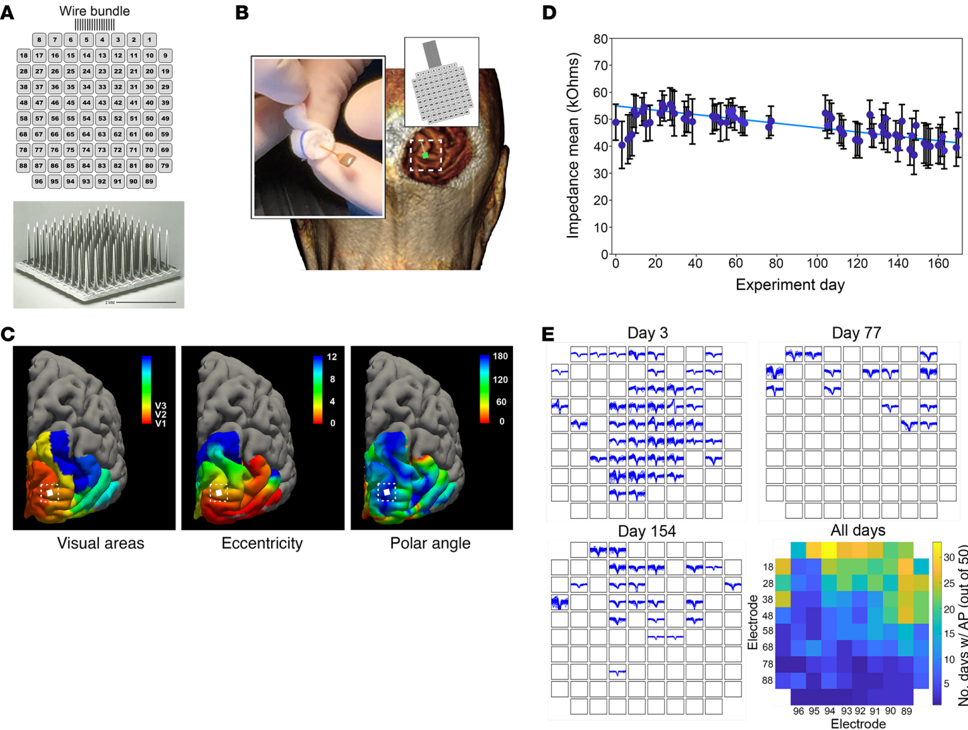
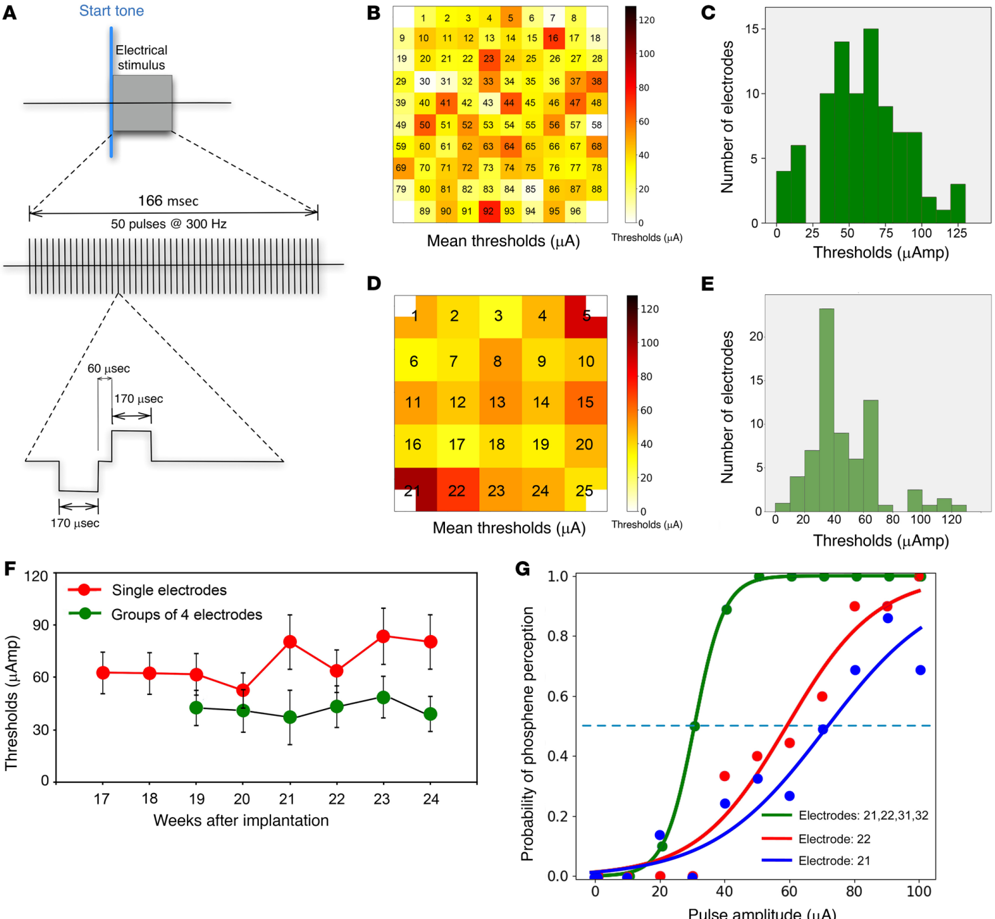
- Implantation and explantation occurred without complications; electrode impedances were mostly 37–56 kΩ (47 ± 4.8 kΩ), and single-electrode thresholds increased by 19.4% over the last 4 months, from 64.8 to 80.4 μA. Phosphenes were reliably evoked with 88 of 96 electrodes, with a mean single-electrode threshold of 66.8 ± 36.5 μA (range 7–128 μA).
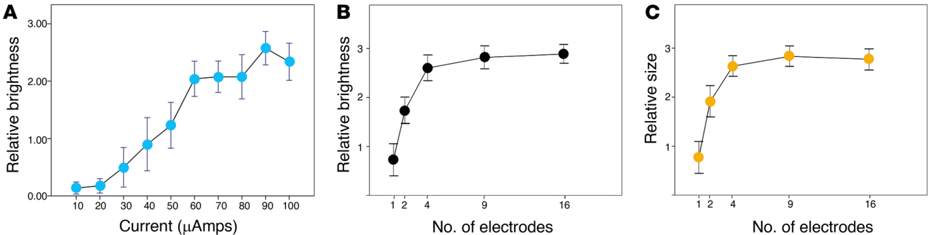
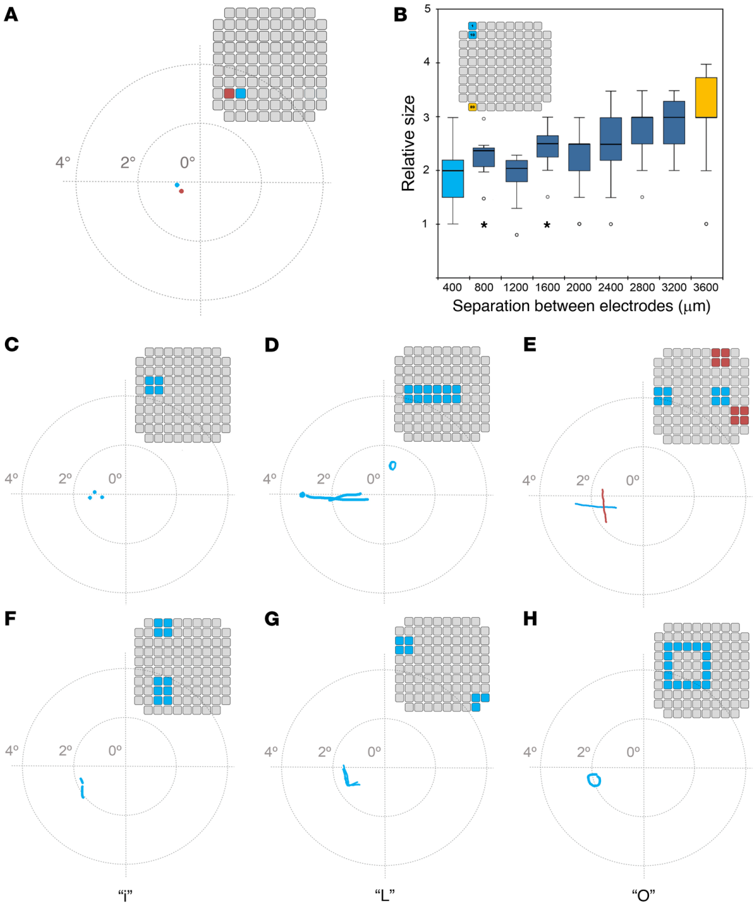
- Simultaneous stimulation of larger electrode groups significantly reduced thresholds (P < 0.001, ANOVA); 4-electrode thresholds averaged 48.0 ± 22.6 μA, 28% lower than single electrodes. Two-point discrimination was limited: 23.6% of pair stimulations evoked 2 discrete phosphenes, while 76.4% evoked a single phosphene that was 1.9 ± 0.1 times larger; for electrodes 400 μm apart, temporal separation >250 ms yielded 2 distinct phosphenes 90% of the time, reaching 100% at ≥565 μm separation.
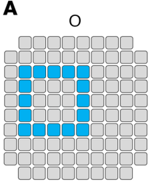
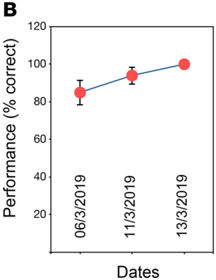
- The subject discriminated horizontal versus vertical patterns with 81.4% overall success across 22 sessions on 4 days, later reaching 100%; she reliably discriminated letters such as i, L, C, V, and O with overall success always >70%. In an O-versus-o task, performance improved to 90%–95% after 70 trials and 100% in the latest sessions.
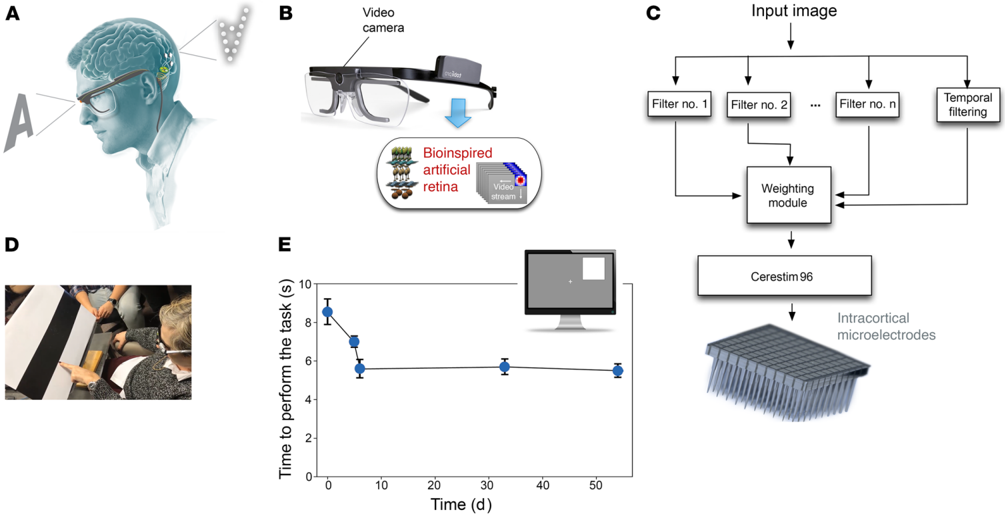
- With a bio-inspired retinal encoder, the subject localized a large white square with 100% accuracy across 70 trials and a smaller square with 100% accuracy across 150 trials over 5 days; reaction time decreased from 8.6 ± 0.6 seconds to 5.4 ± 0.3 seconds after 2 training days.
Methods
- Single-subject feasibility study in a 57-year-old right-handed female with toxic optic neuropathy and complete blindness for 16 years. A Utah Electrode Array with 96 electrodes (1.5-mm shanks, 10 × 10 grid) was implanted in the right occipital cortex near the V1/V2 border and explanted after 6 months.
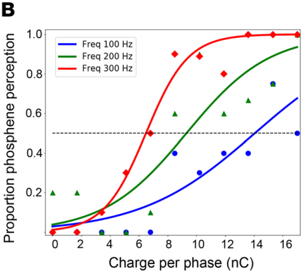
- Stimulation and recording used the CereStim 96 and NeuroPort systems, with up to 16 simultaneously stimulated electrodes; sessions occurred generally 5 days per week, 1–2 times per day, up to 4 hours per session, totaling approximately 540 hours of stimulation. Thresholds were measured with a binary search procedure (1–128 μA, 1-μA minimum step, 10% catch trials), and psychometric curves were fit with a Weibull cumulative distribution function to estimate 50% detection thresholds.
- Behavioral testing included sham-controlled detection, 2-alternative forced-choice discrimination, phosphene mapping on a digitizing tablet, subjective brightness/size ratings, two-point discrimination with varied electrode spacing and stimulus delays, and preliminary tests with a bio-inspired retinal encoder. Statistical analysis used IBM SPSS 20.0 with t tests or ANOVA and Scheffe’s procedure, with P < 0.05 considered significant.
Limitations
- Stated: the study involved a single subject over a 6-month period, and the authors state that further investigations in more subjects and over a longer period are required; simultaneous stimulation currents can summate, possibly requiring temporal interleaving; percepts sometimes did not clearly correlate with electrode locations, suggesting spatial remapping or fine calibration may be needed; not all letters could be induced, and many stimulation patterns were not recognized as letters; wireless systems are not yet sufficiently robust for clinical use.
- Stated: the CereStim 96 limited simultaneous stimulation to 16 electrodes, constraining the complexity of patterns that could be tested.
- Evident from the text: outcomes depend heavily on the single participant’s subjective reports of phosphene location, brightness, size, and shape, and there was no blinding or control group, limiting generalizability and objectivity.
Model-written summary. Check it against the paper before relying on it.
Integrity signals
Registry
Cites
Statistics
Figures
Verification
Claims the paper makes
19 Valid · 2 Not valid · 5 Not checked · 144 Own results and interpretations
Some cited sources support this claim and some don’t — read each source’s verdict below.
In the paper
“The results therefore suggest that silicon-based, penetrating microelectrode arrays could provide the stability required in a clinical device (11, 32-34) but further investigations in more subjects and over a longer period of time are needed.”
What the sources say
- Partly supportedcites [11] Normann RA, Fernandez E. Clinical applications of penetrating neural interfaces and Utah Electrode Array technologies. J Neural Eng . 2016;13(6):061003. https://doi.org/10.1088/1741-2560/13/6/061003 sourceExperimental — accuracy not yet measured
Section 2.5 describes silicon as a mechanically strong substrate and says silicon carbide may provide long-term mechanical stability in vivo. But it also says materials have not yet been found that protect arrays for the years required in clinical devices. The Conclusions report limited current lifetimes and say further work is needed, so the source supports the possibility, not evidence that silicon-based arrays provide the required clinical stability. (LLM, conf=0.84)
- Disputedcites [32] Marin C, Fernandez E. Biocompatibility of intracortical microelectrodes: current status and future prospects. Front Neuroeng . 2010;3:8. sourceExperimental — accuracy not yet measured
The Introduction says long-term viability and stability remain a problem for available neural electrodes. Challenges and Future Perspectives adds that keeping intracortical microelectrodes biologically and electrically viable for many years remains difficult. Although the paper discusses penetrating arrays, it does not present silicon-based arrays as likely to provide the stability required for a clinical device. (LLM, conf=0.79)
Checked by a reasoning model — may be wrong.
- Not checked — no full text of the sourcecites [33] Fernandez E, Botella C. Biotolerability of intracortical microelectrodes. Advanced Biosystems . 2017;2(1):1-14. https://doi.org/10.1002/adbi.201700115 source
- Could not verifycites [34] Fernandez E. Development of visual neuroprostheses: trends and challenges. Bioelectron Med . 2018;4(8):1-8. sourceExperimental — accuracy not yet measured
The ‘Electrode-to-tissue Interface issues’ section discusses long-term viability as a challenge, including corrosion, glial scarring, and the need for improved protection of implant electronics. Searches for silicon-based penetrating arrays and clinical-device stability found no passage reporting results that suggest those arrays could provide the required stability. (LLM, conf=0.72)
hedgedstates a possible cause- Asserted: passes — The authors put it forward as true.
- Checkable: passes — It can be checked against evidence.
- Load-bearing: passes — The paper’s conclusions depend on it.
- Based: passes — The paper gives a reason why it holds.
- Partly supported
The cited sources support only part of this claim — read each source’s verdict below.
In the paper
“Current-induced tissue damage during electrical stimulation was avoided by keeping stimulus charge density below the damage threshold boundary (20, 21).”
What the sources say
- Partly supportedcites [20] Cogan SF, et al. Tissue damage thresholds during therapeutic electrical stimulation. J Neural Eng . 2016;13(2):021001. https://doi.org/10.1088/1741-2560/13/2/021001 sourceExperimental — accuracy not yet measured
The Introduction (page unavailable) says the Shannon boundary often distinguishes damaging from non-damaging stimulation for large electrodes. But the paper’s section on the origin of the 30 μC cm−2 threshold says charge density alone is insufficient to predict damage: tissue damage can occur below that limit. The claim overstates charge density as a general way to avoid damage. (LLM, conf=0.87)
- Not checked — no full text of the sourcecites [21] Shannon RV. A model of safe levels for electrical stimulation. IEEE Trans Biomed Eng . 1992;39(4):424-426. https://doi.org/10.1109/10.126616 source
plainstates a causeSingle case- Asserted: passes — The authors put it forward as true.
- Checkable: passes — It can be checked against evidence.
- Load-bearing: passes — The paper’s conclusions depend on it.
- Based: passes — The paper gives a reason why it holds.
- Partly supported
The cited sources support only part of this claim — read each source’s verdict below.
In the paper
“and several studies indicate that UEAs retain their functionality in humans for more than 1000 days (29, 31).”
What the sources say
- Supportedcites [29] Willett FR, et al. High-performance brain-totext communication via handwriting. Nature . 2021;593(7858):249-254. https://doi.org/10.1038/s41586-021-03506-2 source
The Discussion (page not provided) states that microelectrode arrays have retained functionality for more than 1,000 days after implantation, citing prior studies and this study’s Extended Data Fig. 7. This supports the claim about long-term functionality in humans. (LLM, conf=0.93)
- Partly supportedcites [31] Simeral JD, et al. Home use of a percutaneous wireless intracortical brain-computer interface by individuals with tetraplegia. IEEE Trans Biomed Eng . 2021;68(7):2313-2325. https://doi.org/10.1109/TBME.2021.3069119 sourceExperimental — accuracy not yet measured
The Results section (page unavailable) shows that implanted intracortical arrays supported computer use in two people with tetraplegia, including T5 on trial day 588. The References section cites a study reporting cursor control 1000 days after array implantation, but this paper does not report functionality for more than 1000 days. (LLM, conf=0.85)
hedged- Asserted: passes — The authors put it forward as true.
- Checkable: passes — It can be checked against evidence.
- Load-bearing: passes — The paper’s conclusions depend on it.
- Based: passes — The paper gives a reason why it holds.
- Supported
The cited sources support only part of this claim — read each source’s verdict below.
In the paper
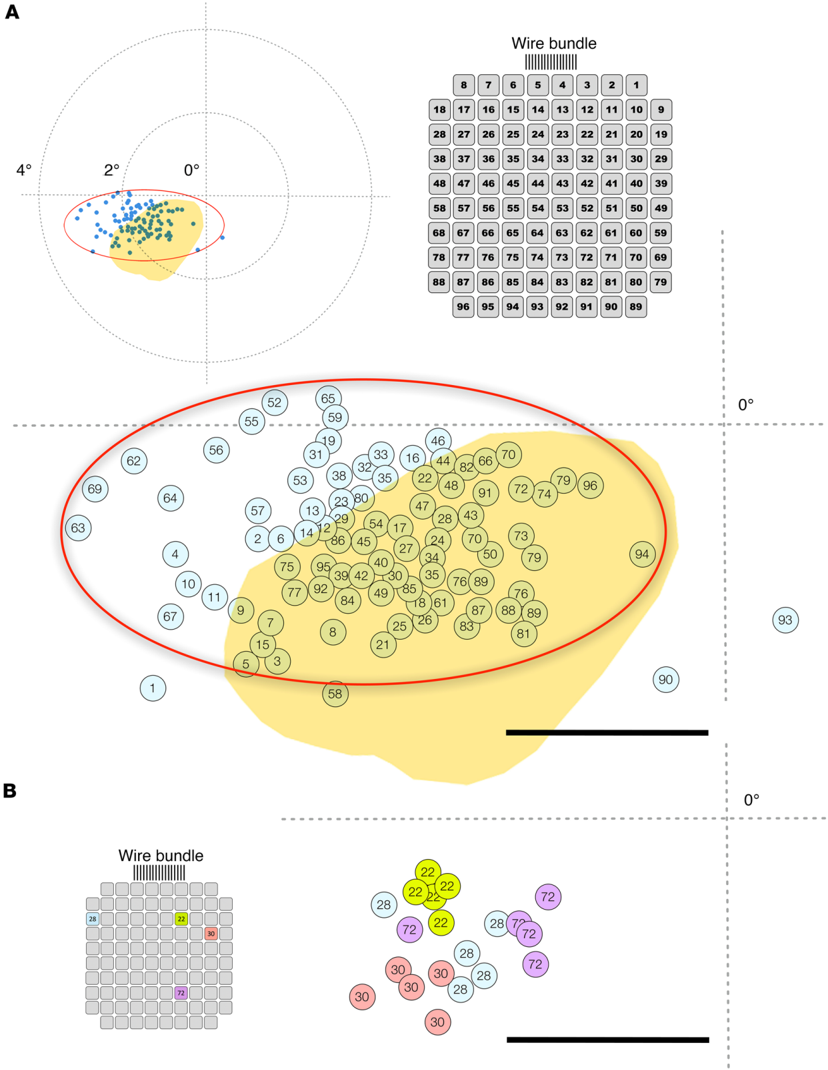
“There was also a good agreement between predicted phosphene locations based on our presurgical analysis (refs. 22, 23; yellow area in Figure 5A) and the reported locations of the evoked phosphenes (blue dots with electrode numbers in Figure 5A).”
What the sources say
- Supportedcites [22] Benson NC, et al. The retinotopic organization of striate cortex is well predicted by surface topology. Curr Biol . 2012;22(21):2081-2085. https://doi.org/10.1016/j.cub.2012.09.014 source
The citation is attached to the citing authors’ presurgical prediction method, not to their observed agreement with evoked phosphenes. The source’s Results describe predicting an individual’s retinotopic map from an anatomical brain image, which supports its use for that method; the phosphene comparison is the citing authors’ own finding. (LLM, conf=0.86)
- Partly supportedcites [23] Butt OH, et al. The fine-scale functional correlation of striate cortex in sighted and blind people. J Neurosci . 2013;33(41):16209-16219. https://doi.org/10.1523/JNEUROSCI.0363-13.2013 sourceExperimental — accuracy not yet measured
The Introduction and Discussion describe using cortical anatomy to predict retinotopic positions in blind and sighted people, which supports the basis for predicting visual-field locations. The paper does not report presurgical phosphene predictions, evoked phosphenes, or agreement between predicted and reported locations; that agreement is presented as the citing authors’ own finding. (LLM, conf=0.76)
plainstates an associationSingle case- Asserted: passes — The authors put it forward as true.
- Checkable: passes — It can be checked against evidence.
- Load-bearing: passes — The paper’s conclusions depend on it.
- Based: passes — The paper gives a reason why it holds.
- Supported
The cited sources support only part of this claim — read each source’s verdict below.
In the paper
“Individuals with profound blindness generally do not live in a world of total blackness but experience a variety of spontaneous phosphenes (18, 19)”
What the sources say
- Partly supportedcites [18] Bittner AK, et al. Photopsias are related in part to perceived stress and positive mood in retinitis pigmentosa. Eye (Lond) . 2012;26(1):101-108. https://doi.org/10.1038/eye.2011.247 sourceExperimental — accuracy not yet measured
The Results report several types of spontaneous photopsias in people with retinitis pigmentosa, including flashes, dots or shapes, glare, and background glow. But the study concerns people with retinitis pigmentosa who underwent vision testing; it does not establish that individuals with profound blindness generally have these experiences or do not perceive total blackness (Results and Data collection; page not available). (LLM, conf=0.87)
- Not checked — no full text of the sourcecites [19] Boller F, et al. Charles bonnet syndrome and other hallucinatory phenomena. Front Neurol Neurosci . 2018;41:117-124. source
plain- Asserted: passes — The authors put it forward as true.
- Checkable: passes — It can be checked against evidence.
- Load-bearing: passes — The paper’s conclusions depend on it.
- Based: passes — The paper gives a reason why it holds.
- Partly supported
90 more claims · 1 with their cited sources checked
Create a free account to see all 170 claims and every source verdict.
- Probably not a substantial claim. 34
- It may state two separate claims as one. 50
- The quote only partly states this claim. 1
Claims other papers make about this one
Each is checked against this paper’s own text: does it say what the citing paper says it does?
The source backs part of the claim, not all of it — or backs it for a different population, condition or comparison.
In the citing paper
“However, since the goal is not primarily to create natural vision, it suffices that phosphene characteristics are distinct and stable over time, which is the case for current implants (Luo et al., 2016; Fernández et al., 2021).”
From Towards a Smart Bionic Eye : AI-powered artificial vision for the treatment of incurable blindness (2022) · cites this paper as Fernández et al., 2021
Experimental — accuracy not yet measuredThe source backs part of the claim, not all of it — or backs it for a different population, condition or comparison.
In the citing paper
“However, empirical data show that phosphenes are not symmetric, either for retinal101 or cortical42 implants.”
From Visual Prostheses in the Era of Artificial Intelligence Technology (2025) · cites this paper as [42]
Experimental — accuracy not yet measuredThe source backs part of the claim, not all of it — or backs it for a different population, condition or comparison.
In the citing paper
“Note that the effects found by Fernández et al., 2021 (that were modeled by us) are consistent with findings by other studies, which report brighter phosphenes for higher stimulation strengths (Schmidt et al., 1996), and a lower stimulation efficiency (i.e. higher total charge thresholds) for longer pulse trains or higher pulse widths and frequencies (Niketeghad et al., 2020).”
From Towards biologically plausible phosphene simulation for the differentiable optimization of visual cortical prostheses (2024) · cites this paper as Fernández et al., 2021
Experimental — accuracy not yet measuredThe source backs part of the claim, not all of it — or backs it for a different population, condition or comparison.
In the citing paper
“The conscious perception of phosphenes requires considerable training and the detection process is influenced by attention (Fernández et al., 2021).”
From Towards biologically plausible phosphene simulation for the differentiable optimization of visual cortical prostheses (2024) · cites this paper as Fernández et al., 2021
Experimental — accuracy not yet measuredThe source backs part of the claim, not all of it — or backs it for a different population, condition or comparison.
In the citing paper
“more recent work has highlighted that the percepts resulting from multi-electrode stimulation cannot be explained by a summative model based on single-electrode phosphenes (Beauchamp et al., 2020; Barry et al., 2020; Fernández et al., 2021).”
From Towards a Smart Bionic Eye : AI-powered artificial vision for the treatment of incurable blindness (2022) · cites this paper as Fernández et al., 2021
Experimental — accuracy not yet measured
11 more claims about this paper
Create a free account to see every claim other papers make about this one.
Citations
Cites
SciPy 1.0: fundamental algorithms for scientific computing in Python
Virtanen, P., Gommers, R., Oliphant, T. E., Haberland, M., Reddy, T., Cournapeau, D., Burovski, E., Peterson, P., Weckesser, W., Bright, J., et al. (2020) · Nature Methods · doi:10.1038/s41592-019-0686-2 · Cited by 38,430
SciPy 1.0: fundamental algorithms for scientific computing in Python
Virtanen, P., Gommers, R., Oliphant, T. E., Haberland, M., Reddy, T., Cournapeau, D., Burovski, E., Peterson, P., Weckesser, W., Bright, J., et al. (2019) · Apollo - University of Cambridge Repository · doi:10.17863/cam.64134 · Cited by 10,460
The sensations produced by electrical stimulation of the visual cortex
Brindley, G. S., & Lewin, W. S. (1968) · The Journal of Physiology · doi:10.1113/jphysiol.1968.sp008519 · Cited by 1,170
High-performance brain-to-text communication via handwriting
Willett, F. R., Avansino, D. T., Hochberg, L. R., Henderson, J. M., & Shenoy, K. V. (2021) · Nature · doi:10.1038/s41586-021-03506-2 · Cited by 1,024 · cited 1×
“A recent systematic review of human neuroprosthetic research using the UEA reported that the mean number of days of UEA implantation across all participants at the time of the study was at least 578 days (30), and several studies indicate that UEAs retain their functionality in humans for more than 1000 days (29, 31).”
Restoring cortical control of functional movement in a human with quadriplegia
Bouton, C. E., Shaikhouni, A., Annetta, N. V., Bockbrader, M. A., Friedenberg, D. A., Nielson, D. M., Sharma, G., Sederberg, P. B., Glenn, B. C., Mysiw, W. J., et al. (2016) · Nature · doi:10.1038/nature17435 · Cited by 924
Intracortical microstimulation of human somatosensory cortex
Flesher, S. N., Collinger, J. L., Foldes, S. T., Weiss, J. M., Downey, J. E., Tyler-Kabara, E. C., Bensmaia, S. J., Schwartz, A. B., Boninger, M. L., & Gaunt, R. A. (2016) · Science Translational Medicine · doi:10.1126/scitranslmed.aaf8083 · Cited by 704 · cited 1×
“Although the duration of this study was limited to 6 months, UEAs have been successfully implanted in human subjects in numerous studies (25–29) and these devices have continued to work for many years.”
Schmidt, E. M., Bak, M. J., Hambrecht, F. T., Kufta, C. V., O'Rourke, D. K., & Vallabhanath, P. (1996) · Brain · doi:10.1093/brain/119.2.507 · Cited by 672 · cited 6×
“We found similar results in previous animal experiments (35), and the visual prosthesis work with intracortical microelectrodes of Schmidt and colleagues also indicates that there is some variability phosphene location (10).”
InfluentialDecoding motor imagery from the posterior parietal cortex of a tetraplegic human
Aflalo, T., Kellis, S., Klaes, C., Lee, B., Shi, Y., Pejsa, K., Shanfield, K., Hayes-Jackson, S., Aisen, M., Heck, C., et al. (2015) · Science · doi:10.1126/science.aaa5417 · Cited by 649
A model of safe levels for electrical stimulation
Shannon, R. V. (1992) · IEEE Transactions on Biomedical Engineering · doi:10.1109/10.126616 · Cited by 526 · cited 3×
“Current-induced tissue damage during electrical stimulation was avoided by keeping stimulus charge density below the damage threshold boundary (20, 21).”
Dobelle, W. H., & Mladejovsky, M. G. (1974) · The Journal of Physiology · doi:10.1113/jphysiol.1974.sp010766 · Cited by 468
Research works printed but not linked: 1
- Brindley, 1968, Short and long-term stability of cortical electrical phosphenes, J Physiol, 196, 479, 10.1113/jphysiol.1968.sp008519 · DOI · Paper page
Cited by
Items 101–200 of 232
The Role of Scalp EEG Recordings During Cortical Visual Prosthesis Testing
Stephan, K., Troyk, P. R., Dagnelie, G., Cogan, S. F., Barry, M. P., Grant, P., Lane, F. J., Szlyk, J. P., McNulty, M. L., van Drongelen, W., et al. (2025) · Artificial Organs · doi:10.1111/aor.15023 · Cited by 6
Schelles, M., Lievens, W., Goyvaerts, L., Ceyssens, F., Muller, R., & Kraft, M. D. (2025) · IEEE Access · doi:10.1109/access.2025.3581460 · Cited by 7
“…and surrounding electronics, is the highly varying number of active electrodes and therefore power consumption over a time scale of several minutes [24], while preserving a steady high supply voltage for the implant, required to achieve the high compliance voltage necessary for electrical…”
Optimization of sputtered iridium oxide microelectrodes for long-term intracortical stimulation
Schelles, M., Goyvaerts, L., Merken, L., Janssen, P., Ceyssens, F., & Kraft, M. D. (2025) · Biomedical Physics & Engineering Express · doi:10.1088/2057-1976/adfdec · Cited by 6
Lozano, A., Chen, X., Grouw, M. L., Li, B., Wang, F., van der Grinten, M., Soto‐Sánchez, C., Morales-Gregorio, A., Fernández, E., & Roelfsema, P. R. (2025) · Brain stimulation · doi:10.1016/j.brs.2025.103019 · Cited by 6
Self-citationIndustry 6.0 and the Digital Transformation of Healthcare and Pharmaceuticals
Majeed, H., & Iftikhar, T. (2026) · Springer eBooks · doi:10.1007/978-3-032-07278-8_12 · Cited by 5
van Stuijvenberg, O. C., Bassil, K. C., de Vos, C. C., Geleijnse, G., Noordmans, H. J., Broekman, M. L. D., van der Graaf, R., Bertens, R., Lázaro‐Muñoz, G., & Jongsma, K. R. (2026) · Neuromodulation Technology at the Neural Interface · doi:10.1016/j.neurom.2025.12.011 · Cited by 5
“3,21,23 Clear communication of the study’s goals, demands, and realistic outcomes helps mitigate therapeutic misconception, misplaced hope, or despair, while distinguishing these from legitimate treatment search fatigue, 49 and prevents false hope reinforced by media-driven narratives about…”
A novel simulation paradigm utilising MRI-derived phosphene maps for cortical prosthetic vision
Wang, H. Z., & Wong, Y. T. (2023) · Journal of Neural Engineering · doi:10.1088/1741-2552/aceca2 · Cited by 5
“For example, consecutive stimulation of the same site might decrease phosphene brightness [5, 8, 65], but this is not replicated in a more recent human trial [12].”
BackgroundMethodInfluentialOlder Women Images and Technologies to Increase Gender Peace in Crisis and COVID-19 Times
Zorrilla-Muñoz, V., Tomás, M. S. A., Donio‐Bellegarde, M., Forjaz, M. J., Fernández, E., Rodríguez‐Blázquez, C., Ayala, A., & Fernández‐Mayoralas, G. (2022) · Lecture notes in computer science · doi:10.1007/978-3-031-05654-3_30 · Cited by 4
Self-citationA 128-channel real-time VPDNN stimulation system for a visual cortical neuroprosthesis
Mohamed, H., Raducanu, B., Kiselev, I., Wang, Z., Küçükoğlu, B., Rueckauer, B., van Gerven, M. A. J., López, C. M., & Liu, S. (2023) · IEEE Biomedical Circuits and Systems Conference (BioCAS) · doi:10.1109/biocas58349.2023.10389055 · Cited by 3
Horizon Cyber-Vision: A Cybernetic Approach for a Cortical Visual Prosthesis
Calvo, M. V., Ruiz, R. M., Soo, L., Wacławczyk, D., Grani, F., Vicente, J. M. F., & Jover, E. F. (2022) · Lecture notes in computer science · doi:10.1007/978-3-031-06242-1_38 · Cited by 4
Ultra-Miniaturised CMOS Current Driver for Wireless Biphasic Intracortical Microstimulation
Barbruni, G. L., Ros, P. M., Demarchi, D., Carrara, S., & Ghezzi, D. (2022) · International Conference on Modern Circuits and Systems Technologies · doi:10.1109/mocast54814.2022.9837681 · Cited by 3
“For example, it has been shown that the threshold to evoke phosphenes in the human visual cortex via intracortical microstimulation is in the order of 20− 60 μA [17].”
BackgroundEditorial: Safety and efficacy evaluation of electrical stimulation devices for neural modulation
Ye, M., Zestos, A. G., Welle, C. G., Wu, G. K., & Cui, X. T. (2023) · Frontiers in Neuroscience · doi:10.3389/fnins.2023.1143989 · Cited by 4
“For example, multiple studies showed that the threshold for restoring motor or sensory function through intracortical stimulation ranges from 3 to 10 nC per phase and the sensation features can be finely tuned by adjusting the stimulation intensity up to 20 nC (Kim et al., 2015a; Flesher et al., 2016; Fernández et al.…”
BackgroundLarge-scale RF mapping without visual input for neuroprostheses in macaque and human visual cortexPreprint
Lozano, A., Chen, X., Grouw, M. L., Li, B., Wang, F., van der Grinten, M., Soto‐Sánchez, C., Morales-Gregorio, A., Fernández, E., & Roelfsema, P. R. (2024) · medRxiv · doi:10.1101/2024.12.22.24319047 · Cited by 3
Self-citationEvaluating Deep Human-in-the-Loop Optimization for Retinal Implants Using Sighted Participants
Schoinas, E., Rastogi, A., Carter, A., Granley, J., & Beyeler, M. (2025) · arXiv · doi:10.48550/arxiv.2502.00177 · Cited by 3
Visual Prostheses in the Era of Artificial Intelligence Technology
Sarbout, I., Gungor, A., Ounissi, M., Zaher, S., Ptito, M., Kupers, R., Racoceanu, D., & Milea, D. (2025) · Eye and Brain · doi:10.2147/eb.s524322 · Cited by 3
“However, empirical data show that phosphenes are not symmetric, either for retinal 101 or cortical 42 implants.”
Intracortical microstimulation induces rapid microglia process convergence
Williams, N. P., Kelly, A. M., Zheng, X. S., Vazquez, A. L., & Cui, X. T. (2025) · Biomaterials · doi:10.1016/j.biomaterials.2025.123732 · Cited by 4
Perceptual learning of prosthetic vision using video game training
Esquenazi, R., Meier, K., Beyeler, M., Wright, D., Boynton, G. M., & Fine, I. (2025) · Journal of Vision · doi:10.1167/jov.25.12.12 · Cited by 3
“Retinal implants are currently the only devices approved for commercial implantation in patients, though a variety of cortical implants and optogenetic technologies are in clinical trials (Fernandez et al., 2021; Mohanty et al., 2025; Provansal, Marazova, Sahel, & Picaud, 2022; Sahel et al., 2021).”
Forrest, A. M., Kunigk, N. G., Collinger, J. L., Gaunt, R. A., Chen, X., Geest, J. P. V., & Kozai, T. D. Y. (2025) · Journal of Neural Engineering · doi:10.1088/1741-2552/ae1bda · Cited by 3
Self-citationA brain-computer interface roadmap for diagnosing and treating neurological disorders
Sun, G., Wang, Y., Liu, H., Weng, L., Li, X., He, W., Sun, J., Liang, S., Kong, W., Dong, J.-Z., et al. (2025) · The Innovation Informatics · doi:10.59717/j.xinn-inform.2025.100016 · Cited by 2
Evaluating Deep Human-in-the-Loop Optimization for Retinal Implants Using Sighted Participants
Schoinas, E., Rastogi, A., Carter, A., Granley, J., & Beyeler, M. J. (2025) · Annual International Conference of the IEEE Engineering in Medicine and Biology Society (EMBC) · doi:10.1109/embc58623.2025.11253762 · Cited by 5
“Phosphenes—the artificial visual percepts evoked by stimulation—vary widely across individuals [6], [9]–[11] and often do not combine linearly [12]–[14], suggesting the presence of a nonlinear transfer function between electrical stimuli and perceptual outcomes.”
Brain-computer interface: an update for the clinicians
Jain, A., Raveendran, S., Nair, K. P. S., & Ramakrishnan, S. (2026) · Frontiers in Human Neuroscience · doi:10.3389/fnhum.2026.1777024 · Cited by 6
“Patient was able to perceive phosphenes and object boundaries; Bacher et al., 2015; Vansteensel et al., 2016; Pandarinath et al., 2017; Fernández et al., 2021; Willett et al., 2021; Chaudhary et al., 2022; Greenspon et al., 2023; Metzger et al., 2023).”
Sortino, R., González-Díez, A., Navarro, S. M., Martínez‐Tambella, J., Paleo‐García, V., Calatayud, E., de Saralegui, P., Opar, E., Claparols, À., Quintanilla, J. A., et al. (2026) · Journal of the American Chemical Society · doi:10.1021/jacs.5c18611 · Cited by 2
In vivo recording of visually evoked potentials with novel full diamond ECoG implants
Wilfinger, F. C., Zhang, J. M., Nguyen, D., Dégardin, J., Bergonzo, P., Picaud, S. A., Borda, E., Ghezzi, D., Scorsone, E., Lissorgues, G., et al. (2024) · Diamond and Related Materials · doi:10.1016/j.diamond.2024.111335 · Cited by 3
Grani, F., Soto‐Sánchez, C., Doblado, A. R., Grima, M. D., Farfán, F. D., Calvo, M. V., Soo, L., Wacławczyk, D., Ferrandez, J., González, P., et al. (2022) · Lecture notes in computer science · doi:10.1007/978-3-031-06242-1_51 · Cited by 3
Self-citationAn 11 V-tolerant, high-density neurostimulator using time-domain calibration in 65 nm CMOS
Feyerick, M., & Dehaene, W. (2022) · IEEE Biomedical Circuits and Systems Conference (BioCAS) · doi:10.1109/biocas54905.2022.9948626 · Cited by 2
“200 Hz repetition rate for visual cortical stimulation [12], [13], one can find a leading phase peak amplitude of 5.”
BackgroundEye‐Mimicked Neural Network Composed of Photosensitive Neural Spheroids with Human Opsin Proteins
Park, B., Bang, S., Hwang, K. S., Chi, Y. K., Kwak, J., Tran, N. L., Kim, H., Park, S., Oh, S. J., Im, M., et al. (2023) · Advanced Materials · doi:10.1002/adma.202302996 · Cited by 2
Towards a Smart Bionic Eye: AI-Powered Artificial Vision for the Treatment of Incurable BlindnessPreprint
Beyeler, M., & Garcia, M. S. (2022) · doi:10.31219/osf.io/fpdyv · Cited by 2
Human single neuron recordings
Fu, Z., & Rutishauser, U. (2022) · Elsevier eBooks · doi:10.1016/b978-0-12-820480-1.00002-4 · Cited by 3
Bipolar intracortical microstimulation expands the repertoire of neuronal activation patterns
Schelles, M., Verhaege, A., Rompaey, N. V., Goyvaerts, L., Wierda, K. D. B., Ceyssens, F., Kraft, M. D., & Bonin, V. (2026) · Journal of Neural Engineering · doi:10.1101/2025.03.21.644593 · Cited by 3
“Higher current amplitudes recruit larger neural populations, resulting in larger and less precise phosphenes [8,35], highlighting the need for more selective stimulation.”
Kim, K., Sonego, V., Strohmer, B., Chang, B., Liu, X., Yonza, A. K. I., Kucharz, K., Asiminas, A., Lind, B. L., Tao, L., et al. (2025) · bioRxiv (Cold Spring Harbor Laboratory) · doi:10.1101/2025.06.25.661479 · Cited by 1
“Yet, percepts induced by such multi-electrode arrays often remain rudimentary; in primates, recognition performance with multi-site ICMS is typically compromised (11, 18).”
Stürmer, S., Bolz, S., Zrenner, E., Ueffing, M., & Haq, W. (2024) · International Journal of Molecular Sciences · doi:10.3390/ijms25031616 · Cited by 1
“…approaches in which sustained electrical stimulation is delivered to excitable neuronal tissue facilitating GJ-nets, such as through retinal implants [5,6], transcorneal electrical stimulation [75,76], cochlear implants [77,78], cortical implants for vision [7], and cortical seizures [41,43].”
BackgroundPark, S., Lipton, M. H., Sun, Y. J., & Dadarlat, M. C. (2024) · STAR Protocols · doi:10.1016/j.xpro.2024.103027 · Cited by 1
Letner, J. G., Lam, J. L. W., Copenhaver, M. G., Barrow, M., Patel, P. R., Richie, J. M., Lee, J., Kim, H.-S., Cai, D., Weiland, J. D., et al. (2026) · Frontiers in Neuroscience · doi:10.3389/fnins.2026.1848862 · Cited by 2
Nokura, T., Tamaki, T., & Hayashida, Y. (2024) · Biomedical Engineering International Conference · doi:10.1109/bmeicon64021.2024.10896365 · Cited by 1
“…have explored the feasibility of intra-cortical visual prostheses, where electrical current pulses are delivered from penetrating electrode tips into the primary visual cortex (V1) in the cerebrum to evoke spatially localized perceptions of light, known as phosphenes, in blind subjects [1][2].”
How pain fools everyone: An inference to the best explanation
Key, B., & Brown, D. J. (2025) · Neuroscience & Biobehavioral Reviews · doi:10.1016/j.neubiorev.2025.106317 · Cited by 1
Enabling Neuroprostheses via Machine Learning
Chen, Q., Lin, P., Yu, Z., & Pan, G. (2025) · Machine Intelligence Research · doi:10.1007/s11633-025-1571-3 · Cited by 2
A 128‐channel Flexible Probe for Stable Neural Recording in the Visual Cortex
Tu, K., Chen, Q., Zheng, H. R., Xu, Q., Jiang, C., Cao, J., Wen, D., Li, Z., Wei, N., Chen, H., et al. (2025) · Advanced Materials Technologies · doi:10.1002/admt.202501171 · Cited by 1
Yan, H., Han, Y., Shan, X., Li, H., Liu, F., Li, P., Yuan, Y., Zhao, J., & Guo, W. (2025) · Journal of Affective Disorders · doi:10.1016/j.jad.2025.120449 · Cited by 1
Neural population dynamics of direct electrical stimulation of neocortex
Hickman, J. L., Hughes, G., Sahai, E., Miles, M., & Denman, D. J. (2026) · Cell Reports · doi:10.1016/j.celrep.2026.117420 · Cited by 2
Visual Neurorestoration: An Expert Review of Current Strategies for Restoring Vision in Humans
Cavaleri, J., Lin, M. P., Wu, K., Gilbert, Z. D., Huang, C. Y., Lo, Y. T., Garimella, V., Dallas, J., Briggs, R. G., Borja, A. J., et al. (2025) · Brain Sciences · doi:10.3390/brainsci15111170 · Cited by 1
Object recognition from sparse simulated phosphenes and curved segments
Scialom, E., Ernst, U. A., Rotermund, D., & Herzog, M. H. (2025) · Vision Research · doi:10.1016/j.visres.2025.108718 · Cited by 5
Increasing the quantity of electrical stimulation pulses reduces cortical response inhibition
Meikle, S. J., Hagan, M. A., Price, N. S. C., & Wong, Y. T. (2025) · Brain stimulation · doi:10.1016/j.brs.2025.103003 · Cited by 1
Terakura, Y., Yamada, K., Fukuda, S., et al. (2025) · International Conference on Intelligent Informatics and Biomedical Sciences (ICIIBMS) · doi:10.1109/iciibms66230.2025.11316709 · Cited by 1
“Intracortical microstimulation has been investigated in clinical trials of visual prostheses as a means to elicit artificial visual sensations, known as phosphenes, in individuals with acquired blindness [1].”
Fukuda, S., & Hayashida, Y. (2026) · Frontiers in Neuroscience · doi:10.3389/fnins.2025.1710221 · Cited by 1
Fuzzing the brain: automated stress testing for the safety of ML-driven neurostimulation
Downing, M., Peng, M., Granley, J., Beyeler, M., & Bultan, T. (2026) · Journal of Neural Engineering · doi:10.1088/1741-2552/ae4927 · Cited by 3
Meyer, L. M., & Zamani, M. (2026) · Journal of Neural Engineering · doi:10.1088/1741-2552/ae6dfd · Cited by 1
“…arrays in nonhuman primates ( ∼ 10 3 sites across V1/V4) enable immediate recognition of simple shapes and letters from spatiotemporal stimulation patterns [138], and first-in-human implants with ∼ 10 2 occipital channels have produced discrim-inable letters and object boundaries [133].”
Long-term safety and efficacy of intracortical microstimulation in humans
Greenspon, C. M., Hobbs, T. G., Verbaarschot, C., Alamri, A. H., Shelchkova, N. D., Lienkämper, R., Ye, J., Simpson, T. W., Weiss, J. M., Weir, D., et al. (2026) · Science Translational Medicine · doi:10.1126/scitranslmed.aec3728 · Cited by 11
Rassia, K. E. K., Liapi, L., & Pezaris, J. S. (2026) · Progress in Retinal and Eye Research · doi:10.1016/j.preteyeres.2026.101494 · Cited by 2
Advancing data protections for implantable brain-computer interfaces
Sandbrink, J. D., & Young, M. J. (2026) · Communications Medicine · doi:10.1038/s43856-026-01797-y · Cited by 2
What biology can and cannot tell us about conscious AI
Klatzmann, U., & Doerig, A. (2026) · Trends Open · doi:10.1016/j.treopn.2026.07.012 · Cited by 3
“Researchers recently implanted electrodes in the occipital cortex of a blind patient, and successfully evoked simple conscious visual percepts 29 (more detailed percepts were evoked in monkeys 30 ).”
Hu, Y., Feng, Z., Zheng, L., & Ye, X. (2023) · Journal of Neural Engineering · doi:10.1088/1741-2552/acf959 · Cited by 2
Kim, Y. H., Koo, H., Kim, M. S., & Jung, S.-D. (2023) · Biomaterials Advances · doi:10.1016/j.bioadv.2023.213629 · Cited by 1
Wang, Q., Chen, G., Wang, X., Yang, R., Luo, L., Ding, H., Teng, P., Wang, J., He, L., Ren, J., et al. (2024) · Brain stimulation · doi:10.1016/j.brs.2024.03.003 · Cited by 2
“We observed that during the 11 – 29 s period following the onset of iES, the firing rates were higher in the visible trials compared to the invisible ones (all p s < 0.05; paired t -tests), which was consistent with a previous study [8].”
MethodResultInfluentialHinrichs, S., Placidet, L., Duret, A., Authié, C., Arleo, A., & Ghezzi, D. (2024) · Journal of Neural Engineering · doi:10.1088/1741-2552/ad8b6f · Cited by 1
“Similarly, prior experiments on patients with artificial vision have mainly been conducted in controlled environments using simple and stereotyped tasks [18, 24, 25, 54, 55].”
Okada, R., Ishikawa, S., Tasaki, T., Yagi, T., & Hayashida, Y. (2022) · Proceedings of International Conference on Artificial Life and Robotics · doi:10.5954/icarob.2022.os6-5 · Cited by 1
The Assessment of Activities of Daily Living Skills Using Visual Prosthesis
Wacławczyk, D., Soo, L., Val, M., Ruiz, R. M., Grani, F., & Fernández, E. (2022) · Lecture notes in computer science · doi:10.1007/978-3-031-06242-1_39 · Cited by 2
Self-citationSaalmann, Y. B., Mofakham, S., Mikell, C. B., et al. (2022) · SSRN Electronic Journal · doi:10.2139/ssrn.4124479 · Cited by 1
Fine, I., & Boynton, G. (2023) · bioRxiv · doi:10.1101/2023.03.18.532424 · Cited by 1
“Very similar amplitude-size functions have also been observed by Fernandez et al.53.”
BackgroundIn Vivo Recording of Visually Evoked Potentials with Novel Full Diamond Ecog ImplantsPreprint
Wilfinger, C., Zhang, J., Nguyen, D., et al. (2023) · SSRN Electronic Journal · doi:10.2139/ssrn.4630713 · Cited by 1
A novel interface for cortical columnar neuromodulation with multi-point infrared neural stimulationPreprint
Tian, F., Zhang, Y., Schriver, K. E., et al. (2024) · bioRxiv (Cold Spring Harbor Laboratory) · doi:10.1101/2024.02.25.581906 · Cited by 1
Human Single Neuron RecordingsPreprint
Fu, Z., & Rutishauser, U. (2024) · PsyArXiv (OSF Preprints) · doi:10.31234/osf.io/57wzm · Cited by 1
Minimizing the number of phosphenes required for object recognition under prosthetic visionPreprint
Scialom, E., Ernst, U. A., Rotermund, D., & Herzog, M. H. (2024) · bioRxiv (Cold Spring Harbor Laboratory) · doi:10.1101/2024.09.26.614440 · Cited by 1
Zou, Y., Niu, H., Zhao, B., Yi, G.-L., Yang, M., Ju, J., Yin, J., & Li, C. (2025) · bioRxiv (Cold Spring Harbor Laboratory) · doi:10.1101/2025.11.12.688136 · Cited by 1
“Recent advances with high-channel-count micro-electrode arrays (96–1024 channels) demonstrate that intra-cortical stimulation can evoke shape-like percepts in both primates and humans (Chen et al. 2020; Fern´andez et al. 2021).”
Eye-mimicked neural network composed of photosensitive neural spheroids with human photoreceptorsPreprint
Park, B., Bang, S., Hwang, K. S., Cha, Y. K., Kwak, J., Tran, N. L., Kim, H., Park, S., Oh, S. J., Im, M., et al. (2022) · Research Square · doi:10.21203/rs.3.rs-2039569/v1
When Vision Is Unreliable: The Role of Play in Supporting Children
Akay, S., Kanero, J., & Alp, N. (2022) · Advances in psychology, mental health, and behavioral studies (APMHBS) book series · doi:10.4018/978-1-6684-5068-0.ch012
van Steveninck, J. D. R., Nipshagen, M., van Gerven, M. A. J., Güçlü, U., Güçlütürk, Y., & Wezel, R. J. A. V. (2023) · bioRxiv (Cold Spring Harbor Laboratory) · doi:10.1101/2023.09.18.558225
“Even given the rapid recent developments (for instance, see (7, 8)) it is clear that the quality of the prosthetic vision will be relatively elementary compared to natural vision.”
BackgroundRoBrain: Towards Robust Brain-to-Image Reconstruction via Cross-Domain Contrastive Learning
Liu, C., Du, C., & He, H. (2023) · Lecture notes in computer science · doi:10.1007/978-981-99-8067-3_17
Wang, H. Z., & Wong, Y. T. (2023) · Annual International Conference of the IEEE Engineering in Medicine and Biology Society (EMBC) · doi:10.1109/embc40787.2023.10341189
“If we substitute I with the current level used in intracortical stimulation, where I = 80 μA [2], we get AC = 0.34 mm.”
BackgroundMethodResultInfluentialMultichannel current-mode stimulator with channel-specific regulated power supply
Varkevisser, F., Costa, T. L., & Serdijn, W. A. (2023) · IEEE Biomedical Circuits and Systems Conference (BioCAS) · doi:10.1109/biocas58349.2023.10388577 · Cited by 1
Contemporary approaches towards emerging visual prosthesis technologies
Rashika, M., Atheena, M. P. S., & Mohammed, S. S. (2024) · i-manager s Journal on Material Science · doi:10.26634/jms.12.1.21033
Improvement of dynamic phosphene presentation for a cortical visual prosthesis is task-specific
Wang, H. Z., & Wong, Y. T. (2024) · Annual International Conference of the IEEE Engineering in Medicine and Biology Society (EMBC) · doi:10.1109/embc53108.2024.10782366
“Phosphene persistence was fixed at 250 ms for all conditions [5].”
Fukuda, S., Nomoto, T., Yagi, T., & Hayashida, Y. (2024) · Annual International Conference of the IEEE Engineering in Medicine and Biology Society (EMBC) · doi:10.1109/embc53108.2024.10782304
“This can be an underlying mechanism explaining the localized phosphene observed in the blind patients [1][2], despite the possibility of the direct activation of the passing axons near the stimulation site [5][6][7].”
A Bioelectric Router for Adaptive Isochronous NeurostimulationPreprint
Sahai, E., Hickman, J. L., & Denman, D. J. (2025) · bioRxiv (Cold Spring Harbor Laboratory) · doi:10.1101/2025.01.28.635122
“In addition to these expanding indications, clinical neural implants capable of iEBS are being tested as prospective sensory prosthetics[15, 16, 17] and for providing feedback to improve the quality and e ! cacy of motor brain-machine interfaces[18].”
Hinrichs, S., Tisserand, Y., Scialom, E., & Ghezzi, D. (2025) · bioRxiv (Cold Spring Harbor Laboratory) · doi:10.1101/2025.03.27.645647
Urban Technologies for Sustainable Aging: Addressing Vision Impairments in Older Populations
Martı́nez, G., Zorrilla-Muñoz, V., Sáenz‐de‐Cabezón, E., et al. (2025) · Lecture notes in networks and systems · doi:10.1007/978-3-031-95652-2_33
Self-citationSahai, E., Hickman, J. L., & Denman, D. J. (2025) · Scientific Reports · doi:10.1038/s41598-025-07568-4 · Cited by 1
“The Raspberry Pi 4B’s GPIO pins 22–27 manage the BRAINS board output enable and latch enable functions, while pins 5, 6, 12, 13, 16, 17, 19, and 26 handle digital input control.”
Exploring Cortical Connectivity of Visual Prosthesis Users: Resting-State Study
Arroyave, M. D. M. A., Farfán, F. D., Soo, L., Albarracín, A. L., & Fernández, E. (2025) · doi:10.3390/engproc2024081020
Self-citationSingh, S. L. R. R. (2025) · Lecture notes in computer science · doi:10.1007/978-3-032-00800-8_20
Farfán, F. D., Soo, L., Tagashira, C. E., Padilla, G. L., Saavedra, C., Parajón, M., & Fernández, E. (2025) · World Congress on Medical Physics and Biomedical Engineering, September 7 - 12, 2009, Munich, Germany · doi:10.1007/978-3-032-06401-1_107
Self-citationSuematsu, N., Vazquez, A. L., & Kozai, T. D. Y. (2026) · Biomaterials · doi:10.1016/j.biomaterials.2026.124276 · Cited by 4
Cortical neuroprostheses improve auditory coding and perception compared to cochlear implantsPreprint
Taylor, J. A., Jovanovic, N., Navntoft, C. A., et al. (2025) · bioRxiv (Cold Spring Harbor Laboratory) · doi:10.1101/2025.10.27.684780
“In vision restoration, intracortical stimulation of the visual cortex using Utah arrays has enabled blind patients to perceive borders, shapes, and even characters 19 .”
Mid-level visual features engage V4 to support sparse object recognition under uncertaintyPreprint
Loued‐Khenissi, L., Scialom, E., Lutti, A., Herzog, M., & Draganski, B. (2025) · bioRxiv (Cold Spring Harbor Laboratory) · doi:10.1101/2025.10.28.685033
Baroni, L., Picek, M., Patel, S. S., Tolias, A. S., & Antolík, J. (2025) · bioRxiv (Cold Spring Harbor Laboratory) · doi:10.1101/2025.11.03.684808
“Indeed, phosphenes induced by V1 stimulation have been reported to vary in their perceptual properties across electrodes, and simultaneous activation of multiple sites to often produce non-additive and inconsistent percepts rather than predictable composite images [27].”
Cortical Dynamics of Phosphene Perception: A Study Using EEG Signals
Farfán, F. D., Grani, F., Soo, L., et al. (2025) · doi:10.3390/engproc2024081024
Self-citationNeuronal Responses to Both Negative and Positive Pulses During HFS
Feng, Z. (2025) · Springer eBooks · doi:10.1007/978-981-95-4145-4_7
Hahn, N., Moure, P., & Liu, S. (2025) · Annual International Conference of the IEEE Engineering in Medicine and Biology Society (EMBC) · doi:10.1109/embc58623.2025.11253749
Investigation of Audio Controlled Edge Semantic Segmentation System for Visually Impaired People
Wang, Y., Wang, Z., Hahn, N., Cheng, L., & Liu, S. (2025) · Annual International Conference of the IEEE Engineering in Medicine and Biology Society (EMBC) · doi:10.1109/embc58623.2025.11252696
“Electrical stimulation of the visual cortex can induce perceptions of light, known as phosphenes [7], [8].”
Temporally-Varying Stimulations for Cortical Visual Neuroprosthetics using Spiking Neural Networks
Moure, P., Pak, T., Hahn, N., van Steveninck, J. D. R., & Liu, S. (2025) · Annual International Conference of the IEEE Engineering in Medicine and Biology Society (EMBC) · doi:10.1109/embc58623.2025.11251728
“The BMI comprises electrode arrays that deliver electrical pulses to neurons in the visual cortex, producing localized perceptions of light called phosphenes [9], [17].”
In vivo microstimulation stability of electrodeposited platinum-iridium on carbon fiber electrodes
Weiland, J. D., Koo, B., Paier, G., della Valle, E., Patel, P. R., & Chestek, C. A. (2025) · Annual International Conference of the IEEE Engineering in Medicine and Biology Society (EMBC) · doi:10.1109/embc58623.2025.11253521
Gamification Enhances User Engagement and Task Performance in Prosthetic Vision TestingPreprint
Turkstra, L. M., Johnson, B. A., Kartha, A., et al. (2025) · medRxiv · doi:10.64898/2025.12.20.25342740
Suzuki, U., Kato, D., Fukuda, S., Sugiura, T., & Hayashida, Y. (2025) · International Conference on Intelligent Informatics and Biomedical Sciences (ICIIBMS) · doi:10.1109/iciibms66230.2025.11316746
“To address these limitations, several strategies have been proposed, including stimulus wave-form optimization [4][5][6] or current steering with the use of multielectrode arrays [2][7][8].”
Christie, B. P., Acosta, N. N., Sadeghi, R., Kartha, A., Ewulum, C., Caspi, A., Tenore, F. V., Dagnelie, G., Klatzky, R. L., & Billings, S. (2026) · Journal of Neural Engineering · doi:10.1088/1741-2552/ae3d67 · Cited by 1
Varkevisser, F., Serdijn, W. A., & Costa, T. L. (2026) · Journal of Neural Engineering · doi:10.1088/1741-2552/ae409c · Cited by 1
“A binary search procedure was used to determine the stimulation threshold that led to a visual perception in 50% of the trials.”
Friend, Not Foe: Lowered Tissue Reactivity to Long‐Term Polyimide Implants
Orlemann, C., Santis, L. M. D., Neering, P., Boehler, C., Sharma, K., Aarts, A. A. A., Holzhammer, T., van Daal, R. J. J., Ruther, P., Asplund, M., et al. (2026) · Advanced Science · doi:10.64898/2026.02.06.703281 · Cited by 3
Self-citationYuina Terakura, K. Y., Terakura, Y., Fukuda, S., & Hayashida, Y. (2026) · Bioengineering · doi:10.3390/bioengineering13020231
“Consequently, this fixed stimulation was applied in an all-or-none manner at selected electrode positions to induce phosphene patterns, allowing the patient to detect contrast edges in input images [8].”
InfluentialPercept-Aware Surgical Planning for Visual Cortical Prostheses with Vascular Avoidance
Pogoncheff, G., Wang, A., Granley, J., & Beyeler, M. (2026) · Lecture notes in computer science · doi:10.1007/978-3-032-38236-8_30 · Cited by 1
Huang, Z. Z., Liu, R., Ma, X., Pang, Y., Li, Y., Ma, D., Yu, Z., Liu, J., Li, J., & Li, Z. (2026) · IEEE International Conference on Micro Electro Mechanical Systems (MEMS) · doi:10.1109/mems64181.2026.11419532
“The UEA has been extensively applied in human neuroscience and clinical studies, and has shown clear abilities in motor, visual, and linguistic function restoration [4-6].”
Perceptual awareness and visual cortex
Bachmann, T. (2026) · Elsevier eBooks · doi:10.1016/b978-0-443-29258-3.00018-5
Nonuniform spike count shared variability in the mouse early visual system
Hickman, J. L., Santiago‐Moreno, J., Hughes, G., Sahai, E., Garcia, N., & Denman, D. J. (2026) · Journal of Neurophysiology · doi:10.1152/jn.00382.2025
Metadata
- Authors
- Fernández, E., Alfaro, A., Soto-Sánchez, C., Gonzalez-Lopez, P., Lozano, A. M., Peña, S., Grima, M. D., Rodil, A., Gómez, B., Chen, X., Roelfsema, P. R., Rolston, J. D., Davis, T. S., & Normann, R. A.
- Affiliations
- Universitat de Miguel Hernández d'Elx (ES)
- Netherlands Institute for Neuroscience (NL)
- University of Utah (US)
- ORCID
- Venue
- Journal of Clinical Investigation
- Published
- 2021-12-01
- Volume
- 131
- Issue
- 23
- ISSN
- 0021-9738 (ISSN-L)
- 1558-8238
- PMC
- PMC8631600
- OpenAlex
- W3207382873
- Semantic Scholar
- 3fc2ad1299c6210f699eec7354757ffedb0bdc7a
- Cited by
- 246
- References
- 56
- Citations by year
- 2026: 63 · 2025: 69 · 2024: 31 · 2023: 42 · 2022: 40 · 2021: 1
- FWCI
- 10.33
- Type
- journal article
- Language
- en
- Open access
- bronze
- doi.org
- Locations
- Journal of Clinical Investigation (publishedVersion)
- PubMed Central (publishedVersion)
- PubMed (publishedVersion)
- Pure Amsterdam UMC (publishedVersion, cc-by)
- KNAW Research Portal (The Royal Netherlands Academy of Arts and Sciences) (publishedVersion, other-oa)
- KNAW research portal (Royal Academy of Art and Sciences (KNAW)) (publishedVersion, other-oa)
- VU Research Portal (publishedVersion, other-oa)
- Data Archiving and Networked Services (DANS) (submittedVersion, other-oa)
- Funders
- Spanish Ministerio de Ciencia Innovación y Universidades (RTI2018-098969-B-100)
- Generalitat Valenciana (PROMETEO/2019/119)
- Bidons Egara Research Chair of the University Miguel Hernández (2019)
- John Moran Eye Center of the University of Utah (2019)
- Topics
- Life Sciences › Neuroscience › Cellular and Molecular Neuroscience › Neuroscience and Neural Engineering
- Life Sciences › Neuroscience › Cognitive Neuroscience › Tactile and Sensory Interactions
- Life Sciences › Neuroscience › Cognitive Neuroscience › EEG and Brain-Computer Interfaces
- Keywords
- cortical visual prosthesis, intracortical microelectrode arrays, microstimulation, visual percepts, phosphenes, blindness, visual cortex, stimulation threshold, vision restoration
- MeSH terms
- Blindness, Electric Stimulation, Electrodes, Implanted, Female, Humans, Microelectrodes, Middle Aged, Occipital Lobe, Optic Nerve Diseases, Phosphenes, Retina, Vision, Ocular, Visual Cortex, Visual Perception, Treatment Outcome, Visual Prosthesis
About these checks
Registry, retraction, Cites and statistics results are computed, not judged, with one exception: a printed reference that no index lists is read once by a model before it counts as a citation error. Claims are extracted by a model and kept only when their quote appears verbatim in the text; each cited source is then checked, with a model’s help, for whether it says what the claim relies on. Those verdicts can be wrong — read the claim’s quote and the cited source before relying on one.
The claim verdicts this report counts are experimental: their accuracy is not yet measured.
A language model drew the claims from the paper on 2026-10-10, under version 3 of the claim definition (model deepseek-v4.1-flash, prompt extract-v3).
A second model labelled each claim on 2026-10-10 (model jev-1.13-20260917, definition revision gold-guideline-v0.2).
Cited sources are checked with a language model’s help (gpt-6-sol).
Statistics and arithmetic are recomputed, not judged.
Confidence bands are shown only for fields calibrated on our annotated test set. None is calibrated yet, so no band is shown.
What counts as a claim ›How we measure confidence ›How we check this ›
Are you an author, or do you see a problem with this page? Request a review
Data sources
Bibliographic data: Semantic Scholar, OpenAlex, Crossref.
Contains information from the Semantic Scholar Academic Graph Datasets, made available under the ODC Attribution License (ODC-BY 1.0).
Semantic Scholar’s data is described in: Kinney, R., et al. (2023). The Semantic Scholar Open Data Platform. arXiv:2301.10140.
