

Existential threat and responses to emotional displays of ingroup and outgroup members
Open accessThe DOI matches its Crossref record; 58 of the 65 references it cites were found in a registry or an index, and 1 are not checked yet; 10 of the 56 sources its claims cite were checked for support.
Abstract
The present research investigates how emotional displays shape reactions to ingroup and outgroup members when people are reminded of death. We hypothesized that under mortality salience, emotions that signal social distance promote worldview defense (i.e., increased ingroup favoritism and outgroup derogation), whereas emotions that signal affiliation promote affiliation need (i.e., reduced ingroup favoritism and outgroup derogation). In three studies, participants viewed emotional displays of ingroup and/or outgroup members after a mortality salience or control manipulation. Results revealed that under mortality salience, anger increased ingroup favoritism and outgroup derogation (Study 1), enhanced perceived overlap with the ingroup (Study 3), and increased positive facial behavior to ingroup displays—measured via the Facial Action Coding System (Studies 1 and 2) and electromyography of the zygomaticus major muscle (Study 3). In contrast, happiness decreased ingroup favoritism and outgroup derogation (Study 2), and increased positive facial behavior towards outgroup members (Study 3). The findings suggest that, in times of threat, emotional displays can determine whether people move away from unfamiliar others or try to form as many friendly relations as possible.
Verified 2026-11-22 · 1 reference not checked yet
Overview
CoChat Summary
## TL;DR
Across three studies, mortality salience changed how participants responded to emotional displays from ingroup and outgroup members: anger tended to trigger worldview defense, while happiness tended to trigger affiliation. The paper concludes that these effects are preliminary and small, but suggest that emotional context helps determine whether threat leads to distancing or connection.
## Key findings
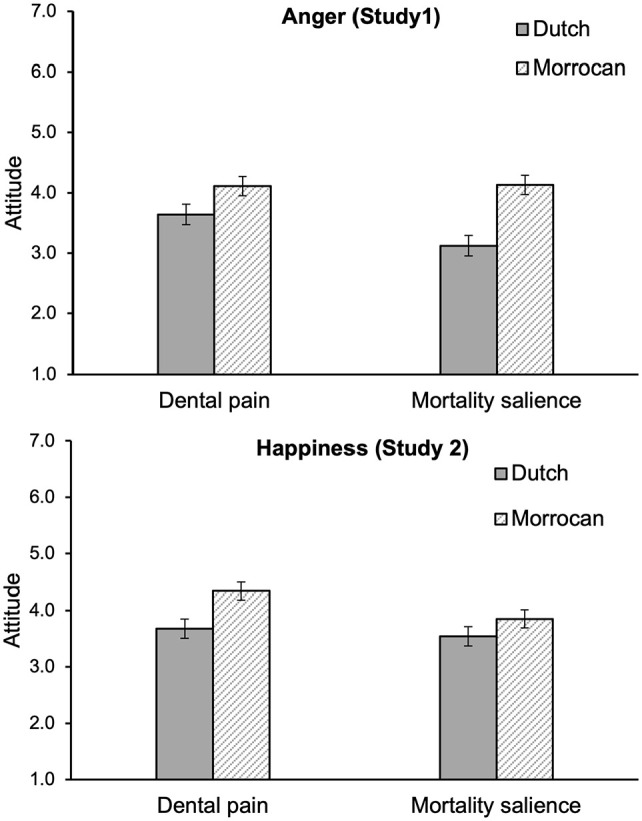
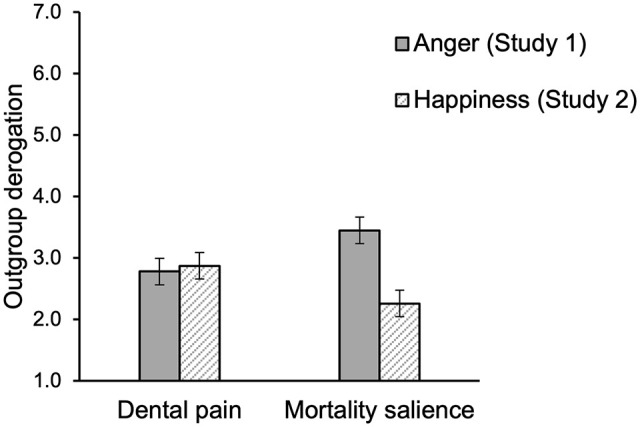
- Study 1 (anger displays): Under mortality salience, participants showed more outgroup derogation, with agreement to the statement that “the Koran is a violent and fascist book” higher in the mortality salience condition than control (M = 3.45 vs. 2.77, F(1, 90) = 4.28, p = .041, η² = .05).
- Study 1 (attitudes): The mortality salience × attitude target interaction was marginal, and under mortality salience the Dutch were rated more positively than Moroccans (Dutch M = 3.19 vs. Moroccan M = 4.13, F(1, 90) = 26.75, p < .001, η² = .23).
- Study 2 (happiness displays): Under mortality salience, outgroup derogation was lower than in control (M = 2.26 vs. 2.87, F(1, 90) = 4.69, p = .033, η² = .05), and the mortality salience effect on attitude target was not significant.
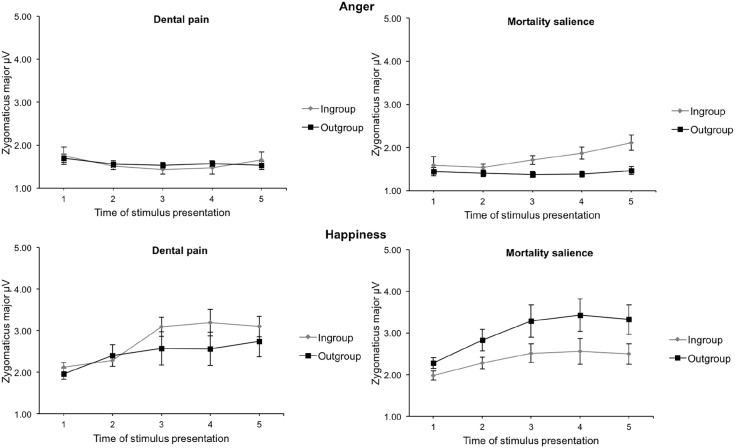
- Study 3 (EMG and IOS): Zygomaticus activity showed a three-way interaction (F(2, 143) = 5.93, p = .003, ηp² = .08); under mortality salience, participants smiled more to ingroup anger than outgroup anger (F(1, 47) = 8.36, p = .006, ηp² = .15) and more to outgroup happiness than ingroup happiness (F(1, 46) = 5.11, p = .03, ηp² = .10).
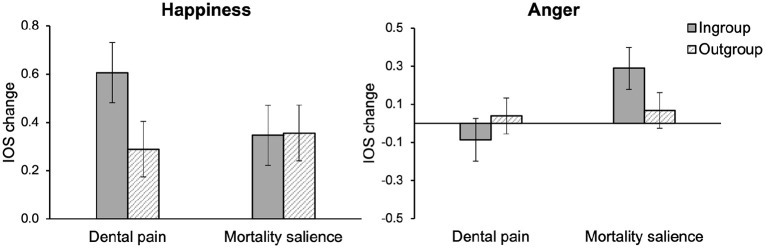
- Study 3 (perceived overlap): For anger, mortality salience increased perceived overlap with the ingroup more than the outgroup (F(1, 50) = 4.52, p = .04, ηp² = .08); for happiness, the ingroup-over-outgroup difference was present in control but not mortality salience.
## Methods
- Design: Three experiments with mortality salience vs. control manipulations, paired with emotional displays of ingroup vs. outgroup members; Study 1 used anger, Study 2 used happiness, and Study 3 used anger, happiness, and sadness with a more complex mixed design.
- Samples: Study 1 had 94 final participants from 101 recruited; Study 2 had 94 final participants from 100 recruited; Study 3 had 157 participants (minimum planned: 150).
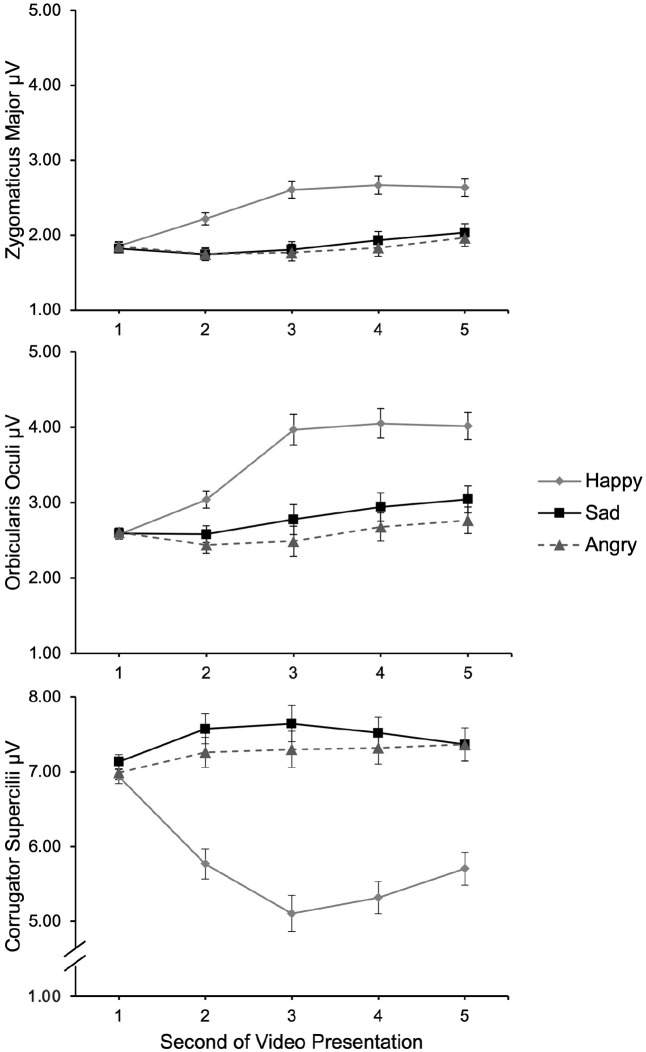
- Main analyses: Mixed ANOVAs/ANCOVAs tested mortality salience, emotion, and social category effects on self-reported attitudes/outgroup derogation, facial behavior (FACS in Studies 1–2; EMG in Study 3), and perceived overlap (IOS in Study 3).
## Limitations
- The paper states that FACS coding in Studies 1 and 2 was inconclusive and may not have been sensitive enough to detect subtle facial differences.
- The authors note that EMG in Study 3 measured only a limited number of muscle sites, so it may have missed other facial responses.
- Evident from the text: Study 1 and Study 2 used different emotions and between-subject social-category conditions, which the authors say limited direct comparisons across emotions and reduced power.
Model-written summary. Check it against the paper before relying on it.
Integrity signals
Registry
Cites
Statistics
Figures
Verification
Claims the paper makes
9 Valid · 0 Not valid · 26 Not checked · 91 Own results and interpretations
Every source the paper cites for this claim was checked and supports it.
In the paper
“research on terror management has also shown that under certain conditions, mortality salience can increase affiliation with others (for an overview, see Vail et al., 2012).”
§ Existential threat and responses to emotional displays of ingroup and outgroup members > Responses to Mortality: Worldview Defense and Affiliation Human beings, like all animals, have an instinctive drive for self-preservation. At the same time—and probably different from other animals—they know that they are eventually going to die. According to terror management theory (Greenberg et al., 1986, 1997; Solomon et al., 1991), the conflict between the human drive to survive and humans’ awareness of their mortality produces the potential for overwhelming anxiety (i.e., terror). In order to manage this anxiety, the theory proposes two anxiety-buffering systems: (a) cultures that offer worldviews and standards of value that can provide meaning beyond an individual’s existence, and (b) individuals’ self-esteem, which is defined as the extent to which one lives up to one’s cultural value system. The theory assumes that increased accessibility of death-related thoughts will result in a stronger need to affirm one’s cultural worldviews and to bolster one’s self-esteem. This traditional view of terror management theory has been tested extensively (for a meta-analysis, see Burke et al., 2010). After inducing mortality salience (e.g., via two open-ended questions about one’s death) and a delay task, participants typically defend their moral or cultural values. For example, they show increased ingroup favoritism (Greenberg et al., 1990), demand stronger punishments for people who violate their cultural norms (Florian & Mikulincer, 1997; Rosenblatt et al., 1989), and exhibit more aggression towards individuals who criticize their cultural beliefs (McGregor et al., 1998). Similarly, in order to bolster a positive self-image, they prefer to associate themselves with groups that provide a feeling of self-worth (e.g., Taubman Ben-Ari et al., 1999), while distancing themselves from groups that influence their self-worth negatively (Dechesne et al., 2000). Thus, generally speaking, mortality salience increases ingroup favoritism as well as outgroup derogation. Apart from these “classic” findings on the detrimental effects of mortality salience on perception and behavior towards outgroup members, research on terror management has also shown that under certain conditions, mortality salience can increase affiliation with others (for an overview, see Vail et al., 2012). For example, after mortality salience, people were more willing to initiate social interactions (Taubman Ben-Ari et al., 2002) and reported higher romantic commitment to their partners (Florian et al., 2002). The enhanced affiliation need after mortality salience even leads people to accept worldview-opposing individuals as a source of affiliation (Wisman & Koole, 2003). Past research has proposed two important contextual factors that can moderate whether people react with worldview defense or with affiliation strategies under mortality salience. First, when norms or values promoting positive intergroup attitudes are chronically or situationally accessible, mortality salience can bolster such outcomes (Jonas et al., 2008). For example, mortality salience reduced derogation of a U.S. critic when U.S. individuals had earlier completed a questionnaire on tolerance (Greenberg et al., 1992), and led to more favorable attitudes amongst White participants towards Black individuals when egalitarianism had been primed (Gailliot et al., 2008). Second, establishing personal connections or making a superordinate group identity salient can initiate a recategorization mechanism which leads people to expand their group boundaries and include members of otherwise different groups into their ingroup (Gaertner & Dovidio, 2000; Gaertner et al., 1993). After mortality salience, making a common superordinate group identity salient can decrease outgroup derogation (Giannakakis & Fritsche, 2011; Motyl et al., 2011). In sum, previous findings on the effects of mortality salience on distancing from and affiliation with outgroup members point in two different directions: When reminded of their mortality, people show either worldview defense strategies (i.e., derogation of an outgroup) or, under certain conditions, a tendency to affiliate with and include others (even worldview-threatening group members). We propose that others’ emotional displays might be an additional contextual factor that determines whether people respond with distancing or affiliation after mortality salience. In times of threat, subtle emotional signals might help to decide whether to exclude potential enemies or form as many friendships as possible.
What the sources say
- Supportedcites Vail et al., 2012 matched to “When Death is Good for Life: Considering the Positive Trajectories of Terror Management” (2012) source
The “Relationships and Social Bonds” section reports that mortality salience can strengthen romantic relationship commitment, particularly when a partner provides positive regard. It also says mortality salience can increase identification with social groups that offer positive self-reflection, while distancing people from others. These conditions support the citing sentence’s qualified claim. (LLM, conf=0.93)
plainstates a possible cause- Asserted: passes — The authors put it forward as true.
- Checkable: passes — It can be checked against evidence.
- Load-bearing: passes — The paper’s conclusions depend on it.
- Based: passes — The paper gives a reason why it holds.
- Supported
The sources with a verdict support this claim; the rest weren’t checked yet, have no full text we could read, or their verdicts aren’t rated yet.
In the paper
“Instead, we propose that the smiles served as signals of affiliation rather than reflections of joy or felt reward (Martin et al., 2017; Niedenthal et al., 2010; Rychlowska et al., 2021).”
§ Existential threat and responses to emotional displays of ingroup and outgroup members > General Discussion
What the sources say
- Not checked — no full text of the sourcecites Martin et al., 2017 matched to “Smiles as Multipurpose Social Signals” (2017) source
- Supportedcites Niedenthal et al., 2010 matched to “The Simulation of Smiles (SIMS) model: Embodied simulation and the meaning of facial expression” (2010) source
In sect. 2.2 (Functional smiles) Niedenthal et al. state that smiles can be 'readouts of positive social intentions that are essential for the creation and maintenance of social bonds, without necessarily being about personal enjoyment,' and define 'affiliative smiles' as expressions of positive social motives, contrasted with 'enjoyment smiles' that are readouts of happy feelings. Sect. 3.4 reinforces the contrast: an enjoyment smile 'involves a basic rewarding feeling of positive affect' whereas an affiliative smile 'involves a positive feeling of attachment and intimacy (where the positive feelings of enjoyment vs. attachment/intimacy are distinct).' This supports the citing sentence's use of the source for the idea that a smile can function as an affiliation signal rather than an expression of joy or felt reward; the only nuance is that the source frames affiliative smiles as carrying their own distinct positive (attachment-related, OFC) feeling rather than no reward signal at all. (LLM, conf=0.82)
- Supportedcites Rychlowska et al., 2021 matched to “Dominance, reward, and affiliation smiles modulate the meaning of uncooperative or untrustworthy behaviour” (2021) source
The Discussion (p. null, Contrast 2 passage) states that affiliation smiles convey appeasement, prosocial motives and acknowledgment of group norms and are conceptually different from reward smiles that communicate joy and happiness, and the closing paragraph of the Discussion adds that affiliation smiles convey less positivity and greater willingness to repair the situation. The introduction ('Smiles and their social functions') reinforces this: affiliation smiles signal non-threat and 'neither dominance nor affiliation smiles are held to be signals of underlying positive emotion', while reward smiles convey positive feelings and serve to reward behaviour. Together these support the paraphrase that such smiles function as affiliation signals rather than reflections of joy or felt reward; the paper reports and relies on the point in its own studies rather than merely crediting it elsewhere. (LLM, conf=0.85)
plainstates a cause- Asserted: passes — The authors put it forward as true.
- Checkable: passes — It can be checked against evidence.
- Load-bearing: passes — The paper’s conclusions depend on it.
- Based: passes — The paper gives a reason why it holds.
Every source the paper cites for this claim was checked and supports it.
In the paper
“However, our findings allow no conclusions about whether the smiles were “genuine” as expressions of felt joy (Feldman Barrett et al., 2019).”
§ Existential threat and responses to emotional displays of ingroup and outgroup members > General Discussion
What the sources say
- Supportedcites Feldman Barrett et al., 2019 matched to “Emotional expressions reconsidered: Challenges to inferring emotion from human facial movements” (2019) source
The Summary and Recommendations section says it is not possible to confidently infer happiness from a smile alone. The discussion of Duchenne smiles likewise notes that they can be produced when a person is not happy. This supports the citing authors’ caution that their observed smiles cannot establish felt joy. (LLM, conf=0.92)
plain- Asserted: passes — The authors put it forward as true.
- Checkable: passes — It can be checked against evidence.
- Load-bearing: passes — The paper’s conclusions depend on it.
- Based: passes — The paper gives a reason why it holds.
- Supported
A result the paper reports from its own data — it cites no other source for it, so there is none to check. The quote shows it is in the paper.
In the paper
“Results revealed that under mortality salience, anger increased ingroup favoritism and outgroup derogation (Study 1)”
§ Existential threat and responses to emotional displays of ingroup and outgroup members > Abstract
plainstates a cause- Asserted: passes — The authors put it forward as true.
- Checkable: passes — It can be checked against evidence.
- Load-bearing: passes — The paper’s conclusions depend on it.
- Based: passes — The paper gives a reason why it holds.
A result the paper reports from its own data — it cites no other source for it, so there is none to check. The quote shows it is in the paper.
In the paper
“Follow-up simple effects analyses revealed that there was some indication that participants in the mortality salience condition smiled more in response to outgroup happiness displays (M = 2.05, SD = 3.46) than to ingroup happiness displays (M = 0.65, SD = 1.30), F(1, 85) = 3.59, p = .061, η2 = .04.”
§ Existential threat and responses to emotional displays of ingroup and outgroup members > Study 2 > Results
hedged- Asserted: passes — The authors put it forward as true.
- Checkable: passes — It can be checked against evidence.
- Load-bearing: unclear — It is unclear whether the paper’s conclusions depend on it.
- Based: passes — The paper gives a reason why it holds.
66 more claims
Create a free account to see all 126 claims and to verify the 4 references still open.
- Probably not a substantial claim. 28
- It may state two separate claims as one. 32
- The quote only partly states this claim. 1
Statistics recomputed
Every reported test result, recomputed from its test statistic and degrees of freedom. A result shows as not adding up only once an independent check has confirmed it.
- Consistentt(93) = 18.6reported p < .001 · recomputed p < .001
“t(93) = 18.60, p < .001”
- Consistentt(93) = 17.7reported p < .001 · recomputed p < .001
“t(93) = 17.70, p < .001”
- Consistentt(93) = 17.98reported p < .001 · recomputed p < .001
“t(93) = 17.98, p < .001”
- ConsistentF(1, 90) = 29.93reported p < .001 · recomputed p < .001
“F(1, 90) = 29.93, p < .001”
- ConsistentF(1, 90) = 3.37reported p = .07 · recomputed p = .070
“F(1, 90) = 3.37, p = .070”
29 more recomputed tests
Create a free account to see every test the Stats check recomputed.
Self-check
Percentages, sums and reported differences re-computed from the paper’s own numbers.
Self-check results appear here once an independent check has confirmed them.
Citations
Cites
Development and validation of brief measures of positive and negative affect: The PANAS scales.
Watson, D., Clark, L. A., & Tellegen, A. (1988) · Journal of Personality and Social Psychology · doi:10.1037/0022-3514.54.6.1063 · Cited by 32,433 · cited 1×
“…same mortality salience manipulation procedure as in Study 1 and Study 2 (Green-berg et al., 1990), and reported their current affective state using a German version of the Positive and Negative Affect Schedule (PANAS; Krohne et al., 1996; Watson et al., 1988) as a delay task (Burke et al., 2010).”
MethodEkman, P., & Friesen, W. V. (2019) · PsycTESTS Dataset · doi:10.1037/t27734-000 · Cited by 6,019
Social categorization and intergroup behaviour
Tajfel, H., Billig, M. G., Bundy, R. P., & Flament, C. (1971) · European Journal of Social Psychology · doi:10.1002/ejsp.2420010202 · Cited by 5,562 · cited 1×
“…such as group favorability (Studies 1 and 2), liking of the models (Studies 1 and 2), self-reported affect (Studies 1 and 2), Tajfel matrices (Tajfel et al., 1971), and the OSIO scale (Study 3; Schubert & Otten, 2002) showed no significant effects of mortality salience (see supplemental…”
BackgroundInclusion of Other in the Self Scale and the structure of interpersonal closeness.
Aron, A., Aron, E. N., & Smollan, D. (1992) · Journal of Personality and Social Psychology · doi:10.1037/0022-3514.63.4.596 · Cited by 5,157 · cited 2×
“Participants then began the computerized task run by Inquisit 4.0 (Millisecond), starting with a premeasure of the IOS scale (Aron et al., 1992).”
MethodInfluentialSchwarz, N., & Clore, G. L. (1983) · Journal of Personality and Social Psychology · doi:10.1037/0022-3514.45.3.513 · Cited by 4,952 · cited 1×
“…are meaningful social signals that inform the perceiver about the expresser’s appraisal of the situation and their behavioral intentions, thus influencing the per-ceiver’s emotions and behavior (e.g., Keltner & Haidt, 1999; Manstead & Fischer, 2001; Schwartz & Clore, 1983; van Kleef, 2009).”
BackgroundThe Causes and Consequences of a Need for Self-Esteem: A Terror Management Theory
Greenberg, J., Pyszczynski, T., & Solomon, S. (1986) · Public Self and Private Self · doi:10.1007/978-1-4613-9564-5_10 · Cited by 3,032 · cited 1×
“According to terror management theory (Greenberg et al., 1986, 1997; Solomon et al., 1991), the conflict between the human drive to survive and humans’ awareness of their mortality produces the potential for overwhelming anxiety (i.e., terror).”
Method(2000) · Cited by 2,172
Emotional expressions reconsidered: Challenges to inferring emotion from human facial movements
Barrett, L. F., Adolphs, R., Marsella, S., Martinez, A. M., & Pollak, S. D. (2019) · Psychological Science in the Public Interest · doi:10.1177/1529100619832930 · Cited by 1,748 · cited 1×
“However, our findings allow no conclusions about whether the smiles were “genuine” as expressions of felt joy (Feldman Barrett et al., 2019).”
ResultSocial Functions of Emotions at Four Levels of Analysis
Keltner, D., & Haidt, J. (1999) · Cognition and Emotion · doi:10.1080/026999399379168 · Cited by 1,743 · cited 2×
“On an intergroup level, comparably, emotions can define group boundaries (Keltner & Haidt, 1999): Anger displays, for example, can sharpen group boundaries, while happiness displays can override them (e.g., Bourgeois & Hess, 2008).”
BackgroundGuidelines for Human Electromyographic Research
Fridlund, A. J., & Cacioppo, J. T. (1986) · Psychophysiology · doi:10.1111/j.1469-8986.1986.tb00676.x · Cited by 1,737 · cited 2×
“…skin and placed the EMG electrodes on the left side of the face on the zygomaticus major (associated with smiling), the orbicularis oculi (associated with smiling), and the corrugator supercilii (associated with frowning) muscle sites, following the guidelines of Fridlund and Cacioppo (1986).”
MethodSolomon, S., Greenberg, J., & Pyszczynski, T. (1991) · Advances in Experimental Social Psychology · doi:10.1016/s0065-2601(08)60328-7 · Cited by 1,636 · cited 1×
“According to terror management theory (Greenberg et al., 1986, 1997; Solomon et al., 1991), the conflict between the human drive to survive and humans’ awareness of their mortality produces the potential for overwhelming anxiety (i.e., terror).”
MethodThe common ingroup identity model: recategorization and the reduction of intergroup bias.
Gaertner, S. L., Dovidio, J. F., Anastasio, P. A., Bachman, B. A., & Rust, M. C. (1993) · European Review of Social Psychology · doi:10.1080/14792779343000004 · Cited by 1,559 · cited 2×
“…establishing personal connections or making a superordinate group identity salient can initiate a recategoriza-tion mechanism which leads people to expand their group boundaries and include members of otherwise different groups into their ingroup (Gaertner & Dovidio, 2000; Gaertner et al., 1993).”
BackgroundGreenberg, J., Solomon, S., & Pyszczynski, T. (1997) · Advances in Experimental Social Psychology · doi:10.1016/s0065-2601(08)60016-7 · Cited by 1,505
How Emotions Regulate Social Life: The Emotions as Social Information (EASI) Model
Van Kleef, G. A. (2009) · Current Directions in Psychological Science · doi:10.1111/j.1467-8721.2009.01633.x · Cited by 1,457 · cited 1×
“…are meaningful social signals that inform the perceiver about the expresser’s appraisal of the situation and their behavioral intentions, thus influencing the per-ceiver’s emotions and behavior (e.g., Keltner & Haidt, 1999; Manstead & Fischer, 2001; Schwartz & Clore, 1983; van Kleef, 2009).”
BackgroundGreenberg, J., Pyszczynski, T., Solomon, S., Rosenblatt, A., Veeder, M., Kirkland, S., & Lyon, D. (1990) · Journal of Personality and Social Psychology · doi:10.1037/0022-3514.58.2.308 · Cited by 1,412 · cited 4×
“As a manipulation of mortality salience, participants received two open-ended questions about what they thought would happen to them if they died, and the feelings they experienced when they thought of their own death (Greenberg et al., 1990).”
BackgroundMethodInfluentialRosenblatt, A., Greenberg, J., Solomon, S., Pyszczynski, T., & Lyon, D. (1989) · Journal of Personality and Social Psychology · doi:10.1037/0022-3514.57.4.681 · Cited by 1,323 · cited 4×
“Taken together, these findings suggest that, under mortality salience, people feel the need to strengthen their ingroup ties and move away from outgroup members when confronted with displays that signal distancing—a replication of classical findings of worldview defense in studies of terror management theory (e.g., Mc…”
BackgroundInfluentialHuman facial expression: an evolutionary view
(1995) · Choice Reviews Online · doi:10.5860/choice.32-3890 · Cited by 1,279 · cited 1×
“For example, emotions such as anger and contempt can be expressed to signal dominance, whereas expressions of happiness and sadness signal the expresser’s willingness to affiliate (Fischer & Manstead, 2008; Fridlund, 1994; Knutson, 1996).”
BackgroundTwo Decades of Terror Management Theory: A Meta-Analysis of Mortality Salience Research
Burke, B. L., Martens, A., & Faucher, E. H. (2010) · Personality and Social Psychology Review · doi:10.1177/1088868309352321 · Cited by 1,188 · cited 3×
“After an initial questionnaire, participants were presented with the mortality salience manipulation, followed by a delay task: The Interpersonal Reactivity Index (Davis, 1980; see also Burke et al., 2010).”
MethodBrysbaert, M. (2019) · Journal of Cognition · doi:10.5334/joc.72 · Cited by 996 · cited 1×
“In addition, social category was a between-subjects factor in Study 1 and Study 2, which limited the power of these studies (Brysbaert, 2019), and (facial) responses to ingroup and out-group displays could not be compared within participants.”
Principles of psychophysiology : physical, social, and inferential elements
Cacioppo, J. T., & Tassinary, L. G. (1990) · Cambridge University Press eBooks · Cited by 780
Facial expressions of emotion influence interpersonal trait inferences
Knutson, B. (1996) · Journal of Nonverbal Behavior · doi:10.1007/bf02281954 · Cited by 644 · cited 3×
“Happiness displays can signal affiliative intentions (Hess et al., 2000; Knutson, 1996; Martin et al., 2017), and past research shows that people mimic smiling outgroup members as much as they mimic smiling ingroup members (Bourgeois & Hess, 2008; van der Schalk, et al.”
BackgroundThe Simulation of Smiles (SIMS) model: Embodied simulation and the meaning of facial expression
Niedenthal, P. M., Mermillod, M., Maringer, M., & Hess, U. (2010) · Behavioral and Brain Sciences · doi:10.1017/s0140525x10000865 · Cited by 618
Emotional Mimicry as Social Regulation
Hess, U., & Fischer, A. (2013) · Personality and Social Psychology Review · doi:10.1177/1088868312472607 · Cited by 596 · cited 1×
“We assessed activity of the zygo-maticus major and the orbicularis oculi to measure positive facial reactions, and of the corrugator supercilii to measure negative facial reactions (Dimberg, 1990; Hess & Fischer, 2013).”
MethodSelf-citationMoving faces, looking places: Validation of the Amsterdam Dynamic Facial Expression Set (ADFES).
van der Schalk, J., Hawk, S. T., Fischer, A. H., & Doosje, B. (2011) · Emotion · doi:10.1037/a0023853 · Cited by 521
Self-citationGreenberg, J., Simon, L., Pyszczynski, T., Solomon, S., & Chatel, D. (1992) · Journal of Personality and Social Psychology · doi:10.1037/0022-3514.63.2.212 · Cited by 487 · cited 2×
“Studies have identified cultural worldviews that promote tolerance between groups, prosocial norms, and individual differences in empathy as potential situational moderators that facilitate affiliation need (Greenberg et al., 1992; Jonas et al., 2008; Schimel et al., 2006).”
BackgroundThe existential function of close relationships: Introducing death into the science of love
Mikulincer, M., Florian, V., & Hirschberger, G. (2003) · Personality and Social Psychology Review · doi:10.1207/s15327957pspr0701_2 · Cited by 477 · cited 1×
“Previous research on terror management has also demonstrated that reminding people of their mortality not only enhances worldview defense but also the need to affiliate (e.g., Mikulincer et al., 2003; Taubman Ben-Ari et al., 2002; Wisman & Koole, 2003).”
BackgroundThe impact of social context on mimicry
Bourgeois, P., & Hess, U. (2008) · Biological Psychology · doi:10.1016/j.biopsycho.2007.11.008 · Cited by 458 · cited 4×
“For example, individuals tend to automatically imitate anger displays of ingroup members more than those of outgroup members, while they automatically imitate happiness displays of ingroup and outgroup members to a similar degree (e.g., Bourgeois & Hess, 2008; van der Schalk, Fischer, et al., 2011).”
BackgroundInfluentialMcGregor, H. A., Lieberman, J. D., Greenberg, J., Solomon, S., Arndt, J., Simon, L., & Pyszczynski, T. (1998) · Journal of Personality and Social Psychology · doi:10.1037/0022-3514.74.3.590 · Cited by 403 · cited 2×
“…show increased ingroup favoritism (Greenberg et al., 1990), demand stronger punishments for people who violate their cultural norms (Florian & Mikulincer, 1997; Rosenblatt et al., 1989), and exhibit more aggression towards individuals who criticize their cultural beliefs (McGregor et al., 1998).”
BackgroundDimberg, U. (1990) · Psychophysiology · doi:10.1111/j.1469-8986.1990.tb01962.x · Cited by 397 · cited 2×
“Facial EMG provides a more precise measure of facial responses and is capable of picking up even subtle facial behavior (e.g., Dimberg, 1990).”
BackgroundMethodThe impact of mortality salience on reckless driving: A test of terror management mechanisms.
Ben-Ari, O. T., Florian, V., & Mikulincer, M. (1999) · Journal of Personality and Social Psychology · doi:10.1037//0022-3514.76.1.35 · Cited by 358 · cited 1×
“Similarly, in order to bolster a positive self-image, they prefer to associate themselves with groups that provide a feeling of self-worth (e.g., Taubman Ben-Ari et al., 1999), while distancing themselves from groups that influence their self-worth negatively (Dechesne et al., 2000).”
BackgroundOverlap of Self, Ingroup, and Outgroup: Pictorial Measures of Self-Categorization
Schubert, T. W., & Otten, S. (2002) · Self and Identity · doi:10.1080/152988602760328012 · Cited by 353 · cited 2×
“…such as group favorability (Studies 1 and 2), liking of the models (Studies 1 and 2), self-reported affect (Studies 1 and 2), Tajfel matrices (Tajfel et al., 1971), and the OSIO scale (Study 3; Schubert & Otten, 2002) showed no significant effects of mortality salience (see supplemental material).”
BackgroundMethodSocial Appraisal: The Social World as Object of and Influence on Appraisal Processes
Manstead, A. S. R., & Fischer, A. H. (2001) · Appraisal Processes in Emotion · doi:10.1093/oso/9780195130072.003.0012 · Cited by 340
Self-citationHess, U., Blairy, S., & Kleck, R. E. (2000) · Journal of Nonverbal Behavior · doi:10.1023/a:1006623213355 · Cited by 340 · cited 2×
“Happiness displays can signal affiliative intentions (Hess et al., 2000; Knutson, 1996; Martin et al., 2017), and past research shows that people mimic smiling outgroup members as much as they mimic smiling ingroup members (Bourgeois & Hess, 2008; van der Schalk, et al.”
BackgroundFlorian, V., Mikulincer, M., & Hirschberger, G. (2002) · Journal of Personality and Social Psychology · doi:10.1037/0022-3514.82.4.527 · Cited by 334 · cited 1×
“For example, after mortality salience, people were more willing to initiate social interactions (Taubman Ben-Ari et al., 2002) and reported higher romantic commitment to their partners (Florian et al., 2002).”
BackgroundConvergent and divergent responses to emotional displays of ingroup and outgroup.
van der Schalk, J., Fischer, A., Doosje, B., Wigboldus, D., Hawk, S., Rotteveel, M., & Hess, U. (2011) · Emotion · doi:10.1037/a0022582 · Cited by 275
Self-citationThe Psychology of Affiliation. Experimental Studies of the Sources of Gregariousness
Lemaine, J. M., & Schachter, S. (1960) · Revue Française de Sociologie · doi:10.2307/3319079 · Cited by 253
Of snakes and faces: An evolutionary perspective on the psychology of fear
ÖHMAN, A. (2009) · Scandinavian Journal of Psychology · doi:10.1111/j.1467-9450.2009.00784.x · Cited by 244 · cited 1×
“It has similarly been suggested that evolutionary processes have selected angry faces, as signals of threat, to be processed highly rapidly and efficiently in order to prevent escalation of conflict in social groups (Öhman, 2009).”
BackgroundFlorian, V., & Mikulincer, M. (1997) · Journal of Personality and Social Psychology · doi:10.1037/0022-3514.73.2.369 · Cited by 235 · cited 1×
“…example, they show increased ingroup favoritism (Greenberg et al., 1990), demand stronger punishments for people who violate their cultural norms (Florian & Mikulincer, 1997; Rosenblatt et al., 1989), and exhibit more aggression towards individuals who criticize their cultural beliefs (McGregor…”
BackgroundAronoff, J., Woike, B. A., & Hyman, L. M. (1992) · Journal of Personality and Social Psychology · doi:10.1037//0022-3514.62.6.1050 · Cited by 230 · cited 1×
“Like anger, sadness is an emotion with negative valence, but unlike anger, it lacks a threatening component (Aronoff et al., 1988, 1992).”
BackgroundWhen Death is Good for Life: Considering the Positive Trajectories of Terror Management
Vail, K. E., Juhl, J., Arndt, J., Vess, M., Routledge, C., & Rutjens, B. T. (2012) · Personality and Social Psychology Review · doi:10.1177/1088868312440046 · Cited by 210 · cited 1×
“…“classic” findings on the detrimental effects of mortality salience on perception and behavior towards outgroup members, research on terror management has also shown that under certain conditions, mortality salience can increase affiliation with others (for an overview, see Vail et al., 2012).”
BackgroundEthnic Out-Group Faces Are Biased in the Prejudiced Mind
Dotsch, R., Wigboldus, D. H. J., Langner, O., & van Knippenberg, A. (2008) · Psychological Science · doi:10.1111/j.1467-9280.2008.02186.x · Cited by 207 · cited 1×
“The instructions stated explicitly that the models were either Dutch (an ingroup for Dutch participants) or Moroccan (an outgroup for Dutch participants; Dotsch et al., 2008).”
BackgroundKlein, R. A., Cook, C. L., Ebersole, C. R., Vitiello, C., Nosek, B. A., Hilgard, J., Ahn, P. H., Brady, A. J., Chartier, C. R., Christopherson, C. D., et al. (2022) · Collabra Psychology · doi:10.1525/collabra.35271 · Cited by 193 · cited 1×
“An important area for future research is to directly or conceptually replicate these findings, especially in light of current failure to replicate classical terror management findings (Klein et al., 2019; Rodríguez-Ferreiro et al., 2019).”
BackgroundJonas, E., Martens, A., Niesta Kayser, D., Fritsche, I., Sullivan, D., & Greenberg, J. (2008) · Journal of Personality and Social Psychology · doi:10.1037/a0013593 · Cited by 189 · cited 2×
“First, when norms or values promoting positive inter-group attitudes are chronically or situationally accessible, mortality salience can bolster such outcomes (Jonas et al., 2008).”
BackgroundSmiles as Multipurpose Social Signals
Martin, J., Rychlowska, M., Wood, A., & Niedenthal, P. (2017) · Trends in Cognitive Sciences · doi:10.1016/j.tics.2017.08.007 · Cited by 187 · cited 3×
“Instead, we propose that the smiles served as signals of affiliation rather than reflections of joy or felt reward (Martin et al., 2017; Niedenthal et al., 2010; Rychlowska et al., 2021).”
BackgroundDechesne, M., Janssen, J., & van Knippenberg, A. (2000) · Journal of Personality and Social Psychology · doi:10.1037//0022-3514.79.6.923 · Cited by 182 · cited 2×
“Similarly, in order to bolster a positive self-image, they prefer to associate themselves with groups that provide a feeling of self-worth (e.g., Taubman Ben-Ari et al., 1999), while distancing themselves from groups that influence their self-worth negatively (Dechesne et al., 2000).”
BackgroundMortality salience increases adherence to salient norms and values
Gailliot, M. T., Stillman, T. F., Schmeichel, B. J., Maner, J. K., & Plant, E. A. (2008) · Personality and Social Psychology Bulletin · doi:10.1177/0146167208316791 · Cited by 174 · cited 1×
“…salience reduced derogation of a U.S. critic when U.S. individuals had earlier completed a questionnaire on tolerance (Greenberg et al., 1992), and led to more favorable attitudes amongst White participants towards Black individuals when egalitarianism had been primed (Gailliot et al., 2008).”
BackgroundWisman, A., & Koole, S. L. (2003) · Journal of Personality and Social Psychology · doi:10.1037/0022-3514.84.3.511 · Cited by 159
Positive and Negative Affect Schedule--German Version
Krohne, H. W., Egloff, B., Kohlmann, C., & Tausch, A. (1996) · PsycTESTS Dataset · doi:10.1037/t49650-000 · Cited by 157
The recognition of threatening facial stimuli.
Aronoff, J., Barclay, A. M., & Stevenson, L. A. (1988) · Journal of Personality and Social Psychology · doi:10.1037/0022-3514.54.4.647 · Cited by 140 · cited 1×
“Like anger, sadness is an emotion with negative valence, but unlike anger, it lacks a threatening component (Aronoff et al., 1988, 1992).”
BackgroundDeWall (2007) · doi:10.1111/j.1467-9280.2007.02013.x · Cited by 130
Klein, R. A., Cook, C. L., Ebersole, C. R., et al. (2019) · doi:10.31234/osf.io/vef2c · Cited by 125 · cited 1×
“An important area for future research is to directly or conceptually replicate these findings, especially in light of current failure to replicate classical terror management findings (Klein et al., 2019; Rodríguez-Ferreiro et al., 2019).”
BackgroundSocial Identities, Group Norms, and Threat: On the Malleability of Ingroup Bias
Giannakakis, A. E., & Fritsche, I. (2011) · Personality and Social Psychology Bulletin · doi:10.1177/0146167210386120 · Cited by 110 · cited 2×
“…al.’s (1993) common ingroup identity model: Establishing personal connections between individual group members can initiate a recategoriza-tion mechanism whereby individuals who could be seen as outgroup members are included in one’s social group (Giannakakis & Fritsche, 2011; Motyl et al., 2011).”
BackgroundTaubman‐Ben‐Ari, O., Findler, L., & Mikulincer, M. (2002) · British Journal of Social Psychology · doi:10.1348/014466602760344296 · Cited by 110
Motyl, M., Hart, J., Pyszczynski, T., Weise, D., Maxfield, M., & Siedel, A. (2011) · Journal of Experimental Social Psychology · doi:10.1016/j.jesp.2011.04.010 · Cited by 81 · cited 3×
“…al.’s (1993) common ingroup identity model: Establishing personal connections between individual group members can initiate a recategoriza-tion mechanism whereby individuals who could be seen as outgroup members are included in one’s social group (Giannakakis & Fritsche, 2011; Motyl et al., 2011).”
BackgroundSchimel, J., Wohl, M. J. A., & Williams, T. (2006) · Motivation and Emotion · doi:10.1007/s11031-006-9040-y · Cited by 65 · cited 1×
“Studies have identified cultural worldviews that promote tolerance between groups, prosocial norms, and individual differences in empathy as potential situational moderators that facilitate affiliation need (Greenberg et al., 1992; Jonas et al., 2008; Schimel et al., 2006).”
BackgroundHolbrook, C., Sousa, P., & Hahn-Holbrook, J. (2011) · Journal of Personality and Social Psychology · doi:10.1037/a0024033 · Cited by 62
The Face of Love: Spontaneous Accommodation as Social Emotion Regulation
Häfner, M., & IJzerman, H. (2011) · Personality and Social Psychology Bulletin · doi:10.1177/0146167211415629 · Cited by 49 · cited 1×
“Previous research has shown that individuals smile in response to others’ anger displays in order to ameliorate the others’ negative feelings: Häfner and IJzerman (2011) found that participants spontaneously smiled in response to anger displays of their significant other (i.e., they “smiled away”…”
BackgroundAre we truly special and unique? A replication of Goldenberg et al. (2001)
Rodríguez-Ferreiro, J., Barberia, I., González-Guerra, J., & Vadillo, M. A. (2019) · Royal Society Open Science · doi:10.1098/rsos.191114 · Cited by 19 · cited 1×
“An important area for future research is to directly or conceptually replicate these findings, especially in light of current failure to replicate classical terror management findings (Klein et al., 2019; Rodríguez-Ferreiro et al., 2019).”
BackgroundRychlowska, M., van der Schalk, J., Niedenthal, P., Martin, J., Carpenter, S. M., & Manstead, A. S. R. (2021) · Cognition and Emotion · doi:10.1080/02699931.2021.1948391 · Cited by 17 · cited 1×
“Instead, we propose that the smiles served as signals of affiliation rather than reflections of joy or felt reward (Martin et al., 2017; Niedenthal et al., 2010; Rychlowska et al., 2021).”
BackgroundFACIAL EXPRESSION AND THE METHODS OF CONTEMPORARY EVOLUTIONARY RESEARCH
FRIDLUND, A. J. (1994) · Human Facial Expression · doi:10.1016/b978-0-12-267630-7.50008-3 · Cited by 5
Research works printed but not linked: 3
- Allport G. W. (1954). The nature of prejudice. Addison-Wesley.
- Davis M. H. (1980). A multidimensional approach to individual differences in empathy. JSAS Catalog of Selected Documents in Psychology, 10, 85.
- Fischer A. Manstead A. S. R. (2008). Social functions of emotion. In Lewis M. Haviland-Jones J. M. Feldman Barrett L. (Eds.), Handbook of emotion (3rd ed., pp. 456– 468). Guilford Press.
Cited by
Approaches to implementing peace education in high schools for nonviolent conflict resolution
Saleh, M., Hanum, F., & Rukiyati (2025) · Cogent Education · doi:10.1080/2331186x.2025.2553004 · Cited by 35
“This reflects research suggesting that individuals tend to favor their in-group while perceiving outsiders as threats (Chae et al., 2022; Wessler et al., 2023).”
Körün, A. B., & Satıcı, S. A. (2025) · International Journal of Mental Health and Addiction · doi:10.1007/s11469-025-01580-5 · Cited by 6
“However, it is shown in the literature that this tendency is associated with a decrease in empathy level, increased social distance and relational disconnections in the long term (Bacile et al., 2024; Wessler et al., 2023).”
Hosseini, Z., Alkhani, L., & Alucozai, D. (2025) · Journal of Child and Family Studies · doi:10.1007/s10826-025-03168-y
“Not only are emotions meant to serve vital benefits such as facilitating social interactions (Keltner & Haidt, 1999 ; Wessler et al., 2023), the beliefs that people hold about emotions can also serve key functions, including influenc - ing choices in emotion regulation (Matthews et al., 2021) and…”
Metadata
- Authors
- Wessler, J., van der Schalk, J., Hansen, J., Klackl, J., Jonas, E., Fons, M., Doosje, B., & Fischer, A.
- Affiliations
- German Research Centre for Artificial Intelligence (DE)
- Cardiff University, UK
- University of Salzburg (AT)
- University of Amsterdam (NL)
- Corresponding author
- Wessler, Janet
- ORCID
- Venue
- Group Processes & Intergroup Relations
- Publisher
- SAGE Publications
- Published
- 2022-11-05
- Volume
- 26
- Issue
- 8
- Pages
- 1866-1887
- ISSN
- 1368-4302 (ISSN-L)
- 1461-7188
- PMC
- PMC10665133
- OpenAlex
- W4308260675
- Cited by
- 3
- References
- 65
- Citations by year
- 2025: 3
- FWCI
- 0.71
- Type
- journal article
- Language
- en
- Open access
- hybrid
- doi.org
- Locations
- Group Processes & Intergroup Relations (publishedVersion, cc-by)
- PubMed Central (publishedVersion, cc-by)
- PubMed (publishedVersion)
- ORCA Online Research @Cardiff (Cardiff University) (submittedVersion)
- UvA-DARE (University of Amsterdam) (submittedVersion, cc-by)
- Funders
- Austrian Science Fund (P25307-G22)
- European Science Foundation (461-04-650)
- Topics
- Social Sciences › Psychology › Social Psychology › Death Anxiety and Social Exclusion
- Social Sciences › Sociology and Political Science › Social and Intergroup Psychology
- Social Sciences › Anthropology › Death, Funerary Practices, and Mourning
- Keywords
- mortality salience, existential risk, emotional display, in-group favoritism, outgroup derogation, worldview defense, need for affiliation, social distance, anger, happiness, facial expressions, zygomaticus major muscle, intergroup relations
About these checks
Registry, retraction, Cites and statistics results are computed, not judged, with one exception: a printed reference that no index lists is read once by a model before it counts as a citation error. Claims are extracted by a model and kept only when their quote appears verbatim in the text; each cited source is then checked, with a model’s help, for whether it says what the claim relies on. Those verdicts can be wrong — read the claim’s quote and the cited source before relying on one.
The claim verdicts this report counts are experimental: their accuracy is not yet measured.
A language model drew the claims from the paper on 2026-10-11, under version 3 of the claim definition (model deepseek-v4.1-flash, prompt extract-v3).
A second model labelled each claim on 2026-10-11 (model jev-1.13-20260917, definition revision gold-guideline-v0.2).
Cited sources are checked with a language model’s help (gpt-6-sol and qwen3.8-omni-flash).
Statistics and arithmetic are recomputed, not judged.
Confidence bands are shown only for fields calibrated on our annotated test set. None is calibrated yet, so no band is shown.
What counts as a claim ›How we measure confidence ›How we check this ›
Are you an author, or do you see a problem with this page? Request a review
Data sources
Bibliographic data: Semantic Scholar, OpenAlex, Crossref.
Contains information from the Semantic Scholar Academic Graph Datasets, made available under the ODC Attribution License (ODC-BY 1.0).
Semantic Scholar’s data is described in: Kinney, R., et al. (2023). The Semantic Scholar Open Data Platform. arXiv:2301.10140.
