

WGCNA: an R package for weighted correlation network analysis
Open accessThe DOI matches its Crossref record; 49 of the 49 references it cites were found in a registry or an index.
Abstract
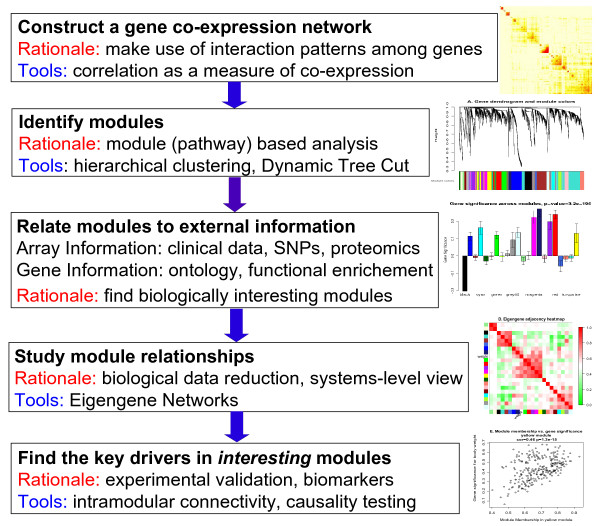
BACKGROUND: Correlation networks are increasingly being used in bioinformatics applications. For example, weighted gene co-expression network analysis is a systems biology method for describing the correlation patterns among genes across microarray samples. Weighted correlation network analysis (WGCNA) can be used for finding clusters (modules) of highly correlated genes, for summarizing such clusters using the module eigengene or an intramodular hub gene, for relating modules to one another and to external sample traits (using eigengene network methodology), and for calculating module membership measures. Correlation networks facilitate network based gene screening methods that can be used to identify candidate biomarkers or therapeutic targets. These methods have been successfully applied in various biological contexts, e.g. cancer, mouse genetics, yeast genetics, and analysis of brain imaging data. While parts of the correlation network methodology have been described in separate publications, there is a need to provide a user-friendly, comprehensive, and consistent software implementation and an accompanying tutorial. RESULTS: The WGCNA R software package is a comprehensive collection of R functions for performing various aspects of weighted correlation network analysis. The package includes functions for network construction, module detection, gene selection, calculations of topological properties, data simulation, visualization, and interfacing with external software. Along with the R package we also present R software tutorials. While the methods development was motivated by gene expression data, the underlying data mining approach can be applied to a variety of different settings. CONCLUSION: The WGCNA package provides R functions for weighted correlation network analysis, e.g. co-expression network analysis of gene expression data. The R package along with its source code and additional material are freely available at http://www.genetics.ucla.edu/labs/horvath/CoexpressionNetwork/Rpackages/WGCNA.
Overview
The claims and statistics of this paper haven’t been checked yet.
Free: it reads the open-access text and checks the first 5 claims that cite a source we can check. Create a free account to check every claim.
Integrity signals
Registry
Cites
Statistics
Figures
Verification
Claims the paper makes
The claims and statistics of this paper haven’t been checked yet.
Free: it reads the open-access text and checks the first 5 claims that cite a source we can check. Create a free account to check every claim.
Claims other papers make about this one
Each is checked against this paper’s own text: does it say what the citing paper says it does?
The source backs part of the claim, not all of it — or backs it for a different population, condition or comparison.
In the citing paper
“The most frequently used programs for differential clustering analysis, which have also been compared with others programs, are WGCNA [54], DICER [4] and DiffCoEx [100], all of which first identify modules co-expressed across the full set of study samples.”
From Gene co-expression analysis for functional classification and gene–disease predictions (2017) · cites this paper as [54]
Experimental — accuracy not yet measuredThe source backs part of the claim, not all of it — or backs it for a different population, condition or comparison.
In the citing paper
“Protein–protein interaction (PPI) networks and weighted gene co-expression network analysis (WGCNA) based on the RNA sequencing and microarray data have been revealed to establish potent organized biological strategies for mining the functional gene modules and detecting novel prognostic biomarkers [11,12].”
From Bioinformatics Analysis and Validation of Potential Markers Associated with Prediction and Prognosis of Gastric Cancer (2024) · cites this paper as [11]
Experimental — accuracy not yet measuredThe source backs part of the claim, not all of it — or backs it for a different population, condition or comparison.
In the citing paper
“Subsequently, methods such as Weighted Gene Co-expression Network Analysis (WGCNA) enhanced network granularity by identifying modules of highly co-expressed genes, offering biologically relevant insights into co-regulated pathways implicated in AD244,299.”
From Artificial intelligence-driven multi-omics approaches in Alzheimer's disease: Progress, challenges, and future directions (2025) · cites this paper as [299]
Experimental — accuracy not yet measuredThe source backs part of the claim, not all of it — or backs it for a different population, condition or comparison.
In the citing paper
“We identified four modules—ME5, ME7, ME12 and ME15—that were significantly associated with MLs containing foamy microglia (Fig. 3e).”
From Foamy microglia link oxylipins to disease progression in multiple sclerosis (2026) · cites this paper as [39]
Experimental — accuracy not yet measuredThe cited source says what the claim attributes to it.
In the citing paper
“A major family of methods in this category is based on co-expression analysis (reviewed in [32]), and has been broadly used on bulk gene expression data (e.g. GENIE3 [33] and WGCNA [34], see [27, 35] for benchmark comparisons).”
From Mapping gene regulatory networks from single-cell omics data (2018) · cites this paper as [34]
11 more claims about this paper
Create a free account to see every claim other papers make about this one.
Self-check
Percentages, sums and reported differences re-computed from the paper’s own numbers.
The self-check needs the paper’s full text.
Citations
Cites
Cytoscape: A software Environment for integrated models of biomolecular interaction networks
Shannon, P., Markiel, A., Ozier, O., Baliga, N. S., Wang, J. T., Ramage, D., Amin, N., Schwikowski, B., & Ideker, T. (2003) · Genome Research · doi:10.1101/gr.1239303 · Cited by 51,888 · cited 1×
“For example, our R functions exportNetworkToVisANT and exportNetworkToCyto-scape allow the user to export networks in a format suitable for VisANT [37] and Cytoscape [38], respectively.”
Gene Ontology: tool for the unification of biology
Ashburner, M., Ball, C. A., Blake, J. A., Botstein, D., Butler, H., Cherry, J. M., Davis, A. P., Dolinski, K., Dwight, S. S., Eppig, J. T., et al. (2000) · Nature Genetics · doi:10.1038/75556 · Cited by 43,206
Collective dynamics of ‘small-world’ networks
Watts, D. J., & Strogatz, S. H. (1998) · Nature · doi:10.1038/30918 · Cited by 43,060 · cited 2×
“where A (q) denotes the n (q) × n (q) adjacency matrix corresponding to the sub-network formed by the genes of module q. Another useful concept is the clustering coefficient of gene i, which is a measure of 'cliquishness' [ 34 ].”
BackgroundMethodFinding groups in data: an introduction to cluster analysis
(1991) · Choice Reviews Online · doi:10.5860/choice.28-4558 · Cited by 10,474
DAVID: Database for Annotation, Visualization, and Integrated Discovery
Dennis, G., Sherman, B. T., Hosack, D. A., Yang, J., Gao, W., Lane, H. C., & Lempicki, R. A. (2003) · Genome Biology · doi:10.1186/gb-2003-4-5-p3 · Cited by 9,327 · cited 2×
“We used the online software David [40] to determine whether the three body weight related modules were significantly enriched with regard to known gene ontologies.”
MethodFinding Groups in Data: An Introduction to Cluster Analysis
Kaufman, L., & Rousseeuw, P. J. (1990) · Wiley Series in Probability and Statistics · doi:10.1002/9780470316801 · Cited by 7,344
A General Framework for Weighted Gene Co-Expression Network Analysis
Zhang, B., & Horvath, S. (2005) · Statistical Applications in Genetics and Molecular Biology · doi:10.2202/1544-6115.1128 · Cited by 5,684 · cited 6×
“For weighted networks, 0 ≤ aij ≤ 1 implies that 0 ≤ ClusterCoefi ≤ 1 [5].”
InfluentialSelf-citationMissing Value Estimation Methods for DNA Microarrays
Troyanskaya, O., Cantor, M., Sherlock, G., Brown, P., Hastie, T., Tibshirani, R., Botstein, D., & Altman, R. B. (2001) · Bioinformatics · doi:10.1093/bioinformatics/17.6.520 · Cited by 4,230 · cited 1×
“Eigengene calculation incorporates imputation of missing values implemented in the package impute [31,32].”
MethodHierarchical Organization of Modularity in Metabolic Networks
Ravasz, E., Somera, A. L., Mongru, D. A., Oltvai, Z. N., & Barabási, A.-L. (2002) · Science · doi:10.1126/science.1073374 · Cited by 4,224 · cited 1×
“The mean clustering coefficient has been used to measure the extent of module structure present in a network [26,34].”
MethodBioinformatics and Computational Biology Solutions Using R and Bioconductor
(2005) · Statistics for Biology and Health · doi:10.1007/0-387-29362-0 · Cited by 3,289
Research works printed but not linked: 1
- (2006) FDT fields: Tools for Spatial Data Tech rep, National Center for Atmospheric Research, Boulder, CO 2007
Cited by
Items 1,201–1,268 of 1,268
Translation efficiency covariation identifies conserved coordination patterns across cell types
Liu, Y., Rao, S., Hoskins, I., Geng, M., Zhao, Q., Chacko, J., Ghatpande, V., Qi, K., Persyn, L., Wang, J., et al. (2026) · Nature Biotechnology · doi:10.1038/s41587-025-02718-5 · Cited by 15
Li, X., Duan, Y., & Hao, Y. (2021) · BMC Medical Genomics · doi:10.1186/s12920-021-00916-z · Cited by 14
csuWGCNA: a combination of signed and unsigned WGCNA to capture negative correlations
Dai, R., Xia, Y., Liu, C., & Chen, C. (2018) · doi:10.1101/288225 · Cited by 13
(2025) · doi:10.1038/s41467-025-60437-6 · Cited by 13
Fang, P., Yu, X., Ding, M., Cong, Q., Jiang, H., Shi, Q., Zhao, W., Zheng, W., Li, Y., Ling, Z., et al. (2025) · doi:10.1101/2025.02.15.638397 · Cited by 13
Lin, Y., Li, Y., Zhu, H., Tang, L., & Xu, J. (2025) · Frontiers in Plant Science · doi:10.3389/fpls.2024.1511602 · Cited by 13
Murray, S. A., Dalbøge, L. S., Baquero, K., Sanford, C. A., Misquith, A., Mercer, A. J., Meek, T. H., Guldbrandt, M., Andersen, B., Kievit, P., et al. (2020) · Scientific Reports · doi:10.1038/s41598-020-64170-6 · Cited by 12
Pybus, A. F., Bitarafan, S., Brothers, R. O., Rohrer, A., Khaitan, A., Moctezuma, F. R., Udeshi, K., Davies, B., Triplett, S., Griffin, M. N., et al. (2024) · Journal of Neuroinflammation · doi:10.1186/s12974-024-03128-1 · Cited by 12
Li, S., Lu, C., Zhao, Z., Lu, D., & Zheng, G. (2023) · Frontiers in Aging Neuroscience · doi:10.3389/fnagi.2023.1161405 · Cited by 12
de la Fuente Revenga, M., Zhu, B., Guevara, C. A., Naler, L. B., Saunders, J. M., Zhou, Z., Toneatti, R., Sierra, S., Wolstenholme, J. T., Beardsley, P. M., et al. (2021) · doi:10.1101/2021.02.24.432725 · Cited by 11
Song, G.-Y., Guo, X.-N., Yao, J., Lu, Z.-N., Xie, J.-H., wu, F., He, J., Fu, Z.-L., & Han, J. (2023) · BMC Cardiovascular Disorders · doi:10.1186/s12872-023-03311-x · Cited by 11
SEQUIN is an R/Shiny framework for rapid and reproducible analysis of RNA-seq data.
Weber, C., Hirst, M. B., Ernest, B., Schaub, N. J., Wilson, K. M., Wang, K., Baskir, H. M., Chu, P.-H., Tristan, C. A., & Singeç, I. (2023) · Cell Reports Methods · doi:10.1016/j.crmeth.2023.100420 · Cited by 11
Putative contributions of the sex chromosome proteins SOX3 and SRY to neurodevelopmental disorders
Tahira, A. C., Barbosa, A. R., Feltrin, A. S., Gastaldi, V. D., de Toledo, V. H. C., de Carvalho Pereira, J. G., Lisboa, B. C. G., de Souza Reis, V. N., dos Santos, A. C. F., Maschietto, M., et al. (2019) · American Journal of Medical Genetics Part B: Neuropsychiatric Genetics · doi:10.1002/ajmg.b.32704 · Cited by 11
An interpretable deep learning framework identifies proteomic drivers of Alzheimer’s disease
Panizza, E., & Cerione, R. A. (2024) · Frontiers in Cell and Developmental Biology · doi:10.3389/fcell.2024.1379984 · Cited by 11
Cai, S., Huang, K., Yang, F., Wang, X., Wu, S., Wang, Y., & Huang, L. (2021) · Frontiers in Aging Neuroscience · doi:10.3389/fnagi.2021.745381 · Cited by 11
Ruan, Y., Wang, J., Yu, M., Wang, F., Wang, J., Xu, Y., Liu, L., Cheng, Y., Yang, R., Zhang, C., et al. (2023) · Communications Biology · doi:10.1038/s42003-023-04700-w · Cited by 11
VanGessel, C. J., Felderhoff, T. J., Prigozhin, D. M., Cui, M., Pressoir, G., Healey, A. L., Lovell, J. T., Nalam, V. J., Nishimura, M. T., & Morris, G. P. (2025) · doi:10.1101/2025.04.11.648396 · Cited by 11
Discovering study-specific gene regulatory networks
Bo, V., Curtis, T., Lysenko, A., Saqi, M., Swift, S., & Tucker, A. (2014) · PLoS ONE · doi:10.1371/journal.pone.0106524 · Cited by 10
Ames, R. (2017) · Microorganisms · doi:10.3390/microorganisms5010003 · Cited by 10
Loss of Inpp5d has disease‐relevant and sex‐specific effects on glial transcriptomes
Dabin, L. C., Kersey, H., Kim, B., Acri, D. J., Sharify, D., Lee‐Gosselin, A., Lasagna‐Reeves, C. A., Oblak, A. L., Lamb, B. T., & Kim, J. (2024) · Alzheimer's & Dementia · doi:10.1002/alz.13901 · Cited by 11
Dissecting the Genetic Architecture of Cystatin C in Diversity Outbred Mice
Huda, M. N., VerHague, M., Albright, J., Smallwood, T., Bell, T. A., Que, E., Miller, D. R., Roshanravan, B., Allayee, H., Manuel de Villena, F. P., et al. (2020) · G3 Genes|Genomes|Genetics · doi:10.1534/g3.120.401275 · Cited by 10
VanGessel, C. J., Felderhoff, T. J., Prigozhin, D. M., Cui, M., Pressoir, G., Healey, A. L., Lovell, J. T., Nalam, V. J., Nishimura, M. T., & Morris, G. P. (2025) · Science Advances · doi:10.1126/sciadv.ady1667 · Cited by 10
Sebastian, S., Roy, S., & Kalita, J. (2025) · Journal of Biomedical Informatics · doi:10.1016/j.jbi.2025.104797 · Cited by 10
Mitonuclear Sex Determination? Empirical Evidence from Bivalves
Smith, C. H., Mejia-Trujillo, R., Breton, S., Pinto, B. J., Kirkpatrick, M., & Havird, J. C. (2023) · Molecular Biology and Evolution · doi:10.1093/molbev/msad240 · Cited by 10
WANG, C., SU, H., YANG, L., & HUANG, K. (2017) · Biocomputing 2017 · doi:10.1142/9789813207813_0009 · Cited by 9
Foamy microglia link oxylipins to disease progression in multiple sclerosis
van der Vliet, D., Di, X., Shamorkina, T. M., Coulon-Bainier, C., Pavlovic, A., van der Vliet, I. A. C. M., Zeng, Y., Macnair, W., van Egmond, N., Chen, J. Q. A., et al. (2026) · Nature Neuroscience · doi:10.1038/s41593-026-02302-3 · Cited by 18
Xu, X., Dong, Y., Liu, J., Zhang, P., Yang, W., & Dai, L. (2024) · Journal of Inflammation Research · doi:10.2147/jir.s480574 · Cited by 9
In a nutshell: pistachio genome and kernel development
Adaskaveg, J. A., Lee, C., Wei, Y., Wang, F., Grilo, F. S., Mesquida‐Pesci, S. D., Davis, M., Wang, S. C., Marino, G., Ferguson, L., et al. (2025) · New Phytologist · doi:10.1111/nph.70060 · Cited by 9
Divergent age-related methylation patterns in long and short-lived mammals
Haghani, A., Wang, N., Lu, A. T., Mozhui, K., Mammalian Methylation Consortium, Raj, K., Yang, X. W., & Horvath, S. (2022) · doi:10.1101/2022.01.16.476530 · Cited by 9
Self-citationHam, M., Cho, Y., Kang, T., Oh, T., Kim, H., & Kim, K. (2024) · Aging Cell · doi:10.1111/acel.14049 · Cited by 8
Hushpulian, D. M., Kaidery, N. A., Soni, P., Poloznikov, A. A., Zakhariants, A. A., Razumovskaya, A. V., Silkina, M. O., Tishkov, V. I., Kazakov, E. H., Brown, A. M., et al. (2025) · Redox Biology · doi:10.1016/j.redox.2025.103794 · Cited by 8
Evgrafov, O. V., Armoskus, C., Wrobel, B. B., Spitsyna, V. N., Souaiaia, T., Herstein, J. S., Walker, C. P., Nguyen, J. D., Camarena, A., Weitz, J. R., et al. (2017) · doi:10.1101/209197 · Cited by 8
Liu, F., Jiang, X., Yang, J., Tao, J., & Zhang, M. (2022) · Briefings in Bioinformatics · doi:10.1093/bib/bbac365 · Cited by 8
Hushpulian, D. M., Kaidery, N. A., Soni, P., Poloznikov, A. A., Zakhariants, A. A., Razumovskaya, A. V., Silkina, M. O., Tishkov, V. I., Kazakov, E. H., Brown, A. M., et al. (2025) · doi:10.1101/2025.05.30.656434 · Cited by 8
Liu, F., Jiang, X., & Zhang, M. (2022) · doi:10.1101/2022.03.07.22271997 · Cited by 8
Hierarchical cortical transcriptome disorganization in autism
Lombardo, M. V., Courchesne, E., Lewis, N. E., & Pramparo, T. (2016) · doi:10.1101/042937 · Cited by 7
Milewski, T. M., Lee, W., Young, R. L., Hofmann, H. A., & Curley, J. P. (2025) · PLoS Genetics · doi:10.1371/journal.pgen.1011548 · Cited by 9
Guo, H., Yang, J., Liu, S., Qin, T., Zhao, Q., Hou, X., & Ren, L. (2021) · Bioengineered · doi:10.1080/21655979.2021.1957645 · Cited by 7
Miyoshi, E., Morabito, S., & Swarup, V. (2021) · Neurobiology of Disease · doi:10.1016/j.nbd.2021.105530 · Cited by 7
Zhang, Z., Qiu, X., Zeng, X., Liu, X., Lu, J., Xu, C., Huang, J., Zhao, C., & Zhan, Y. (2025) · Scientific Reports · doi:10.1038/s41598-025-18650-2 · Cited by 6
Qiu, K., Zeng, T., Xia, W., Peng, M., & Kong, W. (2025) · BMC Medical Education · doi:10.1186/s12909-025-07631-8 · Cited by 6
Single-cell expression predicts neuron-specific protein homeostasis networks
Pechmann, S. (2024) · Open Biology · doi:10.1098/rsob.230386 · Cited by 6
Cai, X., Zheng, X., Wang, Y., Tian, L., & Mao, Y. (2022) · Frontiers in Microbiology · doi:10.3389/fmicb.2022.843807 · Cited by 6
Single-cell expression predicts neuron specific protein homeostasis networks
(2023) · doi:10.1101/2023.03.14.532571 · Cited by 6
Role of serum cytokines in the prediction of heart failure in patients with coronary artery disease
Hou, Q., Sun, Z., Zhao, L., Liu, Y., Zhang, J., Huang, J., Luo, Y., Xiao, Y., Hu, Z., & Shen, A. (2023) · ESC Heart Failure · doi:10.1002/ehf2.14491 · Cited by 5
Mao, R., & Li, J. (2024) · BMC Medical Genomics · doi:10.1186/s12920-024-02008-0 · Cited by 5
Cathepsin X is a conserved cell death protein involved in algal response to environmental stress
Mizrachi, A., Sadeh, M., Ben-Dor, S., Dym, O., Ku, C., Feldmesser, E., Zarfin, A., Brunson, J. K., Allen, A. E., Jinkerson, R. E., et al. (2025) · Current Biology · doi:10.1016/j.cub.2025.03.045 · Cited by 5
Graham, A. C., Bellou, E., Harwood, J. C., Yaman, U., Celikag, M., Magusali, N., Rambarack, N., Botia, J. A., Frigerio, C. S., Hardy, J., et al. (2023) · doi:10.1101/2023.03.30.23287975 · Cited by 4
Regulation of RNA splicing in endometrial tissue and its association with endometriosis
Yang, F., Qi, T., McRae, A. F., Rogers, P. A. W., Montgomery, G. W., & Mortlock, S. (2025) · iScience · doi:10.1016/j.isci.2025.113207 · Cited by 4
Cell signaling pathways discovery from multi-modal data
He, C., Simpson, C., Cossentino, I., Zhang, B., Tkachev, S., Eddins, D. J., Kosters, A., Yang, J., Sheth, S., Levy, T., et al. (2025) · doi:10.1101/2025.02.06.636961 · Cited by 3
Network analysis identifies strain-dependent response to tau and tau seeding-associated genes
Acri, D. J., You, Y., Tate, M. D., Karahan, H., Martinez, P., McCord, B., Sharify, A. D., John, S., Kim, B., Dabin, L. C., et al. (2023) · Journal of Experimental Medicine · doi:10.1084/jem.20230180 · Cited by 4
Cheng, C. C. Y., Cheung, M. F., Lee, A. Y., Wu, Q., Chow, S. H.-C., Ang, J. Y. J., Riquelme Medina, I., Lo, G., Wu, H., Yang, W., et al. (2025) · Communications Biology · doi:10.1038/s42003-025-09154-w · Cited by 3
Vaparanta, K., Merilahti, J. A. M., Ojala, V. K., & Elenius, K. (2024) · Molecular & Cellular Proteomics · doi:10.1016/j.mcpro.2024.100780 · Cited by 3
Martin, L. E., Barr, J. S., Cartailler, J.-P., Shrestha, S., Estévez-Lao, T. Y., & Hillyer, J. F. (2025) · Immunity & Ageing · doi:10.1186/s12979-025-00551-7 · Cited by 3
Sayed, F. A., Kodama, L., Udeochu, J. C., Fan, L., Carling, G. K., Le, D., Li, Q., Zhou, L., Mathys, H., Wang, M., et al. (2020) · doi:10.1101/2020.07.24.218719 · Cited by 3
Cohen, N. J., Lesseur, C., Cardenas, A., Ward-Caviness, C. K., Spring, A. C., Rager, J. E., Fry, R. C., & Eaves, L. A. (2025) · Epigenomics · doi:10.1080/17501911.2025.2533115 · Cited by 2
Varella-Branco, E., Shephard, E., Toledo, V. H. C., Ramos, I. C., Lacerda, E. C. M., Carvalho, L. L. M., Fiuza, M. A., Paschalidis, M., Costa, C. I. S., Girardi, A. C. S., et al. (2026) · Molecular Psychiatry · doi:10.1038/s41380-025-03433-y · Cited by 2
Continuous-Time Quantum Walk on Biological Network
Revythi, M., Koukiou, G., & Anastassopoulos, V. (2025) · IEEE Access · doi:10.1109/access.2025.3644962 · Cited by 1
A newly evolved small secretory peptide enhances mechanical properties of spider silk
(2025) · doi:10.1038/s41467-025-65026-1 · Cited by 1
Wang, Y., & Li, Q. (2025) · Scientific Reports · doi:10.1038/s41598-025-97269-9 · Cited by 1
A Newly Evolved Small Secretory Peptide Enhances Mechanical Properties of Spider Silk
Wang, Y., Jia, A., Mao, Y., Yang, T., Zhang, G., Wang, Q., Hu, W., Dong, Z., Zhang, Z., & Ma, S. (2025) · doi:10.21203/rs.3.rs-6320776/v1 · Cited by 1
The Wor2 phenotypic switching regulator controls biofilm formation in Candida auris
Liang, W., Guan, S., Bing, J., Du, H., Zheng, Q., Tao, L., Li, B., Huang, G., & Chu, H. (2026) · npj Biofilms and Microbiomes · doi:10.1038/s41522-026-01043-2
CauTrigger: deciphering biological system state transitions by hierarchical causal decomposition
Zhang, C., Cai, D., Aihara, K., & Chen, L. (2026) · Nature Methods · doi:10.1038/s41592-026-03274-9
Chen, K., Chen, Y., Ren, Y., Wang, Z., Huang, Y., Pan, M., Li, Z., Casey, M. C., Qiao, W., Shi, J., et al. (2026) · Nature Communications · doi:10.1038/s41467-026-78407-x
Kawabata, S., Iijima, H., Kanemura, N., & Murata, K. (2025) · Molecular Neurobiology · doi:10.1007/s12035-024-04666-8
Jiang, W., Bronk, G., Lake, M. T., Hoffman, N., Zar, H. J., Breen, M. S., Stein, D. J., Koen, N., Ressler, K. J., & Klengel, T. (2026) · American Journal of Psychiatry · doi:10.1176/appi.ajp.20251098
Intrinsic capacity modifies the risk of depression and anxiety through metabolomic signature
Song, S., Suo, X., Guo, J., Li, C., Lu, S., Zhu, Y., Kou, G., & Bo, Y. (2026) · Psychological Medicine · doi:10.1017/s0033291726106047
Schildcrout, R., Rhoads, N., & Chandrasekaran, S. (2026) · npj Metabolic Health and Disease · doi:10.1038/s44324-026-00138-w
Metadata
- Authors
- Langfelder, P., & Horvath, S.
- Affiliations
- University of California, Los Angeles (US)
- Corresponding author
- Horvath, Steve
- Venue
- BMC Bioinformatics
- Published
- 2008-12
- Volume
- 9
- Issue
- 1
- Pages
- 559-559
- ISSN
- 1471-2105 (ISSN-L)
- PMC
- PMC2631488
- OpenAlex
- W1966327575
- Cited by
- 27,252
- References
- 49
- Citations by year
- 2026: 3010 · 2025: 3785 · 2024: 4034 · 2023: 3455 · 2022: 3414 · 2021: 2988 · 2020: 2101 · 2019: 1423 · 2018: 869 · 2017: 721 · 2016: 514 · 2015: 335 · 2014: 228 · 2013: 160 · 2012: 103
- FWCI
- 13.70
- Type
- journal article
- Language
- en
- Open access
- gold
- doi.org
- Licence
- cc-by
- creativecommons.org/licenses/by/2.0 (tdm)
- Locations
- BMC Bioinformatics (publishedVersion, cc-by)
- PubMed Central (publishedVersion, cc-by)
- PubMed (publishedVersion)
- DOAJ (DOAJ: Directory of Open Access Journals) (submittedVersion)
- Funders
- National Cancer Institute (P50CA092131, P30CA016042)
- National Institute of Neurological Disorders and Stroke (R01NS050151, NS050151-01)
- Topics
- Life Sciences › Biochemistry, Genetics and Molecular Biology › Molecular Biology › Bioinformatics and Genomic Networks
- Life Sciences › Biochemistry, Genetics and Molecular Biology › Molecular Biology › Gene expression and cancer classification
- Life Sciences › Biochemistry, Genetics and Molecular Biology › Molecular Biology › Gene Regulatory Network Analysis
- Keywords
- weighted gene co-expression network analysis, gene co-expression network, module detection, module eigengenes, hub genes, module membership, gene expression data, R package, biomarker discovery, drug target identification, network topology
- MeSH terms
- Algorithms, Animals, Computer Graphics, Computing Methodologies, Humans, Pattern Recognition, Automated, Programming Languages, Software, Computational Biology, Oligonucleotide Array Sequence Analysis, Gene Expression Profiling, Databases, Genetic, Systems Biology, Mice
About these checks
Registry, retraction, Cites and statistics results are computed, not judged, with one exception: a printed reference that no index lists is read once by a model before it counts as a citation error. Claims are extracted by a model and kept only when their quote appears verbatim in the text; each cited source is then checked, with a model’s help, for whether it says what the claim relies on. Those verdicts can be wrong — read the claim’s quote and the cited source before relying on one.
Statistics and arithmetic are recomputed, not judged.
Confidence bands are shown only for fields calibrated on our annotated test set. None is calibrated yet, so no band is shown.
What counts as a claim ›How we measure confidence ›How we check this ›
Are you an author, or do you see a problem with this page? Request a review
Data sources
Bibliographic data: Semantic Scholar, OpenAlex, Crossref.
Contains information from the Semantic Scholar Academic Graph Datasets, made available under the ODC Attribution License (ODC-BY 1.0).
Semantic Scholar’s data is described in: Kinney, R., et al. (2023). The Semantic Scholar Open Data Platform. arXiv:2301.10140.
