

The Firmicutes/Bacteroidetes ratio of the human microbiota changes with age
Open accessThe DOI matches its Crossref record; 33 of the 33 references it cites were found in a registry or an index.
Abstract
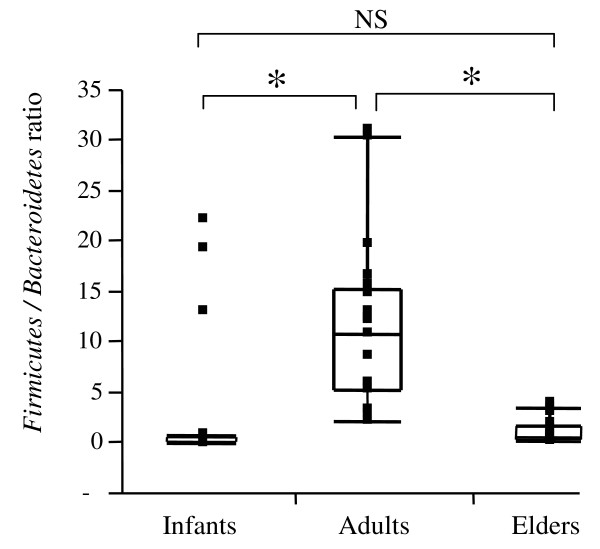
BACKGROUND: In humans, the intestinal microbiota plays an important role in the maintenance of host health by providing energy, nutrients, and immunological protection. Applying current molecular methods is necessary to surmount the limitations of classical culturing techniques in order to obtain an accurate description of the microbiota composition. RESULTS: Here we report on the comparative assessment of human fecal microbiota from three age-groups: infants, adults and the elderly. We demonstrate that the human intestinal microbiota undergoes maturation from birth to adulthood and is further altered with ageing. The counts of major bacterial groups Clostridium leptum, Clostridium coccoides, Bacteroidetes, Bifidobacterium, Lactobacillus and Escherichia coli were assessed by quantitative PCR (qPCR). By comparing species diversity profiles, we observed age-related changes in the human fecal microbiota. The microbiota of infants was generally characterized by low levels of total bacteria. C. leptum and C. coccoides species were highly represented in the microbiota of infants, while elderly subjects exhibited high levels of E. coli and Bacteroidetes. We observed that the ratio of Firmicutes to Bacteroidetes evolves during different life stages. For infants, adults and elderly individuals we measured ratios of 0.4, 10.9 and 0.6, respectively. CONCLUSION: In this work we have confirmed that qPCR is a powerful technique in studying the diverse and complex fecal microbiota. Our work demonstrates that the fecal microbiota composition evolves throughout life, from early childhood to old age.
Overview
The claims and statistics of this paper haven’t been checked yet.
Free: it reads the open-access text and checks the first 5 claims that cite a source we can check. Create a free account to check every claim.
Integrity signals
Registry
Cites
Statistics
Figures
Verification
Claims the paper makes
The claims and statistics of this paper haven’t been checked yet.
Free: it reads the open-access text and checks the first 5 claims that cite a source we can check. Create a free account to check every claim.
Claims other papers make about this one
Each is checked against this paper’s own text: does it say what the citing paper says it does?
The source backs part of the claim, not all of it — or backs it for a different population, condition or comparison.
In the citing paper
“A reduced Firmicutes:Bacteroidetes ratio has been reported in Irish and French elderly compared to young adults”
From The Microbiota-Gut-Brain Axis (2019) · cites this paper as Mariat et al., 2009
Experimental — accuracy not yet measuredIn the citing paper
“The disappearance of these microorganisms is important because they normally counteract the expansion of pathogenic microbial communities, while also maintaining intestinal barrier integrity by fermenting starches and dietary fibres and producing mucus and lipid metabolites, such as short-chain fatty acids (primarily acetate, propionate, and butyrate)66–68.”
From Inflammageing: chronic inflammation in ageing, cardiovascular disease, and frailty (2018) · cites this paper as [66]
In the citing paper
“Despite large variability in the gut microbiota found in different populations, geographic regions, and settings, evidence suggests that ageing is associated with a reduction in beneficial commensal microorganisms — such as Coprococcus, Faecalibacterium, and Lactobacillus — as well as a decrease in the Firmicutes: Bacteroidetes ratio66–68.”
From Inflammageing: chronic inflammation in ageing, cardiovascular disease, and frailty (2018) · cites this paper as [66]
In the citing paper
“In fact it has been reported that breast-fed infants generally harbor a more complex and numerous Bifidobacterium microbiota than formula-fed infants (19, 20).”
From Bifidobacteria and Their Health-Promoting Effects (2017) · cites this paper as [19]
In the citing paper
“An increased F/B ratio, caused by an expansion of Firmicutes and/or a contraction of Bacteroidetes, has been widely considered a signature of gut dysbiosis and has been associated with obesity, diabetes, and CVD8, 13, 16.”
From Gut Dysbiosis Is Linked to Hypertension (2015) · cites this paper as [8]
1 more claim about this paper
Create a free account to see every claim other papers make about this one.
Self-check
Percentages, sums and reported differences re-computed from the paper’s own numbers.
The self-check needs the paper’s full text.
Citations
Cites
Human gut microbes associated with obesity
Ley, R. E., Turnbaugh, P. J., Klein, S., & Gordon, J. I. (2006) · Nature · doi:10.1038/4441022a · Cited by 8,785 · cited 4×
“[7] when a correlation between body weight and gut microbial ecology was analysed.”
BackgroundInfluentialDiversity of the Human Intestinal Microbial Flora
Eckburg, P. B., Bik, E. M., Bernstein, C. N., Purdom, E., Dethlefsen, L., Sargent, M., Gill, S. R., Nelson, K. E., & Relman, D. A. (2005) · Science · doi:10.1126/science.1110591 · Cited by 7,913 · cited 1×
“This has markedly increased the information available concerning the complexity of the human bowel microbiota, from which over 1250 Operational Taxonomic Units have been identified corresponding to several dominant phyla [4,5].”
BackgroundHost-Bacterial Mutualism in the Human Intestine
Bäckhed, F., Ley, R. E., Sonnenburg, J. L., Peterson, D. A., & Gordon, J. I. (2005) · Science · doi:10.1126/science.1104816 · Cited by 5,277 · cited 1×
“The major functions attributed to the microbiota present in the gut begin to manifest at the end of the second year of life and comprise: i) nutrients absorption and food fermentation [10], ii) stimulation of the host immune system [11] and iii) barrier effects against pathogens [12].”
BackgroundDevelopment of the Human Infant Intestinal Microbiota
Palmer, C., Bik, E. M., DiGiulio, D. B., Relman, D. A., & Brown, P. O. (2007) · PLoS Biology · doi:10.1371/journal.pbio.0050177 · Cited by 2,877 · cited 1×
“Establishment of the intestinal microbiota has been shown to be a progressive process [9].”
BackgroundMICROBIAL ECOLOGY OF THE GASTROINTESTINAL TRACT
Savage, D. C. (1977) · Annual Review of Microbiology · doi:10.1146/annurev.mi.31.100177.000543 · Cited by 2,436 · cited 1×
“methods for more accurately assessing its composition and diversity, formerly thought to contain a mere 400– 500 bacterial species [2].”
MethodReduced diversity of faecal microbiota in Crohn’s disease revealed by a metagenomic approach
Manichanh, C., Rigottier-Gois, L., Bonnaud, E., Gloux, K., Pelletier, E., Frangeul, L., Nalin, R., Jarrin, C., Chardon, P., Marteau, P., et al. (2006) · Gut · doi:10.1136/gut.2005.073817 · Cited by 2,277 · cited 1×
“This has markedly increased the information available concerning the complexity of the human bowel microbiota, from which over 1250 Operational Taxonomic Units have been identified corresponding to several dominant phyla [4,5].”
BackgroundSelf-citationInteractions between commensal intestinal bacteria and the immune system
Macpherson, A. J., & Harris, N. L. (2004) · Nature Reviews Immunology · doi:10.1038/nri1373 · Cited by 1,610
Anatomical basis of tolerance and immunity to intestinal antigens
Mowat, A. M. (2003) · Nature Reviews Immunology · doi:10.1038/nri1057 · Cited by 1,415 · cited 1×
“The major functions attributed to the microbiota present in the gut begin to manifest at the end of the second year of life and comprise: i) nutrients absorption and food fermentation [10], ii) stimulation of the host immune system [11] and iii) barrier effects against pathogens [12].”
BackgroundHarmsen, H. J. M., Wildeboer–Veloo, A. C. M., Raangs, G. C., Wagendorp, A. A., Klijn, N., Bindels, J. G., & Welling, G. W. (2000) · Journal of Pediatric Gastroenterology and Nutrition · doi:10.1002/j.1536-4801.2000.tb02655.x · Cited by 1,337
Franks, A. H., Harmsen, H. J. M., Raangs, G. C., Jansen, G. J., Schut, F., & Welling, G. W. (1998) · Applied and Environmental Microbiology · doi:10.1128/aem.64.9.3336-3345.1998 · Cited by 1,056 · cited 1×
“Once climax composition is achieved near the end of adolescence, this ecosystem displays a high stability in healthy adults [13].”
Background
Cited by
Items 901–1,000 of 1,003
Overgrowth of the indigenous gut microbiome and irritable bowel syndrome
Bye, W. A., Ishaq, N., Bolin, T. D., Duncombe, V. M., & Riordan, S. M. (2014) · World Journal of Gastroenterology · doi:10.3748/wjg.v20.i10.2449 · Cited by 21
Toxic effects of binary toxicants of cresol frother and Cu (II) on soil microorganisms
Zhu, X., Wu, X., Yao, J., Wang, F., Liu, W., Luo, Y., & Jiang, X. (2017) · International Biodeterioration & Biodegradation · doi:10.1016/j.ibiod.2017.04.012 · Cited by 19
Mattioli, S., Bosco, A. D., Combes, S., Moscati, L., Crotti, S., Mancinelli, A. C., Cotozzolo, E., & Castellini, C. (2019) · Animals · doi:10.3390/ani9060341 · Cited by 19
“Bacteroidetes are believed to be one of the major commensal phyla in the gut of rabbits and they were proven to stimulate the development of gut-associated immune tissue [42,43].”
BackgroundNichenametla, S. N., Mattocks, D. A. L., Midya, V., & Shneyder, J. (2020) · The Journals of Gerontology Series A · doi:10.1093/gerona/glaa270 · Cited by 24
Zheng, N., Li, S., Dong, B., Sun, W. C., Li, H.-R., Zhang, Y., Li, P., Fang, Z., Chen, C., Han, X., et al. (2020) · Clinical Microbiology and Infection · doi:10.1016/j.cmi.2020.10.033 · Cited by 22
The microbiome’s relationship with congenital heart disease: more than a gut feeling
Feng, D., Christensen, J. T., Yetman, A. T., Lindsey, M. L., Singh, A. B., & Salomon, J. (2021) · Journal of Congenital Cardiology · doi:10.1186/s40949-021-00060-4 · Cited by 25
“4, while in adults, it is ~ 10 indicating that Firmicutes contribution increases with maturity [40].”
BackgroundLima, M. T. N. S., Howsam, M., Anton, P. M., Delayre‐Orthez, C., & Tessier, F. J. (2021) · Nutrients · doi:10.3390/nu13093091 · Cited by 21
Moxibustion may delay the aging process of Wistar rats by regulating intestinal microbiota
Ouyang, X., Duan, H., Jin, Q., Luo, X., Han, L., Zhao, B., Li, J., Chen, Y., Lin, Y., Liu, Y., et al. (2021) · Biomedicine & Pharmacotherapy · doi:10.1016/j.biopha.2021.112147 · Cited by 21
Gut Microbiota-Derived Metabolites and Cardiovascular Disease: Focus on Trimethylamine- N -oxide
He, M., Tan, C. P., & Liu, Y. (2025) · Journal of Agricultural and Food Chemistry · doi:10.1021/acs.jafc.5c08378 · Cited by 22
Mikrobiyota, prebiyotik ve probiyotikler
Karatay, E. (2019) · Anatolian Current Medical Journal · doi:10.38053/agtd.529392 · Cited by 22
Gröschel, C., Prinz-Wohlgenannt, M., Mesteri, I., George, S. K., Trawnicek, L., Heiden, D., Aggarwal, A., Tennakoon, S., Baumgartner, M., Gasché, C., et al. (2019) · Nutrients · doi:10.3390/nu12010045 · Cited by 19
“WD also decreased the Firmicutes to Bacteroidetes ratio; this ratio was correlated with obesity and adult age [92,93].”
BackgroundAlemohammad, S. M. A., Noori, S. M. R., Samarbafzadeh, E., & Noori, S. M. A. (2022) · Molecular Biology Reports · doi:10.1007/s11033-021-07078-2 · Cited by 20
“It has also been observed that the Firmicutes/Bacteroidetes ratio decreases significantly in elderly individuals [83] and it may be related to deficits in cognitive activities such as spatial memory in the elderly.”
BackgroundThe Role of Gut and Airway Microbiota in Pulmonary Arterial Hypertension
Huang, L., Zhang, H., Liu, Y., & Long, Y. (2022) · Frontiers in Microbiology · doi:10.3389/fmicb.2022.929752 · Cited by 20
Li, N., Amatjan, M., He, P., Zhang, B., Mai, X., Jiang, Q., Xie, H., & Shao, X. (2022) · Pharmaceutical Biology · doi:10.1080/13880209.2022.2147551 · Cited by 20
Insight into the Role of Gut Microbiota in Duchenne Muscular Dystrophy
Jollet, M., Mariadassou, M., Rué, O., Pessemesse, L., Ollendorff, V., Ramdani, S., Vernus, B., Bonnieu, A., Bertrand‐Gaday, C., Goustard, B., et al. (2023) · American Journal Of Pathology · doi:10.1016/j.ajpath.2023.10.010 · Cited by 20
Chae, H., Kim, S. Y., Kang, H. M., Im, S. A., & Youn, Y. (2024) · Scientific Reports · doi:10.1038/s41598-024-75157-y · Cited by 23
“Bifidobacteria are well known for their ability to utilize human milk oligosaccharides and reduce the overrepresentation of enteropathogenesis, thereby increasing disease risk 30,31 .”
BackgroundFróes, A. M., da Mota, F. F., Cuadrat, R. R. C., & Dávila, A. M. R. (2016) · Frontiers in Microbiology · doi:10.3389/fmicb.2016.01790 · Cited by 21
Leuvenhaege, C. V., Vandelannoote, K., Affolabi, D., Portaels, F., Sopoh, G. E., de Jong, B. C., Eddyani, M., & Meehan, C. J. (2017) · PLoS ONE · doi:10.1371/journal.pone.0181994 · Cited by 22
The Role of Ames Dwarfism and Calorie Restriction on Gut Microbiota
Wiesenborn, D. S., Gálvez, E. J. C., Spinel, L., Victoria, B., Allen, B. N., Schneider, A., Gesing, A., Al-Regaiey, K., Strowig, T., Schäfer, K., et al. (2019) · The Journals of Gerontology Series A · doi:10.1093/gerona/glz236 · Cited by 19
“during life but decreases during aging [38].”
BackgroundPesoa, S., Portela, N. D., Fernández, E., Elbarcha, O. C., Gotteland, M., & Magne, F. (2021) · Scientific Reports · doi:10.1038/s41598-021-87365-x · Cited by 20
Nan, W., Si, H., Yang, Q., Shi, H., Zhang, T., Shi, Q., Li, G., Zhang, H., & Liu, H. (2021) · Animals · doi:10.3390/ani11061577 · Cited by 19
The importance of age in compositional and functional profiling of the human intestinal microbiome
Herzog, E. L., Wäfler, M., Keller, I., Wolf, S., Zinkernagel, M. S., & Zysset‐Burri, D. C. (2021) · PLoS ONE · doi:10.1371/journal.pone.0258505 · Cited by 20
“The most noticeable feature in the microbiota of elderly individuals is an altered ratio of Firmicutes to Bacteroidetes, with an increased proportion of Bacteroidetes in the elderly [10].”
BackgroundLi, T., Yuan, Q., Gong, H., Du, ., & Mao, X. (2022) · International Journal of Obesity · doi:10.1038/s41366-021-01029-4 · Cited by 22
“Bacteroidetes and Firmicutes are the two dominant phyla in gut region of human as well as in rodents [34].”
BackgroundMicrobial Diversity and Interactions in Natural Ecosystems
Gentry, T. J., Pepper, I. L., & Pierson, L. S. (2014) · Elsevier eBooks · doi:10.1016/b978-0-12-394626-3.00019-3 · Cited by 26
Maile, A., Kumar, K. V., Muruganandam, N., Chander, M. P., Kartick, C., & Vijayachari, P. (2016) · Anaerobe · doi:10.1016/j.anaerobe.2016.03.002 · Cited by 20
Impact of Long-Term Proton Pump Inhibitor Therapy on Gut Microbiota in F344 Rats: Pilot Study
Shin, C. M., Kim, N., Kim, Y. S., Nam, R. H., Park, J. H., Lee, D. H., Seok, Y., Kim, Y.-R., Kim, J.-H., Kim, J. M., et al. (2016) · Gut and Liver · doi:10.5009/gnl15529 · Cited by 19
“6, respectively.(17) In this study, luminal microbiota of terminal ileum was evaluated.”
BackgroundEffects of antibiotic on microflora in ileum and cecum for broilers by 16S rRNA sequence analysis
She, Y., Cai, H., & Liu, G. (2018) · Animal Science Journal · doi:10.1111/asj.13113 · Cited by 18
Gut Microbiota and Osteoarthritis: From Pathogenesis to Novel Therapeutic Opportunities
Xi, Y., Wang, Z., Wei, Y., Xiao, N., Duan, L., Zhao, T., Zhang, X., Zhang, L., Wang, J., Li, Z., et al. (2025) · The American Journal of Chinese Medicine · doi:10.1142/s0192415x2550003x · Cited by 18
The Gut-Brain Axis in Alzheimer’s Disease: Exploring Microbial Influences and Therapeutic Strategies
Mustafa, M. A., Vadia, N., Varma, P., Al‐Shaker, H., Mohanty, B., Dhyani, A., Kaur, I., Chauhan, A. S., & Garg, G. (2025) · Molecular Neurobiology · doi:10.1007/s12035-025-05474-4 · Cited by 19
“In elderly individuals, there is a notable decrease in Firmicutes and an increase in Bacteroidetes, shifting the Firmicutes/Bacteroidetes ratio and disrupting microbial homeostasis [228].”
Ertuğlu, L. A., Afşar, B., Yıldız, A. B., Demiray, A., Ortíz, A., Covic, A. C., & Kanbay, M. (2021) · Current Nutrition Reports · doi:10.1007/s13668-021-00372-2 · Cited by 18
Jalodia, R., Kolli, U., Braniff, R. G., Tao, J., Abu, Y. F., Chupikova, I., Moidunny, S., Ramakrishnan, S., & Roy, S. (2022) · Gut Microbes · doi:10.1080/19490976.2022.2143225 · Cited by 20
“Firmicutes/Bacteroidetes ratio has been used as a marker for obesity, diabetes, and aging.(52,53) However, contradictory results have been reported on the Firmicutes/Bacteroidetes ratio in opioid studies.”
The Gut Microbiota: a Novel Player in the Pathogenesis of Uterine Fibroids
Vineetha, K. K., Bhat, R. G., Rao, B. K., & Archana, P. R. (2023) · Reproductive Sciences · doi:10.1007/s43032-023-01289-7 · Cited by 21
“According to a study by Mariat D et al. [31] the ratio of Firmicutes to Bacteroi-detes changed in older people consuming a Western-style diet, dropping from 10.9 in adults (25–45 years) to 0.6 in the elderly cohort (70–90 years), which is like the ratio of 0.4 in infants (three weeks to 10 months…”
ResultInfluentialYin, D., Zhao, L. X., Deng, S., Xie, Y., Ro, K.-S., Yang, Z., Du, L., Xie, J., & Wei, D. (2024) · Probiotics and Antimicrobial Proteins · doi:10.1007/s12602-023-10208-w · Cited by 19
“F/B of adults and elderly individuals were 10.9 and 0.6, respectively, according to a study on human, which suggested that the drop of F/B might be a typical event of the gut microbiota dysbiosis in aging [50].”
InfluentialResearch development on gut microbiota and vulnerable atherosclerotic plaque
Zheng, S., Liu, Z., Liu, H., Lim, J. Y., Li, D. W. H., Zhang, S., Luo, F., Wang, X., Sun, C., Tang, R., et al. (2024) · Heliyon · doi:10.1016/j.heliyon.2024.e25186 · Cited by 20
Barkus, A., Baltrūnienė, V., Baušienė, J., Baltrūnas, T., Barkienė, L., Kazlauskaitė, P., & Baušys, A. (2024) · Life · doi:10.3390/life14101227 · Cited by 18
Leaky Gut Syndrome: An Interplay Between Nutrients and Dysbiosis
Marcari, A. B., Paiva, A. D., Simon, C. R., & dos Santos, M. E. S. M. (2025) · Current Nutrition Reports · doi:10.1007/s13668-025-00614-7 · Cited by 18
“Changes in intestinal bacterial species, evaluating the F/B ratio [92], were also observed in a study, which showed that mice fed a high-fat diet had a higher proportion of Firmicutes and a reduction in Bacte-roidetes [93].”
Immunity-Based Evolutionary Interpretation of Diet-Induced Thermogenesis
Liao, W.-H., Henneberg, M., & Langhans, W. (2016) · Cell Metabolism · doi:10.1016/j.cmet.2016.05.002 · Cited by 19
Consequences of colonialism: A microbial perspective to contemporary Indigenous health
Skelly, E., Kapellas, K., Cooper, A., & Weyrich, L. S. (2018) · American Journal of Physical Anthropology · doi:10.1002/ajpa.23637 · Cited by 22
Young at Gut—Turning Back the Clock with the Gut Microbiome
Narasimhan, H., Ren, C. C., Deshpande, S., & Sylvia, K. E. (2021) · Microorganisms · doi:10.3390/microorganisms9030555 · Cited by 17
The controversial association of gut and urinary microbiota with kidney stone formation
Bostanghadiri, N., Ziaeefar, P., Sameni, F., Mahmoudi, M., Hashemi, A., & Darban‐Sarokhalil, D. (2021) · Microbial Pathogenesis · doi:10.1016/j.micpath.2021.105257 · Cited by 21
Role of age-related plasma in the diversity of gut bacteria
Ceylani, T., Allahverdi, H., & Teker, H. T. (2023) · Archives of Gerontology and Geriatrics · doi:10.1016/j.archger.2023.105003 · Cited by 18
Longitudinal analysis and genotyping of infant dominant bifidobacterial populations
Aires, J., Thouverez, M., Allano, S., & Butel, M. J. (2011) · Systematic and Applied Microbiology · doi:10.1016/j.syapm.2011.02.007 · Cited by 21
“Several reports have described gut bifidobacteria colonization in different age groups of humans in relation to location [1,10], age [15,16,18,20], gender [22,30], and diet [31,37].”
BackgroundProgress in Our Understanding of the Gut Microbiome: Implications for the Clinician
Iqbal, S., & Quigley, E. M. M. (2016) · Current Gastroenterology Reports · doi:10.1007/s11894-016-0524-y · Cited by 22
Mrozińska, S., Radkowski, P., Gosiewski, T., Szopa, M., Bulanda, M., Ludwig‐Słomczyńska, A. H., Trznadel-Morawska, I., Sroka-Oleksiak, A., Matejko, B., Kapusta, P., et al. (2016) · Journal of Diabetes Research · doi:10.1155/2016/3876764 · Cited by 21
“It has also been presented that the obese people have increased F/B ratio [28].”
BackgroundRole of the Phytochemical Compounds like Modulators in Gut Microbiota and Oxidative Stress
Martínez, Y., Toro, D. M., Betancur, C., Gebeyew, K., Adebowale, T. O., Hussain, T., Lan, W., & Ding, X. (2020) · Current Pharmaceutical Design · doi:10.2174/1381612826666200515132218 · Cited by 18
Pekkala, S., Lensu, S., Nokia, M., Vanhatalo, S., Koch, L. G., Britton, S. L., & Kainulainen, H. (2017) · Physiological Genomics · doi:10.1152/physiolgenomics.00081.2017 · Cited by 16
“To our Coriobacteriaceae P NS NS NS NS NS NS 0.043 NS R 0.647 Bacteroidetes P NS NS NS NS 0.004 NS 0.020 NS R 0.814 0.717 Bacteroidales S24-7 P 0.034 NS NS NS NS NS NS 0.009 R 0.669 0.771 S24-7 unknown genus P 0.034 NS NS NS NS NS NS 0.009 R 0.669 0.771 Prevotellaceae P NS NS NS NS NS 0.046 NS NS R 0.640 Paraprevotell…”
BackgroundInfluentialGut-Microbiota-Driven Lipid Metabolism: Mechanisms and Applications in Swine Production
Xiong, S. (2025) · Metabolites · doi:10.3390/metabo15040248 · Cited by 21
“For instance, Bacteroidetes are associated with lean phenotypes, while specific Firmicutes taxa, such as Faecalibacterium , Lachnospiraceae, and Ruminococcaceae, show positive correlations with obesity [7].”
Insights into the gut-liver axis: mechanisms and emerging therapies in hepatocellular carcinoma
Hu, Y., Gao, M., Chenghuang, J., & Bao, R. (2025) · Frontiers in Pharmacology · doi:10.3389/fphar.2025.1595853 · Cited by 24
Wan, X., Jiang, Y., Cao, Y., Sun, B., & Xiang, X. (2020) · Animals · doi:10.3390/ani10122352 · Cited by 16
“Gut microbial community patterns are affected by a series of complex and dynamic interactions throughout life, including diet [10], age [11], gender [12], seasonal fluctuations [13], and genotype [14].”
Cao, H., Yang, X., Peng, C., Wang, Y., Guo, Q., & Su, H. (2022) · Annals of Microbiology · doi:10.1186/s13213-022-01669-5 · Cited by 16
Liuzijue training improves hypertension and modulates gut microbiota profile
Wu, S., Zheng, C., Liu, N., Deng, T., Wang, J., Qi, L., & Xia, L. (2023) · Frontiers in Cardiovascular Medicine · doi:10.3389/fcvm.2023.1075084 · Cited by 16
“microbial community structure from mammalian feces (38).”
The Involvement of Immune Cells Between Ischemic Stroke and Gut Microbiota
Pu, B., Zhu, H., Wei, L., Gu, L., Zhang, S., Jian, Z., & Xiong, X. (2023) · Translational Stroke Research · doi:10.1007/s12975-023-01151-7 · Cited by 16
“The relationship between Firmicutes/Bacteroidetes ratio and stroke can now be confirmed in several mouse stroke studies [66, 67].”
Dong, C., Guan, Q., Xu, W., Zhang, X., Jin, B., Yu, S., Xu, X., & Xia, Y. (2023) · Gut Microbes · doi:10.1080/19490976.2023.2290320 · Cited by 17
“17 Nevertheless, the generalizability of prior findings in microbiome-wide association studies has been limited by small sample sizes.”
BackgroundZhi, N., Chang, X., Wang, X., Guo, J. X., Chen, J., & Gui, S. (2024) · Frontiers in Nutrition · doi:10.3389/fnut.2023.1341583 · Cited by 17
Aging Gut Microbiome in Healthy and Unhealthy Aging
Yangyanqiu, W., Qu, Z., Chu, J., & Han, S. (2024) · Aging and Disease · doi:10.14336/ad.2024.0331 · Cited by 27
“The Bacteroidetes to Firmicutes ratio during infancy, adulthood, and old age was 0.4, 10.9, and 0.6, respectively [7].”
InfluentialEnhancing gut-ovary health in aged laying hens: the impact of dietary betaine supplementation
Du, X., Pian, H., Zhao, D. H., Zhang, Y., Wu, X., He, J., Chen, L., Liu, F., & Yu, D. (2025) · Poultry Science · doi:10.1016/j.psj.2025.104894 · Cited by 19
“Studies have shown that bacterial diversity within the intestinal microbiome is altered during intestinal aging, marked by a decline in beneficial microorganisms and an increase in potentially pathogenic bacteria (Agus, et al., 2021; Biagi, et al., 2010; Mariat, et al., 2009).”
Vanhooren, V., Vandenbroucke, R. E., Dewaele, S., Hamme, E. V., Haigh, J. J., Hochepied, T., & Libert, C. (2013) · PLoS ONE · doi:10.1371/journal.pone.0079883 · Cited by 17
“IBD patients, infants and elderly individuals [35,36].”
Zhu, L., Ma, Z., Ren, M., Wei, Y., Liao, Y., Shen, Y., Fan, S.-M., Li, L., Wu, Q., Gao, Z.-S., et al. (2020) · Cardiology Research and Practice · doi:10.1155/2020/1957843 · Cited by 20
“So, F/B ratio was gradually considered as a potential biomarker for various pathological statuses [30], and high F/B ratio was reported to be closely associated with obesity, diabetes mellitus, and hypertension [31–33].”
BackgroundLee, J. H. J., & Zhu, J. (2020) · Experimental Biology and Medicine · doi:10.1177/1535370220979952 · Cited by 18
Asakura, H., Nakayama, T., Yamamoto, S., Izawa, K., Kawase, J., Torii, Y., & Murakami, S. (2021) · Frontiers in Veterinary Science · doi:10.3389/fvets.2021.675570 · Cited by 17
“The Firmicutes/Bacteroidetes (F/B) ratio, which is related to age in humans (31), was decreased in a time-dependent manner, from 0 weeks p.”
BackgroundRegulation of a New Type of Selenium-Rich Royal Jelly on Gut Microbiota Profile in Mice
Chi, X., Liu, Z., Wang, H., Wang, Y., Xu, B., & Wei, W. (2021) · Biological Trace Element Research · doi:10.1007/s12011-021-02800-4 · Cited by 19
Skillington, O., Mills, S., Gupta, A., Mayer, E. A., Gill, C. I. R., Rio, D. D., O’Riordan, K. J., Cryan, J. F., Ross, R. P., & Stanton, C. (2021) · Nutrition and Healthy Aging · doi:10.3233/nha-210129 · Cited by 18
“[169] Mariat D, Firmesse O, Levenez F, Guimarăes V, Sokol H, Doré J, Corthier G, Furet JP.”
BackgroundLiu, J., Luo, M. B., Qin, S., Li, B., Huang, L., & Xia, X. (2022) · Frontiers in Cellular and Infection Microbiology · doi:10.3389/fcimb.2022.808991 · Cited by 19
Andújar-Tenorio, N., Prieto, I., Cobo, A., Martínez-Rodríguez, A. M., Hidalgo, M., Segarra, A. B., Ramírez, M. R., Gálvez, A., & Martínez‐Cañamero, M. (2022) · PLoS ONE · doi:10.1371/journal.pone.0271634 · Cited by 20
“Lactobacillaceae are lactic-acid bacteria (LAB) that are present within the intestinal microbiota in higher numbers during lactation but are proposed to decrease over time in the adult life [27, 28].”
BackgroundFinnicum, C. T., Rahal, Z., Hassane, M., Treekitkarnmongkol, W., Sinjab, A. F., Morris, R., Liu, Y., Tang, E., Viet, S., Petersen, J. L., et al. (2022) · International Journal of Molecular Sciences · doi:10.3390/ijms231810930 · Cited by 16
Influence of natural gut flora on immune response
Strzępa, A., & Szczepanik, M. (2013) · Postępy Higieny i Medycyny Doświadczalnej · doi:10.5604/17322693.1064563 · Cited by 20
“U osób starszych zauważa się zmniejszenie liczby dobroczynnych beztlenowców Bacteroides oraz Bifidobacteria, co uwidocznia się w spadku stosunku Bacteroidetes do Firmicutes [61].”
BackgroundInfluentialNewton, R. U., Christophersen, C. T., Fairman, C. M., Hart, N. H., Taaffe, D. R., Broadhurst, D., Devine, A., Chee, R., Tang, C., Spry, N. A., et al. (2019) · BMJ Open · doi:10.1136/bmjopen-2018-024872 · Cited by 21
“25 Of note, the ratio of Firmicutes to Bacteroidetes phyla is of particular importance, with obese individuals having a higher Firmicutes to Bacteroidetes ratio which is indicative of poorer gut health.(26) 27 Importantly, it has been consistently demonstrated that men on ADT experience considerable unfavourable shift…”
BackgroundMurata, C., Gutiérrez‐Castrellón, P., Pérez‐Villatoro, F., García‐Torres, I., Enríquez‐Flores, S., la Mora, I. D. L. M.-D., Fernández‐Lainez, C., Werner, J., & López‐Velázquez, G. (2020) · Medicine · doi:10.1097/md.0000000000022442 · Cited by 19
“The F:B ratios in those individuals born by Csection far exceed the values reported in any other infant populations.([50,54]) The F:B ratio is regarded to be of significant relevance in human gut microbiota composition,([55]) and high”
BackgroundGebru, Y. A., Choi, M., Ganesan, R., Gupta, H., Sharma, S. P., Choi, Y. R., Kim, H. S., Yoon, S. J., Kim, D. J., & Suk, K. T. (2021) · Microorganisms · doi:10.3390/microorganisms9020296 · Cited by 16
“major roles in MAIT cell development and expansion since early in life [49].”
BackgroundIntestinal injury and changes of the gut microbiota after ischemic stroke
Shen, Y., Wang, J. A., Li, Y., Kang, X., & Gu, L. (2025) · Frontiers in Cellular Neuroscience · doi:10.3389/fncel.2025.1557746 · Cited by 16
“The genera Bacteroidia and Bacillota make up approximately 90% of the gut microbiota.”
InfluentialPathways and microbiome modifications related to surgery and enterocolitis in Hirschsprung disease
Biassoni, R., Marco, E. D., Squillario, M., Ugolotti, E., Mosconi, M., Faticato, M. G., Mattioli, G., Avanzini, S., & Prato, A. P. (2021) · Pediatric Surgery International · doi:10.1007/s00383-021-05012-y · Cited by 17
“In our study, Firmicutes/Bacteroidetes (F/B) ratio was higher than expected, based on the reported value present in literature [19, 26], being 4.”
BackgroundWang, X., Liu, Y., Wang, Y., Dong, X., Wang, Y., Yang, X., Tian, H., & Li, T. (2022) · Journal of Agricultural and Food Chemistry · doi:10.1021/acs.jafc.2c00267 · Cited by 18
Effect of Gut Microbiota on the Pharmacokinetics of Nifedipine in Spontaneously Hypertensive Rats
Zhou, R., Yang, H., Zhu, P., Liu, Y., Zhang, Y., Zhang, W., Zhou, H., Li, X., & Li, Q. (2023) · Pharmaceutics · doi:10.3390/pharmaceutics15082085 · Cited by 15
“We found that in the SHR group, the ratio of Firmicutes to Bacteroidetes (F/B ratio) increased, which is a potential biomarker of gut microbial dysbiosis [49,50].”
BackgroundMulti-omics analysis of fecal samples in colorectal cancer Egyptians patients: a pilot study
Khattab, R. H., Abo-Hammam, R. H., Salah, M., Hanora, A., Shabayek, S., & Zakeer, S. (2023) · BMC Microbiology · doi:10.1186/s12866-023-02991-x · Cited by 16
Systemic inflammatory and gut microbiota responses to fracture in young and middle-aged mice
Roberts, J. L., Chiedo, B., & Drissi, H. (2023) · GeroScience · doi:10.1007/s11357-023-00963-7 · Cited by 16
Amara, J., Itani, T. M., Hajal, J., Bakhos, J., Saliba, Y., Aboushanab, S. A., Kovaleva, E. G., Farès, N., Mondragón, A. D. C., & Miranda, J. M. (2024) · Nutrients · doi:10.3390/nu16020247 · Cited by 15
Zhang, Z., Bao, C., Li, Z., He, C., Jin, W., Li, C., & Chen, Y. (2024) · Applied Microbiology and Biotechnology · doi:10.1007/s00253-023-12841-5 · Cited by 16
“The Firmicutes / Bacteroidetes (F/B) ratio is the most commonly used indicator for determining the composition of the gut microbiome (Mariat et al. 2009; Polak et al. 2021).”
Coffee and Microbiota: A Narrative Review
Rosa, F., Marigliano, B., Mannucci, S., Candelli, M., Savioli, G., Merra, G., Zanza, C., Gasbarrini, A., Franceschi, F., & Piccioni, A. (2024) · Current Issues in Molecular Biology · doi:10.3390/cimb46010057 · Cited by 17
“In the elderly, there is a higher proportion of pathogenic enterobacteria and a lower proportion of probiotic Bifidobacteria [20].”
BackgroundGut microb-aging and its relevance to frailty aging
Cosquer, G. L., Vergnolle, N., & Motta, J. (2024) · Microbes and Infection · doi:10.1016/j.micinf.2024.105309 · Cited by 16
Li, X., Jiang, B., Gao, T., Nian, Y., Bai, X., Zhong, J., Qin, L., Gao, Z., Wang, H., & Ma, X. (2024) · European journal of medical research · doi:10.1186/s40001-024-02034-9 · Cited by 19
Exerkine irisin mitigates cognitive impairment by suppressing gut-brain axis-mediated inflammation
Zhang, H., Liang, J., Huang, J., Wang, M., Wu, L., Wu, T., & Chen, N. (2024) · Journal of Advanced Research · doi:10.1016/j.jare.2024.10.031 · Cited by 18
“Statistical analysis of gut microbiota at the phylum and genus levels has documented that F/B ratio shows a significant decrease in aged mice, with consistent results with previous studies [37,38], and the F/B ratio decline may be also due to aging stages, and races [39–41].”
Lin, W., Pu, L., Qian, X., Pan, J., Cheng, R., & Sun, P. (2025) · Frontiers in Microbiology · doi:10.3389/fmicb.2025.1671975 · Cited by 18
The microbiome links between aging and lupus
Katz-Agranov, N. S., & Zandman‐Goddard, G. (2021) · Autoimmunity Reviews · doi:10.1016/j.autrev.2021.102765 · Cited by 15
Rajeev, A. C., Sahu, N., Arvind, K., Deori, M., Grace, T., Dev, S. A., Yadav, V. P., & Ghosh, I. (2021) · Environmental Pollution · doi:10.1016/j.envpol.2021.117003 · Cited by 15
Wang, W., Zhu, G., Wang, Y., Li, W., Yi, S., Wang, K., Fan, L., Tang, J., & Chen, R. (2022) · Frontiers in Aging Neuroscience · doi:10.3389/fnagi.2022.877078 · Cited by 16
Paës, C., Gidenne, T. N., Bébin, K., Duperray, J., Gohier, C., Guené-Grand, E., Rebours, G., Barilly, C., Gabinaud, B., Cauquil, L., et al. (2022) · mSystems · doi:10.1128/msystems.00243-22 · Cited by 20
“At the phylum level, the ratio Firmicutes/Bacteroidota, which is known to increase during the transition from young to adult (28), was lower in the RFF1 group at d38 compared to STA1 (4 versus 7; P , 0.”
BackgroundSu, A., Ma, G., Ma, N., Pei, F., Yang, W., & Hu, Q. (2022) · Food Science and Biotechnology · doi:10.1007/s10068-022-01192-y · Cited by 15
“As reported (Mariat et al., 2009), these bacteria were linked to aging.”
BackgroundConsonni, A., Miglietti, M., Luca, C. M. G. D., Cazzaniga, F. A., Ciullini, A., Dellarole, I. L., Bufano, G., Fonzo, A. D., Giaccone, G., Baggi, F., et al. (2022) · Brain Sciences · doi:10.3390/brainsci12111579 · Cited by 15
Intestinal microbiota: A bridge between intermittent fasting and tumors
Liu, J., Shao, N., Qiu, H., Zhao, J., Chen, C., Wan, J., He, Z., Zhao, X., & Xu, L. (2023) · Biomedicine & Pharmacotherapy · doi:10.1016/j.biopha.2023.115484 · Cited by 17
Ahmad, A., Riaz, S., & Desta, D. T. (2024) · Food Science & Nutrition · doi:10.1002/fsn3.4455 · Cited by 15
Gao, P., Nie, Y., Zhao, L., Zhang, J., & Ge, W. (2025) · Antioxidants · doi:10.3390/antiox14050547 · Cited by 16
Biţă, A., Scorei, I. R., Soriano-Ursua, M. A., Mogoşanu, G. D., Belu, I., Ciocîlteu, M. V., Biță, C. E., Rău, G., Pisoschi, C. G., Racu, M.-V., et al. (2025) · Pharmaceuticals · doi:10.3390/ph18060766 · Cited by 16
“In addition, the aging of humans shows a decrease in the Firmi-cutes / Bacteroidetes ratio and a proliferation of pathogenic bacteria and correlated with a decrease in the abundance of BPB useful in the storage of the bacteria [120,121].”
Shi, Y., Wang, P., Zhou, D., Huang, L., Zhang, L., Gao, X., Maitiabula, G., Wang, S., & Wang, X. (2022) · Frontiers in Microbiology · doi:10.3389/fmicb.2022.827071 · Cited by 15
“…physical training, there is an overproduction of reactive oxygen species and occurrence of low-grade systemic inflammation, leading to lipid and protein peroxidation and muscle cell metabolism disorders, which together ultimately disrupt muscle function (Merry and Ristow, 2016; Karl et al., 2017).”
BackgroundHou, J., Xu, H., Cao, G., Tian, L.-L., Wang, L., Zhu, N.-Q., Zhang, J., & Yang, H. (2023) · Frontiers in Pharmacology · doi:10.3389/fphar.2023.1175970 · Cited by 14
“For instance, infants with higher Bacteroidetes strains at 1 year of age exhibit better cognitive performance at 2 years of age (Mariat et al., 2009), whereas cognitively impaired patients have lower abundances of Bacteroidetes strains in their gut microbiota (Carlson et al.”
BackgroundOsuna‐Prieto, F. J., Xu, H., Ortiz-Alvarez, L., Di, X., Köhler, I., Jurado‐Fasoli, L., Rubio‐López, J., Plaza‐Díaz, J., Vilchez‐Vargas, R., Link, A., et al. (2023) · Metabolomics · doi:10.1007/s11306-023-02016-8 · Cited by 15
Hansen, Z. A., Vasco, K. A., Rudrik, J. T., Scribner, K. T., Zhang, L., & Manning, S. D. (2023) · Scientific Reports · doi:10.1038/s41598-023-42822-7 · Cited by 16
Microbiota-Accessible Boron-Containing Compounds in Complex Regional Pain Syndrome
Biță, C. E., Scorei, I. R., Vreju, F. A., Mușetescu, A. E., Mogoşanu, G. D., Biţă, A., Dinescu, V. C., Dinescu, Ș. C., Criveanu, C., Bărbulescu, A. L., et al. (2023) · Medicina · doi:10.3390/medicina59111965 · Cited by 18
“It is known that in children and the elderly, the Firmicutes / Bacteroidetes ratio is low, while for adults, this ratio increases [140]; aging is an inducing factor of dysbiosis.”
BackgroundO’Toole, P. W. (2024) · Microbial Biotechnology · doi:10.1111/1751-7915.14477 · Cited by 16
“Some early culture-independent studies suggested that the microbiome changed with ageing primarily at a macro/phylum level (Claesson et al., 2011; Mariat et al., 2009).”
BackgroundWang, P., Wang, L., Fan, Y.-Q., Dou, Z., Han, J.-X., & Wang, B. (2024) · Scientific Reports · doi:10.1038/s41598-024-72230-4 · Cited by 24
Shi, N., Jiang, S., Zhao, Y., Zhang, Y., Duan, X., Hong, G., Yang, Z., Duan, Y., & Niu, H. (2024) · Molecular Medicine · doi:10.1186/s10020-024-01014-3 · Cited by 15
Metadata
- Authors
- Mariat, D., Firmesse, O., Levenez, F., Guimarăes, V., Sokol, H., Doré, J., Corthier, G., & Furet, J.-P.
- Affiliations
- Institut National de Recherche pour l'Agriculture, l'Alimentation et l'Environnement (FR)
- Institut National de la Recherche Agronomique (FR)
- Assistance Publique – Hôpitaux de Paris (FR)
- Corresponding author
- Mariat, D
- ORCID
- Venue
- BMC Microbiology
- Published
- 2009
- Volume
- 9
- Issue
- 1
- Pages
- 123
- ISSN
- 1471-2180 (ISSN-L)
- PMC
- PMC2702274
- OpenAlex
- W2142536690
- Cited by
- 1,755
- References
- 33
- Citations by year
- 2026: 63 · 2025: 123 · 2024: 150 · 2023: 162 · 2022: 187 · 2021: 179 · 2020: 195 · 2019: 130 · 2018: 115 · 2017: 92 · 2016: 79 · 2015: 54 · 2014: 55 · 2013: 54 · 2012: 48
- FWCI
- 15.42
- Type
- journal article
- Language
- en
- Open access
- gold
- doi.org
- Licence
- cc-by
- Locations
- BMC Microbiology (publishedVersion, cc-by)
- PubMed Central (publishedVersion, cc-by)
- PubMed (publishedVersion)
- HAL (submittedVersion, other-oa)
- DOAJ (DOAJ: Directory of Open Access Journals) (submittedVersion)
- Topics
- Life Sciences › Biochemistry, Genetics and Molecular Biology › Molecular Biology › Gut microbiota and health
- Health Sciences › Nursing › Nutrition and Dietetics › Infant Nutrition and Health
- Health Sciences › Dentistry › Periodontics › Oral microbiology and periodontitis research
- Keywords
- Firmicutes/Bacteroidetes ratio, human gut microbiome, fecal microbiota, age-related changes, microbiota maturation, infants, older adults, Clostridium leptum, Clostridium coccoides, Bacteroidetes, Bifidobacterium, Lactobacillus, Escherichia coli, bacterial diversity, real-time PCR
- MeSH terms
- Adult, Aged, Aged, 80 and over, Aging, Bifidobacterium, Clostridium, DNA, Bacterial, Escherichia coli, Feces, Humans, Infant, Infant, Newborn, Intestines, Lactobacillus, Middle Aged, Colony Count, Microbial, Bacteroidetes
About these checks
Registry, retraction, Cites and statistics results are computed, not judged, with one exception: a printed reference that no index lists is read once by a model before it counts as a citation error. Claims are extracted by a model and kept only when their quote appears verbatim in the text; each cited source is then checked, with a model’s help, for whether it says what the claim relies on. Those verdicts can be wrong — read the claim’s quote and the cited source before relying on one.
Statistics and arithmetic are recomputed, not judged.
Confidence bands are shown only for fields calibrated on our annotated test set. None is calibrated yet, so no band is shown.
What counts as a claim ›How we measure confidence ›How we check this ›
Are you an author, or do you see a problem with this page? Request a review
Data sources
Bibliographic data: Semantic Scholar, OpenAlex, Crossref.
Contains information from the Semantic Scholar Academic Graph Datasets, made available under the ODC Attribution License (ODC-BY 1.0).
Semantic Scholar’s data is described in: Kinney, R., et al. (2023). The Semantic Scholar Open Data Platform. arXiv:2301.10140.
