

The Firmicutes/Bacteroidetes ratio of the human microbiota changes with age
Open accessThe DOI matches its Crossref record; 33 of the 33 references it cites were found in a registry or an index.
Abstract
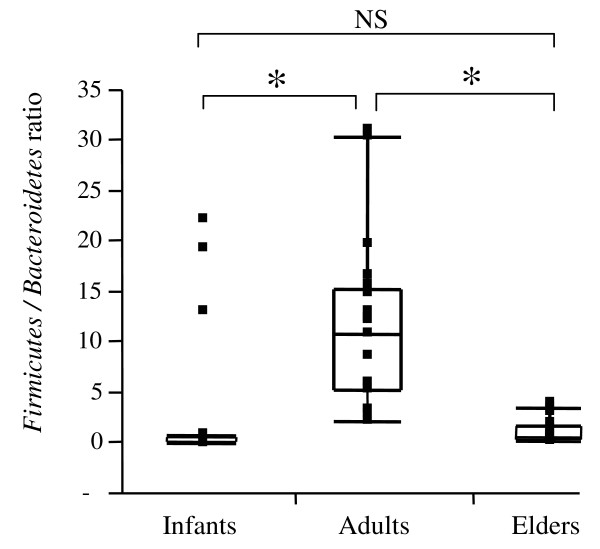
BACKGROUND: In humans, the intestinal microbiota plays an important role in the maintenance of host health by providing energy, nutrients, and immunological protection. Applying current molecular methods is necessary to surmount the limitations of classical culturing techniques in order to obtain an accurate description of the microbiota composition. RESULTS: Here we report on the comparative assessment of human fecal microbiota from three age-groups: infants, adults and the elderly. We demonstrate that the human intestinal microbiota undergoes maturation from birth to adulthood and is further altered with ageing. The counts of major bacterial groups Clostridium leptum, Clostridium coccoides, Bacteroidetes, Bifidobacterium, Lactobacillus and Escherichia coli were assessed by quantitative PCR (qPCR). By comparing species diversity profiles, we observed age-related changes in the human fecal microbiota. The microbiota of infants was generally characterized by low levels of total bacteria. C. leptum and C. coccoides species were highly represented in the microbiota of infants, while elderly subjects exhibited high levels of E. coli and Bacteroidetes. We observed that the ratio of Firmicutes to Bacteroidetes evolves during different life stages. For infants, adults and elderly individuals we measured ratios of 0.4, 10.9 and 0.6, respectively. CONCLUSION: In this work we have confirmed that qPCR is a powerful technique in studying the diverse and complex fecal microbiota. Our work demonstrates that the fecal microbiota composition evolves throughout life, from early childhood to old age.
Overview
The claims and statistics of this paper haven’t been checked yet.
Free: it reads the open-access text and checks the first 5 claims that cite a source we can check. Create a free account to check every claim.
Integrity signals
Registry
Cites
Statistics
Figures
Verification
Claims the paper makes
The claims and statistics of this paper haven’t been checked yet.
Free: it reads the open-access text and checks the first 5 claims that cite a source we can check. Create a free account to check every claim.
Claims other papers make about this one
Each is checked against this paper’s own text: does it say what the citing paper says it does?
The source backs part of the claim, not all of it — or backs it for a different population, condition or comparison.
In the citing paper
“A reduced Firmicutes:Bacteroidetes ratio has been reported in Irish and French elderly compared to young adults”
From The Microbiota-Gut-Brain Axis (2019) · cites this paper as Mariat et al., 2009
Experimental — accuracy not yet measuredIn the citing paper
“The disappearance of these microorganisms is important because they normally counteract the expansion of pathogenic microbial communities, while also maintaining intestinal barrier integrity by fermenting starches and dietary fibres and producing mucus and lipid metabolites, such as short-chain fatty acids (primarily acetate, propionate, and butyrate)66–68.”
From Inflammageing: chronic inflammation in ageing, cardiovascular disease, and frailty (2018) · cites this paper as [66]
In the citing paper
“Despite large variability in the gut microbiota found in different populations, geographic regions, and settings, evidence suggests that ageing is associated with a reduction in beneficial commensal microorganisms — such as Coprococcus, Faecalibacterium, and Lactobacillus — as well as a decrease in the Firmicutes: Bacteroidetes ratio66–68.”
From Inflammageing: chronic inflammation in ageing, cardiovascular disease, and frailty (2018) · cites this paper as [66]
In the citing paper
“In fact it has been reported that breast-fed infants generally harbor a more complex and numerous Bifidobacterium microbiota than formula-fed infants (19, 20).”
From Bifidobacteria and Their Health-Promoting Effects (2017) · cites this paper as [19]
In the citing paper
“An increased F/B ratio, caused by an expansion of Firmicutes and/or a contraction of Bacteroidetes, has been widely considered a signature of gut dysbiosis and has been associated with obesity, diabetes, and CVD8, 13, 16.”
From Gut Dysbiosis Is Linked to Hypertension (2015) · cites this paper as [8]
1 more claim about this paper
Create a free account to see every claim other papers make about this one.
Self-check
Percentages, sums and reported differences re-computed from the paper’s own numbers.
The self-check needs the paper’s full text.
Citations
Cites
Human gut microbes associated with obesity
Ley, R. E., Turnbaugh, P. J., Klein, S., & Gordon, J. I. (2006) · Nature · doi:10.1038/4441022a · Cited by 8,785 · cited 4×
“[7] when a correlation between body weight and gut microbial ecology was analysed.”
BackgroundInfluentialDiversity of the Human Intestinal Microbial Flora
Eckburg, P. B., Bik, E. M., Bernstein, C. N., Purdom, E., Dethlefsen, L., Sargent, M., Gill, S. R., Nelson, K. E., & Relman, D. A. (2005) · Science · doi:10.1126/science.1110591 · Cited by 7,913 · cited 1×
“This has markedly increased the information available concerning the complexity of the human bowel microbiota, from which over 1250 Operational Taxonomic Units have been identified corresponding to several dominant phyla [4,5].”
BackgroundHost-Bacterial Mutualism in the Human Intestine
Bäckhed, F., Ley, R. E., Sonnenburg, J. L., Peterson, D. A., & Gordon, J. I. (2005) · Science · doi:10.1126/science.1104816 · Cited by 5,277 · cited 1×
“The major functions attributed to the microbiota present in the gut begin to manifest at the end of the second year of life and comprise: i) nutrients absorption and food fermentation [10], ii) stimulation of the host immune system [11] and iii) barrier effects against pathogens [12].”
BackgroundDevelopment of the Human Infant Intestinal Microbiota
Palmer, C., Bik, E. M., DiGiulio, D. B., Relman, D. A., & Brown, P. O. (2007) · PLoS Biology · doi:10.1371/journal.pbio.0050177 · Cited by 2,877 · cited 1×
“Establishment of the intestinal microbiota has been shown to be a progressive process [9].”
BackgroundMICROBIAL ECOLOGY OF THE GASTROINTESTINAL TRACT
Savage, D. C. (1977) · Annual Review of Microbiology · doi:10.1146/annurev.mi.31.100177.000543 · Cited by 2,436 · cited 1×
“methods for more accurately assessing its composition and diversity, formerly thought to contain a mere 400– 500 bacterial species [2].”
MethodReduced diversity of faecal microbiota in Crohn’s disease revealed by a metagenomic approach
Manichanh, C., Rigottier-Gois, L., Bonnaud, E., Gloux, K., Pelletier, E., Frangeul, L., Nalin, R., Jarrin, C., Chardon, P., Marteau, P., et al. (2006) · Gut · doi:10.1136/gut.2005.073817 · Cited by 2,277 · cited 1×
“This has markedly increased the information available concerning the complexity of the human bowel microbiota, from which over 1250 Operational Taxonomic Units have been identified corresponding to several dominant phyla [4,5].”
BackgroundSelf-citationInteractions between commensal intestinal bacteria and the immune system
Macpherson, A. J., & Harris, N. L. (2004) · Nature Reviews Immunology · doi:10.1038/nri1373 · Cited by 1,610
Anatomical basis of tolerance and immunity to intestinal antigens
Mowat, A. M. (2003) · Nature Reviews Immunology · doi:10.1038/nri1057 · Cited by 1,415 · cited 1×
“The major functions attributed to the microbiota present in the gut begin to manifest at the end of the second year of life and comprise: i) nutrients absorption and food fermentation [10], ii) stimulation of the host immune system [11] and iii) barrier effects against pathogens [12].”
BackgroundHarmsen, H. J. M., Wildeboer–Veloo, A. C. M., Raangs, G. C., Wagendorp, A. A., Klijn, N., Bindels, J. G., & Welling, G. W. (2000) · Journal of Pediatric Gastroenterology and Nutrition · doi:10.1002/j.1536-4801.2000.tb02655.x · Cited by 1,337
Franks, A. H., Harmsen, H. J. M., Raangs, G. C., Jansen, G. J., Schut, F., & Welling, G. W. (1998) · Applied and Environmental Microbiology · doi:10.1128/aem.64.9.3336-3345.1998 · Cited by 1,056 · cited 1×
“Once climax composition is achieved near the end of adolescence, this ecosystem displays a high stability in healthy adults [13].”
Background
Cited by
Items 301–400 of 1,003
Dietary‐resistant starch improves maternal glycemic control in Goto–Kakizaki rat
Shen, L., Keenan, M. J., Raggio, A., Williams, C., & Martin, R. J. (2011) · Molecular Nutrition & Food Research · doi:10.1002/mnfr.201000605 · Cited by 101
Scalabrin, D. M. F., Mitmesser, S. H., Welling, G. W., Harris, C. L., Marunycz, J. D., Walker, D. C., Bos, N. A., Tölkkö, S., Salminen, S., & Vanderhoof, J. A. (2012) · Journal of Pediatric Gastroenterology and Nutrition · doi:10.1097/mpg.0b013e318237ed95 · Cited by 100
“In contrast, clostridia, including members of the C coccoides group, appear later in the colonization process, as demonstrated by their relatively low levels in infants (6,41).”
BackgroundOng, S. H., Kukkillaya, V. U., Wilm, A., Lay, C., Ho, E. X. P., Low, L., Hibberd, M. L., & Nagarajan, N. (2013) · PLoS ONE · doi:10.1371/journal.pone.0060811 · Cited by 110
“The most notable compositional difference between the infant and adult stool samples is the difference in their Bacteroidetes:Firmicutes ratio [31,32,33], with a lower percentage of Firmicutes observed in the 2-year-old infant compared to the 34-year-old adult.”
BackgroundDiets rich in n -6 PUFA induce intestinal microbial dysbiosis in aged mice
Ghosh, S., Molcan, E., DeCoffe, D., Dai, C., & Gibson, D. L. (2013) · British Journal of Nutrition · doi:10.1017/s0007114512005326 · Cited by 100
“Ageing has been recently associated with microbial dysbiosis((23)), and at different stages in life the ratio of FIRM:CFB has been shown to be different((7)).”
BackgroundGut Microbiota and Atherosclerosis—Focusing on the Plaque Stability
Shen, X., Li, L., Sun, Z., Zang, G., Zhang, L., Shao, C., & Wang, Z. (2021) · Frontiers in Cardiovascular Medicine · doi:10.3389/fcvm.2021.668532 · Cited by 115
Murray, E. R., Kemp, M., & Nguyen, T. T. (2022) · Archives of Clinical Neuropsychology · doi:10.1093/arclin/acac008 · Cited by 92
“In contrast, unhealthy aging is associated with reduced diversity (Kim and Benayoun, 2020; Mariat et al., 2009) and preservation of core abundant taxa (Wilmanski et al.”
BackgroundThe role of the gut microbiome in eye diseases
Zysset‐Burri, D. C., Morandi, S. C., Herzog, E. L., Berger, L., & Zinkernagel, M. S. (2022) · Progress in Retinal and Eye Research · doi:10.1016/j.preteyeres.2022.101117 · Cited by 113
Contribution of Trimethylamine N-Oxide (TMAO) to Chronic Inflammatory and Degenerative Diseases
Constantino-Jonapa, L. A., Espinoza-Palacios, Y., Escalona‐Montaño, A. R., Hernández-Ruiz, P., Amezcua-Guerra, L. M., Amedei, A., & Aguirre‐García, M. M. (2023) · Biomedicines · doi:10.3390/biomedicines11020431 · Cited by 102
“One of the factors that causes the changes in the gut microbiota is the decline of the immune system, which affects the relationship between the host and the microbiota, leading to dysbiosis [40] and increasing the Firmicutes–Bacteroidetes ratio and, thus, TMAO production, which is associated with an increase in this…”
Obesity and the gut microbiome: Striving for causality
Harley, I. T. W., & Karp, C. L. (2012) · Molecular Metabolism · doi:10.1016/j.molmet.2012.07.002 · Cited by 96
“Further, the presence of similar shifts between Firmicutes and Bacteroidetes with aging has raised the possibility of uncontrolled-for confounders in the initial study [21,80].”
BackgroundSoldi, S., Vasileiadis, S., Uggeri, F., Campanale, M. C., Morelli, L., Calanni, F., Grimaldi, M., Gasbarrini, A., & Fogli, M. V. (2015) · Clinical and Experimental Gastroenterology · doi:10.2147/ceg.s89999 · Cited by 96
Maki, K. A., Burke, L., Calik, M. W., Watanabe‐Chailland, M., Sweeney, D., Romick‐Rosendale, L. E., Green, S. J., & Fink, A. M. (2020) · Physiological Genomics · doi:10.1152/physiolgenomics.00039.2020 · Cited by 103
Kimble, R., Gouinguenet, P., Ashor, A. W., Stewart, C. J., Deighton, K., Matu, J., Griffiths, A., Malcomson, F. C., Joel, A., Houghton, D., et al. (2022) · Critical Reviews in Food Science and Nutrition · doi:10.1080/10408398.2022.2057416 · Cited by 107
Vael, C., Vanheirstraeten, L., Desager, K. N., & Goossens, H. (2011) · BMC Microbiology · doi:10.1186/1471-2180-11-68 · Cited by 94
“In adult fecal microbiota Clostridium coccoides subcluster XIVa is the most abundant taxonomic group [16] but in infants it normally constitutes only a subdominant group at much lower counts [25].”
BackgroundThe microbiota and helminths: sharing the same niche in the human host
GLENDINNING, L., NAUSCH, N., FREE, A., TAYLOR, D. W., & MUTAPI, F. (2014) · Parasitology · doi:10.1017/s0031182014000699 · Cited by 95
“A study comparing the gut microbiotas of infants (3 weeks to 10 months), adults (25–45 years) and the elderly (70– 90 years) eating a Western diet (Mariat et al. 2009) found significant differences between the three age groups.”
Microbiota and Diabetes Mellitus: Role of Lipid Mediators
Salazar, J. J., Angarita, L., Morillo, V., Navarro, C., Martínez, M. S., Chacín, M., Torres, W., Rajotia, A., Rojas, M., Cano, C., et al. (2020) · Nutrients · doi:10.3390/nu12103039 · Cited by 108
“The high prevalence of these phyla (90%) in healthy subjects and their relation to different pathologies has led to using Firmicutes/Bacteroidetes as a marker ratio of gut microbiome dynamics [67].”
BackgroundDiet-induced gut dysbiosis and inflammation: Key drivers of obesity-driven NASH
Kang, G. G., Trevaskis, N. L., Murphy, A. J., & Febbraio, M. A. (2023) · iScience · doi:10.1016/j.isci.2022.105905 · Cited by 94
Molist, F., Manzanilla, E. G., Pérez, J. F., & Nyachoti, C. M. (2011) · British Journal Of Nutrition · doi:10.1017/s0007114511005216 · Cited by 109
“In humans, Mariat et al.((47)) have suggested that infants and the elderly, who are more sensitive to pathogens, present ten times lower Firmicutes:Bacteroidetes ratios, compared to healthy adults.”
BackgroundThe anti-obesity effect of Ephedra sinica through modulation of gut microbiota in obese Korean women
Kim, B. S., Song, M., & Kim, H. (2014) · Journal of Ethnopharmacology · doi:10.1016/j.jep.2014.01.038 · Cited by 101
Yang, Z., Huang, S., Zou, D., Dong, D., He, X., Liu., N., Liu, W., & Huang, L. (2016) · Amino Acids · doi:10.1007/s00726-016-2308-y · Cited by 93
“Young adults have more Firmicutes than Bacteroidetes, but in aged people, Bacteroidetes is more abundant and the ratio of Firmicutes/Bacteroidetes is reduced (Mueller et al. 2006; Mariat et al. 2009; Zwielehner et al. 2009; Claesson et al. 2010; Mäkivuokko et al. 2010).”
BackgroundFecal microbes, short chain fatty acids, and colorectal cancer across racial/ethnic groups
Hester, C. M. (2015) · World Journal of Gastroenterology · doi:10.3748/wjg.v21.i9.2759 · Cited by 93
Moles, L., & Otaegui, D. (2020) · Nutrients · doi:10.3390/nu12061654 · Cited by 112
Cultivable and Pyrosequenced Fecal Microflora in Centenarians and Young Subjects
Drago, L., Toscano, M., Rodighiero, V., De Vecchi, E., & Mogna, G. (2012) · Journal of Clinical Gastroenterology · doi:10.1097/mcg.0b013e3182693982 · Cited by 92
Evolving Concepts: How Diet and the Intestinal Microbiome Act as Modulators of Breast Malignancy
Shapira, I., Sultan, K., Lee, A., & Taioli, E. (2013) · ISRN Oncology · doi:10.1155/2013/693920 · Cited by 92
“The host’s digestive tract provides the nutrient niche for the microbiota, while the microbiota protects against pathogens, helps in the development of the immune system, aids in nutrient reclamation from food by fermenting indigestible fiber to short chain fatty acids, produces essential amino…”
BackgroundGut Microbiota: A Modulator of Brain Plasticity and Cognitive Function in Ageing
Leung, K., & Thuret, S. (2015) · Healthcare · doi:10.3390/healthcare3040898 · Cited by 92
“Bacteroidetes and Firmicutes are dominant in the adult and elderly gut (95% and 93% respectively), distinct changes occur in the Firmicutes subgroups, with multiple members in this phylum decreasing in number [39].”
Meng, X., Hu, W., Wu, S., Zhu, Z.-X., Lu, R., Yang, G., Qin, C., Yang, L., & Nie, G. (2019) · Fish & Shellfish Immunology · doi:10.1016/j.fsi.2019.10.066 · Cited by 94
Pareek, S., Kurakawa, T., Das, B., Motooka, D., Nakaya, S., Rongsen‐Chandola, T., Goyal, N. P., Kayama, H., Dodd, D., Okumura, R., et al. (2019) · npj Biofilms and Microbiomes · doi:10.1038/s41522-019-0110-9 · Cited by 99
Li, Y., Su, X., Gao, Y., Lv, C., Gao, Z., Liu, Y., Wang, Y., Li, S., & Wang, Z. (2020) · Biochimica et Biophysica Acta (BBA) - Molecular Basis of Disease · doi:10.1016/j.bbadis.2020.165764 · Cited by 102
Ke, H., Li, F., Deng, W., Li, Z., Wang, S., Lv, P., & Chen, Y. (2021) · Frontiers in Pharmacology · doi:10.3389/fphar.2021.726707 · Cited by 101
“Increased or decreased Firmicutes/Bacteroidetes (F/B) ratio is regard as dysbiosis (Mariat et al., 2009).”
BackgroundZhu, X., Cai, J., Wang, Y., Liu, X., Chen, X., Wang, H., Wu, Z., Bao, W., Fan, H., & Wu, S. (2023) · International Journal of Molecular Sciences · doi:10.3390/ijms242316733 · Cited by 99
Compositional dynamics of the human intestinal microbiota with aging: Implications for health
Lakshminarayanan, B., Stanton, C., O'Toole, P. W., & Ross, R. P. (2014) · The Journal of nutrition, health and aging · doi:10.1007/s12603-014-0549-6 · Cited by 89
Microbiome diurnal rhythmicity and its impact on host physiology and disease risk
Nobs, S. P., Tuganbaev, T., & Elinav, E. (2019) · EMBO reports · doi:10.15252/embr.201847129 · Cited by 90
“However, the composition of the microbiome maintains a rate of change well into old age, with distinct microbiomes noted in elderly subjects [73].”
Manandhar, I., Alimadadi, A., Aryal, S., Munroe, P. B., Joe, B., & Cheng, X. (2021) · American Journal of Physiology-Gastrointestinal and Liver Physiology · doi:10.1152/ajpgi.00360.2020 · Cited by 91
The gut microbiome and Alzheimer’s disease: Complex and bidirectional interactions
Tarawneh, R. M., & Penhos, E. (2022) · Neuroscience & Biobehavioral Reviews · doi:10.1016/j.neubiorev.2022.104814 · Cited by 97
Zhang, W., Guo, R., Yang, Y., Ding, J., & Zhang, Y. (2016) · Toxicology Letters · doi:10.1016/j.toxlet.2016.07.003 · Cited by 93
Liu, Y., Gibson, G. R., & Walton, G. E. (2016) · PLOS ONE · doi:10.1371/journal.pone.0162604 · Cited by 88
The microbiota-gut-brain axis: Focus on the fundamental communication pathways
(2020) · Progress in Molecular Biology and Translational Science · doi:10.1016/bs.pmbts.2020.08.012 · Cited by 88
A day in the life of the meta-organism: diurnal rhythms of the intestinal microbiome and its host
Thaiss, C. A., Zeevi, D., Levy, M., Segal, E., & Elinav, E. (2015) · Gut Microbes · doi:10.1080/19490976.2015.1016690 · Cited by 89
“However subtly, the composition of the microbiome maintains a rate of change well into old age, with distinct microbiomes in elderly subjects.(25,26) While long-term compositional changes are important to the general understanding of host-microbiome coevolution and to the composition of the microbiome in health and di…”
BackgroundA probiotics-containing biscuit modulates the intestinal microbiota in the elderly
Rampelli, S., Candela, M., Severgnini, M., Biagi, E., Turroni, S., Roselli, M., Carnevali, P., Donini, L., & Brigidi, P. (2013) · The Journal of nutrition, health and aging · doi:10.1007/s12603-012-0372-x · Cited by 85
Zhao, R., Cheng, N., Nakata, P. A., Zhao, L., & Hu, Q. (2019) · Food Research International · doi:10.1016/j.foodres.2019.04.070 · Cited by 90
“Photobiomics”: Can Light, Including Photobiomodulation, Alter the Microbiome?
Liebert, A. D., Bicknell, B. T., Johnstone, D. M., Gordon, L. C., Kiat, H., & Hamblin, M. R. (2019) · Photobiomodulation Photomedicine and Laser Surgery · doi:10.1089/photob.2019.4628 · Cited by 96
“159,160 UV therapy of skin has been shown to affect the skin microbiome by altering barrier function, leading to microbial-specific skin-resident memory T cells, disrupting the healthy balance between skin microbiome and skin immune cells, and resulting in chronic inflammation and diseased skin.”
Sanborn, V., Azcarate-Peril, M. A., Updegraff, J., Manderino, L., & Gunstad, J. (2020) · Neuropsychiatric Disease and Treatment · doi:10.2147/ndt.s270035 · Cited by 82
Micheli, L., Bertini, L., Bonato, A., Villanova, N., Caruso, C., Caruso, M., Bernini, R., & Tirone, F. (2023) · Nutrients · doi:10.3390/nu15071767 · Cited by 97
Effect of Non-Nutritive Sweeteners on the Gut Microbiota
Conz, A., Salmona, M., & Diomede, L. (2023) · Nutrients · doi:10.3390/nu15081869 · Cited by 121
Sahle, Z., Engidaye, G., Shenkute, D., Adenew, B., & Asfaw, T. (2024) · SAGE Open Medicine · doi:10.1177/20503121241257486 · Cited by 99
“23 The host may benefit from the metabolites that the microbiota creates, including those that have anti-inflammatory and antioxidant activity, regulate intestinal barrier function, and provide vitamins and energy.”
BackgroundXue, D., Chen, H., Chen, F., He, Y., Zhao, C., Zhu, D., Zeng, L., & Li, W. (2016) · Livestock Science · doi:10.1016/j.livsci.2016.04.009 · Cited by 91
The influence of gut microbiota alteration on age-related neuroinflammation and cognitive decline
Shah, Z., & Alsegiani, A. S. (2022) · Neural Regeneration Research · doi:10.4103/1673-5374.335837 · Cited by 95
“6) of the human microbiota between adults (25 to 45 years old) and the elderly (70–90 years old) (Mariat et al., 2009).”
BackgroundMethodResultInfluentialMetabolic Alterations to the Mucosal Microbiota in Inflammatory Bowel Disease
Davenport, M., Poles, J., Leung, J. M., Wolff, M. J., Abidi, W. M., Ullman, T., Mayer, L., Cho, I., & Loke, P. (2014) · Inflammatory Bowel Diseases · doi:10.1097/mib.0000000000000011 · Cited by 84
Maintenance of a healthy trajectory of the intestinal microbiome during aging: A dietary approach
Candela, M., Biagi, E., Brigidi, P., O’Toole, P. W., & de Vos, W. M. (2013) · Mechanisms of Ageing and Development · doi:10.1016/j.mad.2013.12.004 · Cited by 97
Reciprocal Interactions Between Gut Microbiota and Host Social Behavior
Münger, E., Montiel-Castro, A. J., Langhans, W., & Pacheco-López, G. (2018) · Frontiers in Integrative Neuroscience · doi:10.3389/fnint.2018.00021 · Cited by 86
“coli and Bacteroidetes, suggesting an evolving ratio of Firmicutes to Bacteroidetes across the life cycle (Mariat et al., 2009).”
BackgroundCui, Z., Huntley, R. B., Zeng, Q., & Steven, B. T. (2020) · The ISME Journal · doi:10.1038/s41396-020-00784-y · Cited by 91
The Emerging Role of the Microbiota in Breast Cancer Progression
Bernardo, G., Noci, V. L., Modica, M. D., Montanari, E., Triulzi, T., Pupa, S. M., Tagliabue, E., Sommariva, M., & Sfondrini, L. (2023) · Cells · doi:10.3390/cells12151945 · Cited by 93
“The augmented abundance of such microorganisms results in an increased concentration of circulating free estrogens, eventually contributing to breast cancer progression [37,38].”
BackgroundInteraction between gut immunity and polysaccharides
Huang, X., Nie, S., & Xie, M. (2015) · Critical Reviews in Food Science and Nutrition · doi:10.1080/10408398.2015.1079165 · Cited by 88
Indoor microplastics and bacteria in the atmospheric fallout in urban homes
Cui, J., Chen, C., Gan, Q., Wang, T. A., Li, W., Zeng, W., Xu, X., Chen, G., Wang, L., Lu, Z., et al. (2022) · The Science of The Total Environment · doi:10.1016/j.scitotenv.2022.158233 · Cited by 91
Neto, M. P. C., Aquino, J. D. S., da Silva, L. D. F. R., Silva, R. D. O., Guimarães, K. S. D. L., de Oliveira, Y., de Souza, E. L., Magnani, M., Vidal, H., & Alves, J. L. D. B. (2018) · Pharmacological Research · doi:10.1016/j.phrs.2018.01.020 · Cited by 90
The Association of Gut Microbiota with Nonalcoholic Steatohepatitis in Thais
Sobhonslidsuk, A., Chanprasertyothin, S., Pongrujikorn, T., Kaewduang, P., Promson, K., Petraksa, S., & Ongphiphadhanakul, B. (2018) · BioMed Research International · doi:10.1155/2018/9340316 · Cited by 85
“The number of Bacteroides and Prevotella genera considered to be representative of the Bacteroidetes phylum [25] was elevated in the NASH group but not significantly so, although the number of Prevotella was distinctively high in the NASH group (Table 2).”
BackgroundA great-ape view of the gut microbiome
Nishida, A. H., & Ochman, H. (2019) · Nature Reviews Genetics · doi:10.1038/s41576-018-0085-z · Cited by 91
Age-dependent remodeling of gut microbiome and host serum metabolome in mice
Wu, C., Muthyala, S. D. V., Klemashevich, C. L., Ufondu, A., Menon, R., Chen, Z., Devaraj, S., Jayaraman, A., & Sun, Y. (2021) · Aging · doi:10.18632/aging.202525 · Cited by 101
“6 for infants, adults and elderly individuals, respectively [28].”
BackgroundSoldán, M., Argalášová, Ľ., Hadvinová, L., Galileo, B., & Babjaková, J. (2024) · Nutrients · doi:10.3390/nu16183134 · Cited by 101
“In terms of density, dominant bacterial genera, Bacteroides , Bifidobacterium , Eubacterium , Clostridium , Propionibacterium , Peptostreptococcus , and Ruminococcus, account for 10 9 of bacterial cells/gram of colon tissue [26].”
BackgroundDiversity and metabolic impact of intestinal Lactobacillus species in healthy adults and the elderly
Štšepetova, J., Sepp, E., Kolk, H., Lõivukene, K., Songisepp, E., & Mikelsaar, M. (2011) · British Journal of Nutrition · doi:10.1017/s0007114510004770 · Cited by 83
“During ageing, the typical shifts in the Lactobacillus sp. population may have been caused by some degenerative shifts in the gastrointestinal function such as reduction in transit time and digestive secretions (45) .”
Chen, J.-J., He, S., Fang, L., Wang, B., Bai, S.-J., Xie, J., Zhou, C.-J., Wang, W., & Xie, P. (2020) · Aging · doi:10.18632/aging.102775 · Cited by 76
“Mariat et al reported that the Firmicutes/Bacteroidetes ratio of the human microbiota could change with age [23].”
BackgroundMicrobial Alterations and Risk Factors of Breast Cancer: Connections and Mechanistic Insights
Parida, S., & Sharma, D. (2020) · Cells · doi:10.3390/cells9051091 · Cited by 81
Freijy, T. M., Cribb, L., Oliver, G., Metri, N., Opie, R., Jacka, F. N., Hawrelak, J. A., Rucklidge, J. J., Ng, C. H., & Sarris, J. J. (2023) · Frontiers in Neuroscience · doi:10.3389/fnins.2022.1097278 · Cited by 101
“Adult gut microbiota composition is shaped by various factors (Jernberg et al., 2007; Khachatryan et al., 2008; Mariat et al., 2009; Scott et al., 2013), with diet potentially modulating over 50% of variation (Zhang et al.”
BackgroundFanning, S., Hall, L. J., & van Sinderen, D. (2012) · Gut Microbes · doi:10.4161/gmic.20630 · Cited by 82
“Promoter fusions and primer extension analyses revealed the main promoters health is explored through metagenome projects, which analyze microbial composition and functionality,4,5,19,20 as well as stability.(21,22) These and other studies have greatly enhanced our knowledge on what constitutes a “normal” or healthy m…”
BackgroundEffect of Age on Treatment Outcomes in Clostridium difficile Infection
Louie, T. J., Miller, M. A., Crook, D. W., Lentnek, A., Bernard, L., High, K. P., Shue, Y., & Gorbach, S. L. (2013) · Journal of the American Geriatrics Society · doi:10.1111/jgs.12090 · Cited by 80
Xu, J., Ma, Z., Li, X., Liu, L., & Hu, X. (2020) · Food & Function · doi:10.1039/c9fo02025j · Cited by 82
Sharma, R. (2022) · Probiotics and Antimicrobial Proteins · doi:10.1007/s12602-021-09903-3 · Cited by 75
“mal aging is inevitably accompanied by changes in the gut microbiome [32, 33].”
BackgroundWang, M., Radlowski, E. C., Monaco, M. H., Fahey, G. C., Jr., Gaskins, H. R., & Donovan, S. M. (2013) · Journal of Nutrition · doi:10.3945/jn.112.173096 · Cited by 95
Enteric pathogens through life stages
Kolling, G. L., Wu, M., & Guerrant, R. L. (2012) · Frontiers in Cellular and Infection Microbiology · doi:10.3389/fcimb.2012.00114 · Cited by 98
“Facultative anaerobes, like E. coli (Hopkins et al., 2001; Salminen and Isolauri, 2006; Mariat et al., 2009) and Gram-negative obligate anaerobes (e.g., Bacteroides-Prevotella) dominate early followed by a predominance of bifidobacteria by three months of age (Mah et al., 2007; Mariat et…”
BackgroundShen, X., Miao, J., Wan, Q., Wang, S., Li, M., Pu, F., Wang, G., Qian, W., Yu, Q., Marotta, F., et al. (2018) · Gut Pathogens · doi:10.1186/s13099-018-0231-3 · Cited by 79
“35, which was relatively lower than those reported in other elderly people [23].”
ResultFischer, F., Romero, R., Hellhund, A., Linne, U., Bertrams, W., Pinkenburg, O., Eldin, H. S., Binder, K., Jacob, R., Walker, A., et al. (2020) · Gut Microbes · doi:10.1080/19490976.2020.1829962 · Cited by 94
Distribution and roles of Ligilactobacillus murinus in hosts
Chuandong, Z., Hu, J., Li, J., Wu, Y., Wu, C., Lai, G., Shen, H., Wu, F., Tao, C., Liu, S., et al. (2024) · Microbiological Research · doi:10.1016/j.micres.2024.127648 · Cited by 90
Understanding gut microbiota in elderly's health will enable intervention through probiotics
Pérez Martínez, G., Bäuerl, C., & Collado, M. C. (2014) · Beneficial Microbes · doi:10.3920/bm2013.0079 · Cited by 76
Relationship between intestinal microbial dysbiosis and primary liver cancer
Zhang, L., Wu, Y.-N., Chen, T., Ren, C.-H., Li, X., & Liu, G. (2019) · Hepatobiliary & pancreatic diseases international · doi:10.1016/j.hbpd.2019.01.002 · Cited by 86
Shi, T., Zhong, X., Hua, L., Zhao, R., Yang, Y., Wang, H., Zhang, S., Liu, W., & Xie, R.-R. (2019) · Journal of Endocrinological Investigation · doi:10.1007/s40618-019-1010-9 · Cited by 83
The environment as a determinant of successful aging or frailty
Ciaula, A. D., & Portincasa, P. (2020) · Mechanisms of Ageing and Development · doi:10.1016/j.mad.2020.111244 · Cited by 95
Gut microbiota and associated metabolites: key players in high-fat diet-induced chronic diseases
Du, W., Zou, Z., Ye, B., & Zhou, Y. Q. (2025) · Gut Microbes · doi:10.1080/19490976.2025.2494703 · Cited by 91
“37 In both animal and human studies, dietary fat typically results in an elevated Firmicutes/Bacteroidetes ratio.”
Giovannini, M., Verduci, E., Gregori, D., Ballali, S., Soldi, S., Ghisleni, D., Riva, E., & for the PLAGOS Trial Study Group (2014) · Journal of the American College of Nutrition · doi:10.1080/07315724.2013.878232 · Cited by 77
“A significantly lower ratio, synonymous with a higher presence of the latter desirable bacteria, was found when considering both the entire follow-up and the retrieval after 2 months of life (V2), confirming the efficacy of the GOS-supplemented formula with respect to the control formula in favoring the growth of posi…”
BackgroundMicrobiota and neurodegenerative diseases
Marizzoni, M., Provasi, S., Cattaneo, A., & Frisoni, G. B. (2017) · Current Opinion in Neurology · doi:10.1097/wco.0000000000000496 · Cited by 76
“Mariat D, Firmesse O, Levenez F, et al. The Firmicutes/Bacteroidetes ratio of the human microbiota changes with age.”
BackgroundNative κ-carrageenan induced-colitis is related to host intestinal microecology
Mi, Y., Chin, Y., Cao, W. X., Chang, Y. G., Lim, P., Xue, C. H., & Tang, Q. J. (2020) · International Journal of Biological Macromolecules · doi:10.1016/j.ijbiomac.2020.01.072 · Cited by 82
The Effects and Mechanisms of Flavonoids on Cancer Prevention and Therapy: Focus on Gut Microbiota
Wang, M., Yu, F., Zhang, Y., Chang, W., & Zhou, M. (2022) · International Journal of Biological Sciences · doi:10.7150/ijbs.68170 · Cited by 85
“The human gut microbiota is mostly made up of Actinobacteria, Bacteroidetes, Firmicutes, Fusobacteria, Proteobacteria and Verrucomicrobia, with the two phyla Bacteroidetes and Firmicutes accounting for 90% of the total microbial population [18].”
BackgroundSex differences in colorectal cancer: with a focus on sex hormone–gut microbiome axis
Wu, Z., Huang, Y., Zhang, R., Zheng, C., You, F., Wang, M., Xiao, C., & Li, X. (2024) · Cell Communication and Signaling · doi:10.1186/s12964-024-01549-2 · Cited by 96
“Previous studies have indicated that the F/B ratio increases from birth to adulthood and then gradually decreases with age [65].”
BackgroundEffect of Diet on the Gut Microbiota Associated with Obesity
Kim, B., Choi, H., & Yim, J. (2019) · Journal of Obesity & Metabolic Syndrome · doi:10.7570/jomes.2019.28.4.216 · Cited by 86
Lee, C., Liao, Y.-C., Lee, M., Lin, K., Hsu, H., Chiou, S., Young, S.-L., Lin, J., Huang, C., & Watanabe, K. (2021) · Frontiers in Nutrition · doi:10.3389/fnut.2021.708096 · Cited by 87
Comparison of the Distal Gut Microbiota from People and Animals in Africa
Ellis, R. J., Bruce, K. D., Jenkins, C., Stothard, J. R., Ajarova, L., Mugisha, L., & Viney, M. (2013) · PLoS ONE · doi:10.1371/journal.pone.0054783 · Cited by 89
“terms of the constituent species within each of the major phyla) in adulthood and alters again in old age [16].”
BackgroundKozik, A. J., Nakatsu, C. H., Chun, H., & Jones‐Hall, Y. (2017) · Experimental and Molecular Pathology · doi:10.1016/j.yexmp.2017.11.014 · Cited by 82
You, L., Gong, Y., Li, C., Hu, X., Brennan, C. S., & Kulikouskaya, V. I. (2019) · International Journal of Food Science & Technology · doi:10.1111/ijfs.14408 · Cited by 83
Fan, Z., Wu, D., Zhang, Y., Li, J., Xu, Q., & Wang, L. (2021) · Aquaculture · doi:10.1016/j.aquaculture.2021.737135 · Cited by 75
Chen, H., Dong, L., Chen, X., Ding, C., Hao, M., Peng, X., Zhang, Y., Zhu, H., & Liu, W. (2022) · Experimental Gerontology · doi:10.1016/j.exger.2022.111769 · Cited by 78
“9, while, after PZ treatment, the ratio returned to the level of mice in the normal group (He et al., 2019; Mariat et al., 2009).”
BackgroundThe gut microbiota and aging: interactions, implications, and interventions
Gyriki, D., Nikolaidis, C. G., Bezirtzoglou, E., Voidarou, C. C., Stavropoulou, E., & Tsigalou, C. (2025) · Frontiers in Aging · doi:10.3389/fragi.2025.1452917 · Cited by 87
“…there tends to be an increase in Escherichia coli and other Proteobacteria and a decrease in bene fi cial bacteria like Bacteroides and Bi fi dobacterium , essential for gut health and overall wellbeing (Woodmansey et al., 2004; Mariat et al., 2009; Biagi et al., 2010; Odamaki et al., 2016).”
InfluentialBai, L., Zhou, P., Li, D., & Ju, X. (2017) · Journal of Medical Microbiology · doi:10.1099/jmm.0.000568 · Cited by 82
“S2a) showed that, at the phylum level, the most predominant phyla in children were Firmicutes, Bacteroidetes, Actinobacteria and Proteobacteria, which are also predominant in the GI microbiota composition in adults [29].”
BackgroundDinakaran, V., Mandape, S. N., Shuba, K., Pratap, S., Sakhare, S. S., Tabatabai, M., Smoot, D. T., Farmer‐Dixon, C. M., Kesavalu, L. N., Adunyah, S. E., et al. (2019) · Frontiers in Microbiology · doi:10.3389/fmicb.2018.03220 · Cited by 75
“However, none of the earlier studies using feces have shown a shift in the balance between Phyla Bacteroidetes and Firmicutes among UC or CC patients; even though this was observed in healthy individuals (Mariat et al., 2009; Koliada et al., 2017).”
BackgroundResultGut microbiota and physical frailty through the mediation of sarcopenia
Casati, M., Ferri, E., Azzolino, D., Cesari, M., & Arosio, B. (2019) · Experimental Gerontology · doi:10.1016/j.exger.2019.110639 · Cited by 75
Primate microbiomes over time: Longitudinal answers to standing questions in microbiome research
Björk, J. R., Dasari, M. R., Grieneisen, L., & Archie, E. A. (2019) · American Journal of Primatology · doi:10.1002/ajp.22970 · Cited by 82
Seasonal variation in gut microbiota composition: cross-sectional evidence from Ukrainian population
Koliada, A., Moseiko, V., Romanenko, M., Piven, L., Lushchak, O., Kryzhanovska, N., Guryanov, V., & Vaiserman, A. (2020) · BMC Microbiology · doi:10.1186/s12866-020-01786-8 · Cited by 75
“Accordingly, the Firmicutes to Bacteroidetes (F/B) ratio which is widely used as a biomarker for pathological conditions [24], was shown to be dependent on season of sampling (Kruskal-Wallis test, p = 0.”
BackgroundZhao, R., Ji, Y., Chen, X., Su, A., Ma, G., Chen, G., Hu, Q., & Zhao, L. (2020) · Food & Function · doi:10.1039/c9fo03017d · Cited by 76
Liu, J., Wang, Z., Mai, P., Hao, Y., Wang, Z., & Wang, J. (2022) · International Journal of Biological Macromolecules · doi:10.1016/j.ijbiomac.2022.06.194 · Cited by 78
Investigation of the koala (Phascolarctos cinereus) hindgut microbiome via 16S pyrosequencing
Barker, C. J., Gillett, A. K., Polkinghorne, A., & Timms, P. (2013) · Veterinary Microbiology · doi:10.1016/j.vetmic.2013.08.025 · Cited by 79
Spore-forming Bacilli and Clostridia in human disease
Mallozzi, M., Viswanathan, V. K., & Vedantam, G. (2010) · Future Microbiology · doi:10.2217/fmb.10.60 · Cited by 82
Global Disparities and Their Implications in the Occurrence and Outcome of Autoimmune Hepatitis
Czaja, A. J. (2017) · Digestive Diseases and Sciences · doi:10.1007/s10620-017-4675-y · Cited by 85
“The intestinal microbiome constitutes an internal environment that may distinguish age groups [120, 143, 144], genders [116, 117], ethnic communities [186–188], and countries [189, 190], and it has been underevaluated in autoimmune hepatitis [79, 95].”
BackgroundKim, J.-Y., Kwon, Y. M., Kim, I.-S., Kim, J., Yu, D.-Y., Adhikari, B., Lee, S., Choi, I.-S., & Cho, K.-K. (2018) · Frontiers in Nutrition · doi:10.3389/fnut.2018.00023 · Cited by 77
Metadata
- Authors
- Mariat, D., Firmesse, O., Levenez, F., Guimarăes, V., Sokol, H., Doré, J., Corthier, G., & Furet, J.-P.
- Affiliations
- Institut National de Recherche pour l'Agriculture, l'Alimentation et l'Environnement (FR)
- Institut National de la Recherche Agronomique (FR)
- Assistance Publique – Hôpitaux de Paris (FR)
- Corresponding author
- Mariat, D
- ORCID
- Venue
- BMC Microbiology
- Published
- 2009
- Volume
- 9
- Issue
- 1
- Pages
- 123
- ISSN
- 1471-2180 (ISSN-L)
- PMC
- PMC2702274
- OpenAlex
- W2142536690
- Cited by
- 1,755
- References
- 33
- Citations by year
- 2026: 63 · 2025: 123 · 2024: 150 · 2023: 162 · 2022: 187 · 2021: 179 · 2020: 195 · 2019: 130 · 2018: 115 · 2017: 92 · 2016: 79 · 2015: 54 · 2014: 55 · 2013: 54 · 2012: 48
- FWCI
- 15.42
- Type
- journal article
- Language
- en
- Open access
- gold
- doi.org
- Licence
- cc-by
- Locations
- BMC Microbiology (publishedVersion, cc-by)
- PubMed Central (publishedVersion, cc-by)
- PubMed (publishedVersion)
- HAL (submittedVersion, other-oa)
- DOAJ (DOAJ: Directory of Open Access Journals) (submittedVersion)
- Topics
- Life Sciences › Biochemistry, Genetics and Molecular Biology › Molecular Biology › Gut microbiota and health
- Health Sciences › Nursing › Nutrition and Dietetics › Infant Nutrition and Health
- Health Sciences › Dentistry › Periodontics › Oral microbiology and periodontitis research
- Keywords
- Firmicutes/Bacteroidetes ratio, human gut microbiome, fecal microbiota, age-related changes, microbiota maturation, infants, older adults, Clostridium leptum, Clostridium coccoides, Bacteroidetes, Bifidobacterium, Lactobacillus, Escherichia coli, bacterial diversity, real-time PCR
- MeSH terms
- Adult, Aged, Aged, 80 and over, Aging, Bifidobacterium, Clostridium, DNA, Bacterial, Escherichia coli, Feces, Humans, Infant, Infant, Newborn, Intestines, Lactobacillus, Middle Aged, Colony Count, Microbial, Bacteroidetes
About these checks
Registry, retraction, Cites and statistics results are computed, not judged, with one exception: a printed reference that no index lists is read once by a model before it counts as a citation error. Claims are extracted by a model and kept only when their quote appears verbatim in the text; each cited source is then checked, with a model’s help, for whether it says what the claim relies on. Those verdicts can be wrong — read the claim’s quote and the cited source before relying on one.
Statistics and arithmetic are recomputed, not judged.
Confidence bands are shown only for fields calibrated on our annotated test set. None is calibrated yet, so no band is shown.
What counts as a claim ›How we measure confidence ›How we check this ›
Are you an author, or do you see a problem with this page? Request a review
Data sources
Bibliographic data: Semantic Scholar, OpenAlex, Crossref.
Contains information from the Semantic Scholar Academic Graph Datasets, made available under the ODC Attribution License (ODC-BY 1.0).
Semantic Scholar’s data is described in: Kinney, R., et al. (2023). The Semantic Scholar Open Data Platform. arXiv:2301.10140.
