

The Firmicutes/Bacteroidetes ratio of the human microbiota changes with age
Open accessThe DOI matches its Crossref record; 33 of the 33 references it cites were found in a registry or an index.
Abstract
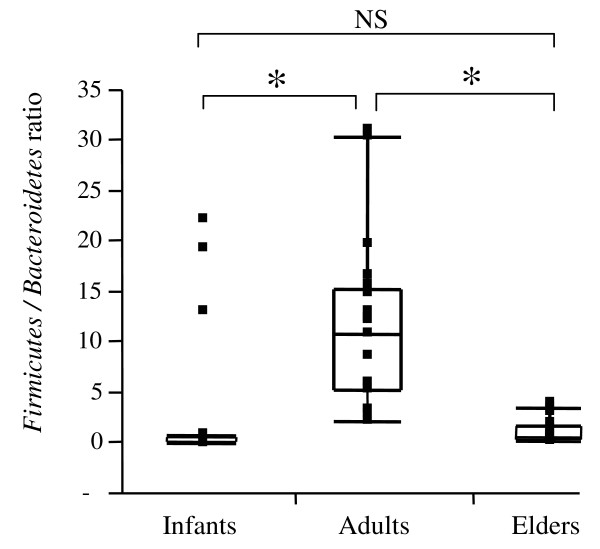
BACKGROUND: In humans, the intestinal microbiota plays an important role in the maintenance of host health by providing energy, nutrients, and immunological protection. Applying current molecular methods is necessary to surmount the limitations of classical culturing techniques in order to obtain an accurate description of the microbiota composition. RESULTS: Here we report on the comparative assessment of human fecal microbiota from three age-groups: infants, adults and the elderly. We demonstrate that the human intestinal microbiota undergoes maturation from birth to adulthood and is further altered with ageing. The counts of major bacterial groups Clostridium leptum, Clostridium coccoides, Bacteroidetes, Bifidobacterium, Lactobacillus and Escherichia coli were assessed by quantitative PCR (qPCR). By comparing species diversity profiles, we observed age-related changes in the human fecal microbiota. The microbiota of infants was generally characterized by low levels of total bacteria. C. leptum and C. coccoides species were highly represented in the microbiota of infants, while elderly subjects exhibited high levels of E. coli and Bacteroidetes. We observed that the ratio of Firmicutes to Bacteroidetes evolves during different life stages. For infants, adults and elderly individuals we measured ratios of 0.4, 10.9 and 0.6, respectively. CONCLUSION: In this work we have confirmed that qPCR is a powerful technique in studying the diverse and complex fecal microbiota. Our work demonstrates that the fecal microbiota composition evolves throughout life, from early childhood to old age.
Overview
The claims and statistics of this paper haven’t been checked yet.
Free: it reads the open-access text and checks the first 5 claims that cite a source we can check. Create a free account to check every claim.
Integrity signals
Registry
Cites
Statistics
Figures
Verification
Claims the paper makes
The claims and statistics of this paper haven’t been checked yet.
Free: it reads the open-access text and checks the first 5 claims that cite a source we can check. Create a free account to check every claim.
Claims other papers make about this one
Each is checked against this paper’s own text: does it say what the citing paper says it does?
The source backs part of the claim, not all of it — or backs it for a different population, condition or comparison.
In the citing paper
“A reduced Firmicutes:Bacteroidetes ratio has been reported in Irish and French elderly compared to young adults”
From The Microbiota-Gut-Brain Axis (2019) · cites this paper as Mariat et al., 2009
Experimental — accuracy not yet measuredIn the citing paper
“The disappearance of these microorganisms is important because they normally counteract the expansion of pathogenic microbial communities, while also maintaining intestinal barrier integrity by fermenting starches and dietary fibres and producing mucus and lipid metabolites, such as short-chain fatty acids (primarily acetate, propionate, and butyrate)66–68.”
From Inflammageing: chronic inflammation in ageing, cardiovascular disease, and frailty (2018) · cites this paper as [66]
In the citing paper
“Despite large variability in the gut microbiota found in different populations, geographic regions, and settings, evidence suggests that ageing is associated with a reduction in beneficial commensal microorganisms — such as Coprococcus, Faecalibacterium, and Lactobacillus — as well as a decrease in the Firmicutes: Bacteroidetes ratio66–68.”
From Inflammageing: chronic inflammation in ageing, cardiovascular disease, and frailty (2018) · cites this paper as [66]
In the citing paper
“In fact it has been reported that breast-fed infants generally harbor a more complex and numerous Bifidobacterium microbiota than formula-fed infants (19, 20).”
From Bifidobacteria and Their Health-Promoting Effects (2017) · cites this paper as [19]
In the citing paper
“An increased F/B ratio, caused by an expansion of Firmicutes and/or a contraction of Bacteroidetes, has been widely considered a signature of gut dysbiosis and has been associated with obesity, diabetes, and CVD8, 13, 16.”
From Gut Dysbiosis Is Linked to Hypertension (2015) · cites this paper as [8]
1 more claim about this paper
Create a free account to see every claim other papers make about this one.
Self-check
Percentages, sums and reported differences re-computed from the paper’s own numbers.
The self-check needs the paper’s full text.
Citations
Cites
Human gut microbes associated with obesity
Ley, R. E., Turnbaugh, P. J., Klein, S., & Gordon, J. I. (2006) · Nature · doi:10.1038/4441022a · Cited by 8,785 · cited 4×
“[7] when a correlation between body weight and gut microbial ecology was analysed.”
BackgroundInfluentialDiversity of the Human Intestinal Microbial Flora
Eckburg, P. B., Bik, E. M., Bernstein, C. N., Purdom, E., Dethlefsen, L., Sargent, M., Gill, S. R., Nelson, K. E., & Relman, D. A. (2005) · Science · doi:10.1126/science.1110591 · Cited by 7,913 · cited 1×
“This has markedly increased the information available concerning the complexity of the human bowel microbiota, from which over 1250 Operational Taxonomic Units have been identified corresponding to several dominant phyla [4,5].”
BackgroundHost-Bacterial Mutualism in the Human Intestine
Bäckhed, F., Ley, R. E., Sonnenburg, J. L., Peterson, D. A., & Gordon, J. I. (2005) · Science · doi:10.1126/science.1104816 · Cited by 5,277 · cited 1×
“The major functions attributed to the microbiota present in the gut begin to manifest at the end of the second year of life and comprise: i) nutrients absorption and food fermentation [10], ii) stimulation of the host immune system [11] and iii) barrier effects against pathogens [12].”
BackgroundDevelopment of the Human Infant Intestinal Microbiota
Palmer, C., Bik, E. M., DiGiulio, D. B., Relman, D. A., & Brown, P. O. (2007) · PLoS Biology · doi:10.1371/journal.pbio.0050177 · Cited by 2,877 · cited 1×
“Establishment of the intestinal microbiota has been shown to be a progressive process [9].”
BackgroundMICROBIAL ECOLOGY OF THE GASTROINTESTINAL TRACT
Savage, D. C. (1977) · Annual Review of Microbiology · doi:10.1146/annurev.mi.31.100177.000543 · Cited by 2,436 · cited 1×
“methods for more accurately assessing its composition and diversity, formerly thought to contain a mere 400– 500 bacterial species [2].”
MethodReduced diversity of faecal microbiota in Crohn’s disease revealed by a metagenomic approach
Manichanh, C., Rigottier-Gois, L., Bonnaud, E., Gloux, K., Pelletier, E., Frangeul, L., Nalin, R., Jarrin, C., Chardon, P., Marteau, P., et al. (2006) · Gut · doi:10.1136/gut.2005.073817 · Cited by 2,277 · cited 1×
“This has markedly increased the information available concerning the complexity of the human bowel microbiota, from which over 1250 Operational Taxonomic Units have been identified corresponding to several dominant phyla [4,5].”
BackgroundSelf-citationInteractions between commensal intestinal bacteria and the immune system
Macpherson, A. J., & Harris, N. L. (2004) · Nature Reviews Immunology · doi:10.1038/nri1373 · Cited by 1,610
Anatomical basis of tolerance and immunity to intestinal antigens
Mowat, A. M. (2003) · Nature Reviews Immunology · doi:10.1038/nri1057 · Cited by 1,415 · cited 1×
“The major functions attributed to the microbiota present in the gut begin to manifest at the end of the second year of life and comprise: i) nutrients absorption and food fermentation [10], ii) stimulation of the host immune system [11] and iii) barrier effects against pathogens [12].”
BackgroundHarmsen, H. J. M., Wildeboer–Veloo, A. C. M., Raangs, G. C., Wagendorp, A. A., Klijn, N., Bindels, J. G., & Welling, G. W. (2000) · Journal of Pediatric Gastroenterology and Nutrition · doi:10.1002/j.1536-4801.2000.tb02655.x · Cited by 1,337
Franks, A. H., Harmsen, H. J. M., Raangs, G. C., Jansen, G. J., Schut, F., & Welling, G. W. (1998) · Applied and Environmental Microbiology · doi:10.1128/aem.64.9.3336-3345.1998 · Cited by 1,056 · cited 1×
“Once climax composition is achieved near the end of adolescence, this ecosystem displays a high stability in healthy adults [13].”
Background
Cited by
Items 701–800 of 1,003
Origination, change, and modulation of geriatric disease-related gut microbiota during life
Rajoka, M. S. R., Zhao, H., Li, N., Lu, Y. P., Lian, Z., Shao, D., Jin, M., Li, Q., Zhao, L., & Shi, J. (2018) · Applied Microbiology and Biotechnology · doi:10.1007/s00253-018-9264-2 · Cited by 36
New insights on atherosclerosis: A cross-talk between endocannabinoid systems with gut microbiota
Moludi, J., Alizadeh, M., Yagin, N. L., Pasdar, Y., Nachvak, S. M., Abdollahzad, H., & Tabaei, A. S. (2018) · Journal of Cardiovascular and Thoracic Research · doi:10.15171/jcvtr.2018.21 · Cited by 36
Pafčo, B., Sharma, A. K., Petrželková, K. J., Vlčková, K., Todd, A. F., Yeoman, C. J., Wilson, B. A., Stumpf, R. M., White, B. A., Nelson, K. E., et al. (2019) · American Journal of Physical Anthropology · doi:10.1002/ajpa.23842 · Cited by 36
“Gut microbiome composition has been shown to dramatically change during the lifespan of an individual host (Mariat et al., 2009; Turnbaugh et al., 2007).”
BackgroundJohnstone, A. M., Kelly, J., Ryan, S., Romero-Gonzalez, R., McKinnon, H., Fyfe, C., Näslund, E. B., López‐Nicolás, R., Bosscher, D., Bonnema, A. L., et al. (2020) · Journal of Nutrition · doi:10.1093/jn/nxaa124 · Cited by 37
Kok, C. R., Brabec, B., Chichlowski, M., Harris, C. L., Moore, N. D., Wampler, J. L., Vanderhoof, J. A., Rose, D. J., & Hutkins, R. W. (2020) · BMC Microbiology · doi:10.1186/s12866-020-01991-5 · Cited by 37
Argyridou, S., Bernieh, D., Henson, J. J., Edwardson, C. L., Davies, M. J., Khunti, K., Suzuki, T., & Yates, T. E. (2020) · BMJ Open Diabetes Research & Care · doi:10.1136/bmjdrc-2020-001359 · Cited by 38
“19 20 TMAO levels are also influenced by other factors.”
Djekkoun, N., Lalau, J., Bach, V., Dépeint, F., & Khorsi‐Cauet, H. (2021) · European Journal of Nutrition · doi:10.1007/s00394-021-02548-6 · Cited by 38
Ba, Z., Lee, Y., Meng, H., Kris‐Etherton, P. M., Rogers, C. J., Lewis, Z. T., Mills, D. A., Furumoto, E. J., Rolon, M. L., Fleming, J. A., et al. (2021) · mSphere · doi:10.1128/msphere.00084-21 · Cited by 36
“The F/B ratio is known to vary dramatically among populations, as well as between age groups (36).”
BackgroundMazgaj, R., Lipiński, P., Szudzik, M., Jończy, A., Kopeć, Z., Stankiewicz, A. M., Kamyczek, M., Swinkels, D. W., Żelazowska, B., & Starzyński, R. R. (2021) · International Journal of Molecular Sciences · doi:10.3390/ijms22189930 · Cited by 36
“Similar to others [71], we also found that the additional provision of iron did not change the ratio of Firmicutes/Bacteroides (F/B), which is indicative of the overall health of the gastrointestinal tract.”
ResultImpact of the Age of Cecal Material Transfer Donors on Alzheimer’s Disease Pathology in 5xFAD Mice
Valeri, F., Guilherme, M. D. S., He, F., Stoye, N. M., Schwiertz, A., & Endres, K. (2021) · Microorganisms · doi:10.3390/microorganisms9122548 · Cited by 34
Cui, X., Gou, Z., Jiang, Z., Li, L., Lin, X., Fan, Q., Wang, Y., & Jiang, S. (2022) · Poultry Science · doi:10.1016/j.psj.2022.101721 · Cited by 36
“” On the other hand, Faecalibacterium are described to be “obese microbes” (Mariat et al., 2009).”
BackgroundThe Gut Microbiota-Brain Axis: A New Frontier on Neuropsychiatric Disorders
Queiroz, S. A. L., Ton, A. M. M., Pereira, T. D. M. C., Campagnaro, B. P., Martinelli, L., Picos, A., Campos‐Toimil, M., & Vasquez, E. C. (2022) · Frontiers in Psychiatry · doi:10.3389/fpsyt.2022.872594 · Cited by 37
Yang, X. Y., Tai, Y., Ma, Y., Xu, Z., Hao, J., Han, D., Li, J., & Deng, X. (2022) · Frontiers in Microbiology · doi:10.3389/fmicb.2022.984654 · Cited by 39
“Studies have reported that a higher Firmicutes/Bacteroides ratio is associated with human obesity (Mariat et al., 2009), while the reverse is related to weight loss (Ley et al.”
BackgroundNutritional influences on the gut microbiota and the consequences for gastrointestinal health
Scott, K. P., Duncan, S. H., Louis, P., & Flint, H. J. (2011) · Biochemical Society Transactions · doi:10.1042/bst0391073 · Cited by 42
Slowing Alzheimer’s disease progression through probiotic supplementation
Medeiros, D., McMurry, K., Pfeiffer, M., Newsome, K., Testerman, T., Graf, J., Silver, A. C., & Sacchetti, P. (2024) · Frontiers in Neuroscience · doi:10.3389/fnins.2024.1309075 · Cited by 33
Chen, X., Zhu, Z., Zhang, X., Chen, L., Gu, Q., & Li, P. (2024) · Journal of Dairy Science · doi:10.3168/jds.2023-24332 · Cited by 37
“…flora is regarded as a stable community(O'Toole and Claes-son, 2010), it can be altered due to various internal and external factors (such as age(Mariat et al., 2009), diet(Claesson et al., 2012), antibiotics(Robinson and Young, 2010), smoking(Biedermann et al., 2013), psychological…”
BackgroundLi, Y., Hao, Y., Gao, B., Geng, P., Huang, H., Yu, L., Choe, U., Liu, J., Sun, J., Chen, P. C., et al. (2019) · Journal of Functional Foods · doi:10.1016/j.jff.2019.04.053 · Cited by 32
Total body irradiation induced mouse small intestine senescence as a late effect
Zhao, Y., Zhang, J., Han, X., & Fan, S. (2019) · Journal of Radiation Research · doi:10.1093/jrr/rrz026 · Cited by 34
“In addition, the composition of the gut microbiota differs between the young and the elderly: Bacteroidetes instead of Firmicutes is dominant in the elderly gut microbiota [18, 19].”
Yu, X., Zhang, X., Jin, H., Wu, Z., Yan, C., Liu, Z., Xu, X., Liu, S., & Zhu, F. (2019) · Biological and Pharmaceutical Bulletin · doi:10.1248/bpb.b19-00057 · Cited by 36
Zhang, W., Zhang, Y., Zhang, X., Deng, Z., Liu, J., He, M., & Wang, H. (2020) · Animals · doi:10.3390/ani10020180 · Cited by 38
Human Microbiome: age-related changes and functions
Kaybysheva, V. O., Zharova, M. E., Filimendikova, K. Y., & Nikonov, E. L. (2020) · Russian Journal of Evidence-Based Gastroenterology · doi:10.17116/dokgastro2020902142 · Cited by 33
Lakshmanan, A. P., Shatat, I. F., Zaidan, S. A., Jacob, S. S., Bangarusamy, D. K., Alabduljabbar, S., Al‐Khalaf, F., Petroviski, G., & Terranegra, A. (2021) · Biomedicine & Pharmacotherapy · doi:10.1016/j.biopha.2021.111736 · Cited by 42
Bifidobacteria and Their Health-Promoting Effects
Hidalgo-Cantabrana, C., Delgado, S., Ruíz, L., Ruas‐Madiedo, P., Sánchez, B., & Margollés, A. (2018) · ASM Press eBooks · doi:10.1128/9781555819705.ch3 · Cited by 42
The Interplay Between Gut Microbiota and miRNAs in Cardiovascular Diseases
Ionescu, R. F., Enache, R. M., Creţoiu, S. M., & Crețoiu, D. (2022) · Frontiers in Cardiovascular Medicine · doi:10.3389/fcvm.2022.856901 · Cited by 35
Bello-Medina, P. C., Corona-Cervantes, K., Zavala-Torres, N. G., González, A., Pérez-Morales, M., González-Franco, D. A., Gómez, A., García-Mena, J., Díaz-Cintra, S. Y., & Pacheco‐López, G. (2022) · International Journal of Molecular Sciences · doi:10.3390/ijms23158209 · Cited by 35
“Recent studies have shown a decrease in Proteobacteria, and have related increased levels of Bacteroidetes and Firmicutes to AD and aging [10,28,29,44,46,51,52].”
BackgroundYoshikata, R., Yamaguchi, M., Mase, Y., 田續, 綾., Myint, K. Z. Y., & Ohta, H. (2022) · Journal of Women s Health · doi:10.1089/jwh.2022.0114 · Cited by 35
Gut microbiota in hypertensive patients with versus without obstructive sleep apnea
Lu, D., Xu, S., Dai, P., Wu, L., Zhang, H., & Zhou, B. (2022) · Journal of Clinical Hypertension · doi:10.1111/jch.14598 · Cited by 32
Schmit, K. J., Garcia, P., Sciortino, A., Aho, V. T. E., Rodriguez, B. P., Thomas, M. H., Gérardy, J., Acha, I. B., Halder, R., Cialini, C., et al. (2023) · Cell Reports · doi:10.1016/j.celrep.2023.113071 · Cited by 36
Mao, D., Tao, B., Sheng, S., Jin, H. Z., Chen, W., Gao, H., Deng, J., Li, Z., Chen, F., Chan, S., et al. (2023) · Investigative Ophthalmology & Visual Science · doi:10.1167/iovs.64.12.32 · Cited by 36
Uyaguari, M., Scott, G. I., & Norman, R. S. (2013) · Marine Pollution Bulletin · doi:10.1016/j.marpolbul.2013.09.027 · Cited by 31
High Abundance of Escherichia During the Establishment of Fecal Microbiota in Brazilian Children
Taddei, C. R., de Oliveira, F. F., Duarte, R. T. D., Talarico, S. T., Takagi, E. H., Carvalho, I. I. R., Gomes, F. M. D. S., Brandt, K. G., & Martinez, M. B. (2014) · Microbial Ecology · doi:10.1007/s00248-014-0381-x · Cited by 36
Ossa, J. C., Yáñez, D., Valenzuela, R., Gallardo, P., Lucero, Y., & Farfán, M. J. (2018) · Frontiers in Cellular and Infection Microbiology · doi:10.3389/fcimb.2018.00190 · Cited by 37
“BF harbors more Firmicutes and fewer Bacteroidetes, exhibiting a higher Firmicutes/Bacteroidetes (F/B) ratio than the BM group at T1 and T3, which is in line with previous data in healthy newborns (Mariat et al., 2009).”
ResultRelative abundance of nasal microbiota in chronic rhinosinusitis by structured histopathology
Kuhar, H. N., Tajudeen, B. A., Mahdavinia, M., Heilingoetter, A. L., Ganti, A., Gattuso, P., Ghai, R., & Batra, P. S. (2018) · International Forum of Allergy & Rhinology · doi:10.1002/alr.22192 · Cited by 32
Maternal micronutrients can modify colonic mucosal microbiota maturation in murine offspring
Nagy‐Szakal, D., Ross, M. C., Dowd, S. E., Mir, S. A. V., Schaible, T. D., Petrosino, J. F., & Kellermayer, R. (2012) · Gut Microbes · doi:10.4161/gmic.20697 · Cited by 34
Duan, G., & Li, L. (2023) · Frontiers in Nutrition · doi:10.3389/fnut.2023.1160069 · Cited by 33
“may be associated with lower inflammatory factors (48).”
BackgroundGut macrobiotic and its metabolic pathways modulate cardiovascular disease
Zhu, J., Lyu, J., Zhao, R., Liu, G., & Wang, S. (2023) · Frontiers in Microbiology · doi:10.3389/fmicb.2023.1272479 · Cited by 39
Targeting the Gut Microbiota for Prevention and Management of Type 2 Diabetes
Zeppa, S. D., Gervasi, M., Bartolacci, A., Ferrini, F., Patti, A., Sestili, P., Stocchi, V., & Agostini, D. (2024) · Nutrients · doi:10.3390/nu16223951 · Cited by 35
“Consequently, physical activity may encourage the production of less dangerous bioactive metabolites, such as TMAO, by improving the profile of the gut microbiome, especially in older or obese people who are more prone to have a dysfunctional gut microbiota [173].”
Characterizing the fecal microbiota of infants with botulism
Shirey, T. B., Dykes, J. K., Lúquez, C., Maslanka, S. E., & Raphael, B. H. (2015) · Microbiome · doi:10.1186/s40168-015-0119-0 · Cited by 32
“[40] illustrated the utility of using phylum-level abundance ratios to profile the infant gut microbiota.”
BackgroundNiu, J., Zhang, J., Wei, L.-Q., Ma, X., Zhang, W., & Nie, C. (2020) · Applied Microbiology and Biotechnology · doi:10.1007/s00253-020-10538-7 · Cited by 30
Potential anti-aging effects of fermented wheat germ in aging mice
Zhao, Y., Liao, A., Liu, N., Huang, J., Lv, X., Yang, C., Chen, W., Hou, Y., Ma, L., & Hui, M. (2021) · Food Bioscience · doi:10.1016/j.fbio.2021.101182 · Cited by 30
Muthyala, S. D. V., Shankar, S., Klemashevich, C. L., Blazier, J. C., Hillhouse, A., & Wu, C. (2022) · The Journal of Nutritional Biochemistry · doi:10.1016/j.jnutbio.2022.108999 · Cited by 38
Shannon, E., Conlon, M. A., & Hayes, M. (2022) · Nutrients · doi:10.3390/nu14102163 · Cited by 32
Host-genotype-dependent cecal microbes are linked to breast muscle metabolites in Chinese chickens
Feng, Y., Liu, D., Liu, Y., Yang, X., Zhang, M., Wei, F., Li, D., Hu, Y., & Guo, Y. (2022) · iScience · doi:10.1016/j.isci.2022.104469 · Cited by 32
“The Firmicutes/Bacteroidetes (F/B) ratio, a potentially important biomarker for animal and human gut microbial composition (Mariat et al., 2009), differed in the 10 chicken breeds (Figure S1B), with the highest in NYB and the lowest in SG, which might suggest the different capacities of the cecal…”
BackgroundThe effect of gut microbiota dysbiosis on patients with preeclampsia
Zhao, Y., Wang, B., Zhao, X., Cui, D., Hou, S., & Zhang, H. (2023) · Frontiers in Cellular and Infection Microbiology · doi:10.3389/fcimb.2022.1022857 · Cited by 32
“A system review pointed out that individuals with obesity have a greater F/B ratio, and upon weight loss, this ratio reverts to normal (Mariat et al., 2009; Crovesy et al., 2020).”
BackgroundKhalili, L., Centner, A. M., & Salazar, G. (2023) · International Journal of Molecular Sciences · doi:10.3390/ijms24043084 · Cited by 33
“The Firmicutes/Bacteroidetes (F/B) ratio has been used as a predictor of disease, as this ratio increases in obesity [13], with HFD in mouse models [14] and even during aging [15].”
MethodGut microbiome-modulated dietary strategies in EAE and multiple sclerosis
Hoffman, K. R., Doyle, W. J., Schumacher, S. M., & Ochoa‐Repáraz, J. (2023) · Frontiers in Nutrition · doi:10.3389/fnut.2023.1146748 · Cited by 33
“Lachnospiraceae has been associated with antiinflammatory properties (83).”
BackgroundInfluentialShould We Build “Obese” or “Lean” Anaerobic Digesters?
Briones, A. M., Coats, E. R., & Brinkman, C. K. (2014) · PLoS ONE · doi:10.1371/journal.pone.0097252 · Cited by 31
“Bacteroidetes and Firmicutes are also dominant in mammalian gut, with relative abundances that are determined by a number of hostrelated factors, such as obese or lean states [23] or age [24].”
BackgroundLi, W., Han, L., Yu, P., Ma, C., Wu, X., & Xu, J. (2014) · Microbiological Research · doi:10.1016/j.micres.2014.02.008 · Cited by 30
“Like- g gradient gel electrophoresis analysis of human skin microbial icres.2014.02.008 wise, there are many studies concerning the features of the aged gut microbiota (Mueller et al., 2006; Mariat et al., 2009; Drago et al., 2012; Marathe et al., 2012).”
BackgroundMethodInfluentialThe effect of aspartate supplementation on the microbial composition and innate immunity on mice
Bin, P., Liu, S., Chen, S., Zeng, Z., Huang, R., Yin, Y., & Liu, G. (2017) · Amino Acids · doi:10.1007/s00726-017-2467-5 · Cited by 31
Dietary raisin intake has limited effect on gut microbiota composition in adult volunteers
Wijayabahu, A. T., Waugh, S. G., Ukhanova, M., & Mai, V. (2019) · Nutrition Journal · doi:10.1186/s12937-019-0439-1 · Cited by 32
LaMonte, M. J., Genco, R. J., Buck, M. J., McSkimming, D. I., Li, L., Hovey, K. M., Andrews, C., Zheng, W., Sun, Y., Millen, A. E., et al. (2019) · BMC Oral Health · doi:10.1186/s12903-019-0906-2 · Cited by 33
McGinley, J. N., Fitzgerald, V. K., Neil, E. S., Omerigic, H., Heuberger, A. L., Weir, T. L., McGee, R. J., Vandemark, G. J., & Thompson, H. J. (2020) · Nutrients · doi:10.3390/nu12030593 · Cited by 32
Tangestani, H., Emamat, H., Ghalandari, H., & Shab‐Bidar, S. (2020) · Recent Patents on Food Nutrition & Agriculture · doi:10.2174/2212798411666200316152252 · Cited by 34
Cheng, J., Kolba, N., & Tako, E. (2023) · Critical Reviews in Food Science and Nutrition · doi:10.1080/10408398.2023.2169857 · Cited by 35
“Firmicutes phylum abundance was found to be decreased with Zn restriction in two of the selected studies (Chen et al. 2021); however, the changes in Firmicutes abundance may also be related to the change in life stage due to study progression (Mariat et al. 2009; Chen et al. 2021).”
BackgroundXiao, L., Engen, P. A., Leusink-Muis, T., van Ark, I., Stahl, B., Overbeek, S. A., Garssen, J., Naqib, A. D., Green, S. J., Keshavarzian, A., et al. (2019) · Journal of Nutrition · doi:10.1093/jn/nxz006 · Cited by 32
“In addition, a significant increase in the Firmicutes/Bacteroidetes ratio, which changes with age (33) was observed in cecal samples of GF2F (P < 0.”
Zheng, M., Mao, P., Tian, X., & Meng, L. (2020) · Poultry Science · doi:10.1016/j.psj.2020.11.005 · Cited by 31
Casani-Cubel, J., Benlloch, M., Sanchis-Sanchis, C. E., Marín, R., Lajara-Romance, J. M., & Ortí, J. E. D. L. R. (2021) · Metabolites · doi:10.3390/metabo11020120 · Cited by 33
“(2017) [56], and associated with a poor quality gut microbiota in babies and the elderly [57].”
BackgroundLuise, D., Chalvon‐Demersay, T., Lambert, W., Bosi, P., & Trevisi, P. (2021) · Italian Journal of Animal Science · doi:10.1080/1828051x.2021.1952911 · Cited by 34
Lamas, B., Evariste, L., & Houdeau, É. (2023) · Environmental Pollution · doi:10.1016/j.envpol.2023.121795 · Cited by 34
Changes in Korean Adult Females’ Intestinal Microbiota Resulting from Kimchi Intake
Kim, J. Y., & Ey, C. (2016) · Journal of Nutrition & Food Sciences · doi:10.4172/2155-9600.1000486 · Cited by 30
“The formation of intestinal dominant bacteria is affected by not only foods but also by age, antibiotics, probiotics, and prebiotics [21-23].”
BackgroundLaparra, A., Tricot, S., Le Van, M., Damouche, A., Gorwood, J., Vaslin, B., Favier, B., Benoist, S., Ho Tsong Fang, R., Bosquet, N., et al. (2019) · Frontiers in Immunology · doi:10.3389/fimmu.2019.00117 · Cited by 29
“The F/B ratio is also considered a significant marker of gut microbiota composition and high F/B ratio is associated with obesity (75, 76).”
BackgroundThe role of the gut microbiome in the development of hepatobiliary cancers
Daniel, N., Genua, F., Jenab, M., Mayén, A., Chatziioannou, A. C., Keski‐Rahkonen, P., & Hughes, D. J. (2023) · Hepatology · doi:10.1097/hep.0000000000000406 · Cited by 33
“[8] The shift of bacterial composition from eubiosis to a state of “ dysbiosis ” is characterized by a disruption to the gut microbiota homeostasis and is caused by an imbalance in the microflora, an alteration of their activities or function, or a shift in their local distribution.”
BackgroundPeniche, A. G., Spinler, J. K., Boonma, P., Savidge, T., & Dann, S. M. (2018) · Anaerobe · doi:10.1016/j.anaerobe.2018.07.011 · Cited by 30
Dynamic distribution of gallbladder microbiota in rabbit at different ages and health states
Xing, Y., Liu, J., Lu, F., Wang, L., Li, Y., & Ouyang, C. (2019) · PLoS ONE · doi:10.1371/journal.pone.0211828 · Cited by 36
Biemann, R., Buss, E., Benndorf, D., Lehmann, T., Schallert, K., Püttker, S., Reichl, U., Isermann, B., Schneider, J. G., Saake, G., et al. (2021) · Biomolecules · doi:10.3390/biom11050726 · Cited by 24
“This conclusion is in accordance with other findings suggesting that the ratio of Bacteroidetes to Firmicutes evolves during different life stages and strongly depends on the individual’s age [35].”
Resultvan Rossen, T. M., Ooijevaar, R. E., Kuyvenhoven, J. P., Eck, A., Bril, H., Buijsman, R., Boermeester, M. A., Stockmann, H. B. A. C., de Korte, N., & Budding, A. E. (2021) · PLoS ONE · doi:10.1371/journal.pone.0256657 · Cited by 32
“A higher Firmicutes/Bacteroidetes ratio is associated with dysbiosis [13, 14].”
BackgroundLi, Y., Muli, S., Huybrechts, I., Nöthlings, U., Ahrens, W., Scalbert, A., & Floegel, A. (2022) · Metabolites · doi:10.3390/metabo12020126 · Cited by 32
“It is well known that intestinal microbiota undergo maturation from birth to adulthood [12,14].”
BackgroundYao, N., Yang, Y., Li, X., Wang, Y., Guo, R., Wang, X., Li, J., Xie, Z., Li, B., & Cui, W. (2022) · Frontiers in Nutrition · doi:10.3389/fnut.2022.906511 · Cited by 32
“The F/B ratio is a marker of ecological dysregulation associated with a variety of metabolic diseases (99).”
BackgroundSong, C., Kim, N., Nam, R. H., Choi, S. I., Jang, J. Y., & Lee, H. (2022) · Cancer Research and Treatment · doi:10.4143/crt.2022.080 · Cited by 32
“Numerous studies have supported that lower F/B ratios are associated with a healthy state [42, 43], and”
Chu, X., Hou, Y., Meng, Q., Croteau, D. L., Wei, Y. Q., De, S., Becker, K. G., & Bohr, V. A. (2022) · Frontiers in Aging Neuroscience · doi:10.3389/fnagi.2022.993615 · Cited by 30
“The alteration of gut microbiota is associated with aging, cognitive frailty and AD, demonstrating that the changes in the taxonomic composition of the intestinal flora might influence brain functions (Mariat et al., 2009; Ticinesi et al., 2018).”
BackgroundWang, X., Li, L., Bian, C., Bai, M., Yu, H., Gao, H., Zhao, J., Zhang, C., & Zhao, R. (2023) · Frontiers in Microbiology · doi:10.3389/fmicb.2022.1068825 · Cited by 33
“However, some types of these gut microbiota changes also could be caused by other factors, such as obesity, a high-fat diet, and aging, demonstrating that this dysbiosis may not be specific to AUD (Ley et al., 2005; Hildebrandt et al., 2009; Mariat et al., 2009; Day and Kumamoto, 2022).”
BackgroundGong, H., Li, T., Liang, D., Gao, J., Liu, X., & Mao, X. (2023) · Food Science and Human Wellness · doi:10.26599/fshw.2022.9250010 · Cited by 32
Xian, W., Deng, Y., Yang, Y., Tan, Z., Chen, C., Li, W., & Yang, R. (2023) · Journal of Agricultural and Food Chemistry · doi:10.1021/acs.jafc.3c00960 · Cited by 30
Suja Rani, S., Prajapati, J. B., Joshi, C. G., Sreeja, V., Gohel, M. K., Trivedi, S. S., Patel, R., Pandya, H. V., Singh, U. S., Phatak, A. G., et al. (2015) · Frontiers in Microbiology · doi:10.3389/fmicb.2015.00944 · Cited by 32
Probiotic Bacteria and Enteric Infections
Paton, A., Morona, R., & Paton, J. (2011) · Springer eBooks · doi:10.1007/978-94-007-0386-5 · Cited by 30
Schwenger, K. J. P., Chen, L., Chelliah, A., Silva, H. D., Teterina, A. A., Comelli, E. M., Taïbi, A., Arendt, B. M., Fischer, S. E., & Allard, J. P. (2018) · International Journal of Molecular Medicine · doi:10.3892/ijmm.2018.3800 · Cited by 30
A comprehensive review for gut microbes: technologies, interventions, metabolites and diseases
Qi, C., Wang, P., Fu, T., Lu, M., Cai, Y., Chen, X., & Cheng, L. (2021) · Briefings in Functional Genomics · doi:10.1093/bfgp/elaa029 · Cited by 29
Morwani‐Mangnani, J., Giannos, P., Belzer, C., Beekman, M., Slagboom, P. E., & Prokopidis, K. (2022) · SLEEP · doi:10.1093/sleep/zsac239 · Cited by 33
“The Firmicutes to Bacteroidetes ratio (F/B ratio) is commonly used as a proxy for metabolic homeostasis [36, 37].”
MethodZou, Y., Liao, R., Cheng, R., Chung, H., Zhu, H., & Huang, Y. (2023) · Microbial Pathogenesis · doi:10.1016/j.micpath.2023.106370 · Cited by 29
What we need to know about the germ-free animal models
Aghighi, F., & Salami, M. (2024) · AIMS Microbiology · doi:10.3934/microbiol.2024007 · Cited by 33
“Two phyla Firmicutes and Bacteroidetes constitute 70% of the total microbiota [12].”
BackgroundFecal Microbiota Characteristics in Constipation-Predominant and Mixed-Type Irritable Bowel Syndrome
Vladimirovna, G. M., Dmitrievna, S. Y., Burakova, I. Y., Morozova, P., Lagutina, S. N., Chizhkov, P. A., Korneeva, O. S., & Syromyatnikov, M. (2024) · Microorganisms · doi:10.3390/microorganisms12071414 · Cited by 29
“In addition, the F/B ratio is thought to be important in signaling the health of the human gut microbiota [44].”
BackgroundGut microbiota composition and type 2 diabetes: Are these subjects linked Together?
Razavi, S., Amirmozafari, N., Bialvaei, A. Z., Navab-Moghadam, F., Khamseh, M. E., Alaei-Shahmiri, F., & Sedighi, M. (2024) · Heliyon · doi:10.1016/j.heliyon.2024.e39464 · Cited by 33
Zhang, J., Yang, J., Yang, C., Chen, T., Wang, Z., Li, J., Qin, F., Deng, Q., & Zhang, X. (2020) · Frontiers in Psychiatry · doi:10.3389/fpsyt.2020.00631 · Cited by 29
“The composition of this mass microbiota can be affected by many contributors, such as genetic factors (2), age (3), diet and exercise (4), etc.”
BackgroundEpigenetic alterations in aging tooth and the reprogramming potential
Hodjat, M., Khan, F., & Saadat, K. A. S. M. (2020) · Ageing Research Reviews · doi:10.1016/j.arr.2020.101140 · Cited by 28
Qi, M., Tan, B., Wang, J., Liao, S., Li, J., Cui, Z., Shao, Y., Ji, P., & Yin, Y. (2020) · Journal of Cellular Physiology · doi:10.1002/jcp.30028 · Cited by 28
Xia, T., Yao, Y., Wang, C., Dong, M., Wu, Y., Li, D., Xie, M., Ni, Q., Zhang, M., & Xu, H. (2020) · Global Ecology and Conservation · doi:10.1016/j.gecco.2020.e01409 · Cited by 30
Theabrownin modulates the gut microbiome and serum metabolome in aging mice induced by D-galactose
Lei, S., Zhang, Z., Xie, G., Zhao, C., Miao, Y., Chen, D., Zhang, G., Liu, H., Peng, C., Hou, Y., et al. (2022) · Journal of Functional Foods · doi:10.1016/j.jff.2022.104941 · Cited by 28
Feng, Y., Zhang, D., Zhao, Y., Duan, T., Sun, H., Ren, L., Ren, X., Lu, G., Liu, Y., Zhang, Z., et al. (2022) · Neurogastroenterology & Motility · doi:10.1111/nmo.14313 · Cited by 30
Utilization of Host and Microbiome Features in Determination of Biological Aging
Ratiner, K., Abdeen, S. K., Goldenberg, K., & Elinav, E. (2022) · Microorganisms · doi:10.3390/microorganisms10030668 · Cited by 30
“In general, the elderly microbiota is characterized by a decline in diversity, expansion of Bacteroidetes at the expense of Firmicutes phyla, an increase in the abundance of opportunistic enteropathogens, and a reduction in species known for producing short-chain fatty acids (SCFAs), in particular butyrate [1,16,17,21…”
BackgroundWang, L., Wang, C., Huang, C., Gao, C. Y., Wang, B., He, J., & Yan, Y. (2023) · Fish & Shellfish Immunology · doi:10.1016/j.fsi.2023.108910 · Cited by 32
Improving intestinal inflammaging to delay aging? A new perspective
Zhang, L., Yan, J., Zhang, C., Feng, S., Zhan, Z., Bao, Y., Zhang, S., & Chao, G. (2023) · Mechanisms of Ageing and Development · doi:10.1016/j.mad.2023.111841 · Cited by 29
Digestion and Postprandial Metabolism in the Elderly
Milan, A. M., & Cameron‐Smith, D. (2015) · Advances in food and nutrition research · doi:10.1016/bs.afnr.2015.09.001 · Cited by 33
Age related differences in the plasma kinetics of flavanols in rats
Margalef, M., Iglesias‐Carres, L., Pons, Z., Bravo, F. I., Muguerza, B., & Arola‐Arnal, A. (2015) · The Journal of Nutritional Biochemistry · doi:10.1016/j.jnutbio.2015.11.007 · Cited by 29
“Moreover, the wider variety of compounds detected in the adult rats could be attributed to the fact that the microbiota composition changes along ageing [24,37,38].”
BackgroundLim, Y. Y., Lee, Y. S., & Ooi, D. S. Q. (2020) · Biotechnology Journal · doi:10.1002/biot.202000013 · Cited by 29
Horwat, P., Kopeć, S., Garczyk, A., Kaliciak, I., Staręga, Z., Drogowski, K., Mardas, M., & Stelmach-Mardas, M. (2020) · Nutrients · doi:10.3390/nu12092551 · Cited by 29
Biscarini, F., Cremonesi, P., Castiglioni, B., Stella, A., Bronzo, V., Locatelli, C., & Moroni, P. (2020) · Frontiers in Veterinary Science · doi:10.3389/fvets.2020.00581 · Cited by 29
“The F:B ratio has been used to describe the shift in the gut microbiota associated with aging in humans (57), where it has been reported to increase with time, as found in the present study but on a different timespan.”
MethodChanges in Microbial Community Composition Related to Sex and Colon Cancer by Nrf2 Knockout
Song, C., Kim, N., Nam, R. H., Choi, S. I., Yu, J. E., Nho, H., & Surh, Y. (2021) · Frontiers in Cellular and Infection Microbiology · doi:10.3389/fcimb.2021.636808 · Cited by 29
“The F/B ratio is used as a representative index to compare different microbial communities (Mariat et al., 2009).”
BackgroundMethodKhogali, M. K., Wen, K., Jauregui, D., Malik, H. E. E., Liu, L., Zhao, M., Gong, D., & Geng, T. (2022) · The Journal of Poultry Science · doi:10.2141/jpsa.0210061 · Cited by 27
“The Firmicutes phylum plays a major role in food digestion (Mariat et al., 2009; Ma et al., 2018) and degradation of dietary fiber into short-chain fatty acids (SCFAs) (Li et al., 2020), and thus is closely associated with SCFA metabolism (Oakley et al., 2014; Polansky et al.,2015; Elokil et al.,…”
BackgroundHu, C., Liu, M., Sun, B., Tang, L., Zhou, X., & Chen, L. (2022) · Environment International · doi:10.1016/j.envint.2022.107418 · Cited by 26
Xu, Y., Huang, Y., Guo, L., Zhang, S., Wu, R., Fang, X., Xu, H., & Nie, Q. (2022) · Frontiers in Microbiology · doi:10.3389/fmicb.2022.930289 · Cited by 32
Metadata
- Authors
- Mariat, D., Firmesse, O., Levenez, F., Guimarăes, V., Sokol, H., Doré, J., Corthier, G., & Furet, J.-P.
- Affiliations
- Institut National de Recherche pour l'Agriculture, l'Alimentation et l'Environnement (FR)
- Institut National de la Recherche Agronomique (FR)
- Assistance Publique – Hôpitaux de Paris (FR)
- Corresponding author
- Mariat, D
- ORCID
- Venue
- BMC Microbiology
- Published
- 2009
- Volume
- 9
- Issue
- 1
- Pages
- 123
- ISSN
- 1471-2180 (ISSN-L)
- PMC
- PMC2702274
- OpenAlex
- W2142536690
- Cited by
- 1,755
- References
- 33
- Citations by year
- 2026: 63 · 2025: 123 · 2024: 150 · 2023: 162 · 2022: 187 · 2021: 179 · 2020: 195 · 2019: 130 · 2018: 115 · 2017: 92 · 2016: 79 · 2015: 54 · 2014: 55 · 2013: 54 · 2012: 48
- FWCI
- 15.42
- Type
- journal article
- Language
- en
- Open access
- gold
- doi.org
- Licence
- cc-by
- Locations
- BMC Microbiology (publishedVersion, cc-by)
- PubMed Central (publishedVersion, cc-by)
- PubMed (publishedVersion)
- HAL (submittedVersion, other-oa)
- DOAJ (DOAJ: Directory of Open Access Journals) (submittedVersion)
- Topics
- Life Sciences › Biochemistry, Genetics and Molecular Biology › Molecular Biology › Gut microbiota and health
- Health Sciences › Nursing › Nutrition and Dietetics › Infant Nutrition and Health
- Health Sciences › Dentistry › Periodontics › Oral microbiology and periodontitis research
- Keywords
- Firmicutes/Bacteroidetes ratio, human gut microbiome, fecal microbiota, age-related changes, microbiota maturation, infants, older adults, Clostridium leptum, Clostridium coccoides, Bacteroidetes, Bifidobacterium, Lactobacillus, Escherichia coli, bacterial diversity, real-time PCR
- MeSH terms
- Adult, Aged, Aged, 80 and over, Aging, Bifidobacterium, Clostridium, DNA, Bacterial, Escherichia coli, Feces, Humans, Infant, Infant, Newborn, Intestines, Lactobacillus, Middle Aged, Colony Count, Microbial, Bacteroidetes
About these checks
Registry, retraction, Cites and statistics results are computed, not judged, with one exception: a printed reference that no index lists is read once by a model before it counts as a citation error. Claims are extracted by a model and kept only when their quote appears verbatim in the text; each cited source is then checked, with a model’s help, for whether it says what the claim relies on. Those verdicts can be wrong — read the claim’s quote and the cited source before relying on one.
Statistics and arithmetic are recomputed, not judged.
Confidence bands are shown only for fields calibrated on our annotated test set. None is calibrated yet, so no band is shown.
What counts as a claim ›How we measure confidence ›How we check this ›
Are you an author, or do you see a problem with this page? Request a review
Data sources
Bibliographic data: Semantic Scholar, OpenAlex, Crossref.
Contains information from the Semantic Scholar Academic Graph Datasets, made available under the ODC Attribution License (ODC-BY 1.0).
Semantic Scholar’s data is described in: Kinney, R., et al. (2023). The Semantic Scholar Open Data Platform. arXiv:2301.10140.
