

The DOI matches its Crossref record; 83 of the 85 references it cites were found in a registry or an index; none of the 31 sources its claims cite is checked for support yet.
Clinical risk factors for age-related macular degeneration: a systematic review and meta-analysis
Open accessAbstract
BACKGROUND: Age-related macular degeneration (AMD) is the leading cause of blindness in Western countries. Numerous risk factors have been reported but the evidence and strength of association is variable. We aimed to identify those risk factors with strong levels of evidence which could be easily assessed by physicians or ophthalmologists to implement preventive interventions or address current behaviours. METHODS: A systematic review identified 18 prospective and cross-sectional studies and 6 case control studies involving 113,780 persons with 17,236 cases of late AMD that included an estimate of the association between late AMD and at least one of 16 pre-selected risk factors. Fixed-effects meta-analyses were conducted for each factor to combine odds ratio (OR) and/or relative risk (RR) outcomes across studies by study design. Overall raw point estimates of each risk factor and associated 95% confidence intervals (CI) were calculated. RESULTS: Increasing age, current cigarette smoking, previous cataract surgery, and a family history of AMD showed strong and consistent associations with late AMD. Risk factors with moderate and consistent associations were higher body mass index, history of cardiovascular disease, hypertension, and higher plasma fibrinogen. Risk factors with weaker and inconsistent associations were gender, ethnicity, diabetes, iris colour, history of cerebrovascular disease, and serum total and HDL cholesterol and triglyceride levels. CONCLUSIONS: Smoking, previous cataract surgery and a family history of AMD are consistent risk factors for AMD. Cardiovascular risk factors are also associated with AMD. Knowledge of these risk factors that may be easily assessed by physicians and general ophthalmologists may assist in identification and appropriate referral of persons at risk of AMD.
Overview
AI snapshot
Written from the paper’s full text.
TL;DR
This systematic review and meta-analysis found increasing age, current smoking, previous cataract surgery, and family history of AMD were strong and consistent risk factors for late AMD, with cardiovascular/metabolic factors showing moderate associations. It synthesizes 45 retained articles to identify risk factors that can be assessed by primary care physicians and general ophthalmologists.
Key findings
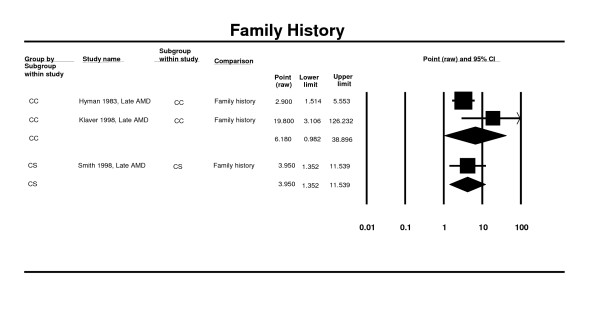
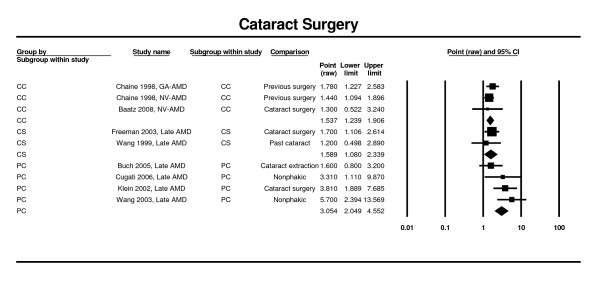
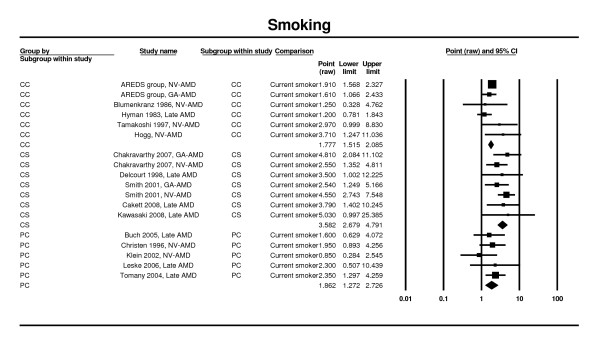
- Strong and consistent associations with late AMD were reported for increasing age, current cigarette smoking, previous cataract surgery, and family history of AMD. Smoking: prospective RR 1.86 (95% CI 1.27–2.73), cross-sectional OR 3.58 (2.68–4.79), case-control OR 1.78 (1.52–2.09). Cataract surgery: prospective RR 3.05 (2.05–4.55), cross-sectional OR 1.59 (1.08–2.34), case-control OR 1.54 (1.24–1.91). Family history: cross-sectional OR 3.95 (1.35–11.54); case-control OR 6.18 (0.98–38.90) in Table 3.
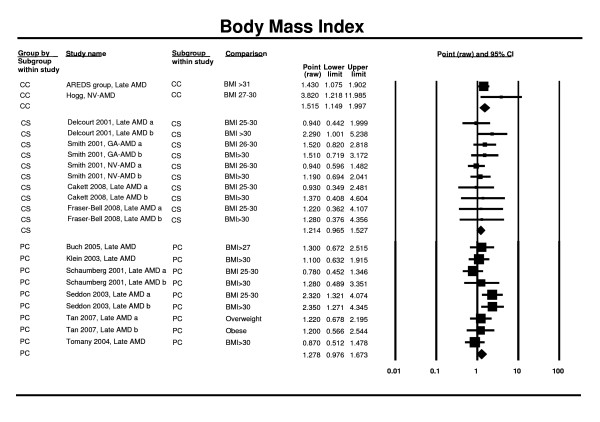
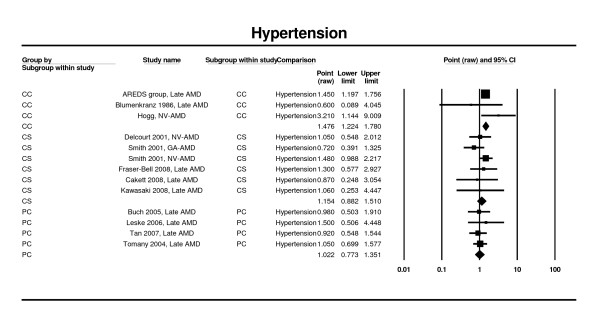
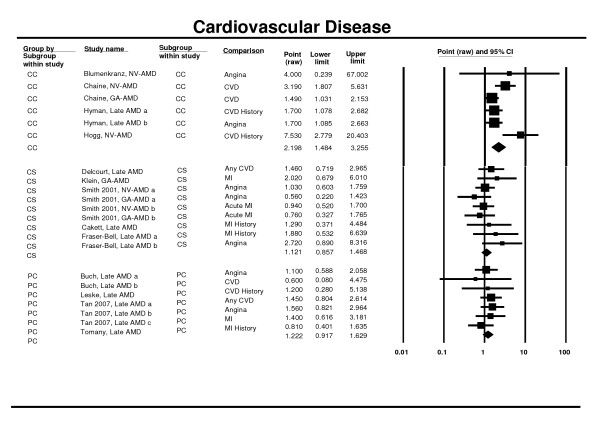
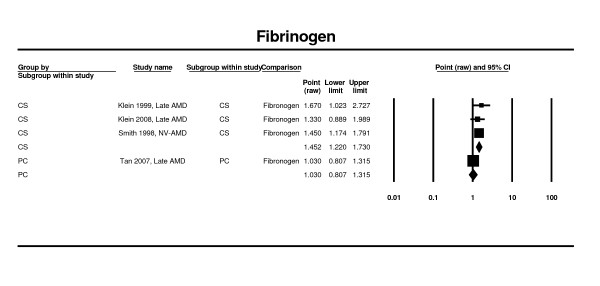
- Moderate and consistent associations were reported for higher BMI (case-control OR 1.52, 1.15–2.00; prospective RR 1.28, 0.98–1.67), history of cardiovascular disease (case-control OR 2.20, 1.49–3.26), hypertension (case-control OR 1.48, 1.22–1.78), and higher plasma fibrinogen (cross-sectional OR 1.45, 1.22–1.73).
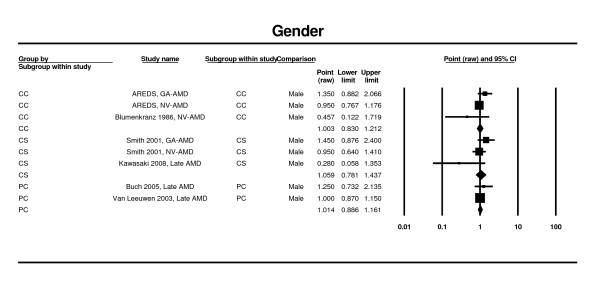
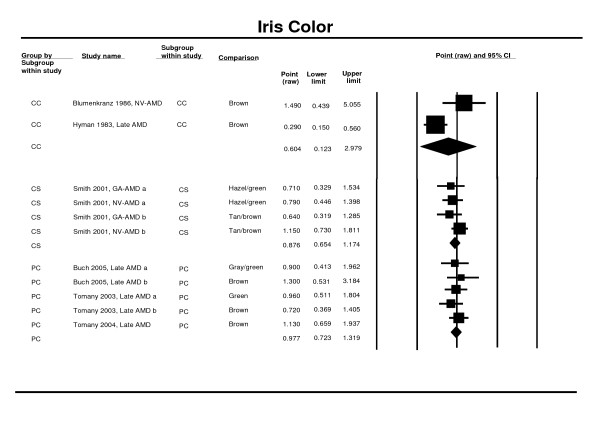
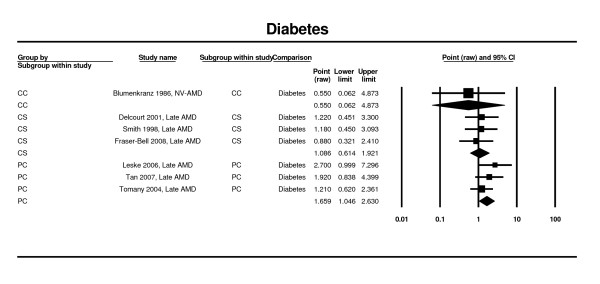
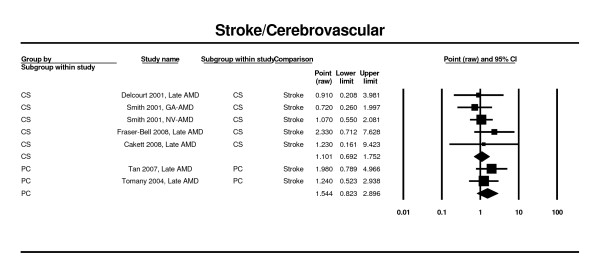
- Weaker and inconsistent associations were reported for gender, ethnicity, diabetes, iris colour, history of cerebrovascular disease, and serum total and HDL cholesterol and triglyceride levels. Diabetes was significant in prospective studies (RR 1.66, 1.05–2.63) but not in cross-sectional or case-control analyses.
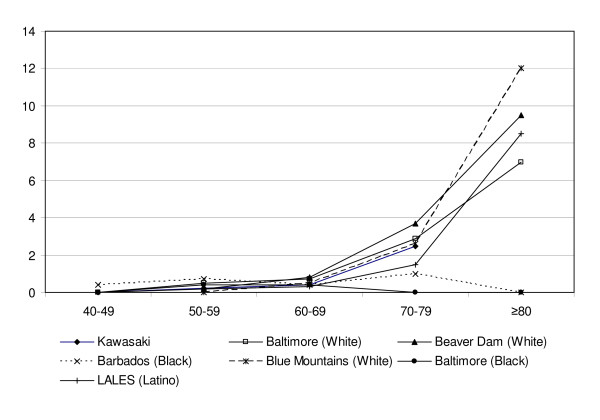
- Increasing age was strongly associated with late AMD in all studies; prevalence rose with age, e.g. 12.0% in the ≥80-year Blue Mountains white cohort (Table 4).
Methods
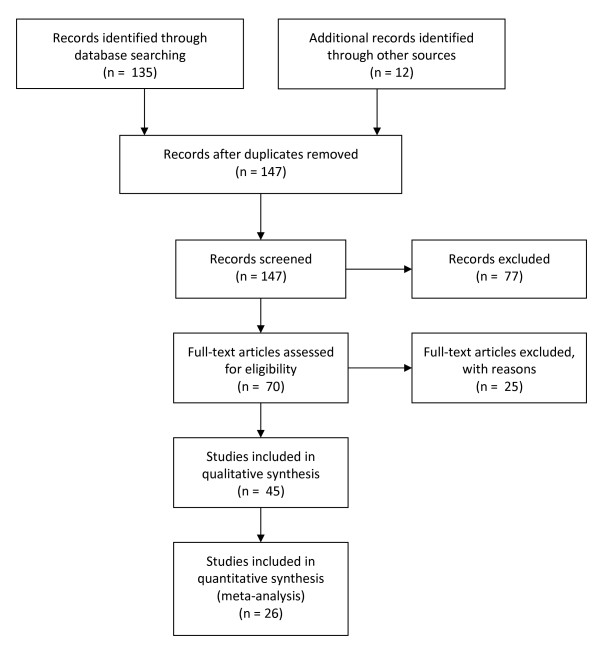
- Systematic review and meta-analysis of 16 pre-selected risk factors considered readily measured in nonspecialist settings; ocular, genetic, and nutritional factors were excluded. Searches were conducted in Medline and Cochrane, completed 28 February 2007 and repeated November 2008; 295 references were initially yielded, 147 articles were assessed, 70 fulfilled eligibility criteria, and 45 articles were retained.
- Included prospective cohort, cross-sectional, and case-control studies reporting an OR or RR between late AMD and at least one risk factor; adjusted estimates were selected. Fixed-effects meta-analyses were used unless heterogeneity was present (I² p<0.10), in which case random-effects models were used; funnel plots explored publication bias.
- The abstract reports 18 prospective and cross-sectional studies and 6 case-control studies involving 113,780 persons with 17,236 late AMD cases; the Results section reports 18 prospective/cross-sectional and 8 case-control studies contributing 94,058 patients and 3,178 late AMD cases.
Limitations
- The paper states that appropriateness or completeness of adjustment could not be ascertained; some data were crude and subject to measurement error (e.g. “history of cardiovascular disease” spanning asymptomatic angina to myocardial infarction), likely diluting effects. It excluded ocular factors, dietary factors, and genetic factors; included only English-language articles; searched only Medline and Cochrane (not EMBASE); and notes that prognostic use requires further research, with generally small observed odds ratios and limited preventive interventions.
- Evident from the text: study counts and sample sizes are inconsistent between the abstract and Results (113,780 persons/17,236 cases and 6 case-control studies vs 94,058 patients/3,178 cases and 8 case-control studies), and the family-history confidence interval in the narrative (1.94–6.61) differs from Table 3 (0.98–38.90).
Model-written summary. Check it against the paper before relying on it.
Integrity signals
Registry
Cites
Statistics
Figures
Verification
Claims the paper makes
30 Own result · 15 Own method · 10 Not checked yet · 9 Own interpretation · 1 No basis given
A result the paper reports from its own data — it cites no other source for it, so there is none to check. The quote shows it is in the paper.
In the paper
“No significant association was found in the prospective cohort and the cross-sectional studies (RR 1.22, 95% CI 0.92 - 1.63 and OR 1.12; 95% CI 0.86 - 1.47).”
§ Clinical risk factors for age-related macular degeneration: a systematic review and meta-analysis > Results > History of Cardiovascular Disease
plain- Asserted: passes — The authors put it forward as true.
- Checkable: passes — It can be checked against evidence.
- Load-bearing: passes — The paper’s conclusions depend on it.
- Based: passes — The paper gives a reason why it holds.
A result the paper reports from its own data — it cites no other source for it, so there is none to check. The quote shows it is in the paper.
In the paper
“A significant association was observed in the case control studies, with around double the odds of late AMD in individuals with cardiovascular disease (OR 2.20; 95% CI 1.48 - 3.26) (Figure 12).”
§ Clinical risk factors for age-related macular degeneration: a systematic review and meta-analysis > Results > History of Cardiovascular Disease
plaincorrelational- Asserted: passes — The authors put it forward as true.
- Checkable: passes — It can be checked against evidence.
- Load-bearing: passes — The paper’s conclusions depend on it.
- Based: passes — The paper gives a reason why it holds.
A result the paper reports from its own data — it cites no other source for it, so there is none to check. The quote shows it is in the paper.
In the paper
“Our systematic review and meta-analysis identified four strong and consistent risk factors for late AMD (increasing age, current smoking, previous cataract surgery and an AMD family history)”
§ Clinical risk factors for age-related macular degeneration: a systematic review and meta-analysis > Conclusions
boostedcorrelational- Asserted: passes — The authors put it forward as true.
- Checkable: passes — It can be checked against evidence.
- Load-bearing: passes — The paper’s conclusions depend on it.
- Based: passes — The paper gives a reason why it holds.
A result the paper reports from its own data — it cites no other source for it, so there is none to check. The quote shows it is in the paper.
In the paper
“based only on US data, people of European origin were at increased risk compared to other ethnic groups”
§ Clinical risk factors for age-related macular degeneration: a systematic review and meta-analysis > Discussion
hedgedcorrelational- Asserted: passes — The authors put it forward as true.
- Checkable: passes — It can be checked against evidence.
- Load-bearing: passes — The paper’s conclusions depend on it.
- Based: passes — The paper gives a reason why it holds.
A result the paper reports from its own data — it cites no other source for it, so there is none to check. The quote shows it is in the paper.
In the paper
“this was not significant in the cross-sectional or case-control studies”
§ Clinical risk factors for age-related macular degeneration: a systematic review and meta-analysis > Discussion
plain- Asserted: passes — The authors put it forward as true.
- Checkable: passes — It can be checked against evidence.
- Load-bearing: passes — The paper’s conclusions depend on it.
- Based: passes — The paper gives a reason why it holds.
None of the sources cited for this claim have been checked yet.
In the paper
“All studies found a strong association with increasing age (Table 4 and Figure 2) [31,74].”
- Also stated in: § Results · boosted
“Increasing age, current cigarette smoking, previous cataract surgery, and a family history of AMD showed strong and consistent associations with late AMD.”
§ Clinical risk factors for age-related macular degeneration: a systematic review and meta-analysis > Results > Age
What the sources say
- Not checked yetcites [31] Kawasaki R, Wang JJ, Aung T, Tan DT, Mitchell P, Sandar M, et al: Prevalence of age-related macular degeneration in a Malay population: the Singapore Malay Eye Study. Ophthalmology. 2008, 115: 1735-41. 10.1016/j.ophtha.2008.02.012. source
- Not checked yetcites [74] Varma R, Ying-Lai M, Francis BA, Nguyen BB, Deneen J, Wilson MR, et al: Prevalence of open-angle glaucoma and ocular hypertension in Latinos: the Los Angeles Latino Eye Study. Ophthalmology. 2004, 111: 1439-48. 10.1016/j.ophtha.2004.01.025. source
boostedcorrelational- Asserted: passes — The authors put it forward as true.
- Checkable: passes — It can be checked against evidence.
- Load-bearing: passes — The paper’s conclusions depend on it.
- Based: passes — The paper gives a reason why it holds.
- Also stated in: § Results · boosted
A result the paper reports from its own data — it cites no other source for it, so there is none to check. The quote shows it is in the paper.
In the paper
“Analysis of the prospective cohort studies showed that previous cataract surgery is a strong risk factor for neovascular AMD (RR 3.05; CI 2.05 - 4.55).”
- Also stated in: § Results · boosted
“Increasing age, current cigarette smoking, previous cataract surgery, and a family history of AMD showed strong and consistent associations with late AMD.”
§ Clinical risk factors for age-related macular degeneration: a systematic review and meta-analysis > Results > Cataract surgery
boostedcorrelational- Asserted: passes — The authors put it forward as true.
- Checkable: passes — It can be checked against evidence.
- Load-bearing: passes — The paper’s conclusions depend on it.
- Based: passes — The paper gives a reason why it holds.
- Also stated in: § Results · boosted
In the paper
“There was only one estimate from a prospective study [46] and it did not support this finding (OR 1.03; 95% CI 0.81 - 1.32) of significance in the cross-sectional studies (Figure 14).”
§ Clinical risk factors for age-related macular degeneration: a systematic review and meta-analysis > Results > Biological markers
What the sources say
- Not checked yetcites [46] Tan JS, Mitchell P, Smith W, Wang JJ: Cardiovascular Risk Factors and the Long-term Incidence of Age-Related Macular Degeneration The Blue Mountains Eye Study. Ophthalmology. 2007, 114: 1143-50. 10.1016/j.ophtha.2006.09.033. source
plain- Asserted: passes — The authors put it forward as true.
- Checkable: passes — It can be checked against evidence.
- Load-bearing: unclear — It is unclear whether the paper’s conclusions depend on it.
- Based: passes — The paper gives a reason why it holds.
A result the paper reports from its own data — it cites no other source for it, so there is none to check. The quote shows it is in the paper.
In the paper
“None of the analyses showed statistically significant associations (prospective cohort RR 1.02; 95% CI 0.77 - 1.35; cross-sectional studies OR 1.15; 95% CI: 0.88 - 1.51).”
§ Clinical risk factors for age-related macular degeneration: a systematic review and meta-analysis > Results > Hypertension
plain- Asserted: passes — The authors put it forward as true.
- Checkable: passes — It can be checked against evidence.
- Load-bearing: passes — The paper’s conclusions depend on it.
- Based: passes — The paper gives a reason why it holds.
A result the paper reports from its own data — it cites no other source for it, so there is none to check. The quote shows it is in the paper.
In the paper
“Our systematic review and meta-analysis identified four strong and consistent risk factors for late AMD (increasing age, current smoking, previous cataract surgery and an AMD family history)”
§ Clinical risk factors for age-related macular degeneration: a systematic review and meta-analysis > Conclusions
boostedcorrelational- Asserted: passes — The authors put it forward as true.
- Checkable: passes — It can be checked against evidence.
- Load-bearing: passes — The paper’s conclusions depend on it.
- Based: passes — The paper gives a reason why it holds.
- It may state two separate claims as one. 13
- Probably not a substantial claim. 13
A result the paper reports from its own data — it cites no other source for it, so there is none to check. The quote shows it is in the paper.
In the paper
“a further four risk factors showing significant and moderate strength of associations (high BMI, history of cardiovascular disease, hypertension and plasma fibrinogen)”
§ Clinical risk factors for age-related macular degeneration: a systematic review and meta-analysis > Conclusions
plaincorrelational- Asserted: passes — The authors put it forward as true.
- Checkable: passes — It can be checked against evidence.
- Load-bearing: passes — The paper’s conclusions depend on it.
- Based: passes — The paper gives a reason why it holds.
It may state two separate claims as one.
A result the paper reports from its own data — it cites no other source for it, so there is none to check. The quote shows it is in the paper.
In the paper
“The pooled odds ratios and relative risks were non-significant for both serum cholesterol measures.”
§ Clinical risk factors for age-related macular degeneration: a systematic review and meta-analysis > Results > Biological markers
plain- Asserted: passes — The authors put it forward as true.
- Checkable: passes — It can be checked against evidence.
- Load-bearing: passes — The paper’s conclusions depend on it.
- Based: passes — The paper gives a reason why it holds.
It may state two separate claims as one.
None of the sources cited for this claim have been checked yet.
In the paper
“In total, data from 18 prospective, cross-sectional studies and 8 case control studies [12,24-26,28,30,31,33-47,49-54,57-73] were included in the final analysis, contributing a sample of some 94,058 patients (ranging from 261 to 22,071) including 3,178 (ranging from 8 to 776) late AMD cases.”
§ Clinical risk factors for age-related macular degeneration: a systematic review and meta-analysis > Results
What the sources say
- Not checked yetcites [12] Chakravarthy U, Augood C, Bentham GC, De Jong PT, Rahu M, Seland J, et al: Cigarette Smoking and Age-Related Macular Degeneration in the EUREYE Study. Ophthalmology. 2007, 114: 1157-63. 10.1016/j.ophtha.2006.09.022. source
- Not checked yetcites [24] Wang JJ, Klein R, Smith W, Klein BE, Tomany S, Mitchell P: Cataract surgery and the 5-year incidence of late-stage age-related maculopathy: pooled findings from the Beaver Dam and Blue Mountains eye studies. Ophthalmology. 2003, 110: 1960-7. 10.1016/S0161-6420(03)00816-9. source
- Not checked yetcites [25] Smith W, Assink J, Klein R, Mitchell P, Klaver CC, Klein BE, et al: Risk factors for age-related macular degeneration: Pooled findings from three continents. Ophthalmology. 2001, 108: 697-704. 10.1016/S0161-6420(00)00580-7. source
- Not checked yetcites [26] Tomany SC, Wang JJ, Van Leeuwen R, Klein R, Mitchell P, Vingerling JR, et al: Risk factors for incident age-related macular degeneration: pooled findings from 3 continents. Ophthalmology. 2004, 111: 1280-7. 10.1016/j.ophtha.2003.11.010. source
- Not checked yetcites [28] Cackett P, Wong TY, Aung T, Saw SM, Tay WT, Rochtchina E, et al: Smoking, cardiovascular risk factors, and age-related macular degeneration in Asians: the Singapore Malay Eye Study. Am J Ophthalmol. 2008, 146: 960-7. 10.1016/j.ajo.2008.06.026. source
- Not checked yetcites [30] Kawasaki R, Wang JJ, Ji GJ, Taylor B, Oizumi T, Daimon M, et al: Prevalence and risk factors for age-related macular degeneration in an adult Japanese population: the Funagata study. Ophthalmology. 2008, 115: 1376-81. 10.1016/j.ophtha.2007.11.015. 1381 source
- Not checked yetcites [31] Kawasaki R, Wang JJ, Aung T, Tan DT, Mitchell P, Sandar M, et al: Prevalence of age-related macular degeneration in a Malay population: the Singapore Malay Eye Study. Ophthalmology. 2008, 115: 1735-41. 10.1016/j.ophtha.2008.02.012. source
- Not checked yetcites [33] Buch H, Vinding T, la Cour M, Jensen GB, Prause JU, Nielsen NV: Risk factors for age-related maculopathy in a 14-year follow-up study: the Copenhagen City Eye Study. Acta Ophthalmologica Scandinavica. 2005, 83: 409-18. 10.1111/j.1600-0420.2005.00492.x. source
- Not checked yetcites [34] Christen WG, Glynn RJ, Manson JE, Ajani UA, Buring JE: A prospective study of cigarette smoking and risk of age-related macular degeneration in men. JAMA. 1996, 276: 1147-51. 10.1001/jama.276.14.1147. source
- Not checked yetcites [35] Cugati S, Mitchell P, Rochtchina E, Tan AG, Smith W, Wang JJ: Cataract surgery and the 10-year incidence of age-related maculopathy: the Blue Mountains Eye Study. Ophthalmology. 2006, 113: 2020-5. 10.1016/j.ophtha.2006.05.047. source
hedgedn = 3,178- Asserted: passes — The authors put it forward as true.
- Checkable: passes — It can be checked against evidence.
- Load-bearing: passes — The paper’s conclusions depend on it.
- Based: passes — The paper gives a reason why it holds.
It may state two separate claims as one.
A result the paper reports from its own data — it cites no other source for it, so there is none to check. The quote shows it is in the paper.
In the paper
“a further four risk factors showing significant and moderate strength of associations (high BMI, history of cardiovascular disease, hypertension and plasma fibrinogen)”
§ Clinical risk factors for age-related macular degeneration: a systematic review and meta-analysis > Conclusions
plaincorrelational- Asserted: passes — The authors put it forward as true.
- Checkable: passes — It can be checked against evidence.
- Load-bearing: passes — The paper’s conclusions depend on it.
- Based: passes — The paper gives a reason why it holds.
It may state two separate claims as one.
A result the paper reports from its own data — it cites no other source for it, so there is none to check. The quote shows it is in the paper.
In the paper
“a further four risk factors showing significant and moderate strength of associations (high BMI, history of cardiovascular disease, hypertension and plasma fibrinogen)”
§ Clinical risk factors for age-related macular degeneration: a systematic review and meta-analysis > Conclusions
plaincorrelational- Asserted: passes — The authors put it forward as true.
- Checkable: passes — It can be checked against evidence.
- Load-bearing: passes — The paper’s conclusions depend on it.
- Based: passes — The paper gives a reason why it holds.
It may state two separate claims as one.
A result the paper reports from its own data — it cites no other source for it, so there is none to check. The quote shows it is in the paper.
In the paper
“a further four risk factors showing significant and moderate strength of associations (high BMI, history of cardiovascular disease, hypertension and plasma fibrinogen)”
§ Clinical risk factors for age-related macular degeneration: a systematic review and meta-analysis > Conclusions
plaincorrelational- Asserted: passes — The authors put it forward as true.
- Checkable: passes — It can be checked against evidence.
- Load-bearing: passes — The paper’s conclusions depend on it.
- Based: passes — The paper gives a reason why it holds.
It may state two separate claims as one.
What the paper did — it cites no source for this, so there is none to check. The quote shows it is in the paper.
In the paper
“we only included articles that were identified in the Medline and Cochrane databases”
§ Clinical risk factors for age-related macular degeneration: a systematic review and meta-analysis > Discussion
plain- Asserted: passes — The authors put it forward as true.
- Checkable: passes — It can be checked against evidence.
- Load-bearing: fails — The paper’s conclusions may not depend on it.
- Based: passes — The paper gives a reason why it holds.
Probably not a substantial claim. The paper’s conclusions may not depend on it.
What the paper did — it cites no source for this, so there is none to check. The quote shows it is in the paper.
In the paper
“we could not ascertain the appropriateness or completeness of adjustment in the studies”
§ Clinical risk factors for age-related macular degeneration: a systematic review and meta-analysis > Discussion
hedged- Asserted: passes — The authors put it forward as true.
- Checkable: passes — It can be checked against evidence.
- Load-bearing: fails — The paper’s conclusions may not depend on it.
- Based: passes — The paper gives a reason why it holds.
Probably not a substantial claim. The paper’s conclusions may not depend on it.
In the paper
“Large, epidemiological, cohort studies had the advantage over other study designs in that they removed any temporal or causal ambiguity as the exposure precedes the disease and if follow-up is not biased selection bias is less of a problem than in other study designs [90].”
§ Clinical risk factors for age-related macular degeneration: a systematic review and meta-analysis > Discussion
What the sources say
- Not checked yetcites [90] Wong TY, Hyman L: Population-based studies in ophthalmology. Am J Ophthalmol. 2008, 146: 656-63. 10.1016/j.ajo.2008.07.048. source
plaindirect- Asserted: passes — The authors put it forward as true.
- Checkable: passes — It can be checked against evidence.
- Load-bearing: passes — The paper’s conclusions depend on it.
- Based: passes — The paper gives a reason why it holds.
It may state two separate claims as one.
What the paper did — it cites no source for this, so there is none to check. The quote shows it is in the paper.
In the paper
“we selected only studies that reported some adjustment for confounding factors”
§ Clinical risk factors for age-related macular degeneration: a systematic review and meta-analysis > Discussion
plain- Asserted: passes — The authors put it forward as true.
- Checkable: passes — It can be checked against evidence.
- Load-bearing: passes — The paper’s conclusions depend on it.
- Based: passes — The paper gives a reason why it holds.
Probably not a substantial claim.
A conclusion the paper draws from its own results — it cites no other source for it, so there is none to check. The quote shows it is in the paper.
In the paper
“Our meta-analysis confirmed the increased risks of late AMD associated with advancing age (especially for the oldest age groups of 80 years and over), current cigarette smoking, and previous cataract surgery.”
§ Clinical risk factors for age-related macular degeneration: a systematic review and meta-analysis > Discussion
plaincorrelational- Asserted: passes — The authors put it forward as true.
- Checkable: passes — It can be checked against evidence.
- Load-bearing: passes — The paper’s conclusions depend on it.
- Based: passes — The paper gives a reason why it holds.
It may state two separate claims as one.
What the paper did — it cites no source for this, so there is none to check. The quote shows it is in the paper.
In the paper
“we feel it is unlikely any relevant articles were missed.”
§ Clinical risk factors for age-related macular degeneration: a systematic review and meta-analysis > Discussion
hedged- Asserted: passes — The authors put it forward as true.
- Checkable: fails — It may be too vague to check against evidence.
- Load-bearing: fails — The paper’s conclusions may not depend on it.
- Based: passes — The paper gives a reason why it holds.
Probably not a substantial claim. It may be too vague to check against evidence. The paper’s conclusions may not depend on it.
What the paper did — it cites no source for this, so there is none to check. The quote shows it is in the paper.
In the paper
“We did not include studies that reported only the unadjusted results (i.e., crude ORs).”
§ Clinical risk factors for age-related macular degeneration: a systematic review and meta-analysis > Methods > Studies and Participants
plain- Asserted: passes — The authors put it forward as true.
- Checkable: passes — It can be checked against evidence.
- Load-bearing: passes — The paper’s conclusions depend on it.
- Based: passes — The paper gives a reason why it holds.
Probably not a substantial claim.
What the paper did — it cites no source for this, so there is none to check. The quote shows it is in the paper.
In the paper
“the assessment of the quality of the publications was performed as part of this study”
§ Clinical risk factors for age-related macular degeneration: a systematic review and meta-analysis > Discussion
plain- Asserted: passes — The authors put it forward as true.
- Checkable: passes — It can be checked against evidence.
- Load-bearing: fails — The paper’s conclusions may not depend on it.
- Based: passes — The paper gives a reason why it holds.
Probably not a substantial claim. The paper’s conclusions may not depend on it.
What the paper did — it cites no source for this, so there is none to check. The quote shows it is in the paper.
In the paper
“All studies included adjusted for age; when studies reported more than one adjusted estimate, the multivariate adjusted estimate was selected (i.e., if a study reported either age adjusted or age, gender and smoking adjusted results, the latter was chosen).”
§ Clinical risk factors for age-related macular degeneration: a systematic review and meta-analysis > Methods > Studies and Participants
plain- Asserted: passes — The authors put it forward as true.
- Checkable: passes — It can be checked against evidence.
- Load-bearing: passes — The paper’s conclusions depend on it.
- Based: passes — The paper gives a reason why it holds.
Probably not a substantial claim. It may state two separate claims as one.
What the paper did — it cites no source for this, so there is none to check. The quote shows it is in the paper.
In the paper
“we included only English language articles”
§ Clinical risk factors for age-related macular degeneration: a systematic review and meta-analysis > Discussion
plain- Asserted: passes — The authors put it forward as true.
- Checkable: passes — It can be checked against evidence.
- Load-bearing: fails — The paper’s conclusions may not depend on it.
- Based: passes — The paper gives a reason why it holds.
Probably not a substantial claim. The paper’s conclusions may not depend on it.
A conclusion the paper draws from its own results — it cites no other source for it, so there is none to check. The quote shows it is in the paper.
In the paper
“Smoking, previous cataract surgery and a family history of AMD are consistent risk factors for AMD.”
§ Clinical risk factors for age-related macular degeneration: a systematic review and meta-analysis > Abstract > Conclusions
plaincorrelational- Asserted: passes — The authors put it forward as true.
- Checkable: passes — It can be checked against evidence.
- Load-bearing: passes — The paper’s conclusions depend on it.
- Based: passes — The paper gives a reason why it holds.
It may state two separate claims as one.
What the paper did — it cites no source for this, so there is none to check. The quote shows it is in the paper.
In the paper
“The abstracts of these articles were independently reviewed by two researchers (LP and CE) and relevant data (e.g., study design, risk factor, type of AMD) was recorded on a study-specific abstraction form.”
§ Clinical risk factors for age-related macular degeneration: a systematic review and meta-analysis > Methods > Study Selection
plain- Asserted: passes — The authors put it forward as true.
- Checkable: passes — It can be checked against evidence.
- Load-bearing: passes — The paper’s conclusions depend on it.
- Based: passes — The paper gives a reason why it holds.
Probably not a substantial claim.
A conclusion the paper draws from its own results — it cites no other source for it, so there is none to check. The quote shows it is in the paper.
In the paper
“Of the 16 risk factors identified in our systematic review and meta-analysis, age, current smoking, cataract surgery, and potentially family history were strongly and consistently associated with late AMD.”
§ Clinical risk factors for age-related macular degeneration: a systematic review and meta-analysis > Discussion
boostedcorrelational- Asserted: passes — The authors put it forward as true.
- Checkable: passes — It can be checked against evidence.
- Load-bearing: passes — The paper’s conclusions depend on it.
- Based: passes — The paper gives a reason why it holds.
It may state two separate claims as one.
What the paper did — it cites no source for this, so there is none to check. The quote shows it is in the paper.
In the paper
“We conducted fixed-effects and random-effects meta-analyses to combine these outcomes across included studies by study design, estimating overall raw point estimates of each risk factor and their associated 95% confidence intervals (CI). The selection of fixed-effects vs. random-effects models was based on the reported I-squared value and associated p-value.”
§ Clinical risk factors for age-related macular degeneration: a systematic review and meta-analysis > Methods > Data Synthesis
plain- Asserted: passes — The authors put it forward as true.
- Checkable: passes — It can be checked against evidence.
- Load-bearing: passes — The paper’s conclusions depend on it.
- Based: passes — The paper gives a reason why it holds.
Probably not a substantial claim. It may state two separate claims as one.
What the paper did — it cites no source for this, so there is none to check. The quote shows it is in the paper.
In the paper
“we decided to present the data based on the type of study design reported in the publication: cohort, cross sectional and case control”
§ Clinical risk factors for age-related macular degeneration: a systematic review and meta-analysis > Discussion
plain- Asserted: passes — The authors put it forward as true.
- Checkable: passes — It can be checked against evidence.
- Load-bearing: passes — The paper’s conclusions depend on it.
- Based: passes — The paper gives a reason why it holds.
Probably not a substantial claim.
A conclusion the paper draws from its own results — it cites no other source for it, so there is none to check. The quote shows it is in the paper.
In the paper
“Knowledge of these risk factors that may be easily assessed by physicians and general ophthalmologists may assist in identification and appropriate referral of persons at risk of AMD.”
§ Clinical risk factors for age-related macular degeneration: a systematic review and meta-analysis > Abstract > Conclusions
hedgedconditional- Asserted: passes — The authors put it forward as true.
- Checkable: fails — It may be too vague to check against evidence.
- Load-bearing: passes — The paper’s conclusions depend on it.
- Based: passes — The paper gives a reason why it holds.
Probably not a substantial claim. It may be too vague to check against evidence.
- Rests on an assumption: The 16 selected risk factors are readily measured in nonspecialist settings.
- Rests on an assumption: The risk factors are easily assessed through discussions with patients and do not entail a lengthy medical history taking or laboratory evaluations.
In the paper
“The relationship of cataract surgery and late AMD was previously reported in a pooled analysis of 3 studies in different continents [26].”
§ Clinical risk factors for age-related macular degeneration: a systematic review and meta-analysis > Discussion
What the sources say
- Not checked yetcites [26] Tomany SC, Wang JJ, Van Leeuwen R, Klein R, Mitchell P, Vingerling JR, et al: Risk factors for incident age-related macular degeneration: pooled findings from 3 continents. Ophthalmology. 2004, 111: 1280-7. 10.1016/j.ophtha.2003.11.010. source
plaincorrelational- Asserted: passes — The authors put it forward as true.
- Checkable: passes — It can be checked against evidence.
- Load-bearing: fails — The paper’s conclusions may not depend on it.
- Based: passes — The paper gives a reason why it holds.
Probably not a substantial claim. The paper’s conclusions may not depend on it.
What the paper did — it cites no source for this, so there is none to check. The quote shows it is in the paper.
In the paper
“Funnel plots were reviewed and no evidence of publication bias was observed.”
§ Clinical risk factors for age-related macular degeneration: a systematic review and meta-analysis > Results
plain- Asserted: passes — The authors put it forward as true.
- Checkable: passes — It can be checked against evidence.
- Load-bearing: unclear — It is unclear whether the paper’s conclusions depend on it.
- Based: passes — The paper gives a reason why it holds.
It may state two separate claims as one.
The paper relies on this without support.
The 16 selected risk factors are readily measured in nonspecialist settings.
“Following review by an expert panel (UC, AF, PM, TYW), 16 factors that were considered to be readily measured in nonspecialist settings were selected for the full systematic review.”
The paper relies on this without support.
The risk factors identified as associated with cardiovascular disease are also likely to be measured and monitored in the primary care setting.
“All of these factors are associated with cardiovascular disease and are also likely to be measured and monitored in the primary care setting.”
The paper relies on this without support.
The risk factors are easily assessed through discussions with patients and do not entail a lengthy medical history taking or laboratory evaluations.
“All of these are easily assessed through discussions with patients and do not entail a lengthy medical history taking or laboratory evaluations.”
The paper relies on this without support.
Vascular diseases, including myocardial infarction, stroke, angina, and hypertension, are pathogenic factors for the development of late AMD.
“Vascular diseases, including myocardial infarction, stroke, angina, and hypertension are thought to be pathogenic factors for the development of late AMD.”
The paper relies on this without support.
Genetic testing is not readily available in general clinical practice.
“we felt that genetic testing was not readily available in general clinical practice”
The paper relies on this without support.
Ocular factors (e.g., presence of large drusen) cannot be easily ascertained by family physicians.
“we felt they could not be easily ascertained by family physicians”
The paper relies on this without support.
There are limited interventions to prevent AMD.
“there are limited interventions to prevent AMD”
Claims other papers make about this one
Each is checked against this paper’s own text: does it say what the citing paper says it does?
The source backs part of the claim, not all of it — or backs it for a different population, condition or comparison.
In the citing paper
“In addition to ageing, smoking is a significant environmental risk factor for AMD, with the odds ratio for current smokers compared to ex-smokers being estimated by one meta-analysis to be 1.78 (95% confidence intervals, 1.52–2.09) [73].”
From Bruch’s Membrane: A Key Consideration with Complement-Based Therapies for Age-Related Macular Degeneration (2023) · cites this paper as [73]
Experimental — accuracy not yet measuredIn the citing paper
“Its strong genetic component, with an up to 10-fold increase in risk when a parent or sibling is affected, makes it one of the most heritable complex diseases [73,74].”
From Bruch’s Membrane: A Key Consideration with Complement-Based Therapies for Age-Related Macular Degeneration (2023) · cites this paper as [73]
Self-check
Percentages, sums and reported differences re-computed from the paper’s own numbers.
Each contradiction between two passages listed here was confirmed by an independent check.
Rated major: it would touch a result — a value a result rests on, reported and recomputed p-values on opposite sides of the significance level, two passages that conflict with no sign which is right, or a cited work retracted before this paper was published.
In the paper
§ Clinical risk factors for age-related macular degeneration: a systematic review and meta-analysis > Results > Family history
“Findings from the meta-analysis show an insignificant association between family history and late AMD (OR 6.18; 95% CI 1.94 - 6.61).”
§ Clinical risk factors for age-related macular degeneration: a systematic review and meta-analysis > Results
“| Family History* | 0 | | 1 | 3.95 (1.35 - 11.54) | 2 | 6.18 (0.98 - 38.90)* |”
Rated major: it would touch a result — a value a result rests on, reported and recomputed p-values on opposite sides of the significance level, two passages that conflict with no sign which is right, or a cited work retracted before this paper was published.
In the paper
§ Clinical risk factors for age-related macular degeneration: a systematic review and meta-analysis > Results > Race/ethnicity
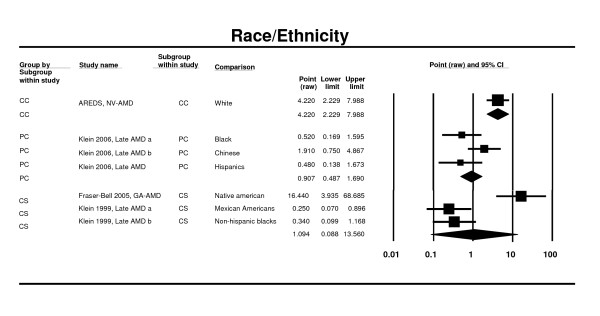
“In the NHANES III [58], there were no significant differences between Non-Hispanic White, Non-Hispanic Black (OR 0.34, 95%CI 0.10 - 1.18) and Mexican Americans (OR 0.25, 95% CI 0.07 - 0.90).”
§ Clinical risk factors for age-related macular degeneration: a systematic review and meta-analysis > Results > Race/ethnicity
“Mexican Americans (OR 0.25, 95% CI 0.07 - 0.90)”
Rated major: it would touch a result — a value a result rests on, reported and recomputed p-values on opposite sides of the significance level, two passages that conflict with no sign which is right, or a cited work retracted before this paper was published.
In the paper
§ Clinical risk factors for age-related macular degeneration: a systematic review and meta-analysis > Abstract > Methods
“18 prospective and cross-sectional studies and 6 case control studies involving 113,780 persons with 17,236 cases of late AMD”
§ Clinical risk factors for age-related macular degeneration: a systematic review and meta-analysis > Results
“data from 18 prospective, cross-sectional studies and 8 case control studies [12,24-26,28,30,31,33-47,49-54,57-73] were included in the final analysis, contributing a sample of some 94,058 patients (ranging from 261 to 22,071) including 3,178 (ranging from 8 to 776) late AMD cases.”
Rated minor: it would not touch a result — a value no result rests on, a p-value that stays on the same side of the significance level, or a conflict that is clerical, resolved elsewhere in the paper, or outside its own findings.
In the paper
§ Clinical risk factors for age-related macular degeneration: a systematic review and meta-analysis > Results > Race/ethnicity
“individuals of Native American ancestry were nearly 15 times more likely to have geographic atrophy (95% CI 1.8 - 12.6) than Latinos.”
§ Clinical risk factors for age-related macular degeneration: a systematic review and meta-analysis > Results > Race/ethnicity
“(95% CI 1.8 - 12.6)”
Rated minor: it would not touch a result — a value no result rests on, a p-value that stays on the same side of the significance level, or a conflict that is clerical, resolved elsewhere in the paper, or outside its own findings.
In the paper
§ Clinical risk factors for age-related macular degeneration: a systematic review and meta-analysis > Results
“Table: Table 2 Summary of characteristics of the 18 prospective and cross sectional studies | STUDY NAME | LOCATION | DATE OF STUDY | POPULATION | NUMBER OF LATE AMD SUBJECTS | AGE RANGE | % MALE | METHOD OF FUNDUS CAPTURE | METHOD OF CLASSIFICATION | | --- | --- | --- | --- | --- | --- | --- | --- | --- | | AREDS [64] | USA | 1992-1998 | 4,519 | 776 | 60-80 | NA | Retinal photo | WARMGS |”
§ Clinical risk factors for age-related macular degeneration: a systematic review and meta-analysis > Results > Race/ethnicity
“One case control study (AREDS) [64]”
Citations
Cites
Ranibizumab for Neovascular Age-Related Macular Degeneration
Rosenfeld, P. J., Brown, D. M., Heier, J. S., Boyer, D. S., Kaiser, P. K., Chung, C. Y., & Kim, R. Y. (2006) · New England Journal of Medicine · doi:10.1056/nejmoa054481 · Cited by 5,886
Ranibizumab versus Verteporfin for Neovascular Age-Related Macular Degeneration
Brown, D. M., Kaiser, P. K., Michels, M., Soubrane, G., Heier, J. S., Kim, R. Y., Sy, J. P., & Schneider, S. (2006) · New England Journal of Medicine · doi:10.1056/nejmoa062655 · Cited by 3,522
Causes and Prevalence of Visual Impairment Among Adults in the UnitedStates
(2004) · Archives of Ophthalmology · doi:10.1001/archopht.122.4.477 · Cited by 2,616
Prevalence of age-related maculopathy
Klein, R., Klein, B. E. K., & Linton, K. L. P. (1992) · Ophthalmology · doi:10.1016/s0161-6420(92)31871-8 · Cited by 1,845
Klein, R., Klein, R., Moss, S. E., & Linton, K. L. P. (1992) · Ophthalmology · doi:10.1016/s0161-6420(92)32011-1 · Cited by 1,382
Age-related macular degeneration
Jager, R. D., Mieler, W. F., & Miller, J. W. (2008) · New England Journal of Medicine · doi:10.1056/nejmra0801537 · Cited by 1,379
The Wisconsin Age-related Maculopathy Grading System
Klein, R., Davis, M. D., Magli, Y. L., Segał, P., Klein, R., & Hubbard, L. D. (1991) · Ophthalmology · doi:10.1016/s0161-6420(91)32186-9 · Cited by 1,188
Wada, K., Tanaka, K., & Nakashima, K. (2011) · PubMed · Cited by 1,132
Risk factors for age-related macular degeneration
Smith, W., Assink, J., Klein, R., Mitchell, P., Klaver, C. C. W., Klein, B. E. K., Hofman, A., Jensen, S., Wang, J. J., & de Jong, P. T. V. M. (2001) · Ophthalmology · doi:10.1016/s0161-6420(00)00580-7 · Cited by 1,071
Self-citation
Research works printed but not linked: 13
- Despriet DD, Klaver CC, Witteman JC, Bergen AA, Kardys I, de Maat MP, et al: Complement factor H polymorphism, complement activators, and risk of age-related macular degeneration. JAMA. 2006, 296: 301-9. 10.1001/jama.296.3.301. · DOI · Paper page
- Freeman EE, Munoz B, West SK, Tielsch JM, Schein OD: Is there an association between cataract surgery and age-related macular degeneration? Data from three population-based studies.[see comment]. American Journal of Ophthalmology. 2003, 135 (6): 849-56. 10.1016/S0002-9394(02)02253-5. · DOI
- Van Leeuwen R, Klaver CC, Vingerling JR, Hofman A, De Jong PT: The risk and natural course of age-related maculopathy: follow-up at 6 1/2 years in the Rotterdam study.[erratum appears in Arch Ophthalmol. 2003 Jul;121(7):955]. Archives of Ophthalmology. 2003, 121 (4): 519-26. 10.1001/archopht.121.4.519. · DOI · Paper page
- Van Leeuwen R, Klaver CC, Vingerling JR, Hofman A, De Jong PT: The risk and natural course of age-related maculopathy: follow-up at 6 1/2 years in the Rotterdam study.[erratum appears in Arch Ophthalmol. 2003 Jul;121(7):955]. Archives of Ophthalmology. 2003, 121 (4): 519-26. 10.1001/archopht.121.4.519. · DOI · Paper page
- Freeman EE, Munoz B, West SK, Tielsch JM, Schein OD: Is there an association between cataract surgery and age-related macular degeneration? Data from three population-based studies.[see comment]. American Journal of Ophthalmology. 2003, 135 (6): 849-56. 10.1016/S0002-9394(02)02253-5. · DOI
- Freeman EE, Munoz B, West SK, Tielsch JM, Schein OD: Is there an association between cataract surgery and age-related macular degeneration? Data from three population-based studies.[see comment]. American Journal of Ophthalmology. 2003, 135 (6): 849-56. 10.1016/S0002-9394(02)02253-5. · DOI
- Klein R, Klein BE, Franke T: The relationship of cardiovascular disease and its risk factors to age-related maculopathy. The Beaver Dam Eye Study.[see comment]. Ophthalmology. 1993, 100 (3): 406-14. · DOI
- Klein R, Klein BE, Franke T: The relationship of cardiovascular disease and its risk factors to age-related maculopathy. The Beaver Dam Eye Study.[see comment]. Ophthalmology. 1993, 100 (3): 406-14. · DOI
- Seddon JM, Francis PJ, George S, Schultz DW, Rosner B, Klein ML: Association of CFH Y402H and LOC387715 A69S with progression of age-related macular degeneration. JAMA. 2007, 297: 1793-800. 10.1001/jama.297.16.1793. · DOI · Paper page
- Haines JL, Pericak-Vance MA: Rapid dissection of the genetic risk of age-related macular degeneration: achieving the promise of the genomic era. JAMA. 2007, 297: 401-2. 10.1001/jama.297.4.401. · DOI · Paper page
- Freeman EE, Munoz B, West SK, Tielsch JM, Schein OD: Is there an association between cataract surgery and age-related macular degeneration? Data from three population-based studies.[see comment]. American Journal of Ophthalmology. 2003, 135 (6): 849-56. 10.1016/S0002-9394(02)02253-5. · DOI
- Klein R, Klein BE, Franke T: The relationship of cardiovascular disease and its risk factors to age-related maculopathy. The Beaver Dam Eye Study.[see comment]. Ophthalmology. 1993, 100 (3): 406-14. · DOI
- Van Leeuwen R, Klaver CC, Vingerling JR, Hofman A, De Jong PT: The risk and natural course of age-related maculopathy: follow-up at 6 1/2 years in the Rotterdam study.[erratum appears in Arch Ophthalmol. 2003 Jul;121(7):955]. Archives of Ophthalmology. 2003, 121 (4): 519-26. 10.1001/archopht.121.4.519. · DOI · Paper page
Cited by
Sorted by citations
Wong, W. L., Su, X., Li, X., Cheung, C. M. G., Klein, R., Cheng, C., & Wong, T. Y. (2014) · The Lancet Global Health · doi:10.1016/s2214-109x(13)70145-1 · Cited by 5,545
Self-citationHigh blood pressure and cardiovascular disease
Fuchs, F. D., & Whelton, P. K. (2020) · Hypertension · doi:10.1161/hypertensionaha.119.14240 · Cited by 1,948
Age-related macular degeneration
Lim, L. S., Mitchell, P., Seddon, J. M., Holz, F. G., & Wong, T. Y. (2012) · The Lancet · doi:10.1016/s0140-6736(12)60282-7 · Cited by 1,806
Self-citationEmbryonic stem cell trials for macular degeneration: a preliminary report
Schwartz, S. D., Hubschman, J.-P., Heilwell, G., Franco-Cardenas, V., Pan, C. K., Ostrick, R. M., Mickunas, E., Gay, R., Klimanskaya, I., & Lanza, R. (2012) · The Lancet · doi:10.1016/s0140-6736(12)60028-2 · Cited by 1,409
Schwartz, S. D., Regillo, C. D., Lam, B. L., Eliott, D., Rosenfeld, P. J., Gregori, N. Z., Hubschman, J.-P., Davis, J. L., Heilwell, G., Spirn, M., et al. (2015) · The Lancet · doi:10.1016/s0140-6736(14)61376-3 · Cited by 1,327
Diretrizes Brasileiras de Hipertensão Arterial – 2020
Barroso, W. K. S., Rodrigues, C. I. S., Bortolotto, L. A., Gomes, M. A. M., Brandão, A. A., Feitosa, A. D. M., Machado, C. A., Poli‐de‐Figueiredo, C. E., Amodeo, C., Mion, D., et al. (2021) · Arquivos Brasileiros de Cardiologia · doi:10.36660/abc.20201238 · Cited by 1,389
Mechanisms of Age-Related Macular Degeneration
Ambati, J., & Fowler, B. J. (2012) · Neuron · doi:10.1016/j.neuron.2012.06.018 · Cited by 1,062
Tan, D. T. H., Dart, J. K. G., Holland, E. J., & Kinoshita, S. (2012) · The Lancet · doi:10.1016/s0140-6736(12)60437-1 · Cited by 817
Chakravarthy, U., Harding, S. P., Rogers, C. A., Downes, S. M., Lotery, A. J., Culliford, L. A., & Reeves, B. C. (2013) · The Lancet · doi:10.1016/s0140-6736(13)61501-9 · Cited by 748
Self-citationPennington, K. L., & DeAngelis, M. M. (2016) · Eye and Vision · doi:10.1186/s40662-016-0063-5 · Cited by 499
Age-Related Macular Degeneration
Thomas, C. J., Mirza, R. G., & Gill, M. K. (2021) · Medical Clinics of North America · doi:10.1016/j.mcna.2021.01.003 · Cited by 490
Deng, Y., Qiao, L., Du, M., Qu, C., Wan, L., Li, J., & Huang, L. (2022) · Genes & Diseases · doi:10.1016/j.gendis.2021.02.009 · Cited by 411
Recent developments in age-related macular degeneration: a review
Al-Zamil, W. M., & Yassin, S. A. (2017) · Clinical Interventions in Aging · doi:10.2147/cia.s143508 · Cited by 427
Risk factors for progression of age‐related macular degeneration
Heesterbeek, T. J., Lorés‐Motta, L., Hoyng, C. B., Lechanteur, Y. T. E., & den Hollander, A. I. (2020) · Ophthalmic and Physiological Optics · doi:10.1111/opo.12675 · Cited by 399
Rudnicka, A. R., Jarrar, Z. A., Wormald, R., Cook, D. G., FLETCHER, A. E., & Owen, C. G. (2011) · Ophthalmology · doi:10.1016/j.ophtha.2011.09.027 · Cited by 392
Self-citationA paradigm shift in imaging biomarkers in neovascular age-related macular degeneration
Schmidt-Erfurth, U., & Waldstein, S. M. (2016) · Progress in Retinal and Eye Research · doi:10.1016/j.preteyeres.2015.07.007 · Cited by 390
Defining response to anti-VEGF therapies in neovascular AMD
Amoaku, W. M., Chakravarthy, U., Gale, R., Gavin, M., Ghanchi, F., Gibson, J., Harding, S., Johnston, R. L., Kelly, S., Lotery, A., et al. (2015) · Eye · doi:10.1038/eye.2015.48 · Cited by 355
Self-citationRisk factors and biomarkers of age-related macular degeneration
Lambert, N. G., Elshelmani, H., Singh, M. K., Mansergh, F. C., Wride, M. A., Padilla, M., Keegan, D., Hogg, R. E., & Ambati, B. K. (2016) · Progress in Retinal and Eye Research · doi:10.1016/j.preteyeres.2016.04.003 · Cited by 367
Age-related macular degeneration and polypoidal choroidal vasculopathy in Asians
Wong, C. W., Yanagi, Y., Lee, W., Ogura, Y., Yeo, I. Y. S., Wong, T. Y., & Cheung, C. M. G. (2016) · Progress in Retinal and Eye Research · doi:10.1016/j.preteyeres.2016.04.002 · Cited by 345
Self-citationOxidative stress in the eye and its role in the pathophysiology of ocular diseases
Böhm, E. W., Buonfiglio, F., Voigt, A. M., Bachmann, P., Safi, T., Pfeiffer, N., & Gericke, A. (2023) · Redox Biology · doi:10.1016/j.redox.2023.102967 · Cited by 334
The estimated prevalence and incidence of late stage age related macular degeneration in the UK
Owen, C. G., Jarrar, Z. A., Wormald, R., Cook, D. G., FLETCHER, A. E., & Rudnicka, A. R. (2012) · British Journal of Ophthalmology · doi:10.1136/bjophthalmol-2011-301109 · Cited by 318
Self-citationParallel findings in age-related macular degeneration and Alzheimer’s disease
Ohno-Matsui, K. (2011) · Progress in Retinal and Eye Research · doi:10.1016/j.preteyeres.2011.02.004 · Cited by 280
The Diagnosis and Treatment of Age-Related Macular Degeneration
Stahl, A. (2020) · Deutsches Ärzteblatt international · doi:10.3238/arztebl.2020.0513 · Cited by 296
Updates on the Epidemiology of Age-Related Macular Degeneration
Jonas, J. B., Cheung, C. M. G., & Panda‐Jonas, S. (2017) · Asia-Pacific Journal of Ophthalmology · doi:10.22608/apo.2017251 · Cited by 278
Miller, J. W. (2012) · American Journal of Ophthalmology · doi:10.1016/j.ajo.2012.10.018 · Cited by 254
State of science: Choroidal thickness and systemic health
Tan, K.-A., Gupta, P., Agarwal, A. K., Chhablani, J. K., Cheng, C., Keane, P. A., & Agrawal, R. V. (2016) · Survey of Ophthalmology · doi:10.1016/j.survophthal.2016.02.007 · Cited by 249
Solar Radiation Exposure and Outdoor Work: An Underestimated Occupational Risk
Modenese, A., Korpinen, L. H., & Gobba, F. (2018) · International Journal of Environmental Research and Public Health · doi:10.3390/ijerph15102063 · Cited by 243
Smoking and Age-Related Macular Degeneration: Review and Update
Velilla, S., García‐Medina, J. J., García‐Layana, A., Dolz‐Marco, R., Pons-Vázquez, S., Pinazo-Duran, M. D., Gómez‐Ulla, F., Arévalo, J. F., Díaz-Llopis, M., & Gallego‐Pinazo, R. (2013) · Journal of Ophthalmology · doi:10.1155/2013/895147 · Cited by 244
Disparities in Vision Health and Eye Care
Elam, A. R., Tseng, V. L., Rodriguez, T. M., Mike, E. V., Warren, A., Coleman, A. L., Aguwa, U. T., Alabiad, C. R., Briceño, C. A., Capó, H., et al. (2022) · Ophthalmology · doi:10.1016/j.ophtha.2022.07.010 · Cited by 233
Progression of Geographic Atrophy in Age-related Macular Degeneration
Keenan, T. D. L., Agrón, E., Domalpally, A., Clemons, T. E., van Asten, F., Wong, W. T., Danis, R. P., Sadda, S. R., Rosenfeld, P. J., Klein, M. L., et al. (2018) · Ophthalmology · doi:10.1016/j.ophtha.2018.05.028 · Cited by 225
Neovascular Age-Related Macular Degeneration: Therapeutic Management and New-Upcoming Approaches
Ricci, F., Bandello, F. M., Navarra, P., Staurenghi, G., Stumpp, M. T., & Zarbin, M. A. (2020) · International Journal of Molecular Sciences · doi:10.3390/ijms21218242 · Cited by 224
Marazita, M. C., Dugour, A. V., Marquioni‐Ramella, M. D., Figueroa, J. M., & Suburo, Á. M. (2015) · Redox Biology · doi:10.1016/j.redox.2015.11.011 · Cited by 212
Geerlings, M. J., de Jong, E. K., & den Hollander, A. I. (2016) · Molecular Immunology · doi:10.1016/j.molimm.2016.11.016 · Cited by 209
Age-related eye disease and gender
Zetterberg, M. (2016) · Maturitas · doi:10.1016/j.maturitas.2015.10.005 · Cited by 185
On phagocytes and macular degeneration
Guillonneau, X., Eandi, C. M., Paques, M., Sahel, J.-A., Sapieha, P., & Sennlaub, F. (2017) · Progress in Retinal and Eye Research · doi:10.1016/j.preteyeres.2017.06.002 · Cited by 185
Owsley, C. J. (2016) · Annual Review of Vision Science · doi:10.1146/annurev-vision-111815-114550 · Cited by 196
Age-Related Macular Degeneration: Role of Oxidative Stress and Blood Vessels
Ruan, Y., Jiang, S., & Gericke, A. (2021) · International Journal of Molecular Sciences · doi:10.3390/ijms22031296 · Cited by 198
Rudnicka, A. R., Kapetanakis, V. V., Jarrar, Z. A., Wathern, A. K., Wormald, R., FLETCHER, A. E., Cook, D. G., & Owen, C. G. (2015) · American Journal of Ophthalmology · doi:10.1016/j.ajo.2015.04.003 · Cited by 180
Self-citationAge‐related macular degeneration—clinical review and genetics update
Ratnapriya, R., & Chew, E. Y. (2013) · Clinical Genetics · doi:10.1111/cge.12206 · Cited by 180
Early and intermediate age-related macular degeneration: update and clinical review
García‐Layana, A., López, F. A. C., García‐Arumí, J., Arias, L., & Ruiz‐Moreno, J. M. (2017) · Clinical Interventions in Aging · doi:10.2147/cia.s142685 · Cited by 179
Quantitative Fundus Autofluorescence in Healthy Eyes
Greenberg, J. P., Duncker, T., Woods, R. L., Smith, R. T., Sparrow, J. R., & Delori, F. C. (2013) · Investigative Ophthalmology & Visual Science · doi:10.1167/iovs.13-12445 · Cited by 168
Agrón, E., Mares, J. A., Clemons, T. E., Swaroop, A., Chew, E. Y., & Keenan, T. D. L. (2020) · Ophthalmology · doi:10.1016/j.ophtha.2020.08.018 · Cited by 173
Regulation of age-related macular degeneration-like pathology by complement factor H
Toomey, C. B., Kelly, U., Saban, D. R., & Rickman, C. B. (2015) · Proceedings of the National Academy of Sciences · doi:10.1073/pnas.1424391112 · Cited by 157
Gonadal Hormones and Retinal Disorders: A Review
Nuzzi, R., Scalabrin, S., Becco, A., & Panzica, G. (2018) · Frontiers in Endocrinology · doi:10.3389/fendo.2018.00066 · Cited by 152
Social inequalities in blindness and visual impairment: A review of social determinants
Lansingh, V. C., Rius, A., Valencia, L., Carter, M., & Eckert, K. A. (2012) · Indian Journal of Ophthalmology · doi:10.4103/0301-4738.100529 · Cited by 144
Aflibercept for neovascular age-related macular degeneration
Sarwar, S., Clearfield, E., Soliman, M. K., Sadiq, M. A., Baldwin, A. J., Hanout, M., Agarwal, A., Sepah, Y. J., Do, D. V., & Nguyen, Q. D. (2016) · Cochrane Database of Systematic Reviews · doi:10.1002/14651858.cd011346.pub2 · Cited by 142
Systemic and ocular fluid compounds as potential biomarkers in age-related macular degeneration
Kersten, E., Paun, C. C., Schellevis, R. L., Hoyng, C. B., Delcourt, C., Lengyel, I., Pető, T., Ueffing, M., Klaver, C. C. W., Dammeier, S., et al. (2017) · Survey of Ophthalmology · doi:10.1016/j.survophthal.2017.05.003 · Cited by 146
CURRENT KNOWLEDGE AND TRENDS IN AGE-RELATED MACULAR DEGENERATION
Vélez-Montoya, R., Oliver, S. C. N., Olson, J. L., Fine, S. L., Quiroz-Mercado, H., & Mandava, N. (2013) · Retina · doi:10.1097/iae.0000000000000036 · Cited by 141
Healthy Aging—Nutrition Matters: Start Early and Screen Often
Roberts, S. B., Silver, R. E., Das, S. K., Fielding, R. A., Gilhooly, C. H., Jacques, P. F., Kelly, J. M., Mason, J. B., McKeown, N. M., Reardon, M. A., et al. (2021) · Advances in Nutrition · doi:10.1093/advances/nmab032 · Cited by 138
Xue, C., Rong, S. S., Xu, Q., Tang, F. Y., Liu, Y., Gu, H., Tam, P. O. S., Chen, L. J., Brelen, M. E., Pang, C. P., et al. (2014) · PLoS ONE · doi:10.1371/journal.pone.0108196 · Cited by 137
Curcio, C. A. (2018) · Investigative Ophthalmology & Visual Science · doi:10.1167/iovs.18-24883 · Cited by 127
Widespread sex dimorphism in aging and age-related diseases
Sampathkumar, N. K., Bravo, J. I., Chen, Y., Danthi, P. S., Donahue, E. K., Lai, R. W., Lu, R. J., Randall, L. T., Vinson, N. M., & Benayoun, B. A. (2019) · Human Genetics · doi:10.1007/s00439-019-02082-w · Cited by 130
Age-related macular degeneration and the role of the complement system
McHarg, S., Clark, S. J., Day, A. J., & Bishop, P. N. (2015) · Molecular Immunology · doi:10.1016/j.molimm.2015.02.032 · Cited by 131
Holliday, E. G., Smith, A. V., Cornes, B. K., Buitendijk, G. H. S., Jensen, R. A., Sim, X., Aspelund, T., Aung, T., Baird, P. N., Boerwinkle, E., et al. (2013) · PLoS ONE · doi:10.1371/journal.pone.0053830 · Cited by 128
Self-citationCzakó, C. N., Kovács, T., Ungvari, Z. I., Csiszár, A., Yabluchanskiy, A., Conley, S. M., Csípő, T., Lipécz, Á., Horváth, H., Sándor, G. L., et al. (2020) · GeroScience · doi:10.1007/s11357-020-00252-7 · Cited by 130
Adaptive Optics Technology for High-Resolution Retinal Imaging
Lombardo, M., Serrao, S., Devaney, N. M., Parravano, M., & Lombardo, G. (2012) · Sensors · doi:10.3390/s130100334 · Cited by 120
Retinal pathology as biomarker for cognitive impairment and Alzheimer's disease
Ikram, M. K., Cheung, C. Y.-L., Wong, T. Y., & Chen, C. (2012) · Journal of Neurology Neurosurgery & Psychiatry · doi:10.1136/jnnp-2011-301628 · Cited by 123
Self-citationten Berge, J. C., Fazil, Z., van den Born, L. I., Wolfs, R. C. W., Schreurs, M. W. J., Dik, W. A., & Rothova, A. (2019) · Acta Ophthalmologica · doi:10.1111/aos.13899 · Cited by 118
Cheung, C. M. G., & Wong, T. Y. (2014) · Journal of Internal Medicine · doi:10.1111/joim.12227 · Cited by 122
Self-citationCougnard‐Grégoire, A., Delyfer, M., Korobelnik, J., Rougier, M., Goff, M. L., Dartigues, J., Barberger‐Gateau, P., & Delcourt, C. (2014) · PLoS ONE · doi:10.1371/journal.pone.0090973 · Cited by 118
Association of Metformin Use With Age-Related Macular Degeneration
Blitzer, A. L., Ham, S. A., Colby, K. A., & Skondra, D. (2021) · JAMA Ophthalmology · doi:10.1001/jamaophthalmol.2020.6331 · Cited by 117
Age-Related Macular Degeneration: Epidemiology and Clinical Aspects
Keenan, T. D. L., Cukras, C. A., & Chew, E. Y. (2021) · Advances in experimental medicine and biology · doi:10.1007/978-3-030-66014-7_1 · Cited by 119
Lechner, J., Chen, M., Hogg, R. E., Tóth, L., Silvestri, G., Chakravarthy, U., & Xu, H. (2016) · Immunity & Ageing · doi:10.1186/s12979-016-0060-5 · Cited by 114
Self-citationHISTORY OF SUNLIGHT EXPOSURE IS A RISK FACTOR FOR AGE-RELATED MACULAR DEGENERATION
Schick, T., Ersoy, L., Lechanteur, Y. T. E., Saksens, N. T. M., Hoyng, C. B., den Hollander, A. I., Kirchhof, B., & Fauser, S. (2015) · Retina · doi:10.1097/iae.0000000000000756 · Cited by 111
Fan, Q., Maranville, J., Fritsche, L. G., Sim, X., Cheung, C. M. G., Chen, L. J., Gorski, M., Yamashiro, K., Ahn, J., Laude, A., et al. (2017) · International Journal of Epidemiology · doi:10.1093/ije/dyx189 · Cited by 111
Self-citationLaíns, I., Kelly, R. S., Miller, J. B., da Silva, R. M., Vavvas, D. G., Kim, I. K., Murta, J., Lasky-Su, J. A., Miller, J. W., & Husain, D. (2017) · Ophthalmology · doi:10.1016/j.ophtha.2017.08.008 · Cited by 109
The challenges and promise of complement therapeutics for ocular diseases
Park, D. H., Connor, K. M., & Lambris, J. D. (2019) · Frontiers in Immunology · doi:10.3389/fimmu.2019.01007 · Cited by 108
Circulating Omega-3 Fatty Acids and Neovascular Age-Related Macular Degeneration
Merle, B. M. J., Benlian, P., Puche, N., Bassols, A., Delcourt, C., & Souied, E. H. (2014) · Investigative Ophthalmology & Visual Science · doi:10.1167/iovs.14-13916 · Cited by 113
Kuan, V., Warwick, A., Hingorani, A. D., Tufail, A., Cipriani, V., Burgess, S., Sofat, R., Fritsche, L. G., Igl, W., Bailey, J. N. C., et al. (2021) · JAMA Ophthalmology · doi:10.1001/jamaophthalmol.2021.4601 · Cited by 110
Self-citationPolypoidal Choroidal Vasculopathy in Asians
Wong, C. W., Wong, T. Y., & Cheung, C. M. G. (2015) · Journal of Clinical Medicine · doi:10.3390/jcm4050782 · Cited by 105
Self-citationKeenan, T. D. L., Agrón, E., Mares, J. A., Clemons, T. E., van Asten, F., Swaroop, A., & Chew, E. Y. (2020) · Ophthalmology · doi:10.1016/j.ophtha.2020.04.030 · Cited by 102
Saccà, S. C., Roszkowska, A. M., & Izzotti, A. (2013) · Mutation Research/Reviews in Mutation Research · doi:10.1016/j.mrrev.2013.01.001 · Cited by 100
Incidence of and Risk Factors Associated With Age-Related Macular Degeneration
Saunier, V., Merle, B. M. J., Delyfer, M., Cougnard‐Grégoire, A., Rougier, M.-B., Amouyel, P., Lambert, J., Dartigues, J., Korobelnik, J., & Delcourt, C. (2018) · JAMA Ophthalmology · doi:10.1001/jamaophthalmol.2018.0504 · Cited by 96
Emerging therapeutic strategies for unmet need in neovascular age-related macular degeneration
Khachigian, L. M., Liew, G., Teo, K. Y. C., Wong, T. Y., & Mitchell, P. (2023) · Journal of Translational Medicine · doi:10.1186/s12967-023-03937-7 · Cited by 98
Self-citationCigarette Smoking and the Natural History of Age-Related Macular Degeneration
Myers, C. E., Klein, R., Gangnon, R. E., Sivakumaran, T. A., Iyengar, S. K., & Klein, R. (2014) · Ophthalmology · doi:10.1016/j.ophtha.2014.04.040 · Cited by 101
Applications of microneedles in delivering drugs for various ocular diseases
Gupta, P., & Yadav, K. S. (2019) · Life Sciences · doi:10.1016/j.lfs.2019.116907 · Cited by 93
Retinal Vascular Signs and Cerebrovascular Diseases
Rim, T. H., Teo, A. W. J., Yang, H. H. S., Cheung, C. Y.-L., & Wong, T. Y. (2020) · Journal of Neuro-Ophthalmology · doi:10.1097/wno.0000000000000888 · Cited by 92
Self-citationPrevalence of and Risk Factors for Age-Related Macular Degeneration in a Multiethnic Asian Cohort
Tai, E. S. (2011) · Archives of Ophthalmology · doi:10.1001/archophthalmol.2011.376 · Cited by 90
Cipriani, V., Leung, H.-T., Plagnol, V., Bunce, C., Khan, J. C., Shahid, H., Moore, A. T., Harding, S. P., Bishop, P. N., Hayward, C., et al. (2012) · Human Molecular Genetics · doi:10.1093/hmg/dds225 · Cited by 90
Nuzzi, R., & Caselgrandi, P. (2022) · International Journal of Molecular Sciences · doi:10.3390/ijms23063269 · Cited by 89
Involvement of Nrf2 in Ocular Diseases
Batliwala, S. Y., Xavier, C., Liu, Y., Wu, H., & Pang, I.-H. (2017) · Oxidative Medicine and Cellular Longevity · doi:10.1155/2017/1703810 · Cited by 93
Wang, Y., Zhong, Y., Zhang, L., Wu, Q., Tham, Y. C., Rim, T. H., Kithinji, D. M., Wu, J., Cheng, C., Liang, H., et al. (2021) · Gerontology · doi:10.1159/000518822 · Cited by 88
Gender Differences in Ocular Blood Flow
Schmidl, D., Schmetterer, L. F., Garhöfer, G., & Popa‐Cherecheanu, A. (2014) · Current Eye Research · doi:10.3109/02713683.2014.906625 · Cited by 88
Lipécz, Á., Miller, L. R., Kovács, I., Czakó, C. N., Csípő, T., Baffi, J., Csiszár, A., Tarantini, S., Ungvari, Z. I., Yabluchanskiy, A., et al. (2019) · GeroScience · doi:10.1007/s11357-019-00138-3 · Cited by 88
The Oxygen Paradox, the French Paradox, and age-related diseases
Davies, J. M. S., Cillard, J., Friguet, B., Cadenas, E., Cadet, J., Cayce, R., Fishmann, A., Liao, D., Bulteau, A.-L., Derbré, F., et al. (2017) · GeroScience · doi:10.1007/s11357-017-0002-y · Cited by 82
Brinks, J., van Dijk, E. H. C., Klaassen, I., Schlingemann, R. O., Kiełbasa, S. M., Emri, E., Quax, P. H. A., Bergen, A. A. B., Meijer, O. C., & Boon, C. J. F. (2021) · Progress in Retinal and Eye Research · doi:10.1016/j.preteyeres.2021.100994 · Cited by 82
Zheng, W., Mast, N., Saadane, A., & Pikuleva, I. A. (2014) · Journal of Lipid Research · doi:10.1194/jlr.m053439 · Cited by 81
Vallée, A., Lecarpentier, Y., Guillevin, R., & Vallée, J.-N. (2017) · Journal of Molecular Neuroscience · doi:10.1007/s12031-017-0947-4 · Cited by 80
Korb, C. A., Kottler, U. B., Wolfram, C., Höhn, R., Schulz, A., Zwiener, I., Wild, P. S., Pfeiffer, N., & Mirshahi, A. (2014) · Graefe s Archive for Clinical and Experimental Ophthalmology · doi:10.1007/s00417-014-2591-9 · Cited by 79
Lechner, J., Chen, M., Hogg, R. E., Tóth, L., Silvestri, G., Chakravarthy, U., & Xu, H. (2017) · Journal of Neuroinflammation · doi:10.1186/s12974-017-0820-y · Cited by 83
Self-citationOxidative stress and mitochondrial failure in the pathogenesis of glaucoma neurodegeneration
Pinazo-Duran, M. D., Zanón‐Moreno, V., Gallego‐Pinazo, R., & García‐Medina, J. J. (2015) · Progress in brain research · doi:10.1016/bs.pbr.2015.06.001 · Cited by 75
Nakata, I., Yamashiro, K., Nakanishi, H., Akagi-Kurashige, Y., Miyake, M., Tsujikawa, A., Matsuda, F., & Yoshimura, N. (2013) · American Journal of Ophthalmology · doi:10.1016/j.ajo.2013.06.007 · Cited by 75
Chaker, L., Buitendijk, G. H. S., Dehghan, A., Medici, M., Albert Hofman, D., Vingerling, J. R., Franco, O. H., Klaver, C. C. W., & Peeters, R. P. (2015) · BMC Medicine · doi:10.1186/s12916-015-0329-0 · Cited by 75
Klein, R., Howard, K. P., Lee, K. E., Iyengar, S. K., Sivakumaran, T. A., & Klein, R. (2012) · Ophthalmology · doi:10.1016/j.ophtha.2012.01.050 · Cited by 74
METABOLIC SYNDROME AND RISK OF AGE-RELATED MACULAR DEGENERATION
Maralani, H. G., Tai, B. C., Wong, T. Y., Tai, E. S., Li, J., Wang, J. J., & Mitchell, P. (2014) · Retina · doi:10.1097/iae.0000000000000338 · Cited by 74
Self-citationRetinal angiomatous proliferation
Tsai, A. S. H., Cheung, N., Gan, A. T. L., Jaffe, G. J., Sivaprasad, S., Wong, T. Y., & Cheung, C. M. G. (2017) · Survey of Ophthalmology · doi:10.1016/j.survophthal.2017.01.008 · Cited by 74
Self-citationSenabouth, A., Daniszewski, M., Lidgerwood, G. E., Liang, H. H., Hernández, D., Mirzaei, M., Keenan, S. N., Zhang, R., Han, X., Neavin, D. R., et al. (2022) · Nature Communications · doi:10.1038/s41467-022-31707-4 · Cited by 75
Cho, B., Heo, J. W., Kim, T. W., Ahn, J., & Chung, H. (2013) · Investigative Ophthalmology & Visual Science · doi:10.1167/iovs.13-13096 · Cited by 71
Age-Related Retinal Changes in Wild-Type C57BL/6J Mice Between 2 and 32 Months
Ferdous, S., Liao, K. L., Gefke, I. D., Summers, V. R., Wu, W., Donaldson, K. J., Kim, Y.-K., Sellers, J. T., Dixon, J. A., Shelton, D. A., et al. (2021) · Investigative Opthalmology & Visual Science · doi:10.1167/iovs.62.7.9 · Cited by 70
Owsley, C. J., Huisingh, C., Jackson, G. R., Curcio, C. A., Szalai, A. J., Dashti, N., Clark, M. E., Rookard, K., McCrory, M. A., Wright, T. T., et al. (2014) · Investigative Ophthalmology & Visual Science · doi:10.1167/iovs.14-14502 · Cited by 70
Metadata
- Authors
- Chakravarthy, U., Wong, T. Y., Fletcher, A., Piault, E., Evans, C., Zlateva, G., Buggage, R., Pleil, A., & Mitchell, P.
- Affiliations
- Queen's University Belfast (GB)
- The University of Melbourne (AU)
- London School of Hygiene & Tropical Medicine (GB)
- Pfizer (United States) (US)
- Novartis (United States) (US)
- The University of Sydney (AU)
- Corresponding author
- Chakravarthy, Usha
- Venue
- BMC Ophthalmology
- Published
- 2010-12
- Volume
- 10
- Issue
- 1
- Pages
- 31-31
- ISSN
- 1471-2415 (ISSN-L)
- PMC
- PMC3009619
- OpenAlex
- W2147322584
- Semantic Scholar
- 1a73237caef4a0069d84dbdf668544aea301ac8f
- Cited by
- 842
- References
- 85
- Citations by year
- 2026: 44 · 2025: 60 · 2024: 53 · 2023: 74 · 2022: 67 · 2021: 70 · 2020: 52 · 2019: 42 · 2018: 56 · 2017: 61 · 2016: 38 · 2015: 50 · 2014: 69 · 2013: 43 · 2012: 48
- FWCI
- 6.20
- Type
- journal article
- Language
- en
- Open access
- gold
- doi.org
- Licence
- Locations
- BMC Ophthalmology (publishedVersion, cc-by)
- PubMed Central (publishedVersion, cc-by)
- PubMed (publishedVersion)
- LSHTM Research Online (London School of Hygiene and Tropical Medicine) (acceptedVersion)
- Minerva Access (University of Melbourne) (submittedVersion, cc-by)
- National University of Singapore (submittedVersion)
- DOAJ (DOAJ: Directory of Open Access Journals) (submittedVersion, cc-by-sa)
- Research Portal (Queen's University Belfast) (submittedVersion)
- Funders
- Pfizer
- Topics
- Health Sciences › Medicine › Ophthalmology › Retinal Diseases and Treatments
- Health Sciences › Medicine › Radiology, Nuclear Medicine and Imaging › Retinal Imaging and Analysis
- Health Sciences › Medicine › Ophthalmology › Ophthalmology and Visual Impairment Studies
- Keywords
- age-related macular degeneration, late AMD, risk factors, cigarette smoking, cataract surgery, family history (medicine), body mass index, cardiovascular disease, hypertension, fibrinogen, age
- MeSH terms
- Aging, Cardiovascular Diseases, Cataract Extraction, Eye Color, Fibrinogen, Humans, Macular Degeneration, Obesity, Risk, Risk Factors, Sex Factors, Smoking, Odds Ratio, Evidence-Based Medicine, Genetic Predisposition to Disease, Racial Groups, Diabetes Complications
About these checks
Registry, retraction, Cites and statistics results are computed, not judged, with one exception: a printed reference that no index lists is read once by a model before it counts as a citation error. Claims are extracted by a model and kept only when their quote appears verbatim in the text; each cited source is then checked, with a model’s help, for whether it says what the claim relies on. Those verdicts can be wrong — read the claim’s quote and the cited source before relying on one.
A language model drew the claims from the paper on 2026-10-06, under version 3 of the claim definition (model deepseek-v4.1-flash, prompt extract-v3).
A second model labelled each claim on 2026-10-06 (model jev-1.13-20260917, definition revision gold-guideline-v0.2).
Statistics and arithmetic are recomputed, not judged.
Confidence bands are shown only for fields calibrated on our annotated test set. None is calibrated yet, so no band is shown.
What counts as a claim ›How we measure confidence ›How we check this ›
Are you an author, or do you see a problem with this page? Request a review
